Showing posts with label Butter. Show all posts

Monday, June 1, 2026

Turkey Giblets a la Bourgeoisie

"... if it be true that real happiness consists in making others happy, the author can at least feel a sense of gratification in the thought that his attempts to satisfy the cravings of the inner man have not been wholly un-appreciated by the any he has had the pleasure of serving...."
-- Rufus Estes

Rufus Estes has a story, and quite the story it is. He was born a slave in 1857 in Murray County, Tennessee. He was the youngest of a family that included seven boys and two girls, all of whom -- with their mother -- were owned by D.J. Estes. When the Civil War broke out, the male slaves ran away to join the Union forces, leaving the younger kids to work the plantations. Rufus carried water from the spring to the house, drove cattle to and from the pasture, and did other work. 

After the war ended, Rufus's mother moved her family to Nashville, Tennessee. Rufus sought work, whether it was milking cows (for which he was paid $2.00 per month) or carrying hot dinners to workers in the field (for which he was paid $0.25 per month), Rufus gave all of his earnings to his mother. By the age of sixteen, Rufus got work at Hemphills, a fine dining establishment in Nashville. By the age of twenty-four, he had emigrated north and found a job at a restaurant in Chicago. 

Rufus Estes
Two years later, Rufus Estes started on a track that would define the rest of his life. He got a job with the Pullman Service, which he held for fourteen years. Estes recalled that "some of the most prominent people in the world traveled in the car assigned to me, as I was selected to handle all special parties." The "special parties" included Henry Morton Stanley, the explorer; two Presidents, Grover Cleveland and Benjamin Harrison; and many others.  After leaving the Pullman Service, Estes was hired to run a private car for the president of the Kansas City, Pittsburg & Gould Railroad, which he worked from 1897 to 1907, and, thereafter, he worked as a chef for United States Steel Corporation in Chicago. 

After a career of serving as a chef to the rich and powerful, Rufes Estes became an author, writing Good Things to Eat as Suggested by Rufus: A Collection Practical Recipes for Preparing Meats, Game, Fowl, Fish, Puddings, Pastries, Etc. Published in 1911, his book represents one of the first cookbooks written and published by an African American chef. The recipes contained in that cookbook represent, in Estes' own words, "the labor of years." Estes' labor opens windows into the past, offering glimpses of what people prepared and ate during the turn of the 19th and 20th centuries, as well as views of what the elite ate in the palace cars that ran the rails from coast to coast. Dishes such as Bird's Nest Salad to Turkey Truffles (a "fat turkey" stuffed with a mixture that includes three to four pounds of truffles), that is not all, it also gives us a view into what the working class and poor ate as well, like Codfish Hash or Broiled Pig's Feet. 

I read Good Things to Eat and decided to prepare a recipe suggested by Rufus Estes. I wanted a recipe that could bridge the gap between the poor and the rich.  I wanted to prepare something that could have been just as likely to have been prepared for a working class person as it would some rich perosn. I found that dish in Turkey Giblets a la Bourgoisie. Estes's recipe uses the parts of a turkey -- the heart, gizzard, liver and turkey neck -- that most people would discard (especially today), and elevate those ingredients in a delicious way. The recipe produces a wonderful small plate or appetizer that can precede a roast turkey meal. I would suggest serving this dish with some toasted slices of bread, which guests could use to eat the flavorable mixture of turkey and herbs. 

Given I still have Rufus Estes's book, I plan on making more dishes suggested by the accomplished chef. All of these recipes, like this one, are part of my historical cooking journeys that are catalogued in my Federal Project Number One. So, please check it out every once in a while. Until then ....

TURKEY GIBLETS A LA BOURGOISIE

Recipe from Rufus Estes, Good Things to Eat

Serves 2-3

Ingredients:

  • Turkey giblets (pinions, feet, neck and gizzard)
  • Piece of butter
  • Flat leaf parsley
  • Sprig of thyme
  • Green onions
  • Garlic, 1 clove
  • Bay Leave
  • Flour, spoonful
  • Stock, spoonful
  • Salt
  • Pepper

Directions:

The giblets of the turkey consist of the pinions, feet, neck and gizzard. After having scalded pick them well and put in a saucepan wiht a piece of butter, some parsley, green onions, clove of garlic, sprig of thyme, bay leaf, a spoonful of fluor moistened with stock, salt and pepper. Brown to a good color. 

PEACE.

Sunday, April 12, 2026

Chesapeake Oyster Dressing

The history of oyster stuffing can be traced back to the 17th century where, in Britain, cooks incorporated oysters with the ingredients used to stuff, among other things, chicken, fish, and rabbits. in the stuffing of for, among other things, chickens, fish, and rabbits. One of the earliest recipes can be found in The Accomplisht Cook (1685), where it appears in a recipe that called for the oysters to be cooked, mixed with herbs and spices, and then stuffed in a young hen's belly for roasting. 

The use of oysters in stuffing or dressing (the former refers to cooking it in the bird while the latter refers to cooking it separately), made its way across the Atlantic Ocean when the British colonized the new world. With oysters as plentiful up and down the east coast as they were in the British isles, it was only a matter of time before cooks would use oyster stuffings when preparing chicken, fish and, of course, turkeys. Thus, oyster stuffing itself migrated from New England down the coast to the Chesapeake Bay.

As the few who follow this blog know, I have an affinity for the Chesapeake Bay. I have spent a lot of time exploring various aspects about the Bay, especially when it comes to its cuisine. Recently, my beautiful Angel and our wonderful family spent some time during the most recent Thanksgiving holiday in Crisfield, Maryland. Crisfield is "the City Built on Oysters." It began as a small fishing village known as Sumer's Cove. However, John Crisfield had other ideas. He worked to get a railroad line built to the village, which was completed in 1866 when the first train pulled into the station. That railine, along with a steamboat wharf, turned the town into a transportation hub.  The residents renamed the town Crisfield. But, there was more in store for the town. 

Six years after that first train arrived in the city, there were 600 hundred registered oyster boats working out of the harbor. Thirteen years after that, an average of 400,000 bushels of oysters were arriving at the Crisfield Wharf annually. At its height, there were 40 to 50 seafod houses along the Crisfield waterfront. The city had become the "Seafood Capital of the World."  Oysters contributed more than just economic growth, their shells helped the city expand. People started taking the oyster shells from the shucking houses and using them to provide a building foundation. Those shells provided stability in an area that was primarily marshland prone to flooding. 

Maryland oysters.

Simply put, oysters were critical to the Crisfield's rise. So, it seemed appropriate that as the Savage Boleks had their Thanksgiving meal in Crisfield, I should prepare and serve an oyster dressing. The internet contains quite a few possible recipes, but I decided to prepare a recipe from the Oyster Recovery Partnership ("ORP"). The ORP is a non-profit dedicated to rebuilding the oyster population in the Chesapeake Bay. They do that through a variety of initiatives, including the restoration of public fishery reefs and the establishment of an oyster shell recycling program. The ORP has had an undeniable, beneficial impact on the oyster population, having planted more than 3.1 billion oysters on 3,000 acres of reef, and recycled more than 350,000 bushels of oyster shells. 

This recipe is very good and it was a hit at the meal. Just one note: I made one adjustment to the fourth step. As I was combining the ingredients, I noted that the mixture was a little dry. The recipe calls for adding some turkey stock to the mixture. I decided to add both stock and a little more white wine, roughly in equal proportions, until the mixture was moist enough. I have to admit that I did not measure as I worked, I just used my eye to make sure that the stuffing had the right moisture before being put into the oven. 

CHESAPEAKE OYSTER DRESSING

Recipe adapted from Oyster Recovery Partnership

Ingredients:

  • 14 ounces of day-old bread, cut into pieces
  • 8 tablespoons butter (1 stick)
  • 1 large onion, chopped
  • 3 celery ribs, chopped
  • Sea salt, to taste
  • Freshly ground black pepper, to taste
  • 6 ounces of chicken (or turkey) broth, more if needed
  • 4 ounces white wine
  • 1 pint oysters (including liquor, strained)
  • Juice of 1 lemon
  • 1-2 teaspoons of hot sauce
  • 2 tablespoons chopped parsley
  • 1/4 teaspoon mace
  • 1 tablespoon of Old Bay or XO spice
  • 2 tablespoons of butter, cut into small pieces.

Directions:

1. Prepare the dressing. Place bread stuffing in a large bowl. Melt butter in a large skillet over medium heat. Add the chopped onion and celery and saute for 6-8 minutes until soft and just beginning to brown. Season lightly with salt and pepper, deglaze the pan with chicken (or turkey) broth and white wine and cook for another 2-3 minutes. Remove from heat and let cool slightly. 

2. Prepare the oysters. In a medium bowl, mix lightly the oysters, lemon juice, hot sauce and parsley. 

3. Bake the dressing. Add the cooled onion mixture to the bread. Gently fold in the oysters, mace, and Old Bay or XO spice. Add the reserved oyster liquor and mix gently. Add more chicken (or turkey) stock if the stuffing seems dry. It should be very moist. Put the stuffing in a large greased baking dish. Dot the surface with small pices of butter. Cover tightly with foil and bake at 350 degrees Fahrenheit for 30 minutes. Remove foil and bake for an additional 15 minutes. 

PEACE.

Sunday, March 1, 2026

Around the World in 80 Dishes: Yemen

 "Don't worry about Yemen. Yemen started in peace, and it will end its revolution in peace, and it will start its new civil state in peace."

-- Tawakkol Karmon, Nobel Peace Laureate (2011)

The journalist, politician and human rights activist -- Tawakkol Karmon -- spoke those words fifteen years ago when she accepted the Nobel Peace Prize. She accepted the award in the midst of the Arab Spring, when masses rose up against dictatorial regimes across North Africa and the Middle East. One of those revolutions took place in Yemen. That revolution brought down then-President Ali Abullah Saleh, a military officer who served in that role since 1990. 

Yet, over the course of the following fifteen years, peace has proved elusive in Yemen. The country has become a battleground between different forces, political and religious, internal and external. Those battles have inflicted severe harm upon the over 40.6 million residents spread out from the Red Sea across the southern Arabian peninsula to the borders of neighboring Oman. Yet, at least in the West, much of that harm goes untold, as the media focuses more upon the offensives of the political and religious actors. We hear more about missiles being fired from Yemen or ships being seized in the Red Sea than we hear about the millions of Yemenis who face starvation or the lack of essential infrastructure for much of the population. The result is a damning story that talks more about violence and less about the people. 

"The People are Not the Same as Their Government."

One really has to dig deep to get past the narrative that has been built by the media over the years to learn more about the Yemeni people. I have never been to Yemen, although I have always read with fascination and viewed with wonder about the country, its residents and their achievements. For example, there is amazing mud brick architecture, such as the 16th century walled city of Shibham. The city has densely packed, mudbrick buildings that are several stories tall, which has led to the city being  often referred to as the "Manhattan of the desert." And there is the Seiyun Palace in the eastern region of Hadramut, which stands as the largest mud brick structure in the world.  

Another great resource (surprisingly enough) is YouTube, where one could watch videos posted by people who have been brave enough to travel to war-torn and troubled places. Many of those travelers go out of their way to learn about the people themselves. And, as traveler and storyteller Drew Binsky has noted, the Yemeni people are not the same as their government. His video can be watched here: 


I strongly recommend Drew's videos generally, because of his efforts to talk with the people of a country to learn more about their culture and cuisine. In his video about Yemen, Drew is honest about the difficulties Yemenis face, but he is equally honest about the Yemeni themselves. As Drew says in his video, "the people are not the same as their government." Yemeni's hospitality is warm, curious and genuine. Yemenis are quick to welcome people in, share food, and talk about themselves, their cuisine and their culture. 

"Yemeni cuisine is ... a cultural narrative woven into every dish."

Yemeni cuisine differs from the cuisine of Arabic cultures. The differences arise in part from Yemen's relative isolation from the broader Arabic world. The country lies at the southwestern end of the Arabic Peninsula. The Rub al Khali -- the "Empty Quarter" -- limits land routes to Yemen, leaving only those that trace along the coastline of the peninsula. Yet, Yemen has nearly 2,000 miles of coastline, as well we major ports like Aden, Hodeidah, Mukallah and Nishtun. Yemen's ports played an important role in the maritime history of the spice trade, welcoming foods and ingredients from Persia, India and as far away as Indonesia. 

Over time, these foods and ingredients, along with culinary practices, became interwoven with the indigenous ways of cooking. They helped to create a cuisine that sets itself apart from other Arabic cuisines. There is a diversity that, for example, blends Persian cooking methods and indigenous cooking ingredients, Turkish ingredients with local fish, and much more. It is a cuisine that focuses on slow cooking methods, with many herbs and spices (cardamom, caraway, cumin, fenugreek, saffron, and turmeric, just to name a few), and, of course, chiles. The dishes are often served communally, shared among family and friends. Once again, a practice reflective of Yemeni culture and hospitality. 


The rich culinary history cannot be viewed in isolation from the present situation in Yemen. The toll of decades of war, both fueled internally and externally (by Saudi Arabia and the UAE), have created a situation where mass starvation has the people in its grips. In the good times, Yemen imported a substantial amount of its food (sometimes up to 90% of it); war makes such imports problematic. It also makes the delivery of food aid and other humanitarian aid very difficult. As a result, mass starvation threatens large numbers of Yemenis. The United Nations estimated that, as of June 2025, nearly 5 million Yemenis faced food insecurity, with nearly 1.5 million of those Yemenis facing emergency food security. To put it in context, that would be the same as the entire population of Dallas, Texas or San Diego, California facing emergency food insecurity. And those are just the numbers from the southern regions of Yemen. 

There are numerous reasons for food insecurity in Yemen. That discussion is best left to another post or perhaps another blog. (There is a lot of reporting about food insecurity in Yemen out there). The point here is that such insecurity is projected only going to get worse, as the violence -- but not humanitarian assistance -- continues. The U.S. Agency for International Development provided substantial assistance (as much as $1 billion in Fiscal Years 2019 and 2020) that helped to provide food, medical care, safe drinking water and more to Yemenis. With the Trump administration's closure of USAID, the ripple effects are felt across Yemen, such as, by way of example, the closure of malnutrition support services for Yemeni children, as well as pregnant and breastfeeding mothers. 

MAIN COURSE

Given this rich culinary history, and the ongoing food insecurity issues, this particular occasion is a challenge for me in more ways than one. On the one hand, there are a wide array of main dishes that could be the subject of this challenge. For example, there is mandi, which is considered Yemen's national dish. It consists of lamb or chicken, marinated in spices, and cooked in a tandoor. There is also maraq, which is a soup made with lamb, that often serves as a first dish but can be used to make salta, a stew that is also considered a national dish. On the other hand, there is the knowledge that millions of Yemenis are struggling to find that "one bite."

Lamb shanks before the marinade.

In the end, I decided to make Lamb Haneeth. It is a dish that originated in the Hadhraaut region, which is the area that Drew Binsky traveled when he was in Yemen. However, Lamb Haneeth is more than just a regional dish; it has deep roots in Yemeni culture and cuisine. Indeed, this dish has been described as "an expression of familial bonds, cultural continuity and the preservation of a culinary legacy that transcends time and borders." The word haneeth hints at that legacy, as it refers to slow-cooked meat, which is a cornerstone of Yemeni cuisine.

The dish is also served in a manner that is truly reflective of Yemeni culture. Lamb Haneeth is served "family style" or "communal style," on a large platter with rice to be shared by guests and family members. Such a dish makes the perfect challenge for me to prepare. 

LAMB HANEETH

Recipe from Every Little Crumb

Serves 4

Ingredients:

  • 1 bunch scallions
  • 1 bunch chives
  • 3 peeled garlic cloves
  • 1 tablespoon cumin powder
  • 1 tablespoon turmeric powder
  • 1 tablespoon salt
  • 1/2 tablespoon black pepper powder
  • 3 cloves
  • 4 whole cardamom pods
  • 3 bay leaves
  • 1/3 cup olive oil
  • 1.5 tablespoons butter
  • 2 dried lemons (optional)
  • 4 lamb shanks or lamb pieces with bone (about 1.5 pounds)

Directions:

1. Prepare the marinade. Combine all the ingredients from the green onions through to the butter (everything but the dried lemon and the lamb) in a food processor or blender and process until well blended and has turned into a thick paste consistency. If you need to, add a splash of water if the sauce is so thick that it won't combine well. 

2. Marinate the lamb. Pour the green sauce over the lamb and toss to coat thoroughly, then cover tightly by placing a sheet of parchment paper on top of the lamb, then sealing with foil and marinade for as much time as you have, anywhere from four hours to overnight. 

3. Roast the lamb. Preheat the oven to 465 degrees Fahrenheit. Remove the shanks from the wrapper Place the shanks, covered with foil, on a foil covered pan in the oven for 1 hour. After 1 hour, reduce the temperature to 350 degrees Fahrenheit and cook for another 2 hours. Halfway through, toss the lamb, flipping the pieces over. When 30 minutes of cooking time remain, uncover the dish so the outside of the lamb crisps up a little.

4. Finish the dish. Serve with rice, preferably topped with toasted nuts and garnished with chopped cilantro.  

CONDIMENT

Shatta is a spicy hot sauce that often accompanies dishes in Yemen. It is not unique to Yemen, and, its culinary history can actually be traced to the Palestinian cuisine. The popularity of the hot sauce enabled it to transcend Palestine to reach tables in Lebanon, Syria, Jordan, Saudi Arabia and, of course, Yemen.

This condiment is typically prepared with long red chiles or jalapeno chiles. I did not have access to red chiles, so I went with jalapenos. The end result is not a fiery red hot sauce, but a deceptively hot green sauce (as I left as many of the seeds in as possible.)

SHATTA

Recipe from My Goodness Kitchen

Ingredients:

  • 250 grams (1/2 pound) long red or jalapeno chiles
  • 1 tablespoon salt, non-iodized
  • 3 tablespoons apple cider vinegar
  • 1 teaspoon lemon juice
  • 3 tablespoons olive oil

Directions:

1. Prepare the pepper mixture. Slice the chiles into coin-wide rounds. Combine the sliced chiles with the salt and stir well. Transfer the salted chiles to the jar and pop the lid on. Place the jar in a cool, shady place for 3 days or transfer to the fridge for up to 7 days.

2. Finish the hot sauce. Drain the chiles through a colander or sieve and transfer them to a food process or mortar and pestle. Add the vinegar and lemon juice and process - or pound in the pestle - until you are happy with the texture. Transfer the chile paste back to its jar and pour in enough olive oil to cover it. Store in the fridge for up to six months. 

*     *     *

In the end, the Lamb Haneeth was delicious and, when served with the shatta, it seemed to be truly reflective of Yemeni culture and cuisine. A land where it is hot (over half of Yemen is desert), but, like the people, warm and welcoming to those who are brave enough to make the trip there. This challenge was important to me, because it is important to highlight what does not get disseminated by the global media, and to put the focus where it belongs ... the Yemeni people. 

PEACE.

Sunday, February 15, 2026

Turmeric Steamed Clams with Cabbage

I have made a commitment to myself to improve what I eat. The task requires me to focus on the balance in my cooking, incorporating new ingredients, new cooking techniques and, most importantly, new cooking philosophies. All of this work will hopefully improve my diet and my health. 

This effort has broadened my search for recipes, which is being documented as part of my culinary journey in The Mindfulness Foodways. The particular focus of this journey revolves around  how food can be used as "medicine." This focus has led me to longstanding culinary teachings like Ayurveda and Yakuzen, but it has also led me to other unexpected places. 

One such place is a website that has a mental health magazine, Awai Life. The website also has a wide range of recipes, each with an objective, such as improving sleep, regaining energy or eliminating loss of concentration. One recipe -- Turmeric Steamed Clams with Cabbage -- has the goal of relieving tension. Given the amount of stress and tension that I have in my work life, I thought it was a good idea to try this recipe. 

This recipe also represents a particular challenge for me. I am not a big fan of cabbage, and that is due to the taste of the vegetable. Over the course of my life, I only ate cabbage I was served cole slaw. Perhaps it was the vinegar dressing (that is the type of cole slaw that I prefer) or the celery seeds. Both of which can mask the flavor of cabbage. Yet, this recipe puts cabbage along side the clams. The use of turmeric adds flavor, but it is more of an earthy flavor rather than a tart or bitter flavor. The combination of turmeric and cabbage is not the same as vinegar/celery seeds and cabbage. 

Nevertheless, I made this dish and ate it, including the cabbage (although admittedly not all of it). This effort represented a first step forward to using cabbage, more specifically Napa cabbage, in my cooking. Time till tell how the journey will progress. 


TURMERIC STEAMED CLAMS WITH CABBAGE

Recipe from Awai

Serves 2

Ingredients:

  • 1/2 pound of littleneck clams
  • 1/2 pound of cabbage
  • 1 tablespoon cilantro/coriander
  • 1/2 teaspoon turmeric
  • 4 tablespoons white wine
  • 1 teaspoon butter

Directions:

1.  Prepare the clams. Wash the clams and place them in a tray. Add enough salt water to cover them (similar salt concentration to seawater, roughly 1 tablespoon of salt per 2 cups of water), cover with a dish towel, and leave in a cool dark place for 2-3 hours to remove the sand. Cut the coriander and coriander into bite-sized pieces.

2. Steam the cabbage. Place the cabbage in a heat-resistant container and place it in a steamer with the steam rising. Cover and steam for 5-6 minutes. Add the clams, along wtih the turmeric and white wine to a small pot, cover and steam for about 3 minutes. Remove the clams to a tray as they open, add butter to the broth and simmer for 1-2 minutes. 

3. Finish the dish. Return the clams to the cabbage, pour the broth over them and top with the coriander.

PEACE.

Saturday, December 20, 2025

Butter-Braised Mashed Potatoes

The potato is a venerable tuber. Its history, at least as defined by its cultivation by people, dates back at least 7,000 years. Its origin can be traced to the Andes Mountains in South America, somewhere around northwestern Bolivia and southeastern Peru. Indigenous cultures discovered that the tuber, which grew in different varieties, could be boiled and mashed to produce a tasty, and relatively healthy, foodstuff. 

Centuries later, people around the world are boiling, frying, steaming, and stewing the thousands of different varieties of potatoes. (As an aside, there are approximately 4,000 different varieties of potatoes in the Andes Mountains alone.) This is due partly to the fact that potatoes can be cultivated in a wide range of environs, from the coasts to the mountains. They can also be grown in a wide range of places, from Peru to Greenland. Most importantly, potatoes are relatively cheap to cultivate and more productive than other crops (like grains), making the tubers an important food for the masses.

Someday, I will explore the role of the modest potato in cucina povera, because that subject, as well as that cuisine, interests me greatly. However, I had a more immediate problem: how to best prepare mashed potatoes for a recent holiday feast. For decades, I did prepared mashed potatoes the "traditional way," boiling the potatoes, and mashing them while adding butter and milk. That was how I was taught to prepare them. A while back, I used to experiment by adding cheese, such as Parmigiano Reggiano or Wesleydale cheese, or other ingredients, like bone marrow (which is a popular post among readers). These efforts produced good side dishes, but I wanted to improve on my mashed potatoes skills. 

Enter Chris Kimball's Milk Street. I had gotten a subscription to the magazine as a gift from my inlaws. One of the magazines had a recipe for butter braised mashed potatoes. The use of the word "braised" caught my attention because it suggested a different way to make the dish. I read the recipe and decided to give it a try. Milk Street's recipe draws its inspiration from a potato dish found in Turkish cuisine. (Although Milk Street does not name the recipe, perhaps it was Patates Pacasi, which Milk Street highlighted back in 2022.) The cooks at Milk Street modified the Turkish recipe by reducing the water and adding the butter. This step was based on science, as the butterfat coats the potatoes, reducing water absorption and helping to preserve the potato flavor. It also reduces the amount of starch granules that burst, which results in a fluffier and less gluey texture. 

The recipe suggests using russet potatoes over Yukon Gold. Russet potatoes have higher starch contents, as well as lower water contents, which help produce lighter, fluffier mashed potatoes. By contrast, Yukon Gold potatoes will produce a creamier mashed potato, which is not quite the result contemplated by the recipe. Light, fluffy potatoes are the goal; so, I used russet potatoes. The end result was far better than any mashed potatoes that I have previously prepared. They were truly lighter and fluffier, while still buttery and potatoey in flavor. These butter-braised mashed potatoes were also a hit among the guests. It was the one dish that had the least amount of leftovers.

I think I have found my go to recipe for mashed potatoes. Thank you, Milk Street.

BUTTER-BRAISED MASHED POTATOES

Recipe from Christopher Kimball's Milk Street (Oct.-Dec. 2025), pp. 12-13

Serves 6-8 

Ingredients:

  • 3 pounds russet potatoes, peeled and cut into 1-inch chunks
  • 18 tablespoons salted butter, cut into chunks
  • Kosher salt
  • Ground black pepper
  • Boiling water, if served right away
  • Chives, chopped, to serve

Directions:

1. Prepare the potatoes. Place the potatoes in a colander; rinse briefly under cool water while tossing. Drain well, then transfer to a large (7-8 quart) Dutch oven, distribute evenly. Add 1 1/2 cups of water; the potatoes will not be fully submerged. Sprinkler with 1 1/2 teaspoons salt, then drop in the butter. 

2. Boil the potatoes. Bring to a boil over medium high heat, then cover, reduce to medium low heat and simmer, stirring occasionally until the potatoes fall apart when pierced with a fork, 25-30 minutes. Uncover and cook over medium stirring only once or twice, until only a little starchy liquid remains in the bottom of the pot, about 3 to 5 minutes. Off heat, use a potato masher to mash the potatoes until smooth. 

3. If serving right away. Add 1/2 cup boiling water and mash until the water is incorporated. Taste and season with salt and pepper. Transfer to a warmed serving dish and sprinkle with chives and additional pepper. 

4. If making ahead. Transfer to a container and cool completely, then cover tightly and refrigerate up to 2 days. To reheat, transfer the potatoes to a large saucepan and add 3/4 cup water. Cover and cook over medium-low, mashing occasionally (do not stir) until the potatoes are warm and fluffy, about 20 minutes; add more water a few tablesppons at a time as needed to adjust consistency. Taste and season with salt and pepper. Transfer to a warmed serving dish and sprinkler with chives and additional pepper. 

PEACE.

Tuesday, July 1, 2025

Crab and Crawfish Etouffee

"We have a common language with food."
-- Chef Leah Chase

Chef Leah Chase was a culinary icon in New Orleans, known as the "Queen of Creole Cuisine." Her restaurant, Dooky Chase, was a center of Creole cuisine and culture, earning her many awards and honors. But, Chef Chase's contributions go far beyond food. 

The restaurant, Dooky Chase, had an important role in the civil rights movement. It was one of the very few places in New Orleans where African Americans could meet and discuss the struggles of the time. Local civil rights leaders would meet in the upstairs meeting rooms of the restaurant, while Chef Chase would serve gumbo and fried chicken. Some of those meetings involved Martin Luther King, Jr. and the Freedom Riders. As they began to organize the bus boycott in Montgomery, Alabama, King and others would meet with local civil rights leaders at Dooky Chase to learn about the similar boycott in Baton Rouge.

The struggle for equal rights is an important part of our history as a country. That history is under attack. Such an attack is not simply an attack upon African Americans, but it is an attack upon all of us. It is an effort to deny a painful part of our past, out of a mistaken notion that our admitting to our shortcomings somehow makes us weak. To the contrary, acknowledging our shortcomings actually makes us stronger, because it is the first step toward fixing our past mistakes and building a better future. 

All of this requires us to know our true history, which inevitably and unquestionably demands that we acknowledge the contribution of everyone to our combined existence. This acknowledgment in particularly embodied in Creole cuisine. When one thinks of Creole food, perhaps the first thing that comes to mind is its relationship to French cuisine, most likely because of the Acadians who migrated from Canada to the Mississippi delta. But, the true history of Creole cuisine is so much more. It is a true melting pot, incorporating African American and Native American ingredients, processes and traditions. Creole food is truly a common language that unites multiple groups of peoples, each unique in their own history, but each of whom share a common bond. 

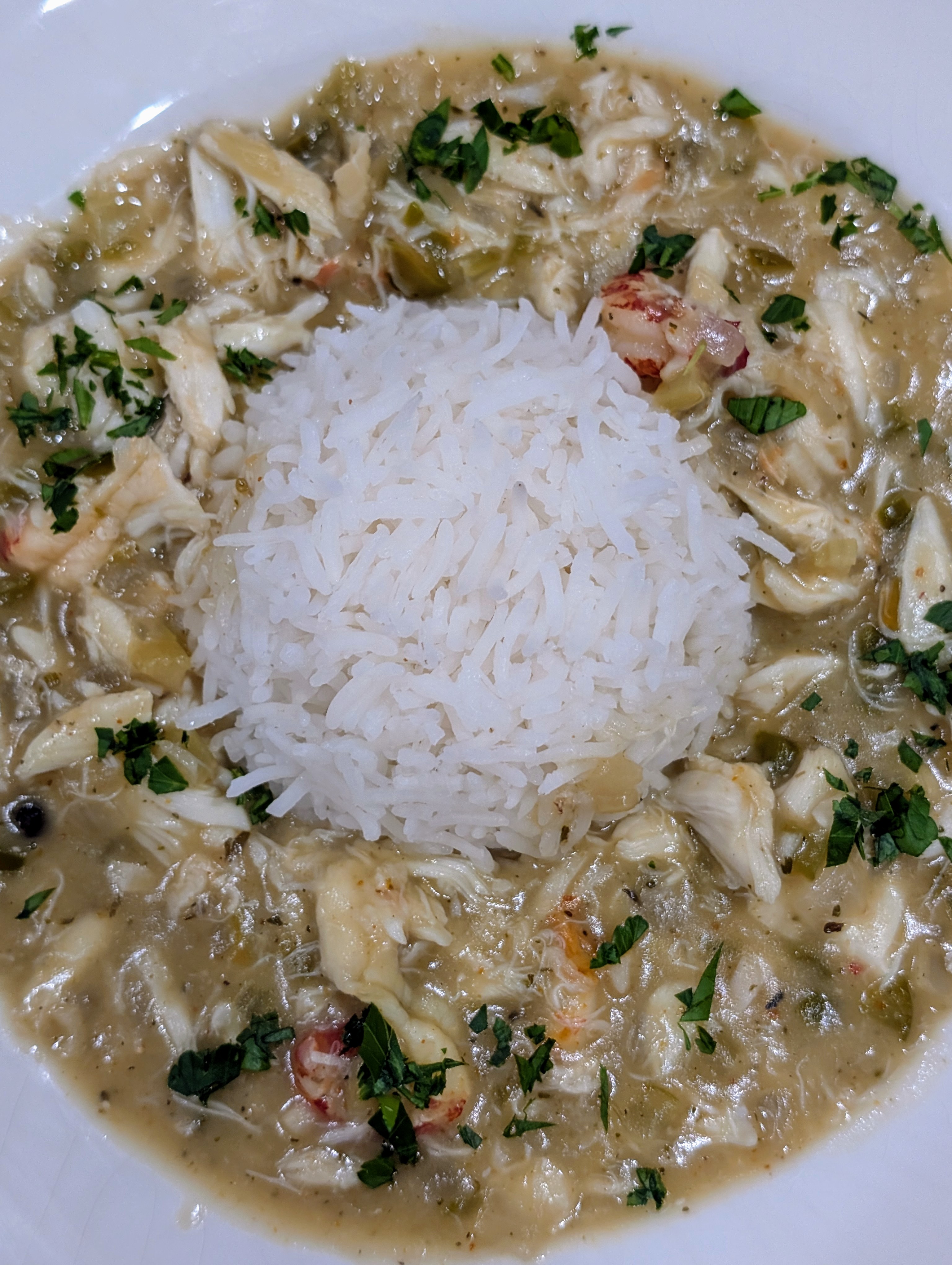
I wanted to acknowledge that common bond when I prepared this recipe of Crab and Crawfish Etouffee. I used my No Man's Land seasoning. The mix uses a Creole seasoning base but adds sundried tomato powder and crawfish powder, both of which are ingredients drawn from the culinary history of enslaved Africans. The combination of those powders added an earthiness and almost an umami to the dish, whcih easily made up for the lack of pork or sausage. In the end, this dish was perhaps one of the best dishes that I have prepared in recent months. 

CRAB AND CRAWFISH ETOUFFEE

Recipe adapted from Food & Wine

Serves 6-8

Ingredients:

  • 2 pounds crawfish. tails and meat removed
  • 4 1/2 cups of water
  • 1/2 cup unsalted butter
  • 1/2 cup all purpose flower
  • 1 medium sized yellow onion, finely chopped
  • 2 large celery stalks, finely chopped
  • 2 large green bell peppers finely chopped
  • 10 garlic cloves, coarsely chopped
  • 1 tablespoon Creole seasoning (or No Man's Land Seasoning)
  • 1 dried bay leaf
  • 4 thyme sprigs
  • 1 pound fresh crabmeat, picked over
  • Kosher salt
  • Long grain rice, for serving

Directions:

1. Prepare the crawfish. Rinse well. Remove the tails and remove the meat from the tails, reserving the shells from the tails. Bring 4 1/2 cups water and reserved shells to a simmer in a large saucepan over medium heat. Remove from heat; let stand for 15 minutes. Strain stock and discard shells. Set aside 4 cups crawfish stock.

2. Prepare the base. Melt butter in a large heavy saucepan over medium heat. Whisk in flour. Cook, whisking constantly until light blond in color, about 3 minutes. Add onion, celery, bell pepper and garlic. Cook, stirring occasionally, until the vegetables are tender, about 8 minutes. Add the creole seasoning, bay leaf and thyme and cook, stirring constantly 1 minute. Add stock, cook, stirring occasionally until slightly thickened, about 30 minutes. 

3. Add crawfish and crab meat. Add the crawfish and crab meat. Cook over medium heat, stirring occasionally, about 3 minutes. Discard the bay leaf and thyme sprigs. Season with Kosher salt to taste. Serve over rice.

PEACE.

Saturday, March 15, 2025

Lowcountry Brown Oyster Stew

This post about an oyster stew takes us to a very specific and incredibly important part of South Carolina's lowcountry. It is that part that overlaps with the Gullah-Geechee Corridor. The corridor itself runs from Jacksonville, Florida to Wilmington, North Carolina. However, as the corridor passes through South Carolina, it crosses islands, along with towns and cities, with the rich history of the Gullah-Geechee people. 

The Gullah-Geechee are descended from West Africans who were forcibly taken places ranging from modern day Senegal to Angola during the 18th century. The enslaved West Africans were brought to the United States to labor on rice plantations on the South Carolina's sea islands and along its Atlantic Coast. I had an opportunity to learn about this history and its profound impact upon our country as I prepared a dish of Carolina Crab Rice. (Hint: it was the knowledge and skills, along with the uncompensated hard labor, of those enslaved West Africans that created the infrastructure for, as well as enabled the successful production of, rice in South Carolina.)

The enslaved brought more than their knowledge and skills to this country, they also brought a variety of ingredients that were not part of the American-table at that time. This recipe captures some of those ingredients. For example, dawadawa or fermented locust beans. The fermenting of locust beans can be traced back to the 14th century, and its use in the preparation of food goes equally far back in time. Cooks in African countries like Nigeria, Benin and Ghana use dawadawa in many iconic dishes, like Jollof, as well as soups or stews like Fakoye. Locust beans are typically not cultivated, rather they are dispersed by people and animals. That brings us to the connection between Africa and the "New World." Slaves brought these locust beans with them as they were forcibly taken from Africa and transported to various places in North America, like the South Carolina coast, or the Caribbean. That may be one reason why one can find locust beans, as well as dawadawa, in Haiti

Dawadawa (Source: Slow Food)

Another interesting ingredient is the dried crayfish powder. As someone who has used dried shrimp when preparing dishes from Sri Lanka, I have a little familiarity with the umami-like scents and tastes that the ingredient can provide to a dish. The use of dried crayfish powder is used for that very purpose -- to add umami -- in dishes prepared along the African coastline of modern day Ghana and Benin. The technique of drying crayfish - which thrive in freshwater and some brackish water -- could have been brought with Africans so that they could preserve this source of protein for use in dishes.

Both dawadawa and dried crayfish powder are more than ingredients; they embody culinary techniques. A natural processing of ingredients from the land or the water to obtain something more. This particular recipe highlights that fact. The use of dawadawa and ground crayfish powder, along with the sundried tomato powder, served as a substitute for bacon or smoked pork. These ingredients provided elements that mimic smoked flavors, earthiness and richness that one would ordinarily get from using diced up bacon or smoked ham.  

Together, these ingredients helped to produce a stew that I have to say is far more complex and delicious than any oyster stew made with heavy cream. If I had my druthers, I would produce a huge batch of this stew and enter as a contestant in the next Oysterfest held by the Chesapeake Bay Maritime Museum in October 2025. It probably would not win (as the winners are usually the heavy-cream based stews), but it would introduce a completely different, but equally authentic and historic, way to prepare this dish to an audience who would probably never have the opportunity to taste it. 

LOWCOUNTRY BROWN OYSTER STEW

Recipe from Saveur

Serves 4

Ingredients:

  • 2 teaspoons toasted benne (sesame seeds)
  • 1/2 teaspoon ground ginger
  • 1/2 teaspoon lemongrass powder
  • 4 tablespoons all purpose flour
  • 3 tablespoons vegetable oil, divided
  • 2 tablespoons unsalted butter
  • 1 celery stalk, finely chopped
  • 1 small yellow onion, finely chopped
  • 1.5 tablespoons sundried tomato powder
  • 2 teaspoons Caribbean bay leaf powder or 2 dried bay leaves; 
  • 1.5 teaspoon crawfish powder or dried shrimp powder
  • 2 teaspoons ground dawadawa
  • 1.5 teaspoon garlic powder
  • 1.5 teaspoon onion powder
  • 1.5 teaspoon smoked paprika
  • 1 teaspoon chipotle powder
  • 2 pints shucked fresh oysters
  • 6 cups seafood stock, vegetable stock or water
  • 1 teaspoon kosher salt, plus more
  • 2 tablespoons finely chopped onion sprouts or chives

Directions:

1. Toast the spices. in a large skillet set over medium-low heat, add the benne, ginger powder and lemongrass powder; toast until golden-brown, 3-5 minutes. Remove from heat. 

2. Prepare the roux. In a large pot over medium high heat, whisk together the flour, 2 tablespoons of oil and the butter. Stir continuously until the roux turns a dark chocolate brown color, about 5 minutes. 

3. Saute the vegetables. In a separate skillet over medium high heat, add the remaining oil, celery and onion. Cook, stirring frequently, until soft and translucent, about 3 minutes. Remove from the heat. 

4. Continue working with the roux. Turn the heat down to low, then add the tomato powder, bay leaf powder, dawadawa, crawfish powder, garlic powder, onion powder, smoked paprika and chipotle powder. Cook, stirring continuously until fragrant, about 1 minute. Stir in the celery-onion mixture and then slowly pour in the oyster liquor and the tock, stirring continuously until all the liquid is incorporated into the roux. Add the salt, turn the heat up to medium-low to bring the stew to a boil, then turn the heat back down to maintain a simmer. Cook until the broth is thick enough to coat the back of a wooden spoon and has reduced by about a third, 40 to 45 minutes. 

5. Finish the dish. Remove the stew from the heat, then immediately stir in the oysters (the residual heat will cook them). Season to taste with more salt as needed. Ladle the brown oyster stew into wide soup bowls, garnish with onion sprouts and reserved benne seed-ginger-lemongrass mixture and serve hot. 

PEACE.

Friday, August 19, 2022

Maine Lobster Rolls

While the first documented lobster roll may have been served at a restaurant in Milford, Connecticut, there is no doubt that the lobster roll is an icon of Maine cuisine. Anyone who takes a vacation in Maine -- from Kennebunkport to Lubec -- will inevitably have the opportunity to try a roll. And, there are many places across the State to get one. 

However, there are a lot of stories behind this sandwich. It is the stories about the lobsters and those who catch them that need to be told more. 

One of those stories is presently unfolding in the Gulf of Maine. Climate change is clearly making its presence known. The waters in the western part of the Gulf of Maine - such as Casco Bay (near Portland, Maine) - are beginning to get warmer. As anyone who has cooked a lobster will tell you, lobsters don't like warm water. As the waters of Casco Bay get warmer, the lobsters move north and east. As one fisher told Norah Hogan, a journalist with WMTW, "[w]hen I started [about 30 years ago], almost half of the lobsters in the state of Maine were landed in this part of the state - Casco Bay region." He added, "[w]e're not in the ballpark anymore." 

Lobsters thrive in waters that are between 54 degrees and 68 degrees Fahrenheit. The waters in the western portions of the Gulf of Maine exceed 68 degrees from time to time. This means that the lobsters will migrate to where it is cooler, which is toward the northeastern shore of the State and into Canadian waters. It also pushes the lobsters further offshore, to cooler, deeper waters. 

This means that, as the waters warm, there will be less lobsters around the shores of Maine. Less lobsters mean that the already high prices for lobster rolls will only go higher (as long as the demand is there). In fact, I was quite surprised that the cost of a lobster roll could be from $28 to $38 for each roll. If both my beautiful Angel and I had a lobster roll, we would be looking at paying $56 to $76 for a meal (and that is without any beer or anything else). 

As it turns out, I had brought my trusty steam pot to Maine for our vacation. As I noted in my post about Steamed Lobsters, I was able to find a seafood market that sold whole lobsters for anywhere from $8.00 to $12.00 per pound, depending upon the lobster. The market only had soft shelled lobsters (that is, those who had recently molted). Soft shelled lobsters come with a lot of water since they have not fully regrown into their new shells. So, part of what one is paying for with that $8.00 to $12.00 per pound is water. I knew this fact when I bought them, but I could buy 4 soft-shelled lobsters for the price of 2 lobster rolls. 

With those lobsters, I proceeded to make my own lobster rolls. I found a recipe, which is set forth below, and tried to follow it as best I could. I also decided that I would do the "presentation piece" and have a whole lobster claw served on the top of the sandwich. However, I think in the future that I perhaps do a rough chop of the claw into pieces. I think that would be better than a whole claw.

MAINE LOBSTER ROLLS

Recipe from Food & Wine

Serves 2

Ingredients:

  • 1/2 cup mayonnaise
  • 2 tablespoons fresh lemon juice
  • 2 teaspoons fresh chervil or tarragon
  • Kosher salt
  • Freshly ground black pepper
  • 1/4 cup minced celery
  • 1 pound cooked, shucked and chopped lobster meat (from knuckles and 6 pincer claws)
  • 6 top split (New England style) hot dog buns, separated
  • 2 tablespoons salted (or unsalted butter), softened
  • 1 tablespoon fresh chives, plus more for garnish
  • 6 butter lettuce leaves

Directions:

1. Prepare the lobster. Whisk together mayonnaise, lemon juice and chervil. Season lightly with salt and pepper. Stir in celery and fold in chopped lobster meat. Cover and chill up to 4 hours.

2. Prepare the buns.  Heat a large skillet over medium heat. Butter the sides of buns and toast in skillet until golden and heated through, about 2 minutes. 

3. Finish the dish. Fold chives into lobster salad. Place a lettuce leaf inside each bun. Divide lobster salad evenly among buns. Sprinkle with chives. Serve immediately. 

ENJOY!

Saturday, July 23, 2022

Steamed Lobster

A lobster does not need a hot tub. It just needs a steam room.

There are many websites that will tell you there are two ways to prepare whole, fresh lobsters. One way is to boil the lobsters. Another way is to steam the lobsters. These websites will engage in a seemingly meaningless discussion about the pros and cons of each method. Truth be told, in my humble opinion, there is only one way a whole lobster should be prepared. It must be steamed. 

A long time ago, at a crab house far, far away, I used to steam lobsters. The kitchen had three large steam pots, as well as another three, equally large pots in a back-up kitchen. The primary purpose of the pots was to steam crabs; however, we always left at least one open to steam other seafood. A lot of mussels and clams, but, every once in a while, a lobster. 

Since that time, I have not steamed whole lobsters very often. The one notable time involved my effort to make Masaharu Morimoto's Lobster Masala

However, the Savage Boleks recently vacationed in Maine, spending a week on Mount Desert island. I found a local business, Parsons Lobsters, in Bar Harbor. Parsons is perhaps the only place that I could find in the town that sold live lobsters. Sitting right outside Acadian National Park, Parsons is a family owned business that has been selling lobsters, and other fresh seafood, such as clams, oysters and fish, for more than forty years. 

We visited the Parsons store, because I wanted to purchase some lobsters to prepare for my family. The store is small, but impressive. At the time, the store was holding approximately six hundred (600) pounds of live lobsters in multiple tanks. There were also displays featuring those clams, oysters, fish and more. We purchased four lobsters and returned to the place where we were staying. (The four lobsters were approximately one and one-half pounds each; but, the cost of four lobsters were less than the cost of a lunch or dinner in town.) 

Going back to the original point of this post, I planned on steaming those lobsters. I brought my good old steam pot, the one piece of cookery that ties me to my original cooking experience.  Steaming is the preferred way to prepare lobsters for one reason ... boiling lobster threatens the taste of the meat. One is far less likely to get the sweet, tender meat that creates an amazing culinary experience. By contrast, steaming the lobster provides a way to get that tender meat, and, protect the meat. 

To be sure, steaming a lobster takes more care and monitoring than simply boiling it. Steaming also provides an additional way to provide some subtle flavor. While most steaming uses simple water, I have often substituted that plain ingredient with something like stock, beer or wine. The best stock would be seafood stock, which can be purchased at many grocery stores. As for beer and wine, the thoughts should turn to something on the lighter side. The best beers would be pilsners and summer ales. As for wines, I think the best wines would be white wines, such as Albarinos from Galicia, Spain or Vinho Verdes from Portgual. 

In the end, and in my humble opinion, the liquid does not matter. All that matters is that you steam the lobster, don't boil it. 

STEAMED LOBSTER

A Chef Bolek Original

Serves 2

Ingredients:

  • 2 whole lobsters, live 
  • 1/4 cup butter, melted
  • Water, seafood stock, beer or wine

Directions:

1. Prepare the steam pot. Fill the steam pot with water, seafood stock, beer or wine, but the level should remain below the steam plate. Heat the steam pot on high heat until it steams. 

2. Steam the lobsters. Add the lobsters. Steam for seven minutes for the first pound of lobster, then an additional 3 minutes for each additional pound of lobster that you are steaming. Melt the butter while the lobsters are steaming. Once they are cooked, remove from the steam pot and serve immediately with the melted butter. 

One final note ... I may have to eat my words about boiling versus steaming the next time I enjoy a lobster boil. But, that will be for another post. 

ENJOY!

Wednesday, March 9, 2022

Around the World in 80 Dishes: Ukraine

"For Ukrainians who have never had their own tsar ..., the Motherland, their homeland, has always been more important than a foreign tsar and - which is the worse for Russia - more important than faith."

Andriy Kurkov, Ukraine in Histories and Stories: Essays by Ukrainian Intellectuals.

February 23, 2022 - the foreign tsar -- namely, the President of the Russian Federation, Vladimir Vladimirovich Putin -- authorized an unjustified and unprovoked war against Ukraine and its people. Putin conjured up multiple, patently false reasons for his war. Reasons so patently absurd that I will not repeat them because I do not want to give them any more airing than what news outlets have already provided. Nevertheless, this is the war of Vladimir Putin and his cronies, like Foreign Minister Sergei Lavrov. They have pressed hundreds of thousands of Russian troops into a war that, judging by the anti-war protests that took place across the Russian Federation, is not one embraced by the Russian people themselves. 

Ukrainian President Volodymyr Zelenskyy telling 
the Ukrainian people that he and his advisors are
fighting alongside them in the streets.

In the days that followed the initial invasion, the above quote manifested itself in the resolve of the Ukrainian people. It was found among that small Ukrainian garrison on Zminnyi Island (Snake Island) who told a Russian warship to go fuck itself. It is also present in the sacrifice of Skakun Vitaliy Volodymyrovich, a Ukrainian soldier who remained with the explosives that he used to blow up a bridge because he did not have time to set the charge and escape. It can even be seen in the words of the Ukrainian President, Volodymyr Zelenskyy, who responded to the United States offer of evacuation with the words, "the fight is here, I need more ammo, not a ride."

The Ukrainian woman who told the Russian
soldier to put seeds in his pockets.
Indeed, this resolve is seemingly present in almost every Ukrainian. There is the woman in Henychesk, Kherson region, who stood just feet away from a Russian soldier while telling him to put sunflower seeds in his pockets so when he dies on Ukrainian land, those flowers, which happen to be the national flower of Ukraine, will grow from that spot. There are also countless other examples, including the Ukrainians who take to the streets to block Russian military vehicles with their bodies. 

To be clear, the stakes of the current conflict involves much more than whether Ukraine will continue as an independent country. At its most basic level, the conflict presents a clear and present danger to the very identity of the Ukrainian people. If the Russian Federation is successful in occupying Ukraine, the Russians could effectively destroy the history and heritage of the Ukrainian people. Indeed, that assault is already underway, with attacks on cultural institutions such as opera houses, museums and even the Babyn Yar memorial (which was built to remember the massacre of Jewish Ukrainians during the holocaust). 

In waging this It involves the Ukrainian identity. Ukrainian people are desperately defending not just their homeland, but their own identity and their freedom. No speech by Vladimir Putin and no war by the Russian Federation will deny or erase the history of the Ukrainian people or their homeland.  

"Inside yourself, dig the well which will bring water to both your house and your neighbor's." - Gregory Skorovoda (Ukrainian writer)

The war in Ukraine has underscored the importance of protecting and preserving the Ukrainian culture. Across the world, Ukrainians are reconnecting through shared experiences, many of which revolve around food. In the past, I have used this blog to discuss the persecution of peoples, such as the genocide of the Rohingya, the plight of the Somali, apartheid-like conditions imposed upon the Palestinians, and the systematic imprisonment of the Uyghurs and the destruction of their culture. I realize that posting on a blog is not much, but I try dig deep to contribute in my own small way to helping people understand (to the extent they don't already) the importance of human rights and the need to accept peoples and their cultures for who and what they are.

To this end, I have placed my thumb on the Around the World in 80 Dishes culinary challenge. Rather than wait for the random country generator to assign Ukraine as my next challenge, I have made an exception. It is perhaps one of the most important exceptions that I have made. 

I strongly believe that this particular story needs to be told right now. My hope is that by doing my own digging, I will be able to share what I have learned to help both myself and those who read this blog.

"We have survived two world wars, Holodomor, Holocaust, the Great Purge, occupation in eastern Ukraine. We don't have a lot of land, we don't have nuclear arms, ....  But we have our people and our land - that's what we're fighting for.

- Volodymyr Zelenskyy

The nation state construct known as Ukraine first emerged in the ashes of World War I.  In fact, multiple Ukrainian states emerged, such as Ukrainian People's Republic, the Hetmanate, and the Ukrainian Soviet Socialist Republic. However, it was the Ukrainian People's Republic that obtained recognition by the international community in 1917. Wars continued in the region, with most of those nascent Ukrainian states finding themselves incorporated into other countries. When relative peace emerged in 1921, the territory of what would become modern day Ukraine was basically split between four countries. The western portions fell within the borders of Poland, Czechoslovakia, and Romania. The rest was squarely within the Soviet Union.  After the Second World War, the Soviet Union, under the iron grasp of Josef Stalin, drew the borders that continue to this day.  

And, while it may have been the Soviet Union that carved the lines that constitute the present-day Ukraine, it is an important thing to keep in mind that the Soviet Union and Russia are two separate states themselves. The Soviet Union was an "international project," a federation of national units, one of which was the Ukrainian Soviet Socialist Republic. When the Soviet Union dissolved, those units emerged as independent countries, from Estonia to Moldova, Ukraine to Kazakhstan. (Ironically, the Russian Federation itself is an amalgamation of oblasts, republics, krais, and autonomous okrugs, many of which -- for example, Adygea, Bashkorostan, or Kalmykia -- were founded upon ethnic groups and/or have substantial numbers of ethnic minorities in them today.

In any event, the history of this nation state construct is not the same as the people who lived within it. Indeed, the history of the Ukrainian people predate that nation-state. While most of the people who lived in the areas would have identified themselves as Orthodox (based on their religion), a Ukrainian identity emerged in the early 19th century, with its own language separate and consciousness as a people.  Intellectuals and writers, such as Taras Shevchenko and Mykola Kostomarov, wrote works in Ukrainian exploring what would become Ukrainian national philosophy. Shevchenko wrote about the political repression of the poorer classes and dreamed of their liberation. This perspective is important: it is the poor in the countryside who formed the core of the Ukrainians, and the anti-elitist nature of their philosophy was integral given those who lived in the cities spoke Polish or Russian.  For these reasons, Ukrainian thought thrived at the lowest levels, out of view of the official state.  As the Soviet Union emerged, the emphasis on educating the poorest classes resulted in the spread of the Ukrainian language and literature into the 1930s.

However, the Ukrainian identity -- while officially celebrated as part of the Soviet Union -- was also viewed as a threat, especially by the Soviet leader, Josef Stalin. Aided by inept agricultural practices and poor weather, Stalin set in motion the events that led to the Holodomor, or the Great Famine, in 1932 to 1933. Nearly four million Ukrainians starved to death, while their intellectuals, artists, and writers were arrested. While the Ukrainian identity survived the Great Famine, it would face challenges  over and over again. Approximately 900,000 Ukrainian Jews were murdered during the Holocaust, including the massacres of September 29 and 30, 1941, when 33,731 Jews were massacred by the Nazis. Hundreds of thousands of additional Ukrainians were killed after World War II during Stalin's Great Purge. While peace eventually emerged across what was the Ukrainian Soviet Socialist Republic, the battle continued to preserve the Ukrainian identity in a union dominated by Russians. 

This struggle ended with the collapse of the Soviet Union. From the ashes of that empire arose an independent Ukraine. As with all of the post U.S.S.R. countries, Ukraine struggled with establishing a democratic government. While some of those newly established countries fell quickly back into authoritarianism (see my challenge involving a main course from Turkmenistan), the Ukrainian government established a republic and elected its leaders. Ukraine's independence has not always been smooth, with revolutions in 2004 and, most recently, the Revolution of Dignity in 2014. That second one led to the ouster of  pro-Russian President Viktor Yanukovych, and a new, more pro-western government. Elections in 2019 led to a new President, Volodymyr Zelenskyy, who continued to push for greater ties with the European Union and with the North Atlantic Treaty Organization.

Dear God, calamity again! 

It was so peaceful, so serene;

We had just begun to break the chains

That bind our folk in slavery

When halt! Once again the people's blood

is streaming.

"Calamity Again," Taras Shevchenko

This poem hauntingly captures what it means to be Ukrainian. With the Revolution of Dignity in 2014, Ukraine and its people finally liberated themselves from the direct shackles of its past (whether it be as a direct subject of the Russian Empire or the Soviet Union) and the indirect bondage of the present (through forced economic and political ties with the Russian Federation). They had finally the freedom to chart their own course; and, whether it took them west toward the European Union or continued east toward the Commonwealth of Independent States, it would be their own choice. 

All of that came to an end on February 23, 2022. Without provocation or justification, Russia commenced a war that is characterized by the inhumane assault upon the Ukrainian people. Those people are now fighting not only for their freedom, but for their identity. This fight has led many Ukrainians around the world to think about protecting their heritage. They have taken to social media to tell their stories, many of which surround the food that they eat. Whether it is the Ukrainian Borscht (which, as with the Ukrainian people, is different than Russian Borscht) or their paska (Easter Bread), these recipes define who they are as much as their history or any nation state. 

There are several key components to Ukrainian cuisine. First, flour and cereals -- such as rye and wheat -- play a significant role in many dishes, including breads, dumplings and pies. Second, ingredients like onions, garlic, horseradish, dill, parsley, and thyme are used to provide flavor to dishes.  Over time, the trade in spices also brought black pepper, cardamom, cloves and cinnamon to the Ukrainian kitchen. Third, Ukrainian cuisine emphasizes a wide use of pork and fat, along with sour cream, sunflower oil and eggs. Finally, Ukrainian cuisine is noteworthy for the two-step process in preparing many dishes, with the ingredients being boiled or fried first, followed by a second technique, such as stewing or baking, to complete the dish.

Telling the stories and sharing the recipes is important. It is as much a part of the Ukrainian resistance to the Russian war as taking arms or throwing Molotov cocktails. Russia has launched this war on the premise of nullifying the Ukrainian identity by subsuming it into a larger Russian one. Efforts to preserve what it means to be Ukrainian, even if through words, contributes to the defense. And, in the end, even the smallest contributions matter.

APPETIZER

Turning to the challenge, I wanted to find a couple of recipes that are either distinctively Ukrainians or upon which Ukrainians have put their own mark. I chose two receipes, one that is a side dish and another that is a main course. 

The side dish, which could also double as a main course itself, is known as deruny, which are relatively simple potato pancakes. The cultivation of potatoes became widespread throughout Ukraine in the 19th century. Potatoes eventually emerged as the "second bread" on family tables, displacing vegetables like parnisps and turnips. Traditionally, families prepare deruny on Sundays as a meal in and of themselves. It seemed only appropriate that I made this dish on a Sunday as well.
This recipe comes from the northern region of Ukraine. If one travelled about two hours west from Kiev, they would arrive in the city of Zhytomyr. The city is some to a very particular piece of artwork by Volodymyr Kosyrenko. It is a stone monument to the deruny, featuring a basket of the potato pancakes sitting on a pedestal of red and gray granite. One could travel another hour and half north to the city of Korosten for the deruny festival.  The festival showcased not just the Ukrainian pancakes, but similar ones from Belarus, England, France, Norway and Poland.

Unfortunately, both Zhytomyr and Korosten have been targets of Russia's unprovoked war, where Russian forces have murdered Ukrainians in attacks across that region.


DERUNY
Recipe from Ukraine Food
Serves 4

Ingredients:
  • 1 pound of potatoes
  • 1/2 teaspoon freshly ground black pepper
  • 1 egg
  • 1 teaspoon salt
  • 3 tablespoons flour
  • 3/4 cup sour cream
  • 1/2 cup of vegetable oil
Directions:
1. Prepare the potatoes. Peel and wash the potatoes. Grate using a medium grater. Combine the potatoes with the egg, salt, pepper and flour. Stir until completely combined.

2. Fry the potato cakes. Heat the vegetable oil over medium high heat. Spoon the potatoes into disc shapes in the oil. Fry each side until golden crisp.

3. Finish the dish. Once fried, remove from the oil. Serve with sour cream or browned onions. 

MAIN COURSE

The main course for this challenge involves something that I have not done for years: make dumplings. I have to go back to my special challenge involving Tibet, when I made sha momos, or my challenge to prepare veprova pecene, a main course from the Czech Republic, during which I also made houskove knedlicky, or bread dumplings. In the Ukraine, the particular dish that I made is halushki. 

While one can find halushki dishes across central and eastern Europe, the Ukrainian version involves the preparation of small flour dumplings, as opposed to either potato dumplings or noodles. At least what I can find, Ukrainian halushki is more often served with onions and mushrooms, along with some bacon (as noted above, pork can be found in many Ukrainian dishes). This particular combination of ingredients works well together, with the puffy dumplings contrasted with crunchy bacon and sautéed mushrooms.

To be sure, my dumpling making skills need a lot of refinement. The dumplings came out rather rustic and, despite my best efforts to standardize the size and shape, it just did not work out well.  Still, in the end, the combination of those dumplings with the butter, bacon, mushrooms and onions made this a very delicious dish. 

HALUSHKI

Recipe from Mom's Dish

Serves 4

Ingredients:

  • 5 cups flour
  • 4 eggs
  • 1 teaspoon salt
  • 1 cup lukewarm water
  • 150 grams of butter, plus 3 tablespoons of butter
  • 1 pound of fresh mushrooms
  • 1 onion, diced
  • 1 cup bacon pieces
  • 1 tablespoon salt
  • 1 tablespoon freshly ground black pepper

Directions:

1. Prepare the dough. Place the flour and salt in a large bowl. Make a little well in the middle. Place whisked eggs, water and melted butter into it. Using a fork, work the ingredients together to form a dough. Finish up combining the ingredients by hand until you get a smooth even texture. 

2. Prepare the dumplings. Divide the dough into eight even pieces. On a floured surface, roll each piece into a long string. Dice each string into small pieces.

3. Cook the dumplings. Bring a pot of salted water to a boil. Toss in the raw dumplings and boil them until they float to the top.

4. Prepare the toppings. Dice the mushrooms and sauté them in a buttered skillet for about 5 minutes. Dice the onions and add them to the skillet, cooking them until softened. Season with salt and pepper. Stir in the bacon and sauté for about 5 minutes. Place the dumplings in a non-stick skillet and add the sautéed mixture and butter. Cook until they turn golden brown.

*    *    *

This challenge was done in short order. While I am not Ukrainian, I still wanted to contribute to the discussion of the Ukrainian culture, cuisine and heritage, all of which are under attack. One cannot stand silent watching Russia's unprovoked assault on Ukraine, its murder of Ukrainians and its attempt to subjugate Ukrainians under some false notion that they are anything other than Ukrainian. In this moment, we are all Ukrainians. Until the next time, 

SLAVA UKRAINI!