Showing posts with label Features. Show all posts

Wednesday, November 24, 2021

Thanksgiving @ Chef Bolek's House

Hellu! I im vriting a pust ibuout vhet I im gung to cuok fur Thuonksgeefing. I hefe-a a reelly beeg tuorkey. I im guing to prepere-a a rub vit luts ouff fennell seeds, rusemery, gerleec, und sume-a pinches ouff clufes and lemun zest. I im zee-a guing tu stuoff zee-a tourkey vit luts ouff chestnuots, ouniuns, celery, cerruts, und, ouff, course-a luts and luts of breed. 

Bork! Bork! Bork!

(translation of English to Swedish Chef courtesy of https://funtranslations.com/chef)

Sometimes, especially around events when I am cooking for people other than myself and my immediately family, I can feel a little like the Swedish Chef. Things go wrong. Sometimes they go very wrong. (Like, the oven going kaput and me having to break down a turkey and microwaving it to a finish. If only I channeled the Swedish Chef at that moment in time, I could have at least injected some humor into that catastrophe.)

Those thoughts always hide in the recesses of my mind. I worry about whether the meal that I am about to prepare will be the best that I can make. We are hosting Thanksgiving this year and it is the first one that we are having with guests since 2019.   

To put my mind somewhat at ease, I am preparing a turkey in a style that I have done for recent Thanksgivings. I will be preparing a Turkey in the Arista Style. An Arista is a traditional recipe from Tuscany, Italy, for a pork roast. Records of the recipe go as far back as the beginning of the 13th century.  However, the story about how the dish got its name dates back to the early 15th century, when it was served to a visiting Byzantine patriarch. The visitor was so pleased with the dish, he cried out, "aristos!" The Tuscans looked puzzled and thought their visitor proclaimed "pork." Apparently, they did not understand Greek very well, because the patriarch proclaimed that the dish was "excellent." 

The ingredients that make this dish excellent can be found in the rub.  An arista is heavy on the rosemary and garlic.  Some recipes, including the one that I use, add additional flavors, such as cloves, fennel and lemon zest.  I think these flavors provide for a more interesting and tasty dish. I also think that all of these ingredients work very well with the mild taste of a turkey. That is the main reason why I have taken this pork recipe and turned into a turkey recipe.

In the past, I have prepared a Tuscan chestnut stuffing to complement this Tuscan-style turkey. However, this year it appears that chestnuts are in short supply. My local grocery store has unfortunately let me down, even though in past years it used to have a bin full of chestnuts. I would buy a pound or two of chestnuts, roast them and chop them up myself. No bin this year.  It took visits to four stores before I could find some packaged chestnuts. I guess it will save me some time because I will not have to roast them. However, I think I may experiment a little by mixing in some pecans or pistachios into the stuffing. Both of those nuts have more flavor than chestnuts and I think they could work fairly well with the other ingredients.  That might be a last minute call as I get ready to make the stuffing.

I will be preparing one other dish for this dinner:  cranberry sauce.  I had initially thought of making a Chianti Cranberry Sauce, something along the lines of this recipe. I was simply trying to build on the whole Tuscan theme. After some thought, however, I decided that I would return to a recipe that has served well at Thanksgiving: Cranberry Orange Relish. This recipe has historical roots in the United States, as it is based on recipes prepared in the taverns of colonial Williamsburg.  I found the recipe in a cookbook, entitled, Colonial Williamsburg Tavern Cookbook, which I purchased years ago when we visited the area. The recipe is clearly intended for adults, because one of its ingredients is Cointreau. I say that it is intended for adults because nothing is cooked, so all the booziness of that liquor will be present in the sauce when it is served.  The Cointreau macerates the cranberries as the dish rests in the refrigerator overnight. I have since adapted the recipe to make a kid-friendly one, substituting orange juice for the Cointreau. My kids have eaten this version during past Thanksgiving meals and they have liked it.  In the end, this dish usually makes everyone happy. 

Well, that summarizes the dishes that "Chef Bolek" will prepare this Thanksgiving. It is a lot less than a typical Thanksgiving holiday. In the past, I prepared some potato dish (such as my Mashed Sweet Potatoes with Ginger, Cardamom and Honey) and a roasted vegetable dish (like my Roasted Fall Vegetables). However, for this Thanksgiving, I am thankful that our guests will be providing those dishes and more (like an oyster stuffing, gravy and bread). It will give me more time to focus on the tasks ahead.

With that said, I hope everyone has a safe and happy Thanksgiving or should I say ...


I hupe-a iferyune-a hes a heppy thuonksgeefing! Bork! Bork! Bork!

ENJOY! 

Saturday, October 30, 2021

Chef Bolek's Scariest Moments in the Kitchen

Halloween is the time of year when everyone thinks about everything that is scary or spooky. While this particular holiday does not rank among my favorites, I nevertheless got to thinking about what are some of the scariest things that I have prepared in the kitchen since I started this blog thirteen years ago.

I also decided to write this post. I figured that, over those thirteen years, there had to be some misfires, some disasters, or even some questionable dishes that were probably better left un-posted. Then, while going through my old posts, I remembered the cardinal rule of my personal culinary blog: Don't Post the Disasters! For the most part, this rule worked. It probably prevented the scariest dishes from ever seeing the light of day.  

Still, the "word" scary can have different meanings in different contexts.  For example, it could mean the ingredients that strike the most fear in the eater. It could also mean the most frightening-looking dishes ever presented to a guest. Keeping this in mind, here are some of the scariest things to ever grace this blog: 

Top 3 Scariest Ingredients

Over the years, I have cooked with many different ingredients. The idea of learning about those ingredients, how they are used, and their place in the cuisines around the world have propelled me to try things that, as a kid or even as a young adult, would have sent me fleeing in terror.  Here are three dishes that contain some of those ingredients. 

1.  Fried Lamb's Liver and Heart (Khalyat Alkadba Wal Galoob). This dish comes from my Around the World in 80 Dishes personal culinary challenge.  It was the challenge for Libya.  Don't get me wrong, this offal dish was delicious. The combination of two spice mixes (bzaar and hararat), along with hot chile powder turned this recipe into an amazing dish. I think that, for the average person, a plate of lamb hearts and lamb livers would be scary and off-putting. That is why this dish made the list. 

2. Pig Trotter Curry (Kangchu Maroo).
This is another dish from my Around the World in 80 Dishes personal culinary challenge. It was the challenge for Bhutan. Unlike the recipe for lamb's liver and heart, this recipe did not have multiple spice mixes. It is a simple curry, with only garlic, ginger, and chiles. These ingredients provided flavor to the overall dish, but the absence of those spice mixes meant that one could taste more of the pig's feet.  I loved this dish and it has always been on my list to re-make.  

3. Pork Offal Meatballs (Frattaglie di Mailale Polpette).
While the last dish included pig's feet, this particular dish goes one or two steps further (pun intended). It includes pig neck and pig tails, which were boiled together with the pig's feet to make meatballs. The triumvirate of pig parts was a little difficult to handle and probably could have used a little more binding to keep them together. Needless to say, these are not your Italian grandmother's meatballs. They were still delicious, and, in some respects, just as good as regular meatballs. 

Top 3 Scariest Dishes

While I have done my best to ensure that none of my failures ever see the light of day, I have to admit there are some dishes that still made the blog.  These dishes fall into the "what were you thinking" category.  Here are three of those dishes: 

1. Lobstercake Sandwiches. This dish was my effort to recreate an amazing Lobster Burger dish that I had at Chef Michel Richard's Central. That dish had big chunks of lobster meat held together by the smallest amount of binding.  My "re-creation" was more like a soupy Frankenstein. Frozen lobster meat (bad choice), bolstered with scallops, bound together with a "soup" that left me scrambling to try to save the dish. The end result barely resembled a lobstercake. I couldn't even cut the cheese correctly for the picture.

2. Rockfish with a Trio of Sauces.
 This dish haunts the cook in me.  What was I thinking? Quite frankly, I had the idea of creating a "stop light" trio of sauces that could complement the flavor of rockfish (which I love).  I should have just looked at the red sauce, stopped with the idea, and made a different dish. Each of the sauces was basically an uninspired puree of a different bell pepper.  The only true difference between the sauces was the color. This recipe leaves me shaking my head, and, would most likely leave Chef Gordon Ramsey saying, "what the f___?" 

3. Dungie Cakes with a Yellow Pepper Saffron Sauce.
The last dish draws inspiration from the last two recipes: a forgettable "cake" with a regrettable "sauce." The cake, which was made from dungeness crab, turned out slightly better than the lobstercake, but what really doomed this recipe is the sauce. I can already hear the calls of "c'mon man." A yellow pepper sauce with saffron? Saffron turns everything yellow. What's the point? To have those little red strands poking through the gloppy, yellow mess? Who is going to see the strands with the diced onion and peppers littering the plate?

In the end, it is good to go back to acknowledge one's shortcomings. It is the only way that we learn. For example, I have learned that I am never going to do a stop light trio of sauces. I have also learned that, since that day, I have made some dishes with amazing sauces.  And, finally, while I may not be the biggest fan of Halloween, I do love trying scary ingredients. 

To everyone, I hope you have a Happy Halloween and 

ENJOY!

Tuesday, January 1, 2019

A New Year for Chef Bolek

As I look back at 2018, I am happy that I have been able to cook more than in previous years, as well as write more on this blog. Admittedly, I have only a handful of hobbies right now (due to time constraints). Cooking has been the most important of those hobbies.

I use cooking, as well as this blog, as a way to relieve stress from my day job (which was very stressful last year).  The research and preparation of a dish allows me to forget about my day job and focus on the ingredients, processes, and plating of the meal.  It is one of the few hobbies that allows me to do that; and, perhaps, that is one reason why I love to cook.  

But, cooking and my blog also serve another important purpose ... to learn about food, cultures and people.  They have inspired me to pursue my personal culinary challenge, Around the World in 80 Dishes, which I completed seven main courses from seven different countries (Italy, Croatia, Djibouti, Panama, South Korea, Guyana and Ghana).  Each of those challenges involved a lot of research into the countries, their cuisines and their cultures.  (Unfortunately, due to time constraints, not all of that research made it into the blog posts.)  I have also done research into various aspects of food and cooking, looking at the history of ingredients and cooking processes, as well as particular dishes.  

But, as I turn to 2019, there are going to be some changes.  I am still working them out, but here are some of the bigger ones: 

(1) Healthier Foods.  I am a carnivore at heart, but I have to protect that heart.  I will still make meat dishes, but, my goal for 2019 is to make healthier dishes, with an increase in the use of fruits and vegetables.  This is one aspect of a larger goal of creating a healthier diet (something along the lines of a Mediterranean diet or perhaps a diet based upon Ayurvedic principles).

(2) More Socially Conscious Choices.  I have already been doing this in 2018, focusing on where things come from (especially seafood) and/or how they are raised (such as primarily buying grass-fed beef).  This has been a significant part of the research that I have done in preparation of dishes.  I want to take it to the next level, perhaps by going back to a community supported agriculture program for vegetables and more work to source ingredients locally.  This may lead to a resurrection of my CSA Challenge.

(3) More Posts About Issues of Concern to Me.  Not only am I going to focus on making more socially conscious choices, I may start blogging more about issues related to food that concern me.  There are many of them and I have been tempted to do this in the past. Issues such as the environment, which is important to me because of the Chesapeake Bay, an estuary that has a special importance in the area where I live.  Issues such as human rights and worker rights, which are important in practically every aspect of agriculture and food production, but especially important with respect to modern day slavery on fishing vessels and elsewhere.  

(4)  More Experimentation.  There are many things that I have wanted to do.  They form a bucket list of sorts.  I want to make a dish using different proteins, such as alligator or turtle meat (responsibly and sustainably sourced, of course).  

(5) More conservation.  Finally, I am going to continue working on portion sizes with a goal of minimizing food waste.  Did you know that 40% of the food in the United States does not get eaten?  With starving people and children in the United States and around the world, this is unconscionable.  Change starts with oneself and then it can build from there.  So, for this year, I am going to be far more aware of the amounts of food that I buy so that I do not end up throwing away leftovers after a few days.  I am also going to explore other ways that I and my family can reduce our footprint on this planet.  I hope that you can do so too.

These are just a few thoughts that I quickly typed out for this year.  Please check back over the course of the year to see how I do and how my cooking evolves over time.  Until then ... 

ENJOY!

Tuesday, December 25, 2018

Merry Christmas!

Christmas is probably my favorite time of year. It is definitely not the presents.  I already have everything that I have ever wanted with my beautiful Angel and my two little kids.  It is definitely not the snow, because we have not had a white Christmas in a couple of years.  

The reason why I love Christmas is the food.  In my family, there were strong and abiding food traditions. Some of those traditions were based on family history, such as the Christmas Eve dinner based upon traditions that originated in Abruzzo, Italy. Each meal opened with a plate of antipasti.  There was a selection of meats and cheeses, carefully sliced and placed on the platter, with garnishments that usually included olives and anchovies.  There was also the baccalao, salted cod fish, prepared by my grandfather because he loved it. Everyone else ate some of that cod as well.  While I initially liked it, I grew to dislike it a lot.  (It is one aspect of the family food tradition that I am happy to say has been relegated to memory.)

Once the antipasti course was completed, there was the traditional minestra maritata or Italian wedding soup.  As the link above suggests, I have previously posted the recipe to this dish.  The central ingredients in this dish, at least from my perspective are the whole chicken and the little meatballs. Traditionally, those meatballs were made from beef.  My beautiful Angel does not eat either beef or chicken.  So, for this year, I made an all turkey version of the soup.  The first problem was one of logistics: I could not boil a whole turkey.  But, I could boil a deconstructed turkey.  So, I bought a packages of thighs, wings and legs, as well as some breast meat.  I also used ground turkey for the meatballs.  The end result was just as good as the original. 

And, for the finale, there was the traditional pasta with tomato sauce, meatballs and sausage. I made a few alterations to the tomato sauce, borrowing inspiration from the Sunday Sauce in the Godfather movie. There was an all turkey version, with turkey sausage that helped to flavor the sauce.  However, there was also Sunday gravy with the beef/pork/veal meatballs and Italian pork sausage (both spicy and mild). 

All of this preparation and cooking was for Christmas Eve.  For the holiday itself, there is a 10 pound bone-in ribeye roast awaiting me.  As I tend to that project, I just want to wish everyone ...

A VERY MERRY CHRISTMAS!

Wednesday, November 21, 2018

The Heritage Turkey

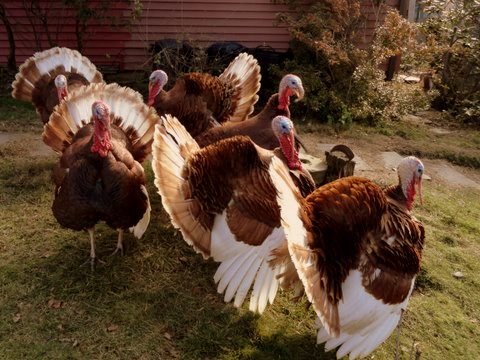
The Bourbon Red.  A descendant from the Buff, a historic breed of turkey from the Mid-Atlantic states.  In the late 1800s, the Buff was brought to Kentucky and Ohio.  J.F. Barbee cross-bred the Buff with Bronze and White Holland breeds of turkeys.  Barbee's goal was to produce a turkey breed that could rival the Mammoth Bronze turkey (a precursor to today's mammoth double breasted white turkeys).  The result was what Barbee dubbed, "the Bourbon Butternut."  Apparently, the butternut was not like a "Butterball" (which, as a name for turkeys, was not recognized until 1940).  The breed got a rebranding as the Bourbon Red.

With a new name, the Bourbon Red rose in prominence. The breed's rise peaked during the 1930s and 1940s. A Bourbon Red can grow to be a large and hardy bird, with mature toms getting as large as 33 pounds while hens grow to be 18 pounds. Its large size helped in its rise, but, the breed eventually was eclipsed by broad-breasted varieties,  which became the darling of the commercial turkey industry and, eventually, of American consumers.  The Bourbon Red stock declined, and, today, it is one of the rarer breeds of turkeys.  There are only about 5,000 breeding Bourbon Reds in the United States right now.  The breed is so endangered that it found itself on the Slow Food's USA Ark of Taste (which is a list of heritage foods in danger of extinction.

But, the rumors of the Bourbon Red's demise may be premature.  This heritage breed of turkey has made a rebound, with organic farms raising these turkeys specifically for the Thanksgiving table. One of those farms is Nick's Organic Farm, which is a certified organic farm of 165 acres located near Buckeystown, Maryland. Nick's Organic Farm raises both Narrangansett and Bourbon Reds.  After doing some research into organic farms in Maryland, I chose Nick's and ordered two good sized Bourbon Red turkeys (one for myself and one for my father-in-law) for the Thanksgiving holiday.

I have spent a lot of time researching the cooking of heritage birds, deciding between roasting or smoking the bird, what kind of stuffing to use, how to prepare the birds, and the sides.  The theme for this Thanksgiving is a nod to Colonial America, with recipes being based on dishes from Mount Vernon, Monticello and Colonial Williamsburg.  Those recipes will be posted in the coming days and weeks, so stay tuned!

ENJOY!

Sunday, October 28, 2018

The Oysterfest

Author Hector Bolitho once wrote, "Oysters are the most tender and delicate of all seafoods.  The stay in bed all day and night.  They never work or take exercise, are stupendous drinkers, and wait for their meals to come to them." The Chesapeake Bay Maritime Museum brought these words to life on August 27, 2018 at its annual OysterFest. 

It was a very rainy and windy day. The gray pallor of the clouds that moved overhead.  However, it did not tamper down the enthusiasm of thousands of people from all around Maryland and beyond who came to the small town of St. Michaels, Maryland to celebrate, and more importantly, eat oysters.   Amongst the thousands were myself, by beautiful Angel, our two little kiddos and my Angel's parents.   

As one entered the OysterFest, he or she could see one of the major events at the festival: the Oyster Stew Competition.  There were six competitors: (1) Sunflowers & Greens of Easton, MD (which won the competition last year); (2) Milestone Catering of Easton, MD; (3) Bistro St. Michaels of St. Michaels, MD; (4) Theo's Steaks, Sides and Spirits of St. Michaels, MD; (5) Crab N Que of St. Michaels, MD; and (6) General Store of Royal Oak, MD. I got to be one of a few hundred who would judge the oyster stews.  The competition was blind (labelled A through F); however, so judges did not know which stew was being made by which competitor. 

Here is the thing about oyster stew, at least from my experience: there are generally two types or styles.  The first style is more like a cream colored soup, with a thinner consistency that gets its off-white color (tinged by the fat used as part of the soup's base) from the use of half and half. The other style is more like a chowder, with a whiter color and thicker consistency with heavy cream. Regardless of the type, an oyster stew should have minced vegetables (celery, shallots), potatoes and, of course, oysters (either whole, which I prefer, or chopped).    

Both types of oyster stew were on display at this competition.  To be sure, all six of the contestants produced some very tasty oyster stew.  When it came to my judging of the stews, I needed something, either in terms of texture or taste, that it the stew apart from its competitors.  Right out of the gate, the Contestant A set itself apart, with a lighter oyster stew that had a very smoky taste.  That flavor is most likely due to the use of smoked bacon as the base of the stew.  As someone who loves a smoky taste (just check out the Savage Boleks BBQ posts on this site), the stew got my attention.  Admittedly, the smoky taste may be off-putting for someone who does not like barbecued or smoked meats, but I liked it.  Contestant D also had a smoky flavor, which was more subdued.  The taming of the smoky taste is most likely because, unlike Contestant A's lighter stew, Contestant D's stew had more of a light chowder consistency.  The use of heavy cream can tamp down the smokiness of the bacon.  In the end, it came down to Contestant A and D in my mind, with Contestant A winning my vote.  (As of the date of this post, I don't know who actually won the contest, but I will update the post when I find out.)

UPDATE: The Chesapeake Bay Maritime Museum announced the winner of the oyster stew competition: Bistro St. Michaels.  It was Contestant F.  Contestant D -- Sunflowers & Greens -- won second place and Contestant A -- The General Store -- won third place.

The other contest was the oyster slurping contest.  After having eaten one and one-half dozen oysters, I had the chance to fill out the second dozen by trying to be the fastest person to slurp six oysters.  I was part of Round 3, along with my beautiful Angel and a third person named Jack.  To make a long story short, I lost the contest, coming in last. I won't post any excuses.  If I have any other career ahead of me, it will not be as a competitive food eater.  That was made clear after about the twenty or thirty seconds of the competition.  

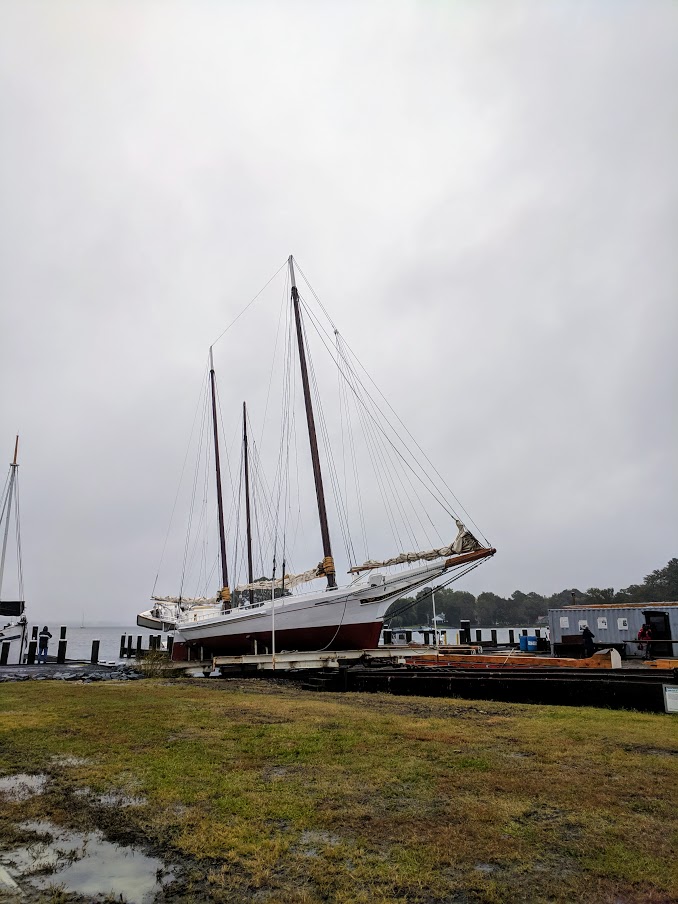
The biggest event at the Oysterfest was the re-lauching of the Edna E. Lockwood, the last existing nine-log bugeye.  John B. Harrison built the Edna in 1887 -- the seventh of the eighteen bugeyes built by Harrison.  The purpose of the Edna, as it was it all bugeyes, was to dredge oysters in the Chesapeake Bay.  With its shallow draft, the bugeye could reach parts of the Bay that were not as accessible to schooners and pungies because of their deeper draft.  The bugeye's lower bulwark, as well as its less complex rigs, made it easier to engage in dredging with less crewmembers.   While a typical bugeye could be expected to be in service for about 20 years, the Edna continued in service until 1967. It outlasted not only the other seventeen bugeye built by John B. Harrison, but also the many skipjacks that were built long after the last bugeye.

The Edna had been gifted to the Chesapeake Bay Maritime Museum with the expectation that it would be restored and used to educate the public about a true Chesapeake tradition.  The latest restoration began in 2016, with volunteers working to restore the log hull. That work continued until it was completed earlier this year, and the vessel was moved to the marine launch for the OysterFest.  

This was the first launching of a vessel that I have witnessed.  There was the traditional opening remarks, along with the thanks to all of those individuals who helped to restore the Edna.  (The Chesapeake Bay Maritime Museum contains its own shop where the work was performed.) This was followed by the traditional breaking of a champagne bottle -- or, in this case, three champagne bottles -- on the bow of the vessel.  After the initial ceremonies, the vessel was slowly lowered into the water, a couple of feet at a time, until the vessel could float on its own.  At that point, the Edna was immediately moored and the celebrations concluded. The Edna will eventually begin a tour of the Chesapeake Bay

Not only is the the first time that I witnessed the launching or relaunching of a vessel. This was also the first time we went to the OysterFest, or, for that matter, any oyster festival.  It was a lot of fun, even with the wind and rain.  To be sure, the weather probably depressed the turnout, which made it a little easier to navigate all of the attractions, vendors and events.  At this point, I have just realized that I did not take any pictures of any oysters from the festival.   

But, I did take some pictures after the OysterFest. We went to a local restaurant where I could sample some Maryland oysters.  This time, I remembered to take a picture so that I could remember the oysters that I tried.  I tried four different oysters.  Two are farmed: (a) Wild Ass Ponies, described as having "good salt content, briny"; and (b) Fisherman's Daughter, described as having "mild salt content, sweet finish.  The remaining two are wild: (c) Deal Island, described as "medium salt, smooth, mild brine"; and (d) Wild Divers, described as "medium salt, full-bodied, buttery."  

All of the descriptions were on the spot and demonstrated the range of Maryland oysters, from salty to smooth, briny to sweet.  The oysters are even better with a local brew, such as the St. Michael's Ale from Eastern Shore Brewing Company (it is photobombing the picture of the oysters).  A red ale with a good malty backbone, the beer was a great complement to the full range of oysters that I tried. 

A great festival, great oysters, great beer and, of course, great company.  This festival has inspired me to make my own oyster stew.  Stay tuned for that.  Until next time ...

ENJOY!

Saturday, September 15, 2018

Project Maryland BBQ: Part 2, Old Line Barbecue Chicken

The first element of any regional barbecue style, in my humble opinion, is the protein. In the Carolinas, whether eastern, western or southern, it is pork. Whole hogs. In Texas, whether it is brisket or barbacoa, it is beef.  In between, either in Kansas City or Memphis, it may be beef or pork, depending upon the cut. (Go north to Kentucky, it is mutton.)  But, what would the protein be in Maryland, if Maryland had a regional style of barbecue?

The protein for barbecue is defined by what is around you.  If you are in the Carolinas, it is hogs, because there are a lot of pigs.  More than four million hogs are being raised in North Carolina alone.  There are more hogs currently in North Carolina than there are people in the entire countries of Bosnia & Herzegovina or Uruguay.  There are more than 12 million cattle cows (for beef) in Texas.  That means there are more cows in Texas than there are people within the borders of Belgium or Cuba.

According to the United States Department of Agriculture, there were only 46,000 cattle for beef production and 26,000 hogs for pork production in the State of Maryland. If there was a barbecue style in Maryland, it would most likely not involve either beef or pork. However, there are 306,700,000 chickens in the State of Maryland.  That's right, there are more chickens in the State of Maryland than there are people in the countries of Pakistan, Brazil or Indonesia.  For a point of reference, there are over 326,000,000 people in the United States.  There are almost as many chickens in Maryland as there are people in this country. 

The location of large scale chicken farms in the State of Maryland.
So, if there is a such a thing as Maryland style barbecue, then the protein would be chicken.  A lot of chicken. And, if one were to drive through the Eastern Shore of Maryland, he or she would agree.  Drive the backroads of the DelMarVa (the region of Delaware, the eastern Shore of Maryland and the Virginian peninsula), and you will see -- and maybe even smell -- a lot of chicken houses.  Many of those chicken houses are owned and run by hardworking chicken farmers (and, just how those farmers are treated by big chicken companies will definitely be the subject of another post, because I have a lot to say on that subject.)  Many more are large scale chicken operations, either CAFOs (Concentrated Animal Feeding Operations) or MAFOs (Maryland Animal Feeding Operations).  (Just what is a CAFO or a MAFO, as well as their impact on the environment, is also a subject for another day.)

Thus, the first element of a regional style of barbecue is in place.  Maryland style barbecue, if it exists or existed, should or would be centered around chicken. Just like Texas style barbecue focuses on beef and Carolina style barbecue focuses on pork.  That is not to say that there can't be beef and pork in Maryland barbecue (after all, there are those 46,000 cattle and 26,000 hogs in the Old Line State).  All it means that we need to nail down a recipe for smoked chicken that could serve as the foundation for Maryland barbecue.

It seems only natural that chicken should be the protein.  After all, there is the Delmarva Chicken, which is a tradition on the Eastern shore. Local groups and firehouses get together, marinate large amounts of chicken, grill that chicken and offer it to anyone willing to enjoy it.  The thing is that Delmarva Chicken is as much barbecue as pit beef is barbecue. The recipes for Delmarva Chicken involve grilling the bird or its constituent parts, as opposed to the low and slow smoking of the meat.

Nevertheless, the recipe for Delmarva Chicken can serve as the basis for Maryland barbecue. It starts with the rub.  Delmarva Chicken calls for a rub of poultry seasoning, salt, pepper, cayenne pepper and garlic powder.  Rather than use poultry seasoning, I think that a good substitute could be Old Bay seasoning.  Old Bay is practically synonymous with Maryland because of its use with our beloved blue crabs.  What is little known (despite the advertising) is that Old Bay can be used in other recipes, including chicken.  With Old Bay, and the remainder of the ingredients, I have the basic rub for Maryland barbecue. 

The recipe of Delmarva Chicken also includes the use of oil and vinegar.  These liquid ingredients could work well with barbecue chicken and provide a distinctive character. Most recipes for Delmarva Chicken, such as this one, call for the chicken to be placed into a bowl, with the rub ingredients added, followed by oil and cider vinegar. Those instructions baffle me a little bit, to be honest, but, if they are rearranged, then they could provide a basis for preparing the chicken.  Place the chicken in a large bowl, whisk the cider vinegar with the oil to create an emulsion, pour that emulsion so that it covers the chicken, both on the skin and underneath, and then spread the rub over the chicken both on the skin and underneath.  The emulsion will help the rub stick to the chicken and, if you get it underneath the skin, it will also flavor the meat.

While the Delmarva Chicken provides the basis for the preparation for the Maryland barbecue chicken recipe, I have to say it ends there.  If you look at Delmarva Chicken recipes, there are no mops (after all, it is grilled chicken).  The recipes call for a "sauce," but, in my humble opinion, the sauce is somewhat questionable in the context of barbecue.  Many recipes describe a sauce that consists of 1 part oil and one part salad dressing or mayonnaise. Salad dressing is out of the equation.  That leaves mayonnaise.  However, a mayonnaise-based sauce for chicken that is clearly and indisputably identified with Alabama barbecue (see Big Bob Gibson's Chicken with White Sauce).  This project focuses on defining Maryland barbecue. Thus, Delmarva Chicken can take us far towards Maryland barbecue chicken, but, just not across the finish line.

In any event, the sauce for Maryland barbecue is a subject of its own, and, it will have its own post in this project.   Until then. the basic recipe for Maryland-style barbecue chicken, which I have dubbed "Old Line Barbecue Chicken" ...


OLD LINE BARBECUE CHICKEN
Recipe adapted from Lang BBQ Smokers
Serves 4-6

Ingredients:
1 whole chicken, spatchcocked
1 1/2 cups of apple cider vinegar
1 cup of olive oil
2-3 teaspoons of Old Bay Seasoning
2 teaspoons sea salt (or kosher salt)
3 teaspoons of freshly ground black pepper
1 teaspoon cayenne pepper 
1  1/2 teaspoons granulated garlic powder
Chunks of hickory, pecan or apple wood
     (I used apple wood)

Directions:
1.  Prepare the chicken.  Place the spatchcocked chicken into a large bowl.  In a separate small bowl, combine the spices (Old Bay, salt, pepper, and garlic powder) and mix well.  In a medium bowl, add the vinegar and then whisk in the oil.  Once the oil and vinegar have been whisked into an emulsion, pour some of the mixture over the chicken, rubbing it into the skin and beneath the skin on the meat.  After the entire chicken is covered with the oil/vinegar mixture, move the chicken to a cutting board.  Apply the rub to all sides of the chicken, both on the skin and under the skin on the meat.  

2.  Prepare the smoker.  Start a chimney and, when ready, place the coals in the smoker.  The desired temperature is 275 to 300 degrees Fahrenheit.  

3.  Smoke the chicken.  Place the chicken on the smoker.  Add the wood chunks to create the smoke.  Smoke the chicken until it reaches 160 degrees Fahrenheit.  Remove the chicken from the smoker and cover with foil.  Let rest for 10 minutes until the temperature comes up to 165 degrees Fahrenheit.  Carve the chicken into pieces - sliced breast meat, thigh, legs and wings for service. 

ENJOY!

Sunday, September 9, 2018

Project Maryland BBQ: Part 1: The Beginning

Barbecue is regional, albeit the names are more local.  There is Eastern Carolina barbecue, with smoked whole hogs served with a piquant vinegar sauce (perhaps my favorite).  There is also Western Carolina barbecue, which is still pork based, but there is an added tomato tang to the sauce.  Then, there is Southern Carolina barbecue, which goes its own way with a mustard based sauce.  Travel west, and one finds Kentucky barbecue, Memphis barbecue, Kansas City barbecue, Texas barbecue and, even further west, Santa Maria barbecue.  Add to all of these the international styles of barbecue, brought to the United States by immigrants who brought their culinary traditions with them (think, barbacoa, for example).  

I am a big fan of barbecue, but I don't live in the Carolinas.  I don't call Memphis, Kansas City or any part of Texas my home.  I live in the Mid-Atlantic, the State of Maryland to be exact.  These questions got me to thinking about barbecue in the State where I live.  To be sure, there are a lot of good barbecue joints across Maryland, and, I have eaten at quite a few of them.  Those restaurants feature barbecue that draws its inspiration from those major regions ... Eastern Carolina vinegar-based pork; pork ribs with the tangy, spicy Kansas City barbecue sauce; and central Texas style brisket.  

If one were to look past the barbecue joints and ask what is true Maryland barbecue, the first answer might be Baltimore Pit Beef with Tiger Sauce.  But, as much as I love pit beef, it does not fit the definition of barbecue, that is, the low, slow cooking of proteins over wood smoke.  Pit beef is more about grilling, using a higher heat to generate a crust on the beef, which is thinly sliced, piled onto a bun and dressed with the sauce.  Others may say Delmarva chicken (which someday will be a post of its own), but that is really just grilled chicken dressed with a sauce that is one part oil and one part salad dressing or mayonnaise.  To be sure, one could have smoked chicken with a mayonnaise sauce; after all, Big Bob Gibson's in Decatur, Alabama perfected it. (You can check out my effort to make the recipe here.)  However, there is little doubt that Delmarva chicken is more about grilling than it is smoking.  

So what is Maryland barbecue?  Is there such a thing as Maryland barbecue?

There is no easy answer to these questions, because there is no accepted concept of a Maryland style of barbecue. That does not mean that it does not exist.  I will need to look around the Old Line State.  I need to go beyond the barbecue joints and focus upon the essence of barbecue: cooking protein over over wood smoke in a low and slow fashion. Even if there is no such thing as Maryland barbecue, I will take the initiative to create one.  Hence, the Chef Bolek's "Project Maryland BBQ" Series.  

A disclaimer ... this entire endeavor is for fun.  Over a series of posts, I will explore those fundamental elements of barbecue -- (1) protein; (2) rubs; (3) mops/sauces; and (4) wood/smoke -- and how they fit into a style of barbecue that could be called Maryland's own. I will also focus on other aspects of barbecue as they would relate to a style. Only time will tell whether or what will come of this endeavor.  Until then ...

ENJOY!

Thursday, November 16, 2017

Mussels, Barnacles, and More

In recent weeks and months, I have gotten back into the routine of not only cooking, but also blogging.  I am averaging about a post a week, and, I have a healthy number of posts in the works.  I hope to be cooking even more and posting even more, even though I probably will never return to the number of posts that I was doing back in 2011 or 2012.  

But, I am taking this brief break to blog about another interest of mine ... photography.  It may not show in the pictures of the various dishes that I make, but I like to take pictures.  Setting aside my family, who are the subject of a majority of my pictures, the rest are generally of food, animals or landscapes. 

Recently, I was working on a wine review.  For that review, I went back to find some pictures of the vineyard. The pictures were from my honeymoon with my beautiful Angel.  We spent a little more than a week in Oregon.  The trip started in Portland, worked its way through Willamette Valley and ended on the coastline in Pacific City. 

While we were in Pacific City, we walked the coastline.  I was amazed by the wildlife that was exposed by the low tide.  Mussels, barnacles, starfish, crabs, and so much more. I took a lot of pictures during those couple of days.  Lots and lots of pictures.  

So, as a break from what I have been working on and posting on this blog, I have decided to post a few pictures of the wildlife that lives around the coastline near Pacific City, Oregon.  As I write this post, I have been thinking about how this wildlife could be harvested and find its way onto a plate.

Picturing a dish of mussels is fairly easy. I have made quite a few of them. Some of those dishes have made it to this blog, such as Malabar Mussels, Curried Haddock and Mussels, and Green Mussel Soup.  The great thing about museels is that the dish does not even have to be fancy or complicated.  Just put handfuls of mussels in a steam pot along with a heaping helping of minced garlic.   Wait a couple of minutes and you have a very basic and very delicious meal of steamed mussels. 

Picturing a dish of barnacles is far more difficult. Barnacles don't line the shelves of the grocery stores around where I live.  They also don't grace the menus of the restaurants of where I eat.  (If either was the case, I would have probably tried to cook them and eat them by now.)  However, I do know that barnacles -- or at least gooseneck barnacles -- are edible.  I know that because I watched an episode of Bizarre Foods, in which Andrew Zimmern went foraging for gooseneck barnacles in Oregon.  

A quick Google search also produces some recipes for gooseneck barnacles.  Another google search provides results for places where you can purchase the barnacles online, such as La Tienda, a store that I trust that sells the barnacles by their Spanish name, percebes.  Unfortunately, I am not willing to wait two weeks for a delivery of percebes; and, moreover, I am not willing to part with over $100 for the ingredient.  While I am sure I could find barnacles cheaper elsewhere online, I don't want to think about where those barnacles may have been.  

While I can almost guarantee that there will be more mussel recipes on Chef Bolek in the future, I hope that maybe someday there will be a barnacle recipe too.  Only time will tell.  Until then...

ENJOY!

Saturday, May 20, 2017

A Caboose, an Old Ox and a Lost Rhino ... A Journey Through Northern Virginia Craft Beer

A year ago, for my birthday, my beautiful Angel took me on a tour of Maryland's farm breweries, such as Red Shedman and Milkhouse Breweries. This year, the tour went across the Potomac to the State of Virginia.   The Old Dominion State has a lot of craft breweries.  Until a week or two ago, the only craft brewery that I visited in Virginia had been Port City (which, by the way, is a very good brewery and whose Porter I have previously reviewed).  My birthday celebration took me to three different breweries in Northern Virginia ... a caboose, an old ox and a lost rhino.  The trip touched the whole range of brew styles.

THE CABOOSE

The first stop was Caboose Brewing Company in Vienna, Virginia.  The brewery is located at end of an industrial complex (as many craft breweries are).  The Caboose had over twelve beers on draft,  providing a wide range of styles to choose from.  I decided to do a flight of beers, so that I could pick from that range.  I tried the Crazy Train Tripel, the Citra Session IPA, the Stop, Drop & Doppelbock and the Gandy Dancer, which was a Schwartzbier.

All four beers were very good, but my favorite was probably the Crazy Train Tripel.  Setting aside my preference for Belgian beer styles, the Crazy Train hit the mark when it came to the style.  Elements of bananas and cloves were both on the nose and the palate, with the slight sweetness from candy sugar.  With a 9.0% ABV, there was a little booziness in the background.  The Doppelbock was also very good, with a light coffee taste accompanied by some raisin notes.  While this beer had an ABV of 8.2%, it was lighter than the tripel and a little deceiving in that respect.  The Schwartzbier also represented its style well, with the roasted malts suggesting dark roast coffee and well toasted bread.   The Citra Session IPA was good, providing a little citrus bitterness that one expects with a session pale ale.

THE OLD OX

The next stop was Old Ox Brewery, located in Ashburn, Virginia.  The name comes from one of the oldest roads in Loudoun County, which connected farmers to the markets.  Old Ox is a familiar name, as I have seen six packs of their beers -- such as the Alpha Ox Session IPA and the Golden Ox Belgian Style Golden Ale -- in local grocery stores.   However, I have to admit that I never had their beer, before this trip.  

I started first with the rarest beers offered on the board that day ... a collaboration between Old Ox Brewing and Ocelot Brewing, which is another Virginian craft brewery.  The beer was named Sir Oxcelot, and was a Belgian Quadrupel.  (Remember, I am a big fan of Belgian beer styles.)  This Quad,  rang in at a whopping 14.3% ABV.  This makes any description about it being boozy perhaps the most obvious statement one could make about the beer.  Still, the beer poured a nice dark brown, with notes of toffee and caramel in both the nose and the palate.  There was also some dark berry notes which I could not really place. 

Although one beer would have been enough, I did not know when I would be back in Ashburn, Virginia.  So, I also tried the Hoppier Place Powder to the People Imperial India Pale Ale.  This beer was relatively lighter when it came to the ABV, registering just 8.5%.  This ABV ensured a smoothness to the Imperial IPA, but the hops were aggressive enough so that the piney notes gripped the edges of the tongue with every sip.   Both are great sipping beers, which allowed me to sit back and relax a little with my beautiful Angel, as we watched our kids try to understand corn hole  (Needless to say, they did not quite get the game, but they nevertheless had fun trying to get the beanbags through the hole.)  

The two beers - the Sir Oxelot and the Hoppier Place -- were both very good beers.  I wish were bottled or canned, because I would have bought a couple to go.  Needless to say, I just bought a six pack of their Hardway Summer Lager. 

THE LOST RHINO

The last stop was the Lost Rhino Brewing Company, which was just a mile or two from the Old Ox.  Just like Old Ox, I have seen various beers from Lost Rhino in the grocery stores; and, I had not tried any of them before this visit.  The tap room had about eight different beers on tap, some of which were styles that I had not seen at either Caboose or Old Ox.  I decided to try a couple of them.  

First, I decided to try the Meridian Kolsch.  This was perhaps the lightest beer that I had tried during this trip.  It was refreshingly different, with a light yellow appearance that could have been mistaken for a hefeweizen.  The kolsch was a well balance of malts, both Pilsner and wheat, with just a hint of hops.  An easy drinking beer, as most kolsch beers are.   The only question was which beer to try next.  Having had an easy drinking beer, it was time to try the exact opposite.

That would be the Alphabrett beer.   This is a Belgian-style brown ale.  It is first brewed with a Belgian yeast (St. Bernardus) and then is aged for two years in wooden barrels with Brettanomyces or "Brett."  This is the name for wild yeast, which were in the barrel.  

The result is a very sour beer, which would probably turn off the casual beer drinker.  However, if you are someone who loves craft beer, especially trying something different, then this is the type of beer you should seek out and try.  The Alphabrett pours a light, wooden brown, and its aromatic elements provide advance warning of the sour notes from the wild yeast.  The flavor of the beer is a sour, slightly puckering green apple.  The Alphabrett was a great way to end an adventure through Northern Virginia craft beer. 

In the end, another successful expedition through craft beer of a region.   I can't wait until my next birthday.  Too bad I have to wait a year.  Until that time ...

ENJOY!

Wednesday, May 18, 2016

Farm to Brewery in the Free State

Recently, my beautiful Angel, Clare, organized a surprise for my birthday.  She kept all of the details under wraps, except one: we would be having a picnic.  That's it: a picnic.  All of the other details, such as where we were having a picnic were a mystery.  While a picnic with my wife is a birthday treat in and of itself, I knew that she had other plans.  I also know that she knows me very well.  Just how well she knows me was reinforced when I learned of my surprise: a tour of a couple of Maryland's Farm to Breweries.  Farms + Breweries = a very happy and intrigued Keith!

The Farm-to-Brewery movement in Maryland was sparked by a bill passed by the state legislature a few years ago.  That bill created a new license -- known as the Class 8 Farm Brewery License -- which allows farms that grow hops to produce their own beers.  Not only could farmers produce their own beer, but the license allows them to sell the beer on premises, as well as to distributors or individual customers.  However, farmers are limited to just 15,000 barrels per year (that's 1,840,000 pints of beer).  The farmers must also use at least one ingredient grown on the farm, such as barley or hops, (the other ingredients do not have to necessarily come from the particular farm in question).

The first stop in our tour was Red Shedman Farm Brewery & Hop Yard.  The name "Red Shedman" hearkens to a story of the owner's father about a mysterious stranger who lurked in the red shed in the yard.  The father told the story to explain the source of mysterious sounds -- the bumps in the night -- to his frightened children.

Needless to say, the Red Shedman now refers to the Farm Brewery, whose buildings are all decked out in a solid barn-red color.  The farm cultivates Cascade, Chinook, Columbus, Nugget, and Crystal hops,  It does so only on one-half acre of land, which is a small area compared to the 70 acres of grapes grown by Linganore Cellars, which is owned by the same family. Nevertheless, that half-acre of hops makes its way into the beer, such as the Pump House IPA.

The Pump House IPA -- a West Coast Style IPA, produced with farm grown hops and supplemented with Amarillo and Summit hops -- was one of six beers that I tried during our visit.  I also tasted the Utopia, a farmhouse Belgian Saison that was well balanced.  (The only negative I can say about that beer is that my sample kicked the keg and there was no more for a pint.)  I also tried the Suicide Blonde Nitro, which was an adept combination of a classic Belgian Wit and a dry-hopped India Pale Ale.  The Suicide Blonde featured the best of each style -- the lighter, fruitier aspects of a wit with the bitterness of the IPA.  I also tried the Lunatic Fringe, a "lightly aged" Habanero IPA.  This beer had just the right heat from the habanero peppers but still allowed someone who is not accustomed to such heat to enjoy the beer.  The last two beers that I tried were the Grinder Espresso Stout -- a Chocolate nitro stout blended with Colombian coffee -- and the Honey Bourbon -- a limited release aged in bourbon barrels.  All in all, the flight provided a range of beers that were very good.  The best of the beers was the Pump House IPA (although the Utopia was a close second).

After sampling the beers, we moved on to the second stop on the farm to brewery tour ... Milkhouse Brewery at Stillpoint Farm.   The Stillpoint farm raised sheep, cultivated hops and even had an apiary.  However, the owner was a home brewer and wanted to pursue brewing as a way to supplement his income. (After all, a farmer could make more money selling beer than selling hops.)  He worked with farmers, brewers and officials to help to pass the law that gave rise to the Class 8 Farm Brewery License.  The owner then opened the Milkhouse Brewery, which was Maryland's first farm-to-brewery operation.  

We sampled nine beers at the Milkhouse brewery, which spanned the spectrum of beer styles.  There was the Dollyhyde Petite Farmhouse Ale (a Belgian "Patersbier" made with honey from the Stillpoint farm), the Goldie's Best Bitter (dry-hopped with Chinook hops from the farm) and the Homestead Hefeweizen, which was a very good example of the style.  We also sampled a couple of IPAs, including the Throwback IPA and the Stillpoint SMaSH Pale Ale, both of which were good.  Another noteworthy beer was the Petite Summer Sour.  While Clare did not care for the beer, I thought it was very good for a sour.  The beer was tart, full of a lemony citrus character, and light on the tongue. It would make a very good palate cleanser.  We also had the Coppermine Creek Dry Stout, which was good, and a couple of other beers, whose names escape me at the present time.  Overall, the Milkhouse Brewery had several beers that were standouts, such as the Hefeweizen, the Summer Sour and one of the pale ales (whose name I cannot remember).

In the end, this little foray into the farm to beer movement was a great introduction to the types of beers that could be produced by farmers-turned-brewers.  It also provides us with a new way to support local businesses.   And there are more such local businesses to support, including Manor Hill Brewing, Ruhlman Brewing and even the Brookville Beer Farm, which will be opening close to where we live in the near future.

So, there will be more to come.  Stay tuned!