Showing posts with label Juniper Berries. Show all posts

Saturday, December 6, 2025

Roast Turkey, Wild Onions, and Maple Squash

"We will be known forever by the tracks we leave." 
-- Words of wisdom from the Dakota People

Thanksgiving is supposed to be a day in which we give thanks for all of our blessings over the past year. The holiday draws inspiration from events, partly historical and partly fictional, that transpired in the fall of 1621. The pilgrims of the Plymouth colony (that is, white colonizers) organized a feast to celebrate their successful harvest, giving thanks for the cultivation of food that would support them through the winter. 

That's where the history ends and much of the fiction begins. Subsequent generations would be taught that the feast was one shared by grateful pilgrims and their neighbors, the indigenous Wampanoag people. That is not entirely accurate. The feast was initially a white person, pilgrim/colonizer affair, because they did not initially invite the Wampanoag to the feast. Rather, the Wampanoag arrived after hearing gunshots fired off by celebratory pilgrims, thinking that the pilgrims were under an attack. Only after they arrived were the indigenous people allowed to stay and join in the feast. 

Thanksgiving was, and continues to be, built upon a myth of celebration and cooperation between white colonists and the indigenous people. The actual history -- over four hundred years of it -- defined what would become the United States. That definition includes the forced displacement and death of a majority of the indigenous people, removed from the land upon which their ancestors built not only comunities but also entire cultures and societies. Much of those civilizations have been lost, as the United States established itself, and expanded itself, at the expense of the indigenous peoples, nation after nation. 

Those are the tracks that we have left as a country and as "the American people." It is a path hardly discussed because holidays like Thanksgiving have us looking anywhere but down at our feet. So, for this particular Thanksgiving in 2025, I thought I would do something other than express gratitude for my blessings. I am looking down at my feet, at the ground.

The particular context of my feast unfolded in the city of Crisfield, Maryland, where my beautiful Angel and my wonderful family took a short trip during the holiday weekend. I found a lovely house in Crisfield, Maryland (more about that in another post), where I would prepare our holiday feast with help from our family. The city of Crisfield lies on a peninsula that was originally the home of the Annamessex people, who, in turn, were part of the Pocomoke Paramountcy. As an aside, the colonizers who reached this penninsula referred to it as the "Annamessex Neck." 

It is difficult to find much about the Annamessex people, but there is more out there about the greater Pocomoke nation. That nation stretched across the eastern shore, particularly along the Annamessex, Manokin, and Pocomoke rivers. They were organized into communities, with women and younger children growing corn, beans and squashes, while men and older boys hunted, trapped and fished. The Pocomoke were also traders, producing wampum, which are the shell beads and belts, and peake, which are darker beads made from clams. In addition to trading wampum and peake, the Pocomoke also crafted dug-out canoes that they used for transport and trade. 

As European colonizers settled in Annamessex Neck, the indigenous people were driven from their lands. The colonizers claimed the territory, refused to allow indigenous people to hunt on the land, and, with the assistance of the local and state governments, forced the Annamessex onto a reservation located at Askiminokonson, near present day Snow Hill, Maryland. Eventually, the white colonizers claimed that territory, leaving the Annamessex, along with the greater Pocomoke nation, with nothing. 

I have been unable to locate any Annamessex or even Pocomoke recipes for a turkey. This particular roast turkey recipe comes from Sean Sherman, an Ogala Lakota chef who has made it his mission to preserve and advance indigenous cuisine. He focuses upon both the ingredients and cooking processes used by indigenous cooks across Turtle Island. (I also used his recipe for wojape to serve alongside the turkey). 

I have to admit that I had some concerns, because the recipe did not call for a stuffing. I have always prepared roast turkeys with stuffings, using the latter to help regulate temperatures and add flavors to the meat. Fearful that I would overcook the bird without a stuffing, I decided to utilize a stuffing from Renewing America's Food Traditons, a book written by Gary Paul Nabhan. A first-generation Lebanese-American, Nabhan is an Agricutural Ecologist, Ethnobiologist, and Franciscan brother. He has worked with indigenous peoples, particularly in the southwestern United States and Mexico to preserve their foodways and advocate for their sovereignty. This particular stuffing comes from the opposite side of the United States, with a recipe offered in connection with a discussion of the endangered Naragannsett Turkey. The stuffing is not a traditional one that would be served alongside the bird. Instead, it consists of ingredients intended to provide additonal flavors to the meat. 

With these recipes in hand, I proceeded with Chef Sherman's Roast Turkey, Wild Onions and Maple Squash recipe. The overall dish provided a great example of indigenous foods could be prepared by indigenous peoples like the Annamessex. Wild turkeys are found across the State of Maryland; and, as noted above, the Annamessex cultivated squash. They could have easily gathered wild onions from around their village, along with other ingredients, such as juniper berries, which could have been gathered from the eastern red cedar trees or perhaps the common juniper (before it went locally extinct in the State of Maryland). 

In sum, this dish and my heart is with honoring those who were originally present and thriving here, long before any Spanish explorer or English colonizer ever set foot on dry land in this hemisphere. I also want to acknowledge the tracks that have been left over the centuries, and, for what that means when it comes to the United States. Our greatness (if it can be called that) came with a tremendous cost, a price not paid by those who benefitted the most, year after year, decade after decade, generation after generation. If we want to truly be known as a great country (however that could be defined), then that requires us to come to terms with our past. Otherwise, we can never truly achieve greatness as a country.  

ROAST TURKEY, WILD ONIONS AND MAPLE SQUASH

Recipe from Sean Sherman, The Sioux Chef's Indigenous Kitchen, pg. 107

Additional cavity stuffing recipe from Gary Paul Nabhan, Renewing America's Food Traditions, pg. 125

Serves 8

Ingredients (for the roast turkey):

  • 1 small turkey (about 10-12 pounds)
  • 1/4 cup hazelnut oil
  • 2 tablespoons chopped sage
  • Coarse salt
  • Crushed juniper
  • 2 cups corn, wild rice, or turkey stock
  • 4 wild onions or 2 large onions, quartered
  • 1 cup wild mushrooms, chopped
  • 2 cups winter squash, cubed
  • 1/4 cup maple syrup

Ingredients (for the cavity stuffing):

  • 2 tablespoon sea salt
  • 1 teaspoon freshly ground black pepper
  • 1 tablespoon dried marjoram or sweet basil leaves
  • 1/4 cup finely chopped flat-leaf parsley
  • 1/2 cup whole wheat bread crumbs
  • 1 tablespoon unsalted butter
  • 1/4 cup chopped celery stalks
  • 1 small white onion, chopped

Directions:

1. Prepare the turkey. One hour before roasting, remove the turkey from the refrigerator and bring to room temperature. In a blender, puree the hazelnut oil and sage and rub over the turkey. Season with salt and juniper.

2. Prepare the cavity. Rub the cavity with a mixture of 1 tablespoon of salt, 1/2 teaspoon of pepper, all of the basil or marjoram, and some of the chopped parsley. Combine the bread crumbs, lump of butter (mixed with salt and pepper), the rest of the parsley, chopped celery and onion. Stuff the mixture into the cavities of the turkey. 

3. Roast the turkey. Preheat the oven to 450 degrees Fahrenheit. Place the turkey in a roasting pan, add the stock and put in the oven. Roast until the turkey is a light golden brown, about 45 minutes. Reduce the oven temperature to 350 degrees Fahrenheit and continue roasting. After about 1 1/2 hours, scatter the onions, mushrooms and squash into the roasting pan and baste the turkey and vegetables occasionally with the pan juices. Continue cooking until the an instant-read thermometer inserted into the thigh reads 160 degrees Fahrenheit, about 30 minutes to 1 hour longer. Brush the turkey with the maple syrup. 

4. Finish the dish. Remove the turkey from the oven and transfer to a cutting board. Arrange the vegetables on a platter. Carve the turkey and arrange over the vegetables. Drizzle the pan juices over all. Serve with wild rice and cranberry sauce or wojape.  

PEACE.

Tuesday, September 19, 2023

Sumac Navajo Leg of Lamb with Onion Sauce

As the Navajo (Dine) chef and author, Freddie Bitsoie recounts the Navajo story, "there was a thick fog for four days. No one could see their hand in front of their faces, and people were growing worried and scared. But, when the fog lifted, little cloud puffs were left behind: the sheep."

Sheep are not indigenous to the North American continent. The "fog" that brought the sheep there were Spanish conquistadors and colonizers. The person credited with bringing sheep to the area where the Navajo lived is Don Juan Onate, a conquistador who would later become governor of Santa Fe de Nuevo Mexico. He brought 2,900 hundred sheep with him and Spanish settlers, who continued to raise those sheep on ranches throughout the province. Apart from bringing sheep to the region, Onate is known for his massacre of indigenous people of the Acoma Pueblo. 

Onate embodies the reason why the Navajo were worried and scared of that fog of colonization (as history has shown, see books like Sundberg, Dinetah and Denetdale, The Long Walk). When the fog lifted, the Navajo found themselves on a reservation that spans an area larger than West Virginia. That reservation covers a hot, arid region that crosses over the political boundaries that separate Arizona, Utah, and New Mexico 

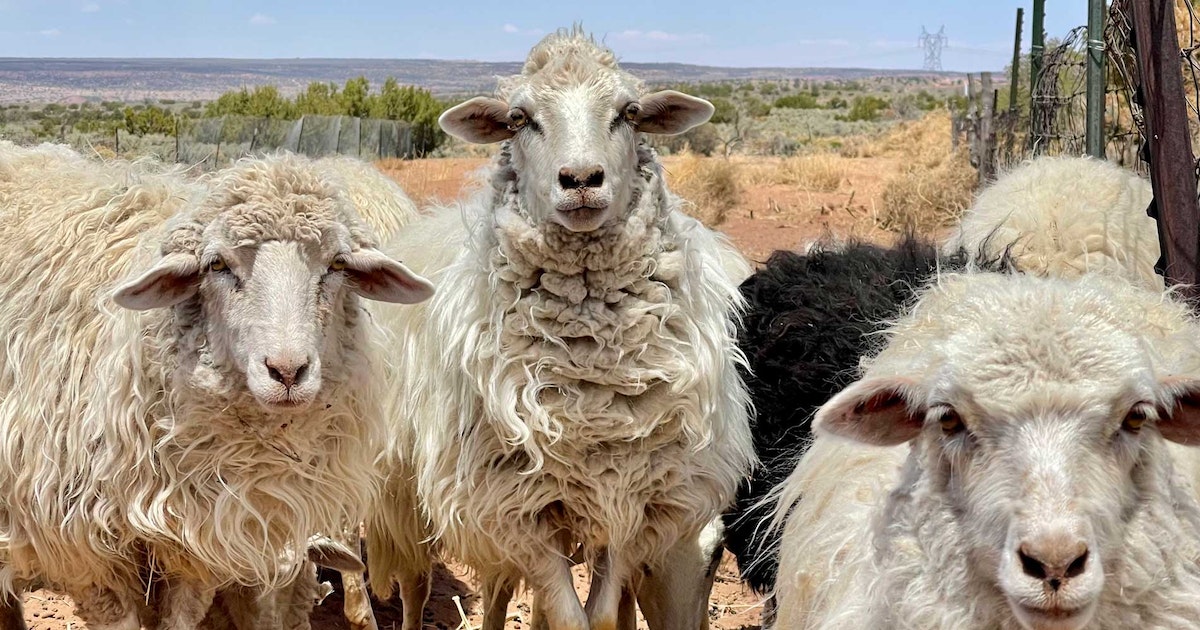
Nevertheless, the Navajo accepted in those "little cloud puffs." The Navajo Churro sheep are descendants from the original stock brought to the new world by the Spanish. The Navajo obtained the sheep from the Spanish, whether by trade with the Spanish or raids on their settlements.  The Navajo had great success in raising these sheep, which grew in numbers until they were more than 574,000 in the 1930s. 

Navajo Churro Sheep (Source: Nikyle Begay)

However, the drought conditions at the time led the United States to engage in a forced reduction. The reduction resulted in a loss of about 30% of a household's livestock, including sheep, cattle and horses. For the Navajo, the forced reduction was as painful as the Long Walk. The stocks of Navajo Churro continued to decrease until the point that they faced extinction. Efforts were made to revive the numbers of sheep, which have been largely successful. 

Although not an animal native to North America, the Navajo Churro has nevertheless assumed an important place within Navajo culture. The stocks may have declined, but Navajo have continued to raise the sheep throughout the years. They have also used the wool, spinning it and dyeing it to produce fibers that make their way into clothing, blankets, rugs and decorative arts. 

In addition to the wool, the Navajo have used the meat of the lamb and sheep in various dishes. Recipes have been developed over generations, and indeed centuries, that feature this protein. One common recipe is Navajo Lamb Stew. This recipe combines mutton with carrots, onions, potatoes and cabbage for a dish that is ideal on cool to cold nights.

Another recipe is this Sumac Navajo Leg of Lamb with Onion Sauce. The recipe is an inspiration of Chef Bitsoie, drawing from his memory of his grandfather, who would roast lamb over a fire and then serve it with a sauce made out of chopped onion. His grandfather did not necessarily use sumac, but Chef Bitsoie thought that the flavor of the sumac worked well with the lamb. (He is correct.)  He used juniper berries and rosemary in the onion sauce because he believed that his grandfather would have foraged those ingredients while he was herding the cattle and sheep in the mountains. 

The use of sumac drew my attention to this recipe. It pairs a non-indigenous protein with a very indigenous little sumac berry. There are 14 species of sumac that grow only in North America. The range of these species runs from southern Quebec across to southern British Columbia, and then south to northern Florida and across to northern Arizona. 

The sumac berry is known for providing a lemony element to dishes, which was part of the overall balance to this dish. The slightly bitter, lemon flavor brought by the sumac berry complements not only the rich taste from the leg of lamb, but also the sweetness of the onion sauce. That balance makes this dish one of the best leg of lamb dishes that I have made in a very long time. 

SUMAC NAVAJO LEG OF LAMB

Recipe adapted from Washington Post

Serves 6-8

Ingredients (for the lamb):

  •  One three pound leg of lamb or tied lamb roast
  • 1 teaspoon fine salt
  • 1 teaspoon freshly ground black pepper
  • 1/3 cup (1 1/2 ounces) ground sumac
  • 3 tablespoons canola oil

Ingredients (for the onion sauce):

  • 2 tablespoons canola oil
  • 1 large yellow onion, halved and thinly sliced
  • 2 sprigs fresh thyme
  • 1 spring fresh rosemary
  • 5 dried huniper berries
  • 1 teaspoon fine salt
  • 1 teaspoon freshly cracked black pepper
  • Water, as needed
  • 2 cups chicken stock

Directions:

1. Prepare the lamb: Heat the oven or a grill to 375 degrees (or heat a smoker to about 275 degrees, and smoke some oak or mesquite wood chunks for about 1 hour). Season the lamb on all sides with salt and pepper, then coat the lamb on all sides with the sumac.

2. Brown the lamb: If you are going to roast the lamb, heat the oil in an ovenproof skillet over high heat, heat the oil until it shimmers. Add the meat and sear on all sides until evenly browned, about 8 minutes. If the lamb is going on the grill or into a smoker, then skip this step. 

3. Roast/Grill/Smoke the lamb. Transfer to the oven to roast for about 40 minutes or until a thermometer inserted into the center reaches 145 degrees for medium-rare. Depending upon the size of the lamb roast, it may take longer to reach that temperature. If using a grill or smoker, place the lamb on the grill and cover. Grill or smoke the lamb until it reaches 145 degrees.

4. Prepare the onion sauce. While the lamb is roasting/grilling/smoking, in a medium saute pan over high heat, heat the oil until it shimmers. Add the onion, thyme, rosemary, juniper berries, salt and pepper. Lower heat to medium and cook, stirring often until the onions are soft and brown, about 20 minutes. If the onions begin to stick,  or darken in any places, stir in a splash of water and adjust theheat. Once browned, add the stock and simmer until the liquid is reduced by half, about 10 minutes. Remove from the heat and discard the herb stems and juniper berries.

5. Finish the dish. When the lamb is done, remove it from the oven and let it rest on a cutting board for 10 minutes before slicing. Serve warm, with the onion sauce on the side. 

ENJOY!

Saturday, February 4, 2023

Native American Inspired Rib Roast

In my continuing quest to learn more about the cultures behind the cuisines, I have spent a lot of time reading about different indigenous cultures across North America (that is, the Canada, the United States and Mexico). One aspect of this educational endeavor has been to learn about the native ingredients that these indigenous cultures had to cook with, long before the arrival of conquistadors, colonists and more. I have been helped greatly by reading the books of, as well as following the work of, Native American chefs, like Sean Sherman.

Their work has opened my eyes and my understanding that there is more to the history of ingredients than what I have already learned or what I know. Just a few years ago, if someone would have asked me what cuisines would have incorporated juniper berries, my first thoughts would have taken me to Northern Europe or Eastern Europe. If someone asked me which cuisine utilizes sumac, I would have reflexively answered Turkish or Persian cuisines. I would never have thought to respond with Sioux, Ojibwe or any other Native American nation. Yet, both of these ingredients - juniper and sumac - have their place in Native American cuisine. 

All of this knowledge inspired me to create a rub based upon ingredients available to Native Americans before the colonial period. I knew going into this effort that I would be using juniper berries. That was the first ingredient. I needed to build around those berries. Fortunately, I found someone else who has been inspired by Chef Sherman: home chef Brad Prose, who has his own website, Chile and Smoke. I highly recommend the website. 

Prose has a recipe for a juniper spiced rub, which helped me to build this recipe. I used the proportions of coriander seed, Kosher salt and whole black pepper that can be found in his recipe, although I converted everything roughly from grams to teaspoons or tablespoons. As an aside, I should note that whole black peppercorns are native to South Asia and Southeastern Asia. I left peppercorns in because, from what I understand, there are native American equivalents that could have been used to achieve the same flavors and effects. 

I was less certain about other ingredients in Prose's recipe.  First, I left out the sugar, as Chef Sherman has left out sugar cane from his dishes. I also left out the chile flakes and garlic powder. My focus for this rub was more towards the Plains (for a reason I discuss further below), rather than the Southwest. This mean that chiles were less likely to be used (and it provides a future opportunity for a Native American inspired rub focused on the Southwest, as I have a lot of ancho peppers, chipotle peppers, and hatch peppers). As for the garlic, it is my understanding (right or wrong), that garlic was brought to the Americas by European settlers. While I am not sure about that understanding, I decided that I could leave it out.

Sumac (Source: Gardener Cook)

Setting aside the sugar, chiles and garlic left some holes that needed to be filled. At this point, I turned to what I learned. Sumac is native to all 48 contiguous United States and it has been used by Native American cooks to impart citrus notes to dishes. Adding sumac to this spice blend compounds the citrus notes provided by juniper berries. Rather than balance that citrus with the sweetness of sugar, I decided to go with dried thyme, which imparts earthier notes with hints of spice and sweetness. 

This rub had a specific purpose. I wanted to prepare a rub that could be used with a bison roast. Bison had an importance place in the cultures of the Plains tribes, such as the Sioux, Cheyenne and Arapaho. These cultures used the bison not only for food, but they used all of the bison - for their shelter, clothing, jewelry and much more. And, at one point, there were tens of millions of bison that roamed the Plains of North America. However, the bison were nearly wiped out as part of a systematic and largely successful effort to remove Native Americans from their lands by depriving them of this important food resource. By the 1880s, the large herds of bison had largely vanished, and the native cultures that relied upon the bison were severely impacted. That is history. Today, there are more than 60 tribes working to restore the herds, both on their tribal lands and in federal parks. The tribes and the federal government are even working together in the State of Montana through the Interagency Bison Management Plan. The Plan has the goals of promoting a free range bison population, while minimizing the risk of diseases and managing those bison that leave Yellowstone and enter the State of Montana.

Source: National Park Service

While I wanted a rub for a bison roast, I did not have one for this recipe. Instead, I had a beef rib roast. I have found that, to a large degree, bison and beef recipes are interchangeable as long as one important principle is kept in mind: bison has far less fat than beef (especially the beef produced in the factory farm setting). Thus, if I was using a bison roast, I would probably baste it more often and perhaps pull it out of the oven at a slightly lower temperature (such as 125 degrees Fahrenheit). 

While I had been holding on to the beef rib roast for a special occasion, honoring the cuisines of Native Tribes and making the effort to learn more about their cultures is just as good of an occasion.

NATIVE AMERICAN INSPIRED RIB ROAST

Recipe adapted from Chile and Smoke

Serves several

Ingredients (for the Spice Rub):

  • 2 1/4 tablespoons of Kosher salt
  • 2 tablespoons of whole black pepper
  • 4 teaspoons whole coriander seed
  • 2 teaspoons juniper berries
  • 2 teaspoons ground sumac
  • 2 teaspoons dried thyme

Ingredients (for the Prime Rib):

  • 1 standing rib roast, beef or bison
  • Vegetable or canola oil
  • 1 cup water, beef stock or beef broth

Directions:

1. Prepare the spice rub. Toast the whole spices (black pepper, coriander seed and juniper berries) in small skillet over medium to medium-low heat, until fragrant, move the spices around to avoid them from becoming burnt. Allow the spices to cool down and then combine with the ground and dried spices.

2. Cook the Roast. Preheat the oven to 325 degrees Fahrenheit. Place the rib roast in a roasting pan with about 1 cup of water, beef stock, or beef broth. Cook the rib roast, covered, for about three hours; however, check the temperature after two and one-half hours. 

3. Finish the cook. When the internal temperature of the roast reaches about 125 degrees Fahrenheit, which is about medium rare. Pull out the roast, leave it covered and let it rest for about 15 to 20 minutes. The roast should cook another 5 to 10 degrees.

ENJOY!