Showing posts with label Octopus. Show all posts

Friday, April 24, 2026

Haitian Style Spicy Grilled Octopus

Octopuses can be found around the Caribbean Sea; and, as one could expect, they make their way onto the plates in restaurants and homes from Jamaica to Dominica. I recently decided to make a Caribbean-inspired octopus recipe. As I searched for a recipe to make, I came across a recipe from a Haitian blogger, food photographer and recipe developer, Annick Megie. The recipe looked like it was something I could make and the dish looked beautiful (Megie is, after all, a food photographer). 

The recipe was even simpler for me because I had purchased pre-cooked octopus. I have worked with raw octopus, and, I have a place where I could easily buy one, but the cooked version was what I had on hand when I was looking to make the recipe. If you have a pre-cooked octopus, you can skip to step 3 in the recipe below. If you don't, then you should follow steps 1 and 2 (especially the dipping the octopus first before you completely submerge it). 

In terms of white wines to use to cook the octopus, think of something that you could pair with the dish when it is ready to eat. Some easier to find wines might be an Albarino from Galicia, Spain; or a Vinho Verde from Portugal. If you are able to search a little more, perhaps a Vermentino from Sardinia, Spain; or a PicPoul de Pinet from Langudoc, France. Basically, you want a lighter, more mineral wine. The opposite of an oaked Chardonnay. (An unoaked Chardonnay would work well.)

As I researched the use of octopus in Haitian cuisine, I read an article (which I am now unable to find again), about how fishermen in the northern coastal cities (most likely Cap-Haitien, but I would like to think it included smaller cities like Labadee or Basse-Terre) would bring back octopus as part of their daily catch.  However, while most of those in the Haitian boat-fishing is done by men, there are women who catch octopus and turtles. That enables women to go beyond their traditional roles in the fishing industry, which focuses more on the processing and selling of the catch. 

Although it is not Haitian, this link will take you to a videostory, Felicia: The Life of an Octopus Fisherwoman, which tells the story of an octopus fisherwoman in Madagascar. While the film tells the story of a fisherwoman half-way around the world, there are commonalities in the life-experiences. Madagascar is one of the poorest countries in Africa, just as Haiti is the poorest country in North America and the Caribbean. Large populations live at or below the poverty line, doing the best to survive on a daily basis. They compete for resources, not just with each other, but with outsiders - like large fishing fleets - that often win the battle. The result is overfishing and environmental degradation, leaving less for the local fishermen and women to feed their families or sell at the market. The experience of Felicia may very well be the experience of women living in poverty along the coastlines of Haiti, or many other places around the world. 

A reminder that, behind a pretty plate of grilled octopus, there are people struggling just to survive. It is struggle shared by the poor around the world, from Haiti to Madagascar, from the United States to Australia.

HAITIAN STYLE SPICY GRILLED OCTOPUS

Recipe from Tchakayiti

Serves 4

Ingredients (for the broth):

  • 1 medium-sized ctopus, previously cleaned
  • 1 cup of white wine
  • 2-3 cups of water, enough to submerge the octopus
  • 3 bay leaves
  • 3-5 garlic heads
  • 1 teaspoon cayenne
  • 1 teaspoon chile powder
  • 1 teaspoon paprika
  • 1 teaspoon salt
  • 1 teaspoon pepper

Ingredients (for the sauce):

  • 5 shallots chopped
  • 1/2 red onion, chopped
  • 1 piment bouc (or scotch bonnet) chopped
  • 3 limes, juiced
  • Olive oil
  • Fresh parsley

Directions:

1. Prepare the octopus.  In a pot, combine all of the broth ingredients. Make sure to add enough water to cover the octopus. Bring all the ingredients to a boil. Let simmer for about 10 minutes for the flavors to be infused. Dip the octopus in the water 2 or 3 times for about 10 seconds each time. This helps the tentacles curl up. Submerge the octopus completely in the broth. 

2. Cook the octopus.  Cook for about 45 minutes to 1 hour, until the octopus is tender. Be careful not to overcook it for that can have the reverse effect and make your octopus chewy. Take the octopus out of the water and cut it into small pieces. 

3. Make the sauce. In a bowl, combine the spicy sauce ingredients. Drizzle the sauce atop the cut octopus. 

4. Marinate the octopus.  Cover and let marinate in the fridge for a few hours.  

5. Finish the dish.  Fire up the grill. Grill the octopus for about 5 to 10 minutes for each side or until it is crispy on the outside. Serve immediately. 

PEACE.

Saturday, July 12, 2025

Grilled Octopus, Roasted Salsa Verde, Tomato Piquillo

For the past several years, my work would take me to Fort Lauderdale, Florida. Most of those trips involved a stay at the Hilton Fort Lauderdale Beach Resort. Each stay inevitably included at least one lunch and/or dinner at a restaurant within the hotel. The restaurant is Sun Surf Sand or S3. 

I spent each occasion sitting at a table on the outside patio of the restaurant, staring at the Atlantic Ocean whose waves rose up to the beach across the street. I rarely spent much time looking at the menu, because I always knew what I wanted. It was an octopus dish, prepared with a salsa verde and a tomato piquillo. 

During my last trip to Fort Lauderdale, I probably ate that dish three times over the course of two weeks. It is perhaps the best dish on the restaurant's menu and it was always something that I looked forward to when I was in town. A plate of nice sized octopus pieces and large beans, brought together with the salsa verde and highlighted with the tomatoes and leafy greens. 

When I returned home, I decided that I would try to prepare this dish myself. I purchased some pre-cooked octopus tentacles (which makes preparation of this dish really easy), and all of the other ingredients. While I could try to prepare the dish as I remembered it at S3, I decided to do things a little differently. First, I decide that I would grill the octopus tentacles. That would provide a slight crunch that could contrast with the beans and the tomatoes. I also decided to prepare a roasted salsa verde. This required a quick roasting of the tomatillos, chile and garlic before blending them together with the cilantro to create the sauce. 

In the end, I am glad I made this dish. It made for a delicious, light lunch. Given how easy it is to make, it will be made again and again in the future. 

GRILLED OCTOPUS, ROASTED SALSA VERDE, TOMATO PIQUILLO

A Chef Bolek Original

Serves 4

Ingredients (for the octopus):

  • 1 pound octopus tentacles
  • Olive oil
  • 1 can of gigante beans or butter beans
  • Handful of micro-greens 

Ingredients (for the sala verde):

  • 1 pound tomatillos, husked and rinsed
  • 1/4 cup fresh cilantro, minced
  • 1 garlic clove, peeled
  • 1 serrano or jalapeno pepper, stem removed
  • Sea salt

Ingredients (for the Tomato Piquillo):

  • 1 cup grape tomatoes
  • 1/4 piquillo pepper

Directions:

1. Complete initial preparation. Rinse the beans under cold water and set aside. Rinse the microgreens under cold water, set aside. 

2. Prepare the salsa verde. Spread tomatillos out on a baking pan. Roast tomatillos about four inches under the broiler for about 6 minutes until they start to brown on one side. Flip the tomatillos and continue to roast them for another 6 minutes. Remove the tomatillos and set aside to cool. Once they are cool, add the tomatillos to a blender wtih the cilantro, chile, and garlic. Blend until you reach your desired consistency, season with sea salt.

3. Prepare the tomato piquillo. Finely dice and mash the piquillo pepper into a paste. Add the tomatoes to a bowl and then the pepper paste. Combine until the tomatoes are covered and season with a little salt. 

4. Grill the octopus. Heat a grill over medium high heat. Brush the octopus legs with olive oil. Grill the legs, about 3-4 minutes per side, until the legs are charred. Remove from the grill. 

5. Finish the dish.  Portion out the beans on four plates or dishes. Slice the octopus tentacles in relatively even pieces, and portion them to each plate or dish. Drizzle the roasted salsa verde over the octopus and beans. Garnish with the tomatoes and microgreens. 

PEACE.

Saturday, February 8, 2025

Around the World in 80 Dishes: Seychelles

Seychelles is an interesting combination of the littlest and the greatest. The one hundred and fifty-five islands that comprise the country, which lie in the Indian Ocean, make Seychelles one of the smallest countries in Africa by square miles. The estimated 100,600 people who live on those islands makes the Seychelles the least populated country in Africa. Yet, Seychelles has the highest nominal gross domestic product (GDP) per capita of any African country, which means its residents have relatively the highest standard of living. It is also ranked the highest electoral democracy in Africa, and forty-third in the world. That is quite the combination for a country whose islands laid uninhabited prior to the 18th century.

The French were the first to occupy and claim the islands in 1756, naming them after Louis XV's Minister of Finance, Jean Moreau de Sechelles. As the French settled on the islands, they brought with them an order that was familiar in the colonial era. Helene Frichot, an architectural author, recounted this historical order in one of her essays:

Originally, when the French plantocracy settled, habitations -- strips of land - were marked from mountain peak to shore, parcelled out for the mostly large, conservative, Catholic families. These families assumed a certain order of things, divided strictly along lines of colour: those who owned and governed, and those obliged to labour. As Mairi O'Gorman argues in her research on the Seychelles, property, espeically when organised according to a plantation regime, is racialised: ownership assumes whiteness, while labor is delegated to Brown and Black people.

And, French settlers brought with them enslaved African men, women and children to work on these new plantations. The British Empire took control of the islands less than fifty years later, with the Treaty of Paris in 1814. The British allowed the use of enslaved Africans to continue, and they began to bring indentured servants from the Indian subcontinent and other parts of Asia to work on the islands. The result was a society that had French plantation owners, the British administrative elite, and a large number of African and Asian laborers, traders and shopkeepers. 

This mix of people and cultures on the islands led to the emergence of the Seychellois Creole, an ethnic group that combines African, Asian and European influences into one common identity with a language and culture of its own. The Seychellois Creole language, Seselwa, is rooted in French, but it has incorporated aspects of African and Malagasy languages, as wells as terms and phrases from English and Hindi. E, kot i konsern manze, lenfliyans Lafrik, Lazi e Eropeen is disifil pou manke. ("And, when it comes to food, the African, Asian and European influences are hard to miss." - My attempt at Seselwa using Google translate.)

Le Jardin du Roi, Mahe, Seychelles
(Source: Runaway Lodge)

As for Seychelles cuisine, its story can be told, in part, with reference to a garden, Le Jardin du Roi, that the French settlers started in 1772.  One of those colonists, Pierre Poivre, wanted to get into the spice trade. Poivre himself was quite the story. He spent his early years as a missionary, living in Cochinchina (later known as Vietnam), Guangzhou, and Macau. He left missionary work to join the French East Indies Company, where he presumably came into contact with the spice trade. By 1772, he was living between Mauritius and the Seychelles, and wanted those islands to be part of that trade. Poivre's entre into the spice word was not very Christian-like. He decided that he would set out on a vessel to Ceylon (now Sri Lanka) and the Moluccas (now part of Indonesia). His goal: to steal the spices and bring them back to French-controlled islands where they could be planted and then France could have its own source.  Poivre actually stole the spices and brought them back to the Seychelles. However, as Poivre returned from his voyage in 1780, the governor mistook Poivre's vessel for an enemy ship. The governor destroyed the growing garden. Spices were too valuable to have fall into the hands of the enemy. 

Le Jardin du Roi ultimately survived and grew into 25 hectares where more than 120 species of fruits and spices were cultivated. That variety is one of the defining characteristics of Seychellois Creole cuisine. Recipes use a range of spices, including chiles, cinnamon, cloves, ginger, nutmeg, turmeric, and much more. The cuisine also features a range of seafood dishes, which one would expect from an island nation. 

MAIN COURSE

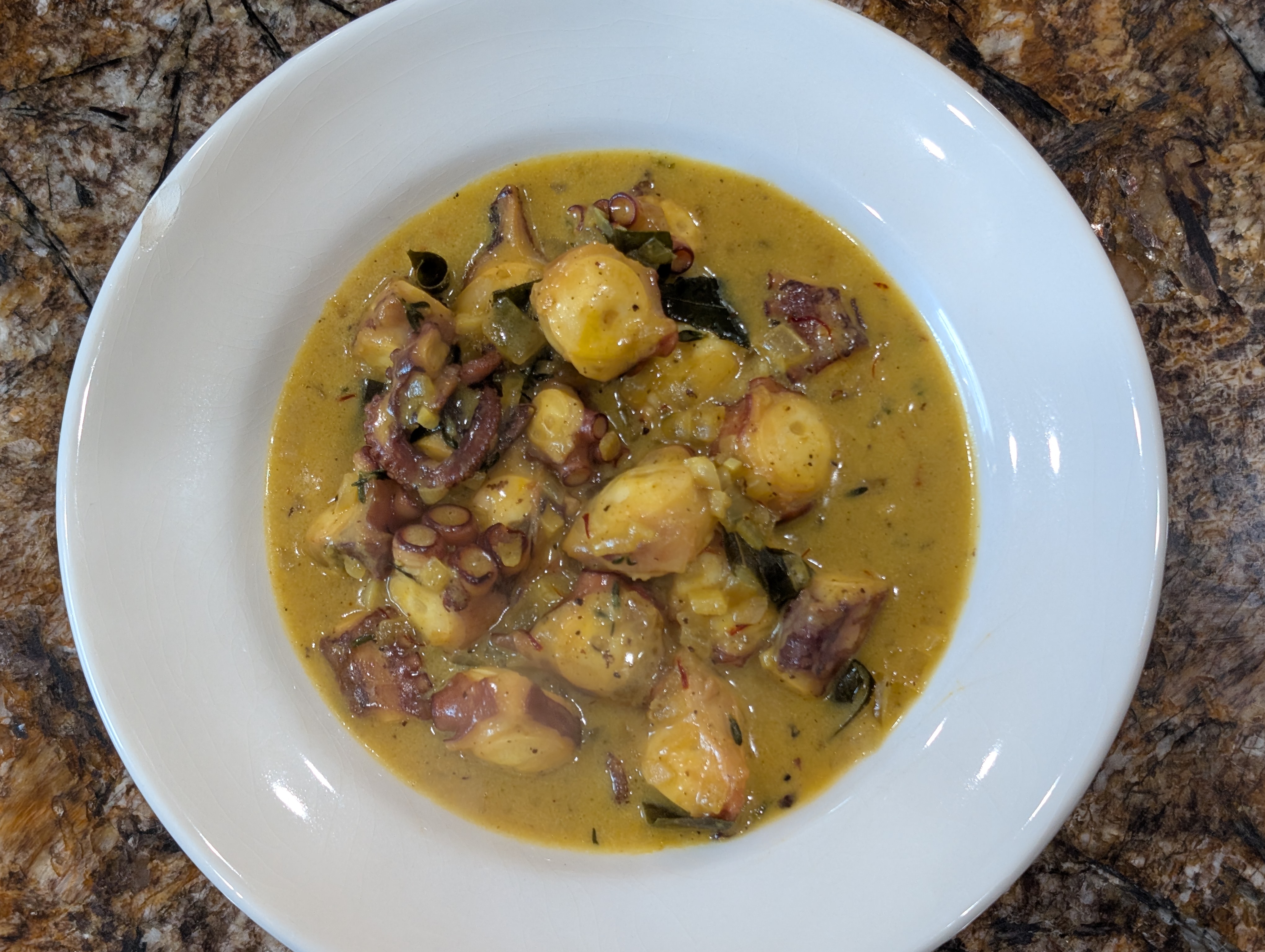
This personal culinary challenge showcases a cuisine that reflects how influences from around the world come together in amazing dishes. The challenge involves the preparation of a Seychellois Octopus Curry. The cephalopods could be found around many of the islands, such as Cousine. That availability led to this curry, which is a popular dish in the Seychelles. 

This demand created a fishery for octopi in the Seychelles. Many look for the creatures around the coral barrier reefs, while others, like a fisherman named Dave Auguste, go further out into the ocean. Auguste has fished for octopus for more than twenty years. When the COVID pandemic hit, the tourist trade (which is important to the Seychelles) crashed, and so did the market for expensive seafood like octopus. As the world gradually reopened and tourists returned, so did the demand for octopus. 

Dave Auguste with his catch (Source: United Nations, Photo: Douglas Okwatch)

Dave Auguste found one longer lasting change ... there were less of the cephalopods to catch. This change is not the result of COVID, but other factors.  In an article published by the United Nations, Auguste explained

There are fewer and fewer octopuses now. Before, I used to find them close to shore, but now I have to go further out. Again, for the last ten years or so, going out to sea has become more complicated because the sea has become rougher and the currents stronger. If I am not careful I can drift away from shore.

Indeed, climate change has affected the work of those who fish the waters around the Seychelles.  Auguste explained that there has been a change in rain patterns: "we used to have rainy periods that lasted several days, now it rains the same amount for one day and it all runs off into the sea." The prolonged rains and the runoff cause the waters close to shore to take on a reddish hue. The octopi do not like the tinged water and move further offshore. An additional factor is that, due to warming temperatures in the sea, there are some areas of the barrier reefs where up to 90% of the coral have died.

Not all of the news is bad. The Seychelles has taken proactive steps to stem the damage caused by changes in the climate. These steps include imposing quotas on seafood catches, expanding the range of protected marine areas, and implementing reef restoration projects. This has required some adjustment and adaptation, especially for those who work in the seafood industry, which makes up 27% of the Seychelles gross domestic product. This sacrifice, as well as, the conservation efforts, may not be enough if the climate continues to change. 

Turning to the challenge, I have prepared whole octopus in the past, but I decided for this dish that I would use pre-cooked octopus, which is available online or from some warehouse stores. Each package usually has 2-3 large tentacles, which may be less than a kilogram but still enough to prepare a meal for at least 2-3 people. The pre-cooked octopus also saves a lot of time (basically you can skip step 1). 

OCTOPUS CURRY

Recipe from Tourism Seychelles

Serves 4

Ingredients:

  • 1 kilogram octopus
  • Salt
  • Pepper
  • Fresh coconut milk (substitute 1 can coconut milk or cream)
  • 2 teaspoons saffron
  • 1 onion
  • Fresh thyme
  • 3 garlic cloves
  • Ginger (a little bit)
  • 1 teaspoon curry powder (or to taste)
  • Cinnamon sticks
  • Curry Leaves
  • Oil

Directions:

1. Prepare the octopus. Add the octopus to a pot and fill it with water. Boil until tender, about 45 minutes to 1 hour depending upon the size. Use a fork to check if the octopus is soft enough. Once the octopus is done, cut it into pieces

2. Prepare the curry. In a saucepan, add the oil, onion, garlic, ginger, saffron, curry powder, cinnamon sticks, thyme, salt and pepper. Mix and the add the octopus pieces. Fry the octopus pieces for a few minutes and then add the coconut milk and stir. Cover the saucepan and let it simmer for 15 to 20 minutes, as the sauce thickens. 

3. Finish the dish. Once cooked, serve with some white rice, lentils and papaya chutney. 

SIDE DISH

Ordinarily, as noted above, one would prepare white rice to serve with an octopus curry. Seychellois cuisine is known for its creole rice, a dish that is shared -- in some common form -- by creole cultures around the world. Rice is a staple food in the Seychelles, often accompanying main dishes. Yet, cultivation of rice cannot occur on a large enough scale on the islands to support its population. (Indeed, while the Seychelles may have an abundance of spices and access to seafood, it actually imports much of its other food.) Most of the rice comes from India, with smaller amounts imported from countries such as Pakistan, the United Arab Emirates, France and South Africa.

This personal culinary challenge gave me an opportunity to prepare creole rice and, to do so using the wide range of spices drawn from the subcontinent and southeastern Asia. The recipe shows that diversity with garlic, ginger, bay leaf, cinnamon, cloves, pepper and turmeric. I knew that I had to prepare this dish, which I served alongside the octopus curry.

SEYCHELLES CREOLE RICE

Recipe from Amy's Cooking Adventures

Serves 4

Ingredients:

  • 2 tablespoons butter
  • 1/2 red bell pepper diced (about 1/3 cup)
  • 1/2 onion diced (about 1/3 cup)
  • 2 cloves garlic, minced
  • 1/2 teaspoon turmeric powder
  • 1/2 teaspoon salt
  • 1/4 teaspoon black pepper
  • 1/4 teaspoon ground ginger
  • 1 bay leaf
  • Pinch of ground cinnamon
  • Pinch of ground cloves
  • 1/2 cup basmati rice
  • 1 cup water
  • Fresh parsley to garnish

Directions:

1. Saute the vegetables. Melt the butter in a saucepan over medium heat. Add the bell pepper and onion and cook for 5 minutes. Add the garlic, spices and rice and cook for another minute. Stir in the water and bring to a low boil. 

2. Finish the dish. Cover, reduce heat to low, and simmer for 15-20 minutes or until the water is absorbed. Fluff the rice, garnish with parsley and serve. 

*          *          *

To be honest, I had not expected to do a personal culinary challenge involving the Seychelles. I had previously done one for Mauritius, when I prepared an amazing duck curry. However, I really wanted to prepare this octopus curry and that led me to add this to the Around the World in 80 Dishes challenge. It is a decision that I will never regret, because it opened a door to exploring a creole culture and cuisine that draws inspiration from the diverse populations that have come to live on the Seychelles islands.  

Each of these dishes was a success, and, perhaps, some of the best dishes that I have prepared in recent weeks. This challenge has inspired me to move on to the next one. Check back to see where I end up. Until then ... 

PEACE.

Sunday, May 8, 2022

Around the World in 80 Dishes: Portugal

"Portugal was the beginning, where I began to notice the things that were missing from the average American dining experience. The large groups of people who ate together. The family element."

- Anthony Boudain

I have never been to Portugal, although it is definitely on my culinary travel list. The country's relationship with food is a mixed story. On the one hand, Portugal had a key role in terms of the distribution of spices and other ingredients across the globe. At one point in history, the Portuguese had complete control over the African sea route, a long perilous journey around the Cape of Good Hope in southern Africa to lands such as Kerala (in India), Malacca (in Malaysia) and, ultimately to the Moluccas (in present day Indonesia). On the other hand, the Portuguese were a colonial power, which propagated the inhuman and immoral practice of slavery in the New World and oppressive violence in its colonies.

Yet, the good and bad are inextricably intertwined to form the one history of Portugal as a people. Just as they used to say that the sun never set on the British empire, the saying also applies to a certain extent to the Portuguese. The country had colonies that stretched from South America (Brazil) to Africa (Cape Verde, Guinea-Bissau, Sao Tome & Principe, Angola, and Mozambique to Asia (Goa, Macao).  The Portuguese are well known for their role in bringing peppers from South America to Europe, Africa and Asia. And, I am a very big fan of that particular pepper -- the peri-peri or piri-piri.

So, I always thought that when I got to the personal culinary challenge to make a main course from Portugal, that it would feature that pepper. However, as it turns out, the challenge ended taking a completely different turn.

The (few) followers of this blog may remember that I have recently grappled with how to prepare a challenge for a country that has regional cuisines, like Spain and Canada. I have taken to using a random address and then building the challenge from there. I thought about doing the same for Portugal, which definitely has regional cuisines as one travels from Porto to Lisbon to Lagos, and then beyond to the Azores or Madeira. That is when I had what I thought was a great thought - as one goes down the coastline of Portugal, the one thing that all of those regions have in common is that very coastline. Seafood comes with coastline. With this thought, I had the building blocks for my culinary challenge.

APPETIZER

I don't know what it is about the Iberian peninsula, but both Spanish and Portuguese cuisines have recipes that combine octopus with potatoes. For an appetizer, I decided to explore the Portuguese version of this dish. While I have always loved the Spanish version, which is available at almost every tapas restaurant that I have eat at, I have to say that I loved the Portuguese version much more. 

I have to admit that I departed slightly from this recipe. First, I did not pour the oil and the garlic from the roasted potatoes over the dish. I think this helped from making the octopus and potatoes seem "drowned" in oil. Second, while I like cilantro, I thought that parsley would work better.  Finally, I left off the olives because of the guests who got to enjoy this dish. They were not olive fans. 

POLVO A LAGAREIRO

Recipe adapted from Photos and Food

Serves 4

Ingredients:

  • 2.65 pounds of octopus, either whole or tentacles
  • 1 pound of fingerling or small white potatoes, with peel and washed
  • 1 tablespoon kosher salt for boiling the potatoes
  • 3/4 cup olive oil
  • 1 1/2 teaspoon kosher salt for roasting the potatoes
  • 4 cloves garlic, sliced thin
  • 1 dried bay leave
  • 1/4 cup cilantro (or flat leaf parsley)
  • 1/2 cup black olives (optional)

Directions:

1. Boil the potatoes. Fill a medium to large pot half-way with water, add the 1 tablespoon of salt, and boil the potatoes for about 15 to 20 minutes or until they become tender.  If using cooked octopus, skip to step 3, if using raw octopus, continue with the next step.

2. Prepare the octopus. Using your hands, wash the octopus under cold water, and boil the whole octopus for about 40 minutes or until tender (you should be able to insert a fork into the thickest part of the tentacle). 

3. Prepare the oven and grill. Preheat both the oven for broiling and the BBQ or grill at 500 degrees Fahrenheit.

4. Continue to prepare the potatoes. Once the potatoes are ready, pour out the water and pat them dry with a paper towel. Place the potatoes in a roasting pan. Use the bottom of a glass or a mug to carefully press down on each potato until they slightly crack. Do not completely flatten them. Drizzle olive oil them.  Place the roasting pan with the potatoes in the hot oven on the middle rack and roast for 5 to 10 minutes.

5. Grill the octopus. Place the octopus on the BBQ or grill for about 5 minutes, flip and then let cook for another 5 minutes.

6. Finish the dish. Scoop the potatoes onto a serving dish. Cut the octopus into bite sized pieces. Place the grilled octopus over the potatoes. Drizzle the olive oil and garlic from the roasting pan over the potatoes and octopus. Garnish with olives and cilantro (or parsley).

MAIN COURSE

As I mentioned above, I decided to build the personal culinary challenge around the one thing that may unit all of Portuguese cuisine in one way or another ... seafood. I decided to make a Caldeirada de Peixe, which is the Portuguese version of a fish stew that goes by many other names throughout the Mediterranean. To be sure, there are regional variations of this dish, which vary based upon the available fish and ingredients. The regional variations cannot obscure the fact that this dish represents Portugal, and, provides an ever so slight nod to the country's history from the shores to the seas.

CALDEIRADA DE PEIXE

Recipe from Photos and Food

Serves 4

Ingredients:

  • 1 cup white wine
  • 3 tablespoon tomato paste
  • 1 teaspoon paprika
  • 1/4 cup olive oil
  • 6 pounds of fresh grouper cut into steaks (substitute conger or cod)
  • 1 large cooking onion, sliced thin
  • 5 cloves of garlic, sliced thin
  • 1 tablespoon kosher salt
  • 1 teaspoon cumin 
  • 1/2 teaspoon ground cinnamon
  • 2 medium tomatoes sliced into thin wheels
  • 1 large bell pepper sliced into thin wheels
  • 2 bay leaves
  • 8 sprigs of fresh flat leaf parsley with most stem cut off

Directions:

1. Build the stew. In a measuring cup with a spout, whisk together the wine, tomato paste, and paprika until well combined. Pour the olive oil into the bottom of a large dutch oven or heavy pot.  Spread half of the sliced onions and garlic evenly over the oil and bottom of the pot. Place half of the fish steaks over the onions and garlic in one layer. Sprinkler 1/3 of the salt, cumin and cinnamon evenly over the fish.

2. Continue to build the stew. Place the tomato and pepper sliced wheels evenly over the fish.  Spread the remaining half of the sliced onions and garlic evenly over the tomato and pepper slices.  Place the remaining half of the fish steaks over the onions and garlic in one layer. Sprinkler 1/3 of the salt, cumin and cinnamon evenly over the fish.

3. Continue to build the stew. Place the remaining tomato and pepper sliced wheels evenly over the fish.  Sprinkle the remaining salt, cumin and cinnamon over the tomatoes and peppers.  Add the two bay leaves.  Pour the wine mixture over the ingredients in the pot.  

4. Cook the stew. Place the pot on the stove and turn the heat up to medium high.  Once the liquid starts to bubble, cover the pot with the lid and reduce the heat to low.  Let simmer for about 30 minutes or until the fish starts to flake.  Turn off the heat, uncover the pot, and add the springs of fresh parsley over the cooked ingredients.  Serve with steamed/boiled potatoes, rice or a green salad.

*     *     *

Needless to say, I think I can chalk up another successful personal culinary challenge. The guests who got to enjoy both dishes certainly thought that I did a good job. It was just the morale boost that I needed as I contemplate some much more difficult challenges ahead. Until next time, 

ENJOY!

Saturday, January 22, 2022

Pulpo en Purgatorio

Every once in a while, my beautiful Angel buys me a package of octopus from our local big box store. The package usually includes three to four large tentacles. Those tentacles are cooked, meaning that one of the most time-intensive parts of preparing activity of making octopus (boiling the octopus) is already done. That opens a wide range of opportunities to focus on different ways to present that ingredient.

I spent a lot of time looking for recipes to make with that octopus. I found three recipes: one from Peru, a second from Italy, and a third from Haiti.  I could not decide which one to make. So, I turned to my friends on social media and asked for their opinion. The results were closer than I expected, but the clear winner was this recipe: Pulpo en Purgatorio. The recipe is a specialty from Molise, where it is known as i pulepe 'npregatorie in the local dialect.

Molise happens to be the newest Italian region, having been established in 1970 after it split from Abruzzo e Molise. Despite the split, the cuisine of Molise remains substantially similar to that of Abruzzo. Both cuisines draw from the bounty of the sea, whether from the port of Chieti in Abruzzo or the port of Termoli in Molise. More significantly, both cuisines share the use of  peperoncini (a general label for a range of chiles) in many dishes.

Source : Tesori del Matese
It is said that Italians refer to peperoncini as la droga di poveri (the drug of the poor). The origin of this phrase comes from two facts: (1) that the pepper plants are cheap and (2) the chiles can grow anywhere. Thus, these chiles are available to the poor, who can purchase them and grown them on their properties. Thus, while the rich are able to utilize black pepper (which costs more given it has to be imported), the poor cultivate these chiles, dry them, and use them in very much the same way. For these reasons, peperoncini often finds its way into cucina povera. The chiles enable the poor to provide that spicy kick to bland dishes. And, the poor used these chiles in large quantities, especially in the southern regions, like Molise.

A relatively large amount of peperoncini (for some people) is called for when one makes pulpo en purgatorio. The word, "purgatory," is defined as a place of temporary suffering or misery. The heat and spice of the peperoncini are supposed to provide that suffering or misery. I guess that someone who does not ordinarily eat spicy food may find this recipe a bit "painful." However, as followers of this blog may recall, I revel in the heat and piquancy of chiles. After all, I created the Inferno Steak, a recipe inspired by Dante Alighieri's famous poem. The recipe utilizes nine different chiles, each one representing a circle of hell and each subsequent chile being hotter than the last. Italian peperoncini inflict little suffering or misery to my taste buds. 

As for the recipe itself, it calls for the use of a raw octopus, which requires some extra work. I kept those instructions in the case someone is using a raw, rather than a cooked octopus. I then added directions for pre-cooked octopus. When you used the pre-cooked variety, this recipe becomes very simple and quick to make. 

PULPO EN PURGATORIO

Recipe from Gusto TV and Serge the Concierge

Serves 4

Ingredients:

  • 2 cups olive oil
  • 2 small onions, finely diced
  • 1 pound of fresh, large octopus tentacles
  • 4 red chiles, seeded and sliced (or 2 teaspoon crushed red pepper)
  • 1 chile, minced for garnish 
  • 1/2 cup parsley, chopped, plus more for garnish
  • 1 teaspoon salt
  • 1 teaspoon freshly ground black pepper

Directions:

1. If using fresh octopus. Heat half the oil in a medium frying pan over medium heat.  Add the onions, garlic, parsley and chiles (or crushed red pepper) and cook, stirring frequently, until the onions soften, about 6 to 8 minutes.  Put the tentacles in a pot and add the onion mixture and the remaining oil. Add enough water to cover just the tentacles and bring it to a boil over high heat.  Reduce the heat to low, season generously with salt, cover and cook, stirring occasionally until the liquid has evaporated, about 2 hours. Serve immediately. 

2. If using cooked octopus.  Heat half the oil in a medium frying pan over medium heat.  Add the onions, and garlic, and cook, stirring frequently, until the onions soften, about 6 to 8 minutes. Add octopus, parsley and chiles (or crushed red pepper), salt and black pepper, and stir to combine. Cook until octopus is heated through.  Transfer octopus with oil to platter, garnish with remaining parsley and red chiles. Squeeze juice of 1/2 lemon over dish. 


Saturday, March 14, 2020

Jerked Octopus

I am a huge fan of the Jamaican jerk style of cooking.  The combination of spices and peppers, along with the smoky notes used when cooked over wood is perhaps one of the best ways to cook proteins.  When it comes to the protein, one most often sees jerked chicken. However, the cooking process has also been used for pork, beef, goat and lamb.  It has even been used for shrimp and shellfish.  

I have prepared jerked chicken in the past, but I got to thinking that this style and process of cooking seemed perfect for octopus. Generally speaking, a common way to prepare octopus is to marinate the tentatcles and then grill it. This cooking technique is perhaps best known from the octopus dishes prepared in Greece. The basic method of cooking remains the same, the only differences would be the marinade and (in theory) the actual cooking process (that is, the wood used if one were using wood).  In the end, those differences do not really matter, because the overall style of jerk cooking seemed to be a natural fit for octopus.  And, it was.

I went back to some old jerk recipes to come up with a good jerk marinade for the octopus. The key to the marinade is the use of allspice and, of course, the scotch bonnet pepper (or a habanero, if your local market does not have the scotch bonnet).  Other spices, such as cloves, cinnamon, ginger and nutmeg help to round out the marinade.  Once the marinade is ready, the tentacles should be marinated for at least a few hours, but overnight may be preferable.     

When it comes to cooking, if one wants to be authentic, then he or she would grill the octopus over the coals from a pimento wood fire.  I did not have any pimento wood.  So, I grilled the tentacles on my gas grill.  It worked just as well when it came to the requisite charring of the edges, but, it will lakc the smoky element that only grilling over hardwood can give.  (One could always cheat and add a little smoked paprika to the marinade, but I did not cheat with this recipe.) I was fine without the smoky taste.  The octopus was just too damn good to even care. 


JERKED OCTOPUS
Adapted from recipe from Food Stories
Serves 4

Ingredients:
1 package of precooked octopus, about 2 pounds
1 1/2 tablespoons of allspice (freshly ground is best)
1/3 cup dark brown sugar, packed
4 garlic cloves
1 tablespoon thyme
1 bunch scallions (white part, chopped)
1/2 teaspoon cinnamon
1/4 teaspoon nutmeg
1/2 teaspoon ground ginger
1/2 teaspoon ground cloves
3 Scotch bonnet chiles (deseeded)
Juice of 2 large limes
1 teaspoon salt

Directions:
1. Marinade the octopus. Blend the allspice, sugar, cloves, thyme, scallions, cinnamon, nutmeg, ginger, cloves, chiles, lime juice.  Insert skewers through the octopus to straighten the tentacles.  Combine the marinade with the octopus and allow it to marinate in the fridge for a couple of hours, or overnight. 

2.  Grill or broil the octopus.  Cook the octopus over direct heat, flipping frequently until a little charred, brushing every now and then with the marinade (because the octopus is already precooked, there is no worry about contamination).  Serve immediately with a side, such as Jamaican rice and peas. 

ENJOY!

Sunday, March 24, 2019

Iron Chef: Octopus

If memory serves me right, it has been a long time since I have stepped foot in Savage Bolek Kitchen Stadium.  My last challenger -- Radish Sprouts -- got the better of me.  While the three dishes each highlighted a certain creativity (for who would have ever thought of a radish sprout broth), the execution fell short of the expectations that I had set for myself. 

After that challenge, I decided to take a sabbatical from the Iron Chef battles. I needed to work on my creativity, my skills and my dishes.  As the days, weeks and months passed, I spent my time trying new foods, cooking with new ingredients, and honing my skills. 

But, as helpful as this time away from Savage Bolek Kitchen Stadium has been, the Iron Chef must return to face another challenger.  A challenger who could be as creative and crafty as the Iron Chef.  Coming from far away, this challenger will present the Iron Chef with many more opportunities to express not only his creativity, but his love for cuisines around the world.

Allow me to introduce the challenger ... OCTOPUS. 

FIRST COURSE

The first course is a nod to Japanese cuisine, with Taku Su, a cold salad that combines octopus with cucumbers and seaweed.  All of the ingredients are tied together with a vinaigrette of soy sauce and rice wine vinegar with sugar and salt to round out the taste .


TAKO SU (OCTOPUS SALAD)
Recipe from Just One Cookbook
Serves 2

Ingredients (for the octopus):
1/4 pound octopus cooked, sliced thinly
1/2 English Cucumber
1/2 tablespoon dried wakame seaweed
1/2 tablespoon toasted white sesame seeds

Ingredients (for the vinaigrette):
3 tablespoons rice vinegar
1 1/2 tablespoon granulated sugar
1 teaspoon soy sauce
1/8 teaspoon kosher salt
1 teaspoon toasted white sesame seeds

Directions:
1.  Prepare the octopus. Slice the octopus very thinly.  

2. Prepare the cucumber.  Alternatively peel a 1/2 inch side strip lengthwise, leaving a strip intact.  With this method, the cucumber slices have some decorative dark green accents and a little bit of extra crunchiness.  Cut the cucumber into small pieces using the cutting technique Rangiri.

3.  Prepare the seaweed.  In a small bowl, soak the dried seaweed in warm water.  Let it soak for 15 minutes.  Drain and squeeze the liquid out.  Set aside.

4.  Prepare the vinaigrette.  In a medium bowl, combine all the ingredients for the vinaigrette.

5.  Finish the dish.  Add the cucumber, octopus, seaweed and sesame seeds and toss all together.  Chill in the refrigerator for 15 to 30 minutes.  Serve immediately.  

SECOND COURSE

The second course takes its inspiration from Mexican cuisine, with the octopus being served with a sauce featuring the smoky heat of ancho chiles and the sweetness of honey.  Much like the Tako Su, the mild flavors of the octopus work as a tableau upon which the flavors of the sauce can show themselves.  The hardest part is making sure that the octopus itself, as the secret ingredient, is not eclipsed by that sauce. 


GRILLED OCTOPUS WITH ANCHO HONEY SAUCE
Recipe adapted from Tom Colicchio
Serves 2

Ingredients (for the octopus):
1/2 pound octopus tentacle, cooked

Ingredients (for the sauce):
2 dried ancho chiles
1/2 cup apple cider vinegar
1 garlic clove, minced
3 tablespoons of honey
1/8 cup of grapeseed oil or vegetable oil

Directions:
1.  Prepare the sauce.  Toast the chiles over moderate heat, turning, until fragrant and pliable, 2 to 3 minutes.  Add the vinegar, honey and garlic and bring just to a simmer.  Remove from the heat and let stand until the chiles are softened, about 20 minutes.  transfer to a blender and puree until smooth.  With the machine on, add the grapeseed or vegetable oil until incorporated.  Season the sauce with salt.

2.  Prepare the grill or broiler.  Heart the grill or broiler.  Grill the cooked tentacle until the suckers start to crisp and brown around all of the edges, about 4 minutes.

THIRD COURSE

For the final dish, I draw upon Hawaiian cuisine.  This is a play on the popular dish of Ahi Poke; however, instead of the rare tuna being the star of the poke, it is octopus.  The avocado, tomato and onions in this dish, combined with the lemon juice, provide a very bright background that allows the octopus to take the center stage.  The fish sauce provides that salty, umami flavor that rounds out the dish . 


HAWAIIAN OCTOPUS POKE
Recipe adapted from Cookpad
Serves 2

Ingredients:
1/2 pound octopus tentacle, cooked
1 avocado
1/2 tomato
1/4 onion
1 bunch green onions
1 tablespoon white sesame seeds
1 tablespoon lemon juice
1/2 teaspoon fish sauce
1/2 clove grated garlic
1/2 tablespoon sesame oil

Directions:
1. Prepare the avocado. Pit the avocado, peel and dice.  Put the diced avocado into a bowl and mix with 1 tablespoon of lemon juice to prevent discoloring.

2.  Prepare the onion.  Cut the onion in half and slice thinly along the grain.

3.  Prepare the octopus.  Slice the octopus.  Put it in a bowl and mix with the fish sauce and garlic.

4.  Prepare the rest of the ingredients.  Cut the tomato roughly and chop a generous amount of green onions.

5.  Combine ingredients: Put the avocado, onion, tomato, green onions, sesame oil and white sesame seeds in a bowl and mix.  Chill in the refrigerator.

6.  Plate the dish.  Just before plating, add the octopus and mix well.  

Sunday, January 7, 2018

Around the World in 80 Dishes: Italy

As I continue my personal culinary challenge, Around the World in 80 Dishes, I find myself in nearly the same situation as a few weeks ago.  Back then, my beautiful Angel bought a whole duck for me to cook; and, I decided that I would make Peking Duck.  After making that decision, and perusing the aisles of the local Asian grocery store, I realized that the Peking Duck could satisfy the challenge to make a main course for the country of China

Fast forward those few weeks to the days before Christmas Eve.  I had decided to make a Christmas Eve feast.  Drawing inspiration from the fact that the families of my beautiful Angel and myself originate in part from Italy, I decided to make the Feast of Seven Fishes, or, as it would be known in Italy, La VigiliaSeven courses, each made with a different fish or seafood.   As I prepared for this feast, which was the second largest cooking experience I have undertaken (the largest was my Guest Chef  Night experience), I decided that this would satisfy my challenge to make a main course for the country of Italy.  

This challenge presented the same fundamental issue for me as that China challenge.  Like China, Italy has numerous regions, each with its own cuisine.  Each of those cuisines has its own history, influences, and character.  However, unlike my last challenge, I had decided that each course or dish of the Feast of Seven Fishes would come from a different region.  In the end, I had a dish from Friuli-Venezia-Guilia, Apulia, Umbria, Abruzzo, Calabria, Sardinia and Sicily.  And, as some of my challenges have involved multiple dishes, I have decided that all of the dishes would be part of this challenge.  Thus, while it may have been my second largest cooking experience, the challenge to cook a main course from Italy is the largest test of the Around in the World in 80 dishes.  All of the dishes made it into this post.  So, without further ado:

FIRST COURSE: APPETIZER
(FRIULI-VENEZIA-GIULIA)

The first course or appetizer begins in the region of Friuli-Venezia-Guilia, a very small region in northeastern Italy.   This region's history underlies its cuisine, with influences from Venice, with those of Austrian and Slavic cuisines.  Following northern Italian cuisine, polenta is a staple in this region, which is served along stewed meats, games and cheeses.  These meats and game include venison and rabbit.  They also include gulasch, which is a stew of beef and peppers (and, a great example of the Slavic influence upon the cuisine).  

Drawing from the shores around its capital, Trieste, I am starting with a recipe that brings together shrimp with the staple of polenta.  I digressed from the recipe by simply warming the polenta in the oven, then plating it with the shrimp and drizzling the mushrooms and sauce around the shrimp.  The result was a great start to the dinner.


POLENTA PASTICCIATA AL GAMBERI (POLENTA WITH SHRIMP)
Recipe from Culinaria Italia (pg. 19)
Serves 6-8

Ingredients:
Polenta
Butter
2 pounds of shrimp
1 handful of fresh mushrooms
1 clove of garlic, chopped finely
1 tablespoon chopped parsley
3/4 cup white wine
4 cups vegetable stock
Freshly ground pepper
Nutmeg

Directions:
1.  Prepare the polenta. Prepare the polenta to a soft consistency.  Cool and cut into slices and place them on a greased backing sheet so that the slices cover it completely, overlapping slightly.  Preheat the oven to 350 to 375 degrees Fahrenheit.

2.  Prepare the sauce.  Clean the mushrooms and chop finely.  Peel the shrimp and saute them in a little butter in the saucepan.  Add the mushrooms, garlic and parsley.  Pour some of the white wine and vegetable stock and bring to a boil.  Add the rest only if needed  Season with freshly ground pepper and nutmeg, and arrange on top of the polenta slices.  Bake for a few minutes in the preheated oven.

SECOND COURSE: APPETIZER
(APULIA)

The next course takes us all the way down the eastern coast of Italy to Apulia or Puglia.  The southeastern region has a coastline along the Adriatic and Ionian Seas, as well as the Gulf of Taranto.  This wide access to the sea allows for seafood to play an important role in the cuisine of the region, with fish, octopus, squid and even sea urchins gracing the dishes.

But it is the Gulf of Taranto that provides the oysters.  No feast would be complete without oysters.  While I love eating them raw, I found a recipe for broiling/roasting the oysters with just a few ingredients.  The recipe simply calls for breadcrumbs, parsley, oregano, lemon juice and olive oil.  It is just another case where simplicity breeds deliciousness.  For this course, I used salty hog oysters, which I think come from Maine.  These oysters serve as the centerpiece for the second course, Ostriche Arrosto.


OSTRICHE ARROSTO (BROILED OYSTERS)
Recipe from Culinaria Italia (pg. 373)
Serves 1

Ingredients (per person):
6 oysters
Chopped parsley
1 clove garlic, chopped
Breadcrumbs
Oregano
Lemon Juice
Olive Oil
Salt and pepper

Directions:
1.  Prepare the oysters.  Remove the upper shelves and place the lower halves containing the oyster meat on a wire rack.  Sprinkle the parsley and garlic evenly over the oysters, followed by the breadcrumbs and oregano, then drizzle 2-3 drops of lemon juice and a little olive oil.

2.  Roast the oysters.  Season with salt and pepper and broil for 15 minutes.

THIRD COURSE APPETIZER
(ABRUZZO)

The third appetizer takes us north along Italy's Adriatic coast to the region of Abruzzo.  That stretch of coastline, with ports such as like Pescara and Ortona, allows Abruzzo to have a very diverse seafood cuisine of various fish and shellfish, just like its southern neighbors.

The key to a dish from this region is to use one of its signature ingredients.  Two such ingredients come to mind: peperoncino and saffron.  Abbruzese cuisine is known for being spicy, with a liberal use of peppers.  Yet, it is croccus sativus, whose dried stems give us saffron, that truly interests me.  The flowers brought to this province more than 450 years ago by a priest name Santelli, and they grow on the Navelli Plain in the L'Aquila province.  While cultivated in Abruzzo, saffron is not a common ingredient in regional cuisine.  It finds its way into the cuisines of neighboring regions, such as Le Marche or Emilia-Romagna, where it provides its signature yellow color to dishes.

It is that yellow color that makes the broth of Cozze allo Zafferano stand out.  The broth is made from white wine and water, but the saffron gives it a bright yellow color.  In making this recipe, I did make one change: I left the mussels in their shell rather than taking off the top part of the shell.  This saved a lot of time and I think the whole shell provides a better presentation.  


COZZE ALLO ZAFFERANO (MUSSELS WITH SAFFRON)
Recipe from Food and Memories of Abruzzo (pg. 21)
Serves 4-6

Ingredients:
2 pounds of mussels, scrubbed and debearded
2 shallots, each quartered or 1 onion quartered
2 sprigs fresh Italian parsley
1 sprig fresh thyme
2 bay leaves
3/4 cup dry white wine
1/4 cup water
Freshly ground pepper to taste
1/2 teaspoon saffron
3 tablespoons extra virgin olive oil

Directions:
1.  Steam the mussels.  Place all of the ingredients in a large skillet . Cook over medium heat, shaking the skillet often, until the mussels open, 5 to 8 minutes.  Remove the open mussels and discard half of the shell.  Discard the mussels that have not opened.  Place the remaining half of with the mollusk on a serving plate.  Keep warm.

2.  Finish the dish.  With a slotted spoon remove the solids from the skillet and discard.  Strain the liquid through a towel into a small saucepan.  Bring the liquid to a boil and if there is more than 3/4 cup reduce it by boiling it.  Pour the liquid over the mussels and serve.  This dish can also be served chilled. 


FOURTH COURSE: SOUP
(UMBRIA)

Given the more than 4,700 miles of coastline, it would be easy to create seven dishes from Italian regions that border either the Adriatic or the Tyrhennian Seas.  After all, fifteen of the twenty Italian regions have some portion of their territory that touches the sea.  To make this a true challenge, I needed to make a dish from one of the five landlocked regions.  The region I chose is Umbria.

The dish is a play on a traditional Umbrian dish: Polpette in Umido or Meatballs in Broth.  The meatballs are traditionally made with pork from the renown Umbrian pigs.  Given pork is not on the menu for a Feast of Seven Fishes or La Vigilia feast, I decided to make fish meatballs.  To be true to the landlocked nature of the Umbrian region, I needed a freshwater fish.  The two obvious choices are trout and catfish.  Given the meatier texture of catfish, I thought it would work better as meatballs.

Given the experimental nature of this dish, I kept the meatballs pretty simple.  Catfish, bread crumbs  (with Italian seasoning, thereby providing some basil and oregano) and eggs, with some salt and pepper.  I refrigerated the meatballs to firm them up before baking them to preserve their shape.   The meatballs were then warmed in the broth prior to serving. 


POLPETTE DI PESCE IN UMIDO (FISH MEATBALLS IN BROTH)
Recipe inspired by Lidia Cooks from the Heart of Italy (196-197)
Serves 4

Ingredients:
1 pound of freshwater fish fillets (such as catfish or trout)
1 large egg, beaten with a pinch of salt
1/4 cup of fine dread breadcrumbs, 
Freshly ground black pepper and salt
3 to 4 quarts of seafood stock
2 bay leaves
2 sprigs fresh parsley
2 sprigs of fresh thyme
10 peppercorns
Dried basil, oregano or pepper flakes, optional. 

Directions:
1.  Make the broth.  You can make a fish broth ahead of time if you have the heads and bones.  Just bring them short of a boil with an onion, fresh thyme, fresh parsley, bay leaves and peppercorns and cook for about one hour.  If you get pre-made seafood stock or broth, then just add the fresh herbs and bring short to a boil and cook for about an hour. .

2.  Prepare the meatballs.  Wash the fish fillets and pat them dry with a paper towel. Cut the fish into large pieces and place into a food processor.  Pulse the fish multiple times until the fish is the right texture for meatballs, about 10 to 12 times.  Do not over-pulse the fish or the meatballs will not work.  Add the fish to a bowl and then add the egg and breadcrumbs.  You can also add some dried basil, oregano and even pepper flakes, all of which is optional.  Season with salt and pepper.  Combine the ingredients together.  Make twelve fishballs.  Refrigerate the fishballs for about 30 minutes.

3.  Bake the meatballs.  Preheat the oven to 375 degrees Fahrenheit.  Bake the meatballs for 20 minutes, turning them once after 10 minutes.

4.  Finish the dish.  Once the meatballs are baked, add them to the broth and let them rest for about 20 minutes more.

FIFTH COURSE: APPETIZER
(CALABRIA)

To this point, all of the dishes have come from regions along the Adriatic Sea, as well as one landlocked region.  It is time to head west to the Italian coastline along the Tyrrhenian Sea.  The starting point is the southwestern region of Calabria, which is the "toe' in the Italian "boot."  Calabria shares one thing in common with Abruzzo: the use of pepper to make spicy dishes.

When it comes to seafood, fish is the predominant protein for Calabrian dishes.  For the fifth course of this feast, however, I wanted to make something with squid or calamari.  I found a Calabrian recipe for Calamari Piccanti or spicy calamari.  This recipe uses red pepper flakes to give it that Calabrian character.  While I ordinarily add more pepper flakes to make a dish truly spicy, I stuck to the amounts called for in the recipe.


CALAMARI PICCANTI
Recipe from Lidia Cooks from the Heart of Italy (pg. 339)
Serves 6

Ingredients:
2 pounds cleaned calamari, whole bodies and tentacles
3/4 cup extra virgin olive oil
6 plump garlic cloves, peeled and crushed
1 1/2 teaspoons of kosher salt
1/2 teaspoon peperoncino flakes
2 tablespoons freshly squeezed lemon juice
1 tablespoon chopped fresh Italian parsley

Directions:
1. Prepare the calamari. Dry the calamari well and put in a large bowl  Pour over them 12 cup of the olive oil and add the garlic, a teaspoon of salt and peperoncino.  Toss to coat and let marinate at room temperature for 30 minutes to an hour.  

2.  Make the dressing.  When you are ready to cook the calamari, make the dressing.  Whisk together the remaining 1/4 cup of olive oil, the lemon juice, the remaining 1/2 teaspoon of salt, and the chopped parsley until emulsified.

3.  Cook the calamari.  Set the skillet over high eat and it when it is very hot, lift the calamari out of the marinade with tongs, let it dry briefly and then lay a bat of them flat in the dry skillet.  Sear the calamari, turning several times until the edges of the bodies are caramelized and crispy, about 2 minutes per batch.  If you are using unskinned calamari, the skin will darken to a deep reddish hue.  

4.  Finish the dish  As the calamari comes out of the skillet, arrange them on a warmed platter, when all of the calamari is done, drizzle the dressing over them and serve right away.

SIXTH COURSE:SALAD
(SARDINIA)

The culinary experience leaves the mainland for the island of Sardegna or Sardinia.  I have a fascination with this island, having previously explored its cuisine when I made Insalata dell'Aragosta or Sardinian Lobster Salad.  Fish and lobsters predominate the seafood cuisine of the island.  However, I wanted to make something different.  I scoured recipes until I found one using octopus.  I love eating octopus.  I have had it many times as Pulpo Gallego (Octopus with paprika) at Spanish restaurants.  The dish is octopus served with potatoes and paprika.  I have also had it grilled at Greek restaurants, served just on its own or perhaps dressed with a combination of olive oil and lemon juice.

For the sixth course, I found an octopus and potato salad from Sardinia.  This dish connects Spain and Greece for me, bringing together the potatoes from Pulpo Gallego with the olive oil and lemon juice of the Greek version.  A nod to the historical influences that have come and gone like the waves that crash on the shores of the Island.   The addition of celery leaves and parsley leaves give this salad its own character.  


INSLATA DI POLPO E PATATE (OCTOPUS AND POTATO SALAD)
Recipe from How to Eataly (p. 240)
Serves 4

Ingredients:
1 octopus (about 1 1/2 pounds)
1 tablespoon fine sea salt
2 medium Yukon Gold potatoes
1/4 cup loosely packed flat leaf parsley leaves
1 red onion
2 teaspoons white wine vinegar
2 tablespoons extra virgin olive oil
Freshly ground black pepper to taste
1/4 cup loosely packed celery leaves

Directions:
1.  Cook the octopus.  Place the octopus in a large pot and add water just to cover.  Sprinkle in the 1 tablespoon of salt.  Bring to a boil, then lower the heat and simmer until the octopus is tender, about 50 minutes.  Drain and set aside to cool slightly but not completely.  

2.  Cook the potatoes.  Place the potatoes in a separate pot and add water to cover.  Bring to a boil, then lower the heat and simmer until the potatoes are easily pierced with a paring knife, about 30 minutes.  Drain and set aside to cool slightly but not completely.  When the potatoes are cool enough to handle, peel them and cut into 1/2 inch slices.  Place in a large bowl.

3.  Continue to prepare the octopus.  Separate the octopus head and tentacle. Chop the tentacles and place them in the bowl with the potato slices.  Remove the internal sac from the head if it hasn't been removed already, then chop the head and add to the bowl.   

4.  Continue to prepare the salad.  Roughly chop the parsley and add to the bowl.  Halve and thinly slice the onion and add that to the bowl along with the celery.  In a small bowl, whisk together the vinegar and olive oil and season with salt and pepper.  Drizzle the dressing over the salad and toss to combine. 

5.  Finish the dish.  The salad benefits from sitting at room temperature for an hour or so or you can refrigerate it and bring it back to room temperature before serving. Garnish with celery leaves.

SEVENTH COURSE: MAIN COURSE
(SICILY)

The final course of this seven course dish constitutes the challenge for my Around the World in 80 Dishes.  This course takes us to Sicily, an island well known for its fish and shellfish dishes.  One truly Sicilian dish, Cuscusu or Couscous with Fish, actually displays the wonderful influences upon the island's cuisine.  The use of couscous, as well as saffron, is a nod to the influence of the Arabs, who ruled the island from 827 A.D. to 1091 A.D.  While Cuscusu may have Arabic origins, the Sicilians have made it their own.  They steam the couscous over fish broth, made from a variety of fishes (such as scorpion fish, bogue and eel), rather than a meat broth as is done in Northern Africa.

While I could steam the couscous over a fish broth (I made one for this feast), I ultimately decided to use the fish broth to make the coucous in the traditional fashion.  The "traditional fashion" means following the directions on the side of the box.  In my defense, I have made Cuscusu by steaming the couscous in the past.  Having completed several dishes, including a couple (such as the octopus salad) that could satisfy the main dish requirement, I decided I needed a break.  The completion f the dish still satisfies the challenge of making a main course.  


CUSCUSU (COUSCOUS WITH FISH)
Recipe adapted from Regional Italian Cuisine (pg 288-289)
Serves 4 to 6

Ingredients:
10 ounces or 1 2/3 cups couscous
1 teaspoon saffron
1 pinch powdered cloves
1 pinch cinnamon
Nutmeg
Salt and freshly ground pepper
6 cups seafood stock

Directions:
1.  Prepare the couscous. Dissolve the saffron in some of the seafood stock.  Bring enough seafood stock to a boil to prepare the couscous according to the package.  Reserve the remaining seafood stock.   Season the couscous with salt , pepper, powdered cloves, cinnamon and grated nutmeg.  

2. Prepare the fish.  Bring about 2 cups of stock to a boil in a deep pot.  Place the fish in the stock and simmer on medium heat for 5 to 10 minutes.  Chop the remaining parsley

3.  Finish the dish.  Place the couscous on a preheated platter.  Top the couscous with the pieces of fish and sprinkle with the chopped parsley.  Serve immediately.

*     *     *   

This was an amazing culinary tour around the country of Italy.  I never thought I could complete seven dishes in one night, let alone that the dishes would come out looking presentable.   This challenge was a success in many ways and it has galvanized me toward working on the next one.  Until that time...

ENJOY!