Showing posts with label Chives. Show all posts

Sunday, March 1, 2026

Around the World in 80 Dishes: Yemen

 "Don't worry about Yemen. Yemen started in peace, and it will end its revolution in peace, and it will start its new civil state in peace."

-- Tawakkol Karmon, Nobel Peace Laureate (2011)

The journalist, politician and human rights activist -- Tawakkol Karmon -- spoke those words fifteen years ago when she accepted the Nobel Peace Prize. She accepted the award in the midst of the Arab Spring, when masses rose up against dictatorial regimes across North Africa and the Middle East. One of those revolutions took place in Yemen. That revolution brought down then-President Ali Abullah Saleh, a military officer who served in that role since 1990. 

Yet, over the course of the following fifteen years, peace has proved elusive in Yemen. The country has become a battleground between different forces, political and religious, internal and external. Those battles have inflicted severe harm upon the over 40.6 million residents spread out from the Red Sea across the southern Arabian peninsula to the borders of neighboring Oman. Yet, at least in the West, much of that harm goes untold, as the media focuses more upon the offensives of the political and religious actors. We hear more about missiles being fired from Yemen or ships being seized in the Red Sea than we hear about the millions of Yemenis who face starvation or the lack of essential infrastructure for much of the population. The result is a damning story that talks more about violence and less about the people. 

"The People are Not the Same as Their Government."

One really has to dig deep to get past the narrative that has been built by the media over the years to learn more about the Yemeni people. I have never been to Yemen, although I have always read with fascination and viewed with wonder about the country, its residents and their achievements. For example, there is amazing mud brick architecture, such as the 16th century walled city of Shibham. The city has densely packed, mudbrick buildings that are several stories tall, which has led to the city being  often referred to as the "Manhattan of the desert." And there is the Seiyun Palace in the eastern region of Hadramut, which stands as the largest mud brick structure in the world.  

Another great resource (surprisingly enough) is YouTube, where one could watch videos posted by people who have been brave enough to travel to war-torn and troubled places. Many of those travelers go out of their way to learn about the people themselves. And, as traveler and storyteller Drew Binsky has noted, the Yemeni people are not the same as their government. His video can be watched here: 


I strongly recommend Drew's videos generally, because of his efforts to talk with the people of a country to learn more about their culture and cuisine. In his video about Yemen, Drew is honest about the difficulties Yemenis face, but he is equally honest about the Yemeni themselves. As Drew says in his video, "the people are not the same as their government." Yemeni's hospitality is warm, curious and genuine. Yemenis are quick to welcome people in, share food, and talk about themselves, their cuisine and their culture. 

"Yemeni cuisine is ... a cultural narrative woven into every dish."

Yemeni cuisine differs from the cuisine of Arabic cultures. The differences arise in part from Yemen's relative isolation from the broader Arabic world. The country lies at the southwestern end of the Arabic Peninsula. The Rub al Khali -- the "Empty Quarter" -- limits land routes to Yemen, leaving only those that trace along the coastline of the peninsula. Yet, Yemen has nearly 2,000 miles of coastline, as well we major ports like Aden, Hodeidah, Mukallah and Nishtun. Yemen's ports played an important role in the maritime history of the spice trade, welcoming foods and ingredients from Persia, India and as far away as Indonesia. 

Over time, these foods and ingredients, along with culinary practices, became interwoven with the indigenous ways of cooking. They helped to create a cuisine that sets itself apart from other Arabic cuisines. There is a diversity that, for example, blends Persian cooking methods and indigenous cooking ingredients, Turkish ingredients with local fish, and much more. It is a cuisine that focuses on slow cooking methods, with many herbs and spices (cardamom, caraway, cumin, fenugreek, saffron, and turmeric, just to name a few), and, of course, chiles. The dishes are often served communally, shared among family and friends. Once again, a practice reflective of Yemeni culture and hospitality. 


The rich culinary history cannot be viewed in isolation from the present situation in Yemen. The toll of decades of war, both fueled internally and externally (by Saudi Arabia and the UAE), have created a situation where mass starvation has the people in its grips. In the good times, Yemen imported a substantial amount of its food (sometimes up to 90% of it); war makes such imports problematic. It also makes the delivery of food aid and other humanitarian aid very difficult. As a result, mass starvation threatens large numbers of Yemenis. The United Nations estimated that, as of June 2025, nearly 5 million Yemenis faced food insecurity, with nearly 1.5 million of those Yemenis facing emergency food security. To put it in context, that would be the same as the entire population of Dallas, Texas or San Diego, California facing emergency food insecurity. And those are just the numbers from the southern regions of Yemen. 

There are numerous reasons for food insecurity in Yemen. That discussion is best left to another post or perhaps another blog. (There is a lot of reporting about food insecurity in Yemen out there). The point here is that such insecurity is projected only going to get worse, as the violence -- but not humanitarian assistance -- continues. The U.S. Agency for International Development provided substantial assistance (as much as $1 billion in Fiscal Years 2019 and 2020) that helped to provide food, medical care, safe drinking water and more to Yemenis. With the Trump administration's closure of USAID, the ripple effects are felt across Yemen, such as, by way of example, the closure of malnutrition support services for Yemeni children, as well as pregnant and breastfeeding mothers. 

MAIN COURSE

Given this rich culinary history, and the ongoing food insecurity issues, this particular occasion is a challenge for me in more ways than one. On the one hand, there are a wide array of main dishes that could be the subject of this challenge. For example, there is mandi, which is considered Yemen's national dish. It consists of lamb or chicken, marinated in spices, and cooked in a tandoor. There is also maraq, which is a soup made with lamb, that often serves as a first dish but can be used to make salta, a stew that is also considered a national dish. On the other hand, there is the knowledge that millions of Yemenis are struggling to find that "one bite."

Lamb shanks before the marinade.

In the end, I decided to make Lamb Haneeth. It is a dish that originated in the Hadhraaut region, which is the area that Drew Binsky traveled when he was in Yemen. However, Lamb Haneeth is more than just a regional dish; it has deep roots in Yemeni culture and cuisine. Indeed, this dish has been described as "an expression of familial bonds, cultural continuity and the preservation of a culinary legacy that transcends time and borders." The word haneeth hints at that legacy, as it refers to slow-cooked meat, which is a cornerstone of Yemeni cuisine.

The dish is also served in a manner that is truly reflective of Yemeni culture. Lamb Haneeth is served "family style" or "communal style," on a large platter with rice to be shared by guests and family members. Such a dish makes the perfect challenge for me to prepare. 

LAMB HANEETH

Recipe from Every Little Crumb

Serves 4

Ingredients:

  • 1 bunch scallions
  • 1 bunch chives
  • 3 peeled garlic cloves
  • 1 tablespoon cumin powder
  • 1 tablespoon turmeric powder
  • 1 tablespoon salt
  • 1/2 tablespoon black pepper powder
  • 3 cloves
  • 4 whole cardamom pods
  • 3 bay leaves
  • 1/3 cup olive oil
  • 1.5 tablespoons butter
  • 2 dried lemons (optional)
  • 4 lamb shanks or lamb pieces with bone (about 1.5 pounds)

Directions:

1. Prepare the marinade. Combine all the ingredients from the green onions through to the butter (everything but the dried lemon and the lamb) in a food processor or blender and process until well blended and has turned into a thick paste consistency. If you need to, add a splash of water if the sauce is so thick that it won't combine well. 

2. Marinate the lamb. Pour the green sauce over the lamb and toss to coat thoroughly, then cover tightly by placing a sheet of parchment paper on top of the lamb, then sealing with foil and marinade for as much time as you have, anywhere from four hours to overnight. 

3. Roast the lamb. Preheat the oven to 465 degrees Fahrenheit. Remove the shanks from the wrapper Place the shanks, covered with foil, on a foil covered pan in the oven for 1 hour. After 1 hour, reduce the temperature to 350 degrees Fahrenheit and cook for another 2 hours. Halfway through, toss the lamb, flipping the pieces over. When 30 minutes of cooking time remain, uncover the dish so the outside of the lamb crisps up a little.

4. Finish the dish. Serve with rice, preferably topped with toasted nuts and garnished with chopped cilantro.  

CONDIMENT

Shatta is a spicy hot sauce that often accompanies dishes in Yemen. It is not unique to Yemen, and, its culinary history can actually be traced to the Palestinian cuisine. The popularity of the hot sauce enabled it to transcend Palestine to reach tables in Lebanon, Syria, Jordan, Saudi Arabia and, of course, Yemen.

This condiment is typically prepared with long red chiles or jalapeno chiles. I did not have access to red chiles, so I went with jalapenos. The end result is not a fiery red hot sauce, but a deceptively hot green sauce (as I left as many of the seeds in as possible.)

SHATTA

Recipe from My Goodness Kitchen

Ingredients:

  • 250 grams (1/2 pound) long red or jalapeno chiles
  • 1 tablespoon salt, non-iodized
  • 3 tablespoons apple cider vinegar
  • 1 teaspoon lemon juice
  • 3 tablespoons olive oil

Directions:

1. Prepare the pepper mixture. Slice the chiles into coin-wide rounds. Combine the sliced chiles with the salt and stir well. Transfer the salted chiles to the jar and pop the lid on. Place the jar in a cool, shady place for 3 days or transfer to the fridge for up to 7 days.

2. Finish the hot sauce. Drain the chiles through a colander or sieve and transfer them to a food process or mortar and pestle. Add the vinegar and lemon juice and process - or pound in the pestle - until you are happy with the texture. Transfer the chile paste back to its jar and pour in enough olive oil to cover it. Store in the fridge for up to six months. 

*     *     *

In the end, the Lamb Haneeth was delicious and, when served with the shatta, it seemed to be truly reflective of Yemeni culture and cuisine. A land where it is hot (over half of Yemen is desert), but, like the people, warm and welcoming to those who are brave enough to make the trip there. This challenge was important to me, because it is important to highlight what does not get disseminated by the global media, and to put the focus where it belongs ... the Yemeni people. 

PEACE.

Saturday, December 20, 2025

Butter-Braised Mashed Potatoes

The potato is a venerable tuber. Its history, at least as defined by its cultivation by people, dates back at least 7,000 years. Its origin can be traced to the Andes Mountains in South America, somewhere around northwestern Bolivia and southeastern Peru. Indigenous cultures discovered that the tuber, which grew in different varieties, could be boiled and mashed to produce a tasty, and relatively healthy, foodstuff. 

Centuries later, people around the world are boiling, frying, steaming, and stewing the thousands of different varieties of potatoes. (As an aside, there are approximately 4,000 different varieties of potatoes in the Andes Mountains alone.) This is due partly to the fact that potatoes can be cultivated in a wide range of environs, from the coasts to the mountains. They can also be grown in a wide range of places, from Peru to Greenland. Most importantly, potatoes are relatively cheap to cultivate and more productive than other crops (like grains), making the tubers an important food for the masses.

Someday, I will explore the role of the modest potato in cucina povera, because that subject, as well as that cuisine, interests me greatly. However, I had a more immediate problem: how to best prepare mashed potatoes for a recent holiday feast. For decades, I did prepared mashed potatoes the "traditional way," boiling the potatoes, and mashing them while adding butter and milk. That was how I was taught to prepare them. A while back, I used to experiment by adding cheese, such as Parmigiano Reggiano or Wesleydale cheese, or other ingredients, like bone marrow (which is a popular post among readers). These efforts produced good side dishes, but I wanted to improve on my mashed potatoes skills. 

Enter Chris Kimball's Milk Street. I had gotten a subscription to the magazine as a gift from my inlaws. One of the magazines had a recipe for butter braised mashed potatoes. The use of the word "braised" caught my attention because it suggested a different way to make the dish. I read the recipe and decided to give it a try. Milk Street's recipe draws its inspiration from a potato dish found in Turkish cuisine. (Although Milk Street does not name the recipe, perhaps it was Patates Pacasi, which Milk Street highlighted back in 2022.) The cooks at Milk Street modified the Turkish recipe by reducing the water and adding the butter. This step was based on science, as the butterfat coats the potatoes, reducing water absorption and helping to preserve the potato flavor. It also reduces the amount of starch granules that burst, which results in a fluffier and less gluey texture. 

The recipe suggests using russet potatoes over Yukon Gold. Russet potatoes have higher starch contents, as well as lower water contents, which help produce lighter, fluffier mashed potatoes. By contrast, Yukon Gold potatoes will produce a creamier mashed potato, which is not quite the result contemplated by the recipe. Light, fluffy potatoes are the goal; so, I used russet potatoes. The end result was far better than any mashed potatoes that I have previously prepared. They were truly lighter and fluffier, while still buttery and potatoey in flavor. These butter-braised mashed potatoes were also a hit among the guests. It was the one dish that had the least amount of leftovers.

I think I have found my go to recipe for mashed potatoes. Thank you, Milk Street.

BUTTER-BRAISED MASHED POTATOES

Recipe from Christopher Kimball's Milk Street (Oct.-Dec. 2025), pp. 12-13

Serves 6-8 

Ingredients:

  • 3 pounds russet potatoes, peeled and cut into 1-inch chunks
  • 18 tablespoons salted butter, cut into chunks
  • Kosher salt
  • Ground black pepper
  • Boiling water, if served right away
  • Chives, chopped, to serve

Directions:

1. Prepare the potatoes. Place the potatoes in a colander; rinse briefly under cool water while tossing. Drain well, then transfer to a large (7-8 quart) Dutch oven, distribute evenly. Add 1 1/2 cups of water; the potatoes will not be fully submerged. Sprinkler with 1 1/2 teaspoons salt, then drop in the butter. 

2. Boil the potatoes. Bring to a boil over medium high heat, then cover, reduce to medium low heat and simmer, stirring occasionally until the potatoes fall apart when pierced with a fork, 25-30 minutes. Uncover and cook over medium stirring only once or twice, until only a little starchy liquid remains in the bottom of the pot, about 3 to 5 minutes. Off heat, use a potato masher to mash the potatoes until smooth. 

3. If serving right away. Add 1/2 cup boiling water and mash until the water is incorporated. Taste and season with salt and pepper. Transfer to a warmed serving dish and sprinkle with chives and additional pepper. 

4. If making ahead. Transfer to a container and cool completely, then cover tightly and refrigerate up to 2 days. To reheat, transfer the potatoes to a large saucepan and add 3/4 cup water. Cover and cook over medium-low, mashing occasionally (do not stir) until the potatoes are warm and fluffy, about 20 minutes; add more water a few tablesppons at a time as needed to adjust consistency. Taste and season with salt and pepper. Transfer to a warmed serving dish and sprinkler with chives and additional pepper. 

PEACE.

Saturday, October 1, 2022

Rapa Nui Ceviche

"Whether an island such as Easter Island can be considered remote is simply a matter of perspective. Those who live there, the Rapa Nui, call their homeland Te Pito Te Henua, 'the navel of the world.' Any point on the infinite globe of the Earth can become a centre."

 - Judith Schalansky, Atlas of Remote Islands

The island of Te Pito Te Henua or, as it is more commonly known, Easter Island, lies in the middle of the southern Pacific Ocean. It is a special territory of Chile, yet it lies more than 1,400 miles from the nearest Chilean island and more than 2,400 miles from the capital of Chile, Santiago.

Yet, the island remains the center of the Rapa Nui, the indigenous people descended from the Polynesians who first arrived by two canoe expedition from Marae Renga (also known as the Cook Islands) between 800 C.E. and 1200 C.E. The Polynesian explorers believed the island was a good place to settle and live peacefully away from the conflicts from where they came.

The Rapa Nui eventually encountered the European explorers during the 18th century; but, the 19th century brought devastating events for the indigenous people, including slave raids from Peru in the 1860s (resulting in nearly half of the population being captured and taken away) and colonization by Chile in 1887. The indigenous people found themselves largely confined to the city of Hanga Roa, while the rest of the island was rented to the Williamson-Balfour Company, who used the land for a sheep farm. This ended by 1966 and the island was reopened again to its residents. 

Despite all of this adversity, on a remote island in the middle of the ocean, the Rapa Nui have retained their own culture, including their language, their art (for example, the Moai resting on large platforms known as ahu), and their cuisine.  Chilean control of the island has left its mark as well, with Spanish being the predominant language and with Latin influences making their way into the cuisine of the people. 

This recipe provides an example of that influence. Tuna - or kahi as it is referred to in Rapa Nui - is a traditional food of the Rapa Nui. Tuna ahi is a Rapa Nui dish that involves placing the tuna on hot volcanic rocks, allowing the fish to cook as the rocks begin to cool. This dish and its preparation represent traditional Rapa Nui preparation of the fish.

By contrast, a tuna ceviche is perhaps the most typical dish of Rapa Nui cuisine. It is also illustrative of how the Latin influences have made their way into that cuisine. The tuna is cut into small pieces or slices, and then prepared with lime juice, sugar, and ginger. The addition of coconut milk provides more of a Polynesian influence to the dish. The tuna is then mixed with the liquid, along with diced chiles, sliced onions and julienned carrots. The end result takes a traditional food of the Rapa Nui people and presents it in a manner that one could find along the Pacific coastline of South America.

RAPA NUI CEVICHE

Recipe from New World Review

Serves 4-8 

Ingredients:

  • 2 tablespoons grated fresh ginger
  • 1 tablespoon sugar
  • 1/2 cup freshly squeezed lime juice
  • 14 ounces unsweetened coconut milk
  • 1 1/2 pounds sashimi grade tuna, cut 1/4 inch thick
  • 1/2 purple (red) onion, thinly sliced
  • 2 tablespoons died red pepper (use aji rocoto for a little kick)
  • 1 tablespoon finely chopped chives
  • 3 tablespoons finely chopped cilantro leaves
  • 3 tablespoons julienned carrots

Directions:

1. Prepare the ceviche liquid. Place the ginger, sugar, lime juice and coconut milk in a blender and puree until smooth. 

2. Combine the liquid with the tuna. Toss the mixture with the tuna and the remaining ingredients. Cover and refrigerate if not serving immediately. 

3. Finish the dish. Garnish with thick cut potato chips, coconut sticky rice, cucumber slices and/or a small bowl of coconut milk. Serve immediately.

ENJOY!

Friday, August 19, 2022

Maine Lobster Rolls

While the first documented lobster roll may have been served at a restaurant in Milford, Connecticut, there is no doubt that the lobster roll is an icon of Maine cuisine. Anyone who takes a vacation in Maine -- from Kennebunkport to Lubec -- will inevitably have the opportunity to try a roll. And, there are many places across the State to get one. 

However, there are a lot of stories behind this sandwich. It is the stories about the lobsters and those who catch them that need to be told more. 

One of those stories is presently unfolding in the Gulf of Maine. Climate change is clearly making its presence known. The waters in the western part of the Gulf of Maine - such as Casco Bay (near Portland, Maine) - are beginning to get warmer. As anyone who has cooked a lobster will tell you, lobsters don't like warm water. As the waters of Casco Bay get warmer, the lobsters move north and east. As one fisher told Norah Hogan, a journalist with WMTW, "[w]hen I started [about 30 years ago], almost half of the lobsters in the state of Maine were landed in this part of the state - Casco Bay region." He added, "[w]e're not in the ballpark anymore." 

Lobsters thrive in waters that are between 54 degrees and 68 degrees Fahrenheit. The waters in the western portions of the Gulf of Maine exceed 68 degrees from time to time. This means that the lobsters will migrate to where it is cooler, which is toward the northeastern shore of the State and into Canadian waters. It also pushes the lobsters further offshore, to cooler, deeper waters. 

This means that, as the waters warm, there will be less lobsters around the shores of Maine. Less lobsters mean that the already high prices for lobster rolls will only go higher (as long as the demand is there). In fact, I was quite surprised that the cost of a lobster roll could be from $28 to $38 for each roll. If both my beautiful Angel and I had a lobster roll, we would be looking at paying $56 to $76 for a meal (and that is without any beer or anything else). 

As it turns out, I had brought my trusty steam pot to Maine for our vacation. As I noted in my post about Steamed Lobsters, I was able to find a seafood market that sold whole lobsters for anywhere from $8.00 to $12.00 per pound, depending upon the lobster. The market only had soft shelled lobsters (that is, those who had recently molted). Soft shelled lobsters come with a lot of water since they have not fully regrown into their new shells. So, part of what one is paying for with that $8.00 to $12.00 per pound is water. I knew this fact when I bought them, but I could buy 4 soft-shelled lobsters for the price of 2 lobster rolls. 

With those lobsters, I proceeded to make my own lobster rolls. I found a recipe, which is set forth below, and tried to follow it as best I could. I also decided that I would do the "presentation piece" and have a whole lobster claw served on the top of the sandwich. However, I think in the future that I perhaps do a rough chop of the claw into pieces. I think that would be better than a whole claw.

MAINE LOBSTER ROLLS

Recipe from Food & Wine

Serves 2

Ingredients:

  • 1/2 cup mayonnaise
  • 2 tablespoons fresh lemon juice
  • 2 teaspoons fresh chervil or tarragon
  • Kosher salt
  • Freshly ground black pepper
  • 1/4 cup minced celery
  • 1 pound cooked, shucked and chopped lobster meat (from knuckles and 6 pincer claws)
  • 6 top split (New England style) hot dog buns, separated
  • 2 tablespoons salted (or unsalted butter), softened
  • 1 tablespoon fresh chives, plus more for garnish
  • 6 butter lettuce leaves

Directions:

1. Prepare the lobster. Whisk together mayonnaise, lemon juice and chervil. Season lightly with salt and pepper. Stir in celery and fold in chopped lobster meat. Cover and chill up to 4 hours.

2. Prepare the buns.  Heat a large skillet over medium heat. Butter the sides of buns and toast in skillet until golden and heated through, about 2 minutes. 

3. Finish the dish. Fold chives into lobster salad. Place a lettuce leaf inside each bun. Divide lobster salad evenly among buns. Sprinkle with chives. Serve immediately. 

ENJOY!

Sunday, February 20, 2022

Gazpacho con Bogavante (Gazpacho with Lobster)

Recently, a certain extremist Republican member of the United States House of Representatives uttered the following words on television: 

"Not only do we have the DC jail which is the DC gulag, but now we have Nancy Pelosi's gazpacho police spying on members of Congress, spying on the legislative work we do, spying on our staff and spying on the American citizens."

This particular elected official, who represents the 14th district of the State of Georgia, tried to evoke many things with that statement. There is the reference to the gulag, which was the prison system of the Soviet Union from 1918 to 1955. This not a particularly apt comparison. While the D.C. jail definitely has its issues (by way of example, overflowing sewage, lack of adequate medical care, and a history of violence), an estimated 1.2 million to 1.7 million died in the Soviet gulags.

And then there is the Representative's reference to the Nazi gestapo, the Geheime Staatspolizei, or German Secret Police, which enforced the brutal and inhumane policies of Adolf Hitler's Nazi regime. Except, this particularly uninformed Republican Representative called referred to that organization as the gazpacho. Gazpacho is a cold soup from Andalusia, Spain. It is the furthest thing from Herman Goring's conception of a secret police force, or Reinhard Heydrich's utilization of that force to facilitate the Holocaust, murdering millions of Jews, Poles, and Soviets, along with hundreds of thousands of Roma (or Romany) and disabled people. (The estimates exceed 17 million being killed during the Holocaust). 

How does one respond to a statement of such stunningly stupid propaganda? To be sure, responses came flowing throughout social media. One such response caught my eye. It came from a true expert on the subject of gazpacho: Jose Ramon Andres Puerta. Most of us know this expert as Chef Jose Andres.  The Spanish born, now American citizen, chef is known for his cookbooks, such as Made in Spain, and his restaurants, such as Jaleo. More recently, he is known for his leadership with the World Central Kitchen (WCK), which has done outstanding work to help coordinate the food responses in response to catastrophes around the world, including in the United States. (If I ever looked up to someone I did not personally know, Chef Andres makes the very short list).)

Chef Jose Andres got wind of what the Representative said and responded by noting on Twitter, "the Gazpacho police was created by me in 1993 to make sure that no one will add Tabasco or jalapeno or strange things to my beloved soup!" Andres also invited the representative to "stop by for a glass," but to not forget her mask and vaccination card.

Chef Andres' offer got me to thinking about gazpacho. His beloved soup has graced this blog in the past. I then decided to look for a gazpacho recipe to make. More specifically, I was looking for a recipe that included lobster. I had a few lobster tails in the fridge that I needed to use. I searched the Internet and, quickly found a recipe for Gazpacho con Bogavante, or Gazpacho with Lobster. The recipe comes from none other than Chef Jose Andres.

I decided to make that recipe, but I had to improvise a little. Chef Andres' recipe calls for the use of whole lobster; however, I had only lobster tails. Without the entire lobster, I did not have to go through the process of straining and reserving the coral. That improvisation impacted the dressing the most, because the coral contributes additional flavoring to what otherwise be just oil and sherry vinegar. It also affected the presentation, as I did not have the claws to present with the final dish.

Despite these improvisations, the Gazpacho con Bogavante was an amazing dish. The smoothness of the bright, cold soup stood in contrast with the crunchy vegetable garnish and the croutons. The slight acidity of the tomatoes, warmed by the use of sherry vinegar, was a great complement to the sweetness of the lobster medallions. 

This little culinary experience proved two things: ignorance is definitely not bliss, but its maliciousness can lead to a counter-challenge that promotes learning, opens minds, and expands horizons. 

GAZPACHO CON BOGAVANTE

Recipe from Jose Andres, available at Food Network

Serves 6

Ingredients (for the gazpacho)

  • 2 pounds of tomatoes, diced
  • 1/2 cucumber, peeled, seeded and diced
  • 1/2 green pepper, seeded and diced
  • 1 cup of water
  • 6 tablespoons of Spanish extra virgin olive oil
  • 2 tablespoons of sherry vinegar
  • 3 ounces of bread, torn into small pieces
  • Kosher salt

Ingredients (for the lobster and dressing):

  • 2 (1 1/4 pound lobsters)
  • Kosher salt
  • 2 tablespoons sherry vinegar
  • 10 tablespoons Spanish extra virgin olive oil

Ingredients (for the garnish):

  • 4 plum tomatoes
  • 1 cucumber peeled
  • Kosher salt, as needed
  • 1 red pepper, seeded, cut into tiny dice
  • 1 green pepper, seeded and cut into tiny dice
  • 2 shallots, cut into tiny dice
  • Olive oil, for frying
  • 4 (1/2 thick) slices of bread, cut into 1/2 inch cubes
  • Spanish extra virgin olive oil to garnish
  • Minced chives
  • Fleur de sel, to garnish

Directions:

1. Make the gazpacho. In small batches, mix all of the ingredients in a blender until very smooth. Pay attention to the consistency. You my have to add more water, as the water content in the ingredients may vary. Strain and chill.

2. Make the lobster and dressing. Fill a large pot with water and add plenty of salt. Bring to a boil and add lobsters.  Cook for 1 minute. Remove from water, drain and chill. Once the lobsters are cool, take off the head and remove the coral and liquid.  Pass the coral through a chinois or fine-mesh sieve. Set aside the resulting liquid for use in the dressing. Peel lobster tails and cut each tail into 6 medallions.  Carefully crack the claws and remove the meat. The idea here is to keep the claw meat whole. Split the claw meat in half lengthwise. Refrigerate the lobster until needed. 

3. Prepare the dressing. In a bowl, whisk together the reserved coral, vinegar and oil until smooth and blended. Season with salt to taste. Set aside. 

4. Make the garnish. Cut the ends off the tomatoes, cut the tomatoes in half lengthwise. Peel back the skin and flesh to expose the seeds. Remove the seeds, taking care to keep the mass whole. The point here is to remove the tomato seeds and their surrounding gel intact. Set aside. (Reserve the tomato flesh for another use.)

5.  Continue to make the garnish. Cut the cucumber in half lengthwise and remove seeds. Sprinkler the cucumber generously with salt and let sit for an hour in a colander in the sink. (The salt will cause the cucumber to release water.) Rinse the cucumber and pat dry with paper towels. Cut the cucumber into a tiny dice. In a bowl, combine the cucumber, peppers and shallot. set aside. 

6. Fry the bread. Pour the oil for frying into a large saucepan to a depth of 2 inches. Heat over medium heat until a deep fry thermometer inserted into the oil reads 375 degrees Fahrenheit. Fry the bread cubes until golden brown. Using a slotted spoon, transfer the croutons to a paper towel-lined plate to drain. 

7. Finish the dish. Pour the chilled gazpacho in a pitcher. In the center of each bowl, place 2 lobster medallions, 1 claw half and 1 tomato seed "fillet." Arrange some of the cucumber mixture around the edge of the blow, sprinkle with chives and top with 4 croutons. Drizzle the dressing around the lobster and drizzle the lobster with some of the extra-virgin olive oil. Finally sprinkle everything lightly with the fleur de sel. At the table, set the bowls in front of your guests and pour some of the gazpacho into each.

ENJOY!

Sunday, November 1, 2015

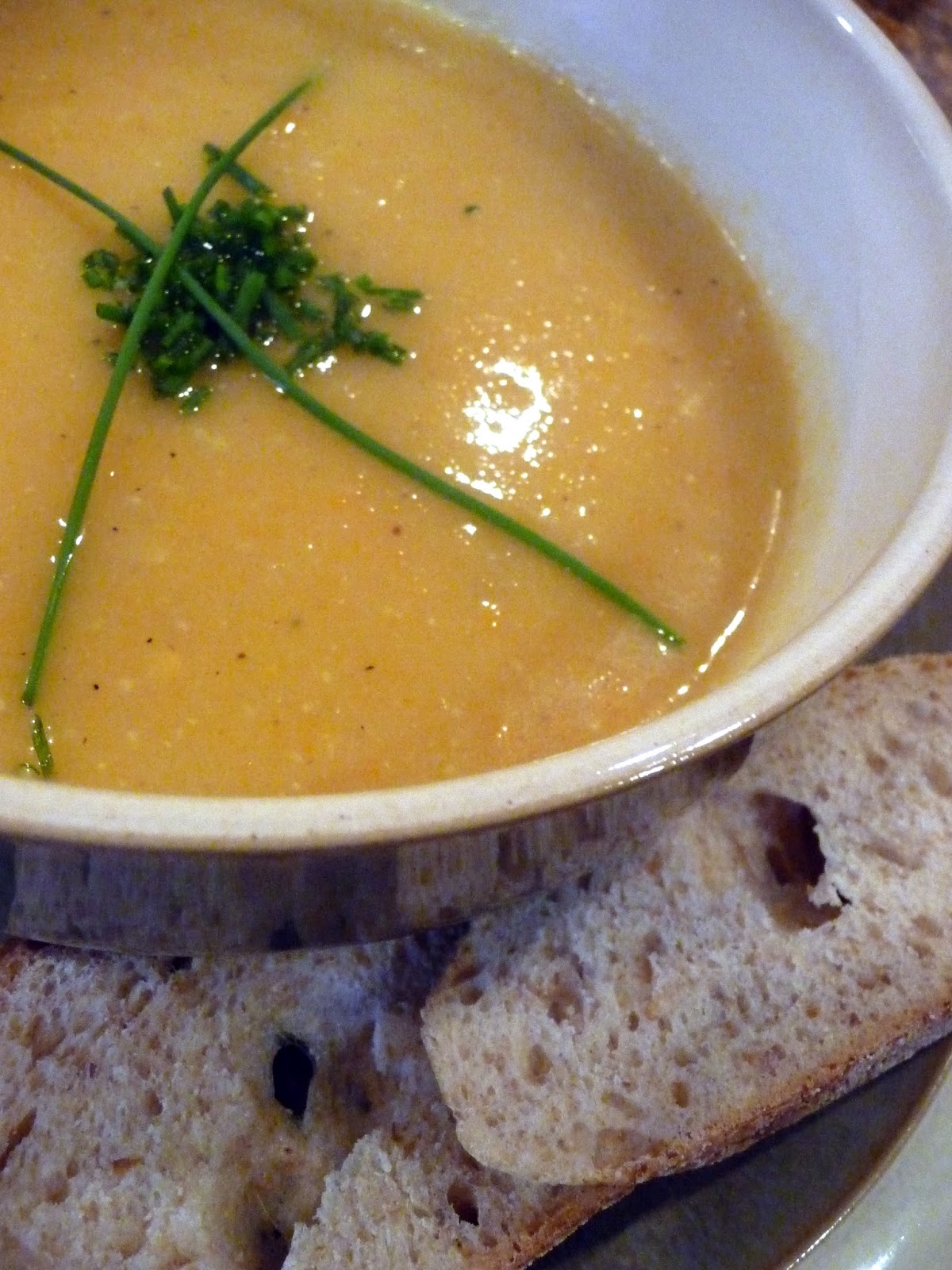
Acorn Squash Soup

Recently, we joined a community supported agriculture program, also known as a CSA.  We get a box of fruit and vegetables every week.   This box presents a lot of challenges for me, given that my cooking tends to be more meat-centric than vegetable centric.  Therefore, I am using this CSA as a cooking challenge for me -- a CSA challenge -- to make dishes based on the fruits and vegetables that we get each week in our box.

Given the time of year, the box contains a lot of winter vegetables, such as potatoes, squash, and yams.  Over the past couple of weeks, the box has contained acorn squash.  That is one ingredient that, until recently, I had never prepared before. 

As I always do, I looked for a recipe.  I am quite familiar with butternut squash soup, because Clare has made that before and it was very tasty.  So, a soup seemed like a good start.  I reviewed a handful of acorn squash recipes before I came across one from Mario Batali.  The most appealing thing about this recipe is its simplicity.  A handful of ingredients, boiled together, blended together.  The result is a creamy, earthy soup with a lot of flavor from the nutmeg and a little kick from some crushed red pepper.

Not only have I not cooked with acorn squash, I don't believe that I had ever tasted it before.  However, I think I can say that I am very impressed with the taste of this soup.  Given how easy it is to make, and the availability of acorn squash during this time of year, I have a feeling that we will be eating a lot more of this soup over the coming weeks and months.


ACORN SQUASH SOUP
Recipe by Mario Batali
Serves 6

Ingredients:
2 acorn squash (peeled, seeded and cut into large cubes)
1 onion, diced
2 carrots, sliced
Chile flakes, to taste
1/2 teaspoon freshly grated nutmeg
2 cloves garlic, minced
5 cups of water
Chives, minced
Salt
Freshly ground black pepper
Extra virgin olive oil
Creme Fraiche 

Directions:
1.  Saute the squash, onions and carrots.  In a large heavy bottomed pot over medium-high heat, add about 4 tablespoons of olive oil.  Add the squash, onions, carrots, chile flakes, nutmeg and season with a generous pinch of salt.  Cook for 15 minutes or until the vegetables are tender and have broken down a bit and are soft. 

2.  Continue cooking.  Add the garlic and cook for a minute longer.  Add the water and bring to a boil and then reduce to a simmer.  Cook for 15 to 20 minutes more.  

3.  Blend the soup.  Use a hand blender to blend the soup until smooth and creamy.  Adjust the seasoning.  

4.  Finish the dish.  Serve with a drizzle of good olive oil, a dollop of Creme Fraiche, and a sprinkle of chives. 

ENJOY!

Tuesday, August 4, 2015

Grilled Steak with Green Sriracha

One of the things on my culinary bucket list is to make my own hot sauce.  It may not seem like much, especially to cooks and chefs who could easily make a hot sauce for various dishes.  However, I love hot sauce.  I really, really LOVE hot sauce.  I usually keep at least 3 or 4 different types of hot sauce on hand in our refrigerator, including the "staples," like Tabasco and Sriracha. 

Recently, I came across a recipe for a grilled steak with a green sriracha sauce.  A sriracha sauce is a type of hot sauce typically made from chiles, distilled vinegar, garlic, sugar and salt. The sauce is Thai in origin, often called sot Siracha; the name comes from the city of Si Racha, which is located in the Chonburi province of eastern Thailand.  The sauce is typically used in Thai cuisine as a condiment; and, it even finds its way into Vietnamese cuisine, served alongside bowls of phở.

Sriracha is particularly popular in the United States.  Given that over one ton of Sriracha sauce is produced every hour, it has found its way into many grocery stores and restaurants across the United States.  The supply is readily eaten by demand, including one person who consumed three bottles of it at one time.  While I have consumed my fair share of Sriracha sauce, I have never simply guzzled the hot sauce.  It is best drizzled over food, especially fried or grilled foods.

While the red Sriracha sauce is almost ubiquitous, the green sauce seems more intriguing and it is one that I have never tried before.  The recipe incorporates green chiles -- roasted poblano peppers and serrano chiles -- with a range of fresh ingredients such as basil, chives, cilantro, lemongrass, lime leaves and coconut.  The poblano peppers add depth to the flavor of the sauce, while the serrano chiles provide quite the kick, which one would expect.  The end result is a hot sauce that is in many respects better than the red Sriracha.  Maybe it is the use of fresh ingredients, prepared using a blender.  Maybe it is the tartness of the lime juice contrasted with the heat of the serranos, along the field of chives, cilantro, basil and mint.  Maybe it is just that I love most of what I make.    


GRILLED STEAK WITH GREEN SRIRACHA
Recipe from Food & Wine
Serves 4

Ingredients:
3 large poblano chiles 
2 serrano chiles
3 large garlic cloves, peeled & smashed
1/2 cup fresh ginger, sliced
1 half-inch piece of turmeric or
     1/2 teaspoon of ground turmeric
1 cup shredded unsweetened coconut
2 loose cups of basil leaves
2 loose cups of mint leaves
1 1/2 cups of snipped chives
1/2 cup of chopped cilantro
4 makrut lime leaves, shredded
1 lemongrass stalk, tender inner bulb, bottom 4 inches
     peeled and thinly sliced
1 cup canola oil, plus more for grilling
1/4 cup of lime juice, plus 2 tablespoons
Kosher salt
4-5 pounds of steak, such as flank steak or skirt steak, cut into 
     4 even sized pieces

Directions:
1.  Prepare the Green Sriracha.  Roast the poblano chiles directly over a gas flame, turning, until charred and tender.  Transfer to a bowl, cover with plastic wrap and let cool.  Peel, core and seed the poblanos.  Transfer the poblanos to a blender.  Add the serranos, garlic, ginger, turmeric, coconut, basil, mint, chives, cilantro, lime leaves and lemongrass and pulse to chop.  With the machine on, add the 1 cup of oil and puree.  Add the lime juice and season the green Sriracha with salt. Once the sauce is made, it can be refrigerated for up to three days.

2.  Grill the steak.  Light a grill.  Brush the steaks with oil and season with salt.  Oil the grill grates and grill the steaks in batches over high heat, turning once or twice, until the meat is lightly charred and medium rare, 5 to 6 minutes.  Cook a little longer, 1 to 2 minutes more, to obtain medium, if that is your desired doneness.  Transfer to a carving board and let rest for 5 minutes before slicing across the grain.  Serve the steak with the green Sriracha.

Sunday, March 29, 2015

Steak Marchand de Vin

French cooks believe that good meat deserves a sauce.  These words were written by Anne Willan, the author of one of my favorite French cookbooks, The Country Cooking of France.  Anne Willan is a member of the James Beard Cookbook Hall of Fame.  She received that honor for her cookbooks, which have focused on French Cuisine.  She wrote those books with the goal of helping home cooks, like myself, learn the techniques and recipes used by French cooks and chefs.

One of these recipes is called "Steak Marchand de Vin," also known as "Winemaker's Steak."  A "Marchand de Vin," is a quick jus or sauce made with wine and fresh herbs.  In this case, the sauce is made after pan frying a steak.  Willan says that any cut of steak can be used in this recipe, from a filet to T-bone or entrecote.  With all of the fond in the pan, a cook uses wine to deglaze the pan and incorporate those flavors into what becomes the sauce.   As the wine reduces, with the alcohol evaporating, along with some of the liquid, the pan is removed from the heat and fresh herbs are added.  The end result is a very simple sauce that is full of flavor.

One last note, as any chef or cook will tell you, you cook with a wine you want to drink.  For this recipe, I used a Saumur Champigny, a wine from the Loire region of France.  The wine worked very well with this recipe, because of its ripe cherry and cranberry elements.  If you can't find that wine, look for a Côtes du Rhône or another red wine from France, especially if you want to keep with the French inspiration.   If you are looking for other inspirations, many consider a Carmenere from Chile.  Those wines often have a spice or pepper element to them that could provide another layer of flavor to the sauce.


STEAK MARCHAND DE VIN (WINEMAKER'S STEAK)
Recipe from Anne Willan, The Country Cooking of France, p. 135
Serves 4

Ingredients:
4 steaks, cut 3/4 inch thick (about 1 1/2 pounds)
Salt
Pepper
4 tablespoons of butter
2 shallots, finely chopped
1 garlic clove, finely chopped
1 cup of full bodied red wine
Leaves from 3 to 4 sprigs of fresh tarragon, chopped
3 to 4 fresh chives blades, chopped
3 or 4 sprigs fresh parsley, chopped

Directions:
1.  Brown the steaks.  Season the steaks on both sides with salt and pepper.  Melt half of the butter in a frying pan over high heat until it stops foaming.  Add the steaks and fry until well browned 2 to 3 minutes.  Turn them, lower the heat slightly, and continue frying until brown and cooked to your taste, 2 to 3 minutes for rare steak, 3 to 5 minutes if you prefer it more done.  Lift out the steaks and set on warmed plates, keep warm.

2.  Make the wine sauce.  Pour all of 1 tablespoon of the fat from the pan and return to high heat.  Add the shallots and garlic and saute until soft, about 2 minutes.  Add the wine and boil rapidly until reduced by half.  Take from the heat and whisk in the remaining butter in small pieces.  Stir in the herbs, taste, and adjust the heat.  Spoon the sauce over the steaks and serve at once.

ENJOY!

Sunday, March 1, 2015

Shrimp Stew from Puglia

Every recipe can tell a story, if you are willing to listen to it.  This recipe tells of small fishing villages along the coastline of Apulia or Puglia. Villages such as Molfetta or Monopoli.  Walking along the docks early in the morning, one would watch as the small fishing boats head out into the Adriatic Sea, searching for the freshest catch available.  The catch could be mackerel or anchovies.  It could be squid or octopus.  And, for some, it could be shrimp.  As the boats return to the harbor and the docks, one waits to survey the catch.  And, if possible, one could select the freshest seafood, and take their "catch" to a nearby restaurant to be prepared in the local style.  Local seafood prepared by local chefs. 

This recipe -- Shrimp Stew from Puglia -- comes, not from a local seafood restaurant in either Molfetta or Monopoli.  Instead, it comes by way of Mario Batali in his book America Farm to Table.  The recipe was provided by Mariquita Farm, which is located in Watsonville, California.  The farm does not cultivate or raise shrimp.  Rather, it grows a variety of produce, including sweet peppers.  Those peppers provide a nice contrast to the briny shrimp, which is what makes this dish shine.  

Shrimp sauteing in the pan.
When it comes to the shrimp, Mario Batali suggests that one look for American gulf shrimp. The reason is that buying American helps to support local fisheries; and, there is no doubt that the shrimping fishery in the Gulf Coast region definitely needs our support.   

There are also other reasons to buy American shrimp.  One major reason is that there are grave issues with respect to shrimp that is harvested in certain areas of the world.  For example, there are numerous reports and stories about slave labor being used by Thai fishing boats. Those same vessels also do not use sustainable fishing methods, which leads to overfishing and damage to the oceans.  

Fortunately, I was able to find some wild caught shrimp from the United States.  When you look for shrimp, you should buy shell-on shrimp, so you can make the shrimp stock called for in the recipe.  You should also look at large shrimp, such as U-12 (twelve shrimp to a pound), but no smaller than 16-20 count (sixteen to twenty shrimp per pound).  Smaller shrimp would simply get lost in the stew.  

Although there is no mention of it in the recipe, I would suggest that this dish be served with a good piece of crusty bread.  The stew is very good and the bread works well to get every last drop of its sweetness.  We did not have any bread when I made this dish for my beautiful Angel.  That was the one missing ingredient.


SHRIMP STEW FROM PUGLIA
Recipe from Mario Batali, America Farm to Table, pg. 167
Serves 4

Ingredients (for the shrimp stock):
1 tablespoon of olive oil
Reserved shells from 2 pounds of shrimp
2 tablespoons of sweet paprika or pimenton
4 cups of water
Kosher salt

Ingredients (for the shrimp stew):
6 tablespoons extra virgin olive oil, plus more for drizzling
1 red onion, cut into 1/8 inch dice
2 red bell peppers, seeded and cut into 1/8 inch dice
2 yellow bell peppers, seeded and cut into 1/8 inch dice 
1 teaspoon of red pepper flakes
1 tablespoon of sugar
1/2 cup basic tomato sauce
Kosher salt
Freshly ground black pepper
2 pounds (16/20 count shrimp), peeled and deveined,
     shells reserved for stock
3 cups of shrimp stock
1/3 bunch fresh chives

Directions:
1.  Make the shrimp stock.  In a 3 to 4 quart saucepan, heat the olive oil over medium heat.  Add the shrimp shells and toss well.  Allow the shells to cook for 2 to 3 minutes, stirring often.  Add the sweet paprika and cook for 3 minutes more.  Add the water and bring to a simmer, pressing down on the shells with a spatula or large spoon to extract maximum flavor.  Cook until reduced by one-quarter.  Season with a little sauce to taste.

2.  Saute the vegetables.  In a 10 to 12 inch saute pan, heat 2 tablespoons of the olive oil over high heat until just smoking.  Add the onion and bell peppers and saute for 5 minutes.  Add the red pepper flakes, sugar, tomato sauce, and salt and black pepper to taste and cook over low heat until tender, about 10 minutes.   Remove from the heat and set aside.

3.  Saute the shrimp.  In a 12 to 14 inch saute pan, heat the remaining 4 tablespoons of olive oil over high heat until smoking.  Season the shrimp with salt and black pepper on both sides and cook until very red, 1 to 2 minutes.  Turn carefully with a wide spatula and cook on the other side for 1 minute.  You may need to cook the shrimp in batches to avoid overcrowding the pan.

4.  Make the stew. Remove the shrimp, add the bell pepper mixture and the shrimp stock to the pan and bring to the a boil.  Cook for 3 minutes, then return the shrimp to the mix and reduce the heat to maintain a simmer for a few minutes more.  

5.  Plate the dish.  Ladle the stew into deep bowls and garnish with chives and and a drizzle of good olive oil.

ENJOY!

Wednesday, November 21, 2012

Carrot Soup with Coriander, Curry, Ginger and Chives

With the cooler days of autumn now upon us, my focus has turned to heartier fare.  Still, every once in a while, I come across a recipe that is not just hearty, but also healthy.  I came across a recipe for Carrot Soup with Coriander, Curry, Ginger and Chives in one of the pregnancy cookbooks that I recently bought.  Although I am not the biggest fan of carrots, I nevertheless decided to make the recipe because I was not cooking just for myself.  I was also cooking for my beautiful wife and our child on the way. 

This soup did a lot to improve my view of carrots.  (I have to admit that it was probably the use of the coriander, curry, and ginger that helped in this regard.)  This soup is very easy to make and it can be enjoyed both as a warm soup or a cold soup.  Moreover, this soup could also double as baby food.  The only change to the recipe is that the salt and pepper should be omitted, as well as the garnish of chives. I can't wait to start preparing baby food dinners for the little Baby Bolek!  Until that time, I will continue to focus on my presentation.  I think it still needs a little work.


CARROT SOUP WITH CORIANDER, CURRY, GINGER AND CHIVES
Recipe from The Well Rounded Pregnancy Cookbook at 48
Serves 4

Ingredients:
2 tablespoons olive oil
1 medium sweet onion, chopped
1 medium Yukon Gold potato, peeled and chopped
1 clove of garlic, chopped
1 tablespoon peeled and grated fresh ginger
1 teaspoon curry powder
1 1/2 pounds carrots, peeled and chopped
4 cups vegetable stock
Salt
Freshly ground pepper
1/2 cup heavy cream
1/2 cup fresh chives, chopped

Instructions:
1.  Saute the vegetables.  Heat the olive oil  in a large saucepan over medium heat.  Add the onion, potato, garlic, ginger, coriander, and curry powder and cook until the onion is soft and translucent, about 5 to 8 minutes.  

2.  Simmer the soup.  Add the carrots and stock and bring to a boil.  Reduce the heat, cover and simmer for 20 minutes or until the carrots are tender.

3.  Puree the soup.  Puree in a blender and season to taste with salt and pepper.  Swirl in the cream and garnish with the chives before serving.

ENJOY!

Wednesday, August 8, 2012

Grilled Beef Heart with Herbed Viniagrette

As I continue my culinary journeys, there are a few people who I follow.  One of those individuals is Michael Ruhlman. Michael is an author, food writer and blogger.  He is one of the writers behind Thomas Keller's cookbooks.  However, Michael has several cookbooks of his own, including Ruhlman's Twenty.  The fact that Ruhlman is from and promotes Cleveland, where I grew up, is just another reason to listen to what he has to say.

One (of many) Ruhlman's recipes that I have wanted to make is his Grilled Beef Heart with Herbed Vinaigrette.  As I continue to expand my cooking knowledge and skills, I have become particularly interested in cooking with ingredients that are a little out of the ordinary. Offal constitutes a category of such ingredients.  Brains, hearts, kidneys, livers and more.  I recently discovered that a local grocery store carried beef hearts, so I bought a two and one-half pound heart, pulled up Ruhlman's recipe and began to cook with this ingredient for the first time.

Beef heart is a relatively healthy choice for someone looking to cook beef.  It has less fat than most other cuts of beef, and it is packed with protein.  Beef heart contains several B vitamins, lycopene, iron, phosphorus, potassium, sodium, selenium and zinc.  Beef heart also has Coenzyme Q10, which is said to boost energy levels, help improve the immune system and act as an antioxidant.  Coenzyme Q10 is also believed to prevent blood clots, lower blood pressure and help prevent heart disease.  That's right, eating beef heart may help improve your heart ... or so they say.  It is important to note that beef heart, like other organ meat, does have a lot amount of cholesterol.  (I tried to figure out the levels of good and bad cholesterol in beef heart; however, I was not successful in that endeavor.)

Overall, this is a great recipe.  The grilled beef heart was delicious, but the vinaigrette really put the dish over the top. 


GRILLED BEEF HEART WITH HERBED VINIAGRETTE
Recipe adapted from one by Michael Ruhlman
Serves 6

Ingredients (for the beef heart):
1 beef heart, trimmed and cut into slices or chunks
1/2 large shallot, chopped or diced
Salt, as needed
Black pepper, as needed
Olive oil, as needed
Arugula or Spinach, one handful per serving

Ingredients (for the herbed vinaigrette):
3 tablespoons of red wine vinegar
1/2 large shallot, minced
1 tablespoon of oregano, parsley, chives or 
     1 tablespoon of basil, parsley and rosemary
1/4 teaspoon of salt
3 tablespoons of extra virgin olive oil

Directions:
1.  Marinate the beef heart.  Liberally salt and pepper the beef heart, add the shallot and oil.  Toss the ingredients to combine.  Refrigerate the beef for at least one hour and up to overnight.

2.  Prepare the vinaigrette. Combine the vinegar, shallot and salt.  Let sit for five to ten minutes.  Stir in the herbs.

3.  Cook the beef heart.  Grill the beef over hot coals or over high heat on a gas grill.  Thread the pieces on water-soaked skewers.   Grill the beef heart for two to three minutes on each side for medium rare (maybe one to two minutes if the pieces are smaller).

4.  Plate the dish.  Arrange the arugula or spinach on a plate, top with the beef heart and spoon some of the vinaigrette over the beef heart. 

PAIRING THIS DISH

There is not a lot out there about pairing beef heart with either wine or beer.  And, I have to admit that when I ate this dish, I did not drink a beer or wine with it.  So, it is fairly hard for me to suggest a pairing.  Nevertheless, I think that there are a couple of obvious suggestions. Just as red wine pairs well with beef, a red wine -- such as a Pinot Noir or a Chianti -- could pair well with this dish.

ENJOY!

Thursday, September 15, 2011

Smoked Mullet Spread

Striped mullet fish, or Mugil Cephalus, can be found along the coastlines around the world.   In the United States, various species of mullet (such as white mullet and striped mullet) are most prevalent in the Gulf of Mexico and the North Atlantic.  The biggest fisheries in the U.S. can be found in Louisiana, east of the Mississippi River, and in southwest Florida. 

Mullet school in large populations, and fishermen use cast nets, strike nets or beach seines, fishermen are able to harvest the fish in a manner that results in little bycatch.  These fishing methods have led some, like the Monterrey Bay Aquarium's Seafood Watch, to rate Striped Mullet as not only a sustainable option, but a "best choice."  Cooks often use the oily flesh of the mullet, as well as the roe, in dishes.  The mullet also has an economic importance because, when not being incorporated into local dishes, fishermen use the mullet as bait to catch larger species of fish, such as billfish.

Mullet are rather intriguing fish themselves. Although the most noticeable feature of the mullet is its relatively large eyes, it is the rounded head, inconspicuous teeth and thin lips are more noteworthy.  The teeth and the lips are a gateway to a stomach that has a gizzard like structure.  I say all of this because the teeth and lips are perfect for a fish with a diet that consists of zooplankton, dead plant matter and detritus.  Striped mullets will feed along the top layer of sediment, sucking it in, along with micro-algae and detritrus, using the gravel it consumes in its gizzard to digest its food.

During a recent trip to Eastern Market with Clare's parents, we came across whole Striped Mullets at Southern Maryland Seafood.  While we were principally there to buy some sockeye salmon for smoking, we decided we would experiment with a mullet as well.  We purchased a mullet, which averages between two or three pounds, and were on our way.    

When it came to smoking, I only had three woods available: mesquite, hickory or apple.  Mesquite and hickory would not work with this fish (or, for that matter, any fish).  This left the apple wood.  I had purchased the apple wood when I made the Big Bob Gibson's Eight Time World Championship Pork Shoulder for the Savage Boleks' Second Annual BBQ.  I decided to use apple juice in the liquid bowl to help add a sweetness to the oily flesh of the mullet. 

Clare's father did some research on the Internet and came across some recipes for a smoked mullet spread.  The recipes could be broken down into two categories.  First, there are recipes that call for the use of cream cheese.  Second, there are recipes that are based upon sour cream.  We decided to go with the first category, cream cheese.  We added some fresh herbs, such as chives and tarragon, along with a healthy number of splashes of Tabasco sauce.


SMOKED MULLET SPREAD
A Chef Bolek Collaboration with Frank Savage
Serves many

Ingredients (for the Brine):
1 fresh whole mullet (about 2 pounds), cleaned and gutted
     with head and backbone removed
4 cups water
3/4 cup of Kosher Salt
1/2 cup of light brown sugar

Ingredients (for the Spread):
8 ounces of cream cheese
1/4 cup diced onion
1 tablespoon of fresh chives, chopped finely
1 tablespoon of fresh tarragon, chopped finely
Salt, to taste
Ground black pepper, to taste
1 teaspoon of Tabasco 
 
Directions:
1.   Brine the mullet.  Combine the water, salt and brown sugar to create the brine.  Add the mullet to the brine and allow the fish to rest for about forty-five minutes. After forty-five minutes, remove the fish and set it out to air-dry.  

2.  Prepare the smoker.  Start the fire in the smoker.  Once the fire is set, add some pieces of apple wood to start the smoke.   the smoker is ready when the temperature is between 200 and 225 degrees Fahrenheit.

3.  Smoke the mullet.  Add the mullet and smoke it for about one hour.  The internal temperature should reach about 140 degrees Fahrenheit and the meat of the fish should be easy to flake. 

4.  Create the spread.  Remove the fish. Using a fork, pull the flesh off of the skin.  Once you have removed all of the flesh, break it into small pieces.  Combine the fish, cream cheese, tarragon, chives, Tabasco, salt and pepper. Mix thoroughly.


This is a great recipe.  The mullet contributes to this dish, not by adding a heavy smoke flavor to the cream cheese, but by adding texture.  The one thing I would note as a word of caution is to be conservative in the use of tarragon, because it has a strong flavor that could overshadow the fish if too much is added.

ENJOY!

For more about Striped Mullet, check out the Florida Museum of Natural History.