Showing posts with label Coconut Milk. Show all posts

Friday, May 22, 2026

Chicken Tikka Masala

As the story goes, it all began the Shish Mahal, which is currently located at the corners of West Prince's Street and Park Road. It was the 1970s, and, the owner of the restaurant - Ali Ahmed Aslam - was confronted by customers who complained that his tandoori chicken tikka was slightly dry. Chicken tikka, is actually a kebab of boneless chicken chunks cooked in a tandoor oven. Apparently, at the time, Aslam was perhaps cooking his kebabs a little too long. The complaints motivated the owner to respond by adding a creamy tomato sauce. The end result was the first serving of Chicken Tikka Masala. 

I have prepared Chicken Tikka in the past. However, until very recently, I have never went the additional step to add the creamy tomato sauce.  The recipe came from an unlikely place ... Ayurvedic cooking. I have always thought that Ayurvedic cuisine focused heavily on vegetables. That thought was reinforced by many of the recipes that I came across as I was researching ways to improve my cooking. Not that vegetables are a bad thing, I have quite a few Ayurvedic vegetable recipes that I want to make. But, I still remain an omnivore, and, protein (in some form) still remains a significant part of my diet. 

Yet, as I have learned, Ayurvedic cuisine does not completely take chicken off the table. The cuisine definitely promotes vegetarianism as it helps to promote higher consciousness. It does include chicken (and turkey) dishes because Ayurveda recognizes those proteins as something that has a range of chicken dishes in its repertoire. Chicken is considered nourishing and warming, something that can balance certain doshas (like Vata and Pitta). In taking an ayurvedic test, my results labeled me as Vata with some Kapha. As I searched for recipes that would fit this profile, I found one for Chicken Tikka Masala. 

The recipe has some modifications that make it healthier, such as the use of chicken breasts instead of chicken thighs. The one modification that specifically addresses a Vata dosha is the addition of four tablespoons of coconut milk. That also helps to add to the creaminess of the sauce. It also made this dish a little lighter than the Chicken Tikka Masala that I have gotten at restaurants, which is okay given the reason why I made it. And, why I will make it again ... and again. 

CHICKEN TIKKA MASALA

Recipe from Tomas Yareda, et al., Eat Taste Heal, pg. 267

Serves 4

Ingredients:

  • 4 skinless chicken breast halves
  • 1/4 cup organic plain yogurt
  • 2 tablespoons sunflower oil or ghee
  • 1 tablespoon lemon or lime juice
  • 4 tablespoons organic tomato paste
  • 2 teaspoons curry powder
  • 1 teaspoon salt
  • 1/2 teaspoon chile powder
  • 2 teaspoons paprika
  • 1 teaspoon minced garlic
  • 1 teaspoon grated ginger
  • 1/4 teaspoon ground turmeric
  • 6 kari leaves, chopped or 1 tablespoon chopped fresh mint
  • 4 tablespoons coconut milk

Directions:

1. Prepare the chicken. Make several deep slits over the meaty side of each chicken breast. Put the chicken in a baking dish, bone down.

2. Prepare the sauce. In a mixing bowl, whisk the yogurt, sunflower oil (or ghee), lemon (or lime) juice, tomato paste, curry powder, salt, chile powder, paprika, garlic ginger, turmeric, coconut milk, and kari leaves (or fresh mint). Spread the yogurt mixture over the chicken evenly. Cover and refrigerate for at least 3 hours or overnight. 

3. Bake the chicken. Preheat the oven to 475 degrees Fahrenheit. Transfer chicken and marinade to a baking pan and cook until tender, about 25 minutes. 

PEACE.

Saturday, February 8, 2025

Around the World in 80 Dishes: Seychelles

Seychelles is an interesting combination of the littlest and the greatest. The one hundred and fifty-five islands that comprise the country, which lie in the Indian Ocean, make Seychelles one of the smallest countries in Africa by square miles. The estimated 100,600 people who live on those islands makes the Seychelles the least populated country in Africa. Yet, Seychelles has the highest nominal gross domestic product (GDP) per capita of any African country, which means its residents have relatively the highest standard of living. It is also ranked the highest electoral democracy in Africa, and forty-third in the world. That is quite the combination for a country whose islands laid uninhabited prior to the 18th century.

The French were the first to occupy and claim the islands in 1756, naming them after Louis XV's Minister of Finance, Jean Moreau de Sechelles. As the French settled on the islands, they brought with them an order that was familiar in the colonial era. Helene Frichot, an architectural author, recounted this historical order in one of her essays:

Originally, when the French plantocracy settled, habitations -- strips of land - were marked from mountain peak to shore, parcelled out for the mostly large, conservative, Catholic families. These families assumed a certain order of things, divided strictly along lines of colour: those who owned and governed, and those obliged to labour. As Mairi O'Gorman argues in her research on the Seychelles, property, espeically when organised according to a plantation regime, is racialised: ownership assumes whiteness, while labor is delegated to Brown and Black people.

And, French settlers brought with them enslaved African men, women and children to work on these new plantations. The British Empire took control of the islands less than fifty years later, with the Treaty of Paris in 1814. The British allowed the use of enslaved Africans to continue, and they began to bring indentured servants from the Indian subcontinent and other parts of Asia to work on the islands. The result was a society that had French plantation owners, the British administrative elite, and a large number of African and Asian laborers, traders and shopkeepers. 

This mix of people and cultures on the islands led to the emergence of the Seychellois Creole, an ethnic group that combines African, Asian and European influences into one common identity with a language and culture of its own. The Seychellois Creole language, Seselwa, is rooted in French, but it has incorporated aspects of African and Malagasy languages, as wells as terms and phrases from English and Hindi. E, kot i konsern manze, lenfliyans Lafrik, Lazi e Eropeen is disifil pou manke. ("And, when it comes to food, the African, Asian and European influences are hard to miss." - My attempt at Seselwa using Google translate.)

Le Jardin du Roi, Mahe, Seychelles
(Source: Runaway Lodge)

As for Seychelles cuisine, its story can be told, in part, with reference to a garden, Le Jardin du Roi, that the French settlers started in 1772.  One of those colonists, Pierre Poivre, wanted to get into the spice trade. Poivre himself was quite the story. He spent his early years as a missionary, living in Cochinchina (later known as Vietnam), Guangzhou, and Macau. He left missionary work to join the French East Indies Company, where he presumably came into contact with the spice trade. By 1772, he was living between Mauritius and the Seychelles, and wanted those islands to be part of that trade. Poivre's entre into the spice word was not very Christian-like. He decided that he would set out on a vessel to Ceylon (now Sri Lanka) and the Moluccas (now part of Indonesia). His goal: to steal the spices and bring them back to French-controlled islands where they could be planted and then France could have its own source.  Poivre actually stole the spices and brought them back to the Seychelles. However, as Poivre returned from his voyage in 1780, the governor mistook Poivre's vessel for an enemy ship. The governor destroyed the growing garden. Spices were too valuable to have fall into the hands of the enemy. 

Le Jardin du Roi ultimately survived and grew into 25 hectares where more than 120 species of fruits and spices were cultivated. That variety is one of the defining characteristics of Seychellois Creole cuisine. Recipes use a range of spices, including chiles, cinnamon, cloves, ginger, nutmeg, turmeric, and much more. The cuisine also features a range of seafood dishes, which one would expect from an island nation. 

MAIN COURSE

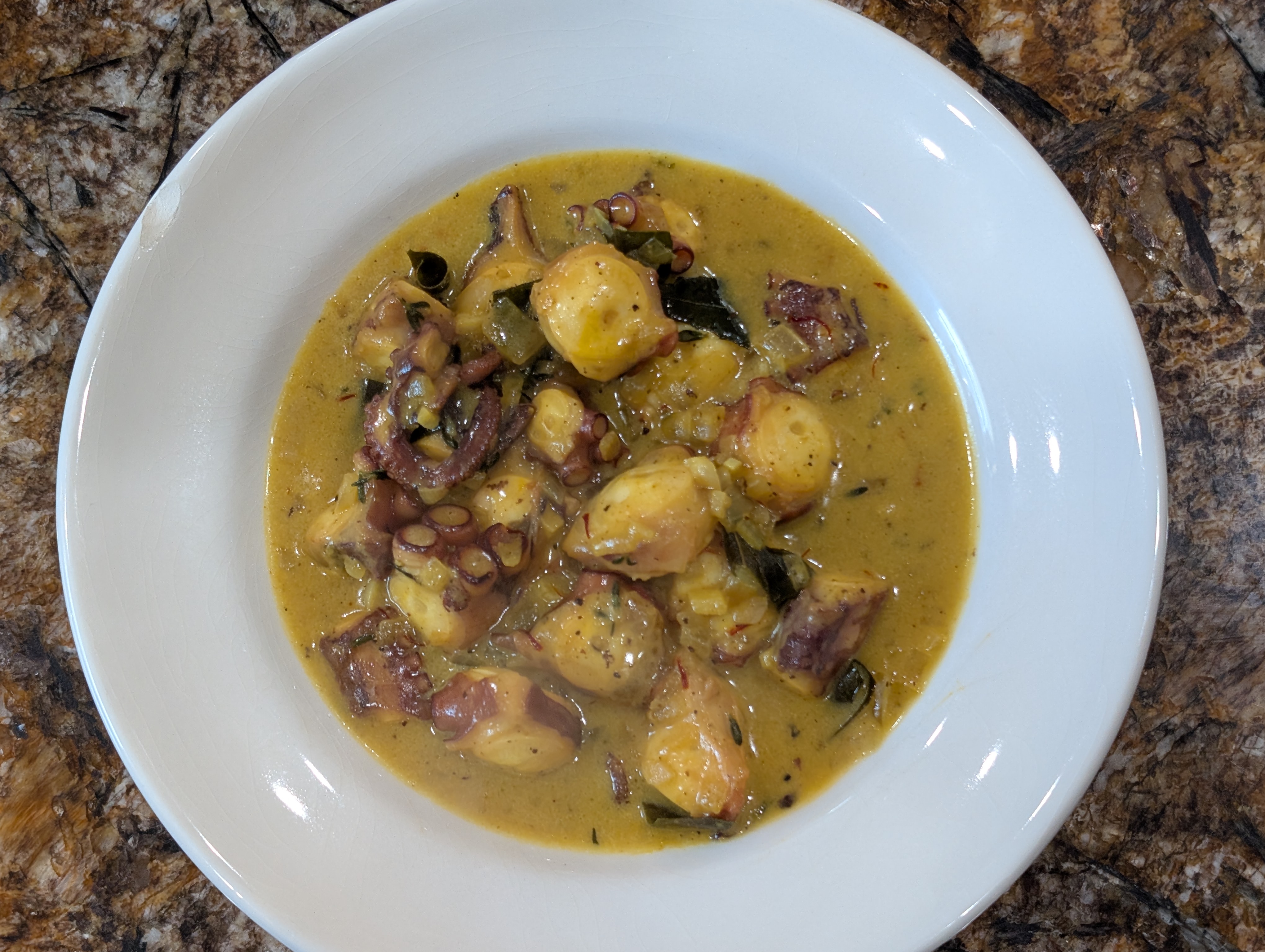
This personal culinary challenge showcases a cuisine that reflects how influences from around the world come together in amazing dishes. The challenge involves the preparation of a Seychellois Octopus Curry. The cephalopods could be found around many of the islands, such as Cousine. That availability led to this curry, which is a popular dish in the Seychelles. 

This demand created a fishery for octopi in the Seychelles. Many look for the creatures around the coral barrier reefs, while others, like a fisherman named Dave Auguste, go further out into the ocean. Auguste has fished for octopus for more than twenty years. When the COVID pandemic hit, the tourist trade (which is important to the Seychelles) crashed, and so did the market for expensive seafood like octopus. As the world gradually reopened and tourists returned, so did the demand for octopus. 

Dave Auguste with his catch (Source: United Nations, Photo: Douglas Okwatch)

Dave Auguste found one longer lasting change ... there were less of the cephalopods to catch. This change is not the result of COVID, but other factors.  In an article published by the United Nations, Auguste explained: 

There are fewer and fewer octopuses now. Before, I used to find them close to shore, but now I have to go further out. Again, for the last ten years or so, going out to sea has become more complicated because the sea has become rougher and the currents stronger. If I am not careful I can drift away from shore.

Indeed, climate change has affected the work of those who fish the waters around the Seychelles.  Auguste explained that there has been a change in rain patterns: "we used to have rainy periods that lasted several days, now it rains the same amount for one day and it all runs off into the sea." The prolonged rains and the runoff cause the waters close to shore to take on a reddish hue. The octopi do not like the tinged water and move further offshore. An additional factor is that, due to warming temperatures in the sea, there are some areas of the barrier reefs where up to 90% of the coral have died.

Not all of the news is bad. The Seychelles has taken proactive steps to stem the damage caused by changes in the climate. These steps include imposing quotas on seafood catches, expanding the range of protected marine areas, and implementing reef restoration projects. This has required some adjustment and adaptation, especially for those who work in the seafood industry, which makes up 27% of the Seychelles gross domestic product. This sacrifice, as well as, the conservation efforts, may not be enough if the climate continues to change. 

Turning to the challenge, I have prepared whole octopus in the past, but I decided for this dish that I would use pre-cooked octopus, which is available online or from some warehouse stores. Each package usually has 2-3 large tentacles, which may be less than a kilogram but still enough to prepare a meal for at least 2-3 people. The pre-cooked octopus also saves a lot of time (basically you can skip step 1). 

OCTOPUS CURRY

Recipe from Tourism Seychelles

Serves 4

Ingredients:

  • 1 kilogram octopus
  • Salt
  • Pepper
  • Fresh coconut milk (substitute 1 can coconut milk or cream)
  • 2 teaspoons saffron
  • 1 onion
  • Fresh thyme
  • 3 garlic cloves
  • Ginger (a little bit)
  • 1 teaspoon curry powder (or to taste)
  • Cinnamon sticks
  • Curry Leaves
  • Oil

Directions:

1. Prepare the octopus. Add the octopus to a pot and fill it with water. Boil until tender, about 45 minutes to 1 hour depending upon the size. Use a fork to check if the octopus is soft enough. Once the octopus is done, cut it into pieces

2. Prepare the curry. In a saucepan, add the oil, onion, garlic, ginger, saffron, curry powder, cinnamon sticks, thyme, salt and pepper. Mix and the add the octopus pieces. Fry the octopus pieces for a few minutes and then add the coconut milk and stir. Cover the saucepan and let it simmer for 15 to 20 minutes, as the sauce thickens. 

3. Finish the dish. Once cooked, serve with some white rice, lentils and papaya chutney. 

SIDE DISH

Ordinarily, as noted above, one would prepare white rice to serve with an octopus curry. Seychellois cuisine is known for its creole rice, a dish that is shared -- in some common form -- by creole cultures around the world. Rice is a staple food in the Seychelles, often accompanying main dishes. Yet, cultivation of rice cannot occur on a large enough scale on the islands to support its population. (Indeed, while the Seychelles may have an abundance of spices and access to seafood, it actually imports much of its other food.) Most of the rice comes from India, with smaller amounts imported from countries such as Pakistan, the United Arab Emirates, France and South Africa.

This personal culinary challenge gave me an opportunity to prepare creole rice and, to do so using the wide range of spices drawn from the subcontinent and southeastern Asia. The recipe shows that diversity with garlic, ginger, bay leaf, cinnamon, cloves, pepper and turmeric. I knew that I had to prepare this dish, which I served alongside the octopus curry.

SEYCHELLES CREOLE RICE

Recipe from Amy's Cooking Adventures

Serves 4

Ingredients:

  • 2 tablespoons butter
  • 1/2 red bell pepper diced (about 1/3 cup)
  • 1/2 onion diced (about 1/3 cup)
  • 2 cloves garlic, minced
  • 1/2 teaspoon turmeric powder
  • 1/2 teaspoon salt
  • 1/4 teaspoon black pepper
  • 1/4 teaspoon ground ginger
  • 1 bay leaf
  • Pinch of ground cinnamon
  • Pinch of ground cloves
  • 1/2 cup basmati rice
  • 1 cup water
  • Fresh parsley to garnish

Directions:

1. Saute the vegetables. Melt the butter in a saucepan over medium heat. Add the bell pepper and onion and cook for 5 minutes. Add the garlic, spices and rice and cook for another minute. Stir in the water and bring to a low boil. 

2. Finish the dish. Cover, reduce heat to low, and simmer for 15-20 minutes or until the water is absorbed. Fluff the rice, garnish with parsley and serve. 

*          *          *

To be honest, I had not expected to do a personal culinary challenge involving the Seychelles. I had previously done one for Mauritius, when I prepared an amazing duck curry. However, I really wanted to prepare this octopus curry and that led me to add this to the Around the World in 80 Dishes challenge. It is a decision that I will never regret, because it opened a door to exploring a creole culture and cuisine that draws inspiration from the diverse populations that have come to live on the Seychelles islands.  

Each of these dishes was a success, and, perhaps, some of the best dishes that I have prepared in recent weeks. This challenge has inspired me to move on to the next one. Check back to see where I end up. Until then ... 

PEACE.

Wednesday, January 1, 2025

Around the World in 80 Dishes: Colombia

"In Colombian cuisine, every dish tells a story."

-- Harry Sasson (Colombian chef)

This part of my journey around the world in eighty (80) dishes takes me to the South American country of Colombia. The above quote from one of the most famous Colombian chefs, Harry Sasson, represents my starting point. It is an acknowledgement that, in Colombia, cuisine represents more than just food on a plate. Instead, to borrow someone else's words, it is "a narrative of tradition, culture and love passed down the generations." I can't believe a better way to start a culinary adventure.

This personal culinary challenge presents an opportunity to learn about some of those stories. The thing is, there are a lot of them to tell. Colombia is in many ways a "melting pot," in which many cultures -- both indigenous and non-indigenous -- have flourished in a range of environments, from the coastlines of the Caribbean Sea and the Pacific Ocean to the heights of the Andes Mountains and back down into the marshlands of the Orinoquia region or the forests of the Amazon. This wide range of people and places gives rise to an equally diverse set of cuisines.

For some background, Colombia is generally divided into six regions. Those regions are Caribe, Pacifico, Andres, Orinoquia, Amazonia, and Insular. The map to the right shows each of those regions. 

At first, I wanted to tell the stories of the indigenous people of Colombia, such as the Guambiano and Muisca peoples. That would take me to the Andes region of Colombia. Thoughts of stories about corn, potatoes, quinoa and beans started running through my mind. I have to admit that I encountered some difficulty in finding indigenous recipes that I could use to prepare the dishes. 

Given this difficulty, I decided to shift my focus from inland to the coastal regions. I decided to research and learn about both of Colombia's coastal regions: Caribe and Pacifico. (Perhaps also the Insular region, which happens to consist of islands in both the Caribbean Sea and the Pacific Ocean.) So, basically, this post will try to tell Colombian stories around seafood. 

APPETIZER

I decided to start with perhaps one of the lesser told stories of Colombia. It's neighbors, Ecuador and Peru, are well known for their tuna fisheries. Indeed, one city in Ecuador -- Manta -- boasts of the name, Tuna Capital of the World, because it has some of the highest tuna landings of any port on the Pacific Ocean. Much of the catch is yellowfin or skipjack tuna, with some bluefin tuna. Yet, Ecuador shares the Pacific coastline with Colombia. The thing is that Colombia's fishery is far less developed than its neighbors. For one thing, there are far less ports, and even less ports of substantial size, along the Pacific Coastline in Colombia. 

Yet, the waters boast of one of the more notable fish migrations: millions of sardines make a journey down the Pacific coastline from Panama south along Colombia.  As one would expect, that sizeable migration would attract the attention of others, namely predators. One of those predators happens to be the yellowfin tuna. The yellowfin provide a sustainable fishery for Colombians. As Matt Harris described the experience, being on the waters off of Colombia looking to fish yellowfin tuna: 

We scanned the water expectantly, rods at the ready and line stripped on the deck. Just as Jose predicted, we didn't have to wait long. Suddenly they were all around. Yellowfin. Everywhere. The feeding activity was astonishing. Everywhere we looked there were myriad busts as if dozens of hand-grenades were being thrown around the boat. The water was literally churning with activity, as hundreds of tuna fizzed through the waves like supercharged torpedoes, slicing through the bait-ball in a frenetic blizzard of mayhem and slaughter.

I strongly recommend reading the entire article, which was published in the magazine In the Loop, and which was very interesting. 

This story provides the opening to my first dish, an appetizer that features yellowfin tuna. The method of preparation is not so much Colombian, but it definitely draws its inspiration from the cuisine. The dish is Tomates Rellenos de Atun, or Stuffed Tomatoes with Tuna. 

TOMATES RELLENOS DE ATUN

Recipe from My Colombian Recipes

Serves 4

Ingredients:

  • 1-2 cans (6 ounces of tuna)
  • 1/8 cup chopped onion (red or yellow)
  • 1/8 cup chopped red bell pepper
  • 1/8 teaspoon salt
  • 1/8 teaspoon freshly ground black pepper
  • 1/2 tablespoon lime juice
  • 1/4 cup mayonnaise
  • 1/2 cup mixed corn, diced carrots, peas
  • 1 tablespoon chopped parsley, plus more for garnish
  • 4 medium sized tomatoes, cored and seeded
  • Lettuce leaves, for serving (optional)

Directions:

1. Prepare the filling. In a medium bowl, combine all of the ingredients, except the tomatoes and lettuce. Cover and chill for 1 hour.

2. Finish the dish. To serve, line a large plate with lettuce leaves, spoon tuna salad into tomatoes and garnish with chopped parsley. Arrange the tomatoes on top of the lettuce leaves and serve. 

MAIN COURSE

While I could have stayed along the Pacifico region of Colombia for my culinary challenge, I decided to "travel" to the other coastline, along the Caribbean Sea. This coastline is dotted with port cities like Cartagena, Barranquilla, and Santa Marta. The challenge requires me to prepare Cazuela de Mariscos, a dish with perhaps a few stories. One of them would take me across the ocean to Spain, where seafood stews abound in a country with 3,084 miles (4,964 kilometers) or coastline. By contrast, Colombia has only 1,800 miles (2,900 kilometers). 

However, I want to stay in Colombia, so I look for stories in places like Cartagena or Santa Marta. In the latter city, there is a place where people talk about some of the best seafood stews or casseroles around.  It is Plaza San Francisco. Vendors sell the stews in pots. But, the story actually begins early in the morning, when they gather the ingredients together at their homes, prepare the dish, and cook it over a wood fire. When the stew or casserole is ready, then they head to the plaza to sell their food to locals and tourists alike. 

A cazuela de mariscos is prepared with seafood that is local to the area, although that typically includes clams, shrimp and white fish. The recipe typically calls for the use of coconut milk and, in some cases, heavy cream. I decided to skip on the heavy cream for health reasons, but I saw that other recipes incorporated seafood stock and/or water. So, I used some of the stock from steaming the clams, along with some water. 

CAZUELA DE MARISCOS

Recipe adapated from My Colombian Recipes and Travel Food Atlas

Serves 4

Ingredients:

  • 1 tablespoon butter
  • 1 tablespoon olive oil
  • 1/2 cup chopped green pepper
  • 1/2 cup chopped red bell pepper
  • 1 cup chopped onion
  • 2 fresh garlic cloves minced
  • 1 cup grated carrot
  • 1/2 teaspoon paprika
  • 1 can (13.5 ounces) coconut milk
  • 1/2 cup white wine
  • 4 cups heavy cream (I substituted clam stock and water)
  • 2 pounds of jumbo shrimp, peeled and deveined
  • 12 littleneck clams, scrubbed
  • 2 pounds white fish, cut into 1 inch pieces
  • 1 tablespoon fresh parsley or cilantro
  • 1 tablespoon tomato paste

Directions:

1. Sauté the vegetables. In a large saucepan over medium heat, warm the olive oil and butter. Add the garlic, red pepper, garlic, green pepper and carrots and sauté, until tender and translucent, about 10 minutes, stirring occasionally. Add salt and pepper

2. Continue to prepare the stew. Add the cream and coconut milk. Bring to a boil. Add the seafood and cover, reduce the heat and cook about 2 minutes until the clams open. Remove from the heat, discard any open shells. 

3. Finish the dish. Add the wine and tomato paste, simmer for about 20 minutes. Garnish with fresh cilantro or parsley. 

*    *    *

It has definitely been a while since I did my last personal culinary challenge (which was The Gambia). This particular challenge went well; but more importantly, as much as I enjoyed preparing this meal, I also enjoyed researching the cuisine of Colombia. I think that I will be paying future "visits" to this country, so that I can try to prepare foods from other regions, like the Andes and the Amazon. Until then ...

PEACE.

Thursday, June 1, 2023

Swahili Fish with Creamy Coconut Sauce

There is a small island along the shore of the Kenyan coastline called Lamu. The island has the oldest and best preserved Swahili settlement in eastern Africa. The settlement - Lamu Old Town - dates back to the 12th century and is now one of UNESCO's World Heritage Sites. As the U.N. agency describes the town, "[b]uilt in coral stone and mangrove timber, the town is characterized by the simplicity of structural forms enriched by such features as inner courtyards, verandas, and elaborately carved wooden doors." The town has also become a center for learning about the Swahili culture and the Islamic religion. 

Nearly ten years ago, the culture and cuisine of Kenya took center stage at the Smithsonian Institution's Folklife Festival. While I did not attend the festival that year, I have been to the festival in the past. Each year, the Smithsonian Institution provides a spotlight for a few different cultures from around the world. One can learn about art, cuisine, history, music and much more at various stalls and stands across the National Mall. 

Back in 2014, one had an opportunity to learn about the Kenyan cuisine as part of a program called Kenya: Mambo Poa. The demonstration included this recipe, which is for Swahili Fish with Creamy Coconut Sauce. As Michaela Wright wrote for the Smithsonian Institution, the dish comes from Lamu island, where it is served for special occasions. It is also served of the iftar, the feast eaten by Muslims at night during the Ramadan holiday.

The cooks who prepared this dish - Amina Harith Swaleh and Fatrma Ali Busaidy - at the festival explained that they usually use 8 to 10 pounds of fish, such as red snapper or kingfish, for this dish. I did not have or intend to use 8 to 10 pounds of fish (primarily because neither my beautiful Angel nor myself would eat that much). So, I modified the proportions and cooking times to allow for about 2 pounds of fish (basically one large red snapper). 

If one had this dish on Lamu island, they would most likely be served a millet or what porridge during Ramadan, or with bread and rice at other times. If I make my way there, I will definitely try it as I take in the sights and sounds of that island. 

SWAHILI FISH WITH CREAMY COCONUT SAUCE

Recipe from Smithsonian Institution

Serves several

Ingredients:

  • 8-10 pounds of firm, white fish (such as red snapper)
  • Juice of 3 limes
  • 6-7 garlic cloves, pureed
  • 1/4 cup of pepper
  • 3 tablespoons of salt
  • 2 16 ounce cans of coconut milk
  • 1 tablespoon tamarind
  • 2 1/2 tablespoons turmeric
  • Pepper to taste

Directions:

1. Prepare the fish. Toss the lime juice, pureed garlic, pepper and salt into a large plastic bag. remove bones and scales from fish, but no need to remove head. Place fish (whole) into bag and marinate for two hours.

2. Broil the fish. Remove fish and place on baking sheet. Broil the fish at 350 degrees Fahrenheit for about 15 to 20 minutes, or until cooked through and lightly browned.

3. Prepare the sauce. Pour coconut milk, tamarind, pepper and turmeric into a medium saucepan and let simmer for about 15 minutes, stirring occasionally. Add salt to taste.

4. Finish the dish. Plate the fish. Remove sauce from heat and carefully use a spoon to coat both sides of the fish in coconut sauce. Pour any extra sauce on top. Serve warm with bread or rice. 

ENJOY!

Friday, March 17, 2023

Goan Clam Curry

Some say "Goa is where my heart belongs"; but, for me, the saying needs to be amended to read, "Goa is where my stomach belongs." There is something about the cuisine. Goa may be the smallest state in India, with the fourth smallest population of any Indian state. However, its cuisine punches way above its weight, both figuratively and (due to the abundant use of chiles) literally. It is that punch that appeals so much to my gut.

What drew my attention to this cuisine is perhaps one of the most well known of Goan dishes ... Vindaloo. The fiery curry -- in all of its forms (whether pork, lamb, beef of chicken) -- is one of my favorite dishes. Yet, while Vindaloo may be one of the most popular dishes, there is so much more to Goan cuisine. 

This small Indian state lies along the western coastline of India. Its 103 kilometers of coastline offer not only great beaches (from what I have read), but access to a steady source of seafood. This includes fish such as kingfish, mackerel, sardines and even sharks, as well as shellfish like crabs, prawns, lobsters, squid and mussels.

All of this seafood provides the basis for a range of different dishes. These dishes include, by way of example, Fish Curry (Xitti Kodi), Shark Ambot Tik, Samarachi Kodi, and Crab Xacuti. I would not have come across any of these dishes (at least not yet) if not for the fact that I found a recipe for a Goan clam curry. That recipe got me to look further into Goan cuisine, thereby opening the proverbial book on something that I had overlooked for the longest time. 

Source: Times of India

The summer months are often considered the shellfish months in Goa. The bays of Goa - such as Sancoale and Chicalim - are home to oysters, mussels and clams (known as tisreos) that are harvested by both locals and non-locals alike. The high demand for all of this shellfish has resulted in overfishing and degradation of the habitats. It has threatened the existence of clams in these bays, as more juvenile clams are harvested and their habitat is destroyed by the collection methods. 

The alarm bells have sounded in recent years, which has resulted in some responses to what has become a significant decline in the once abundant shellfish. A modest start involved a local biodiversity board's call for the use of handpicking as the only method to collect clams. This call joins other efforts to regulate the size of harvested clams, quotas on the amount to be harvested, and limiting harvests to locals only. 

All of these efforts are just guidelines, and, they will be effective only as long as people are willing to observe them. This requires people to move beyond the shortsightedness of making money now or enjoying these delicacies in the present, so that they will be around for a long time to come. 

GOAN CLAM CURRY

Recipe adapted from My Heart Beets

Serves 4

Ingredients:

  • 2 tablespoons ghee (or neutral oil)
  • 2 large shallots or 4 small ones finely chopped
  • 2 garlic cloves, minced
  • 1 inch ginger, minced
  • 2 tablespoons paprika
  • 1 teaspoon coriander powder
  • 1/2 teaspoon ground cumin
  • 1/2 teaspoon turmeric
  • 1/2 teaspoon salt
  • 1/4 teaspoon Kashmiri chile powder (or more if you want it to be really spicy)
  • 1/4 teaspoon black pepper
  • 1/2 cup coconut milk
  • 2 pounds small clams, littlenecks
  • 1 lime wedge, plus more for garnish
  • 2 tablespoons cilantro leaves, chopped

Directions:

1.  Clean the clams. If necessary, soak in cold water for 20 minutes with a big pinch of salt. Lift each clam out of the bowl and rinse with water. (If you are using farmed clams, you can probably just rinse them.)

2. Sauté the aromatics. Melt the ghee in a Dutch oven or heavy pot over medium heat, then add shallots, garlic, ginger and sauté for 6 to 7 minutes. Add the spices then stir.

3. Cook the clams. Add the coconut milk and bring to a gentle boil. Add clams, cover and cook stirring occasionally until the clams are opened, 6 to 8 minutes. Discard any unopened clams. 

4. Finish the dish. Serve the clams in bowls with the cooking liquid and squeeze lime wedge overtop. Garnish with cilantro. 

ENJOY!

Sunday, February 12, 2023

Ceylon Curry of Oysters

This recipe is a reminder that we have the British to blame for what is known as "curry." (I say that half-sarcastically, half-seriously.) The word "curry" is the anglicized version of kari, a word from the Tamil language for "sauce" or "relish for rice." The British used the word "curry" to describe basically every sauce and every relish for rice. They used the word not just for those dishes in India, but also for dishes made in a similar fashion across the British empire. 

The point is that, by lumping everything together as "curry," one takes away the individuality of the underlying dishes and the cuisines from which they originate. A "curry" from the subcontinent (such as from India or Sri Lanka) is different than a curry from Southeast Asia (such as from Thailand or Vietnam). Curries also differ significantly within countries, such as from Uttar Pradesh to Tamil Nadu in India or among the different ethnic minorities of Myanmar. 

Another aspect of westernization is apparent in the recipes themselves, in which the authors substitute more readily available ingredients for those used by the locals. This substitution was done perhaps out of necessity (as some ingredients were not available to western cooks) or a misunderstanding of the ingredients.

All of these thoughts are embodied in this recipe, Ceylon Curry of Oysters. The recipe originated with a person named Darmadasa, who worked at the East India Curry shop, which was located on East 57th Street in New York City. I used the past tense because both Darmadasa and the shop could be found on East 57th Street in the late 1930s, long before the emergence of Whole Foods, BLT Steak, or Mr. Chow. Darmadasa's recipe became public through a newspaper article written by Charlotte Hughes. Ms. Hughes declared that, "everybody in India, apparently, eats curry." She added that, while curries are difficult to make, "American cooks with pioneering spirits can master curry dishes." 

Hughes included some recipes with her article, including this oyster curry. Yet, as some have noted, her recipe had been Westernized, with substitutions of ingredients that would not have been used by Sri Lankan cooks. For instance, Hughes included "green pepper" in her recipe (most likely a reference to the bell pepper). However, the "green pepper" used by Sri Lankan cooks would have been more likely one of the more piquant varieties, such as a serrano pepper or a Thai (bird's eye) chile. She also called for the use of butter (in place of coconut oil), bay leaves (in place of curry leaves or pandan leaves) and "curry powder" (as opposed to identifying the various spices that would be included in making the masala).  

I made the Charlotte Hughes' Westernized version of Darmadasa's recipe. However, I added a few of my own changes to that recipe. The first change is a nod to the recipe's Sri Lankan roots. I substituted "curry powder" with roasted curry powder, which is, as far as I can tell, an ingredient that is unique to Sri Lankan curries. The second change goes to the method by which the oysters are "cooked" in the curry." The original recipe calls for the oysters to be placed in the curry and cooked for 3 to 4 minutes. That will cause the oysters to shrink and, depending upon the size of the oyster, may result in tough, chewy, little nuggets. I decided that I would add the oysters at the very end of the cooking process. By adding the oysters at this time, I rely upon the residual heat in the curry liquid. The oysters will not be completely raw, but they will also not be completely cooked. Such a result is fine given that oyster can be eaten raw.   

CEYLON CURRY OF OYSTERS

Recipe adapted from New York Times Cooking

Serves 2-3

Ingredients:

  • 2 tablespoons butter or coconut oil
  • 4 small shallots, finely chopped
  • 1 clove garlic, minced
  • 1/2 serrano chile or Thai chile, seeded and minced
  • 1 tablespoon roasted curry powder
  • 1 large pinch turmeric
  • 1 cinnamon stick
  • 3 cloves
  • 1 bay leaf
  • 1 cup coconut milk
  • Salt
  • 12 oysters, shucked, liquor reserved
  • Juice of 1/2 lemon

Directions:

1.  Saute the shallots, garlic and chiles. In a medium saucepan over medium heat, melt the butter. Add the shallots, garlic and chiles, and saute until softened and starting to brown, about 2 to 3 minutes. Stir in the curry powder, turmeric, cinnamon stick, cloves and bay leaf. Cook for 1 minute. 

2. Saute the oysters. Reduce the heat to low and add the coconut milk and 1/2 teaspoon of salt. Simmer for 3 minutes. Add the oyster and their liquor; simmer until the oysters are just firm, 3 to 4 minutes. Take the pan off heat and add the lemon juice and salt to taste. Serve over rice or on hoppers.

Monday, December 26, 2022

Around the World in 80 Dishes: Sri Lanka

As a young kid, I was always fascinated with maps, both new and old. I spent a lot of time going from continent to continent,  country to country. I spent a lot of time learning the geography of each country ... their shapes, capitals, major cities, and much more. Whenever I looked at these maps, one teardrop-shaped  island always caught my eye. It has the shape of a little teardrop, falling off the southeastern coast of the Asian subcontinent. I traced the outline of the island, from Jaffna at the tip, down the coast through either Colombo or Trimcomalee, to the bottom at Matara. All of those old maps referred to that little island as "Ceylon."  Go back further, and the island was referred to as "Serendip," short for serendipity. 

Since 1972, the country has been known as Sri Lanka (which translates as "resplendent island") or, officially, the Socialist Democratic Republic of Sri Lanka. The country is home to diverse groups, from the majority Sinhalese to a large minority of Tamils, along with Moors, Burghers, Malay, Chinese and indigenous people known as the Vedda. Nearly every major religion -- Buddhism, Hinduism, Christianity and Islam -- is practiced in Sri Lanka. This multi-ethnic country provides the setting for my latest Around the World in 80 Dishes personal culinary challenge.

This particular challenge has probably been the longest of my Around the World challenges in terms of the recipe planning. That planning began a few years ago. I met one of my best friends for dinner at a pop-up restaurant.  The menu featured a range of Sri Lankan dishes.  We selected a range of dishes from all of the categories on the menu. Every single dish was an amazing experience. 

Since that pop-up dinner, I had a lot of thoughts about what I would prepare if I would be presented with the challenge of making a main course from Sri Lanka as part of my Around the World in 80 Dishes culinary challenge. I started to organize my thoughts, but, then I realized that I needed to learn more about the cuisine itself. This challenge provided me with the best opportunity for that education. It was a challenge that I was more than ready to accept.

One common theme emerged very early in my research is the following: Sri Lankans curry just about anything and everything. As someone who loves everything about the cuisine from the subcontinent, this theme greatly appeals to me. It led me to spend some extra time learning about just what makes this cuisine so special. 

I searched the internet for articles about the ingredients, cooking processes and ingredients, finding some articles that provided a decent background into Sri Lankan cuisine. However, it was a the book Lanka Food that really fueled my research. The book provided an introduction into the cooking processes (such as use of chatty pots over a hearth) and ingredients (with explanations for ingredients that I have never heard of or used before, such as pandan leaves, goraka and Maldive fish chips).  Most importantly, it provided another source of recipes from which I could use as a guide for not only the main course, but also the accompaniments, such as the sambols.

One final note about Sri Lankan cuisine, which ties into something that has really caught my attention in recent months. It is how the cuisine incorporates the five flavors - sweet, sour, salty, bitter, and umami. I was first introduced to this concept through Vietnamese cuisine, where it is known as "Ngu Hanh" or "Ngu Vi." I got to learn more about this concept with my introduction to Sichuan cuisine, which actually adds additional flavors, such as "fragrant." As with Chinese and Vietnamese cuisine, Sri Lankan cuisine incorporates this balancing of different flavors, and, it often does so not just in one dish, but by the incorporation of multiple dishes, such as the pairing of a curry with a sambol.

For this challenge, I decided to do more than just the main course. I had too much information in front of me to simply complete the challenge and move on to the next one. I wanted to try to create that balance of flavors through not just one dish, but with a whole meal. So, here it goes....

MAIN COURSE

For the cuisine that curries everything, the most iconic of Sri Lanka's curries revolves around chicken. Sri Lankans refer to it as Kukul Mas. The history of this dish traces it to Colombo, which was the country's historical capital. (The capital, at least for legislative purposes, has moved to Sri Jayewardenepura Kotte.) It is a dish that comes from the island's Sinhalese community. They represent a majority of the Sri Lankan population and their cuisine has been described as one of the most complex of South Asia. While I am still looking for an adequate explanation of that complexity, the one thing that I have learned from this challenge that there is a complexity in terms of how different flavors and textures are added to dishes. 

This chicken curry dish provides an example of another feature of Sri Lankan cuisine: the many variations of dishes. In some respects, there are as many variations of Kukul Mas as there are families and restaurants that prepare the dish. Many of the variations are based on the different spices used to create the curry powder. Other variations surround other ingredients. For example, some recipes for Kukul Mas use tomatoes or tomato puree (a nod to the colonial influences that brought the ingredient to the island). Tomatoes provide the curry with a reddish hue. Others, such as the recipe that I used, dispense with the tomato. These recipes result in a dish of golden chicken, thanks to the turmeric in the curry powders. Despite all of the variations, one common note among recipes is the preference for using a whole chicken, broken down into its constituent parts. This approach ensures that the bones are used and ensures that they provide additional flavor to the dish. In the end, regardless of the recipe used, the end result is a delicious dish that can be found on the tables of many homes in Sri Lanka.

KUKUL MAS CURRY

Recipe from Dish

Serves 4

Ingredients:

  • 1 whole chicken (about 3 pounds), cut into pieces (or bone-in, skin on chicken thighs and drumsticks)
  • 3 tablespoons olive oil
  • 4 cardamom pods, bruised
  • 3 dried chiles
  • 8-10 curry leaves
  • 2 onions, finely chopped
  • 2 cm piece fresh ginger, peeled and grated
  • 4 cloves garlic, finely chopped
  • 1 teaspoon ground turmeric
  • 2 teaspoons ground paprika
  • 1 teaspoon ground cumin
  • 1 teaspoon ground coriander
  • 1/2 teaspoon ground fennel
  • 1 cup coconut milk
  • 1 stem lemongrass, bruised
  • 1 cinnamon stick
  • 1 teaspoon salt
Directions:

1. Prepare the chicken.  Joint the chicken, then cut the breast and thigh in half, leaving the wings and drumsticks whole.

2. Sauté the spices.  Heat the oil in a large heavy-based saucepan over medium heat. Add the cardamom pods, chiles, and curry leaves and fry for 2 minutes, stirring. Add the onion and cook until golden. Add the ginger and garlic and cook for 2 minutes.  Add the ground spices and stir well to combine. 

3.  Sauté the chicken.  Add the chicken to the pan and stir until it is well coated with the spice mix.  Add half of the coconut milk, the lemongrass and cinnamon, cover and cook over low heat for 40 minutes to 50 minutes.  Stir in the remaining coconut milk, season with salt and cook uncovered for a further 5 minutes to 10 minutes. 

SIDE DISH

Although the Kukul Mas satisfies the challenge, I wanted to prepare an entire Sri Lankan meal.  The author O Tama Carey describes dhal as the "most essential side dish" in her Lanka Food cookbook (at page 183). A dhal is basically a curry that features a dried, split pulse - such as lentils, beans or peas - as the principal ingredient. Given Carey's description, I had to make a dhal to accompany my chicken curry. Dhals can be found across the subcontinent.

In Sri Lanka, dhals are commonly prepared with red lentils. The common ingredient belies a range of variations in dishes, with some dhals being spicier than others, and some dhals being thicker than others. There are also differences in how the dhal is finished, with some adding green leaves (such as curry leaves, which help reinforce flavors), while others get a garnish, such as fried onion, to add texture to the dish.

In my research for this challenge, I spent a lot of time at a local Sri Lankan grocery store called Spice Lanka. (BTW, I strongly recommend this small, family owned business, because they have a good selection of ingredients and the owners and staff are always very friendly.) I also purchased quite a few ingredients from the store, including a bag of red lentils. Those lentils enabled me to make this Sri Lankan dhal. 

DHAL

Recipe from O Tama Carey, Lanka Food, at 186

Serves 4-6

Ingredients:

  • 75 grams (2 3/4 ounces) coconut oil
  • 5 grams (1/5 ounce) curry leaves
  • 550 grams (1 lb, 3 oz.) brown onions, cut into medium dice
  • 18 grams (2/3 ounce) finely chopped garlic
  • 15 grams (1/2 ounce) finely chopped ginger
  • Salt
  • Freshly ground black pepper
  • 7 grams (1/4 ounces) black mustard seeds
  • 5 grams (1/5 ounce) turmeric powder
  • 1 cinnamon stick
  • 4 2-inch pandan leaf
  • Bottom 2 inches lemongrass stem, lightly bruised
  • 525 grams (1 lb, 3 oz.) red lentils, thoroughly washed
  • 450 ml (15 fluid oz) coconut cream
Directions:

1. Saute Ingredients. Melt the coconut oil in a medium saucepan over a medium heat, add the curry leaves and cook, stirring, for a minute or so until the leaves are fried. Add the onion, garlic and ginger and cook, stirring occasionally, for 6-7 minutes until the onion has softened. Lightly season with salt and pepper. Add the mustard seeds, turmeric, and cinnamon and cook, stirring, 1-2 minutes until the turmeric begins to catch the bottom of the pan.

2. Cook the lentils. Add the pandan leaf, lemongrass and lentils and give everything a good stir to combine. Pour in the coconut cream and 1 liter (36 fluid ounces or 4 1/4 cups) of water and mix well, then reduce heat to low and simmer gently for 10-15 minutes, stirring occasionally. the dhal is ready when all the lentils have just given away and turned yellow while still retaining a little texture. Re-season with salt and pepper and serve hot. 

CONDIMENT (SAMBOL #1)

"Sambal is a state of mind." While an Indonesian chef, William Wongso, may have uttered those words, the statement is seemingly universal in southern and eastern Asian cuisine. Sambals - or Sambols, as they are referred to in Sri Lanka (the only country that uses an "o" instead of an "a") are a condiment based upon chiles.  As Carey notes in Lanka Food (at pg. 209), sambols play an important role in adding flavors, spices and textures to dishes. 

There are many different sambols in Sri Lankan cuisine. I decided to make two of them for this challenge.  The first one - pol sambol - literally translates into coconut sambol. It is perhaps the most common sambol in Sri Lanka. It also serves as a good representation of the balancing of the five tastes. There is the sweet from the coconut, the umami from the Maldive fish chips, the heat from the chiles and the sour or bitter from the lime juice. 

POL SAMBOL

Recipe from O Tama Carey, Lanka Food, at 214

Serves 8-10

Ingredients:

  • 300 grams or 10 1/2 ounces of grated coconut
  • 100 grams or 3 1/2 ounces finely sliced shallots
  • 3 small green chiles, finely chopped
  • 20 grams or 3/4 ounce Maldive fish chips
  • 5 grams (1/5 ounce) chilli powder
  • 3 grams (1/10 ounce) freshly ground black pepper
  • 3 grams (1/10 ounce) sweet paprika
  • 1-2 limes juiced
  • Salt, to taste
Directions:

1. Combine the ingredients. Place all of the ingredients, except the lime juice and salt, in a bowl and firmly mix them together with one hand, using a squeezing and kneading motion. This not only combines the ingredients, but it helps to release the oils from the coconut. Keep going until the texture of the sambol is almost a little sticky.

2. Finish the dish. Season to taste with lime juice and a generous amount of salt, mixing and squeezing again. Serve at room temperature.

CONDIMENT (SAMBOL #2)

For the second sambol, I decided to continue my exploration of new ingredients. This sambol introduced to me the use of dried shrimp. Much like the Maldive Fish Chips, the dried shrimp provided an almost umami flavor to this particular sambol.  

DRIED SHRIMP SAMBOL

Recipe from Asia Society

Ingredients:

  • 1 cup dried shrimp
  • 1 cup desiccated coconut
  • 3 teaspoons chopped red chiles or sambal oelek
  • 2 medium onions, chopped
  • 2 tablespoons garlic, chopped
  • 3/4 cup lime juice
  • 1 teaspoon salt, or more to taste
Directions:

1. Prepare the shrimp and the coconut. Floss prawns in a blender or food processor. Put desiccated coconut in a dry frying pan and toast, stirring constantly, until there is a rich brown color. Immediately turn out onto a plate to cool.

2. Blend the ingredients. Blend the chiles, onion, garlic, lime juice and salt to a smooth puree.  Add the coconut and blend again, adding a little water if necessary to produce a smooth paste.  Add the shrimp floss and blend again, scraping down the sides of the container with a spatula. Serve as a relish with rice and curries. 

*    *    *

This challenge may have taken a really long time to come together, but the end result was perhaps one of the most delicious meals that I have had in a long time. I really liked the Kukul Mas Curry and I will eventually make it again, perhaps adding some of the variations that I came across while researching the dish. As for the sambols, I think I should have them around like bottles of hot sauce. Fortunately, I have enough Maldive fish chips and dried shrimp to make both of the sambols ... again and again!

Until next time ...

ENJOY!    

Saturday, October 1, 2022

Rapa Nui Ceviche

"Whether an island such as Easter Island can be considered remote is simply a matter of perspective. Those who live there, the Rapa Nui, call their homeland Te Pito Te Henua, 'the navel of the world.' Any point on the infinite globe of the Earth can become a centre."

 - Judith Schalansky, Atlas of Remote Islands

The island of Te Pito Te Henua or, as it is more commonly known, Easter Island, lies in the middle of the southern Pacific Ocean. It is a special territory of Chile, yet it lies more than 1,400 miles from the nearest Chilean island and more than 2,400 miles from the capital of Chile, Santiago.

Yet, the island remains the center of the Rapa Nui, the indigenous people descended from the Polynesians who first arrived by two canoe expedition from Marae Renga (also known as the Cook Islands) between 800 C.E. and 1200 C.E. The Polynesian explorers believed the island was a good place to settle and live peacefully away from the conflicts from where they came.

The Rapa Nui eventually encountered the European explorers during the 18th century; but, the 19th century brought devastating events for the indigenous people, including slave raids from Peru in the 1860s (resulting in nearly half of the population being captured and taken away) and colonization by Chile in 1887. The indigenous people found themselves largely confined to the city of Hanga Roa, while the rest of the island was rented to the Williamson-Balfour Company, who used the land for a sheep farm. This ended by 1966 and the island was reopened again to its residents. 

Despite all of this adversity, on a remote island in the middle of the ocean, the Rapa Nui have retained their own culture, including their language, their art (for example, the Moai resting on large platforms known as ahu), and their cuisine.  Chilean control of the island has left its mark as well, with Spanish being the predominant language and with Latin influences making their way into the cuisine of the people. 

This recipe provides an example of that influence. Tuna - or kahi as it is referred to in Rapa Nui - is a traditional food of the Rapa Nui. Tuna ahi is a Rapa Nui dish that involves placing the tuna on hot volcanic rocks, allowing the fish to cook as the rocks begin to cool. This dish and its preparation represent traditional Rapa Nui preparation of the fish.

By contrast, a tuna ceviche is perhaps the most typical dish of Rapa Nui cuisine. It is also illustrative of how the Latin influences have made their way into that cuisine. The tuna is cut into small pieces or slices, and then prepared with lime juice, sugar, and ginger. The addition of coconut milk provides more of a Polynesian influence to the dish. The tuna is then mixed with the liquid, along with diced chiles, sliced onions and julienned carrots. The end result takes a traditional food of the Rapa Nui people and presents it in a manner that one could find along the Pacific coastline of South America.

RAPA NUI CEVICHE

Recipe from New World Review

Serves 4-8 

Ingredients:

  • 2 tablespoons grated fresh ginger
  • 1 tablespoon sugar
  • 1/2 cup freshly squeezed lime juice
  • 14 ounces unsweetened coconut milk
  • 1 1/2 pounds sashimi grade tuna, cut 1/4 inch thick
  • 1/2 purple (red) onion, thinly sliced
  • 2 tablespoons died red pepper (use aji rocoto for a little kick)
  • 1 tablespoon finely chopped chives
  • 3 tablespoons finely chopped cilantro leaves
  • 3 tablespoons julienned carrots

Directions:

1. Prepare the ceviche liquid. Place the ginger, sugar, lime juice and coconut milk in a blender and puree until smooth. 

2. Combine the liquid with the tuna. Toss the mixture with the tuna and the remaining ingredients. Cover and refrigerate if not serving immediately. 

3. Finish the dish. Garnish with thick cut potato chips, coconut sticky rice, cucumber slices and/or a small bowl of coconut milk. Serve immediately.

ENJOY!

Saturday, September 17, 2022

Whole Roast Fish with Lemongrass and Ginger

There is something about a whole fish that is either roasted or grilled. The entire fish - head to tail (minus the innards), laying on the plate, inviting the diner to peek below the skin to see the flaky, flavored meat. Working one's way down the filet and then lifting the backbone to reach the other fillet resting on the plate. It is perhaps the best way to enjoy fish because the cooking process ensures the maximum amount of flavor, given the fish is cooked with the bones and the skin. 

As much as I love whole fish, it is a preparation that I have rarely done. There are quite a few reasons; however, the main one is that I had some difficulty in finding whole fish that I would want to cook in this manner. Most standard grocery stores don't carry a large selection of whole fish. Some higher end stores have the selection, but it comes with a rather hefty price. All of this changed when I started shopping at the local Asian markets. Those stores had a large selection of whole fish.

I recently decided to take advantage of that selection. I purchased four whole sea bass because I wanted to make a New York Times recipe for whole roast fish with lemongrass and ginger. This particular recipe reminded me of my recent forays through southeast Asian cuisine. The lemongrass and ginger reminded me of Burmese (or Myanmar) cuisine, which utilizes these ingredients provide freshness to their curry dishes. The use of habanero chiles evokes Laotian cuisine, which boasts of dishes that have a spicy kick. The coconut milk draws parallels to Thai curries. All of these ingredients come together for a completely unique dish, which is why the recipe caught my attention. 

This recipe worked very well with sea bass. It could also work well with any other mild white fish. Truth be told, that would most likely come in the form of whole Tilapia, but it might work well with speckled trout or rainbow trout. Other mild white fish, such as cod, grouper or halibut are rarely sold whole and, if so, are well beyond the budgets of most people (including me). 

WHOLE ROAST FISH WITH LEMONGRASS AND GINGER

Recipe from New York Times Cooking

Serves 4

Ingredients:

  • 2 1/2 pounds of whole fish, scaled and cleaned (about 3 branzino)
  • 6 tablespoons of neutral oil (such as grapeseed or canola oil)
  • 1 1/2 tablespoons Kosher salt
  • 1 stalk lemongrass (about 2 1/4 ounces tougher outer part discarded, chopped)
  • 1 (2-inch) piece of ginger, scrubbed and chopped
  • 4 scallions, green parts sliced and white parts trimmed and left whole
  • 1 scotch bonnet chile, with or without seeds, chopped
  • 1 shallot, peeled and and chopped
  • 2 lemons
  • 1/2 teaspoon ground turmeric
  • 1/2 cup full fat coconut milk
  • 10 cilantro sprigs, cut crosswise
Directions:
1. Prepare the fish. Preheat the oven to 425 degrees Fahrenheit.  Pat the body and inside of the fish dry, and space the fish evenly apart on an unlined sheet pan.  Using a sharp knife, cut two diagonal slits, 2 inches apart, into the skin of each fish, making sure not to cut through to the bone. Repeat the slits on the other side.  Drizzle both sides and the inside with 3 tablespoons of oil and season with 1 1/2 tablespoons salt. 

2. Prepare the marinade. Working in batches if necessary, transfer the lemongrass to the bowl of an asanka or a mortar.  Use the pestle to pound the lemongrass pieces until fragrant.  Move the crushed pieces to one side of the mortar bowl or the asanka.  Add the ginger pieces and repeat the process until they are crushed.  Combine the ginger and the lemongrass.  Add the scallion greens and the scotch bonnet chile.  Use the pestle to crush and combine these with the lemongrass mixture.  Add the shallot and the zest of 1 lemon, crush and combine with the paste.  Stir in the turmeric and coconut milk.  (Makes about 1 1/4 cup marinade.)  As an alternative, you can use a food processor, adding the ingredients in order and pulsing them together.  Stir in the turmeric and coconut milk.

3. Continue to prepare the fish. Slice the zested lemon into 3 or 4 rounds. Spread the marinade generously over both sides of each fish and about 2 tablespoons into each cavity.  Place a lemon slice, the white end of a scallion and some cilantro sprigs in each cavity.  (At this point, the fish can be left to marinate for up to 30 minutes or covered and refrigerated overnight.) Drizzle the tops of the fish with the remaining oil.

4.  Roast the fish. Roast the fish until firm and cooked through, rotating the sheet pan once halfway through the process, about 22 to 25 minutes.  Slice the remaining lemon into wedges.  Serve the fish over steamed rice or alongside a hearty salad with lemon wedges for squeezing.

ENJOY!