Showing posts with label Peppercorns. Show all posts

Monday, January 1, 2024

A Chef Bolek Fondue

Fondue originated in Switzerland, most likely in the Valais region through which the Rhone River flows in southern Switzerland. The tradition emerged as Swiss farm families gathered around a hearth over which they melted hardened cheese in a pot called a caquelon. The family members would then dip pieces of stale bread into the cheese, which softened the bread and made it easier to eat. It was a way for these poor farming families to make the most out of what little they had. 

Although originating as a cucina povera dish, fondue made its way into cookbooks, with the first known written recipe dating back to 1699. That recipe was published in a cookbook under the recipe name of Kass mit Wein zu Kochen or "to cook cheese with wine."  Fondue even made its way into the cookbooks for the Swiss military. Over time, the farm family tradition would be elevated beyond as a national dish of Switzerland (or so the Schweizerische Kaseunion - or Swiss Cheese Union - wanted everyone to believe because it would lead to the sale of more cheese).  And, as the dish spread across the world, it would take on new preparations and new ingredients.

Nothing says Switzerland like an "envelope" of Lipton's Onion Soup Mix.

Indeed, the passage of time gave rise to other versions of fondue. One popular one is fondue au chocolat, which involves dipping those food bites (usually bread, cheese or fruit) in a pot of melted chocolate. To be sure, my kids love chocolate fondue because they love anything that has a nice, chocolate coating. Another version is known as fondue bourguignonne, also known as beef fondue. The cheese or chocolate is replaced with hot oil, which is perfect for dipping bite sized pieces of your favorite protein or, on occasion, a vegetable or mushroom. 

Apparently, a guitar is required for fondue.

It is this latter version of fondue that became part of my family's New Year's Eve tradition. We would gather around a pot of hot oil, which was also encircled with dishes containing raw pieces of beef, chicken, sausage, mushrooms, broccoli and other foods. We pierced each bite and dipped it into the oil, becoming our own cook for a few minutes. Over the years, it became clear that dipping a bunch of things in hot peanut oil is not necessarily the healthiest way to ring in the New Year. So the tradition evolved to using vegetable broth, which cooked the food without the added consequence of clogging an artery. 

Fast forward to today, my beautiful Angel suggested that we have a fondue to ring in the new year. After clarifying that cheese and chocolate would not be involved, the Chef Bolek began to emerge. Rather than unhealthy oil or plain vegetable broth, what if I made a court bouillon for the fondue pot? A court bouillon is a flavorful liquid that is often used to poach proteins, such as fish or seafood. It would provide a healthy alternative in which I could control the ingredients and, by extension, the flavors. I quickly found a good court bouillon recipe as a starting point. Then my mind started thinking about the sauces. 

The tradition in my family, as is the tradition typically for a fondue bourguignonne, would be to serve about three to four sauces as part of the meal. These sauces typically included a Béarnaise sauce, a Bordelaise sauce, and, if I recall correctly, a horseradish sauce. However, I wanted to take those sauces to the next level. I wanted to serve sauces from around the world. So, for a Chef Bolek Fondue, I drew upon my experience and made the following sauces: 

Argentinian Chimichurri: I recently completed the Around the World in 80 Dishes challenge for Argentina, which had me prepare chimichurri in two different ways. I decided to prepare one of those chimichurris, because the garlicky sauce goes well with beef, chicken and vegetables.

Catalan Romesco Sauce: This sauce goes well with just about any food, with the smoked paprika, almonds and sherry vinegar providing different flavors for the meal. I borrowed from a recipe that I prepared more than ten years ago, but I will post a new one in the near future.  

Sri Lankan Lunu Miris: An extremely fiery sambol with three chiles and freshly ground black pepper from the cuisine that curries everything, which is why I love Sri Lankan food. This sauce is really just for me; it is too spicy for everyone else. I will post the recipe in the near future. 

Vietnamese Nuoc Cham: I have spent a lot of time this year learning about Vietnamese cuisine. I have become a huge fan of nuoc cham because of how it balances the different flavor elements. I used this recipe in which I paired the sauce with raw oysters in place of a mignonette. 

With these sauces, one has a fondue Chef Bolek style. The recipe for the court bouillon is set forth below. 


COURT BOUILLON

Recipe from Rouxbe

Ingredients:

  • 5 cups cold water
  • 1 cup white wine
  • 2 ribs celery
  • 1 leek (white part only)
  • 1 small onion
  • 1 lemon
  • 1 bay leaf
  • 1 teaspoon whole peppercorns (white or black)
  • 2 teaspoons Kosher salt (or to taste)
  • 1 sprig fresh parsley

Directions:

Place the cold water and wine in a pot. Slice the celery into 1/8 inch slices. Cut the leek in half, wash, and thinly slice the white part. Dice the onion and add everything to the liquid. Cut the lemon and squeeze the juice into the liquid (keep the seeds out of the liquid). Add the bay leaf, peppercorns and parsley and bring to a simmer. Once the liquid comes to a simmer, turn off the heat. Cover with a lid and let steep for about 30 minutes. Strain the liquid and transfer to the fondue pot.  

Once the court bouillon is prepared, then it can be used for a fondue, with the sides served alongside all of the cut meats and vegetables. 

PEACE.

Friday, October 7, 2022

Garlic and Lavender Rubbed Leg of Lamb

Since I started cooking as a hobby, I have become more and more interested in what are known as "foodways." Generally, a "foodway" is the eating habits and culinary practices of a people, region or historical period. Some of the most interesting perspectives - at least in my humble opinion - come from a viewpoint of a people in a region over a period of time (that is, essentially combining all three components of a foodway). There many different foodways, but, one in particular grabbed ahold of my attention and pushed me to learn more. It is the African-American foodway. 

The eating habits and culinary practices of African-Americans was undeniably "molded in the crucible of enslavement." Africans were uprooted from their homes and forcibly brought to the New World. Yet, they did not leave everything behind. As is well documented in the works of culinary historicans and authors, such as Jessica B. Harris and Michael W. Twitty, they brought some of those habits and practices with them. Africans were then forced to adjust under circumstances marked by deprivation and dehumanization. Nevertheless, enslaved Africans were able to develop their own foods, cooking practices, and cuisine. Put differently, in the words of Randy Fertel of the Fertel Foundation, they were "making a way of no way and taking advantage of disadvantages." 

I came across an article on Epicurious by Gabrielle Carter, who is a cultural preservationist who uses food to reimagine, among other things, marginalized food systems. She wrote about what she would serve at a dinner party after emerging from the COVID pandemic. The centerpiece of that dinner was a roasted leg of lamb. The recipe comes from Jessica B. Harris, and it includes what Carter describes as a "fragrant paste of garlic, lavender and other herbs." 

Apart from the connection to my exploration of African-American foodways, it was this paste that also caught my attention. I have been wanting to make a dish that incorporated lavender. During the COVID pandemic, my family took a camping trip in rural Maryland. As we made our way back home, we stopped at a local lavender farm. I had purchased some "culinary lavender" to use in recipes, but I did not have any such recipes at the time. When I came across the recipe from Jessica Harris, which was introduced to me by the article written by Gabrielle Harris, I knew that I had to make this leg of lamb. 

While I have used lavender in recipes in the past, I think this recipe represents the first time that I used the ingredient successfully in a recipe. The aroma and the flavor of the lavender was just right, present enough to know that it was there, but not to overpowering or offsetting to throw off either the smell or the taste of the roasted lamb.

GARLIC AND LAVENDER RUBBED LEG OF LAMB

Recipe by Jessica B. Harris, available on Epicurious

Serves Several

Ingredients:

  • 1 leg half bone-in leg of lamb (4 to 5 pounds)
  • 6 large garlic cloves
  • 1 1/2 teaspoons dried lavender flowers
  • 1 tablespoon fresh thyme leaves
  • 1 1/2 tablespoons finely ground sea salt
  • 2 tablespoons mixed peppercorns
  • 1 tablespoon dried rosemary
  • 1 tablespoon herbes de Provence
Directions:
1. Prepare the leg of lamb. Preheat the oven to 450 degrees Fahrenheit.  If the butcher has not already removed the fell (parchment like membrane) from the lamb leg, trim it away along with the excess fat.  Using the tip of a sharp knife, make 15 or so small incisions in the leg, spacing them evenly. 

2. Prepare the rub. Place the garlic, lavender and thyme in a small food processor and pulse until you have a thick paste.  Poke a bit of the paste into each of the incisions in the lamb. Place the salt, peppercorns, dried rosemary and herbes de Provence in a spice grinder and pulse until you have a coarse mix.  Rub the mix all over the lamb, covering it evenly. Place the lamb on a rack in a roasting pan.

3. Roast the lamb. Roast the lamb for 15 minutes. Lower the heat to 350 degrees Fahrenheit and continue to roast for about 1 hour or until a thermometer inserted into the thickest part away from the bone registers 130 degrees Fahrenheit for rare, or 140 to 145 degrees Fahrenheit for medium rare.  Remove the lamb from the oven and let it rest for 15 minutes before carving. 

4. Finish the dish. Carve the lamb parallel to the bone in long thin slices and arrange the slices on the platter. Transfer the warm sauce to a sauceboat and serve immediately. 

ENJOY!

Sunday, November 7, 2021

Ping Gai (ປີ້ງໄກ່), Laotian Grilled Chicken

Certain recipes have the ability to transport someone across the world. This particular recipe took me to a street full of food stalls in Vientiane, the capital of Laos. Perhaps it is the Ban Anou night market, just a short distance from the Mekong River. Maybe it is one of the morning markets, such as the Khua Din Market or the Talat Sao Market. It could have been anywhere in the downtown city area where wafts of street food fill the air.

In any event, I am drawn to this region by the smell of grilled chicken. But, not just that chicken. There is so much more. Chicken marinated with a mixture of soy sauce, oyster sauce, and, that very special, fish sauce.  There is something about fish sauce, that umami from southeast Asia, that is intriguing to both the nostrils and the taste buds. Fish sauce features prominently not only in the preparation of this grilled chicken, but also the thin, vinegary dipping sauce that is served with it. The aromas were so intriguing as I made this dish, I could not wait to taste it. And, when I tasted it, I could not wait to make it again. This dish - Ping Gai - is probably one of the best chicken dishes that I have made, and eaten, in recent memory.

The recipe that I found may not be truly authentic, there is a good possibility that it is an interpretation of Ping Gai or ປີ້ງໄກ່, which is translated into "roast chicken." The traditional cooking process begins with a chicken that is halved, and then pounded flat. The recipe I had called for the use of skinless, boneless thighs. I compromised with skin-on, bone-in thighs. Once the chicken is prepared, it is marinated in a sauce consisting of fish sauce, garlic, turmeric, coriander and white pepper. Other spices, such as chiles, find their way into the marinade. Once marinated, the chicken is then grilled over a charcoal flame on low heat. The final dish is then sliced and served to customers with that tangy dipping sauce.

As I noted above, this is one of the best chicken recipes that I have made in a very long time. I say that even though I did not marinate the chicken overnight. I think if I did that, it would have turned out even better.  I also think that the combination of the marinade and the dipping sauce makes Ping Gai an excellent candidate for buffalo wings. Some of the best wings that I have had are grilled, and, between the marinade and the sauce, this recipe is full of flavor. Don't be surprised if you see a Ping Gai buffalo wing post in the near future. 

PING GAI (ປີ້ງໄກ່), LAOTIAN GRILLED CHICKEN

Recipe available at Allrecipes

Serves several

Ingredients (for the Marinade):

  • 1 tablespoon whole black peppercorns, or more to taste
  • 1 bunch fresh cilantro, stems and leaves
  • 3 tablespoons oyster sauce
  • 2 tablespoons soy sauce
  • 2 tablespoons fish sauce
  • 2 tablespoons vegetable oil
  • 2 pinches cayenne pepper
  • 10 chicken thighs

Ingredients (for the Dipping Sauce):

  • 2/3 cup seasoned rice vinegar
  • 1 lime juiced
  • 4 cloves garlic, crushed
  • 1 tablespoon sambal oelek
  • 1 tablespoon fish sauce
  • 1/4 cup freshly chopped cilantro
  • 2 tablespoons honey, or more to taste

Directions:

1.  Prepare the marinade. Grind peppercorns coarsely using a mortar and pestle, electric grinder or spice mill.  Chop cilantro finely and transfer to a mixing bowl. Stir in the freshly ground pepper, oyster sauce, soy sauce, fish sauce, oil and cayenne.  Add chicken thighs and toss by hand until completely coated.  Cover with plastic wrap and marinate in the fridge for 4 to 12 hours.

2. Prepare the dipping sauce. Combine rice vinegar, lime juice, garlic, sambal, fish sauce, cilantro, and honey to make the dipping sauce. Refrigerate until ready to use.

3. Grill the chicken.  Preheat the grill to medium high heat and lightly oil the grate.  Place the chicken thighs on the grill, discarding any excess marinade.  Cover and grill until thighs spring back to the touch, 5 to 6 minutes per side (a few minutes longer for each if you are using bone-in thighs).  An instant read thermometer should read at least 155 degrees Fahrenheit. Slice and serve with dipping sauce.

ENJOY!

Tuesday, August 6, 2013

Crispy Salt and Pepper Squid with a Cucumber Salad

In a land where the food airwaves are dominated by Food Network, one can understandably look elsewhere for inspiration.  Rather than watching shows like Diners Dives and Drive-Ins, Semi-Homemade Meals and What is Brian Boitano Cooking, I find myself watching shows like Hell's Kitchen and MasterChef.  Both of those shows feature Gordon Ramsay, but they reveal very little about his cooking.  I found myself channel surfing again, only to stop at a show called the F-Word

When it comes to Gordon Ramsay, who built his reputation on being a brash, straightforward chef, the "F Word" could have a couple of meanings.  In this case, the "F Word" means food.  What sets the F-Word apart from other Ramsay shows is that the F-Word shows Gordon Ramsay cooking dishes and providing the recipes for the viewers.  One such recipe is Gordon Ramsay's Crispy Salt and Pepper Squid with a Cucumber Salad.

Of course, the recipe comes with that thought of Gordon Ramsay critiquing you from a distance.  As I made this recipe, I thought "what would the Chef say?"  Those thoughts became more and more frequent as it became clear as I struggled with the breading of the calamari.  In the end, I do not think that Chef Ramsey would have approved of the dish because the breading did not adhere to the calamari as much as I think he would expect.  There was still enough breading left that you could taste the peppercorns and Chinese five spice with every bite of the squid.  In any event,  I am not cooking on any of his shows and I have the opportunity to practice the dish before the rather unforeseeable event that I should find myself on one of those programs.


CRISPY SALT AND PEPPER SQUID WITH A CUCUMBER SALAD
Recipe by Gordon Ramsay
Available at BBC America

Ingredients (for the squid):
3/4 pound squid, both bodies and tentacles
1 tablespoon of Szechuan peppercorns
     (or substitute black peppercorns, with 1/2 teaspoon of red chile flakes)
1 teaspoon Chinese five spice powder
1 tablespoon sea salt
8 tablespoons of corn flour
Vegetable oil for frying

Ingredients (for the salad):
1 cucumber, peeled and shaved into thin ribbons
1 carrot, peeled and shaved into thin ribbons
1 chile, diced finely
1 to 2 tablespoons rice wine vinegar
1 teaspoon toasted sesame oil
1 pinch of sugar
Salt, to taste
1/4 cup of cilantro leaves
Lime slices, for serving


Directions: 
1.  Prepare the squid. Crush together the peppercorns, chilli flakes and sea salt with a pestle and mortar then mix with the flours. Slit the squid hoods down one side, open out then score the inside lightly in a criss-cross pattern. Cut into bite-size pieces.  Add the squid to the flour and toss to coat the squid as much as possible.

2.  Prepare the salad.  Combine all of the ingredients, mix thoroughly.

3.  Fry the squid.  Fill a large pan or wok 1/3 full with oil. Heat until a cube of bread browns in 30 seconds. Coat the squid pieces in the flour, shaking off the excess, and fry for 1-2 minutes or until golden. Serve with lemon wedges.

ENJOY!

Wednesday, December 14, 2011

Coq au Beaujolais

As I was writing this blog post, I came across the episode of Good Eats, aptly titled "Cuckoo for Coq au Vin."  The dish Coq au Vin is a French dish that traditionally requires a whole rooster.  With a meat cleaver in hand, Alton Brown approaches a caged rooster, menacingly stating, "hey, Mr. Rooster, it's time to learn about your place on the ol' food chain...."  Ultimately, nothing was learned, as Alton Brown did not kill the rooster.  Instead, he went to the grocery store.  And, while Alton should have left the store with a whole roaster or stewing hen, he chose chicken thighs and legs instead. 

Alton Brown's choice provided some after-the-fact vindication for my first effort to make Coq au Vin.  This dish is traditionally a fricassée made with an old rooster, browning the broken-down pieces of the bird in pork fat and then stewing it a liquid of wine and aromatic vegetables. I wanted to make Coq au Vin  a main dish for a Christmas Party.  However, using an old rooster was not an option.  In fact, a whole bird was also not an option, because, absent some freaky mutation, a whole bird provides only two legs, two thighs, two breasts and two wings.  For a party of twelve or more people, that is just not pragmatic.  So, I decided to use chicken breasts and thighs, providing guests with the option of white or dark meat. 

To make this dish, I used a recipe called Le Vrai Coq au Vin from Anne Willian's book The Country Cooking of France.  Willan describes her recipe as the true way to make Coq au Vin, and, she even goes on to describe the different versions of Coq au Vin, which, as one would expect, vary based upon the "vin" or wine used to make the dish . One such style is Coq au Beaujolais, which has, in her words, "a light tawny sauce made with the local Gamay."  Based upon Willian's recipe, I   decided to make Coq au Beaujolais for a Christmas party.  To make this dish, I used a wine that I have previously reviewed on my blog ... the Domaine Pignard Beaujolais (2009).  This wine is made entirely with Gamay grapes and very drinkable, which makes for the perfect wine to cook Coq au Beaujolais.  If you cannot find a Beaujolais wine, you can substitute a Pinot Noir or Syrah, preferably one from France.    


COQ AU BEAUJOLAIS
Adapted from The Country Cooking of France at 113-114
Serves 6 to 8


Ingredients (for the Marinade):
1 onion, sliced
1 carrot, sliced
2 celery stalks, sliced
1 garlic clove
1 teaspoon of black peppercorns
1 bottle of wine (e.g., Beaujolais)
1 tablespoon olive oil

Ingredients (for the Chicken):
1 five to six pound stewing hen or roasting chicken
      (or pieces of chicken equaling five to six pounds)
1 tablespoon of vegetable oil
6 ounces of lean smoked bacon
3 tablespoons of flour
2 cups of chicken broth
2 shallots, chopped
2 garlic cloves, chopped
1 bouquet garni

Ingredients (for the Garnish):
2 tablespoons of unsalted butter
16 to 18 baby onions, peeled
1/2 pound of button mushrooms
Salt, to taste
Pepper, to taste
1 tablespoon of chopped flat leaf parsley

Directions:
1.  Make the marinade.  In a medium saucepan, bring the onion, carrot, celery, 1 clove garlic, peppercorns and wine to a boil and simmer 5 minutes, and then cool the marinade completely.

2.  Marinade the chicken.  Rub each piece of chicken with a pinch each of salt and pepper. Pack the pieces in a deep, non-metallic bowl and pour the cooled marinade and flavorings over them. Spoon the olive oil over to keep the chicken moist. Cover with plastic wrap and let the chicken marinate in the refrigerator for at least a day, turning the pieces from time to time, and up to 3 days if you like a full-bodied flavor of wine.

3.  Prep the chicken and reserve the marinade.  Remove the chicken pieces from the marinade and pat them dry with paper towels. Strain and reserve the marinade liquid, keeping the vegetables separate.

4.   Fry the lardon or bacon.  Heat the oven to 325 degrees. Cut the bacon into lardons -- small cubes or sticks. If you're using thick-sliced bacon, cut the bacon crosswise into thin sticks.  Heat the oil in a braising pan and fry the lardons until browned and the fat runs. Transfer the lardons to a bowl using a slotted spoon and set aside for the garnish.

5.  Brown the chicken.  Add the chicken pieces to the pan, skin-side down, and sauté over medium heat until well browned, at least 10 minutes. Turn, cook until the other side browns, 3 to 5 minutes, and remove them. Do not overcrowd the pan; if necessary, fry the chicken in two batches.

6.  Add the vegetables and liquid.  Add the reserved vegetables from the marinade to the pan and fry until they start to brown, 5 to 7 minutes. Stir in the flour and cook over high heat, stirring until it browns, 2 to 3 minutes. Pour in the marinade liquid and bring to a boil, stirring constantly until the sauce thickens. Simmer 2 minutes, then stir in the broth with the shallots, the remaining two garlic cloves (chopped) and bouquet garni.

7.  Simmer the chicken.  Return the chicken to the pan, pushing the pieces down under the sauce. Cover the pan and cook in the oven, turning the chicken occasionally, until the pieces are tender and fall easily from a two-pronged fork, about 40 minutes to 1 hour. Some pieces may be done before others -- if so, remove them so they do not dry out from additional cooking, and continue cooking the rest.

8.  Prepare the garnish.  Melt the butter in a frying pan, add the onions, sprinkling one-eighth teaspoon salt and a pinch of pepper, and brown them over medium heat, about 5 to 7 minutes. Shake the pan from time to time so they color evenly. Lower the heat, cover and cook the onions, shaking the pan occasionally, until just tender, 8 to 10 minutes more. Remove them with a slotted spoon and add to the reserved lardons. Add the mushrooms to the pan, sprinkling a pinch each of salt and pepper and add a little more butter if needed. Saute until tender, 3 to 5 minutes. Add them to the lardons and onions.

9.  Prepare the sauce.  When the chicken is cooked, remove the pieces from the sauce and set them aside. Strain the sauce into a bowl, discarding the vegetables and seasonings. Use a ladle to skim any fat on the surface. Wipe out the pan and add the garnish. Stir in the sauce; if it seems thick, add a little more broth. If it's too thin, reduce over high heat. Taste and adjust the seasoning. Add the chicken pieces, pushing them well down into the sauce, and heat gently 3 to 5 minutes so the flavors blend. Coq au vin improves if you keep it, covered, in the refrigerator at least a day and up to 3 days so the flavor mellows before serving.

10.  Plate the dish.  To serve, reheat the chicken with the garnish and sauce on top of the stove. Transfer the chicken pieces to a serving dish or individual plates and spoon over the garnish with a little sauce. Sprinkle the chicken with chopped parsley and serve any remaining sauce separately.

Overall, the dish turned out well, although I wish I had used chicken with the skin and bones.  I think both the skin and the bones would have provided more flavor to the dish.   Still, it was a good effort for my first attempt at making Coq au Vin or Coq au Beaujolais.  Anne Willan also includes instructions for making Coq au Riesling, using white wine instead of red wine.  I will definitely add that to my ever-growing "to do" list for cooking.
ENJOY!

Friday, September 23, 2011

Grass Fed N.Y. Strip Steak with Bone Marrow-Sage "Chimichurri"

If someone were to ask me to identify my favorite ingredient, I could quickly focus on a handful of ingredients. One of those ingredients is bone marrow.  The health benefits of bone marrow are still under study, but there are some preliminary findings that are very favorable.  Bone marrow is full of polyunsaturated fatty acids.  Those are the good type of fatty acids, as best demonstrated by one of the most well known polyunsaturated fatty acids ... Omega 3.  Bone marrow also contains iron, phosphorus and vitamin A.   However, the most interesting nutritional fact about bone marrow is that it contains alkylglycerols or AKG.  Alkylglycerols are a form of lipid that stimulate the generation of white blood cells known as neutrophils, which are cells of the immune system that defend against bacteria and fungi. AKGs are also believed to stimulate the production of microphages, which are immune cells that actually digest pathogens and foreign invaders.  

The common wisdom is that if something is that good for you, as bone marrow seems to be, it could not possibly taste good.  I am happy to say that this is where the common wisdom fails. In this recipe, bone marrow is used as a substitute for olive oil and sage is used for a substitute for cilantro and parsley.  The substitutions created a great flavor pairing ... bone marrow and sage ... that led to a great sauce to top a New York Strip Steak. 

GRASS FED N.Y. STRIP STEAK WITH
BONE MARROW-SAGE "CHIMICHURRI"
A Chef Bolek Original
Serves  2-3

Ingredients:
1 N.Y. Strip Steak, about 3/4 to 4/5 of a pound
3 marrow bones
1 teaspoon of pink peppercorns (substitute black peppercorns)
2 cloves of garlic, sliced
2 tablespoons of fresh sage, chiffonade
1 teaspoon of ground black pepper
1 teaspoon of ground sea salt
1/4 teaspoon of crushed red pepper

Directions:
1.  Roast the marrow bones.  Set the oven at 425 degrees Fahrenheit.  Place the marrow bones in the oven and cook them for about thirty minutes.  Remove the bones from the heat and scoop out the marrow into a bowl.  

2.  Cook the strip steak.  Start the broiler.  Season the steak with salt and black pepper on all sides.  Cook the steak to the desired doneness.  

3.  Prepare the "chimichurri."  While the steak is cooking, add the bone marrow and the other ingredients (sage, black pepper, peppercorns, sea salt, crushed red pepper) to a food processor.  Use the food processor setting and pour in any liquid fat from the bone marrow.  (If there is no liquid fat, use about one to two tablespoons of olive oil.)  

4.  Plate the dish.  Slice the strip steak and spoon the "chimichurri' over the meat.

ENJOY!

For more about the health benefits of bone marrow, check out Thatsfit.ca.

Friday, March 4, 2011

Grass-Fed Ribeye with Bone Marrow Mushrooms and Parmigiano Reggiano

Red meat gets a bad rap.  There are a lot of studies out there that say eating red meat is not good for your health.  Yet, if you make certain choices, you can actually enjoy a steak that can also be healthy.  For example, as I have mentioned in a previous post, I always try to buy grass fed beef, because it has more Omega-3 fatty acids, which are important for a healthy diet.  One can add to the health benefits of eating red meat with the ingredients used in the dish.  For example, from what I have read, beef bone marrow is high in protein and monounsaturated fats, which are supposed to lower your LDL cholesterol levels. 

Previously, I tried my hand at cooking beef bone marrow as part of my Iron Chef challenge.  It was my first effort at roasting the bones, extracting the marrow and then using it as an ingredient in three different dishes.  Although I think I did okay for a beginner, I have always wanted to use this ingredient in different ways, seeing what I could do to impart the flavor of the marrow to other ingredients. 

For this dish, I decided to use bone marrow in making a topping for a grass-fed ribeye.  I first roasted the marrow in the traditional way.  After removing the marrow from the bone, I used it in place of oil or butter to saute oyster and shiitake mushrooms with various herbs and spices.  Generally, if you overcook marrow, it reduces to a liquid; however, that is exactly what I wanted for this recipe.  The bone marrow would become the liquid in which I would cook the mushrooms, which would soak up the liquified bone marrow as they cook.  When the mushrooms were done, and the ribeye was almost done, I topped the ribeye with the mushrooms and a good amount of Parmigiano Reggiano.   I finish the ribeye off under the broiler, allowing the cheese to melt into the mushrooms and begin to brown.  The end result is a very decadent, but somewhat "healthy," topping for the ribeye. 

GRASS-FED RIBEYE WITH BONE MARROW MUSHROOMS
AND PARMIGIANO REGGIANO
A Chef Bolek Original
Serves 2-3

Ingredients:
6 marrow bones
1 pound of grass-fed ribeye
3.5 ounces of oyster mushrooms
8 ounces of shiitake mushrooms
4 cloves of garlic, diced
2 tablespoons of fresh rosemary, chopped finely
2 tablespoons of fresh sage, chopped finely
1 tablespoon of fresh thyme
1 teaspoon of crushed red pepper
1 tablespoon of mixed peppercorns, cracked
Salt, to taste
Ground pepper to taste
1/2 cup of grated Parmigiano Reggiano

Directions:
1.  Roast the marrow bones.  Heat the oven to 375 degrees Fahrenheit.  Cook the marrow bones for 30 minutes.  Remove the bones from the oven and remove the marrow from the bones into a bowl.

2.  Begin to cook the ribeye.  Start the broiler.  Salt and pepper the ribeye to taste.  Place the ribeye into the broiler and cook for about eight each side.

3.  Saute the mushrooms.  Add the bone marrow to a pan on high heat.  Add the garlic and cook until fragrant, about two minutes.  Add the mushrooms, rosemary, sage, thyme, cracked peppercorns and crushed red pepper.  Cook for about ten minutes.

4.  Add the mushrooms of the ribeye steak.  After flipping the ribeye and about five minutes into the cooking of the second side of the ribeye, add the mushrooms and top with the Parmigiano Reggiano.  Return to the broiler to cook for three minutes and perhaps more until the cheese begins to melt and brown.  When that starts to happen, remove the steak.  Let rest for a few minutes and then serve.

My mouth is continuing to drool as I finish this blog post and I wished that I had more of both the mushrooms and cheese (as well as the ribeye).  Although I am still learning how to use this ingredient, I really love cooking with bone marrow.  Not only will I make this dish again, but I will also think of new ways to use bone marrow in other recipes.

ENJOY!

Thursday, December 9, 2010

Portobello Peppercorn Crusted Ribeye

Whenever I buy beef, I try hard to buy grass-fed beef.  Grass-fed beef has less total fat and saturated fat than grain-fed beef.  Not only is it lower in fat, it is lower in calories. Grass-fed beef also has more Omega 3 fatty acids, conjugated linoleic acid, and Vitamin E, all of which are part of a healthy diet.  So, for those like me who love to eat meat, grass-fed beef is the best way to enjoy beef. 

My favorite cuts of beef are the porterhouse, N.Y. strip and the ribeye.  So, when I saw grass-fed ribeyes at my local Whole Foods, I bought one.  The general rule -- or so I'm told -- to cooking cut s like porterhouses, strip steaks and ribeyes is to use just salt and pepper, but no rubs.  The reason to forgo a rub is that you want to be able to enjoy the flavor of the beef, not the spices.  But, every once in a while, I defy convention and experiment with a rub that I think would pair well with the meat.

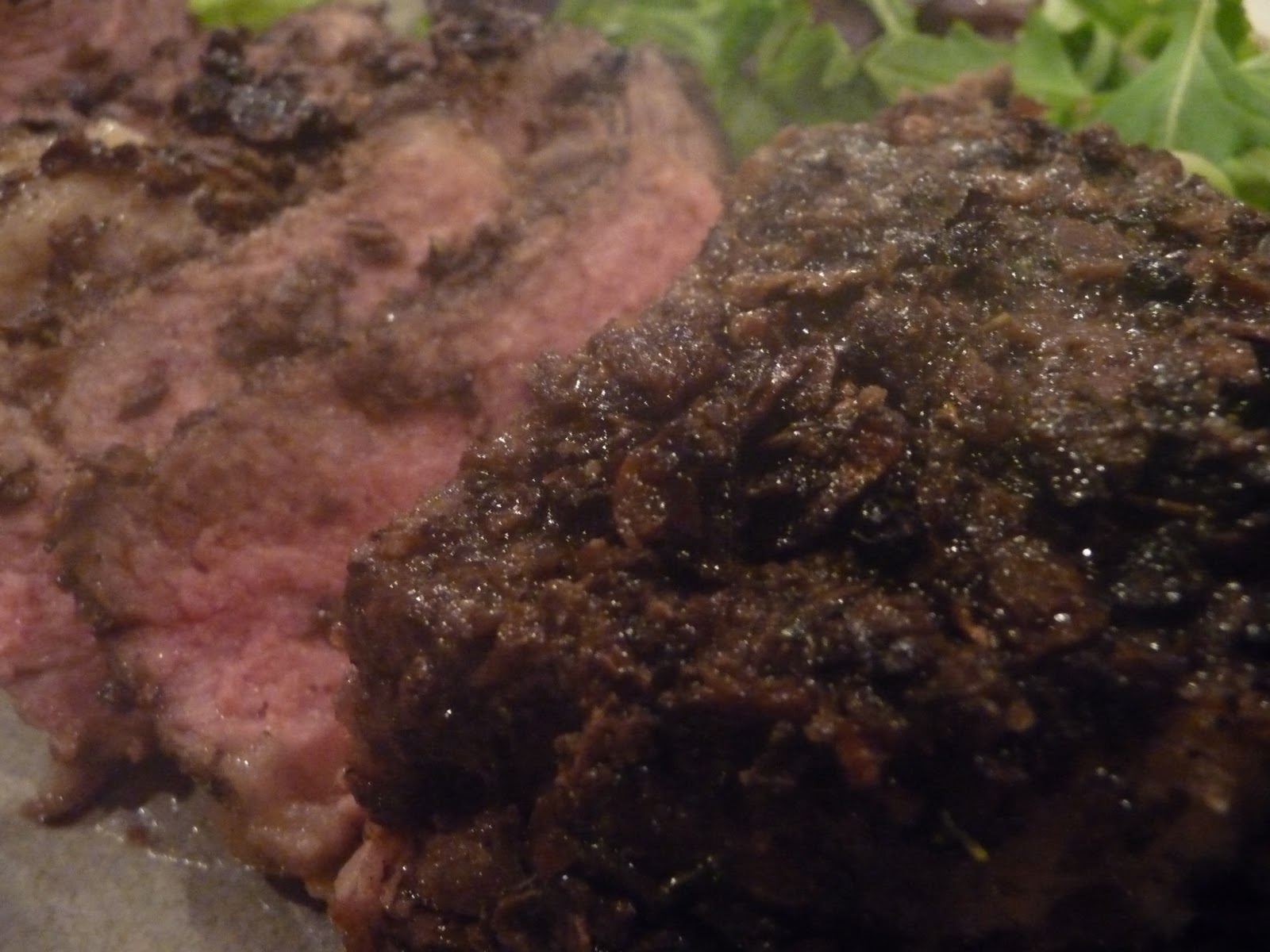
For this experiment, I wanted to use dried mushrooms.  You can get dried mushrooms in mushroom form or in a powder.  A mushroom powder would work fine, but I wanted to try it with dried mushrooms in mushroom form.  The next question is which type of mushroom to use.  You can use porchini, but they are a little expensive.  Dried shiitakes may be a little cheaper.  But dried portobello mushrooms are definitely cheaper and, because it would be the primary ingredient in my rub, I would need more mushrooms.  I also added a healthy tablespoon of black peppercorns , along with dried thyme, garlic powder, sea salt and some olive oil.  My plan was to make a rub that was just "wet" enough to stick to the meat and impart just enough flavor to make it interesting without overwhelming the meat.

So, with a food processor, a little time and a big grass-fed ribeye, I proceeded with my experiment and the result was ... very, very tasty.


PORTOBELLO PEPPERCORN CRUSTED RIBEYE
A Chef Bolek Original
Serves 1 (if it is me), Serves 2-3 (for everyone else)

Ingredients:
1 ribeye (between 3/4 pound to 1 pound)
1 package of dried portobello mushrooms
1 tablespoon of black peppercorns
1 tablespoon of dried thyme
1 tablespoon of garlic powder
1 tablespoon of sea salt (feel free to use less)
4 tablespoons of olive oil

Directions:
1.  Grind the mushrooms.  Put the dried mushrooms in a food processor and grind the mushrooms on the food processor setting until you have as small of mushroom pieces as you can get.

2.  Add the spices.  Add the peppercorns, dried thyme, garlic powder and sea salt.  Continue to use the food processor setting to grind everything and mix everything together.  Run the food processor on pulse a few times more to ensure everything is mixed thoroughly.

3.  Add the olive oil.  Continue the food processor on the mix setting and pour the olive oil slowly.  If you are not getting a paste like rub, use the pulse setting a few times more times.  With each pulse, the mixture should absorb more olive oil.

4.  Apply the rub to the ribeye.  Take the rub and apply it liberally to all sides of the ribeye.

5.  Cook the ribeye.  Place the ribeye under the broiler.  After about eight to ten minutes, flip the ribeye.  Some of the extra mushroom rub may smoke while the ribeye is under the broiler, but that is okay.   Cook the ribeye for about eight to ten more minutes or until your desired level of doneness. 

I have to say that this experiment was a success.  The dried portobello mushrooms imparted a very earthy flavor to the steak. In addition to the mushrooms, you can also taste the pepper and the salt.  The thyme and garlic powder get a little lost in the mushroom rub, but that was okay for me.  If you truly want to taste the garlic, I would add about 1/2 to 1 additional tablespoon.   I was just happy to sit down to a nice big ribeye with a great, off-of-the-cuff rub that I was able to think up on my own. 


ENJOY!

For more about the health benefits of grass-fed beef, check out Eatwild.com.

Saturday, September 18, 2010

Iron Chef: BEEF BONE MARROW

I decided to do an Iron Chef night and, this time, use an ingredient that I do not believe ever appeared on either the Japanese or American versions of the Iron Chef show.  The secret ingredient was ... BEEF BONE MARROW.  There are many recipes on the Internet for roasting bone marrow, which is the primary way of preparing it.  Given it was my first time using bone marrow, I stuck to the traditional approach, roasting the marrow at 475 degrees for about 30 minutes (some recipes say 450 degrees for 15 minutes, but I wanted to be safe, but I watched to make sure that the marrow did not become liquid). I then tried to think of different ways to incorporate the roasted marrow into dishes.  This is truly an experiment and I have included these recipes only to show some of the more "oddball" things I try to make every once in a while.  These are original recipes and I would only recommend them to the truly adventurous.


BEEF BONE MARROW CROSTINI WITH CILANTRO SALAD
Serves many

Ingredients:
Crostini
2-3 beef bones
Bunch of cilantro, chopped well.
1 shallot sliced thin
1 lemon, juiced
Salt, to taste
Pepper, to taste

Directions:
1.  Roast the bones for 30 minutes at 450 or 475 degrees Fahrenheit. 

2.  Heat the croutons.  Mix the cilantro and scallions, adding the lemon juice from half of the lemon.  Place the cilantro/scallion mix on the crostini.  Once the bones are done (you can tell when the marrow begins to separate from the bones), scoop out the marrow and divide amongst the crostini.  Drizzle the lemon juice from the second half of the lemon over the crostini.


MASHED POTATOES WITH ROASTED BONE MARROW AND TALEGGIO CHEESE
Serves 2 people


Ingredients:
2 Yukon Gold potatoes, peeled and cut into even shaped pieces
1/2 pound Taleggio cheese, cut into small cubes and pads (like butter)
Milk
1 teaspoon fresh rosemary, diced
1 teaspoon fresh sage, diced
2-3 beef bones

Directions:
1.  Roast the bones for 30 minutes at 450 or 475 degrees Fahrenheit. 


2.  Bring a pot of water to a rolling boil.  Add potatoes and boil for fifteen minutes.  When the potatoes are soft to the fork, drain the potatoes and return them to the pot. Add milk gradually while you mash the potatoes.  Continue to mash until you get your desired smoothness, adding milk if the potatoes seem dry.  In addition, add some of the taleggio cubes and mix them into the potatoes.


3.  Add the bone marrow and mix well.  Plate and sprinkle the rosemary and sage over the potatoes.


GRASS FED NEW YORK STRIP STEAK WITH ROASTED BONE MARROW AND REUNION PINK PEPPERCORNS
Serves four


Ingredients:
1 pound of grass-fed N.Y. Strip Steak
3-4 beef bones
2 teaspoons Reunion pink peppercorns
1 teaspoon of whole thyme leaves
3 tablespoons rosemary, diced finely
3 tablespoons sage, diced finely
3 tablespoons olive oil
Salt, to taste
Pepper, to taste

Directions:
1.  Roast the bones for 30 minutes at 450 or 475 degrees Fahrenheit. 

2.  Spread the olive oil over the strip steak.  Sprinkle the rosemary and sage over the steak.  Salt and pepper the steak. Cook the steak in the broiler.  Flip the steak after about 6 minutes and cook for 6 minutes more.  You want the temperature to be medium rare.  After the steak is done, wrap it in foil and let it stand for about 10 minutes.

3.  Slice the steak.  Spoon the roasted bone over the steak and drizzle the peppercorns and thyme leaves over the marrow.

ENJOY!