Showing posts with label Honey. Show all posts

Saturday, July 25, 2026

Buffalo Wings with Homemade BBQ Sauce

I have always loved buffalo wings, and, until recently, I was the only one of the Savage Boleks who enjoyed eating wings. And, for me, the hotter the wing sauce, the better. However, my daughter has started eating wings recently.  She does not like things as spicy as I do, but it is great to have someone who also likes to eat buffalo wings in the family. 

So, I thought it would be great if I prepared a wing sauce with my daughter that would be more to her liking. She is good with barbecue sauces, generally mild, and a little sweet. I went through some recipes and found a basic barbecue sauce recipe that we could make together.  As much as I wanted to try something different (I also had a guava barbecue sauce that I have been wanting to make), it seemed only appropriate to start with the standard sauce. If she liked it, then we could move on to different sauces. 

The recipe that I found had all the basic ingredients that one would expect in a barbecue sauce: ketchup, apple cider vinegar, Worcestershire sauce, honey, and lemon juice. These ingredients create a balance of flavors that clearly tends toward the sweet. The honey and sugar overpower the vinegar, Worchestershire sauce and lemon juice. The sweetness is re-balanced with the black pepper and the dash (or two) of hot sauce. It's a basic barbecue sauce that works well for kids.

As for the wings, I decide to make them in the oven. I am not one for deep frying things at home (I don't want to deal with the oil) and I was unsure that my daughter would like grilled wings. The oven could work well for wings, either baking them or, as I prefer, just sticking them under the broiler. Once they are done, just toss the wings in the sauce and you are ready to go. (Just like they do in a restaurant). 

In the end, my daughter loved the sauce and she ate all of the wings. I have to say it is not my favorite sauce, but I did get to enjoy time with my daughter and a shared meal. That is more important thany anything I could make for myself. 

BUFFALO WINGS WITH HOMEMADE BBQ SAUCE

A Daddy-Daughter Collaboration 

Sauce recipe adapted from Add a Pinch

Ingredients (for the sauce):

  • 2 cups ketchup
  • 1/2 cup apple cider vinegar
  • 1/4 cup packed brown sugar
  • 2 tablespoons honey
  • 1 tablespoon Worcestershire sauce
  • 1 tablespoon lemon juice
  • 1 teaspoon kosher salt
  • 1/2 teaspoon freshly ground black pepper
  • 1/2 teaspoon granulated garlic
  • 1/2 teaspoon hot sauce (such as Tabasco sauce)

Ingredients (for the wings):

  • 2 dozen buffalo wings
  • Kosher salt
  • Freshly ground black pepper

Directions:

1. Prepare the sauce. Whisk all of the ingredients (other than the wings) in a medium saucepan situated over medium heat. Allow to come to a bubble and then reduce theheat to low. Allow to simmer until thickened, about 10 minutes. 

2. Prepare the wings. Sprinkle salt and freshly ground pepper over the wings. Arrange the wings on a sheet pan lined with parchment paper. Heat the oven's broiler. Place the wings in the oven and cook for 15 minutes. Turn the wings and cook for 10 minutes more. Turn the wings again one last time, cook for 5 minutes. 

3. Finish the dish. Remove the wings from the oven and add to a large bowl. Add the barbecue sauce and toss the wings. Plate the wings and serve immediately. 

PEACE.

Sunday, February 22, 2026

Chinese Grocery Roast Pork

The Mississippi delta has been described as a "haunted landscape," a beautiful backdrop of alluvial plains and coastal wetlands, marred by the brutal legacies of slavery and segregation. The history has been recorded in both the black and white of history books, but also in the colorful, yet melancholy, notes of delta blues musicians such as Robert Johnson, Charlie Patton and Son House. These musicians not only recorded the daily oppression, poverty and strugle of African Americans lives, but they also documented the resilience and strength of both the people and their communities. 

Yet, there are chapters of the delta's history that until, relatively recently, went largely untold. One such chapter revolves around the Chinese immigrants who settled in the Mississippi delta in the aftermath of the Civil War. These immigrants left their homes (primarily in the Guangdong and Canton provinces) in search of the Gam Sahn ("golden mountain"), akin to what we would call the "American dream." These Chinese immigrants ended up on the same cotton plantations previously worked by African-American slaves. They performed the same back-breaking work. The only difference was that the white owners had to pay the Chinese immigrants for their labor. But, the pay was not enough to justify the hard work, let alone support a family either in the United States or back home in China.  

Consequently, many Chinese laborers left the cotton fields, looking for work elsewhere. They made their way to nearby cities, where they established themselves in the community by opening grocery stores. The first such stores began to appear in the 1870s. The work continued to be hard, with early mornings and late nights, but these Chinese-Americans took control of their economic lives. They also relied upon hui, their relatives, to open additional grocery stores. Soon, Chinese-owned grocery stores proliferated across the Mississippi Delta. In the city of Greenville, Mississippi -- an important transit point for transportation between New Orleans, Louisiana and points north -- had 40,000 residents and 50 Chinese-owned grocery stores.  

One of the first Chinese-owned grocery stores in Greenville, MS, at the corner of Washington
Avenue and Walnut Street, photo taken  in 1939 by Farm Security Admin. photographer
Marion Post Wolcott, available at the Library of Congress (Source: KPBS)

The successful exertion by Chinese-Americans of their economic independence had its limits in the racially structured, white supremacist society. The Chinese were not "White" or "Colored," falling into a third category. The Chinese-Americans did not suffer the extreme violence suffered by African-Americans, but they nevertheless suffered from discrimination and segregation. It was in this space that the Delta Chinese soon found that they too had limited opportunities. the only employment available to them involved owning or working in these grocery stores. 

Chinese-Americans navigated within this space. And they did so in a very historically significant way. The Chinese-American owned grocery stores served as critical lifelines for the most oppressed people in the Mississippi delta: the African-American community. The same white supremacist racial and economic order that confined the Chinese to owning and/or working in grocery stores made it difficult, if not impossible for African-Americans to go to white-owned grocery stores.  

Chinese store owners purchased goods from white-owned wholesalers. They then stocked the shelves with foodstuffs (like flour, sugar, canned goods), clothing, farms tools, and much more. However, these grocery stores provided more than a place for African-Americans to purchase what they needed. The stores provided a social environment where African Americans were respected: they could walk through the front door of a store (rather than through the back door) and would be treated with civility. The Chinese-American grocery store owners would offer lower prices and were the only ones to extend credit to African-American sharecroppers, who were paid only once or twice per year.  The two communities -- Chinese and African-American -- worked together in solidarity as they struggled to survive the racist economy, government and society that operated violently along the Mississippi River and across the delta.

(As an aside, immigrant communities in other cities -- like the Italians in Birmingham, Alabama and New Orleans, Louisiana -- also operated grocery stores that served the African-American community.)

Picture exhibited in 2023 at the Mississippi Delta Chinese Heritage Museum,
located at the Delta State University in Cleveland, Mississippi

The grocery stores were not only the business of the Chinese-American communities, they were also their homes. Because of the racist Chinese Exclusion Act, Chinese-Americans could not own land. They usually lived in the back of their stores or in adjacent structures. Many of the memories of Chinese-American children revolve around food, which also served as the focal point of gatherings among their community.

After learning about the Chinese-American community in the Mississippi delta, as well as their relationship with their African-American neighbors, I wanted to prepare a dish in recognitionof and to honor that history. I found a recipe for Chinese Grocery Roast Pork. This recipe was perfect: it took a traditional Chinese recipe -- Char Siu, which is usually prepared with pork belly -- but used a cut of pork that is synonymous with the iconic southern barbecue: the pork butt.

CHINESE GROCERY ROAST PORK (MISSISSIPPI STYLE CHAR SIU)

Recipe adapted from James Beard Organization 

Serves 6

Ingredients:

  • 1 tablespoon vegetable oil
  • 4 green onions, white and green parts, chopped
  • 2 garlic cloves, minced
  • 1 teaspoon grated peeled fresh ginger
  • 1 cup dark soy sauce
  • 1/2 cup dry sherry
  • 1/2 cup rice vinegar (preferably red)
  • 1 tablespoon honey
  • 2 tablespoons dark brown sugar
  • 1 tablespoon hoisin sauce
  • 1 star anise
  • 2-inch piece cinnamon stick
  • 1/4 teaspoon five spice powder
  • 1 3-pound shoulder of pork (Boston butt)

Directions:

1.  Prepare the sauce. Heat the oven to 325 degrees Fahrenheit. In a large Dutch oven or roasting pan, heat the oil over medium heat. Add the onions, garlic and ginger and cook for 1 minute. Add the soy sauce, sherry, vinegar, honey, brown sugar, hoisin sauce, anise, cinnamon and five-spice powder. Simmer for 1 minute. Add 1 cup of water and bring to a boil. Reduce the heat under the pan so that the mixture simmers. 

2. Roast the pork. Loosen the skin from the meat in several places, but do not remove it. Place the meat in the liquid, turning several times to coat it with the sauce. Transfer the pot to the oven. Cook for 30 minutes undisturbed, then baste with the cooking liquid and continue to baste every 20 minutes until the internal temperature of the meat is between 170 and 180 degrees Fahrenheit, about 4 to 4 1/2 hours. 

3. Finish the dish.  Remove the pork to a cutting board or serving platter and let rest for 10 minutes. Slice thinly and pour the pan juices over the meat, removing the star anise and cinnamon. 

*     *     *

Postscript: To learn more about the experience of Chinese-Americans in the Mississippi Delta, I recommend watching The Untold Story of America's Southern Chinese. Part 2 of the series focuses upon the Chinese in the Mississippi Delta and their history in the region. 


I also recommend the movie, Far East Deep South. Written and directed by Larissa, Lam, the movie follows the story of the Chiu family as they learn more about their family's history and roots in the Mississippi delta. It is availalbe on Tubi. I watrched the movie. Not only is it very informative, it was truly moving to watch and learn alongside the family. 

 PEACE.

Saturday, January 17, 2026

Mala BBQ Wings

Mala sauce originates in China's Sichuan province,which is known for its spicy cuisine. The name, mala, means numbing and spicy; and, in the context of this sauce, it refers to the use of chiles and Sichuan peppercorns. The sauce is typically prepared by combining those ingredients, along with tobanjiang, ginger, garlic, shallots, sesame oil, and other spices.  Once completed, mala is typically served alongside other dishes, as a condiment or dipping sauce. 

This rather unique sauce inspired me, as part of my Wings Around the World project, to create a mala wing sauce. This required more research, because the typical sauce would not work very well. It is more of a brothy type of sauce, which would have a hard time holding itself to the chicken wings. Moreover, some versions use oil, which, in my humble opinion, would not provide a very pleasant wing-eating experience. I am not a big fan of wing dripping in oil, even if that oil is so spicy that I would not know it because the Sichuan peppercorns had numbed my tongue. 

I eventually found a recipe for a mala barbecue sauce, which was served in connection with pork spare ribs (mala paigu). Obviously, barbecue sauces have the great texture for wings. Most restaurants that serve wings usually offer a barbecue sauce option. Yet, unlike a standard barbecue sauce, this mala barbecue sauce balances the five elements: salty (or han in the Sichuan dialect), sweet (tian), sour (suan), hot or pungent (la) and bitter (ku). (For more about the balance of flavors, check out my Laozi Iniative, which is part of The Mindfulness Foodways.) The sweet comes from the sugar and sweet wheat paste, the bitter comes from the black vinegar, while the hot or pungent comes  and Sichuan peppercorns and the doubanjiang, and the salt comes from the hoisin sauce and a little from the Shaoxing wine. 

I prepared the sauce (a picture of it is to the right). I placed the wings in a ziploc bag, added about 2/3 of the sauce and mixed the wings to ensure that they were covered. I allowed the wings to marinate for about 15 minutes or so (you can obviously go longer if you would like, but put the wings in the refrigerator if you do so). I then broiled/roasted the wings in the oven for about 30 minutes. Once they were done, I moved the wings to the bowl and tossed them with the remaining 1/3 of the mala sauce. 

In the end, I have to say that this sauce was not as spicy or as numbing as I had expected after reading many articles about Mala sauce. That is probably a good thing for everyone else, given my love for really spicy foods means that, if I found it spicy, it would probably be too hot for everyone else. It could also be the result of the balance of flavors that I mentioned above. This allowed the sweet and bitter, to shine as much as the spicy/numbing. These wings were very good. I count them as a success in my efforts to globalize buffalo wings. Until next time ....

MALA BBQ WINGS

Recipe from The Mala Market

Serves 3-4

Ingredients:

  • 12 chicken wings (drummettes and flats)
  • Kosher salt
  • Freshly ground black pepper
  • 2 tablespoons sugar
  • 2 tablespoons doubanjiang (chile bean paste)
  • 2 tablespoons tianmianjiang (sweet wheat paste)
  • 2 tablespoons Chinese dark soy sauce
  • 2 tablespoons Shaoxing wine
  • 2 tablespoons Zhenjiang black vinegar
  • 2 teaspoons hoisin sauce
  • 2 teaspoons Chinese roasted sesame oil
  • 1/2 teaspoon freshly ground Sichuan pepper
  • 2 tablespoons honey

Directions:

1. Prepare the sauce. Place the chile bean paste on a cutting board and mince it with a knife to break down any whole beans. Add it to a small bowl with the sweet wheat paste, vinegar, dark soy sauce, Shaoxing wine, hoisin, sesame oil and ground Sichuan pepper and stir to combine. You could add all of the ingredients in a blender and blend until smooth as an alternative. 

2. Prepare the wings. Place the wings in a ziplock bag. Add about 2/3 of the sauce to the bag and mix so that the wings are covered with the sauce. Allow the wings to rest for about 15 minutes, if you want to marinate them longer, place them in the refrigerator for a couple of hours. 

3. Cook the chicken wings. Heat a grill on medium high heat or the broiler of an oven. Rinse the chicken wings and pat them dry. Season with salt and pepper. Oil the grates of the grill (if using) and place the chicken wings on the grill.  Grill or roast for about seven minutes and then flip the wings, grilling them for about seven minutes more. 

4. Finish the dish. Once the wings reach an internal temperature of 165 degrees Fahrenheit, remove them from the grill. Add the wings to a large bowl and pour the rest of the sauce over the wings. Toss the wings to ensure that the sauce covers all of the wings. 

PEACE.

Saturday, June 7, 2025

Persian Roast Lamb

Persian cuisine has a very long history and, within that history, there has has been a long tradition of roasting lamb. That tradition has been dated as far back as the Achaemenian dynasty, which rule from approximately 770 B.C.E. to 330 B.C.E. At its height, around 550 B.C.E. to 330 B.C.E., the Achaemenid Empire stretched from southeastern Europe and northeastern Africa all the way to the edges of the Indian subcontinent. This empire encompassed many different groups -- Greeks, Egyptians, Babylonians, Lydians, and others -- who were able to retain their identities and their cultures.

One of the many legacies of the Achaemenid rulers revolves around food. Rather than requiring conquered peoples to assimilate into the empire, the Achaemenid rulers incorporated aspects of their cultures into the empire, especially when it came to food. The empire adopted the Greek methods of producing olive oil, the Egyptian practices of cultivating grain, and the Mesopotamian baking recipes. 

It was during the Achaemenid dynasty that some of the earliest accounts of roasted lamb could be found. The Achaemenid kings were known for their grand feasts and elaborate dining traditions. Claudius Aelianus wrote in his Varia Historia that one would eat with a knife in the right hand and a piecce of bread in the left hand. The food was cut with the knife and then placed on the bread. As for the food itself, another writer -- the Macedonian writer Polyaenus -- wrote in the second century B.C.E. that the ingredients of a dinner featured "sweet grape jelly, candied turnips and radishes prepared with salt, candied capers with salt, from which delicious stuffings weremade, terebinth (from pistachio nuts) oil, Ethiopian cumin and Median saffron." Other fruits and nuts would have graced the tables as well, including dates, pomegranates, figs, apples, raisins and almonds. The main course of the royal feasts featured among other things, roasted lamb and saffron-infused rice. 

By contrast, the masses across the empire generally ate grilled meats, flatbreads and porridge. 

The traditions and cuisine of the Achaemenid empire constitute a noteworthy part of the history of Persian cuisine. The dishes of that time focused on a balance between sweet, sour and savory, which  was achieved through the use of spice mixes, fruit-based sauces and other methods. That balance continues to this day in Persian dishes. 

Drawing from this culinary history, I wanted to prepare a Persian-style roasted lamb. I found a recipe online that tracks the balance of sweet, sour and savory which defined the Achaemenid cuisine. That balance could be found in the marinade, whose ingredients include pomegranate molasses, honey, lemon juice, cumin, saffron, and turmeric. I opted for an overnight marinade given I was woking with a six pound boneless leg of lamb. I have to say that the lamb cooked faster than the times indicated in the recipe, which I think would probably be more accurate for a bone-in leg of lamb. 

In the end, I had my own little Persian feast when the lamb was finished. The table not only featured the sliced leg of lamb, but also jeweled rice and a Shirazi salad. Both of these dishes made excellent sides, adding a lot of colors and flavors to complement the meat. 

PERSIAN ROAST LAMB

Recipe from Lin's Food

Serves 8

Ingredients:

  • 1 leg or shoulder of lamb, about 3.5 to 4.5 pounds
  • 1 large onion, sliced in rings
  • 1 cup chicken stock, vegetable stock or water
  • 5 cloves of garlic, finely minced or crushed
  • 4 tablespoons pomegranate molasses
  • 2 tablespoons honey
  • 1 tablespoon extra virgin olive oil
  • 1 lemon, juiced
  • 1 tablespoon ground cumin
  • 1 teaspoon turmeric
  • 1 teaspoon ground black pepper
  • 2 strops of fresh rosemary leaves, pounded or finely chopped
  • 1 pinch saffron
  • 2 tablespoons hot water 
  • Pomegranate seeds, for garnish

Directions:

1. Prepare the saffron. Tip the saffron in a mortar with a small pinch of salt. Crush the saffron with the peste, goung round and round. Add the hot water and leave it to soak while you get everything else ready. 

2. Prepare the marinade. Combine the garlic, pomegranate molasses, honey, olive oil, lemon juice, liquid saffron, ground cumin cumin, turmeric, black pepper and rosemary. Mix well. Set aside.

3. Prepare the lamb. With a small knife, make a half dozen small slashes straight down into the lamb, especially around the thicker parts. Rub the marinade all over the lamb, pushing down into the cuts and into the meat folds. Cover the lamb and allow to marinate for at least 2 hours or overnight.

4. Roast the lamb.  Heat the oven to 350 degrees Fahrenheit. Line the roasting pan or baking dish with the sliced onions. Sit the lamb on the onions. Pour the stock or water in, making sure to pour it on the onions and not the lamb. Cover with foil and roast for 1 hour by which time the lamb should be almost done. Take the cover off and roast for another 30 minutes, so that the meat will be pink. 

5. Finish the dish. When the lamb is done, there will be a little sauce or gravy that can be served separately. You can choose to get separate the excess fat, but that is not required. Slice the roast and serve on a platter with the onions.

PEACE.

Monday, September 2, 2024

Kashmiri-Style Raan

Many recipes have a history; and, for this leg of lamb recipe, that history can be traced to the fourth century B.C.E.  Alexander III of Macedon -- known as "Alexander the Great" -- was leading his armies on a path eastward into what was known then as Bactria. The region was well established along the Silk Road in an area that is divided amongst common-day Afghanistan, Pakistan and Tajikistan. While history confirms Alexander's conquest of the mountainous region in which Bactria could be found, what comes next is the subject of some dispute.

As one story goes, it was 327 B.C.E. when Alexander the Great had just conquered the Hindu Kush, a mountainous region that could have been the southern part of Bactria. Basking in the victory, Alexander married Roxane, the daughter of Oxyartes. The centerpiece of the wedding feast was known as Sikandari Raan or Alexander Raan. Alexander would go on to appoint Oxyartes to serve as the governor of Bactria.

Another story paints a different picture: Alexander the Great sent his army into the Battle of Hydaspes in 326 B.C.E. The battle took place along the Jhelum River in what would become northeastern Pakistan. By the end of the battle, Alexander's forces had captured the local king, Porus. Alexander asked Porus how he would like to be treated; and, the defeated monarch replied "treat me like a King would treat another King." Alexander the Great released Porus and the two became friends. A feast was held to celebrate the friendship. The centerpiece of that feast was a leg of lamb.

The true story, along with the recipe for that leg of lamb, are lost to history. Nevertheless, the centerpiece of the feast is still known as Sikandari Raan. And, unlike any conqueror or king, this leg of lamb recipe lives on today as the focal point of many celebratory meals. 

I prepared raan for my own little celebration, namely, by birthday. I chose to prepare a Kashmiri-style raan, because I thought that this meal is reflective of Kashmiri cuisine. This cuisine is perhaps the most meat-centric of all the subcontinent cuisines, as Kashmiris eat more meat -- mainly lamb and mutton -- than in any other region of Pakistan or India. This aspect of their diet corresponds to the importance of livestock itself, as there is a long history of nomadic herders raising sheep in the region's valleys. While Kashmiri cuisine may be heavy on the meat, it is much leaner when it comes to the use of spices in recipes.  Commonly used spices include chile powder, ginger powder, saffron, aniseed, and asafetida.  

Perhaps the most intriguing aspect of Kashmiri cuisine is the distinction between Muslim and Pandit (Hindu). This distinction mostly revolves around the ingredients used to prepare the dishes. On the one hand, Muslim Kashmiris use onion, garlic and tomatoes in their preparations, while the Hindu Pandits do not. Another difference lies with the protein, as Muslims tend to use more lamb and mutton, while the Pandits use goat or chevron more in their dishes. 

This Kashmiri-style raan is clearly inspired by the Muslim preparations, as it incorporates not only lamb, but also onions in the recipe. It also follows the traditional preparation, which incorporates two marinades. The first marinade is a dry rub, which is first applied to the leg of lamb. The second marinade is a wet rub, a combination of Greek yogurt and even more spices). Some recipes combine the two marinades together, but the Kashmiri-style raan recipe that I found retained this two-step approach.

Apart from the time it takes to prepare the lamb, this is a very easy recipe to make. The difficult part is to decide what should accompany the roasted lamb. I prepared a traditional Kashmiri pulao, and I even had an ambitious goal of preparing one or two sambals to go with it. (The sambals did not happen.) One can also just serve some naan and a salad alongside the lamb. 

KASHMIRI-STYLE RAAN

Recipe adapted from from Big Oven

Serves several

Ingredients (for the dry rub):

  • 10 green cardamom pods (seeds only)
  • 1 star anise
  • 2 mace 
  • 4 dried bay leaves
  • 2 tablespoons fennel seeds
  • 2 inch cinnamon stick

Ingredients (for the marinade):

  • 1 1/4 white onions, thinly sliced
  • 7 garlic cloves mashed or roughly chopped
  • 1 1/2 teaspoon Kashmiri chile powder
  • 2 inches of ginger, peeled, roughly chopped
  • 1 1/2 cup Greek Yogurt
  • 1/2 teaspoon saffron
  • 1 teaspoon salt
  • 1 teaspoon turmeric
  • 1 tablespoon honey

Ingredients (for the lamb):

  • 1 leg of lamb (about five pounds)

Ingredients (for the gravy):

  • 5 garlic cloves
  • 1 inch ginger
  • 2 tablespoons vegetable oil
  • 1/2 teaspoon cumin powder
  • 1 tablespoon coriander powder
  • 12 teaspoon Kashmiri chile powder
  • 1 teaspoon cardamom powder
  • 3 tablespoons Greek yogurt
  • 2 tablespoons ground almonds
  • Salt to taste

Directions:

1. Prepare the lamb and the first marinade. Trim all of the fact from the lamb and, using a sharp knife. Roast the dry rub spices in a dry frying pan over a low heat for about 10 minutes. Shake the pan a few times as they release their aroma. Cool slightly and grind to a fine powder. Rub this spiced powder all of over the leg of lamb, in the cuts as well. Leave to marinate for 40 minutes while you get the second marinade ready. 

2. Prepare the second marinade. Soak the saffron threads in hot water for five minutes. In a large frying pan, add the oil and fry the onions until light brown. Turn off the heat and cool. Set half of the onions aside. Add the remaining half of the onions, garlic, ginger, and 2 tablespoons of Greek yogurt to a blender. Blend into a smooth fine paste. In a large bowl, add the blended paste along with the remaining yogurt, chile powder, and saffron (with water). Season to taste and mix well. Pour this marinade all over the leg of lamb, mixing well to ensure that it is covered well. Drizzle the leg of lamb with honey. Cover and marinate in the refrigerator overnight or two nights. 

3. Roast the lamb. Preheat the oven to 450 degrees Fahrenheit. Roast the lamb in a covered baking dish for 1/2 hour. Reduce the heat to 325 degrees Fahrenheit and cook for 25 minutes per pound, around 1.5 hours until the meat is tender. 

4. Prepare the gravy. Blend the garlic and ginger to a smooth paste with a space of water in a grinder or blender. Heat a large frying pan with the oil. Add the paste and fry over a low heat for 2 minutes. Add the spiced powders along with the yogurt and ground almonds. Add any leftover marinade and juices from the baking try to the pan. Fry for 4 minutes. Add 6 tablespoons of water and simmer over a low heat for 12 to 15 minutes. Stir often to make sure that it does not stick to the bottom of the pan. Add a little more water if required to thin it out slightly. Season to taste and keep warm.

5. Finish the dish. Serve the ran on a platter with the fried onions, shallots, mint and pomegranate, as well as pulao and gravy.

PEACE.

Sunday, June 16, 2024

Grilled Clams with Cambodian Ginger Dressing

In my humble opinion, Cambodian cuisine has mastered the pairing of ginger to seafood. I don't know how they did or even when they did it. Yet, whenever I come across a Cambodian seafood recipe that incorporates a ginger sauce or dressing, that recipe is amazing. 

I learned that first hand more than four years ago, when my beautiful Angel and I hosted a New Year's Eve party. I prepared a bunch of dishes that symbolized good luck in the new year. The most popular dish that I prepared was a Cambodian Ginger Catfish recipe. That catfish was in more demand from the guests than anything else in the spread. 

So, when I got my hands on some top neck clams that I planned on grilling, it seemed only appropriate that I return to the cuisine of Srok Khmer (how the Cambodians refer to their country) and its cuisine for inspiration. Sure enough, I found a few recipes that were worth a try. The only question is which one to use. 

I ultimately chose a recipe from Theo Cooks, but I decided to make a few modifications. The original recipe called for four tablespoons of grated ginger and four tablespoons of olive oil. I halved the grated ginger because I got a little impatient and I thought that, given its relatively strong flavor profile, a lot of ginger might cause an imbalance in the dressing. I also substituted vegetable oil for olive oil because, as far as I know, olive oil does not feature prominently in Cambodian cuisine. The last modification is that I did not shake the ingredients in a jar. Instead, I used a whisk to create an emulsion. I thought that would better mix the ingredients as well as improve the texture of the dressing. 

In the end, this recipe was very good. The ginger still shined in the dressing, but the sweetness from the honey and the slight tartness of the lime juice were also present in the flavor of the dressing. Not only does the dressing work well on clams, but it would also be a good condiment for grilled fish. That will be another post for another day.

GRILLED CLAMS WITH CAMBODIAN GINGER DRESSING

Recipe adapted from Theo Cooks

Serves 2-3

Ingredients:

  • 2 pounds of top neck clams (about 8 to 12)
  • 2 tablespoons grated ginger
  • 1 clove garlic, grated
  • 1 lime juiced
  • 1 teaspoon soy sauce
  • 1 tablespoon honey
  • Salt
  • Freshly ground black pepper
  • 2 tablespoons vegetable oil
  • Pinch dried chile flakes
  • Handful of finely chopped cilantro

Directions:

1. Prepare the dressing. Combine all of the ingredients, except the cilantro, together in a bowl. Whisk until the ingredients are well combined. Add the cilantro and stir to combine. 

2. Grill the clams. Heat a grill on high heat. Place the clams on the grate. Close the grill and cook the clams until they open, at most 5 minutes.  Remove the clams from the grill.

3. Finish the dish. Remove the top shells from the clams. Spoon some of the dressing over the clams and serve immediately.

PEACE.

Friday, February 9, 2024

Morning Tsampa

In a prior post, I began the exploration of tsampa, one of the most fundamental aspects of the Tibetan foodways. The cultivation of barley, along with the roasting of barley berries, gave rise to a foodstuff that provided sustenance to the Tibetan people, allowing them to expand their culture and civilization across the high, arid Tibetan plateau. As part of this journey, I made my own tsampa, roasting the barley and grinding it down into the finest powder that I could with what I have. 

Now it is time to go further down those foodways, to explore the uses of tsampa. A British adventurer and food writer, Peter Fleming, once recounted a basic way of preparing breakfast with tsampa: 

You fill your shallow wooden bowl with tea, then you let the butter melt in the tea (the butter is usually rancid and has a good cheesy flavor); then you put a handful of tsampa in. At first it floats; then like a child's castle of sand, its foundation begins to be eaten by the liquid. You coax it with your fingers until it is more or less saturated and has become a paste; this you knead until you have a kind of doughy cake in your hand and the wooden bowl is empty and clean. Breakfast is ready.

Fleming provides quite the description, and, maybe someday I will try to prepare breakfast in that manner. That date may have to wait until I have some rancid butter. 

More recent accounts, such as one by Barbara Hazelton, who visited Tibet in 2016, provide a similar glimpse into how tsampa is eaten at breakfast. Hazelton wrote: 

The trip to Tibet is long and arduous, and over these many trips to Tibet, I have found I have developed my wits and ways of adapting to this fierce world. In the monastery, the food, tiresome, over-fried and boiled vegetables and tasteless white rice which the kind, bow-legged cook Karma carefully prepares for the "foreigners," Rinpoche's guests, I discovered one gloomy cold morning, can be avoided by taking refuge in the warm cozy kitchen, where one finds the dzo yogurt from the nunnery and the leather bag of tsampa from the cook's family, hanging on a post by the kitchen stove and in the decorated wooden bowl, dried cheese, and sugar. This is where the monks gather and laugh and chat, as they make their morning tsampa balls and slurp the heavy nourishing butter tea, in the kitchen y the long black metal stove filled with fragrant wood, that snaps and spreads out its waves of welcome heat. 

This account -- with its dzo yogurt and tsampa -- provides a tie-in to what I decided would become my attempt to make a breakfast meal using tsampa. 

The recipe, Morning Tsampa, comes from the Beyond the Great Wall cookbook, which was written by Jeffery Alford and Naomi Duguid. That cookbook taught me how to make tsampa in the first place, so it seemed only appropriate that it should guide my on my next step: to incorporate the roasted barley flour into a dish. 

The Morning Tsampa recipe, like many tsampa recipes, is very simple. It involves up to four ingredients, namely, tsampa, yogurt, berries and some sugary ingredient like maple syrup or honey. Those ingredients are combined in a bowl and eaten. The combination of tsampa (which is high in fiber, has important minerals, and promotes the growth of healthy gut bacteria), along with the yogurts and berries, probably represents the healthiest breakfast that I have ever had in my life time. 

For that reason, I have resolved that this dish will constitute the start of my day whenever possible. It also represents a significant step forward on my Mindfulness Foodways, as it not only represents a notable improvement in my diet, but one based upon an ingredient and foodstuff that has an important place in our world. 

MORNING TSAMPA

Recipe from Jeffrey Alford and Naomi Daguid, 

Beyond the Great Wall, pg. 181

Ingredients:

  • About 1/2 cup whole milk yogurt, plain or sweetened
  • 3 tablespoons Tsampa, or to taste
  • Handful of berries or chopped fruit (optional)
  • Honey, sugar or maple syrup, to taste

Directions:

Place the yogurt in  bowl and stir in the tsampa thoroughly so it is all moistened. Add fruit and a sweetener (honey, sugar or maple syrup) if you wish.

PEACE.

Friday, February 2, 2024

Chargrilled Hmong Black Pig Skewers with Sesame Salt

"I would tell people that Hmong food is not just a type of food. It's not about the product. It's a philosophy.... If you want to know our people you have to know our food. By knowing our food, you will know our story. You'll know where we been and it will show the trajectory of where we're going.  

-- Chef Yia Vang

To the extent people know about the Hmong, that knowledge comes more from political history. The Hmong are an indigenous ethnic group that has lived for centuries as a minority in eastern and southeastern Asia. During the Vietnam War, the United States Central Intelligence Agency recruited and trained the Hmong living in Laos for a "secret war" against the North Vietnamese Army. The Hmong harassed the North Vietnamese along the Ho Chi Minh trail, safeguarded U.S. radar installations, and rescued downed American pilots. After the war, the communist governments of Vietnam and Laos declared that the Hmong were "traitors." The governments persecuted the Hmong. They arrested the Hmong, who were sent to hard labor camps. They sprayed Hmong villages with chemicals, including napalm.  Nearly ten percent (10%) of the Hmong population was killed and around 100,000 Hmong sought refuge in neighboring Thailand and beyond. 

The culinary history of the Hmong is far less known. Before the Vietnam War, the Hmong had a strong agrarian tradition in the mountains of northern Laos and Vietnam. They grew rice and other produce, as well as raised livestock, such as pigs. The Hmong practiced animism, believing that objects, plants animals, and even places have their own spirit. These beliefs underlie the respect that the Hmong hodl for what they have. It also informs their traditions. 

For example, there is a Hmong tradition -- called Noj Tsiab (nee-al jia) -- that centers around the butchering of a pig. During the last week of December, each family would select a pig from their herd to be butchered. Every family member had a role in the process, being taught by the elders how to prepare the pig, how it would be cut, and how to ensure that all of the pig would be used with nothing going to waste. This knowledge was important, and it was passed on from generation to generation. The end products would be used to prepare a meal for the community for the new year. It enabled everyone to participate in a tradition that gives thanks for what they have been given and to their ancestors for watching over them.

This tradition was lost, at least temporarily, for those Hmong who fled their homes and found themselves in refugee camps. Even after they escaped those camps, making their way to the United States or elsewhere, many of their new lives did not include the raising of pigs, let alone the opportunity to butcher them in accordance with their traditions. 

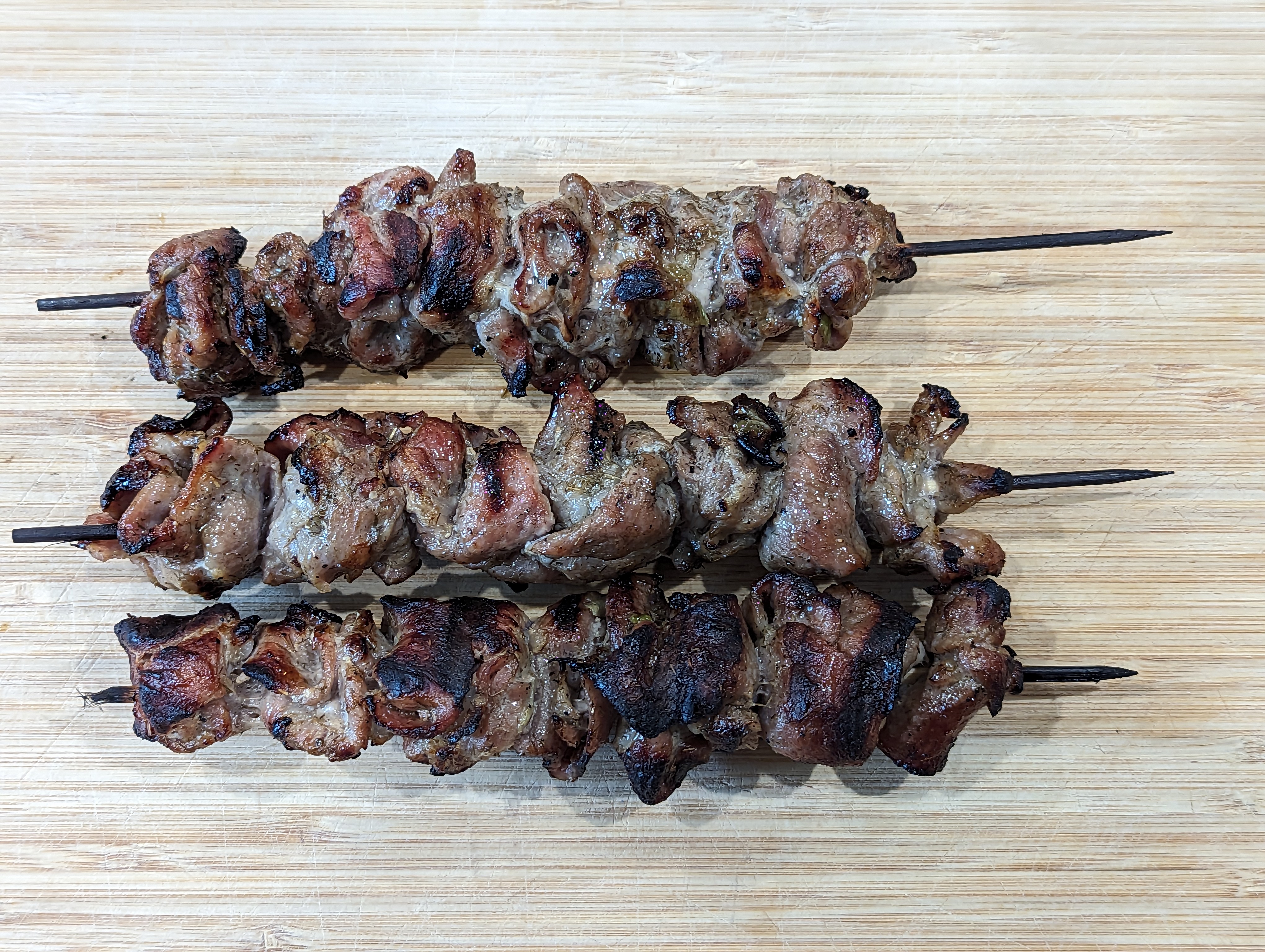
I knew none of this when I came across a recipe for Chargrilled Hmong Black Pig Skewers with Sesame Salt.  It was in a cookbook called the Food of Vietnam. The author, Luke Nguyen, is a Vietnamese-Australian chef who was part of a television show, Luke Nguyen's Vietnam, that I watched on public television. Every episode fascinated me, both with respect to the people, the surroundings, and, of course, the food. When I got this cookbook, as well as another Vietnamese cookbook, I spent a lot of time paging through the recipes. This one caught my eye because of the reference to the Hmong people. 

Roasted sesame seeds with salt
According to Chef Nguyen, the Hmong raised black pigs in the hills and mountains of Vietnam. The cuts from the necks would be used for this dish. I had access neither to those particular black pigs, or, more generally, to pig necks. Instead, I looked for any cut of pork that would enable me to slice thinly or that came sliced thinly. 

There are two things that I really like about this recipe. The first thing is the marinade. The recipe calls for a combination of scallions, lemongrass, fish sauce, oyster sauce, black pepper, and honey, for a marinade. This particular combination of ingredients imparts a lot of flavor into the meat, which is facilitated by the fact that the meat has been thinly sliced.  The second thing is the ease of preparing this dish. Once the marinade is complete, the rest of this recipe is easy: just thread some pre-soaked skewers, place on a heated grill, flip the skewers a few times and you are done. 

These skewers are very delicious and, given the ease of preparing this dish, I will very likely make this recipe again. The next time will take on a little more meaning now that I have some understanding of the traditions of the people behind the recipe. 

CHARGRILLED HMONG BLACK PIG SKEWERS WITH SESAME SALT

Recipe from Luke Nguyen, The Food of Vietnam, pg. 318

Serves 4-6

Ingredients:

  • 300 grams (10.5 ounces) pork neck, thinly sliced
  • 2 tablespoons toasted sesame seeds
  • 3 spring onions, sliced then bashed to release the flavor
  • 4 tablespoons finely diced lemongrass, white part only
  • 3 tablespoons fish sauce
  • 1 teaspoon oyster sauce
  • 1 teaspoon sugar
  • 1 tablespoon honey
  • 1/2 teaspoon freshly ground black pepper
  • 3 tablespoons vegetable oil

Directions:

1. Prepare the marinade. Combine the onions, lemongrass, fish sauce, oyster sauce, sugar honey and black pepper in a mixing bowl and mix well. Add the pork and toss until well coated. Cover and marinate in the refrigerator overnight. 

2. Prepare the skewers. Soak 12 bamboo skewers in water for 30 minutes to prevent scorching. Thread the pork on to the skewers and chargrill on each side for 3 minutes. Mix the sesame seeds with a pinch of sea salt. Serve on the side for dipping the skewers into. 

PEACE. 

Thursday, October 19, 2023

Cuminatum in Ostrea

I love reading about history, including culinary history. My travels through books and along the Internet take me to a lot of recipes. Many of those recipes, along with the resulting dishes, have long histories that date back decades, centuries and, in a few cases, perhaps a millennium or two. Yet, the recipes I find are usually the present day versions of those recipes, with little to no discussion about how we got to this point or that recipe.

Every once in a while, I will stumble upon someone who takes the time to find and talk about those recipes. In this case, it is the Historical Italian Cooking blog. The recipe that caught my eye is called cuminatum in ostrea et conchylia, which is Latin for cumin sauce for oysters and shellfish. The recipe dates back to at least the 5th century C.E., during which the Roman Empire collapsed (476 C.E.). We can go this far back because the recipe was found in the midst of a collection of recipes compiled in De Re Culinaria, also known as Apicius. The only surviving version of the Apicius dates back to the 5th century. 

Yet, cookbooks are sometimes akin to history books: they recount the recipe at the time of publication. This particular recipe may be much older, perhaps dating all the way back to the 1st century C.E. Some have attributed the Apicius to Marcus Gavius Apicius, who noble who was renown for his love of luxury foods. The Roman philopsopher Seneca once remarked that Apicius "proclaimed the science of the cookshop" (Seneca, Consolatio ad Helviami 10) and then corrupted the age through his example.

As the Historical Italian Cooking blog explains, Romans considered oysters to be a "costly food." Oysters may have been a luxury to the point that there was a reluctance to share them. The Roman poet, Martial (known as the father of the epigram, after all, he wrote 1,561 of them) recounted the following interesting epigram about a guest's response to the host's dinner: 

I dine with you at my own cost,

So why not fare the same, both guest and host?

You swallow Lucrine oysters large and fat,

I suck a whelk and cut my lips at that.

You're served with mushrooms, I chew fungus still,

You have to do with turbot, I with brill

Plump yellow doves your appetite assuage, 

I have a magpie starved within its cage.

I am by your side and yet I'm far away.

The dole has gone. Let's fare the same, I say.

Clearly, oysters ranked with other luxurious food items, such as mushrooms, turbot, and "plump yellow doves." (By the way, the underlying message in this epigram is as timeless is as true today as it was when Martial wrote it back in the first century A.D.) Other epigrams and poems by Martial underscore the oyster as an expensive food for Romans. 

Yet, even a costly food item like oysters has its limits. In another poem, Martial wrote, in part: 

I WILLINGLY accept your dainty fare

If hospitality be undesigning: 

Not so, if you imagine that I care

For nothing in the world so much as dining; 

A dozen oysters will not make you heir

To my reputed wealth for which you are pining; 

The feast is elegant; that I admit

But on the morrow what is left of it? 

Upon the morrow? Where is it to-day

The moment after it has passed your gullet?

Thus, oysters won't make you rich during Roman times, but they were certainly enjoyed by the rich.

This leads me to how Romans ate oysters. For that, I turned back to the Historical Italian Cooking blog. The author writes that in books wrote in the 2nd century, Galen's De Facultatibus Alimentorium, and in the 6th century, Anthimus' De Observatione Ciborum, recount that Romans ate oysters both raw and cooked (either boiled or fried). 

However, the recipe in Apicius provides for the oysters and shellfish but did not provide a cooking method. it provided only a sauce, and one that has its base in cuminum or cumin. In fact, the sauce requires a good amount of cumin (or cuminum plusculum). The recipe also calls for other spices (black pepper and lovage), herbs (fresh parsley and mint, the recipe calls for dried mint but you can use fresh mint), and a liquid mixture that consists of honey, garum and vinegar. If you do not have lovage, Historical Italian Cooking advises that, according to Pliny, you could use anise seeds, or according to Dioscorides, you can use fennel seeds.

For this recipe, I decided to prepare the sauce to serve with raw oysters. While I do not have authentic Roman garum (check out this post by Historical Italian Cooking on how to make it), I do have a significant amount of Vietnamese fish sauce (check out my post with a brief discussion of the history of fish sauce, including a reference to garum). I have modified the recipe slightly from the one provided by Historical Italian Cooking to show both how the writer described the preparation and how I prepared this dish. 

In the end, I have to say that I was not a big fan of this sauce. While I like cumin as a spice, I came to the realization that I am not keen on cuminum plusculum. The large amount of cumin overwhelmed the flavors of the oysters, with the brininess being lost in the loud notes of the spice. 

CUMINATUM IN OSTREA

Recipe adapted from Historical Italian Cooking

Serves several

Ingredients:

  • 1.5 kilograms (about 3 pounds) of oysters
  • Pinch of freshly ground black pepper; 
  • Pinch of fennel seeds; 
  • 4 tablespoons of cumin;
  • 1 bunch of parsley, minced finely
  • 1 tablespoon of dried mint leaves
  • 1 tablespoon honey
  • 1 tablespoon fish sauce
  • 2 tablespoons white wine vinegar

Directions:

1. Prepare the sauce. Mince the parsley (and mint, if you use fresh mint). Pound them in the mortar with the pepper and the fennel seeds (or anise seeds or lovage), adding the cumin as you work. Move the mixture to a bowl and then proceed to mix in the honey and fish sauce (or garum), diluting it with the vinegar. 

2.  Finish the dish. Shuck the oysters and reserve the liqueur. Add some of the liqueur to the cumin sauce. Spoon some of the sauce over the shucked oysters and serve immediately. 

ENJOY!

Thursday, October 20, 2022

Wojape (Wozapi)

If you could make your food taste exactly like the place where you are physically standing, then you can really evoke the flavor profile that resonates through history. This way of thinking provides a direct connection that we have as indigenous people to our ancestors and to the flavors of their foods, because those flavors have not changed.

-Sean Sherman, quoted in Cornell Chronicle

Quotes have an inherent force, a persuasiveness that brings an important point to the forefront so that it could be considered more fully and understood better. Yet, even quotes require a dive into the context surrounding the words, and, when it comes to the foodways of the indigenous peoples of Turtle Island, understanding that context is critical.

Growing up in the Midwest, I learned very little about the indigenous peoples of North America. I write "very little" for a reason. To be sure, indigenous people were mentioned in my U.S. history books. However, the books told that history from the perspective of rich white men, not indigenous men and women. There was very little, if anything, from the perspective of those whose ancestors had lived on this continent for generations.

Fortunately, I found a hobby in cooking, which provides me with an opportunity to learn. I use these chances to educate myself, not just about how to prepare food, but also about the peoples, cultures and history behind the ingredients, cooking processes and dishes. I use this blog to record some of my thoughts and some of what I have learned after making the dishes.

One area that I wanted to further explore involves indigenous cooking throughout North America. The desire to learn about this particular aspect of cooking, as well as the underlying cultures and peoples, really took hold during a visit to  Minneapolis, Minnesota. I was there for work, but I found a restaurant near my hotel that sparked my interest. The restaurant is Owamni, which is run by Chef Sean Sherman. An Oglala Lakota, born in Pine Ridge, South Dakota, Chef Sherman has made it his life's work to educate everyone about indigenous cuisine, as the native Americans would have prepared it (that is, without "colonizer ingredients," such as wheat, beef, pork, etc.). My meal that I had at Owamni was one of the best meals that I had ever had in a restaurant (you can read my restaurant review here).

Since that time, I have wanted to explore indigenous cuisine. The first steps took place on Indigenous People's Day, when I decided to make Wojape or, as it translates in Lakota, "fruit stew." It is a native berry sauce made by indigenous peoples, including the Lakota and Dakota. They traditionally prepared the sauce with canpa'-hu, or, as we would call them chokecherries or bittercherries.  The chokecherry plant is part of the rose family, and it can be found throughout much of the United States and most of Canada. Its white flowers bloom in May, and, then give way to small, rather tart berries in July and August. When the berries are ripe, they are picked for use in a wide range of foods, one of the most common being pemmican, which is a combination of dried meat, fat and, of course, berries. A foodstuff necessary for survival in the northern Plains, especially during the long winter months.

Yet, the Lakota and Dakota also used chokecherries to make wojape. The traditional recipe calls for a combination of cooked chokeberries, pounded raw berries and ground root powder. The result is something that has the consistency of a pudding. As with pemmican, there was a purpose to the pudding. It transformed the berries into something that could last longer than a simple berry sauce.  

As much as I wanted to make a traditional Wojape, I faced a couple of obstacles. First, as common as chokecherries may be, I don't have a ready access to them. Chokecherries are not in my local grocery stores and I don't have the time to go foraging for them. Second, I have even less access to the root powder or root flour that would be used to make the dish. I did not want my start on this indigenous cooking exploration to begin with the use of corn starch or wheat flour. That would seem to be the wrong course to take.

Fortunately, I have a recipe that was developed by Chef Sean Sherman. The recipe comes from Chef Sherman's The Sioux Chef's Indigenous Kitchen cookbook. He provides a recipe that incorporates readily available substitutes, such as blackberries, blueberries and raspberries. His recipe also does not use root powder, but substitutes maple syrup or honey, which provides some slight thickening and more sweetness to the final dish. In the end, I was able to make Wojape; and, in a nod to indigenous cuisine, I served it over a roasted, sliced bison loin. 

WOJAPE (WOZAPI)

Recipe from Sean Sherman, The Sioux Chef's Indigenous Kitchen, pg. 173

Makes 4 to 6 cups

Ingredients:

  • 6 cups of fresh berries (chokeberries or a mix of blueberries, raspberries, strawberries, elderberries, cranberries, blackberries)
  • 1 to 1/2 cups water
  • Honey or maple syrup, to taste
Directions:
Put the berries and water into a saucepan and set over low heat.  Bring to a simmer and cook, stirring occasionally until the mixture is thick. Taste and season with honey or maple syrup as desired.

ENJOY!

Saturday, May 21, 2022

Mi Zhi Ji Chi Chuan

Behind every recipe there is a story or an image. That is certainly the case when it comes to Mi Zhi Ji Chi Chuan, which are chicken wing skewers. I struggled to tell that story or frame the image. Someone else has fortunately captured what I was thinking when I came across a recipe for these chicken wings. It is cook and author Lillian Chou, who wrote the following in an article for the food magazine, Saveur:

My favorite chicken wing joint, Kuan Dian, is set atop a shack in Xicheng district, near central Beijing. Here, a grill in a makeshift kitchen overlooks a maze of hutongs, the traditional alleyway dwellings unique to Beijing, and rowdy students clamor over chicken wings that have been smoldering over charcoal embers until the blistered skin resembles a crisp veil the color of mahogany. 

Lillian Chou, Fire in the Belly, Saveur No. 157 (June 6, 2013). Her words conjured up exactly what I was thinking: a small restaurant or food stall in or near a maze of alleys, with a cook standing over a grill, turning skewer after skewer of chicken wings.

The word "chuan" refers to a range of kebabs, from those made with proteins (like lamb, beef, chicken or pork) to those made with seafood or even vegetables. I have previously made Yangrou Chuan, lamb kebabs as part of my Kebab-apalooza challenge. When I prepared for that challenge, I researched a variety of chuan recipes. When I came across a recipe for Mi Zhi Ji Chi Chuan, I was immediately intrigued by the use of chicken wings. These wings were not the diminutive wings that are dumped in a deep fryer, tossed with a sauce and dumped into a basket like buffalo wings in the United States. This chuan requires full-sized wings -- marinated in a sauce that combines elements of sweet, spicy, and salty -- skewered and then grilled to perfection (or, in my case, as close to perfection as an amateur cook can get). 

A chuan vendor in Xinjiang.
(Source: Wikiwand)
And, as much as I love this recipe, it nevertheless conjures up another image, one that is far less enjoyable than a small makeshift kitchen overlooking a maze of alleyways in an old part of Beijing. This image is a much darker one, and, it is one that is currently unfolding. The many forms of chuan originate with the Uyghur people. They are the people of East Turkestan, now known as the Chinese province of Xinjiang. The Uyghur culture is the subject of a systematic attack by the Chinese government. This attack is all encompassing and, to say the least, very inhumane. I have previously discussed this matter at length. I won't repeat it here, except to say that the attack upon the Uyghur culture threatens the very source of beloved recipes or foods such as Mi Zhi Ji Chi Chuan. That is the darker image: a juxtaposition of the Chinese love for chuan and the cruel oppression of those who brought forth the recipes.  

In the end, every recipe has a story or conjures up an image. I stand corrected in that, some recipes may conjure up more than one story or image. Some may be good, while others are bad. The important thing is to ensure that all images can be seen and that all stories can be heard. Nothing should be hidden or repressed. Every person should know what truly lies behind what they eat.

MI ZHI JI CHI CHUAN

Recipe from Food.com

Serves 4

Ingredients:

  • 1/3 cup soy sauce, divided
  • 1/4 cup peanut oil, divided
  • 1/4 cup Sichuan peppercorns, lightly crushed
  • 2 teaspoons freshly ground black pepper, plus more to taste
  • 2 teaspoons honey
  • salt to taste
  • 2 teaspoons toasted sesame oil
  • 8 garlic cloves, finely chopped
  • 2 scallions finely chopped
  • 1 ginger, peeled finely chopped (2 inches)
  • 2 pounds whole chicken wings, tips removed
  • 6 12-inch bamboo skewers, soaked in water for 30 minutes
  • 1/4 cup rice vinegar
  • 2 tablespoons hot sesame chile oil
Directions:

1. Marinate the chicken. Stir together 1/4 cup soy sauce, 1 tablespoon peanut oil, half of the Sichuan peppercorns, black pepper, honey, toasted sesame oil, 2/3 of the minced garlic, scallions, ginger and pinch of salt in a bowl.  Add chicken wings and toss to coat.  Cover and refrigerate for at least 4 hours or up to overnight. 

2. Prepare for grilling. Heat a charcoal grill or set a gas grill to high.  When hot, bank coals or turn off burner on one side.  While grill is heating up, remove chicken from marinade and working in batches, thread 2 wings lengthwise onto a skewer and set aside.

3. Grill the wings. Grill the wings on the hottest part of the grill, turning as needed until charred in spots and cooked through (about 12-15 minutes). If the outside starts to burn before wings are cooked, move to cooler section of grill until done. 

4. Finish the dish. Whisk remaining soy sauce, peppercorns and garlic, plus vinegar and hot sesame chile oil in a bowl and drizzle over wings on serving platter.

ENJOY!