Showing posts with label Turmeric. Show all posts

Thursday, October 22, 2026

Thai Red Curry Powder

Recently, I really needed a red curry powder for a recipe. I have a few, pre-made curry powders on hand, but none of them are read. They are the typical curry powders, which are yellow in color. But, I really needed a red curry powder. The thing was that the recipe did not even call for a red curry powder, but other sources hinted at the use of the ingredient in preparing the dish. So, I needed it even though I did not know what kind or how much would be necessary. 

That lack of information meant that I would not be buying red curry powder from the store. Curry powders can be expensive, and, without knowing what other uses that I may have for it, I did not want to spend a lot on another jar of a spice mixture. As my beautiful Angel will attest, I have a lot of jars already. 

So, I turned to the internet. To be truly authentic, it would have to be a Trini red curry powder. I had no luck finding such a recipe. I delved deeper, knowing that the author of the recipe came from the Indian community in Trinidad & Tobago, I looked for red curry powder recipes from India. Still no luck. And no recipe.

I had to broaden my search, and that led me to a Thai red curry powder recipe. And, that seemed like a stretch, because, in my adventures through Thai cooking, I always used curry pastes, whether red or green. Never a curry powder. Still, I needed a recipe so I decided to make this particular red curry powder. Its relatively "reddish" hue comes from the crushed red chile flakes, because the other ingredients -- cumin, ginger, bay leaves, cloves and turmeric (the golden spice) -- have no red hues in them at all. The spice mix worked well for my needs, so I decided to give the recipe its own post on this blog. 

THAI RED CURRY POWDER

Recipe from Vegan with Gusto

Ingredients:

  • 3 tablespoons coriander seeds
  • 2 tablespoons cumin seeds
  • 1 tablespoon turmeric powder
  • 2 teaspoons ground ginger
  • 1 tablespoon red chile flakes
  • 3 medium bay leaves
  • 2 whole cloves

Directions:

1. Toast the whole spices.  Heat a skillet or frying pan to medium heat. Add all of the whole spices and stir them constantly for 1-2 minutes until the cumin and coriander seeds become fragrant and slightly darker.

2. Grind the spices. Add the whole spices to a spice grinder with the remaining ingredients. Grind the ingredients into a fine powder. 

PEACE.

Thursday, October 8, 2026

Bajan Hot Sauce

"Yuh don't need to eat a whole pig to know yuh eating pork."

-- G. Addington Forde, De Mortar-Pestle: A Collection of Barbadian Proverbs

The words set forth above come from Barbados, wisely suggesting that one needs only a small sample of something to understand the value of what they are enjoying. That can be said of one truly Barbadian product: namely, Bajan Hot Sauce.

My introduction to Bajan Hot Sauce came with a bottle of Lottie's Yellow Hot Pepper Sauce. I would find bottles of it occasionally on the shelves of a local general store (attached to a brewery). The label reads, "just add a little of this national and international award-winning gourmet hot pepper sauce and all of your dishes and recipes will explode with flavor." That label evokes the above proverb. I don't need to consume much of Lottie's Hot Pepper Sauce to know that I am tasting Scotch Bonnet peppers. Just a little reminds me of why that Bajan hot pepper sauce ranks as one of my all-time favorites.

If one were to travel to Barbados to visit Lottie's production facility, as someone from Fiery Foods Central did, they would come across a building with fourteen people working around a table. The workers would be performing tasks like cleaning Scotch Bonnet peppers, chopping onions, and mixing spices. Some workers may also be putting labels on bottles of sauce. The owner of Lottie's, Jackie Heath, previously sold insurance. However, she decided she needed a change in careers to become a producer of hot sauces. And, as one of her consumers in the United States, I am glad she made that decision. 

However, Lottie's Bajan hot sauce is not always on the shelf of the stores where I buy hot sauce. So, while I continue my search, I also decided to try to make some of my own in my kitchen. I found a recipe on the website of Chili Pepper Madness, which is a site that I strongly recommend if, like me, you are into really spicy foods. Although I was not able to find some Scotch Bonnet peppers around me, I simply substituted a close relative to the Scotch Bonnet: habanero peppers. I wanted to make sure that I wanted to ensure the golden yellow color of the hot sauce, so I bought some orange peppers. (In any event, the use of mustard and, in particular, turmeric, nearly guarantee a yellow or gold color.) 

Once the recipe was done, it brought back memories of Lottie's Yellow Hot Pepper Sauce. It also confirmed to me that, if I cannot find a bottle of Lottie's on a shelf, I can spend about a half hour making the sauce myself. 

BAJAN HOT SAUCE

Recipe from Chili Pepper Madness

Ingredients:

  • 4 ounces chopped Scotch Bonnet or Habanero peppers (about 12), stems removed
  • 1/2 cup chopped white onion
  • 3 cloves garlic, chopped
  • 1 tablespoon yellow mustard
  • 1/2 cup distilled white vinegar
  • 1/2 teaspoon turmeric powder
  • 1/4 teaspoon brown sugar
  • 1/4 teaspoon sea salt
  • 1/4 teaspoon black pepper
  • 1 tablespoon fresh lime juice or to taste

Directions:

1. Prepare the sauce. Add the chilies, onion, garlic, mustard, vinegar, turmeric, brown sugar, salt and black pepper to a pot. Bring to a boil, then reduce heat and simmer for 10 minutes. 

2. Finish the sauce. Transfer the ingredients to a blender and add lime juice. Process until smooth. Adjust for lime and salt. Transfer to a clean sealable bottle and enjoy. 

PEACE.

Tuesday, September 1, 2026

Dhal Bhat

"Dhal bhat power, 24 hours."
-- Nepali saying

Many cuisines are readily identifiable by one dish. For example, jollof rice would be cited for the cuisines of Ghana or Nigeria. Sushi could be identified for the cuisine of Japan, while pho could be identified for the cuisine of Vietnam. And, if one had to choose which dish could be representative of Nepali cuisine, that dish would be dhal bhat. 

The name translates literally into lentil soup and rice, which is a very good description of the dish. Yellow or red lentils are prepared with a variety of spices, like mustard, turmeric, coriander and cumin, to prepare a stew that is served alongside or with rice.

Yet, to Nepalis, dhal bhat is not just a dish or even a meal. It is a story as old as the people themselves. Nepali farmers have been cultivating both lentils and rice for centuries. Nepali cooks have take those two building blocks to prepare a dish that became the source of fuel or energy for farmers when they went back into the field. Hence the phrase, "dhal bhat power, 24 hours." Between 400 C.E. and 750 C.E., dhal bhat became more popular generally as both Buddhism and Hinduism, with their emphasis on vegetarian dishes, spread among the Nepali people. As time went on, especially during the thirteenth through eighteenth centuries,  dhal bhat went from representing fuel for farmers to a dish that meant hospitality and community. It was something that not only energized farmers in the fields, but also something that brought families together. Even today, when someone serves dhal bhat, it is a sign of regard and respect of the host toward guests. 

There are regional variations of dhal bhat within Nepal. If one travels the terai, which are the lowlands of western Nepal, they would most likely find a thinner dhal bhat prepared with mustard oil and chiles, making a spicer dish. If they headed into the Himalayan mountains, they would be served a thicker stew, with barley or millet serving as a substitute for the rice. 

I found a recipe for a dhal bhat prepared in connection with the Tibetan Nuns' Project, a charity that supports and educates nuns living in India. The dish caught my attention as part of my own Mindfulness Foodways, where I have been exploring healthier foods to prepare. A dish that could naturally provide power for twenty-four hours is far more preferable than western-style supplements. Although the source describes this dhal bhat as "Tibetan-style," it is very similar to the dishes prepared by Nepalis, whether in the Himalayas or the terai.

This dish challenged me in a few ways, but all of them are good. I have eaten lentil dishes in the past, but they are not a regular part of my culinary repetoire. This dish provided a compelling reason why they should be. Quite frankly, I should be preparing a huge pot of this at the beginning of the week and making a small bowl of this part of my breakfast for the day. That definitely provides me with something to think about. Until then ....

DHAL BHAT

Recipe from the Tibetan Nuns Project

Serves 4

Ingredients:

  • 1 cup red lentils
  • 1 tablespoon vegetable oil
  • 1 small red onion, chopped in small dice
  • 2 cloves garlic, minced
  • 1 tablespoon ginger minced
  • 3/4 teaspoon salt
  • 1/2 teaspoon mustard seed
  • 1/2 teaspoon tumeric
  • 1/2 teaspoon cumin seeds
  • 1/2 teaspoon coriander powder
  • 1 medium tomato, diced
  • 1/2 tablespoon butter or ghee
  • 2 tablespoons cilantro and/or green onion, chopped. for garnish
  • Water
  • Basmati rice
  • Indian chutney or pickle (achar) as accompaniment

Directions:

1. Prepare the lentils. Wash the lentils and rinse a couple of time. Be careful to remove any stones. If you have the time, soak the lentils in water as long as you can, up to overnight, before you cook. They can get very soft and can cook faster.

2. Prepare the rice. Prepare the rice according to its instructions. 

3. Prepare the base. Heat the oil in a pan for a minute or two. Add the ginger, garlic and onion and stir fry on high until the onion is a little brown on the edges, about a minute or two. Stir in the cumin seeds, salt, turmeric, mustard seed and coriander powder, turn down the heat to medium and cook for two minutes (stirring often). Add the tomatoes and butter. Stir and cover with the lid and cook for four minutes. 

4. Continue cooking the lentils. Stir in the lentils, cover and cook for 5 minutes. Add one cup of water, cover the lid and cook for 5 more minutes. Stir in 2 more cups of water, as the water will begin to decrease as you cook. Continue to cook on medium heat for 10 minutes. 

5. Finish the dish. Remove from the heat, garnish with the cilantro and/or green onions. Serve immediately with rice. 

PEACE.

Friday, May 22, 2026

Chicken Tikka Masala

As the story goes, it all began the Shish Mahal, which is currently located at the corners of West Prince's Street and Park Road. It was the 1970s, and, the owner of the restaurant - Ali Ahmed Aslam - was confronted by customers who complained that his tandoori chicken tikka was slightly dry. Chicken tikka, is actually a kebab of boneless chicken chunks cooked in a tandoor oven. Apparently, at the time, Aslam was perhaps cooking his kebabs a little too long. The complaints motivated the owner to respond by adding a creamy tomato sauce. The end result was the first serving of Chicken Tikka Masala. 

I have prepared Chicken Tikka in the past. However, until very recently, I have never went the additional step to add the creamy tomato sauce.  The recipe came from an unlikely place ... Ayurvedic cooking. I have always thought that Ayurvedic cuisine focused heavily on vegetables. That thought was reinforced by many of the recipes that I came across as I was researching ways to improve my cooking. Not that vegetables are a bad thing, I have quite a few Ayurvedic vegetable recipes that I want to make. But, I still remain an omnivore, and, protein (in some form) still remains a significant part of my diet. 

Yet, as I have learned, Ayurvedic cuisine does not completely take chicken off the table. The cuisine definitely promotes vegetarianism as it helps to promote higher consciousness. It does include chicken (and turkey) dishes because Ayurveda recognizes those proteins as something that has a range of chicken dishes in its repertoire. Chicken is considered nourishing and warming, something that can balance certain doshas (like Vata and Pitta). In taking an ayurvedic test, my results labeled me as Vata with some Kapha. As I searched for recipes that would fit this profile, I found one for Chicken Tikka Masala. 

The recipe has some modifications that make it healthier, such as the use of chicken breasts instead of chicken thighs. The one modification that specifically addresses a Vata dosha is the addition of four tablespoons of coconut milk. That also helps to add to the creaminess of the sauce. It also made this dish a little lighter than the Chicken Tikka Masala that I have gotten at restaurants, which is okay given the reason why I made it. And, why I will make it again ... and again. 

CHICKEN TIKKA MASALA

Recipe from Tomas Yareda, et al., Eat Taste Heal, pg. 267

Serves 4

Ingredients:

  • 4 skinless chicken breast halves
  • 1/4 cup organic plain yogurt
  • 2 tablespoons sunflower oil or ghee
  • 1 tablespoon lemon or lime juice
  • 4 tablespoons organic tomato paste
  • 2 teaspoons curry powder
  • 1 teaspoon salt
  • 1/2 teaspoon chile powder
  • 2 teaspoons paprika
  • 1 teaspoon minced garlic
  • 1 teaspoon grated ginger
  • 1/4 teaspoon ground turmeric
  • 6 kari leaves, chopped or 1 tablespoon chopped fresh mint
  • 4 tablespoons coconut milk

Directions:

1. Prepare the chicken. Make several deep slits over the meaty side of each chicken breast. Put the chicken in a baking dish, bone down.

2. Prepare the sauce. In a mixing bowl, whisk the yogurt, sunflower oil (or ghee), lemon (or lime) juice, tomato paste, curry powder, salt, chile powder, paprika, garlic ginger, turmeric, coconut milk, and kari leaves (or fresh mint). Spread the yogurt mixture over the chicken evenly. Cover and refrigerate for at least 3 hours or overnight. 

3. Bake the chicken. Preheat the oven to 475 degrees Fahrenheit. Transfer chicken and marinade to a baking pan and cook until tender, about 25 minutes. 

PEACE.

Sunday, March 1, 2026

Around the World in 80 Dishes: Yemen

 "Don't worry about Yemen. Yemen started in peace, and it will end its revolution in peace, and it will start its new civil state in peace."

-- Tawakkol Karmon, Nobel Peace Laureate (2011)

The journalist, politician and human rights activist -- Tawakkol Karmon -- spoke those words fifteen years ago when she accepted the Nobel Peace Prize. She accepted the award in the midst of the Arab Spring, when masses rose up against dictatorial regimes across North Africa and the Middle East. One of those revolutions took place in Yemen. That revolution brought down then-President Ali Abullah Saleh, a military officer who served in that role since 1990. 

Yet, over the course of the following fifteen years, peace has proved elusive in Yemen. The country has become a battleground between different forces, political and religious, internal and external. Those battles have inflicted severe harm upon the over 40.6 million residents spread out from the Red Sea across the southern Arabian peninsula to the borders of neighboring Oman. Yet, at least in the West, much of that harm goes untold, as the media focuses more upon the offensives of the political and religious actors. We hear more about missiles being fired from Yemen or ships being seized in the Red Sea than we hear about the millions of Yemenis who face starvation or the lack of essential infrastructure for much of the population. The result is a damning story that talks more about violence and less about the people. 

"The People are Not the Same as Their Government."

One really has to dig deep to get past the narrative that has been built by the media over the years to learn more about the Yemeni people. I have never been to Yemen, although I have always read with fascination and viewed with wonder about the country, its residents and their achievements. For example, there is amazing mud brick architecture, such as the 16th century walled city of Shibham. The city has densely packed, mudbrick buildings that are several stories tall, which has led to the city being  often referred to as the "Manhattan of the desert." And there is the Seiyun Palace in the eastern region of Hadramut, which stands as the largest mud brick structure in the world.  

Another great resource (surprisingly enough) is YouTube, where one could watch videos posted by people who have been brave enough to travel to war-torn and troubled places. Many of those travelers go out of their way to learn about the people themselves. And, as traveler and storyteller Drew Binsky has noted, the Yemeni people are not the same as their government. His video can be watched here: 


I strongly recommend Drew's videos generally, because of his efforts to talk with the people of a country to learn more about their culture and cuisine. In his video about Yemen, Drew is honest about the difficulties Yemenis face, but he is equally honest about the Yemeni themselves. As Drew says in his video, "the people are not the same as their government." Yemeni's hospitality is warm, curious and genuine. Yemenis are quick to welcome people in, share food, and talk about themselves, their cuisine and their culture. 

"Yemeni cuisine is ... a cultural narrative woven into every dish."

Yemeni cuisine differs from the cuisine of Arabic cultures. The differences arise in part from Yemen's relative isolation from the broader Arabic world. The country lies at the southwestern end of the Arabic Peninsula. The Rub al Khali -- the "Empty Quarter" -- limits land routes to Yemen, leaving only those that trace along the coastline of the peninsula. Yet, Yemen has nearly 2,000 miles of coastline, as well we major ports like Aden, Hodeidah, Mukallah and Nishtun. Yemen's ports played an important role in the maritime history of the spice trade, welcoming foods and ingredients from Persia, India and as far away as Indonesia. 

Over time, these foods and ingredients, along with culinary practices, became interwoven with the indigenous ways of cooking. They helped to create a cuisine that sets itself apart from other Arabic cuisines. There is a diversity that, for example, blends Persian cooking methods and indigenous cooking ingredients, Turkish ingredients with local fish, and much more. It is a cuisine that focuses on slow cooking methods, with many herbs and spices (cardamom, caraway, cumin, fenugreek, saffron, and turmeric, just to name a few), and, of course, chiles. The dishes are often served communally, shared among family and friends. Once again, a practice reflective of Yemeni culture and hospitality. 


The rich culinary history cannot be viewed in isolation from the present situation in Yemen. The toll of decades of war, both fueled internally and externally (by Saudi Arabia and the UAE), have created a situation where mass starvation has the people in its grips. In the good times, Yemen imported a substantial amount of its food (sometimes up to 90% of it); war makes such imports problematic. It also makes the delivery of food aid and other humanitarian aid very difficult. As a result, mass starvation threatens large numbers of Yemenis. The United Nations estimated that, as of June 2025, nearly 5 million Yemenis faced food insecurity, with nearly 1.5 million of those Yemenis facing emergency food security. To put it in context, that would be the same as the entire population of Dallas, Texas or San Diego, California facing emergency food insecurity. And those are just the numbers from the southern regions of Yemen. 

There are numerous reasons for food insecurity in Yemen. That discussion is best left to another post or perhaps another blog. (There is a lot of reporting about food insecurity in Yemen out there). The point here is that such insecurity is projected only going to get worse, as the violence -- but not humanitarian assistance -- continues. The U.S. Agency for International Development provided substantial assistance (as much as $1 billion in Fiscal Years 2019 and 2020) that helped to provide food, medical care, safe drinking water and more to Yemenis. With the Trump administration's closure of USAID, the ripple effects are felt across Yemen, such as, by way of example, the closure of malnutrition support services for Yemeni children, as well as pregnant and breastfeeding mothers. 

MAIN COURSE

Given this rich culinary history, and the ongoing food insecurity issues, this particular occasion is a challenge for me in more ways than one. On the one hand, there are a wide array of main dishes that could be the subject of this challenge. For example, there is mandi, which is considered Yemen's national dish. It consists of lamb or chicken, marinated in spices, and cooked in a tandoor. There is also maraq, which is a soup made with lamb, that often serves as a first dish but can be used to make salta, a stew that is also considered a national dish. On the other hand, there is the knowledge that millions of Yemenis are struggling to find that "one bite."

Lamb shanks before the marinade.

In the end, I decided to make Lamb Haneeth. It is a dish that originated in the Hadhraaut region, which is the area that Drew Binsky traveled when he was in Yemen. However, Lamb Haneeth is more than just a regional dish; it has deep roots in Yemeni culture and cuisine. Indeed, this dish has been described as "an expression of familial bonds, cultural continuity and the preservation of a culinary legacy that transcends time and borders." The word haneeth hints at that legacy, as it refers to slow-cooked meat, which is a cornerstone of Yemeni cuisine.

The dish is also served in a manner that is truly reflective of Yemeni culture. Lamb Haneeth is served "family style" or "communal style," on a large platter with rice to be shared by guests and family members. Such a dish makes the perfect challenge for me to prepare. 

LAMB HANEETH

Recipe from Every Little Crumb

Serves 4

Ingredients:

  • 1 bunch scallions
  • 1 bunch chives
  • 3 peeled garlic cloves
  • 1 tablespoon cumin powder
  • 1 tablespoon turmeric powder
  • 1 tablespoon salt
  • 1/2 tablespoon black pepper powder
  • 3 cloves
  • 4 whole cardamom pods
  • 3 bay leaves
  • 1/3 cup olive oil
  • 1.5 tablespoons butter
  • 2 dried lemons (optional)
  • 4 lamb shanks or lamb pieces with bone (about 1.5 pounds)

Directions:

1. Prepare the marinade. Combine all the ingredients from the green onions through to the butter (everything but the dried lemon and the lamb) in a food processor or blender and process until well blended and has turned into a thick paste consistency. If you need to, add a splash of water if the sauce is so thick that it won't combine well. 

2. Marinate the lamb. Pour the green sauce over the lamb and toss to coat thoroughly, then cover tightly by placing a sheet of parchment paper on top of the lamb, then sealing with foil and marinade for as much time as you have, anywhere from four hours to overnight. 

3. Roast the lamb. Preheat the oven to 465 degrees Fahrenheit. Remove the shanks from the wrapper Place the shanks, covered with foil, on a foil covered pan in the oven for 1 hour. After 1 hour, reduce the temperature to 350 degrees Fahrenheit and cook for another 2 hours. Halfway through, toss the lamb, flipping the pieces over. When 30 minutes of cooking time remain, uncover the dish so the outside of the lamb crisps up a little.

4. Finish the dish. Serve with rice, preferably topped with toasted nuts and garnished with chopped cilantro.  

CONDIMENT

Shatta is a spicy hot sauce that often accompanies dishes in Yemen. It is not unique to Yemen, and, its culinary history can actually be traced to the Palestinian cuisine. The popularity of the hot sauce enabled it to transcend Palestine to reach tables in Lebanon, Syria, Jordan, Saudi Arabia and, of course, Yemen.

This condiment is typically prepared with long red chiles or jalapeno chiles. I did not have access to red chiles, so I went with jalapenos. The end result is not a fiery red hot sauce, but a deceptively hot green sauce (as I left as many of the seeds in as possible.)

SHATTA

Recipe from My Goodness Kitchen

Ingredients:

  • 250 grams (1/2 pound) long red or jalapeno chiles
  • 1 tablespoon salt, non-iodized
  • 3 tablespoons apple cider vinegar
  • 1 teaspoon lemon juice
  • 3 tablespoons olive oil

Directions:

1. Prepare the pepper mixture. Slice the chiles into coin-wide rounds. Combine the sliced chiles with the salt and stir well. Transfer the salted chiles to the jar and pop the lid on. Place the jar in a cool, shady place for 3 days or transfer to the fridge for up to 7 days.

2. Finish the hot sauce. Drain the chiles through a colander or sieve and transfer them to a food process or mortar and pestle. Add the vinegar and lemon juice and process - or pound in the pestle - until you are happy with the texture. Transfer the chile paste back to its jar and pour in enough olive oil to cover it. Store in the fridge for up to six months. 

*     *     *

In the end, the Lamb Haneeth was delicious and, when served with the shatta, it seemed to be truly reflective of Yemeni culture and cuisine. A land where it is hot (over half of Yemen is desert), but, like the people, warm and welcoming to those who are brave enough to make the trip there. This challenge was important to me, because it is important to highlight what does not get disseminated by the global media, and to put the focus where it belongs ... the Yemeni people. 

PEACE.

Sunday, February 15, 2026

Turmeric Steamed Clams with Cabbage

I have made a commitment to myself to improve what I eat. The task requires me to focus on the balance in my cooking, incorporating new ingredients, new cooking techniques and, most importantly, new cooking philosophies. All of this work will hopefully improve my diet and my health. 

This effort has broadened my search for recipes, which is being documented as part of my culinary journey in The Mindfulness Foodways. The particular focus of this journey revolves around  how food can be used as "medicine." This focus has led me to longstanding culinary teachings like Ayurveda and Yakuzen, but it has also led me to other unexpected places. 

One such place is a website that has a mental health magazine, Awai Life. The website also has a wide range of recipes, each with an objective, such as improving sleep, regaining energy or eliminating loss of concentration. One recipe -- Turmeric Steamed Clams with Cabbage -- has the goal of relieving tension. Given the amount of stress and tension that I have in my work life, I thought it was a good idea to try this recipe. 

This recipe also represents a particular challenge for me. I am not a big fan of cabbage, and that is due to the taste of the vegetable. Over the course of my life, I only ate cabbage I was served cole slaw. Perhaps it was the vinegar dressing (that is the type of cole slaw that I prefer) or the celery seeds. Both of which can mask the flavor of cabbage. Yet, this recipe puts cabbage along side the clams. The use of turmeric adds flavor, but it is more of an earthy flavor rather than a tart or bitter flavor. The combination of turmeric and cabbage is not the same as vinegar/celery seeds and cabbage. 

Nevertheless, I made this dish and ate it, including the cabbage (although admittedly not all of it). This effort represented a first step forward to using cabbage, more specifically Napa cabbage, in my cooking. Time till tell how the journey will progress. 


TURMERIC STEAMED CLAMS WITH CABBAGE

Recipe from Awai

Serves 2

Ingredients:

  • 1/2 pound of littleneck clams
  • 1/2 pound of cabbage
  • 1 tablespoon cilantro/coriander
  • 1/2 teaspoon turmeric
  • 4 tablespoons white wine
  • 1 teaspoon butter

Directions:

1.  Prepare the clams. Wash the clams and place them in a tray. Add enough salt water to cover them (similar salt concentration to seawater, roughly 1 tablespoon of salt per 2 cups of water), cover with a dish towel, and leave in a cool dark place for 2-3 hours to remove the sand. Cut the coriander and coriander into bite-sized pieces.

2. Steam the cabbage. Place the cabbage in a heat-resistant container and place it in a steamer with the steam rising. Cover and steam for 5-6 minutes. Add the clams, along wtih the turmeric and white wine to a small pot, cover and steam for about 3 minutes. Remove the clams to a tray as they open, add butter to the broth and simmer for 1-2 minutes. 

3. Finish the dish. Return the clams to the cabbage, pour the broth over them and top with the coriander.

PEACE.

Saturday, January 10, 2026

Mshakiki

It all began on a three-island archipelago nestled in the warm waters of the Indian Ocean. That three island union is known as the Comoros. And, that is where the street food skewers known as mshakiki first originated. 

As I often do when I research about food, I try to picture myself where the food originates. This effort is often made more difficult by the fact that I have never set foot in Comoros. All I have are the pictures and descriptions that I come across whenever I research the food. It's a start, but it is never enough.  

Take, for example, the village of Vouvouni, which is located on the island of Grande Comoro. Descriptions speak of walking the streets, lined with buildings influenced by the architecture of the Muslim religion (98% practice Sunni Islam) and colonialism (the French controlled the islands prior to their independence). The sights for the eyes are complemented with aromas that tempt the nose. The aromas of street food, coming from the sizzling grills and spices used by cooks to prepare dishes that include biryani and, of course, mshakiki. 

Mshakiki is most often made with beef, but lamb is also a protein that could make its way onto those skewers. Some recipes are simply skewers of beef, marinated in a combination of spices, tomato, honey, oil and other ingredients that entice both the nose and the palate. Other recipes add to the senses with pieces of red and green bell pepper, creating colorful skewers that compliment both the aromas and tastes. One could double up on the grilled experience with a side of grilled breadfruit, bananas or cassava.

Although these skewers originated in the Comoros, their popularity has led to the spread of this street food onto mainland Africa. One can find mshakiki on the streets of cities in Kenya and Tanzania, where it may go by the name mishkaki.  There it would be served with bread or other sides. 

As I made this dish, it called for a sprinkling of cilantro at the end. I admittedly forgot to do that, because I pretty much wanted to eart them right away. I will save the cilantro for a future dish. 

MSHAKIKI

Recipe from Fork and Salt

Serves 4

Ingredients:

  • 1 pound beef tenderloin, cut in to 1 inch cubes
  • 2 tablespoons extra virgin olive oil
  • 2 tablespoons fresh lime juice
  • 1 tablespoon soy sauce
  • 1 tablespoon honey
  • 1 tablespoon tomato paste
  • 2 garlic cloves, finely minced
  • 1 tablespoon fresh ginger, grated
  • 1 teaspoon ground cumin
  • 1 teaspoon smoked paprika
  • 1/2 teaspoon ground coriander
  • 1/2 teaspoon ground cinnamon
  • 1/2 teaspoon ground cayenne pepper
  • 1 small red bell peppper, cut into 1 inch pieces
  • 1 small green bell peppper cut into 1 inch pieces
  • Kosher salt, to taste
  • Freshly ground black pepper, to taste
  • Cilantro, chopped

1. Prepare the beef. In a large mixing bowl, combine the olive oil, lime juice, soy sauce, honey, tomato paste, minced garlic, grated ginger, ground cumin, smoked paprika, ground coriander, ground cinnamon, cayenne pepper, salt and black pepper. Whisk until the marinade is smooth and well blended. Add the beef cubes to the marinade, tossing to coat each piece thoroughly. Cover the bowl and refrigerate for at least 2 hours or prefrerably overnight, to allow the flavors to penetrate the meat. 

2. Prepare the skewers. Remove the marinated beef from the refrigerator and let sit at room temperature for 20 minutes before skewering. Preheat the grill or grill pan over medium-high heat. Lightly oil the grates to prevent sticking. Thread the skewers alternating with the beef, red bell pepper and green bell pepper to ensure that each skewer has a colorful combination. 

3. Grill the skewers. Place the skewers on teh grill, cook for 2-3 minutes per side, turning occasionally until the beef is nicely charred and cooked to your desired doneness. Once cooked transfer the skewers to a plate and let them rest for five minutes for the juices to redistribute. 

4. Finish the dish. Arrange the skewers on a platter and sprinkler generously with chopped fresh cilantro before serving.

PEACE.

Sunday, July 27, 2025

Goat Sukha

Whenever I order food from a particular Indian restaurant, I always include an appetizer of goat sukka (or sukha). As an aside, this particular restaurant allows its customers to choose between an American level of spice and an Indian level of spice for their dishes. I like a restaurant that not only caters to the local Indian community in this way, but also offers those options to someone like myself, who is not Indian. Given my love for very spicy foods, I always order my dishes from this restaurant at the Indian spicy or Indian very spicy level. 

Being able to choose spice levels in accordance with the Indian palate is important to me, because I want to experience the foods of southern India as one would prepare them for people who live in that region. Chefs and cooks alike across southern Indian states like Karnataka, Kerala and Tamil Nadu have embraced chiles. In so doing, they create dishes that contrast with those from the north of India. 

A sukka (or sukha) is a dry curry dish that originates from the south of India. The word sukha is Hindi and means "dry." Unlike a typical curry, sukhas are not prepared with a yogurt, tomato, or coconut milk base. Instead, recipes typically call for a combination of chiles and spices that, when prepared, cling to the featuerd protein with a paste-like texture. And, as for that protein, it could be just about anything. The most common versions of sukhas feature mutton or lamb, but one can find many recipes for Mangalore Chicken Sukha or even Chana Sukha (for vegetarians).  

For this recipe, I attempted to recreate the goat sukka dish from one of my favorite restaurants. I had some extra goat meat from another recipe that I prepared (which will also be posted on this blog). I encountered some difficulty finding a goat sukha recipe, which I needed to ensure that I prepared the goat properly. I eventually decided to use a mutton sukha recipe, for which there are many, and incorporated the directions for preparing goat from that other recipe I mentioned above. 

In the end, this dish was good, but it was not the goat sukka that I would order from the restaurant. There are two reasons for this conclusion. First, I am not as good at cooking goat as the Indian cook or chef at that restaurant. (Despite my best efforts, the goat was a little overcooked.) Second, the recipe would probably translate to an Indian mild or Indian medium on spice level. As noted above, my minimum threshold is Indian hot. 

GOAT SUKHA

Recipe adapted from Relish the Bite

Serves 2-3

Ingredients:

  • 1 pound goat, cubed, bone-in
  • 1/2 teaspoon turmeric
  • Salt, to taste
  • Garlic, 5 cloves minced
  • 5 dried chiles (e.g., Kashmiri)
  • 1/2 teaspoon fennel seeds
  • 1/4 cup onions, sliced thinly
  • Few curry leaves
  • 4 green chiles (e.g., jalapeno)
  • 1 teaspoon chile powder
  • 1 teaspoon coriander powder
  • 1 teaspoon cumin powder
  • Salt, to taste
  • 2 teaspoons oil
  • Lime juice and coriander (cilantro), chopped, for garnish

Directions:

1. Prepare the goat. Place the goat, turmeric and salt in a sauce pan and cover with water. Bring to a boil and boil until cooked, about 15 to 20 minutes. Remove the goat from the water, strain the water through a fine mesh and reserve. 

2. Prepare the base. While the goat is cooking, combine the garlic, dried chiles and fennel seeds in a mortar and pestle. Grind the ingredients, with a dash of salt, until they become a paste.

3. Prepare the curry. In a pan, heat the oil over medium high heat. Add the onions, green chiles and curry leaves. Saute until the onions become translucent and the chiles become softer. Add the paste, along with the red chile powder, coriander powder and cumin powder. Saute well. 

4. Finish the dish. Add the goat and stir. Add some of the reserved water and let it cook until the water evaporates. Drizzle some lime juice and garnish with the chopped coriander (cilantro). Serve with rice and naan. 

PEACE.

Saturday, June 7, 2025

Persian Roast Lamb

Persian cuisine has a very long history and, within that history, there has has been a long tradition of roasting lamb. That tradition has been dated as far back as the Achaemenian dynasty, which rule from approximately 770 B.C.E. to 330 B.C.E. At its height, around 550 B.C.E. to 330 B.C.E., the Achaemenid Empire stretched from southeastern Europe and northeastern Africa all the way to the edges of the Indian subcontinent. This empire encompassed many different groups -- Greeks, Egyptians, Babylonians, Lydians, and others -- who were able to retain their identities and their cultures.

One of the many legacies of the Achaemenid rulers revolves around food. Rather than requiring conquered peoples to assimilate into the empire, the Achaemenid rulers incorporated aspects of their cultures into the empire, especially when it came to food. The empire adopted the Greek methods of producing olive oil, the Egyptian practices of cultivating grain, and the Mesopotamian baking recipes. 

It was during the Achaemenid dynasty that some of the earliest accounts of roasted lamb could be found. The Achaemenid kings were known for their grand feasts and elaborate dining traditions. Claudius Aelianus wrote in his Varia Historia that one would eat with a knife in the right hand and a piecce of bread in the left hand. The food was cut with the knife and then placed on the bread. As for the food itself, another writer -- the Macedonian writer Polyaenus -- wrote in the second century B.C.E. that the ingredients of a dinner featured "sweet grape jelly, candied turnips and radishes prepared with salt, candied capers with salt, from which delicious stuffings weremade, terebinth (from pistachio nuts) oil, Ethiopian cumin and Median saffron." Other fruits and nuts would have graced the tables as well, including dates, pomegranates, figs, apples, raisins and almonds. The main course of the royal feasts featured among other things, roasted lamb and saffron-infused rice. 

By contrast, the masses across the empire generally ate grilled meats, flatbreads and porridge. 

The traditions and cuisine of the Achaemenid empire constitute a noteworthy part of the history of Persian cuisine. The dishes of that time focused on a balance between sweet, sour and savory, which  was achieved through the use of spice mixes, fruit-based sauces and other methods. That balance continues to this day in Persian dishes. 

Drawing from this culinary history, I wanted to prepare a Persian-style roasted lamb. I found a recipe online that tracks the balance of sweet, sour and savory which defined the Achaemenid cuisine. That balance could be found in the marinade, whose ingredients include pomegranate molasses, honey, lemon juice, cumin, saffron, and turmeric. I opted for an overnight marinade given I was woking with a six pound boneless leg of lamb. I have to say that the lamb cooked faster than the times indicated in the recipe, which I think would probably be more accurate for a bone-in leg of lamb. 

In the end, I had my own little Persian feast when the lamb was finished. The table not only featured the sliced leg of lamb, but also jeweled rice and a Shirazi salad. Both of these dishes made excellent sides, adding a lot of colors and flavors to complement the meat. 

PERSIAN ROAST LAMB

Recipe from Lin's Food

Serves 8

Ingredients:

  • 1 leg or shoulder of lamb, about 3.5 to 4.5 pounds
  • 1 large onion, sliced in rings
  • 1 cup chicken stock, vegetable stock or water
  • 5 cloves of garlic, finely minced or crushed
  • 4 tablespoons pomegranate molasses
  • 2 tablespoons honey
  • 1 tablespoon extra virgin olive oil
  • 1 lemon, juiced
  • 1 tablespoon ground cumin
  • 1 teaspoon turmeric
  • 1 teaspoon ground black pepper
  • 2 strops of fresh rosemary leaves, pounded or finely chopped
  • 1 pinch saffron
  • 2 tablespoons hot water 
  • Pomegranate seeds, for garnish

Directions:

1. Prepare the saffron. Tip the saffron in a mortar with a small pinch of salt. Crush the saffron with the peste, goung round and round. Add the hot water and leave it to soak while you get everything else ready. 

2. Prepare the marinade. Combine the garlic, pomegranate molasses, honey, olive oil, lemon juice, liquid saffron, ground cumin cumin, turmeric, black pepper and rosemary. Mix well. Set aside.

3. Prepare the lamb. With a small knife, make a half dozen small slashes straight down into the lamb, especially around the thicker parts. Rub the marinade all over the lamb, pushing down into the cuts and into the meat folds. Cover the lamb and allow to marinate for at least 2 hours or overnight.

4. Roast the lamb.  Heat the oven to 350 degrees Fahrenheit. Line the roasting pan or baking dish with the sliced onions. Sit the lamb on the onions. Pour the stock or water in, making sure to pour it on the onions and not the lamb. Cover with foil and roast for 1 hour by which time the lamb should be almost done. Take the cover off and roast for another 30 minutes, so that the meat will be pink. 

5. Finish the dish. When the lamb is done, there will be a little sauce or gravy that can be served separately. You can choose to get separate the excess fat, but that is not required. Slice the roast and serve on a platter with the onions.

PEACE.

Sunday, June 1, 2025

Around the World in 80 Dishes: Nepal

For many, the mention of Nepal conjures images of Mount Everest. Known locally as Sagarmatha or Qomolangma, Mount Everest boasts of the highest point above sea level. The thought of the mountain also conjures up images of intrepid mountain climbers moving from base camp to base camp, with their sherpas. Indeed, the mountain casts a long shadow, one that often obscures the tens of millions of Nepali who live not just in the mountains and the valleys, but also the plains below. 

I find the stories of the Nepali people far more interesting and compelling than those any person -- such as Sir Edmund Hillary or  George Mallory -- who ascended Mount Everest. Their stories told by the Nepalis are ones of struggle, resilience, and hope. Unlike those of Hillary or Mallory, these stories recount lived experiences that span three hundred and sixty-five days per year, each and every year.  

Many of those stories can be found on a website, Stories of Nepal. The website curates the short stories of everyday Nepalis by subject and by cmmunity. The subjects that got my attention had names such as A Right to Earn a Living, Of Hope and Resilience, Strive Struggle Trive, and The Future I Want. I also browsed the stories by communities, looking at the stories from each of Nepal's three ecological regions: the mountains, the hills and the terai (or plains). 

As I read through these stories, I began to notice the common threads: the poverty at home, the desire to have a better life, the paths that they took to achieve that goal, and the obstacles that they had to overcome. There are two measures of poverty: income poverty and human poverty. The former measures whether a person has enough income to meet basic needs, while the latter has a broader focus on whether a person has access to essential resources and opportunities necessary for a decent life. Significant portions of Nepalis across all regions suffer from both types of poverty: in the mountains, 38% suffer from human poverty and 42 percent suffer from income poverty; in the hills, 24% suffer from human poverty while 29% suffer from income poverty; and, in the terai, 33% suffer from human poverty while only 23% suffer from income poverty.

But, as they say, numbers don't tell the whole story. That is where the Nepalis themselves come in. Their contribution demonstrates the hard work that they endure, but the hope that they have for either themselves or their children. For example, Beyond these Mountains tells the story of one Nepali woman, Bhomo Karto Tamang, in Gatang, which is high up in the mountains. She was born in a relatively well-to-do family whose father herded 18 yaks, 200 sheep, and, in her words, "I did not count the goats." She talked about how strong her mother was and how she helped her mother prepare the barley flour. That flour was payment to her father's shepherds. When she grew up, she got married and her life continued much like her mother. However, unlike her mother, this woman decided with her husband to send their children to school. She wanted her children to experience what lies beyond the mountains, something that she never had.

Then there is the story of Hiralel Rai, who lives in Khotang, which is firmly nestled in the hills of Nepal. Rai loved to sing and dance as a kid. His conduct was frowned upon in school, as it was deemed the type of activity inappropriate for boys. That led to corporal punishment by teachers. Rai persevered and, eventually, became a teacher himself. In his own words: 

I am aware that the choices I make as a teacher, inside the classroom, will have a great impact on the lives of these children. Of what they will do and who they will become. So I am always careful as to what I do and what I say in class. I am not a strict teacher who only disciplines students. We all know we get bored in class so I make things fun. I tell stories. While I teach English, I also dance with them. I also sing with them. And everyone sings and dances with me. Freely, without any fear.

There are many more stories that are illuminating and inspiring about how people overcome their circumstances for the betterment of not just themselves but others. When one can see that in people, they are seeing the innate dignity that lies within all of us and that we all deserve. 

I strongly recommend reading Stories of Nepal, where the above stories and pictures come from. They provide a very good starting point to learn about the people. Now, it is time to learn about their cuisine, which is the focus of my personal culinary challenge, Around the World in 80 Dishes. The main course, Bhuketo Maso, and the side dish, Piro Alu Dum, have their own stories to tell.

MAIN COURSE

My love for eating goat meat has made its appearance in my culinary challenge on more than one occasion, with Goat Curry from Guyana and two dishes -- Chichinga and Jollof Rice with Goat -- from Ghana. In preparing those dishes, I only tangentially touched, at best, or completely missed, at worst, an important subject: the role that goats play to help lift the poor out of poverty. That subject is harder to miss when one looks at Nepal, because quite a few non-governmental organizations have pursued initiatives to introduce goat farming to those who have little, and researchers followed behind to measure the impact. 

Goats are often referred to as the "poor man's cow." Like cows, goats produce milk and meat, but at a cheaper price to purchase and at a lower cost to maintain. One study estimated that a person could maintain four goats at the same cost as one cow. In addition, one can raise goats in areas where, due to lack of substantial vegetation, it would be harder to raise cows or other animals.  

There are many organizations that have worked to provide goats to poor Nepalis, to provide them with a means through which they can earn money through the sale of goat milk, or, over time, goat meat. Those programs were, in turn, monitored through research, including efforts that were funded by the United States Agency of International Development or USAID. One such research effort found that the provision of goats by Heifer International to poor Nepali women, along with training in animal husbandry, had positive outcomes on the living standards of those women. (I had to look for sources other than those of USAID because the current American administration has taken down EVERYTHING that USAID has done to help the poor around the world.)

For my main challenge, I decided to prepare Bhuketo Maso, which is a dry curry. The dish could be prepared with any kind of protein, such as chicken or lamb. However, I decided to use goat as a nod to the importance that this particular protein has in lifting many Nepalis of poverty. 

BHUKETO MASO

Recipe from Nepali Tummy

Serves 4

Ingredients:

  • 1 pound goat meat (clean and cut in 2 inch cubes)
  • 1/2 tablespoon of cumin seeds or 1/2 tablespoon cumin powder
  • 1/2 tablespoon coriander seeds or 1/2 tablespoon coriander powder
  • 1 cinnamon stick or 1/2 tablespoon cinnamon powder
  • 3-4 dried red chiles or 1/2 tablespoon red chile powder
  • 1 teaspoon turmeric powder
  • 1 tablespoon ginger-garlic paste
  • Salt
  • 4 tablespoons oil

Directions:

1. Prepare the spice mix. Add the cinnamon stick, cumin seeds, coriander seeds, and dried red chiles in a spice grinder. (If you are using ground spices, just combine). Grind until the spices are a powder. Remove to a small bowl. Add 2 tablespoons of water to make a thick paste.

2. Boil the meat. In a deep pan, add the meat, water (to cover) and 2 pinches of salt. Boil the meat until it is cooked, approximately 20 minutes.  Be careful not to overcook. 

3. Finish the dish. Heart the oil in a separate pan. Add the boiled meat and the spice paste, stir over medium heat and cook for 10-12 minutes. 

SIDE DISH

While Bhuketo Maso may be a dry curry, I prepared a side dish that did have a curry-like sauce. Piro alu dum is a potato curry that has a tomato base.  This provided a little contrast to the overall meal. 

Potatoes were actually introduced into Nepal back in the mid-19th century, when a British naturalist, Sir Joseph Dalton Hooker, during an expedition to that country. While Hooker ultimately left, the tubers remained and became a vital crop across the country. They have an adaptability that works well in a country with differing regions, soils and climates. Nepalis are able to grow potatoes in areas where other crops could not thrive, thereby enabling them to produce a commodity that has taken a featured spot in their cuisine.

PIRO ALU DUM

Recipe from Cookpad

Serves 2

Ingredients:

  • 4 medium sized potatoes, cut into 4 pieces
  • 10 cloves garlic
  • 2 whole red chiles
  • 1 medium sized tomato paste
  • Salt, to taste
  • 1 teaspoon turmeric powder
  • 1 teaspoon Kashmiri red chile powder
  • 3 tablespoons mustard oil
  • 1/2 teaspoon kalonji
  • 1/4 teaspoon fenugreek seeds
  • 2 tablespoons cilantro (coriander leaves)

Directions:

1. Boil the potatoes. Peel the potatoes. Heat a pot of water to boiling. Add potatoes and boil until tender. Remove from heat and drain the potatoes. While the potatoes are boiling, mince the garlic cloves and chiles, and then combine the two into a paste. 

2. Prepare the tomato-spice paste. In a bowl, add the garlic-chile paste, tomato paste, salt, turmeric powder and Kashmiri chile powder. Mix well. 

3. Finish the dish. Heat the oil in the pan on medium heat. Add kalonji and fenugreek seeds. Add potatoes and stir, mixing well. Add the tomato-spice paste and mix well. Add hot water and continue to cook, while the sauce thickens. Once the sauce is at the desired consistency, add coriander leaves and serve hot. 

*    *    *

In the end, I am grateful for having the opportunity to prepare this meal. I am much more grateful for taking the time to learn about the roles that the primary ingredients -- goat meat and potatoes -- has had in Nepali life and cuisine. Not everything that I read is reflected in this post. But, I wanted to make sure one thing is prominently set forth here ... the importance of development programs to help the poor lift themselves out of their poverty, and the critical work of those who oversee and implement those programs. Their work takes on moral and ethical obligations, which are gravely under threat. That is best saved for another post. Until then ... 

PEACE.

Saturday, February 8, 2025

Around the World in 80 Dishes: Seychelles

Seychelles is an interesting combination of the littlest and the greatest. The one hundred and fifty-five islands that comprise the country, which lie in the Indian Ocean, make Seychelles one of the smallest countries in Africa by square miles. The estimated 100,600 people who live on those islands makes the Seychelles the least populated country in Africa. Yet, Seychelles has the highest nominal gross domestic product (GDP) per capita of any African country, which means its residents have relatively the highest standard of living. It is also ranked the highest electoral democracy in Africa, and forty-third in the world. That is quite the combination for a country whose islands laid uninhabited prior to the 18th century.

The French were the first to occupy and claim the islands in 1756, naming them after Louis XV's Minister of Finance, Jean Moreau de Sechelles. As the French settled on the islands, they brought with them an order that was familiar in the colonial era. Helene Frichot, an architectural author, recounted this historical order in one of her essays:

Originally, when the French plantocracy settled, habitations -- strips of land - were marked from mountain peak to shore, parcelled out for the mostly large, conservative, Catholic families. These families assumed a certain order of things, divided strictly along lines of colour: those who owned and governed, and those obliged to labour. As Mairi O'Gorman argues in her research on the Seychelles, property, espeically when organised according to a plantation regime, is racialised: ownership assumes whiteness, while labor is delegated to Brown and Black people.

And, French settlers brought with them enslaved African men, women and children to work on these new plantations. The British Empire took control of the islands less than fifty years later, with the Treaty of Paris in 1814. The British allowed the use of enslaved Africans to continue, and they began to bring indentured servants from the Indian subcontinent and other parts of Asia to work on the islands. The result was a society that had French plantation owners, the British administrative elite, and a large number of African and Asian laborers, traders and shopkeepers. 

This mix of people and cultures on the islands led to the emergence of the Seychellois Creole, an ethnic group that combines African, Asian and European influences into one common identity with a language and culture of its own. The Seychellois Creole language, Seselwa, is rooted in French, but it has incorporated aspects of African and Malagasy languages, as wells as terms and phrases from English and Hindi. E, kot i konsern manze, lenfliyans Lafrik, Lazi e Eropeen is disifil pou manke. ("And, when it comes to food, the African, Asian and European influences are hard to miss." - My attempt at Seselwa using Google translate.)

Le Jardin du Roi, Mahe, Seychelles
(Source: Runaway Lodge)

As for Seychelles cuisine, its story can be told, in part, with reference to a garden, Le Jardin du Roi, that the French settlers started in 1772.  One of those colonists, Pierre Poivre, wanted to get into the spice trade. Poivre himself was quite the story. He spent his early years as a missionary, living in Cochinchina (later known as Vietnam), Guangzhou, and Macau. He left missionary work to join the French East Indies Company, where he presumably came into contact with the spice trade. By 1772, he was living between Mauritius and the Seychelles, and wanted those islands to be part of that trade. Poivre's entre into the spice word was not very Christian-like. He decided that he would set out on a vessel to Ceylon (now Sri Lanka) and the Moluccas (now part of Indonesia). His goal: to steal the spices and bring them back to French-controlled islands where they could be planted and then France could have its own source.  Poivre actually stole the spices and brought them back to the Seychelles. However, as Poivre returned from his voyage in 1780, the governor mistook Poivre's vessel for an enemy ship. The governor destroyed the growing garden. Spices were too valuable to have fall into the hands of the enemy. 

Le Jardin du Roi ultimately survived and grew into 25 hectares where more than 120 species of fruits and spices were cultivated. That variety is one of the defining characteristics of Seychellois Creole cuisine. Recipes use a range of spices, including chiles, cinnamon, cloves, ginger, nutmeg, turmeric, and much more. The cuisine also features a range of seafood dishes, which one would expect from an island nation. 

MAIN COURSE

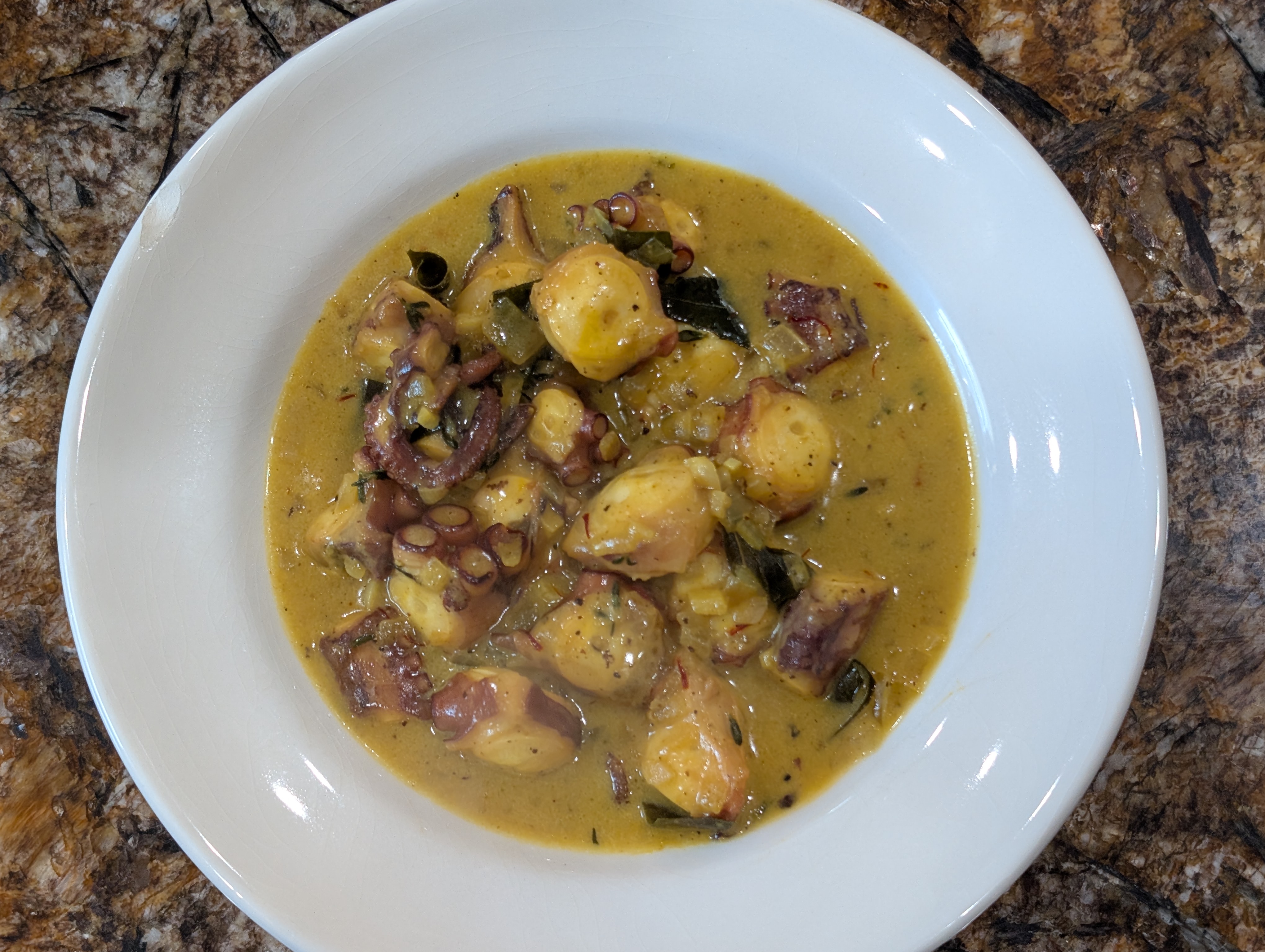
This personal culinary challenge showcases a cuisine that reflects how influences from around the world come together in amazing dishes. The challenge involves the preparation of a Seychellois Octopus Curry. The cephalopods could be found around many of the islands, such as Cousine. That availability led to this curry, which is a popular dish in the Seychelles. 

This demand created a fishery for octopi in the Seychelles. Many look for the creatures around the coral barrier reefs, while others, like a fisherman named Dave Auguste, go further out into the ocean. Auguste has fished for octopus for more than twenty years. When the COVID pandemic hit, the tourist trade (which is important to the Seychelles) crashed, and so did the market for expensive seafood like octopus. As the world gradually reopened and tourists returned, so did the demand for octopus. 

Dave Auguste with his catch (Source: United Nations, Photo: Douglas Okwatch)

Dave Auguste found one longer lasting change ... there were less of the cephalopods to catch. This change is not the result of COVID, but other factors.  In an article published by the United Nations, Auguste explained: 

There are fewer and fewer octopuses now. Before, I used to find them close to shore, but now I have to go further out. Again, for the last ten years or so, going out to sea has become more complicated because the sea has become rougher and the currents stronger. If I am not careful I can drift away from shore.

Indeed, climate change has affected the work of those who fish the waters around the Seychelles.  Auguste explained that there has been a change in rain patterns: "we used to have rainy periods that lasted several days, now it rains the same amount for one day and it all runs off into the sea." The prolonged rains and the runoff cause the waters close to shore to take on a reddish hue. The octopi do not like the tinged water and move further offshore. An additional factor is that, due to warming temperatures in the sea, there are some areas of the barrier reefs where up to 90% of the coral have died.

Not all of the news is bad. The Seychelles has taken proactive steps to stem the damage caused by changes in the climate. These steps include imposing quotas on seafood catches, expanding the range of protected marine areas, and implementing reef restoration projects. This has required some adjustment and adaptation, especially for those who work in the seafood industry, which makes up 27% of the Seychelles gross domestic product. This sacrifice, as well as, the conservation efforts, may not be enough if the climate continues to change. 

Turning to the challenge, I have prepared whole octopus in the past, but I decided for this dish that I would use pre-cooked octopus, which is available online or from some warehouse stores. Each package usually has 2-3 large tentacles, which may be less than a kilogram but still enough to prepare a meal for at least 2-3 people. The pre-cooked octopus also saves a lot of time (basically you can skip step 1). 

OCTOPUS CURRY

Recipe from Tourism Seychelles

Serves 4

Ingredients:

  • 1 kilogram octopus
  • Salt
  • Pepper
  • Fresh coconut milk (substitute 1 can coconut milk or cream)
  • 2 teaspoons saffron
  • 1 onion
  • Fresh thyme
  • 3 garlic cloves
  • Ginger (a little bit)
  • 1 teaspoon curry powder (or to taste)
  • Cinnamon sticks
  • Curry Leaves
  • Oil

Directions:

1. Prepare the octopus. Add the octopus to a pot and fill it with water. Boil until tender, about 45 minutes to 1 hour depending upon the size. Use a fork to check if the octopus is soft enough. Once the octopus is done, cut it into pieces

2. Prepare the curry. In a saucepan, add the oil, onion, garlic, ginger, saffron, curry powder, cinnamon sticks, thyme, salt and pepper. Mix and the add the octopus pieces. Fry the octopus pieces for a few minutes and then add the coconut milk and stir. Cover the saucepan and let it simmer for 15 to 20 minutes, as the sauce thickens. 

3. Finish the dish. Once cooked, serve with some white rice, lentils and papaya chutney. 

SIDE DISH

Ordinarily, as noted above, one would prepare white rice to serve with an octopus curry. Seychellois cuisine is known for its creole rice, a dish that is shared -- in some common form -- by creole cultures around the world. Rice is a staple food in the Seychelles, often accompanying main dishes. Yet, cultivation of rice cannot occur on a large enough scale on the islands to support its population. (Indeed, while the Seychelles may have an abundance of spices and access to seafood, it actually imports much of its other food.) Most of the rice comes from India, with smaller amounts imported from countries such as Pakistan, the United Arab Emirates, France and South Africa.

This personal culinary challenge gave me an opportunity to prepare creole rice and, to do so using the wide range of spices drawn from the subcontinent and southeastern Asia. The recipe shows that diversity with garlic, ginger, bay leaf, cinnamon, cloves, pepper and turmeric. I knew that I had to prepare this dish, which I served alongside the octopus curry.

SEYCHELLES CREOLE RICE

Recipe from Amy's Cooking Adventures

Serves 4

Ingredients:

  • 2 tablespoons butter
  • 1/2 red bell pepper diced (about 1/3 cup)
  • 1/2 onion diced (about 1/3 cup)
  • 2 cloves garlic, minced
  • 1/2 teaspoon turmeric powder
  • 1/2 teaspoon salt
  • 1/4 teaspoon black pepper
  • 1/4 teaspoon ground ginger
  • 1 bay leaf
  • Pinch of ground cinnamon
  • Pinch of ground cloves
  • 1/2 cup basmati rice
  • 1 cup water
  • Fresh parsley to garnish

Directions:

1. Saute the vegetables. Melt the butter in a saucepan over medium heat. Add the bell pepper and onion and cook for 5 minutes. Add the garlic, spices and rice and cook for another minute. Stir in the water and bring to a low boil. 

2. Finish the dish. Cover, reduce heat to low, and simmer for 15-20 minutes or until the water is absorbed. Fluff the rice, garnish with parsley and serve. 

*          *          *

To be honest, I had not expected to do a personal culinary challenge involving the Seychelles. I had previously done one for Mauritius, when I prepared an amazing duck curry. However, I really wanted to prepare this octopus curry and that led me to add this to the Around the World in 80 Dishes challenge. It is a decision that I will never regret, because it opened a door to exploring a creole culture and cuisine that draws inspiration from the diverse populations that have come to live on the Seychelles islands.  

Each of these dishes was a success, and, perhaps, some of the best dishes that I have prepared in recent weeks. This challenge has inspired me to move on to the next one. Check back to see where I end up. Until then ... 

PEACE.