Showing posts with label Cinnamon. Show all posts

Saturday, August 1, 2026

Duck Fesenjan

This particular dish, Duck Fesenjan, is a Persian stew -- a koresh or khoresht -- traditionally prepared with duck and a sauce made with walnuts and pomegranate. Much like the broader Persian cuisine from which it comes, the history of fesenjan dates back centuries. Indeed, some have traced that history as far back as the Sassanid era, which was from 224 C.E. to 651 C.E., and written recipes date back to at least the thirteenth or fourteenth centuries. 

Indeed, the long culinary history is as evident as the ingredients and cooking processes set forth in the black and white of the recipe. The use of pomegranate in Persian cooking predates the Islamic-era. Cooks used pomegranate in dishes to symbolize abundance, fertility, and/or the beauty of nature. Likewise, the cooking process of slow roasting or braising meat with fruits and nuts is also a centuries-old cooking technique in Persia cuisine. In this particular case, the combination of duck and walnuts was said, according to ancient Persian texts, to personify perfection. Indeed, if prepared properly (or even close to properly), then the resulting dish is perhaps as close as one can come to culinary perfection. 

The cooking process defines the dish. Walnuts need to be ground into fine crumbs, which can be done with a food processor or a spice grinder (although the latter takes more time). As the walnuts are ground, they will release their oils. The ground walnuts function as a thickener for the stew, aided by the pomegranate molasses, which also gives the stew its darker and richer flavor. The thickness and color are only achieved by cooking the ingredients for a long time. 

The recipe also calls for the use of chicken stock or duck stock. If you are using duck legs for the stew, then you should use chicken stock. If you use a whole duck, as I did, then I would consider making your own impromptu duck stock. You can break down the duck as you would a chicken into pieces (chicken breasts, wings, leg quarters -- or legs and thighs). You will then have the backbone and the neck, along with other bones, that can be combined with two chopped carrots, two chopped celery stalks, one chopped onion, a couple of bay leaves, a tablespoon of black peppercorns, a sprig (or two) of fresh rosemary and a sprig (or two) of fresh thyme. Also, as an option, you can add a tablespoon of dried juniper berries.  Add enough water to cover the duck, bring it to a boil, and reduce the heat to let it simmer for at least an hour (or, more preferably, longer).  This process is adjusted from the duck broth recipe created by Hank Shaw on his website, Hunter, Angler, Gardener, Cook, which is one of my go-to resources. I simplified the recipe and adjusted the amounts because, unlike Hank Shaw, I was not looking to make a lot of stock. 

The extra effort to make duck stock is clearly worth it, because Fesenjan is such an iconic dish in Persian cuisine. It is also considered a dish of the rich or upper classes, as illustrated by the Persian saying, "he behaves as if he has had partridge and fesenjan."  Although that saying typically refers to someone showing off or behaving pretentiously, the dish itself is often the centerpiece of festivals, like Nowruz, weddings, or other celebrations. Fesenjan is also popular among the Iranian Jewish community and diaspora, who enjoy the dish in connection with Passover or Rosh Hashanah

Finally, fesenjan is always served with rice, and, Persian cuisine offers a variety of rice dishes. However, given the status of the dish, I felt it was appropriate to serve it with Javaher Polow, or Persian Treasured Rice.  Together, the meal was fit for royalty, perhaps Shashid I or Khosrow I. However, if one does not have the time to make treasured rice, a standard Persian white rice recipe will do. 

DUCK FESENJAN

Recipe from Hunt Gather Cook

Serves 4

Ingredients:

  • 1 tablespoon duck fat or clarified butter
  • 3 pounds duck legs or 1 duck 
  • 1 large onion, chopped
  • 1/2 cup pomegranate molasses
  • 2 cups walnut halves, toasted and finely ground
  • 2 cups duck stock (or chicken stock)
  • 1/4 teaspoon saffron
  • 1/4 teaspoon ground cinnamon
  • 1/2 teaspoon ground nutmeg
  • 1 teaspoon ground black pepper
  • Pomegranate seeds, optional, for garnish
  • 3 tablespoons chopped parsley, for garnish

Directions:

1. Prepare the duck. If the duck is fat, pierce the skin of the legs (and other parts, if using a whole duck) all over with a need or the sharp point of a knife, do not pierce the meat. (For most wild ducks, you won't need to do this.) Salt well and set aside. 

2. Brown the duck. In a large sauté pan, heat the tablespoon of duck fat over medium heat. Add the duck legs (and other parts, if using a whole duck), skin side down and brown slowly, rendering the fat. Remove the legs (or other parts) as they brown and set aside. 

3. Continue the dish. Add the chopped onion and sauté until translucent. Add the duck legs and other parts to the pan, skin side up. Add enough duck stock (or chicken stock), cover and simmer gently for 1 hour. 

4. Continue to prepare the stew. Stir in the ground walnuts, pomegranate molasses and the spices. Cover and cook over very low heat until the meat is tender, stirring every 20 minutes or so to keep the walnuts from sticking to the bottom of the pan. Turn off the heat and add more stock or salt to taste. You want the stew to be very thick but not pasty. 

5. Finish the dish. Garnish with pomegranate seeds and parsley. Serve with rice. 

PEACE. 

Sunday, February 22, 2026

Chinese Grocery Roast Pork

The Mississippi delta has been described as a "haunted landscape," a beautiful backdrop of alluvial plains and coastal wetlands, marred by the brutal legacies of slavery and segregation. The history has been recorded in both the black and white of history books, but also in the colorful, yet melancholy, notes of delta blues musicians such as Robert Johnson, Charlie Patton and Son House. These musicians not only recorded the daily oppression, poverty and strugle of African Americans lives, but they also documented the resilience and strength of both the people and their communities. 

Yet, there are chapters of the delta's history that until, relatively recently, went largely untold. One such chapter revolves around the Chinese immigrants who settled in the Mississippi delta in the aftermath of the Civil War. These immigrants left their homes (primarily in the Guangdong and Canton provinces) in search of the Gam Sahn ("golden mountain"), akin to what we would call the "American dream." These Chinese immigrants ended up on the same cotton plantations previously worked by African-American slaves. They performed the same back-breaking work. The only difference was that the white owners had to pay the Chinese immigrants for their labor. But, the pay was not enough to justify the hard work, let alone support a family either in the United States or back home in China.  

Consequently, many Chinese laborers left the cotton fields, looking for work elsewhere. They made their way to nearby cities, where they established themselves in the community by opening grocery stores. The first such stores began to appear in the 1870s. The work continued to be hard, with early mornings and late nights, but these Chinese-Americans took control of their economic lives. They also relied upon hui, their relatives, to open additional grocery stores. Soon, Chinese-owned grocery stores proliferated across the Mississippi Delta. In the city of Greenville, Mississippi -- an important transit point for transportation between New Orleans, Louisiana and points north -- had 40,000 residents and 50 Chinese-owned grocery stores.  

One of the first Chinese-owned grocery stores in Greenville, MS, at the corner of Washington
Avenue and Walnut Street, photo taken  in 1939 by Farm Security Admin. photographer
Marion Post Wolcott, available at the Library of Congress (Source: KPBS)

The successful exertion by Chinese-Americans of their economic independence had its limits in the racially structured, white supremacist society. The Chinese were not "White" or "Colored," falling into a third category. The Chinese-Americans did not suffer the extreme violence suffered by African-Americans, but they nevertheless suffered from discrimination and segregation. It was in this space that the Delta Chinese soon found that they too had limited opportunities. the only employment available to them involved owning or working in these grocery stores. 

Chinese-Americans navigated within this space. And they did so in a very historically significant way. The Chinese-American owned grocery stores served as critical lifelines for the most oppressed people in the Mississippi delta: the African-American community. The same white supremacist racial and economic order that confined the Chinese to owning and/or working in grocery stores made it difficult, if not impossible for African-Americans to go to white-owned grocery stores.  

Chinese store owners purchased goods from white-owned wholesalers. They then stocked the shelves with foodstuffs (like flour, sugar, canned goods), clothing, farms tools, and much more. However, these grocery stores provided more than a place for African-Americans to purchase what they needed. The stores provided a social environment where African Americans were respected: they could walk through the front door of a store (rather than through the back door) and would be treated with civility. The Chinese-American grocery store owners would offer lower prices and were the only ones to extend credit to African-American sharecroppers, who were paid only once or twice per year.  The two communities -- Chinese and African-American -- worked together in solidarity as they struggled to survive the racist economy, government and society that operated violently along the Mississippi River and across the delta.

(As an aside, immigrant communities in other cities -- like the Italians in Birmingham, Alabama and New Orleans, Louisiana -- also operated grocery stores that served the African-American community.)

Picture exhibited in 2023 at the Mississippi Delta Chinese Heritage Museum,
located at the Delta State University in Cleveland, Mississippi

The grocery stores were not only the business of the Chinese-American communities, they were also their homes. Because of the racist Chinese Exclusion Act, Chinese-Americans could not own land. They usually lived in the back of their stores or in adjacent structures. Many of the memories of Chinese-American children revolve around food, which also served as the focal point of gatherings among their community.

After learning about the Chinese-American community in the Mississippi delta, as well as their relationship with their African-American neighbors, I wanted to prepare a dish in recognitionof and to honor that history. I found a recipe for Chinese Grocery Roast Pork. This recipe was perfect: it took a traditional Chinese recipe -- Char Siu, which is usually prepared with pork belly -- but used a cut of pork that is synonymous with the iconic southern barbecue: the pork butt.

CHINESE GROCERY ROAST PORK (MISSISSIPPI STYLE CHAR SIU)

Recipe adapted from James Beard Organization 

Serves 6

Ingredients:

  • 1 tablespoon vegetable oil
  • 4 green onions, white and green parts, chopped
  • 2 garlic cloves, minced
  • 1 teaspoon grated peeled fresh ginger
  • 1 cup dark soy sauce
  • 1/2 cup dry sherry
  • 1/2 cup rice vinegar (preferably red)
  • 1 tablespoon honey
  • 2 tablespoons dark brown sugar
  • 1 tablespoon hoisin sauce
  • 1 star anise
  • 2-inch piece cinnamon stick
  • 1/4 teaspoon five spice powder
  • 1 3-pound shoulder of pork (Boston butt)

Directions:

1.  Prepare the sauce. Heat the oven to 325 degrees Fahrenheit. In a large Dutch oven or roasting pan, heat the oil over medium heat. Add the onions, garlic and ginger and cook for 1 minute. Add the soy sauce, sherry, vinegar, honey, brown sugar, hoisin sauce, anise, cinnamon and five-spice powder. Simmer for 1 minute. Add 1 cup of water and bring to a boil. Reduce the heat under the pan so that the mixture simmers. 

2. Roast the pork. Loosen the skin from the meat in several places, but do not remove it. Place the meat in the liquid, turning several times to coat it with the sauce. Transfer the pot to the oven. Cook for 30 minutes undisturbed, then baste with the cooking liquid and continue to baste every 20 minutes until the internal temperature of the meat is between 170 and 180 degrees Fahrenheit, about 4 to 4 1/2 hours. 

3. Finish the dish.  Remove the pork to a cutting board or serving platter and let rest for 10 minutes. Slice thinly and pour the pan juices over the meat, removing the star anise and cinnamon. 

*     *     *

Postscript: To learn more about the experience of Chinese-Americans in the Mississippi Delta, I recommend watching The Untold Story of America's Southern Chinese. Part 2 of the series focuses upon the Chinese in the Mississippi Delta and their history in the region. 


I also recommend the movie, Far East Deep South. Written and directed by Larissa, Lam, the movie follows the story of the Chiu family as they learn more about their family's history and roots in the Mississippi delta. It is availalbe on Tubi. I watrched the movie. Not only is it very informative, it was truly moving to watch and learn alongside the family. 

 PEACE.

Tuesday, September 16, 2025

Around the World in 80 Dishes: Mexico

"Mexican food is far more varied than people think."

-- Gael Garcia Bernal, Actor & Filmmaker

That statement is particularly true if the people happen to live in the United States. In a country where the history of Mexican food tells the tales of Chi-Chi's and Chili's, along with Taco Bell and Chipotle, one could easily think that Mexican food consists of nachos, tacos, quesadillas and chalupas. Yet, the entirety of Mexico, from the Rio Grande to the Usumacinta, from the Pacific to the Caribbean, plays host to a wide range of different cuisines. The foods of the arid stretches of Sonora differ from those along the coastline of Jalisco. Those dishes differ from the indigenous cuisines of Oaxaca and Tabasco.

Americans love Mexican food, but as Anthony Bourdain once noted, "we have barely scratched the surface of what Mexican food really is." In some respects, Mexican cuisine is older than "the great cuisines" of Europe. And, it can stand its ground with those cuisines as well. A mole sauce from Oaxaca is as complicated to make (if not more so), in terms of ingredients and processes, as any sauce from storied European cuisines that are featured the Michelin-starred kitchens of restaurants anywhere in the world.  

The regional cuisines of Mexico
In order to understand the range of regional cuisines in Mexico, one needs to look at the country itself. Generally speaking, one could outline at least seven different regional cuisines. There is the El Norte (Aguascalientes, Baja, Sonora, Chihuahua, Cohuila, Durango, Nuevo Leon, Tamaulipas and Zacatecas), with a range of seafood dishes from the coasts of the Pacific Ocean and Baja California) to the beef dishes from the ranches of Sonora and Chichuahua. (I think this could be split in two separate regions on its own.) There is the Costa del Pacifico Norte (Comalina, Jalisco, Nyarit, and Sinaloa), which is known for dishes such as pozole and birria. There is the Bajio (Guanajuato, Michoacan, Queretaro and San Luis Potosi), where rice and pork feature prominently. There is Costa del Pacifico Sur (Chiapas, Guerrero, and Oaxaca) where one could enjoy the cuisine of the indigenous peoples. Then there is El Sur (Campeche, Quintana Roo and Yucatan), where one could enjoy pork dishes like pibil. There is El Golfo (Tabasco & Veracruz), where, as noted above, there is Afro-Cuban and Creole influences. Finally, Mexico Central (Federal District, Hidalgo, Mexico, Morelos,  Puebla, and Tlaxcala), where many of the other regions' influences meet. 

This variety makes the preparation of a main dish from Mexico especially challenging. I have previously dabbled in the particular regional cuisines, whether it is preparing the Mole Verde Zacatano or Tacos de Chapulines con Tequila y Guacamole. Yet, which cuisine will reign supreme for this Mexican round of my Around the World in 80 Dishes Challenge

With so many regions, states and cuisines to choose from, I decided to introduce some randomness. I used a random address generator to provide me with three addresses as starting points to choose the cuisine and the dish. Those addresses gave me the following Mexican States: (1) Sonora; (2) Jalisco; and (3) Tabasco.

APPETIZER

I have never traveled to the State of Sonora, let alone walked the streets of its capital, Hermosillo, during the 1980s. (I would have been in my teens during that time.) Yet, if one did, they would have come across the culinary creation known as the Sonoran Dog or the Danger Dog. Vendors, known as dogueros, grilled bacon-wrapped hot dogs, which they placed in bollilo bun could be customized with a rage of toppings and condiments. Toppings typically included tomatoes, onions, beans, guacamole or salsa, while condiments could include mayonnaise or mustard. 

Grilling the dogs is the key. One cannot boil or steam them. However, some vendors operated in less than sanitary conditions or in violation of food preparation regulations, which gave rise to the name "danger dogs." Fortunately, I found a recipe on Saveur from Danny Trejo, the famous actor who owns restaurants like Trejo's Cantina and Trejo's tacos. There is no issue with the food, the only danger would be crossing one of characters played by Trejo, like Navajas from Desperado or Machete from the movie of the same name.

DANGER DOGS (SONORAN DOGS)

Recipe from Danny Trejo

Serves 4-6

Ingredients (for onions and peppers):

  • 2 tablespoons olive oil
  • 1 medium onion, thinly sliced (1 1/2 cup)
  • 1/2 medium green bell pepper, thinly sliced (2/3 cup)
  • 1/2 medium red bell pepper, thinly sliced (2/3 cup)
  • Kosher salt

Ingredients (for the Danger Dogs):

  • 2 jalapenos, quartered lengthwise
  • 6 hot dogs
  • 6 bacon slices
  • 6 hot dog buns
  • 2 tablespooons vegetable oil

Directions:

1. Prepare the onions and peppers. In a large skillet, add the oil and onion and cook, stirring occasionally, until softened and beginning to brown, about 7 minutes. Add the green and red bell peppers and cook, stirring occasionally, until everyhting is soft and deep golden brown, 10-12 minutes. Transfer to a bowl, season to taste with salt, and set aside. 

2. Prepare the jalapeno peppers. In an empty skillet, add the jalapenos skin-side down and cook over medium heat without moving until charred, about 5 minutes. Turn them owner and cook until tender, about 5 minutes more. Transfer to a bowl and set aside. Return the skillet ot the stove and turn off heat. 

3. Make the danger dogs. Tightly wrap the hot dogs in bacon from end to end. To the empty skillet, add the oil and turn the heat to medium. When it's hot and shimmering, add the hot dogs and cook until browned on the bottom, about 5 minutes. Using tongs, give each hot dog a quarter turn and cook for another 5 minutes. Repeat on the remiaining two sides until the hot dogs are crisp all over. 

4. Finish the dish. To serve, spoon the reserved onions and peppers into buns, then top each with one jalapeno slice. Top with the hot dogs and serve immediately. 

MAIN COURSE

As the story goes, the Spanish conqusitadors were not the only ones to arrive in what is now Mexico during the 16th century. Those conquistadors brought goats with them, which were used to help clear the rugged terrain as the conquistadors and colonizers made their way across the Americas. However, the goats became a problem. Their numbers multipled and, as the Spanish colonizers settled in, there was not as great of a need for the goats. Unlike cattle or pigs, the Spanish were not fans of eating cabro or cabra, as they did not like the smell or taste of the gamey meat. So, in Jalisco, they decided to give the goats to the indigenous peoples. The goats were just as much of a problem for the natives, as the goats ate everything, including the crops. So the indigenous people decided to eat the goats. They used traditional preparations, using spices and herbs as they cooked the meat slowly in vinegar and water, until it became a delicious soup. The Spanish were unimpressed, referring to the soup derogatorily as "birria," which means "worthless" or "useless." 

That worthless soup outlived the Spanish empire and became an important part of the cuisine in Jalisco. A person who prepares the iconic soup became known as birriero. The preparations began to vary with regions within Jalisco and with the cooks, but the end product - the soup with its rich broth did not change. As birria expanded across Mexico, there were additional changes. For example, as it reached Tijuana in the 1950s, a street food vendor named Don Guadalupe Zarate decided to use beef instead of goat. There is also a legend in connection with Zarate that customers asked him to add liquid to the birria, which led to the beef soup. (I think that this part is probably legend, as other sources indicate that the preparation of birria as a soup goes back to Jalisco.)

Birria continued its expansion northward, along with Danger Dogs, into the United States. Culinary migrants, whose aromas and flavors would add to the tables in kitchens and restaurants across the country. Birria could not make it on its own, it needed real people, real migrants who came to this country seeking a better life for themselves and their families. At first, there was Chalio Luis, who brought birria to the Los Angeles, California in the 1970s. Then there was Reuben Ramirez, along with his cousins Oscar and Omar Gonzalez, who opened a birria stand in South Central Los Angeles, California in 2013. There were countless others, who brought their knowledge as birreros or just as someone who could prepare birria to the U.S. for people to eat and enjoy. 

Today, Americans have embraced birria, with restaurants serving the beef and broth, often in taco form, in restaurants from Washington, D.C. to Los Angeles, California. However, our government has turned against the Mexicans migrants and residents who live in the United States (along with all other individuals with brown or black skin). Governmental authorities have increased their efforts to deport them, with masked individuals rounding up individuals and taking them away in unmarked vans to detention centers and prisons. These facts were not lost on me as I prepared this dish. 

BEEF BIRRIA

Recipe from Isabel Eats

Serves many

Ingredients:

  • 4 to 5 pounds chuck roast, cut into large 4-inch chunks
  • 1/2 tablespoon kosher salt
  • 1/2 tablespoon ground black pepper
  • 1 1/2 tablespoon olive oil
  • 12 guajillo chiles, rinsed, stemmed and seeded
  • 5 ancho chiles, rinsed, stemmed and seeded
  • 5 arbol chiles, rinsed and stemmed
  • 2 large Roma tomatoes
  • 1/2 medium yellow onion
  • 1 4-inch Mexican cinnamon stick
  • 3 bay leaves
  • 1/2 teaspoon whole black peppercorns
  • Water, as needed
  • 2 cups beef broth
  • 1/4 cup distilled white viengar
  • 5 cloves garlic
  • 1 teaspoon ground cumin
  • 1 teaspoon dried Mexican oregano
  • 1/2 teaspoong ground cloves

Directions:

1. Brown the meat. Generously season the meat with salt and pepper on all sides, and heat the olive oil in a large pot or Dutch oven over medium high heat. Working in 2 batches, add the meat and sear on all sides until browned. Remove the pot from the heat, add the seared meat back into the pot and set aside. 

2. Continue with other ingredients. While the meat is searing, add the guajillo chiles, ancho chiles, arbol chiles, tomatoes, onion, cinnamon stick, bay leaves and pepper corns to a medium pot. Cover completely with water and bring to a boil over high ehat. Reduce the heat to low, cover, and cook for 10 minutes. 

3. Blend the other ingredients. Using a slotted spoon, transfer the softened chiles and other ingredients to a large blender. Add 1 cup of the chile soaked cooking water, the beef broth, white vinegar, garlic, cumin, oregano and cloves. Blend on high for a few minutes until compeletly smooth. (You may have to do this in 2 batches if your blender is not big enough.) Strain the blended sauce through a fine mesh strainer into the pot with the seared meat. Discard any solids left behind.

4. Cook the birria. Stir the meat and chile sauce together to combine and bring to a boil over high heat. Reduce the heat to low, cover and simmer for 3 to 3 1/2 hours until the meat is fall-apart tender. 

5. Finish the dish. Transfer the meat to a large bowl and shred it with two forks. Add the meat back into the consomme and serve as a stew in bowls with diced onion and chopped cilantro, or as tacos in corn tortillas with shredded Oaxaca cheese, cilantro and diced onions.

SAUCE

For the last dish, which comes from the state of Tabasco, a State that lies along Mexico's Caribbean coastline of Mexico. This region has a long history, stretching all the way back to the Olmec civilization, which predominated over the area from 1400 BCE to about 400 BCE. After the decline of the Olmecs, the Chontal Maya civilization emerged, controlling the area from 300 CE until the Spanish conquistadors and colonists arrived. 

I wanted to find a recipe that draws from the pre-Spanish culinary traditions. I found it in chirmol. I am not talking about the Guatemalan salsa. Instead, it is a "stew" whose origins go back as far as the Chontal Maya civilization, if not further back in time. The quotation marks are used because chirmol is not so much a stew, as it is a mole. A sauce prepared with a range of ingredients that set it apart from other preparations. For the chirmol, the key ingredients are the tortillas, which are burnt; the anchos, which provide the smoke and spice; and, most importantly, the petitas or pumpkin seeds. 

The sauce is very versatile, but it is usually served over chicken, fish or pork. Of course, chicken and pork are not indigenous ingredients, both of which having been brought over by the Spanish. If you want to de-colonize the dish, I would use either fish or turkeys, which had been domesticated by indigenous people in the area long before Spanish arrived. 

CHIRMOL TABASQUENO

Recipe from Hunter Angler Gardener Cook

Serves 6

Ingredients:

  • 3 stale tortillas or tostadas
  • 3 to 5 ancho chiles, stemmed and seeded
  • 1 head of garlic, cloves separated but not peeled
  • 1 white onion, peeled and quartered
  • 1/2 pound Roma tomatoes, halved lengthwise
  • 1/3 pound pepitas or pumpkin seeds
  • 3 cloves
  • 1 tablespoon achiote paste (optional)
  • 1/2 teaspoon anise seeds (optional)
  • 1 hoja santa or small bunch of epazote (optional)
  • 2 tablespoons lard or olive oil
  • 1 pound of crab meat (or any other protein)

Directions:

1. Prepare the tortillas. Get a large heavy frying pan or comal very hot. Partially char the stale tortillas, you want lots of black marks, but don't blacken them totally. If you are using tostadas, no need for this. 

2. Prepare the chiles. Briefly toast the ancho chiles, pressing down on them with a spatula. You want to see some blistering, so maybe 10 to 30 seconds per side. Submerge all the toasted chiles in warm water. 

3. Prepare the other ingredients. Arrange the onions garlic and tomatoes on the hot pan to char them. You want serious blackening here. The tomatoes will take the longest, and don't be tempted to move them too soon or you will leave all the good blackened bits in the pan. If that happens, scrape it up immediately and set the scapings aside.

4. Toast the pepitas. In another pan, toast the pumpkin seeds over medium high heat until they start to pop. Move to the bowl of a blender. Crush up the toasted tortillas and put them in the blender too, along with the cloves, achiote, and anise seeds, if using. Add enough water to the blender to turn this all into a runny paste. Pour the contents into a large bowl. 

5. Continue the preparation. When the vegetables are nicely charred, peel the garlic, then add everything to the blender with the soaked chiles and the joa santa leaf if using. Add some of the chile soaking water and blend this to a puree too. Add it to the bowl and mix well. Add salt to taste.  

6. Finish the dish. Heat the lard or olive oil in a pot over medium high heat and when it's hot, add the chirmol. Stir well to combine and drop the heat to low. Let this simmer 15 to 20 minutes. Serve over cooked crabmeat or other protein. 

*     *     *

This challenge has special meaning. I strived to complete it by Mexican Independence Day in 2025, during a time in which the administration of the United States was using its enforcement powers in unconstitutional and inhumane ways against Mexicans who were living here both lawfully and without proper documentation. It was also reported that the administration planned to have Immigration & Customs Enforcement target Mexican Independence Day celebrations in Chicago, Illinois. Rather than persecute people, I wanted to join in the celebration of their culture.

In so doing, I made three interesting dishes from across the country. All three were successes and I look forward to where the next challenge will take me. 

PAZ.

Sunday, June 1, 2025

Around the World in 80 Dishes: Nepal

For many, the mention of Nepal conjures images of Mount Everest. Known locally as Sagarmatha or Qomolangma, Mount Everest boasts of the highest point above sea level. The thought of the mountain also conjures up images of intrepid mountain climbers moving from base camp to base camp, with their sherpas. Indeed, the mountain casts a long shadow, one that often obscures the tens of millions of Nepali who live not just in the mountains and the valleys, but also the plains below. 

I find the stories of the Nepali people far more interesting and compelling than those any person -- such as Sir Edmund Hillary or  George Mallory -- who ascended Mount Everest. Their stories told by the Nepalis are ones of struggle, resilience, and hope. Unlike those of Hillary or Mallory, these stories recount lived experiences that span three hundred and sixty-five days per year, each and every year.  

Many of those stories can be found on a website, Stories of Nepal. The website curates the short stories of everyday Nepalis by subject and by cmmunity. The subjects that got my attention had names such as A Right to Earn a Living, Of Hope and Resilience, Strive Struggle Trive, and The Future I Want. I also browsed the stories by communities, looking at the stories from each of Nepal's three ecological regions: the mountains, the hills and the terai (or plains). 

As I read through these stories, I began to notice the common threads: the poverty at home, the desire to have a better life, the paths that they took to achieve that goal, and the obstacles that they had to overcome. There are two measures of poverty: income poverty and human poverty. The former measures whether a person has enough income to meet basic needs, while the latter has a broader focus on whether a person has access to essential resources and opportunities necessary for a decent life. Significant portions of Nepalis across all regions suffer from both types of poverty: in the mountains, 38% suffer from human poverty and 42 percent suffer from income poverty; in the hills, 24% suffer from human poverty while 29% suffer from income poverty; and, in the terai, 33% suffer from human poverty while only 23% suffer from income poverty.

But, as they say, numbers don't tell the whole story. That is where the Nepalis themselves come in. Their contribution demonstrates the hard work that they endure, but the hope that they have for either themselves or their children. For example, Beyond these Mountains tells the story of one Nepali woman, Bhomo Karto Tamang, in Gatang, which is high up in the mountains. She was born in a relatively well-to-do family whose father herded 18 yaks, 200 sheep, and, in her words, "I did not count the goats." She talked about how strong her mother was and how she helped her mother prepare the barley flour. That flour was payment to her father's shepherds. When she grew up, she got married and her life continued much like her mother. However, unlike her mother, this woman decided with her husband to send their children to school. She wanted her children to experience what lies beyond the mountains, something that she never had.

Then there is the story of Hiralel Rai, who lives in Khotang, which is firmly nestled in the hills of Nepal. Rai loved to sing and dance as a kid. His conduct was frowned upon in school, as it was deemed the type of activity inappropriate for boys. That led to corporal punishment by teachers. Rai persevered and, eventually, became a teacher himself. In his own words: 

I am aware that the choices I make as a teacher, inside the classroom, will have a great impact on the lives of these children. Of what they will do and who they will become. So I am always careful as to what I do and what I say in class. I am not a strict teacher who only disciplines students. We all know we get bored in class so I make things fun. I tell stories. While I teach English, I also dance with them. I also sing with them. And everyone sings and dances with me. Freely, without any fear.

There are many more stories that are illuminating and inspiring about how people overcome their circumstances for the betterment of not just themselves but others. When one can see that in people, they are seeing the innate dignity that lies within all of us and that we all deserve. 

I strongly recommend reading Stories of Nepal, where the above stories and pictures come from. They provide a very good starting point to learn about the people. Now, it is time to learn about their cuisine, which is the focus of my personal culinary challenge, Around the World in 80 Dishes. The main course, Bhuketo Maso, and the side dish, Piro Alu Dum, have their own stories to tell.

MAIN COURSE

My love for eating goat meat has made its appearance in my culinary challenge on more than one occasion, with Goat Curry from Guyana and two dishes -- Chichinga and Jollof Rice with Goat -- from Ghana. In preparing those dishes, I only tangentially touched, at best, or completely missed, at worst, an important subject: the role that goats play to help lift the poor out of poverty. That subject is harder to miss when one looks at Nepal, because quite a few non-governmental organizations have pursued initiatives to introduce goat farming to those who have little, and researchers followed behind to measure the impact. 

Goats are often referred to as the "poor man's cow." Like cows, goats produce milk and meat, but at a cheaper price to purchase and at a lower cost to maintain. One study estimated that a person could maintain four goats at the same cost as one cow. In addition, one can raise goats in areas where, due to lack of substantial vegetation, it would be harder to raise cows or other animals.  

There are many organizations that have worked to provide goats to poor Nepalis, to provide them with a means through which they can earn money through the sale of goat milk, or, over time, goat meat. Those programs were, in turn, monitored through research, including efforts that were funded by the United States Agency of International Development or USAID. One such research effort found that the provision of goats by Heifer International to poor Nepali women, along with training in animal husbandry, had positive outcomes on the living standards of those women. (I had to look for sources other than those of USAID because the current American administration has taken down EVERYTHING that USAID has done to help the poor around the world.)

For my main challenge, I decided to prepare Bhuketo Maso, which is a dry curry. The dish could be prepared with any kind of protein, such as chicken or lamb. However, I decided to use goat as a nod to the importance that this particular protein has in lifting many Nepalis of poverty. 

BHUKETO MASO

Recipe from Nepali Tummy

Serves 4

Ingredients:

  • 1 pound goat meat (clean and cut in 2 inch cubes)
  • 1/2 tablespoon of cumin seeds or 1/2 tablespoon cumin powder
  • 1/2 tablespoon coriander seeds or 1/2 tablespoon coriander powder
  • 1 cinnamon stick or 1/2 tablespoon cinnamon powder
  • 3-4 dried red chiles or 1/2 tablespoon red chile powder
  • 1 teaspoon turmeric powder
  • 1 tablespoon ginger-garlic paste
  • Salt
  • 4 tablespoons oil

Directions:

1. Prepare the spice mix. Add the cinnamon stick, cumin seeds, coriander seeds, and dried red chiles in a spice grinder. (If you are using ground spices, just combine). Grind until the spices are a powder. Remove to a small bowl. Add 2 tablespoons of water to make a thick paste.

2. Boil the meat. In a deep pan, add the meat, water (to cover) and 2 pinches of salt. Boil the meat until it is cooked, approximately 20 minutes.  Be careful not to overcook. 

3. Finish the dish. Heart the oil in a separate pan. Add the boiled meat and the spice paste, stir over medium heat and cook for 10-12 minutes. 

SIDE DISH

While Bhuketo Maso may be a dry curry, I prepared a side dish that did have a curry-like sauce. Piro alu dum is a potato curry that has a tomato base.  This provided a little contrast to the overall meal. 

Potatoes were actually introduced into Nepal back in the mid-19th century, when a British naturalist, Sir Joseph Dalton Hooker, during an expedition to that country. While Hooker ultimately left, the tubers remained and became a vital crop across the country. They have an adaptability that works well in a country with differing regions, soils and climates. Nepalis are able to grow potatoes in areas where other crops could not thrive, thereby enabling them to produce a commodity that has taken a featured spot in their cuisine.

PIRO ALU DUM

Recipe from Cookpad

Serves 2

Ingredients:

  • 4 medium sized potatoes, cut into 4 pieces
  • 10 cloves garlic
  • 2 whole red chiles
  • 1 medium sized tomato paste
  • Salt, to taste
  • 1 teaspoon turmeric powder
  • 1 teaspoon Kashmiri red chile powder
  • 3 tablespoons mustard oil
  • 1/2 teaspoon kalonji
  • 1/4 teaspoon fenugreek seeds
  • 2 tablespoons cilantro (coriander leaves)

Directions:

1. Boil the potatoes. Peel the potatoes. Heat a pot of water to boiling. Add potatoes and boil until tender. Remove from heat and drain the potatoes. While the potatoes are boiling, mince the garlic cloves and chiles, and then combine the two into a paste. 

2. Prepare the tomato-spice paste. In a bowl, add the garlic-chile paste, tomato paste, salt, turmeric powder and Kashmiri chile powder. Mix well. 

3. Finish the dish. Heat the oil in the pan on medium heat. Add kalonji and fenugreek seeds. Add potatoes and stir, mixing well. Add the tomato-spice paste and mix well. Add hot water and continue to cook, while the sauce thickens. Once the sauce is at the desired consistency, add coriander leaves and serve hot. 

*    *    *

In the end, I am grateful for having the opportunity to prepare this meal. I am much more grateful for taking the time to learn about the roles that the primary ingredients -- goat meat and potatoes -- has had in Nepali life and cuisine. Not everything that I read is reflected in this post. But, I wanted to make sure one thing is prominently set forth here ... the importance of development programs to help the poor lift themselves out of their poverty, and the critical work of those who oversee and implement those programs. Their work takes on moral and ethical obligations, which are gravely under threat. That is best saved for another post. Until then ... 

PEACE.

Saturday, May 10, 2025

Advieh

Longtime followers of this blog may (or may not) remember a dish that I prepared 11 years ago -- Advieh-e Spiced Chicken Kebabs. That dish was my attempt to use an iconic spice mix from Iran in one of my favorite preparations, namely, kebabs. In that effort, I talked about the spice mix. I also ended my post by noting one truly special ingredient: dried rose petals. At the time, I did not have that ingredient and I decided to substitute a few drops of rose water. Improvisation that worked, but it was not truly Advieh. 

Time has passed and I now have dried rose petals among the many herbs and spices at my disposal. So, it was time to return to Advieh, to prepare it properly and to learn more about its place in Persian cuisine. 

Although no one has been able to trace the history of advieh to its origin, the use of this spice mix, or one very similar to it, can be found in recipes that can be dated as far back as 2,000 years ago. It should be noted that the history of the spice trade routes dates back as far as 1,000 B.C.E. One of the routes of the spice trace wound its way through what is now northern Iran. That trade route most likely provided the cinnamon, coriander, nutmeg, and cardamom used to prepare advieh. Over time, this spice mix has become what one described as a "cornerstone" or a "bridge" for Persian cuisine. 

As for the ingredients used to prepare advieh, there is no one definitive recipe. Like most recipes, there are variations that have developed over time and with different cooks. I tried to find a typical advieh recipe that includes the most commonly used ingredients. Each ingredient has a purpose: cinnamon, for its "sweet warmth"; cardamom, for its "minty undertones"; cumin, which adds earthiness; coriander, which supplies citrus notes; nutmeg, which gives a "spicy sweetness"; and, of course, rose petals, which provide a floral scent to the mix. Other recipes may add ingredients such as black pepper, cardamom or even saffron. 

I used this spice mix to prepare some roasted halibut for my beautiful Angel. Fortunately, because I had rose petals, she was able to experience advieh as it truly should be made. She loved the dish very much; and, I have some leftover mix to use on something more traditional, like chicken kebabs.

ADVIEH

Recipe from Meljoulwan

Ingredients:

  • 1 teaspoon ground cinnamon
  • 1 geaspoon ground coriander
  • 1 teaspoon grond nutmeg
  • 1 teaspoon ground cardamom
  • 1 teaspoon ground rose petals
  • 1/2 teaspoon ground cumin

Instructions:

Combine all of the spices in a small bowl and mix well. 

PEACE.

Saturday, February 8, 2025

Around the World in 80 Dishes: Seychelles

Seychelles is an interesting combination of the littlest and the greatest. The one hundred and fifty-five islands that comprise the country, which lie in the Indian Ocean, make Seychelles one of the smallest countries in Africa by square miles. The estimated 100,600 people who live on those islands makes the Seychelles the least populated country in Africa. Yet, Seychelles has the highest nominal gross domestic product (GDP) per capita of any African country, which means its residents have relatively the highest standard of living. It is also ranked the highest electoral democracy in Africa, and forty-third in the world. That is quite the combination for a country whose islands laid uninhabited prior to the 18th century.

The French were the first to occupy and claim the islands in 1756, naming them after Louis XV's Minister of Finance, Jean Moreau de Sechelles. As the French settled on the islands, they brought with them an order that was familiar in the colonial era. Helene Frichot, an architectural author, recounted this historical order in one of her essays:

Originally, when the French plantocracy settled, habitations -- strips of land - were marked from mountain peak to shore, parcelled out for the mostly large, conservative, Catholic families. These families assumed a certain order of things, divided strictly along lines of colour: those who owned and governed, and those obliged to labour. As Mairi O'Gorman argues in her research on the Seychelles, property, espeically when organised according to a plantation regime, is racialised: ownership assumes whiteness, while labor is delegated to Brown and Black people.

And, French settlers brought with them enslaved African men, women and children to work on these new plantations. The British Empire took control of the islands less than fifty years later, with the Treaty of Paris in 1814. The British allowed the use of enslaved Africans to continue, and they began to bring indentured servants from the Indian subcontinent and other parts of Asia to work on the islands. The result was a society that had French plantation owners, the British administrative elite, and a large number of African and Asian laborers, traders and shopkeepers. 

This mix of people and cultures on the islands led to the emergence of the Seychellois Creole, an ethnic group that combines African, Asian and European influences into one common identity with a language and culture of its own. The Seychellois Creole language, Seselwa, is rooted in French, but it has incorporated aspects of African and Malagasy languages, as wells as terms and phrases from English and Hindi. E, kot i konsern manze, lenfliyans Lafrik, Lazi e Eropeen is disifil pou manke. ("And, when it comes to food, the African, Asian and European influences are hard to miss." - My attempt at Seselwa using Google translate.)

Le Jardin du Roi, Mahe, Seychelles
(Source: Runaway Lodge)

As for Seychelles cuisine, its story can be told, in part, with reference to a garden, Le Jardin du Roi, that the French settlers started in 1772.  One of those colonists, Pierre Poivre, wanted to get into the spice trade. Poivre himself was quite the story. He spent his early years as a missionary, living in Cochinchina (later known as Vietnam), Guangzhou, and Macau. He left missionary work to join the French East Indies Company, where he presumably came into contact with the spice trade. By 1772, he was living between Mauritius and the Seychelles, and wanted those islands to be part of that trade. Poivre's entre into the spice word was not very Christian-like. He decided that he would set out on a vessel to Ceylon (now Sri Lanka) and the Moluccas (now part of Indonesia). His goal: to steal the spices and bring them back to French-controlled islands where they could be planted and then France could have its own source.  Poivre actually stole the spices and brought them back to the Seychelles. However, as Poivre returned from his voyage in 1780, the governor mistook Poivre's vessel for an enemy ship. The governor destroyed the growing garden. Spices were too valuable to have fall into the hands of the enemy. 

Le Jardin du Roi ultimately survived and grew into 25 hectares where more than 120 species of fruits and spices were cultivated. That variety is one of the defining characteristics of Seychellois Creole cuisine. Recipes use a range of spices, including chiles, cinnamon, cloves, ginger, nutmeg, turmeric, and much more. The cuisine also features a range of seafood dishes, which one would expect from an island nation. 

MAIN COURSE

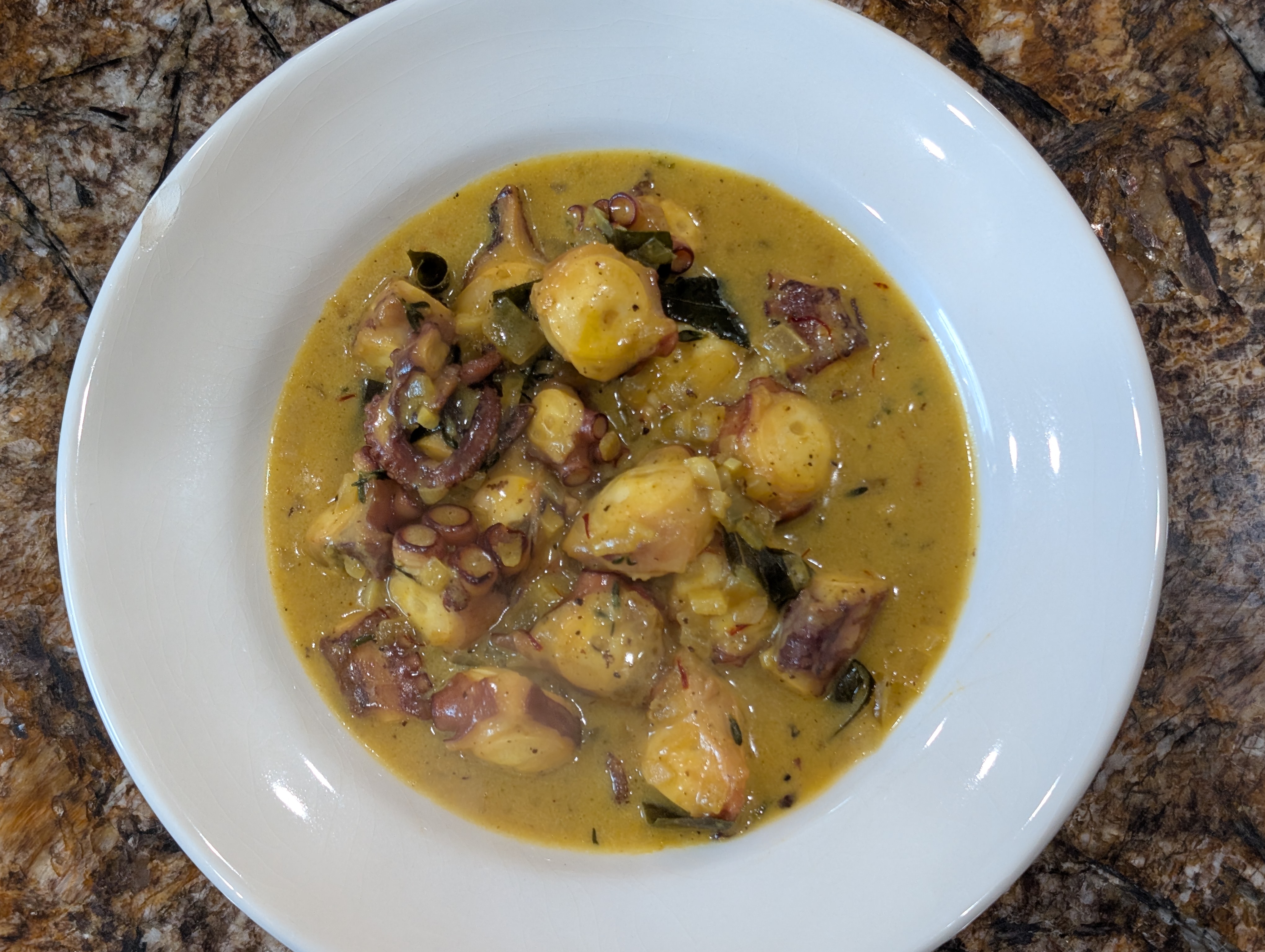
This personal culinary challenge showcases a cuisine that reflects how influences from around the world come together in amazing dishes. The challenge involves the preparation of a Seychellois Octopus Curry. The cephalopods could be found around many of the islands, such as Cousine. That availability led to this curry, which is a popular dish in the Seychelles. 

This demand created a fishery for octopi in the Seychelles. Many look for the creatures around the coral barrier reefs, while others, like a fisherman named Dave Auguste, go further out into the ocean. Auguste has fished for octopus for more than twenty years. When the COVID pandemic hit, the tourist trade (which is important to the Seychelles) crashed, and so did the market for expensive seafood like octopus. As the world gradually reopened and tourists returned, so did the demand for octopus. 

Dave Auguste with his catch (Source: United Nations, Photo: Douglas Okwatch)

Dave Auguste found one longer lasting change ... there were less of the cephalopods to catch. This change is not the result of COVID, but other factors.  In an article published by the United Nations, Auguste explained

There are fewer and fewer octopuses now. Before, I used to find them close to shore, but now I have to go further out. Again, for the last ten years or so, going out to sea has become more complicated because the sea has become rougher and the currents stronger. If I am not careful I can drift away from shore.

Indeed, climate change has affected the work of those who fish the waters around the Seychelles.  Auguste explained that there has been a change in rain patterns: "we used to have rainy periods that lasted several days, now it rains the same amount for one day and it all runs off into the sea." The prolonged rains and the runoff cause the waters close to shore to take on a reddish hue. The octopi do not like the tinged water and move further offshore. An additional factor is that, due to warming temperatures in the sea, there are some areas of the barrier reefs where up to 90% of the coral have died.

Not all of the news is bad. The Seychelles has taken proactive steps to stem the damage caused by changes in the climate. These steps include imposing quotas on seafood catches, expanding the range of protected marine areas, and implementing reef restoration projects. This has required some adjustment and adaptation, especially for those who work in the seafood industry, which makes up 27% of the Seychelles gross domestic product. This sacrifice, as well as, the conservation efforts, may not be enough if the climate continues to change. 

Turning to the challenge, I have prepared whole octopus in the past, but I decided for this dish that I would use pre-cooked octopus, which is available online or from some warehouse stores. Each package usually has 2-3 large tentacles, which may be less than a kilogram but still enough to prepare a meal for at least 2-3 people. The pre-cooked octopus also saves a lot of time (basically you can skip step 1). 

OCTOPUS CURRY

Recipe from Tourism Seychelles

Serves 4

Ingredients:

  • 1 kilogram octopus
  • Salt
  • Pepper
  • Fresh coconut milk (substitute 1 can coconut milk or cream)
  • 2 teaspoons saffron
  • 1 onion
  • Fresh thyme
  • 3 garlic cloves
  • Ginger (a little bit)
  • 1 teaspoon curry powder (or to taste)
  • Cinnamon sticks
  • Curry Leaves
  • Oil

Directions:

1. Prepare the octopus. Add the octopus to a pot and fill it with water. Boil until tender, about 45 minutes to 1 hour depending upon the size. Use a fork to check if the octopus is soft enough. Once the octopus is done, cut it into pieces

2. Prepare the curry. In a saucepan, add the oil, onion, garlic, ginger, saffron, curry powder, cinnamon sticks, thyme, salt and pepper. Mix and the add the octopus pieces. Fry the octopus pieces for a few minutes and then add the coconut milk and stir. Cover the saucepan and let it simmer for 15 to 20 minutes, as the sauce thickens. 

3. Finish the dish. Once cooked, serve with some white rice, lentils and papaya chutney. 

SIDE DISH

Ordinarily, as noted above, one would prepare white rice to serve with an octopus curry. Seychellois cuisine is known for its creole rice, a dish that is shared -- in some common form -- by creole cultures around the world. Rice is a staple food in the Seychelles, often accompanying main dishes. Yet, cultivation of rice cannot occur on a large enough scale on the islands to support its population. (Indeed, while the Seychelles may have an abundance of spices and access to seafood, it actually imports much of its other food.) Most of the rice comes from India, with smaller amounts imported from countries such as Pakistan, the United Arab Emirates, France and South Africa.

This personal culinary challenge gave me an opportunity to prepare creole rice and, to do so using the wide range of spices drawn from the subcontinent and southeastern Asia. The recipe shows that diversity with garlic, ginger, bay leaf, cinnamon, cloves, pepper and turmeric. I knew that I had to prepare this dish, which I served alongside the octopus curry.

SEYCHELLES CREOLE RICE

Recipe from Amy's Cooking Adventures

Serves 4

Ingredients:

  • 2 tablespoons butter
  • 1/2 red bell pepper diced (about 1/3 cup)
  • 1/2 onion diced (about 1/3 cup)
  • 2 cloves garlic, minced
  • 1/2 teaspoon turmeric powder
  • 1/2 teaspoon salt
  • 1/4 teaspoon black pepper
  • 1/4 teaspoon ground ginger
  • 1 bay leaf
  • Pinch of ground cinnamon
  • Pinch of ground cloves
  • 1/2 cup basmati rice
  • 1 cup water
  • Fresh parsley to garnish

Directions:

1. Saute the vegetables. Melt the butter in a saucepan over medium heat. Add the bell pepper and onion and cook for 5 minutes. Add the garlic, spices and rice and cook for another minute. Stir in the water and bring to a low boil. 

2. Finish the dish. Cover, reduce heat to low, and simmer for 15-20 minutes or until the water is absorbed. Fluff the rice, garnish with parsley and serve. 

*          *          *

To be honest, I had not expected to do a personal culinary challenge involving the Seychelles. I had previously done one for Mauritius, when I prepared an amazing duck curry. However, I really wanted to prepare this octopus curry and that led me to add this to the Around the World in 80 Dishes challenge. It is a decision that I will never regret, because it opened a door to exploring a creole culture and cuisine that draws inspiration from the diverse populations that have come to live on the Seychelles islands.  

Each of these dishes was a success, and, perhaps, some of the best dishes that I have prepared in recent weeks. This challenge has inspired me to move on to the next one. Check back to see where I end up. Until then ... 

PEACE.

Sunday, December 1, 2024

Around the World in 80 Dishes: Afghanistan

I find myself challenged in more ways than one. My Around the World in 80 Dishes takes me to Afghanistan, which is also known as the "Graveyard of Empires." One foreign power after another -- the Greeks, Persians, Arabs, Mongols, Mughals, British, Soviets, and, most recently, Americans -- sought to dominate the country, from the southwestern plateau to the northern plains, and from the central highlands to the Hindu Kush.  Yet, if one were to go to Afghanistan, any tombstones that they would find will not have the names of empires. Rather, they would bear the names of the Afghans who have been victims of those empires. 

Today, a more appropriate name for Afghanistan would be the "Graveyard of Rights." In recent years, as the Taliban reasserted its control over the country, the extremist Muslim leadership have imposed restriction after restriction upon women and girls. The Taliban first limited the educational and employment opportunities for women. It then sought to limit their voice, imposing oppressive restrictions upon women raising their voice in public. The restrictions even prohibit women from signing or laughing in public. The Taliban are literally oppressing the voice of women and girls. 

Hence, the challenge. Typically, I spend time researching the post, delving  not only into cooking, but the cuisine and culture of those who prepare the food. I could write a post about the Pashtun people, who constitute a plurality of "Afghans," and their cuisine. I could also write about the other "Afghans" -- such as the Tajiks, Hazaras, Uzbeks, Aimaks, Turkmen, Balochs, Nuristanis and Pamiris -- and their cuisine. But, how can I ignore the plight of women in Afghanistan, a plight that crosses ethnic lines. 

Afghan women (Source: Wikipedia)

The answer is that I don't. This post will feature a challenge to prepare a main course of Afghan cuisine, but I will do so while explaining the plight of women, contrasted with their undeniable contribution to Afghan society and their unquestionable right to be free from arbitrary and capricious legal restrictions.

I want the women of my country to know that they are equal to men in the eyes of religion, of civil laws, and humanity. God created them equal."

-- Lina Rozbih, Journalist and Poet

Unlike most of the empires that passed through, the United States engaged in nation building, with a focus on establishing governmental institutions. In 2004, Afghanistan adopted a new constitution. A product of 500 delegates representing Afghan men and women who met at the Constitutional Loya Jira, Article Twenty-Two declares "[a]ny kind of discrimination and distinction between citizens of Afghanistan shall be forbidden. The article further provides, "[t]he citizens of Afghanistan, man and woman, shall have equal rights and duties under the law. 

During the twenty or so years that the United States worked in Afghanistan, opportunities opened for women. Indeed, at the time the Constitution was adopted, women constituted twenty-seven percent (27%) of the lower legislative house (compared to women constituting only 25% of the U.S. House of Representatives). Those women, along with their male counterparts, enacted laws prohibiting a range of crimes against women, including domestic violence and forced marriage, as well as established other prohibitions, such as preventing women or girls from going to school or preventing women to own property. 

Female students (Source: United Nations)

By 2020, women made substantial strides in Afghanistan. Over three million girls attend school, and, at the university level, girls are 25% of the students. The literacy rate had tripled for women (although even with that progress, it was only 30%). Women were 19% of the doctors, 40% of the nurses, 35% of the public school teachers, 27% of the government employees, 12% of judges, 10% of attorneys and 20% of provincial council members. Considering that women had been persecuted for years and decades prior to 2001, the gains over the two decades marked considerable progress. 

"Because of the Taliban, Afghanistan has become a jail for women. We haven't got any human rights. We haven't got the right to go outside, to go to work, to look after our children."

-- Faranos Nazir, 34 year old woman in Kabul

In 2021, the United States withdrew from Afghanistan, creating a power vacuum that the Taliban quickly filled with the Second Islamic Emirate. Much like the First Islamic Emirate, which was the Taliban's rule between 1996 and 2001, the government moved quickly to strip women of not only the progress they made over the previous two decades, but also of their fundamental rights.  The damage is substantial. The Taliban have banned girls from attending secondary school (that is, up to Grade 7), thereby significantly limiting their educational opportunities. For those women attending universities, the Taliban has imposed numerous restrictions upon them and their education. The government first banned women from pursuing certain degrees, such as agriculture, mining, civil engineering and journalism. Thereafter, the Taliban banned women from universities altogether.

The loss of rights extends beyond the educational system, it includes stripping women of their legal rights. The Taliban went so far as to invalidate thousands of divorces that had been decreed between 2001 and 2020.  It dissolved the Afghan Independent Human Rights Commission, but established a female moral police department. 

Afghan women after 2021. (Source: United Nations)

The Taliban also stripped women of employment opportunities, ordering women to stay home rather than go to work. It also banned women from many occupations in the legal system, government, and private sector. 

Finally,  the Taliban issued a series of decrees that greatly restricted the movement of women outside of their homes. Indeed, women cannot leave their home without a mahram, which is a close relative. Even if a woman went out on her own, the Taliban imposed rules prohibiting many -- from health centers to coffee shops -- from providing goods and services to them. 

MAIN COURSE

For this particular challenge, I wanted to focus on a particular ingredient ... the tomato. While the tomato may be native to South America, it has its place in Afghan cuisine. This main course -- Kofta Challow -- features lamb or beef meatballs cooked in an onion-spiked tomato sauce. 

KOFTA CHALLOW

Recipe adapted from Afghan Yummy Food

Serves 4

Ingredients (for the rice):

  • 3 cups basmati rice
  • 1/2 cup vegetable oil
  • 1 tablespoon cumin seeds
  •  2 tablespoons salt
  • 1 tablespoon black pepper, freshly ground
  • 1 teaspoon cardamom
Ingredients (for the meatballs):
  • 2 cups coriander (cilantro), minced
  • 1 green pepper, minced
  • 3 cloves of garlic, minced
  • 2 onions minced
  • 1 pound ground beef or veal
  • 1 egg
  • 1/2 teaspoon black pepper 
  • 1.5 tablespoon coriander powder
  • 1 tablespoon salt
  • 1/2 cup oil
  • 1 cup tomato sauce

Directions:

1. Prepare the rice. Rinse the rice and set aside for a few hours before cooking. Boil water in a pot. Add the rice and boil for a few minutes or until the rice is soft and long. Drain the water from the rice.

2. Continue preparing the rice. Heat a pan on high heat and add vegetable oil, boiled rice, salt dissolved in warm water and the spices. Mix well. Make holes with the back of the spatula. Cover the lid with a kitchen towel and place it on the pot. Cook on low heat for at least 25 to 30 minutes. 

3. Prepare the meatballs.  Add coriander, green pepper, one onion, garlic and mince in a food processor. In a big bowl, add the meat and spices. In a large saucepan, add the oil and heat on high heat. Add the second onion (minced), and sauté. Add the tomato sauce. Add water and leave on high heat until it comes to a boil. Make small balls form the meat mixture and add to the sauce. Leave it on low for 30 minutes to cook. 

4. Finish the dish. Serve with basmati rice or naan bread.

SIDE DISH

The tomato sauce continues onto the side dish, Banjan Salat. This dish is a simple one, consisting of eggplant, tomato sauce, and some spices. It is also different in terms of presentation insofar as it is served either at room temperature or cold. As I am not a very big fan of eggplant, I was a little apprehensive about a cold dish. I did like the spiced tomato sauce, but I still need to work on my liking of eggplant.

BONJUN SALAT

Recipe from Recipeland

Serves 8

Ingredients:

  • 3 medium eggplants
  • 2.5 teaspoons kosher salt
  • 1/4 cup corn oil
  • 1.5 cups tomato sauce
  • 1/4 teaspoon black pepper
  • 1 teaspoon red pepper flakes or minced fresh chiles
  • 2 teaspoons ground cinnamon
  • 1 tablespoon mint leaves

Directions:

1. Prepare the eggplant. Slice the eggplants crosswise into 1.5 inch thick pieces.  Sprinkle them with 2 teaspoons of coarse salt and let stand for 15 minutes. Rinse the eggplants under cold water, which removes the bitter taste. Rinse and dry well on a towel. 

2. Brown the eggplants. Heat the oil in a skillet and lightly brown the eggplant slices over moderate heat for 5 minutes.  Remove and put in a serving bowl to cool. 

3. Prepare the sauce. Put the tomato sauce, pepper, chile, cinnamon, mint and 1/4 teaspoon of salt in a pan. Simmer over low heat for 10 minutes, which is long enough to integrate the flavors.

4. Finish the dish.  Pour the sauce over the eggplant, refrigerate until ready to use. The salad can remain in the refrigerator for several days. Serve cold or at room temperature. 

*    *    *

In doing a challenge to prepare a main course from Afghanistan, it is impossible to ignore the plight of women in that country. Extremist religions of every kind often subordinate (or subjugate) women, depriving them of important and necessary opportunities to learn and seek better lives. The Taliban is depriving women of their fundamental rights, as well as denying the undeniable: namely, women have a lot to contribute to the political, economic and social success of Afghanistan. While I think I succeeded in making Kofta Challow, my mind will always look to a possible future where women could once again contribute to the future of the country.

PEACE.