Showing posts with label Kebaba-palooza. Show all posts

Sunday, April 5, 2026

Sosaties

Admittedly, I have never been to South Africa. But, if I were to visit the country (and, hopefully, someday I will), I would like to find myself in a backyard of a friend's house, as charcoal smoke gently wafts from a grill, surrounded by family and friends, whose chatter competes with the sizzle of lamb and apricot skewers on the grill grate. 

Yes, if I had the chance, I would love to attend a braai in which, among other meats and sausages, the grillmaster was carefully watching the grilling of sosaties. These lamb and apricot skewers are among my most favorite kebabs, on the level with Persian barreh kebabs or Nigerian suya kebabs. Yet, what sets apart South African sosaties is the use of apricots alongside onions and lamb, as opposed to peppers, tomatoes or other ingredients. 

Sosaties originate with South Africa's Cape Malay community. Historically, the Cape Malay people are the descendents of Muslim slaves brought to southern Africa by colonizers, originally from the Dutch East Indies (present day Indonesia), but the group also includes individuals (both slaves and freed people) also from other parts of eastern and southern Asia, along with parts of Africa, like Madagascar. What united these people were their religion -- Islam -- and their decision to use Malay as a lingua franca. But, today, it is their religion that unites them, as many now speak Afrikaans and/or English.

These skewers are, in some ways, a reflection of multi-culturalism. Their ingredients, particularly the use of curry powders are echoes of an eastern or southern Asian past. The use of dried fruits, as well as the use of kebabs generally, provides hints of possible Persian influences. And, the cooking techniques, those could have originated with the European colonialists. 

Yet, sosaties are something that can bring together all South Africans. As one description set the scene: 

On Sundays in South Africa, you can smell these curried lamb skewers cooking over live fires throughout every neighborhood as families gather around the braai, an Afrikaans word that describes both the social event and the actual technique of grilling over a live fire.

That description comes from the Splendid Table, but the concept of people gathering together around a grill for, among other things, those kebabs can be found in many other accounts. It is yet another reminder of how food can unite different people within one country, and, perhaps, around the world. 

SOSATIES

Recipe from Cookies and Crumbs

Serves 4

Ingredients (for the marinade):

  • 1 onion (some will be used for the marinade, some for the kebabs)
  • 1 tablespoon olive oil
  • 1 tablespoon curry powder
  • 1 teaspoon coriander
  • 4-6 slices of 1/2 inch ginger
  • 1/4 cup vinegar
  • 1 cup apricot jam

Ingredients (for the kebabs);

  • 2 pounds lamb (preferably leg or chops)
  • 3/4 cup of dried apricots

Directions:

1. Prepare the onions. Cut the onion in half. With one half, cut strups vertically that will go onto the kebabs. You will need at least 20-25 vertical strips, perhaps more. Set aside and dice the remaining onion. 

2. Prepare the marinade. Warm the oil in a pan over medium-high heat. When it is warm, saute the diced onions until they are soft and transluscent. While the onions saute, cut the lamb into bite-sized pieces, as square as possible. Wehn the onions are soft, add all of the rest of the marinade ingredients except for the apricot jam. Mix together and cook for a few more mounites to release the flavors and let them meld together. Then add the jam and cover. 

3. Continue preparing the marinade. Heat the marinade until it starts bubbling, then turn down the heat. Let it simmer, covered, for a few more minutes to thicken. 

4. Prepare the lamb. When the marinade is ready, remove from heat and let cool. Add the lamb to a ziploc bag and then the cooled marinade. Mix to make sure that the marinade covers all of the meat. marinate for at least 4 hours, but ideally overnight in the refrigerator. 

5. Prepare the skewers. About an hour before grilling, remove the marinated lamb from the refrigerator. Add the onions and dried apricots. The apricots will need about an hour or two in the marinanadte to plump up. If they are not plump, add them to hot water for a few minutes. When you are ready to grill, assemble the kebabs by placing meat, dried apricots, and onion on the kebab sticks in whatever order you like. 

6. Grill the skewers. Place the skewers on a medium-high heat grill and turn frequently, about every minute or two. It will take only a few minutes on each side to cook through the bite-sized piees. You can check meat doneness by pressing on the piece of meat. If the liquid runs out pink, it is rare. If it is clear, it is medium. Do not overcoook the kebabs. 

PEACE.

Saturday, January 10, 2026

Mshakiki

It all began on a three-island archipelago nestled in the warm waters of the Indian Ocean. That three island union is known as the Comoros. And, that is where the street food skewers known as mshakiki first originated. 

As I often do when I research about food, I try to picture myself where the food originates. This effort is often made more difficult by the fact that I have never set foot in Comoros. All I have are the pictures and descriptions that I come across whenever I research the food. It's a start, but it is never enough.  

Take, for example, the village of Vouvouni, which is located on the island of Grande Comoro. Descriptions speak of walking the streets, lined with buildings influenced by the architecture of the Muslim religion (98% practice Sunni Islam) and colonialism (the French controlled the islands prior to their independence). The sights for the eyes are complemented with aromas that tempt the nose. The aromas of street food, coming from the sizzling grills and spices used by cooks to prepare dishes that include biryani and, of course, mshakiki. 

Mshakiki is most often made with beef, but lamb is also a protein that could make its way onto those skewers. Some recipes are simply skewers of beef, marinated in a combination of spices, tomato, honey, oil and other ingredients that entice both the nose and the palate. Other recipes add to the senses with pieces of red and green bell pepper, creating colorful skewers that compliment both the aromas and tastes. One could double up on the grilled experience with a side of grilled breadfruit, bananas or cassava.

Although these skewers originated in the Comoros, their popularity has led to the spread of this street food onto mainland Africa. One can find mshakiki on the streets of cities in Kenya and Tanzania, where it may go by the name mishkaki.  There it would be served with bread or other sides. 

As I made this dish, it called for a sprinkling of cilantro at the end. I admittedly forgot to do that, because I pretty much wanted to eart them right away. I will save the cilantro for a future dish. 

MSHAKIKI

Recipe from Fork and Salt

Serves 4

Ingredients:

  • 1 pound beef tenderloin, cut in to 1 inch cubes
  • 2 tablespoons extra virgin olive oil
  • 2 tablespoons fresh lime juice
  • 1 tablespoon soy sauce
  • 1 tablespoon honey
  • 1 tablespoon tomato paste
  • 2 garlic cloves, finely minced
  • 1 tablespoon fresh ginger, grated
  • 1 teaspoon ground cumin
  • 1 teaspoon smoked paprika
  • 1/2 teaspoon ground coriander
  • 1/2 teaspoon ground cinnamon
  • 1/2 teaspoon ground cayenne pepper
  • 1 small red bell peppper, cut into 1 inch pieces
  • 1 small green bell peppper cut into 1 inch pieces
  • Kosher salt, to taste
  • Freshly ground black pepper, to taste
  • Cilantro, chopped

1. Prepare the beef. In a large mixing bowl, combine the olive oil, lime juice, soy sauce, honey, tomato paste, minced garlic, grated ginger, ground cumin, smoked paprika, ground coriander, ground cinnamon, cayenne pepper, salt and black pepper. Whisk until the marinade is smooth and well blended. Add the beef cubes to the marinade, tossing to coat each piece thoroughly. Cover the bowl and refrigerate for at least 2 hours or prefrerably overnight, to allow the flavors to penetrate the meat. 

2. Prepare the skewers. Remove the marinated beef from the refrigerator and let sit at room temperature for 20 minutes before skewering. Preheat the grill or grill pan over medium-high heat. Lightly oil the grates to prevent sticking. Thread the skewers alternating with the beef, red bell pepper and green bell pepper to ensure that each skewer has a colorful combination. 

3. Grill the skewers. Place the skewers on teh grill, cook for 2-3 minutes per side, turning occasionally until the beef is nicely charred and cooked to your desired doneness. Once cooked transfer the skewers to a plate and let them rest for five minutes for the juices to redistribute. 

4. Finish the dish. Arrange the skewers on a platter and sprinkler generously with chopped fresh cilantro before serving.

PEACE.

Saturday, September 21, 2024

Espetada

It has been referred to as "meat on a stick, the Madeira way." The word in question, Espetada, actually refers to the cooking method. The method basically involves skewing food on sticks and cooking it over charcoal. However, on the Portuguese archipelago of Madeira, the Espetada rises to a completely different level.

Madeira consists of four groups of islands: Madeira, Porto Santo, Desertas and Salvagens. Only Madeira and Porto Santo are populated, Desertas and Salvagens are both set aside as nature reserves. Yet, it is Madeira that is the most popular, mostly due to its long history of wine making. (Or, if you watched the recent Star Wars series, Acolyte, the beautiful landscape, as scenes were filmed at Fanal Forest and the parishes of Canical and Ribeira de Janela.) While Madeira may have some very beautiful scenery, it is the wine that has in many ways defined the islands, and certainly defines its espetada.

The history of Madeira wine dates back to the 15th century (before that, Madeira was principally known for sugar, as well as all of the negative things that came with it at the time, like slavery and plantations). Madeira wine is a fortified wine, which means that - much like Port - it is fortified with neutral grape spirits. The wine tends toward the sweet side, and often is served with desserts. 

For espetada, it serves as the liquid for the marinade. The marinade itself is fairly simple: adding crushed bay leaves (or laurel leaves), black pepper and garlic. After the meat marinates for at least four hours, one would skewer it and whatever else you want to add -- such as tomatoes, bell peppers, or chorizo -- to long laurel skewers. Those skewers then get placed over hot coals, which would be traditionally produced using grape wood. I didn't have laurel skewers on hand, so traditional metal skewers are just fine, as is using a gas grill if that is all you have ready to go. 

One last thing about the Madeiran version of espetada: it is traditionally made with beef, along with bell pepper and tomatoes. However, beef could be substituted with chicken or pork, as well as seafood like shrimp or squid. (Obviously, cooking times will then vary.) 

ESPETADA

Recipe from Curious Cuisiniere

Serves 4

Ingredients:

  • 1 1/2 pounds beef sirloin, cubed into 2 inch chunks
  • 6 garlic cloves, minced
  • 12 bay leaves, crumbled
  • 1/2 teaspoon ground black pepper
  • 1/4 cup Madeira wine
  • 2 tablespoons olive oil
  • 3 Roma tomatoes, halved
  • 2 green peppers, halved and seeded
  • 2 teaspoons salt

Directions:

1. Marinate the meat. In a small bowl, mix together minced garlic, crushed bay leaves, and black pepper.  Rub the beef chunks with the mixture and place them in a flat baking dish or ziploc bag.  In another small bow, mix together the Madeira wine and olive oil. Pour the wine mixture over the beef cubes, making sure that they are well coated.  Refrigerate the beef for at least 4 hours or overnight. 

2. Prepare the skewers. Preheat the grill to medium high heat. Place the beef chunks on soaked, sturdy wooden skewers (or metal skewers) interspersed with tomato and green pepper halves. Sprinkle the beef and vegetables with salt. 

3. Grill the skewers. Grill the meat for 3-5 minutes. Flip the skewers and grill for an additional 3-5 minutes, until the beef is just starting to become firm.  Remove the skewers from the grill to a platter. Cover the skewers with aluminum foil and let them stand for 10 minutes before serving.

4. Finish the dish. Serve the skewers on a bed of crusty bread, drizzled with any juices that pooled in the platter as they rested. 

PEACE.

Wednesday, December 14, 2022

Yakitori Hatsu

This post is the final installment of the three-part, Yakitori-themed Kebab-apalooza. The prior two installments focused upon Yakitori Negima (chicken thigh kebabs) and Yakitori Sunagimo (chicken gizzard kebabs). Now, I take an additional step into the world of chicken offal with Yakitori Hatsu. Skewers of chicken hearts.

I am no stranger to preparing heart. To date, I have prepared Grilled Beef Heart with a Herbed Vinaigrette, Cuore di Agnello al Chianti (Lamb Heart Braised in Chianti), and Khalyat Alkadba Wal Galoob (Fried Heart and Liver). (That last one was the Around the World in 80 Dishes challenge to prepare a main course from Libya.)

Some say that the Yakitori Hatsu is as popular as Yakitori Negima. And, as with the latter type of skewers, Yakitori Hatsu is prepared with, as well as served with, a tare. That is a sauce made with soy sauce, mirin and sake. The tare provides a slightly sweet, yet salty complement to the earthy, mineral flavors of the chicken hearts. 

One practical note: I purchased a two pound package of chicken hearts from a local Korean grocery store. (It was the smallest package I could find.) Given the number of hearts that came in the package, I decided to thread the hearts horizontally onto the skewers, which increased the number of hearts that I could have on each kebab. I think the more traditional way of doing it would be to thread the hearts vertically. 

In the end, this recipe represents a strong finish for this three-part series, which was the first to focus upon the kebabs of one particular cuisine (as opposed to three separate kebabs from three different cuisines). This little journey has gotten me thinking about what other cuisines. Perhaps that will be the subject of the next Kebab-apalooza. 

YAKITORI HATSU

Recipe from Ang Sarap

Serves 4

Ingredients:

  • 20 chicken hearts
  • 1 1/2 tablespoons sugar
  • 2 tablespoons sake
  • 3 tablespoons mirin
  • 3 tablespoons soy sauce
  • 1/2 teaspoon ginger paste
  • 1 teaspoon corn starch

Directions:

1. Prepare the sauce. In a sauce pan mix together sugar, sake, mirin, soy sauce, ginger paste and corn starch. Mix well until free of lumps and then place on the stove top, using high heat boil the mixture and simmer for a minute. 

2. Grill the chicken hearts. Season the chicken hearts with salt and pepper, then place on skewers. Grill the chicken heart while brushing with the soy sauce mixture occasionally.  Remove from the grill and then serve immediately. 

ENJOY!

Thursday, December 1, 2022

Yakitori Sunagimo

For those few who follow this blog, you may have seen the post about Yakitori Negima. The skewers of bite-sized chicken thigh and scallions, brushed with a tare of soy sauce, mirin, and sake, are some of the best skewers or kebabs that I have had. Yakitori is the essence of simplicity and perfection.

Yet, yakitori is not just one type of chicken skewer. Japanese cuisine features more than a dozen different types of yakitori.  Each skewer features a different part of the bird. For example, there is torikawa, which are skewers of crispy chicken skin. There is also kimo, which are skewers of chicken livers. And, there are the tsukune, which are little balls of ground chicken, egg and spices. 

With a wide array of possibilities, I decided to go down a path of vintage Andrew Zimmern. The Zimmern of Bizarre Foods. Rather than have the more common varieties of yakitori, such as the ones I mentioned above, I went for the less common and more out of the ordinary. My starting point is sunagimo, which are skewers of chicken gizzards. 

To be sure, I have eaten gizzards before. Whenever I purchase a whole chicken, I usually use the gizzards, along with the neck, to make a quick broth or stock. Yet, one gizzard does not make a skewer. Fortunately, the local Asian grocery store sells gizzards ... by the pound or three.  

The recipe that I used for sunagimo offered a opportunity to learn more about the different types of seasoning used to make yakitori. One seasoning involves the use of a tare sauce, which, as I noted above, is a combination of soy sauce, mirin and sake that is used as a basting liquid during grilling and served on the side. This sunagimo recipe uses only a sprinkling of salt, a preparation known as yakitori shio

So there you have it: namely, the two basic flavor styles of yakitori: tare and shio. You also have a glimpse into the fact that yakitori is not just grilled chicken thighs. It includes other grilled parts of the bird. The only question that remains, is, apart from what I mentioned above, what other parts can be used to make these skewers.

YAKITORI SUNAGIMO

Serves 4

Ingredients:

  • 1 1/2 pounds of chicken gizzards
  • Salt
  • Skewers

Directions:

1. Prepare the skewers. Soak the skewers for 30 minutes. Remove the skewers from the water. Thread the gizzards on the skewers, leaving room to be able to turn the skewers. Salt the skewers generously. 

2. Grill the skewers. Heat a grill to high heat. Add the skewers and turn every couple of minutes until the gizzards are cooked through.

ENJOY!


Tuesday, November 1, 2022

Yakitori Negima

Good food is very often, even most often, simple food.

- Anthony Bourdain

Bourdain's words provide an apt description for one of the simplest, but perhaps, greatest kebabs in the world ... Yakitori. Even the word is simple, translating to "grilled bird." Small bite sized pieces grilled over a charcoal grill, sometimes basted with a particular sauce or other times just a sprinkle of salt. These particular chicken skewers a truly a unique culinary experience. 

The history of yakitori dates back to the middle of the Meiji Period, around the 1880s and 1890s. (However, there are references to grilled chicken dishes going as far back as the Kamakura Period, the fourteenth century, and the term "yakitori" is said to have appeared in the oldest Japanese cookbook, Ryori Monogatari, which was produced during the Edo Period in 1643.)

Yet, it may have been pigs who led the way. Before yakitori become widespread, there was yakaton, which was pork offal skewers, which were first made in the Kanto Region of Japan (which includes, among others, the city of Tokyo). It is said that these pork offal skewers led the way for the chicken skewers that became yakitori. Food stalls -- or yatai --started popping up across Japan, from which vendors offered skewers of grilled innards from the expensive game birds served by from restaurants. The grilled skewers became a way for Japanese to enjoy grilled birds, which were often too expensive to bun the restaurants.

It took some time to get used to the smells of these stalls. For many Japanese, the smells of roasted or grilled meat was distasteful. Vendors began grilling their skewers using a particular type of coal, binchotan coal. This coal gets very hot, burns cleanly, but produces its own smoky aromas, which not only mask the smell of the grilled fowl, but also provide a smoky taste to the skewers. Vendors also started applying a tare, a sweet and salty sauce that added more aromas and flavors to the meat. 

There are many different types of yakitori, with each type focusing on a particular part of the bird or chicken. The most common yakitori is Yakitori Negima (ねぎま), which consists of bite sized pieces of chicken thigh skewered along with pieces of scallions or long onions. This particular yakitori includes the preparation of a tare, which is a sauce consisting of soy sauce, mirin, sake and sugar. The sauce is brushed on the skewers during the grilling process, as well as served alongside the skewers.

This recipe seemed like the perfect start for the trifecta of yakitori recipes that will serve as the latest installment of my Kebab-apalooza series. Come back and check as I head further back into the origins of yakitori, including the preparation of kebabs using chicken offal (like hearts and gizzards). 

YAKITORI NEGIMA

Recipe from Curious Cuisinere

Serves 4

Ingredients (for the chicken):

  • 8 bamboo skewers
  • 1 pound chicken thighs, cut in 1 inch pieces
  • 6 scallions, cut in 1 inch pieces

Ingredients (for the tare):

  • 1/2 cup soy sauce
  • 1/2 cup mirin
  • 1/4 cup sake
  • 2 tablespoons sugar

Directions:

1. Prepare the grill and the skewers. Preheat the grill to a medium-high to high heat, roughly 450 degrees Fahrenheit. Soak the skewers in water for 10 minutes.

2. Prepare the tare. In a small saucepan, mix the soy sauce, mirin, sake and sugar. Bring the mixture to a boil over high heart. Reduce the heat to medium heart and set it aside to cool slightly. Once cool, divide the sauce between two small bowls. One will be used for brushing the raw meat, one will be used for serving. 

3. Prepare the skewers. While the sauce is simmering and resting, remove the skewers from the soaking water and skewer the chicken and scallion pieces, leaving a little room at each end for easy turning.

4.  Cook the skewers. Cook the yakitori skewers over a hot grill for 2 minutes on the first side. Flip the skewers and cook for an additional 2 minutes on the second side. Flip the skewers again and brush them with the yakitori sauce. Flip and brush the skewers once more. At this point, the chicken should be firm and the sauce should be beginning to caramelize and create a nice glaze on the chicken.

5. Finish the dish. Transfer the cooked yakitori to a platter and brush them once more with the yakitori sauce (using a clean brush and the second bowl of yakitori sauce that has not been used for the chicken as it cooked).

Friday, September 3, 2021

Rago Suya

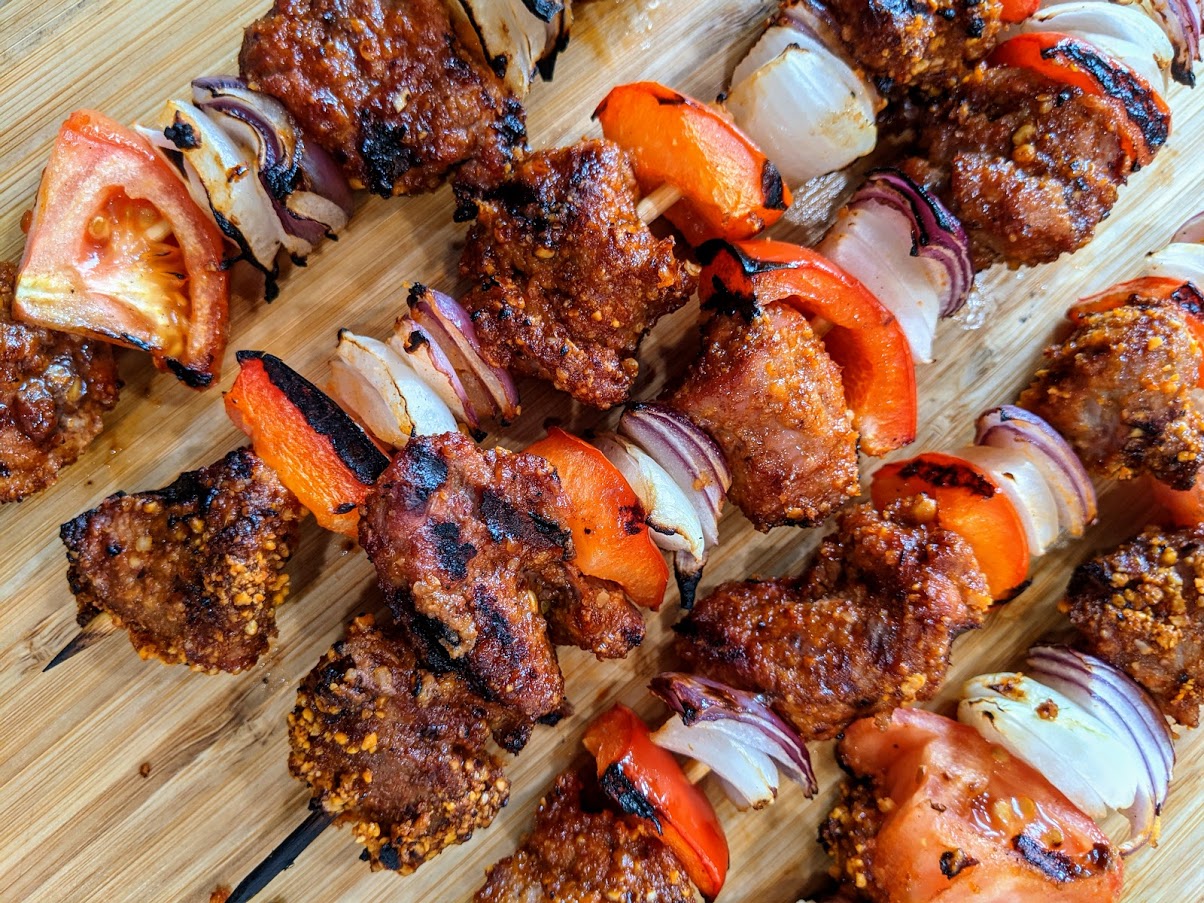
It is the most popular street food in the largest city, Lagos, of the most populous nation in Africa, Nigeria. Large chunks of meats strung on skewers that are drizzled with groundnut oil and then rubbed with a spice mix known as yaji or suya. The kebabs are known as Rago Suya. To find them, one need only follow the scent emanating from steel-drums-turned-grills behind makeshift stalls or food carts all across Lagos.

The vendors are usually men, often referred to as mai suya or mallam.  The title comes from the fact that it takes some skill to make suya, whether it is the slicing of the meat or the preparation of the spice blend.  Every mai suya has his own recipe for that spice mix. Yet, there are some common ingredients, such as ground peanuts, ginger and chiles. Vendors may also vary the proteins.  Although most suya is prepared with beef, some vendors use lamb, chicken and even offal, such as kidneys, livers and chicken gizzards.

While Suya is popular in Lagos, it originated amongst the Hausa in northern Nigeria. The skewered meat, with the spice mix, spread throughout Nigeria.  The seemingly omnipresence of the food stalls or carts of the mai suya, as well as the affordability of the grilled and smoked meat, has given this dish the power to unify a nation that is divided in so many ways. 

The skill and expertise of a mai suya or mallam can be divided into five steps.  The first step involves the protein, purchasing it from a local market.  The second step is to skewer the meat.  It would seem, based on my research, that a more authentic suya would involve sliced meat, but there are many recipes that call for the meat to be cut into bite-sized chunks.  The third step is to apply the suya mix to the meat on the skewers.  The skewers then marinate until the meat begins to change color, turning a dark red. The fourth step is to grill the skewers, preferably over charcoal. The final step is to apply some additional oil during the cooking process. Once the skewers are cooked, the meat is removed and cut into smaller pieces. 

I am not a mai suya or mallam but, I nevertheless came across a recipe for Rago Suya. I had some lamb that I thought would work well with the suya spice blend. The recipe basically follows the five step process, except for the use of bite-sized chunks rather than sliced meat, as well as the omission of the fifth step (the applying of oil during the cooking process), which I was okay with. After I completed this recipe, I realized why so many Nigerians love these skewers.  They were perhaps the best skewers that I have ever made. The experience made me want to become a mai suva or mallam and open my own cart in my neighborhood.  

RAGO SUYA

Recipe adapted from National Dish

Serves 2-4

Ingredients:

  • 1.5 pounds of lamb shoulder or leg, cut into 1 inch pieces
  • 5 tablespoons roasted peanuts
  • 1 teaspoon cayenne pepper
  • 1 teaspoon dried chile flakes
  • 1 teaspoon dried chile powder
  • 1 teaspoon smoked paprika powder
  • 1 teaspoon sea salt
  • 1 teaspoon ground ginger
  • 1 teaspoon ground garlic
  • 1 medium onion cut into large chunks
  • 1 medium red onion cut into large chunks
  • 1 large tomato, cut into large chunks
  • 1 red pepper, chopped into large chunks
  • 1 bunch fresh coriander/cilantro, roughly chopped for garnish
Directions:

1. Prepare the marinade.  Add all of the marinade ingredients (peanuts, cayenne pepper, chile flakes, chile powder, paprika powder, sea salt, ginger, garlic) into a spice grinder and blitz until as powdery as it can be made without turning the peanuts into a paste. This spice mix is called Suya.  Remove a third of the Suya mix and set aside.  Place the remainder of the Suya into a mixing bowl along with the lamb and make sure that it gets fully coated.  Allow the meat to marinate for 30 minutes. 

2. Prepare the kebabs. Heat up a grill on medium high heat. Take pre-soaked skewers, load them with an onion, pepper and piece of lamb. Repeat until there are 3-4 pieces of lamb on the skewers.  Repeat with the rest of the skewers. 

3. Grill the kebabs. Grill the kebabs for about five minutes, turning every couple of minutes, until the lamb is cooked and the vegetables have a slight char. 

4. Finish the dish.  Remove from the heat and serve on the skewer or remove and serve with Jollof rice, garnished with the chopped coriander/cilantro.

ENJOY!

Sunday, May 2, 2021

Yangrou Chuan

For all that it may do, China cannot erase the influences of those who practice Islam (namely, the Uyghurs) on both the people ... and their food. This influence is most noticeable when it comes to chuan or chuan'r. It is a dish that begins with small pieces of a protein, usually lamb, which are heavily seasoned with ground cumin and chiles. The seasoned meat is threaded onto skewers and then roasted over hot coals. The end product resembles the kebabs that are seemingly omnipresent throughout the Muslim world. 

These particular kebabs originated within, and quintessentially associated with, the Uyghur communities who live in Xinjiang, which is located in the northwest corner of China. The Uyghurs are currently the victims of a concerted effort to erase their culture and history. I have previously posted about this effort, as well as its impact upon Uyghur cuisine. I am not going to repeat what I discussed in that post. But, the subject of chuan brings me back to this discussion, because it is a subject of how aspects of a culture can be accepted and even incorporated into a larger body even while that culture is ruthlessly repressed. 

The spread of chuan throughout northern and eastern China tells a familiar story. The preparation of these kebabs began to spread as the Chinese -- especially those who lived in Beijing -- learned that the skewers were not just delicious, but a good eat after a long night on the nightlife scene.  Small food carts started appearing in the nighttime at night-time stalls, known as da pai dang, serving those who had spent the night partying in the clubs. In other words, the food of the Uyghurs has been accepted into the "mainstream," while other aspects of their culture, such as their religion, their language and their traditions, have not. 

To be clear, this situation -- where certain aspects of a culture have been accepted into the "mainstream" while the culture itself has not -- is not unique to the Uyghurs in China. Indeed, if one looked hard enough (which really is not that hard at all), one can see aspects of Native American culture that have been accepted into mainstream American culture while the Native Americans themselves were forced over the course of our history onto reservations. 

In my humble opinion, it is important to ensure that everyone knows and understands the history behind the foods that they enjoy.  It is equally important that, where this history is troublesome and difficult, people acknowledge the issues and work to make positive changes. Put another way, education will hopefully help to prevent these historical issues from repeating themselves. 


YANGROU CHUAN

Recipe from Serious Eats

Serves 4

Ingredients:

  • 1 tablespoon red chile flakes
  • 1 tablespoon whole cumin seeds
  • 2 teaspoons whole fennel seed
  • 1 teaspoon kosher salt
  • 2 teaspoons granulated garlic
  • 2 pounds of boneless lamb shoulder or leg, cut into 1 inch pieces
  • 1 tablespoon vegetable or canola oil
  • 2 teaspoons Shaoxing wine (or rice wine)

Directions:

1. Prepare the marinade. In a mortar and pestle or spice grinder, coarsely grind chile flakes, cumin and fennel.  Add granulated garlic and kosher salt and briefly grind to break salt into smaller pieces and thoroughly combine ingredients. reserve 1 tablespoon of the spice mix in a small bowl.  Add lamb to a large bowl and toss thoroughly with the remaining spice mix, oil and Shaoxing wine (or rice wine0.

2. Prepare the grill. Light a chimney of charcoal or a gas grill to medium high hear.  When the charcoal is lit and covered with gray ash, pour out and arrange the coals on one side of the charcoal grate. Set cooking grate in place, cover grill and allow to preheat for 5 minutes.  Clean and oil the grate. 

3. Grill the skewers. Grill skewers, covered, over indirect heat until lamb is nearly cooked through, about four minutes per side.  Move skewers over direct heat, sprinkle with the reserved spice mix and cook until well seared on both sides, about 1 minute total. 

4. Finish the dish.  Remove the skewers from the gas grill and serve right away. 

ENJOY!

Thursday, April 1, 2021

Torshe Kebab

Food provides a way to travel at any place around the world, without having to go anywhere. If you have a recipe, you have a passport. That piece of paper can take you just about anywhere if you have an open mind and a desire to learn, can take you just about anywhere. This has been especially important for me during this time of COVID, because of the inability to travel and the lack of desire to waste time watching television or tablets. 

Recipes can come from anywhere.  A couple of years ago, my parents bought me a copy of Naomi Duguid's Taste of Persia.  They knew of my love for Persian food, especially kabobs.  (For those who read this blog, you may have seen my posts about Kubideh, Chenjeh and, for my Around the World in 80 Dishes personal culinary challenge, Jojeh Kebabs.)  I thought that the Taste of Persia cookbook would not only enable me to learn more about those kebabs, but to explore more about Persian cooking.  As an added bonus, the cookbook also explores the cuisines of neighboring countries, such as Armenia, Azerbaijan, and Georgia, as well as particular ethnic groups, such as the Kurds.  

There was one recipe in that book that I have wanted to try for a while.  It was a recipe for Torshe Kebab. (The word "torsh" means sour, so the recipe is actually for Persian sour kebabs.) This recipe would take me to the northern Iranian provinces of Gilan and Mazandaran, which lie along the Caspian Sea. From what I could ascertain, the recipe originated in Gilan.  The marinade used in the recipe -- with its walnut paste and pomegranate sauce -- is used not just for these kebabs, but also as the basis for Fesejan or Fesejoon, which is a stew of chicken, duck or lamb. 

Torshe kebabs are typically prepared with beef, usually from the sirloin or tenderloin cut.  As beef can be expensive, cooks may make the kebab with chicken, goat or lamb. While the particular protein can change, the walnut paste and pomegranate sauce remains the same. It serves two important purposes as a marinade.  The combination of walnuts and pomegranate not only tenderizes the meat, but it also adds a lot of flavor to the meat of the kebab. For that reason, while the recipe contemplates a short marinade time of 1 to 2 hours, I would marinate the meat overnight.  

The recipe also provides a way to broil the kebabs, but the best way to prepare them is to grill them.  Once the kebabs are finished, they should be served with rice and/or a salad. If you are looking for a drink, consider making some doogh.


TORSHE KEBABS
Recipe from Naomi Daguid, Taste of Persia at 165
Serves 4

Ingredients:
1 cup walnuts or walnut pieces
1/2 cup pomegranate molasses
1 teaspoon sea salt
2 garlic cloves, mashed or minced
2 tablespoons sunflower or extra virgin olive oil
1/2 cup minced fresh flat leaf parsley (optional)
2 pounds boneless lamb or goat shoulder, or 
     boneless beef top round or hanger steak, cut into 1 inch cubes
Sugar (optional)
Fresh tarragon leaves (optional)

Directions:
1.  Prepare the marinade.  To make the marinade, place the walnuts in a food processor and pulse to drop them to smaller than raisin size.  Add the remaining ingredients and pulse to blend.  Transfer to a large bowl.  (Alternatively, very finely chop the walnuts and pound to a coarse powder in a large mortar.  Transfer to a large bowl, add the remaining ingredients, and stir to blend thoroughly.

2.  Continue the marinade.  Add the meat to the bowl and stir, turning to make sure all surface are coated with the marinade.  Cover and set aside to marinate for at least 1 hour or as long as overnight; refrigerate if the marinating time is more than 2 hours.  

3.  Preheat the grill.  Bring the meat to room temperature. Preheat a charcoal or gas grill. 

4.  Prepare the kebabs.  Brush off the most of the marinade that is clinging to the meat and reserve the marinade.  Thread the meat onto metal skewers so that the piece are barely touching each other, not crowded together, this helps the meat to cook evenly.  

5.  Cook the kebabs. Place the skewers 4 to 5 inches from the coals or fame and grill, turning occasionally for 7 to 12 minutes, depending upon the heat of your fire and the desired degree of doneness.  Alternatively, you can broil the meat.  Preheat the broiler with a rack about 5 inches below it.  Line a baking sheet with parchment or lightly oil it.  Place the pieces of meat on the sheet and cook for 8 to 10 minutes turning the meat at the halfway point and checking it for doneness after 7 minutes.

6.  Prepare the sauce.  When the meat is grilling, or once it comes off the grill, pour the marinade into a small saucepan, add about 1/2 cup of water, and bring to a boil over medium heat.  Cook for a few minutes, stirring occasionally.  Taste it and season it with salt if you wish; if it is too tart for your taste, add a teaspoon of sugar or more to taste.  You might want to stir in some tarragon leaves once it comes off the heat.  Pour into  a small serving bowl. 

7.  Finish the dish.  Remove the meat from the skewers, put out a platter of herbs, rice and the sauce. 

ENJOY!

Saturday, March 27, 2021

Arrosticini

You are standing next to your horse on the hillside in the province of Abruzzo, halfway between the mountains and the plains. You are following the "silent grassy river," trekking "on the footsteps of ancient fathers." This particular route was  restored in the 13th century by the Holy Roman Emperor, Frederick II.  It was his zeal to return to the glory of ages past that led to the restorations of trails like this one, which were first trodden by the Romans centuries earlier.  You are not an emperor. You are just a guide. Those who you guide are grazing peacefully on the verdant grass that leads down to the valley.  They are your flock of sheep.  It is your job to lead them to greener pastures,

It's getting late, the sun will soon set. You survey the green landscape in the distance: the mountains, the valleys, the small towns in the distance. Yet, your eyes always return to those sheep. They are the reason why you are standing in this spot at this particular moment. These sheep are the means by which you, and your family, are able to make a living, as meager as it may be. 

The Transumanza
As you watch the sheep, you begin to realize how tired you are. Shepherds do not get very many breaks. You are in the midst of the Transumanza, or "crossing the land."  It is the three-week trek from the mountains to the plains in search of better grazing lands. The sheep are eating, but you are hungry too. However, there is still work to do. You need to set up your stazzi, the temporary fencing that will keep the sheep corralled during the night.  As you set the remaining posts of that fence, you call upon your Maremmano-Abruzzese sheepdog to corral the straggling sheep into the enclosure. With the fencing in place and the sheep inside, you can finally take a rest ... and eat. 

You start a fire over which you will cook your meal. You don't have a furnacella, which is the brazier that you would traditionally use to make your meal. Instead, you just have to work with what you have. With the words of O Surdato Nnammurato singing through your head, you pulled out some mutton from an old sheep you recently butchered, stringing roughly similar sized pieces on wooden skewers known as ceppos. Once the coals take on their ashy appearance, with the heat radiating from the center, you place the skewers over the fire. Turning the skewers every once in a while, you watch the meat cook as the embers burn a deep red. That red begins to illuminate the space around you as the sun begins to set. Soon enough, the skewers are cooked and you are ready to begin eating your meal. 

This dish is known Arrosticini -- kebabs of mutton, rubbed with rosemary or other available herbs -- is  one of the iconic foods from the Abruzzo region. Yet, it is the simple food of the shepherds. It is what they would prepare when they were out with their flocks of sheep or herds of cattle. It is a dish that reflects the particular circumstances of a shepherd.  Very tired, with little at his or her disposal, he or she would prepare this simple meal to provide needed sustenance. They took what little they had -- and, perhaps, the most important thing they had, namely, their animals -- to produce a meal that, in my humble opinion, is far greater than the sum of its ingredients.  

Today, most arrosticini are prepared in kitchens and restaurants throughout Abruzzo and, as evident from this post, around the world. Home cooks can buy their own furnacella to grill the skewers in their backyards. They can even buy their own special knives by which they can cut the mutton for the kebabs. If one is too tired (or lazy), he or she can simply forgo the butchering of a piece of mutton or lamb and order pre-made arrosticini. 

Pre-made kebabs is not for me, especially when dealing with a dish with such humble and simple origins. That is one of the important purposes of this blog: namely, my effort to learn about the origins of a dish, as well as what that the dish means for those who originally made it. For the shepherds, arrosticini was sustenance. It fulfilled a basic need for someone who worked long hours, perhaps on an equally long journey. And, those skewers were damn good to eat. 


ARROSTICINI

Recipe adapted from Great Italian Chefs

Serves 8

 Ingredients:

  • 1.5 pounds of lamb shoulder or leg, diced into 1 inch cubes
  • 1 spring of rosemary, chopped finely
  • Olive oil
  • Sea salt
  • Freshly ground black pepper
Directions:

1. Marinate the lamb.  Place the lamb in a bowl with the rosemary and olive oil and season with salt and pepper. Mix well and set aside while you preheat a barbecue for direct cooking.

2. Skewer the lamb.  if using wooden skewers, leave to soak in cold water for at least 20 minutes to prevent them from burning during cooking.  Thread the lamb onto the skewers neatly, ensuring an even distribution of fat and meat. 

3. Cook the skewers.  Once the coals in the barbecue have turned an ashy white, or the gas grill is heated to medium high.  Cook the skewers for 2-3 minutes, turning them halfway through. 

4. Finish the dish. Serve hot with pepperoncini and crusty bread with good quality olive oil. 

For an excellent article about the Transumanza through the neighboring province of Molise, check out this New York Times article by Maria Russo.

ENJOY!

Friday, November 2, 2018

Angel Cruz Beef Skewers

After the overthrow of the Khmer Rouge in 1979, thousands of Cambodians sought refuge in the United States.  It is estimated that, by 1994, approximately 158,000 Cambodians had legally entered the U.S., most of those were refugees. The United States settled these refugees across the country; and, over time, Cambodian communities began to emerge. Communities such as those in Lowell, Massachusetts (which is the second largest in the United States); Jacksonville, Florida; and Columbus, Ohio, along with Los Angeles and Stockton, California.

And, in Stockton, there is Angel Cruz park, a local gathering site for the Cambodian Community.  Families gather together at the park to "hang out, grill, and eat."  I have never been to Stockton, California, let alone to Angel Cruz Park.  Thanks to the wonder of the Internet, I can still get a sense of what happens there. If one were to Google "Cambodian Angel Cruz Park," like I did, he or she would find videos of cooks grilling and preparing a variety of Cambodian foods. 

If you want to get a sense of the kinds of food being prepared, this video provides an example of the experience: 


While I may not be in Stockton, and, I am not Cambodian, that does not mean that I can't try to bring a little of Angel Park out my way.  I found a recipe from Nite Yun, the owner and chef of Nyum Bai (which means "Let's Eat!" in Khmer).  According to Eater, Nite Yun was born in a refugee camp in Thailand.  At age 2, her parents made their way to the United States as refugees. While her parents had been sponsored to go to Texas, they settled in California, Stockton to be exact.  Although her parents were thousands of miles away from their home, they brought their culture, and their food, with them to the U.S.  Yun remembers, "sitting on the floor, chopping lemongrass, peeling garlic, washing veggies and herbs."  She loved that work, and she eventually learned how to cook on her own.  

As her interest in food grew, Nite Yun realized that the food of her family and culture, Cambodian food, was unrepresented.  There were no good Cambodian restaurants.  During a trip to Phnom Penh, the capital of Cambodia, Yun was at a noodle stall when she decided that she would start her own restaurant.  A restaurant focused on her culinary and cultural heritage.  That moment led to Nyum Bai. The menu is graced with dishes such as Naim Chien Chrouk (crispy rolls filled with taro, cabbage, glass noodles, pork, garlic and onions), Kuy Teav Phnom Penh (rice dish with minced pork and shrimp served in a 7 hour pork broth with herbs and crispy garlic) and Chien Trey & Ngoum Mango (crispy catfish topped with tangy and tart green mango salad, shallots and red pepper).

Unfortunately, I have not had the opportunity to try any of these dishes, all of which sound delicious.  I did find a recipe from Nite Yun's for beef skeewers.  The name is Angel Cruz Beef Skewers, a nod to the gathering of Cambodian families at Angel Cruz park. The recipe calls for the beef to be marinated in a very tasty paste of lemongrass, kaffir lime and fish sauce.  The end result is so good that I am seriously thinking of trying this marinade with chicken or pork skewers. 


ANGEL CRUZ BEEF SKEWERS
Recipe from Saveur
Serves 2-4

Ingredients:
6 stalks lemongrass, tough outer layers removed, 
     soft inner cores thinly sliced
6 kaffir lime leaves finely chopped
6 cloves garlic, peeled
2 shallots, finely chopped
1 (1-inch) piece of ginger, peeled and minced
3 pounds beef chuck, cut into 1/2 inch pieces
1 teaspoon ground turmeric
1/2 cup plus 1 tablespoon of honey
6 tablespoons vegetable oil
6 tablespoons fish sauce
6 tablespoons oyster sauce
1 1/2 tablespoons sweet paprika
Wooden skewers, soaked in water for 30 minutes

Directions:
1.  Prepare the beef.  In a food processor, combine the lemongrass with the lime leaves, garlic, shallots, ginger, and turmeric, and pulse until a smooth paste forms.  Scrape the past in a large bowl, and add the beef, honey, oil, fish sauce, oyster sauce and paprika.  Toss the beef until evenly coated and then cover with a plastic wrap and refrigerate for at least 3 hours. 

2.  Grill the skewers.  Light a grill.  Thread the beef on to wooden skewers and then grill, turning as needed until charred and cooked through, about 8 minutes.  Transfer to a platter and serve while hot.  

ENJOY!

Wednesday, November 1, 2017

Pinchos Morunos (Moorish Kebabs)

Anthony Bourdain once said, "street food, I believe, is the salvation of the human race."  That is quite the statement.   And it made me wonder, how could street food deliver the human race from harm, loss or ruin?  Street food is defined as "ready-to-eat" food sold by a vendor in a market or along the side of the street.  The term encompasses the wide range of food prepared, served and sold from booths, carts, and/or food trucks.  

Take, for example, pinchos morunos  or Moorish kebabs.  Small cubes of meat, threaded onto skewers and grilled over a charcoal brazier.  Also known as pinchitos, it is commonly sold by street vendors in Andalucia and Extramadura to hungry customers.  This food may provide some insight into Bourdain's statement.  The name itself reveals its origins: these threaded skewers originated with the Moors who occupied southern Spain during the Middle Ages.  The Moors marinated meat, most often lamb, with olive oil and spices (like garlic, cumin, thyme, oregano and turmeric).  Long after the Moors were defeated with the fall of Granada, these meat skewers continued to be served to hungry people at street corners and in markets.  To be sure, the skewers have evolved over time, with lamb being replaced by pork and chicken.  But, its history ties present day Spaniards with the peoples of the region's past.  

A street food like pinchitos can also tie Spaniards with other peoples.  One need only cross the Strait of Gibraltar into Morocco and northern Africa to find vendors serving a very similar kebab, made with lamb at local markets.  A common dish that can be enjoyed together, with friends or strangers.  As people enjoy the skewers, they can start to talk to each other.  They can talk about the food, the area, or a local sporting event.  As they talk, people can realize that -- despite their nationality, religion, etc, -- they actually have a lot in common.  And, that is how street food can start us on the road toward the salvation of the human race.  

There are a variety of pinchito recipes on the Internet, but I decided to use a recipe from one from my cookbooks, Culinaria Spain.  This recipe is also very simple and very cheap to make, which is the key to street food.   It calls for the use of lamb (a nod to tradition) or pork (a nod to current street food). This recipe does not include expensive ingredients, like saffron, which is found in the ingredient list of other recipes.  (I saved the saffron for the rice that accompanied the kebabs.) Finally, and most important, this recipe can be made using the broiler of an oven, which opens it up to those who may not have a charcoal brazier or grill.  

One last note: even if you make this dish at home, you can still fulfill the fundamental potential of street food.   Invite some friends over for a meal, or better yet, invite some acquaintances over for a meal and get to know them better.  Every little step counts.


PINCHOS MORUNOS (MOORISH KEBABS)
Recipe from Culinaria Spain, pg. 432
Serves 4

Ingredients:
1 1/4 pound of pork or lamb fillet
1/2 cup of olive oil
3 1/2 tablespoons of dry sherry
1 teaspoon of mild paprika
1/2 teaspoon hot paprika
1/2 teaspoon of ground cumin
Salt
Pepper

Directions:
1.  Prepare the kebabs.  Cut the fillet into 3/4 to 1 1/4 inch chunks.  Make a marinade with the olive oil, sherry, spices and marinate the meat chunks for at least 2 hours.

2.  Broil the kebabs.  Thread the meat chunks onto 4 kebab skewers.  Broil under medium heat for about 10 minutes, turning several times.  Serve immediately with bread, lemon or, in my case, some saffron rice.  

ENJOY!