Showing posts with label Curry Powder. Show all posts

Friday, May 22, 2026

Chicken Tikka Masala

As the story goes, it all began the Shish Mahal, which is currently located at the corners of West Prince's Street and Park Road. It was the 1970s, and, the owner of the restaurant - Ali Ahmed Aslam - was confronted by customers who complained that his tandoori chicken tikka was slightly dry. Chicken tikka, is actually a kebab of boneless chicken chunks cooked in a tandoor oven. Apparently, at the time, Aslam was perhaps cooking his kebabs a little too long. The complaints motivated the owner to respond by adding a creamy tomato sauce. The end result was the first serving of Chicken Tikka Masala

I have prepared Chicken Tikka in the past. However, until very recently, I have never went the additional step to add the creamy tomato sauce.  The recipe came from an unlikely place ... Ayurvedic cooking. I have always thought that Ayurvedic cuisine focused heavily on vegetables. That thought was reinforced by many of the recipes that I came across as I was researching ways to improve my cooking. Not that vegetables are a bad thing, I have quite a few Ayurvedic vegetable recipes that I want to make. But, I still remain an omnivore, and, protein (in some form) still remains a significant part of my diet. 

Yet, as I have learned, Ayurvedic cuisine does not completely take chicken off the table. The cuisine definitely promotes vegetarianism as it helps to promote higher consciousness. It does include chicken (and turkey) dishes because Ayurveda recognizes those proteins as something that has a range of chicken dishes in its repertoire. Chicken is considered nourishing and warming, something that can balance certain doshas (like Vata and Pitta). In taking an ayurvedic test, my results labeled me as Vata with some Kapha. As I searched for recipes that would fit this profile, I found one for Chicken Tikka Masala. 

The recipe has some modifications that make it healthier, such as the use of chicken breasts instead of chicken thighs. The one modification that specifically addresses a Vata dosha is the addition of four tablespoons of coconut milk. That also helps to add to the creaminess of the sauce. It also made this dish a little lighter than the Chicken Tikka Masala that I have gotten at restaurants, which is okay given the reason why I made it. And, why I will make it again ... and again. 

CHICKEN TIKKA MASALA

Recipe from Tomas Yareda, et al., Eat Taste Heal, pg. 267

Serves 4

Ingredients:

  • 4 skinless chicken breast halves
  • 1/4 cup organic plain yogurt
  • 2 tablespoons sunflower oil or ghee
  • 1 tablespoon lemon or lime juice
  • 4 tablespoons organic tomato paste
  • 2 teaspoons curry powder
  • 1 teaspoon salt
  • 1/2 teaspoon chile powder
  • 2 teaspoons paprika
  • 1 teaspoon minced garlic
  • 1 teaspoon grated ginger
  • 1/4 teaspoon ground turmeric
  • 6 kari leaves, chopped or 1 tablespoon chopped fresh mint
  • 4 tablespoons coconut milk

Directions:

1. Prepare the chicken. Make several deep slits over the meaty side of each chicken breast. Put the chicken in a baking dish, bone down.

2. Prepare the sauce. In a mixing bowl, whisk the yogurt, sunflower oil (or ghee), lemon (or lime) juice, tomato paste, curry powder, salt, chile powder, paprika, garlic ginger, turmeric, coconut milk, and kari leaves (or fresh mint). Spread the yogurt mixture over the chicken evenly. Cover and refrigerate for at least 3 hours or overnight. 

3. Bake the chicken. Preheat the oven to 475 degrees Fahrenheit. Transfer chicken and marinade to a baking pan and cook until tender, about 25 minutes. 

PEACE.

Sunday, April 5, 2026

Sosaties

Admittedly, I have never been to South Africa. But, if I were to visit the country (and, hopefully, someday I will), I would like to find myself in a backyard of a friend's house, as charcoal smoke gently wafts from a grill, surrounded by family and friends, whose chatter competes with the sizzle of lamb and apricot skewers on the grill grate. 

Yes, if I had the chance, I would love to attend a braai in which, among other meats and sausages, the grillmaster was carefully watching the grilling of sosaties. These lamb and apricot skewers are among my most favorite kebabs, on the level with Persian barreh kebabs or Nigerian suya kebabs. Yet, what sets apart South African sosaties is the use of apricots alongside onions and lamb, as opposed to peppers, tomatoes or other ingredients. 

Sosaties originate with South Africa's Cape Malay community. Historically, the Cape Malay people are the descendents of Muslim slaves brought to southern Africa by colonizers, originally from the Dutch East Indies (present day Indonesia), but the group also includes individuals (both slaves and freed people) also from other parts of eastern and southern Asia, along with parts of Africa, like Madagascar. What united these people were their religion -- Islam -- and their decision to use Malay as a lingua franca. But, today, it is their religion that unites them, as many now speak Afrikaans and/or English.

These skewers are, in some ways, a reflection of multi-culturalism. Their ingredients, particularly the use of curry powders are echoes of an eastern or southern Asian past. The use of dried fruits, as well as the use of kebabs generally, provides hints of possible Persian influences. And, the cooking techniques, those could have originated with the European colonialists. 

Yet, sosaties are something that can bring together all South Africans. As one description set the scene: 

On Sundays in South Africa, you can smell these curried lamb skewers cooking over live fires throughout every neighborhood as families gather around the braai, an Afrikaans word that describes both the social event and the actual technique of grilling over a live fire.

That description comes from the Splendid Table, but the concept of people gathering together around a grill for, among other things, those kebabs can be found in many other accounts. It is yet another reminder of how food can unite different people within one country, and, perhaps, around the world. 

SOSATIES

Recipe from Cookies and Crumbs

Serves 4

Ingredients (for the marinade):

  • 1 onion (some will be used for the marinade, some for the kebabs)
  • 1 tablespoon olive oil
  • 1 tablespoon curry powder
  • 1 teaspoon coriander
  • 4-6 slices of 1/2 inch ginger
  • 1/4 cup vinegar
  • 1 cup apricot jam

Ingredients (for the kebabs);

  • 2 pounds lamb (preferably leg or chops)
  • 3/4 cup of dried apricots

Directions:

1. Prepare the onions. Cut the onion in half. With one half, cut strups vertically that will go onto the kebabs. You will need at least 20-25 vertical strips, perhaps more. Set aside and dice the remaining onion. 

2. Prepare the marinade. Warm the oil in a pan over medium-high heat. When it is warm, saute the diced onions until they are soft and transluscent. While the onions saute, cut the lamb into bite-sized pieces, as square as possible. Wehn the onions are soft, add all of the rest of the marinade ingredients except for the apricot jam. Mix together and cook for a few more mounites to release the flavors and let them meld together. Then add the jam and cover. 

3. Continue preparing the marinade. Heat the marinade until it starts bubbling, then turn down the heat. Let it simmer, covered, for a few more minutes to thicken. 

4. Prepare the lamb. When the marinade is ready, remove from heat and let cool. Add the lamb to a ziploc bag and then the cooled marinade. Mix to make sure that the marinade covers all of the meat. marinate for at least 4 hours, but ideally overnight in the refrigerator. 

5. Prepare the skewers. About an hour before grilling, remove the marinated lamb from the refrigerator. Add the onions and dried apricots. The apricots will need about an hour or two in the marinanadte to plump up. If they are not plump, add them to hot water for a few minutes. When you are ready to grill, assemble the kebabs by placing meat, dried apricots, and onion on the kebab sticks in whatever order you like. 

6. Grill the skewers. Place the skewers on a medium-high heat grill and turn frequently, about every minute or two. It will take only a few minutes on each side to cook through the bite-sized piees. You can check meat doneness by pressing on the piece of meat. If the liquid runs out pink, it is rare. If it is clear, it is medium. Do not overcoook the kebabs. 

PEACE.

Saturday, October 4, 2025

Around the World in 80 Dishes: South Africa

I have gotten to where I am in life not because of something I brought to the world but through something I found - the wealth of African culture. 

-- Hugh Masakela 

When reading these words, they sound like the notes emanating from the trump of the famous South African jazz musician. "The Father of South African jazz, Masakela was known for his anti-apartheid songs, such as Soweto Blues and Bring Him Back Home." His music encouraged and inspired South Africans in their struggle to end the racist system of apartheid. That struggle eventually prevailed on May 4, 1990, when an agreement was reached to establish a democratic government -- of all the people and by all of the people -- by 1994. And, in that year, South Africa held its first fully democratic election, in which the Rainbow Nation (a term originated with Archbishop Desmond Tutu) elected Nelson Mandela as its first black President.

South Africa has always interested me, as it represents one of the best examples of how a diverse people can tear down a racist system and replace it with one based on equality and freedom. To be sure, South Africa has its issues, particularly economic issues which have perpetuated and, in some respects, worsened the economic divides amongst its people. But, there is a wealth of South African culture, one that transcends dollars and cents, or Rands. One that is truly invaluable.

My Around the World in 80 Dishes challenge invites me to learn more about this wealth. The Rainbow Nation, South Africa, is truly a diverse one, as evidenced by the fact that it has eleven official languages (Afrikaans, English, Ndebele, Sepedi, Sesotho, Setswana, siSwati, Tshivenda, Xhosa, Xitsonga and Zulu). This diversity presents a lot of potential dishes for a main course. There are, of course, many dishes from the various African nations who live in South Africa, along with dishes from other significant ethnic groups, such as curry dishes from India and Malaysia, who were brought or made their way during the colonial period. And, there are, of course, the dishes of the colonizers themselves, such as the English and the Afrikaans. There are so many options that it took a very long time to decide. And, in the end, the decision was made not by myself but, interestingly enough, by Chef Gordon Ramsay. 

While I was preparing a meal one afternoon, I happened to have Gordon Ramsay: Uncharted on the television in the background. The show chronicles Chef Ramsay's travels to various parts of the world, where he spends a week learning about the people, their culture, and their food, all tied together by a challenge to prepare a meal at the end. This particular episode followed Chef Ramsay as he learned about South African cuisine in the KwaZulu-Natal province, with a particular emphasis on the Zulu cuisine, but a recognition of other influences. He prepared a whole fish on the braai, learned how to make Ushatini and Chakalaka, and discovered the importance of pelepele or piri piri. 

Ramsay's adventures provided a roadmap for this particular challenge. I am going to make the principal dishes from that Uncharted show: whole fish on the Braai, which will satisfy the challenge, along with the sides of ushatini and chakalaka. I will even make pelepele (or peri peri).   

MAIN DISH

For the culinary challenge, I prepared a whole fish for the braai. Gordon Ramsay's preparation of this dish was very simple, basically just some salt on the fish before placing it on the grill. My recipe involves a little more preparation and ingredients. 

WHOLE FISH ON THE BRAAI

Recipe from Fish Wife

Serves 2

Ingredients:

  • 1 whole fish (such as Red Roman, red snapper)
  • 1 red onion
  • 1 handful of cilantro
  • 2 teaspoon minced garlic
  • 1 teaspoon minced chiles
  • 2 teaspoons grated ginger
  • 1/2 cup soy sauce
  • 1 lemon

Directions:

1. Prepare the fish. Score both sides of the fish.  Chop the red onion and the cilantro and stuff into the cavity of the fish. Grate some lemon rind and add to the cavity. Mix together the garlic, chiles, ginger and soy sauce. Spread one-half of the sauce over both sides of the fish. Keep the remaining half for basting the fish. Place the fish on a fish basket that can be flipped.

2. Grill the fish. Heat a charcoal or gas grill over high heat. Cook the fish over the heat for 20 to 25 minutes, flipping over 3 to 5 minutes. Using a basting brush, paint the fish with the marinade with every flip. When the fish is done, remove from the heat and allow to rest for a few minutes. 

SIDE DISH

Chakalaka is a South African side dish that is often served with the braai. Its origins lie in the townships around Johnannesberg, where Mozambican mineworkers lived and worked. These mineworkers would combine tinned food, like beans and tomatoes, with chiles to create a dish that they could eat with pap (porridge). Chakalaka represents an effort to take something that was brought to the region by colonialists (tinned food) and making it into something indigenous. 

CHAKALAKA

Recipe from Cooking Channel

Serves 4

Ingredients:

  • 3 tablespoons oil
  • 1 onion, finely chopped
  • 2 green Thai Bird's eye chiles, seeded and chopped
  • 2 garlic cloves, crushed
  • 2 ounces ginger, finely grated
  • 2 tablespoons mild curry powder
  • 1 green bell pepper, finely chopped
  • 1 yellow bell pepper, finely chopped
  • 1 red bell pepper, finely chopped
  • 5 large carrots, scrubbed, topped, tailed and grated
  • 14 ounces canned chopped tomatoes
  • 12 ounces tomato paste
  • 14 ounces canned baked beans
  • 2 sprigs fresh thyme
  • Salt
  • Freshly ground black pepper 

Directions:

1. Saute ingredients. Heat the oil in a pan and fry the onions until soft and translucent. Add the chiles, garlic and half of the ginger (reserve the other half to add right at the end). Add the curry powder and stir to combine. Add the bell peppers and cook for another two minutes. Add the carrots and stir to make sure they are well combined with the other ingredients and coated in the curry powder. Add in the tomatoes and tomato paste and stir. Cook until the mixture is well combined and slightly thickened, about 5 to 10 minutes. 

2. Finish the dish. Remove from the heat and add the baked beans, thyme and remaining ginger. Stir to combine; season with salt and pepper. Serve hot or cold. 

RELISH

Ushatini is a South African version of a salad or relish that I have seen around the world. In the Americas, it resembles salsa or pico de gallo, with tomatoes, onions and chiles. In the Middle East, it is halfway to a salad e-shirazi (all it needs is cucumbers). Yet, ushatini is South African with its use of the piri-piri chiles (or, in my case, Thai green chiles). It is a great accompaniment to the Braai, as it should be spooned over the grilled meat or seafood.  

USHATINI

Recipe from Cookpad

Ingredients:

  • 1 red onion, diced
  • 2 big tomatoes, diced
  • 3 chiles, minced
  • Vinegar, to taste
  • Salt, to taste 

Directions:

Combine all of the ingredients in a bowl and mix well. 

CONDIMENT

The final part of the Around the World in 80 Dishes challenge involves the preparation of peri-peri sauce, or what was referred to in Uncharted as "pele pele" sauce. This condiment was made possible by the Portuguese, who brought chiles to South Africa (as they did around the world), which served as the basis for the sauce. This is a very spicy sauce given the types of chiles used. 

SOUTH AFRICAN PERI PERI

Recipe from African Bites

Ingredients:

  • 10 hot chiles (habanero, scotch bonnet or Thai chiles)
  • 1 medium onion
  • 4 cloves garlic
  • 2 tablespoons bouillon powder or Maggi cubes
  • 2 basil leaves
  • 2 tablespoons parsley
  • 1-3 roma tomatoes
  • 1/2 to 1 cup vegetable oil
  • Salt
  • Freshly ground black pepper 

Directions:

1. Prepare the sauce. Coarsely chop the tomatoes and onions and discard the pepper stems. Then puree the tomatoes, onions, garlic, pepper, parsley, basil, and bouillon powder in a food processor with as much oil as needed to make a thick-ish puree. 

2. "Cook" the sauce. Pour the pepper mixture into a small saucepan, bring to a boil, reduce heat, and slowly simmer for about 15 minutes, stirring frequently to prevent burning. Adjust seasoning with salts.

 3. Finish the dish. Let it cool, pour into a mason jar or a container with a lid, and store it in a fridge for up to a week. For the pepper sauce to last longer, fully cover it with oil. 

*     *     *

In the end, I think these dishes turned out well, even if they may not have reached the standards of either Gordon Ramsey or his hosts when he visited South Africa. The dishes enabled me to participate in an endeavor to learn more about South African cuisine, especially the dishes of the indigenous peoples. This challenge was a success and motivates me to my next one. Stay tuned for more....

PEACE.

Saturday, February 8, 2025

Around the World in 80 Dishes: Seychelles

Seychelles is an interesting combination of the littlest and the greatest. The one hundred and fifty-five islands that comprise the country, which lie in the Indian Ocean, make Seychelles one of the smallest countries in Africa by square miles. The estimated 100,600 people who live on those islands makes the Seychelles the least populated country in Africa. Yet, Seychelles has the highest nominal gross domestic product (GDP) per capita of any African country, which means its residents have relatively the highest standard of living. It is also ranked the highest electoral democracy in Africa, and forty-third in the world. That is quite the combination for a country whose islands laid uninhabited prior to the 18th century.

The French were the first to occupy and claim the islands in 1756, naming them after Louis XV's Minister of Finance, Jean Moreau de Sechelles. As the French settled on the islands, they brought with them an order that was familiar in the colonial era. Helene Frichot, an architectural author, recounted this historical order in one of her essays:

Originally, when the French plantocracy settled, habitations -- strips of land - were marked from mountain peak to shore, parcelled out for the mostly large, conservative, Catholic families. These families assumed a certain order of things, divided strictly along lines of colour: those who owned and governed, and those obliged to labour. As Mairi O'Gorman argues in her research on the Seychelles, property, espeically when organised according to a plantation regime, is racialised: ownership assumes whiteness, while labor is delegated to Brown and Black people.

And, French settlers brought with them enslaved African men, women and children to work on these new plantations. The British Empire took control of the islands less than fifty years later, with the Treaty of Paris in 1814. The British allowed the use of enslaved Africans to continue, and they began to bring indentured servants from the Indian subcontinent and other parts of Asia to work on the islands. The result was a society that had French plantation owners, the British administrative elite, and a large number of African and Asian laborers, traders and shopkeepers. 

This mix of people and cultures on the islands led to the emergence of the Seychellois Creole, an ethnic group that combines African, Asian and European influences into one common identity with a language and culture of its own. The Seychellois Creole language, Seselwa, is rooted in French, but it has incorporated aspects of African and Malagasy languages, as wells as terms and phrases from English and Hindi. E, kot i konsern manze, lenfliyans Lafrik, Lazi e Eropeen is disifil pou manke. ("And, when it comes to food, the African, Asian and European influences are hard to miss." - My attempt at Seselwa using Google translate.)

Le Jardin du Roi, Mahe, Seychelles
(Source: Runaway Lodge)

As for Seychelles cuisine, its story can be told, in part, with reference to a garden, Le Jardin du Roi, that the French settlers started in 1772.  One of those colonists, Pierre Poivre, wanted to get into the spice trade. Poivre himself was quite the story. He spent his early years as a missionary, living in Cochinchina (later known as Vietnam), Guangzhou, and Macau. He left missionary work to join the French East Indies Company, where he presumably came into contact with the spice trade. By 1772, he was living between Mauritius and the Seychelles, and wanted those islands to be part of that trade. Poivre's entre into the spice word was not very Christian-like. He decided that he would set out on a vessel to Ceylon (now Sri Lanka) and the Moluccas (now part of Indonesia). His goal: to steal the spices and bring them back to French-controlled islands where they could be planted and then France could have its own source.  Poivre actually stole the spices and brought them back to the Seychelles. However, as Poivre returned from his voyage in 1780, the governor mistook Poivre's vessel for an enemy ship. The governor destroyed the growing garden. Spices were too valuable to have fall into the hands of the enemy. 

Le Jardin du Roi ultimately survived and grew into 25 hectares where more than 120 species of fruits and spices were cultivated. That variety is one of the defining characteristics of Seychellois Creole cuisine. Recipes use a range of spices, including chiles, cinnamon, cloves, ginger, nutmeg, turmeric, and much more. The cuisine also features a range of seafood dishes, which one would expect from an island nation. 

MAIN COURSE

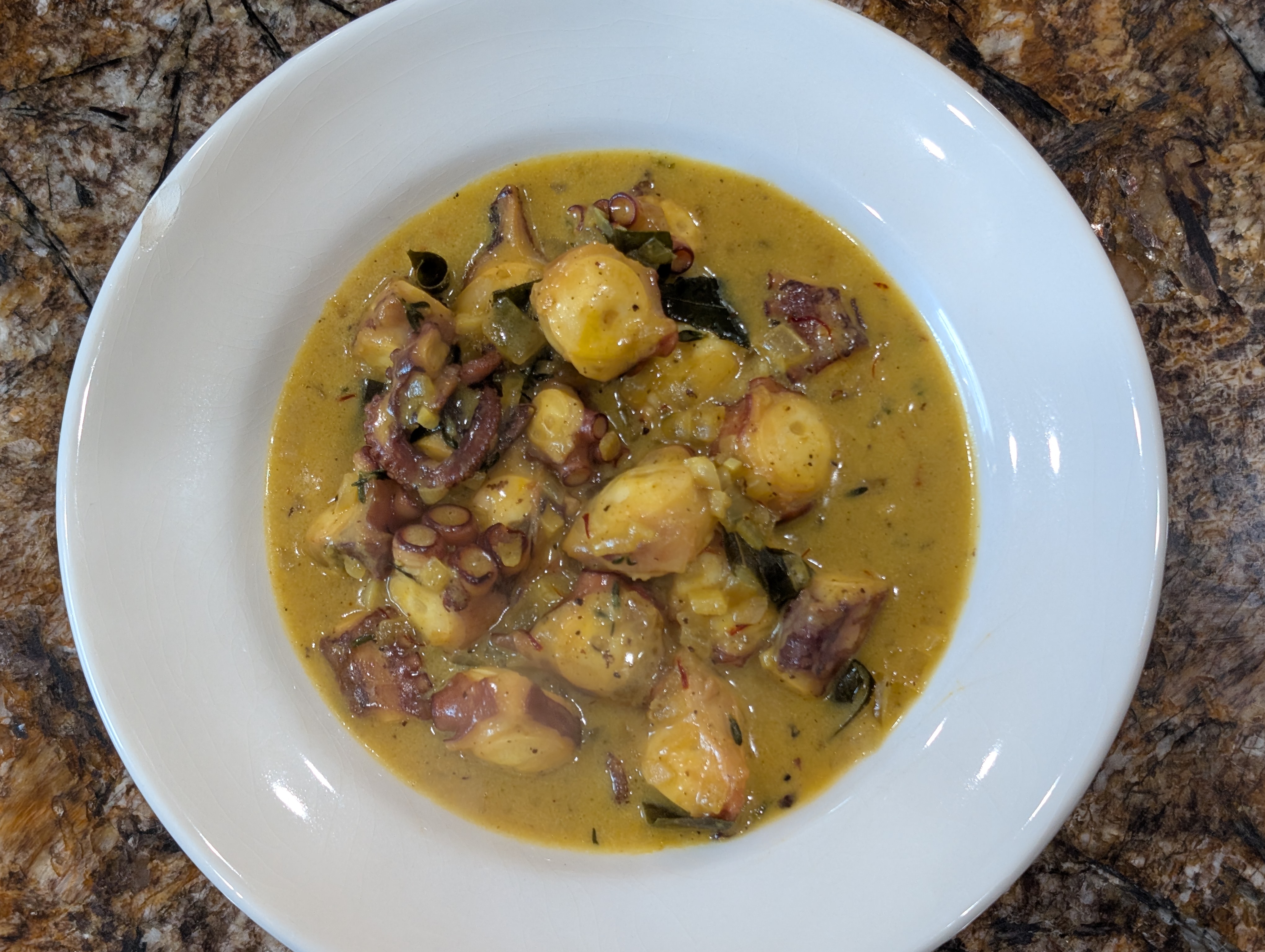
This personal culinary challenge showcases a cuisine that reflects how influences from around the world come together in amazing dishes. The challenge involves the preparation of a Seychellois Octopus Curry. The cephalopods could be found around many of the islands, such as Cousine. That availability led to this curry, which is a popular dish in the Seychelles. 

This demand created a fishery for octopi in the Seychelles. Many look for the creatures around the coral barrier reefs, while others, like a fisherman named Dave Auguste, go further out into the ocean. Auguste has fished for octopus for more than twenty years. When the COVID pandemic hit, the tourist trade (which is important to the Seychelles) crashed, and so did the market for expensive seafood like octopus. As the world gradually reopened and tourists returned, so did the demand for octopus. 

Dave Auguste with his catch (Source: United Nations, Photo: Douglas Okwatch)

Dave Auguste found one longer lasting change ... there were less of the cephalopods to catch. This change is not the result of COVID, but other factors.  In an article published by the United Nations, Auguste explained

There are fewer and fewer octopuses now. Before, I used to find them close to shore, but now I have to go further out. Again, for the last ten years or so, going out to sea has become more complicated because the sea has become rougher and the currents stronger. If I am not careful I can drift away from shore.

Indeed, climate change has affected the work of those who fish the waters around the Seychelles.  Auguste explained that there has been a change in rain patterns: "we used to have rainy periods that lasted several days, now it rains the same amount for one day and it all runs off into the sea." The prolonged rains and the runoff cause the waters close to shore to take on a reddish hue. The octopi do not like the tinged water and move further offshore. An additional factor is that, due to warming temperatures in the sea, there are some areas of the barrier reefs where up to 90% of the coral have died.

Not all of the news is bad. The Seychelles has taken proactive steps to stem the damage caused by changes in the climate. These steps include imposing quotas on seafood catches, expanding the range of protected marine areas, and implementing reef restoration projects. This has required some adjustment and adaptation, especially for those who work in the seafood industry, which makes up 27% of the Seychelles gross domestic product. This sacrifice, as well as, the conservation efforts, may not be enough if the climate continues to change. 

Turning to the challenge, I have prepared whole octopus in the past, but I decided for this dish that I would use pre-cooked octopus, which is available online or from some warehouse stores. Each package usually has 2-3 large tentacles, which may be less than a kilogram but still enough to prepare a meal for at least 2-3 people. The pre-cooked octopus also saves a lot of time (basically you can skip step 1). 

OCTOPUS CURRY

Recipe from Tourism Seychelles

Serves 4

Ingredients:

  • 1 kilogram octopus
  • Salt
  • Pepper
  • Fresh coconut milk (substitute 1 can coconut milk or cream)
  • 2 teaspoons saffron
  • 1 onion
  • Fresh thyme
  • 3 garlic cloves
  • Ginger (a little bit)
  • 1 teaspoon curry powder (or to taste)
  • Cinnamon sticks
  • Curry Leaves
  • Oil

Directions:

1. Prepare the octopus. Add the octopus to a pot and fill it with water. Boil until tender, about 45 minutes to 1 hour depending upon the size. Use a fork to check if the octopus is soft enough. Once the octopus is done, cut it into pieces

2. Prepare the curry. In a saucepan, add the oil, onion, garlic, ginger, saffron, curry powder, cinnamon sticks, thyme, salt and pepper. Mix and the add the octopus pieces. Fry the octopus pieces for a few minutes and then add the coconut milk and stir. Cover the saucepan and let it simmer for 15 to 20 minutes, as the sauce thickens. 

3. Finish the dish. Once cooked, serve with some white rice, lentils and papaya chutney. 

SIDE DISH

Ordinarily, as noted above, one would prepare white rice to serve with an octopus curry. Seychellois cuisine is known for its creole rice, a dish that is shared -- in some common form -- by creole cultures around the world. Rice is a staple food in the Seychelles, often accompanying main dishes. Yet, cultivation of rice cannot occur on a large enough scale on the islands to support its population. (Indeed, while the Seychelles may have an abundance of spices and access to seafood, it actually imports much of its other food.) Most of the rice comes from India, with smaller amounts imported from countries such as Pakistan, the United Arab Emirates, France and South Africa.

This personal culinary challenge gave me an opportunity to prepare creole rice and, to do so using the wide range of spices drawn from the subcontinent and southeastern Asia. The recipe shows that diversity with garlic, ginger, bay leaf, cinnamon, cloves, pepper and turmeric. I knew that I had to prepare this dish, which I served alongside the octopus curry.

SEYCHELLES CREOLE RICE

Recipe from Amy's Cooking Adventures

Serves 4

Ingredients:

  • 2 tablespoons butter
  • 1/2 red bell pepper diced (about 1/3 cup)
  • 1/2 onion diced (about 1/3 cup)
  • 2 cloves garlic, minced
  • 1/2 teaspoon turmeric powder
  • 1/2 teaspoon salt
  • 1/4 teaspoon black pepper
  • 1/4 teaspoon ground ginger
  • 1 bay leaf
  • Pinch of ground cinnamon
  • Pinch of ground cloves
  • 1/2 cup basmati rice
  • 1 cup water
  • Fresh parsley to garnish

Directions:

1. Saute the vegetables. Melt the butter in a saucepan over medium heat. Add the bell pepper and onion and cook for 5 minutes. Add the garlic, spices and rice and cook for another minute. Stir in the water and bring to a low boil. 

2. Finish the dish. Cover, reduce heat to low, and simmer for 15-20 minutes or until the water is absorbed. Fluff the rice, garnish with parsley and serve. 

*          *          *

To be honest, I had not expected to do a personal culinary challenge involving the Seychelles. I had previously done one for Mauritius, when I prepared an amazing duck curry. However, I really wanted to prepare this octopus curry and that led me to add this to the Around the World in 80 Dishes challenge. It is a decision that I will never regret, because it opened a door to exploring a creole culture and cuisine that draws inspiration from the diverse populations that have come to live on the Seychelles islands.  

Each of these dishes was a success, and, perhaps, some of the best dishes that I have prepared in recent weeks. This challenge has inspired me to move on to the next one. Check back to see where I end up. Until then ... 

PEACE.

Tuesday, October 25, 2016

Curried Coconut Borscht

I have previously professed my hatred for broccoli.  However, there is something that I hate much more than broccoli ... beets.  Writing that last sentence, especially those five letters, b-e-e-t-s, just gave me the shivers.  My extreme dislike for beets is principally because of the taste.  I have just never been able to bring myself around to even accepting the flavor of beets.

It is not like I haven't tried.  Back in college, I studied abroad for a semester in Prague.  During our break, the class went to Moscow for the week.  We stayed at a college dormitory that had a cafeteria, where we had breakfast, lunch and dinner. Despite the passage of time, there is one thing that I clearly remember.  Every dinner began with with a bowl of borscht.  A bowl of thin, Communist-red broth.  That broth had the strong taste of beets.  It did not have any actual beets in it.  The absence of visible beets was a relief for me, as I grabbed the shaker filled with generic black pepper.  I would add a thin layer of the black and white pepper on the top of the red sheen of a soup.  It was the only way that I could eat borscht.

While it is not on my list of favorite dishes, borscht is a popular dish in Eastern European countries, including Poland, Belarus, Lithuania and Russia.  The dish originated with a sour soup made with pickled stems, leaves and umbels of the hogweed plant.  Over time, the recipe evolved from the hogweed to beet roots.  Other ingredients, such as cabbage, carrots, onions, potatoes and tomatoes were added to the dish.  The various ingredients could be chopped and added to the dish for presentation.  Alternatively, they could be pureed into the relatively thin soup that I ate day after day during my stay in Moscow.

By now, you may be asking yourself, why I am droning on about beets and borscht.  As it turns out, it is the Community Supported Agriculture or CSA time of year.  One of our weekly CSA shipments included a couple red beets.  Given my beet repertoire is as thin as the soup I know, I decided that I would try my hand at making the soup that I can barely eat.  I found a recipe for a curried coconut borscht, which made the beet soup seem more palatable.  I thought that the coconut milk could round out the tartness of the beets, while the curry powder could help to offset that taste that is so off-putting to me. The recipe also allowed me to use some other ingredients from my CSA, such as a sweet potato (in place of the potatoes called for in the recipe) and a few carrots.

I will be honest, I ate the broth.  It was good.  I also ate the carrots and the sweet potatoes.  But, I could not bring myself to eat the diced beets.  I tried, but I could not eat the beets.  Don't let my distaste for beets stop you from making this recipe, because, if you like beets, this soup is definitely worth a try. 


CURRIED COCONUT BORSCHT
Recipe adapted from Fresh and Natural Foods
Serves 2

Ingredients:
1 tablespoon of coconut oil (or vegetable oil)
1 bunch of scallions
1 shallot or 1/2 onion, sliced
1 cup of red beets, cut into large dice
1 cup of carrots, sliced on the diagonal
2 garlic cloves, minced
1/4  jalapeno pepper, minced
3/4 tablespoon of mild curry powder or garam masala
1 tablespoon of dried ginger or 1 teaspon of fresh ginger
1/2 teaspoon of turmeric
1 cup of potatoes, diced
1/2 can of light coconut milk
1 cup of vegetable stock or water
1/2 teaspoon sea salt
1 lime juiced
1 tablespoon of arrowroot (dissolved in 1 tablespoon of water)

Directions:
1. Saute the vegetables.  Add the oil to a large saucepan over medium heat  Add scallions, beets shallot (or onion), carrots and saute until softened, about 5 minutes.  Add the garlic, jalapeno, ginger, curry powder (or garam masalam), turmeric, and saute until the spices are fragrant, about 2 minutes.  Add the potatoes, coconut milk, stock (or water) and brnig to a boil

2.  Boil the borscht.  Lower to a simmer and cook until the vegetables are tender, about 20 minutes.  Add lime juice, cilantro and arrowroot and cook until soup thickens slightly.  Serve hot.

ENJOY!

Monday, April 27, 2015

Pan Seared Scallops with a Roasted Red Pepper Curry Coulis

My relationship with scallops as an ingredient has, historically, been a troubled one.  At times, I love the ingredient and think of various different ways to prepare this shellfish.  Those times often coincide with other inspirations and influences.  The results are dishes such as Seared Sea Scallops with Carrot-Orange Gastrique and Cauliflower Puree.  Then there are the periods where I hate scallops.  I see it on a menu and I keep looking.  When I am in the kitchen or my local grocery store, my mind races away from the ingredient, looking for substitutions or different recipes altogether.

Recently, I was inspired by my beautiful Angel to make a scallop dish.   I perused the Internet looking for recipe ideas and I came across the idea of scallops served with a red pepper coulis.  A coulis is a thick sauce made from fruits or vegetables.  The name itself comes from an old French word -- couleis -- which, in turn, comes from the Latin word -- colatus -- or "to strain."  The sauce is made by pureeing the fruit or vegetable and then passing it through a sieve or strainer.    The one coulis most often paired with scallops is a pepper coulis.  I found a recipe from a website, jessicagavin.com that for a roasted red pepper curried coulis.  Given my love for curry, this recipe seemed perfect.  I had my recipe - Pan Seared Scallops with a Roasted Red Pepper Curry Coulis.

Jessica Gavin happens to be a certified food scientist and her recipe included something else that interested me ... a step that called for brining the scallops.  This step originated with Thomas Keller, who has a recipe for Caramelized Sea Scallops in his cookbook, Ad Hoc At Home, that calls for the scallops to be brined before being seared. A brine for scallops is intriguing.  Like many seafood, scallops are notorious for how quickly they cook and for how absolutely horrible they are when overcooked.  The brine helps to provide some additional flavor to the scallops and also helps to firm the scallops' flesh.

These two new elements -- the  brining of the scallops and the use of a coulis -- have opened new doors for me, to say the least.  From now on, a brine will be a mandatory, preparatory step whenever I prepare scallops.  As for the coulis, the ease of making it means that I will be experimenting with this sauce, particularly on those evenings when I have less time to prepare a nice meal.  


PAN SEARED SCALLOPS WITH 
A ROASTED RED PEPPER CURRY COULIS
Recipe adapted from one by Jessica Gavin
Serves 2

Ingredients (for the scallops):
1 pound of jumbo scallops, muscle removed (about 8 to 10 pieces)
3 tablespoons of grapeseed or olive oil
1 tablespoon unsalted butter
Sea salt, as needed
Freshly ground black pepper 
Micro-greens, for garnish

Ingredients (for the scallop brine):
1/2 cup kosher salt
1 cup hot water
4 cups cold water

Ingredients (for the Roasted Red Pepper Curry Coulis):
1 large red bell pepper (about 2/3 cup of roasted pepper)
1 tablespoon of grapeseed or olive oil
1 tablespoon of shallots, thinly sliced
1/4 teaspoon of curry powder
1 tablespoon of coconut milk
1/8 teaspoon salt
1/8 teaspoon ground ginger

Ingredients (for the Vegetable Stack):
1 eggplant, sliced
1 Yukon Gold potato, sliced
1 sweet onion sliced
Grapeseed or olive oil
Salt, to taste
Ground black pepper, to taste

Directions:
1.  Prepare the coulis.  Roast the red peppers directly over a gas flame or under the broiler, turning occasionally until the peppers are blackened all over.  Transfer the pepper the pepper to a bowl and cover with plastic wrap to cool completely.  Peel the pepper and discard the skin, seeds and core.  In a food processor or blender, combine the peppers with the oil, shallot, curry powder, coconut milk, salt and ginger.  Puree the coulis until very smooth and then strain through a sieve to remove air bubbles.  Season the coulis with additional salt if needed.  Set aside until ready to serve.

2.  Prepare the vegetable stock.  Preheat the oven to 375 degrees.  Spray a baking sheet with a non-stick spray.  Place the sliced eggplants, potatoes and onions on a baking sheet.  Brush the vegetables with olive oil.  Sprinkle with salt and black pepper.  Bake for about 15 minutes, until the vegetables are cooked. 

3.  Brine the scallops.  In a medium sized bowl, combine the salt with boiling water, stirring to dissolve the salt.  Add ice water to cool the brine.  Add scallops to the brine and let stand for 10 minutes.  Drain the scallops, rinse under cold water and arrange in a single layer on a paper towel lined baking sheet.  Place a paper towel on top of the scallops and gently press to remove the additional moisture.  Allow to sit for 10 minutes at room temperature before cooking.

4.  Sear the scallops.  Heat 3 tablespoons of oil in a large stainless steel frying pan over medium high heat until it ripples and begins to smoke.  Sprinkle scallops lightly with salt and add them to the pan without crowding.  Cook the scallops without moving them, until the bottoms are a rich golden brown, about 3 to 3 1/2 minutes.  Add 1 tablespoon of butter to the pan.  Turn the scallops and caramelize the second side, about 1 1/2 to 2 minutes.  Transfer to a serving platter.  Lightly season with freshly ground black pepper.

5.  Plate the dish. Stack the vegetables, alternating eggplant, potato and onion.  Spoon the coulis over the vegetable stack and on the plate.  Place 2 scallops on top of the stack and 3-4 scallops on the plate.  Top with micro-greens. 

ENJOY!

Wednesday, March 6, 2013

Around the World in 80 Dishes: Mauritius

I have been working on my ongoing, personal culinary challenge, Around the World in 80 Dishes.  However, as I worked on a couple of particular challenges, a surprise challenge seemed to emerge out of nowhere.  It was a dot in amongst an ocean of ingredients.  A package of duck breasts.  My eyes fixated on that package, and, I began to wonder what I could make with it.  As soon as I got to a computer, I began to review various recipes that used duck breasts.  It was then that I came across for a recipe of Mauritius Duck Curry.  That recipe gave rise to a challenge.  I would make a main course from the country of Mauritius. 

Much like those duck breasts, the Republic of Mauritius is a dot or dots in the larger Indian Ocean. The country consists of a set of islands, including Mauritius, Agaléga, Rodrigues, and Saint Brandon.  Mauritius was first charted by Arab sailors, although it was Portuguese explorers, perhaps Diogo Fernandes Pereira, who established the first base on the island of Mauritius.  At that time, the Portuguese encountered the local inhabitants ... the dodo bird. The Portuguese later abandoned the islands, only to have the Dutch who landed and later settled the island.  (The Dutch gave the country its name, Mauritius.) The Dutch settlements did not survive, but they left sugar cane, domestic animals and deer.

After the Dutch abandoned the island, it was the French who settled in and established a long-lasting settlement and renamed the islands the "Isle de France." The French established Port Louis, the capital, and used it as a naval base to raid British shipping.  Ultimately, the French lost the islands to the British in 1810 as a result of the British victory in the Napoleonic war.  The British allowed the residents to keep their land, their French language and their laws.  This probably gave rise to the Mauritian Creole (Kreol Morisien), a French-based language spoken by the populace, even though English is the official language.

It is at this point the focus shifts to the culture and cuisine.  Mauritius has a very diverse population.  At first, there were the Africans, Creoles and Europeans.  During the 19th century, Indians began to emigrate to Mauritius from the subcontinent, bringing their culinary traditions with them.  Toward the end of that century, the Chinese began to migrate to Mauritius.

Each of these populations have left their mark on the Mauritian cuisine. A variety of dishes may grace the tables of Mauritians, whether at home, on the street or in a restaurant.  These dishes include Indian curries, European braised dishes, and Chinese stir frys. Such a range of culinary influences creates a dilemma for my personal culinary challenge.  The question becomes what which influence should serve as my starting point.  For this challenge, the choice of a duck curry made this decision rather easy.  I would be exploring the Indian influence on Mauritian cuisine. 

FIRST COURSE

Indians migrated to Mauritius from both North and South India, which means that there is a wide range of influences just within the Indian cuisine in Mauritius.  As followers of my blog know, I try to make more than just the main course.  I usually try to make a first course, side dish and/or a beverage.  On this occasion, I decided to make a first course of Chana Masala. 

Chana -- or chole -- are more commonly known as chickpeas.  This masala is a very popular dish in the Punjab region of India, as well as in Guajarat and Rajahstan.  I found the recipe on the Mijo Recipes website.   The one substitution that I made was to use canned chickpeas, rather than dried chickpeas.  This cut down on the preparation time, although it also meant that I would not have the reserved liquid that is called for in Step 3.  I had some vegetable stock in the refrigerator, so I used that in place of the reserved liquid.  This substitution worked out very well. 


CHANA MASALA
Recipe adapted from Mijo Recipes
Serves 4-6

Ingredients:
2-3 cups of chana/chole/chickpeas (if using dried, soaked overnight or at least 5 hours)
2 2/3 tablespoons of butter
1 medium onion, chopped finely
1 tablespoon garlic-ginger paste (or 4 cloves garlic and 2 cm ginger, grated)
1-2 red chiles, sliced
1 teaspoon cumin seeds
1/4 teaspoon turmeric powder
1 teaspoon coriander powder
1 teaspoon garam masala powder
2 medium tomatoes, chopped to a paste (or made into a paste with a blender)
1 tablespoon of cilantro, chopped
1/2 cup of low sodium vegetable stock or broth (if using canned chickpeas)

Directions:
1.  Prepare the chole.  Soak the chole in water overnight or for at least 5 hours. Wash and boil them until well cooked. Take one chole and if you can mash it with your fingers, then it’s done. Drain the chole and reserve the liquid.

2.  Begin to prepare the masala.  Heat a non-stick pot over medium heat.  When warm, add the butter and allow it to melt.  Add the cumin seeds and let them fry for a few minutes.  Add the chopped onions and fry until most of the water evaporates.  Add ginger-garlic, fry until fragrant. Lower your heat, add turmeric powder, coriander powder, garam masala powder, salt and 1 tbsp water. Mix until you get a nice paste and cook until fragrant. The low heat and adding some water prevents the spices from burning.

3.  Continue to prepare the masala.  Put heat to medium. Add red chillies, chopped tomatoes and cook until the mixture reduces to about half in quantity. The mixture will become a bit thicker.  Add the chole/chickpeas, and add half-cup of the reserved liquid.  Cook for a further 10 minutes covered.

4.  Finish the dish.  Mash up some of the chickpeas and add water until the mixture reaches your desired consistency.  Add chopped coriander leaves.  Mix and serve.

This dish is very good.  I liked this recipe because it allows the cook to adjust the consistency of the masala to his or her own liking. Personally, I prefer the masala on the dry side.  This meant that I did not add any water at the end of the cooking.

MAIN COURSE

When I selected the challenge to make a main course from Mauritius, I did not expect that it would come with a lesson about food security.  However, I should have expected it.  Mauritius is a series of islands, which means that there is not a lot of land to grow crops or raise livestock.  The country imports about 75% of its food, while only producing 25% locally.  Food also accounts for approximately one-third of the expenses incurred by a Mauritian family.   Taken together, these facts reveal the basic problem in the context of food security: the vulnerability to increases in food prices.  For the people of Mauritius, they not only face higher increases in the cost of basic food, but also increased costs attendant to the importation of that food. These increases in food and transportation costs translate into an even larger portion of an average family's expenses being used to purchase the food they need to survive.

Given this real threat of food insecurity, the Mauritian government has undertaken various initiatives to obtain food "independence," which means self-sufficiency in the production of dairy, vegetables, and meat.  This provides a good transition to those duck breasts.  One of the government's initiatives is to increase the production and consumption of ducks.  Private companies brought stocks of Pekin and Muscovy ducks to Mauritius.  However, with some assistance, the Mauritian government established a "Duck Unit," which included the construction of a hatchery in Reduit and a farm in Albion.  The government's objectives include the development of high yielding meat strains through breeding, to increase the number of hatchlings and to further research duck nutrition.

As the Mauritian government promotes the production and consumption of ducks, chefs and cooks have risen to the challenge by using their creativity to develop dishes that feature Mauritian ducks.  One such chef is Jocelyn Riviere, who was born in Mauritius but who heads kitchens in Australian restaurants.  Chef Riviere created a recipe for Mauritian Duck Curry, which serves as the main dish for my challenge.

This is a very interesting recipe and I wished I could have followed it to the letter. Unfortunately, I had to make a couple of changes due to the availability of ingredients.  First, the original recipe calls for the use of a whole duck, but I wanted to cook with duck breasts and, in any event, the store where I bought the duck did not have whole ducks available.  So, I used duck breasts.  Second, the recipe calls for the use of stalks of young curry leaves.  Once again, the store did not have any curry leaves and I did not have the time to stop at the stores where I knew that ingredient would be available.  So, I made the dish without the curry leaves, but I left them in the recipe.  Finally, the recipe calls for the use of bird eye chilies.  These chiles are also known as "piri-piri."  I did not have any whole bird eye chiles, but I did have ground piri-piri.  So, I substituted ground chiles for whole ones.  This substitution greatly increased the heat of the dish, but, it is consistent with the fact that Mauritians love spicy foods.  (After all, the influences of African, Indian and Chinese cuisines provides the perfect conditions for spicy dishes.)  With all of those changes, I proceeded to the challenge:


MAURITIAN DUCK CURRY
Recipe adapted from SBS Food
Serves 2-4

Ingredients:
1 whole duck cut into sauté pieces or four duck breasts
Vegetable oil
3 inch piece of fresh ginger, peeled
6-8 large cloves garlic, peeled and chopped
1-2 birds eye chilies (or 1/4 teaspoon of ground piri-piri pepper)
4 tablespoons of curry powder, mixed with water to make a wet paste
2 medium onions, finely chopped
10 stalks of fresh young curry leaves
Half a bunch of washed coriander, coarsely chopped
4 medium sized ripe tomatoes, pulp removed and diced coarsely

Directions:
1.  Make the garlic/ginger/chile paste.  In a mortar and pestle crush ginger, garlic and chilli with a pinch of salt to form a paste. 

2.  Prepare the duck.  Remove all the excess fat and skin that hangs from the sides or ends of the duck, leaving only the skin that sits on top of the meat. Cut the duck into 2 drumsticks, 2 thighs, and 4-breast quarter and the rest into same size pieces. Place in a bowl, season well with salt and fresh ground white pepper and toss. If you are using duck breasts, just season them liberally with salt and ground pepper.  

3.  Brown the duck.  Heat a large heavy sauté pan on medium to high heat. When it is hot, put in as many duck pieces as will fit easily, skin side down. Quickly brown the duck on both sides. Set the browned pieces aside. Continue to brown all the duck pieces in the same way. (Do not burn the bottom of the pan) Reduce to medium heat. 

4.  Saute the onions.  To the same hot pan, which should have enough duck fat for frying, add the onion and sauté until light brown. Add the garlic, chile and ginger paste. Sauté and cook for about 2 minutes, then add the curry leaves and curry powder mix, stirring and cooking over medium-low heat for another 2 minutes until the paste bubbles and cooks out. 

5.  Make the curry.  Add one-half cup of water, the cooked duck pieces and any juices from the bowl.  Mix well and add another cup of water to bring the liquid level to half way up the ingredients. Check seasoning.   Bring to the boil then cover and simmer on a low heat for 45 minutes to 1 hour until meat is tender (almost falling of the bone). Stir gently every 20 minutes or so during the cooking period, turning the duck pieces over now and then. 

6.  Finish the curry.  Remove lid and add chopped tomato. Allow the tomato to break down into the sauce, gently turning up the heat to reduce. Check the seasoning and, just before serving, add the chopped cilantro. 

*          *          *

When asked to give advice to home cooks, Chef Riviere recommended that they be "well organized and season everything before cooking (especially with freshly ground pepper)."  "More importantly," he added, "remember that it takes a few tries to get it perfect."  Those words are sage advice.  I have to say that my first attempt at Chana Masala and Mauritian Duck Curry was a good start.  The masala was very good and I was able to taste the various spices in the dish.  The duck curry was a little reminiscent of the Kerala Duck Curry that I made a few weeks ago.  If I had to chose between the two types of curry -- Mauritian or Keralan, I think I would choose the Mauritian Duck Curry.  I also plan on following Chef Riviere's advice by making the duck curry again.  I will update this post with any changes based upon my future efforts.  

Now, it is time to return to my previously scheduled challenges, and, until that time ...


ENJOY!


For more about Mauritius, check out Wikipedia

Monday, January 14, 2013

Mary Randolph's Curry

The scene ... Philadelphia, late eighteenth century.   As recounted by Dave DeWitt in The Founding Foodies, Philadelphia was the second largest city in the British Empire, only after London.  Approximately three times each week, ships entered the harbor.  These ships brought goods from around the world ... citrus, coconuts, bananas, plantains, guavas, oranges, dried plums, dried cherries, and, of course, spices and powders, like curry powder.  The goods were auctioned off at dockside, with taverns and caterers buying them for their use in their businesses.  The size of the port in Philadelphia ensured a wide diversity of foods, including curry dishes. 

I can just picture the cooks in local taverns, seeing and smelling the strange spice mixtures that had just arrived in the city.  The unique smells and tastes were sure to pique the interest of the guests and set the dishes apart from the typical fare.  The only question was how to incorporate the spice mix into the dishes.  Few, if any, recipes have survived from the late 1700s, making it very difficult to surmise what those cooks made with the new-found spices. 

One of the first recipes for a curry is found in The Virginian Housewife, written by Mary Randolph in 1824One of the most influential books on housekeeping and cooking in the nineteenth century.  The recipe was entitled "To Make a Dish of Curry After the East Indian Manner."  Mary Randolph does not explain how she developed the recipe or what sources upon which she relied.  Nevertheless, as DeWitt explained, spices were brought to the colonies -- through Philadelphia -- and it is reasonable to assume that the fascination with those spices led cooks in the taverns and in homes to try to recreate those East Indian dishes.

This recipe is particularly difficult, mostly due to Mary Randolph's failure to include cooking times.  Therefore, I had to rely a lot upon my eyes, nose and gut to determine when a step was completed and it was time to move to the next step.   To make things more difficult, boiling pieces of chicken does not take as long as boiling a whole chicken.  So, the recipe requires a lot of attention during the cooking process to ensure that everything is cooked well and not overcooked.  And, after a lot of thought, I decided that I would follow Mary Randolph's lead and not include cooking times.  It was just two difficult to do, particularly since I spent more time looking at the chicken cook than I did at the clock. 

Finally, Mary Randolph suggests that this dish could be served with rice.  While Randolph provided a recipe for making rice, I just followed the directions on the package.  I realize that I lose some of the authenticity, but, white rice cooked using the methods of the late 18th and early 19th century looks a lot like white rice cooked using the methods of the 21st century. 


MARY RANDOLPH'S CURRY
Recipe by Mary Randolph, The Virginian Housewife (1824) at 80
and reprinted in Dave DeWitt, The Founding Foodies at pgs.47-48
Serves 4-6

Ingredients:
2 whole chickens, organic and cage free
1 tablespoon of salt
1/2 pound of butter
2 cloves of garlic
1 large onion sliced
2-3 tablespoons of curry powder
Water
Juice from a lemon or orange, optional

Directions:
1.  Prepare the chicken.   Cut the chicken into pieces as for a fricassee (basically, remove the backbone, remove the breastbone, and cut the chicken into eight to twelve pieces).  Wash all of the chicken pieces and put them into a stew pan with as much water as will cover them.  Sprinkle them with a large spoonful of salt.

2.  Boil the chicken.  Boil the chickens until tender, covered closed all the time, and skim them well.  When boiled enough, take up the chickens, and put the liquor of them into a pan.

3.  Saute the vegetables and chicken.  Then put have a pound of fresh butter in the pan, and brown it a little.  Put into it two cloves of garlic and a large onion slice, and let all fry brown, often shaking the pan.  Then put in the chickens and sprinkle over them two or three spoonsful of curry powder; then cover the pan close and let the chickens do till brown, often shaking the pan.  Then put in the liquor the chickens were boiled in, and let all stew till tender.  If acid is agreeable, squeeze the juice of a lemon or orange into it.

In the end, the effort was worth it.  The chicken was cooked well and the curry powder provided a wonderful taste.  (I am a big fan of curry powder, and, curries in general.)  The only drawback that is not addressed by Mary Randolph is the thickness of the "liquor" (that is, the liquid used to boil the chicken).  I added the liquor back into the pot with the chicken, onions and curry powder, but, even after letting the ingredients "stew" for a while, the liquid still remained very thin.  I tried to boil it down a little, hoping that the butter would help to thicken it, but, after several minutes, I realized that it may take took long.  The effort was worth it and it was a great introduction into cooking a historical recipe as close as possible to how people would have prepared the dish back during the Colonial era. 

ENJOY!

Friday, December 14, 2012

Vegetarian Curry

Every once in a while, I come across a recipe about which I am skeptical. This recipe was one of them.  I found the recipe in one of my pregnancy books when I was looking for a dish to make for my beautiful Angel, Clare.  I read through the ingredient list -- asparagus, carrots, red bell pepper, tofu, zucchini, etc. -- and it did not seem to appetizing to me.  Still, I know that Clare likes those ingredients, except for zucchini, she has never been a big fan of that ingredient.  So, I decided to make this recipe, despite the use of zucchini.

Clare's dislike would not be a problem for this recipe, because I did not intend to buy any zucchini.  Instead, we had a cucumber that had been sitting around our kitchen for a day or two and I wanted to use that ingredient.  Clare is also not a big fan of cucumbers and, generally speaking, cucumbers do not always make the best substitutes for zucchini.  I did not want to throw the cucumber away, so I added to this recipe as a substitute.  In the end, I have to say that the substitution of the zucchini with the cucumber did not matter. 
More importantly, I have to admit that, despite my initial skepticism, this recipe turned out very well.  This is a healthy dish, which I made even healthier by using brown rice instead of plain white rice. I think that what made this dish good for me was the choice in curry powders.  I used a tablespoon of sweet curry powder and a teaspoon of Penzey's Maharajah Curry Powder.  All of this exposed a secret about the carnivore in me ... cook a bunch of vegetables in a curry and I will eat them ... along with the tofu.


VEGETARIAN CURRY
Recipe from Eating for Pregnancy at 206-207
Serves 4

Ingredients: 
2 tablespoons of canola oil
2 tablespoons of minced or grated fresh ginger, or to taste
1 garlic clove
1 cup sliced baby carrots or shredded regular carrots
1/2 red bell pepper, quartered and thinly sliced
1 medium zucchini, washed, halved lengthwise and 
     into thinly sliced
12-16 ounces of asparagus, washed, tough ends trimmed and 
     cut into 1/2 inch slices
1 15-ounce package of extra-firm tofu, drained, cut into 1/2 inch
     cubes and blotted dry with paper towels
1/2 cup thinly sliced scallions
1 tablespoon plus 1 teaspoon of milk curry powder, or to taste
1 14-ounce can of light or regular coconut milk
1/3 cup chopped fresh cilantro
1 tablespoon of quick dissolving flour, to desired consistency
Juice of 1 lime or to taste
Salt, to taste

Directions:
1.  Saute the vegetables.  In a large non-stick skillet or large walk, heat 1 tablespoon of canola oil over medium high heat.  Add the ginger and garlic and cook for 30 seconds.  Add the carrots, bell pepper, zucchini, and asparagus and/ saute for 3 minutes.  Transfer the cooked vegetables to a serving dish and cover with foil.  Set aside. 

2.  Saute the tofu  Add the remaining 1 tablespoon of canola oil to the skillet or wok and heat over medium-high heat.  Add the tofu, scallions and curry powder and saute for 3 minutes.  Add the coconut milk and cook for 3 minutes, or until hot.  Sprinkle in the quick dissolving flour and stir to mix.  Add the reserved vegetables and mix gently, then stir in the cilantro and lime juice.  Adjust the seasoning.

3.  Plate the dish.  Transfer the curry to a serving bowl and serve immediately with brown rice (made according to the instructions on the package).

ENJOY!