Showing posts with label Craft Beer. Show all posts

Sunday, June 28, 2026

Dogfish Head Bourbon Barrel Aged Worldwide Stout

Dogfish Head debuted its World Wide Stout back in 1999. The brewers offered not just a stout, but one that set itself apart from the entire family of stout beers. Most stouts are pitch black, with a strong malt backbone, and usually aromatic and taste elements that feature chocolate, coffee, cocoa, or roasted grains. They are also generally low in ABV, ranging from 4% to 6% but could go as high as 8% to 12% if it is an imperial stout.

Dogfish Head and its brewers sought to transcend even the imperial stout with its World Wide Stout. Everything about this beer is more than the average stout. Somehow, the beer appears more black than a typical stout. Its aromas feature deeper tones of coffee and roasted grains. Its flavors feature fuller notes of the same elements. And, as for its ABV, that runs anywhere from 15% to 20%. For that reason, the World Wide Stout is basically an experience onto its own. 

But, the brewers have not rested with simply the World Wide Stout. They have continued to experiment with the beer, producing versions of the stout like a Barrel Aged World Wide Stout. As a fan of barrel aged beers, I bought a four pack when I was at Dogfish Head's brewpub in Rehoboth Beach. I also did what the brewers suggest, cellaring the beer for a period of time. Now, I have had a chance to enjoy the beer, and, like its predecessors, the Bourbon Barrel Aged World Wide Stout is that singular experience. 

The beer pours pitch black, like motor oil or obsidian. The aromatic elements feature more of the bourbon barrel, which is not unexpected with barrel aged beers, but also a strong alcohol presence (which is also not unexpected given its 18.3% ABV). There are hints, not of coffee or chocolate, but of a boozy fruit, like blackberries or cherries, which I found to be interesting. Those elements came through in flavor as well, providing an unexpected sweetness.

As with anything that has a very high ABV, this is a beer for sipping and enjoying over a longer period of time. It is definitely worth the experience, even though it can be quite pricey in the store. Still, it is worth purchasing to try and keep around whenever you want to just sit back and relax.  Until next time ...

PEACE.


Saturday, March 28, 2026

Smith Island Oyster Stout

As one would expect, oysters have a special place along Virginia's eastern shore. This year provided me with opportunities to learn about that special place, whether it was the tour of the Lambert Shellfish oyster farm in Vaucluse Shores or a more general look at the work of the Virginia Institute of Marine Sciences in Wachapreague. And, of course, given my family's love of oysters, we ate a lot of fresh, local oysters. We sampled oysters straight out of Hungar's Creek; we ate fried oysters out of the local fixture, the Machipango Clam Shack, and I shucked a couple dozen from Cherrystone Aqua Farms, whose operations are centered in Cape Charles, Virginia, for us to enjoy at our leisure. 

And, as we sat in the only brewpub on the eastern shore of Virginia, Cape Charles Brewing, I had to try the Smith Island Oyster Stout. I am a big fan of oyster stouts. The combination of a dark, robust style of beer with the very subtle salinity elements of oysters is a combination that seems just natural. 

And, indeed it is, because the oyster stout style has a relatively long history, at least one that dates back to 19th century England. At that time, porters and stouts were popular, everyday beers. As one sat at the bar in the pub, they would have been served a stout alongside oysters. Indeed, although in Ireland, Guinness would advertise that its famous stout paired perfectly with the shucked bivalves. 

At some point, most likely around the end of the 19th century, brewers discovered that oyster shells, which are rich in calcium carbonate, could be used to filter beer. And, it was only a matter of time before the oyster meat would also make its way into the brewing process.

The first brewery to produce an oyster stout was not in England or the United States. It was the Dunedin Brewery in New Zealand, which offered the first oyster stout in 1938. They did not use fresh oysters, but canned oyster concentrate. To be sure, others followed in Dunedin's footsteps, such as Castleton Brewery on the Isle of Man and the Manx Brewery in the United States. 

The brewers at Cape Charles Brewing describe the oysters' contribution to the Smith Island Oyster Stout as follows: "We gave it an Eastern Shore twist by adding hundreds of fresh, local oysters to the boil," adding "you won't taste the oysters themselves, but rather a subtle, pleasant salinity."

To be sure, the Smith Island Oyster Stout checks off all of the markers of a typical stout: a dark, nearly impenitrable color, aromatic elements of roasted malt, and a flavor profile that hints at earthier tastes, like a little chocolate or coffee. As for that salinity, I could sense it a little, especially as the beer warmed and opened up. 

I have tried several of Cape Charles Brewing's beers, including but not limited to, the Assateague Island IPA and the Cobb Island IPA. Yet, while all of the beers are very good, the Smith Island Oyster Stout is my favorite. Both the brewery, and the opportunity to drink a pint of this beer, are reasons enough to visit Cape Charles. Until next time ...

PEACE.

Thursday, January 8, 2026

Cool Runnings

The name comes from a 1993 movie about the Jamaican national bobsled team's first Olympic competition at the 1988 Winter Olympics, which were held in Calgary, Alberta. The beer is inspired by Caribbean stouts or tropical stouts, which first emerged with the founding and production of strong, sweet stouts by the Walters Trinidad Brewing Company in 1908. 

I have to say that I don't come across to many Caribbean-inspired beers, let alone tropical stouts. So, when I saw one on the beer menu at Market Garden, a brewery in Cleveland, Ohio, I knew that I had to try it. With a description that included notes of vanilla, nutmeg, coffee, clove and sweet spice, then I knew that I had to try it. 

The Caribbean is known for lighter beers, usually pale lagers like the eponymous Carib beer. Yet, there is a dark streak that runs through brewing across the isles, that produces some very good stouts. Such beers can be found in Aruba, Bahamas, Puerto Rico, and St. Lucia.

Jamaica also produces stouts, like Dragon Stout and Trouble Brewing's Stout. These beers, as well as other stouts up and down the Lesser Antilles, tend to feature more sweet elements, that are balanced with roasty and darker flavors.  The descriptions of the beers evoke (at least for me) the thoughts of Guinness stouts. This is an apropros reference given, for example, that Walters Trinidad Brewing Company was founded by an Irish entrepreneur, Richard Walters, who eventually sold his brewery to Carib in 1957. (Carib continues to produce the Royal Extra Stout, which is a nod to Walters Trinidad Brewing.)

The brewers describe this "Rum Cake Stout" as having "the holiday flavors of sweet molassess, home baked chocolate desserts and creamy caramel in this toasty, balanced Caribbean inspired brew." They add that there is a "harmonious medley of vanilla, nutmeg, coffee, clove and sweet spice" that grace the palate with this beer. 

I have to say that the sweet (chocolate, sweet spice) and bitter (coffee) come through on both the nose and the palate, but I was struggling a little to find the vanilla, nutmeg and clove. As it was those elements, in addition to the coffee, that sold me on buying a glass of the beer. There was a great balance between the elements, but I wish some of them came through a little more. It may have been that the beer was too cold; and, as this time of year would call for, if it warmed a little, those elements may have been more pronounced. 

I looked for six packs at the brewery, but could only find it in a holiday 12-pack, that included the Festivus and other holiday beers. It is worth a try if you can find it. 

PEACE.

Friday, November 28, 2025

Cobb Island IPA

It was originally named Sand Shoal Island until it was purchased by Nathan Cobb for 100 bags of salt in 1939. The island was then renamed Cobb Island. It has always been one of the barrier islands along the eastern shore of Virginia. Nathan Cobb built a resort on the island and, with his sons, he was  known to "splice the main brace" with the rich and famous who would come and stay at the Cobb Island Hotel. That was until the hotel was washed away in 1893. By 1933, the rest of the residents retreated to the mainland. Cobb Island was once again deserted. 

For me, the mention of Cobb Island has some other meanings. During our most recent vacation on the eastern shore of Virginia, we visited the Virginia Institute of Marine Science, where we learned about the efforts to restore a locally extinct species ... the bay scallop. Once of the areas that they have focused their work is Cobb Bay, which is the brackish water near Cobb Island. The scientists and researchers first restored the seagrasses in the area, and then they followed with the re-introduction of the bay scallop. Their efforts have been successful, bringing bay scallop populations to the point where there might be a recreational fishery in the near future. 

The brewers at Cape Charles Brewery give a nod to this history, along with the island itself, with their Cobb Island India Pale Ale. The beer is brewed in the style of a West Coast IPA: a golden hue with foam that stubbornly clings to the sides of the glass, with the centennial and cascade hops providing citrus aromas and flavor elements. Those flavor elements weigh heavily on the citrus side (as opposed to the piney side). The most readily identifiable element is grapefruit, with a little lemon on the edge. 

I have not seen this beer where I live, but I did pick up a four-pack from the brewpub in Cape Charles, Virginia. It's definitely worth the trip, not only for the beer (which is excellent), but also the award-winning wings with Miss Eve's Sweet and Spicy Sauce. Those were the best wings that I have had in a long time.

PEACE.

Wednesday, October 29, 2025

Assateague Island IPA

Assateague Island and its modern-day parks stretch along the mid-Atlantic coast between the States of Maryland and Virginia. Yet, this island has a long history. Before the arrival of European colonists, indigenous tribes -- principally the Alquonquin-tribe known as the Kickotanks -- would come to the island to fish, crab, and hunt. Those colonists eventually arrived and displaced the indigenous peoples. The colonists brought animals for grazing, as well as hunted and fished just like the Kickotanks.

The island also has its share of interesting stories (which may or may not be true). One involves a wife that Blackbeard kept on the island, to whiom he would return after raiding vessels as well as towns along the Carolina coast. Another story involves pirates having released horses on the island, or a Spanish vessel having done the same when it ran aground. Whatever may be said about those stories, it is true that horses have been on the island for hundreds of years. 

Indeed, the Assateague ponies are one of the major tourist draws to the island, apart from the natural beauty of the island. (As an aside, human development -- including the building of resorts -- have been ultimately thwarted by nature. The horses adapted to living on the barrier island, learning to munch on the saltmarsh grasses and growing heavier coats to withstand the winds, especially in the winter. 

Assateague Island also serves as the inspiration for the brewers at Cape Charles Brewing Company for a New England-style India Pale Ale. The beer pours a hazy yellowish-gold hue, with a lot of foam at the top. As that foam recedes, the aromatic elements from the Mosaic and Citra hops begin to shine through. The notes are more citrusy, with tangerine, grapefruit and/or pineapple in the front. 

As for the taste, the beer features the citrus elements, perhaps more of the grapefruit than either tangerine or pineapple. I also sensed some piney notes arond the edges. Both the citrus and pine notes are a little more pronounced than other hazy IPAs that I have tried. Nevertheless, the beer is very good. 

The beer is available on the eastern Shore of Virginia, whether at the Cape Charles Brewpub, in stores and at restaurants. I ordered it a few times in restaurants and purchased a four pack when we visited the brewpub. It is definitely worth the purchase. 

PEACE.

Saturday, September 13, 2025

Welcome to Scoville

It all began with Ed's Cave Creek Chili Beer. Basically, take Corona and substitute a serrano chile for the lime. And let that chile sit in the beer for a very long, long time. The result is an experience apart from all other beers. Put simply, one drinks Chili beer not so much for the beer, but for the burn.  That is how my love for chile beers began. 

Over time, that love evolved. It was not so much about the burn anymore. I stopped drinking the Cave Creek beer, partly because it became harder to find, but partly because I was introduced to a whole different kind of chile beers ... mole stouts. (Check out the beer review page to see the different stouts that I have reviewed to this date.)  I found that the use of chiles (most commonly ancho chiles), along with other spices, produced a beer that was far more enjoyable than one that simply scorched the insides going down. It seemed as if those would be the only chile beers that would catch my attention. 

Until I came across Jailbreak Brewing's Welcome to Scoville. An India Pale Ale brewed with jalapeno peppers, Jailbreak's offering is what a chile beer should be. The pepper is present, but it is rounded out with the hops and a slightly more elevated malt profile. 

The Welcome to Scoville pours a standard IPA golden color, although it has a slight hazy appearance and offers a decent foam at the top. The aroma of the beer gives some not-so-subtle hints of the pepper, but once one takes a sip, that is where this beer sets itself apart from other "chile beers." 

One can definitely taste the jalapeno pepper, as well as feel the burn, but it is really no more than if one ate a sliced and seeded jalapeno pepper. Not only can one taste that pepper, but they could also make out the hop notes, such as a slight bitterness, as well as the malt in the background. These elements make this beer the most rounded chile beer (excluding mole stouts, which probably still represent my favorite style of chile beers), that I have had the opportunity to drink. 

This beer is available at Jailbreak's brewpub, where I found it for about $13.99 per six pack (if I recall correctly). I have seen it in stores where Jailbreak beers are distributed, but it is not as common as the brewery's other offerings. Until next time ...

PEACE.

Saturday, July 19, 2025

Pre-Punk in London

I have been a huge fan of punk music for a long time, but I kow little about what came before that genre. I wanted to learn more about the genres of music that could be considered pre-punk music, and, a particular beer provided me with an opportunity to dive headfirst into that proverbial pit. 

The name of that beer is Pre-Punk in London, which was produced by the brewers at Dogfish Head's brewpub in Rehoboth Beach, Delaware. According to those brewers, this beer "harkens back to the off-centered feel of pre-punk London, when things were calm but with an underlying sense of something coming." Reading this description got me to thinking: so what exactly was pre-punk London?

The answer takes us to Ladbroke Grove, a name for a street and a neighborhood in western London. The area served as a focal point for the counterculture in the 1960s. Mick Farren, an English musician and author, decribed Ladbroke Grove and its residents as "an enclave freaks, immigrants and bohemians...." Some of the people who walked the streets at the time included, besides Farren, the likes of Joe Strummer, Lemmy Kilmister, and Stuart Goddard (who would become better known as Adam Ant). The "feel" of those in Ladbroke Grove at the time was anti-war and anti-establishment. 

It is from this area that the genre of proto-punk, along with bands like The Deviants (which Mick Ferran was a part of) and The Clash, emerged. Proto-punk is usually described as "stripped down" or "minimalist," but aggressive and high-energy. It gave us songs like White Riot (The Clash) and  Slumlord (Deviants). Or, in the United States, it was songs like Kick Out the Jams (MC5) or Trash (New York Dolls). These songs and bands, along with many others, set the stage for what followed, most notably, punk music itself.

I tried two versions of the Pre-Punk in London, first the cask version (which would perhaps come closest to how this beer should be served in the first place) and then the regular version. At first sight, the beer falls nearly into an Ordinary Bitter style, sporting amber or copper hues. A slight, off-white foam graced the top of the liquid, but that receded relatively quickly. 

The brewers describe the beer as having an "aroma of subtle fruit and citrus notes with a malty backbone." I could identify that "malty backbone," as well as a hint of citrus on the aroma. As for the taste, the brewers write of notes like "sweet bready malt, brown sugar and balanced citrus." The bready malt and even a sweetness (perhaps brown sugar) were present for me. The citrus was present, reminding me that this is a bitter ale. 

If I could find this beer on a store shelf, I would buy the Pre-Punk in London. A low ABV, English Ordinary Bitter just seems punk to me and perfect for relaxing while The Stooges play in the background and I delve even further into the roots, reaching into garage rock and even skiffle. Meanwhile, if you find yourself in Rehoboth Beach, Delaware, head over to Dogfish Head Alehouse and have a Pre-Punk in London. It is definitely worth it. 

PEACE.

Saturday, April 26, 2025

Pimp My Sleigh: The Pink Tequila Barrel Edition

I don't drink hard liquor anymore so I never order anything such as a tequila shot or a margarita. The only way I would ever experience hard liquor is when I order a beer that has been aged in the barrels as the liquor. Back when I did many more beer reviews than I do now, I did quite a few bourbon-barrel aged beers, such as Brooklyn's Special Operations or Heavy Seas' Blackbeard's Breakfast. I've even done a review of Hitachino's XH, a beer aged in sake barrels. However, I have never done a beer aged in tequila barrels, let alone pink tequila barrels ... until now. 

The first question that I asked myself is what exactly is pink tequila? The answer involves the barrel aging process, as it is tequila that is aged in red wine barrels. To be sure, aging tequila is not new, there is reposado and anejo, each involving the aging of the liquor. However, that aging usually involves bourbon barrels, which impart specific desired flavors and attributes. There are significant differences when it comes to flavors, as well as color, when it comes to aging in wine barrels.

The use of wine barrels to age tequila is said to have been started by the Real family, who live and produce tequila in Amatitan, which can be found in the Jalisco State of Mexico. The red wine elements from the barrel are said to give the tequila its pink color (hence "pink tequila"), along with floral aromatic notes and berry elements in the flavor. The end result is a tequila rosa.

The Pink Tequila Barrel Aged Pimp My Sleigh pours a dark brown, with lighter tones nearer to the surface. The caramel foam quickly gave way to the beer itself. The alcohol elements are definitely the first things one notices when taking a sniff of the beer. The traditional aromatic elements of the Pimp My Sleigh Christmas Ale seem to get a little lost in the aroma, but that's okay for me. After all, I purchased a tequila-aged beer for a reason, and it was to get something more than the traditional elements. 

That something more is also present in the taste of the beer. With this being the first tequila aged beer that I have had, I was not sure what to expect. The taste tended away from a traditional Christmas Ale toward a barleywine, and even toward the 120 Minute from Dogfish Head. There was a heavy alcohol taste, but the sweetness from the Christmas Ale elements was more present in the taste than in the aroma. 

Only 100 cases of this beer were produced, and that was back around Thanksgiving of 2024. My guess is that the beer is no longer available. If Fat Heads decides to brew it again, it is definitely worth the purchase. You can cellar it and it can remain available longer at your home than at the brewery.

PEACE.

Wednesday, December 11, 2024

Paul's Perfect Pour

Cult Classic Brewing is a brewery and restaurant located on Kent Island just off of Route 50. Drawing inspiration from popular cult movies over the decades, which is evident with the movie posters hanging in the restaurant, the brewery produces a wide range of beers. I have previously reviewed one of its India Pale Ales, The IPA When the World Stood Still, which I bought when the Savage Boleks first visited this brewpub back in 2021. 

A few years later, the Savage Boleks found themselves passing through Kent Island on our way to the Oysterfest in St. Michaels, Maryland. Loyal to any brewpub that serves good beer, we made a stop at Cult Classic Brewing for dinner. When we left, we purchased two six packs. One of them was Paul's Perfect Pour. 

As it turns out, this beer was brewed for a cause. Cult Classic Brewing partnered with the guitar maker Paul Reed Smith to produce Paul's Perfect Pour. They joined in this collaboration to celebrate Make Music Day, which was on June 21, 2024. Make Music Day was first recognized forty-two years ago in France as a day where "free music would be everywhere: street corners, parks, rooftops, gardens and store fronts." 

Although we came a few months late for Make Music Day, we nevertheless got a chance to try Paul's Perfect Pour. It is advertised as a blend of an Irish Red Ale and a German Kolsch Ale. 

The beer pours more like the former rather than the latter, with a reddish hue. The aromatic elements are very malt-forward, with a sweetness laced among them. The sweetness may be the Kolsch trying to shine through the otherwise Irish Red facade. The malt characteristics follow through with the taste, with a sweet, somewhat fruity flavor in the initial taste. It is somewhat reminiscent of apples. The sweetness hangs out on the palate for quite a while.

This beer proved to be as interesting as I thought an blend of Irish Red Ale and Kolsch would be. If you happen to find yourself around Kent Island, Maryland, you should check out Cult Classic Brewing and pick up a six pack. That is, if it is still around. Until next time ...

PEACE.

Saturday, July 27, 2024

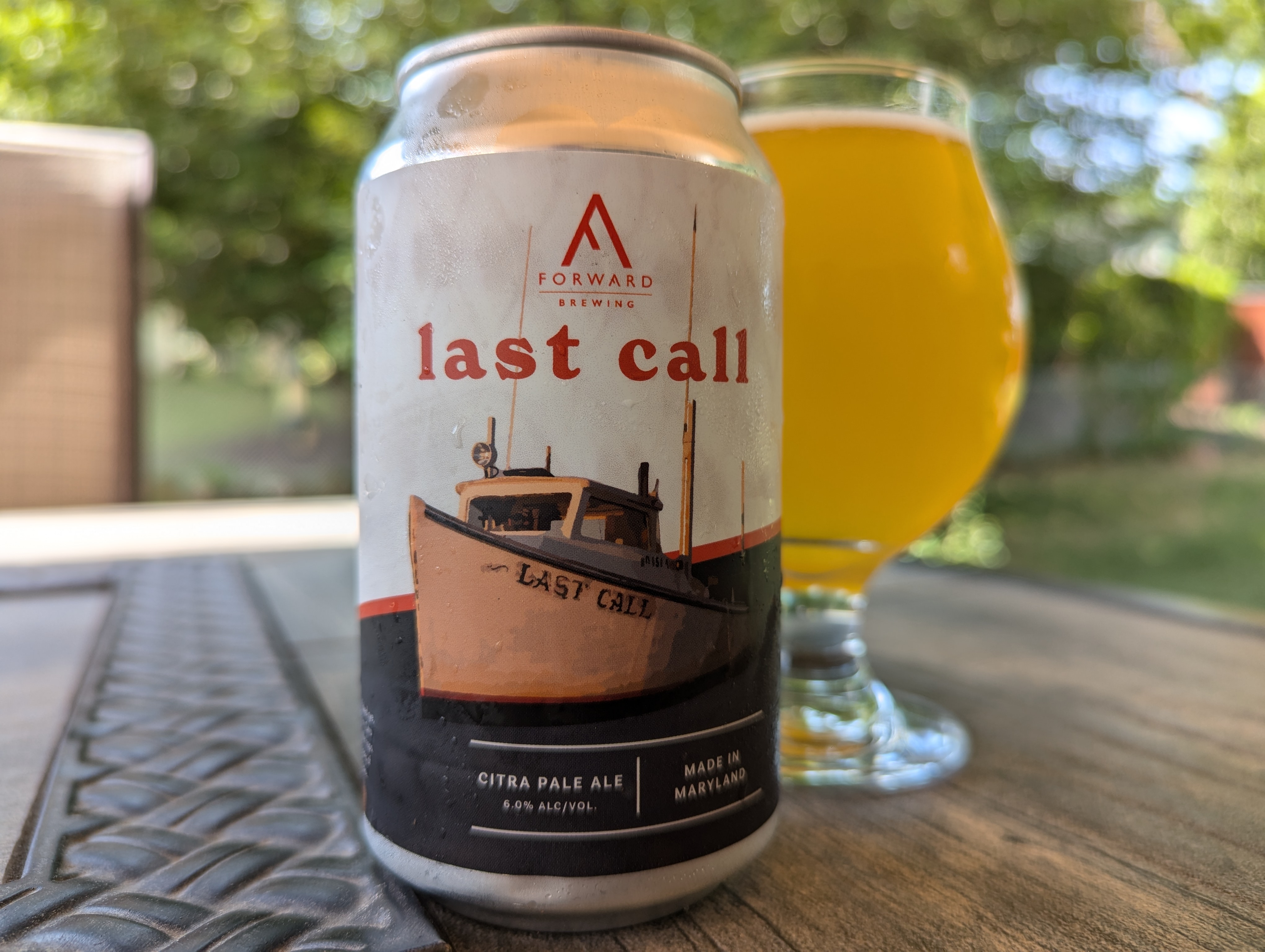
Last Call

They say one should never judge a book by its cover; and, one should never buy a bottle of wine based on the label. I am pretty sure that latter rule also applies to beer. If it does, then I broke that rule when I purchased a six pack of Forward Brewing's Last Call. I totally bought it because of the label. 

The label features artwork based on the photography of Jay Fleming.  If you live in the Chesapeake Bay region, you may have heard of his photography. Fleming stands out as one of the premier photographers, not just of the beauty of the bay's natural environment, but also of the culture of those who live there and make their living there.  Fleming has published two books, Working the Water and Island Life, both of which I have read cover to cover. He has also published a long list of articles, as well as has his photography for sale. I have long wanted to buy one of this photographs to be framed for our house, but every time I look at the website, I ultimately can't decide which one to purchase. (To get a look into my dilemma, the three pictures that I have gone back and forth are this one, this one and this one.) 

As that internal struggle continues, I was perusing the beer aisle of one of my favorite local haunts when I came across a six pack of Forward Brewing's Last Call. The Annapolis-based brewery collaborated with Jay Fleming, whose artwork - a photo of a fishing vessel named Last Call - is featured on the label. As a huge fan of Fleming's work, as well as a big fan of pale ales, I bought a six pack.

The Last Call is a traditional Pale Ale, which the brewers describe having been brewed with "flaked rye, Idaho Gem and Citra Hops." The brewers also describe the taste of the beer as "juicy and citrusy, with pineapple and subtle notes of spice." 

The beer pours a light golden color, which one could expect from a pale ale, with a slight haze. The citrus notes are on the nose, reinforcing the brewers' description. Those citrus notes come through on the palate as well. I can see the hints of pineapple, but I also think other citrus fruits, such as lemon, are present in each sip. As for the spice notes, they were not so present for me, but they could be present for someone else who tries this beer. 

Overall, this is a very drinkable beer, especially with an ABV of 6%. While I may have bought it for the label, I walked away with a six pack of a pale ale that makes me want to bypass my usual haunt and make my way to the brewery's taproom. If you happen to come across a six pack of the Last Call, pick up a six pack. There is more to this beer than just the label (which, I still love). 

PEACE.

Saturday, April 27, 2024

Black Viking's Zingabier

There are more craft breweries in the United States than ever before, with an estimated 9,500 such breweries across the country. Those breweries produce a diverse range of beers, from light session beers to weighty barleywines. The diversity of beers is not really matched by the diversity of brewers. Only about ten percent (10%) of the brewers are persons of color and other historically underrepresented groups.  

Diversity, equity and inclusion have been reaching into the craft brewing movement.  Some of the breweries owned and/or operated by African-Americans, Hispanics, women and others have staked a name for themselves. One example of a large craft brewery is Brooklyn Brewery. Garrett Oliver serves as Brooklyn's head brewer; and, while he could be in the running for the most interesting person in the world (in my humble opinion), he has overseen some amazing beers, such as the Soriachi Ace and the Black Ops. More locally in my area is Union Brewing, which has firmly established itself among the Charm City breweries (in Baltimore Maryland).  Union produces some solid beers, such as the Duckpin double IPA.

Relatively recently, the first African-American owned and led brewery opened its doors in Montgomery County, Maryland. The brewery is Black Viking. The brewery was started by Shaun Taylor, the head story teller, and Jamil Raoof, the head brewer. One of their first beers that I have seen on store shelves is the Zingabier, a Golden Ale brewed with ginger and honey. (The name zinga comes from the Latin word for ginger.)

The Zingabier pours true to its style, with a densely golden color. The aroma of the beer hints at some floral notes, as well as its primary ingredients, both the honey and ginger. Those primary ingredients shine through more in the flavor of the beer. As I took sips, I could note the ginger in the taste. The honey probably came through more as some of the sweetness in the taste and the finish. 

The Zingabier may become the flagship beer for Black Viking. It is definitely a remarkable start for the new brewery. Right now, distribution is limited to the State of Maryland and the District of Columbia. However, they have big plans. In the meantime, if you see a six pack of the Zingabier on a store shelve, I strongly recommend you buy it. 

Until next time...

PEACE.

Saturday, March 2, 2024

The Xocoveza

Beer reviews have become fewer and fewer on this blog. It is not so much that I am not drinking beer. It's just that I have been drinking many of the same beers (some of which have already been reviewed and others which don't really need or deserve a review). However, every once in a while, there comes a beer that deserves its own review. 

The Xocoveza from Stone is such a beer.

The story of this beer begins back in 2014 as a mocha stout recipe submitted by Chris Banker as part of Stone's Annual Homebrew Competition. Banker's recipe won the competition. After joining a collaboration between Stone Brewing and Cerverceria Insurgente (a craft brewery in Tijuana), Banker's recipe became the Xocoveza. Nearly ten years later, the beer is now brewed with a range of ingredients beyond the traditional barley, hops (English Challenger and East Kent Golding) and yeast. The additional ingredients include cocoa, coffee, pasilla peppers, vanilla, cinnamon, nutmeg and lactose. The combination of scents and tastes elevate this stout to something well beyond any chile stout (pasilla peppers) or holiday stout (cinnamon, vanilla and nutmeg). 

The greatness of this beer comes from the fact that the additional ingredients contribute to every aspect of the beer. The beer pours pitch black with a brown foam. That foam gives way to an aroma where the cinnamon, coffee and coca become gradually more noticeable. While the brewers say there is also nutmeg and peppers in the aroma, I had a little more difficulty pinpointing those elements. 

However, the nutmeg and peppers are evident in the taste. Those flavors emerge out of the cocoa, coffee and cinnamon, and there is a heat that comes through in the middle and the finish from the peppers. Together, the complexity of the numerous flavor elements remind me of a simple mole. Indeed, this beer would complement a mole very well, although I have to admit that it would probably be drunk long before the mole was finished. 

This beer is on my short list of favorites. It also makes me happy that Stone has made the Xocoveza one of its annual offerings. If you see it in the store, buy a six pack or two. It's definitely worth it. 

PEACE.

Saturday, February 25, 2023

Cadillac Mountain Stout

One place that we love to visit is Acadia National Park in Maine. Every part of the park, from Jordan Pond to Sand Beach, from Schoodic Point to Cadillac Mountain is amazing. Like many national parks, Acadia offers a person the ability to surround themselves with some of the most amazing and beautiful scenes that nature has to offer. 

Just as certain as we are to see the various sights of the park when we visit Acadia, we will find our way to Atlantic Brewing. (We are, after all, Savage Boleks.)  Atlantic Brewing has two locations, the original one on Knox Road and a newer tap room in downtown Bar Harbor. I made it to both over the course of our vacation.

Back in 2008, Atlantic Brewing purchased Bar Harbor Brewing and its recipes. Atlantic Brewing continues to make two of Bar Harbor's beers - Thunder Hole Ale and Cadillac Mountain Stout. Needless to say, we had both while we were in Bar Harbor, and, we took home a four pack of the Cadillac Mountain Stout to enjoy back at home. 

The Cadillac Mountain Stout is brewed in the style of a dry Irish Stout. This beer style features a jet black color, with aromatic notes and flavors of coffee or bitter chocolate that come with roasted barley, along with a smoothness that sets this beer apart from other stouts.

The brewers at Atlantic Brewing have checked off most of the key features of a dry Irish Stout with the Cadillac Mountain Stout. The beer pours as black as oil, with a thick foam whose coloration resembles a light chocolate cream. The aromatic elements feature light coffee notes, but tend more toward chocolate. That tendency is also reflected in the taste, as this dry Irish Stout as a sweetness that predominates over any bitter or roasted notes. Overall, this is perhaps one of my favorite beers brewed by Atlantic Brewing.

If you happen to find yourself at Pesamkuk, also known as Mount Desert Island, in Maine, you should make your way to Atlantic Brewing and try the stout or another of the brewery's beers. It is definitely worth the visit. 

ENJOY!

Sunday, November 27, 2022

Global Disturbance Hazy IPA

There were three trails that could take someone westward: the 900 mile Santa Fe trail, the 2,000 mile Oregon trail, and the 2,000 mile California trail. All three trails have a common starting point: Independence, Missouri. The town was founded in 1827, at first for the Santa Fe trail. Records indicate that approximately 12,000 people used the Santa Fe trail from 1849 to 1859, along with 3,000 wages and 50,000 animals. Between 1840 and 1860, between 300,000 to 400,000 people used the Oregon trail.  Another 200,000 also used the California trail during the same time period. In summary, a lot of people made their way through Independence seeking a life out west. 

The use of trails ended with the rise of the railroads. Those who came to Independence did not continue on to the west. Of course, there is a lot to see and do in Independence. One could visit the Harry S. Truman National Historic Site. There are other mansions or estates - such as the Harvey M. Vaile Mansion and the Bingham Waggoner Estate - that one could visit.

But, if one were a Savage Bolek, he or she would be visiting the local brewpubs. Fortunately, my beautiful Angel got to visit one such brewery when she was in Independence ... 3 Trails Brewing. At this point, I should probably disclose that a close family friend is the head brewer at 3 Trails Brewing, and my Angel was there because he was getting married and the reception was held there. I was unable to attend (unfortunately), but my Angel did bring back a six-pack of beer for me to try. And, I am truly thankful that she did. 

The beer is 3 Trails' Hazy India Pale ale known as the Global Disturbance. The brewer notes, "[o]riginally brewed during a time of uncertainty[,] [t]his beer brings flavors of tropical fruit. citrus and guava derived from the Galaxy and Mosaic hops."  That is a good description of what was to come when I had a chance to try the beer. 

The Global Disturbance pours like a hazy IPA, a yellowish-gold (reminiscent of what turmeric does when it is added during cooking). There is a solid foam that covers the entire surface of the liquid and only gradually gives way over time. The beer does give aromas of citrus fruit, along the lines of grapefruit. The taste falls squarely within the brewer's description: it is grapefruit forward, with hings of other citrus fruit swirling around in the taste of the beer. 

I have always been a little skeptical of hazy IPAs; however, this beer is very good. If you happen to make your way to Independence, I strongly suggest you visit 3 Trails Brewing. There will be no need to go any further west.

ENJOY!

Thursday, September 1, 2022

Mexican Chocolate Waypost

N onouian

"Here, there and everywhere." - Nahuatl saying

For me, the saying - N onouian - represents the influence that the Aztec and other Mesoamerican indigenous peoples have had across the world. This influence is particularly apparent in the food that is consumed, whether in Mexico, Mozambique, Malaysia or Micronesia. While chiles may have originated in Bolivia, they were first cultivated in what is now Mexico. The Aztecs and the Mayans also developed cocoa as a crop. The Totonacs of the eastern coast of Mexico were among the first to cultivate vanilla. 

Then came the conquistadors and the colonizers. While they brought death and subjugation to the indigenous people, they took chiles, cocoa and vanilla back to Europe and across the world. The complex history of food should never be forgotten. The origins of foods should always be acknowledged and remembered. These principles guide me not only in my quest to learn about more cuisines, but they often emerge in ancillary ways, such as in the beer that I drink.

The few ardent followers of this blog may recall that I have a love of a particular beer style - the mole stout. It is a beer that is inspired by the molli (or mole) sauces of Mexico, whether from Oaxaca or Puebla regions. Those sauces incorporate ingredients that can be traced back to the Aztecs, Mayans, Totonacs and other indigenous cultures that flourished prior to the arrival of Europeans.

While vacationing in the Williamsburg, Virginia area, the Savage Boleks had the opportunity to try a new brewery - Virginia Beer Company. We just happened to visit when the brewery was celebrating its sixth anniversary. One of the anniversary beers was the Mexican Chocolate Waypost, a bourbon barrel-aged imperial milk stout brewed with cocoa nibs, cinnamon sticks, vanilla beans, ancho chiles and habanero chiles. It is a mole style beer that was right in my wheelhouse. 

The Mexican Chocolate Waypost pours a dark brown, almost fertile soil brown in appearance. The aroma has a sweetness that I don't recall from other mole stouts. That sweetness may come from the milk stout style, or perhaps the combination of coca, cinnamon and vanilla. There was only a faint whisper of the pepper, which I generally associate more with the aroma of a mole stout. The pepper comes through much more in the taste of the beer. As for whether it was ancho or habanero, I have to lean more on the latter than the former. There was more of a kick than a smoky element. That kick kept its presence, even when surrounded by the sweeter elements of the cinnamon and vanilla. All of those additional ingredients make one forget that this beer is also made with Columbus hops and a variety of malts, including but not limited to 2 Row, Munich malt and roasted malt.

This beer makes me want to return to Williamsburg, but it is not one that is offered year around. It should be though. The next time I am in the area, this beer is enough to draw me back to check out the tap room. Until next time ...

ENJOY!

Wednesday, August 10, 2022

Thai Hot

When it comes to spiced ales, the typical offerings - pumpkin beers, Christmas ales, and the like - don't usually get my attention, let alone hold it long enough for me to consider buying them. (There are some exceptions, but that is the general rule.) But, when I find a mole stout - a beer incorporating the ingredients that typically find their way into a mole sauce (for example, chiles, chocolate, and nuts), that beer has my attention. Indeed, until very recently, mole stouts were the only spiced ales that I would purchase. 

However, while on a recent vacation, the Savage Boleks visited Fogtown Brewing Company's tap room in Bar Harbor, Maine. According to its website, Foghorn brews farmhouse ales, saisons, sours, spiced ales, and other styles. The beers are brewed with malts, grains and hops that are grown in Maine. 

While sitting at a table, I looked over at the beer fridge. There was a four pack that caught my eyes. The red labels with a golden script that I could not recognize. The only thing that I could understand was the print at the bottom: "Thai Hot." I picked up the four pack for a closer inspection. The beer is an ale brewed with grains from Maine, along with rice, lemongrass, basil, toasted coconut, lime and thai chiles.

The beer pours a golden yellow, with a thin foam that quickly gives way to the liquid. The lemongrass and limes provide featured aromas, but I think I could sense some grass as well. 

The beer has a very light body, with the lemon and lime at the front of the taste. My initial reaction seemed to prepare myself for something along a sour beer; however, any thoughts of sourness soon gave way to the heat from the chiles, which could be felt both on the tip of the tongue and in the back of the throat. 

With an ABV of only 4.7%, this beer would be a very drinkable, except that burn from the Thai chiles can set the pace from time to time. It's a good think that I love spicy food and that I have experience cooking with Thai chiles, so that I know what to expect. 

In the end, if you find yourself in Maine, near Ellsworth or on Mount Desert Island, you should check out Fogtown Brewing Company. And, if you are like me and always willing to try something different, check out the Thai Hot if it is available. Until next time ...

ENJOY!

Sunday, July 17, 2022

Double Dead Rise

Over the past several months, I spent a substantial amount of time writing and publishing my In Search of Orange Gold blogpost series.  The series explored the history of using spice mixes in Chesapeake cuisine generally, as well as the origin of the iconic Old Bay spice mix. I traced the travels of Gustav Brunn, who Jewish-German spice maker who escaped Nazi Germany and came to Baltimore, Maryland. He set up his spice shop. He developed an 18-ingredient spice mix, which he eventually sold to local seafood vendors. Only 15 of those ingredients are publicly known, but I tried to ascertain what could have been the final three ingredients. I ended the post series by trying to recreate Brunn's mix.

It would seem that the next logical step in the series is to explore the ways in which Old Bay is used. A local Maryland Brewery has taken the mix to produce what it calls the Dead Rise. A deadrise is a type of workboat used on the Chesapeake Bay used to catch crabs, oysters, fish and eels. It is also the angle that forms from a boat's bottom to a horizontal plane on either side of the keel. However, for Flying Dog, it is a blonde ale that is spiced with Old Bay.

I have to admit that I have used Flying Dog's Dead Rise more for steaming crabs than I have for drinking. I don't usually drink it, preferring Flying Dog's other offerings, such as the Truth or Raging B. 

However, I recently came across the Double Dead Rise, which Flying Dog describes as an Imperial Summer Ale. That beer caught my attention, which the brewery is very good at doing. The brewers describe the beer in the following way:

... double the spice and double the ABV. This Double Dead Rise will surely blow your taste buds away. Spicy and lemon-y you can almost skip the crabs ... almost.

This is pushing the envelope, as I cannot skip the opportunity to eat blue crabs. However, the words of the brewers did rope me in to try the beer.

The Double Dead Rise pours out a few shades of orange lighter than the Old Bay spice mix itself. A thin blond foam is also present, but it quickly recedes to the edges of the glass, leaving only cirrus-like whiffs floating across the center. 

The typical aromatic elements of this beer -- that is, those that would be produced by the hops, malts or yeast - have to contend with the aromas that come with the use of Old Bay. The aromas have a good hint of spice, but it is not the typical coriander or herbal notes that typically come with a summer ale.

As for the flavor, this beer is what the name implies. The presence of the Old Bay spice mix is definitely amped up over what it is in the Dead Rise.  The spice mix is so present that, in my humble opinion, the beer could probably have been marketed as an Imperial Spiced Ale, as opposed to an Imperial Summer Ale. That is not necessarily a bad thing, especially if you are someone living in the Chesapeake Bay region who loves Old Bay.  However, the beer acts like a spiced beer, there is a sting in the back of the throat and a sharp finish. A finish reminiscent not so much of the claws of a crab, but its bite. Indeed, the Old Bay makes one forget about the other "bite," that is the 9% ABV of the beer. 

Overall, I liked this beer and I would buy it again. For those who don't like spices generally or in their beer, I would suggest you try it before you buy it. (Or, in the alternative, you can send me the remaining 3 bottles from the four pack.) Until next time ...

ENJOY!

Friday, April 22, 2022

Blackbeard's Breakfast (Revisited)

"On your way now. And tell the world that you sailed with Blackbeard."

- Blackbeard

If one sailed with Blackbeard, what would one eat? Historical accounts noted that, generally, pirate vessels generally stocked themselves with meat, vegetables and perhaps even fruit. There are stories of how one pirate - Francois L'Onnais - offered in 1666 to leave the port of Maracaibo if he was supplied with 500 head of cattle. Another pirate, Henry Morgan raided a Cuban town seeking a ransom of 500 cattle. Even when they were successful, pirates still had issues. For example, what do you do with 500 cattle at sea? The possible answer lies with another pirate, Jean Tocard, who occupied the Mexican port city of Tampico in 1682 for the purpose of slaughtering cattle. 

Notwithstanding these stories about cattle, the cuisine aboard a pirate ship could hardly be equated with the menu of a steakhouse. Fresh ingredients don't last long with the salty air of the open seas. After the first few days or weeks, the menu aboard a pirate ship would feature more salted and pickled options than fresh meat or vegetables. That fresh steak would have more likely been a salted strip of jerky better used as a belt than as something that could be digested in a stomach.

I write all of this because I got to thinking about this question as I poured a bottle of Blackbeard's Breakfast, a porter brewed by Heavy Seas Brewing just outside of Baltimore, Maryland. What would Blackbeard's breakfast actually look like? Once I took a sip of the beer, those thoughts quickly subsided.

Instead, I got lost in the pitch black color of the porter, graced only by the caramel notes of the foam. Those are shades or hues that probably resembled the salted, jerked meat ate by pirates after weeks at sea. In any event, the brewers note that the beer is their take on an imperial porter, and, in that regard, an oily black beer is right on target. 

The Blackbeard's Breakfast also hits all of the other notes for an imperial porter. There were the aromatic elements of the roasted malts, twisting together with the aroma of the dark Sumatra coffee from Chesapeake Bay Roasting Company. (I always like it when brewers incorporate local ingredients and locally-owned businesses as part of the creativity in the brewing process.) I could also get the faint whiffs of the alcohol coming from the beer being aged in bourbon barrels. That aging also made its way into the taste of the beer, with a strong bourbon backbone upon which the coffee notes and roasted malt flavors were layered, as well as the ABV, which is 10%.

Heavy Seas' Blackbeard Breakfast is perhaps one of the best imperial porters that I have had in recent memory. In fact, it may the best one that I have had in a very long time. If you can find it on a store's shelf, it is definitely worth the price. However, given it is only a limited release, chances are one will have to wait ... just like a pirate ... for a fresh new release.

ENJOY!

P.S. As it turns out, I previously reviewed Heavy Seas' Blackbeard's Breakfast over two years ago. I did not realize that fact until after I posted this review. In any event, the previous review can be found here

Monday, December 27, 2021

Brother Thelonius

"If you want to understand the meaning of bebop, you have to understand the meaning of freedom." 

Thelonius Monk

For many years, Thelonius Monk wrote and performed music in an improvisational and unorthodox style. His music clearly and unquestionably demonstrated that he understood the meaning of freedom. That understanding gave rise to songs such as Straight, No Chaser, Epistrophy, Blue Monk and Round Midnight. As David Graham once observed in The Atlantic, Monk's "catalog - some 60 to 70 songs, many of them familiar to even moderately serious jazz fans - form the spine of contemporary repertoire." Indeed, Monk's song, Round Midnight, stands as the most recorded jazz composition of all time ... and, for good reason. 

Yet, not everyone was a fan of Monk's music.  One jazz critic described Monk as "an elephant on the keyboard." Yet, that is what makes Monk so special. He flattened his fingers when playing notes, sometimes hitting a single key with two fingers or splitting single line melodies with both hands. Yet, to some, Monk "adjusted his finger pressure on the keys the way baseball pitchers do to the ball to make its path bend, curve or dip in flight."  Sometimes there would be chord changes in Monk's music that seem wrong or out of place. To Monk, those chords were "the logical result of countless hours of musical exploration." 

For years, North Coast Brewing has honored the legendary jazz artist with a Belgian style abbey ale known as the Brother Thelonius. The beer is described as a "Belgian Style Abbey Ale," which does not lend itself to categorization in what is a realm of well defined beer styles - such as the Belgian dubbel, tripel or quadrupel. Perhaps that was intentional, a nod to an artist who sought to free himself from conventional labels.

As for the beer, I am reminded of a quote by Thelonius Monk: "the piano ain't got no wrong notes." The same can be said for North Coast's Brother Thelonius. The beer pours a reddish brown to amber, with a slight layer of foam as the beer is poured into the glass. The aromatic elements of the beer fit quite nicely into the Belgian styles. There are the yeast notes, which are accompanied by scents of banana and sugar. Those latter notes carry through to the taste, which has the  same sensory effects on the tongue as Thelonius Monk playing Sweet and Lovely. There are other elements in the taste of the Brother Thelonius, such as notes of figs and caramel, along with just a faint sense of the hops in the background.

The Brother Thelonious is very much the tribute to Thelonius Monk, as complicated and deep of a beer as Monk was a jazz artist. The beer sells for approximately $12.99 for a four pack of 12 ounce bottles or $8.99 for a 750 ml bottle. It is totally worth it, especially if you do what I do and enjoy the beer while listening to Monk playing in the background. 

ENJOY!

Tuesday, December 7, 2021

The IPA When the Earth Stood Still

For years, Kent Island was always a place where I would drive through, either to get to the Eastern Shore or to return back to Annapolis, Maryland and points beyond. I actually never stopped to visit the island. That all changed recently; and, I got an introduction to a really cool brewery that makes some very interesting and drinkable brews.

The brewery is Cult Classic Brewing.  As its name suggests, the brewery is motivated my old cult classic movies. The tap room is lined with old movie posters and the tap list hanging over the bar sports some brews with cult movie names, such as the Attack of the Strawberry Blonde and the IPA When the Earth Stood Still.  I stopped in to try the beers and grab a bite to eat.  When I left, I took home a six pack of that IPA with an intent to do a beer review. 

And, now, I shall go off the Deep End (1970) and begin the review:

The IPA When the Earth Stood Still does not Psyche Out (1968) anyone. It pours like a classic India Pale Ale. The beer has a deep golden hue. There is a good layer of foam, thick enough to hide The Creature from the Black Lagoon (1954).  

When it comes to both the aroma and the taste, the beer takes the drinker to but not Over the Edge (1979). If I could point to The Thing (1982) about this beer, then it would be to how it plays to the genre of the west coast IPA. The aroma give hints of the Things to Come (1936), with both piney and citrusy hints.  The taste is a Fantastic Voyage (1966) through the finer points of what defines a West Coast IPA.  There is a good deal of hop bitterness, which sometimes veers between the pine and citrus (although, admittedly, at least for me, it tended to be more of the former than the latter).  There is also a good amount of astringency on the finish, which grips the tongue tightly, as if in fear of something, like Reptilicus (1961) or The Blob (1958). 

In the end, in a world of IPAs, this one truly stands like Gorgo (1961) or Konga (1961) above most of the rest. It stands as a reason, in and of itself, to make a stop on Kent Island and grab a beer.  Until next time ...

ENJOY!