Tuesday, April 5, 2011

Better Luck Next Time ...

Unfortunately, my entry was not selected to be a finalist in the Whole Foods "Foodie Fantasty" Vacation.  In the end, that is okay with me.  For one thing, while I really wanted to win the vacation, the contest is not being run in accordance with its official rules.  Although the official rules say there are to be ten finalists, Whole Foods only picked eight finalists. Quite frankly, I am not sure that I would have wanted to participate in a contest when the rules are not being strictly enforced.

But, on a more positive note, the contest allowed me to try my hands at some new things, like editing video and sound together to create a package.  I hope to be able to use these new skills to improve my blog more so that it can be more enjoyable for people like you who visit in order to read about what I cook and what I have to say. 

So, it will be back to the regular programming.  Once again, I want to thank everyone for supporting me in this endeavor. Until next time ...

Monday, April 4, 2011

An Update About My Entry in Whole Foods' "Foodie Fantasy Vacation" Contest ....

As followers of this blog may know, Whole Foods has a "Foodie Fantasy Vacation" contest, giving food bloggers (such as myself) until 11:59 p.m. Central Daylight Time on April 3, 2011 to submit a 30 to 60 second video entry explaining why he or she should win a Berlin to Paris vacation.  I submitted my entry last Wednesday and you can see it here:


You can view my entry on the contest page by (1) going to the Whole Foods' Facebook fan page; (2) click on "The First Yum & Foodie Fantasy" (which is on the left hand side of the Fan Page below "Notes"), (3) click "View Entries," and (4) go to page 2.  My entry is the first one in the third row.  You can access Whole Foods' fan page with this link.

I focused my entry on the fact that Whole Foods is providing two producer visits where the winner will have the opportunity to learn firsthand how farmers, producers, brewers or vintners make the ingredients or foods that are part of the country's cuisine.  None of the other bloggers' entries made mention of these visits, which I think are just as important as eating one's way through Western Europe.  After all, the producers are the people who contribute to the food traditions of their respective countries. 

Now, that the entry period is closed, we move to the judging phases of the contest.  The judging phases are two-fold: (1) selection of ten finalists by a committee of Whole Foods employees; and (2) voting by the general public.   The Whole Foods committee will select the finalists between April 4 and April 6, announcing the finalists on April 6.  At that time, the public will have an opportunity to vote for the finalist that they would like to win the contest.  (This is somewhat different than what is said in the official rules, which states that voting by the general public will begin on April 5, rather than April 6.)

So, for now at least, I need to have everybody keep their fingers crossed and hope that my entry gets selected as a finalist.  If it is selected, then I will need everyone to vote for my entry beginning on Wednesday, April 6. 

Of course, if and when I get selected as a finalist, I will send out additional details on how to vote.  Until then, I want to express my gratitude for all of the support and kind words that you have given to me about my blog and my entry.   It is great to know that so many of you enjoy reading my blog as much as I enjoy cooking and writing for it.

THANK YOU!

Around the World in 80 Dishes: Paraguay

After having tried lamb hearts and livers during my challenge to cook a Libyan meal, I now turn to Paraguay, also known as "Corazon de America" or the "Heart of America." The country gets this name primarily because of its location, nestled in the Gran Chaco between Argentina and Brazil.  This geography presented some challenges for me, because, as a landlocked country, the cuisine of Paraguay focuses more on meat than seafood.

Over the course of a couple weeks, I struggled to find recipes for a main course in Paraguay.  I found a dish called Pira Caldo, which is a soup made from river fish.  There were two problems.  First, I've made many a fish soup or fish stew, so I wanted to make something different.  Second, I could not find a recipe for Pira Caldo on the Internet.

With fish coming off the menu, I had to turn my attention to dishes that involve meat or other proteins.  With some help, I was able to come up with a main course that I think is reflective of Paraguayan cuisine and the roots of Paraguay itself.  For the main course, I made a meat soup called So'o-Yosopy or "Soyo," which can be a meal itself.

THE MAIN COURSE

So'o-Yosopy is a dish of the Guarani, a name that is both used to describe the indigenous people who inhabited a substantial part of South America that included Paraguay, Uruguay, Argentina, Bolivia and Brazil, as well as their language. Soyo is considered a dish of people who had scarce or limited resources, like many of the Guarani themselves, which explains the simplicity of the ingredients ... ground meat, onion, pepper, tomato and water.  Over time, however, the dish has become more popular among all Paraguayans.

The key to this dish is to stir it constantly when the soup is boiling (see step four below).  The goal is to blend the meat with the water.  When cooking Soyo, the superstition says that, if anyone who does not enjoy cooking is present in the kitchen, he or she may cause the Soyo to separate and ruin the dish.


SO'O-YOSOPY (BEEF SOUP)
Adapted from World Recipes
Serves 2-3 

Ingredients:
1 pound of ground beef
1 tablespoon of vegetable oil
1 medium onion, finely chopped
1/2 green pepper, seeded and chopped
2 medium tomatoes, peeled and chopped
4 cups of cold water
1/4 cup of dried rice
Salt, to taste
Parmesan cheese, grated

Directions:
1.  Prepare the meat.  Smash meat in a large mortar or process the meat in a food processor until it is almost a paste.

2.  Saute the vegetables.  Heat the oil in a saute pan and add the onions and green pepper.  Saute the ingredients until the onions are softened and translucent.  Add the tomatoes and cook until the mixture thickens and is well blended, which should take about five minutes.  Set aside to cool.. 

3.  Add the meat and water.  Add the beef to a saucepan or small pot. Mix in the sauteed onions, green pepper and tomatoes, along with the four cups of water.  Mix all of the ingredients well.

4.  Cook the soup.  Bring the ingredients to a boil over moderate heat, stirring continuously with a wooden spoon.  Add the rice and continue to cook for about fifteen minutes until the rice is tender.  Continue to stir while the rice is cooking.  At this point, the meat and the liquid should be completely blended.  Season with salt to taste.

*     *     *

I would say that this dish was a success, although not as great of a success as other challenges, such as Ethiopia, Czech Republic, Mongolia or Libya. I was able to make the Soyo and it it to blend well.  However, I wanted to make a side of Sopa Paraguaya, which is basically a cornbread.  The Sopa did not turn out well.  It was not because of the recipe, which was fine.  It was because of me.  I did not add enough cornmeal and the Sopa was more like a soup than a bread.  So, I was left with only the main course, which still satisfies my personal challenge.   When I make So'o-Yosopy again, I will definitely try to make Sopa Paraguaya to accompany the main course.   

As they say in the Guarani language, "Paraguay Rojhaiju" or "Paraguay, I love you." Now, I must prepare myself for a new challenge.  Until next time ...

ENJOY!

For more about Soyo, check out Wikipedia.

Sunday, April 3, 2011

Domaine de Chevilly Quincy (2009)

If someone were to ask me which is the most interesting wine region in France, he or she might be surprised by my answer.  It is not Bordeaux.  It is not the Rhone valley.  But, it is a valley ... the Loire Valley.  My interest was first captured by a wine that I had at Bistro du Beaujolais in North Olmsted, Ohio.  The wine was Chenonceau, and it was amazing. Since that time, I have struggled to find that wine, but, as I searched through wine shops, I took interest in other wines from the Loire Valley region.

Domaine de Chevilly is a stark contrast.  The blocks are definitely French, located about ten miles west of Sancerre, France.  The winemaker, however, is Australian ... Douglas Lamb Wines.  Douglas Lamb was a former attorney and importer in Australia who studied at Cambridge, but also studied wine in France.  Douglas Lamb has passed away, but the family continues to own plots in several areas of France, including the Loire Valley where, at Domaine de Chevilly, the family devotes their winemaking exclusively to growing Sauvignon Blanc grapes.

Domaine de Chevilly is located in Quincy, which is part of Le Centre-Loire, one of the wine growing regions in the Loire Valley. "Le Centre" is what it means, the exact center of France, where grapes have grown for more than 2,000 years.  In this region, Sauvignon Blanc grapes, like the grapes grown at Domaine de Chevilly are "roi" or king.

The Quincy pours a light gold, reminiscent of grapefruit juice, which provides a not-to-subtle of what is to come.  Both the aroma and taste of the Quincy prominently feature citrus fruits, including grapefruit.  The aromatic elements include a little white pepper and some floral scents.  The taste is definitely full of grapefruit.  The wine is crisp, refreshing and definitely dry.

Wines that are dry and full of citrus fruit go very well with fish, like the Poisson en Papillote.  This wine also pairs well with other seafood, such as crab and lobster, as well as white meat like chicken.  Sauvignon Blanc wines can also be paired with goat and sheep cheeses.

This wine sells for about $16.99 a bottle at Whole Foods and may be available at other wine stores.

ENJOY!

Friday, April 1, 2011

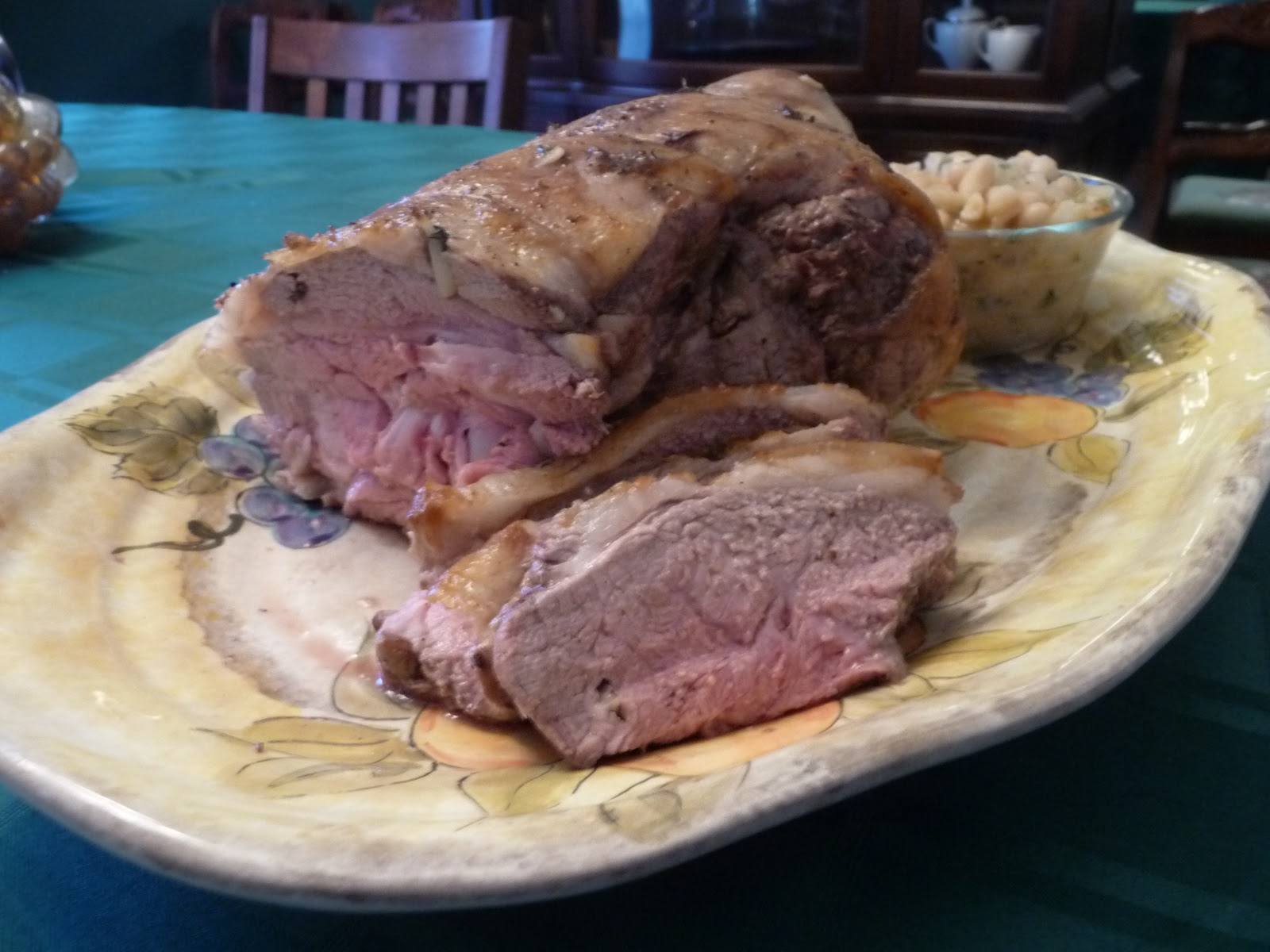
Gigot d'Agneau a la Bretonne (Roast Leg of Lamb with White Beans)

I have always wanted to make a leg of lamb.  In both French and Italian cuisines, a cooked leg of lamb has a certain nostalgia to it.  The leg of lamb immediately evokes memories of Sunday dinners or special occasions, like Easter.  Families and extended families gathered around the table, with the patron of the family at the head of the table, armed with a carving knife and fork, busily working away at carving the meat.

When I cook, I like to picture scenes like the family around the table, even when I am only cooking for myself.  This is particularly true when I am stressed out.  Cooking is a means of stress relief for me because, when I am preparing the food, my focus is solely on the ingredients, the cooking process, and the end result.  Whatever is stressing me out is completely blocked out by a laser-like focus on trying to make a great meal.

In this case, I wanted to prepare a leg of lamb as a means of stress relief, but also as a means of preparing for the upcoming Easter holiday. I wanted to be able to make a leg of lamb for Easter.  A bone-in leg of lamb is an expensive cut of meat, at about $9.00 per pound with a minimum of at least four pounds.  So, I thought I needed a little training before I made this meal for guests on a holiday. My practice was to make Gigot d'Agneau a la Bretonne.

This recipe is centered around a preparation of the leg of lamb as it is done along the shores of Brittany, which places this recipe within the style of "a la Bretonne."  The leg of lamb is studded with slices of garlic and sprigs of thyme.  The leg is seared at high heat for a short period of time (about fifteen to twenty minutes) and then roasted for a good period of time thereafter.  The "a la Bretonne" style of lamb is served with a white kidney bean dish that is studded itself with onions, garlic and tomato.  This is a fairly easy recipe to make and a great way to start learning how to cook a leg of lamb.


GIGOT D'AGNEAU A LA BRETONNE
(ROAST LEG OF LAMB WITH WHITE BEANS)
Adapted from Anne Willan, The Country Cooking of France, 154-155
Serves 8-10


Ingredients (for the beans):
2 cups of white kidney beans
2 tablespoons of butter
2 onions finely chopped
2 or 3 large tomatoes, peeled, seeded and chopped
2 or 3 garlic cloves
1/2 cup of dry white wine
2 to 3 tablespoons of flat leaf parsley, chopped

Ingredients (for the lamb):
1 four to five pound leg of lamb
2 garlic cloves (at least)
1 bunch fresh thyme
2 tablespoons of butter (at least)

Ingredients (for the gravy):
1/2 cup dry white wine
1 1/2 cup of veal or beef broth

Directions:
1.  Cook the beans.  Add the butter to a medium sized saute pan. Add the onions and saute until soft, but not browned, about five to seven minutes.  Stir in the tomatoes, garlic and white wine.  Add the kidney beans.  Mix carefully as as to not break the beans.  Simmer over medium heat, stirring often until nearly all of the moisture has evaporated, which should take about twenty minutes.

2.  Prepare the lamb.  While you are working on the bean dish, preheat the oven to 450 degrees Fahrenheit.  Prepare the lamb by trimming off any skin and all but a thin layer of fat.  Cut one garlic clove into sticks (I actually cut about four small ones).  Poke small holes in the meat and insert the sticks of garlic with small sprigs of thyme.  Butter all sides of the leg of lamb.  Then salt and pepper the lamb liberally.

3.  Cook the lamb.  Sear the lamb in the oven for fifteen to twenty minutes.  Lower the eat to 375 degrees Fahrenheit and continue to roast the leg of lamb often for about forty to fifty minutes.  I put a cup of beef broth and two cups of water in the bottom of the roasting pan so that I could baste the lamb often.  By the end of the cooking process, most of that liquid had evaporated.  I basted the leg about every seven to eight minutes.  A thermometer reading of 140 degrees Fahrenheit will provide for pink meat and 160 degrees for well done. 

4.  Finish the dish.  Transfer the lamb to a carving board and cover it loosely with foil.  Leave it stand while you make the gravy.    For the gravy, discard all but 1 table spoon of fat from the roasting pan.  Add that to a sauce pan with the wine and bring it to a boil.  Add the broth and continue boiling until the gravy is reduced and concentrated.  This should take about five to eight minutes.


Serve the lamb by carving it into thin slices.  Set the meat on a large platter, with the beans on the side and spoon a little gravy over the lamb.

For my first effort at making a leg of lamb, I have to say it was a relatively good success.  I did not get the dark crust on the outside, which was the result of two things that I did differently than the recipe in the cookbook.  First, I covered the lamb during the searing, which I did to avoid a lot of butter spattering in the oven.  Second, I basted the lamb with the mixture of beef broth and water, rather than butter.  Still, the end result was incredibly delicious.  I've learned a lot and will put that new knowledge to my next effort at making this dish, which will be very soon.

ENJOY!

Wednesday, March 30, 2011

My Entry in the Whole Foods Foodie Fantasy Vacation Contest

For those of you who have been following me on my culinary adventures, cooking has been a learning experience for me.  With each dish and each blog post, I take the time to research, not only about the ingredients and techniques, but about the history of a dish, as well as the cuisines and cultures of the people and/or nations who identify themselves through those dishes.

I recently came across a contest sponsored by Whole Foods called the Foodie Fantasy Vacation.  It is a trip from Berlin to Paris, with stops in Amsterdam and Bruges in between.  What really caught my attention is that there will be two producer visits on this vacation.  I would love the opportunity to see how ingredients are grown or food products are made firsthand by producers during this vacation, along with the opportunity to try the cuisines of the Germans, Dutch, Belgians and French.  So, I decided that I would submit an entry for the contest.  Here is my entry:


I submitted it today and you can see my entry as it is submitted at this website.  (Note: Whole Foods is conducting this contest through Facebook, and you may have to accept the Contests Application in order to view the video.  Please accept the application, because I will need your votes ... more about that below.  you can always remove the Contest application after this contest is over.) 

The entry period for the contest runs through April 3. Beginning on Tuesday, April 5, the public will be able to vote for their favorite video.  I really need everyone to vote for my video on Tuesday, because, the next day, on Wednesday, April 6, Whole Foods will be choosing the finalists.  Assuming I am a finalist, the voting will continue until April 13, and the entry that receives the most votes will win. So, I will need everyone to vote like he or she lives in Chicago -- vote early and often.  Well, the rules allow you to only vote once per day, but that still permits you to vote "often." 

I will provide more information as I get it.  Thank you all for your support and encouragement with my cooking and my blog and, as always ...

ENJOY!

Poisson en Papillote

As with any great meal, there is an inspiration.  In this case, the inspiration is my beautiful wife.  I wanted to make a very special dinner for her birthday.  On one prior occasion during a class at L'Academie de Cuisine, I made fish baked in paper, also known as Poisson en Papillote in France and Pesce en Cartoccio in Italy. This is a very healthy way to eat dinner.  The fish is enclosed in parchment paper with whatever vegetables you wish to add along with some olive oil and wine.  The fish proceeds to steam in the bag (or bake depending on how well you seal the bag).  Either way, the final product is very delicious.

So, I found a few recipes to use as guides and decided to make my own version of Poisson en Papillote.  The only limitation was the parchment paper, which ended up being a little on the small side.  Still, I was able to lay a foundation of thinly sliced potatoes, salted and peppered with a little dry thyme, that served as the base for the fish.  I then put carrots, green peppers and red onions, with a little garlic on top.  After almost sealing the pouch,  I added a little white wine from the Loire Valley.  I closed the pouch and stuck it in the oven.


POISSON EN PAPILLOTE
Serves 2

Ingredients:
Between 3/4 to 4/5 of pound of fish, such as Halibut
1 medium sized carrot, julienned
1/2 medium red onion, julienned
3/4 green pepper, julienned
2 red potatoes, very thinly sliced
1 clove of garlic, finely diced
1/4 teaspoon of dried thyme
1/4 cup of dry white wine
Salt to taste
Ground pepper to taste
Olive oil for drizzling and basting

Ingredients:
1.  Prepare the packets.  Preheat the oven to 400 degrees Farenheit.  Prepare two sheets of parchment paper.  Place the potatoes in two rows about the length and width of the fish on each piece of paper.  Salt and pepper the potatoes liberally.  Sprinkle the dried thyme over the potatoes and drizzle a little olive oil over the potatoes.


Place the fish on top of the potatoes.  Salt and pepper the fish.  Then place the vegetables (red onion, carrot and green pepper) on top of the fish.  (Don't worry if you don't use all of the vegetables, just saute the extras and you have an instant side dish.)


Begin sealing each side of the pouch by folding over the parchment and crimp the edges.  When you get to the middle, lift the pouch and pour half of the wine in each pouch. Seal the pouches and spread a little olive oil over the tops of the pouches with a brush.


2.  Bake the fish.  Bake the fish in the oven for about twenty five minutes.


3.  Plate the dish.  Remove the fish from the oven and let it rest for a couple of minutes.  Then split the paper open carefully, because the steam will escape as you cut through the paper.  Serve immediately.

ENJOY!

Monday, March 28, 2011

Great Lakes Brewing Company The Doppelrock

Great Lakes Brewing Company produces a wide variety of seasonal beers, like the Lake Erie Monster and the Christmas Ale.  Recently, they expanded that lineup by adding the Doppelrock, bringing the favors of Germany to the drinking masses in a beer aptly named for the Home of Rock and Roll. 

The doppelbock -- which literally means "double bock" was reportedly brewed first by the monks of St. Francis of Paula.  The monks were aiming to a lager version of the strong ale, which the monks brewed for the Lenten season.  According to the rules of their order, the monks were required to fast for periods during the Lenten season, which meant that they were not permitted to eat solid foods.  So, rather than make regular bread, the monks used the grains to make "liquid bread."

The Doppelrock pours brown, with a reddish tinge depending upon the light.  The aromas of the beer are very roasty, evoking the chocolate malts used in the brewing process.  The roasted flavors turn to more toasted flavors in the taste of the beer.  As with any bock, the malt flavors of the beer clearly predominate.  After all, in addition to the chocolate malts, the brewer also uses Harrington two-row base malts, Munich and Cara Pils malts.  As for hops, the brewer uses Hallertau hops, which are the American version of the German noble hops.  At 7.8%, the brewer got the ABV right on the mark for a doppelbock, but you would never know that while you are drinking the beer.

Great Lakes Brewing Company suggests that this beer could be paired with pot roast, hearty beef stews and earthy cheeses.

I found this beer at Whole Foods, where it sells for about $8.99 for a four pack.  It should also be available at most beer stores that sell Great Lakes beers. 

ENJOY!

For more information about doppelbocks, check out the German Beer Institute.  For more about the beer itself, check out the brewer's website.

Saturday, March 26, 2011

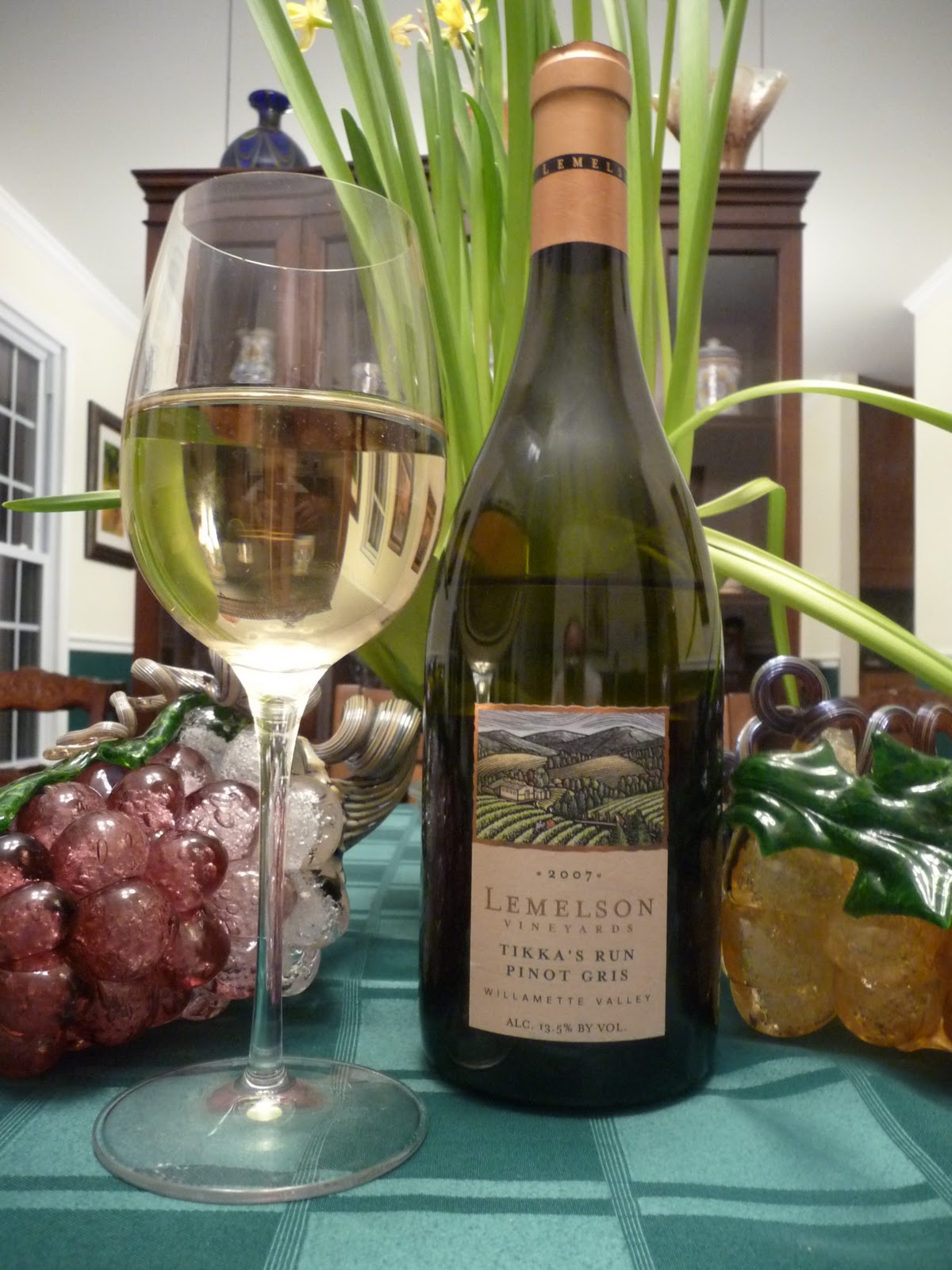
Lemelson Vineyards Tikka's Run Pinot Gris (2007)

Many of the wines that I've reviewed to date have been from vineyards that both Clare and I visited on our honeymoon, such as Domaine Drouhin Oregon, Prive Vineyards, and Sokol Blosser. We visited many vineyards and purchased quite a lot of wine.  As we near our second anniversary, we still have some bottles left from our vacation, which we now open on special occasions or, just when we want to have a really good wine.  With respect to the Tikka's Run Pinot Gris from Lemelson Vineyards, it was the latter occasion ... we wanted a really good wine.  And we got what we wanted.

I can still remember visiting the winery at Lemelson Vineyards during our honeymoon.  Like many Oregon vineyards, Lemelson has strived to ensure that its winemaking is as environmentally friendly as possible.  They use multiple fermentation vessels, allowing the grapes from each vineyard block to ferment separately.  The vineyard uses gravity -- rather than pumps -- to move the wine at very low pressures, helping to preserve the aromas and flavors of their wines.
Lemelson Vineyards sets itself apart from all of the other Oregon vineyards with what it calls a "one-of a kind mobile stainless steel sorting platform." This platform, which resembles the bridge of a vessel, moves along the fermentation vessels.  On this platform, the winemakers can sort through the grapes to pick out those clusters that they want to use for their wines, like the Pinot Gris grapes used for the Tikka's Run.

The grapes for the 2007 vintage of the Tikka's Run comes from Lemelson's Chestnut Hill Vineyard and from its Wascher Vineyard.  While both of these vineyards are in the Willamette AVA, they have different soils and are at different elevations.  The Chestnut Hill vineyard has volcanic soil at about 900 feet, while the Wascher vineyard has sedimentary soil and a lower 300 feet elevation.  The fermentation of the wine began in the tanks, with some of the wine being transferred to oak barrels during the late stages of fermentation.  

The Tikka's Run Pinot Gris pours a nice light gold color, which is very appealing.  The winemaker notes that the aromas remind them of passion fruit, green apples and Asian pears, along with Meyer lemons and chalk.  For me, however, I think the aromatic elements speak more of apricots and a little melon.  The winemaker also notes that the taste of the wine has almond and red apple.  Once again, I found that there was some apricot, melon and even a little fennel. The wine itself coats the tongue in a way that is more suggestive of a dessert wine than a wine one would ordinarily drink with a meal.  The sugary sweetness of the wine leaves the drinker with a finish of apricots that is very enjoyable. 

Like most Pinot Gris wines, the Lemelson Vineyards Tikka's Run Pinot Gris pairs well with mild white fish, like rockfish, along with other seafood, such as oysters or crab.  The Tikka's Run also pairs well with very spicy dishes, providing a sweet complement to the heat of the peppers.

Clare and I purchased this wine when we were at the vineyard in Willamette Valley and I have to admit that I have not seen it in any stores.  Lemelson wines are available over the Internet and at some larger wine stores. 

ENJOY!

For more about the Tikka's Run Pinot Gris, check out the winemaker's notes.

Friday, March 25, 2011

Spice Crusted Strip Steak with Sauteed Rainbow Chard

Every week, I have what I call "Steak Night."  That is a night during the week when my beautiful wife, who does not eat meat, is either at work or at a meeting around dinner time.  While she is gone, I pull out a nice (and sometimes big) steak, cook it, and enjoy life as a carnivore.  Recently, when Clare was meeting up with some friends, I decided that I would make a spice crusted steak and, based upon my success at sauteing Swiss chard, I would make a side of sauteed chard.

Normally, I would simply throw some different types of ground pepper together, along with some cumin, paprika, and garlic powder.  However, that usually results in a very spicy rub.  Knowing that this would end up on my blog, I decided that I would look at what other people do for rubs.  Who better to consult about a rub for beef than Bobby Flay.  I found a blog which reproduced Bobby Flay's recipe for Spice Crusted Strip Steak in Mesa Grill Cookbook.  I did not really follow it, but it provided some guidance on how I could restrain myself when it came to adding peppers to the rub.


I also decided that I would pan sear the strip steak, sealing in the juices and getting a good crust, and using the remnants in the pan to saute the Swiss Chard.  I also substituted the white wine called for in the recipe I previously used with a half cup of a pilsner beer.  As with wine, you should always use a beer you would drink.  I chose an Abita SOS Pilsner. In the end, the remnants of the rub, plus a little butter and beer, created a very tasty chard.

SPICE CRUSTED STRIP STEAK WITH SAUTEED RAINBOW CHARD
Rub Adapted from Bobby Flay's Mesa Grill Cookbook
Serves 2

Ingredients (for the Rub):
1 teaspoon of ancho chile powder
1 teaspoon of chipotle chile powder
1 teapoon of coriander powder
1 teaspoon of dried mustard
1/2 teaspoon of dried oregano
1/2 teaspoon of ground cumin 

Ingredients (for the Steak and Swiss Chard):
1 strip steak, about 3/4 to 4/5 pound 
1 bunch of rainbow chard, stems diced, leaves sliced in even slices
2 cloves diced
5 tablespoons of canola oil
2 tablespoons of butter
1/2 cup of beer, preferably a pilsner
2 tablespoons of grated Parmigiano Reggiano
Salt, to taste
Pepper, to taste

Directions:
1.   Prepare the rub.  Rub 2 tablespoons of canola oil over all sides of the strip steak.  Combine all of the powders and dried ingredients together and then rub it over all sides of the steak.

2.  Pan sear the steak.  Heat an ovenproof pan on medium high heat and add three tablespoons of canola oil.  Place the steak in the pan and begin to cook at least five minutes to each side.  (The reason it is not on high heat is that it would simply burn the rub.  Medium high heat will burn it a little, but develop a better crust.)  Remove the steak.   You can finish the steak in the oven to medium in the broiler for about 5 more minutes on both sides.  Otherwise, the steak will be medium rare or rare.

3.  Saute the shard.  Once the steak has been removed, melt the butter in the pan and add the diced stems.  Saute the stems for about six minutes.  Add the garlic and continue to saute for a couple more minutes. Add the beer and continue to saute for a couple of minutes.  Add the Swiss chard and continue to saute until it is wilted.  Add the Parmigiano Reggiano and continue to stir for a minute.  Salt and pepper to taste.

4.  Plate the dish.  Plate the Swiss chard on the middle of the plate.  Cut the strip steak and plate it over the Swiss Chard.

ENJOY!