Friday, September 30, 2011

Elysian Brewing Company Night Owl Pumpkin Ale

I was standing in front of the seasonal beer selection at a local store when I saw the Elysian Brewing Night Owl Pumpkin Ale.  The Elysian Brewing Company was founded in 1995 by three individuals: Dick Cantwell, Joe Bisacca, and David Buhler.  The brewery opened in the Capitol Hill neighborhood of Seattle, Washington. The brewery has expanded over the years, establishing its own brewpub called TangleTown.  The brewery also opened Elysian Fields, a large brewpub near Qwest Field and Safeco Field.  At these locations, Elysian Brewing Company serves a total of almost twenty of its own beers, including the Night Owl.   

Elysian Brewing brewed the Night Owl using over seven pounds of pumpkin per barrel.  The brewer provided more information on its website. More specifically, roasted and raw pumpkin seeds were added to the mash.  Pumpkin was also added to the mash, kettle and fermenter.  The brewer spiced the beer during conditioning with nutmeg, clove, cinnamon, ginger and allspice.  In addition, the brewer used Pale, Crystal and Munich malts, along with Magnum hops in the brewing process. 

The Night Owl pours a dark orange/copper color, with a thin layer of foam that quickly recedes to the edges of the glass.  The aromatic elements of this beer include pumpkin, along with a darker cinnamon or sugar.  What sets the beer apart from others in this style is that, unlike other pumpkin ales that I have tried, the aromas of this beer feature pumpkin more than the spices.

The Night Owl has a lighter body than other pumpkin ales that I have tried.  The primary taste of this beer is also the pumpkin, with the nutmeg, clove, cinnamon and other spices complementing that flavor.  As the pumpkin and spices give way, the beer has a slightly dry finish.  

This beer has an ABV of 5.9% and an IBU of 18.  It is available at beer stores that have a large selection of craft beers, like Gilly's Craft Beer and Fine Wine in Rockville, Maryland.

ENJOY!

Tuesday, September 27, 2011

Barbecued Octopus with Arugula and Mint

While I was on my vacation, I was standing at the seafood counter at a local grocery store when something caught my eye ... a whole octopus.  I've cooked with octopus before, as part of an Iron Chef challenge involving the "secret" ingredient of mussels.  However, this was a big octopus, weighing in at about one and one half pounds.

I must have walked by the seafood counter at least three times, with my cell phone in hand, googling recipes for a whole octopus.  This was a little daunting for me.  I scrolled down, page after page, looking for a recipe that I could do.  I was just about to give up when I came across a recipe from the one person who is probably my most favorite and admired chef ... Mario Batali.  Feeling safe with the knowledge that Chef Batali knows a lot more about cooking than me, I looked at his recipe for Barbecued Octopus with Escarole and Mint and decided that I would give it a try.

I immediately encountered a problem. The store did not have any escarole.  However, I decided to substitute arugula because I thought the peppery taste of arugula would be paired well with the mint.  After adjusting some of the recipe to take into account that the octopus I bought (which was one and one-half pounds) was much less than the three to five pound octopus called for in the recipe. 


BARBECUED OCTOPUS WITH ARUGULA AND MINT
Adapted from Mario Batali's recipe on Food Network's website
Serves 3-4

A big octopus, about 3' in length
Ingredients:
1 octopus (about 1 and 1/2 pounds, cleaned)
1/2 cup extra virgin olive oil
1 lemon, juiced and zest
1/2 tablespoon of crushed red pepper flakes
1/2 bunch of fresh oregano, chopped
1/2 tablespoon of freshly ground black pepper
1 teaspoon of ground sea salt
1 bunch of arugula
1/2 cup of fresh mint leaves, chopped

Directions:
1. Simmer the octopus.  Place octopus in cold water with a cork and bring to a boil.  Reduce to a simmer and cook for about fifteen to eighteen minutes.  Remove, rinse and cut into four pieces.

2.  Marinate the octopus.  In a mixing bowl, stir together the olive oil, lemon zest and juice, red pepper, oregano and black pepper.  Marinate the octopus pieces for about ten minutes.  

3.  Grill the octopus.  Preheat the grill while the octopus is simmering in water.  Place the octopus pieces on the grill.  Cook for about five minutes per side.  Return the octopus to the marinade and cut into bite sized pieces.

4.  Plate the dish.  Arrange the arugula leaves a plate.  Arrange the octopus on the plate and sprinkle with the mint.  

ENJOY!

Monday, September 26, 2011

Fusilli con Gambero (Fusilli with Shrimp)

My beautiful Angel does not eat meat and, when I made a Fusilli con Salsicca dell'Agnello for her parents, I decided to make a separate sauce with shrimp for Clare.

When buying shrimp, never focus on the size.  Descriptions like medium, large, extra-large and jumbo do not mean anything.  The most important consideration is the "count."  The "counts" may seem a little confusing, but the one thing to remember is that a count is the number of shrimp that are in a pound.  So, when you see a number like 21/25, it means that there is 21 to 25 shrimp in a pound.  

Generally, when I am using shrimp in a main dish, I look for a 16/20 count, which means that 16 to 20 shrimp in a pound.  That means that a portion is about 1/4 of pound or 4 to 5 shrimp.  By contrast, when I am using shrimp in an appetizer or a salad, I will usually look for 21 to 30 count or 31 to 35 count.  These shrimp will be smaller than the 16/20 count, but they will not be too small.  Depending upon the recipe, I will consider 36/45 count, but I will generally steer toward smaller counts like 31 to 35. 

For this recipe, I used 16/20 count shrimp that were from the Gulf of Mexico.  These shrimp were harvested off the coast of Texas and looked great when I cooked them. Different sizes of shrimp can be used, with only a minor change to the cooking time. 


FUSILLI CON GAMBERO (FUSILLI WITH SHRIMP)
A Chef Bolek Original
Serves 3-4

Ingredients:
3/4 pound of fresh fusilli
1/2 pound of fresh shrimp, deveined and deshelled
1 large clove of garlic, diced finely
1/2 onion, diced finely
3/4 of a can of whole San Marzano tomatoes
1/2 tablespoon of dried basil
1 teaspoon of dried oregano
1/2 teaspoon of red chile flakes
2 teaspoons of finely grated Parmigiano Reggiano
Salt, to taste
Pepper, to taste
3 tablespoons of extra virgin olive oil

Directions:
1. Saute the garlic and onions.  Heat the olive oil on medium heat.  Add the garlic.  Cook for one minute.  Add the onions and continue to cook for about three to four minutes, until the onions are translucent.  Stir occasionally to prevent the garlic from burning.

2.  Add the tomatoes and spices.  Add the tomatoes.  Using a masher, mash the tomatoes until they are broken up well.  Add the basil, oregano and chile pepper flakes. 

3.  Add the shrimp.  When the tomatoes begin to boil, add the shrimp to the tomato sauce.  Continue to cook until the shrimp is opaque and firm, which should take about two to three minutes. Add the Parmigiano Reggiano cheese and stir well.

4.  Cook the pasta.  While you are preparing the sauce, heat a pot of water until it is boiling.  Add the fresh fusilli to the boiling water.  Cook for two minutes.  Remove the pasta from the water and add it to the tomato sauce, with a little of the water from the pasta.  Stir very well until the pasta is covered with the sauce.  Add the fresh basil.  Serve immediately.

ENJOY!

Sunday, September 25, 2011

Vinhas Altas Vinho Verde (2010)

One of the latest trends in white wine is Vinho Verde, a white wine produced in Portugal.  Vinho Verdes are also a fairly difficult wine to blog about.  It takes a little time to get information about the wine, and even longer if I want to include something about the winemaker.  When I reviewed the Opala Vinho Verde (2009), I was able to get enough information to talk about the background about this wine, including the types of grapes used and the DOC established for the wine. 

Recently, when I was working on the latest installment of my Around the World in 80 Dishes Challenge, I was able to try another Vinho Verde.  The challenge was Mozambique, a former Portuguese colony.  As part of the challenge, I was making Camarao Mozambique.  One of the ingredients in that dish is 1/4 bottle of white wine and, given the origins of the recipe, Vinho Verde was the recommended wine.  So, I bought a bottle of the Vinhas Alta Vinho Verde (2010).

The Vinhas Alta Vinho Verde is very similar to the Opala Vinho Verde.  The wine pours very light and clear, with heavy carbonation.  As the picture shows, there were a lot of bubbles that danced up the sides of the glass.  The aromas of the wine include crisp apple, some pear and even a little grass.   

After taking in the aromatic elements of the wine, I could taste green apples, just after taking the initial bite.  Not just any green apples, but apples that had marinated in a wine like Moscato.  The Vinhas Alta Vinho Verde has that sugary sweetness that is very reminscent of dessert-style Moscato wines. This sweetness provided a little different character to the Vinhas Alta, separating it from the Opala.  

As for pairing, I paired this wine with the Camarao Mozambique, a spicy shrimp dish from Mozambique.  I had restrained myself a little in terms of the spice, which was a good thing because it allowed the wine to shine a little more.  Other than somewhat spicy dishes, this wine -- like most Vinho Verdes -- pair very well with seafood dishes, as well as chicken dishes that include citrus (like lemon juice or lime juice).  

This wine is good, although I think the Opala Vinho Verde a little more.  This wine is available at local grocery stores and wine stores.  It is a bargain value at about $8.99 a bottle.

ENJOY!

Saturday, September 24, 2011

Uinta Brewing Company Punk'n Ale

There is a high chain of mountains in northeastern Utah known as the Uinta Range.  The mountains are the highest range that runs from East to West in the continental United States. At a little lower altitude, there is Uinta Brewing Company, a craft brewer located in Salt Lake City.

Utah and Salt City are not known for craft beer; yet, Uinta has been brewing beer there since 1993.  The brewer has expanded over the year, growing not only its operations but the distribution of its beer. Recently, both Clare and I were visiting one of our local craft beer stores.  We came across a six pack of Uinta Brewing Company's Punk'n, an ale brewed with pumpkin and spices.  Ordinarily, this beer is available from October to December; however, we were fortunate enough to try the beer a little early. 

The Punk'n pours a light orange in color, with a little foam.  The brewer describes the beer as having hints of vanilla and cloves.  For me, the highlights of the aromatic elements feature more cinnamon than either vanilla or cloves (although there is definitely cloves in the aroma).  

The body of the beer is very light, a little more than I expected.  Cinnamon not only provides the primary aroma, but also the primary taste of the beer.  Cloves, nutmeg and allspice seem to follow the cinnamon, but they are more secondary.  

The brewer suggests that this beer is best paired with food that contains nutmeg, cloves and cinnamon.  Suggested dishes include roasted turkey, squash or pumpkin ravioli, peach cobbler or pumpkin cheesecake.  I was a little more adventurous in the pairing, pitting it against the Mozambican dish of Matata.  The reason is that Matata is traditionally made with pumpkin leaves and, while I used spinach as a substitute, I thought the beer would work well with the dish.  As it turns out, the pairing was pretty good.  The spices in the beer provided a complement to the more earthy flavors of the clam and peanut stew.  

The Punk'n has an ABV of 4.0% and an IBU of 10.  The beers are available at beer stores that have a larger selection of craft beers.  

ENJOY!

Friday, September 23, 2011

Grass Fed N.Y. Strip Steak with Bone Marrow-Sage "Chimichurri"

If someone were to ask me to identify my favorite ingredient, I could quickly focus on a handful of ingredients. One of those ingredients is bone marrow.  The health benefits of bone marrow are still under study, but there are some preliminary findings that are very favorable.  Bone marrow is full of polyunsaturated fatty acids.  Those are the good type of fatty acids, as best demonstrated by one of the most well known polyunsaturated fatty acids ... Omega 3.  Bone marrow also contains iron, phosphorus and vitamin A.   However, the most interesting nutritional fact about bone marrow is that it contains alkylglycerols or AKG.  Alkylglycerols are a form of lipid that stimulate the generation of white blood cells known as neutrophils, which are cells of the immune system that defend against bacteria and fungi. AKGs are also believed to stimulate the production of microphages, which are immune cells that actually digest pathogens and foreign invaders.  

The common wisdom is that if something is that good for you, as bone marrow seems to be, it could not possibly taste good.  I am happy to say that this is where the common wisdom fails. In this recipe, bone marrow is used as a substitute for olive oil and sage is used for a substitute for cilantro and parsley.  The substitutions created a great flavor pairing ... bone marrow and sage ... that led to a great sauce to top a New York Strip Steak. 

GRASS FED N.Y. STRIP STEAK WITH
BONE MARROW-SAGE "CHIMICHURRI"
A Chef Bolek Original
Serves  2-3

Ingredients:
1 N.Y. Strip Steak, about 3/4 to 4/5 of a pound
3 marrow bones
1 teaspoon of pink peppercorns (substitute black peppercorns)
2 cloves of garlic, sliced
2 tablespoons of fresh sage, chiffonade
1 teaspoon of ground black pepper
1 teaspoon of ground sea salt
1/4 teaspoon of crushed red pepper

Directions:
1.  Roast the marrow bones.  Set the oven at 425 degrees Fahrenheit.  Place the marrow bones in the oven and cook them for about thirty minutes.  Remove the bones from the heat and scoop out the marrow into a bowl.  

2.  Cook the strip steak.  Start the broiler.  Season the steak with salt and black pepper on all sides.  Cook the steak to the desired doneness.  

3.  Prepare the "chimichurri."  While the steak is cooking, add the bone marrow and the other ingredients (sage, black pepper, peppercorns, sea salt, crushed red pepper) to a food processor.  Use the food processor setting and pour in any liquid fat from the bone marrow.  (If there is no liquid fat, use about one to two tablespoons of olive oil.)  

4.  Plate the dish.  Slice the strip steak and spoon the "chimichurri' over the meat.

ENJOY!

For more about the health benefits of bone marrow, check out Thatsfit.ca.

Wednesday, September 21, 2011

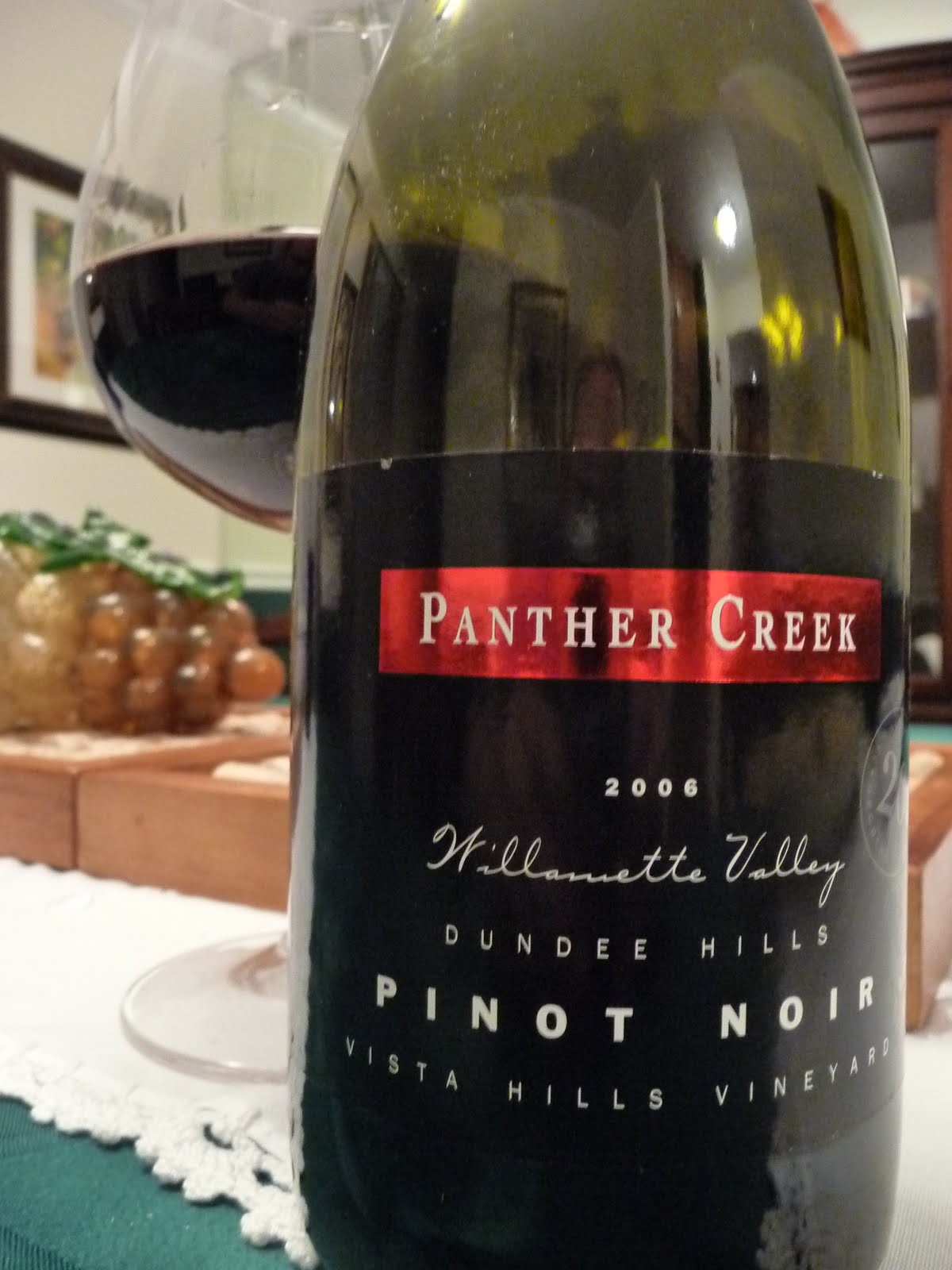
Panther Creek Cellars Vista Hills Vineyard Pinot Noir (2006)

As a winemaker, Panther Creek does not have its own vineyards.  There are benefits to not having your own vineyard.  Most notably, the winemaker can choose to make wines using fruit from different sources.  I have previously reviewed Panther Creek's Shea Vineyard Pinot Noir (2006), where the winemaker obtained all of the grapes from the Shea Vineyard in Oregon's Willamette Valley. 

Both Clare and I purchased the Shea Vineyard Pinot Noir during our honeymoon, when we also picked up another Panther Creek wine, its Vista Hills Vineyard Pinot Noir.  The Vista Hills Vineyard is a forty-five acre vineyard located in the Dundee Hills AVA (American Viticultural Area) of Willamette Valley.  The family owned vineyard grows Pinot Noir and Pinot Gris grapes.  The Pinot Noir grapes are Pommard clones, which originated in Burgundy, France.  And, when they are not bottling their own wine under the Vista Hills Vineyard label, they sell their fruit to local winemakers, like Solena, Panther Creek. 

I could not find any information on the 2006 wine, but I did find the winemaker's notes for the 2007 wine.  While wines can differ from year to year, those notes can provide a guide.  Panther Creek describes its wine as having bright, ruby tones.  This wine is brighter than many of the Oregonian Pinot Noir wines that I have tried. The aromatic elements of the wine are very fruit forward.  The winemaker describes the aromas as having berries, rose petals and cloves.  I can definitely see the berries and even the cloves.  The rose petals did not seem to come forward in the bottle that we tried.  As for the taste, I think the wine had flavors of raspberries, strawberries and other bright fruit, as opposed to dark cherries or plums.  The winemaker describes the wine as having the flavors of strawberries, cream, brandied cherries, and earth tones.  While I think this is a very good wine, I did not pick up all of the flavors that the winemaker suggests.

A bottle of Panther Creek sells for $40.00 per bottle.  It is available from the winemaker's website.

ENJOY!

Tuesday, September 20, 2011

Coriander Sesame Bluefish

While perusing the selection at Southern Maryland Seafood, I saw that they had some really nice, fresh bluefish fillets. The bluefish, Pomatomus Saltatrix, is a game fish found around the world.   In the United States, bluefish migrate up and down the east coast, moving north in the spring and returning south in the fall.  Bluefish can live for up to twelve years and grow to about forty inches long, although the bluefish in the Chesapeake Bay (where I live) usually only reach about twelve inches in length. They are closely related to jacks, pompanos and roosterfish.

Bluefish are truly an interesting species of fish.  The most striking feature of this fish is its razor-like teeth.  Those teeth are often the bane of fishermen, as the bluefish have the ability to strike and steal the bait.  Those teeth also tear into herring, mackerel, anchovies, striped bass and shad, which are part of the bluefish's diet. Indeed, bluefish will strike at most anything, even at things that it would normally not eat, including humans.  The voracious nature of the bluefish, as well as its teeth, have earned the fish the nickname of "marine piranha."  

Personally, I really like to cook with bluefish.  This recipe is a collaboration between myself and Clare's father, Frank.  After purchasing a good sized fillet, we pondered over how to prepare the fish.  Frank suggested that we use Asian flavors, such as sesame oil.  I thought that was a great idea and, together, we made a wet and dry rub incorporating a variety of Asian flavors to use on the fish.  This recipe is excellent and it is definitely one that I will make again.


CORIANDER SESAME BLUEFISH
A Chef Bolek Collaboration with Frank Savage
Serves 4-6

Ingredients:
2 pounds of bluefish fillet, cut into four steaks
1 tablespoon of ground coriander
1 tablespoon of ground onion
1 teaspoon of ground garlic
2 teaspoons of ground black pepper
1/2 teaspoon of Sambal Oelek
2 tablespoons of canola oil
2 teaspoons of sesame oil
2 teaspoons of soy sauce
1 teaspoon of ground sea salt
2 tablespoons of sesame seeds

Directions:
1.  Marinate the fish. Mix all of the dry ingredients (coriander, onion, garlic, black pepper, salt) together.  Mix all of the wet ingredients together.  Baste the bluefish steaks with the wet ingredients and then sprinkle the steaks with a good amount of the dry ingredients.  Let the fish stand for ten to fifteen minutes.

2.  Roast the fish.  Heat the oven to 425 degrees Fahrenheit. Place the steaks in the oven to cook for fifteen minutes.  Turn on the broiler and finish the fish for about five minutes under the broiler.  

3.  Toast the sesame seeds.  After about ten minutes, heat the sesame seeds in a dry skill on medium high heat.  Toast the seeds.  

4.  Finish the dish.  Remove the fish from the heat.  Sprinkle some of the toasted sesame seeds over the steaks.  Serve immediately.


ENJOY!

Sunday, September 18, 2011

New Belgium Brewing Company Grand Cru Abbey Ale

New Belgium Brewing Company produces some great beers, such as its Fat Tire Amber Ale.  However, the beers that truly get my attention are the special or limited edition beers.  These beers include those that are part of New Belgium's Lips of Faith Series. The Lips of Faith Series are small batch beers, usually produced for internal consumption.  I've previously reviewed one such beer, the Le Fleur, Misseur? Ale, which involved a very good use of Brettanomyces.   

Fortunately, Clare and I have a couple of friends in Colorado who provided us with a couple bottles from the Lips of Faith Series.  I decided that these beers deserved special treatment.  Not only would I do a review of the beer, but I would also research the food pairing for each beer.  Based upon my research, I would create a Chef Bolek Original dish.  I would serve the dish to Clare and myself while we tried the beer. 

The first beer that our friends provided us is New Belgium Brewing's Grand Cru Abbey Ale.  After every one thousand batches of beer brewed by New Belgium, a batch of the Grand Cru Abbey Ale is brewed.  The Grand Cru is a nod to the Abbey Ale, which was New Belgium's first beer.  The Abbey Ale has collected sixteen medals at the Great American Beer Festival, seven of which were gold medals.

The brewer uses an array of ingredients to brew this beer.  There are five malts used to make this beer, including Chocolate, Carapils, C-80, Pale and Munich malts.  There are also three hops used in the brewing process, including Willamette, Target and Liberty hops.

The Grand Cru Abbey Ale pours a nice amber and gold color, with a nice foam that hugs the edges  elements of the glass.  The aromatic elements of the beer foreshadow the alcohol in the beer,  which, after all, has an ABV of 9.5%.  The aroma is far more complex than alcohol.  There are also aromatic elements such as vanilla, sugar, cloves, and rum.  Some of these elements carry over to the taste of the Grand Cru.  At least for me, the beer is full of flavors that are associated with trappist beers, such as cloves, as well as cloves and caramel.  

In terms of food pairing, the brewer provides several suggested pairings on its website; however, one pairing caught my attention ... a roasted vegetable stew with dumplings.  Drawing my inspiration from roasted vegetables, I developed the dish, Seared Sea Scallop on a Roasted Root Vegetable Puree. The puree is made from roasted root vegetables, such as leeks, onions, carrots and radishes.  What ties the flavors of the puree to the flavors of the Grand Cru is the use of certain spices.  In particular, I used clove and coriander, which are intended to complement the clove and banana flavors in Grand Cru Abbey Ale.  The cloves and coriander also tie the root vegetable to the flavors of the protein ... the pan seared scallops.

For my first time creating a dish in order to pair it with a beer, I think I did a fairly good job.  I still have a lot to learn, but that is one of the reasons for this blog.  

With this beer, New Belgium declares, "[t]oast to the monk's virtue and have a heavenly experience."  In this case, both Clare and I toast the our friends' kindness and have enjoyed a very, very good beer.

ENJOY!

Saturday, September 17, 2011

Pan Seared Scallops with Roasted Root Vegetable Puree

This dish represents a first for me ... a challenge to create a dish specifically to pair to a beer. The beer is the New Belgium Brewing Company's Grand Cru Abbey Ale.  After reviewing the brewer's website and perusing the recommended food pairing, there was something that caught my eye.  Roasted vegetables.  Those two words started the creative process.  Carrots, garlic, leeks, onions, radishes.  There were a lot of choices when it comes to ingredients.  Ultimately, I decided on a selection of root vegetables -- carrots, leeks and radishes -- along with some vegetables that I had lying around the kitchen, like onions and garlic.

There were also choices when it came to preparation.  While I had been thinking about the ingredients, I chose scallops as the protein.  The question then became: how do I "pair" the vegetables to the scallops?  I had to answer this question before I could ultimately pair the dish with the beer.  I decided that the roast the vegetables and then puree them to the something that approached the consistency of mashed potatoes.

So, in the end, I had Pan Seared Scallops with Roasted Root Vegetable Puree.  The dish turned out well, the pureeing of the different root vegetables resulted in an interesting texture for the puree.  This texture could be smoothed out for people who like things like smooth mashed potatoes, by the addition of a couple of tablespoons of milk or heavy cream.  Since I like my mashed potatoes with some texture, I did not add anything to the puree, other than some coriander and toasted whole cloves, which tied the dish together with the beer


PAN SEARED SCALLOPS WITH ROASTED ROOT VEGETABLE PUREE
A Chef Bolek Original
Serves 2

Ingredients:
8 bay scallops  
1 bunch of carrots (approximately 8 carrots)
1 bunch of radishes (approximately 10 radishes)
2 leeks
1/2 sweet onion
6 cloves of garlic, roasted
8 cloves, toasted
1/4 teaspoon of ground coriander
1 tablespoon of fresh thyme chopped
Handful of thyme sprigs
3-4 tablespoons of extra virgin olive oil
Extra virgin olive oil for drizzling
Salt, to taste
Ground pepper, to taste

Directions:
1.  Roast the vegetables.  Cut the root vegetables (leek, radishes, carrots, onion) into even size pieces.  Drizzle the vegetables with olive oil, and season with salt and pepper.  Add the thyme sprigs.  Mix the vegetables so that all are well covered with the oil, salt and pepper.  Heat the oven to 400 degrees Fahrenheit.  Roast the vegetables in the oven for about thirty minutes. 

2.  Make the puree.  Remove the vegetables and add to a blender.  Toast the cloves in a dry pan until fragrant and add them to the blender with the coriander. Puree the vegetables, spoon into a bowl and cover. 

3.  Saute the scallops.  Heat the 3 to 4 tablespoons of olive oil in a pan on high heat.  Add the scallops and sear on one side for about eight minutes.  Flip and continue to cook until the other side begins to develop some color, about four to five minutes more depending upon the size of the scallops. 

4.  Plate the dish.  Plate the roasted root vegetable puree in the middle of the plate and place four scallops on the puree.  Sprinkle some of the chopped thyme and serve immediately.

ENJOY!