Friday, October 22, 2021

Pumpkin Spice Mix

For those who know me, they would also know that a post about pumpkin spice is an unlikely subject for this blog. There are many reasons. You may ask:

Would you like it in your coffee?  
Would you like it in your tea?

I would not like it in my coffee.  
I would not like it in my tea.
I don't like it here or there.
I don't like it anywhere.
I don't like pumpkin spice.
About it, I can't say anything nice.

Would you eat it in a cake?
Would you drink it in shake?
I would not eat it in a cake.
I would not drink it in a shake.
I don't like it here or there.
I don't like it anywhere. 
I don't like pumpkin spice.
It is not worth the added price.

I could go on, but I think you get the point. I don't like pumpkin spice.

But, I love my family and everyone was getting together for a virtual baking event. The recipe for our event was a pumpkin swirl cheesecake. One of the ingredients listed in the recipe was one and one-half teaspoons of "pumpkin pie spice."  While I may have dozens of spices in my kitchen, there is not a single bottle of pumpkin spice to be found. 

So, I went looking for a recipe online to make a pumpkin spice. Needless to say, there are a lot of recipes for pumpkin spice on the Internet. There is one common feature of these recipes: they all start with cinnamon and ginger (more of the former than the latter), but then the recipe turns into a sort of choose-your-own-adventure. Mace or nutmeg. Allspice or cloves. It is as if one could end up with multiple configurations of what could be pumpkin spice.

I did not want to have to choose between spices. I wanted a recipe that was more straightforward. A recipe that called for mace and nutmeg, allspice and cloves. After all, I have all of those ingredients.  I should be able to use them all. I eventually found that recipe on The Kitchn website. A pumpkin spice recipe that called for all six of the ingredients (cinnamon, ginger, allspice, cloves, nutmeg and mace). 

Once I stopped looking, my mind turned to a rather ironic fact. I hate pumpkin spice, but I love every ingredient used to make that spice.  I freely use all of those ingredients (as called for) when I make spice mixes, such as masalas and curries. A quick glance at the label cloud to the right shows there are 18 recipes with allspice, 41 recipes with cinnamon, 30 recipes with cloves, 52 recipes with ginger, 0 recipes with mace and 15 recipes with nutmeg. Clearly, I don't have any problems with the ingredients that go into pumpkin spice. 

Perhaps my dislike of pumpkin spice comes from its commercialization. It seems like everything is "pumpkin spice" this time of year.  Now, I am back to hating that spice. 

PUMPKIN SPICE MIX

Recipe from The Kitchn

Ingredients:

  • 1 tablespoon ground cinnamon
  • 2 teaspoons ground ginger
  • 1/2 teaspoon ground allspice
  • 1/2 teaspoon ground cloves
  • 1/2 teaspoon ground mace
  • 1/2 teaspoon ground nutmeg

Directions:

Combine all of the ingredients together and stir until well-mixed. Store in an airtight container at room temperature for up to one year.

ENJOY!

Friday, October 15, 2021

Asari No Sumashijiru (Japanese Clam Soup)

There is something to be said about simplicity. A handful of ingredients - water, lemon, clams, salt and cilantro - combined in a basic preparation. The end result is a soup is a dining experience that transcends many of the dishes that I have had at a lot of fancy restaurants. 

This recipe - Asari No Sumashijiru - has made me rethink much of what I have thought about cooking. I spend a lot of time looking for recipes that incorporate a range of ingredients, utilize new cooking (and sometimes complex) cooking techniques, and produce some very delicious dishes (which, if my photography skills were a little better, would look as good as they taste). But this five ingredient dish, prepared simply by boiling the clams, turned everything on its head.

A sumashijiru is a simple, clear soup with certain specific components. There is the suiji, which is the stock (or water), and the wadane, which is the solid ingredient. There is also the tsuma, a garnish that adds color, and the suikuchi, a garnish that adds fragrance. 

Each particular component is clearly present in this recipe. The suiji is water, flavored by the solid ingredient or the wadane, which are asari (clams). The tsuma is the Japanese cilantro and the suikuchi is the use of lemon juice and zest.   

One additional note about the clams. The recipe called for manila clams, which resemble short-neck clams (or little neck clams). Little neck clams are the smallest type of clams that one will find either in grocery stores or in restaurants. 

However, I had middle-neck claims on hand when I made this recipe.  Middle neck clams are, as their name suggests, mid-sized clams. They are basically cherrystone clams. Generally speaking, I prefer middle-necks or cherrystone clams because of their size. In my humble opinion, they are the "Goldilocks" of clams, not too small so as to barely register when you bite into them and not too big so that they are too tough when you bite into them. In the end, I think the middle-neck clams worked as well as manila clams or little-neck clams. 

Whatever clams you have, or if you need clams (go out and get them), you should make this recipe. It is truly amazing how something so simple can be so profound.

ASARI NO SUMASHIJIRU (JAPANESE CLAM SOUP)

Recipe available at The Spruce Eats

Serves 4

Ingredients:

  • 1 pound manila clams
  • 5 cups water
  • Kosher salt, to taste
  • 1 lemon, zested
  • Mitsuba (wild Japanese cilantro), for garnish

Directions:

1. Cook the clams. In a medium pot, bring water to a boil. Reduce heat to medium and add a bit of salt to the water (approximately 1/2 to 1 teaspoon salt). Add fresh clams directly into the boiling water.  Cook until all the clams open. If there are any unopened clams, remove them from the pot and discard.

2. Finish the dish. While the clams are are cooking, zest the lemon using a microplane or a peeler.  Serve four to five clams in small soup bowls and pour broth over them. Garnish with lemon zest and Japanese parsley. Serve immediately. 

ENJOY!

Thursday, October 7, 2021

Sea You At the Bottom

While I may say that I never buy anything based on a label, even I have to admit that is not always the case ... especially when the label has Cthulhu on it. Recently, I came across another Cthulhu-inspired label on a beer.  This one is for the Sea You at the Bottom, a farmhouse ale from D.C. Brau in collaboration with the Sea Line, a seafood and oyster restaurant just a ball's throw from Nationals Park in Washington, D.C. 

The thing about a "farmhouse ale" is that the name is not a style. Instead, it refers to a range of styles, that differ from country to country. The styles include saison, biere de garde, gueze or sahti (if you happen to be in Finland). These beers tend to have orangish to golden colors, with a lighter in body and a noticeable dryness in the taste.  Some of these styles, such as a saison, also have elements that could work well with oysters, such as citrus (think lemons) or pepper notes.

Yet, a farmhouse ale is hardly the type of beer that one would associate with Cthulhu. If someone is going to brew a beer that will feature Ph'nglui mglw'nafh Cthulhu R'lyeh wgah'naghl fhtagn (the full name of the literary beast), one would expect a darker beer, such as a Russian Imperial Stout, along the lines of the The Death of Cthulhu brewed by Virginian craft brewer Adroit Theory. 

D.C. Brau and the Salt Line nevertheless went with a farmhouse ale brewed with oysters. (The oyster part was as compelling of a reason for me to purchase the beer as the image of Cthulhu on the label.) Conceptually, I guess, the oysters are what ties the beer to the waters from which Cthulhu emerges. Yet, oysters don't live deep in the ocean. They are usually found in brackish waters that are eight to thirty-five feet deep. If one wants to be true to the them, one should consider brewing a beer with squid. (Surprisingly enough, someone has brewed beer with squid ink.)

In any event, D.C. Brau did a great job with Sea You at the Bottom worked very well. The beer pours a golden hue, with only a thin layer of foam that recedes as quickly as the sea foam.  The aromatic elements of the beer track a typical saison, with some citrus notes and some other less recognizable, but pleasing elements.  As for the taste, that is where the oysters truly reveal themselves. The brewers used Skipjack oysters from the Chesapeake Bay. Named after the iconic vessels that once plied the bay to dredge for oysters, the Skipjack is an average-sized oyster has been with a mild salinity but meaty texture.  That salinity, which gives the oyster its briny flavor, is noticeable in what I could only describe as a "salty" element. That element is not too pronounced.  It took several sips before I could identify it amongst the more traditional citrus notes that one would expect in a saison.  That was not a bad thing, as the Sea You At the Bottom is a very drinkable beer.

This beer presents a very good case why oysters can be used in styles other than stouts. I purchased a four pack from D.C. Brau for $14.99. If you happen to make your way to the Salt Line in Washington, D.C. or make a stop by the D.C. Brau brewery, I would definitely try or buy this beer.  Until next time ...

ENJOY!

Friday, October 1, 2021

In Search of Orange Gold: Part One - An Introduction

Maura Judkis of The Washington Post once referred to it as Maryland's "magical fairy dust." The mere label suggests that a sprinkle will confer magical properties upon the subject.  In this case, "[s]prinkle it on almost any seafood -- or even beer or doughnuts -- and it becomes even more delicious." Judkis adds, "[i]t is one of the infallible constants in the universe; practically science. (There is an exception though, as even this magical fairy dust can't help a McDonald's McFish sandwich.)

That magical substance is Old Bay. One cannot truly understand the love that is created for this spice mixture unless he or she has spent some time in the State of Maryland.  It does not take much,  just a few days, and perhaps less if he or she happens to be hanging around any of the local crab shacks. It is that smell, which borders on indescribable (at least in my humble opinion). It is the texture, how it gets on your fingers as you eat those crabs.  And, most of all, it is the taste. How that combination of flavors complements the sweetness of blue crab meat or shrimp. 

Indeed, polls have shown how much people who live in the Free State love Old Bay. In fact, they seem to love it more than anything else. According to one poll, Old Bay had a favorability rating among Maryland residents of 83%. That is a higher rating that Marylanders have for their governor, or, for that matter, any other politician. Marylanders love Old Bay more than they love their sports teams, as 83% far exceeds fan support for football and baseball teams in the Old Line State. Simply put, Marylanders love Old Bay more than just about anything and everything else.
(Illustration: Maximilian Franz)

My history with the spice mix is to put it, "mixed" (pun intended). I have lived in the area for more than thirty years. My first true encounter with Old Bay came while I was in college. I was elevated to the position of steam cook at a local D.C. crab house where I worked during the summers. My job was to pack and steam pots with live crabs and blanket them with Old Bay, which came in containers that had the height of a kindergartener. I also had to cook those pots. I worked long hours in that kitchen. The combination of steam, sweat and Old Bay meant that, every night after work, I reeked of the spice. It had infiltrated everything: my clothes, my shoes and even my skin.  No matter how often I washed my clothes, the smell never went away. 

For years after that job, I never really cared for Old Bay.  I also went a long time without eating crabs (partly because of my experience working in that kitchen and partly because, quite frankly, I could not afford to purchase them). As time went by, my disdain for the spice faded, forgotten as I moved on to new jobs and new adventures. 

Photo: Baltimore.org
I eventually found myself living in Maryland with my beautiful Angel.  Slowly, but surely, I was reintroduced into steamed crabs.  I was no longer cooking them, but eating them. We went to local crab houses once in a while -- never the one where I worked -- and enjoyed a dozen crabs (or a crab feast, which was the all-you-can-eat small crab experience). As a tray of those crabs were presented to the table, we would be greeted by that smell of Old Bay.  When we ate those crabs, the wet, grainy texture of the mix as it got on your fingers while eating the crabs, provided a completely different experience. I had been won over, and, I have since become a big fan of the spice mix.  I even began steaming my own crabs, using Old Bay in the same manner that I used to as a steam cook.

I am not the only person to have been won over by Old Bay.  During the coronavirus pandemic, the demand for the spice mix increased substantially. The current owner of the recipes and rights, McCormick Foods, had to cut back production of its less popular spice blends in order to keep pace with the increasing demand for Old Bay.  That demand is not just in Maryland. As the PR people at McCormick like to say, "born on the Bay, loved in the USA."

The heightened popularity of Old Bay got me to thinking about just how this spice mix originated. It did not simply appear one day on store shelves or in restaurants.  There is a history.  I wanted to explore that history, which has led me to research and write a short blog series entitled In Search of Orange Gold. As it stands, this series will cover a range of topics, beginning with what preceded Old Bay, followed by the person who created the mix and how Old Bay developed over the years and decades.  I will also explore the ingredients that go into Old Bay and how the mix is used in a variety of recipes.  Finally, I will use my best effort to recreate the spice mix based upon what I have learned (given the actual recipe is a closely guarded secret hidden somewhere in the headquarters of McCormick Foods). 

I hope that you will find these posts as interesting as I found the subject matter to be when I wrote them.  To find all of the posts in this series, you can check out my Other Projects page. Until then ...

ENJOY!

Thursday, September 23, 2021

Michael Symon's Grilled Oysters

Few things are more sublime than the raw oyster, whether it is the iconic Kumamoto from Washington's Puget Sound or the lesser-known Chincoteague Salts from the Chesapeake Bay. There is something, in my humble opinion, about taste of oysters, especially those that have a briny little bite to them, that just speaks to me. 

For this reason, I usually order raw oysters in the restaurant; or, even better yet, I purchase some from a local aqua farm and shuck them myself.  And, as is evident to anyone who follows this blog, I usually serve them with a mignonette, such as my Peach Champagne Mignonette, or as shooters, like my gazpacho, Andalusian-Style Oyster Shooters.

Recently, I purchased a new grill and I decided it was time to try grilled oysters. So, I purchased some Chincoteague Salt oysters and set out to find a good grilled oyster recipe on the Internet. Fortunately, I was able to find a recipe from one of the few chefs that I admire. That chef is Michael Symon.

One of the many reasons that I admire Chef Symon is his ability to simplify recipes and the cooking process to enable people to make really good food in a way that is easy to understand. His 5 in 5 cookbooks are great examples of his ability. More recently, drawing upon his personal experiences, Chef Symon has used skills to author a cookbook entitled Fix it with FoodThis book is designed to help people with autoimmune issues (Chef Symon has publicly acknowledged his rheumatoid arthritis and discoid lupus conditions). The recipes enable people to cook simple and delicious recipes that are targeted to address their triggers (whether it is meat, dairy, etc.). Chef Symon has another Fix it with Food book coming out in the near future with an appropriate subtitle, Every Meal Easy. That book is set to be released on December 7, 2021.

Source: Food Network

This grilled oyster recipe is an excellent example of Chef Symon's skills terms of communicating and teaching a recipe in a way that makes it easy to prepare and produces a very delicious meal. Each element and technique is straight forward. A quick sauce consisting primarily of butter, shallots and garlic, with some crushed red pepper and some parsley.  A quick roast of the oysters over a hot grill. Once the oysters are done, dress them with the sauce and the dish is ready to be served. The recipe is easy enough; however, the hardest part is waiting for those oysters to open. I have to admit that I watched them carefully, worrying that they may end up overcooked. In the end, I pulled a few off before they opened and just opened them with an oyster knife. 

In the end, I still prefer my oysters served raw with a side of a mignonette or some freshly grated horseradish.  If I decide to have some cooked oysters, this grilled oyster recipe is the way to go.

MICHAEL SYMON'S GRILLED OYSTERS

Recipe available at Cooking Channel

Serves 4

Ingredients:

  • 16 oysters
  • 3 tablespoons unsalted butter
  • 3 tablespoons extra-virgin olive oil
  • 2 cloves of garlic, minced
  • 1 shallot minced
  • 1 tablespoon fresh parsley, minced
  • 1 teaspoon lemon zest
  • 1 teaspoon lemon juice
  • 1/2 teaspoon chile pepper flakes
  • Salt
  • Cracked black pepper
Directions:
1. Prepare the sauce. Heat a saucepan over medium low heat.  When hot, add the butter and olive oil.  Add the garlic and shallots and sauté until fragrant, about 30 seconds.  Add the parsley, lemon zest, and juice, chile pepper flakes, salt and pepper to taste. Remove from the heat.

2. Grill the oysters. Place the oysters on the hot grill until they pop open, about 2 minutes.  Carefully remove the the top shells (BBQ gloves make this much easier, a thick kitchen towel is a good substitute). Spoon some sauce over top of each oyster and serve.

ENJOY!

Wednesday, September 15, 2021

Around the World in 80 Dishes: Gabon

With many African countries, there is always two stories (at least) when it comes to the cuisine. There is the story about the cuisine of the indigenous people; and, there is the other story about the influences inserted into that cuisine during the colonialist period. I often struggle with those two stories, wavering between those stories when pursuing my personal culinary challenge, Around the World in in 80 Dishes. More often than not, the emphasis tends toward the indigenous peoples.  (After all, if I want to do a personal culinary challenge that involves English or French culinary influences, I could always do a challenge for the United Kingdom or France.) But, that is not always the case. Sometimes, I have to take both stories into account. 

Take, for example, the country of Gabon. It is situated in west-central Africa along the Atlantic Coast. The territory had long been the home of various Bantu groups, including the Fang, Punu (or Bapunu), Teke (or Bateke), and the Bakota. Its southern reaches were part of the Kingdom of Loango, whose obscure origins get lost in the beautiful art, such as intricately carved ivory tusks, along with a developed society and economy. 

Then came the European explorers and colonizers.  The Portuguese arrived first in the late 15th century. The Portugese provided the name, Gabao, which translates to "a coat with sleeves."  The French followed and stayed, establishing a protectorate in the area between 1838 and 1841. Several years later, the French freed a slave vessel and transported the persons to an area near a French post.  The freed slaves established Libreville (Free city), which would eventually become the capital of an independent Gabon. That independence would not come until 1960. 

While Gabon achieved its independence, it still embraces the French influences, especially when it comes to the country's cuisine. Beignets and brochettes are popular among the Gabonnais. Indigenous foods are also present, taking advantage of local ingredients, such as cassava and atanga. The most common proteins are chicken and fish, but beef, goat, lamb and other meats can be found as well. I decided to focus on the use of beef for this particular challenge, because I found a recipe that I could not resist to make. 

MAIN COURSE

Before I get to that recipe, I wanted to make an observation.  As I have pursued my Around the World in 80 Dishes, one of my favorite challenges involved a sandwich, the Chivitos al PanI made that sandwich to complete a main course from Uruguay. That was ten years ago.  I think it is time for another sandwich challenge.  Rather than a heart clogging conglomerations of steak, ham, bacon and cheese stuffed between two buns, I decided to take on some central African barbecue. 

That barbecue is known as Coupe Coupe. The name comes from the past participle of the French word, coupe or "to cut." Coupe Coupe is a catchall for a type of barbecue that is common throughout central Africa, including Gabon, as well as in neighboring countries such as Cameroon, Republic of Congo and Democratic Republic of Congo. 

As to how one could describe this barbecue, I think the best description comes from Barbecue: A Global History (at page 74), by Johnathan Deutsch and Megan Elias. Deutsch and Elias describe Coupe Coupe "represents a fusion of indigenous ingredients and techniques with colonial influences." They do not go on to explain that characterization, which I guess leaves it to the readers' imaginations to fill in the blanks. 

Coupe coupe is quintessential street food in Gabon. Men and women work in small food stalls to prep the meat and cook it.  When it comes to cooking the meat, which is usually chicken or beef, the methods differ with the cooks.  Some grill the meat, while others slow roast or smoke it. Either way, the cooks have to start early so that they have enough for the lunch crowd. Once the meat is ready, the cooks slice, chop or pull it, thereafter stuffing the meat into small foil packets that are served to hungry customers with a section of a baguette.  The meat and bread are also served with toppings, such as grilled peppers and onions, or sauces, such as a hot pepper (pili pili) sauce. 


COUPE COUPE

Recipe adapted from Global Table Adventure and Congo Cookbook

Serves 4

Ingredients:

  • 1 1/2 teaspoon garlic powder
  • 1 1/2 teaspoon powdered chicken bouillon
  • 1/4 teaspoon cayenne
  • 1 1/2 pounds of flank steak
  • Vegetable oil
  • Salt
  • Freshly ground black pepper
  • Grilled poblano peppers, skinned and cut into strips
  • 1 onion, sliced and grilled
  • 1 baguette
  • 2 cups of hickory chips
Directions:
1.    Prepare the fire.  Soak the hickory chips for at least 15 to 30 minutes, or if you use hickory chunks, for 30 minutes to 60 minutes depending upon their size.  Start a fire in a chimney and get it ready to be placed in the smoker. 

2.  Prepare the flank steak.  Place the powdered chicken bouillon, garlic powder and cayenne, as well as salt and black pepper, in a small bowl and stir until well mixed. Apply some oil on the flank steak and then apply the spice mix.  Once the steak is covered, wrap it in plastic and allow it to marinate for at least a half hour to an hour in the refrigerator. 

3. Smoke the steak. Remove the steak from the refrigerator and let it come to room temperature.  Once the smoker registers 225 to 250 degrees Fahrenheit, place the steak on the grill and add the hickory chips/chunks to the fire. Smoke the meat until it registers about 145 degrees Fahrenheit as an internal temperature.  Remove the meat and let it rest for 5 to 10 minutes. 

4. Finish the dish.  While the steak is the smoker, grill the poblano peppers, remove the blackened skin and slice.  Grill the onion and slice that as well.  Place the baguette on the grill to toast for a minute or two and remove. Once all of the ingredients have been prepared, lay slices of the flank steak on the bread, top with the peppers and onions, and serve immediately. 

*    *    *

While it is always hard to top a sandwich like the Chivitos, with multiple different types of pork and beef, as well as an egg, I have to say that the Coupe Coupe came in a very close second. Quite frankly, this challenge has gotten me into thinking about more street food as part of my personal culinary challenge. Only time will tell. Until next time ...

ENJOY!

Friday, September 10, 2021

Longevity Chardonnay (2019)

A few months ago, I was strolling through the county liquor store, perusing the wine selection.  This trip was intentional, because, I was on the lookout for some new wines to try.  I was particularly focused on new regions or varietals. However, one thing caught my eye. It was three letters: "BLM." The letters stood for "Black Lives Matters," and, as it turns out, the county liquor store was highlighting African-American owned wineries and vineyards.  The one that got my attention was a Chardonnay from Longevity.

Longevity Wines is a family owned winery located in the Livermore Valley of California.  It is a certified minority owned winery, run by Debra and Phil Long.  As their website explains, Debra Long chose the name Longevity as a play on their last name, as well as an expression of the love she shares with Phil and producing wine. 

The Longs produce their wines using local grapes from the Livermore Valley.  The valley is one of one hundred and forty-two (142) American Viticultural Areas or AVAs located in the State of California. The Livermore Valley AVA is located around, as the name suggests, the city of Livermore in the Tri-Valley region.  There is a relatively long history of winegrowing in the area, with the most popular varietal being Petit Sirah. However, that is not the only varietal grown in the AVA.  There are over thirty varietals grown there, and, the list reads like an around the world tour of wine grapes including varietals typically associated with France (like Cabernet Sauvignon, Pinot Noir and others), Germany (such as Gewurztraminer), Italy (including Barbera and Sangiovese), Spain (Tempranillo) and even Portugal (such as Souzao and Touriga Nacional).

But, it is the Chardonnay from Longevity Wines that got my attention. Not just the fact that the winery is owned by an African-American (which is notable), but also the wine itself.  This is one of the few wine reviews that I have done where both my beautiful Angel and myself have actually tried a couple of the bottles of the wine. (Usually, I do a review based on the first bottle.)

When we purchased the first bottle, both my Angel and I thought that this wine was truly unique.  We both sensed flowers and some fruit in the aromas.  Flowers are not something that I would ordinarily expect from a Chardonnay.  But, there may be a reason for our initial impression.  Both my Angel and I have been leaning toward unoaked Chardonnay wines.  Those wines tend to be lighter and crisper, while oaked Chardonnay wines tend to develop more mellow tones, such as vanilla and butter.

When it comes to Longevity, the winemakers note that the wine is made with 100% Chardonnay grapes, which underwent "nine (9) months of fermentation in 20% new French oak barrels combined with 100% malolactic fermentation." The time spent in those barrels give rise to aromas and flavors that those winemakers describe "rich, complex, well rounded and full of ripe fruit and crisp acidity."  "In other words," they add, "think of aromas as apricot, pineapple, Asian pear, sweet vanilla and butterscotch."  

With our second bottle, the oaked presence seemed to become more pronounced. I could definitely sense the apricots and pears, as well as that vanilla and butterscotch. While those elements are definitely present, they are not overpowering, as some oaked Chardonnays can get.  For the price of about $12.99 a bottle, this is definitely a wine worth keeping around the house, either for guests or just when you want a glass while you are cooking. 

ENJOY!

Friday, September 3, 2021

Rago Suya

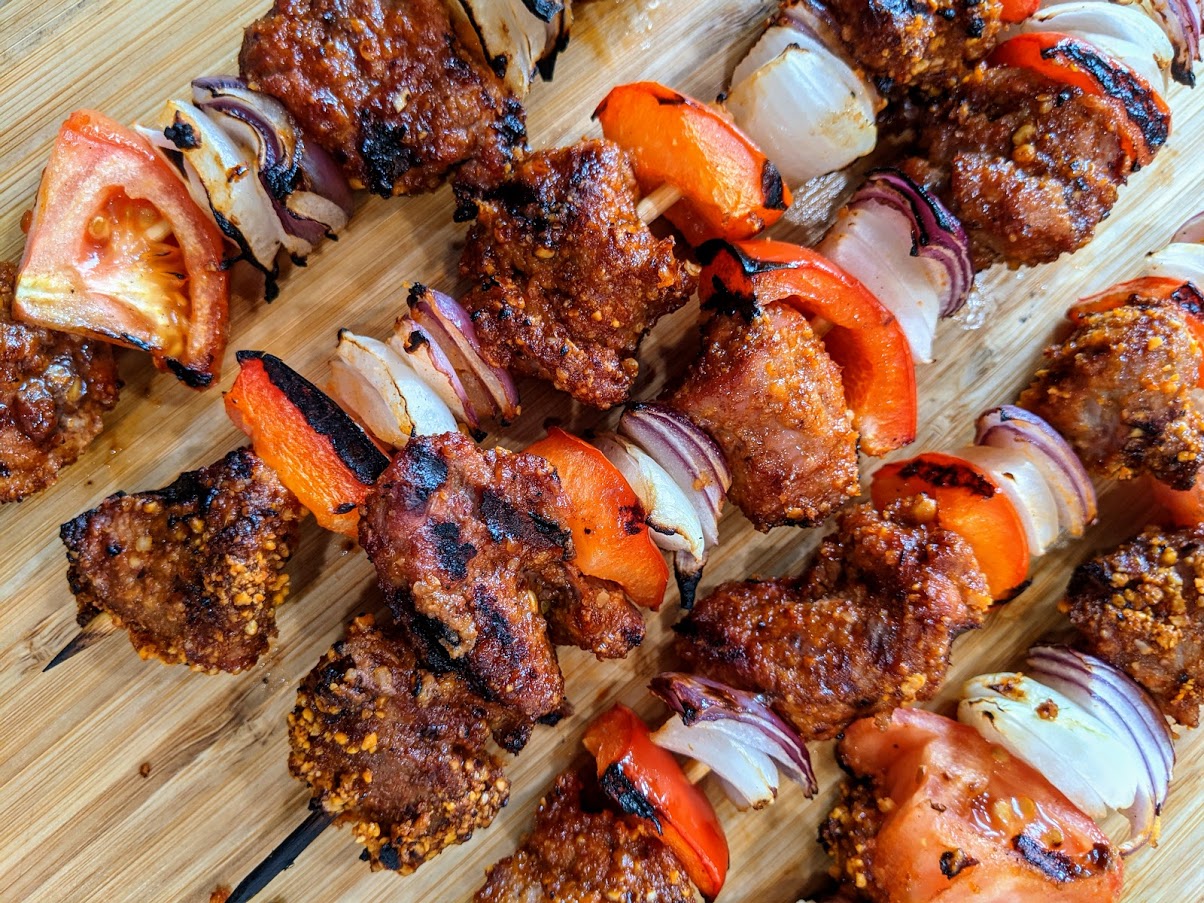
It is the most popular street food in the largest city, Lagos, of the most populous nation in Africa, Nigeria. Large chunks of meats strung on skewers that are drizzled with groundnut oil and then rubbed with a spice mix known as yaji or suya. The kebabs are known as Rago Suya. To find them, one need only follow the scent emanating from steel-drums-turned-grills behind makeshift stalls or food carts all across Lagos.

The vendors are usually men, often referred to as mai suya or mallam.  The title comes from the fact that it takes some skill to make suya, whether it is the slicing of the meat or the preparation of the spice blend.  Every mai suya has his own recipe for that spice mix. Yet, there are some common ingredients, such as ground peanuts, ginger and chiles. Vendors may also vary the proteins.  Although most suya is prepared with beef, some vendors use lamb, chicken and even offal, such as kidneys, livers and chicken gizzards.

While Suya is popular in Lagos, it originated amongst the Hausa in northern Nigeria. The skewered meat, with the spice mix, spread throughout Nigeria.  The seemingly omnipresence of the food stalls or carts of the mai suya, as well as the affordability of the grilled and smoked meat, has given this dish the power to unify a nation that is divided in so many ways. 

The skill and expertise of a mai suya or mallam can be divided into five steps.  The first step involves the protein, purchasing it from a local market.  The second step is to skewer the meat.  It would seem, based on my research, that a more authentic suya would involve sliced meat, but there are many recipes that call for the meat to be cut into bite-sized chunks.  The third step is to apply the suya mix to the meat on the skewers.  The skewers then marinate until the meat begins to change color, turning a dark red. The fourth step is to grill the skewers, preferably over charcoal. The final step is to apply some additional oil during the cooking process. Once the skewers are cooked, the meat is removed and cut into smaller pieces. 

I am not a mai suya or mallam but, I nevertheless came across a recipe for Rago Suya. I had some lamb that I thought would work well with the suya spice blend. The recipe basically follows the five step process, except for the use of bite-sized chunks rather than sliced meat, as well as the omission of the fifth step (the applying of oil during the cooking process), which I was okay with. After I completed this recipe, I realized why so many Nigerians love these skewers.  They were perhaps the best skewers that I have ever made. The experience made me want to become a mai suva or mallam and open my own cart in my neighborhood.  

RAGO SUYA

Recipe adapted from National Dish

Serves 2-4

Ingredients:

  • 1.5 pounds of lamb shoulder or leg, cut into 1 inch pieces
  • 5 tablespoons roasted peanuts
  • 1 teaspoon cayenne pepper
  • 1 teaspoon dried chile flakes
  • 1 teaspoon dried chile powder
  • 1 teaspoon smoked paprika powder
  • 1 teaspoon sea salt
  • 1 teaspoon ground ginger
  • 1 teaspoon ground garlic
  • 1 medium onion cut into large chunks
  • 1 medium red onion cut into large chunks
  • 1 large tomato, cut into large chunks
  • 1 red pepper, chopped into large chunks
  • 1 bunch fresh coriander/cilantro, roughly chopped for garnish
Directions:

1. Prepare the marinade.  Add all of the marinade ingredients (peanuts, cayenne pepper, chile flakes, chile powder, paprika powder, sea salt, ginger, garlic) into a spice grinder and blitz until as powdery as it can be made without turning the peanuts into a paste. This spice mix is called Suya.  Remove a third of the Suya mix and set aside.  Place the remainder of the Suya into a mixing bowl along with the lamb and make sure that it gets fully coated.  Allow the meat to marinate for 30 minutes. 

2. Prepare the kebabs. Heat up a grill on medium high heat. Take pre-soaked skewers, load them with an onion, pepper and piece of lamb. Repeat until there are 3-4 pieces of lamb on the skewers.  Repeat with the rest of the skewers. 

3. Grill the kebabs. Grill the kebabs for about five minutes, turning every couple of minutes, until the lamb is cooked and the vegetables have a slight char. 

4. Finish the dish.  Remove from the heat and serve on the skewer or remove and serve with Jollof rice, garnished with the chopped coriander/cilantro.

ENJOY!

Monday, August 30, 2021

Half Door Brewing Company's Belgian Tripel

I recently spent several days in San Diego for work.  It is not the first time that I have spent a significant amount of time in "America's Finest City."  The last time that I did this trip, I found a small brew pub just outside the Gas Lamp District. It was Half Door Brewing Company.  It was also the place that I would go to get away from my work.

Fast forward a few years, and, I found myself back in San Diego. I was not able to get back to Half Door Brewing Company until the last day of my trip.  I went up to the bar and perused the beer list.  It seemed that hazy IPAs dominated that list, with the North East IPA, Diamond Dress, Swole City, and Hoban House IPA at the top of the list.  Then there were the lagers, with the Bat Flip to the Moon Black Lager, Media Puerta Mexican Lager and the Summer Bock bringing up the rear of the list. There were a couple of individual styles, such as a Dry Irish Stout and a Red Ale. But, one beer caught my eye. It was neither a hazy IPA nor a lager. It was one of my favorite styles, namely the Belgian Tripel.

I have done several reviews of Belgian Tripel beers; and, as I took a few sips from this beer, I decided that I should do another, albeit quick review. The reason is simple: Half Door Brewing Company's Tripel is a very good example of the style. 

The beer poured a solid golden color with decent clarity. The golden beer was topped with a white foam that receded to the edges.  The aromas of the beer greeted the nose with some of the traditional elements of the Belgian style, with some clove, banana and slight hint of the hops used to brew the beer. As for the taste, the Tripe was very smooth, a nice balance of both hops and malts that provided the foundation for some citrus fruits and some of that banana elements from the aroma. The beer also gave slight hints of the fact that it comes with a 10.8% ABV, which is at the high end of the alcohol content that one would expect from a Belgian Tripel. 

In the end, Half Door Brewing Company's Tripel was a good way to end a work trip.  If you happen to find yourself in San Diego for work (or for play or if you just live there), you may want to make your way to Half Door Brewing ... if only to try the Tripel.

ENJOY!

Sunday, August 15, 2021

Around the World in 80 Dishes: Dominica

There is an old saying in the Caribbean, "nicknames are used in case the Devil comes asking for you." That may explain why many of the islands have nicknames. There is "Spice Island" (Grenada), "Helen of the West Indies" (St. Lucia), "Little England" (Barbados), and the "Island of Flowers" (Martinique). There is also "Nature Isle." This is the nickname for the Commonwealth of Dominica; or, as the indigenous Kalinago people refer to the island, Waitukubuli, which translates to "tall is her body." 

Both Waitukubuli and "Nature Isle" are apt descriptions for the little island, which have some of the tallest peaks -- like Morns Diablotins and Mount Trois Pitons -- in the Caribbean.  Those peaks rise out of and are covered by rainforests that are the homes for many rare species of animals, birds and plants.  The island also boasts of  365 rivers, such as the Indian River and the Rosalie River. And, then there are the beaches, the blue waters and the coral reefs. 

As much as I love nature, this post takes me to the towns and villages to learn more about the people, culture and their cuisine. Dominica has had a rather unique history, which has been shaped by resistance and colonialism. When the Spanish attempted to colonize the island, they met resistance from the indigenous Kalinago peoples. The French were more successful, establishing a permanent colony followed by sugar and coffee plantations.  The French also brought slaves from Africa, and, eventually, people of African descent were the majority of those living on the island.  The British ultimately seized control of the island and Dominica became a British colony.  The British enacted the Slavery Abolition Act in 1833.  Almost five years later, Dominica was the first colony in the British West Indies to have a legislature comprised of a majority of citizens of African descent. Needless to say, the white plantation owners had issues with that situation, which led to a less representative government. It would not be until 1967 when Dominica was able to take full control of its internal affairs and until 1978 when it became an independent country. 

A view of Roseau, the capitol of Dominica (photo by Mike LaMonaca).

This history, as briefly outlined above, shapes the cultures and cuisine of the Dominican people.  There is a mix of African and indigenous influences, along with British, French and island Creole.  There are also influences from nearby islands, such as Trinidad and St. Lucia.  

MAIN COURSE

Dominica's (unofficial) national dish is known as Mountain Chicken. Despite the name, chicken is not an ingredient in that dish. "Mountain chicken" is the local moniker for the Caribbean's largest frog, which also goes by the names of Crapaud. Herpetologists -- that is, those who study reptiles and amphibians would refer to these frogs as Leptodactylus Fallax.  This frog can grow as large as seven inchs long and weigh over two pounds. That is a good size if one is a frog.

The Mountain Chicken
(source: Natural Museum of History)
The mountain chicken has an important place in the culture of the indigenous peoples of Dominica. Local folklore, songs, poems and even jokes have been written about the frog.  

Some of those works of art tell the story of the mountain chicken, especially what confronts the species.  For example, poet Delroy N. Williams wrote The Crapaud Story, which begins as follows: 

De sey de Crapaud smoked my pipe

but me doh hear no Crapaud last night

An long I doh eat no Crapaud in a stew.

I doh even hear anybody talking about that frog.

Something must definitely be wrong.

To be sure, there is definitely something wrong.  Years of hunting the frog -- with anywhere from 18,000 to 36,000 be caught per year on Dominica -- combined with natural factors, such as a fungus that causes chytridiomycosis, caused a steep decline in the populations of the mountain chicken.  The fungus and its disease is believed to have caused a decline of nearly 80% in 18 months. The situation became so dire, that mountain chicken were no longer seen in the wild. By 2008, people believed the species may have went extinct. Returning to the poem: 

It was once our national emblem

Now reduced to the crannies of de "Station."

If somebody doh talk den nobody go listen

So I glad dat Machel an dem doing something

Cuz de Crapaud is Domincia's blessing.

Dat fungus come out from nowhere

An got us forgetting Crapaud is our heritage. 

We cyah just give up, dat would leave Crapaud in a sad state.

De Chyrid ting is very dangerous

Been around for just a decade

Got Crapaiud in decadence.

Fortunately, people did step up to save the mountain chicken. There has been a study in which the frogs were treated with an anti-fungal drug, which showed some promise. There have also been efforts by the Dominican government and non-profit organizations to protect the species.  These efforts have had some mixed success, but still provide promise to restoring the mountain chicken populations.  As the poem closes: 

From our forests an even our minds

Look we even searching for a new national dish

Want to remove Crapaud from its podium of pride

An reduce it to jus hindsight

But Crapaud stronger dan we think

An wit a likle help fromForestry

Dat frog go leap back unto its pedetal

We go hear Crapaud sing again

We go hear Crapaud after a shower of rain

An den we go really understand.

Cuz de Crapaud is Domincia's blessing.

Dat fungus come out from nowhere

An got us forgetting Crapaud is our heritage. 

The hope in this poem is important.  While some may have to make sacrifices by foregoing their (unofficial) national dish, that effort, combined with scientists and researchers, may provide the basis for that hope to become a reality. 

Turning to my personal culinary challenge, I obviously did not use mountain chicken to make this dish.  Instead, I purchased some frog legs from a local grocery store. That was the easiest part of the preparation.  I had a little more difficulty getting my hands on the "provisions," because not every grocery store has true yams and none of the stores around me had dasheen root. After searching for a while, I decided to make "provisions" with what I could get at the store.  I ultimately used sweet potatoes (which are not yams) and name root. 

The actual preparation of this dish is very easy. It is a simple sauté of the frog legs, a basic gravy, and a simple boil of the provisions.  These processes made me question whether the dish will have any taste. (I have to admit that I am not a big fan of root vegetables, especially if all that is done to them is to boil them.) Nevertheless, I forged ahead and completed the main dish. 

MOUNTAIN CHICKEN WITH PROVISIONS

Recipe from National Foods

Serves 4

Ingredients:

  • 12-16 frogs' legs
  • 2 garlic cloves
  • 1 teaspoon minced garlic
  • 1 lime, sliced in half
  • 1/4 cup flour
  • 1 teaspoon vinegar
  • 1 onion, sliced
  • 1 green bell pepper sliced
  • 1 tablespoon butter
  • 1 cup water
  • 2 dasheen roots (cut into 4 pieces)
  • 2 yams (cut into 4 pieces)
  • 1/4 teaspoon fresh thyme, minced
  • Salt, to taste
  • Freshly ground black pepper, to taste
Directions:
1. Prepare the frogs' legs.  Rinse the frogs' legs with water and then wash them in lime juice. Rinse the frogs' legs again in cold water.  Dry the frogs' legs and then place them in a bowl.  Season the frogs' legs with the thyme, vinegar, minced garlic, salt and pepper. Let the frogs' legs rest for two hours. 

2. Fry the frogs' legs. Put the flour in a shallow dish and coat each leg in the flour.  Heat the oil on high in a skillet.  Fry the coated frogs' legs until golden brown and set aside.

3.  Prepare the gravy.  Sauté the onion in a mixture of melted butter and one tablespoon of oil.  Add a cup of water, bring to a boil and then add flour to thicken the gravy.  Simmer the gravy for 5 minutes on medium heat.  Add the frog legs to the gravy, cook for a minute and turn off the heat. 

4. Prepare the provisions. Boil the yams and dasheen root in salted water with the green pepper. When the provisions are fork tender, turn off the heat and drain. 

5. Finish the dish. Serve the Mountain Chicken with the provisions, rice and peas. 

*    *    *

In the end, I successfully completed this challenge.  I was quite surprised by the end result.  The gravy provided enough additional flavor to work with not only the frog legs, but also the provisions.  It is a reminder that sometimes the most simplest elements can contribute the most. 

Now, I need to turn to my next challenges.  There is definitely more to come.  Until then, 

ENJOY!