Friday, November 26, 2021

Arista-Style Turkey with Tuscan Chestnut Stuffing (Savage Boleks' Thanksgiving 2021)

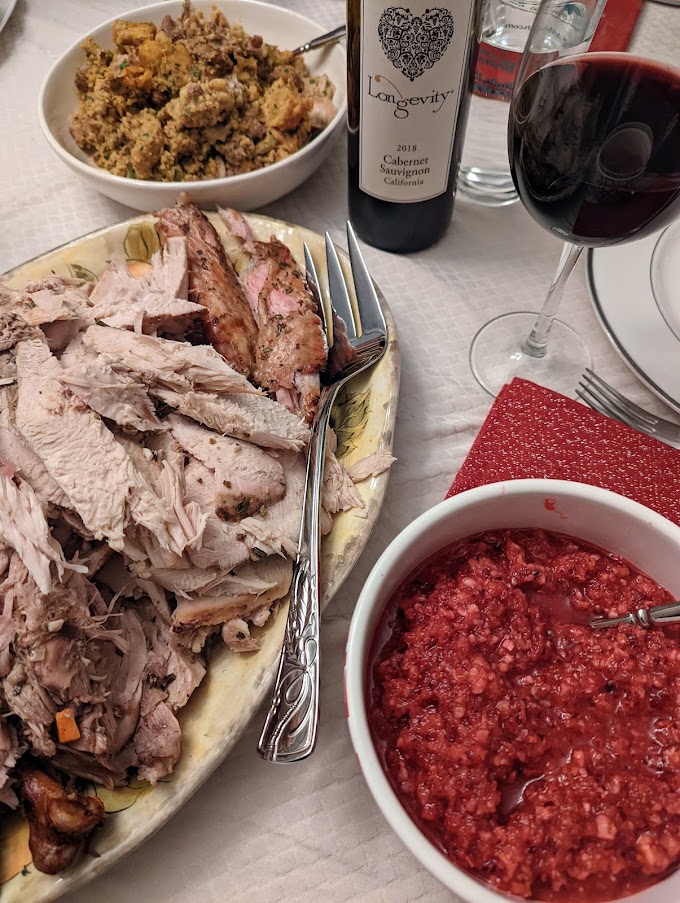
It is interesting how a decision to depart from a tradition could, itself, turn into a tradition.  Nearly two years ago, I decided to try prepare a Christmas dinner that was different than what the traditional Italian holiday meal that my family has prepared for more than fifty years. I prepared a turkey in the style of a Tuscan pork roast. That experience gave rise to a blog post, Turkey in the Arista Style with Tuscan Bread Stuffing. My beautiful Angel loved the meal so much, both the turkey and the stuffing, that I have made the dish a few times since that holiday dinner. And, now, it has officially become the traditional Thanksgiving dinner for the Savage Boleks. 

Yet, a turkey in the arista style is itself a departure from tradition in another sense. Since the dawn of the thirteenth century, an arista has always been a pork roast. That roast evolved over time to what it is today: a mass of porcine goodness covered in a rub consisting primarily of rosemary and garlic, along with other ingredients, such as lemon, cloves and/or fennel seeds. While recipes change, the one constant is that the protein used in an arista comes from some part of a pig, either a roast or the loin. The use of a turkey is a break from that tradition. Yet, it is a good break. The reason is simple: much like pork, turkey meat provides a tableau upon which all of the flavors used in the rub come together to provide a culinary image of Tuscan flavors.  If pork is the other white meat, then turkey is the other, other white meat.

The arista-style turkey is just the beginning of this new Savage-Bolek tradition. Another important aspect is the stuffing and, because I make so much of it, the dressing. (As you may know, it is stuffing if it is stuffed in the bird; it is dressing if it is baked alongside the bird.) This stuffing is a culinary mélange of Tuscan flavors and aromas. It begins with the bread, which is focaccia. The bread is cut up and toasted until the moisture is removed. One then adds in diced pancetta (or, if that person is me cooking for my beautiful Angel, diced turkey bacon), along with diced turkey heart, liver and gizzard (that is, all of the giblets in the package provided with the turkey). This step is followed by the addition of the traditional elements of a stuffing, namely, diced onion, celery and carrots. Finally, just before the liquid (turkey stock) is added, one adds a heaping 1/4 cup of rosemary, sage and the chestnuts. after the liquid is added, the ingredients are mixed well, left to marry for an hour and then stuffed into the bird or placed in a dish to be baked.

This stuffing or dressing is perhaps the best stuffing that I have ever made. One does not have to take my word for it, my beautiful Angel has made similar proclamations. This stuffing or dressing pairs perfectly with the ingredients used to make the arista-style turkey. There are major connections in terms of flavor, with the use of turkey bacon and rosemary. Yet, the stuffing or dressing adds to the flavors of the turkey with the use of sage and chestnuts. 

The recipe set forth below is not the same recipe that I used back in 2019. I have made some modifications based upon my subsequent efforts to make this dish. The two major changes are as follows: (1) I have incorporated the juice from the zested lemons into the marinade, as a way to utilize all of the ingredients; (2) I increased the amount of times that I baste the turkey with the juices and butter from once every hour to once every 40 minutes; and (3) I added an uncovered/covered/uncovered sequence to roasting the bird. While this additional work extends the cooking time a little, it is definitely worth it if you are trying to get crispy, brown skin on  the bird. 


ARISTA-STYLE TURKEY
WITH TUSCAN CHESTNUT STUFFING
Turkey recipe adapted from Reinhardt Hess & Sabine Salzer, 
Regional Italian Cuisine, pp. 148-49
Tuscan Bread Stuffing Recipe adapted from Tasting Table
Serves many

Ingredients (for the turkey):
1 whole turkey (about 12 pounds)
4 lemons, zested and juiced
8 to 10 sprigs of rosemary
10 cloves of garlic
4 teaspoons of fennel seeds
4 pinches of ground cloves
Kosher salt
Freshly ground black pepper
Olive oil
1 stick of unsalted butter

Ingredients (for the stuffing):
1 1/2 pounds ciabatta bread, cut into 1 inch cubes
8 ounces pancetta, small dice
1 package turkey liver and gizzards (from 1 large turkey)
2 medium carrots, peeled and small dice
2 celery stalks, small dice
1 large yellow onion, small dice
2 sticks unsalted butter
1/4 cup heavy cream
3 cups turkey stock + 2 cups of turkey stock
1 cup roasted chestnuts, roughly chopped
1/4 cup minced sage
1/4 cup minced rosemary
Kosher salt, to taste
Freshly ground black pepper, to taste

Directions:
1.  Prepare the turkey.  Rinse the turkey well.  Pat the turkey dry.  Separate the skin from the turkey so that you can apply the rub directly onto the meat. Combine the lemon zest, rosemary, fennel seeds, ground cloves, garlic, salt and black pepper into a small bowl.  Mix well. Juice the lemons and pour into a separate bowl.  Whisk in olive oil with the lemon juice and then add it to the small bowl with the dry ingredients to create a paste. Add additional olive oil, if necessary, to create that paste.  Continue to mix.  Once the paste has the desired consistency, apply it to all parts of the turkey, including under the skin.  Reserve some of the rub for basting. Allow the turkey to rest for at least 2 hours in the refrigerator.

2.  Prepare the stuffing.  Preheat the oven to 225 degrees Fahrenheit.  Lay out the bread on a baking sheet and bake until dry, about 25 to 30 minutes.  Transfer the bread to a huge bowl.  While the bread is baking, heat the pancetta in a medium skillet over medium-high heat. Cook, stirring often until the pancetta is crispy and the fat has rendered, about 8 to 10 minutes. Using a slotted spoon, transfer the pancetta to the bowl with the bread.  Drain the fat into a separate bowl. Add back 1 to 2 tablespoons of the fat to the pan and add the liver and gizzards.  Cook the ingredients, turning as needed until golden and cooked through, about 4 to 5 minutes for the liver and 8 to 10 minutes for the gizzard.  Transfer to a cutting board and roughly chop, then add to the stuffing bowl.

3.  Continue to prepare the stuffing.  Add a little more of the pancetta fat back to the pan.  Add the carrots, celery and onion to the pan.  Sweat the ingredients until softened, 6 to 8 minutes.  Transfer the vegetables to the stuffing bowl.   Add the butter to the pan and cook until it begins to brown and has a nutty aroma.  6 to 8 minutes.  Turn off the heat and stir in the cream to warm through.  Add the butter mixture to the stuffing bowl with the remaining ingredients (namely, the turkey stock).  Using your hands, mix the stuffing to incorporate.  Let sit at room temperature for 1 hour. 

4.  Prepare to roast the turkey.  Preheat the oven to 400 degrees Fahrenheit. Stuff the turkey's cavities with the stuffing, and place the remaining stuffing in a baking dish.  Roast the turkey for about 3 hours or until the turkey's internal temperature reaches 160 degrees. I roast the turkey uncovered for about the first hour and twenty minutes, cover the bird for the next hour and twenty minutes, and then leave the bird uncovered for the rest of the time. Baste the turkey approximately every 40 minutes with melted butter that has some of the rub mixed into it.  Once the turkey reaches that temperature, remove the turkey from the oven and cover it.  Place the baking dish full of dressing in the oven and cook for about 30 minutes to 45 minutes, or until the dressing begins to crisp on the surface.  Remove the stuffing and set on the stove to cool.

5.  Prepare the au jus.  Drain the liquid from the roasting pan into a separator.  Pour the juices into a pot, along with 2 cups of the turkey stock. Taste and adjust the seasonings with salt and pepper if necessary.  Bring to a boil under medium high heat and reduce to a simmer.  Allow to simmer until you are ready to serve. 

6.  Finish the dish.  Spoon the stuffing and dressing into a serving bowls (one for the stuffing and another for the dressing).  Slice the turkey and place on a serving dish.  Serve immediately.

ENJOY!

Wednesday, November 24, 2021

Thanksgiving @ Chef Bolek's House

Hellu! I im vriting a pust ibuout vhet I im gung to cuok fur Thuonksgeefing. I hefe-a a reelly beeg tuorkey. I im guing to prepere-a a rub vit luts ouff fennell seeds, rusemery, gerleec, und sume-a pinches ouff clufes and lemun zest. I im zee-a guing tu stuoff zee-a tourkey vit luts ouff chestnuots, ouniuns, celery, cerruts, und, ouff, course-a luts and luts of breed. 

Bork! Bork! Bork!

(translation of English to Swedish Chef courtesy of https://funtranslations.com/chef)

Sometimes, especially around events when I am cooking for people other than myself and my immediately family, I can feel a little like the Swedish Chef. Things go wrong. Sometimes they go very wrong. (Like, the oven going kaput and me having to break down a turkey and microwaving it to a finish. If only I channeled the Swedish Chef at that moment in time, I could have at least injected some humor into that catastrophe.)

Those thoughts always hide in the recesses of my mind. I worry about whether the meal that I am about to prepare will be the best that I can make. We are hosting Thanksgiving this year and it is the first one that we are having with guests since 2019.   

To put my mind somewhat at ease, I am preparing a turkey in a style that I have done for recent Thanksgivings. I will be preparing a Turkey in the Arista Style. An Arista is a traditional recipe from Tuscany, Italy, for a pork roast. Records of the recipe go as far back as the beginning of the 13th century.  However, the story about how the dish got its name dates back to the early 15th century, when it was served to a visiting Byzantine patriarch. The visitor was so pleased with the dish, he cried out, "aristos!" The Tuscans looked puzzled and thought their visitor proclaimed "pork." Apparently, they did not understand Greek very well, because the patriarch proclaimed that the dish was "excellent." 

The ingredients that make this dish excellent can be found in the rub.  An arista is heavy on the rosemary and garlic.  Some recipes, including the one that I use, add additional flavors, such as cloves, fennel and lemon zest.  I think these flavors provide for a more interesting and tasty dish. I also think that all of these ingredients work very well with the mild taste of a turkey. That is the main reason why I have taken this pork recipe and turned into a turkey recipe.

In the past, I have prepared a Tuscan chestnut stuffing to complement this Tuscan-style turkey. However, this year it appears that chestnuts are in short supply. My local grocery store has unfortunately let me down, even though in past years it used to have a bin full of chestnuts. I would buy a pound or two of chestnuts, roast them and chop them up myself. No bin this year.  It took visits to four stores before I could find some packaged chestnuts. I guess it will save me some time because I will not have to roast them. However, I think I may experiment a little by mixing in some pecans or pistachios into the stuffing. Both of those nuts have more flavor than chestnuts and I think they could work fairly well with the other ingredients.  That might be a last minute call as I get ready to make the stuffing.

I will be preparing one other dish for this dinner:  cranberry sauce.  I had initially thought of making a Chianti Cranberry Sauce, something along the lines of this recipe. I was simply trying to build on the whole Tuscan theme. After some thought, however, I decided that I would return to a recipe that has served well at Thanksgiving: Cranberry Orange Relish. This recipe has historical roots in the United States, as it is based on recipes prepared in the taverns of colonial Williamsburg.  I found the recipe in a cookbook, entitled, Colonial Williamsburg Tavern Cookbook, which I purchased years ago when we visited the area. The recipe is clearly intended for adults, because one of its ingredients is Cointreau. I say that it is intended for adults because nothing is cooked, so all the booziness of that liquor will be present in the sauce when it is served.  The Cointreau macerates the cranberries as the dish rests in the refrigerator overnight. I have since adapted the recipe to make a kid-friendly one, substituting orange juice for the Cointreau. My kids have eaten this version during past Thanksgiving meals and they have liked it.  In the end, this dish usually makes everyone happy. 

Well, that summarizes the dishes that "Chef Bolek" will prepare this Thanksgiving. It is a lot less than a typical Thanksgiving holiday. In the past, I prepared some potato dish (such as my Mashed Sweet Potatoes with Ginger, Cardamom and Honey) and a roasted vegetable dish (like my Roasted Fall Vegetables). However, for this Thanksgiving, I am thankful that our guests will be providing those dishes and more (like an oyster stuffing, gravy and bread). It will give me more time to focus on the tasks ahead.

With that said, I hope everyone has a safe and happy Thanksgiving or should I say ...


I hupe-a iferyune-a hes a heppy thuonksgeefing! Bork! Bork! Bork!

ENJOY! 

Thursday, November 18, 2021

Kaki Gohan

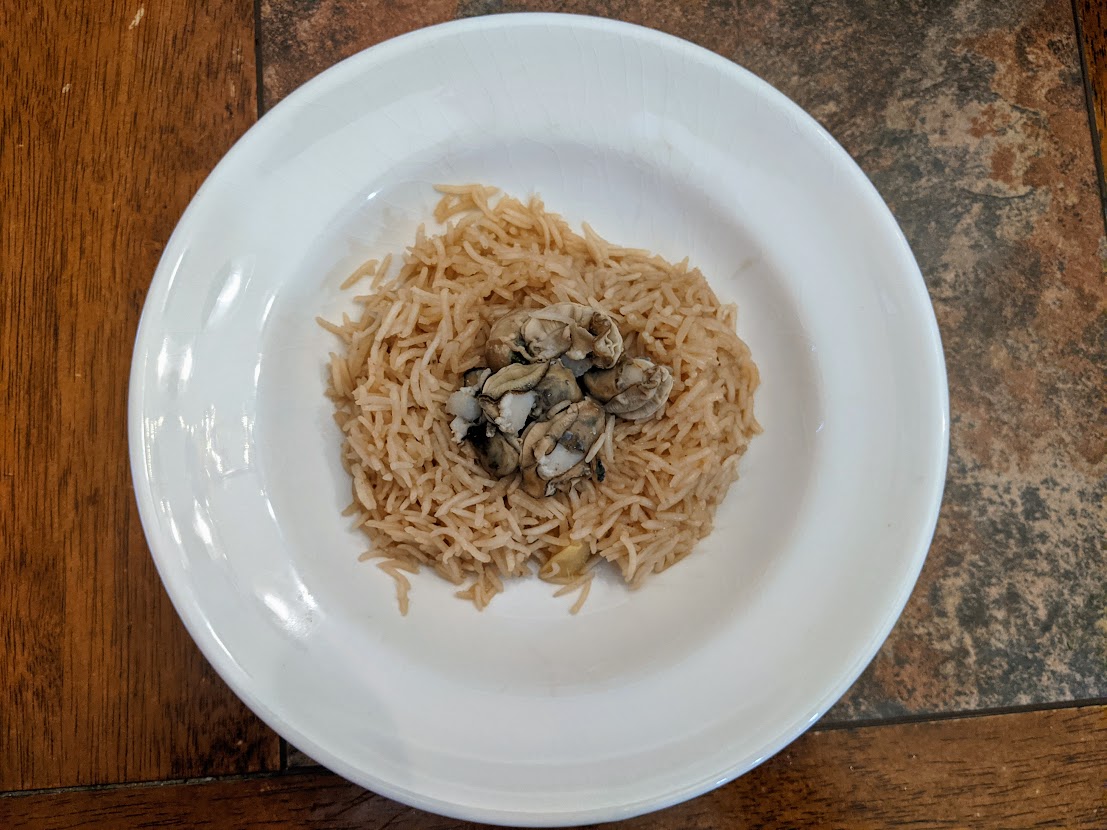
It is known as seasoned rice with oysters, or Kaki Gohan, and it comes from Japan. The rice is seasoned with a water that includes of sake, soy sauce and mirin, as well as the oysters' liqueur. This recipe offered a different way for my beautiful Angel and I to try oysters. And, while it was my first attempt at the dish, this recipe illustrates why it is important to make dishes over and over again. It is all a part of the cooking process. 

The directions call for the oysters to be placed in a boiling broth of water, sake, soy sauce and mirin. This much is very interesting, as it could impart a lot of flavor to the oysters themselves. However, oysters cook very fast, shrinking in size and increasing it toughness. Thus, it takes skill and a good eye when making this recipe to avoid a result that would not be as tasty as it could be.  I followed the recipe, but I ended up with oysters that looked like they had been steamed or grilled. They did not look like the oysters in the picture that came with the recipe.

Looking back on this particular cook, I think I know what I should have done. I need to approach the recipe from a different angle. One way is to use the typical means of preparing an octopus. Recipes will tell you that you should not simply plunk an octopus in boiling water, as it will curl up and become difficult to work with. However, if you carefully dip the octopus into the boiling water three times, that helps to firm up the octopus without it shrinking and curling into a round of tentacles. I think a similar approach could be used with oysters in this recipe.  Once the water and other ingredients come to a boil, the oysters could be dipped a few times, for a minute or two, until they firm up along the edges and become opaque. At that point, I think the oysters would retain their meatiness and texture, while having just a hint of the soy sauce, sake and mirin. 

I will follow up with this post when I have a chance to make this dish again and let you know how this alterative approach works.  In any event, this recipe was a welcomed change from eating raw oysters.  

KAKI GOHAN

Recipe available at Uncut Recipes

Serves 4

Ingredients:

  • 2 jars oysters
  • 2 cups rice
  • 2 cups water
  • 3 tablespoons sake
  • 3 tablespoons soy sauce
  • 2 tablespoons mirin
  • 2 thin pieces of ginger root
  • 1/2 teaspoon salt

Directions:

1. Prepare the rice. Wash all of the rice, as well as you can to remove all of the starch.  Drain and set aside.

2. Prepare the oysters. Wash all of the oysters, gently in salted water.  Pat dry.

3. Prepare the ginger. Cut the ginger root into thin, skinny pieces.  

4. Prepare the broth. In a pot, add the water, salt, soy sauce, sake, and mirin. Bring to a boil.  Add the oysters and cook for three minutes.  Remove the oysters and set aside.

5. Cook the rice. Put the rice in the bowl of a rice cooker.  Add enough of the seasoned liquid to the rice to reach the line of 2 cups and cook the rice. After rice is cooked, add the oysters and leave for 10 minutes. Then mix and serve.

ENJOY!

Sunday, November 14, 2021

Great Lakes Oktoberfest

Anyone who grew up in Cleveland and who loves craft beer knows about Great Lakes Brewing Company. The employee-owned beer company has the distinct honor of being the first craft brewery established in the State of Ohio. While I don't live in Ohio anymore, I never pass up a chance to have a Great Lakes beer when I come across it at a restaurant or in the grocery store.

That was the case recently when I came across a couple of six packs of the Great Lakes' Oktoberfest. The brewery describes its beer as a "Marzen-style lager. It is a reference to the malty style of beer that, for nearly 150 years (roughly from 1840 to 1990), was the primary beer served at the famous Oktoberfest. (The Marzen has since been upstaged by the "Fest Bier," which is now the principal beer served at the festival. 

The historical roots of Marzen beer style lead one to the breweries of Bavaria, most likely during the 1500s. At that time, there were laws that limited the brewing of beer to a period between September and April. (Other factors, such as the weather, similarly made brewing beer in the summer months extremely difficult, if not impossible, to brew lagers like a Marzen.) Brewers typically brewed their beers in March, hence the "Marzen," name  so that they could last throughout the summer months. These beers were typically darker, with more bread and even roasted notes.  However, in 1841, Spaten introduced an amber style of beer, the Marzen, which quickly became the hit of the Oktoberfest. The rest, as they say, is history.

The Marzen style is known for amber-colored beers, which the Great Lakes' Oktoberfest recreates in beautiful fashion. (It should be noted that, historically, the Marzen beers tended to darker hues, with varying shades of brown.) The aroma of the beer is malt-forward, with some bread or toast notes.  Marzen beers have little to no hop notes. As one could guess from the aroma, the taste of the beer should feature the malts and not the hops. While some bitterness should be present, this is not a beer that will feature citrus or pine in any aspect of the flavor. It is all about the malts, which makes for a smoother, more easily drinkable beer.

The Great Lakes Oktoberfest checks off all of the boxes with respect to what one would expect from a Marzen beer (or at least one brewed outside of Bavaria). Not only does its amber hue hit the mark, but the beer is a malty, toasty homage to Oktoberfests of yesteryear.  Not necessarily Bavarian Oktoberfests (one may need to try one of the "Big 6 of Munich" to get that experience - such as Augstiner, Hacker-Pschorr, Hofbrau, Lowenbrau, Paulaner and Spaten), but definitely a clear marker for what could be characterized as an American Oktoberfest.

ENJOY!

Sunday, November 7, 2021

Ping Gai (ປີ້ງໄກ່), Laotian Grilled Chicken

Certain recipes have the ability to transport someone across the world. This particular recipe took me to a street full of food stalls in Vientiane, the capital of Laos. Perhaps it is the Ban Anou night market, just a short distance from the Mekong River. Maybe it is one of the morning markets, such as the Khua Din Market or the Talat Sao Market. It could have been anywhere in the downtown city area where wafts of street food fill the air.

In any event, I am drawn to this region by the smell of grilled chicken. But, not just that chicken. There is so much more. Chicken marinated with a mixture of soy sauce, oyster sauce, and, that very special, fish sauce.  There is something about fish sauce, that umami from southeast Asia, that is intriguing to both the nostrils and the taste buds. Fish sauce features prominently not only in the preparation of this grilled chicken, but also the thin, vinegary dipping sauce that is served with it. The aromas were so intriguing as I made this dish, I could not wait to taste it. And, when I tasted it, I could not wait to make it again. This dish - Ping Gai - is probably one of the best chicken dishes that I have made, and eaten, in recent memory.

The recipe that I found may not be truly authentic, there is a good possibility that it is an interpretation of Ping Gai or ປີ້ງໄກ່, which is translated into "roast chicken." The traditional cooking process begins with a chicken that is halved, and then pounded flat. The recipe I had called for the use of skinless, boneless thighs. I compromised with skin-on, bone-in thighs. Once the chicken is prepared, it is marinated in a sauce consisting of fish sauce, garlic, turmeric, coriander and white pepper. Other spices, such as chiles, find their way into the marinade. Once marinated, the chicken is then grilled over a charcoal flame on low heat. The final dish is then sliced and served to customers with that tangy dipping sauce.

As I noted above, this is one of the best chicken recipes that I have made in a very long time. I say that even though I did not marinate the chicken overnight. I think if I did that, it would have turned out even better.  I also think that the combination of the marinade and the dipping sauce makes Ping Gai an excellent candidate for buffalo wings. Some of the best wings that I have had are grilled, and, between the marinade and the sauce, this recipe is full of flavor. Don't be surprised if you see a Ping Gai buffalo wing post in the near future. 

PING GAI (ປີ້ງໄກ່), LAOTIAN GRILLED CHICKEN

Recipe available at Allrecipes

Serves several

Ingredients (for the Marinade):

  • 1 tablespoon whole black peppercorns, or more to taste
  • 1 bunch fresh cilantro, stems and leaves
  • 3 tablespoons oyster sauce
  • 2 tablespoons soy sauce
  • 2 tablespoons fish sauce
  • 2 tablespoons vegetable oil
  • 2 pinches cayenne pepper
  • 10 chicken thighs

Ingredients (for the Dipping Sauce):

  • 2/3 cup seasoned rice vinegar
  • 1 lime juiced
  • 4 cloves garlic, crushed
  • 1 tablespoon sambal oelek
  • 1 tablespoon fish sauce
  • 1/4 cup freshly chopped cilantro
  • 2 tablespoons honey, or more to taste

Directions:

1.  Prepare the marinade. Grind peppercorns coarsely using a mortar and pestle, electric grinder or spice mill.  Chop cilantro finely and transfer to a mixing bowl. Stir in the freshly ground pepper, oyster sauce, soy sauce, fish sauce, oil and cayenne.  Add chicken thighs and toss by hand until completely coated.  Cover with plastic wrap and marinate in the fridge for 4 to 12 hours.

2. Prepare the dipping sauce. Combine rice vinegar, lime juice, garlic, sambal, fish sauce, cilantro, and honey to make the dipping sauce. Refrigerate until ready to use.

3. Grill the chicken.  Preheat the grill to medium high heat and lightly oil the grate.  Place the chicken thighs on the grill, discarding any excess marinade.  Cover and grill until thighs spring back to the touch, 5 to 6 minutes per side (a few minutes longer for each if you are using bone-in thighs).  An instant read thermometer should read at least 155 degrees Fahrenheit. Slice and serve with dipping sauce.

ENJOY!

Monday, November 1, 2021

In Search of Orange Gold: Part Two - What Came Before

There is a history behind Old Bay, the iconic spice used in the preparation of steamed crabs. It began long before the iconic little tin can began to appear on store shelves or in kitchens. Some have spent time recounting that history. They have delved into cookbooks and other materials that date back as early as the beginning of the eighteenth century. Their efforts certainly provide a good starting point for discussing the history of the spice mixes that came before Old Bay. However, I think we need to go a little further back than any cookbook.

The reason lies with one simple and undeniable fact: the further back into the history of the United States generally -- or the Chesapeake region in particular -- the more likely it is that the cookbooks were written by people of European ancestry. The history of the region can be told from a far wider range of voices.  For example, the consumption of crabs, oysters, clams and other foods from the Chesapeake Bay began centuries before John Smith ever laid eyes on the region. Likewise, after Europeans colonized the bay region, they brought African slaves who performed the manual labor on plantations, including the preparation of meals. If one is truly going to discuss the history of anything, anywhere, in North America, that history needs to be more inclusive. 

The Algonquin peoples -- including the Choptank, Delaware, Matapeake, Nanticoke and Piscataway --lived along the Chesapeake Bay and the Potomac River for centuries before the Europeans' arrival.  These native peoples gathered fish, eels, shrimp, clams, oysters and even blue crabs. Researchers have found fragments of blue crab shells in ninety-three (93) different Native American sites, suggesting that the Native Americans relied upon the crustaceans for food.  Some of the fragments have been found at sites that date back to 1,200 B.C., which is more than three thousand (3,000) years ago. This evidence supports the conclusion that the Algonquin peoples relied on blue crabs as part of their diet. Moreover, given the fact that blue crabs were not found in Europe until relatively recently (and, as an aside are now considered an invasive species in Spanish and French waters), it is most likely that the indigenous people introduced the crustaceans to the European settlers and colonizers.

Source: Redbook
Not only would the indigenous peoples introduced the crab, but they probably passed along cooking techniques. I had a very difficult time finding information about now Native Americans prepared and ate blue crabs. At most, I found anecdotes. According to one person who descended from the Nanticoke tribe, her grandmother used to pour scalding water on the crabs (which most likely stunned them) before placing them in a pot to cook (most likely by steam). The person did not provide any further detail as to how her grandmother prepared crabs in the "Nanticoke style." 

Unable to find specific examples of how Native Americans prepared crabs, I turned to more general information.  For example, many of the herbs and spices that could be found in a modern day kitchen were brought to the new world by European settlers and traders. Native American cooks would not have had access to them when preparing crabs, prior to colonialization. Nevertheless, they had access to a range of indigenous ingredients, such as the seeds of peppergrass or Shepherd's Prune (which have a taste similar to white pepper) and dried berries from spicebushes (a substitute for allspice). Still, I was unable to find anything, such as the spices used, by Native American cooks when preparing crabs. 

As they had for centuries, Europeans brought a range of herbs and spices with them. This fact is evident from the early cookbooks, which include recipes for steamed crabs. One of the earliest written recipes for blue crabs read as follows: 

Take the meat out of the great claws being first boiled, flour and fry them and take the meat out of the body strain half if it for sauce, and the other half to fry, and mix it with grated bread, almond paste, nutmeg, salt and yolks of eggs, fry in clarified butter, begin first dipped in batter, put in a spoonful at a time; then make sauce with wine-vinegar, butter or juyce of orange, and grated nutmeg, beat up the butter thick, and put some of the meat that was strained into the sauce, warm it and put it in a clean dish, lay the meat on the sauce, slices of orange all over and run it over with beaten butter, fryed parasley, round the dish bring and the little legs round the meat.

This recipe comes from Robert May's The Accomplist Cook, which was published in 1685. There is a reference to the use of nutmeg when preparing the crabs.

One of the signers of the Declaration of Independence, William Paca, had his own way to prepare crab meat:

Take out the meat and clean it from the Skin. Put it into a Stew-pan with half a pint of white wine, a little nutmeg, pepper and salt, over a slow fire, - throw in a few crumbs of bread, beat up one yolk of an egg, with a spoonful of vinegar, then shake the sauce round for a minute and serve it upon a plate.

This recipe comes from a cooking manuscript started by Miss Ann Chase in 1811. Once again, there is the use of nutmeg, pepper and salt.

Jane Howard wrote a cookbook in 1873 entitled Fifty Years in a Maryland Kitchen.  The cookbook included two recipes for crab stews: one with a cream sauce with mace, cayenne, salt and pepper; and, a second with mustard, cayenne pepper, cloves, allspice and wine. These recipes are the first that I could find in which a variety of spices -- mace, cayenne pepper, salt, pepper, mustard, cloves and allspice -- used in connection with the preparation of crabs.  It is interesting that nutmeg was not included in those recipes. 

Howard also included a recipe for "stewing" hard crabs.  This recipe reads as follows: 

Pick the crabs carefully. Season with powdered mustard, cayenne pepper, two or three cloves, a very little allspice, the yolks of two eggs and a small quantity of white flour rubbed with two large table-spoonfuls of butter; to which, if you like, add two glasses of white wine.  Mix together, and stew for quarter of an hour.

There is some overlap with other recipes, such as the use of mustard, cayenne pepper, cloves and allspice. 

Other cookbooks from the late nineteenth century - such as Mary Tyson's Queen of the Kitchen (1870) and Mrs. Charles Gibson's Maryland and Virginia Cookbook (1894) contained similar recipes for crabs. For instance, Ms. Tyson recounted a recipe for "stewing" hard crabs that, although following the similar cooking process as Jane Howard's recipe, included "two blades of mace pounded," cayenne pepper, salt, and "a little black pepper." 

All of these recipes provide the foundation for what was to come.  They show a tradition of using certain ingredients -- such as allspice, black pepper, cayenne pepper, cloves, mace, mustard and nutmeg  -- in connection with crabs and crab meat.  All that was missing was someone to unite these ingredients into a spice mix.  The only question is who that person would be. Until next time ...

ENJOY!

Saturday, October 30, 2021

Chef Bolek's Scariest Moments in the Kitchen

Halloween is the time of year when everyone thinks about everything that is scary or spooky. While this particular holiday does not rank among my favorites, I nevertheless got to thinking about what are some of the scariest things that I have prepared in the kitchen since I started this blog thirteen years ago.

I also decided to write this post. I figured that, over those thirteen years, there had to be some misfires, some disasters, or even some questionable dishes that were probably better left un-posted. Then, while going through my old posts, I remembered the cardinal rule of my personal culinary blog: Don't Post the Disasters! For the most part, this rule worked. It probably prevented the scariest dishes from ever seeing the light of day.  

Still, the "word" scary can have different meanings in different contexts.  For example, it could mean the ingredients that strike the most fear in the eater. It could also mean the most frightening-looking dishes ever presented to a guest. Keeping this in mind, here are some of the scariest things to ever grace this blog: 

Top 3 Scariest Ingredients

Over the years, I have cooked with many different ingredients. The idea of learning about those ingredients, how they are used, and their place in the cuisines around the world have propelled me to try things that, as a kid or even as a young adult, would have sent me fleeing in terror.  Here are three dishes that contain some of those ingredients. 

1.  Fried Lamb's Liver and Heart (Khalyat Alkadba Wal Galoob). This dish comes from my Around the World in 80 Dishes personal culinary challenge.  It was the challenge for Libya Don't get me wrong, this offal dish was delicious. The combination of two spice mixes (bzaar and hararat), along with hot chile powder turned this recipe into an amazing dish. I think that, for the average person, a plate of lamb hearts and lamb livers would be scary and off-putting. That is why this dish made the list. 

2. Pig Trotter Curry (Kangchu Maroo).
This is another dish from my Around the World in 80 Dishes personal culinary challenge. It was the challenge for Bhutan. Unlike the recipe for lamb's liver and heart, this recipe did not have multiple spice mixes. It is a simple curry, with only garlic, ginger, and chiles. These ingredients provided flavor to the overall dish, but the absence of those spice mixes meant that one could taste more of the pig's feet.  I loved this dish and it has always been on my list to re-make.  

3. Pork Offal Meatballs (Frattaglie di Mailale Polpette).
While the last dish included pig's feet, this particular dish goes one or two steps further (pun intended). It includes pig neck and pig tails, which were boiled together with the pig's feet to make meatballs. The triumvirate of pig parts was a little difficult to handle and probably could have used a little more binding to keep them together. Needless to say, these are not your Italian grandmother's meatballs. They were still delicious, and, in some respects, just as good as regular meatballs. 

Top 3 Scariest Dishes

While I have done my best to ensure that none of my failures ever see the light of day, I have to admit there are some dishes that still made the blog.  These dishes fall into the "what were you thinking" category.  Here are three of those dishes: 

1. Lobstercake Sandwiches. This dish was my effort to recreate an amazing Lobster Burger dish that I had at Chef Michel Richard's Central. That dish had big chunks of lobster meat held together by the smallest amount of binding.  My "re-creation" was more like a soupy Frankenstein. Frozen lobster meat (bad choice), bolstered with scallops, bound together with a "soup" that left me scrambling to try to save the dish. The end result barely resembled a lobstercake. I couldn't even cut the cheese correctly for the picture.

2. Rockfish with a Trio of Sauces.
 This dish haunts the cook in me.  What was I thinking? Quite frankly, I had the idea of creating a "stop light" trio of sauces that could complement the flavor of rockfish (which I love).  I should have just looked at the red sauce, stopped with the idea, and made a different dish. Each of the sauces was basically an uninspired puree of a different bell pepper.  The only true difference between the sauces was the color. This recipe leaves me shaking my head, and, would most likely leave Chef Gordon Ramsey saying, "what the f___?" 

3. Dungie Cakes with a Yellow Pepper Saffron Sauce.
The last dish draws inspiration from the last two recipes: a forgettable "cake" with a regrettable "sauce." The cake, which was made from dungeness crab, turned out slightly better than the lobstercake, but what really doomed this recipe is the sauce. I can already hear the calls of "c'mon man." A yellow pepper sauce with saffron? Saffron turns everything yellow. What's the point? To have those little red strands poking through the gloppy, yellow mess? Who is going to see the strands with the diced onion and peppers littering the plate?

In the end, it is good to go back to acknowledge one's shortcomings. It is the only way that we learn. For example, I have learned that I am never going to do a stop light trio of sauces. I have also learned that, since that day, I have made some dishes with amazing sauces.  And, finally, while I may not be the biggest fan of Halloween, I do love trying scary ingredients. 

To everyone, I hope you have a Happy Halloween and 

ENJOY!

Friday, October 22, 2021

Pumpkin Spice Mix

For those who know me, they would also know that a post about pumpkin spice is an unlikely subject for this blog. There are many reasons. You may ask:

Would you like it in your coffee?  
Would you like it in your tea?

I would not like it in my coffee.  
I would not like it in my tea.
I don't like it here or there.
I don't like it anywhere.
I don't like pumpkin spice.
About it, I can't say anything nice.

Would you eat it in a cake?
Would you drink it in shake?
I would not eat it in a cake.
I would not drink it in a shake.
I don't like it here or there.
I don't like it anywhere. 
I don't like pumpkin spice.
It is not worth the added price.

I could go on, but I think you get the point. I don't like pumpkin spice.

But, I love my family and everyone was getting together for a virtual baking event. The recipe for our event was a pumpkin swirl cheesecake. One of the ingredients listed in the recipe was one and one-half teaspoons of "pumpkin pie spice."  While I may have dozens of spices in my kitchen, there is not a single bottle of pumpkin spice to be found. 

So, I went looking for a recipe online to make a pumpkin spice. Needless to say, there are a lot of recipes for pumpkin spice on the Internet. There is one common feature of these recipes: they all start with cinnamon and ginger (more of the former than the latter), but then the recipe turns into a sort of choose-your-own-adventure. Mace or nutmeg. Allspice or cloves. It is as if one could end up with multiple configurations of what could be pumpkin spice.

I did not want to have to choose between spices. I wanted a recipe that was more straightforward. A recipe that called for mace and nutmeg, allspice and cloves. After all, I have all of those ingredients.  I should be able to use them all. I eventually found that recipe on The Kitchn website. A pumpkin spice recipe that called for all six of the ingredients (cinnamon, ginger, allspice, cloves, nutmeg and mace). 

Once I stopped looking, my mind turned to a rather ironic fact. I hate pumpkin spice, but I love every ingredient used to make that spice.  I freely use all of those ingredients (as called for) when I make spice mixes, such as masalas and curries. A quick glance at the label cloud to the right shows there are 18 recipes with allspice, 41 recipes with cinnamon, 30 recipes with cloves, 52 recipes with ginger, 0 recipes with mace and 15 recipes with nutmeg. Clearly, I don't have any problems with the ingredients that go into pumpkin spice. 

Perhaps my dislike of pumpkin spice comes from its commercialization. It seems like everything is "pumpkin spice" this time of year.  Now, I am back to hating that spice. 

PUMPKIN SPICE MIX

Recipe from The Kitchn

Ingredients:

  • 1 tablespoon ground cinnamon
  • 2 teaspoons ground ginger
  • 1/2 teaspoon ground allspice
  • 1/2 teaspoon ground cloves
  • 1/2 teaspoon ground mace
  • 1/2 teaspoon ground nutmeg

Directions:

Combine all of the ingredients together and stir until well-mixed. Store in an airtight container at room temperature for up to one year.

ENJOY!

Friday, October 15, 2021

Asari No Sumashijiru (Japanese Clam Soup)

There is something to be said about simplicity. A handful of ingredients - water, lemon, clams, salt and cilantro - combined in a basic preparation. The end result is a soup is a dining experience that transcends many of the dishes that I have had at a lot of fancy restaurants. 

This recipe - Asari No Sumashijiru - has made me rethink much of what I have thought about cooking. I spend a lot of time looking for recipes that incorporate a range of ingredients, utilize new cooking (and sometimes complex) cooking techniques, and produce some very delicious dishes (which, if my photography skills were a little better, would look as good as they taste). But this five ingredient dish, prepared simply by boiling the clams, turned everything on its head.

A sumashijiru is a simple, clear soup with certain specific components. There is the suiji, which is the stock (or water), and the wadane, which is the solid ingredient. There is also the tsuma, a garnish that adds color, and the suikuchi, a garnish that adds fragrance. 

Each particular component is clearly present in this recipe. The suiji is water, flavored by the solid ingredient or the wadane, which are asari (clams). The tsuma is the Japanese cilantro and the suikuchi is the use of lemon juice and zest.   

One additional note about the clams. The recipe called for manila clams, which resemble short-neck clams (or little neck clams). Little neck clams are the smallest type of clams that one will find either in grocery stores or in restaurants. 

However, I had middle-neck claims on hand when I made this recipe.  Middle neck clams are, as their name suggests, mid-sized clams. They are basically cherrystone clams. Generally speaking, I prefer middle-necks or cherrystone clams because of their size. In my humble opinion, they are the "Goldilocks" of clams, not too small so as to barely register when you bite into them and not too big so that they are too tough when you bite into them. In the end, I think the middle-neck clams worked as well as manila clams or little-neck clams. 

Whatever clams you have, or if you need clams (go out and get them), you should make this recipe. It is truly amazing how something so simple can be so profound.

ASARI NO SUMASHIJIRU (JAPANESE CLAM SOUP)

Recipe available at The Spruce Eats

Serves 4

Ingredients:

  • 1 pound manila clams
  • 5 cups water
  • Kosher salt, to taste
  • 1 lemon, zested
  • Mitsuba (wild Japanese cilantro), for garnish

Directions:

1. Cook the clams. In a medium pot, bring water to a boil. Reduce heat to medium and add a bit of salt to the water (approximately 1/2 to 1 teaspoon salt). Add fresh clams directly into the boiling water.  Cook until all the clams open. If there are any unopened clams, remove them from the pot and discard.

2. Finish the dish. While the clams are are cooking, zest the lemon using a microplane or a peeler.  Serve four to five clams in small soup bowls and pour broth over them. Garnish with lemon zest and Japanese parsley. Serve immediately. 

ENJOY!

Thursday, October 7, 2021

Sea You At the Bottom

While I may say that I never buy anything based on a label, even I have to admit that is not always the case ... especially when the label has Cthulhu on it. Recently, I came across another Cthulhu-inspired label on a beer.  This one is for the Sea You at the Bottom, a farmhouse ale from D.C. Brau in collaboration with the Sea Line, a seafood and oyster restaurant just a ball's throw from Nationals Park in Washington, D.C. 

The thing about a "farmhouse ale" is that the name is not a style. Instead, it refers to a range of styles, that differ from country to country. The styles include saison, biere de garde, gueze or sahti (if you happen to be in Finland). These beers tend to have orangish to golden colors, with a lighter in body and a noticeable dryness in the taste.  Some of these styles, such as a saison, also have elements that could work well with oysters, such as citrus (think lemons) or pepper notes.

Yet, a farmhouse ale is hardly the type of beer that one would associate with Cthulhu. If someone is going to brew a beer that will feature Ph'nglui mglw'nafh Cthulhu R'lyeh wgah'naghl fhtagn (the full name of the literary beast), one would expect a darker beer, such as a Russian Imperial Stout, along the lines of the The Death of Cthulhu brewed by Virginian craft brewer Adroit Theory. 

D.C. Brau and the Salt Line nevertheless went with a farmhouse ale brewed with oysters. (The oyster part was as compelling of a reason for me to purchase the beer as the image of Cthulhu on the label.) Conceptually, I guess, the oysters are what ties the beer to the waters from which Cthulhu emerges. Yet, oysters don't live deep in the ocean. They are usually found in brackish waters that are eight to thirty-five feet deep. If one wants to be true to the them, one should consider brewing a beer with squid. (Surprisingly enough, someone has brewed beer with squid ink.)

In any event, D.C. Brau did a great job with Sea You at the Bottom worked very well. The beer pours a golden hue, with only a thin layer of foam that recedes as quickly as the sea foam.  The aromatic elements of the beer track a typical saison, with some citrus notes and some other less recognizable, but pleasing elements.  As for the taste, that is where the oysters truly reveal themselves. The brewers used Skipjack oysters from the Chesapeake Bay. Named after the iconic vessels that once plied the bay to dredge for oysters, the Skipjack is an average-sized oyster has been with a mild salinity but meaty texture.  That salinity, which gives the oyster its briny flavor, is noticeable in what I could only describe as a "salty" element. That element is not too pronounced.  It took several sips before I could identify it amongst the more traditional citrus notes that one would expect in a saison.  That was not a bad thing, as the Sea You At the Bottom is a very drinkable beer.

This beer presents a very good case why oysters can be used in styles other than stouts. I purchased a four pack from D.C. Brau for $14.99. If you happen to make your way to the Salt Line in Washington, D.C. or make a stop by the D.C. Brau brewery, I would definitely try or buy this beer.  Until next time ...

ENJOY!