Promoting learning, understanding, and empathy through food, beer, wine, and, of course, cooking.
Friday, January 28, 2022
Black Ankle's Chispa (2017)
Saturday, January 22, 2022
Pulpo en Purgatorio
| Source : Tesori del Matese |
PULPO EN PURGATORIO
Recipe from Gusto TV and Serge the Concierge
Serves 4
Ingredients:
- 2 cups olive oil
- 2 small onions, finely diced
- 1 pound of fresh, large octopus tentacles
- 4 red chiles, seeded and sliced (or 2 teaspoon crushed red pepper)
- 1 chile, minced for garnish
- 1/2 cup parsley, chopped, plus more for garnish
- 1 teaspoon salt
- 1 teaspoon freshly ground black pepper
Directions:
1. If using fresh octopus. Heat half the oil in a medium frying pan over medium heat. Add the onions, garlic, parsley and chiles (or crushed red pepper) and cook, stirring frequently, until the onions soften, about 6 to 8 minutes. Put the tentacles in a pot and add the onion mixture and the remaining oil. Add enough water to cover just the tentacles and bring it to a boil over high heat. Reduce the heat to low, season generously with salt, cover and cook, stirring occasionally until the liquid has evaporated, about 2 hours. Serve immediately.
2. If using cooked octopus. Heat half the oil in a medium frying pan over medium heat. Add the onions, and garlic, and cook, stirring frequently, until the onions soften, about 6 to 8 minutes. Add octopus, parsley and chiles (or crushed red pepper), salt and black pepper, and stir to combine. Cook until octopus is heated through. Transfer octopus with oil to platter, garnish with remaining parsley and red chiles. Squeeze juice of 1/2 lemon over dish.
Saturday, January 15, 2022
Kitchen Pepper
For as long as there have been organized societies on this planet, there has been a spice trade. For most people, that trade is associated with the "silk road," which connected the Far East (principally China) with the rest of Asia, Europe and Africa. The silk road began around in the third century, B.C.E and continued until the Ottoman Empire effectively shut it down in 1453. What may be less known is the network of "silk roads" that date back to 2,000 B.C.E. This network facilitated the trade in, among other things, cinnamon from Ceylon (now, Sri Lanka), and cassia from China. These routes also gave rise to the trade in cloves and nutmeg from the "spice islands" (later conglomerated into what became Indonesia).
Other roads - or more appropriately, voyages - added to the spice trade by introducing ingredients from the "New World." These ingredients included allspice from Xaymaca (now Jamaica), along with chiles and vanilla from Anahuac (the Nahuatl name for what is now known as Mexico).
In sum, the spice trade introduced a wide range of new ingredients -- black pepper, cardamom, cassia, chiles, cinnamon, cloves, cumin, ginger, mace, nutmeg, saffron, star anise, and turmeric -- to cooks around the world. Cooks from around the world began incorporating these spices into mixes, adding new spices as they became available. These spice mixes include Berbere in the Horn of Africa, the masalas of the subcontinent, and Baharat in the Middle East.
European cooks in the 15th century began to categorize (loosely) those mixes. They fell into three categories: powder blanche, powder deuce (sweet) and powder fort (strong). The mixes eventually were lumped together into one common term, "kitchen pepper."
The story of kitchen pepper is not a uniquely European. The reason is that other voices have contributed to the narrative. These voices include the enslaved Africans, who worked in the kitchens on plantations in the New World and elsewhere in colonies across the globe. For example, Hercules Posey, the enslaved African who served as the cook (really, the chef) for George Washington, is believed to have used a kitchen pepper mix that featured nutmeg. James Hemmings, the enslaved cook (again, chef) for Thomas Jefferson is thought to have used a mix heavily studded with black pepper. And, then there was Polly Haine, who may have used allspice as part of her kitchen pepper spice mix. Polly Haine went on to use that mix to create her Caribbean Pepper Pot soup, which she sold on the streets of Philadelphia in the late 18th century. Each of these examples underscores the primary characteristic of kitchen pepper: everyone has their own individual mix. All of those mixes that give rise to the story.
![]() |
| Michael Twitty |
If I had to summarize kitchen pepper, then I would do so in the following way: kitchen pepper is about the artistry of an untold number of individual, enslaved cooks, each of whom crafted his or her own spice mix. It is about an unspoken effort to assert one's individuality while subjugated in a brutal, dehumanizing system that was intended to deny that right and freedom to that individual.
KITCHEN PEPPER
Recipe by Michael Twitty, available at Bittman Project
or Michael Twitty, The Cooking Gene, pg. 24
Ingredients:
- 2 tablespoons coarsely ground black pepper
- 1 tablespoon freshly grated nutmeg
- 1 tablespoon ground allspice
- 1 tablespoon ground cinnamon
- 1 tablespoon ground ginger
- 1 tablespoon ground mace
- 1 tablespoon ground white pepper
- 1 tablespoon ground red pepper flakes
Thursday, January 6, 2022
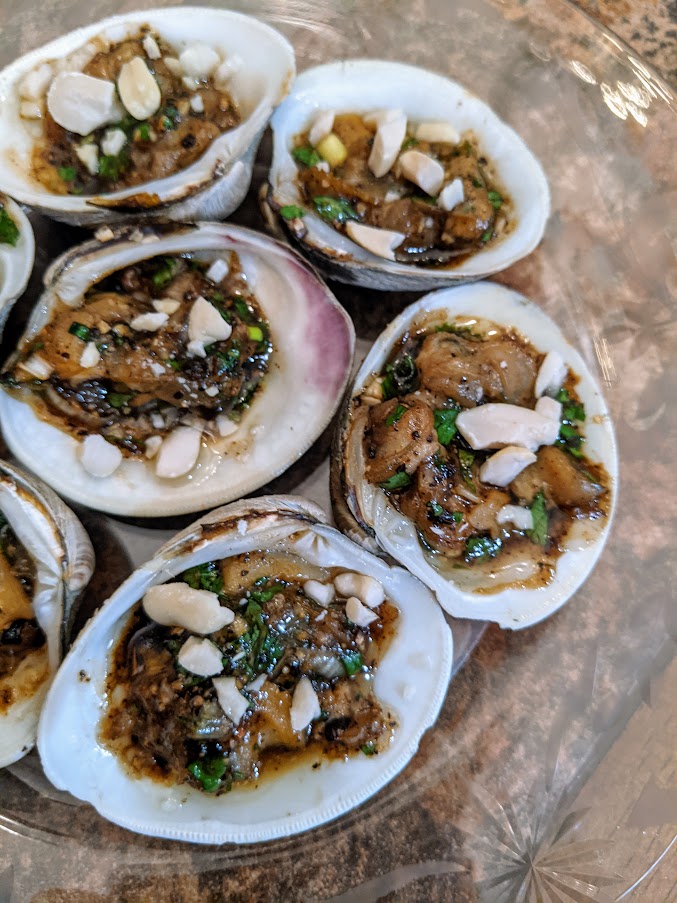
Vietnamese Grilled Clams with Oyster Sauce and Peanuts
VIETNAMESE GRILLED CLAMS WITH OYSTER SAUCE AND PEANUTS
Recipe available at Food and Wine
Serves 4
Ingredients:
- 3 pounds cherrystone clams or 1 pound mussels, scrubbed
- 2 scallions, finely chopped (about 1 1/4 cups)
- 1/2 cup chopped fresh rau ram (Vietnamese coriander) or cilantro
- 1/4 cup packaged crispy fried shallots (such as Maesri)
- 1/4 cup oyster sauce
- 1/4 vegetable oil
- 1 tablespoon granulated sugar
- 1 tablespoon black pepper
- 2 tablespoons plus 2 teaspoons finely chopped peanuts
Saturday, January 1, 2022
In Search of Orange Gold: Part 4 - The Whole is the Sum of its Ingredients
At the time, Brunn was trying to establish a spice business, the Baltimore Spice Company, in downtown Baltimore. He initially sold spices to butchers and meatpackers. However, his business was ideally located for a different customer. The Baltimore Spice Company was located across the street from a historic seafood market, first known as the Center Market and later as the Fish Market. Brunn took the short walk to the market and tried to sell his spice blends to the seafood vendors. He encountered resistance, because each vendor had their own proprietary blend of spices that they used and sold with their seafood. None of the vendors were interested in a newcomer who sold only spices and not fish. While Brunn was turned away, he was not discouraged. Gustav Brunn believed that he could make a better spice blend for seafood.
| Mr. and Mrs. Brunn Source: Jewish Museum of Maryland |
Yet, despite his best efforts, Brunn was not able to fool everyone. Some of those final ingredients have been identified over time. Despite his best efforts, some of those ingredients have been identified or revealed over time. They include:
With the history of Gustav Brunn and a good sense of the Old Bay spice mix, it is now time for me to try my hand at making the blend. I will try to recreate Old Bay and, perhaps in the process, try to discover what may be the three remaining ingredients. Stay tuned and ...
ENJOY!
Monday, December 27, 2021
Brother Thelonius
Thelonius Monk
For many years, Thelonius Monk wrote and performed music in an improvisational and unorthodox style. His music clearly and unquestionably demonstrated that he understood the meaning of freedom. That understanding gave rise to songs such as Straight, No Chaser, Epistrophy, Blue Monk and Round Midnight. As David Graham once observed in The Atlantic, Monk's "catalog - some 60 to 70 songs, many of them familiar to even moderately serious jazz fans - form the spine of contemporary repertoire." Indeed, Monk's song, Round Midnight, stands as the most recorded jazz composition of all time ... and, for good reason.
Yet, not everyone was a fan of Monk's music. One jazz critic described Monk as "an elephant on the keyboard." Yet, that is what makes Monk so special. He flattened his fingers when playing notes, sometimes hitting a single key with two fingers or splitting single line melodies with both hands. Yet, to some, Monk "adjusted his finger pressure on the keys the way baseball pitchers do to the ball to make its path bend, curve or dip in flight." Sometimes there would be chord changes in Monk's music that seem wrong or out of place. To Monk, those chords were "the logical result of countless hours of musical exploration."
Saturday, December 18, 2021
Fennel Rubbed Leg of Lamb with Walnut Romesco Sauce
FENNEL RUBBED LEG OF LAMB WITH WALNUT ROMESCO SAUCE
Recipes adapted from Epicurious
Serves 6-8
Ingredients (for the Romesco Sauce):
- 1/2 tablespoon chopped walnuts
- 1 small red bell pepper, halved, seeds removed
- 1 medium tomato, cored
- 1 garlic clove, unpeeled
- 1 tablespoon olive oil
- 1 tablespoon sherry vinegar
- 1/2 teaspoon chipotle powder or chile powder
- 1 1/2 teaspoons finely chopped parsley
- 1/2 teaspoon sweet paprika
- Kosher salt
Ingredients (for the lamb):
- Kosher salt
- Ground black pepper
- 3 tablespoons fennel seeds
- 4 teaspoons crushed red pepper flakes
- 4 garlic cloves, finely grated
- 3 tablespoons olive oil
- 2 1/2 pounds small or medium carrots with tops
- 1 bag of small mixed potatoes, sliced in half
Directions:
1. Make the romesco sauce. Preheat the oven to 425 degrees Fahrenheit. Toast walnuts on a rimmed baking sheet until golden brown, about 5 minutes. Toss bell pepper tomato and garlic with oil on a clean rimmed baking sheet and roast until browned and softened about 20-25 minutes. Let cool. Remove skin from bell pepper, tomato and garlic, discard. Puree walnuts, bell pepper, tomato, garlic, oil, vinegar, chipotle chile powder, parsley and paprika in a food processor until smooth. Season with salt and ground black pepper.
2. Prepare the rub for the lamb. Using a mortar and pestle, coarsely grind fennel seeds and red pepper flakes. Transfer to a small bowl and mix in garlic and 3 tablespoons of oil. Evenly rub lamb all over with spice mixture, making sure to work it into every nook and cranny.
3. Sear the lamb. Reduce the heat of the oven to 300 degrees Fahrenheit. Heat remaining 1/4 cup of oil in a large heavy skillet over medium. As soon as oil is hot and shimmering, add lamb to skillet and cook, carefully pouring off fat as needed into a small bowl and until golden brown, about 3 to 5 minutes per side. Trim tops from carrots. Place lamb in the center of a roasting pan, pour reserved fat over the lamb, season with salt and pepper. Place carrots and potatoes around the lamb.
4. Roast the lamb. Roast the lamb until an instant read thermometer registers 135 degrees for medium rare, about 75 to 90 minutes. Transfer to a cutting board and let rest for 20 minutes. Slice the lamb in 1/2 inch slices.
ENJOY!
Saturday, December 11, 2021
Around the World in 80 Dishes: Turkmenistan
| The golden statute of the Turkmenbashi. (Source: Souvenir Chronicles) |
![]() |
| Waiting in line for food (Source: Asia News) |
MAIN COURSE
It is against this backdrop that I approach this challenge to prepare a main course from the country of Turkmenistan. The cuisine shares many similarities with those of other central Asian countries, such as Uzbekistan and Kazakhstan. The most notable similarity is the predominance of plov or pilaf (rice with meat and vegetables). There is the legacy of Russian control, as illustrated by shashlyk (kebabs). And then there are the truly Turkmen dishes, such as ishlykly (a Turkmen version of shepherd's pie) and chegdermeh (a mixture of rice, tomato, meat and onions).
However, I chose to prepare Dograma, which roughly translates to "chopped up." The name is fitting because it is a shredded meat and bread stew. I chose this meal because of its simplicity, both in terms of ingredients and preparation. In so doing, I thought that this dish as a type of cucina povera, in which struggling people would use what little they have to make the best meal possible. (This is somewhat a fantasy given the current food shortages in Turkmenistan.) In any event, it is my nod to those impoverished Turkmen peoples who cannot be seen through the dark curtains that enshroud the country.
In terms of preparing this dish, the principal ingredients are protein and bread. The recipe called for lamb, mutton or beef. I did not have easy access to mutton (which would most likely be the protein of choice), so I went with lamb, which would have been cheaper than beef. As for the bread, Turkmen prepare corek, which is a leavened bread cooked in an oven similar to a tandoor. While I thought about preparing the bread, my lack of baking skills led me to the next best thing: a bag of pita bread. The recipe advises that pita or naan could be used for a substitute.
This simple recipe turned out to be a very delicious one. The boiling of the lamb resulted in fork-tender morsels that were relatively easy to shred. It also produced a rather rich broth, created by the melting of the lamb fat into the broth. Perhaps the next time I will make my own corek bread for this dish.
DOGRAMA (SHREDDED MEAT & BREAD STEW)
Recipe from Whats4Eats
Serves 4
Ingredients:
- Mutton, lamb or beef stew meat, cubed, 2 1/2 to 3 pounds
- 3 quarts water
- 2-3 tomatoes, seeded & chopped
- 1 tablespoon salt
- Naan or pita bread, 4 to 5 pieces
- 2-3 onions, thinly sliced
- Salt, to season
- Freshly ground black pepper, to season
Directions:
1. Boil the ingredients. Add the meat, water, tomatoes and salt a large pot and bring to a boil. Skim off any scum that rises to the surface and then reduce heat to medium, cover and simmer for 1 to 1 1/2 hours, or until the meat is cooked through and tender.
2. Tear the bread. Tear the pita or naan bread into small (1/2 inch pieces). Add the pieces of bread to a large bowl, along with the sliced onions and a good grinding of pepper. Toss and set aside to rest and mix the flavors.
3. Shred the meat. Remove the cooked meat from the broth with a slotted spoon. Use clean hands or a fork to shred the meat. Add the meat to with the bread and onion mixture and toss well.
4. Finish the dish. Pour the hot meat broth over the mixture in the bowl and then cover the bowl with a towel or plastic wrap and set aside for 20 to 30 minutes to allow the flavors and textures to meld. Portion out into bowls and serve.
* * *
My personal culinary challenge takes me on some rather interesting adventures, even to lands where cults of personality reign supreme while the masses struggle every day. The lesson of these adventures is to focus on those who struggle, learning more about a particular culture and cuisine through their eyes, as opposed to those of the Turkmenbashi or the Protector. I think I did that with this particular challenge. Until next time ...
ENJOY!
Tuesday, December 7, 2021
The IPA When the Earth Stood Still
Wednesday, December 1, 2021
In Search of Orange Gold: Part Three - Gustav Brunn
![]() |
| German advertisement for seasoning |
![]() |
| Jewish men arrested in the days after Kristallnacht standing for roll call (photo from the Buchenwald concentration camp records office and available at the U.S. Holocaust Museum) |
At that time, it was still possible to "buy" someone's release from Buchenwald. There was a Jewish attorney in Frankfurt who could make the arrangements: 5,000 marks at the beginning and 5,000 marks when the prisoner was released. The Brunn family paid that price, and, Gustav Brunn was able to leave Buchenwald. Within one week of his release, Brunn moved his family, and his spice grinder, to Baltimore, Maryland where they settled in a small apartment located on the 2300 block of Eutaw Place.