
Wednesday, February 23, 2022

Sunday, February 20, 2022

Gazpacho con Bogavante (Gazpacho with Lobster)

Recently, a certain extremist Republican member of the United States House of Representatives uttered the following words on television: 

"Not only do we have the DC jail which is the DC gulag, but now we have Nancy Pelosi's gazpacho police spying on members of Congress, spying on the legislative work we do, spying on our staff and spying on the American citizens."

This particular elected official, who represents the 14th district of the State of Georgia, tried to evoke many things with that statement. There is the reference to the gulag, which was the prison system of the Soviet Union from 1918 to 1955. This not a particularly apt comparison. While the D.C. jail definitely has its issues (by way of example, overflowing sewage, lack of adequate medical care, and a history of violence), an estimated 1.2 million to 1.7 million died in the Soviet gulags.

And then there is the Representative's reference to the Nazi gestapo, the Geheime Staatspolizei, or German Secret Police, which enforced the brutal and inhumane policies of Adolf Hitler's Nazi regime. Except, this particularly uninformed Republican Representative called referred to that organization as the gazpacho. Gazpacho is a cold soup from Andalusia, Spain. It is the furthest thing from Herman Goring's conception of a secret police force, or Reinhard Heydrich's utilization of that force to facilitate the Holocaust, murdering millions of Jews, Poles, and Soviets, along with hundreds of thousands of Roma (or Romany) and disabled people. (The estimates exceed 17 million being killed during the Holocaust). 

How does one respond to a statement of such stunningly stupid propaganda? To be sure, responses came flowing throughout social media. One such response caught my eye. It came from a true expert on the subject of gazpacho: Jose Ramon Andres Puerta. Most of us know this expert as Chef Jose Andres.  The Spanish born, now American citizen, chef is known for his cookbooks, such as Made in Spain, and his restaurants, such as Jaleo. More recently, he is known for his leadership with the World Central Kitchen (WCK), which has done outstanding work to help coordinate the food responses in response to catastrophes around the world, including in the United States. (If I ever looked up to someone I did not personally know, Chef Andres makes the very short list).)

Chef Jose Andres got wind of what the Representative said and responded by noting on Twitter, "the Gazpacho police was created by me in 1993 to make sure that no one will add Tabasco or jalapeno or strange things to my beloved soup!" Andres also invited the representative to "stop by for a glass," but to not forget her mask and vaccination card.

Chef Andres' offer got me to thinking about gazpacho. His beloved soup has graced this blog in the past. I then decided to look for a gazpacho recipe to make. More specifically, I was looking for a recipe that included lobster. I had a few lobster tails in the fridge that I needed to use. I searched the Internet and, quickly found a recipe for Gazpacho con Bogavante, or Gazpacho with Lobster. The recipe comes from none other than Chef Jose Andres.

I decided to make that recipe, but I had to improvise a little. Chef Andres' recipe calls for the use of whole lobster; however, I had only lobster tails. Without the entire lobster, I did not have to go through the process of straining and reserving the coral. That improvisation impacted the dressing the most, because the coral contributes additional flavoring to what otherwise be just oil and sherry vinegar. It also affected the presentation, as I did not have the claws to present with the final dish.

Despite these improvisations, the Gazpacho con Bogavante was an amazing dish. The smoothness of the bright, cold soup stood in contrast with the crunchy vegetable garnish and the croutons. The slight acidity of the tomatoes, warmed by the use of sherry vinegar, was a great complement to the sweetness of the lobster medallions. 

This little culinary experience proved two things: ignorance is definitely not bliss, but its maliciousness can lead to a counter-challenge that promotes learning, opens minds, and expands horizons. 

GAZPACHO CON BOGAVANTE

Recipe from Jose Andres, available at Food Network

Serves 6

Ingredients (for the gazpacho)

  • 2 pounds of tomatoes, diced
  • 1/2 cucumber, peeled, seeded and diced
  • 1/2 green pepper, seeded and diced
  • 1 cup of water
  • 6 tablespoons of Spanish extra virgin olive oil
  • 2 tablespoons of sherry vinegar
  • 3 ounces of bread, torn into small pieces
  • Kosher salt

Ingredients (for the lobster and dressing):

  • 2 (1 1/4 pound lobsters)
  • Kosher salt
  • 2 tablespoons sherry vinegar
  • 10 tablespoons Spanish extra virgin olive oil

Ingredients (for the garnish):

  • 4 plum tomatoes
  • 1 cucumber peeled
  • Kosher salt, as needed
  • 1 red pepper, seeded, cut into tiny dice
  • 1 green pepper, seeded and cut into tiny dice
  • 2 shallots, cut into tiny dice
  • Olive oil, for frying
  • 4 (1/2 thick) slices of bread, cut into 1/2 inch cubes
  • Spanish extra virgin olive oil to garnish
  • Minced chives
  • Fleur de sel, to garnish

Directions:

1. Make the gazpacho. In small batches, mix all of the ingredients in a blender until very smooth. Pay attention to the consistency. You my have to add more water, as the water content in the ingredients may vary. Strain and chill.

2. Make the lobster and dressing. Fill a large pot with water and add plenty of salt. Bring to a boil and add lobsters.  Cook for 1 minute. Remove from water, drain and chill. Once the lobsters are cool, take off the head and remove the coral and liquid.  Pass the coral through a chinois or fine-mesh sieve. Set aside the resulting liquid for use in the dressing. Peel lobster tails and cut each tail into 6 medallions.  Carefully crack the claws and remove the meat. The idea here is to keep the claw meat whole. Split the claw meat in half lengthwise. Refrigerate the lobster until needed. 

3. Prepare the dressing. In a bowl, whisk together the reserved coral, vinegar and oil until smooth and blended. Season with salt to taste. Set aside. 

4. Make the garnish. Cut the ends off the tomatoes, cut the tomatoes in half lengthwise. Peel back the skin and flesh to expose the seeds. Remove the seeds, taking care to keep the mass whole. The point here is to remove the tomato seeds and their surrounding gel intact. Set aside. (Reserve the tomato flesh for another use.)

5.  Continue to make the garnish. Cut the cucumber in half lengthwise and remove seeds. Sprinkler the cucumber generously with salt and let sit for an hour in a colander in the sink. (The salt will cause the cucumber to release water.) Rinse the cucumber and pat dry with paper towels. Cut the cucumber into a tiny dice. In a bowl, combine the cucumber, peppers and shallot. set aside. 

6. Fry the bread. Pour the oil for frying into a large saucepan to a depth of 2 inches. Heat over medium heat until a deep fry thermometer inserted into the oil reads 375 degrees Fahrenheit. Fry the bread cubes until golden brown. Using a slotted spoon, transfer the croutons to a paper towel-lined plate to drain. 

7. Finish the dish. Pour the chilled gazpacho in a pitcher. In the center of each bowl, place 2 lobster medallions, 1 claw half and 1 tomato seed "fillet." Arrange some of the cucumber mixture around the edge of the blow, sprinkle with chives and top with 4 croutons. Drizzle the dressing around the lobster and drizzle the lobster with some of the extra-virgin olive oil. Finally sprinkle everything lightly with the fleur de sel. At the table, set the bowls in front of your guests and pour some of the gazpacho into each.

ENJOY!

Tuesday, February 15, 2022

Hamachi Kama

Most everyone eventually succumbs to social media advertising. They fall prey to the algorithms that utilize their browsing history to place advertisements for things that he or she might purchase. In my case, those algorithms place a lot of ethnic food ingredients, along with a variety of Buddhist-related items. (My love of learning about different cuisines, along with my increased interest in Buddhist meditation has no doubt played a role in the product placement on my timeline.)

Late last year, a certain Asian online grocery stores kept popping up in my timeline. The first item in the advertisement was Hamachi Kama, or yellowtail collars. Hamachi is the Japanese name for the yellowtail - or Japanese Amberjack.  The fish is commonly found in Japanese restaurants and sushi bars, where guests can find both raw and cooked preparations. However, the kama or collar (that is the section of the fish just behind the head and gills) is something truly special. It looks a bit unwieldly, like a little "u" with fins hanging off of it. 

If one did not know better, they would think that it is just a scrap that needs to be thrown away.  However, as the story goes, restaurant owners or cooks would keep the yellowtail collars, or Hamachi Kama, for themselves, friends or regular customers. The reason is simple. Far from a scrap, those collars have some of the fattiest and juiciest meat on the fish.

The Hamachi or Japanese Yellowtail
(Source: Clovegarden)

The collar is actually the clavicle bone of the yellowtail. There is collagen, connective tissue and a lot of fat in that part of the fish, which makes it very easy to cook and even forgiving to a certain extent if one overcooks the collar. And, the richness of the meat combined with the fact that a fish only has two clavicle bones means that the collars can be hard to find on menus. 

Yet, they can be easy to find online, as I have learned. I purchased a package of collars and immediately set out looking for a traditional recipe. Fortunately, the most traditional method of preparation is one of the simplest that I have ever come across. The collars are marinated in a combination of citrus juices (orange, lemon and lime), along with mirin and soy sauce. After marinating the collars for about a day, one just places them on a hot grill, basting the collars with the marinade. (I made a second batch of the marinade for the basting, rather than using the marinade in which the collars rested overnight.)  

That's it. The end result is one of the simplest, yet most delicious fish dishes that I have had in a very long time.  The only limit to me making this recipe as much as I can is the fact that I have to go back to that online store to purchase more collars.  

HAMACHI KAMA

Recipe from Hunter Angler Gardener Cook

Serves 4

Ingredients:

  • 1/3 cup lemon juice
  • 1/3 cup lime juice
  • 1/3 cup orange juice
  • 1 cup soy sauce
  • 1/4 cup mirin or other rice wine
  • 4 yellowtail collars
  • Sesame Oil

Directions:

1. Prepare the marinade. Mix the lemon juice, lime juice, orange juice, soy sauce and mirin in a heavy plastic bag or lidded container.  Add the yellowtail collars. Marinate overnight or up to 1 day. If the collars are not submerged, then them periodically so that they get good contact with the marinade.

2. Prepare the basting sauce. Pour the marinade into a small pot and bring it to a boil. Reduce it by half and set it aside. 

3. Grill the collars. Pat the collars dry with paper towels and coat with a film of sesame oil.  Get your grill nice and hot and clean the grates.  Grill the collars over high heat, basting with the reduced marinade, for about 10 minutes to 20 minutes, depending on how large the collars are and how hot the fire is. The collars must be fully cooked and a little charred.  Serve with steamed rice and a salad.

ENJOY!

Wednesday, February 9, 2022

West African-Style Broiled Lobster Tails

"The American relationship with shellfish would not be the same without the African and African-American presence."

Michael Twitty

The statement of culinary historian and chef, Michael Twitty, refers to the impact that Africans and African-Americans have had on the cuisine of this country, specifically with respect to shellfish, such as lobsters and crawfish. Before being brought to the New World, Africans had extensive experience catching, preparing and eating shellfish. Twitty recounts that experience along the African coast from Senegal to Benin. Whether it is lobster in spicy okra stews of Sierra Leone or the large shrimp thrown on red hot grills in Benin, it is well worth the read. 

Indeed, it was Twitty's words that drew me to this particular recipe for West African-style Broiled Lobster Tails. Twitty noted the red brick slipper lobsters or spiny lobsters that could be found in a Senegalese market, along with the local cooks who knew how to prepare the crustaceans with available ingredients, including tomatoes, ginger, garlic and habanero peppers.  Some of those ingredients - such as the garlic and the chiles - find their way into this recipe, as does the Maggi cube, which seem to find their way into many African recipes. 

The foregoing is not just African culinary history, it is also American culinary history. The Africans who were forcefully brought to the New World as slaves brought their knowledge of how to prepare foods. They incorporated that knowledge with the ingredients they found here, such as those lobsters or crawfish. Their work laid the foundation for many of the dishes that can be found on tables in restaurants and at home across our country. 

The late Cornelius White working on
an oyster skipjack on the Chesapeake
Bay (Source: Visit Annapolis)

There is so much more to the role that African-Americans have played in the culinary history of the United States. They have had a profound impact on what ends up on the plate. This aspect of our history includes the stories of African Americans who worked in every aspect of the seafood trade. It is the story of two African-American business partners, William Coulburne and Frederick Jewett, who opened the Coulbourne and Jewett Packing Company. This company began by processing fish, but it moved on to processing crab meat. Coulburne and Jewett introduced the method of sorting crab meat by backfin, lump, claw, special and regular. It is also the story of Downes Curtis, an African-American who lived in Oxford, Maryland. In the 1920s, he was a well known sailmaker, who produced sails by hand for vessels not only in the Chesapeake Bay area, but for famous people as well. The history of African Americans includes the story of every oysterperson along the Chesapeake Bay who plied the waters to harvest oysters. It also includes the story of every African-American fisherman or shrimper who brought his or her catch to the markets in New Orleans and across the Gulf of Mexico. That history began before the founding of our country (that is, in 1619) and it continues to the present day.

These stories are our history. They are important. They should not be reserved for one month in a year. They deserve to be told over and over again, because their contribution needs to be recognized, not forgotten. In the end, each of these stories is proof that there is so much more than what is simply on a plate.  That has become the purpose of my blog. Only time will tell if I can fulfill it. 

WEST AFRICAN-STYLE BROILED LOBSTER TAILS

Recipe by Michael Twitty, available at Luke's Lobster

Serves 2

Ingredients:
  • 1 inch piece of roughly chopped fresh turmeric or 2 teaspoons of powdered turmeric
  • 1/2 bunch flat leaf or curly parsley, chopped
  • 2 celery stalks, leaves and all, roughly chopped
  • 3 green onions (scallions), sliced,
  • 7 cloves garlic, smashed
  • 1 small red onion, sliced
  • 1 small Scotch Bonnet pepper (spicy) or 1 medium red bell pepper (not spicy), stem removed and chopped
  • 1 crushed small Maggi cube
  • 1 tablespoon canola oil
Directions:
1.  Prepare the rub. Add all of the wet ingredients in a food processor and pulse until the mixture is fully pureed. Scrape down the sides and process again.  Repeat until the mixture is more or less smooth.

2. Prepare the tails.  Using a sharp knife, half each lobster tail lengthwise, cutting almost all the way through the soft side and use your hands to pull gently at each side to lay the lobster flat. Place split lobster tails on a flat surface and season with the wet rub. Place in a resealable plastic bag and close securely. Allow the lobster tails to marinate in the refrigerator for at least 1 hour or up to 6 hours.

3. Broil the tails. Pull the lobster out 30 minutes before broiling and allow to come to room temperature.  Heat your broiler to 450 to 500 degrees Fahrenheit.  Place lobster tails seasoned side up.  Cook until the meat becomes opaque white and the shell turns bright red, or for about 8-10 minutes. 

4. Finish the dish. Remove from the broiler.  Brush the lobster tails with melted butter and serve immediately.

ENJOY!

Saturday, February 5, 2022

Around the World in 80 Dishes: Canada

Once again I find myself trying to design a challenge involving a country that is comprised of multiple provinces, each with its own interesting takes on cuisine. The country is Canada, which has ten (10) provinces and three (3) territories that span the entire northern expanse of North America. Within those thirteen regions, there are the first nations or indigenous peoples, and, those who came during the colonization of the lands, whether English (as in most of Canada) or French (as in Quebec). The range of cuisine is as broad as the geographic range of the country. The only question for me is where do I start?

I decided to approach this challenge as I did my challenge to cook a main course from Spain, that is, I start with a random address. From that point, I could build the challenge. The problem is that the random address generator provided me with half a dozen addresses, spread across the country. When I found a generator that would give me one address, the website put me in Melfort, Saskatchewan. A city in the middle of a Canadian province that itself is close to the middle of Canada. Now that I had my location, I could move on to the next question: what is the cuisine of Saskatchewan? 

For starters, Saskatchewan has the largest proportion of indigenous peoples to the general population of all the Canadian provinces.  There are seventy (70) First Nations in the province, with five linguistic groups: Nehiyawak (Cree), Dakota (Sioux), Dene (Chipewyan), Nakota (Assniboine) and Nahkawininiwak (Salteaux). Those nations have arrived in the area approximately 11,000 years ago.  They established complex societies on the plains, with cultures recognizing that they were a part of, but not central to all that was around them. The closeness to the land and the environment is a critical part of their beliefs and societies, which also included a recognition of the need to share food and other necessities. 

Over the centuries, other groups emigrated and migrated to the Canadian plains. One such group is the Doukhobors, ethnic Russians who, although Christian, rejected the Russian Orthodox church.  Doukhobors practiced a different kind of Christianity, one based more on spiritualism.  Doukhobors believe that the Bible is not enough, that they have to internalize the living spirit of God. They are pacifists who tended to live in their own communities, rejecting materialism but working together. Needless to say, the Russian government mistreated the Doukhobors, leading to their wish to emigrate to other countries.  The government agreed in 1897 to let them leave Russia, but with  three conditions: (1) they never return; (2) they pay their own way; and (3) their imprisoned leaders remained incarcerated before they could leave. Many accepted those conditions and they left for Canada, settling in southern Saskatchewan (as well as southern Alberta and British Columbia). Once they arrived, they established "colonies" in block settlement areas or reserves.  These included the "Thunder Hill Colony," the "Whitesand Colony," the "Good Spirit Lake Annex," and the "Rosthern Colony." 

I have decided that, for this challenge, I would make two recipes from these two ethnic groups. I would first make Bannock, which has its ties to Native American cuisine in the province.  I would then turn to the main course, Shishlik, or the kebabs of the Russian immigrants. This latter dish will satisfy the personal culinary challenge.

BREAD

Bannock is a type of bread that originated in Scotland, where is was known as bannach or "morsel." The Scottish prepared used wheat flour to make this bread, which is really like a big biscuit. They cooked the bread by a fire using a griddle known as a Bannock Stone.  Bannock could be made in other ways, such as frying it or baking it. 

Scottish explorers and traders brought bannock with them as they made their way across the new world, including the United States and Canada.  Some indigenous peoples, such as the Metis, adopted the bread and made it their own. Rather than using wheat, as the Scots did, the indigenous people used corn flour  or flour made from local plants to prepare the bread.  

For this recipe, I wanted to try to recreate the bread using recipes from Saskatchewan. One recipe paired the Bannock with chokecherry syrup. Chokecherries are tart and bitter little berries. The range of these little berries runs from the plains of Canada south to the northern United States. The berries served as an important part of the diet for indigenous nations who lived in that region. While I searched to find chokecherries online, I was unable to do so (most likely because I was making this recipe out of season). If one cannot find chokecherries, the recommended substitute is tart cherries. However, I could not find tart cherries in the store and I did not want to buy them online.  In the end, I decided that I would simply use some cranberries that I had in the freezer, which were left over from the holidays.  

BANNOCK (LUSKNIKN) WITH CHOKECHERRY SYRUP

Recipe from Jenni Lenard, available at Refinery29

Ingredients (for the bannock):

  • 3 cups whole wheat flour
  • 3 cups all-purpose flour
  • 3 tablespoons baking powder
  • 1 teaspoon salt
  • 1/8 cup brown sugar
  • 1/2 cup oil or melted lard
  • 3 to 3 1/2 cups cold water
Ingredients (for the Chokecherry Syrup):
  • 2 cups chokecherries, rinsed well (substitute tart cherries)
  • 2 cups water
  • 3 cups sugar
  • 1 tablespoon lemon juice
Directions:

1. Combine the dry ingredients. In a large bowl, combine both flours, baking powder, salt and brown sugar. 

2. Add the wet ingredients. Add water and oil and mix with your hands until all the dry ingredients are incorporated.  If making bannock on a stick, add the water gradually until the dough is the consistency of a thick biscuit dough. For baked bannock, use 3 1/2 to 4 cups of water. Turn out onto a floured counter and knead for a few minutes.

3. Bake the bannock. Form into a 12 inch by 12 inch circle and bake for 30 to 35 minutes at 375 degrees Fahrenheit until golden brown.

4. Make the Chokecherry Syrup. Take 1/4 cup of the berries and grind them using a mortar and pestle (this releases the flavor of the seeds).  Place a pot with the whole berries and the water.  Bring to a boil then reduce the heat and simmer for 30 minutes. Strain, pressing the berries to release extra juices.  You will need 12 cups to make the syrup, so pour extra hot water over the berries if needed.  Add the sugar and lemon juice to the chokecherry juice and cook over medium heat, stirring occasionally, 25 to 30 minutes until clear and thickened slightly. 

MAIN COURSE

Sometimes it seems inevitable that I would be making a kebab recipe as part of a challenge. Given the ubiquitous nature of skewered meats around the world, the challenge has been to try to find a kebab recipe that sets itself apart from the endless multitude of recipes on the internet.  

This recipe, Shishlik, accomplishes that feat, not because of any specific ingredients or cooking methods, but because of its history. As noted above, this recipe tells the story of a particular group of Russian immigrants, the Doukhobors, who made their way and eventually settled in Saskatchewan. As they built their communities, they continued their culinary traditions. This continuity helped to establish shishliki as a food for both family and community events in southeastern Saskatchewan, around the cities of Yorkton, Kamsack and Canora. 

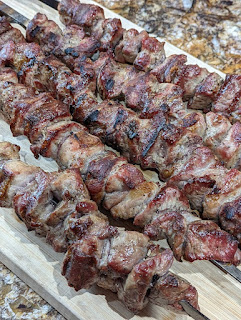
Shisliki is typically made with marinated and grilled lamb, although the recipe that I found leaves open the possibility of preparing skewers of chicken or pork. I decided to keep with the tradition and I used a leg of lamb to prepare this dish. The lamb cut into pieces, seasoned with salt and pepper, and then marinated with onions. (There are some recipes that use vinegar and/or lemon juice as part of the marinade, but I stuck with a fairly basic recipe). The lamb and the onions are left in the refrigerator to  marinate overnight, but, I should note that some recipes call for a longer period of time. For example, the town of Kamsack notes, on its website, the lamb should marinate for up to four days.  That is a little too long for me. I marinated the lamb for a much shorter time.  


SHISHLIK
Recipe from Saskborder
Serves 6

Ingredients:
  • 2 pounds of chicken, pork or lamb, cut into 1 1/2 inch cubes
  • Large onions sliced
  • Kosher salt
  • Freshly ground black pepper
  • Canola oil
Directions:

1.  Prepare the skewers.  Toss the meat and onions in a bowl and add vegetable oil until everything is coated.  Add the salt and black pepper and toss until everything is coated.  Place the meat in a bag and refrigerate it overnight.  

2. Grill the skewers.  Prepare a fire or heat a gas grill on high. Place the skewers next to the fire or on a cooler part of the grill. Turn occasionally and grill until cooked to the proper internal temperature.

*     *     *

In the end, I am happy that my personal culinary challenge is based on the Shishlik, rather than the Bannock. The challenge proved why I don't bake, as the bannock was not baked all the way through. I was still able to salvage enough of it to eat, but I figured that either I needed to make the bread thinner or it needed to bake longer. I also had to reduce the syrup for a longer period of time than what is called for in the recipe. Yet, the lamb skewers turned out perfectly, with pink meat in the center and crispy grilled edges to the lamb. Given the lamb counts as the main course, I can tally this challenge as a win. Until next time ... 

ENJOY!

Tuesday, February 1, 2022

Chengdu Chicken with Black Beans, Chiles, and Peanuts

There are only a small number of chefs that I follow on social media or the Internet; and, I follow them for very specific reasons. For example, I follow chef Sean Sherman, who is reviving Native American foodways through education and, more recently, through practice with his restaurant, Owamni. I also follow chef Michael Symon because, at first, he is a home-town chef, but, in recent years, he has been doing great work in promoting anti-inflammatory recipes and cooking. And then there is chef 
Andrew Zimmern, whose work on television and in the kitchen helped to expand my thinking about exploring new cuisines. These opportunities led to my desire to also learn more about the cultures in which those cuisines arise. And, for the few who follow this blog, it may explain much of what I post and why.
So when I get recipes from Andrew Zimmern, especially those involving dishes from around the world, I take notice. One particular recipe caught my eye: Chengdu Chicken with Black Beans, Chiles and Peanuts.  I got that recipe from Zimmern's weekly newsletter back on October 16, 2018. I bookmarked it with every intention of making that dish. However, for a variety of reasons, it took me more than two and one-half years to actually make the dish. The wait was entirely worth it.

The new ingredients: toban djan and
douchi (fermented black beans)
One reason why it took me a while to make this dish is that the recipe called for the use of ingredients that I had not used in the past. There is toban djan (or doubanjiang), which is a fermented chile bean paste. The paste is made from fermented broad beans, chiles, soybeans, salt and flour. Toban djan has been called the "soul of Sichuan cuisine," because it figures prominently in many well known provincial dishes. There is also douchi or fermented black beans. And, as I discovered, they are not just any fermented black beans. Douchi have been found in sealed in a Chinese tomb that dates back to 165 B.C.E., which makes it the oldest, known soy product out there.  Of these two new ingredients, I was able to find toban djan fairly easily in my local Asian grocery store. It took a little more work to track down the douchi. 

However, once I had all of the ingredients, I set out to make this dish. Not only was this recipe easy to make, the dish itself was incredible. It got me to thinking about all of the bad food that I have ever eaten from local Chinese restaurants and why I don't just invest the time into making, not just great Chinese food, but great regional dishes. Sichuan cuisine always intrigued be because of its extensive use of chiles and garlic in the recipes. This Chengdu Chicken recipe (Chengdu is the capital of the Sichuan province) confirmed everything that I love about the regional cuisine. For that reason, I made the dish a second time and enjoyed a little bit of this dish every day for lunch over the course of a couple of weeks. 

In the end, this is the best recipe that I have made in quite a while (and, in my humble opinion, that is saying something because I think that I have made some very delicious dishes in recent weeks and months). I will make sure that I have all the ingredients on hand so that I can make this dish in the future.


CHENGDU CHICKEN WITH BLACK BEANS, CHILES AND PEANUTS
Recipe from Andrew Zimmern
Serves 4

Ingredients:
20 to 24 ounces of boneless, skinless chicken breast 
     and dark meat, diced
3 tablespoons rice wine or sake
2 tablespoons corn starch
2 tablespoons toban dijan (fermented chile bean paste)
1/3 cup shelled peanuts, toasted
1/2 teaspoon ground white pepper
2 tablespoons sugar
2 tablespoons Szechuan peppercorns, crushed
12 dried whole Chinese chiles (tsin-tsin or Mexican arbols work well)
1 tablespoon ginger, sliced
1 tablespoon garlic, sliced
4 tablespoons peanut oil
4 tablespoons whole fermented Chinese black beans (douchi)
1 tablespoon brown sugar
2 tablespoons black vinegar
2 tablespoons dark soy sauce
1 cup scallions, chopped
Cooked rice, for serving

Directions:
1. Marinate the chicken.  Combine the chicken, rice wine, cornstarch and 1 tablespoon of the toban djan and mix well in a large Ziploc bag or bowl.  Cover or seal and place in the refrigerator to marinate for 4 to 24 hours.  Drain chicken and discard any remaining marinade.

2.  Prepare the wok.  Preheat a wok over high heat for several minutes.  Combine the peanuts, white pepper, white sugar, Szechuan peppercorns, dried chiles, ginger and garlic in a bowl.  When the wok is very hot, add the peanut oil and swirl.  It should smoke and ripple immediately.  Add the bowl of mixed seasonings.  Swirl in the wok - they will scorch quickly. 

3.  Cook the chicken.  Next, add the chicken and 2/3 of the scallions.  Wok toss until cooked through, about 3 minutes.  Use wok tools so you don't break the chiles and can scrape across the sides and bottom of the wok safely.  Add the fermented black beans, brown sugar, black vinegar, soy sauce, and remaining toban dijan.  Toss and cook for another 2 minutes.  The sauce should reduce and tighten to a glaze. 

4.  Finish the dish.  Toss in the remaining scallions and immediately spill contents out on a platter.  Serve with white rice. 

ENJOY!

Friday, January 28, 2022

Black Ankle's Chispa (2017)

Albarino has been called "Spain's quintessential white wine." While this claim may be disputed by others, such as those who love Verdejo or Txakoli, one can't seriously argue that an Albarino is a very good white wine.  And, as I learned recently, this varietal also makes a very good sparkling wine. 

One such varietal is Albarino. I have reviewed Black Ankle's Albarino in the past. My thoughts of that particular wine, which was the 2011 vintage, provide a little foresight into how the wine would work as a sparkling wine: 

The aromatic elements suggest grapefruit and perhaps some apple or a little lemon. The taste also features these elements, with grapefruit and citrus notes being at the forefront. There was definitely a little minerality and even a little hay or straw that followed in the background.  There is also a little tartness that grips the edges of the tongue long after the wine has been consumed....

I said a little foresight, because, as with what happens over time, things change.

The Chispa retains the citrus in both the aroma and the taste; however, there is one element that is far more pronounced than any grapefruit or lemon. It is apple, and, judging by the tartness, something more along the line of green apples.

To be sure, my nose and palate are far from trained, or even refined. Those with more well-trained  noses and tongues typically speak of citrus, like that grapefruit, or stone fruits, such as peaches and nectarines. Indeed, they speak of a wide range of fruits and nuts, from oranges to almonds. Apples are not usually included in the descriptions. 

Perhaps the turn to a sparkling wine influenced the aroma and taste of the Albarino grape. Maybe it is just my lack of experience tasting sparkling Albarino wines. Only time -- and possibly another bottle or two of this sparkling varietal -- will tell. Until then ...

ENJOY!

Saturday, January 22, 2022

Pulpo en Purgatorio

Every once in a while, my beautiful Angel buys me a package of octopus from our local big box store. The package usually includes three to four large tentacles. Those tentacles are cooked, meaning that one of the most time-intensive parts of preparing activity of making octopus (boiling the octopus) is already done. That opens a wide range of opportunities to focus on different ways to present that ingredient.

I spent a lot of time looking for recipes to make with that octopus. I found three recipes: one from Peru, a second from Italy, and a third from Haiti.  I could not decide which one to make. So, I turned to my friends on social media and asked for their opinion. The results were closer than I expected, but the clear winner was this recipe: Pulpo en Purgatorio. The recipe is a specialty from Molise, where it is known as i pulepe 'npregatorie in the local dialect.

Molise happens to be the newest Italian region, having been established in 1970 after it split from Abruzzo e Molise. Despite the split, the cuisine of Molise remains substantially similar to that of Abruzzo. Both cuisines draw from the bounty of the sea, whether from the port of Chieti in Abruzzo or the port of Termoli in Molise. More significantly, both cuisines share the use of  peperoncini (a general label for a range of chiles) in many dishes.

Source : Tesori del Matese
It is said that Italians refer to peperoncini as la droga di poveri (the drug of the poor). The origin of this phrase comes from two facts: (1) that the pepper plants are cheap and (2) the chiles can grow anywhere. Thus, these chiles are available to the poor, who can purchase them and grown them on their properties. Thus, while the rich are able to utilize black pepper (which costs more given it has to be imported), the poor cultivate these chiles, dry them, and use them in very much the same way. For these reasons, peperoncini often finds its way into cucina povera. The chiles enable the poor to provide that spicy kick to bland dishes. And, the poor used these chiles in large quantities, especially in the southern regions, like Molise.

A relatively large amount of peperoncini (for some people) is called for when one makes pulpo en purgatorio. The word, "purgatory," is defined as a place of temporary suffering or misery. The heat and spice of the peperoncini are supposed to provide that suffering or misery. I guess that someone who does not ordinarily eat spicy food may find this recipe a bit "painful." However, as followers of this blog may recall, I revel in the heat and piquancy of chiles. After all, I created the Inferno Steak, a recipe inspired by Dante Alighieri's famous poem. The recipe utilizes nine different chiles, each one representing a circle of hell and each subsequent chile being hotter than the last. Italian peperoncini inflict little suffering or misery to my taste buds. 

As for the recipe itself, it calls for the use of a raw octopus, which requires some extra work. I kept those instructions in the case someone is using a raw, rather than a cooked octopus. I then added directions for pre-cooked octopus. When you used the pre-cooked variety, this recipe becomes very simple and quick to make. 

PULPO EN PURGATORIO

Recipe from Gusto TV and Serge the Concierge

Serves 4

Ingredients:

  • 2 cups olive oil
  • 2 small onions, finely diced
  • 1 pound of fresh, large octopus tentacles
  • 4 red chiles, seeded and sliced (or 2 teaspoon crushed red pepper)
  • 1 chile, minced for garnish 
  • 1/2 cup parsley, chopped, plus more for garnish
  • 1 teaspoon salt
  • 1 teaspoon freshly ground black pepper

Directions:

1. If using fresh octopus. Heat half the oil in a medium frying pan over medium heat.  Add the onions, garlic, parsley and chiles (or crushed red pepper) and cook, stirring frequently, until the onions soften, about 6 to 8 minutes.  Put the tentacles in a pot and add the onion mixture and the remaining oil. Add enough water to cover just the tentacles and bring it to a boil over high heat.  Reduce the heat to low, season generously with salt, cover and cook, stirring occasionally until the liquid has evaporated, about 2 hours. Serve immediately. 

2. If using cooked octopus.  Heat half the oil in a medium frying pan over medium heat.  Add the onions, and garlic, and cook, stirring frequently, until the onions soften, about 6 to 8 minutes. Add octopus, parsley and chiles (or crushed red pepper), salt and black pepper, and stir to combine. Cook until octopus is heated through.  Transfer octopus with oil to platter, garnish with remaining parsley and red chiles. Squeeze juice of 1/2 lemon over dish. 


Saturday, January 15, 2022

Kitchen Pepper

For as long as there have been organized societies on this planet, there has been a spice trade. For most people, that trade is associated with the "silk road," which connected the Far East (principally China) with the rest of Asia, Europe and Africa.  The silk road began around in the third century, B.C.E and continued until the Ottoman Empire effectively shut it down in 1453. What may be less known is the network of "silk roads" that date back to 2,000 B.C.E. This network facilitated the trade in, among other things, cinnamon from Ceylon (now, Sri Lanka), and cassia from China. These routes also gave rise to the trade in cloves and nutmeg from the "spice islands" (later conglomerated into what became Indonesia).

Other roads - or more appropriately, voyages - added to the spice trade by introducing ingredients from the "New World."  These ingredients included allspice from Xaymaca (now Jamaica), along with chiles and vanilla from Anahuac (the Nahuatl name for what is now known as Mexico). 

In sum, the spice trade introduced a wide range of new ingredients -- black pepper, cardamom, cassia, chiles, cinnamon, cloves, cumin, ginger, mace, nutmeg, saffron, star anise, and turmeric -- to cooks around the world. Cooks from around the world began incorporating these spices into mixes, adding new spices as they became available. These spice mixes include Berbere in the Horn of Africa, the masalas of the subcontinent, and Baharat in the Middle East. 

European cooks in the 15th century began to categorize (loosely) those mixes. They fell into three categories: powder blanche, powder deuce (sweet) and powder fort (strong). The mixes eventually were lumped together into one common term, "kitchen pepper." 

The story of kitchen pepper is not a uniquely European. The reason is that other voices have contributed to the narrative. These voices include the enslaved Africans, who worked in the kitchens on plantations in the New World and elsewhere in colonies across the globe. For example, Hercules Posey, the enslaved African who served as the cook (really, the chef) for George Washington, is believed to have used a kitchen pepper mix that featured nutmeg. James Hemmings, the enslaved cook (again, chef) for Thomas Jefferson is thought to have used a mix heavily studded with black pepper.  And, then there was Polly Haine, who may have used allspice as part of her kitchen pepper spice mix. Polly Haine went on to use that mix to create her Caribbean Pepper Pot soup, which she sold on the streets of Philadelphia in the late 18th century. Each of these examples underscores the primary characteristic of kitchen pepper: everyone has their own individual mix. All of those mixes that give rise to the story.

Michael Twitty
I first came across kitchen pepper while reading Michael Twitty's The Cooking Gene, which won the James Beard award in 2018 for the best food writing and book of the year. The award is well deserved. The Cooking Gene is his personal mission "to document the connection between food history and family history from Africa to America, from slavery to freedom." This book introduced me to Twitty's work.  As a writer, scholar, culinary historian and cultural interpreter, Twitty has dedicated his work to preserving and promoting African-American foodways. (A foodway is defined as the culinary practices and eating habits of a people, region or historical period.) Twitty's work, along with that of other writers, historians and interpreters, is bringing to life an important part of the culture and cuisine that has defined not only the United States, but the world for centuries.

Kitchen pepper is an example of this exploration.  Twitty's recipe apparently draws inspiration from the spice mixes developed by Hercules, James, and Polly by incorporating nutmeg, black pepper and allspice. Twitty builds upon that inspiration by adding other spices, including cinnamon, crushed red pepper, ginger, mace, and white pepper to his recipe. The end result is, at least for me, reminiscent of spice mixes that I have encountered throughout my years of cooking. Yet, this particular spice mix - the kitchen peppers developed by enslaved African cooks - is something that does not garner the same attention as those other mixes (like masalas, Berbere, etc.). I am thankful for the opportunity to learn more about kitchen pepper, and, it is an opportunity that I may not have had without Michael Twitty's work. 

If I had to summarize kitchen pepper, then I would do so in the following way: kitchen pepper is about the artistry of an untold number of individual, enslaved cooks, each of whom crafted his or her own spice mix. It is about an unspoken effort to assert one's individuality while subjugated in a brutal, dehumanizing system that was intended to deny that right and freedom to that individual. 

KITCHEN PEPPER

Recipe by Michael Twitty, available at Bittman Project 

or Michael Twitty, The Cooking Gene, pg. 24

Ingredients:
  • 2 tablespoons coarsely ground black pepper
  • 1 tablespoon freshly grated nutmeg
  • 1 tablespoon ground allspice
  • 1 tablespoon ground cinnamon
  • 1 tablespoon ground ginger
  • 1 tablespoon ground mace
  • 1 tablespoon ground white pepper
  • 1 tablespoon ground red pepper flakes
Directions:

Combine all of the ingredients and mix well.  Store in an airtight container. 

ENJOY!

Thursday, January 6, 2022

Vietnamese Grilled Clams with Oyster Sauce and Peanuts

As I always say, cooking provides many opportunities to learn, whether it is about cooking processes, ingredients, recipes and even cultures and cuisines. At least in my cooking experience, and in my humble opinion, few dishes embody this principle more fully and completely that this dish: Vietnamese Grilled Clams with Oyster Sauce and Peanuts. The recipe provided me with a chance to learn about the concept of fundamental elements in cooking. It is a concept that the Vietnamese call, ngu hanh or ngu vi. 

The Ngu Hanh is actually a site in central Vietnam, located just south of Da Nang.  It is actually the Ngu Hanh Son, consisting of five mountains, each representing a fundamental factor of the universe. The mountains are Kim (metal), Moc (wood), Thuy (water), Tho (earth) and Hoa (fire).  

The phrase ngu hanh or ngu vi has also been used by the Vietnamese to refer to other quintuples. There are the five fundamental tastes: spice, sour, bitter, salty and sweet. There are also the five fundamental cooking modes: raw, steamed, broiled, fried/grilled, and fermented. And, there is the five fundamental food textures: crispy, crunchy, chewy, soft and silky. Vietnamese cuisine has always intrigued me as to how it applies and balances all of these quintuples, that is, taste, cooking mode and texture. 

To be sure, the Vietnamese did not create the culinary philosophy of quintuples, it originated in China. However, in my humble opinion, the Vietnamese have taken this philosophy and elevated when it comes to food.  There is something about the dishes, from the North to the South and from the coast to the inland. It is hard to describe, but the dishes always appear to please the eyes, the nose and the taste buds. That is why when I saw this recipe for Vietnamese Grilled Clams, I had to make it. 

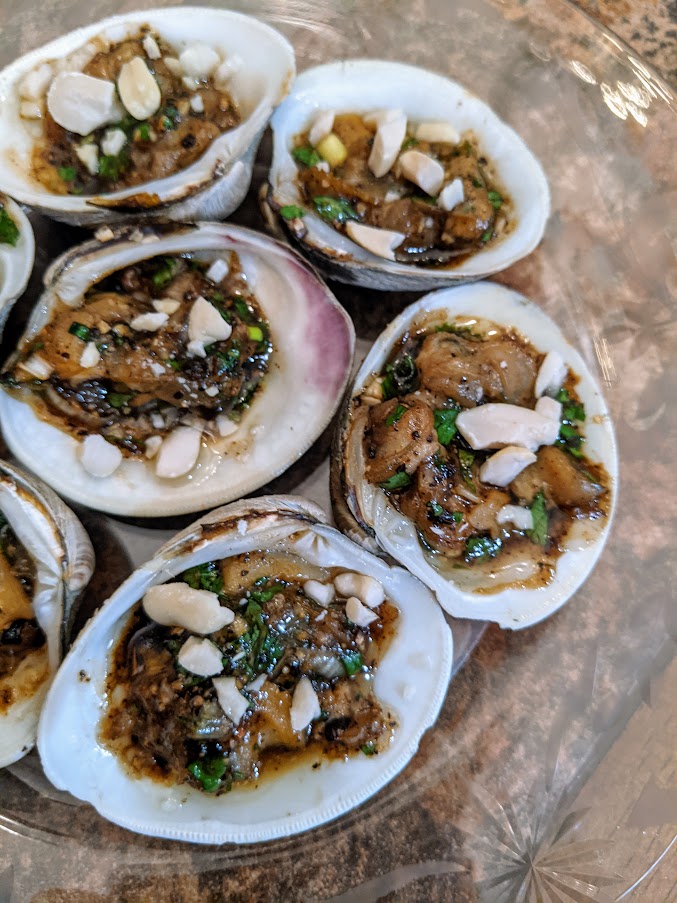
This recipe represents some, but not all, of ngu hanh or ngu vi balance. For example, a balance would include ingredients that are salty and sweet, or spicy and sweet. For this recipe, the ingredients include sugar (sweet), black pepper (spice), which is a balance on a very small level. A balance of textures could be a combination of crispy or crunchy with chewy or silky. The textures in the recipe for Vietnamese Grilled Clams include clams (chewy), fried shallots (crispy) and peanuts (crunchy), paired with the oyster sauce and oil (silky). Together, these balanced ingredients help to elevate the dish to something that is delicious and needs to be made over and over again.

This dish represents what I love about cooking: it is the opportunity to learn and expand horizons. I hope to be able to continue to explore these concepts in future recipes.  Stay tuned for more ....

VIETNAMESE GRILLED CLAMS WITH OYSTER SAUCE AND PEANUTS

Recipe available at Food and Wine

Serves 4

Ingredients:

  • 3 pounds cherrystone clams or 1 pound mussels, scrubbed
  • 2 scallions, finely chopped (about 1 1/4 cups)
  • 1/2 cup chopped fresh rau ram (Vietnamese coriander) or cilantro
  • 1/4 cup packaged crispy fried shallots (such as Maesri)
  • 1/4 cup oyster sauce
  • 1/4 vegetable oil
  • 1 tablespoon granulated sugar
  • 1 tablespoon black pepper
  • 2 tablespoons plus 2 teaspoons finely chopped peanuts
Directions:
1. Steam the clams.  Preheat the grill to high (between 450 degrees and 500 degrees Fahrenheit). While grill preheats, fill a heavy bottomed pot with water to a depth of 1 inch, bring to a boil over high.  Add clams, cover and cook until shells open, 6 to 8 minutes, transferring clams to a backing sheet as they open.  Discard any clams that do not open. 

2. Prepare the sauce. Stir together the scallions, rau ram, fried shallots, oyster sauce, oil, sugar, and pepper in a small bowl. Remove clam meat from shells and coarsely chop. Discard top shells.  Stir chopped meat into scallion mixture; spoon evenly into bottom shells. (If using mussels, spoon about 2 teaspoons of the scallion mixture directly onto the meat inside each shell, leaving the top shells intact.)

3. Finish the dish. Place prepared clams on unoiled grill grates; grill, covered, until scallion mixture bubbles, about 2 minutes.  Carefully transfer to a platter; sprinkle evenly with peanuts, and serve. 

ENJOY!