Thursday, October 19, 2023

Cuminatum in Ostrea

I love reading about history, including culinary history. My travels through books and along the Internet take me to a lot of recipes. Many of those recipes, along with the resulting dishes, have long histories that date back decades, centuries and, in a few cases, perhaps a millennium or two. Yet, the recipes I find are usually the present day versions of those recipes, with little to no discussion about how we got to this point or that recipe.

Every once in a while, I will stumble upon someone who takes the time to find and talk about those recipes. In this case, it is the Historical Italian Cooking blog. The recipe that caught my eye is called cuminatum in ostrea et conchylia, which is Latin for cumin sauce for oysters and shellfish. The recipe dates back to at least the 5th century C.E., during which the Roman Empire collapsed (476 C.E.). We can go this far back because the recipe was found in the midst of a collection of recipes compiled in De Re Culinaria, also known as Apicius. The only surviving version of the Apicius dates back to the 5th century

Yet, cookbooks are sometimes akin to history books: they recount the recipe at the time of publication. This particular recipe may be much older, perhaps dating all the way back to the 1st century C.E. Some have attributed the Apicius to Marcus Gavius Apicius, who noble who was renown for his love of luxury foods. The Roman philopsopher Seneca once remarked that Apicius "proclaimed the science of the cookshop" (Seneca, Consolatio ad Helviami 10) and then corrupted the age through his example.

As the Historical Italian Cooking blog explains, Romans considered oysters to be a "costly food." Oysters may have been a luxury to the point that there was a reluctance to share them. The Roman poet, Martial (known as the father of the epigram, after all, he wrote 1,561 of them) recounted the following interesting epigram about a guest's response to the host's dinner: 

I dine with you at my own cost,

So why not fare the same, both guest and host?

You swallow Lucrine oysters large and fat,

I suck a whelk and cut my lips at that.

You're served with mushrooms, I chew fungus still,

You have to do with turbot, I with brill

Plump yellow doves your appetite assuage, 

I have a magpie starved within its cage.

I am by your side and yet I'm far away.

The dole has gone. Let's fare the same, I say.

Clearly, oysters ranked with other luxurious food items, such as mushrooms, turbot, and "plump yellow doves." (By the way, the underlying message in this epigram is as timeless is as true today as it was when Martial wrote it back in the first century A.D.) Other epigrams and poems by Martial underscore the oyster as an expensive food for Romans. 

Yet, even a costly food item like oysters has its limits. In another poem, Martial wrote, in part: 

I WILLINGLY accept your dainty fare

If hospitality be undesigning: 

Not so, if you imagine that I care

For nothing in the world so much as dining; 

A dozen oysters will not make you heir

To my reputed wealth for which you are pining; 

The feast is elegant; that I admit

But on the morrow what is left of it? 

Upon the morrow? Where is it to-day

The moment after it has passed your gullet?

Thus, oysters won't make you rich during Roman times, but they were certainly enjoyed by the rich.

This leads me to how Romans ate oysters. For that, I turned back to the Historical Italian Cooking blog. The author writes that in books wrote in the 2nd century, Galen's De Facultatibus Alimentorium, and in the 6th century, Anthimus' De Observatione Ciborum, recount that Romans ate oysters both raw and cooked (either boiled or fried). 

However, the recipe in Apicius provides for the oysters and shellfish but did not provide a cooking method. it provided only a sauce, and one that has its base in cuminum or cumin. In fact, the sauce requires a good amount of cumin (or cuminum plusculum). The recipe also calls for other spices (black pepper and lovage), herbs (fresh parsley and mint, the recipe calls for dried mint but you can use fresh mint), and a liquid mixture that consists of honey, garum and vinegar. If you do not have lovage, Historical Italian Cooking advises that, according to Pliny, you could use anise seeds, or according to Dioscorides, you can use fennel seeds.

For this recipe, I decided to prepare the sauce to serve with raw oysters. While I do not have authentic Roman garum (check out this post by Historical Italian Cooking on how to make it), I do have a significant amount of Vietnamese fish sauce (check out my post with a brief discussion of the history of fish sauce, including a reference to garum). I have modified the recipe slightly from the one provided by Historical Italian Cooking to show both how the writer described the preparation and how I prepared this dish. 

In the end, I have to say that I was not a big fan of this sauce. While I like cumin as a spice, I came to the realization that I am not keen on cuminum plusculum. The large amount of cumin overwhelmed the flavors of the oysters, with the brininess being lost in the loud notes of the spice. 

CUMINATUM IN OSTREA

Recipe adapted from Historical Italian Cooking

Serves several

Ingredients:

  • 1.5 kilograms (about 3 pounds) of oysters
  • Pinch of freshly ground black pepper; 
  • Pinch of fennel seeds; 
  • 4 tablespoons of cumin;
  • 1 bunch of parsley, minced finely
  • 1 tablespoon of dried mint leaves
  • 1 tablespoon honey
  • 1 tablespoon fish sauce
  • 2 tablespoons white wine vinegar

Directions:

1. Prepare the sauce. Mince the parsley (and mint, if you use fresh mint). Pound them in the mortar with the pepper and the fennel seeds (or anise seeds or lovage), adding the cumin as you work. Move the mixture to a bowl and then proceed to mix in the honey and fish sauce (or garum), diluting it with the vinegar. 

2.  Finish the dish. Shuck the oysters and reserve the liqueur. Add some of the liqueur to the cumin sauce. Spoon some of the sauce over the shucked oysters and serve immediately. 

ENJOY!

Thursday, October 12, 2023

The Long History Told by Bones

Salmon are an intrinsic part of us. They're in our blood. They're in our being.

- Hereditary Chief Don Svanvik, 
Namgis First Nation, 
Alert Bay, British Columbia

Recently, an online article caught my eye. The article's title was "Salmon Bones Confirm Sustainable Chum Fishery for 2,500 Years Under Tsleil-Waututh Nation."  That title represented a ray of light, a little bit of good news, that brightened what is becoming an otherwise dark picture.

It seems - to me at least - that much about what I have been reading about Pacific salmon has ranged from bad to ominous. This sense seems particularly the case for the salmon in the Pacific Northwest.  For example, a report in 2019 found that, while the preliminary forecasts for chum salmon in the Puget Sound hovered around 550,000 fish, the actual amount may have been more along the lines of 243,000 fish. That statistic is particularly alarming given that the chum salmon has traditionally been the most abundant of all the different types of salmon. 

There are many reasons for the population declines. At first, the culprit was overfishing in the 19th and 20th centuries. The loss in fish numbers was compounded by the loss of their habitat, which was primarily due to the construction of dams that blocked the rivers used by the salmon, along with the timber industry, which damaged the rivers and streams.  And then there is climate change and, in particular, the warming of the Pacific Ocean. As it turns out, just a few degrees of increased temperatures can have a significant impact on salmon populations. As the oceans warm, it favors subtropical zooplankton, which are not eaten by juvenile salmon. Warmer water also has less oxygen, making it harder for the fish to breath.

Yet, this is all the bad news; and, I started out this post noting a ray of light. Research has shown that one of the Salish peoples of the Pacific Northwest - the Tsleil-Waututh - have a long history of managing the chum salmon populations where they live. The story actually explains that the Tsleil-Waututh have a much longer history of managing that important resource.

Archeologists had already known that the Tsleil-Waututh, who live in the Burraud tribal territory, have been sustainably fishing chum salmon for about 1,200 years, from approximately 400 BCE to 1200 A.D. However, recent finds at an archeological site at təmtəmíxʷtən, a very important site for the Tseleil-Waututh, have revealed that this fishery has existed for an additional 1,300 years. This history is important because of one fact: chum salmon are especially vulnerable to overfishing. 

This story has led me to think about how we develop our guidelines for sustainability. Often times, those guidelines are dictated from the top down, from the government to the people, with a healthy disdain for guidelines coming from the reverse direction. As long as people are motivated by capitalistic desires, such as the private ownership of resources and maximizing profit for personal gain, that disdain is warranted. But, what if the people are motivated by something else. What if, like the Tsleil-Waututh, the people are motivated by preserving the resources for future generations to enjoy. Resources that are able to thrive in a larger, more balanced ecosystem. 

All of the foregoing also got me thinking about the salmon recipes that I have made over the years. This is perhaps my most favorite recipe on my blog: 


COPPER RIVER SALMON WITH AN ORANGE-SAFFRON SAUCE
Adapted from recipe by Hunter Angler Gardener Cook
Serves 4

Ingredients for the Orange-Saffron Sauce:
1/2 cup of white wine
1/2 cup orange juice
A healthy pinch of saffron, crumbled
A healthy pinch of sugar
1 shallot, minced
Salt
2 tablespoons of unsalted butter

Ingredients (for the fish and greens):
1 1/2 pounds of tender spring greens, such as spinach
5 tablespoons of unsalted butter or vegetable oil, divided
A splash of water (no more than 3 tablespoons)
Grated zest of an orange
1 1/2 pounds of Copper River Salmon (or any wild salmon)

Directions:
1.  Make the Orange-Saffron Sauce.  Make the sauce by bringing the white wine, orange juice, saffron, sugar and shallot to a boil in a small pot.  Simmer strongly for 5 minutes, then turn off the heat and puree the sauce in a blender.  Return the sauce to the pot and turn the heat to low.  Add salt to taste and keep warm, but do not boil it or simmer it any further.

2.  Make the Greens.  Cook the greens in 2 tablespoons of butter or oil over high heat in a large saute pan, stirring constantly until they wilt. Add a splash of water, the orange zest and some salt and cover the pot. Lower the heat to medium-low and steam the greens for 2 minutes. Turn off the heat.

3.  Sear the salmon.  Heat the remaining butter in a pan large enough to hold the fish.  (If you don’t have such a pan, put a baking sheet in the oven and set the oven to 200 degrees Fahrenheit so you can keep the fish warm as you do this in batches.)  Heat the butter over high heat until it stops frothing. Pat the fish dry with paper towels and set it skin-side down in the hot butter. Turn the heat down to medium-high for a typical fillet  or to medium if you are working with a thicker piece of fish.

4.  Continue cooking the salmon.  Let the fish cook undisturbed for 2 minutes, then use a large spoon to baste the meat side of the fish with the hot butter. Baste the salmon for 90 seconds, then give it a rest. A thin fillet will only need one quick basting, but thicker pieces of fish will need a second or even third round of basting.  It took about four to five rounds of basting for the fillets that I had.  When the basting is done, salt the meat side. The skin side should lift off the pan easily after about 4 to 5 minutes of steady cooking. The moment you take the fish off the heat, salt the skin side.

5.  Finish the dish.  To serve, swirl in the remaining 2 tablespoons of butter into the sauce, one tablespoon at a time. Pour some sauce on everyone’s plate. Top with the greens and then with a piece of fish. Serve immediately.

OTHER DELICIOUS SALMON RECIPES TO TRY

If you are looking for other recipes to honor the salmon and its place in the foodways of different cultures, or if you are just looking for a delicious recipe, I suggest these possibilities:

Smoked Sockeye Salmon:
 This is about as close as I can get to trying to pay homage to how Native Americans and First Nations would prepare their catches. You can check out the post and learn about the Legend of the Lost Salmon. This is one of the recipes that I wish I made more often, if only I had the time and the memory to remind myself. 

"Imperial" King Salmon:
This dish features king salmon grilled on an alder plank. It also features a crab imperial over the top. The imperial literally places this dish over the top. 

Cedar Plank Salmon:
 This recipe was truly an educational experience for me. The "smothering" of the salmon with onions serves an important purpose. The water in the onions help to keep the salmon moist.

Pike's Place Salmon Burgers: 
The final recipe comes from one of my Super Bowl parties, when I prepared a dish from the city of one of the Super Bowl contenders. Back in 2014, that contender was the Seattle Seahawks. So, I prepared a salmon burger recipe that comes from the city's iconic Pike's Place market. 

These are just some of the salmon recipes on this blog. If you want to see the other posts, just click on "Salmon" in the word cloud in "What's in my Fridge + Pantry." Until next time, 

ENJOY!

Sunday, October 1, 2023

A Casualty of History

When the people don't give a damn about reason, they can be manipulated quite easily - and in such cases the perception of the people are manufactured by those controlling the narratives. As a result, ask an Azerbaijani, "who do you think is at fault for the conflict at Nagorno-Karabakh" and they'll say, "Armenia of course" .... Hard as it may sound, whoever controls the narrative, controls the people. And the only way to break that spell is to practice reason, but without losing your warmth.

-- Abhijit Naskar

It is often hard to find a narrative that is not tainted by whoever wields it, especially when it comes to culture, history and/or politics. There are often multiple narratives, some of which are irreconcilable. Yet, even in the fog of conflicting narratives, some facts shine through. Those facts cannot be denied, because they unfold before our eyes or the sounds reach our ears. This has been the case for the past days, weeks and indeed months as a so-called "breakaway republic" will now fade into the pages of history books. The consequences of what happened will live on, not only in those who suffered in the past, but in the suffering of untold numbers in the future. 

The "breakaway republic" that I am referring to is known as the Republic of Artsakh, more commonly known as Nagorno-Karabakh. The latter name is a combination of Russian (Nagorno) and Turkish/Persian (Karabakh) that translates roughly into "mountainous black garden." The Armenians living in the region preferred to call it Artsakh, because that lacked any reference to Russians, Turks, Persians or Azerbaijani. I will refer to Nagorno-Karabakh and Artsakh interchangeably. No country has recognized Nagorno-Karabakh as an independent state; instead, it has been considered to be part of Azerbaijan. Yet, the people who live within the borders of Nagorno-Karabakh are overwhelmingly Armenian. 

That one fact -- a region populated by Armenians that is part of a larger country whose majority is Azerbaijani -- provides the starting point. The mapmakers who created this issue were colonialists, but of a Russian kind. The Russian Empire obtained territory throughout the Caucasus Mountains, including both Armenia and Azerbaijan, as part of treaties that ended the Russian-Persian war in the early nineteenth century. Wars erupted between the Armenians and Azerbaijani in 1917 over various parts of their territories.  It was not until the aftermath of the Russian Revolution, when the Bolsheviks occupied Azerbaijan (including Nagorno-Karabakh) and Armenia, that the borders began to become fixed. The resulting Soviet Union decided that the Nagorno-Karabakh region would remain in Azerbaijan, but the region would retain significant autonomy. That seemed to settle the matter ... until the Soviet Union ceased to exist. 

Azeri poster about Karabakh,
saying "Stand up, son of a Turk" 

As the Soviet Union crumbled, tensions increased within Nagorno-Karabakh. The majority Armenian population wanted the region to be transferred to Armenia. However, they could not get anyone to support their calls. In August and September 1991, both Azerbaijan and Armenia obtained their independence from what was the Soviet Union. Thereafter, the situation began to deteriorate precipitously.  On November 26, 1991, Azerbaijan ended the separate structure of Nagorno-Karabakh (officially known as the Nagorno-Karabakh Autonomous Oblast) and placed the entire region under Azeri control. The region conducted a referendum on December 10, 1991 (boycotted by Azerbaijanis) that resulted in a call for unification with Armenia. The lines were drawn. War broke out. 

The war killed approximately 30,000 people and made refugees out of hundreds of thousands more. A ceasefire was negotiated in 1994 and relative peace was achieved. I say relative because fighting would take place over the coming years and decades, including as recently as 2020. During that conflict, Azerbaijan not only attacked positions within Nagorno-Karabakh, but also Armenia. Those hostilities ended with another cease fire, but it seemed that Azerbaijan was gaining the upper hand.

But it is the events of the past few weeks that gave rise to the casualty of history. For some (additional) context, the predominantly Armenian territory of Nagorno-Karabakh was connected to the country of Armenia by one road, known as the Lachin corridor. Initially, a group of "environmentalists" blocked the corridor. I use the term in quotes because many of those "environmentalists" had connections with the Azerbaijani government. That government also cut off all gas supplies to Nagorno-Karabakh.

The Lachin checkpoint
Azerbaijan escalated the issue by establishing a checkpoint in the Lachin corridor. Perhaps the more appropriate term is a "chokepoint." The Azerbaijani military has used the checkpoint to restrict the passage of goods, materials and commodities between Armenia and Nagorno-Karabakh. Azerbaijan imposed a blockade in April 2023, depriving the people of Nagorno-Karabakh of what they needed to survive, like food, gas and medicine. The blockade soon extended to anything and everything by June 2023. The people of Nagorno-Karabakh were cut off from not only Armenia, but the entire world.  

On September 19, 2023, Azerbaijan commenced a military offensive, which ended one day later with a ceasefire, along with subsequent violations of the ceasefire. Azerbaijan then commenced its efforts to integrate Nagorno-Karabakh into the country. The violence, along with the seeming end of any autonomy, led to a mass exodus of Armenians from Nagorno-Karabakh to Armenia. As of the end of September 2023, more than 100,000 Armenians have fled to safety in Armenia. The population of Nagorno-Karabakh was approximately 120,000 prior to the recent Azerbaijani military offensive. Those who remain would be forced to accept Azerbaijani citizenship.

Ethnic Armenians fleeing Nagorno-Karabakh. Source: Vasily Krestyaninov (AP)

So, here we are, after months of an economic blockade, Azerbaijan used overwhelming military might to force the surrender of the governmental authorities in Nagorno-Karabakh. The military victory paves the way for the former Republic of Artsakh to be fully incorporated into Azerbaijan. The treatment of the Armenian people has led to a mass exodus that could, at the very least, be described as an act of ethnic cleansing.  Alternatively, Azerbaijan's conduct could be described, as it has by several legal experts, as a crime against humanity

The objective of the crime is two-fold: (1) to eliminate the Republic of Artsakh; and (2) to eliminate the Armenian culture that developed within its borders. As Azerbaijan has largely achieved both goals, feelings of powerlessness and meaninglessness may seem too much to overcome. Then again, remember who controls the narrative. In the face of violence and inhumanity, we can break the control over the narrative. So that no one will forget who lived in the mountainous black garden that the Armenians called Artsakh.

That is the purpose of this post. My goal is to make the one food that indisputably comes from the Armenian community that lived in Artsakh. That food is called Zhingalov Khats. The recipe embodies the principle of "Karabaghstin sovadz chi mnoum" or "the people of Karabakh do not remain hungry." During the wars with Azerbaijan, the local populace would gather greens from the forest and elsewhere to prepare this dish, as well as a broth of wild greens. 

The recipe starts with an unleavened dough, which is rolled out into a thin circle. A filling is then prepared by chopping various herbs very finely. If one were preparing this dish in Artsakh, they would be looking for herbs that go by the name of k'ndzmendzyuk, chercheruk, s'msemok and mokhratal. These are just some of the at least seven herbs that are used to make zhingalov khats. Some recipes call for as many as twenty herbs for the filling. Regardless of the number of herbs used, the other ingredients include lemon juice, paprika and some salt. The dough is then folded over and sealed. The packet is then pressed slightly so that it looks like a deflated American football. Once the bread is ready, it is cooked over a saj, which is a specialized domed griddle.

In my case, I prepared a filling that consisted of cilantro, spinach, kale, Swiss chard and scallions.  I could not reach the threshold of seven ingredients because I had some difficulty in finding the other greens at my local grocery store. These greens and herbs included chervil, turnip greens, tarragon, radish tops, sorrel and watercress. Nevertheless, I kept those ingredients in the recipe below in case you are able to find them in your local store. As for the preparation, once I placed the stuffing and sealed the dough, I used a standard griddle to cook the bread.

One final note: it is said that zhingalov khats is best enjoyed with a fine red wine. I definitely have a suggestion, namely, the Karas Classic Red, which comes from Armenia.

ZHINGALOV KHATS

Recipe adapted from Cafe Osharak and New York Times

Serves 4

Ingredients (for the Lavash):

  • 2/3 cup lukewarm water
  • 1 teaspoon kosher salt
  • 1 1/2 cups of all purpose flour, plus 200 grams more for dusting

Ingredients (for the filling):

  • 2 pounds chard, tough stems discarded
  • 4 packed cups fresh cilantro, chervil and dill leaves and tender stems
  • 4 packed radish greens and sorrel
  • 6 spring onions or 10 scallions, thinly sliced
  • 2 tablespoon lemon juice
  • 3 tablespoons sunflower oil or other neutral oil
  • Lavash dough

Directions:

1. Prepare the lavash. In a medium bowl, combine 1 1/2 cups of flour and the salt. pour the lukewarm water into a large bowl, then gradually add the flour mixture, using your hands to incorporate. The dough will be sticky. Dust the counter with flour, turn dough onto it and knead gently until the surface becomes smooth and the dough stops sticking to your hands and counter, about 5 minutes. Roll the dough into a ball, place it in a lightly oiled bowl, turn it to coat, then cover it with a kitchen towel. Let it rest at room temperature for 20 minutes to 1 hour.  

2. Prepare the filling. Wash and dry all of the greens. Chop the greens finely. Mix with spring onions, lemon juice and salt. 

3. Prepare the bread. Spread flour over the work surface. Divide the dough into 4 equal pieces and roll into thin 8 inch ovals using a rolling pin. Place about 2 cups of the filling in the center, then use your hand to pat it down into a round, leaving about a 1 inch border of dough. Pick up the two opposite sides of the dough and pinch them together over the center of the filing, from top to bottom so the middle is wide and the ends form points. 

4. Continue to prepare the bread. Firmly pinch the seam to make sure it's sealed, then turn the dough over and gently flatten it out with the palm of your hand so it resembles a deflated football, sealing any holes in the rough. It should be about 1/4 to 1/2 inch thick. If it is thicker, use a rolling pin to smooth it out aa little. Pinch shut any holes in the dough and then place it on parchment. Repeat steps 3 and 4 with the remaining dough.

5. Cook the bread. Heat a large cast iron pan over medium high. Working with one dough portion at a time, place the dough seam-side down in the center of the pan. Lower the heat to medium and cook for about 3 minutes, until cooked and lightly browned in places. Flip, and cook the other side for 2 minutes. If the dough seems raw in places, flip and cook evenly. Repeat for the rest of the zhingalov khats and serve warm or at room temperature.

*    *    *

Nagorno-Karabakh has become a casualty of history. A history of artificially drawn borders, dividing communities with political boundaries that, sometimes, bind those communities with larger groups of people. When one adds the worst of humanity - distrust and hatred of those who are different - with the desire for power and control, then the scene is set for the events of Nagorno-Karabakh. The only question is when the final act will play out. It has unfolded while the world has watched. It did so silently as brutality, inhumanity and violence caused Artsakh to fall and to force over 80% of the population to flee their homes. 

I leave you with one last note: there are many more Nagorno-Karabakhs across the globe. As you read this post, the military forces of Serbia are amassing along the border with Kosovo, a breakaway republic in the Balkans that is only partially recognized. My guess is that the Serbian government has made a bet: if the West sat silent as Azerbaijan ethnically cleansed Nagorno-Karabakh, then it is unlikely to do anything if the scene repeats itself in Kosovo. 

Only time will tell.

Tuesday, September 19, 2023

Sumac Navajo Leg of Lamb with Onion Sauce

As the Navajo (Dine) chef and author, Freddie Bitsoie recounts the Navajo story, "there was a thick fog for four days. No one could see their hand in front of their faces, and people were growing worried and scared. But, when the fog lifted, little cloud puffs were left behind: the sheep."

Sheep are not indigenous to the North American continent. The "fog" that brought the sheep there were Spanish conquistadors and colonizers. The person credited with bringing sheep to the area where the Navajo lived is Don Juan Onate, a conquistador who would later become governor of Santa Fe de Nuevo Mexico. He brought 2,900 hundred sheep with him and Spanish settlers, who continued to raise those sheep on ranches throughout the province. Apart from bringing sheep to the region, Onate is known for his massacre of indigenous people of the Acoma Pueblo. 

Onate embodies the reason why the Navajo were worried and scared of that fog of colonization (as history has shown, see books like Sundberg, Dinetah and Denetdale, The Long Walk). When the fog lifted, the Navajo found themselves on a reservation that spans an area larger than West Virginia. That reservation covers a hot, arid region that crosses over the political boundaries that separate Arizona, Utah, and New Mexico 

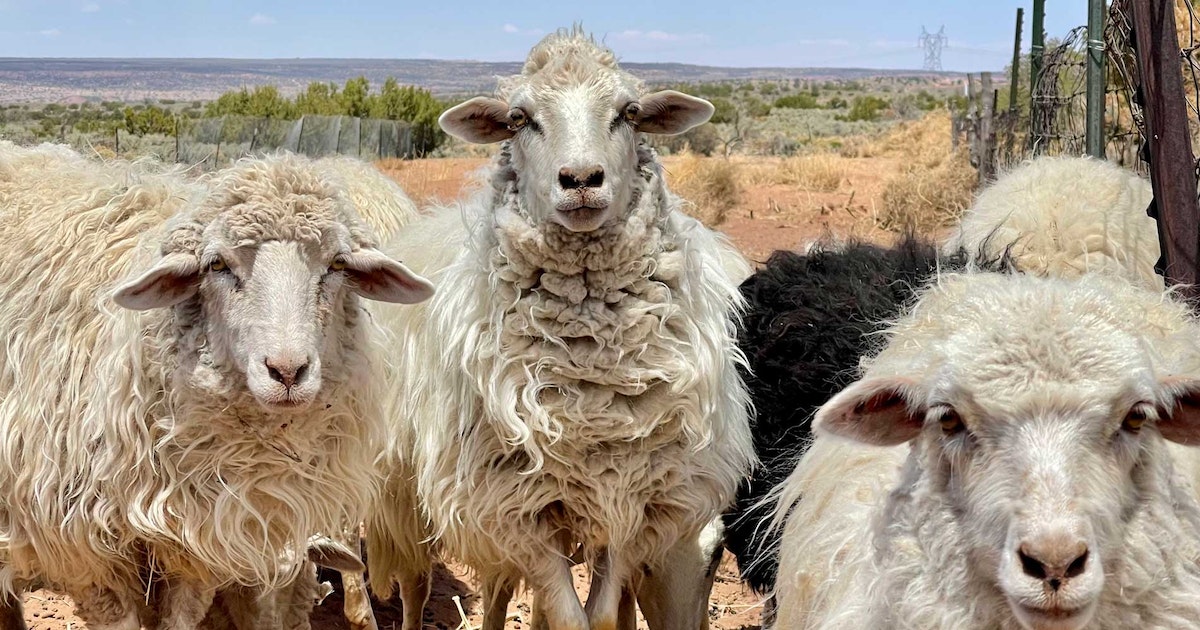
Nevertheless, the Navajo accepted in those "little cloud puffs." The Navajo Churro sheep are descendants from the original stock brought to the new world by the Spanish. The Navajo obtained the sheep from the Spanish, whether by trade with the Spanish or raids on their settlements.  The Navajo had great success in raising these sheep, which grew in numbers until they were more than 574,000 in the 1930s. 

Navajo Churro Sheep (Source: Nikyle Begay)

However, the drought conditions at the time led the United States to engage in a forced reduction. The reduction resulted in a loss of about 30% of a household's livestock, including sheep, cattle and horses. For the Navajo, the forced reduction was as painful as the Long Walk. The stocks of Navajo Churro continued to decrease until the point that they faced extinction. Efforts were made to revive the numbers of sheep, which have been largely successful. 

Although not an animal native to North America, the Navajo Churro has nevertheless assumed an important place within Navajo culture. The stocks may have declined, but Navajo have continued to raise the sheep throughout the years. They have also used the wool, spinning it and dyeing it to produce fibers that make their way into clothing, blankets, rugs and decorative arts. 

In addition to the wool, the Navajo have used the meat of the lamb and sheep in various dishes. Recipes have been developed over generations, and indeed centuries, that feature this protein. One common recipe is Navajo Lamb Stew. This recipe combines mutton with carrots, onions, potatoes and cabbage for a dish that is ideal on cool to cold nights.

Another recipe is this Sumac Navajo Leg of Lamb with Onion Sauce. The recipe is an inspiration of Chef Bitsoie, drawing from his memory of his grandfather, who would roast lamb over a fire and then serve it with a sauce made out of chopped onion. His grandfather did not necessarily use sumac, but Chef Bitsoie thought that the flavor of the sumac worked well with the lamb. (He is correct.)  He used juniper berries and rosemary in the onion sauce because he believed that his grandfather would have foraged those ingredients while he was herding the cattle and sheep in the mountains. 

The use of sumac drew my attention to this recipe. It pairs a non-indigenous protein with a very indigenous little sumac berry. There are 14 species of sumac that grow only in North America. The range of these species runs from southern Quebec across to southern British Columbia, and then south to northern Florida and across to northern Arizona. 

The sumac berry is known for providing a lemony element to dishes, which was part of the overall balance to this dish. The slightly bitter, lemon flavor brought by the sumac berry complements not only the rich taste from the leg of lamb, but also the sweetness of the onion sauce. That balance makes this dish one of the best leg of lamb dishes that I have made in a very long time. 

SUMAC NAVAJO LEG OF LAMB

Recipe adapted from Washington Post

Serves 6-8

Ingredients (for the lamb):

  •  One three pound leg of lamb or tied lamb roast
  • 1 teaspoon fine salt
  • 1 teaspoon freshly ground black pepper
  • 1/3 cup (1 1/2 ounces) ground sumac
  • 3 tablespoons canola oil

Ingredients (for the onion sauce):

  • 2 tablespoons canola oil
  • 1 large yellow onion, halved and thinly sliced
  • 2 sprigs fresh thyme
  • 1 spring fresh rosemary
  • 5 dried huniper berries
  • 1 teaspoon fine salt
  • 1 teaspoon freshly cracked black pepper
  • Water, as needed
  • 2 cups chicken stock

Directions:

1. Prepare the lamb: Heat the oven or a grill to 375 degrees (or heat a smoker to about 275 degrees, and smoke some oak or mesquite wood chunks for about 1 hour). Season the lamb on all sides with salt and pepper, then coat the lamb on all sides with the sumac.

2. Brown the lamb: If you are going to roast the lamb, heat the oil in an ovenproof skillet over high heat, heat the oil until it shimmers. Add the meat and sear on all sides until evenly browned, about 8 minutes. If the lamb is going on the grill or into a smoker, then skip this step. 

3. Roast/Grill/Smoke the lamb. Transfer to the oven to roast for about 40 minutes or until a thermometer inserted into the center reaches 145 degrees for medium-rare. Depending upon the size of the lamb roast, it may take longer to reach that temperature. If using a grill or smoker, place the lamb on the grill and cover. Grill or smoke the lamb until it reaches 145 degrees.

4. Prepare the onion sauce. While the lamb is roasting/grilling/smoking, in a medium saute pan over high heat, heat the oil until it shimmers. Add the onion, thyme, rosemary, juniper berries, salt and pepper. Lower heat to medium and cook, stirring often until the onions are soft and brown, about 20 minutes. If the onions begin to stick,  or darken in any places, stir in a splash of water and adjust theheat. Once browned, add the stock and simmer until the liquid is reduced by half, about 10 minutes. Remove from the heat and discard the herb stems and juniper berries.

5. Finish the dish. When the lamb is done, remove it from the oven and let it rest on a cutting board for 10 minutes before slicing. Serve warm, with the onion sauce on the side. 

ENJOY!

Sunday, September 10, 2023

Defending Against the Blue Crab Invasion

If you find your waters have been invaded by blue crabs, do what we do and soon they will be an endangered species.

- Anonymous

I have found myself intrigued by the recent stories about how blue crabs have invaded the waters of the Mediterranean sea. Having lived near the waters of the Chesapeake Bay for decades, I am very familiar with the small, bluish-green crustacean.

For a period spanning three summers, I worked at a crab house. My principal responsibility was to stuff crab pots for steaming. Each pot was stuffed with a particular size of crab: small, medium, large, extra large and jumbo. As each pot was stuffed, one alternated between layers of crabs and crab spice. There were bushels of blue crabs, in various state of agitation, and barrels of crab spice. It was not an easy job working for hours in a one-hundred degree kitchen for low pay. It even killed my interest in cooking for years.

As long-time followers of this blog know, it was not until approximately 10 to 12 years later until I revived my interest in cooking. That revival occurred during a trip to Italy. I fell in love with the cuisine, starting with the two regions that I visited: Emilia-Romagna and Tuscany.  I then began to explore other Italian regions and eventually other countries, which has led to this globally-inspired cooking blog. 

Artist: Albert Kallis
Yet, it was a recent story in Nature.com about the invasion of blue crabs caught my attention. The story talked about how the species was threatening the northern Adriatic Sea, including the Po River where it is threatening the local clam harvests. Blue crabs can be voracious eaters of clams, mussels and oysters. They also reproduce in large numbers and, if left unchecked, can quickly overtake a local ecosystem, turning into what some describe as an underwater desert. The crabs are also difficult to catch, being able to use their sharp claws to cut through nets. To a region with a long, venerated culinary history and traditions, the appearance of blue crabs may seem very threatening. Kind of like a old horror movie.

I should note that the recent events in the north Adriatic are not the first blue crab invasion in the Mediterranean Sea - or even the Adriatic Sea. There are reports of blue crabs invading the river deltas of Croatia in 2020, the shores and lagoons of Albania in 2021, as well as shorelines of France and Spain and Gibraltar. In each case, the blue crab was able to take over an area, creating a threat not only to the local molluscs, but also the fish and even the plant life.

Source: Kim Cover

As voracious as the blue crab may be, they have a natural predator that can be just as insatiable - us. For those of us who live around the Chesapeake Bay, we know the troubled history of the blue crab in our waters. Overfishing and consumption, combined with poor regulations and the introduction of the crab pot - led to significant declines in blue crab populations. The population declines have been worsened by runoff from farms, whose pollution has affected not only the blue crabs, but the environs around which they live. From the mid-1990s until 2004, the blue crab population in the Chesapeake Bay fell from 900 million to about 300 million. The population fell to its lowest level in 2022, as determined by 33 years of surveys.  

Quite ironically, where Italy has dedicated nearly $3 million Euros to reducing the numbers of crabs in its waters, the U.S. government - along with the governments of Maryland and Virginia - are taking various steps -- such as improving water quality and restoring oyster reefs -- to protect the species and grow its numbers. 

For this post, I thought I would do my part to help those along the shores of the Mediterranean and Adriatic seas suffering from an "invasion" of one of my favorite foods to eat. I am reproducing my all-time favorite (as of right now) blue crab recipe below, as well as links to other very good recipes that one can find on this blog.

MY ALL-TIME FAVORITE BLUE CRAB RECIPE (AS OF RIGHT NOW)

CAROLINA CRAB RICE

Recipe from the Smithsonian Institution

Serves 4

Ingredients:

  • 1 cup long grain rice, uncooked
  • 2 cups water
  • Small pinch of salt
  • 2-3 strips of thick cut bacon, diced
  • 1 celery stalk diced
  • 1/2 bell pepper, any color, diced 
  • 1 small onion, diced
  • 1 pound of crabmeat, cooked (preferably lump)
  • Garlic powder
  • Onion powder
  • Salt
  • Black pepper

Directions:

1.  Prepare the rice. Rinse the dry rice under cool water 3 to 4 times and drain. Put the rinsed rice into a small pot, cover with 2 cups of water, add a pinch of salt and bring to a boil. Turn the heat to low, cover the pot and let the rice cook undisturbed for 20 minutes. Remove from heat, crack the lid of the pot so the rice can stop cooking and set aside. 

2. Fry the bacon. In a small skillet, fry the bacon pieces over medium-low heat until all of the fat is rendered and the bacon is crispy, about 3 to 5 minutes. Carefully remove the bacon pieces and set them aside. Reserve the rendered fat in the pan.

3. Fry the vegetables. Over medium heat, add celery, bell pepper and onion to the pan with the bacon fat and sauté until vegetables have softened and onions are translucent, about 5 minutes. Then add crabmeat and cook for an additional 5 to 10 minutes until crab has begun to crisp. 

4. Finish the dish. Add the cooked rice, bacon and seasonings to the pan with the vegetables. Incorporate all of the ingredients until evenly mixed, turn to low and let cook for an additional 5 to 10 minutes. Serve immediately. 

OTHER DELICIOUS BLUE CRAB RECIPES

If you want some more culinary ideas on how to control blue crab populations, I strongly suggest these possibilities: 

Blue Crabcake Algonquin: This recipe comes in a close second to the Carolina Crab Rice. This recipe comes a book called Renewing America's Food Traditions, which discusses endangered ingredients across the North American continent. This recipe is a very traditional and very delicious crabcake.

Steamed Chesapeake Bay Blue Crabs: This is the traditional method of preparing crabs in along the bay. Just replace "Chesapeake Bay" with "Adriatic Sea" and you are good to go. Also, if you need a recipe for Old Bay seasoning, check out my attempt to recreate that iconic spice mixture.

Crab Flake Salad:
 This recipe could be found on the menus of the Baltimore & Ohio Railroad's dining cars. It is a very simple preparation that makes an amazing appetizer. A similar version of this dish hails from the coastlines of Mississippi and Alabama, which is known as West Indies Salad.

Fire Roasted Gazpacho with Maryland Lump Crab: This recipe combines perhaps my most favorite soup - Gazpacho - with one of my most favorite proteins, blue crab. The fire-roasting of the gazpacho ingredients is an idea of master griller Steven Raichlen.

Chesapeake Paella:
 This recipe utilizes blue crab in a seafood paella (also, if you happen to find some soft-shell blue crabs, then you can enjoy eating the entire crab - minus its face and gills, of course). This recipe provides a wonderful combination of Chesapeake and Valencian culinary influences.

These are just some of the blue crab recipes on the blog, but they are definitely among my favorites. I offer these suggestions as my part to help those living survive the invasion of blue crabs. Until next time ...

ENJOY!

Friday, September 1, 2023

Guiji (Ghost Chicken)

Yunnan is one of the southernmost provinces of China; and, it borders Myanmar, Thailand and Laos. Within the province's borders, one can find the Dai people. I previously blogged about the Dai and their cuisine when I prepared Dai Carrot Salad. As I did some research for that post, I kept coming across a completely different recipe. The dish is referred to as Guiji or, by its more fanciful nickname, "ghost chicken."

The dish is an excellent reflection of Dai cuisine. It draws upon three key ingredients: raw herbs such as culantro and fish mint root; chiles, such as the very piquant Thai bird's eye chiles; and an acidic element such as lime juice. 

Notwithstanding the use of traditional ingredients, the "star" of this recipe is the chicken itself. Guiji is prepared with a silkie chicken, which gets its name for its white, fluffy plummage (which is said to feel like silk to the touch). Indeed, the first recorded sighting of a silkie chicken comes from Marco Polo in the 13th century, who wrote about a "furry chicken" that he encountered during his travels through Asia. Indeed, the silkie chicken originated somewhere in China (although it is possible that it could have emerged elsewhere in Asia, such as as India or Java).  

Beneath the fluffy white feathers, a silkie has black skin, darker meat and black bones, which are well known to and prized by chefs, especially in Asia. Chinese chefs (including Dai chefs) use the meat of the chickens for a wide range of soups, while using the bones for stocks and broths. 

While researching Guiji, I worked under the assumption that the dish was representative of Dai cuisine. Most of the websites attributed the dish to the Dai people. However, I came across some interesting information that placed the dish within the cuisine of another ethnic group, the Jingpo. The Jingpo live in the same region as the Dai, generally around the across the border between Myanmar (where they are known as the Jinghpaw) and China's Yunnan province. 

The link to the Jingpo also provided an interesting backstory to Guiji. There are Jingpo communities who practice a ritual of slaughtering chickens and offering them to departed family members and other souls, along with ancestral spirits or deities. The chickens would then be poached, which is a sign of respect for the dead. Once the chickens are cooked and have cooled down, the meat would be shredded. The shredded chicken is then combined with garlic, ginger and the key ingredients of Dai cuisine, that is, raw herbs, chiles, and lime juice. Hence, the Jingpo tradition may be where this dish gets its nickname, "Ghost Chicken." 


GUIJI (GHOST CHICKEN)

Recipe from Go Kunming

Serves 4

Ingredients:

  • 1 whole silkie chicken (plucked and butchered)\
  • 2 tablespoons ginger, minced
  • 2 tablespoons garlic, minced
  • 7-10 tablespoons culantro
  • 3-4 tablespoons fish mint root (optional)
  • 5-10 Thai bird's eye chiles, sliced thinly
  • 1 tablespoon salt
  • 1 pod dried red cardamom
  • 5 limes, juiced

Directions:

1. Poach the chicken. Place the entire bird into the pot with just enough water to cover and the single pod of red cardamom. Season with a pinch of salt after the water begins to boil. Cover the pot with a lid, lower the flame, and simmer for 10 minutes. Remove the pot from the stove and allow the chicken to sit in the hot liquid for another 20 minutes to continue cooking. After 20 minutes have passed, drain the liquid, remove the cardamom and set the chicken aside to cool. 

2. Pull the chicken meat. Once the chicken has cooled, use your fingers to shred the meat into thin, uniform strips and discard the bones. This should yield about 4 cups of meat, including the skin (the traditional Yunnan way). 

3. Finish the dish. Toss the chicken with the rest of the ingredients in a bowl. Taste. If the flavor is not strong and piquant, add more lime juice, salt or fresh chiles as necessary. Serve cold. 

ENJOY!

Thursday, August 24, 2023

Watermelon Salsa

We had a lot of watermelon, which we had bought for our daughter's birthday party. I sliced the watermelon into kid-sized wedges. But, we had a lot of watermelon. And, when the party was over, we still had a lot of watermelon. 

Clare had been talking about making some watermelon salsa. I went onto the Internet and began looking at various recipes. Needless to say, there is a lot of commonality amongst those recipes. Besides the watermelon, most recipes called for red onion, jalapenos, lime juice, cilantro and salt.

I wanted to do something a little different. There were a few recipes that provided some ideas. Recipes that called for additional ingredients, such as cucumber and lime zest. I even thought about adding some mango, but I decided to leave that for another day and another recipe.

In the end, I took a recipe that I found on Master Class and made a couple of changes based on other recipes. I added that cucumber (1/2 of a cucumber, diced) and lime zest (about 1 tablespoon). I also made the salt optional, because I did not think it was required. Given all of the fresh ingredients, along with watermelon's natural tendency to leech water, I thought that it was good to go without the salt (which would have only drawn out more water from the ingredients).  

The end result is a colorful, fresh salsa that is actually very good. If I had a summer menu, this salsa would be part of it, along with a good gazpacho. 

WATERMELON SALSA

Recipe adapted from Master Class

Serves several

Ingredients:

  • 3 cups of seedless watermelon, diced
  • 1 small red onion, diced
  • 1/2 cucumber, seeded and diced
  • 1 jalapeno, seeds removed and diced
  • 2 tablespoons lime juice
  • 1 tablespoon lime zest
  • 1/3 cup cilantro leaves, chopped finely
  • Kosher salt, to taste (optional)
Directions:

Combine all of the ingredients together and mix well. Season with salt, if desired, just prior to serving. 

Saturday, August 12, 2023

Around the World in 80 Dishes: Republic of the Marshall Islands

The Marshall Islands, also known as Jolet jen Anij to the Marshallese (which translates as "Gifts from God"), consists of five islands and twenty-nine atolls (totaling sixty-six square miles in land) in the Micronesia region of the Pacific Ocean. At first glance, the country is beautiful, with the palm trees swaying in the breeze as blue ocean waves lap the sandy shore. However, this beauty belies a dark past. It is a past that still haunts the country's citizens to this day. But even the legacy of the past pales in comparison to the threats to the country and its citizens posed by the future. 

This particular Around the World in 80 Dishes challenge is more than just a culinary one: the dishes are relatively easy to make. The real challenge is coming to grips with this country's history: past, present and future. 

The history of the Marshall Islands goes all the way back to the 2nd millennium BCE, when Micronesians first settled on the islands and the atolls. There is very little known about this history, except that the people who lived on the islands were largely self-sufficient. They grew fruits (bananas, breadfruit), taro, vegetables and other crops. There was also an abundance of coconut trees. The Marshallese also fished the oceans (the Marshallese have over fifty phrases and words in their native tongue for various fishing techniques). This self-sufficiency continued into the twentieth century, as the islands and atolls passed from Spanish control to German control and then to Japanese control. However the self-sufficiency of the Marshallese people declined significantly with the arrival of the Americans.

The Bombs at Bikini and Beyond

The United States made an ask (or, perhaps better phrased, a demand) of the Marshallese people: to use their islands and atolls to test nuclear weapons. The United States evacuated the Marshallese who lived on the Bikini Atoll. These people went from an atoll with 2.32 square miles of land and 229.4 square miles of lagoon to Rongerik, which consists of .65 square miles of land and 55.28 square miles of lagoon.  A similar fate awaited the Marshallese on Enewetak Atoll, who were moved to another atoll that was 25% of the size of their home and had only 25 square miles of lagoon, as opposed to the 390 miles of lagoon where they lived.

Credit: Bettman/Getty Images
From 1946 to 1958, the United States tested sixty-seven nuclear bombs on the atolls of the Marshall Islands.  The destructive impact was far beyond what was experienced at Hiroshima or Nagasaki. Basically, the impact can be described as dropping twelve bombs of the size that were dropped on Hiroshima each and every day for twelve years. The tests left the atolls of Bikini, Eneweak, Rongelap, and Utirik devastated and much of the remaining islands and atolls contaminated. This legacy has also affected the health of the Marshallese.

As President Truman once remarked, it was "for the good of all mankind and to end all wars." Except it was not good at all for the Marshallese. This displacement resulted in the malnourishment of the Marshallese, who were forced to live on less land with less resources. Indeed, eventually one-half of the population ended up living in the capital, Majuro. The concentration and urbanization of the Marshallese became the drivers that undermined the self-sufficiency of the indigenous people, causing them to rely more and more on imported food. 

A Paradise of Processed Food

Credit: Neil Sands, AFP/Getty Images
For those who lived in the small, densely populated urban centers, such as Majuro (as opposed to those who lived on outlying atolls), their diet consisted less of locally grown fruits or locally grown seafood. Instead, their diet began to feature imported foods such as Spam, canned corned beef, and other "variety meats" like turkey tails and pig intestines. It also included much more white rice, ramen, popsicles and sweet beverages.  Nearly 80% to 90% of all food calories consumed by the Marshallese who live in Majuro comes from less than healthy, imported food. (By contrast, those Marshallese who still live on outlying islands still consume between 50% to 75% of their food calories from locally obtained foods.) All of these statistics come from 2008; however, the situation has not improved over the years.

The importation of processed food has had its impact on the Marshallese. Diabetes has become a serious issue among the Marshallese. As of 2008, overwhelming majorities of Marshallese were overweight, and significant numbers had type 2 diabetes. The type-2 diabetes rate in the Marshall Islands is around 23%, far exceeding the rates in the United States (13%) and globally (9%).  The combination of white rice, with fatty meats, canned seafood, salty snacks and sweet beverages, are believed to be the culprits. These imported foods, which are cheaper than locally produced vegetables or caught seafood, have created this health crisis in the Marshall Islands. 

Thus, the culinary history of the Marshall Islands has been severely and negatively impacted by its political history with the United States. While a substantial amount of work has been done to improve the diet of the Marshallese, the country still suffers from high rates of type 2 diabetes. However, that political history still hangs over the islands, as the majority of the population remains in densely populated areas while many of their homes - such as those who lived on the Bikini atoll - remain off limits. 

I spent a lot of time with this challenge focusing on the theme. In the end, I decided to direct that focus not only on traditional foods, but also on the positive. The appetizer illustrates the positive work undertaken by the Marshallese to take control of their situations. The main course - and, my culinary challenge - turns to the traditional foods of the indigenous people.  

APPETIZER

Nearly ninety (90%) percent of Marshall Island's non-aid income comes from the tuna industry.  To that end, the Marshall Islands started its own tuna company in partnership with the Nature Conservancy.  The company, Pacific Island Tuna, is the first step for this country to enter into a market that is dominated by foreign fleets, mostly from China and Japan.  

The step enables the Marshallese to own the fish that are sold (which are certified as sustainable by the Marine Stewardship Council), thereby ensuring that the proceeds stay in the country. Forty percent (40%) of the net income will be invested in community based conservation efforts and climate resiliency projects. The remaining sixty percent (60%) goes to the island government.  

I begin my challenge with an appetizer in recognition of the innovation and leadership demonstrated by the Marshallese people as they try to conserve an important resource and use proceeds in positive ways, such as improving the communities, marine conservation, and fighting climate change. This was also a very delicious start to the meal. 

TUNA SASHIMI

Recipe from Delicious.com

Serves 2

Ingredients:

  • 500 grams (1 pound) sashimi grade tuna
  • 2 avocados, flesh cut into thick slices
  • 2 tablespoons extra virgin olive oil
  • 1 tablespoon lime juice
  • 4 spring onions, finely sliced on the diagonal
  • 1/2 cup light soy sauce

Directions:

1. Prepare the tuna and avocado.  Using a sharp knife, cut the tuna into 0.5 cm (or 0.2 inch) slices. Place on a serving platter with the slices of avocado.

2. Prepare the dressing. Combine the extra virgin olive oil and lime juice. When ready to serve dress the avocado and tuna with lime dressing. Garnish with spring onions and season with sea salt and pepper.

3. Finish the dishServe with soy sauce for dipping and extra lime, if desired.

MAIN COURSE

Now, I turn to the culinary challenge itself: to make a main course from the Marshall Islands. I drew inspiration from the fishing heritage of the Marshallese people (after all, as noted above, they have fifty different words for fishing techniques in their native language). The main course is known as Marshallese Grilled Fish. 

This grilled fish dish is traditionally prepared by marinating the fish first in "so-shoe" (soy sauce) and then grilling the entire fish (including the guts) over a fire made with coconut husks. I followed the traditional marinade, but the rest of the recipe did not quite follow the tradition. As a routine, I had my fish gutted and scaled at the grocery store. I also lacked coconut husks to use in the grilling process. 

The dish was relatively easy to prepare. The hardest part was deciding on the fish to use. The fishing fleets that patrol the waters of the Marshall Islands usually land bigeye tuna, yellowfin tuna, blue marlin, black marlin, albacore tuna and swordfish. None of those were readily available whole at any market near me. 

However, I decided to go with a yellowtail amberjack. Nevertheless, I felt it was appropriate because the Yellowtail Amberjack is a nod to marine conservation generally. The Monterey Bay Aquarium rates this fish either a "best choice" or a "good alternative" depending upon whether the fish is raised through aquaculture and/or where that takes place. I marinated the whole fish (minus the guts) in soy sauce and then grilled it on my gas grill (not authentic at all). My one regret is not getting a picture of the fish before I started to deconstruct it to serve as the main course for myself and my beautiful Angel.   

MARSHALLESE GRILLED FISH

Recipe from International Cuisine

Serves 2

Ingredients:

  • 1 whole fish, cleaned
  • Coconut oil, for basting
  • 1/4 cup soy sauce
  • Freshly ground black pepper
  • Sea salt
  • 1 pineapple, peeled and cut into rings or chunks

Directions:

1. Prepare the fish. Clean the fish inside and out and pat dry. Marinate the fish in the soy sauce on both sides for about 20 minutes. Brush with some coconut oil. Season with salt and pepper.

2. Grill the fish. Place the fish in a fish basket for grilling so you can flip it without sticking to the grill. Place on a medium-hot grill and cook both sides for about 5 to 6 minutes or until the fish is flaky and tender. Do not overcook.

3. Grill the pineapple. As the fish is being grilled, add the pineapple to the grill. Grill for 1-2 minutes and flip. Grill for another 1 minute.

3. Finish the dish. Serve the fish whole with grilled pineapple and chukuchuk.

SIDE DISH

This side dish calls for the use of calrose rice, although I had a lot of sushi rice at hand. So, I substituted sushi rice, which worked well in terms of making the rice balls. In fact, it worked a little too well as I ended up pretty much with sticky rice. That stickiness ensured that the final product would be a coconut rice ball. These rice balls are served on special occasions and are often served alongside grilled fish. 

CHUKUCHUK

Recipe from International Cuisine

Makes 12 balls

Ingredients:

  • 2 cups calrose rice
  • 1 coconut, meat shredded/grated

Directions:

1. Prepare the rice. Prepare the rice in accordance with the directions on the package.

2. Continue preparing the rice. When the rice is cool enough to handle, roll the rice into balls and then roll the balls on the grated coconut. 

*    *    *

As I mentioned at the outset of this challenge, the dishes are easy to make, it is the history that is hard. The efforts of the Marshallese to take control of their resources, their food and their health face even greater challenges in the future. I cannot finish this post without addressing the biggest of these challenges: climate change. The average height above sea level in the Marshall Islands is seven feet.  As temperatures rise around the globe (and, they are rising given 2023 will be the hottest year in history) and ice melts at the poles, the sea levels will rise. 

Rising sea levels pose a threat to a country like the Marshall Islands. An average sea level rise of just 3 feet (or 1 meter) will result in nearly forty percent (40%) of the buildings in the capital, Majuro, being inundated with water. It will also result in the salinization of land used for domestic agriculture. Thus, Climate change may end up doing what atomic bombs could not do. If left unchecked, it might completely destroy the country, submerging most of it under the Pacific Ocean leaving little left that would be inhabitable. 

Credit: Karl Fellenius, AFP/Getty Images


There is one thing standing in the way: the Marshallese people. Their resilience throughout their history is noteworthy, but I fear it may not be enough. Measures to combat climate change are expensive, far beyond the means of countries with far more in resources that the Marshall Islands. 

The challenge to prepare a main course from the Marshall Islands has been less a story about paradise and more about our health and the health of our planet. It has definitely opened my eyes. 

Until next time ....