Sunday, January 29, 2012

Sake + Beer = Extra High

I can still remember the night.  I was sitting at the bar at Sens, a Japanese restaurant in downtown Phoenix.  While I was looking at the beer menu, my attention focused on the array of Hitachino Nest beers from Kiuchi Brewery ... White Ale, Weizen, Sweet Stout, Red Rice Ale, and the XH.  It was this last beer that really grabbed my attention ... the XH.

The reason is that I had not heard of, let alone seen, a beer like the XH.  The XH,which stands for "Extra High," is a beer aged in oak casks used to mature Sake.  Not just any Sake, but Shocyu, which is a distilled Sake.  Shocyu can be made from several ingredients, including, sweet potatoes, rice, barley and soba (buckwheat).  Shocyu is also high in alcohol content, with an ABV that is usually around 25% but can be as high as 42%.  The XH spends three months in Shocyu casks before being bottled.  It is the first beer that I have encountered that has been aged in something other than wine, bourbon, or port barrels.

Kiuchi Brewery brews the XH in the style of Belgian Brown Ale. The brewer uses Marris Otter, Munich, Crystal and Chocolate malts, along with Chinook and Styrian Golding hops.  The beer has an ABV far less than Shocyu, at about 7% to 8%, and an IBU of 44.

The XH pours a copper or rust brown, with a lot of carbonation and a thick foam.  The aromatic elements of this beer clearly suggest Sake or Shocyu.  Just as a beer aged in bourbon barrels suggest the bourbon in the aroma, the XH clearly foreshadows the taste of the beer.  Many reviewers equate the smell or taste to brettanomyces, but, for me, the beer does suggest the flavors of sake.  A little bitterness, a little rice wine, and the yeast are also present in the taste of the wine. 

When it comes to pairing this beer, the obvious choice is Japanese cuisine.  I paired this beer with the Novice's Catfish Stir Fry, because I thought the sesame flavor would go well this the bitterness of the beer.   I think the XH will also go well with teppanyaki or yakitori, both of which feature griddled or grilled meats and vegetables.

This beer is available at beer stores that have a large import or craft beer selection.  It sells for about $5 to $6 a bottle.

ENJOY!

For more about Shocyu, check out Sake World.

Saturday, January 28, 2012

Novice's Catfish Stir Fry (新手的鯰魚翻炒)

This recipe represents what one can make with the ingredients in the pantry.  Rice noodles, rice wine, sesame oil, and dried chiles (given to Clare and my as a gift from two good friends).  I also had some mushrooms and half an onion left over from another recipe.  The only thing that I purchased was some catfish.

With all of these ingredients, the question is how to prepare the dish.  I decided to make a stir fry.  The term "stir fry" describes two Chinese cooking techniques for preparing food in a wok.  The two techniques are  chǎo (炒) and bào (爆).  Chǎo refers to the method of heating a wok, adding a little oil, searing the meat and then adding the vegetables and liquid.  Bào refers to heating the wok to a dull red, adding the oil, spices, and meats followed by broth and/or vegetables. 

I don't have a lot of experience making a stir fry, so I just "winged" this recipe.  And, quite frankly, I did neither chǎo nor bào, although the method I used is closer to the former than the latter.  The method I used is perhaps best described as 初學者 or "novice."  But, I have to start somewhere ...


NOVICE'S CATFISH STIR FRY
(新手的鯰魚翻炒)
A Chef Bolek Original
Serves 2-3

Ingredients:
1 catfish fillet (about 3/4 pound), cut into even sized pieces
1/2 onion, diced
2 cloves of garlic, diced
4 ounces of button mushrooms, sliced
2 tablespoons of canola oil
2-3 tables of rice wine
1 teaspoon of seasame oil
1/3 package of rice noodles
2-3 dried chiles

Directions:
1.  Hydrate the rice noodles.  Place the noodles in a small pot with very warm water for five to eight minutes.  After the time has elapsed, turn the pot on high.

2.  Begin the stirfry.  Heat the canola oil in the wok.  Once the oil is hot, add the onions and stir continuously to keep the onions from burning.  After about two or three minutes, add the mushrooms and garlic.  Continue to cook for about two or three more minutes.

3.  Add the rice wine.  Once the onions and garlic are translusent and the mushrooms are cooked, add the rice wine.  Also add the dried chiles.  Stir to mix the ingredients together.

4.  Add the catfish.  Add the catfish and cook until the catfish is opaque, about three to five minutes.

5.  Add the noodles.  Drain the noodles and add them to the wok.  Stir until the noodles are coated with the rice wine liquid.  Continue to cook for about a minute or two longer.

6.  Plate the dish.  Divide the noodles between the plates.  Spoon the catfish pieces, mushrooms and onions over the noodles.

PAIRING THIS RECIPE

For this recipe, I think beer provides the best pairing.  A Japanese beer, such as Kirin or Sapporo, or a Chinese beer, like Tsingtao, would work well, helping the cleanse the palate of the sesame flavor for the next bite.  Another possible pairing is 

Kiuchi Brewery -- Hitachino Nest XH
Belgian Brown Ale aged in Shocyu Casks
Ibaraki, Japan
Flavors of Sake, Shocyu, with a little bitterness

ENJOY!

 For some basic information about the stir fry method, check out Wikipedia.

Friday, January 27, 2012

Thorn Clark Milton Park Shiraz (2009)

I can still remember the first time I saw a bottle of the Milton Park Shiraz.  Clare and I were selecting wines for our wine club dinner.  It was the first time that we were responsible for bringing the wine.  To make matters more difficult, we had to pair wines with South Indian dishes.  I knew that we would have a problem when, during my research, the first thing I read stated that South Indian food is best paired with ... beer. Nevertheless we persevered and found a couple of white wines that would work well with the dishes.  However, I also wanted to pair one of the dishes with a red wine.  The question turned to which red wine.

This question was difficult to answer, because tannins in red wines can heighten the heat and spice of dishes.  And, South Indian dishes can be both hot and spicy.  Nevertheless, there was one red that grabbed by my attention ... Australian Shiraz.  The Shiraz is same as the French Syrah grape.  The grape was introduced into Australia by James Busby back in 1832.  Over time, there developed four styles of Australian Shiraz: (1) wines that resemble the Syrahs of the Rhône valley, which are grown in Central and South Victoria (north of Melbourne); (2) more dense Shiraz wines grown in the Barossa Valley (northwest of Adelaide); (3) smooth Shiraz produced in the Coonawarra and Clare Valley (near Adelaide); and (4) velvety Shiraz of the Hunter Valley in New South Wales.  

We purchased a bottle of Thorn Clarke's Milton Park Shiraz (2009).  This Shiraz is made with grapes grown in the Barossa and Eden Valleys, placing the wine within the third style of Australian Shiraz.  The Thorn Clarke vineyard is a family-owned estate, which grows some of the grapes used for this wine.  I think that the winemaker also sources grapes from other vineyards, presumably in the same area, to produce this wine.  the wine is aged in American oak barrels for 12 months. 

The Milton Park Shiraz pours a cranberry red.  The cranberry foreshadows the aromas and tastes to come.  The aromatic elements feature those cranberries and blackberries, as well as raspberries.  These fruit carry over to the taste, which also features a hint of strawberry.  Other reviews find plums, blackberries and sweet spice from the oak.  For a Shiraz/Syrah, this wine has a light body and is somewhat refreshing, with a little spice on the finish. 

Some reviewers have suggested that this wine can be paired with a range of dishes, especially red meats and game.  This suggested pairing seems sensible.  Clare and I paired this wine with Vada Pav with Coriander and Tamarind Chutneys.  The wine worked very well with this dish, helping to round out the "spice" in the coriander and tamarind. 

This wine can be found at most wine stores and Whole Foods Markets.   It sells for about $9.99 a bottle. 

ENJOY!

For more about Australian Shiraz, check out Sally's Place.

Wednesday, January 25, 2012

A Very Belated Gift from Three Wise Brewers

I am often intrigued by collaboration beers; and, recently, brewers have been banding together in threes to produce some rather interesting collaboration beers.  I've reviewed a couple of those beers.  There is the Saison du Buff (Dogfish Head, Stone and Victory), which was brewed with rosemary, sage and thyme.  There is also the El Camino (Un)Real Ale (Stone, 21st Amendment and Firestone Walker), which is brewed with fennel seeds, chia seeds and pink peppercorns, along with mission figs.  Both were very interesting and very good.

When I was in Chicago, I came across another one of these collaboration beers.  The beer is the Special Holiday Ale and it is a collaboration between Stone Brewing Company, Nøgne-Ø and Jolly Pumpkin.  The beer is a holiday ale brewed with certain spices and other ingredients including chestnuts, juniper berries, white sage and caraway seeds.  Although it is a holiday ale, it sat in our basement through the holidays until, recently, when I decided that I would try the beer. 

The Special Holiday Ale pours a brownish color, that somewhat resembles cola. The ingredients contribute to the aroma, because I could smell the juniper berries and the white sage.  These aromas are accompanied by scents of the malts and a little roasted aroma (most likely contributed by the chestnuts).  I had a harder time sensing the caraway seeds, which is a little unexpected because caraway has a strong aroma. 

The flavor of this beer is very good.  Despite the unusual ingredients, the Special Holiday Ale has the flavors of a traditional holiday or Christmas Ale.  The taste elements clearly focus on the chestnuts (which had to have been roasted, given the attendant roast and coffee flavors), white sage and juniper berries.  Unlike the aroma, I could sense some of the caraway in the taste of the beer, especially on the finish and on the tongue. The finish was a little dry, but that did not really detract from the overall experience of drinking the beer. 

I found this beer at a Binny's outside of Chicago.  Although I don't recall the price, the other collaborations usually sold for about $3.00 to $4.00 a bottle.  

ENJOY!

Monday, January 23, 2012

Stoller Vineyards Dundee Hills Pinot Noir (2006)

There are certain wineries that have special meaning for my beautiful wife, Clare, and myself.  Bergström, Dobbes, Domaine Drouhin, Erath, Lemelson, Panther Creek, Privé, Sokol Blosser and Stoller.  All of these wineries are all in Oregon's Willamette Valley and their special meaning comes from the fact that they were all part of our honeymoon.

I can still remember our visit to the tasting room of Stoller Vineyards in Dayton, Oregon.  It was a bright, sunny day as we walked up to the tasting room. We sat at a long table, sampling Stoller's wines.  We liked all of them ... a lot.  We ended leaving with a couple bottles, including the Pinot Noir Rose (2008) and the Dundee Hills Pinot Noir (2006).

The Dundee Hills Pinot Noir (2006) is produced from the winemaker's selection of the favorite blocks and barrels.  The selection ultimately came from the original plantings in the vineyard.  The grapes were destemmed into stainless steel tanks for seven to ten days of cold soak.  After pressing, the wine was aged for ten months in barrels, consisting of sixty percent new oak and forty percent neutral oak.  The wine was bottled in September 2007. 

The winemaker describes the Dundee Hills Pinot Noir as having "violets, earth, mineral and red berry aromatics lead to a palate of spice and ripe berries, coupled with bright acidity and smooth texture."  The wine pours a dark purplish color, which is to me a sign of good aging.  This Pinot Noir shares the aromas and tastes that make Oregon Pinot Noirs so great.  As the wine begins to open, aromas of very ripe, large cherries greet the nose.  Those cherries carry through to the taste of the wine.  The cherries are also complemented with a hint of minerality or spice in the taste.

At least for me, Oregon Pinot Noirs are a little bolder and stronger than other Pinot Noirs, such as those from California.  A wine like the Dundee Hills Pinot Noir could easily be paired with pasta dishes (red sauces or olive oil-based), chicken, pork and salmon dishes.  The wine also goes well with roast vegetables and hard cheeses.

We purchased this wine at the tasting room.  I have to say that I have not seen Stoller wines in many wine stores, but it may be available at larger stores. It is definitely worth purchasing if you find it.

ENJOY!

Friday, January 20, 2012

Baharat Turkey

I am a big fan of spice mixes and have dabbled a little with Middle Eastern spice mixes, such as the Bzaar and Hararat mixes used in Libyan cooking.  Now, I cross the border, so to speak, to dabble with an spice mix called Baharat, which is used in Arab cuisine.  Baharat may have anywhere from four to nine ingredients, including any of the following: allspice, black pepper, black cardamom, cassia, cloves, coriander, cumin, nutmeg and chiles (or paprika).  Some countries, like Turkey and Tunisia, have their own, patricular type of Baharat. Turkish Baharat includes mint, while Tunisian Baharat includes dried rosebuds and ground cinnamon.

For this recipe, I am using an Egyptian version of Baharat.  The spice mix uses paprika, black pepper, cloves, cinnamon, coriander, cumin, cardamom, ginger, allspice and chiles. I chose the Egyptian version of Baharat for a reason, viz., I was trying to pair a dish with a beer.  A little reverse pairing.  I bought a beer brewed based upon an ancient Egyptian recipe -- look for the beer below and the review to come -- and I needed a dish.  I chose the Baharat rub because I wanted to create a more modern dish to pair with that beer.  

With the rub in hand, I had to decide what protein to use.  The easy choice would have been lamb or maybe chicken.  But I wanted to try something different, so I went with turkey.  That's right, turkey.  I thought the texture of the turkey would provide a different contrast for the spices.  I choose a turkey thigh, headed home and began to create a Chef Bolek Original.


BAHARAT TURKEY
Baharat recipe adapted from JaimeOliver.com
Serves 2-3

Ingredients (for the Baharat Spice Mix):
2 teaspoons of paprika
2 teaspoons of ground black pepper
1/2 teaspoon of ground coriander
1/2 teaspoon of ground cloves
1/2 teaspoon of ground cardamom
1/2 teaspoon of ground cumin
1/2 teaspoon of ground cinnamon
1/2 teaspoon of ground ginger
1/4 teaspoon of ground allspice
1 teaspoon of ground dried chilli (optional, I used Aleppo pepper)

Ingredients (for the Turkey):
1 boneless turkey thigh, about 1 pound
Salt, to taste
Ground pepper, to taste

Directions:
1.  Prepare the baharat mix.  Combine all of the spice mix ingredients together.  

2.  Prepare the turkey.  Rub the mix all over the turkey thigh.  Using some kitchen twine, tie together the thigh like you would a leg of lamb.  This will help keep parts of the turkey from cooking faster than other parts. 

3.  Cook the turkey thigh.  Preheat the oven to 450 degrees Fahrenheit.  Cook the thigh for 30 to 35 minutes.  Cooking times will vary depending upon the size of the thigh. 

PAIRING THIS RECIPE

As I noted above, I made this recipe because I needed a dish to pair with a specific beer.  The beer was based upon, and drew inspiration from, an ancient Egyptian recipe for making beer.  

Dogfish Head Brewing -- Ta Henket
Ancient Ale
Milton, Delaware, USA
Flavors of za'atar, doum fruit and chamomile

If you cannot find Ta Henket, there are other beers or wines that could work this this recipe, like the following.

Bergström Winery -- Dr. Bergström Riesling (2007)
100% Riesling
Willamette Valley, Oregon, USA
Flavors of apples, pears and melon

Baying Hound Aleworks -- Lord Whimsey's Mild Pale Ale
Mild Pale Ale
Rockville, Maryland, USA
Flavors of bread and malt

ENJOY!

Thursday, January 19, 2012

Dogfish Head Brewery Ta Henket

Ancient Egyptian lore speaks of the god Hathor descending to the earth to kill men.  One day, the King of Upper Egypt and the King of Lower Egypt, Re, came to inspect the beer but, as the day dawned, he saw that Hathor had slaughtered the the men.  King Re spoke, "How good that is, I will protect mankind from her."  He then stated, "Bring hither the beer to the place where she is slaying mankind."  When the beer was brought in the twilight, it was poured out so that it overflowed the fields.  When Hathor returned, she saw the inundated fields and her face was beautifully reflected in the beer.  Hathor drank from the beer and was satisfied; and, drunk with beer, she left man alone.  (Adolf Erman, Life in Ancient Egypt at 268-69).  

Beer saved ancient Egyptians not only in lore, but also in life.   It was a fundamental part of the Egyptians' diet and has been described as the "national drink" of the time.  Drawing inspiration from ancient recipes, Dogfish Head has sought to recreate that drink for people today.  The brewers used ingredients from Egyptian hieroglyphics, brewing the beer using an ancient form of wheat (Emmer Farro) and loaves of hearth baked bread.  The brewers also used a Middle Eastern spice mix, Za'atar, along with Doum fruit and Chamomile to flavor this beer.  They then went to Egypt with petri dishes to collect native yeast strains, capturing a native Egyptian saccharomyces strain.  The result is:


Bread Loaf Arm

Twisted Flax Wick Vulture Water Basket Vulture Bread Loaf

Roughly translated: Ta Henket.

The Ta Hanket has a somewhat deep orange color, with a nice level of foam that gives way fairly quickly to the beer itself.  The aromatic elements highlight some interesting bready, malty and yeasty aromas.  There are also hints of the za'atar spice mix, which is usually made with, among other things, thyme, sumac and sesame.  I could definitely catch the sumac and a little of the sesame aroma in the beer. 

The interesting nature of this beer carries over to the flavors.  This beer does not taste like any other beer that I've had, which is a good thing.  The za'atar is clearly present in the taste, both up front and continuing into the finish.  As for the other flavorings, doum fruit and chamomile, they are a little harder to detect.  One reason may be that I've never had doum fruit before, so I am unsure what I am looking for and whether I've found it. 

According to the brewers, the Ta Henket can be paired with a range of foods, including grilled fish, pork chops, feta cheese and roasted vegetables.  This beer inspired me to make my Baharat Turkey, pairing a turkey rubbed with a modern version of the Egyptian spice mix with a beer inspired by an ancient Egyptian recipe.  A connection between today and yesterday, culinarily speaking.

The Ta Henket has an ABV of 4.5% and IBUs of 7, which clearly underscores the fact that this is more driven by malt flavors than hop flavors.  The beer is a limited release that sells for about $12.99 a bottle.  I found this beer at a local Whole Foods Market.


Vulture Water Cobra Quail Chick Double Reed Leaf


ENJOY!

(The translation of English to Egyptian hieroglyphics was done using Online Hieroglyphics Translator.)

Tuesday, January 17, 2012

Around the World in 80 Dishes: Andorra

After a break from eating Chivitos al Pan, which was necessary to clear the added cholesterol from my arteries, my culinary adventures take me across the Atlantic Ocean to the little country of Andorra.  I did not select this challenge at random; instead, this is a planned challenge.  I chose Andorra for two reasons. The first reason lies with the cuisine of the country.   Andorra or Principat d' Andorra is a small country nestled in the Pyrennes Mountains between Spain and France.  Despite its location, Andorra is neither Spanish nor French.  Instead, Andorra is Catalan.   The Catalan people have a long history, artistic tradition and cuisine; however, today, the people are split between Catalunya in Spain and Rousillon in France, with the independent country of Andorra in the middle.

Catalan cuisine draws from ingredients found along the Mediterranean coast.  These ingredients include tomatoes, garlic, eggplant, chiles, chickpeas and artichokes, along with poultry, pork, lamb and seafood.  The dishes created by Catalan cooks vary from the seafood-based dishes along the Mediterranean to the heavier, pork dishes found inland.  The inland Catalan cuisine includes, and is sometimes referred to as, "Catalan mountain cuisine."  The cooking in Andorra is a good reflection of the Catalan mountain cuisine.

The second reason for selecting Andorra as my next challenge is the date.  The day, January 17, is St. Anthony's day is Andorra.  Back in the 1970s, some friends got together to prepare the national dish, Escudella, for their neighbors and shopkeepers.  This celebration is a revival of the much older tradition of distributing food amongst the poorest residents.  With every year, more and more Andorrans gathered together to cook and share their national dish.  The celebration was eventually moved to the Village Square in the capital, Andorra La Vella.  And, over time, the Brotherhood of the Escullaires were formed to prepare the stew for each celebration. 

THE MAIN COURSE

This challenge presents me with the opportunity to "join" the Germandat de Escullaires for a day.  I decided to prepare the national dish for Andorra as part of the Around the World in 80 Dishes challenge.  The first reference to escudella was made by a Franciscan writer, Francesc Eiximenis, who was Catalan, in the fourteenth century.  Brother Eiximenis wrote that the Catalan people eat escudella every day.  After having made this dish, I can see why.  Generally speaking, escudella is a Catalan soup with two primary components: (1) the broth and (2) the meats and vegetables used in making the broth.  The broth is basically a stock, flavored by bones, meats and vegetables.

In making this dish, I had to make a couple of substitutions.  The first substitution involves the bones used for the broth.  The recipe calls for both marrow bones and ham bones.  I could easily find the marrow bones, but not the ham bones.  So, I substituted an additional marrow bone or two for the ham bone.  The second substitution relates to the sausage.  The recipe does not specify the particular type of sausage to be used.  After a little research, I decided to use butifarra (or botifarra), which is a traditional Catalan mild pork sausage.  Butifarra can be difficult to find; however, I did find a recipe for making butifarra sausage.  I got all of the ingredients, except for the cure.  I did not need the cure because I was not curing the sausage.  The raw sausage would be browned and go straight into the escudella.  If you plan to make butifarra sausage, check out Len Poli's website, which has general instructions for making the sausage.  


ESCUDELLA
Adapted from My Hungry Tum
Serves 8

Ingredients (for the Escudella):
2 cups of dry cannellini beans
1 marrow bone
1 ham bone
2 chicken breasts or 3 chicken thighs
8-12 cups of cold water
1/2 head green cabbage
1 large potato, cut into eighths
1/4 cup of rice
1 cup chick peas
1 cup of pasta (such as shells)
6 sausages, removed from casings and rolled into balls
2 slices of prosciutto
2 tablespoons of vegetable oil
Salt, to taste
Ground pepper to taste

Ingredients (for the Butifarra Sausage):
1 pound of ground pork
1 teaspoon of salt
1 clove of garlic, finely minced
1/8 teaspoon of ground cumin
1/8 teaspoon of ground black pepper
1 very small pinch (1/16 teaspoon) of nutmeg
1/4 tablespoon of wine vinegar

Directions:
1.  Make and brown the sausage.  Mix the ground pork with all of the ingredients (salt, garlic, cumin, ground black pepper, nutmeg and wine vinegar.  Form small balls or links. Gently brown sausage in cast iron Dutch Oven or pot/casserole w/vegetable oil over medium heat.

2.  Begin the stew.  Rinse the beans in cold water and tie the bones in cheesecloth.  Put both with the chicken, cooked sausage and ham in the pot or casserole with at least 8 cups of cold water and salt. Bring to a boil, reduce flame, and cook gently, covered, about 2 hours or until beans are cooked and chicken very tender.

3.  Remove the meats.  Remove ham and marrow bones and discard them. (I have seen recipes that call to extract and use the marrow, which I did.)  Put chicken aside.

4.  Return the soup to a boil.  If there is only a little liquid left, add a bit of water for the cooking of the remaining ingredients and bring soup to a rapid boil.

5.  Add the remaining ingredients.  When it is boiling, put in cabbage, potatoes, rice, pasta, chick-peas, and pepper to taste.  Continue cooking over medium flame for 30 minutes (or until newly added ingredients are cooked through).

6.  Return the meat to the stew.  A few minutes before serving, put chicken meat, removed from bones and shredded, in the pot to heat.  Season to taste.

7.  Plate the dish.  There are two ways to serve escudella.  One way is to serve the components separately: a bowl of the broth and a plate of the meats and vegetables.  This is known as Escudella i carn d'olla.  The other way is to serve the components together, like a soup or stew.  I chose this second presentation, which is sometimes referred to as Escudella Barrejada.  For this challenge, I plated the escudella using this second presentation. 

*     *     *

Although I was not standing side by side with the actual Brotherhood of Escullaires, this challenge nevertheless offered me the opportunity to cook this amazing Catalan and Andorran stew.  The escudella was great ... the broth was very flavorful, with the beef bones, chicken, ham and sausages making their contributions to the earthy and hearty soup.  The cabbage, potatoes, rice and pasta all added textures that underscored the earthiness of this dish.  Once again, I finish a challenge stuffed, not only with great food, but also with the desire to move on to the next challenge.  Until then, I would like to wish all of the Andorrans out there a very happy St. Anthony's Day, and ...

ENJOY!

For more information about Escudella, check out Slavic Nerd's Travel Blog. 

Saturday, January 14, 2012

Maccheroni alla Chitarra con Frattaglie di Maiale Polpette (Chitarra Pasta with Pork Offal Meatballs)

One weekend morning, I work up with one idea in my mind ... I wanted to cook with pig's feet.  I had already planned to make handmade chitarra pasta and a homemade sauce, so it only seemed natural to make pig feet meatballs.  Generally, meatballs are made with a combination of beef, veal and pork; or, in some cases, with one type of meat, such as lamb.  I have made classic meatballs.  For this recipe, I wanted to try something completely different.  I decided that I would buy some pig feet, boil them to separate the meat and collagen from the bones and then make meatballs.

However, the recipe took on a life of its own once I got to the supermarket.  As I perused the pig's feet, I noticed that the store also had pig necks and pig's tails.  I began to think to myself ... could I use pig necks?  I looked over the necks to see how much meat was on the bones and decided that I could.  Could I use pig tails? There was a lot more fat in tails, but I thought, "what the heck, I'm already using pig feet and pig necks.  Why not throw in a couple of tails as well."  I left the store with a pound of pig feet (basically one foot), a pound of pig necks (about six to eight neck pieces) and a pound of pig tails (about five or six tails).  

When I got back to my kitchen, I thoroughly washed all of the pig parts and placed them in a large stock pot.   I added the standard aromatics -- carrots, celery, and onion -- along with garlic, bay leaves, peppercorns and a little salt.  After boiling the pig parts for about three hours, I cleaned the bones of their meat, along with some fat and some collagen.  I chopped the pig meat thoroughly with a meat cleaver.  I then had to consider what to use as binding.  I ultimately decided to make bread crumbs out of some leftover crostini.  I had about 3/4 cup of bread crumbs and I used one egg for the binding.  The binding worked fairly well, but I decided to brown the meatballs to help keep them together while they cooked in the homemade sauce.

The sauce is a basic tomato sauce.  I did not include measurements with respect to the spices, although I do give some guidance in the directions.  The reason is that, for me, this sauce is like a canvas, and the spices are the paints.  There is only one hard and fast rule that I use: two parts basil to one part oregano (for example, 1 tablespoon of basil to 1/2 tablespoon of oregano).  However, the best way to make sauce is to add spices, a little at a time, until the desired taste is achieved. It is also important to keep in mind that the meatballs will be cooking for about fifteen to thirty minutes in the sauce.  This will add flavor, both pork and spice, to the sauce.

Overall, for my first time making this recipe, it worked out surprisingly well.  I definitely intend to make this dish again; and, with each subsequent attempt, I will revise this recipe based upon what I learn. 


MACCHERONI ALLA CHITARRA WITH
PORK OFFAL MEATBALLS
A Chef Bolek Original
Serves 6-8

Ingredients (for the meatballs):
1 pound of pig's feet (1 foot), broken down into six pieces
1 pound of pig's necks
1 pound of pig's tails
2 onions, quartered
4 carrots, quartered
6 celery stalks, quartered
3 cloves of garlic smashed and roughly chopped
1 handful of flat leaf parsley
3-4 bay leaves
1 bottle of white wine
14 cups of water
 1 cup of bread crumbs
1 tablespoon of dried basil
1/2 tablespoon of dried oregano
1 tablespoon of dried garlic powder
1/4 teaspoon of crushed red pepper
1 egg
4 tablespoons of extra virgin olive oil

Ingredients (for the pasta and sauce): 
1 can of tomato paste
2 cans of tomato puree  
3 cans of water
Dried basil 
Dried oregano
Garlic powder
Crushed red pepper
1 tablespoon of granulated sugar
Salt, to taste
Ground pepper, to taste
4 eggs
8 cups of flour

Directions:
1.  Prepare a pork stock.  Rinse the feet, necks and tails thoroughly. Place all of them in a large stock pot.  Add the carrots, onions, celery, garlic, bay leaves, parsley and the bottle of wine.  Add water to cover all of the pig parts and vegetables.  Bring the stock to a boil and then reduce to a simmer.  Cook the stock for about three hours or until the meat begins to separate from the bones easily.

2.  Make the sauce.  Add the puree and water to a deep pot.  Stir to make sure it is incorporated.  Add the paste a little at a time to incorporate it into the puree and water.  Add the basil, oregano, garlic powder, crushed red pepper, salt and pepper, generally as follows: 2 parts of basil, one part of oregano, one part garlic powder, 1/2 part crushed red pepper, 1 part salt and one part pepper.  Also add 1 tablespoon of granulated sugar (this will help cut the acidity of the tomatoes).  Stir to incorporate the spices into the sauce.  Bring the sauce to a boil and reduce to a simmer. 

3.  Make the pasta.  Create a volcano with half of the flour.  Break two eggs in the well and begin to beat the yolks gently. As you are beating the eggs, begin to incorporate the flour from the sides of the mountain, starting at the top. Continue to add flour until you have a consistent paste. As the mixture comes together, form it into a ball.   Clean the workspace and then sprinkle flour over the working surface. Gently knead the dough until it becomes smooth and elastic. Make sure that there are no sticky spots in the dough (as a sticky dough will simply clog the pasta machine). Once the dough has been kneaded, begin to run it through a handcrank pasta machine at the widest setting. Repeat this five or six times. Then run the pasta through each of the other settings on the pasta machine, except for the last setting. Once you have finished with the second-to-last setting, lightly sprinkle it with flour and set aside for a couple of minutes. Then cut the pasta into segments.  If you have a chitarra, place the pasta on top of the strings. Using a small rolling pin, gently run the pin up and down the pasta until it falls through the strings. Repeat for each segment.  (As an alternative, you can make fettuccine using the appropriate extensions on your hand crank pasta maker.)

4.  Separate the meat, fat and collagen.  Remove the pig feet, pig necks and pig tails from the stock.  After they cool down, remove the meat, fat and collagen and make three separate piles.  Be very careful to catch all of the bones and inedible parts, you can discard those.  You can also set aside the stock and the skin for other uses. (The stock is great for soups.)  Once everything has been removed, add some of the fat and collagen to the the meat.  Chop everything until it is finely minced.  

5.  Create the meatballs.  Place the meat mixture into a bowl.  Add the bread crumbs, basil, oregano, garlic powder, crushed red pepper and egg.  Mix the ingredients thoroughly with your hands.  Make meatballs of the meat in the palms of your hands and work to compact the meatballs as much as possible.  Set aside. 

6.  Brown the meatballs.  Add two tablespoons of olive oil to a pan and bring to high heat.  Add the meatballs to the pan but make sure that there is enough space to move the meatballs around.  Brown the meatballs in batches.  

7.  Add the meatballs to the sauce.  Add the meatballs to the sauce and cover the meatballs with the sauce.  Cook the meatballs in the sauce for about one-half hour at most.

8.  Cook the pasta.  While the meatballs are in the sauce, heat a pot of water on high until it starts boiling.  Add the pasta to the water and cook for about one to two minutes.

9.  Plate the pasta.  Heat a pan on very low heat.  Add a spoonful of sauce.  Add a serving of pasta and more sauce.  Stir until the pasta is covered with the pasta and then plate in a bowl.  Add additional sauce and a couple of meatballs.

PAIRING THIS RECIPE

Generally, pasta recipes that include a red tomato sauce seem to call for a pairing with red wine.  This suggested pairing may be a product of association.  Most people associate pasta with tomato sauce with Italy and everyone knows something about Italian wine.  Nevertheless, this association does work well in this case to a certain degree.  The various regions of Italy produce a wide range of red wines -- from the Barolos of the Piedmont to the Aglianicos of Campania.  These wines have widely differing flavor profiles.  

Personally, I would pair this dish with a red wine from Tuscany or Abruzzo.  The Tuscan wines would include a Chianti (either a Chianti Classico or a Chianti Rufina), an IGT Toscano, or a Super Tuscan.  The Abruzzese wine is a Montepulciano d'Abruzzo.  These wines generally provide a nice, full fruit flavor of cherries or dark cherries, without a lot of tannins.  You definitely want a red wine with less tannins, because those wines will be less astringent, which is a good quality when the pairing involves ingredients, such as tomato sauce that can be very acidic. Here are a couple of examples:

100% Montepulciano d'Abruzzo
Abruzzo, Italy
Flavors of blackberries, plums and dark cherries

La Mozza -- Aragone (2006).
40% Sangiovese, 25% Alicante, 25% Syrah and 10% Carignan
Tuscany, Italy
Flavors of cherries and raspberries

ENJOY!

Friday, January 13, 2012

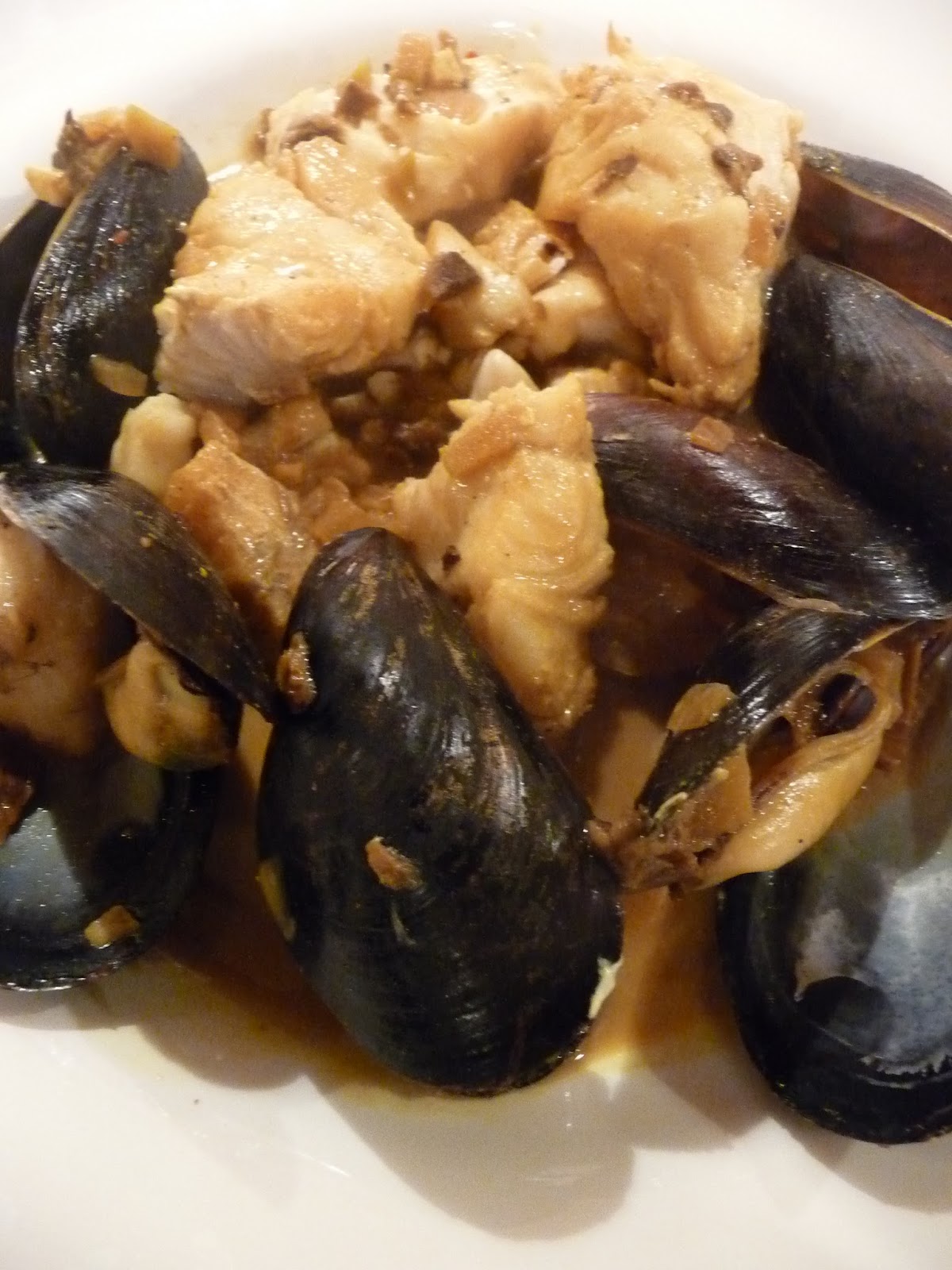
Curried Haddock and Mussels

Alain Ducasse has been described (by others and, perhaps, by himself) as a man obsessed ... with perfection, taste and more.  This obsession has produced remarkable results.  Chef Ducasse is the first chef to own restaurants with three Michelin stars in three different cities, and holds a total of nineteen Michelin stars. So, when I came across his recipe for Curried Haddock and Mussels, I decided that I would give it a try.

I found the recipe on Food & Wine's website, which was entitled Curried Cod and Mussels.  This title presented a dilemma.  Cod has been overfished to the point that stocks, especially those in the Atlantic Ocean, are endangered. (By contrast, cod fished near Iceland and near Maine have been better managed.)  Staring at the little red fish sticker on the price tag, which indicated that these particular cod fillets were not fished in a sustainable way, I decided that I needed to go with another fish.

Fortunately, Food & Wine mentioned that when Chef Ducasse makes this dish, he uses haddock rather than cod.  This was the one bit of information that I needed.  Like cod, haddock had been overfished for years. However, the federal government began to regulate haddock fishing and, over time, the stocks had completely replenished themselves.  This makes haddock a sustainable choice.  So, I bought a couple of haddock fillets and proceeded to make this dish.

One last note about this recipe.  It calls for the use of curry powder.  I used Maharajah Curry Powder from Penzey's Spices.  I like this powder because, for every one hundred pounds of curry powder made, Penzey's uses one pound of saffron.  As a result, this powder costs a little more than the ordinary curry powder, but I think it is worth it. 


CURRIED HADDOCK AND MUSSELS
Adapted from a recipe by Alain Ducasse, available at Food & Wine
Serves 3-4

Ingredients:
1/4 cup dried porcini mushrooms
3/4 cup boiling water
1 tablespoon of extra virgin olive oil
1/4 cup minced shallots
1 Granny Smith apple, finely diced
1 garlic clove, minced
1 tablespoon curry powder
2 thyme sprigs
2 pounds of mussels, scrubbed
1/2 cup dry white wine
1/2 cup heavy cream
1 pound of skinless haddock fillets, bones removed,
     cut into 2 inch chunks
Crusty bread for serving

Directions:
1.  Rehydrate the porcini mushrooms.  Soak the porcini in the boiling water until softened, 10 minutes.  Strain the mushrooms, reserving the soaking liquid and rinse to remove any grit.  Finely chop the mushrooms.

2.  Prepare the curry sauce.  In a large pot, heat the oil.  Add the shallots, apple, garlic, curry powder, thyme sprigs, and porcini.  Season with salt and pepper.  Cook over moderate heat, stirring until the shallots are softened, about five minutes.

3.  Steam the mussels.  Add the mussels and toss.  Add the wine.  Bring to a boil, cover and cook over high heat until the mussels have opened, about three minutes.  

4.  Cook the Haddock.  Add the cream and 1/2 cup of the porcini soaking liquid, stopping before you reach the grit.  Bring to a simmer.  Nestle the haddock in the broth, cover and cook until the fish lightly flakes, about four minutes.  Discard the thyme.  

5.  Plate the dish.  Transfer the cod and mussels to large bowls and spoon the broth over top.  Serve with crusty bread.

PAIRING THIS DISH

The magazine Food & Wine suggests that the Curried Haddock and Mussels dish is best paired with a Sauvignon Blanc.  One such wine, which is produced in the Loire Valley, is the following: 

Domaine de Chevilly -- Quincy (2009).
100% Chenin Blanc
Le Centre Loire, Loire Valley, France
Grapefruit and other citrus fruitiness. 

ENJOY!