Thursday, May 10, 2018

Sriracha Bloody Mary Oyster Shooters

Okay, so the glassware doesn't work.  I find that one of the biggest problem with rental properties is the lack of adequate glassware.  That problem became very obvious when I decided to make oyster shooters while on vacation.  My beautiful family and I rented a place in the Outer Banks, right on the shore.   It was the perfect location.  A couple of miles from my favorite local seafood source.  (That is another blog post.)  A couple of blocks from a great little seafood market, the Austin Fish Company. 

I paid a visit to that market with my father-in-law, and, we walked away with 100 medium neck clams (still another blog post), and a pint of oysters.  The oysters came from Virginia, which was a little of a surprise.  After a couple long walks on the beach, I came across a lot of oyster shells, including some very large ones.  Still, Virginia is close enough to be local for me.  With oysters in hand, we headed back to the rental house to prepare the oyster shooters.  

As for the particular type of shooter, I had a couple things to work with ... Bloody Mary mix and Sriracha.  Combine those two ingredients together and one gets Sriracha Bloody Mary Oyster Shooters.  However, as I noted before, the rental house did not have any shot glasses.  The rental house was a block from a Brew-Thru, which had shot glasses.  Those shot glasses are great for vodka by itself, but they they didn't seem like good ones for an oyster shooter.  (In fact, they are not good oyster shot glasses. They were single shot glasses and you need at least a double shot glass to fit the oyster and the liquid.)  All I had left were round bottomed glasses, which are probably better suited for water or used as a tumbler glass for wine.  

All of this got me to thinking, what would make a good oyster shooter glass.  Clearly, an ordinary shot glass will not work.  I have my doubts that a double shot glass cold really work.   My three prior attempts at oyster shooters -- Oyster Shooters with Tomato, Limes and Chiles, Mexican Oyster Shooters and Andalusian Style Oyster Shooters -- have left me with one firm conclusion ... the best glassware for oyster shooters are the glasses you get from brewery taprooms after doing a tasting.  The glasses are usually hold about five ounces, which is good to hold one (or two) oysters plus the liquid.  All of the prior photos of oyster shooters have used glasses from breweries.  Maybe I just need to visit a few more taprooms that offer souvenir glasses for those who take a tour or order samples.  If I do it enough, maybe I'll eventually have enough glasses for a dozen oyster shooters.  To top it off, I'll come up with an oyster-beer shooter.  The circle will be complete.  


SRIRACHA BLOODY MARY OYSTER SHOOTERS
A Chef Bolek Original
Serves many

Ingredients:
2 cups Bloody Mary mix
1 pint of oysters
1 tablespoon lemon juice
1 tablespoon lime juice
2 tablespoons of Sriracha sauce
1 teaspoon prepared horseradish
1 bunch of scallions, white parts and green parts thinly sliced
Minced cilantro or celery leaves for garnish

Directions:
Pour the Bloody Mary mix into a large bowl.  Mix in the lemon juice, lime juice, horseradish and Sriracha sauce.  Add the white portions of the scallions and mix.  Pour 2 tablespoons of the mix into a shooter glass, add 1 to 2 oysters, and garnish with the green parts of the scallions and cilantro (or celery).

ENJOY!

Saturday, May 5, 2018

Trappistes Rochefort 10

It has been described as one of the five beers that will change one's life.  Craft beer aficionados who have a special place in their heart for Trappist beers would readily agree with that description.  The beer ... the 10.  The ultimate beer produced by the Trappist monks at the Abbaye St. Remy, near Rochefort, Belgium.

That the beer would have such a distinguished honor comes as no surprise.  Records show that those monks at Abbaye St. Remy have been brewing beer since at least 1595 and perhaps as far back as 1464, which was when Cistercian monks took over the monastery and abbey. 

After a few hundred years, the monks refined their brewing skills to three beers.  Each is represented by a number.  The 6.  The 8.  The 10.  Translated: the dubbel, the tripel and the quadrupel.  That is a very basic categorization of the three beers when put side-by-side with traditional Belgian beer styles.

Despite the long history of brewing at the Abbaye St. Remy, the monks have been brewing the 10 since the late 1940s or early 1950s.  The ingredients include what you would expect -- water, barley malt, hops and yeast -- but also candi sugar and coriander.  

The 10 pours a nice chestnut brown.  There is a slight foam that develops as the beer is poured, but that foam quickly recedes to the edge of the glass, exposing the full liquid to allow the aroma to greet the nose.  That aroma has a certain sweetness from it, such as boozy cherries or molasses, with a light clove note.  As with most beers, the aroma carries over to a certain extent with the taste of the beer.  However, the taste of the 10 is not so much as dark cherry and molasses, but more reminiscent of plums and figs.  There is a certain  je ne sais quoi aspect to the taste.  Perhaps a little banana or clove, which would be more expected from a tripel than a quadrupel.

This is a very, very good beer.  I now understand why most reviewers rank this beer as one of the best beers in the world.  I have had this beer cellared for so long that I forgot what I paid for it.  But, if you happen across a bottle in your local beer store, it is definitely worth it.


ENJOY!

Tuesday, May 1, 2018

Red Snapper Stew

A while back, before Fat Tuesday, I happened to visit New Orleans, Louisiana for work.  My trip happened to coincide with Tabasco Week.  The week-long event featured "restaurant week."  Restaurants across The Big Easy featured special menus with dishes that included the eponymous hot sauce.  While my business trip allowed me to visit some of the notable New Orleans restaurants, like Gallatoire's and and Antoine's, I did not have a chance to try any of the  Tabasco week menus.  That missed opportunity got me to thinking once I returned home from that work trip.  

Mardi Gras was about a week away, and, I needed a recipe  to make a special dish for my beautiful Angel.  The Tabasco Week got me to thinking about a small Tabasco Cookbook that has been sitting on the bookshelf.  I pulled out the cookbook, paged through the recipes and came across a recipe for Red Snapper Stew.

This Red Snapper Stew recipe was just right, because, in the back of my mind, I was looking to makes something different for Mardi Gras.  I wanted to do something different than a gumbo, creole or etoufee. Don't get me wrong, I love all of those dishes.  But, I have made them before.  I wanted to make something new, and, perhaps, learn something along the way. 

Image from Pew Trusts
That something was not what I expected.  As it turns out, red snapper happens to be quite the controversial fish in the Gulf of Mexico.  Fishermen have been hauling in red snapper from the Gulf of Mexico since the 1840s, originally around Pensacola, Florida.  By the end of the century, fishermen and scientists began to notice that the stocks of red snapper were being depleted in the areas where they were fishing.  So, the fishermen moved to other parts of the Gulf. The stocks eventually depleted there as well.  Meanwhile, as shrimping increased in the Gulf, the shrimpers began to catch red snapper fry in the shrimp trawls.  The double whammy made itself present in the overall stock of red snapper in the Gulf of Mexico.  Simply put, red snapper were being overfished.   

As a result, the federal government imposed restrictions on the fishing of red snapper in federally controlled waters.  Those restrictions set the Red Snapper season for both recreational anglers and federally permitted for hire "components."  That season was only 3 days for the former but 42 days for the latter.  That 3 day season for recreational anglers is where the controversy began.  Where it went next is quite the story.

The man who tries to change the law by breaking it.
As it turns out, in 2017, the Commerce Department's Director of Policy and Strategic Planning -- Earl Comstock -- advised the Secretary of the Commerce Department -- Wilbur Ross -- that the latter should extend the red snapper season for recreational anglers by thirty-nine days.  The new, forty-two day fishing season would, in Director Comstock's opinion, result in overfishing of red snapper and maybe even a lawsuit.  But all of that would be okay, at least in Comstock's view, because it would lead to a "significant achievement," namely, action by Congress to change the rules for the red snapper season.  In other words, Director Comstock counseled Secretary Ross to violate the law in order to get Congress to change that law.  And, in what could only happen in the current administration, Secretary Ross violated the law and extended the season, thereby prompting a lawsuit by two environmental groups.  Those groups wanted decisions to be made based upon sustainability and accountability, not just on fisherman having a longer period to snag a snapper.

Picture from Caller-Times
The lawsuit worked its way through the United States District Court for the District of Columbia to a settlement.  The settlement provided that the extension of the red snapper season was a "one-time action."  This suggests that recreational anglers will not see such a long season again, at least in federal waters.  Given the state of the red snapper stocks, hat may be a good thing. The preliminary estimates show that, after the extended season in 2017, recreational anglers exceeded the catch limits by fifty percent.  Additional extended seasons could simply further deplete the stocks further.  And, the proposed action by Congress could -- just like any action by Congress -- simply make things worse.

One would think that the settlement would allow red snapper to breathe easier.  However, the current administration has now proposed exempted fishing permits that would allow each of the five states bordering the Gulf of Mexico (Florida, Alabama, Mississippi, Louisiana and Texas) to regulate the state and federal seasons.  Only time will tell if that is a good idea (but I have my own opinion on that point).

Back to the recipe, I bought some red snapper from my local grocery store along with some fish for this stew.  In the end, the Red Snapper Stew is not what I would have expected. It was not very stew-like.  But, it was very delicious.  The spices worked extremely well together and -- with that Tabasco Sauce -- there was a good kick to the dish.  This is definitely a dish for Mardi Gras.


RED SNAPPER STEW
Recipe from Tabasco's Cookbook (pg. 70)
Serves 6

Ingredients:
2 garlic cloves, minced
1 tablespoon chopped fresh parsley
2 teaspoons salt
1 teaspoon dried thyme
1 bay leaf
1/2 teaspoon allspice
1 tablespoon vegetable oil
1 1/4 pound red snapper or white fish fillets
2 tablespoons butter or margarine
1 cup chopped onion
1/4 cup chopped green pepper
1/8 teaspoon powdered saffron
2 16 ounce cans whole tomatoes, undrained, chopped
1 teaspoon Tabasco pepper sauce
3/4 pound okra, cut into 1 inch pieces
1/2 pound medium shrimp, shelled and deveined
Cooked rice

Ingredients:
1.  Prepare the fish.  In a medium bowl, mash together the garlic, parsley, 1 1/2 teaspoons salt, thyme, bay leaf, allspice and oil, forming a paste.  Spread the mixture on the fish and set aside. 

2.  Prepare the stew.  In a large pot, melt the butter over medium heat.  Add the onion, pepper and saffron and cook over 5 minutes.  Add the tomatoes and liquid, the remaining 1/2 teaspoon salt, and the Tabasco sauce and simmer, uncovered, for 10 minutes.   Add the fish, okra, and shrimp.  Simmer the stew, uncovered, for 6 minutes or until the fish flakes easily when pierced with a fork  Serve hot over rice. 

ENJOY!

Saturday, April 28, 2018

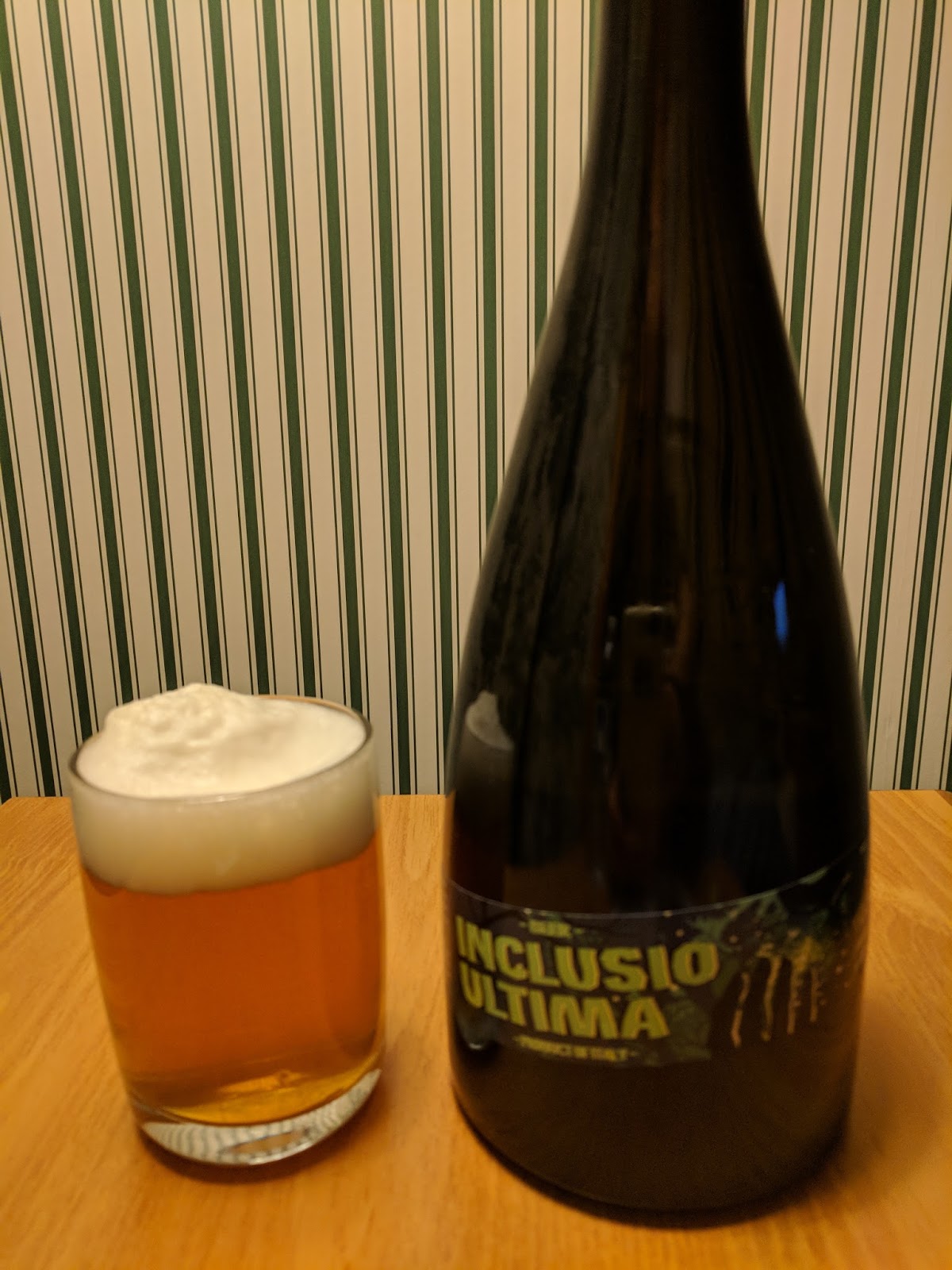
Inclusio Ultima

As the (translated) story goes, "as a man cub I used to play in the forest, catching the magic light of fireflies, letting it last as long as I could."  The storyteller (now brewer), adds, "I use the very same glass to imprison the spirit of hops.  This is the meaning of Inclusio Ultima, the capture at the eleventh hour, a spell designed to trap the scent to trap the scent of the hope ones at the top of their freshness by adding them directly to the bottle."  This story is not so much what caught the attention of my beautiful Angel and myself.  Instead, it was what was behind the story and the beer.

The Inclusio Ultima is an Italian-style pilsner produced by Klan Barbarrique, a brewer engaged in the Fermentations of the Barbarian.  These fermentations involve barrel aging, the use of the champenoise style and/or the infusion of fruit or sour flavors. This explains the Inclusio Ultima, because it is not just any pilsner.  Rather, it is a pilsner produced using the full champagne method process.  The beer is bottle conditioned with hops, and, progressively turned upside down to have the sediments settle in the bottleneck.  Those sediments are disgorged by hand and the bottle is refilled with more beer.  The product is something that one does not see every day on the beer shelves. 

The Inclusio Ultima pours a hazy yellow with a thick, bready foam that resemble thick, floating cumulonimbus clouds.  There is no threat of storms or instability, as the liquid that rests beneath the foam is rather smooth and quiet.  Aromatic elements feature the malts, with the hops providing grass and flower components.  All of those components translate, as one would expect to the taste of the beer.  This pilsner features hops a little more than the typical pilsner.  However, those grass and citrus notes help to provide some complexity to the beer.   The hops also provide a slight bitterness to the finish.  

Overall, this is a good attempt at a pilsner from a country whose beer movement is not known for producing beers of this style.  The pilsner does not reach the levels of some of the best Czech pils beers, but, the use of the champagne method and hops provides a beer that is quintessentially Italian.  Something that shows creativity and sets itself apart.  The oversized bottle sells, if I recall correctly, $19.99 per bottle.

ENJOY!

Saturday, April 21, 2018

Around the World in 80 Dishes: Panama

I continue my personal culinary challenge, Around the World in 80 Dishes.  The next challenge takes me to the República de Panamá.   The name, "Panama," is supposedly derived from an Amerindian word that means "an abundance of fish."  One can understand why the land may have been known for its fish and other seafood because its shorelines grace both the Pacific Ocean and the Caribbean Sea.  This geography is reflected in Panamanian cuisine.  During my research, I came across a lot of recipes for ceviche.  The Panamanian version of ceviche usually involves marinating the fish in lime juice, celery and sometimes peppers.

While ceviche has its place on the Panamanian table, I wanted to know what else may be served during a typical Panamanian meal.  After all, Panama's agricultural sector involves the cultivation of many different tropical fruits, vegetables, and herbs, along with raising cattle, pigs and chicken.  This abundance is reflected in a variety of dishes.  Many of the dishes sound familiar, like tamales, ropa vieja and empanadas.  However, there are uniquely Panamanian dishes, such as carimañolas (ground yucca stuffed with ground meat) almojábana (corn-flour bread) and patacones (crispy chips of fried green plantains).

As the foregoing dishes suggests, Panamanian cuisine is influenced not only by the available ingredients (as are all cuisines), but also by an interesting mix of cultures and influences.  According to Every Culture, the largest demographic group in Panama are the interioranos, whose heritage is a mixture of Spanish and indigenous cultures.  There are also sizeable African and native communities, as well as populations of Italians, Greeks, Jews and Chinese.  All of these groups exert varying degrees of influence upon the dishes that are served in the restaurants and homes throughout Panama.

MAIN COURSE

For my challenge, I decided to make Sancocho, a type of chicken soup or stew.  The name comes from the Spanish word Sancochar, which means to parboil.  The dish itself is derived from cocido, a meat stew that is popular in central and northern Spain.  For example, in Madrid, you can find cocido madrileño, a stew consisting of, among other things, pork belly, chorizo, beef flank, bola (meatballs), chickpeas, potatoes, carrots and turnips.  As the Spanish explored and colonized the New World, they brought dishes like cocido, which took root amongst the local populace and evolved over time into dishes like sancocho.

As one could expect, many Latin American countries have some version of sancocho.  There are sancocho recipes from cooks in Ecuador, Colombia, Peru, El Salvador and the Dominican Republic. However, in Panama, sancocho or Sancocho de Gallina is the national dish.  It first originated in the peninsular region of Azuero in Southern Panama.  The dish spread throughout Panama, with regional variations emerging.  For example, in the town of La Chorrera (which is located east of the Azuero region), cooks make sancocho with free range chicken, onions, garlic, chili peppers, oregano and ñame (yams).  There is also Sancocho chiricano, which is a specialty from the Chiriqui Province in Eastern Panama.  This version is the heartiest.  It includes all of the ingredients for the basic sancocho and squash, which provides a yellowish color to the stew. 

The ingredients for the traditional Panamanian sancocho are simple and straightforward.  A free range chicken, along with ñame (yams) for flavor and texture, and culantro for flavor and color.  There is a list of other ingredients -- such as yuca, corn, onions, garlic, oregano, ñampí (taro) and otoe (a root vegetable) -- may also be used to make the stew.  Once prepared, sancocho is served with white rice on the side, which could be mixed into the stew or simply eaten alongside it. 

This is the version that will serve as my challenge.  I used most of the basic ingredients -- a free range chicken, ñame, and culantro (although I substituted the closely related cilantro), along with onions, garlic, corn and oregano.


SANCOCHO DE GALLINA
Recipe adapted from What's Cooking Panama
Serves 4 to 6

Ingredients:
1 stewing hen (2-1/2 lb), cut in serving pieces
1 medium onion, chopped
4 tablespoons culantro, chopped (cilantro can be substituted)
1 teaspoon dried oregano leaves
2 tablespoons green pepper, chopped
2 lbs. ñame, peeled and chunked (potatoes or yams can be substituted)
2 inch section of corn on the cob for each serving (optional)
2 quarts (8 cups) of water or chicken stock
salt to taste

Directions:
1.  Stew the chicken.  Put chicken pieces into a stock pot with 2 quarts of water or chicken stock. Add onion, cilantro, oregano and green pepper. Cook for 1 hour. 

2.  Add the ñame (potatoes or yams).  Add salt to taste. Add ñame (yams) and cook until the ñame is tender. Add corn last 15 minutes of cooking. 

3.  Finish the dish.  Spoon the chicken and stew into bowls.  Serve with steamed rice on the side.

*     *     *

This culinary challenge represents the first one for Central America, which, until now, was the only region where I have not made a main course based upon a country's cuisine.  This challenge was relatively easy.  There were no complicated steps.  The most difficult part of this challenge is trying to culantro or ñame.  But, if you cannot find those ingredients, the substitutes of cilantro and potatoes or yams still help to make a very delicious soup.   Now, it is time to turn to the next challenge, and, only time will tell where it will take me.  Until then ...

ENJOY!

Monday, April 16, 2018

Andalusian-Inspired Oyster Shooters

The overwhelming majority of oyster shooter recipes utilize alcohol as an ingredient.  Vodka, tequila, wine or beer.  Most recipes incorporate one, and, usually in a rather boring way.  Who wants a Bloody Mary Oyster Shooter? Not me.   How about a Lime Tequila Oyster Shooter?  Uh, no.   Maybe a Champagne oyster shooter?  Maybe; but, not today.  Rather, I wanted to make an oyster shooter; and, I did not want to have to use alcohol as an ingredient.

My search for an alcohol-free oyster shooter recipe, other than the ones that I have already made (see here and here), seemed hopeless.  That was until I found a recipe for a Spanish Style Oyster Shooter.  That recipe called for alcohol (namely, vodka), but it got me to thinking.  The principal ingredients of the liquid were the classic ingredients of a gazpacho.  The chilled tomato soup, with its Andalusian origins, got me to thinking that it would be the perfect medium for an alcohol-free oyster shooter.  

While a gazpacho is a very simple soup to make, I decided to make a few changes. First, traditional gazpacho uses bread to thicken the soup.  That is great when you are serving gazpacho as a soup; it is not so great when you are trying to make it more like a drink.  So, I dispensed with the bread, which helped to maintain a lighter consistency.  Second, I decided to add a 1/2 of a jalapeno pepper.  This ingredient helps to provide a small little kick to the shooter.  I think that I will use an entire jalapeno pepper when I make this recipe again, because that little kick got lost in the tomatoes, cucumber and bell pepper.   Third, I used Willapoint Oysters, which are farm raised in the State of Washington.  These oysters are sold by the pint, which means that they are pre-shucked.  This saves a lot of preparation time.  In addition, Willapoint Oysters also tend to be larger than other oysters that are available to me, such as Blue Points, Chicoteagues and Salt Tanks.  This larger oysters make for a whopping double Oyster Shooters, as the picture below shows.


ANDALUSIAN-INSPIRED OYSTER SHOOTERS
A Chef Bolek Original
Serves 4

Ingredients:
1 pint of shucked oysters or 24 oysters shucked with
     liqueur reserved
1 1/2 pounds of tomatoes, skinned, seeded and chopped
1/2 red bell pepper, diced
1/2 cucumber, skinned, seeded, diced
1/2 jalapeno, skinned, seeded and diced
2 tablespoons white wine vinegar or sherry vinegar
1 bunch of scallions, white parts and green parts
     thinly sliced
1/2 cup water
Kosher salt, to taste
Freshly ground black pepper, to taste

Directions:
1.  Prepare the "gazpacho."  Place the tomatoes, bell pepper, cucumber, white wine vinegar, and jalapeno in a blender.  Blend until the ingredients are liquified.  Add salt and pepper to taste. 

2.  Prepare the oysters.  If you buy a pint of oysters, remove the oysters and strain the liquid through cheesecloth.  If you bought the oysters, shuck the oysters and reserve the liqueur.

3.  Finish the dish.  Stir the oyster liqueur into the "gazpacho."  Place 1 or 2 oysters in the bottom of a shot glass, and 1-2 tablespoons of the "gazpacho."  Garnish with the scallions.  Serve immediately.

ENJOY!

Friday, April 13, 2018

'Bout Time

Character crafted on the beach.  Those are the words that adorn the can of the 'Bout Time Session-Style India Pale Ale produced by the Outer Banks Brewing Station.  Recently, my beautiful family took a vacation in the Outer Banks and, as we usually do when we are in the area, we stopped by the OBX Brewing Station.  I picked up a four pack of the beer for the vacation.  

The five words describing the beer -- "Session Style" India Pale Ale -- got me thinking about what exactly makes a "session style" beer.  Is it just the ability to drink it easily?  The 'Bout Time does drink very easily.  Is it the lower ABV?  This beer has an ABV of 5.8%, which is definitely on the low end of an India Pale Ale. 

The origin of session beers is generally thought to have began in Britain during the First World War.   Manufacturing employees, including those who worked in munitions plants, worked long hours, broken up by breaks or "sessions" of four hours.   The employees drank beer during those sessions; and, if they drank their usual ales, porters or stouts, that could create some problems when they returned to their jobs of producing ammunition, ordnance and the like.  So, brewers produced easy drinking beers with lower alcohol contents; and, thus, the "session" style was borne. One example is the Whitbread IPA had an ABV that decreased from 4.61% in 1914 to 3.30% in 1918.   The only issue with this example is that 4.61% for an India Pale Ale is fairly low, especially by today's standards.  It was also lower than the Whitbread Pale Ale, which had an ABV of 5.31% in 1914 and 3.83% in 1918.  So, an IPA had a lower ABV than a pale ale?  Now, that is truly a session beer. 

The brewers at the OBX Brewing Station produced the 'Bout Time IPA session ale with El Dorado and Azecca hops.  Their work and those hops produced a beer with a copper or light rust color, which one would expect of an India Pale Ale.  The session nature of this beer is evident in both the aroma and taste of this beer. The aromas are there, with some pine bitterness and grass coming out in the nose of the beer.  But, unlike a typical IPA, those elements are not loud.  Their smoothness is consistent with the nature of a session beer.  Likewise, the taste taste elements -- such as the grapefruit notes -- are well rounded and impart some bitterness that quickly recedes after each sip.  The session-style takes what would be a very hoppy IPA and makes it a very good pale ale, at least in terms of the hoppiness and bitterness.  

A four pack of the beer is available at the OBX Brewing Station and, if you happen to be in the area, it is worth the $11.99 per pack.  Until next time ...

ENJOY!

Saturday, April 7, 2018

Around the World in 80 Dishes: Djbouti

My personal culinary challenge -- Around the World in 80 Dishes -- takes me to a country where making a main course may seem like a daunting task.  If you were to find yourself in this country, you would see a land of dry shrub lands, volcanic formations, and sandy beaches.  Indeed, it is the hottest piece of inhabited land in the world.  If you ventured into the country looking for water, you might come across a lake, known as Lake Asal, with the highest salt contents in the world.  The water would be undrinkable, but you could marvel at the chimney-like mineral formations created by the evaporation of the water.  If you haven't guessed it by now, you would be standing in the Republic of Djbouti.

A long time ago, the land constituting Djbouti was part of the legendary land of Punt.  (The ancient Egyptians referred to the land as "Punt," or "God's Land" because of the plentiful resources that could be found there.)  Fast forwarding through time, thee land was thereafter ruled by various sultans for hundreds of years from the thirteen century to the nineteenth century.  However, as that latter century came to a close, in 1894, a colonial power -- namely, the French -- established French Somaliland.  It remained a French colony for nearly 80 years.  Colonization ended with a referendum in 1977, which led to the establishment of a presidential republic and the present day country of Djbouti.  

The country has a diverse population.  The largest ethnic groups are the Somalis, who comprise 60% of the population and the Afar, who comprise 35% of the population. The remaining 5% consists of Ethiopians, Yemeni, and Europeans (mostly Italians and French).  

These cultures provide a window into the culinary influences that have shaped Djbouti cuisine.  That cuisine is a mix of Somali, Yemeni and French influences.  There are even some Indian influences in some of the dishes.  Proximity also has left its imprint on the cooking and dishes of Djbouti, with many Middle Eastern spices finding their way into the food eaten by everyday people.  Ingredients like cinnamon are added to spice blends, while saffron is also used in some dishes.   All of these influences played a role when it came to my decision as to the main course that I would make for my challenge.  I wanted to choose a dish that showed the diversity that can be found among the people of this small country.  

MAIN COURSE

That diversity is best illustrated by the dish of Skoudehkaris, which is often referred to as the national dish of Djbouti.  To make this dish, one sautes onions with a spice blend that draws from many Middle Eastern ingredients.  These ingredients include cumin, cinnamon and cloves, along with cardamom (an ingredient used in subcontinent cooking).  After the onions have softened, lamb is added and browned in the pot.  Tomatoes and water are then added to create a stew, which is then finished with some long rice, which helps to soak up some of the liquid.  The end result is a dish that draws from the land of Africa and the spices of the region to produce a dish that, in some respects, resembles a biryani from Pakistan or India.  


SKOUDEHKARIS
Recipe from Global Table Adventures
Serves 4

Ingredients:
1 pound of lamb, cubed
1 onion, chopped
1-2 tablespoons ghee or vegetable oil
1 teaspoon cumin
1/4 teaspoon cloves
1 teaspoon cardamom
1/4 teaspoon cayenne pepper
1/2 teaspoon cinnamon
1 can of diced tomatoes (14 ounces)
1 cup of water (more if needed)
1/2 cup of long grain rice
Freshly ground black pepper
Salt

Directions:
1.  Saute the onions.  Heat the ghee or oil in a large pot.  Add the onions and the spices (cumin, cloves, cardamom, cayenne, and cinnamon) and cook until soft and fragrant.  

2.  Brown the lamb.  Add the lamb and brown it a little.  (Push the onions out of the way so that the meat has contact with the pan.) 

3.  Cook the lamb.  Add the tomatoes and the water.  Cover and simmer for about 45 minutes, until the lamb is tender.  Add pepper and salt to season.

4.  Add the rice.  Add the rice and 1/2 cup of water if needed. Stir, cover and let simmer for about 20 minutes until the rice is tender.  

BREAD

After having made Skoudehkaris, I needed something to serve with the lamb and rice mixture.  The recipe that I used recommended Laxoox, which is a sponge-like bread.  Laxoox -- or Lahoh, as it is known -- is a bread that can be found in Djbouti, along with Somalia and Yemen.  Thus, the preparation of this bread, which is a lot like the injera prepared in Ethiopia, allows me to bring together the other culinary influences upon Djbouti cuisine.  Those would be the influences of the Somali and Yemenis.

Injera is typically made with teff flour, but the recipe for Laxoox calls for a combination of all purpose flour, wheat flour and millet flour.  If you are like me and you don't have millet flour, just use some more wheat flour.  The end product may not be as good as when you use millet flour, but, if you are like me, it works and saves you some money by not having to buy a package of a type of flour that you will not use in the foreseeable future.  


LAXOOX
Serves 4

Ingredients:
2 cups all purpose flour
1/4 cup wheat flour
1/4 cup millet flour
1 1/2 teaspoon yeast
1 teaspoon salt
1 teaspoon sugar
2 1/2 cups of water

Directions:
1.  Combine the ingredients.  Add the flour to a bowl.  Then sprinkle on the yeast.  After that, add the salt and sugar.  Add the water and whisk all of the ingredients.

2.  Refrigerate the dough.  Cover the bowl and refrigerate overnight.  Remove from the refrigerator and place on the counter for a few hours.  When the mixture begins to bubble or froth, it is ready.  

3.  Make the bread.  Heat some oil in a stainless steel or cast iron skillet.  Add a ladle of the mixture and use the ladle to spread it out to about 1/4 inch thickness.  Cook gently until the bubbles form and the surface dries out.  There is no need to flip, just cook until the underside is golden and it is cooked all the way through.

*          *          *

It has been quite a while since I have made a main dish from a country in Africa.  Six (6) of my thirty (30) challenges have involved African countries.  Of those six, I think that my preparation of Skoudekaris and Laxoox may have been the most successful challenge.  The Skoudekaris was very delicious.  The lamb was tender, the sauce had a good kick, and the Laxoox provided a wonderful tableau for the food. Overall, it was a big victory cooking the main dish of a very small country.

Time to prepare for the next challenge.  Until then ...

ENJOY!

Friday, April 6, 2018

The Sprecher Series ... The Tripel

It is the third step in the Belgian series.  There was the Enkel, which was surprisingly good.  And there was the dubbel.  I like dubbels.  The next one is the tripel.  Ordinarily, I like tripels.  However, this tripel was a slightly different story.

I think of this beer progression like a movie franchise.  The Enkel was a very good example of a patersbier, much like Star Wars: A New Hope was a very good first movie. (I don't consider the prequels to be the first of the Star Wars genre, because I don't like those movies.)  Then, there was the Dubbel, which was a very good sequel to the Enkel.

And then there is the Tripel.  But for my "Sprecher Series," I probably would not have written a review for this beer.  It is one of the more forgettable tripels that I have had tried recently.  I don't think that is the fault of the brewers.  There are a lot of good reviews for this beer on sites such as Ratebeer and Untappd.  I think the reason lies with this particular bottle of beer.  This particular bottle of the tripel was just not a good one.  

The Sprecher Tripel pours a dull yellowish-gold color, with little to no carbonation.  The flatness of the beer gave way to some banana elements in the aroma, which one would expect with a tripel.  That banana carried through with the taste, and was accompanied with some clove notes.  However, the most noticeable element was apple, which one would not expect with a tripel.  That apple was a little tart, which suggested that perhaps this particular bottle was the exception to what would otherwise be a very good progression of Belgian beer styles.  

I hope that I can get another bottle of the Tripel so that I can see if the flatness of this tripel was just an issue with the particular bottle that I had.  If I ever make my way back to Wisconsin, I will certainly look into buying one and doing an updated review.  Until then ... 

ENJOY!

Sunday, April 1, 2018

Detroit-Style Frog Legs

Sam Blythe, a columnist for the New York World, once wrote, "if you have never eaten frog legs in Detroit, you have something to live for, something for which to strive."  He wrote those words in 1905.  A mere five years later, according to Bill Loomis in his article When Frogs were King, "Detroit produced, shipped and consumed 12 tons of frog legs, 6 million pairs of legs (called saddles)."  Bill Loomis also noted that hotels in Detroit served 800 dozen saddles per day back at that time.  That is a lot of frog legs.  So much so that, one year later, the New York Times reported the seemingly obvious: "Detroit is famous for frog legs."  

That frog legs would feature prominently in the cuisine of Detroit does make some sense. After all, Detroit was originally settled by the French.  The Canadian French would head out on the hottest days of the summer along the banks of the St. Claire Flats or the marshes at Monroe near Lake Erie.  The fishermen used a variety of means to catch the frogs, such as tiny "cat and rat" shotguns with mustard seed shot or  a fishing line with a red flannel cloth as a lure (apparently bull frogs were attracted to that lure).  Some used frogging forks, spears and even clubs.  If one knew what he or she was doing, that person could catch as many as 200 frogs per day. 

Given those hauls, it is no wonder that the frog legs were found on many a menu at restaurants and roadhouses around Detroit.  Its introduction into Detroit cuisine was bottom up.  It first appeared on the plates of working class people, prepared in a very simple way.  The saddles were just dipped in milk, then flour and pan-sauteed in butter, and finished with some lemon juice and parsley.  That's it.  If you happened to be at one of the roadhouses around Detroit, which served more rugged and casual food, the cooks used crushed soda crackers for the breading before sauteing the frog legs in butter.  A diner could get a meal for just 20 cents, and, often times, it was an all-you-can-eat buffet of frog legs. 


Eventually, the saddles found their way onto plates placed on white tablecloths.  They also were prepared in a variety of ways.  According to Bill Loomis, Michigan cookbooks included recipes for frog leg salad, frog leg ravioli, picked frog legs, and a frog leg pie.

There were even criteria for what were the best frogs for cooking. The rule was that frogs had to be between 2 and 5 years old.  The problem is that it is fairly difficult to tell a frog's age.  (After all, the frog is not going to volunteer it to you.)  What is perhaps more likely is that the best frogs were determined by their size.  If the frog was too large (and presumably too old), its leg meat would be too tough with a fishy taste.  

However, too much of a good thing is definitely not good, especially for the frogs.  Over-frogging led to declines in the population around the Detroit area.   Even at its height during the first decade of the twentieth century, there were complaints about a dwindling numbers of frogs.  Demand had far exceeded the supply. There were efforts to stave off that decline.  For example, a law was introduced in 1913 that banned the hunting, sale, storage and service of frog legs at restaurants from June to November.  While hotels and restaurants in the city obeyed the law, the roadhouses did not.  Cooks at the roadhouses sold the frog legs under the counter.  Those roadhouses were too dependent upon the sale of frog leg dinners to stop serving them for five or six months a year.  It is recounted that, in 1915, a deputy game warden placed phony orders from roadhouses and returned with 1,000 dinners.   Demand and, eventually, pollution did the frogs in.  

Despite the fall of the frogs in Detroit, one can still find frog legs on menus at local restaurants.  Those frogs are not from the marshes at Monroe or the banks of St. Claire Flats.  Instead, the frogs are imported from India, Indonesia or Vietnam.

That is probably where the frog legs came from for this dish  I found frozen legs at my local Asian grocery store and thought I had to make a dish with them.  That is how I found the Detroit-Style Frog Legs.  An ingredient and a simple Google search resulted in an educational experience and a delicious dinner.  What a time that we live in!


DETROIT-STYLE FROG LEGS
Serves 2

Ingredients:
4 frog legs
1 cup of milk
1 cup of flour
4 tablespoons butter
1/4 cup fresh parsley, finely chopped
1 lemon, juiced
1 lemon, cut into wedges
Kosher salt, to taste
Freshly ground black pepper, to taste

Directions:
1.  Saute the frog legs. Dip the frog legs in milk, then in flour and saute them slowly over medium heat until golden brown all over, about 6 to 8 minutes.

2.  Finish the dish.  Remove the frog legs to a hot serving dish, season with salt and black pepper.  Sprinkle with the lemon juice and garnish with the finely chopped parsley.  Pour what is left of the browned butter in the frying pan over the frog legs and garnish the dish with a slice of lemon.

If you want to learn more about the history and role of frog legs in the cuisine of Detroit, check out the Hour Detroit article written by Bill Loomis, the Spendid Table interview of Bill Loomis, or one of his books.

ENJOY!