Showing posts with label Curry Leaves. Show all posts

Sunday, July 27, 2025

Goat Sukha

Whenever I order food from a particular Indian restaurant, I always include an appetizer of goat sukka (or sukha). As an aside, this particular restaurant allows its customers to choose between an American level of spice and an Indian level of spice for their dishes. I like a restaurant that not only caters to the local Indian community in this way, but also offers those options to someone like myself, who is not Indian. Given my love for very spicy foods, I always order my dishes from this restaurant at the Indian spicy or Indian very spicy level. 

Being able to choose spice levels in accordance with the Indian palate is important to me, because I want to experience the foods of southern India as one would prepare them for people who live in that region. Chefs and cooks alike across southern Indian states like Karnataka, Kerala and Tamil Nadu have embraced chiles. In so doing, they create dishes that contrast with those from the north of India. 

A sukka (or sukha) is a dry curry dish that originates from the south of India. The word sukha is Hindi and means "dry." Unlike a typical curry, sukhas are not prepared with a yogurt, tomato, or coconut milk base. Instead, recipes typically call for a combination of chiles and spices that, when prepared, cling to the featuerd protein with a paste-like texture. And, as for that protein, it could be just about anything. The most common versions of sukhas feature mutton or lamb, but one can find many recipes for Mangalore Chicken Sukha or even Chana Sukha (for vegetarians).  

For this recipe, I attempted to recreate the goat sukka dish from one of my favorite restaurants. I had some extra goat meat from another recipe that I prepared (which will also be posted on this blog). I encountered some difficulty finding a goat sukha recipe, which I needed to ensure that I prepared the goat properly. I eventually decided to use a mutton sukha recipe, for which there are many, and incorporated the directions for preparing goat from that other recipe I mentioned above. 

In the end, this dish was good, but it was not the goat sukka that I would order from the restaurant. There are two reasons for this conclusion. First, I am not as good at cooking goat as the Indian cook or chef at that restaurant. (Despite my best efforts, the goat was a little overcooked.) Second, the recipe would probably translate to an Indian mild or Indian medium on spice level. As noted above, my minimum threshold is Indian hot. 

GOAT SUKHA

Recipe adapted from Relish the Bite

Serves 2-3

Ingredients:

  • 1 pound goat, cubed, bone-in
  • 1/2 teaspoon turmeric
  • Salt, to taste
  • Garlic, 5 cloves minced
  • 5 dried chiles (e.g., Kashmiri)
  • 1/2 teaspoon fennel seeds
  • 1/4 cup onions, sliced thinly
  • Few curry leaves
  • 4 green chiles (e.g., jalapeno)
  • 1 teaspoon chile powder
  • 1 teaspoon coriander powder
  • 1 teaspoon cumin powder
  • Salt, to taste
  • 2 teaspoons oil
  • Lime juice and coriander (cilantro), chopped, for garnish

Directions:

1. Prepare the goat. Place the goat, turmeric and salt in a sauce pan and cover with water. Bring to a boil and boil until cooked, about 15 to 20 minutes. Remove the goat from the water, strain the water through a fine mesh and reserve. 

2. Prepare the base. While the goat is cooking, combine the garlic, dried chiles and fennel seeds in a mortar and pestle. Grind the ingredients, with a dash of salt, until they become a paste.

3. Prepare the curry. In a pan, heat the oil over medium high heat. Add the onions, green chiles and curry leaves. Saute until the onions become translucent and the chiles become softer. Add the paste, along with the red chile powder, coriander powder and cumin powder. Saute well. 

4. Finish the dish. Add the goat and stir. Add some of the reserved water and let it cook until the water evaporates. Drizzle some lime juice and garnish with the chopped coriander (cilantro). Serve with rice and naan. 

PEACE.

Saturday, February 8, 2025

Around the World in 80 Dishes: Seychelles

Seychelles is an interesting combination of the littlest and the greatest. The one hundred and fifty-five islands that comprise the country, which lie in the Indian Ocean, make Seychelles one of the smallest countries in Africa by square miles. The estimated 100,600 people who live on those islands makes the Seychelles the least populated country in Africa. Yet, Seychelles has the highest nominal gross domestic product (GDP) per capita of any African country, which means its residents have relatively the highest standard of living. It is also ranked the highest electoral democracy in Africa, and forty-third in the world. That is quite the combination for a country whose islands laid uninhabited prior to the 18th century.

The French were the first to occupy and claim the islands in 1756, naming them after Louis XV's Minister of Finance, Jean Moreau de Sechelles. As the French settled on the islands, they brought with them an order that was familiar in the colonial era. Helene Frichot, an architectural author, recounted this historical order in one of her essays:

Originally, when the French plantocracy settled, habitations -- strips of land - were marked from mountain peak to shore, parcelled out for the mostly large, conservative, Catholic families. These families assumed a certain order of things, divided strictly along lines of colour: those who owned and governed, and those obliged to labour. As Mairi O'Gorman argues in her research on the Seychelles, property, espeically when organised according to a plantation regime, is racialised: ownership assumes whiteness, while labor is delegated to Brown and Black people.

And, French settlers brought with them enslaved African men, women and children to work on these new plantations. The British Empire took control of the islands less than fifty years later, with the Treaty of Paris in 1814. The British allowed the use of enslaved Africans to continue, and they began to bring indentured servants from the Indian subcontinent and other parts of Asia to work on the islands. The result was a society that had French plantation owners, the British administrative elite, and a large number of African and Asian laborers, traders and shopkeepers. 

This mix of people and cultures on the islands led to the emergence of the Seychellois Creole, an ethnic group that combines African, Asian and European influences into one common identity with a language and culture of its own. The Seychellois Creole language, Seselwa, is rooted in French, but it has incorporated aspects of African and Malagasy languages, as wells as terms and phrases from English and Hindi. E, kot i konsern manze, lenfliyans Lafrik, Lazi e Eropeen is disifil pou manke. ("And, when it comes to food, the African, Asian and European influences are hard to miss." - My attempt at Seselwa using Google translate.)

Le Jardin du Roi, Mahe, Seychelles
(Source: Runaway Lodge)

As for Seychelles cuisine, its story can be told, in part, with reference to a garden, Le Jardin du Roi, that the French settlers started in 1772.  One of those colonists, Pierre Poivre, wanted to get into the spice trade. Poivre himself was quite the story. He spent his early years as a missionary, living in Cochinchina (later known as Vietnam), Guangzhou, and Macau. He left missionary work to join the French East Indies Company, where he presumably came into contact with the spice trade. By 1772, he was living between Mauritius and the Seychelles, and wanted those islands to be part of that trade. Poivre's entre into the spice word was not very Christian-like. He decided that he would set out on a vessel to Ceylon (now Sri Lanka) and the Moluccas (now part of Indonesia). His goal: to steal the spices and bring them back to French-controlled islands where they could be planted and then France could have its own source.  Poivre actually stole the spices and brought them back to the Seychelles. However, as Poivre returned from his voyage in 1780, the governor mistook Poivre's vessel for an enemy ship. The governor destroyed the growing garden. Spices were too valuable to have fall into the hands of the enemy. 

Le Jardin du Roi ultimately survived and grew into 25 hectares where more than 120 species of fruits and spices were cultivated. That variety is one of the defining characteristics of Seychellois Creole cuisine. Recipes use a range of spices, including chiles, cinnamon, cloves, ginger, nutmeg, turmeric, and much more. The cuisine also features a range of seafood dishes, which one would expect from an island nation. 

MAIN COURSE

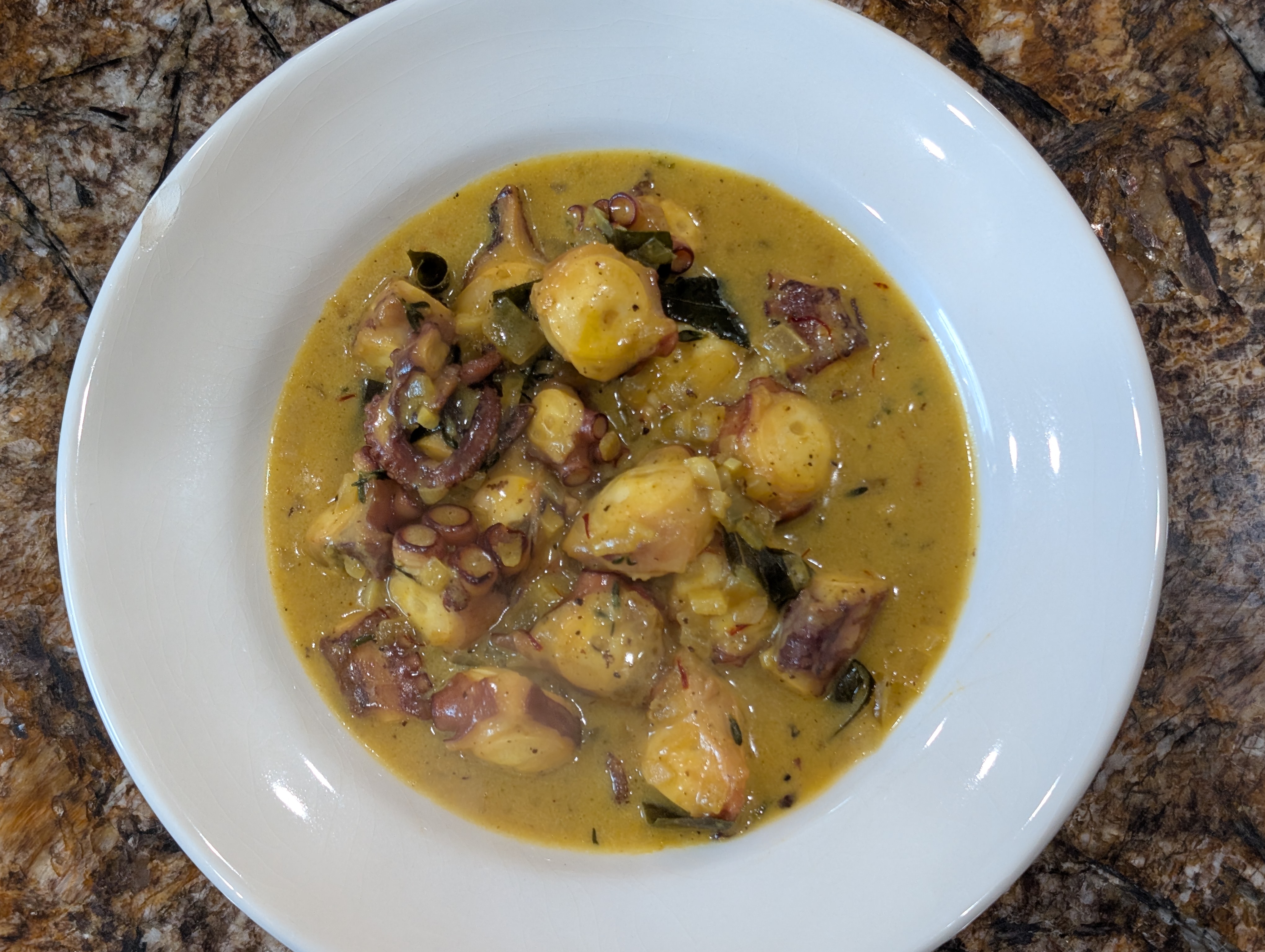
This personal culinary challenge showcases a cuisine that reflects how influences from around the world come together in amazing dishes. The challenge involves the preparation of a Seychellois Octopus Curry. The cephalopods could be found around many of the islands, such as Cousine. That availability led to this curry, which is a popular dish in the Seychelles. 

This demand created a fishery for octopi in the Seychelles. Many look for the creatures around the coral barrier reefs, while others, like a fisherman named Dave Auguste, go further out into the ocean. Auguste has fished for octopus for more than twenty years. When the COVID pandemic hit, the tourist trade (which is important to the Seychelles) crashed, and so did the market for expensive seafood like octopus. As the world gradually reopened and tourists returned, so did the demand for octopus. 

Dave Auguste with his catch (Source: United Nations, Photo: Douglas Okwatch)

Dave Auguste found one longer lasting change ... there were less of the cephalopods to catch. This change is not the result of COVID, but other factors.  In an article published by the United Nations, Auguste explained

There are fewer and fewer octopuses now. Before, I used to find them close to shore, but now I have to go further out. Again, for the last ten years or so, going out to sea has become more complicated because the sea has become rougher and the currents stronger. If I am not careful I can drift away from shore.

Indeed, climate change has affected the work of those who fish the waters around the Seychelles.  Auguste explained that there has been a change in rain patterns: "we used to have rainy periods that lasted several days, now it rains the same amount for one day and it all runs off into the sea." The prolonged rains and the runoff cause the waters close to shore to take on a reddish hue. The octopi do not like the tinged water and move further offshore. An additional factor is that, due to warming temperatures in the sea, there are some areas of the barrier reefs where up to 90% of the coral have died.

Not all of the news is bad. The Seychelles has taken proactive steps to stem the damage caused by changes in the climate. These steps include imposing quotas on seafood catches, expanding the range of protected marine areas, and implementing reef restoration projects. This has required some adjustment and adaptation, especially for those who work in the seafood industry, which makes up 27% of the Seychelles gross domestic product. This sacrifice, as well as, the conservation efforts, may not be enough if the climate continues to change. 

Turning to the challenge, I have prepared whole octopus in the past, but I decided for this dish that I would use pre-cooked octopus, which is available online or from some warehouse stores. Each package usually has 2-3 large tentacles, which may be less than a kilogram but still enough to prepare a meal for at least 2-3 people. The pre-cooked octopus also saves a lot of time (basically you can skip step 1). 

OCTOPUS CURRY

Recipe from Tourism Seychelles

Serves 4

Ingredients:

  • 1 kilogram octopus
  • Salt
  • Pepper
  • Fresh coconut milk (substitute 1 can coconut milk or cream)
  • 2 teaspoons saffron
  • 1 onion
  • Fresh thyme
  • 3 garlic cloves
  • Ginger (a little bit)
  • 1 teaspoon curry powder (or to taste)
  • Cinnamon sticks
  • Curry Leaves
  • Oil

Directions:

1. Prepare the octopus. Add the octopus to a pot and fill it with water. Boil until tender, about 45 minutes to 1 hour depending upon the size. Use a fork to check if the octopus is soft enough. Once the octopus is done, cut it into pieces

2. Prepare the curry. In a saucepan, add the oil, onion, garlic, ginger, saffron, curry powder, cinnamon sticks, thyme, salt and pepper. Mix and the add the octopus pieces. Fry the octopus pieces for a few minutes and then add the coconut milk and stir. Cover the saucepan and let it simmer for 15 to 20 minutes, as the sauce thickens. 

3. Finish the dish. Once cooked, serve with some white rice, lentils and papaya chutney. 

SIDE DISH

Ordinarily, as noted above, one would prepare white rice to serve with an octopus curry. Seychellois cuisine is known for its creole rice, a dish that is shared -- in some common form -- by creole cultures around the world. Rice is a staple food in the Seychelles, often accompanying main dishes. Yet, cultivation of rice cannot occur on a large enough scale on the islands to support its population. (Indeed, while the Seychelles may have an abundance of spices and access to seafood, it actually imports much of its other food.) Most of the rice comes from India, with smaller amounts imported from countries such as Pakistan, the United Arab Emirates, France and South Africa.

This personal culinary challenge gave me an opportunity to prepare creole rice and, to do so using the wide range of spices drawn from the subcontinent and southeastern Asia. The recipe shows that diversity with garlic, ginger, bay leaf, cinnamon, cloves, pepper and turmeric. I knew that I had to prepare this dish, which I served alongside the octopus curry.

SEYCHELLES CREOLE RICE

Recipe from Amy's Cooking Adventures

Serves 4

Ingredients:

  • 2 tablespoons butter
  • 1/2 red bell pepper diced (about 1/3 cup)
  • 1/2 onion diced (about 1/3 cup)
  • 2 cloves garlic, minced
  • 1/2 teaspoon turmeric powder
  • 1/2 teaspoon salt
  • 1/4 teaspoon black pepper
  • 1/4 teaspoon ground ginger
  • 1 bay leaf
  • Pinch of ground cinnamon
  • Pinch of ground cloves
  • 1/2 cup basmati rice
  • 1 cup water
  • Fresh parsley to garnish

Directions:

1. Saute the vegetables. Melt the butter in a saucepan over medium heat. Add the bell pepper and onion and cook for 5 minutes. Add the garlic, spices and rice and cook for another minute. Stir in the water and bring to a low boil. 

2. Finish the dish. Cover, reduce heat to low, and simmer for 15-20 minutes or until the water is absorbed. Fluff the rice, garnish with parsley and serve. 

*          *          *

To be honest, I had not expected to do a personal culinary challenge involving the Seychelles. I had previously done one for Mauritius, when I prepared an amazing duck curry. However, I really wanted to prepare this octopus curry and that led me to add this to the Around the World in 80 Dishes challenge. It is a decision that I will never regret, because it opened a door to exploring a creole culture and cuisine that draws inspiration from the diverse populations that have come to live on the Seychelles islands.  

Each of these dishes was a success, and, perhaps, some of the best dishes that I have prepared in recent weeks. This challenge has inspired me to move on to the next one. Check back to see where I end up. Until then ... 

PEACE.

Saturday, January 18, 2025

Fish Curry

Whenever I prepare a dish, I always have expectations. I have greater expectations when it comes to my favorite cuisine. I am a huge fan of south Asian cuisine. When asked for more specificity, my initial response is Sri Lankan cuisine (usually with an add-on that I also love the cuisine from Tamil Nadu and Kerala). The cuisine is fiery, due to the use of various chiles. It is also curry-based. Taken together, that is where my preferences are at the moment. 

As readers of this blog know, I have made many a curry recipe, sambol or other dish from this part of the world. Those recipes and dishes have created certain expectations whenever I pull a new recipe from a cookbook off of the shelf or print one off of the Internet. Those expectations include a fiery meal, fueled by the use of fresh chiles or piquant curry powders, along with a certain umami that comes from unfamiliar ingredients, like Maldive fish chips, or a particular combination of herbs and spices. 

Recently, I had the urge to make a fish curry. Often times, those curries end up being Chef Bolek Originals, like this one or this one. They basically represent an effort to use what I have learned over time making curries and then just "wing it." This time, the urge was different. I wanted to make a fish curry that more closely followed the lines of a cuisine. The cuisine that first came to mind was, of course, Sri Lanka. And, I had just the cookbook, Lanka Food.

I reviewed the recipe and prepared my grocery list. I then went to my local Asian grocery store to get the ingredients that I did not have on hand, like curry leaves, pandan leaves and coconut cream. I proceeded to make this dish according to the recipe. However, in the end, the dish was not what I had expected. 

Indeed, the dish challenged my expectations. Do all Sri Lankan dishes have to burn with the intensity of a blue flame? Even when I try to make the dish spicy, such as grabbing my hot curry powder instead of my regular curry powder, does that mean that the dish itself should change? It got me to thinking that, whenever I try to be mindful and in the moment, I also have to go one step further with my mind. Namely, I have to approach the present moment with an open mind.

Looking back, and setting aside my expectations, I can say that this particular fish curry dish is very good, even if it is not all that spicy. It is an acknowledgement that there is more to Sri Lankan cuisine than the Scoville-busting curries. That is a good thing to remember. 

FISH CURRY

Recipe from O Tama Carey, Lanka Food, pg. 162

Serves 4-6

Ingredients:

  • 500 grams skinless and boneless snapper fillets (or other firm white fish)
  • 40 grams coconut oil (or ghee or vegetable oil)
  • 4 grams curry leaves
  • 220 grams sliced brown onions (or yellow onions)
  • 20 grams finely chopped garlic
  • 15 grams finely chopped ginger
  • 15 grams finely chopped lemongrass, white part only
  • 1 long green chile, cut into thin rounds
  • 30 grams brown curry powder
  • 8 grams fennel seeds
  • 4 grams fenugreek seeds
  • 40 ml coconut cream
  • 4 x 5 pieces pandan leaf
  • Salt flakes
  • Freshly ground black pepper

Directions:

1. Prepare the fish. Slice the fish into bite sized pieces. Much will depend upon the size of the fillet, but try to make the slices about 1/2 inch thick. Cut them into similar sized pieces. Set aside in the refrigerator.

2. Saute the initial ingredients. Melt the coconut oil in a medium saucepan over medium heat, add the curry leaves and cook, stirring, for a minute or so until the leaves are fried. Add the onion, garlic, ginger, lemongrass, and chile and lightly season with salt and pepper. Cook, stirring occasionally for 6-7 minutes until the onion has softened. 

3. Continue the saute. Add the curry powder and fennel and fenugreek seeds and cook, stirring for 1-2 minutes until the curry powder begins to catch the bottom of the pan. Season again. Add the coconut cream, pandan leaf and 500 ml of water and bring to a boil, then reduce the heat and simmer gently until everything is cook and you can no longer taste a sharpness from the ginger. 

4. Cook the fish. Add the fish pieces and simmer gently until cooked. The cooking time will depend upon the size of the pieces but start checking from about 5 minutes. Taste the curry and season as needed.

PEACE.

Thursday, April 4, 2019

Indian Flank Steak Tacos

For me, fusion cuisine is something of an issue.  I am a big fan of a wide ranges of cuisines, for the ingredients, the cooking processes and, of course, for the dishes produced.  When one starts picking and choosing from two or more cuisines to produce a dish, that becomes a little more problematic.  To be sure, there are some very good examples of fusion cuisine.  But, there are also a lot of misfires.

Yet, despite all of my misgivings about fusion food, this recipe caught my attention.  It involves the fusion between Mexican cuisine and Indian cuisine.  The smells and flavors of Masla-marinated meat served in naan to produce what is one of the most quintessential dishes of Mexican cuisine ... the taco.  Perhaps it is the fact that I like tacos.  Maybe it is the fact that I love Indian cuisine. Either way, I was determined to make this recipe.  And, apart from the need to improve my ability to cut flank steak on a bias, the recipe got me to rethink my view about fusion cuisine. 

The key to this recipe is the masala.  It begins with the classic of garlic and ginger, but only chiles, vinegar, curry leaves and onions are added to complete the masala.  (If you don't have curry leaves, don't worry, it will still turn out well.)  Once the masala is prepared, then the meat must be marinated.  The recipe calls for at least one hour of marination, but I would go at least two hours if not a little longer.  Once the steak is marinated, a quick grilling over high heat on the grill ensures that the steak will be incredibly delicious.  Just cut it on the bias to reduce the chewiness and serve with grilled naan, the onions, and the cilantro.  

Maybe fusion food is not that bad after all. 


INDIAN FLANK STEAK TACOS
Recipe adapted from Tasting Table
Serves 4

Ingredients (for the Masala):
3 tablespoons canola oil
1 large red onion, diced
1/2 cup packed curry leaves
6 garlic cloves, roughly chopped
1 serrano chile (or jalapeno chile), minced
1 three-inch piece of ginger, peeled and roughly chopped
1/4 cup soy sauce
1/4 cup white distilled vinegar
2 tablespoons freshly ground black pepper
1 teaspoon kosher salt

Ingredients (for the tacos):
1 pound of flank steak
1/2 red onion, plus more for serving, thinly sliced
2 tablespoons freshly squeezed lime juice
Grilled naan, for serving
Lime wedges, for serving
Cilantro leaves, for serving

Directions:
1.  Prepare the masala.  In a 12-inch skillet, heat the canola oil over medium-high heat.  Add the onions and cook  until translucent and lightly golden, 3 to 4 minutes.  Add the curry leaves, garlic, serrano (or jalapeno) and ginger and cook until fragrant, 2 minutes more.  Remove from the heat and transfer to a blender with the remaining masala ingredients.  Blend until smooth and let cool completely.

2.  Marinate the meat and the onions.  In a large bowl,  toss the flank steak with the masala to coat.  Refrigerate for at least 1 hour.  Meanwhile, in a small bowl, toss the sliced red onion with lime juice and set aside. 

3.  Grill the meat.  Light a grill or heat a cast iron grill pan over high heat.  Grill the steak, flipping once until caramelized and medium rare, 7 to 8 minutes.  Let rest for 5 minutes, then thinly slice against the grain on a bias. 

4.  Finish the dish. Serve the steak with pieces of grilled naan, sliced red onion and lime wedges, garnishing with cilantro leaves.

ENJOY!