Showing posts with label India Pale Ale. Show all posts

Friday, November 28, 2025

Cobb Island IPA

It was originally named Sand Shoal Island until it was purchased by Nathan Cobb for 100 bags of salt in 1939. The island was then renamed Cobb Island. It has always been one of the barrier islands along the eastern shore of Virginia. Nathan Cobb built a resort on the island and, with his sons, he was  known to "splice the main brace" with the rich and famous who would come and stay at the Cobb Island Hotel. That was until the hotel was washed away in 1893. By 1933, the rest of the residents retreated to the mainland. Cobb Island was once again deserted. 

For me, the mention of Cobb Island has some other meanings. During our most recent vacation on the eastern shore of Virginia, we visited the Virginia Institute of Marine Science, where we learned about the efforts to restore a locally extinct species ... the bay scallop. Once of the areas that they have focused their work is Cobb Bay, which is the brackish water near Cobb Island. The scientists and researchers first restored the seagrasses in the area, and then they followed with the re-introduction of the bay scallop. Their efforts have been successful, bringing bay scallop populations to the point where there might be a recreational fishery in the near future. 

The brewers at Cape Charles Brewery give a nod to this history, along with the island itself, with their Cobb Island India Pale Ale. The beer is brewed in the style of a West Coast IPA: a golden hue with foam that stubbornly clings to the sides of the glass, with the centennial and cascade hops providing citrus aromas and flavor elements. Those flavor elements weigh heavily on the citrus side (as opposed to the piney side). The most readily identifiable element is grapefruit, with a little lemon on the edge. 

I have not seen this beer where I live, but I did pick up a four-pack from the brewpub in Cape Charles, Virginia. It's definitely worth the trip, not only for the beer (which is excellent), but also the award-winning wings with Miss Eve's Sweet and Spicy Sauce. Those were the best wings that I have had in a long time.

PEACE.

Saturday, July 27, 2024

Last Call

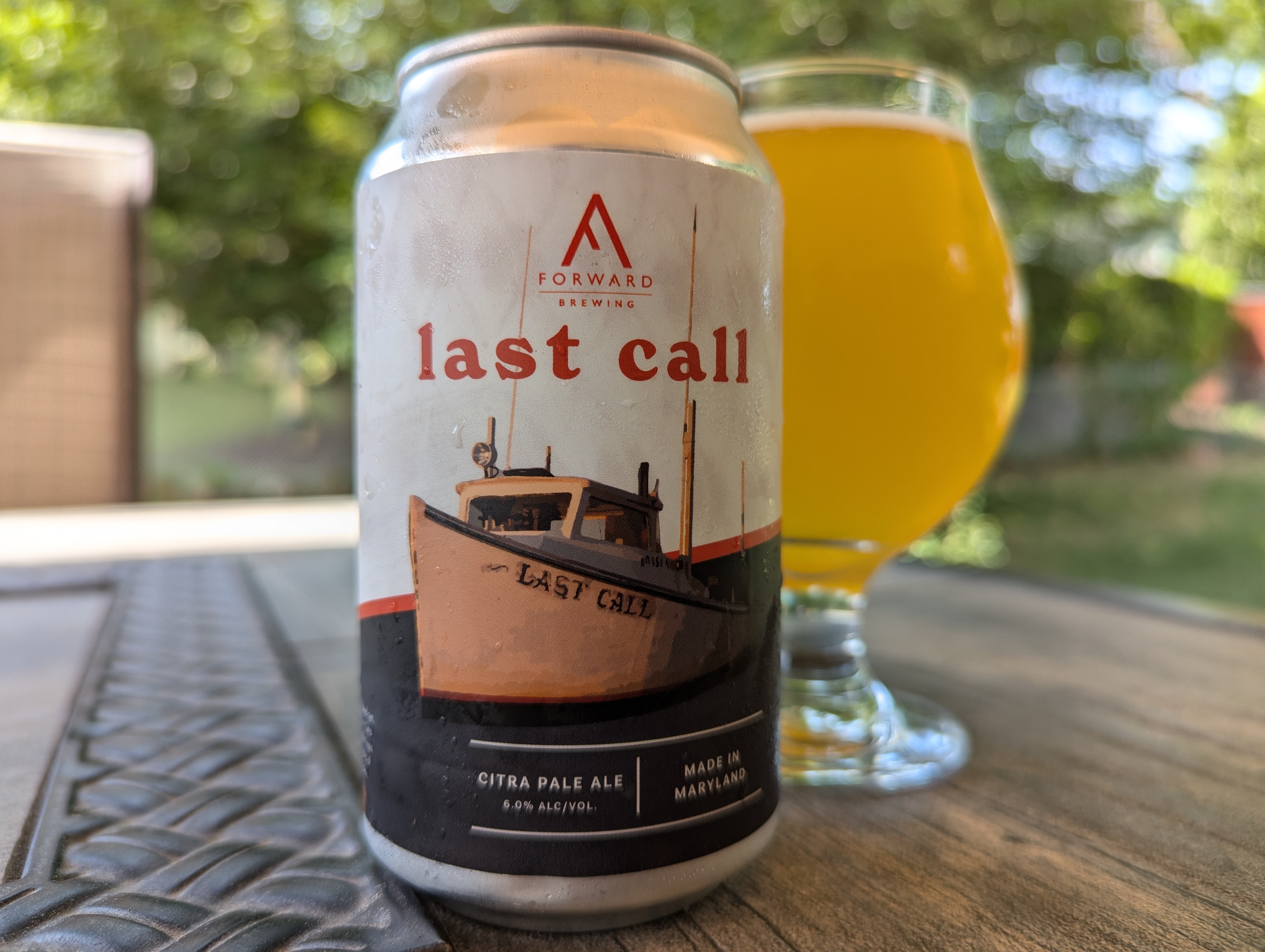
They say one should never judge a book by its cover; and, one should never buy a bottle of wine based on the label. I am pretty sure that latter rule also applies to beer. If it does, then I broke that rule when I purchased a six pack of Forward Brewing's Last Call. I totally bought it because of the label. 

The label features artwork based on the photography of Jay Fleming.  If you live in the Chesapeake Bay region, you may have heard of his photography. Fleming stands out as one of the premier photographers, not just of the beauty of the bay's natural environment, but also of the culture of those who live there and make their living there.  Fleming has published two books, Working the Water and Island Life, both of which I have read cover to cover. He has also published a long list of articles, as well as has his photography for sale. I have long wanted to buy one of this photographs to be framed for our house, but every time I look at the website, I ultimately can't decide which one to purchase. (To get a look into my dilemma, the three pictures that I have gone back and forth are this one, this one and this one.) 

As that internal struggle continues, I was perusing the beer aisle of one of my favorite local haunts when I came across a six pack of Forward Brewing's Last Call. The Annapolis-based brewery collaborated with Jay Fleming, whose artwork - a photo of a fishing vessel named Last Call - is featured on the label. As a huge fan of Fleming's work, as well as a big fan of pale ales, I bought a six pack.

The Last Call is a traditional Pale Ale, which the brewers describe having been brewed with "flaked rye, Idaho Gem and Citra Hops." The brewers also describe the taste of the beer as "juicy and citrusy, with pineapple and subtle notes of spice." 

The beer pours a light golden color, which one could expect from a pale ale, with a slight haze. The citrus notes are on the nose, reinforcing the brewers' description. Those citrus notes come through on the palate as well. I can see the hints of pineapple, but I also think other citrus fruits, such as lemon, are present in each sip. As for the spice notes, they were not so present for me, but they could be present for someone else who tries this beer. 

Overall, this is a very drinkable beer, especially with an ABV of 6%. While I may have bought it for the label, I walked away with a six pack of a pale ale that makes me want to bypass my usual haunt and make my way to the brewery's taproom. If you happen to come across a six pack of the Last Call, pick up a six pack. There is more to this beer than just the label (which, I still love). 

PEACE.

Tuesday, December 7, 2021

The IPA When the Earth Stood Still

For years, Kent Island was always a place where I would drive through, either to get to the Eastern Shore or to return back to Annapolis, Maryland and points beyond. I actually never stopped to visit the island. That all changed recently; and, I got an introduction to a really cool brewery that makes some very interesting and drinkable brews.

The brewery is Cult Classic Brewing.  As its name suggests, the brewery is motivated my old cult classic movies. The tap room is lined with old movie posters and the tap list hanging over the bar sports some brews with cult movie names, such as the Attack of the Strawberry Blonde and the IPA When the Earth Stood Still.  I stopped in to try the beers and grab a bite to eat.  When I left, I took home a six pack of that IPA with an intent to do a beer review. 

And, now, I shall go off the Deep End (1970) and begin the review:

The IPA When the Earth Stood Still does not Psyche Out (1968) anyone. It pours like a classic India Pale Ale. The beer has a deep golden hue. There is a good layer of foam, thick enough to hide The Creature from the Black Lagoon (1954).  

When it comes to both the aroma and the taste, the beer takes the drinker to but not Over the Edge (1979). If I could point to The Thing (1982) about this beer, then it would be to how it plays to the genre of the west coast IPA. The aroma give hints of the Things to Come (1936), with both piney and citrusy hints.  The taste is a Fantastic Voyage (1966) through the finer points of what defines a West Coast IPA.  There is a good deal of hop bitterness, which sometimes veers between the pine and citrus (although, admittedly, at least for me, it tended to be more of the former than the latter).  There is also a good amount of astringency on the finish, which grips the tongue tightly, as if in fear of something, like Reptilicus (1961) or The Blob (1958). 

In the end, in a world of IPAs, this one truly stands like Gorgo (1961) or Konga (1961) above most of the rest. It stands as a reason, in and of itself, to make a stop on Kent Island and grab a beer.  Until next time ...

ENJOY!

Sunday, February 2, 2020

Elvis Juice

Born in Scotland.  Brewed in Ohio.  That is the Brew Dog.  The brewery started over thirteen years ago, in an industrial park in northeastern Scotland. The brewery has taken a rather unique path, fighting against the massive brewing conglomerates while opening up some of its ownership to the people who drink its beer.  And, as Brew Dog carves out its own path, the journey has taken the brewers to the United States, where they have opened first a brewery and then a beer hotel, both of which are located in Columbus, Ohio. 

The opening of the brewery meant that Brew Dog beers could find their way throughout Ohio and the Midwest.  My father loves their beers; and, when we come to visit, Brew Dog finds itself in the fridge.  Most recently,  it was the Elvis Juice, the brewer's nod to a grapefruit infused IPA with natural citrus flavors.  

The Elvis Juice is brewed with Extra Pale and Caramalt malts, as well as Amarillo, Citra, Magnum, Mosaic, and Simcoe hops.  The product is a grapefruit IPA that has a 6.5% ABV and 60 IBUs.  The 60 IBUs falls within the range of American IPAs, which range from 55 IBUs to 70 IBUs.

The Elvis Juice pours a golden, hazy color, which suggests more of a New England IPA or hazy IPA. Any suggestion tha tthis beer is something other than a grapefruit IPA is quickly dispelled by the aroma.  This beer has perhaps the best aroma, because it is the one grapefruit beer where I can truly pick up a distinct grapefruit in the aroma.  That aroma carries clear through to the taste, as if the glass has a full grapefruit in it. While the brewers also added some orange to the beer, that citrus is not as present in either the aroma or the taste of the beer.   As bitter as this beer is from the citrus, one can also find some of the malts around the edges of the palate of the beer. 

The brewers call this beer "the absolute king in a world of wannabes."  As far as grapefruit IPAs go, I have to agree that this beer sets itself apart from its peers. 

Friday, April 13, 2018

'Bout Time

Character crafted on the beach.  Those are the words that adorn the can of the 'Bout Time Session-Style India Pale Ale produced by the Outer Banks Brewing Station.  Recently, my beautiful family took a vacation in the Outer Banks and, as we usually do when we are in the area, we stopped by the OBX Brewing Station.  I picked up a four pack of the beer for the vacation.  

The five words describing the beer -- "Session Style" India Pale Ale -- got me thinking about what exactly makes a "session style" beer.  Is it just the ability to drink it easily?  The 'Bout Time does drink very easily.  Is it the lower ABV?  This beer has an ABV of 5.8%, which is definitely on the low end of an India Pale Ale. 

The origin of session beers is generally thought to have began in Britain during the First World War.   Manufacturing employees, including those who worked in munitions plants, worked long hours, broken up by breaks or "sessions" of four hours.   The employees drank beer during those sessions; and, if they drank their usual ales, porters or stouts, that could create some problems when they returned to their jobs of producing ammunition, ordnance and the like.  So, brewers produced easy drinking beers with lower alcohol contents; and, thus, the "session" style was borne. One example is the Whitbread IPA had an ABV that decreased from 4.61% in 1914 to 3.30% in 1918.   The only issue with this example is that 4.61% for an India Pale Ale is fairly low, especially by today's standards.  It was also lower than the Whitbread Pale Ale, which had an ABV of 5.31% in 1914 and 3.83% in 1918.  So, an IPA had a lower ABV than a pale ale?  Now, that is truly a session beer. 

The brewers at the OBX Brewing Station produced the 'Bout Time IPA session ale with El Dorado and Azecca hops.  Their work and those hops produced a beer with a copper or light rust color, which one would expect of an India Pale Ale.  The session nature of this beer is evident in both the aroma and taste of this beer. The aromas are there, with some pine bitterness and grass coming out in the nose of the beer.  But, unlike a typical IPA, those elements are not loud.  Their smoothness is consistent with the nature of a session beer.  Likewise, the taste taste elements -- such as the grapefruit notes -- are well rounded and impart some bitterness that quickly recedes after each sip.  The session-style takes what would be a very hoppy IPA and makes it a very good pale ale, at least in terms of the hoppiness and bitterness.  

A four pack of the beer is available at the OBX Brewing Station and, if you happen to be in the area, it is worth the $11.99 per pack.  Until next time ...

ENJOY!

Sunday, August 13, 2017

Market Garden Brewery's Citramax IPA

When it comes to the craft beer scene in Cleveland, as one person it, "the word is out." There has been a remarkable growth in craft brewers.  At one time, there was only Great Lakes Brewing Company.  Now, there are breweries like Fat Head's Brewing, Platform Beer Company, Butcher & Brewer, and Market Garden.

The latter brewery, Market Garden, is located next to my favorite spot in Cleveland ... the West Side Market.  THe past couple of times that I have been in Cleveland and I have made a trip to the market, it has always included a side trip to Market Garden.  That side trip was a necessity, because it offered me a chance to try some very good beer.  Beers like the Cluster Fuggle, an IPA, or the Illuminator, a Doppelbock.

The great thing about Cleveland craft beer is that there are so many choices, even within one brewery.  The bad thing about Cleveland beer is that I can only get it when I am in Cleveland.  However, there has been a recent push for many of these breweries to bottle or can their beer.  And, during a recent visit to Cleveland, I was able to find Market Garden's Citramax in a local grocery store.  Needless to say, I bought a six pack and took it back home with me.  

The Citramax is described as a West-Coast style IPA.  The feature of this beer is in the name - Citra.  The brewers dry hopped this West Coast IPA with organic Citra hops.  The goal was to impart intense tropical and citrus fruit aromas in a beer with an aggressive-boldly bright American Hop character that will leave you craving another.

Mission achieved.  The Citramax pours a golden color with a thick foam.  That foam recedes quickly to the edges of the beer, opening the way for an aroma full of tangy citrus fruits, such as grapefruit and tangerine.  As one sips the Citramax, there is a moderate level of bitterness, encasing elements of those citrus fruits with some pine notes on the edges.  This IPA differs a little from most other IPAs that I have had in that the moderate bitterness is also followed by a little sweetness on the palate.  The sweetness helps to balance the beer, making it more palatable for people like my beautiful Angel who are not big hop heads.

As with most Cleveland beers, the Citramax is available in the Cleveland area. If I recall correctly, that six-pack cost about $9.99 or $10.99.  If you see a six pack sitting on the shelf, it is definitely worth trying.

ENJOY!

Saturday, June 17, 2017

A New Project in the Bluegrass State

Whenever we travel, my beautiful Angel, Clare and I like to check out the local scene.   We look for interesting things to do, cool restaurants to try, and, of course, a brewery or brewpub to check out.  Recently, we made a trip to the Bluegrass State to visit with close friends who live in Louisville.  

We arrived the day before and decided to check out the town, with one of the stops being, of course, at a local brewery or brewpub.  We have been to Louisville in the past, and, I have been to Bluegrass Brewing and Against the Grain, both of which are very good.  But, this time, we wante to try something different.   I asked Google for the nearest breweries or brewpubs, and, it responded, "Holsopple Brewing."

Holsopple Brewing opened in February 2017 in the Lyndon neighborhood, which is not too far from Shelbyville Road and I-264.  The brewery's owners -- Sam Gambrill and Kristy Holsopple -- opened the brewery with a tap room that features 8 drafts.  When we visited the tap room, we were greeted with beers that spanned different brewing styles from the classic pale ale and single-hop india pale ales, to a lager, pilsner and even a dunkel.   The tap room also had games and crayons, providing some kid-friendly activities while the parents sample the beers. 

Clare and I tried a few of the beers.  Clare ordered the Hefeweizen, which was a good effort at the beer.  I tried the Project Alpha "B" IPA, which I believe is one of their efforts to brew a single hop India Pale Ale.   I also tried their Paula Pilsner, which was a very crisp and clean pilsner.  It was a good contrast to the hoppy Project Alpha B IPA.

The Project Alpha beer is the second in a single hop IPA experiment of the brewers, with the goal being 26 different single hop IPAs.  From what I could tell, the Project Alpha B IPA is brewed with cascade hops.  As you can see from the picture to the right, the beer pours a orange color with a thick foam covering the surface.  The aromatic elements feature the hops, with the citrus notes, but also a fair aroma from the malts.  This balance carries through to the taste, with the result being a good balance between the hops and the malts.   This balance helps make this beer a little more approachable to people who are usually turned off by very hoppy IPAs.  

Overall, our visit to Holsopple Brewing was a good one, especially given this brewery has been only open for a few months.  If you happen to live in Derby City, you should check it out.  When we make our way back to Louisville, we will definitely make another stop to see how the brewers and the beers have evolved.  Until next time ...

ENJOY!

Wednesday, November 12, 2014

Stalking Hops

"We're a couple of hop stalkers here."  So said Fat Head's brewer, Matt Cole, to Rick Armon of Ohio's Breweries.  Cole described his trips out west, at least twice a year to the State of Washington.  The principal purpose of these trips is to scout hops.  Cole reminisced about one trip, "We were out in a really late harvest in Yakima one year and we were driving around and chasing around some of the hop trucks to follow them back to the harms."  Stalking hops that would ultimately be used in beers such as the Hop Stalker, a Fresh Hop IPA.

According to Armon, the Fresh Hop IPA comes from the fact that the hops are in a kettle approximately 48 hours after they have been picked.  "Fresh hop" beers are apparently in vogue, with a lot of brewers snatching hops practically straight off the farm in order to brew various types of IPA beers.  However, it takes a true hop stalker, like Matt Cole, to produce one of the best beers that, in a style that he truly owns, packs one of the higher IBUs of any "fresh hop" beers. (At this point, I should disclose that Fat Head's is one of my favorite brewers, if that wasn't obvious by now.)

The Hop Stalker pours a copper color, with a thin foam across the surface of the beer.  The aroma of this beer is straightforward ... pine and more pine.  Those are the notes that one would expect from a beer that has 80 IBUs.  It is also what hopheads and fans of Matt Cole's beers come to expect when he brews any kind of pale ale.  

The taste of this beer provides an excellent example of how the hop stalker can get the best out of those little cones.  The Hop Stalker Fresh Hop IPA is very bitter, with strong pine and resin notes.  Those elements wrap themselves around your tongue stretching the hop experience to its natural limits, which should please anyone who is a hop head like myself.  The alcohol of this 7% ABV beer becomes a little more present as you drink it, but it can never overtake the central focus of this beer -- the hops.

Although this beer is available in cans, it is most likely sold out by the time this post goes to air.  If it becomes available again, it can be bought at the Fat Head's restaurants or tap room, which is where my Dad found this beer.

According to the Craft Beer Restaurant, a fresh hop beer pairs well with pork belly or leg of lamb, because the fresh nature of the beer contrasts well with these rich pieces of meat.  The beer can complement an endive and arugula salad or a casserole of brussel sprouts, mushroom and "floral cheese."  I'll never be able to verify that last one, because a casserole with brussel sprouts just seems too unappetizing.  I'll just have the beer.

ENJOY!

Friday, June 27, 2014

Hoppin' to Heaven

The Hoppin' to Heaven is described by its brewery -- Hopping Frog -- as a "classic American I.P.A."  This is a rather odd description, given there is nothing really "American" about an India Pale Ale.  The style was born in England, not New England. Brewers developed this style to weather the voyage to India, not Indiana.  So, it seems odd to use the words "classic" and "American" when one talks about an IPA.

Still, American brewers have a knack for taking a style and making their mark on it.  Take the barleywine.  English brewers have brewed barleywines for a very long time.  Those beers had high alcohol contents, but were very malty in structure, taste and aroma.  When the barleywine style made it across the Atlantic Ocean, American brewers took the beer and gave it their own twist. American barleywines were set apart from their British counterparts with the use of hops.

With all of that said, perhaps that there is something "American" about this IPA.  It is representative of the urge of American brewers to hop their beers aggressively.  That is not a bad thing.  I consider myself a hop head and I love very hoppy beers.  The reason is that, for all of their love of hops, American brewers also know how to balance the beer so that enough of the aroma and the taste of the malt shines through.  The Hoppin' to Heaven IPA is a great example of how this balance can be achieved, with an aggressive hop profile in both aroma and taste, rounded out with a smooth malt character in the background.

The Hoppin to Heaven pours a golden brown to amber in color with thick, fluffy foam that persists for a long time.  The carbonation was quite intense with this beer, and the thick foam made the IPA seemingly impossible to reach.  Yet, with patience and time, the foam receded enough to allow for taking in the aroma and the taste of the beer.

Both the aroma and taste of this beer are very good.  The aroma was fairly well developed, with the hops providing both pine and floral notes. A little work produced some notes of the malt and even a little earthiness character.  The earthiness is something a little different in an Imperial Pale Ale, but it worked with this beer.  As for the taste of the beer, there is a nice amount of pine hop flavors up front.  Some spice notes and pepper also follow the pine elements, with a sweetness around the edges of this beer.  The sweetness is no match for the bitterness of the hops, which prevail and cling around the edges of the tongue as you drink the beer.

Overall, this beer is a very good India Pale Ale and, to the extent that it is an American interpretation of an IPA (that is, a hoppy version of an already hoppy beer), it is a very good example of that.  I found this beer at a local grocery store. It sells for around $10.99 a bottle (give or take a dollar or two).

ENJOY!

Friday, June 6, 2014

Good People

Legally brewed since 2008.  That's what it says on the can.  The story goes back to the Prohibition era, when many states -- such as Alabama -- passed laws prohibiting the brewing of alcoholic beverages in one's home, along with laws prohibiting the production of beverages with alcohol contents over a very low threshold.  If someone were to brew a beer, like an India Pale Ale with an ABV of 7.1%, that person would be violating not one, but two laws.  Laws that carried fines and prison time as punishment. 

However, Alabama is no different than any other state when it comes to craft beer.  There are people who want more than the High Life. They would prefer that it is Imperial.  In 2008, craft beer lovers were able to get the Prohibition era laws repealed, opening the way for craft brewers to begin brewing anything from a session beer to a Russian imperial stout.  This set the stage for Good People to emerge.

Good People sold its first keg on July 4, 2008.  Since then, the brewers have developed an offering that includes a pale ale, brown ale, an India Pale Ale, a double IPA, and a stout.  Recently, my beautiful Angel's father brought a six pack of the IPA for us to enjoy during our family vacation. 

The brewers at Good People produce the IPA with 2-Row malts and 5 specialty grains, along with 5 different types of hops.  The hops are Columbus, Willamette, Cascade, Simcoe and Citra.  Add a Californian ale yeast, and the end result of the brewing process is a beer with a hazy, golden color and a strong, thick foam.  The five hops make their presence known in the aroma and taste of the beer.  Citrus notes, such as grapefruit and tangerine, are in the nose of this beer.  Some malt notes can be detected in the background, but the aroma is hop driven.  As is the taste.  When I first tried this beer, I could easily detect the citrusy notes of grapefruit and lemon.  However, I also sensed a sweetness in the beer, which could have been the result of the grains used in the malt.  As I drank the beer, the hop-centric elements of the flavor became much more prominent and that sweetness faded into memory.

Good People beers are available in Alabama and have a limited distribution.  If you are lucky enough to have someone who can get his (or her) hands on a six pack of the IPA, it is definitely worth it. 

ENJOY!

Wednesday, March 12, 2014

Götterdämmerung

Götterdämmerung.  It was the last of the four operas in Richard Wagner's Der Ring des Nibelungen. The fourth opera represents the climax of a story that begins with an ugly dwarf, Alberich, who comes across Rhinegold, an invaluable treasure that provides the possessor with power over the world.  Meanwhile, the goddess of youth, Freia, was kidnapped by giants who wanted payment in return for building a palace for the god Wotan.  Assisted by the gods Donner and Froh, Wotan finds Alberich and, long story short, Wotan takes a ring from Alberich and becomes entranced with it.  Alberich curses the ring, "ceaseless worry and death shall be the destiny of all who possess it." After being warned about the curse, Wotan throws the ring on the hoard.  The giants fight each other over the ring, with one killing the other.  Horrified by these events, Donner clears the air with lighting and a rainbow appears ... leading to the new castle, known as Valhalla.  

For hop lovers, the Götterdämmerung represents Stone Brewing's effort to create a Valhalla of India Pale Ales. A grand castle or monument to the style, all in commemoration of Stone Brewing's 17th anniversary.  The brewers used "a grain bill comprised exclusively of pilsner malts and German hops with crazy awesome names like Herkules, Hersbrucker, Magnum, Merkur, Opal, Smaragd, and Strisselspalt."  the brewers then dry-hopped the beer with Sterling hops, which are an American hop with Saaz parentage.  The brewers used this hop to impart "a bit of familiarity," but drinkers are warned that the Götterdämmerung "is a unique beer that takes the IPA - a style we've already pushed far beyond its previous limits over the years - to interesting new territory."

The beer pours a nice orange and gold color, which clearly identifies the style of the Götterdämmerung.  The aroma of this IPA evinces tart citrus and a little pine.  Those pilsner malts are completely dominated by the hops with respect to the aroma ... and the taste.  The Götterdämmerung has a taste that is chock full of hops.  The bitterness is first to greet you, with elements of grapefruit and lemon in the taste.  The bitterness of this beer acts like tannins in wine, sticking on the tongue long after the beer has been sipped.  Indeed, as I write this post, it has been at least a couple of minutes since I sipped the beer and my tongue is still in the grips of the hop bitterness.  (This is a feeling that, as a hophead, I quite enjoy.) 

When it comes to food pairing, Stone Brewing offers a variety of choices. These include honey-ginger chicken skewers, crab cakes, grilled peaches with blue cheese, citrus salad with goat cheese, Thai seafood salad, rotisserie chicken, Cajun shrimp and grits, and cedar plank salmon.  As for cheeses, they suggest Grana Padrano, Fiscalini Bandage Wrapped Cheddar, Green Mountain Blue Cheese, and Point Reyes Blue.

I found a bottle of the 17th Anniversary Götterdämmerung at a local beer store for about $10.99, although it was on sale for $7.99.  As this is a seasonal, look for it now because it may be gone soon ... and forever.

ENJOY!

Tuesday, February 26, 2013

Catching the Sculpin

It seems only natural that, if the brewers love to fish, they would name their beers after those fish. Take, for example, the brewers at Ballast Point Brewing Company in San Diego, California.  The brewery has a webpage dedicated to the Ballast Point Fishing Team and their stories about catching and tagging some very impressive fish, such as yellow tuna, wahoo, and grouper. 

So, it comes somewhat as a surprise that Ballast Point chose "Sculpin" as the name for its India Pale Ale.  The sculpin is an elongated fish with a heavy head, gill covers with spines and wide, fan like pectoral fins.  Different species of the sculpin can be found in the Atlantic Ocean (including the bullrout and the longhorn sculpin) and Pacific Ocean (including the cabezone and the long snout sculpin), where they move slowly along the ocean floor seeking out small fish and shrimp. The sculpin is far from a tuna or a grouper.

A Sculpin from our Lobster-Fishing Experience
During our vacation in Maine, both Clare and I came face to face with the sculpin.  We spent a morning aboard a working lobster boat, learning about how a fisherman earns a living catching lobsters.  The sculpin often enter the lobster traps to feast on the bait.  That easy meal sometimes comes with a price as the sculpin are often trapped in the cages and pulled up with the lobsters.  Some fishermen use the trapped sculpin as bait to catch more lobsters.  On our trip, we pulled up a couple of sculpin in the lobster traps.  The largest of the fish is shown in the picture to the right.  That sculpin was lucky. It was thrown back in the water rather than as being used as bait in the lobster trap.

 For the brewers at Ballast Point, the Sculpin is a "testament" to their humble beginnings as the Home Brew Mart, where they began to brew their beers.  The brewers describe the Sculpin as "a deceptively light bodied, yet very hoppy IPA with bright apricot, peach, mango and lemon flavors," which are achieved through the use of different hops.  

The Sculpin pours a nice gold to orange color with a thin, wispy foam.  The aromatic elements of the beer feature strong citrus tones, with some other fruit, such as the apricot or peach suggested by the brewers.  The beer does have a light body, and, it is full of citrus hop flavors.  The hops are well rounded and the citrus flavors continue into the finish, which is somewhat dry.  The hop flavors are well balanced, without imparting too much bitterness and even bringing out some sweetness in the beer.  

One reviewer suggests that the Sculpin is best paired with fish tacos, steamed mussels or blue cheese.  I think the fish tacos would work well, but steamed mussels and blue cheese provide two different end points to a range of flavors that may fall outside of what would work best for an India Pale Ale.  Another review suggests a meaty pizza or Italian dishes.  Personally, I think that the Sculpin is best paired with grilled meats and vegetables.  The light citrus and bitter flavors of the beer would complement the fats of the meats and the oils used with the vegetables.

I found the Sculpin at a local grocery store and if you see it, you should definitely consider buying a bottle to try, even if you are someone who ordinarily does not like hoppy or bitter beers.  It sells for $9.99 a bottle.

ENJOY!

Wednesday, October 24, 2012

The Burning River

The lyrics are haunting for someone born and raised in Cleveland ... "Cleveland, City of Magic; Cleveland, City of Light" ... even as melodic music plays in the background.  References to "magic" and "light" would make one think that the composer and singer is paying a tribute to Cleveland.  However, the composer is Randy Newman and the song is named "Burn On."  The tribute is to a travesty ... "burn on, big river, burn on."

The travesty was the Cuyahoga River catching fire in 1969.  The odd thing is that sight of a river catching fire was not uncommon.  According to Wikipedia, the Cuyahoga has caught fire approximately thirteen times since 1868.  The largest fire was not even the one in 1969.  Instead, a fire in 1952 caused over a million dollars of damage to boats and even a river-front building.

Yet, the burning of the Cuyahoga River in 1969 fire sparked a different kind of flame, which propelled the environmental movement.  People began to take notice and heed of the state of their rivers.  The Cuyahoga River, for example, was basically sludge, with all of the fish having been killed off in many parts of the crooked river.  That fire in 1969 was a catalyst for a lot of good things, such as the Clean Water Act and the Environmental Protection Agency.

The name, Burning River, also happens to be my favorite beer from Great Lakes Brewing Company, at least among its year around offerings.  Great Lakes Brewing is one of the oldest, if not the oldest, craft brewer in the State of Ohio.  For the longest time, it was the standard in craft brewing.  I used to visit Great Lakes whenever I was visited Cleveland.  (Admittedly, I do not get there as often as I used to, due to the proliferation of craft brewers like Fat Head's, The Brew Kettle and Market Garden.)

Great Lakes produces the Burning River with four malts and two hops. The malts are Harrington 2-Row base malt, Crystal 45, Crystal 77 and Biscuit malts.  The hops are Northern Brewer and Cascade hops. 

The Burning River is pours an amber orange color, reminiscent of the hues that could be seen in some fires.  The beer pours an off white foam that graces the top of the liquid.  The aroma is full of hops, which one expects from the Cascade hops.  Both the Northern Brewer and Cascade hops are clearly present in the taste, with the former providing a strong bitterness to the beer, while the latter adds a sense of grapefruit or other citrus to the taste. 

The brewers suggest that this beer is best paired with smoky red meats, as well as flavorful cheeses such as Stilton and other blue cheeses.  I think that the Burning River will go with most any red meat, and even poultry.  I did try the Great Lakes with a Rogue blue cheese and the pairing worked fairly well, much to my surprise.   

Great Lakes is increasing its distribution of its beers, which can be found from Chicago to Washington, D.C.  This beer sells for about $8.99 a six pack.  

ENJOY!

Tuesday, May 8, 2012

The Corruption

The can reads, "[i]n 1824, Speaker of the House Henry Clay forged a coalition that secured the White House for John Quincy Adams.  In return, Adams named Clay as his Secretary of State in what has become known as 'The Corrupt Bargain.'" The bargain is what provides the name for D.C. Brau's India Pale Ale. 

D.C. Brau describes this beer as being brewed just at the line of an India Pale Ale and an Imperial IPA.  Each batch of the Corruption India Pale Ale is brewed with Pale 2-Row, C-10, Honey and Munich Malts, along with 40 pounds of Columbus Hops.  The beer has an ABV of 6.5% and 80 IBUs.  The ABV places this beer squarely on the side of an India Pale Ale, while the IBUs are what nudge it toward an Imperial IPA.  (I have tried some Imperial IPAs that have an ABV as high as 10% and as much as 100 IBUs).

The Corruption pours a hazy orange or copper color, suggesting that that the beer is unfiltered.  Although the brewer does not say whether the beer is filtered or unfiltered, my guess is that it is filtered.  In any event, the aroma of the beer presents the classic India Pale Ale scents of pine and citrus.  The pine aromas are clearly more prominent than the citrus.  The pine is also a principal flavor of the beer.  The pine is coated resin flavors, which sets this beer apart from some of the other India Pale Ales that I have tried.  

As with any India Pale Ale, the Corruption is best paired with meats such as beef, lamb, or bison. The citrus and pine flavors of the beer work well with a steak, as the astringency of those flavors cut through the fat of a cut such as a ribeye, sirloin or or a cowboy steak.   I paired this beer with the Cowboy Steak that I made using a recipe from The Prime Steakhouse at the Bellagio in Las Vegas.  

The beer is available in the Washington, D.C. metropolitan area.  It sells for about $10.99 or $11.99 a six pack.  

ENJOY!

Sunday, March 25, 2012

Japanese Green Tea IPA

Stone Brewing Company is primarily known for its aggressively hopped, in-your-face style of beers ... with names like Arrogant Bastard and Sublimely Self-Righteous Ale.  Stone is also known for its collaborations with other brewers.  The general formula of these collaborations is to have three brewers from three different breweries join together to produce unique examples of beer styles.

Stone Brewing Company is a well established and well recognized brewer.  However, its collaborations offer a great opportunity learn about little-known brewers.  One example of this is the Japanese Green Tea IPA, which Stone brewed with the Japanese Brewery of Baird Beer and the Guam brewery of Ishii Brewing.  I had heard of Baird Beer while working on my blog post about Kiuchi Brewery's Hitachino XH.  With its motto of "Celebrating Beer," Baird Beer produces a line up of craft beers with names like Wheat King Ale, Rising Sun Pale Ale, Suruga Bay Imperial IPA, and Shimaguni Stout. Baird also produces a range of seasonal beers using ingredients such as Japanese figs, mikan fruit and yuzu.  Unlike Baird Beer, I had never heard of Ishii Brewing, a small brewer on the island of Guam.  According to its website, Ishii brews only two beers ... Minagof Pale Ale and Minagof India Pale Ale.  The word "Minagof" means happiness in Chamarro, which is the language of the indigenous peoples of Guam.

There is definitely some "minagof" in the Japanese Green Tea IPA. The beer pours a perfect apricot/orange color, which is, in my mind, the ideal color for an India Pale Ale or Imperial India Pale Ale.  As the picture shows, there is a decent amount of foam that rests gently on top of the beer.  The aromatic elements of this beer are largely the same as an India Pale Ale, although there is a hint of green tea in the aroma.  The tea comes out a little more in the taste, but not too much.  Rather, it is the traditional flavor of grapefruit, brought about by the hops, that is the principal flavor of this beer.

At 9.0% ABV, the beer provides not only a strong grapefruit flavor, but a good sense of alcohol with it.  These flavors, with the alcohol, could pair well with something grilled.  Perhaps it is the suggestion provided by the name of the beer, but, this beer could pair well with yakitori or teppanyaki.  Whether it is grilled chicken skewers or beef cooked on an iron griddle, that seems to work with this beer.  For those lacking an iron griddle, the beer could also be paired with steaks or chicken cooked on a backyard grill as well.

The beer sells for about $7.99 for a twelve ounce bottle, which is a steep price.  However, this beer was brewed as a fundraiser, with the proceeds going to Japanese tsunami relief programs.  On that basis alone, it is definitely worth the price, but you get the added benefit of a very good beer.

ENJOY!

Saturday, October 8, 2011

Tyranena Brewing Company Bitter Woman IPA

One of my favorite beer styles is the India Pale Ale or IPA.  Since I started this blog, I have reviewed a few India Pale Ales, such as Fat Head's Head Hunter IPA and Stone Brewing's Ruination IPA.  My father recommended that I try Tyranena Brewing Company's Bitter Woman IPA and even bought me a bottle.

According to the bottle, the "bitter woman" is based upon Aunt Cal, an early resident of Lake Mills, where the craft brewer is located.  "Local history remembers her for blindly running into a hitching post and saying, 'Excuse me, Mr. Dodge.'"  The brewer continues by adding that it was said that Aunt Cal was "an old sweetheart" of Henry Wadsworth Longfellow.  Unfortunately, she never wed, with only the love letters to remind her of lost possibilities.  Tyranena Brewing says that it brewed the Bitter Woman IPA "the way we imagine Aunt Cal may have been, very fruity and intensely bitter."   

The beer pours the color of amber and copper, with a thin foam and good carbonation.  The aromatic elements of the Bitter Woman IPA are focused on the hops and are rounded out with the aromas from the malts.  This is a good thing for an IPA.  What makes the beer even better is that the hops do not overwhelm the drinker.  There is a bitterness along the edges.  

As for the taste, there is a bitterness up front, which diminishes at the end, giving way to a little sweetness.  The beer is not very heavy or obnoxious.  Instead, it is a drinkable IPA that should appeal to hopheads like myself.  To be sure, I have tasted much hoppier IPAs, such as the Head Hunter, but this beer provides a little complexity that fits in well with the name and the story behind the beer.  

This beer is available in Wisconsin and surrounding states.  I believe my father picked up the beer at a Binny's in the Chicago area.  

ENJOY!

Friday, September 9, 2011

Pub Dog Hoppy Dog Pale Ale

For the past ten years, Pub Dog Pizza and Drafthouse has quietly brewed beers while other Maryland breweries, like Flying Dog and Heavy Seas have grown and garnered a lot of attention.  The brewpub has two locations, one in Baltimore and the other in Columbia.  Pub Dog produces a wide range of beers, from a White Dog (an orange wheat beer) to a Black Dog (the stout).  Recently, Clare purchased a bottle of the Hoppy Dog.

The Hoppy Dog is billed as an India Pale Ale.  An IPA is a moderately hoppy style of beer, with some bitterness from the hops.  Whether it is an English IPA or an American IPA, the beer should have a floral, citrusy aroma, a hoppy but not too bitter taste, and a clean finish. While the Hoppy Dog is good, it falls a little short of an IPA, showing itself to be more like an American Pale Ale than an India Pale Ale.

The beer does pour a golden color with a thick foam that has a very long retention time.  The aromas of the beer is a little floral and a little hoppy.  The aroma of the hops is not overwhelming.  The hops show through in the taste, but, like the aroma, the hop flavor is not overwhelming.  This is a pale ale that would appeal to people who normally steer clear of India Pale Ales or American Pale Ales because of the fear of bitter or citrusy tastes.  This is a very drinkable beer, kind of like a session beer.

Pub Dog's Hoppy Dog Pale Ale has an ABV of 5.4% Clare found this beer at Gilly's, a local beer store.  The beer should be available at beer stores around Maryland.

ENJOY!

Sunday, June 5, 2011

Stone Brewing Company Ruination India Pale Ale

Stone Brewing Company has always interested me.  Stone is  well established player in the craft beer movement, with beers such as the Arrogant Bastard and Lucky Bastard.  I know people who buy these beers for the name.  I guess there is something about saying to a bartender, "I'll have an Arrogant Bastard" that people find amusing.  I order the beer because it is a very good beer.

Recently, I purchased a bottle of Stone's Ruination IPA, which is a great beer that I have had in the past.  This time, I decided to look into the beer a little more.  Stone first released this beer nearly ten years ago in 2002.  The brewer produces this India Pale Ale using Columbus and Centennial Hops.  The brewer describes the origin of this beer as rising out of the ashes from the Stone Anniversary IPA, with an "abundantly pungent aroma of hops" and "richly layered subtleties" from the hops.  

The brewer describes the name "Ruination IPA" as the effect that the beer will have on one's palate. The moment after the first taste of the beer, says the brewer, all other food and drink becomes tasteless. This is the objective of Stone IPA. 

With an IBU of over 100 and an ABV of about 7.7%, Stone largely accomplishes that goal, but in a good way.  The beer pours a perfect amber and gold color.  Once poured, there is a nice cover of off-white foam that is stubbornly persistent.  The foam is permeable, allowing the flavorful aroma of the Columbus and Centennial hops to greet the drinker.  The foam is also suggestive of a creaminess and smoothness that provides body to this beer.  That smoothness is contrasted with the intense hop flavor of this beer.  With hops come related flavors and tastes, such as citrus like lemons and grapefruit, as well as flavors of pine.

After having weathered the hop assault, I am one of the crazy people who would say, "thank you."  This beer can be found at most stores with a good selection of craft beers.  It sells for about $5.99 a bottle. 

ENJOY! 

Thursday, March 17, 2011

Fat Head's Head Hunter India Pale Ale

Cleveland is the home of many great craft brewers, such as Matt Cole, the brewer of Fat Head's Brewery & Saloon in North Olmsted, Ohio.  Whenever I am in Cleveland, I always try to stop by Fat Heads in order to try whatever Matt happens to have on tap at the time.  I've previously reviewed one of his beers, the Hop Juju Imperial India Pale Ale, which is probably one of the best Imperial IPAs that I've ever had.  I was able to do that review because I happened to be in Cleveland at the time when it was on draft.  Now, however, Matt has begun to bottle his beers, opening new possibilities in terms of distribution.  And, recently, I was able to try a bottle of his Headhunter IPA, although my father had to bring it to me from Cleveland.

The India Pale Ale style can be traced back to the pale ales of the seventeenth century in England.  One of the earliest brewers was George Hodgson of Boss Brewery.  Traders working for the East India Trading Company liked the beers of Boss Brewery because they could survive the trip to India.  Eventually, however, the Boss Brewery beers fell out of favor with those traders, and the East India Training Company turned to Allsop Brewery and others, which produced a strongly hopped pale ales in the style of the Boss beers.  The reason for all of those hops was to help preserve the beer. The use of hops, in conjunction with a beer that had a higher alcohol content, helped to prevent spoilage on the vessels during the long voyages to India. 

The IPA brewed by Fat Head's is brewed in a style that could take it around the world.  Matt describes the Head Hunter as a "balls-to-the-wall IPA" that surpasses all others, and an "in-your-face, dry-hopped West Coast-style IPA.  These descriptions are very appropriate.  From the moment you start to pour the beer, you see a nice orange beverage in your glass, but you are greeted with a nose that is basically a ton of grapefruit packed in pine crates.  For a hophead like myself, this is a much treasured aroma.  The nose of the beer clearly summarizes the taste of the beer, which is full of grapefruit, along with some pine and, as the label notes, some tangerine and pineapple. These bitter flavors are rounded, just a little, by the caramelized malts used in the brewing process.  All of these flavors have the tendency to make you forget that the beer has a whopping 7.5% ABV.

When it comes to pairing food with a beer like this one, the effort may require a little creativity. A beer that is packed with this much grapefruit flavor would seem to call for food that is equally full of flavor.  A good marbled piece of beef, or, perhaps chicken wings with a sauce that is full of spices or heat.  In the case of the beef, the beer would be a good contrast to the flavor of the meat.  And, as for the wings, the dry, hoppy nature of the beer may intensify those spices in the sauce, enhancing the meal.  Or, you could do what I did when I tried this beer ... just enjoy the beer by itself.

I would highly recommend this beer for those of you who can lay your hands on it.  It is an excellent example of the India Pale Ale style.  It is often available on tap at Fathead's Brewery and Saloon in North Olmsted, Ohio and bottles may be available there for purchase. 

ENJOY!

For more about the history of India Pale Ale, check out Wikipedia and Brewing Techniques.