Showing posts with label Oregano. Show all posts

Monday, June 8, 2026

Carne Arrustuta

Years ago, I would spend a lot of time researching recipes for a specific weekly event: Steak Night. I would find various beef and steak recipes from around the world, and, prepare them for my own dinner. It was my dinner because, for one thing, my beautiful Angel does not eat red meat, and, for another, that night I ate alone because she had a weekly work obligation in the evening. 

If one were to go back and look at the record (my prior posts), the would discover that Steak Nights often featured massive cuts of beef, like the Chef Bolek's Two-Pound Ribeye. They would also see that I often served a sauce alongside that hunk of meat, like the chimichurri sauce that I served alongside my Smoked Ribeye Roast, Uruguayan Asado Style. Sometimes, I would finish everything in one sitting; other times, the leftovers would be lunches for the next day. 

However, I stopped posting Steak Night recipes back in 2018. I did so for a few reasons. First, those massive steaks were expensive (and are even more so today). Second, I decided to reduce my own red meat intake by limiting the occasions in which I prepared beef or steak. That, along with an increased focus on projects like my Around the World in 80 Dishes and Beyond Borders, led my cooking in other directions.  

However, I return to my Steak Night tradition with this dish, Carne Arrustata, which is Italian for "roasted meat." It is a Sicilian grilled steak recipe. The history of this dish is unknown, as there are few recipes with even fewer details about the dish. Yet, the raising of cows, along with their products, whether milk, cheese and beef, has a long history in Sicily, going as far back as the sixth millenium B.C.E. Indeed, the raising of cattle -- whether it is the Cinsara breed or the Modicana breed (one of the best triple purpose cattle breeds [that is, cattle for milk, meat and draft power]) -- in what is now known as Sicily goes back centuries. Yet, it does not get the same attention as, for example, the raising of Chianina cattle in Tuscany. Nor do Sicilian beef dishes garner the same attention as, for example, the Tuscan Bistecca alla Fiorentina. 

Modicana cattle (Source: Slow Food Foundation for Biodiversity)

I have made that bistecca recipe on many occasions, and, on this particular, one, I wanted to do something different. So, for this Steak Night, I decided to make Carne Arrustata. I also had another reason for taking Steak Night to the most southern reaches of the Appenine peninsula: salmoriglio. It is a sauce featured in the cuisines of Sicily and Calabria that is prepared with, among other things, parsley, oregano, lemon juice, lemon zest, olive oil and water. The combination of steak and this sauce seemed natural for two reasons. First, the recipe for carne arrustuta called for marinating the meat in a marinade that included lemon juice and lemon zest, which creates ties between the steak and the sauce. Second, salmoriglio got me really thinking about Argentine and Uruguayan chimichurris. There are similarities, as chimichurri recipes feature the combination of green herbs like parsley and oregano; and there are differences, namely, salmoriglio lacks the heavy emphasis on garlic that are found in chimichurri sauces. Those differences make salmoriglio a lighter, brighter sauce that (admittedly) would probably go better with chicken or seafood. Yet, the oil and herbs do enough to complete even grilled beef dishes, like Carne Arrustata. 

Finally, as with many of my recipes, I like to think of the journey embodied in the recipe. While I have been to Italy, I have never made it as far south as Sicily. Yet, as I prepared this dish, I like to picture myself as a cook in Sicily who was preparing the dish for guests, whether in a small restaurant down an  side street of a Sicilian village or at an agritourismo located out in the Sicilian countryside. I still fondly remember my visit to Montestigliano, an agritourismo in the hills of Tuscany, where I had an equisite dinner prepared by a local chef. Those memories provided the inspiration that led to my renewed love to cook, as well as the idea of creating this blog.  

CARNE ARRUSTUTA

Recipe from A Sicilian Peasant's Table

Serves 4

Ingredients (for the steak):

  • 1 (1.5 pound) top sirloin, London broil, ribeye or any other cut of steak
  • 2 tablespoons extra virgin olive oil
  • 1 garlic clove
  • 1 tablespoon fresh lemon juice
  • Sicilian sea salt
  • Freshly ground black pepper
  • 1 teaspoon grated lemon zest
  • 1/2 teaspoon dried oregano leaves
  • 2 teaspoons green onion, finely sliced (optional)
  • 1/2 teaspoon crushed red pepper (optional)
  • 2 dried bay leaves (crumbled)

Ingredients (for the arugula salad):

  • 3 cups arugula
  • 1 tablespoon extra virgin olive oil
  • 1 tablespoon red wine or balsamic vinegar
  • 1/4 cup shaved parmesan cheese (substitute Pecorino Siciliano or Maichino if you want to use Sicilian cheeses and can find them)
  • Sicilian sea salt
  • Freshly ground black pepper

Directions:

1. Marinate the steak. Wipe the steak dry with a paper towel and place in a small baking dish. Crush the garlic clove with a garlic press or mash a small amount with salt on a wooden board using the flat side of a chef knife. Rub half of the olive oil and garlic evenly on each side of the steak. Drizzle the lemon juice on both sides and season with salt and pepper to taste. Then sprinkle half of the lemon zest, oregano, bay leaves, green onion and red pepper (if using) on each side of the steak. Cover with plastic wrap and refrigerate for 4 to 6 hours. Remove the steak from the refrigerator 1 hour before you cook it. 

2. Grill the steak. Preheat a gas grill on medium high or prepare a medium high charcoal fire. Grill approximately 8 to 9 minutes on each side for medium rare or until a thermometer inserted into the thickest part reads 125 degrees Fahrenheit. Transfer the steak to a cutting board and cover loosely with foil. Let rest for 10 minutes. the steak will continue to cook. Cut into thin slices.

3. Prepare the salad. Combine the arugula, olive oil and vinegar in a medium bowl. Season with salt and pepper. Toss in the shaved parmesan. Transfer to a serving platter. Top with sliced steak.

*     *     *

Post-Script: I decided to ask AI for an image of a Sicilian farmhouse agritourismo with Carne Arrustata on its menu. AI gave me the following picture: 

Created by AI

A nice picture but I am sure that it pales in comparison to the actual experience of visiting an agritourismo nestled in the coutryside. 

PEACE.

Sunday, March 8, 2026

Salmoriglio

Its history is lost to time. That happens sometimes when a recipe has been around for so long, that people forget where it came from. Take, for instance, salmorigio (which comes from the Sicilian word, salmurigghiu, a lemony sauce made with parsley, oregano, and olive oil that has been used as a marinade or served alongside dishes for centuries in kitchens and restaurants across Calabria and Sicily. (Although one could indirectly date the sauce back to at least the 9th century C.E., when Arabs brought lemon trees to Sicily during their colonization of the island.)

When I first came across a recipe for salmorigio, my mind immediately associated it with the chimichurri sauces of Argentina. Fresh green herbs, combined with garlic, and then blitzed or mixed with olive oil and, in the case of salmoriglio, a little bit of water. 

As I would come to learn, salmorigio is separate and distinct from chimichurri sauce. For one thing, the prominent taste element in salmorigio is lemon, which is infused two-ways into the sauce: first, through the addition of lemon juice; and, second, through the use of lemon zest. The result is a sauce that features the citrus first and foremost, unlike a chimichurri, in which much more garlic is used to create sauce. The difference is notable: salmoriglio is a thinner, smoother sauce that has a lighter, fresher flavor.  

That texture and flavor may explain why Calabrians and Sicilians use salmoriglio as a sauce, dressing or marinade with chicken and seafood. I, on the other hand, decided to use it with beef. I came across a recipe for Carne Arustuta, which is a Sicilian grilled steak recipe. The recipe calls for marinading the beef with, among other things, lemon juice and lemon zest. I thought that those ingredients, which are shared by both salmoriglio and carne arustuta, could be what ties the two recipes together. And, it did. In this sense, the salmoriglio worked like a chimichurri, perfectly complementing the grilled meat. 

SALMORIGLIO

Recipe from Forager Chef

Ingredients:

  • 1 cup packed flat leaf parsley, leaves only
  • 1 cup packed fresh oregano leaves (or bee balm leaves)
  • 1 large clove garlic
  • 1/2 cup light olive oil
  • 1/2 cup extra virgin olive oil
  • 1/4 cup water
  • 2 tablespoons fresh lemon juice
  • Zest from one large lemon
  • Kosher salt and pepper

Directions:

1. Prepare the oil and herbs. Mix the two oils together. Bring a quart of salted water to a boil. Add the parsley and cook for 5 seconds. Remove the parsley and refresh in cold water. Squeeze the parsley dry and reserve.

2. Prepare the sauce. Add the garlic, lemon juice, water, oregano, and parsley to a blender. Begin pureeing the mixture, drizzling the oils until the sauce is smooth and emulsified. Double check the seasoning for salt and pepper and then transfer the finished sauce to a container. Stir in the lemon zest and refrigerate. 

PEACE.

Tuesday, September 16, 2025

Around the World in 80 Dishes: Mexico

"Mexican food is far more varied than people think."

-- Gael Garcia Bernal, Actor & Filmmaker

That statement is particularly true if the people happen to live in the United States. In a country where the history of Mexican food tells the tales of Chi-Chi's and Chili's, along with Taco Bell and Chipotle, one could easily think that Mexican food consists of nachos, tacos, quesadillas and chalupas. Yet, the entirety of Mexico, from the Rio Grande to the Usumacinta, from the Pacific to the Caribbean, plays host to a wide range of different cuisines. The foods of the arid stretches of Sonora differ from those along the coastline of Jalisco. Those dishes differ from the indigenous cuisines of Oaxaca and Tabasco.

Americans love Mexican food, but as Anthony Bourdain once noted, "we have barely scratched the surface of what Mexican food really is." In some respects, Mexican cuisine is older than "the great cuisines" of Europe. And, it can stand its ground with those cuisines as well. A mole sauce from Oaxaca is as complicated to make (if not more so), in terms of ingredients and processes, as any sauce from storied European cuisines that are featured the Michelin-starred kitchens of restaurants anywhere in the world.  

The regional cuisines of Mexico
In order to understand the range of regional cuisines in Mexico, one needs to look at the country itself. Generally speaking, one could outline at least seven different regional cuisines. There is the El Norte (Aguascalientes, Baja, Sonora, Chihuahua, Cohuila, Durango, Nuevo Leon, Tamaulipas and Zacatecas), with a range of seafood dishes from the coasts of the Pacific Ocean and Baja California) to the beef dishes from the ranches of Sonora and Chichuahua. (I think this could be split in two separate regions on its own.) There is the Costa del Pacifico Norte (Comalina, Jalisco, Nyarit, and Sinaloa), which is known for dishes such as pozole and birria. There is the Bajio (Guanajuato, Michoacan, Queretaro and San Luis Potosi), where rice and pork feature prominently. There is Costa del Pacifico Sur (Chiapas, Guerrero, and Oaxaca) where one could enjoy the cuisine of the indigenous peoples. Then there is El Sur (Campeche, Quintana Roo and Yucatan), where one could enjoy pork dishes like pibil. There is El Golfo (Tabasco & Veracruz), where, as noted above, there is Afro-Cuban and Creole influences. Finally, Mexico Central (Federal District, Hidalgo, Mexico, Morelos,  Puebla, and Tlaxcala), where many of the other regions' influences meet. 

This variety makes the preparation of a main dish from Mexico especially challenging. I have previously dabbled in the particular regional cuisines, whether it is preparing the Mole Verde Zacatano or Tacos de Chapulines con Tequila y Guacamole. Yet, which cuisine will reign supreme for this Mexican round of my Around the World in 80 Dishes Challenge

With so many regions, states and cuisines to choose from, I decided to introduce some randomness. I used a random address generator to provide me with three addresses as starting points to choose the cuisine and the dish. Those addresses gave me the following Mexican States: (1) Sonora; (2) Jalisco; and (3) Tabasco.

APPETIZER

I have never traveled to the State of Sonora, let alone walked the streets of its capital, Hermosillo, during the 1980s. (I would have been in my teens during that time.) Yet, if one did, they would have come across the culinary creation known as the Sonoran Dog or the Danger Dog. Vendors, known as dogueros, grilled bacon-wrapped hot dogs, which they placed in bollilo bun could be customized with a rage of toppings and condiments. Toppings typically included tomatoes, onions, beans, guacamole or salsa, while condiments could include mayonnaise or mustard. 

Grilling the dogs is the key. One cannot boil or steam them. However, some vendors operated in less than sanitary conditions or in violation of food preparation regulations, which gave rise to the name "danger dogs." Fortunately, I found a recipe on Saveur from Danny Trejo, the famous actor who owns restaurants like Trejo's Cantina and Trejo's tacos. There is no issue with the food, the only danger would be crossing one of characters played by Trejo, like Navajas from Desperado or Machete from the movie of the same name.

DANGER DOGS (SONORAN DOGS)

Recipe from Danny Trejo

Serves 4-6

Ingredients (for onions and peppers):

  • 2 tablespoons olive oil
  • 1 medium onion, thinly sliced (1 1/2 cup)
  • 1/2 medium green bell pepper, thinly sliced (2/3 cup)
  • 1/2 medium red bell pepper, thinly sliced (2/3 cup)
  • Kosher salt

Ingredients (for the Danger Dogs):

  • 2 jalapenos, quartered lengthwise
  • 6 hot dogs
  • 6 bacon slices
  • 6 hot dog buns
  • 2 tablespooons vegetable oil

Directions:

1. Prepare the onions and peppers. In a large skillet, add the oil and onion and cook, stirring occasionally, until softened and beginning to brown, about 7 minutes. Add the green and red bell peppers and cook, stirring occasionally, until everyhting is soft and deep golden brown, 10-12 minutes. Transfer to a bowl, season to taste with salt, and set aside. 

2. Prepare the jalapeno peppers. In an empty skillet, add the jalapenos skin-side down and cook over medium heat without moving until charred, about 5 minutes. Turn them owner and cook until tender, about 5 minutes more. Transfer to a bowl and set aside. Return the skillet ot the stove and turn off heat. 

3. Make the danger dogs. Tightly wrap the hot dogs in bacon from end to end. To the empty skillet, add the oil and turn the heat to medium. When it's hot and shimmering, add the hot dogs and cook until browned on the bottom, about 5 minutes. Using tongs, give each hot dog a quarter turn and cook for another 5 minutes. Repeat on the remiaining two sides until the hot dogs are crisp all over. 

4. Finish the dish. To serve, spoon the reserved onions and peppers into buns, then top each with one jalapeno slice. Top with the hot dogs and serve immediately. 

MAIN COURSE

As the story goes, the Spanish conqusitadors were not the only ones to arrive in what is now Mexico during the 16th century. Those conquistadors brought goats with them, which were used to help clear the rugged terrain as the conquistadors and colonizers made their way across the Americas. However, the goats became a problem. Their numbers multipled and, as the Spanish colonizers settled in, there was not as great of a need for the goats. Unlike cattle or pigs, the Spanish were not fans of eating cabro or cabra, as they did not like the smell or taste of the gamey meat. So, in Jalisco, they decided to give the goats to the indigenous peoples. The goats were just as much of a problem for the natives, as the goats ate everything, including the crops. So the indigenous people decided to eat the goats. They used traditional preparations, using spices and herbs as they cooked the meat slowly in vinegar and water, until it became a delicious soup. The Spanish were unimpressed, referring to the soup derogatorily as "birria," which means "worthless" or "useless." 

That worthless soup outlived the Spanish empire and became an important part of the cuisine in Jalisco. A person who prepares the iconic soup became known as birriero. The preparations began to vary with regions within Jalisco and with the cooks, but the end product - the soup with its rich broth did not change. As birria expanded across Mexico, there were additional changes. For example, as it reached Tijuana in the 1950s, a street food vendor named Don Guadalupe Zarate decided to use beef instead of goat. There is also a legend in connection with Zarate that customers asked him to add liquid to the birria, which led to the beef soup. (I think that this part is probably legend, as other sources indicate that the preparation of birria as a soup goes back to Jalisco.)

Birria continued its expansion northward, along with Danger Dogs, into the United States. Culinary migrants, whose aromas and flavors would add to the tables in kitchens and restaurants across the country. Birria could not make it on its own, it needed real people, real migrants who came to this country seeking a better life for themselves and their families. At first, there was Chalio Luis, who brought birria to the Los Angeles, California in the 1970s. Then there was Reuben Ramirez, along with his cousins Oscar and Omar Gonzalez, who opened a birria stand in South Central Los Angeles, California in 2013. There were countless others, who brought their knowledge as birreros or just as someone who could prepare birria to the U.S. for people to eat and enjoy. 

Today, Americans have embraced birria, with restaurants serving the beef and broth, often in taco form, in restaurants from Washington, D.C. to Los Angeles, California. However, our government has turned against the Mexicans migrants and residents who live in the United States (along with all other individuals with brown or black skin). Governmental authorities have increased their efforts to deport them, with masked individuals rounding up individuals and taking them away in unmarked vans to detention centers and prisons. These facts were not lost on me as I prepared this dish. 

BEEF BIRRIA

Recipe from Isabel Eats

Serves many

Ingredients:

  • 4 to 5 pounds chuck roast, cut into large 4-inch chunks
  • 1/2 tablespoon kosher salt
  • 1/2 tablespoon ground black pepper
  • 1 1/2 tablespoon olive oil
  • 12 guajillo chiles, rinsed, stemmed and seeded
  • 5 ancho chiles, rinsed, stemmed and seeded
  • 5 arbol chiles, rinsed and stemmed
  • 2 large Roma tomatoes
  • 1/2 medium yellow onion
  • 1 4-inch Mexican cinnamon stick
  • 3 bay leaves
  • 1/2 teaspoon whole black peppercorns
  • Water, as needed
  • 2 cups beef broth
  • 1/4 cup distilled white viengar
  • 5 cloves garlic
  • 1 teaspoon ground cumin
  • 1 teaspoon dried Mexican oregano
  • 1/2 teaspoong ground cloves

Directions:

1. Brown the meat. Generously season the meat with salt and pepper on all sides, and heat the olive oil in a large pot or Dutch oven over medium high heat. Working in 2 batches, add the meat and sear on all sides until browned. Remove the pot from the heat, add the seared meat back into the pot and set aside. 

2. Continue with other ingredients. While the meat is searing, add the guajillo chiles, ancho chiles, arbol chiles, tomatoes, onion, cinnamon stick, bay leaves and pepper corns to a medium pot. Cover completely with water and bring to a boil over high ehat. Reduce the heat to low, cover, and cook for 10 minutes. 

3. Blend the other ingredients. Using a slotted spoon, transfer the softened chiles and other ingredients to a large blender. Add 1 cup of the chile soaked cooking water, the beef broth, white vinegar, garlic, cumin, oregano and cloves. Blend on high for a few minutes until compeletly smooth. (You may have to do this in 2 batches if your blender is not big enough.) Strain the blended sauce through a fine mesh strainer into the pot with the seared meat. Discard any solids left behind.

4. Cook the birria. Stir the meat and chile sauce together to combine and bring to a boil over high heat. Reduce the heat to low, cover and simmer for 3 to 3 1/2 hours until the meat is fall-apart tender. 

5. Finish the dish. Transfer the meat to a large bowl and shred it with two forks. Add the meat back into the consomme and serve as a stew in bowls with diced onion and chopped cilantro, or as tacos in corn tortillas with shredded Oaxaca cheese, cilantro and diced onions.

SAUCE

For the last dish, which comes from the state of Tabasco, a State that lies along Mexico's Caribbean coastline of Mexico. This region has a long history, stretching all the way back to the Olmec civilization, which predominated over the area from 1400 BCE to about 400 BCE. After the decline of the Olmecs, the Chontal Maya civilization emerged, controlling the area from 300 CE until the Spanish conquistadors and colonists arrived. 

I wanted to find a recipe that draws from the pre-Spanish culinary traditions. I found it in chirmol. I am not talking about the Guatemalan salsa. Instead, it is a "stew" whose origins go back as far as the Chontal Maya civilization, if not further back in time. The quotation marks are used because chirmol is not so much a stew, as it is a mole. A sauce prepared with a range of ingredients that set it apart from other preparations. For the chirmol, the key ingredients are the tortillas, which are burnt; the anchos, which provide the smoke and spice; and, most importantly, the petitas or pumpkin seeds. 

The sauce is very versatile, but it is usually served over chicken, fish or pork. Of course, chicken and pork are not indigenous ingredients, both of which having been brought over by the Spanish. If you want to de-colonize the dish, I would use either fish or turkeys, which had been domesticated by indigenous people in the area long before Spanish arrived. 

CHIRMOL TABASQUENO

Recipe from Hunter Angler Gardener Cook

Serves 6

Ingredients:

  • 3 stale tortillas or tostadas
  • 3 to 5 ancho chiles, stemmed and seeded
  • 1 head of garlic, cloves separated but not peeled
  • 1 white onion, peeled and quartered
  • 1/2 pound Roma tomatoes, halved lengthwise
  • 1/3 pound pepitas or pumpkin seeds
  • 3 cloves
  • 1 tablespoon achiote paste (optional)
  • 1/2 teaspoon anise seeds (optional)
  • 1 hoja santa or small bunch of epazote (optional)
  • 2 tablespoons lard or olive oil
  • 1 pound of crab meat (or any other protein)

Directions:

1. Prepare the tortillas. Get a large heavy frying pan or comal very hot. Partially char the stale tortillas, you want lots of black marks, but don't blacken them totally. If you are using tostadas, no need for this. 

2. Prepare the chiles. Briefly toast the ancho chiles, pressing down on them with a spatula. You want to see some blistering, so maybe 10 to 30 seconds per side. Submerge all the toasted chiles in warm water. 

3. Prepare the other ingredients. Arrange the onions garlic and tomatoes on the hot pan to char them. You want serious blackening here. The tomatoes will take the longest, and don't be tempted to move them too soon or you will leave all the good blackened bits in the pan. If that happens, scrape it up immediately and set the scapings aside.

4. Toast the pepitas. In another pan, toast the pumpkin seeds over medium high heat until they start to pop. Move to the bowl of a blender. Crush up the toasted tortillas and put them in the blender too, along with the cloves, achiote, and anise seeds, if using. Add enough water to the blender to turn this all into a runny paste. Pour the contents into a large bowl. 

5. Continue the preparation. When the vegetables are nicely charred, peel the garlic, then add everything to the blender with the soaked chiles and the joa santa leaf if using. Add some of the chile soaking water and blend this to a puree too. Add it to the bowl and mix well. Add salt to taste.  

6. Finish the dish. Heat the lard or olive oil in a pot over medium high heat and when it's hot, add the chirmol. Stir well to combine and drop the heat to low. Let this simmer 15 to 20 minutes. Serve over cooked crabmeat or other protein. 

*     *     *

This challenge has special meaning. I strived to complete it by Mexican Independence Day in 2025, during a time in which the administration of the United States was using its enforcement powers in unconstitutional and inhumane ways against Mexicans who were living here both lawfully and without proper documentation. It was also reported that the administration planned to have Immigration & Customs Enforcement target Mexican Independence Day celebrations in Chicago, Illinois. Rather than persecute people, I wanted to join in the celebration of their culture.

In so doing, I made three interesting dishes from across the country. All three were successes and I look forward to where the next challenge will take me. 

PAZ.

Saturday, April 5, 2025

No Man's Land Seasoning

Every student in the United States learns about the Louisiana Purchase, which was the moment in history where the United States "purchased" a large swath of already inhabited territory that ran from the bayous of the Mississippi delta up to the northern plains. Yet, this anglicized history (which completely ignores the indigenous peoples who lived on this land for centuries and downplays the others who came since, such as fugitive African-American slaves) omits what, in my humble opinion, is the most interesting aspect of that event. 

Down towards the Mississippi delta, there was an area of land between the newly acquired land and the territory that was under Spanish control. I happened to come across this part of history while searching for dishes to make as part of a Mardi Gras dinner for my beautiful Angel. The history involves what is known as the "No Man's Land" or the "Neutral Strip."  It is something that, from a kid growing up in a suburban city in the North, I had absolutely no idea about. As I researched this history, along with the people who lived in that area, I felt compelled to memorialize what I learned in more than one way. 

Sometimes described das a place filled with an outlaw culture or a region with a reputation for a tough and isolated place, the region is better understood as a bastion for those cultural groups who wished to find a home where they could preserve a way of life they cherished. 

Source: Explore Louisiana
No Man's Land existed between 1806 and 1819, a product of negotiations between U.S. Army General James Wilkinson and Spanish Lieutenant Colonel Simon de Herrera. Spain would remain west of the Sabine River, while the United States would respect an arbitrary border that had been established by the Spanish with the French. This agreement left a sizeable strip of land where there was no governing authority.

The absence of authority did not mean that there were no people. No Man's Land was already the home of indigenous peoples, many of whom -- like the Yowani, Choctaw, Alabama, Biloxi and others -- moved there decades earlier to escape the British. They were later joined by squatters, runaway slaves, and army deserters, but also other settlers, whether those looking to establish a farm in the hills or living closer to the Sabine River where they could find work.  The people of the No Man's Land were diverse. They brought with them their own cultures, traditions, and foods.  whether indigenous, Cajun, Creole, African, Spanish, and French.

I wanted to prepare something that provided a nod to the diversity of this area but not necessarily be tied down by specific rules. My starting point was a standard Creole spice mix, which heralds from Louisiana. Typically, a Creole spice mix or seasoning consists of cayenne pepper, oregano, onion powder, garlic powder, salt and thyme. Some recipes add related or like ingredients, like paprika or white pepper. 

For this recipe, drawing inspiration from the No Man's Land and its people, I decided to make one substitution and one addition. First, I drew from the foodways of African slaves to substitute sundried tomato powder for the paprika. Second, I abandoned all the rules to introduce a very unique ingredient from the African foodways: dried crawfish powder. This powder an element of umami to the mix, which, along with the tomato powder, provided very earthy notes to the Creole seasoning. 
 

NO MAN'S LAND SEASONING

Recipe adapted from Southern Living

Prepares 1/4 cup

Ingredients:

  • 1 tablespoon sundried tomato powder
  • 1 1/2 teaspoon kosher salt
  • 1 1/2 teaspoon garlic powder
  • 1 teaspoon onion powder
  • 1 teaspoon dried oregano
  • 1 teaspoon dried thyme
  • 1/2 teaspoon black pepper
  • 1/2 teaspoon cayenne pepper
  • 1/2 teaspoon crawfish powder (optional)

Directions:

Combine all of the ingredients in a small bowl and stir until well combined. 

PEACE.

Saturday, March 8, 2025

Arrachera Verde

My parents bought me Bricia Lopez's Asada, The Art of Mexican Style Cooking for my birthday. It is a cookbook that I have wanted for some time. I wanted to learn more about Mexican cooking, as well as to do more grilling and smoking of meats, seafood and vegetables. As I read the cookbook, I began to make mental lists of the recipes that I wanted to make. One of those recipes is Arrachera Verde. 

The name translates to green skirt steak, which raises a question and provides a nod to its preparation. First, the question is around the meat. While arrachera may mean "skirt steak," the recipe calls for flap steak. That latter is also known as bavette, a thin and chewy cut of meat that is very popular in France, Argentina and Uruguay.  However, I have found that flap steak is not very common or available, at least around where I live. So, I had to look for a substitute, which led me back to skirt steak. Flank steak is also a workable substitute. Both skirt steak and flank steak share many characteristics with flap steak, being thinner cuts, as well as more fibrous and chewy.

The nod goes to the marinade. Perhaps the most green of the marinades is chimichurri. Indeed, Bricia Lopez notes, Arrachera Verde utilizes a marinade that is inspired by chimichurri. The recipe calls for a lot of herbs -- basil, mint, parsley and oregano -- for the marinade. Other classic chimichurri ingredients, like garlic and olive oil, help to round out the marinade. As the photo to the right shows,  the marinade does look a lot like a chimichurri.

The one thing that I like about the marinade is that the recipe says that only thirty (30) minutes are needed before the meat is ready for the grill. (Obviously, one can marinate the meat overnight, but the fact that a short marinade period raises a question for me as to whether a long period is necessary - that may have to await another post.) More importantly, the short marinating period makes the recipe something that can be made as dinner on a busy weekday.

While this blog readily illustrates that I have made quite a few chimichurri recipes over the years, I have to admit that I have rarely made recipes that use flap steak, skirt steak or flank steak. That is another reason why I wanted to make this recipe. I wanted to use a cut of meat that has not been a regular part of my repertoire.

This recipe also led me to another recipe, Salsa de Pina Tatemada. This recipe takes a salsa two ways that are different. First, it incorporates grilled ingredients, like grilled garlic and red onions. Second, it incorporates pineapple, which I have to say I don't usually use when making salsas. But, this salsa really worked and it is amazing with the grilled skirt steak.

One last note, Arrachera Verde with Salsa de Pina Tatemada is best served with corn tortillas. That seems, at least for me, to take me to what asado really is in Mexico.

ARRACHERA VERDE

Recipe from B. Lopez, Asada at 74

Serves 4

Ingredients:

  • 1 cup loosely packed basil leaves
  • 1 cup loosely packed fresh mint
  • 1 cup loosely packed fresh parsley
  • 1/4 cup fresh oregano leaves
  • 2 Fresno chiles
  • 3 large cloves garlic, peeled
  • 1 lemon, zested and juiced
  • 1/4 cup olive oil
  • 1 teaspoon citrus vinegar
  • 2 tablespoons sea salt
  • 2 pounds flap steak
  • Warm tortillas, for serving
  • Salsa de Pina Tatemada, for serving

Directions:

1. Marinate the steak. In a food processor, add the basil, mint, parsley, oregano, chiles, garlic, lemon zest and juice, olive oil, vinegar and salt. Pulse until a smooth paste forms.  Pat the steak dry with paper towels and place it in a large bowl. Rub the paste mixture all over the meat. Cover and refrigerate for at least 30 minutes or overnight.

2. Prepare to grill. Remove the meat from the refrigerator to allow it to reach room temperature before grilling if possible. Start a charcoal or gas grill. The gas should be set to high. If using a pellet grill, preheat your grill to 450 degrees Fahrenheit for at least 15 minutes. If using charcoal, the coals should be red but entirely covered with gray ash.

3. Grill the steak. Remove the meat from the marinade and put it on the grill directly over the fire. Close the lid and cook, turning once, about 4 to 5 minutes on each side. Transfer the meat to a cutting board and let rest for 5 minutes. 

4. Finish the dish. Slice the meat against the grain. Serve with warm tortillas and the salsa. 

PEACE.

Saturday, January 11, 2025

Ciambotta

I spent a fair amount of time planning the Savage Boleks' Christmas Eve dinner. The centerpiece of the dinner would be an Arista-Style Turkey with Tuscan Chestnut Stuffing. That recipe has become my signature dish; and I was looking for regional Italian dishes that could complement the meal. The focus was more on vegetable dishes, because I needed vegetables to balance the protein and the starch from the main course. 

As I was perusing a wide range of Italian dishes, I got to thinking about ratatouille.  That dish serves as an excellent example of la cuisine pauvre. It emerged during the 18th century, when peasants and poor farmers in Provence would cook what was left of their summer vegetable harvest for hours until they produced a chunky stew. Indeed, the name, ratatouille, comes from the Occitain word, ratatolha, which basically means chunky stew. Over time, the dish became popular among restaurants, first in cities like Nice and then across France and beyond. 

While I could make a ratatouille as a side dish for our meal, I began to wonder if there was an Italian version of the dish. Sure enough, the Italians have ciambotta. The dish parallels ratatouille on many levels. Just as ratatouille emerged as poor person's cuisine in the south of France, ciambotta similarly emerged among the peasants and poor farmers of Italy's southern regions. While its exact origins are unknown (unlike ratatouille, which emerged from area around Nice in Provence), much of the literature traces the dish to the region of Campania, where it goes by many different names, such as ciauliello in the town of Cilento, ciaurella in Sapri, ciamardola in Torre Orsaia, or, once again, ciambotta in places such as Campora, Roscigno, and Bellosguardo.

As one would expect with a dish that goes by many names, there can be many different variations of the dish. Yet, all of the variations are tied together by some fundamental basics. Every dish uses seasonal fruits -- like tomatoes, eggplants and peppers -- as well as the remainder of the summer vegetable harvest, such as squash, potatoes, and more. Basic fruits and vegetables because, regardless of the city in which it is prepared, it is a a subsistence dish. 

I found an excellent recipe for ciambotta from The Forked Spoon. This recipe not only drew its inspiration from southern Italian cooking, but it also incorporated some of the keys to making a good ratatouille. These keys include using equal proportions of bright, colorful vegetables and cooking those vegetables separately. This recipe incorporates a fair amount of the rainbow when it comes to (fruits and) vegetables: bright red tomatoes;  red/orange/yellow bell peppers; yellow squash; green zucchini and dark eggplant. Ciambotta also uses a "pesto" of fresh basil, oregano and garlic, along with some crushed red pepper if you like some heat, to help further brighten the dish. 

CIAMBOTTA

Recipe from The Forked Spoon

Serves 8

Ingredients (for the herb pesto):

  • 1/2 cup fresh basil, packed
  • 1/3 cup fresh oregano leaves
  • 8 cloves garlic, peeled and smashed
  • 2 tablespoons olive oil
  • 1/2 teaspoon red pepper flakes (optional)

Ingredients (for the ciambotta):

  • 1 large eggplant, chopped into 1/2 inch pieces
  • Salt
  • 1/4 cup olive oil, divided
  • 2 medium onions, chopped
  • 3 tablespoons tomato paste
  • 2 large russet potatoes, peeled and chopped into 1/2 inch pieces
  • 2.5 cups water
  • 1 can whole peeled tomatoes, with juice (tomatoes roughly chopped)
  • 2 large fresh tomatoes, chopped
  • 2 large zucchini, seeded and chopped
  • 1 yellow squash, seeded and chopped
  • 2 bell peppers (yellow, red or orange), stemmed, seeded and diced

Directions:

1. Make the herb pesto. Add the basil, oregano, garlic, olive oil and red pepper flakes to a small food processor and blend until finely processed, scraping down the sides of the bowl as needed. Set aside. 

2. Prepare the eggplant. Transfer the eggplant pieces to a large bowl. Sprinkle with 1-2 teaspoons of salt and transfer to a large plate lined with paper towels. Microwave, uncovered for 5-8 minutes or until the eggplant is dry to the touch and starting to shrivel. 

3.  Prepare the onions, potatoes and eggplant. Heat a large Dutch oven or pot over medium heat. Add 2 tablespoons of olive oil and onions to the pot, mixing well to combine.  Add the potatoes and eggplant and cook, stirring frequently, for 4-6 minutes, or until the onions are softened and the surface of the potatoes are translucent (they will not be fully cooked. 

4. Add the tomatoes.  Push the potatoes and onions to the side of the pot. Add the tomato paste and 1 tablespoon of olive oil to the other side. Cook the tomato paste, whisking continuously, until a brown fond forms on the bottom of the pot. This will take approximately 2 minutes. Still stirring, add the water scaping the brown bits from the bottom of the pot. Add the canned tomatoes with their juice and the fresh chopped tomatoes. Mix well and bring to a boil. 

5. Simmer. Reduce heat and bring to a simmer. Cook until the potatoes are tender and soft and the eggplant is broken down, approximately 25 minutes. 

6. Prepare the zucchini and pepper. While the stew is simmering, add the remaining tablespoon of olive oil to a large skillet over high heat. Allow the skillet to get really hot before adding the zucchini, yellow squash and bell pepper. Sprinkle with salt and cook, stirring occasionally, until just softening. 

7. Add the herb pesto. Create a well in the middle of the zucchini and bell pepper. Add the herb pesto and cook until fragrant before stirring to combine with the zucchini and bell peppers. Remove from the heat. 

8. Finish the dish. Once the potatoes are soft, add the zucchini and bell pepper mixture to the pot. Remove from the heat and mix well to combine. Cover and allow flavors to combine for at least 10 minutes before serving. Serve with freshly toasted bread. 

PEACE.

Saturday, October 12, 2024

Chicken Savoy

Recently, I have joked with friends and colleagues that my personal cooking blog, Chef Bolek, has become the means through which I have applied my undergraduate degree in International Relations. My posts have explored a range of cuisines and dishes across the globe. At the same time, it seems that posts about American cuisine have become few and far between. 

This post brings me back to the United States, and, in particular, to the State of New Jersey. The town of Bellville, New Jersey to be exact. That is where one can find the Belmont Tavern, an Italian restaurant that became the home of a truly American dish ... Stretch's Chicken Savoy.

The story takes us back to 1967, when the owners of the tavern brought in Charles "Stretch" Verdicchio to work as the cook. Stretch introduced the owners and the customers to a dish consisting of a whole chicken broken down into its constituent parts, rubbed with a mixture of herbs and cheese, and baked in a very hot oven. The chicken is finished with a splash of red wine vinegar that, when cooked down, becomes a sauce that can be spooned over the finished dish. The dish became a regional hit in northern New Jersey.

The actual recipe for Chicken Savoy is a closely guarded secret within the Belmont Tavern, much like the recipe for Oysters Rockefeller is locked away at Antoine's in New Orleans. Yet, there are commonalities among the versions that have emerged at local Italian restaurants throughout northern New Jersey. All involve the use of whole chickens, broken down into their constituent parts. All involve the use of a mixture consisting of dried herbs (dried oregano and dried thyme), finely grated cheese (pecorino), garlic and olive oil. And, all of the recipes involve the use of red wine vinegar, which provides a tangy aroma and taste to the dish. 

This dish is very simple to make. The hardest part (to the extent any part of this recipe can be deemed difficult) is the breaking down the whole chicken. Yet, one could make this recipe buying a package of chicken breasts and chicken thighs, which saves time. That results in a recipe that could easily become a weekday meal for a very busy family with little time to do prep work. 

CHICKEN SAVOY

Recipe from Saveur

Serves 4

Ingredients:

  • 1 3-4 pound chicken, cut into 8 pieces
  • 1/3 cup finely grated pecorino
  • 1/4 cup olive oil divided
  • 1 tablespoon dried oregano
  • 1 teaspoon dried thyme
  • 4 garlic cloves
  • 1 cup red wine vinegar
  • Kosher salt
  • Freshly ground black pepper

Directions:

1. Prepare the chicken. Position a rack in the center of the oven and preheat to 500 degrees Fahrenheit. Season the chicken generously with salt and set aside. 

2. Prepare the paste. In a small food processor, or a mortar and pestle, blend the pecorino, 3 tablespoons of the oil, the oregano, thyme, and garlic to a paste. 

3.  Begin cooking the chicken. To a large skillet over medium-high heat, add the remaining tablespoon of oil. Add the chicken, skin-side down and cook until browned on one side, about 6 to 8 minutes. Turn the chicken, then use a spoon to smear the skin with the paste. Bake until brown and cooked through, about 20 to 25 minutes. 

4.   Finish the dish. To the hot pan, add the vinegar and spoon it over the chicken until reduced slightly, about 1 minute. Serve the chicken from the skillet or transfer to a platter. 

PEACE.

Saturday, August 17, 2024

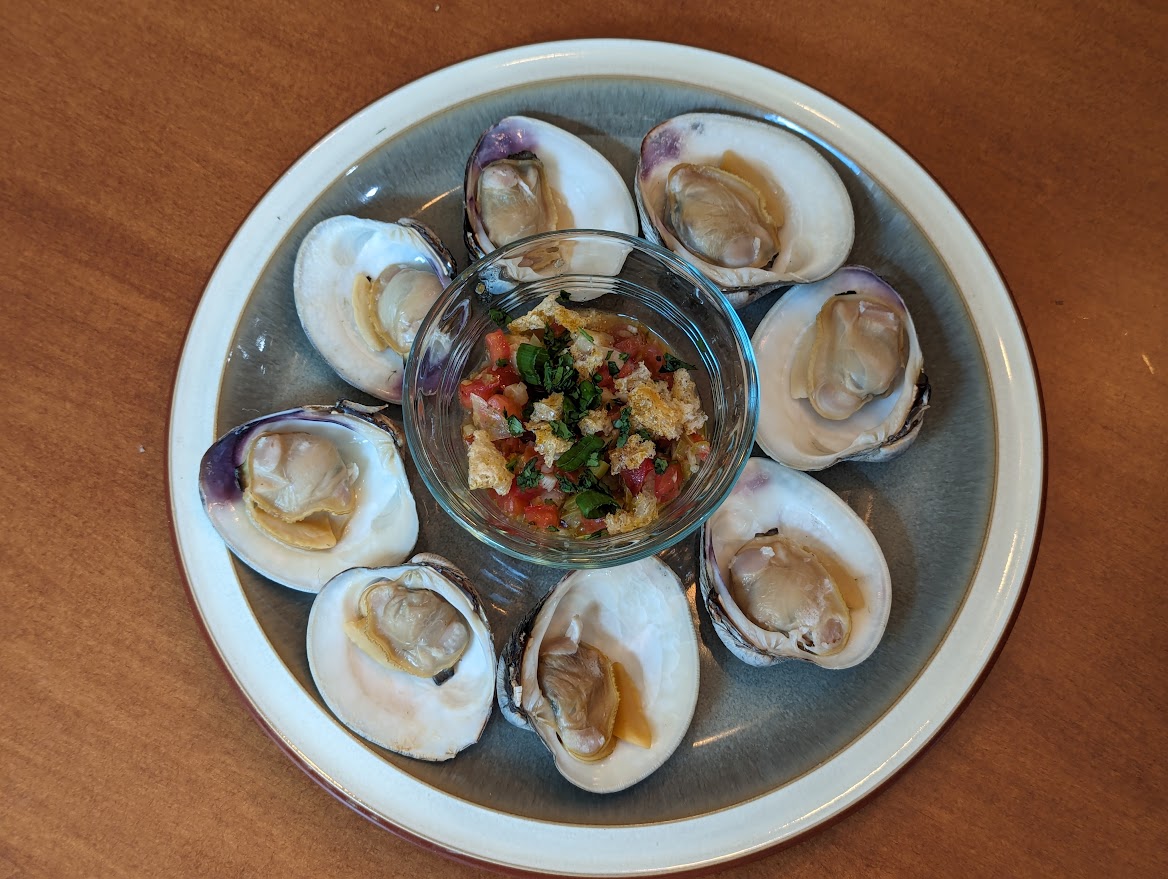
Grilled Clams with Mexican Salsa and Crumbled Chicharrones

Grilling clams is an easy way to prepare the shellfish. The heat of the grill cooks the clams in just minutes. The clams can be plucked off the grill, thereafter removing the top shell. The clam rests on the bottom shell, ready for whatever topping you wish to apply. I have experimented with a few different toppings, which seem to gravitate around Southeastern Asian cuisine. I have prepared Grilled Clams with a Cambodian Ginger Sauce and Vietnamese Grilled Clams with Oyster Sauce and Peanuts.  Both recipes were delicious.

However, this time I wanted to draw inspiration for a topping from a different part of the world. I chose Mexico because I thought that a take on a salsa would be a great topping for grilled clams. I looked for recipes, which were not too hard to find. However, I wanted to do more than simply create a Mexican-inspired topping. I wanted to go above and beyond. I really wanted a recipe that would stand out.

Looking at the recipes, some of them called for the use of bacon. Pork goes very well with clams. Look at any clam chowder and you will find some kind of pork (usually bacon, salt pork, or ham) used to make the recipe. There also also many dishes, like Porco Alentejana, that combine a cut of pork (like a pork butt) with clams. For this recipe, I wanted to take a more Mexican approach. The pork would not be bacon. Instead, it would be chicharrons.

Generally speaking, chicharrones are pieces of fried pork skin. There are many versions of chicharrons, but the classic version involves pork skin or pork belly that is deep fried. If it is just the skin, the process produces a light, puffy, crackling goodness. Chicharrones did not originate in Mexico; instead, these fried pork rinds got their start in Spain, and, more specifically, in the Andalusia region. Spanish conquistadors and colonialists brought not only pigs with them, but the recipes to prepare, among other things, chicharrones. The fried pork rinds took hold across much of the Spanish speaking world, including Mexico, where they are often added as an accompaniment or to finish a dish. 

That is how I used them in this grilled clams recipe. I prepared a Mexican salsa, drawing from recipes that I could find from Baja California. That is the Mexican State where one is most likely to find and harvest clams in Mexico. I took that recipe and then used crumbled chicharrones as a way to finish the dish. The end result was amazing.  I definitely need to incorporate this ingredient into my cooking more often.

GRILLED CLAMS WITH MEXICAN SALSA AND CRUMBLED CHICHARRONES

Recipe adapted from E is for Eat

Serves 2-3

Ingredients:

  • 2 pounds of top neck clams (about 8-12 clams)
  • 1/4 cup chicharrones, crumbled
  • 1 bunch scallions, white parts finely diced, green parts thinly sliced
  • 1 small serrano pepper, seeded and diced
  • 1 tomato, seeded and diced
  • Splash of tequila (about 1 ounce)
  • Pinch of red pepper flakes
  • 1 teaspoon dried Mexican oregano
  • 3-4 cloves garlic, minced
  • Couple dashes hot sauce (optional)
  • 1 lime, zested and juiced
  • Sea Salt
  • 2 tablespoons minced cilantro
  • 1 tablespoon vegetable oil

Directions:

1. Sauté the onions, pepper and garlic. Heat the vegetable oil in a skillet over medium-high heat. Add the scallions, peppers and garlic. Sauté for about 4-5 minutes. Add the crushed red pepper and oregano. Stir the mixture. Add the tequila and cook for about another 2-3 minutes until the tequila has cooked down. Add the tomatoes and cook for another 2-3 minutes.  

2. Finish the sauce. Remove the onion mixture from the heat, add the lime juice, lime zest and sea salt. Stir to combine. Pour the sauce into a bowl, garnish with the cilantro and chicharrones. 

3. Grill the clams. Heat a grill on high heat. Place the clams on the grate. Close the grill and cook the clams until they open, at most 5 minutes.  Remove the clams from the grill.

4. Finish the dish. Remove the top shells from the clams. Spoon some of the salsa over each clam. Serve immediately. 

PEACE.

Saturday, July 20, 2024

Tacos de Chapulines con Tequila y Guacamole

One of the benefits of a personal food blog, as well as the desire to learn more about food, is the moment of discovery. If I just lived my life in a suburban city in the United States, in my own little bubble or cocoon of daily existence, there is a lot that I would never, ever come across. This blog has served as the primary means through which I can learn more about food. It has led me down paths that I know I would never have walked otherwise. 

One such path led me to eating fried grasshoppers.

They are called chapulines, and, have been a fixture of the cuisine of indigenous peoples in Mexico and Central America. The little grasshoppers were an important source of protein before Spanish conquistadors and colonizers brought domesticated animals like pigs and cows. People would head out early in the morning, when it was cooler, to collect the grasshoppers. (Apparently, grasshoppers are less active when it is cooler, rather than in the heat of the day.) They would bring back the catch, and prepare them on a comal, which is a flat, cast iron griddle on which the grasshoppers would be toasted or fried. Once cooked, the grasshoppers would be seasoned with garlic, lime, salt and chiles. 

To state the obvious, I did not go out into fields to catch grasshoppers. I also did not toast them on a comal or any other griddle. As someone who lives in the suburbs of a city, I ordered a package of chapulines online. The grasshoppers came pre-seasoned with salt, lime and chiles, which was okay for the preparation that I had in mind. 

My goal was to recreate my very first experience eating chapulines. It was at Oyamel, a restaurant owned by renown chef, Jose Andres. The restaurant's menu included (and still includes) a chapulines taco. The menu described the taco as including grasshoppers sautéed with shallots, tequila and served with guacamole. Channeling my inner Andrew Zimmern (the host of Bizarre Foods), I ordered the taco. When I took my first bite, I noted the crunchy texture of the grasshoppers, which was well contrasted with the smoothness of the guacamole. 

For my effort, I decided to give a little nod to the region of Mexico that is most associated with chapulines ... Oaxaca. I found a recipe for Oaxacan guacamole from Bricia Lopez's Oaxaca cookbook (which is an excellent cookbook). That would serve as the basis for my taco. I then used the grasshoppers I purchased online, sautéing them in some oil with the shallots and finishing it with what was basically a shot of tequila. 

The recipe was very good, reminding me of what graces the plate at Oyamel. The biggest difference was the saltiness of the chapulines, which was due to the package that I purchased. When I make this dish in the future, I will have to figure a way to lightly rinse off some of that salt. This rinse will be necessary especially if (and when) and I try to incorporate them into other recipes, such as tlyuda.

TACOS DE CHAPULINES CON TEQUILA Y GUACAMOLE

Guacamole recipe from Bricia Lopez, Oaxaca, pg. 252

Serves 4

Ingredients (for the tacos):

  • Corn tortillas
  • 1 cup chapulines (plain, lime/salt, adobo or chipotle)
  • 2-3 tablespoons tequila
  • 1/4 small shallots, julienned or chopped finely
  • 2 tablespoons olive oil or vegetable oil

Ingredients (for the guacamole):

  • 6 tablespoons fresh lime juice
  • 1 teaspoon sea salt
  • 1 cup fresh cilantro, chopped
  • 1 serrano chile, stem removed
  • 1/4 dried oregano
  • 3 avocados, pitted and peeled

Directions:

1. Prepare the guacamole. Blend the lime juice, cilantro, sea salt, chile and oregano in a blender. In a large mixing bowl, mash the avocados. Pour the lime mixture over top and mix until everything is well combined.

2. Prepare the chapulines. Heat the oil in a skillet. Add the shallots and sauté for a few minutes. Add the chapulines and continue to fry until crispy. Add the tequila and keep stirring for another minute or two. 

3. Finish the dish. Warm the corn tortillas. Spoon the guacamole in the center of the taco and top with the chapulines. Serve immediately. 

PEACE. 

Friday, December 8, 2023

Around the World in 80 Dishes: Argentina

The posts that I love the most during my Around the World in 80 Dishes culinary challenge are those that involve cooking meat. I am an unabashed carnivore and, to this date, one of my favorite challenges involved Uruguay. I had to prepare Chivitos al Pan, a sandwich that could clog an artery on its own. 

I could truly feel at home in a large swath of South America - from Brazil to Uruguay and on to Argentina, where the cuisines are, to say the very least, meat-centric. For now, I will settle with my next personal culinary challenge, which requires me to make a main course from Argentina. 

The cuisine of Argentina actually begins with the indigenous people of the Andes, as well as the Guarani. I have already some experience with Guarani cuisine from my challenge involving neighboring Paraguay. These indigenous cultures contributed to Argentine cuisine through the use of potatoes, cassava, melons, peppers, squash, tomatoes, beans, quinoa and other native ingredients. These ingredients gave rise to dishes such aa, humita, which is made after milling maize, and cooking processes like curanto, a method used by the Mapuche to cook meat, vegetable or fruits over hot coals covered with linen or dry leaves.

The Spanish introduced cattle, goats and pigs during the colonial period, which became the foundation for the large cattle industry that has a prominent place in Argentine cuisine and culture. However, many of the cattle and horses escaped farms and ranches, finding independence in the countryside long before the people of what would become Argentina. 

A historic photo of a gaucho
(Source: Estancia Ranquilco)
As the cattle and horses roamed the plains, so did the gaucho. Some say the word "gaucho" comes from the Quecha word "huachu," which means "orphan," or "homeless." Others say it comes from the Guarani word for "drinker." Either way, the etymology of "gaucho" sheds some light on the early history of the Gauchos. They were solitary horsemen, wandering the Pampas in search of wild cattle or horses. To be a gaucho was to be part of a social class, one that was, at least at first, viewed with disdain. The Spanish colonial authorities viewed gauchos as cattle thieves, robbers and smugglers. As someone else summarized a gaucho: 

a colonial bootlegger whose business was contraband trade in cattle hides. His work was highly illegal; his character lamentably reprehensible; his social standing was exceedingly low.

Put simply, "gaucho" was an insult, often lobbed at people who lived in the countryside. 

All of that changed with the war for independence in 1810. As a Spanish general once described the gauchos during the war: 

The gauchos were men that knew the country, well mounted and armed.... They approached the troop with such confidence, relaxation and coolness that they caused great admiration among European military men, who were seeing for the first time these extraordinary horsemen whose excellent qualities for guerilla warfare and swift surprise they had to endure on many occasions.

The war saw gauchos go from being outcasts to revolutionary heroes. The gauchos continued to ply the plains after the war, hunting and trading while living off of the land. 

Ultimately, capitalism was able to accomplish what Spanish generals could not. Private owners began acquiring the livestock that lived on the Pampas, along with fencing off the land into huge estates. As the fences went up, the area for the gauchos to roam shrank. Soon, they were not able to live off the land as they once were. "In one generation," it has been observed, "the free-spirited gaucho was forced to become a ranchhand." 

Modern day gauchos (Source: Audley Travel)

APPETIZER

In honor of the gauchos, this particular Around the World in 80 Dishes challenge will feature meat ... and more meat. For an appetizer, I decided to make Choripan or, as the Argentinians call it, "chori." The origins of this dish can be traced to the gauchos, who would grill chorizo - introduced to the region by the Spanish - over a fire in the countryside. Gauchos serve the grilled sausages with bread (pan) for convenience. The dish made its way into the cities, where it is now a common street food that can be found at food stalls or football matches

The recipe I found calls for the preparation of chimichurri as a condiment for the Choripan. The history of chimichurri is not very clear. Some historians have argued that gauchos created chimichurri to flavor the roasted meats. Others note that "chimichurri" is close to "tximitxurri," which is Basque for "a mixture of several things in no particular order." It may even predate the Spanish, as the Quechua had a similar word for a strong sauce that was used to preserve meats.

The Argentinian government has noted the popularity of this dish, estimating that over 500,000,000 choripan are consumed each year. There is even a Choripan World Cup, which is held annually in the city of Cordoba. 

ARGENTINIAN-STYLE CHORIPAN

Recipe from Saveur

Serves 4

Ingredients:

  • 4 fresh chorizo sausages, Argentinian style if possible
  • 4 6-inch hero rolls, split length wise, connected on one side like a hinge
  • 1/4 cup finely chopped fresh parsley leaves
  • 1/4 cup minced white onion
  • 1 clove of garlic, grated using a microplane
  • 1/4 cup of extra virgin olive oil, plus 3 tablespoons
  • 3 tablespoons red wine vinegar
  • 1/2 teaspoon Kosher salt
  • 1/4 teaspoon freshly ground black pepper

Directions:

1. Prepare the choripan. Preheat a grill over medium heat. Add the chorizo and let cook, turning occasionally with tongs as needed, until the sides are deeply seared and the center is fully cooked through. 30-35 minutes. 

2. Prepare the chimichurri.  In a medium bowl, add the parsley, onion and garlic. Stir briefly to combine. Add the olive oil, vinegar, salt and pepper, stirring well. Let rest for at least 15 minutes. (Chimichurri can be left out at room temperature for up to 12 hours before serving. 

3. Finish the dish. If desired, briefly warm the insides of the rolls over the grill. You can split the sausages lengthwise if desired as well. Place one cooked sausage into each roll. Slater one side of the roll and some of the sausage generously with chimichurri. Serve immediately. 

MAIN COURSE

A cornerstone of Argentine cuisine is asado, or the grilling of meats. The Asador - or cook - prepares the parilla, which is the grill. There are two parts to this grill: one section that houses the charcoal and wood, and another that has the metal grill upon which the meat - known as carne a la parilla - will be cooked. The meat is primarily beef, but lamb, mutton or pork may also find themselves being seared on the grill. As for the cuts or types, one could find chorizo, morcilla (blood sausage), vacio (flank steak), bife ancho (ribeye steak) and lomo (tenderloin). 

However, for this culinary challenge, I will assume the role of asador and prepare tira de asado, which are short ribs and which happen to be one of the more popular cuts to grill. The short ribs are not the typical ones that I can find in grocery stores around me. Instead, the Argentinians have their own style, which is a flanken cut across a three or four bone plate. It took a little time, but I was able to find the cut online (as it is the same type of cut used for South Korean kalbi). 

One last thing, as with the choripan, this recipe called for the preparation of "traditional chimichurri." The recipe underscores one understanding about chimichurri: there are as many versions of the sauce as there are cooks, gauchos or asadors. This recipe does not use onions, as the chimichurri sauce for the choripan, but it does use crushed red pepper. These changes result in a slightly thinner sauce that has a much stronger kick. That is definitely more to my liking. 

TIRA DE ASADO WITH TRADITIONAL CHIMICHURRI

Recipe for the ribs from Food and Wine

Recipe for the chimichurri from Food and Wine

Ingredients (for the short ribs):

  • 3.5 pounds of flanken cut, 3 bone beef short ribs
  • 1.5 tablespoons coarse sea salt

Ingredients (for the chimichurri):

  • 1/4 cup coarsely chopped parsley
  • 3 tablespoons red wine vinegar
  • 4 large garlic cloves, minced
  • 2 tablespoons oregano leaves
  • 2 teaspoons crushed red pepper
  • Kosher salt
  • Freshly ground black pepper
  • 1/2 cup extra virgin olive oil

Directions:

1. Prepare the chimichurri. In a food processor, combine the parsley, vinegar, garlic, oregano and crushed red pepper. Process until smooth. Season with salt and pepper. Transfer the sauce to a bowl and pour the olive oil over the mixture. Let stand for 20 minutes.

2. Grill the beef ribs. Preheat the grill (preferably a wood fire) to medium high (400 degrees Fahrenheit to 450 degrees Fahrenheit). Pat the ribs dry with paper towels. Sprinkle all sides of ribs evenly with salt, pressing salt into meat and rubbing it on bones. Arrange the ribs diagonally, spaced 1 inch apart on lightly oiled grates. Grill uncovered and undisturbed until bottoms of ribs are browned and release from grates, about 4 to 6 minutes. Flip ribs, and continue to grill uncovered until browned and a thermometer near the bone but not touching it registers 130 degrees Fahrenheit, about 2 to 4 minutes. Let rest for 5 to 10 minutes.

3. Finish the dish. Serve the ribs whole, or if serving with an assortment of meats for a larger group, cut each rib into thirds on the diagonal. Serve with chimichurri.

*     *    *

In the end, this challenge satisfied my inner carnivore. Any grilling challenge almost inevitably ends up in the top few of my most favorite challenges. I may not have been out in the middle of nowhere in the Pampas, but from my suburban backyard, I could at least spend a couple of hours as an Asador or a Gaucho. Until next time ...

PEACE.