Showing posts with label Oyster Sauce. Show all posts

Saturday, April 18, 2026

Lamb Stir-Fry with Potatoes and Pine Nuts

Chinese dishes always catch my attention, especially when they involve the use of unusual ingredients or give nods to regional cuisine. This particular dish -- Lamb Stir-Fry with Potatoes and Pine Nuts -- checks off both boxes. 

First, there are the pine nuts. That happens to be an ingredient that I do not use very often in my cooking. It is also an ingredient that I did not associate with Chinese cuisine. I was wrong on that point. There are quite a few dishes across trhe various Chinese regions that incorporate pine nuts, including dishes from my favorite region, culinarily speaking, Sichuan. 

That brings me to the other ingredients featured in this lamb recipe, namely, Chinese chile oil and red Sichuan pepper oil. The reason why I love Sichuan cuisine is the use of peppers to create spicy dishes. Most of the Sichuan dishes that I have made to date -- from Qiatou Yi Nen to Jiaoma Jipian -- feature chicken. So, cooking with lamb was a nice change of pace. 

The oils presented some challenge, at least when it came to acquiring them. I had some difficulty finding in them in Asian markets, although the difficulty was greater when it came to the red Sichuan pepper oil.  I also spent some time looking online; however, my relative unfamiliarity with a lot of the websites and products made me a little reluctant to try to the oils. Eventually, I took a risk and I think the dish turned out well. 

In the end, this dish got me thinking about going back to some of my cookbooks, especially the one by Jeffrey Alford and Naomi Duguid, Beyond the Great Wall. There may be more of those recipes to come. Only time will tell ....

LAMB STIR-FRY WITH POTATOES AND PINE NUTS

Recipe from Saveur

Serves 2

Ingredients:

  • 3 tablespoons vegetable oil, divided
  • 2 tablespoons soy sauce, divided
  • 1 tablespoon Shaoxing wine
  • 1 teaspoon sugar, divided
  • 1/2 teaspoon cornstarch
  • 9 ounces boneless lamb leg, cut into 1 1/2inch by 1/4 inch strips
  • 1 Yukon Gold potato, peeled and thinly sliced
  • 2 tablespoons red Sichuan pepper oil
  • 1 1/2 teaspoon oyster sauce
  • 1/2 teaspoon sesame oil
  • 1 tablespoon finely chopped garlic
  • 1 1/4 teaspoon finely chopped fresh ginger
  • 2 scallions, coarsely chopped
  • 1 medium onion, thinly sliced
  • 1-2 tablespoons Chinese chile oil (optional)
  • 2 tablespoons pine nuts, toasted
  • Chopped cilantro, for serving

Directions:

1. Prepare the lamb. In a medium bowl, stir together 1 1/2 teaspoons of vegetable oil, 1 tablespoon of soy sauce, the Shaoxing wine, 1/2 teaspoon of the sugar and corn starch. Add the lamb and turn to coat, then cover and refrigerate for 40 minutes or up to 24 hours. 

2. Prepare the potato. In a medium pot, cook the potato until tender yet firm, about 2-3 minutes, then drain and set aside. 

3. Prepare the sauce. In a small bowl, stir together half of the Sichuan pepper oil, 1 tablespoon of the vegetable oil, the oyster sauce, sesame oil and the remaining soy sauce and sugar. Set aside. 

4. Cook the dish. Place a large wok or skillet over high heat. When it is hot, add 1 tablespoon of the vegetable oil and add the lamb and stir-fry until browned, 2-3 minutes. Transfer to a bowl. To the empty wok, add the remaining vegetable oil, the garlic, ginger, and scallions and stir-fry until fragrant, 30-60 seconds. Add the onion and cook until tender 3-4 minutes. Add the reserve potato and continue stir-frying until browned at the edges, about 3 minutes. Add the reserved lamb, leaving any juices in the bowl, and the Sichuan oil mixture and stir-fry to coat, about 2 minutes. Stir in the chile oil (if using), then transfer to a platter.

5. Finish the dish. Top with the remaining Sichuan pepper oil, pine nuts and cilantro. Serve hot with white rice. 

PEACE.

Friday, February 2, 2024

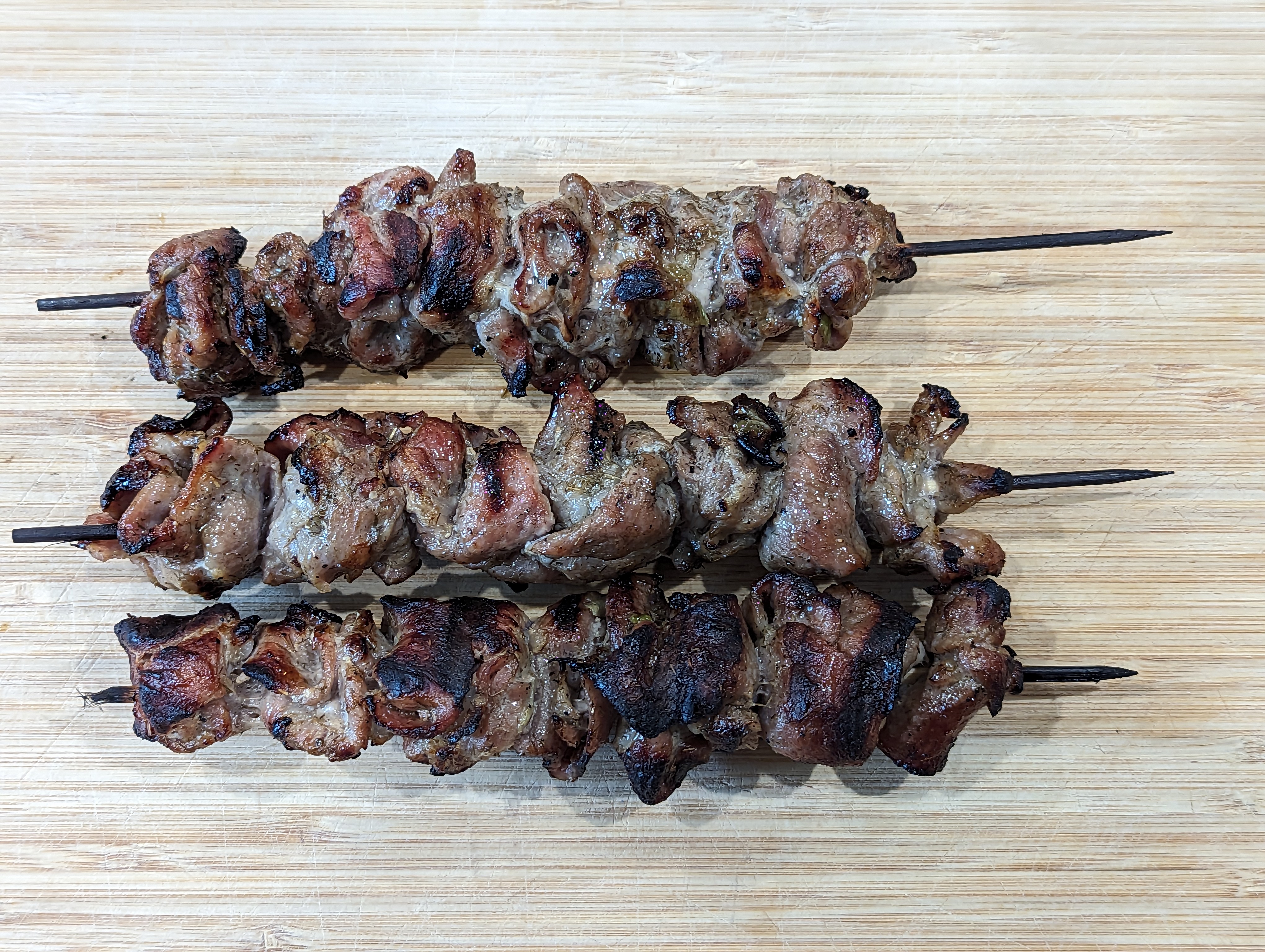
Chargrilled Hmong Black Pig Skewers with Sesame Salt

"I would tell people that Hmong food is not just a type of food. It's not about the product. It's a philosophy.... If you want to know our people you have to know our food. By knowing our food, you will know our story. You'll know where we been and it will show the trajectory of where we're going.  

-- Chef Yia Vang

To the extent people know about the Hmong, that knowledge comes more from political history. The Hmong are an indigenous ethnic group that has lived for centuries as a minority in eastern and southeastern Asia. During the Vietnam War, the United States Central Intelligence Agency recruited and trained the Hmong living in Laos for a "secret war" against the North Vietnamese Army. The Hmong harassed the North Vietnamese along the Ho Chi Minh trail, safeguarded U.S. radar installations, and rescued downed American pilots. After the war, the communist governments of Vietnam and Laos declared that the Hmong were "traitors." The governments persecuted the Hmong. They arrested the Hmong, who were sent to hard labor camps. They sprayed Hmong villages with chemicals, including napalm.  Nearly ten percent (10%) of the Hmong population was killed and around 100,000 Hmong sought refuge in neighboring Thailand and beyond. 

The culinary history of the Hmong is far less known. Before the Vietnam War, the Hmong had a strong agrarian tradition in the mountains of northern Laos and Vietnam. They grew rice and other produce, as well as raised livestock, such as pigs. The Hmong practiced animism, believing that objects, plants animals, and even places have their own spirit. These beliefs underlie the respect that the Hmong hodl for what they have. It also informs their traditions. 

For example, there is a Hmong tradition -- called Noj Tsiab (nee-al jia) -- that centers around the butchering of a pig. During the last week of December, each family would select a pig from their herd to be butchered. Every family member had a role in the process, being taught by the elders how to prepare the pig, how it would be cut, and how to ensure that all of the pig would be used with nothing going to waste. This knowledge was important, and it was passed on from generation to generation. The end products would be used to prepare a meal for the community for the new year. It enabled everyone to participate in a tradition that gives thanks for what they have been given and to their ancestors for watching over them.

This tradition was lost, at least temporarily, for those Hmong who fled their homes and found themselves in refugee camps. Even after they escaped those camps, making their way to the United States or elsewhere, many of their new lives did not include the raising of pigs, let alone the opportunity to butcher them in accordance with their traditions. 

I knew none of this when I came across a recipe for Chargrilled Hmong Black Pig Skewers with Sesame Salt.  It was in a cookbook called the Food of Vietnam. The author, Luke Nguyen, is a Vietnamese-Australian chef who was part of a television show, Luke Nguyen's Vietnam, that I watched on public television. Every episode fascinated me, both with respect to the people, the surroundings, and, of course, the food. When I got this cookbook, as well as another Vietnamese cookbook, I spent a lot of time paging through the recipes. This one caught my eye because of the reference to the Hmong people. 

Roasted sesame seeds with salt
According to Chef Nguyen, the Hmong raised black pigs in the hills and mountains of Vietnam. The cuts from the necks would be used for this dish. I had access neither to those particular black pigs, or, more generally, to pig necks. Instead, I looked for any cut of pork that would enable me to slice thinly or that came sliced thinly. 

There are two things that I really like about this recipe. The first thing is the marinade. The recipe calls for a combination of scallions, lemongrass, fish sauce, oyster sauce, black pepper, and honey, for a marinade. This particular combination of ingredients imparts a lot of flavor into the meat, which is facilitated by the fact that the meat has been thinly sliced.  The second thing is the ease of preparing this dish. Once the marinade is complete, the rest of this recipe is easy: just thread some pre-soaked skewers, place on a heated grill, flip the skewers a few times and you are done. 

These skewers are very delicious and, given the ease of preparing this dish, I will very likely make this recipe again. The next time will take on a little more meaning now that I have some understanding of the traditions of the people behind the recipe. 

CHARGRILLED HMONG BLACK PIG SKEWERS WITH SESAME SALT

Recipe from Luke Nguyen, The Food of Vietnam, pg. 318

Serves 4-6

Ingredients:

  • 300 grams (10.5 ounces) pork neck, thinly sliced
  • 2 tablespoons toasted sesame seeds
  • 3 spring onions, sliced then bashed to release the flavor
  • 4 tablespoons finely diced lemongrass, white part only
  • 3 tablespoons fish sauce
  • 1 teaspoon oyster sauce
  • 1 teaspoon sugar
  • 1 tablespoon honey
  • 1/2 teaspoon freshly ground black pepper
  • 3 tablespoons vegetable oil

Directions:

1. Prepare the marinade. Combine the onions, lemongrass, fish sauce, oyster sauce, sugar honey and black pepper in a mixing bowl and mix well. Add the pork and toss until well coated. Cover and marinate in the refrigerator overnight. 

2. Prepare the skewers. Soak 12 bamboo skewers in water for 30 minutes to prevent scorching. Thread the pork on to the skewers and chargrill on each side for 3 minutes. Mix the sesame seeds with a pinch of sea salt. Serve on the side for dipping the skewers into. 

PEACE. 

Friday, December 22, 2023

Pad Kaprow

My culinary journeys around the world have often led me to "national dishes." Generally speaking, these are meals that have a strong connection to a particular country. This connection may arise in one of several ways. It may involve an ingredient that is produced locally or prepared in way only done in that area. It may form part of a cultural tradition. Or, it may be actively promoted by a government as part of an effort to create a national identity. 

Take, for example, the country of Thailand. At one point in its history, roughly corresponding to the beginning of World War II, the military dictatorship of Thailand promoted a national Thai identity. Field Marshal Plaek Phibunsongkram issued twelve (12) cultural mandates from 1939 to 1941. Each mandate set forth objectives for the people. For instance, the third cultural mandate -- On referring to the Thai people -- prohibited Thais from referring to themselves inconsistently based upon preferred group, region or religion (for example, don't refer to oneself as a southern Muslim Thai). It also required the people to refer to themselves as the Thai people. The fifth mandate also had multiple requirements, including Thai people should make an effort to consume food made only from Thai products. Such an edict is often said to be the basis for some of Thailand's national dishes, such as Pad Thai and Pad Kaprow. 

Thai Basil
While Pad Thai is perhaps the most popular and well-known dish, Pad Kaprow comes in a close second. The name translates into basil stir fry. It is not just any basil, but Thai Basil (or Holy Basil) that makes this a Thai dish. 

The history of this dish is a little unclear. The main ingredient -- Thai Basil -- had been introduced into Thailand centuries ago (approximately around 2,450 B.C.E. or 2,500 B.C.E.). Yet, the dish of stir frying basil with chicken (or other protein), chiles and other ingredients goes back only a few or several decades. Indeed, I could not find anything in my research that would enable me to trace this dish back to the time when Field Marshal Phibunsongkram was issuing his edicts. Then again, while there are a lot of articles about the greatness of Pad Kaprow, few of those articles actually delve into how the dish came into existence or how it has evolved over the years. 

Nevertheless, the research does point out a couple of key things about Pad Kaprow. First, the dish represents a Thai version of the five tastes: salty, sweet, sour, hot (spice) and bitter. (I have talked about the five tastes before, check out this post and this post for more.) One Thai chef, Chakkrit Chuma, once said that Pad Kaprow or "Pad kaphrao has to be salty first, sweet after and then feeling hot and spicy in your mouth." Chef Chuma lamented that "sometimes people just make it too spicy and you don't taste anything else." (The Chef also acknowledges that he uses seven chiles in his recipe.)  Second, Pad Kaprow is flexible when it comes to the protein. It is most commonly made with chicken -- Pad Kaprow Gai -- but it can also be made with beef, pork, vegetables and seafood. For this dish, I made it with turkey, because that is the only meat that my beautiful Angel will eat. Also, while many recipes used ground meat, I used turkey thighs because I think that the bite-sized pieces are better. (Also, the use of ground meat reminds me too much of laab or larb, which is considered the national dish of neighboring Laos.) 

PAD KAPROW

Recipe from All Recipes

Serves 2

Ingredients:

  • 1/3 cup chicken broth
  • 1 tablespoon oyster sauce
  • 1 tablespoon soy sauce, or more as needed
  • 2 teaspoons fish sauce
  • 1 teaspoon white sugar
  • 1 teaspoon brown sugar
  • 2 tablespoons vegetable oil
  • 1 pound boneless, skinless chicken thighs, chopped
  • 1/4 cup shallots, sliced
  • 4 garlic cloves, minced
  • 2 tablespoons Thai chiles, minced or sliced
  • 1 cup basil, thinly sliced
  • 2 cups rice, cooked

Directions:

1. Prepare the broth. Whisk the chicken broth, oyster sauce, soy sauce, fish sauce, white sugar and brown sugar together until well blended. 

2. Sauté the chicken. Heat a large skillet over high heat. Drizzle in oil. Add chicken and stir fry until it loses its raw color, 2 to 3 minutes. Stir in shallots, garlic and chiles. Continue cooking on high heat until some of the juices start to caramelize in the bottom of the pan, about 2 to 3 more minutes. Add a tablespoon of the sauce mixture to the skillet; cook and stir until the sauce begins to caramelize, about 1 minute. 

3. Continue to cook the chicken. Pour in the rest of the sauce. Cook and stir until the sauce has deglazed the bottom of the pan. Continue to cook until the sauce glazes onto the meat, about 1 to 2 minutes more. Remove from heat. 

4. Finish the dish. Stir in basil. Cook and stir until the basil is wilted, about 20 seconds. Serve with rice. 

PEACE.

Sunday, September 11, 2022

Ping Gai Wings

"Don't be surprised if you see a Ping Gai buffalo wing post in the near future."

- Me

And here is that post. For the few ardent followers of my Chef Bolek blog, you may remember my post about Ping Gai or Laotian Grilled Chicken.  I loved that recipe, which was one of the best (and still remains one of the best) chicken recipes that I have ever made and tasted. 

As the name reflects, the recipe comes from the southeastern Asian country of Laos. Whole chickens are halved, marinated and then grilled over charcoal. The grilling is often done low and slow, which a typical way one would prepare barbecue. The dish of Ping Gai has its place in Lao cuisine, especially on the street where one could buy the chicken with a spicy dipping sauce or sides (like sticky rice or papaya). This dish can also be found across the Mekong River in the northeastern Isan region of Thailand, where it is called kai yang or gai yang. 

Fun fact: prior to French colonization of southeast Asia, the Isan region was part of what was then "Laos." Another fun fact: there are more people of Lao identity and heritage in Isan (about 13 million) than in Laos (about 7.5 million).

Turning to the recipe, the key to Ping Gai is the marinade. At its core, the marinade is the umami combination of soy sauce, oyster sauce, and fish sauce, highlighted with fresh cilantro, and underscored with the kick from black pepper and cayenne pepper.  As with any recipe, the marinade used in Ping Gai has its regional, familial and individual variations in how to prepare the marinade. Some of these recipes incorporate ingredients such as coriander, garlic, hoisin sauce, lemongrass and vinegar. 

All of the ingredients in the Ping Gai recipe highlight what separates Lao cuisine from its neighbors, such as Thailand. The recipes in Laos feature herbaceous and bitter flavors, along with the use of dried, ground peppers to give its dishes a spicier kick. Lao dishes rely less on coconut milk (in contrast to Thai cuisine), resulting in somewhat lighter dishes that are not weighed down by thicker sauces. 

Another key aspect of Ping Gai is how it is prepared. As I noted above, the standard method of preparation involves grilling the chicken low and slow over a charcoal fire. Whether over a charcoal fire or a gas grill, I have come to find that grilling is a far better method of preparing buffalo wings than deep frying. The grilled wings have crisp edges and tastier meat (due to the marinade), which cannot be found as much in fried wings. 

In the end, the best chicken recipe (in my humble opinion) produces one of the best buffalo wing recipes that I have made or had in a long time. I think the one change I would make is to take the additional step to prepare the dipping sauce that accompanies Ping Gai. The recipe for the dipping sauce can be found here. 


PING GAI WINGS

Recipe adapted from Allrecipes

Serves several

Ingredients for the wings:

  • 1 tablespoon, freshly ground black pepper
  • 3 tablespoons oyster sauce
  • 2 tablespoons soy sauce
  • 2 tablespoons fish sauce
  • 2 tablespoons vegetable oil
  • 2 pinches cayenne pepper
  • Dipping Sauce, optional (recipe can be found here)

Ingredients (for the dipping sauce):

  • 2/3 cup seasoned rice vinegar
  • 1 lime juiced
  • 4 cloves garlic, crushed
  • 1 tablespoon sambal oelek
  • 1 tablespoon fish sauce
  • 1/4 cup freshly chopped cilantro
  • 2 tablespoons honey or more to taste

Directions:

1. Prepare the marinade. Combine the black pepper, cayenne pepper, oyster sauce, soy sauce, fish sauce and vegetable oil in a bowl. Mix very well to combine ingredients. Add the wings and toss the wings. Cover the bowl and refrigerate for four hours or overnight.

2. Prepare the dipping sauce. Combine rice vinegar, lime juice, garlic, sambal, fish sauce, cilantro, and honey to make the dipping sauce. Refrigerate until ready to use.

3. Grill the wings. Heat a gas grill over medium high heat or prepare a charcoal fire. Place the wings on an oiled grill grate and grill the wings for about seven minutes on each side or a total of 15 minutes. Once the wings reach an internal temperature of 165 degrees Fahrenheit, remove from the heat.  Serve immediately by themselves or with a side of the dipping sauce.

ENJOY!

Thursday, January 6, 2022

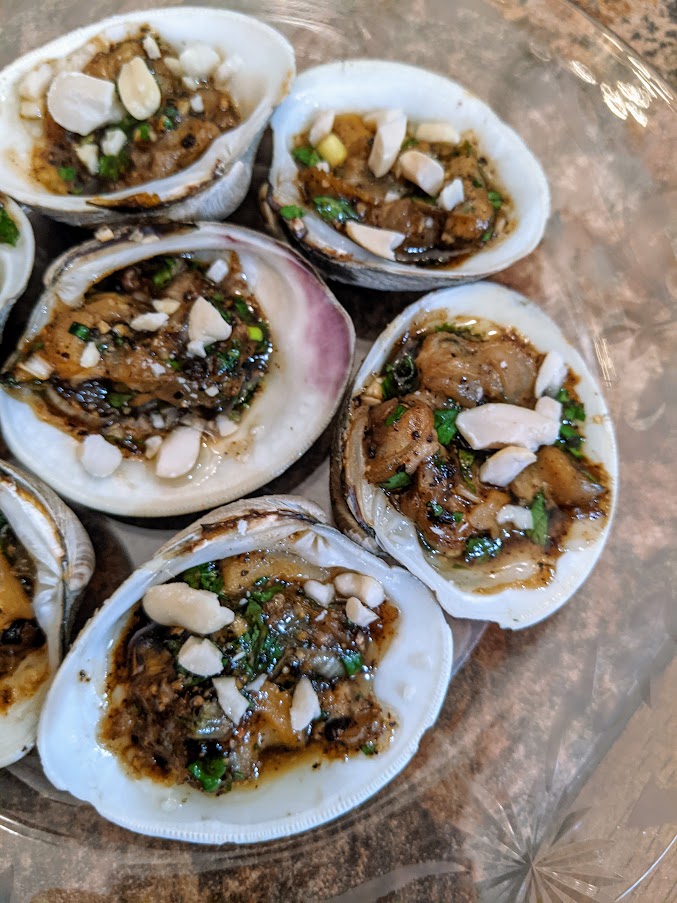
Vietnamese Grilled Clams with Oyster Sauce and Peanuts

As I always say, cooking provides many opportunities to learn, whether it is about cooking processes, ingredients, recipes and even cultures and cuisines. At least in my cooking experience, and in my humble opinion, few dishes embody this principle more fully and completely that this dish: Vietnamese Grilled Clams with Oyster Sauce and Peanuts. The recipe provided me with a chance to learn about the concept of fundamental elements in cooking. It is a concept that the Vietnamese call, ngu hanh or ngu vi. 

The Ngu Hanh is actually a site in central Vietnam, located just south of Da Nang.  It is actually the Ngu Hanh Son, consisting of five mountains, each representing a fundamental factor of the universe. The mountains are Kim (metal), Moc (wood), Thuy (water), Tho (earth) and Hoa (fire).  

The phrase ngu hanh or ngu vi has also been used by the Vietnamese to refer to other quintuples. There are the five fundamental tastes: spice, sour, bitter, salty and sweet. There are also the five fundamental cooking modes: raw, steamed, broiled, fried/grilled, and fermented. And, there is the five fundamental food textures: crispy, crunchy, chewy, soft and silky. Vietnamese cuisine has always intrigued me as to how it applies and balances all of these quintuples, that is, taste, cooking mode and texture. 

To be sure, the Vietnamese did not create the culinary philosophy of quintuples, it originated in China. However, in my humble opinion, the Vietnamese have taken this philosophy and elevated when it comes to food.  There is something about the dishes, from the North to the South and from the coast to the inland. It is hard to describe, but the dishes always appear to please the eyes, the nose and the taste buds. That is why when I saw this recipe for Vietnamese Grilled Clams, I had to make it. 

This recipe represents some, but not all, of ngu hanh or ngu vi balance. For example, a balance would include ingredients that are salty and sweet, or spicy and sweet. For this recipe, the ingredients include sugar (sweet), black pepper (spice), which is a balance on a very small level. A balance of textures could be a combination of crispy or crunchy with chewy or silky. The textures in the recipe for Vietnamese Grilled Clams include clams (chewy), fried shallots (crispy) and peanuts (crunchy), paired with the oyster sauce and oil (silky). Together, these balanced ingredients help to elevate the dish to something that is delicious and needs to be made over and over again.

This dish represents what I love about cooking: it is the opportunity to learn and expand horizons. I hope to be able to continue to explore these concepts in future recipes.  Stay tuned for more ....

VIETNAMESE GRILLED CLAMS WITH OYSTER SAUCE AND PEANUTS

Recipe available at Food and Wine

Serves 4

Ingredients:

  • 3 pounds cherrystone clams or 1 pound mussels, scrubbed
  • 2 scallions, finely chopped (about 1 1/4 cups)
  • 1/2 cup chopped fresh rau ram (Vietnamese coriander) or cilantro
  • 1/4 cup packaged crispy fried shallots (such as Maesri)
  • 1/4 cup oyster sauce
  • 1/4 vegetable oil
  • 1 tablespoon granulated sugar
  • 1 tablespoon black pepper
  • 2 tablespoons plus 2 teaspoons finely chopped peanuts
Directions:
1. Steam the clams.  Preheat the grill to high (between 450 degrees and 500 degrees Fahrenheit). While grill preheats, fill a heavy bottomed pot with water to a depth of 1 inch, bring to a boil over high.  Add clams, cover and cook until shells open, 6 to 8 minutes, transferring clams to a backing sheet as they open.  Discard any clams that do not open. 

2. Prepare the sauce. Stir together the scallions, rau ram, fried shallots, oyster sauce, oil, sugar, and pepper in a small bowl. Remove clam meat from shells and coarsely chop. Discard top shells.  Stir chopped meat into scallion mixture; spoon evenly into bottom shells. (If using mussels, spoon about 2 teaspoons of the scallion mixture directly onto the meat inside each shell, leaving the top shells intact.)

3. Finish the dish. Place prepared clams on unoiled grill grates; grill, covered, until scallion mixture bubbles, about 2 minutes.  Carefully transfer to a platter; sprinkle evenly with peanuts, and serve. 

ENJOY!

Sunday, November 7, 2021

Ping Gai (ປີ້ງໄກ່), Laotian Grilled Chicken

Certain recipes have the ability to transport someone across the world. This particular recipe took me to a street full of food stalls in Vientiane, the capital of Laos. Perhaps it is the Ban Anou night market, just a short distance from the Mekong River. Maybe it is one of the morning markets, such as the Khua Din Market or the Talat Sao Market. It could have been anywhere in the downtown city area where wafts of street food fill the air.

In any event, I am drawn to this region by the smell of grilled chicken. But, not just that chicken. There is so much more. Chicken marinated with a mixture of soy sauce, oyster sauce, and, that very special, fish sauce.  There is something about fish sauce, that umami from southeast Asia, that is intriguing to both the nostrils and the taste buds. Fish sauce features prominently not only in the preparation of this grilled chicken, but also the thin, vinegary dipping sauce that is served with it. The aromas were so intriguing as I made this dish, I could not wait to taste it. And, when I tasted it, I could not wait to make it again. This dish - Ping Gai - is probably one of the best chicken dishes that I have made, and eaten, in recent memory.

The recipe that I found may not be truly authentic, there is a good possibility that it is an interpretation of Ping Gai or ປີ້ງໄກ່, which is translated into "roast chicken." The traditional cooking process begins with a chicken that is halved, and then pounded flat. The recipe I had called for the use of skinless, boneless thighs. I compromised with skin-on, bone-in thighs. Once the chicken is prepared, it is marinated in a sauce consisting of fish sauce, garlic, turmeric, coriander and white pepper. Other spices, such as chiles, find their way into the marinade. Once marinated, the chicken is then grilled over a charcoal flame on low heat. The final dish is then sliced and served to customers with that tangy dipping sauce.

As I noted above, this is one of the best chicken recipes that I have made in a very long time. I say that even though I did not marinate the chicken overnight. I think if I did that, it would have turned out even better.  I also think that the combination of the marinade and the dipping sauce makes Ping Gai an excellent candidate for buffalo wings. Some of the best wings that I have had are grilled, and, between the marinade and the sauce, this recipe is full of flavor. Don't be surprised if you see a Ping Gai buffalo wing post in the near future. 

PING GAI (ປີ້ງໄກ່), LAOTIAN GRILLED CHICKEN

Recipe available at Allrecipes

Serves several

Ingredients (for the Marinade):

  • 1 tablespoon whole black peppercorns, or more to taste
  • 1 bunch fresh cilantro, stems and leaves
  • 3 tablespoons oyster sauce
  • 2 tablespoons soy sauce
  • 2 tablespoons fish sauce
  • 2 tablespoons vegetable oil
  • 2 pinches cayenne pepper
  • 10 chicken thighs

Ingredients (for the Dipping Sauce):

  • 2/3 cup seasoned rice vinegar
  • 1 lime juiced
  • 4 cloves garlic, crushed
  • 1 tablespoon sambal oelek
  • 1 tablespoon fish sauce
  • 1/4 cup freshly chopped cilantro
  • 2 tablespoons honey, or more to taste

Directions:

1.  Prepare the marinade. Grind peppercorns coarsely using a mortar and pestle, electric grinder or spice mill.  Chop cilantro finely and transfer to a mixing bowl. Stir in the freshly ground pepper, oyster sauce, soy sauce, fish sauce, oil and cayenne.  Add chicken thighs and toss by hand until completely coated.  Cover with plastic wrap and marinate in the fridge for 4 to 12 hours.

2. Prepare the dipping sauce. Combine rice vinegar, lime juice, garlic, sambal, fish sauce, cilantro, and honey to make the dipping sauce. Refrigerate until ready to use.

3. Grill the chicken.  Preheat the grill to medium high heat and lightly oil the grate.  Place the chicken thighs on the grill, discarding any excess marinade.  Cover and grill until thighs spring back to the touch, 5 to 6 minutes per side (a few minutes longer for each if you are using bone-in thighs).  An instant read thermometer should read at least 155 degrees Fahrenheit. Slice and serve with dipping sauce.

ENJOY!

Sunday, April 5, 2020

Nyonya-Style Steak

One would think during these times of stay-at-home orders, I would be doing a lot of cooking.  While I am doing some cooking, it is not as much as I would like. There are a couple of reasons.  Work, of course, is one of the main reasons.  The other reason is that I really don't like going to the grocery stores right now.  It is not as enjoyable as it once was.  I have spent quite a bit of my spare time researching how to order directly from farms and other local suppliers.  

Still, I have my fair shares to continue with my cooking hobby.  My beautiful Angel recently bought a couple of sirloin steaks when she went to the grocery store.  I went online looking for recipes and found a recipe for "Nonya-Style Flank Steak" from Steven Raichlen.  According to Steven Raichlen, it is a recipe of steak, Malaysian "Grandmother"-style.  The "style" is defined by the of oyster sauce, anise (or Chinese Five Spice) and topped with fried garlic. As much as I love Steven Raichlen and his contribution to cooking and cuisine (I am a big fan of all his shows), there is a little more to the Nonya-style.

Initially, it is Nyonya, not Nonya. The Nyonya (or Baba Nyonya) are the descendants of the Peranakan Chinese.  The Peranakan Chinese left what is now Guangdong and Fujian in modern-day China.  They emigrated to the Malay peninsula and the islands of what are now Indonesia. The emigration began in the 10th century but mostly took place from the 15th to the 17th centuries.  Thus, the Nyonya are a subculture of Chinese descendants who live in modern-day Malaysia. Those who live in Penang, Malacca and Singapore refer to themselves as Baba Nyonya.

In researching the cuisine of the Nyonya, I came across a very detailed research paper by Chien Y. Ng and Shahrim B. Karim, which can be found here. Both Ng and Karim discuss the historical and contemporary influences on Nyonya cuisine in their paper. They generally describe that cuisine as "a product of of cultural borrowing and cultural innovation through exposure to local sources of food such as ingredients and food preparation, that are non-Chinese." In other words, given the roots from whence they came, the starting point is Chinese cuisine. Once they reached the Malay peninsula, some of the ingredients they would have have used were no longer available or easily attainable.  This is where other cultures, such as the Malay, could fill in the gaps.  This allowed the Nyonya to adapt Chinese cuisine to life on the Malay peninsula.

Commonalities between Nyonya and Malay cuisine emerged over time, particularly when it came ot the use of certain ingredients. Both cuisines extensively use pungent roots (such as turmeric, galangal and ginger), leaves (laksa leaves, galangal leaves, and coriander leaves), spices (cloves, cinnamon, cardamom, cumin and nutmeg) and other ingredients (such as lemongrass and tamarind).  One other common ingredient between the two cuisines is the use of chiles. both dried and fresh.

Ng and Karim posit there are three types of Nyonya dishes: (1) traditional Chinese (Hokkien) dishes; (2) Malay-style dishes; and (3) innovated foods. Returning to Steven Raichlen's recipe, the use of oyster sauce, soy sauce, garlic, and turmeric make it hard to distinguish where this recipe draws its inspiration within those types.  Those ingredients are common in both Chinese and Malay cuisine.  It is perhaps the use of Chinese five spice (which is really a Chinese ingredient) that would put this dish in the first category (if categorization were possible).

Overall, this is a very good recipe for a steak, especially when one may be short on time. It was also a great recipe because it got me to look a little further into a culture and cuisine which I never knew about.  That is what cooking means to me.

I just have to remember the fried garlic slices.  Always something for the next time .... 


NYONYA-STYLE STEAK
Recipe adapted from Steven Raichlen
Serves 2-4

Ingredients:
1 1/2 poounds of flank steak, sirloin steak or any steak
3 tablespoons vegetable oil
3 cloves of garlic, thinly sliced
3 tablespoons of oyster sauce
2 tablespoons of soy sauce
2 tablespoons sugar
2 teaspoons of Chinese five-spice powder
1 teaspoon ground turmeric
1 teaspoon freshly ground black pepper
Kosher salt.

Directions:
1.  Prepare the marinade.  Heat oil in a small skill over medium heat.  Add the garlic and cook until golden brown, about 1 minute.  Transfer the garlic to a plate lined with paper towels to drain.  Pour the garlic flavored oil into a heatproof mixing bowl and let cool to room temperature.  Add the oyster sauce, soy sauce, sugar, Chinese five spice, turmeric, and pepepr to the garlic oil.  Season with salt to taste.  Pour the marinade over the flank steak, turn it to coat both sides.  Let the steak marinate in the refrigerator, covered, 1 to 4 hours, turning it once or twice.

2. Grill the steak.  Heat a grill on high heat.   Brush and oil the grate.  Drain the steak and arrange it on a hot grate at a diagonal to the bars.  Grill the steak until cooked to taste, about 3 to 5 minuts for medium rare.  Transfer the grille dsteak to a platter and let it rest for 2-3 minutes. Thinly slice the steak and serve it with the fired garlic slices sprinkled on top.

ENJOY!

Saturday, January 4, 2020

ត្រីខ្ញីកម្ពុជា (Cambodian Ginger Catfish)

Fish plays an important role in Cambodian cuisine, it is one of the primary proteins in the diet of the Cambodian (or Khmer) people. Located in Southeast Asia, Cambodia has a large system of waterways (including the Tonle Sap and the Mekong Rivers) that provide access to freshwater fish, as well as a 280 mile long coastline along the Gulf of Thailand, which provides access to saltwater fish. In all, Cambodians have access to a large variety of fish species, including snakeheads, gourami, and carp. 

Yet, demand for fish is very high in Cambodia. One estimate is that this demand has increased from 52 kilograms (115 pounds) per year to 63 kilograms (139 pounds) per year. This increased demand presents a threat to the native populations that swim through the rivers or can be found in the Gulf of Thailand.  

The Cambodian government has responded to the increase in demand for fish by encouraging the growth of a domestic aquaculture industry, specifically fish farming.  The government has looked at creating incentives for domestic fish farms, such as lowering energy costs or cutting imports on fish feed (as Cambodia does not have its own fish feed production sector).  The focus on aquaculture has resulted in an increase in farmed fish, from 74,000 tonnes or about 11% of total fish production in 2012 to 172,500 tonnes or 22% of total fish production in Cambodia. 

One of the fish cultivated in Cambodian aquaculture is the catfish.  For example, there is a project in the town of Koh Khorndin, which is located in the Stung Treng province. The goal was to establish a fish farm for African catfish, which would provide a food source for the local population of about 100 families, as well as water storage for their crops. After the first round of fish farming was completed, it was determined that 35 families showed the ability to pursue a profitable business of selling fish and vegetables, with enough to feed their own family members.  

In some sense, this recipe reflects the increased emphasis on sustainable aquaculture.  The catfish is the protein, surrounded by ingredients that are central to Cambodian cuisine, such as ginger and fish sauce.  I prepared this recipe for the Savage Boleks' New Year Open House; and, it appears to have been the most popular dish of the event.  Perhaps it will also serve as the springboard for a Cambodia challenge as part of my quest to go Around the World in 80 Dishes. 


CAMBODIAN GINGER FISH
Recipe from AllRecipes
Serves 4

Ingredients:
2 tablespoons vegetable oil
1/2 pound peeled, matchstick-cut fresh ginger
4 catfish fillets (about 4 ounces each)
2 tablespoons fish sauce
1 tablespoons soy sauce
1 tablespoon oyster sauce
1 large yellow onion, sliced
1/4 red bell pepper, cut in thin matchsticks
1/2 bunch green onions, cut into 1/4 inch pieces

Directions:
1. Prepare the fish. Heat oil in a large skillet over medium heat.  Cook and stir ginger in the hot oil until slightly softened and brown, 5 to 7 minutes.  Add catfish fillets, cook until firm, about 3 minutes per side.  Remove fillets from the skillet to a plate and set aside.  

2.  Finish the dish.  Stir fish sauce, soy sauce, and oyster sauce together in the skillet.  Add onion and red bell pepper.  Cook and stir until softened, about 4 minutes.  Return catfish fillets to the skillet and spoon sauce and vegetables over the fillets.  Continue cooking until the flesh of the fish flakes easily with a fork, about 3 minutes more.  Garnish with green onions and serve immediately. 

ENJOY!

Friday, November 2, 2018

Angel Cruz Beef Skewers

After the overthrow of the Khmer Rouge in 1979, thousands of Cambodians sought refuge in the United States.  It is estimated that, by 1994, approximately 158,000 Cambodians had legally entered the U.S., most of those were refugees. The United States settled these refugees across the country; and, over time, Cambodian communities began to emerge. Communities such as those in Lowell, Massachusetts (which is the second largest in the United States); Jacksonville, Florida; and Columbus, Ohio, along with Los Angeles and Stockton, California.

And, in Stockton, there is Angel Cruz park, a local gathering site for the Cambodian Community.  Families gather together at the park to "hang out, grill, and eat."  I have never been to Stockton, California, let alone to Angel Cruz Park.  Thanks to the wonder of the Internet, I can still get a sense of what happens there. If one were to Google "Cambodian Angel Cruz Park," like I did, he or she would find videos of cooks grilling and preparing a variety of Cambodian foods. 

If you want to get a sense of the kinds of food being prepared, this video provides an example of the experience: 


While I may not be in Stockton, and, I am not Cambodian, that does not mean that I can't try to bring a little of Angel Park out my way.  I found a recipe from Nite Yun, the owner and chef of Nyum Bai (which means "Let's Eat!" in Khmer).  According to Eater, Nite Yun was born in a refugee camp in Thailand.  At age 2, her parents made their way to the United States as refugees. While her parents had been sponsored to go to Texas, they settled in California, Stockton to be exact.  Although her parents were thousands of miles away from their home, they brought their culture, and their food, with them to the U.S.  Yun remembers, "sitting on the floor, chopping lemongrass, peeling garlic, washing veggies and herbs."  She loved that work, and she eventually learned how to cook on her own.  

As her interest in food grew, Nite Yun realized that the food of her family and culture, Cambodian food, was unrepresented.  There were no good Cambodian restaurants.  During a trip to Phnom Penh, the capital of Cambodia, Yun was at a noodle stall when she decided that she would start her own restaurant.  A restaurant focused on her culinary and cultural heritage.  That moment led to Nyum Bai. The menu is graced with dishes such as Naim Chien Chrouk (crispy rolls filled with taro, cabbage, glass noodles, pork, garlic and onions), Kuy Teav Phnom Penh (rice dish with minced pork and shrimp served in a 7 hour pork broth with herbs and crispy garlic) and Chien Trey & Ngoum Mango (crispy catfish topped with tangy and tart green mango salad, shallots and red pepper).

Unfortunately, I have not had the opportunity to try any of these dishes, all of which sound delicious.  I did find a recipe from Nite Yun's for beef skeewers.  The name is Angel Cruz Beef Skewers, a nod to the gathering of Cambodian families at Angel Cruz park. The recipe calls for the beef to be marinated in a very tasty paste of lemongrass, kaffir lime and fish sauce.  The end result is so good that I am seriously thinking of trying this marinade with chicken or pork skewers. 


ANGEL CRUZ BEEF SKEWERS
Recipe from Saveur
Serves 2-4

Ingredients:
6 stalks lemongrass, tough outer layers removed, 
     soft inner cores thinly sliced
6 makrut lime leaves finely chopped
6 cloves garlic, peeled
2 shallots, finely chopped
1 (1-inch) piece of ginger, peeled and minced
3 pounds beef chuck, cut into 1/2 inch pieces
1 teaspoon ground turmeric
1/2 cup plus 1 tablespoon of honey
6 tablespoons vegetable oil
6 tablespoons fish sauce
6 tablespoons oyster sauce
1 1/2 tablespoons sweet paprika
Wooden skewers, soaked in water for 30 minutes

Directions:
1.  Prepare the beef.  In a food processor, combine the lemongrass with the lime leaves, garlic, shallots, ginger, and turmeric, and pulse until a smooth paste forms.  Scrape the past in a large bowl, and add the beef, honey, oil, fish sauce, oyster sauce and paprika.  Toss the beef until evenly coated and then cover with a plastic wrap and refrigerate for at least 3 hours. 

2.  Grill the skewers.  Light a grill.  Thread the beef on to wooden skewers and then grill, turning as needed until charred and cooked through, about 8 minutes.  Transfer to a platter and serve while hot.  

ENJOY!