Showing posts with label Parmigiano Reggiano. Show all posts

Saturday, May 24, 2025

Taglio di Costata di Manzo

The Tuscans have marked their place in Italian cuisine and have done so in many ways. However, one truly unique way in which they have done so surrounds a particular type of cattle. It is the large, white Chianina. This particular animal served important functions, both in the Tuscan economy and society. For centuries, Chianina cattle provided the means of power in agriculture (until replaced by mechanized means). Twice a year, every year, Chianina cattle pull the Carroccio, the cart that carries the banner for the Palio, the horse race that takes place in the center of Siena.

The meat produced by the Chianina is prized and even has its own special designation, IGP Vitellone Bianco dell'appenino Centrale. That meat features prominently in the most Tuscan of dishes: Bistecca Fiorentina. That dish features a porterhouse steak, whose thickness cannot be less than two human fingers in measurement, that is grilled simply with salt until it is a bloody rare. If you cook it beyond rare, you will offend every Tuscan everywhere.

Yet, Tuscans use Chianina beef to prepare other dishes, like Tagliata di Manzo. That dish often uses an entrecote or strip steak cut in its preparation. Tuscans like that preparation to be rare as well, but Tagliata does not have the same place in the heart -- or cuisine -- as Bistecca Fiorentina. I say that to say that there may be some room for forgiveness if the Tagliata comes out medium rare, instead of rare.

I decided to prepare a rib roast in the fashion of a Tagliata, which gave me some more leeway to work with this rather large piece of meat. I prepared a rub using garlic, salt, pepper and fresh rosemary. I then prepared the roast like I would for any prime rib. (If it had been a little warmer outside, I may have tried to grill it to bring the dish closer to a Tagliata at least with respect to preparation.) Still, a couple of hours at 350 degrees Fahrenheit ("F") got me to where I needed to be: around 125 degrees F internal temperature. 

There is something about Tuscan preparations of meat that lift them above many other meat-centric cuisines. For years, I have been preparing turkeys in the style of Tuscan pork roasts (arista-style). Now, I may simply use the Tuscan Tagliata style for all of my beef recipes, especially prime rib roasts. There will always be one exception: Bistecca alla Fiorentina, which can only be prepared one way. 

TAGLIO DI COSTATA DI MANZO

Recipe adapted from several sources

Serves at least 6

Ingredients:

  • One prime rib roast with 2-3 ribs, about 5-6 pounds
  • 16 ounces of arugula
  • 1 tablespoon of lemon juice
  • Kosher salt
  • Rosemary, chopped 
  • 3 cloves of garlic, minced
  • 6 tablespoons freshly ground black pepper
  • 1 pint of grape tomatoes, halved
  • Olive oil
  • Parmigiano Reggiano or other hard cheese

Directions:

1.    Prepare the rib roast. Lightly brush the roast with olive oil. Season the roast on all sides with first with the minced garlic, then the salt and pepper and finally with the rosemary. Place the roast in a roasting pan and let the roast stand for 30 minutes at room temperature.

2. Cook the roast. Heat the oven to 350 degrees Fahrenheit. Place the roast in the oven and cook for approximately 1 3/4 to 2 1/4 hours, until the internal temperature of the roast reaches at least 125 degrees Fahrenheit. Remove the roast from the oven, cover loosely with foil and it rest for 30 minutes. The internal temperature should rise to 130 to 135 degrees Fahrenheit, which would be medium rare. 

3. Prepare the arugula. Place the arugula in a bowl. Dress the arugula with a drizzle of olive oil and the lemon juice.

4. Slice the roast. Slice the roast to remove the bones by placing the roast on its side and cutting along the bones at the bottom of the roast. Cut between the bones and set aside. Place the roast upright and slice at the desired thickness.

5.    Finish the dish. Place a slice of roast on the plate, add a handful of arugula salad, and garnish the salad with tomatoes and thin slices of Parmigiana Reggiano.

PEACE.

Sunday, March 1, 2020

Parmesan Crusted Rack of Lamb

A rack of lamb or carré d'agneau presents an amazing canvas for the right ingredients. The rack of lamb is a cut perpendicular to the spine of the lamb that includes sixteen (16) ribs.  This is an amazing cut of meat, which was often referred to by the British as the "best end of lamb."  And, as one could expect for the "best end," it is also one of the more expensive cuts of lamb sold at a butcher shop or grocery store.  

There are many recipes for a rack of lamb out there on the Internet.  A large segment of those recipes focus around a "crust" for the meat.  Generally speaking, a crust has two to three components: something wet, something dry and something interesting.  The "something wet" is an ingredient that can hold together the other components to the rack. Typically, mustard or olive oil could work. The "something dry" is usually bread crumbs. Finally, for that "something special," it is typically a combination of herbs and spices.  If the right ingredients are combined together, the crust will enhance the taste of the lamb with a depth of added flavors and aromas.

For this recipe the three components are fairly straight forward.  The "something wet" is olive oil and the something dry is bread crumbs. The "something special" is truly special, the king of cheese, Parmigiano Reggiano, along with rosemary and parsley.  The combination of the Parmigiano Reggiano, parsley and rosemary provide levels of earthy flavors that complement the lamb. The amazing flavors are really noteworthy given how easy it is to prepare the dish.

Everytime I think about this recipe, I think about how I need to go out and buy a rack of lamb.  Speaking of which, I need to go out and buy one.  Until next time....


PARMESAN CRUSTED RACK OF LAMB
Recipe adapted from New York Times Cooking
Serves 41

Ingredients:
1 rack of lamb, approximately 1.5 ponds, frenched
2 tablespoons extra virgin oil
Kosher salt
Freshly ground black pepper
1/4 cup bread crumbs
1/4 cup grated Parmigiano Reggiano
1/2 tablespoon fresh rosemary, chopped finely
1 tablespoon fresh parsley

Directions:
1. Sear the lamb.  Preheat the oven to 450 degrees Fahrenheit.  Put a large frying pan over high heat until very hot.  Rub lamb with 1 tablespoon of the oil, season aggressively with salt and pepper and then sear the meat in the pan the meat in the pan until it is golden brown all over, about 4 minutes a side.  Place on a rimmed baking sheet and let rest for 20 to 30 minutes, until cool.

2.  Prepare the crust.  In a bowl, combine the bread crumbs, cheese, rosemary and parsley.  Rub the cooled off lamb with the remaining oil, then pat the seasoned bread crumbs all over the meat in an even layer. 

3.  Roast the lamb.  Put the lamb back on the baking sheet, and roast until a thermometer inserted into the thickest part of the meat registers 120 degrees Fahrenheit, about 20 to 30 minutes.  Remove the lamb from the oven and allow to stand, covered loosely in foil for about 10 minutes.  Carve into chops and serve on a warmed platter.

ENJOY!

Monday, August 27, 2012

Portobellos with Arugula and Parmigiano

According to Mario Batali, this dish -- Portobellos with Arugula and Parmigiano -- was one of the first dishes that he put on the menu at his restaurant, Pó, in New York City.  The recipe can still be found on the menu.  

This dish was the first dish in a three-course dinner featuring recipes by Mario Batali.  The common theme was that all of the recipes feature the use of the grill.  This recipe comes from Mario Batali's book Italian Grill.

The recipe itself is very versatile.  For example, the recipe calls for the use of anchovy paste, which I did not have when I made this dish.  I still think that the recipe worked out well even without the paste.  The combination of the grilled mushroom, the balsamic vinegar and olive oil, and the lettuce makes for a light and tasty salad.  The addition of Parmigiano Reggiano completes the dish.  If you do not have any Parmigiano Reggiano, you can substitute Parmesan cheese, which will work just as well.


PORTOBELLOS WITH ARUGULA AND PARMIGIANO
Recipe from Mario Batali's Molto Italiano, at p. 28
Serves 6

Ingredients:
6 large portobello mushrooms, stems removed
1/4 cup plus 2 tablespoons extra-virgin olive oil
1 teaspoon of anchovy paste
2 tablespoons balsamic vinegar
1/2 teaspoon dried thyme, crumbled
Generous 4 cups trimmed arugula, washed 
    and spun dry
Juice of 1/2 lemon
Coarse sea salt
Ground black pepper
Parmigiano Reggiano, shaved

Directions:
1.  Grill the mushrooms.  Preheat the gas grill or prepare a fire in a charcoal grill.  Place the portobellos on the grill and cook, turning two or three times, until slightly softened, 5 to 8 minutes.  Transfer to a platter, arranging the mushrooms gill side up.

2.  Prepare the mixture.  In a small bowl, whisk together 1/4 cup of the oil oil, the anchovy paste, vinegar and thyme.  Spoon the mixture evenly over the portobellos and let stand for 30 minutes. 

3.  Prepare the arugula.  In a large bowl, toss the arugula with the remaining 2 tablespoons of olive oil and lemon juice.  Season with coarse see salt and pepper.

4.  Plate the dish.  Divide the arugula among six plates and top each with a mushroom.  Using a vegetable peeler, shave the Parmigiano Reggiano over the salads.  Serve immediately.

PAIRING THIS RECIPE

At our wine dinner, this dish was paired with the Sobon Estate Roussanne (2011).  The wine has floral aromas, with elements of butterscotch and pear. While the wine is normally paired with seafood and poultry dishes, it worked very well with the salad.  The richness of the wine worked well with the extra virgin olive oil in the dish, along with the mushroom and Parmesan cheese. 

ENJOY!

Tuesday, March 27, 2012

Pappardelle with Spicy Lamb Ragu

For a couple of years, I went to wine tastings with Clare at the National Geographic Society.  At these tastings, Joshua Wesson (the founder of Best Cellars) introduced the audience to an array of different wines and, in the process, offer advice on pairing those wines with food.  I really enjoyed those tastings and, at one of them, I bought Josh's cookbook, Wine & Food: A New Look at Flavor.  This cookbook is a great read, especially for someone like myself ... who knows little about wine pairing but is eager to learn.  It contains over fifty recipes and, just like the wine tastings, Joshua provides wine pairing suggestions for each one. 

I have read Joshua's book a few times, trying to absorb as much as I can about wine tasting and pairing.  I have always wanted to make some of the recipes from the book and pair them to the wines that Josh recommends.  One particular recipe is the Pappardelle with Spicy Lamb Ragu.  This dish draws its inspiration from Bolognese-style sauce.  Recently, I purchased a package of pappardelle from a local store with the specific intent of making this recipe.  However, I have been very busy at work lately and I kept putting off making this dish.  The package of pappardelle sat in our pantry for days and then weeks. 

After one particularly long and hard day at work, I decided that I would make the Pappardelle with Spicy Lamb Ragu.  My decision was definitely worth it. I followed the recipe with one exception.  I substituted unsalted beef stock for beef broth.  I made this substitution because I generally prefer using stock to broth, and, when a recipe calls for broth, I almost invariably substitute stock.  The dish still turned out very well and, as exhausted as I was, I enjoyed a great meal  ... and two great lunches thereafter. 


PAPPARDELLE WITH SPICY LAMB RAGU
Recipe from Joshua Wesson, Wine & Food, A New Look at Flavor, page 129
Serves 4

Ingredients:
2 teaspoons extra virgin olive oil
1 pound of ground lamb
1 yellow onion, minced
1 cup finely chopped fresh cremini mushrooms
1/4 teaspoon of crushed red pepper, or to taste
3 cloves of garlic, minced
1 3/4 cups of reduced sodium beef broth
1/4 cup dry red wine
1 cup tomato sauce
3 tablespoons tomato paste
1 tablespoon of balsamic vinegar
2 small fresh rosemary or thyme sprigs
Kosher salt
Freshly ground black pepper
3/4 pound dried pappardelle
1/4 cup freshly grated Parmesan cheese,
     plus more for serving
1/4 cup chopped fresh flat leaf parsley

Directions:
1.  Brown the lamb.  In a non-stick frying pan large enough to hold the sauce and the pasta, heat the oil over high heat.  Add the lamb and saute, stirring to break up any clumps, until lightly browned, about 8 minutes.  Using a slotted spoon, transfer the lamb to a plate.

2.  Saute the vegetables.  Pour off all but 1 tablespoon of the fat from the pan and return the pan to medium heat.  Add the onion, mushrooms, and red pepper flakes and saute until the mushrooms have released their moisture and the onion is translucent and soft, about 5-7 minutes.  Add the garlic and cook, stirring, until fragrant, about 1 minute. 

3.  Finish the sauce.  Return the lamb to the pan and add the broth, 1/2 cup of water, the wine, tomato sauce, tomato paste and rosemary.  Bring to a boil, reduce heat to low and simmer gently, uncovered until the sauce has thickened slightly, 25-30 minutes.  Add the vinegar and cook for 1 minute longer.  Taste and season with salt and pepper.  Keep warm over low heat.

4.  Cook the pasta.  About 15 minutes before the sauce is ready, bring a large pot three-fourths full of salted water to a boil.  Add the pappardelle and cook until al dente, 8 to 10 minutes or according to the package directions.   

5.  Finish the dish. Raise the heat under the sauce to medium.  Drain the pasta, add it to the sauce, and toss and stir to combine.  Add the 1/4 cup of Parmesan, the parsley and again toss to combine. 

6.  Plate the dish.  Divide the pasta among warmed shallow bowls and serve right away.  Pass additional Parmesan at the table. 

PAIRING THIS RECIPE

As I  mentioned at the outset of this post, the great thing about Joshua's book is that he offers pairing suggestions for each of the recipes.  The suggestions include New World wines, Old World wines, and alternative pairings.  For this recipe, the "New World" match was a Sangiovese wine from the Mendoza region of Argentina.  The "Old World" pairing was a northern Italian Barbara wine.  The "alternative pairing" was a Californian Blanc de Noirs or a Sangiovese Rose.  Of all these suggestions, I was able to find a Barbera d'Asti, which comes from the northern Italian region of Piedmont:

Crivelli -- Collina La Mora Barbera D'Asti (2009)
100% Barbera
D'Asti, Piedmont, Italy
Flavors of cherries and raspberries with faint hint of spice

According to Josh, a Barbera wine has the natural acidity to match with the tomato in the sauce and to balance the richness of the ground lamb.  He was right.  The Barbera worked perfectly with this dish. 

ENJOY!

Thursday, March 22, 2012

Chef Bolek's Pollo di Parmigiana

I both love and hate Chicken Parmesan.  I love the dish because, when it is made right, it combines chicken, cheese and tomatoes into one amazing meal.  However, when it is done poorly, it can be really bad.  And some Italian restaurants -- who shall remain nameless -- downright "butcher" the dish.  The prep cooks relentlessly pound the unfortunate chicken breasts until they are  flattened into a shape that resembles a two-dimensional football or a Frisbee.  As if that was not enough, the cooks then coat the breasts with a bland breading, deep fry the hell out of them and finish the dish by drowning the breasts not once but twice ... first with gooey "Parmesan" and then with runny tomato sauce.

One of my earliest cooking adventures was to develop what I thought would be a good Chicken Parmesan or Pollo di Parmigiana.  I said "good," not "best" or "perfect."  (I realize that, when it comes to cooking, I am far from perfect.) 

For me, there are four keys to a "good" Chicken Parmesan.  First, set the tenderizer or mallet aside and leave the breast in its original state.  This complicates the cooking of the dish because the average chicken breast has different thicknesses at each end.  Still, it is better than a flat piece of chicken.  Second, unplug the deep fryer.  A "good" Chicken Parmesan is NOT deep-fried.  The chicken should be pan-fried only as long as it takes to brown the bread crumbs.  The chicken should be finished in the oven, baked at a reasonable temperature to ensure that it does not dry out.  Third, two words ... Parmigiano Reggiano.  If you are going to make Chicken Parmesan or Pollo di Parmigiana, why not use the cheese that is actually produced in the areas around the city of Parma in Emilia-Romagna, Italy.  Finally, use home made sauce.  For this particular recipe, I used crushed San Marzano tomatoes, and, added the herbs and spices that I wanted.  I also made the sauce with a consistency that resembles marinara rather than the runny sauces used by some restaurants.  The chunks of the sauce, along with the cheese and the chicken provide a great range of flavors with each bite. 

So, there you have it.  A "good" Chicken Parmesan recipe.  It may not be the best, but it definitely works for me. 


CHEF BOLEK'S POLLO DI PARMIGIANA
A Chef Bolek Original
Serves 2

Ingredients (for the Chicken):
2 boneless chicken breasts
1 cup of flour
2 cups of Italian style bread crumbs
1 tablespoon of dried basil
1/2 tablespoon of dried oregano
1/2 tablespoon of garlic powder
1/2 tablespoon of onion powder
1/2 tablespoon of crushed red pepper
1/2 tablespoon of freshly ground black pepper, plus 
     additional ground black pepper to taste
1 egg
1/8 cup of extra virgin olive oil
2 cups of grated Parmigiano Reggiano
Flat leaf parsley, chopped

Ingredients for the Tomato Sauce
1 can of crushed San Marzano tomatoes
1/2 tablespoon of dried basil
1/4 tablespoon of dried oregano
1/4 tablespoon of crushed red pepper
2 cloves of garlic, diced finely
1/4 onion, diced finely
1 tablespoon of extra virgin olive oil

Directions:
1.  Bread the chicken breasts.  Create a three stage breading process beginning with flour, then beaten egg and then bread crumbs.  Season the flour heavily with freshly ground black pepper.  Combine the basil, oregano, garlic powder, onion powder, crushed red pepper and ground black pepper with the bread crumbs.  Mix well.  Dip each breast first in the flour, then the egg and finally in the bread crumbs.  Let the breasts rest for about ten minutes. 

2.  Brown the chicken breasts.  Heat the olive oil over medium high heat in an oven proof pan.  Also heat the oven to 350 degrees Fahrenheit.  Once the oil is hot, place the breasts allow them to cook for about five minutes on each side.  After ten minutes, place the pan in the oven.  Continue to cook the breasts for about ten more minutes, flipping them after five minutes.  After about twenty minutes of pan frying and cooking in the oven, add a substantial amount of the grated Parmigiano Reggiano on top of the breast.  Continue to cook for at least five minutes or until the cheese has melted and begins to brown.  Remove the chicken to rest for about five minutes. 

3.  Make the sauce.  While the chicken is cooking in the oven, heat about 1 tablespoon of extra virgin olive oil on medium high heat. Add the onions and saute for two minutes.  Add the garlic and saute for an additional two minutes.  Add the crushed tomatoes, basil, oregano and crushed red pepper.  Add salt and ground black pepper to taste.  Continue to simmer on low heat until the chicken is ready to be served.

4.  Plate the dish.  Plate the chicken breast.  Spoon some of the tomato sauce on top of the chicken breast.  Sprinkle the parsley over the top.  Serve the remainder of the sauce on the side.  

PAIRING THIS DISH

This dish is fairly easy to pair with wine. If you want to pair the dish with the region, I would suggest a Sangiovese di Romagna.  However, this dish goes well with other Italian wines, such as Chianti Classico, Super Tuscans and Vino Nobile di Montepulciano.  Here are a couple of wines that I've reviewed that would pair well with this dish: 

Collina dei Lecce -- Sangiovese di Romagna Riserva
100% Sangiovese grapes
Emila-Romagna, Italy
Flavors of cherries and raspberries

Marchesi Antinori -- Villa Antinori
55% Sangiovese, 25% Cabernet Sauvignon, 15% Merlot and 5% Syrah. 
Tuscany, Italy
Flavors of dark cherry, blueberries, earth and spice.

 ENJOY!

Saturday, January 7, 2012

Warm Mushroom Salad with Parmesan and Mixed Greens

This dish is another recipe by Pierre Gagnaire; however, for this recipe, I made some of my own tweaks.  These were not tweaks of creativity so much as they were changes based upon necessity.  The original recipe is Warm Mushroom Salad with Parmesan and Arugula.  I did not have any arugula and, because both Clare and I would be traveling, it did not make sense to buy arugula and then have to throw away some because it went bad while we were gone.  However, we did have some mixed greens or herb salad, so I decided to use those greens in place of the arugula.

This is a very good dish, because of the difference textures provided by the cooked mushrooms, the cheese shavings and the crisp greens.  It is also a very easy recipe to make.  The only cooking involved is the sauteing of the mushrooms.  So, this is a great recipe to make on the fly or at the last minute (so long as you have all of the ingredients).

The only other change I made was that I plated the mushrooms, cheese and lettuce side-by-side, rather than with the mushrooms on the bottom and then topped with the cheese and lettuce.  This was more for the pictures that I am posting on this blog than anything else.  Chef Gagnaire plates the dish with the mushrooms on bottom, topped with the cheese and greens because he wants the heat fro the mushrooms to begin to melt the cheese and wilt the greens.  I will do that the next time I make this dish, because I will not need to take any pictures.


WARM MUSHROOM SALAD WITH PARMESAN AND MIXED GREENS
Adapted from a recipe by Pierre Gagnaire, available at Food and Wine
Serves 4

Ingredients:
2 1/2 tablespoons of extra virgin olive oil
1 pound of mixed mushrooms, cut into large pieces
1/4 cup vegetable stock (or veal/chicken demiglace)
Sea salt
2 ounces of Parmigiano Reggiano, thinly shaved
6 ounces of mixed greens (or arugula)

Directions:
1.  Saute the Mushrooms.  Heat 2 tablespoons of olive oil in a large skillet.  Add the mushrooms and cook over high heat, stirring until tender and lightly browned, about five minutes. Add the vegetable stock and cook over moderate heat for three minutes, stirring occasionally.  Season with salt.

2.  Plate the Dish.  Mound the mushrooms on warmed plates and top with Parmigiano Reggiano shavings.  In a bowl, toss the mixed greens with the remaining 1/2 tablespoon of olive oil and a pinch of salt.  Pile the greens on top of the mushrooms and serve.

PAIRING THIS DISH

For this dish, the key ingredients are mushrooms, Parmigiano Reggiano and greens, all of which would seem to call for a white wine.  Indeed, you could serve this with just about any white wine.  However, for me, the mushrooms and Parmigiano Reggiano seem to call for a Lambrusco.  Winemakers in the Italian region of Emilia-Romagna produce the best Lambrusco wines in the world, including this one:

Cleto Chiarli -- Vecchia Modena Premium.
100% Lambrusco di Sorbara
Reggio-Emilia, Emilia-Romagna, Italy
Sour cherry tastes, with lightness and carbonation

If you are looking for a beer to pair with this dish, you could go with any pilsner or pale ale.  The light hop taste of these beers would go well with the mushrooms and the greens.  However, if you want to be a little more adventurous or experimental, then you might want to try a saison, such as this one:

Birrificio del Ducato -- Nuova Mattina.
Italian-style Saison
Emilia-Romagna, Italy
Flavors of chamomile, green peppers, ginger, and coriander. 

ENJOY!

Thursday, December 29, 2011

Parmigiano Reggiano "Flatbread" with Ribeye, Porcini and Heirloom Tomatoes

Almost all of the "Chef Bolek Original" recipes are posted after I have made them for the first time.  There is no test kitchen.  There are no repeats to see if I can do a better job.  Some recipes are complete disasters, and, those never see the light of day.  Other recipes are okay, and, I usually post them with a few caveats.  And, every one in a while, I have a very successful Chef Bolek Original.

Recently, I was trying to think of recipes for what we had in our refrigerator.  One thing that caught my attention was the bowl full of grated Parmigiano Reggiano.  I knew of various recipes for Parmesan Crisps, but, I had way too much grated cheese to make crisps.  

So then my mind turned to a "flatbread" made entirely of Parmigiano Reggiano.  This idea was both intriguing and risky.  I had never heard of a "flatbread" made of anything other than bread.  Yet, Parmigiano Reggiano is rather salty, which means that you would need to make sure whatever tops the "flatbread" can offset the saltiness of the cheese.  Ultimately, I decided to plate a salad, with porchini mushrooms and slices of heirloom tomatoes.  I also decided that I would put slices of ribeye on top as well.  

Overall, this dish turned out well.  The one thing that I did not add to this recipe that I would definitely add the next time I make it is a good drizzle of aged balsamic vinegard.  The fruitness of the vinegar will offset the saltiness of the cheese very well.


PARMIGIANO REGGIANO "FLATBREAD" WITH RIBEYE
PORCINI AND HEIRLOOM TOMATOES
A Chef Bolek Original
Serves 3-4

Ingredients:
1 grass-fed ribeye steak, about 1 pound
2 cups of mixed greens
1/2 to 1 heirloom tomato
1/4 to 1/2 cup of dried porcini mushrooms
2 cups of chicken broth
2 tablespoons of Sangiovese wine
2 cloves of garlic, diced finely
1 tablespoon of fresh rosemary, chopped finely
2 teaspoons of dried thyme
1/2 teaspoon of crushed red pepper
Finely grated Parmigiano Reggiano
Sea salt, to taste
Ground black pepper, to taste

Directions:
1.  Prepare the marinade for the steak.  Add the red wine, garlic, rosemary, 1 teaspoon of the dried thyme, 1/4 teaspoon of crushed red pepper to a bowl.  Add the ribeye and make sure that it is coated with the mixture.

2.  Rehydrate the Mushrooms.  Heat the chicken broth over medium heat.  Once the broth is heated, add the dried porcini mushrooms to rehydrate.  After about five minutes strain the mushrooms and set aside.

3.  Cook the steak.  Cook the ribeye under the broiler for about eight to ten minutes per side or until cooked to the desired doneness.  Let the steak rest for fifteen minutes.

4.  Make the Parmigiano Reggiano flatbread.  Line a cooking tray with parchment paper.  Brush the paper with extra virgin olive oil.  Place a spoonful of the grated Parmigiano Reggiano in the middle of the paper and use the spoon to gently spread out the cheese until it is a consistent thickness. Repeat along the edges of the cheese until you have reached the desired size of the flatbread.  Sprinkle the remaining thyme and crushed red pepper over the cheese.  Add the cheese to the oven.  Cook until golden brown, anywhere from five to ten minutes depending upon the size of the "flatbread." 

5.  Plate the dish.  Prepare the "flatbread" by placing it on a plate.  Place the mixed greens in the middle of the "flatbread."  Sprinkle the mushrooms and tomatoes over the greens.  Slice the ribeye and place slices over the greens.

 PAIRING THIS RECIPE

The principal component of this dish is two-fold: ribeye steak and the Parmigiano Reggiano flatbread.  Given Parmigiano Reggiano is perhaps one of the signature foods of Emilia-Romagna, I think that the most appropriate pairing for this dish is a wine from that region.  A Sangiovese di Romagna is very much like a Tuscan Sangiovese, which can stand up to not only the "flatbread," but also the steak, which has been flavored with a marinade that draws from the flavors of Tuscany, such as rosemary and garlic.  The wine belows is one Sangiovese di Romagna that I have previously reviewed.

Collina dei Lecci -- Sangiovese di Romagna Reserva (2004).
85% Sangiovese, 15% other
Emilia Romagna, Italy
Flavors of cherries and raspberries

ENJOY!

Tuesday, November 29, 2011

Gnocchi with Prosciutto and Sage

Gnocchi is a very old form of pasta, with some saying that it originated during the Roman Empire.  However, the first written recipe for gnocchi dates back to the fourteenth century.  It comes from a cookbook written in the Tuscan dialect.  "Se vuoi i gnocchi, logli lo cascio fresco e pestalo; poscia toglia la farina et intridi con tourla d'uova a modo di migliacci."  Or, as we would say, "if you want gnocchi, take some cheese and mash it, then take some flour and mix it with egg yolks as if you are making flour."  Hundreds of years later, that still remains the basic recipe for gnocchi, with one noteworthy exception.

The "keystone ingredient" can be something other than cheese.  Indeed, the most well known type of gnocchi is potato.  This type of gnocchi is popular in the Italian regions of Lazio and Abruzzo, where potatoes are common.  Other Italian regions have their own version of gnocchi, such as Malloredus, which is a Sardinian dumpling made only with semolina.

Gnocchi are traditionally a prima or first course. These dumplings can be served with a variety of sauces, such as a traditional red sauce, an Amatriciana sauce, a ragu or a brown butter sauce.  For this recipe, which comes from Frank Stitt's Bottega Favorita, the gnocchi are served in a brown butter sauce and garnished with pieces of proscuitto. 


GNOCCHI WITH PROSCUITTO AND SAGE
Recipe from Frank Stitt's Bottega Favorita at p. 119
Serves 6

Ingredients:
3 Russet potatoes (about 1 1/2 pounds)
2 Yukon Gold potatoes (about 8 ounces)
2 1/2 teaspoons of kosher salt
1 1/2 teaspoons of fresh ground white pepper
Freshly grated nutmeg
9 tablespoons of unsalted butter
About three cups of all-purpose flour
3 large egg yolks
12 medium sage leaves
6 thin slices of Proscuitto di Parma, cut into thin strips
1/4 cup of Parmigiano Reggiano, freshly grated.

Directions:
1.  Preheat the oven at 350 degrees Fahrenheit.  Place the potatoes on a baking sheet and bake until tender for about 1 to 1 1/2 hours. Let cook slightly.

2.  Bring a pot of generously salted water to a rolling boil.

3.  When the potatoes are cool enough to handle, peel them and place the warm (not hot) potatoes in a ricer.  Add the salt, pepper, a grating of nutmeg, 3 tablespoons of butter and a handful of flour and press through the ricer onto a large cutting board or marble pastry board,  Make sure the potato is not too hot, because it will cook the egg yolks.   Using a fork, begin working in the egg yolks and remaining flour (you want an approximately equal volume of flour and potatoes).  Using a pastry scraper or spatula to gradually incorporate the flour into the potato mixture.  The gentler you are during this phase, the lighter the gnochhi will be.

4.  Melt 2 more tablespoons of butter in a large saute pan and keep warm over low heat.

5.  Divide the gnocchi dough into several pieces.  Roll each one into a long 1/4 inch thick rope and cut into 1 inch pieces.  Press each piece with the back of a fork to create ridges.  Once they are all shaped, cook the gnocchi about 15 at a time.  Drop them into the boiling water and then once they float to the surface, 30 seconds or so, remove them with a slotted spoon or skimmer and transfer them to the pan of melted butter.  When all of the gnocchi are cooked and tossed in the melted butter, transfer them to a platter. (You can save the gnocchi to serve later by transferring the cooked gnocchi to an ice bath to cool rapidly and then place on a baking sheet and cover.  Set aside for several hours at room temperature or refrigerate overnight.

6.  Add the remaining 4 tablespoons of butter (or 6 tablespoons if you cooked the gnocchi ahead) to the saute pan and cook over medium heat until it melts and takes on a rich brown color, and gives off a nutty aroma.  Add the gnocchi to the pan, add the sage, and toss to coat and heat through.

7.  Serve the gnocchi on a warm plate, garnished with proscuitto and a sprinkle of Parmigiano Reggiano.

ENJOY!

For more about the history of gnocchi, check out Anna Maria's Open Kitchen.

Monday, November 21, 2011

Parmesan Soufflé with White Wine Butter Sauce

I am not the only one who cooks in our family.  My beautiful wife, Clare, is also a great cook and a great baker.  Every once in a while, I ask my Angel to provide a guest blog post so that I can share some of the amazing and delicious things that she makes for family, friends and, of course, me.  She has already provided guest blog posts about Cuban Bread, Loyalist Bread, Salmon Burgers and Peach Cobbler.  So, without further ado,

A Guest Blog Post by Clare ...

As you may know, both Keith and I hosted a dinner for a Wine Club.  We both decided to cook a four-course meal using recipes from Frank Stitt's Bottega Favorita.  Frank Stitt is a well known chef who owns a few restaurants in and around Birmingham, Alabama.  My parents took Keith and myself to one of those restaurants, Bottega, for dinner during the weekend that Keith met them for the first time.  Perhaps the most memorable moment of that dinner, apart from spending time with my parents and with Keith, was the Parmesan Soufflé that we had as an appetizer.

This dish was amazing ... as one can expect when Frank Stitt describes it as a "cloud-like" pudding.  The eggs, cream and garlic make for a rather light soufflé.  This lightness is contrasted with the richness of the white wine butter sauce.  The wine, vinegar, cream and butter are combined together in the sauce, which is then infused into the mushrooms.  The dish is completed with a garnish of a few strips of prosciutto. 

Looking back, this is a recipe that was easier than what I thought.  One bit of advice that I have learned from making this dish.  When you are baking the soufflés, you should make sure that the sides of the pan or baking dish are not that much higher than the sides of the ramekins.  I found that the best dish for baking the soufflés is a pyrex glass baking dish.  The soufflés seemed to set better in the pyrex dish than the other dishes that I used, such as a roasting pan.


PARMESAN SOUFFLE WITH WHITE WINE BUTTER SAUCE
Recipe from Frank Stitt's Bottega Favorita at p. 40
Serves 6

Ingredients (for the Souffle):
8 large eggs
3 cups heavy cream
1/2 teaspoon roasted garlic puree
Pinch of freshly grated nutmeg
3/4 cup freshly grated Parmigiano Reggiano
1/2 teaspoon kosher salt
1/4 teaspoon white pepper
Dash of Tabasco Sauce

Ingredients (for the White Wine Butter Sauce):
3/4 cup dry white wine
3/4 cup white wine vinegar
1 shallot, finely minced
1 thyme sprig
1 1/2 teaspoons heavy white cream
1/2 pound of unsalted butter
Kosher salt
Freshly ground white pepper
Fresh lemon juice, to taste
Tabasco sauce

Ingredients (to add to the White Wine Butter Sauce):
1 tablespoon of unsalted butter
2 cups quartered or thickly sliced cremini, oyster or button
     mushrooms or a mix of mushrooms
1 shallot, minced
2 thyme sprigs, leaves only
Kosher salt, to taste
Ground black pepper, to taste
4 thin slices of Prosciutto di Parma, sliced julienne

Directions:
1.  Preheat oven to 300 degrees Fahrenheit.  Butter six 6 ounce ramekins and place them in a large shallow baking dish or pan.

2.  Combine all souffle ingredients in a bowl and whisk until combined.  Fill the ramekins almost to the top (use 5.5 ounces in each ramekin).  Fill the baking dish with enough water to come up to about three-quarters the side of the ramekins.

3.  Cover the pan with foil and bake for 1 hour.  Uncover and bake until the souffles are slightly puffed, set and golden, about fifteen minutes more.

4.  Meanwhile, shortly before the souffles are done, prepare the butter sauce.  Combine the wine, vinegar, shallot, and thyme in a small heavy non-reactive pan, bringing it to a boil over high heat to reduce to a syrupy glaze.  This should take about twelve minutes.  Then remove the saucepan from the heat and stir in the cream.  Return it to a simmer and simmer for about 1 minute.  reduce the heat to low and whisk in the butter bit by bit, adding more only after each previous addition has been incorporated.  Regulate the heat so that the sauce stays warm but does not get too hot (otherwise it will separate).  Add the salt, pepper, lemon juice and hot sauce.  Taste and add a little more vinegar or hot sauce is needed.  Strain the sauce. Keep the sauce warm while you saute the mushrooms.

5.  Heat a large saute pan over medium-high heat, and add the butter.  When the butter is melted, add the mushrooms and saute until the edges are golden, about 3 minutes.  Add the shallot and saute for one 1 minute.  Season with the thyme leaves and add the salt and pepper and toss for about 30 seconds.  Set aside, covered to keep warm.

6.  Unmold the souffles onto warm plates and ladle the butter sauce around.  Scatter some of the sauteed mushrooms and sliced prosciutto around each one and serve.

And, as Keith would say,

ENJOY!

Saturday, September 10, 2011

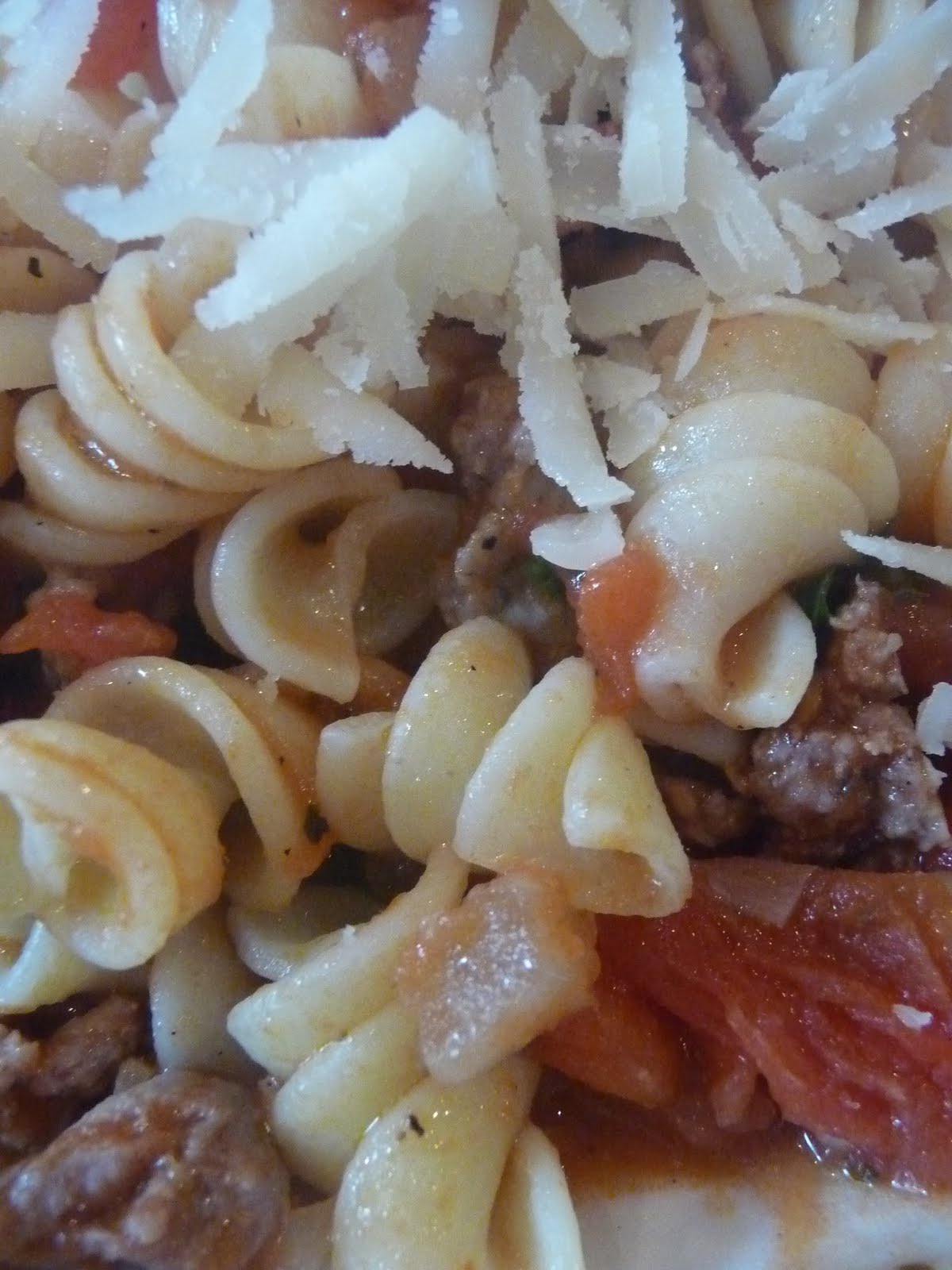
Fusilli con la Salsicca dell'Agnello (Fusilli with Lamb Sausage)

While perusing the stalls of Eastern Market, I was struggling to create a primi or first dish for a meal with Clare and her parents.  Typically, in Italy, a primi is either a soup, salad or pasta dish.  My mind was focused on a pasta dish that incorporated form of meat (and, for my Angel, shrimp) along with a simple red sauce.  

Thus, I had two choices to make.  First, I had to decide upon a pasta.  I chose freshly made fusilli, primarily because I did not see the pappardelle hidden in the back.  Fusilli is a pasta that may have originated in Naples, the capital of the Italian region of Campania.  There are several possible sources for the name.  Some believe that the pasta got its name from fusile or fucile, which is the Italian word for "rifle."  The rounded, spiral shape of the pasta is supposed to represent the groves in the rifle's barrel. Others point to the Neapolitan dialect where fuso is a word that refers to spindle. 

After choosing the pasta, I had to decide upon the meat.  There are a lot of choices at Eastern Market, but I ultimately selected fresh lamb sausage.  The use of sausage provides one handy shortcut ... it provides not only the meat for the dish, but also some seasoning.  It is important to keep that in mind because if you add the normal levels of seasoning, you may end up with a dish that is -- depending upon the type of sausage you use -- too salty or too spicy.  I chose a regular lamb sausage, which did not have any chiles or peppers in it.  

One last note, when working with sausage, I ordinarily brown the sausage first.  However, I wanted to try something different, that is reflected in this recipe.  Rather than browning the sausage, I added the sausage to the tomato sauce and cooked it in the sauce.  I did this because I wanted to break up the sausage into as small of pieces as I could.  It took longer for the sausage to cook, but the end result was still very good. 


FUSILLI CON LA SALSICCA DELL'AGNELLO
(FUSILLI WITH LAMB SAUSAGE)
A Chef Bolek Original
Serves 3-4


Ingredients:
3/4 pound of fresh fusilli
1/2 pound of fresh lamb sausage, removed from casings
1 large clove of garlic, diced finely
1/2 onion, diced finely
3/4 of a can of whole San Marzano tomatoes
1/2 tablespoon of dried basil
1 teaspoon of dried oregano
1/2 teaspoon of red chile flakes
2 teaspoons of finely grated Parmigiano Reggiano
Salt, to taste
Pepper, to taste
3 tablespoons of extra virgin olive oil

Directions:
1.  Saute the garlic and onions. Heat the olive oil on medium heat.  Add the garlic.  Cook for one minute.  Add the onions and continue to cook for about three to four minutes, until the onions are translucent.  Stir occasionally to prevent the garlic from burning.

2.  Add the tomatoes and lamb.  Add the tomatoes to the onion/garlic mixture.  Using a masher, mash the tomatoes until they are broken up well.  Add the basil, oregano and chile pepper flakes.  When the tomatoes begin to boil, break the lamb sausage into small pieces and add to the tomato sauce.  Continue to cook until the lamb is cooked. Add the Parmigiano Reggiano cheese and stir well.

3.  Cook the pasta.  Heat a pot of water until it is boiling.  Add the fresh fusilli to the boiling water.  Cook for two minutes.  Remove the pasta from the water and add it to the tomato sauce, with a little of the water.  Stir very well until the pasta is covered with the sauce.  Serve immediately.

ENJOY!

Wednesday, April 20, 2011

Stuffed Tomatoes Provencal

There are many recipes for stuffed tomatoes, and, I've made a few. However, when I was preparing a nice meal for my beautiful wife, Clare, I used a recipe from The Paley's Place Cookbook.  This recipe was to be a side dish to the Cedar Plank Salmon, which I also prepared using a recipe from this cookbook.

To the writers of the cookbook, this recipe "captures the true flavors of southern France."  The Paley's Place usually serves this side with its spit-roasted lamb or Shoulder of Lamb Roasted with Hay and Lavender. 

This recipe is by far the best recipe that I have come across for stuffed tomatoes.  The stuffing is made from onions, garlic, tomatoes, anchovies, crushed red pepper, a hard boiled egg, Persillade (an Italian parsley garlic mixture, see below for the recipe) and bread crumbs.  Although Paley's Place make their own bread crumbs for this recipe, I used panko bread crumbs.  Perhaps the best part of this recipe is the use of the tomato tops, with stems, for presentation.


STUFFED TOMATOES PROVENCAL
Adapted from The Paley Cookbook at pages 138-39
Serves 2

Ingredients:
4 large, firm, ripe tomatoes
1/4 cup plus too tablespoons of extra virgin olive oil
1 onion, finely diced
2 cloves garlic, finely chopped
Pinch of red pepper flakes
4 anchovy fillets, drained, rinsed and finely minced
Kosher salt, to taste
Ground black pepper to taste
1/2 cup bread crumbs
1/2 cup loosely packed basil leaves, chopped
2 tablespoons of Persillade (see below)
1 hard boiled egg, coarsely grated
1 tablespoon of grated Parmigiano Reggiano

Directions:
1.  Prepare the tomatoes.  Slice off the caps of the tomatoes carefully, setting aside their stems and caps for use later.  Shave off a thin slice from the bottom of the tomatoes to ensure they sit flat.  Chop the trimmings and also save them for use.  Hollow the inside of the tomatoes, being careful not to piece the bottom.  Reserve the flesh and seeds with the chopped trimmings.

2.  Cook the mixture.  Heat the 1/4 cup of olive oil over medium heat.  Add the onions, garlic and the red pepper flakes and cook, stirring often until it is all softened.  This should take about five minutes.  Add the anchovies and chopped tomatoes and continue to cook until the liquid evaporates, about fifteen minutes.

3.  Finish the mixture.  Cool the mixture a slight bit and transfer to a small bowl.  Add the bread crumbs, basil, Persillade and grated egg.

4.  Stuff the tomatoes.  Mound the stuffing in each tomato, patting the tops by hand.  Place the stuffed tomatoes in an oven proof gratin dish.  Sprinkle each tomato with Parmigiano Reggiano.  Place the reserved tops in the dish with the tomatoes.  Drizzle all with the 2 tablespoons of olive oil.

5.  Bake the tomatoes.  Bake until the tomatoes are soft to the touch and the cheese browns a little bit.  This should take about twenty minutes.

The one hint the writers provide is to not stuff the tomatoes too much or else they will split. That is something that I learned first hand, as a couple of my tomatoes did split.  I've duly noted this hint for the next time I make the recipe.  Finally, the recipe for Persillade, which is actually a good little mixture to use in cooking.

PERSILLADE
Makes 1/2 cup
Source: The Paley Place Cookbook at page 198.

Ingredients:
1 bunch Italian flat leaf parsley
3 large cloves of garlic.

Directions:
1.  Finely chop the garlic.  Add the garlic to the parsley and continue to chop until well incorporated.

2.  Transfer the mixture to a small container, cover tightly and refrigerate until ready to use.

ENJOY!

Sunday, March 6, 2011

Sauteed Rainbow Swiss Chard with Parmigiano Reggiano

An interesting fact ... Swiss chard did not originate in Switzerland; instead, it probably originated in Sicily.  This leafy vegetable, which is a descendant of the sea beet, is very common in both French and Italian cuisines.  So, how exactly did it get the name, "Swiss chard"?   The answer lies probably with seed catalogers in the 1800s, who gave the vegetable its name in order to distinguish it from French spinach varieties.   

Although catalogers sought to distinguish Swiss chard from spinach, the two vegetables share one thing in common ... they are very nutritious.  Swiss chard has a lot of vitamins A, C and K. It also more than thirteen polyphenol antioxidants, including kaempherol, which, according to medical studies, reduces the chance of certain types of cancer (like lung and pancreatic cancer) when consumed as part of a healthy diet.  Swiss chard also has syringic acid, which is believed to aid in the  regulation of blood sugar levels.

For me at least, there is a significant obstacle between all of that goodness and my stomach ... namely the bitterness of the raw vegetable.  I have learned to overcome this bitterness by sauteing chard, usually with a little butter and oil, along with other liquids, such as a dry white wine.  When I came across this recipe, it reminded me of the few times that I have made this vegetable in the past.  The recipe calls for the use of Parmesan cheese; and followers of this blog know that whenever a recipe calls for Parmesan, I only use Parmigiano Reggiano.  However, you can feel free to use other Parmesan cheese or other cheeses when making this recipe.


SAUTEED RAINBOW SWISS CHARD WITH PARMIGIANO REGGIANO
Adapted from Allrecipes.com 
Serves about 4

Ingredients:
1 bunch of rainbow Swiss chard (substitute regular Swiss Chard)
2 tablespoons of butter
2 tablespoons of olive oil
1 tablespoon of minced garlic
1/2 small red onion, diced
1/2 cup of dry white wine
1 tablespoon of fresh lemon juice
2 tablespoons of freshly grated Parmesan cheese (like Parmigano Reggiano)
     (plus more to garnish)
Salt, to taste

Directions:
1.  Cut the stems and center ribs out of the leaves and dice the stems and center ribs.  Coarsely chop the leaves.
2. Melt the butter and olive oil in a large saute pan over medium heat.  Stir in garlic and onion, and continue to saute until the onions become translucent, which should take about five minutes.  Add the chard stems and white wine and continue to saute until they soften, which should take an additional five minutes.

3.  Sir in the chard leaves and cook until they become wilted.  Stir in the lemon juice and cheese and season with salt.

ENJOY!

For more information about Swiss chard, check out Wikipedia and World's Healthiest Foods.

Friday, March 4, 2011

Grass-Fed Ribeye with Bone Marrow Mushrooms and Parmigiano Reggiano

Red meat gets a bad rap.  There are a lot of studies out there that say eating red meat is not good for your health.  Yet, if you make certain choices, you can actually enjoy a steak that can also be healthy.  For example, as I have mentioned in a previous post, I always try to buy grass fed beef, because it has more Omega-3 fatty acids, which are important for a healthy diet.  One can add to the health benefits of eating red meat with the ingredients used in the dish.  For example, from what I have read, beef bone marrow is high in protein and monounsaturated fats, which are supposed to lower your LDL cholesterol levels. 

Previously, I tried my hand at cooking beef bone marrow as part of my Iron Chef challenge.  It was my first effort at roasting the bones, extracting the marrow and then using it as an ingredient in three different dishes.  Although I think I did okay for a beginner, I have always wanted to use this ingredient in different ways, seeing what I could do to impart the flavor of the marrow to other ingredients. 

For this dish, I decided to use bone marrow in making a topping for a grass-fed ribeye.  I first roasted the marrow in the traditional way.  After removing the marrow from the bone, I used it in place of oil or butter to saute oyster and shiitake mushrooms with various herbs and spices.  Generally, if you overcook marrow, it reduces to a liquid; however, that is exactly what I wanted for this recipe.  The bone marrow would become the liquid in which I would cook the mushrooms, which would soak up the liquified bone marrow as they cook.  When the mushrooms were done, and the ribeye was almost done, I topped the ribeye with the mushrooms and a good amount of Parmigiano Reggiano.   I finish the ribeye off under the broiler, allowing the cheese to melt into the mushrooms and begin to brown.  The end result is a very decadent, but somewhat "healthy," topping for the ribeye. 

GRASS-FED RIBEYE WITH BONE MARROW MUSHROOMS
AND PARMIGIANO REGGIANO
A Chef Bolek Original
Serves 2-3

Ingredients:
6 marrow bones
1 pound of grass-fed ribeye
3.5 ounces of oyster mushrooms
8 ounces of shiitake mushrooms
4 cloves of garlic, diced
2 tablespoons of fresh rosemary, chopped finely
2 tablespoons of fresh sage, chopped finely
1 tablespoon of fresh thyme
1 teaspoon of crushed red pepper
1 tablespoon of mixed peppercorns, cracked
Salt, to taste
Ground pepper to taste
1/2 cup of grated Parmigiano Reggiano

Directions:
1.  Roast the marrow bones.  Heat the oven to 375 degrees Fahrenheit.  Cook the marrow bones for 30 minutes.  Remove the bones from the oven and remove the marrow from the bones into a bowl.

2.  Begin to cook the ribeye.  Start the broiler.  Salt and pepper the ribeye to taste.  Place the ribeye into the broiler and cook for about eight each side.

3.  Saute the mushrooms.  Add the bone marrow to a pan on high heat.  Add the garlic and cook until fragrant, about two minutes.  Add the mushrooms, rosemary, sage, thyme, cracked peppercorns and crushed red pepper.  Cook for about ten minutes.

4.  Add the mushrooms of the ribeye steak.  After flipping the ribeye and about five minutes into the cooking of the second side of the ribeye, add the mushrooms and top with the Parmigiano Reggiano.  Return to the broiler to cook for three minutes and perhaps more until the cheese begins to melt and brown.  When that starts to happen, remove the steak.  Let rest for a few minutes and then serve.

My mouth is continuing to drool as I finish this blog post and I wished that I had more of both the mushrooms and cheese (as well as the ribeye).  Although I am still learning how to use this ingredient, I really love cooking with bone marrow.  Not only will I make this dish again, but I will also think of new ways to use bone marrow in other recipes.

ENJOY!

Thursday, February 24, 2011

Sicilian Chickpea and Escarole Soup

Photo courtesy of Nanther Thangarajah
When we were designing the menu for Guest Chef Night, both Clare's father, Frank, and I went through a few recipes trying to decide upon a primi or first course (after the antipasta or appetizer).  Initially, we thought about a pasta; however, we could not find a pasta recipe that would fit with the overall menu.

Frank found a recipe for Sicilian Chickpea and Escarole soup, which he had made for friends in the past and which had gotten great reviews.  The recipe includes an interesting selection of ingredients, including garlic, chickpeas, fennel, onions, escarole, anchovies and the Parmigiano Reggiano rinds.  We decided to do this soup for Guest Chef Night and, once again, it got rave reviews from the guests.

The recipe comes from America's Test Kitchen and calls for the use of chicken broth.  Both Frank and I wanted to make sure that this soup could be enjoyed by everyone, including my beautiful wife Clare who does not eat meat.  So, we modified the recipe to use vegetable stock.  When we made this soup for Guest Chef Night, we used a homemade vegetable stock that Frank carefully made over the course of a couple of days.  Homemade stock is always better than store-bought stock.  If you do not want to make your own stock, look for a vegetable stock that is low in sodium.

While I am not a big fan of vegetable soups, I love this soup.  So did everyone who came to the Guest Chef Night.   The use of the Parmigiano Reggiano rinds provides a depth and richness to this soup that complements the flavors of the fennel and anchovies.  I highly recommend this soup.   

SICILIAN CHICKPEA AND ESCAROLE SOUP
Recipes from Soups, Stews and Chilis, America's Test Kitchen at 148-149
Serves 8-10

Ingredients:
2 tablespoons of extra virgin olive oil
1 1/2 pounds of fennel bulbs, trimmed of stalks
     cored and chopped fine
1 small onion chopped medium
1 can of chickpeas
3 medium garlic cloves, minced
2 tablespoons minced fresh oregano leaves
     (or 1/2 teaspoons of dry oregano)
2 anchovy fillets, minced
1/4 teaspoon of crushed red pepper flakes
7 cups of water
5 cups of vegetable broth
1 five inch long piece of Parmigano Reggiano rind
2 bay leaves
1 three inch long strip of zest from an orange
1 large tomato cored, and chopped medium
1 pound of escarole, tripped and cut into 1 inch pieces
Salt, to taste
Ground pepper to taste
8 to 10 slices of toasted garlic bread
1 cup of grated Parmigiano Reggiano

Directions:
1.  Heat the olive oil in a large dutch oven or cast iron pot over medium heat until shimmering.  Add the fennel and onion.  Cook until the vegetables are softened, which should be about seven or eight minutes.  Stir in the garlic, oregano, anchovies and crushed red pepper flakes.  Cook until fragrant, about thirty seconds.

2.  Stir in water, broth, soaked chickpeas, Parmigiano Reggiano rind, bay leaves, and zest.  Bring the soup to a boil and then reduce to a gentle simmer.  Cook until the chickpeas are tender, which should take about one and one-half hours.

3.  Stir in the tomato and continue to simmer for twenty minutes longer.  Then stir in escarole and cook until wilted, which should take about five to ten minutes more.

4.  Remove from the heat.  Remove bay leaves and the cheese rind (scraping off any cheese that has melted back into the soup.  Season with salt and pepper to taste.

5.  To serve, place the toasted garlic bread on the bottom of the bowl.  Ladle the soup over the top of the bread. Sprinkle grated Parmigiano Reggiano over the soup and drizzle lightly with additional olive oil.

ENJOY!

Wednesday, February 23, 2011

Mushroom Gratinate

I have made mushroom crostini for people several times using different recipes.  However, a recipe from Lidia Bastianich gets the best reviews.  It is like the "King" or "Queen" of mushroom crostini recipes, with the title of "Gratinate." This title is especially appropriate because the cheese used in the "Gratinate" is Parmigiano Reggiano, the "king" of Italian cheeses.

The recipe calls for garlic, sage, thyme and flat leaf parsley to be added while you saute the mushrooms. This mixture of herbs contributes a lot of flavor that complements the mushrooms themselves.  You do not have to limit yourself to these herbs, you could experiment by adding some rosemary, to underscore the earthiness of the dish, or some cracked black peppercorns, to provide a little bite. 

This dish was the first course of the four course dinner served at the Guest Chef Night.  We used eight pounds of mushrooms to create this course and went through all of the mushrooms.  Guests who tasted it both at the test kitchen and the Guest Chef Night really liked these crostini.  The recipe set forth below is designed to serve about twelve people, depending upon the size of the crostini or bread that you use.


MUSHROOM GRATINATE
Adapted from Lidia's Italy
Serves 12

Ingredients (for the mushrooms):
3 tablespoons extra-virgin olive oil
4 tablespoons butter
6 garlic cloves, finely chopped
2½ pounds mushroom, cleaned, sliced
1 teaspoon fresh thyme, chopped
4 leaves fresh sage, chopped
1 teaspoon salt
½ cup Parmigiano-Reggiano, freshly grated

Ingredients (for the base and gratin):
12 slices hearty wheat bread, lightly toasted
3 tablespoons soft butter
¼ cup Italian parsley, freshly chopped
1 cup Parmigiano-Reggiano, freshly grated

Directions:
1.  Preheat the oven to 375 degrees Fahrenheit.

2.  Heat the olive oil in the skillet over medium heat and saute the garlic, stirring, until the garlic just begins to color but well before it begins to brown. Add the butter and, when it melts, toss in the mushrooms, sprinkle on the thyme, sage, and salt.  Cook the mushrooms and other ingredients, stirring now and then, until the water evaporates and the mushrooms start to caramelize. Remove from the heat, then stir in the grated cheese.

3.  Lay the bread slices in one layer in the baking pan to cover the bottom completely. Spread the soft butter all over the bread and spoon the mushrooms evenly on top, pressing them down into the bread. Sprinkle the parsley on and top with grated cheese.

4.  Bake for 10 to 15 minutes until the cheese has browned and the edges of the bread are crisp. Let rest a few minutes, before serving.

ENJOY!