Showing posts with label Wine Club. Show all posts

Friday, June 23, 2017

Crab Flake Salad

If you took the Baltimore & Ohio's Capitol Limited from Washington, D.C., you would have had the opportunity to have a special experience on one of the Martha Washington dining cars, with the wooden interiors, white table cloths and the very fancy china.  The surroundings would have raised expectations about the offerings on the menu.  Guests would have expected fine cuisine, whether it was an appetizer, salad or main course.

That is what I thought when I saw the recipe for Crab Flake Salad in the book Dining on the B&O.  The recipe calls for an equal amount of "large crab meat flakes" and "small diced hearts of celery."  It also calls for "a creamy mayonnaise made with lemon juice instead of vinegar, with a garnish of quartered hard boiled eggs.    Although the recipe appears in Dining on the B&O, it originated in the quintessential cookbook, The Edgewater Beach Hotel Salad Book.  

Despite this pedigree, there was something about a "creamy mayonnaise" with lemon juice that did not seem appealing. It is probably because I am not a very big fan of mayonnaise.  The question became, however, what to substitute for mayonnaise.  I decided to draw from another crab recipe, the West Indies Salad (which is one of my favorite lump crab recipes).  The West Indies Salad uses vinegar, rather than mayonnaise.  In my humble opinion, vinegar works much better with crab meat than mayonnaise, and, it is probably healthier too.  I also decided to use finely diced onions, which are used in West Indies Salad, along with the finely diced celery used in the Crab Flake Salad.

The end result is Chef Bolek's interpretation of the B&O's Crab Flake Salad, which I have to say was very, very good.  The celery actually added an additional flavor that is not in the West Indies Salad, and the use of the vinegar kept the salad lighter and provided a good, sharp taste to contrast with the sweetness of the crab meat. 


CRAB FLAKE SALAD
Recipe adapted from Dining on the B&O, pp. 33-34
Serves several

Ingredients:
1 pound of jumbo lump crab, picked
1 heart of celery, diced finely
1 sweet onion, diced finely
1/2 cup water
1/2 cup vegetable oil
6 tablespoons of apple cider vinegar
Cracked black pepper
Sea salt

Directions:
1.  Marinate the crab.  Line the bottom of the bowl or dish with half of the diced onion and celery.  Add the crab meat.  Spread the remaining onion and celery over the crab meat.  Add the cider vinegar to the water and then add the oil, whisking it all together.  Drizzle the mixture over the crab meat and vegetables.  Drizzle the mixture over the crab meat and onions.  Let it rest in the refrigerator overnight. 

2.  Prepare the salad. Gently mix the salad.  Place some lettuce leaves on a plate and spoon the salad over it.  Serve with crackers. 

ENJOY!

Thursday, June 8, 2017

Chicken Maryland

Little did I know, but Chicken Maryland is quite the recipe.  The recipe was born as the Old Line State's answer to traditional southern fried chicken.  Where cooks throughout the American south fried chicken in pots full of oil, lard or shortening, cooks in Maryland pan-fried the chicken. They then finished the dish by adding cream to the pan to create a white sauce that would be poured over the crispy chicken.  This recipe is much like Maryland, something that draws from tradition, but is still unique in its own right. 

If that were the end of the story, a Chicken Maryland recipe might not be that interesting.  However, Chicken Maryland made its way into the news, with the first reference to the recipe or dish appearing in a newspaper in 1886.  Several years later, the recipe began to appear in cookbooks.  And, not just any cookbooks.  The recipe appeared in Fannie Farmer's The Boston Cooking School Cook Book in 1896.  Decades later, a recipe for Chicken a la Maryland in the iconic French cookbook, Ma Cuisine written by August Escoffier.  The dish became so popular that it even appeared on the dinner menu of the Titanic, although I don't know if any of the passengers enjoyed the dish because that menu was for the day the ship sank.  Despite the tragic end of the Titanic, the recipe for Chicken Maryland continued to live.  The dish appeared on the menu for guests  who traveled on the Baltimore & Ohio's Capitol Limited from Washington, D.C. to Chicago. 

Chicken Maryland's travel through time has given rise to many different variations to Maryland's take on southern Fried Chicken.  For example, Auguste Escoffier's version of Chicken a la Maryland featured a side of fried bananas.  The bananas were perhaps a nod to the fact that the largest city in Maryland, Baltimore, was once a key port for the import of bananas from Latin America.  By contrast, the chefs and cooks on the B&O left the bananas off the plate and served the Chicken Maryland with its version of a corn fritter.

For this recipe, I blended the B&O's recipe for Chicken Maryland and Escoffier's version of Chicken a la Maryland.  The former recipe uses whole chickens, spatchcocked, with each serving being half a chicken, while the latter recipe allows for the use of chicken breasts.   I decided to use boneless, skinless breasts because I felt that they would be easier to work with on a frying pan.  I then decided to '86 the frying pan and to just bake the chicken.  This made the recipe healthier.  After getting the chicken ready, I turned to Escoffier's recipe for a bechamel sauce that could be poured over the chicken.  Finally, I decided to serve the dish in the style of the B&O cooks, with a corn fritter as a side.  The two recipes helped to produce a dish that is perhaps one of the best ones that I have made in a long time.    

CHICKEN MARYLAND
Recipe adapted from Dining on the B&O, pp. 71-72
and the Spruce
Serves 4

Ingredients (for the chicken):
2 chickens, spatchcocked and split
     (or use boneless, skinless chicken breasts)
1 egg beaten
Salt and pepper, to taste
Bread crumbs, as needed
Butter, melted as needed
Bacon, 2 slices per servings
Bechamel or cream sauce, 2-3 serving,
Corn Fritters, 1 per serving

Ingredients (for the bechamel or cream sauce):
2 1/2 tablespoons of butter
2 tablespoons of all purpose flour
2 cups milk
1 teaspoon salt
1/8 teaspoon of freshly grated nutmeg

Ingredients (for the corn fritters):
15 ounces of corn, frozen, canned or fresh
1 1/2 tablespoons of butter
2 eggs, beaten
3 tablespoons milk
3/8 cup flour

Directions:
1.  Prepare the chicken. If you are using whole chickens, cut the chickens into portions.  Season with salt and pepper.  Dip the chicken in the beaten eggs and then the breadcrumbs.  Arrange in baking pans with 2 slices of bacon.  Brush the chicken with butter.

2.  Bake the chicken.  Preheat the oven to 400 degrees.  Bake the chicken until the internal temperature reaches 180 degrees.

3.  Prepare the bechamel sauce. In a large saucepan over medium heat, melt the butter and whisk in the flour until it forms a smooth paste. Continue whisking, cook for about 2 minutes, and then gradually – 1/3 cup at a time - add the milk. Continue whisking and cook until the sauce is completely heated through, smooth, and thickened. Remove from the heat and season with the salt and nutmeg.

4.  Prepare the fritters.  Pound the corn, mix with the flour, butter, eggs, salt and pepper.  Heat butter or oil on medium high in a pan.  Ladle the mixture into the pan and do not overcrowd.  Fry for about 5 minutes and flip.  Fry until the fritter is brown.

5.  Finish the dish.  Plate one of the chicken breasts to one side of the dish, ensuring that the bacon remains crossed over the chicken.  Plate the corn fritter next to the chicken.  Pour the bechamel sauce over the chicken breast and the bacon.    

Thursday, May 25, 2017

B&O Egg Sandwich

It is just an egg sandwich.  That is what my beautiful Angel and I kept saying to ourselves as we were preparing that dish for our Wine Club.  It is just an egg sandwich.  But it is a pretty damn good egg sandwich.  Why? Because it proves that you can make a very good dish with a very simple recipe.

This particular recipe originated in Grafton, West Virginia.  According to Dining on the B&O Railroad, the authors visited a signal tower and spoke with the railroader who worked there. The author asked the employee about his favorite food, which was an egg sandwich that he had every day for lunch.  The recipe is basically an egg between two pieces of toast with a dollop of Miracle Whip.   A simple recipe that brought a lot of satisfaction to a worker, day after day, year after year.  A very good dish that is the product of a very simple recipe.

The railroader's egg sandwich was not an official recipe of the B&O Railroad, although a fried egg sandwich did appear on a menu in the railroad's dining car on March 17, 1960.  The author of Dining on the B&O did not have the recipe and I could not find it.  And, while the railroader's recipe was very good for him, both by beautiful Angel and I wanted to make a couple of changes to make this recipe even better, but still very simple.

First, I decided to '86 the Miracle Whip and add some lettuce and a tomato.  I have never been a big fan of mayonnaise or Miracle Whip.  I rather dispense with that and add something that is a little healthier, like a slice of tomato and some lettuce.

Second, my beautiful Angel suggested that we sprinkle some Old Bay on the egg, giving a nod to Maryland.  This is after all a B&O Egg Sandwich and that "B" stands for Baltimore.  I thought that was a great idea.

Finally, we decided to present the sandwich as an open faced sandwich.  By getting rid of the extra piece of bread, we opened the sandwich to a far more pleasant presentation.

With these three changes, we gave this recipe our own touch.  In the end, at least in my humble opinion, this is a far better sandwich.   I have included the original recipe, with our changes listed as options.  Feel free to try both versions  Either way, a simple recipe produces a very tasty sandwich. 


B&O EGG SANDWICH
Recipe adapted from Dining on the B&O, pp. 28-29
Serves 1

Ingredients:
1 or 2 eggs
1 or 2 slices of toast
1-2 tablespoons butter
Kraft Miracle Whip, optional
1 tomato slice, optional
Lettuce, optional
Old Bay, optional
Salt and pepper to taste

Directions:
1.  Prepare the egg.  Melt 1 or 2 tablespoons of butter in an 8 inch non-stick omelet pan or skillet over medium heat.  Break open eggs into pan and immediately reduce heat to low. Cook slowly until the eggs are completely set and the yolks begin to thicken, but not hard.  Break open the yolks and flip over for 15 seconds until cook.  Do not salt the eggs before or during cooking.  Salt can cause the eggs to become tough during cooking so for best results, salt eggs only after cooking.

2.  Finish the dish.  Toast the bread, place eggs on toast and spread Miracle whip (optional) on one slice of toast.  Salt and pepper to taste.

ENJOY!

Wednesday, May 17, 2017

Wine Club - A Dinner on the Baltimore & Ohio

It is a bygone era.  When rail was king and pretty much the principal means by which one could travel long distances.  During the height of its reign, railroads like the Baltimore & Ohio strived to provide passengers with the best experience that one could on the rails.  One important aspect of that experience involved food.  

That experience unfolded on the dining cars.  From the 1920s until the 1970s, the B&O railroad used dining cars on many of its lines, such as the Capitol Limited, which ran from Washington, D.C. to Chicago, Illinois.  A dining car usually had a crew of six: two cooks, three waiters and a steward.  It was their job to prepare meals from scratch for dozens of guests.  The fact that the cooks could prepare those dishes from what could be best described as cramped quarters, while servers brought the food out to guests while the train was moving, meant that these individuals had to be very skilled at their jobs.  

For our next wine club, we will be trying to recreate a three-course dinner aboard the famous Capitol Limited.  If you took that train from Washington to Chicago, you would have had the opportunity to try dishes from the Chesapeake region.  Each one of these courses is selected from the book, Dining on the Railroad, which uses original recipes used by the cooks, with additional explanation and tips to help make the dishes in one's home.

APPETIZER
A Duo - B&O Egg Sandwich and Crab Flake Salad

The first course is actually two dishes.  First, we start with the B&O Railroader's favorite ... the B&O Egg Sandwich.  The recipe comes from Grafton, West Virginia, where there was a signal tower where the railroader who worked there ate the sandwich every day for lunch.  Second, we will serve a crab flake salad, which will take jumbo lump crab marinated overnight and served over lettuce with crackers.  We are going to take a different approach to this recipe, foregoing the mayonnaise based sauce for a vinegar marinade, based upon the recipe for a West Indies Salad

MAIN COURSE
Chicken Maryland

This recipe dates back to the 1960s.  It is a recipe traditionally made with a half chicken per order. We will probably use just chicken breasts or quarters, but, if I feel ambitious, I might just break down a bunch of chickens.   The chicken could be baked or fried, but, in our case will most likely be baked.  The chicken is served with a bechamel or cream sauce and a couple strips of bacon.  We'll finish the dish as it was served on the B&O Railroad ... with a corn fritter. 

DESSERT
Banana Snack Bread with Banana Ice Cream

Bananas were big on the B&O (little known fact ... bananas were a major import that came through Baltimore).  We will end the night with a double banana dessert - a banana snack bread (loaded with bananas and walnuts) with banana ice cream.

As always, recipes are subject to change.  We will see you soon!

Monday, January 18, 2016

Wine Club -- Dinner at Rick's Cafe Americain

Casablanca is my favorite movie.  I can still remember being introduced to the movie in college.  I was a second-year college student who elected to take a cinema class as part of my general education requirements.  The class was taught by Professor Turaj.  On the first day of the class, the Professor told his students (including me) that he could show the movies that other professors used in their courses.  However, he found many of them boring.  Instead, he was going to show movies that he liked ... and that we would like.  So, we got to see movies like High Noon, Deer Hunter, and, of course, Casablanca.  

The iconic movie's plot unfolds at the fictitious Rick's Cafe Americain.  The cafe with a view of the airport, which was a perfect spot for anyone trying to escape the Nazis and the Vichy collaborators.  Walk through the doors and one enters a large restaurant, with its white walls and round arches, crammed with tables of anxious people.  Their collective anxiety focuses on the requisite papers needed for the flight to Lisbon and then on to America.   The multitude of tables surround a pianist playing tunes, such as Knock on Wood, to lift the guests' spirits.  Waiters, such as Carl, wind their way around the restaurant, serving drinks and food....

But wait, the one thing missing is the food.  Having watched the movie more times than I can count, I can recall only one reference to food.  To set the scene: Captain Louis Renault just sat down at a table with Major Heinrich Strasser and his aide Colonel Heinz.  Major Strasser orders a bottle of champaign and a tin of caviar.  Captain Renault suggests a bottle of Veuve Cliquot 26.  That's it.  

Not every guest could have ordered caviar.  After all, many did not have enough to pay for the exit visas needed to get to Lisbon.  This leaves the question of what would they have eaten.  This question leads to an even more basic one: what would Ricks Cafe Americain have had on its menu.  The cafe's menu is the one aspect of the restaurant that the writers and directors did not explore, probably because it did not have any meaningful relationship to the telling of the story.  

So, for the January Wine Club, we are going to explore what could have been the menu at Rick's Cafe Americain.  One of my friends gave me, The Casablanca Cookbook, which has recipes for wining and dining at Ricks.  These recipes loosely draw from Moroccan-inspired recipes, with character's names, like Ugarte's Tangy Chicken Wings and Emil Chickpea Fritters.  This book provides a great start, but we need to delve a little further to create the menu.

FIRST COURSE
Coriander Shrimp Kebabs and Ground Lamb Kebabs
Served over Coucous Morocain

Kebabs are a significant part of many Mediterranean cuisines.  Morocco is no exception, with kebabs reaching the Moroccan area during the height of the Ottoman Empire.  For our first course, everyone will have a choice of two skewers of Coriander Shrimp Kebabs or Ground Lamb Kebabs (or a combination of both).  The kebabs will be served over Moroccan style couscous.

FIRST COURSE
Chicken Tangine with Preserved Lemons and Olives, 
Served with Carrots with Cumin and Garlic

The tangine is the emblematic dish of North African cuisine.  When it comes to Moroccan cuisine in particular, one of the most popular dishes is Tangine Djaj Bi Zaytoun Wal Hamid.  This dish features bone-in, skin-on chicken thighs that are marinated with spices and then cooked until very tender.  The chicken is then served with preserved lemons and green olives.  If you don't like olives (and I know a couple of you do not), don't worry -- I will add the olives at the end, thereby enabling me to omit them from your serving.  This tangine will be served with a side of Carrots with Cumin and Garlic. 

THIRD COURSE, 
Apricot Pistachio Cake

Agriculture in Morocco encompasses a wide variety of ingredients.  For the final course, we will serve a cake that combines two fairly prominent ingredients -- apricots and pistachios.  Morocco is 7th in the world when it comes to producing of pistachios and 11th when it comes to apricots.  

As always, the menu is subject to change.  If there are any food preferences or dietary restrictions that we have overlooked, please let us know.  We look forward to seeing everyone!

Sunday, January 3, 2016

Tagliatelle alla Bolognese

If someone were to ask me what pasta dish would I order at an Italian restaurant, I would reply "the Bolognese."  A "Bolognese," which is also referred to as a "ragu," is a sauce of chopped meat and vegetables cooked in a liquid, such as water or wine.  The sauce is perhaps the most familiar dish from the cuisine of Emilia-Romagna.  And, if it is done right, the Bolognese is perhaps one of the best pasta sauces ever created, not only in Italy, but perhaps the entire world (at least in my humble opinion).  

Speaking of origins, the earliest documented recipe for a Bolognese dates back to the late 1700s.   Lynn Rossetto Kasper writes in her book, The Splendid Table, that Alberto Alvisi, a cook to the Cardinal of Imola, made a sauce that he called "ragu for maccheroni."  The first published recipe was written by Pellegrino Artusi in his 1891 cookbook, La Scienza in Cucina e L'Arte di Mangiare Bene ("The Science of Cooking and the Art of Eating Well").  The recipe called for veal fillets, butter, onions and carrots.  The ingredients were to be minced finely, cooked in the butter, and then covered with a broth.   Artusi also suggested adding mushrooms to improve the taste, as well as cream to make a smoother sauce.  

A lot of time has passed since Artusi published his recipe.  With time, comes change.  At some point over the years, decades and centuries, cooks began to use other proteins, such as beef and pork.   They also substituted water or wine for the broth.  The changes went beyond mere substitutions. Cooks decided to add other ingredients, such as tomato paste.  Many of these changes were probably brought about by necessity, such as the availability of cost of beef.  Other changes were probably made to alter the taste, such as the use of wine over broth.  In the end, these changes produced a sauce made with minced meat, onions, carrots, celery and tomato paste, all of which are cooked in a liquid of the cook's choice.  

One final note about this recipe.  Traditionally, a Bolognese is served with Tagliatelle pasta, which is the traditional type of pasta in Emilia-Romagna.  Tagliatelle is a long, flat pasta.  The flatness of the pasta is the key.  You want a surface that can serve as a canvas for the sauce.  Tagliatelle can be a little hard to find, especially if you do not have an Italian store near you.  If you can't find that pasta, you can use Fettuccine or even Pappardelle.  Just avoid the dried pasta.  A Bolognese should only grace fresh pasta.   It definitely costs more to buy fresh pasta.  However, trust me.  It is definitely worth the cost.  


TAGLIATELLE ALLA BOLOGNESE
Recipe from Oscar Farinetti, How to Eataly at pg. 56
Serves 4

Ingredients:
2 tablespoons unsalted butter
2 tablespoons extra virgin olive oil
1 small yellow onion, minced
1 small carrot, minced
1 rib celery, minced
1 tablespoon garlic, minced
4 ounces ground veal
4 ounces ground pork
4 ounces ground beef
Fine sea salt, to taste
1/4 cup white wine
1/4 cup tomato paste
Freshly ground black pepper to taste
1/4 cup chicken or beef stock
Coarse sea salt for pasta cooking water
Fresh tagliatelle
Grated grana cheese, for serving

Directions:
1.  In a heavy Dutch oven or large heavy bottomed pot over medium heat, melt the butter with the olive oil.  Add the onions and cook, stirring frequently, until the onion is translucent, about 5 minutes.  Add the carrot, celery, and garlic and cook, stirring frequently, until softened and fragrant, about 2 minutes more.

2.  Crumble the veal, pork and beef into the pot.  Season with fine sea salt.  Reduce heat to low and cook, stirring frequently, until the meat has rendered most of its fat and is just beginning to brown, about 5 minutes.  Spoon out and discard some of the rendered fat, but leave enough to cover the bottom of the pan.  (This will depend upon the meat that you are using - there may not be an excessive amount of fat.)

3.  Add the wine and increase the heat to medium.  Cook, stirring occasionally, until the wine has evaporated, about 6 minutes.

4.  Decrease the heat to low, add the tomato paste, stir to combine and cook, stirring frequently, for 20 minutes.  Season to taste with salt and pepper.  Add the stock and adjust the heat if necessary to reach a gentle simmer.  Simmer until the stock has reduced but the sauce is still moist, about 45 minutes longer.  Taste the sauce, adjust the seasoning if necessary and remove from the heat.

5.  Bring a large pot of water to boil for pasta.  When the water is boiling, salt it with coarse salt and add the pasta.  Cook until the pasta rises to the surface of the water.  

6.  Smear a small amount of the sauce on the bottom of a warmed pasta serving bowl. 

7.  When the pasta is cooked, drain it in a colander, then transfer it immediately to the serving bowl.  Top with the remaining sauce and toss vigorously to combine.  Serve immediately with grated cheese on the table.

ENJOY!

Thursday, July 2, 2015

Insalata di Calamari

When it comes to squid or calamari, there is a debate among some.  If you go to many restaurants and order calamari, you get rings.  Pale white rings (more often than not, overcooked and chewy).   The rings are sliced portions of the body or mantle of the squid.  They are also the most boring part of the animal.

For me, the best part of the squid are the tentacles.  Not only are the tentacles more interesting in a visual sense, but they also have a texture and taste that is far better than the cut rings of the body.  I think this preference is due to my love of octopus, which is only served in the form of tentacles.  Grill those tentacles, like the Barbecued Octopus with Arugula and Mint, and I am in heaven. Many people do not share my affinity for the tentacles of octopus or squid.  That is too bad for them, because they are missing out on a great food experience.  

This recipe -- Insalata di Calamari -- is a very simple and very tasty way to incorporate not just those rings, but the tentacles.  The simple part of the recipe is the boiling of the squid for a couple of minutes.  That is the beauty of squid.  It cooks fast.  That beauty is also deceptive, because a minute too long in the boiling water, and you are left with a chewy mess.  If you can cook that squid right, the rest falls into place.  Some white beans, lemon juice and red onions.  Garnish with some chopped parsley.  The end product is an amazing, healthy salad that will become a go to for a dinner any night or a nice dish to serve to guests. 


INSALATA DI CALAMARI
Recipe adapted from Oscar Farinetti, How to Eataly at pg. 232
Serves 4

Ingredients:
1 pound calamari, bodies and tentacles
16 ounces of cooked white beans
2 tablespoons of extra virgin olive oil
2 tablespoons of lemon juice
1/2 red onion, sliced thinly

Directions:
1.  Bring a pot of water to boiling over high heat.  Add the calamari and cook until opaque, for 1 to 2 minutes.  Drain  and, while still warm, toss some cooked white beans and sliced onion.

2. Whisk together the lemon juice and extra virgin oil oil and dress the salad.  Refrigerate until chilled.

3.  Serve with an additional spritz of lemon juice and some minced flat leaf parsley.

ENJOY!

Sunday, November 2, 2014

Around the World in 80 Dishes: India

It has been well over a year since I completed a dinner for my personal culinary challenge, Around the World in 80 Dishes. The last challenge was to prepare Mauritian Duck Curry, along with Chana Masala, dishes from the island country of Mauritius.   The cuisine of Mauritius is heavily influenced by immigrants, especially those from India.  For the next challenge, I'll will travel from Mauritius to India.

The timing could not be better.  I undertook and completed this challenge during Diwali, the Hindu festival of lights, an important festival for Hindus, Jains and Sikhs.  Diwali unfolds over five days, with the third day being celebrated as the main festival or "Festival of Lights." The lights were originally clay lamps, lit for reasons that vary with the celebrants.  For example, lighting lamps represents the victory of knowledge of ignorance.  Darkness represents ignorance, as well as wickedness, violence, anger, bigotry, injustice and suffering.  The lighting of lamps allows light to overcome darkness, which is not only a metaphor for knowledge overcoming ignorance, but also illustrates how light reveals the beauty that surrounds us.

Of course, the Diwali celebration involves far more than lighting of clay or electric lamps.  Families decorate their houses, set off firecrackers and, of course, partake in a feast of food.  The feast of food that I prepared included two main courses and a side dish, all of which are part of this culinary challenge.
 
MAIN COURSE

While I made two main courses, only one can satisfy the challenge.  That dish is Rogan Josh, an aromatic and very tasty lamb stew or curry.  The dish originated in Persia, which gave the red curry its name.  According to Wikipedia, Rogan means "clarified butter" or "fat" in Persian, while Josh basically means to heat or boil in an intense or passionate way.  The dish was introduced to the subcontinent by the Mughal Empire, where it became very popular in the Kashmir region. 

The Kashmiri version features braised lamb chunks cooked with a gravy based on browned onions or shallots, yogurt, garlic, ginger and aromatic spices, such as cloves, bay leaves, cardamom and cinnamon. The red color of Rogan Josh traditionally comes from liberal amounts of dried, de-seeded Kashmiri chilies.  These chiles are more akin to paprika than the cayenne chiles used by Indian cuisine.  

Personally, I love Rogan Josh and this dish has been on my "to do list" for some time. This version is a simplified curry based upon a recipe by Vikram Sunderam, the chef and owner of the very popular Washington, D.C. restaurant Rasika.


ROGAN JOSH
Recipe from Food and Wine
Serves 4

Ingredients:
1/4 cup canola oil
2 pounds boneless lamb shoulder, cut into 1 inch pieces
Kosher salt
2 onions, thinly sliced
2 tablespoons, minced fresh ginger
2 garlic cloves, minced
1 tablespoon plus 1 teaspoon Madras curry powder
1 teaspoon turmeric
1/2 teaspoon cayenne pepper
2 bay leaves
1 14 ounce can tomato puree
1 cup plain whole milk yogurt
1 cup plain whole-milk yogurt
2 cups water
1 teaspoon garam masala
Cilantro leaves, for garnish
Basmati rice and warm naan for serving.

Directions:
1.  Brown the lamb.  In a large, enameled cast-iron casserole, heat the oil. Season the lamb with salt and cook over high heat, stirring occasionally, until the lamb is browned, about 12 minutes; using a slotted spoon, transfer to a plate.

2.  Add the remaining ingredients.  Add the onions to the casserole and cook over moderate heat until lightly browned, 4 minutes. Add the ginger, garlic, curry, turmeric, cayenne and bay leaves and cook for 2 minutes. Add the tomato, yogurt and water; bring to a boil. Season with salt.

3.  Simmer the stew.  Return the lamb and any juices to the casserole. Cover partially and simmer over low heat until the lamb is very tender, 1 hour. Stir in the garam masala; cook for 5 minutes. Discard the bay leaves. Garnish with cilantro. Serve with rice and naan.

SIDE DISHES

Although the Rogan  Josh satisfies the culinary challenge, I try to make some other dishes, whether appetizers, side dishes or desserts as part of the Around the World in 80 Dishes.  Since I have not done a challenge in awhile, I decided to do another main or side dish.  This dish -- Daal Saag -- features yellow split lentils and spinach.  I have to admit that I do not cook very much with lentils, so this presented a whole different type of challenge.


DAAL SAAG
Recipe from Merilees Parker and
Available on the BBC's Food Website
Serves 4

Ingredients:
8 ounces of yellow split lentils (moong dal)
3 1/2 cups of water
2-3 tablespoons of vegetable oil
1 teaspoon black mustard seeds
1/4 teaspoon ground turmeric
1/4 teaspoon ground cumin
1/4 teaspoon asafoetida or fennel seeds
2 tablespoons of fresh ginger, grated
2 green chiles, de-seeded and chopped
8 curry leaves
3 1/2 ounces of spinach
2 spring onions, trimmed and chopped

Directions:
1.  Prepare the lentils.  Put the daal in a heavy based saucepan, pour in the water and bring to a boil.  Reduce the heat and simmer for about 1 hour until the lentils are really soft.

2.  Heat the spices.  Heat oil in a large pan.  Add the mustard seeds, turmeric, cumin, asafoetida or fennel sides, ginger, chilies and curry leaves.  Fry for 2 to 3 minutes.

3.  Add the daal.  When the daal is cooked, add to the pan and stir in spinach and spring onions.  Heat for an additional two minutes.  Season and then serve.

Whenever you make a curry, whether Rogan Josh or Daal Saag, you should always have a pullao, or rice.  This particular rice dish includes carrots, potatoes and green beans. 


VEGETABLE PULLAO
Recipe from Merilees Parker and
Available on the BBC's Food Website
Serves 4

Ingredients (for the garam masala):
1 tablespoon of cardamom seeds
1 teaspoon of black peppercorns
1 teaspoon black cumin seeds (or regular cumin seeds)
1 teaspoon whole cloves
1/3 whole nutmeg
1 medium stick of cinnamon, broken into pieces

Ingredients (for the pullao):
Basmati rice, measured to the 1 pint level (2 cups)
Thumb piece of fresh ginger, grated
3 tablespoons of olive oil
1/2 teaspoon brown mustard seeds
1 hot green chile, finely chopped
1/4 pound of potatoes, peeled and cut into dice
1/4 carrot, peeled, cut into dice
1 1/2 ounces of green beans, cut into segments
1/2 teaspoon ground turmeric
1 teaspoon garam masala
1 1/4 teaspoon salt
1 pint water

Directions:
1.  Prepare the garam masala.  Put all of the spices in a clean coffee grinder or other spice grinder and grind as finely as possible. Store in a tightly lidded jar, away from heat and sunlight. This makes about three tablespoons.

2.  Prepare the rice. Wash the rice in several changes of water then drain. Put the rice in a bowl, cover with water and leave to soak for 30 minutes, then drain again.

3.  Heat the spices.  Heat the oil in a heavy-based pan (with a tight-fitting lid) set over a medium-high heat. When it's hot, add the mustard seeds.  As soon as they begin to pop - a matter of seconds - add the chilli, potato, carrot and green beans and stir. Add the turmeric and garam masala and stir for one minute.  Add the ginger and saute, stirring, for another minute.

4.  Add the rice and other ingredients.  Drain the rice and add it to the pan. Reduce the heat to medium-low and stir the rice very gently to mix it into the other ingredients and coat it with the oil and spices. Cook this way for two minutes.  Add the 570ml/1 pint water and the salt and bring to the boil. Cover the pan with a very tight-fitting lid (if you don't have a very tight-fitting lid then cover the pan with foil then a lid) then turn the heat to very low and cook for 25 minutes. After this time try a grain of rice to see if it's cooked - cook for a few more minutes if necessary.

5.  Finish the dish.  Once it's cooked you can leave it with the lid on and the heat turned off for up to half an hour before serving. Or serve at once on a serving plate.

*     *     *

I have to say that I completed the challenge successfully.  The Rogan Josh was amazing and I can understand why it is a very popular dish in India.  I also learned that I still have a lot of work to do when it comes to making large amounts of rice.  The pullao was good, but I have difficulties getting the right texture with the rice.  I can do it in small batches.  However, when cooking for large crowds, it is a little more difficult, at least for me. The one thing is that I still have over fifty challenges to go.  I am sure that there will be many more opportunities to make rice.  

Until next time ...

 ENJOY!

Saturday, October 18, 2014

Wine Club - A Diwali Inspired Dinner

It has been a little while since we hosted our last wine dinner.  The last dinner was back in April, America in Miniature, when we took a culinary tour around the State of Maryland.  As we prepare for our next wine dinner, the big question was (as it always is), what should be the theme?  The first thing that came to my mind was a celebration.  I checked the calendar (and, of course, the Internet), and I came across a website that listed all of the international festivals in the month of October.  After some more research, I decided upon a theme that should be perfect for the Wine Club ... a Diwali inspired dinner.

Initially, this theme offers an opportunity to learn a little more about Diwali, an important festival for Hindus, Jains and Sikhs.  Diwali unfolds over five days, with the third day being celebrated as the main festival or "Festival of Lights." The lights were originally clay lamps, lit for reasons that vary with the celebrants.  For example, lighting lamps represents the victory of knowledge of ignorance.  Darkness represents ignorance, as well as wickedness, violence, anger, bigotry, injustice and suffering.  The lighting of lamps allows light to overcome darkness, which is not only a metaphor for knowledge overcoming ignorance, but also illustrates how light reveals the beauty that surrounds us. 

Of course, the Diwali celebration involves far more than lighting of clay or electric lamps.  Families decorate their houses, set off firecrackers and, of course, partake in a feast of food.  For this wine club, the feast will be a three course meal, with appetizers, two main courses (served together) and a dessert.

FIRST COURSE
Onion and Sweet Potato Bhajji

The first course will feature a duo of Onion Bhajji and Sweet Potato Bhajji.  A bhaji is a type of pakora or fritter that is a common street food in Maharashtra.  And, from what I have read, bhajji are also commonly served as part of Hindu festivals, such as Dwali.  I hope to have a couple of chutneys to serve with the bhajji; however, due to a lack of time, those may not be homemade. 

SECOND COURSE
Rogan Josh, Daal Saag, and Vegetable Pulao

The main course features two dishes - Rogan Josh and Daal Saag -- served with a vegetable pulao or rice dish.  The dishes accommodate meat eaters, as the Rogan Josh is a traditional lamb dish that, although of Persian origin, is a staple of Kashmiri cuisine.  They also accommodate vegetarians, as Daal Saag, which is a lentil dish that includes spinach.  And, for omnivores, you can have booth. 

THIRD COURSE
Goan Coconut Pancakes

The last course will be Goan Coconut Pancakes, which will have a stuffing of coconuts, raisin, cardamom and nutmeg.  The pancakes will be served with a little vanilla ice cream.

See you soon!

ENJOY!


Saturday, May 31, 2014

Boneless Spring Lamb Roast

A while back, we hosted a dinner with a theme that featured recipes from Maryland.  The theme was America in Miniature, which featured recipes that highlight the produce and products of that wonderful state.  I have already posted two of the recipes from that dinner, an appetizer of Shrimp Pâté with Crostini and a Cream of Asparagus Soup.  Now, we have reached the main course ... Boneless Spring Lamb Roast.
 
The raising of lamb and sheep is an important part of the agricultural sector in Maryland.  There are farms throughout the state -- such as Jehovah Jireh FarmEvermore Farm and Castle Hill Harm -- where farmers raise lamb and sheep in environmentally conscious and humane ways.  There are organizations and associations, such as the Frederick County Sheep Breeders Association, which are devoted to promoting and improving the raising of these animals within Maryland.   Even the University of Maryland has a role, with a program specifically designed to various aspects of raising sheep and goats. 

Most importantly, there are people like myself in Maryland who love to eat lamb.  When I planned our wine dinner, this recipe stood out as a perfect main course.  The recipe is relatively easy to make, with three basic steps: (1) marinating the meat, (2) prepping the meat for roasting; and (3) roasting the meat.  Although you have to watch the temperature of the meat, so as to not overcook it, this recipe allows you to turn to the preparation of other dishes while the roast is cooking in the oven. 

The one slight change I made to the recipe is that, after straining the drippings, I returned them to a small pot and added a little beef stock to the drippings.  I brought it to a boil and reduced it slightly.  This allowed for more "drippings" to ensure that every plate has some of the jus to go with the lamb.


BONELESS SPRING LAMB ROAST
Recipe from Dishing up Maryland, page 68
Serves 6

Ingredients:
1 lemon
3/4 cup olive oil
10 garlic cloves
2 teaspoons dried oregano
2 teaspoon dried rosemary leaves
1/2 teaspoon paprika
1/2 teaspoon salt
1 boneless leg of lamb (3 to 3 1/2 pounds)
1 tablespoon coarse sea salt
1 teaspoon freshly ground black pepper

Directions:
1.  Marinate the lamb.  Zest and juice the lemon.  Combine the lemon zest and juice with the olive oil, 3 of the garlic cloves, 1 teaspoon of he oregano, 1 teaspoon of the rosemary, the paprika and salt in a blender or food processor and blend until smooth.  Place the leg of lamb in a large ziplock bag and add the marinade.  Put the ziplock bag into a larger plastic bag or large container to ensure there is no leakage and place it in the refrigerator to marinate over night or for at least four hours.

2.  Prepare the lamb.  Remove the lamb from the refrigerator and allow the contents to come to room temperature.  Preheat the oven to 450 degrees Fahrenheit.  Combine the remaining 1 teaspoon  oregano and 1 teaspoon rosemary with the sea salt and pepper.  Rub this mixture all over the lamb.  Cut small incisions into the lamb and insert the remaining 7 garlic cloves into the incisions.  Insert a meat thermometer into the roast.

3. Roast the lamb.  Place the lamb on a rack in a roasting pan, fattiest side up.  Roast for 15 minutes.  Reduce the oven to 325 degrees Fahrenheit and roast for an additional 10 to 15 minutes per pound, 30 to 45 minutes, until the meat thermometer reads 140 degrees for medium rare to 150 degrees for medium.  Remove the lamb from the oven, cover it with foil or a lid and allow it to rest for 20 minutes.  Cut the strings from the lamb and transfer it to a serving platter.  Cut the lamb into thick slices.  Strain the pan drippings and pour them over the lamb.

ENJOY! 

Saturday, May 10, 2014

Cream of Asparagus Soup with Rice

I was never a fan of vegetables when I was a kid.  (Truthfully, I was not a fan of anything green when I was a kid.)  Over time, my views and opinions about green food have changed and evolved.  No vegetable represents that change more than the asparagus.  

The cultivation of asparagus dates back to ancient history.  In fact, the name "asparagus" is Greek for "sprout" or "shoot."  The Greeks gathered wild asparagus for dishes, as did ancient Egyptians and Mesopotamians.  However, those wild green fleshing sprouts were especially popular during Roman times.  The Romans were the first to grow and cultivate the sprouts, especially around the Tiber River region.  After the harvest, Roman cooks would have made dishes such as aliter patina de asparagis frigida (Cold Asparagus with Woodock) or other recipes, like the one that appeared Apicius' 3rd century cookbook, De Re Coquinaria.

While the Romans loved those spears, I used to hate them.  I shunned them whenever they made a presence on the plate.  That began to change a few years ago. The principal reason is that I found a way to cook it that really appeals to me ... grilling.  Marinate the stalks in a little olive oil, with some herbs, lemon juice and salt.  After a short period of time, throw them on the grill, turn a few times, and you have a very tasty side dish. A dish that I could eat over and over again.

Recently, we hosted a dinner with a theme that featured recipes from Maryland.  The theme was America in Miniature, which featured recipes that highlight the produce and products of that wonderful state.  One such produce is the asparagus.  There are many farms, such as Godfrey's Farm in Queen Anne's County, that grow the spears.  Indeed, as recounted by Lucie Snodgrass in Dishing Up Maryland, Godfrey's Farm started out as an asparagus farm, cultivating and harvesting as much as 160 acres of the vegetable. The farm sold its produce principally to a plant owned by Green Giant in Delaware.  When the plant closed, Godfrey's Farm began making its harvest available to others, including consumers at farmers' markets.

For the dinner, we made a Cream of Asparagus Soup with Rice.  Asparagus seems to be an odd ingredient for a soup, but it worked.  However, what made this noteworthy was the use of rice.  The rice served to thicken the soup, eliminating the need for heavy cream.  Instead, just a couple of cups of whole milk were required to add that "dairy" element to the soup.  Overall, the soup turned out well.  I would make this recipe again, but, grilled asparagus remains my favorite way to eat those spears.


CREAM OF ASPARAGUS SOUP WITH RICE
Recipe from Dishing up Maryland, page 24
Serves 6

Ingredients:
2 pounds asparagus
2 tablespoons butter
1 small onion, peeled and chopped
2 garlic cloves, peeled and minced
4 cups of chicken stock or vegetable stock
1/2 teaspoon salt
1/2 teaspoon freshly black pepper
1/3 cup of white rice
2 cups milk
2 tablespoons chopped fresh parsley
Creme fraiche (optional).

Directions:
1.  Prepare the asparagus.  Rinse the asparagus well and pat dry.  Snap off and discard the tough ends.  Cut each of the asparagus spears into three pieces.  Place a dozen tips in a small dish and set aside.

2.  Prepare the base of the soup.  Melt the butter in a large saucepan over medium heat.  Add the onion and garlic and saute, stirring constantly, until soft, about 5 minutes.  Add the asparagus pieces and cook and stir for 2 minutes.  Add the stock, salt, pepper and rice; cover, reduce the heat and simmer for 30 minutes.  Remove from the heat.  

3.  Steam the asparagus tips.  Steam the reserved asparagus tips in a steamer for 3 minutes.  Plunge them in ice water, drain, pat dry and then slice each in half lengthwise.

4.  Finish the dish.  Puree the soup using a handheld immersion blender (or in batches using a blender), gradually adding the milk until all of it is blended into the soup.  Return the soup to the stove and heat it through.  Garnish each serving with the asparagus tips, chopped parsley and a dollop of creme fraiche if desired.

ENJOY!

Friday, May 2, 2014

Shrimp Pâté with Crostini

Recently, we hosted a dinner with a theme that featured recipes from Maryland.  The theme was America in Miniature, and, it was based upon recipes from the book, Dishing Up Maryland. There were four courses for this dinner: an appetizer, a soup, a main course and a dessert.  

When one thinks of Maryland, the first thought turns to the Chesapeake Bay.  And, when one thinks of the Bay, the first things that come to mind are blue crabs and oysters.  I could have made an appetizer with either ingredient.  The dish would certainly be delicious and something to remember.  However, it would be too easy and too predictable to start with those ingredients.   I needed to do something different to start the meal.

The "something different" was a recipe for Shrimp Pâté.  Neither Maryland nor the Chesapeake Bay is known for its shrimp. However, the State is home to Marvesta Shrimp Farms.  Three entrepreneurs -- Scott Fritze, Guy Furman and Andy Hanzlik -- opened the farm in Dorchester county.  They learned everything they needed to know about raising shrimp and doing so in an environmentally conscious way.  Whereas most shrimp farms raise the shrimp outside, using chemicals and antibiotics, Marvesta Shrimp Farms raise their shrimp indoors, using tanks of recirculating salt water.  The young shrimp spend about 90 to 100 days growing into the tanks until they reach the right size.  They are then harvested and packaged for shipment to buyers.

I looked into becoming one of those buyers, but Marvesta Shrimp Farms ships only to restaurants and grocery stores.  In making this dish, I used wild shrimp from the United States, which is generally speaking a good alternative to to environmentally protective methods used by Marvesta.  The combination of fresh shrimp, with cayenne pepper, garlic, Tabasco Sauce and Old Bay, makes for a great pâté.  This dish was a great and different start to our Maryland-inspired dinner.


SHRIMP PATE WITH CROSTINI
Recipe from Dishing up Maryland, page 40
Serves 6

Ingredients:
1 pound of Marvesta or other fresh jumbo shrimp, heads on, in the shell
4 tablespoons of butter, softened
2 ounces of cream cheese, softened
1/4 cup of mayonnaise
Cayenne pepper
1 lime, juiced
2 garlic cloves, peeled and minced
2 tablespoons of fresh dill, chopped
1/2 teaspoon salt
1/2 teaspoon of Old Bay or other seafood seasoning
1/4 teaspoon Tabasco cause
1 baguette
2 tablespoons of olive oil

Directions:
1.  Prepare the shrimp.   Bring to a boil in a large saucepan enough water to boil or steam the shrimp.  Cook them for 2 to 3 minutes.  Remove the shrimp from the water with a slotted spoon and immediately plunge them into ice water to stop the cooking.  Pat the shrimp dry, remove the shells and heads and devein them.  Transfer the shrimp to a bowl of a food processor or blender.

2.  Prepare the Pâté:  Add the butter, cream cheese, mayonnaise, a pinch of cayenne pepper, lime juice, garlic, dill, salt, Old Bay and Tabasco to the shrimp and pulse the food processor several times, until the shrimp has been chopped into fine pieces.  Do not overprocess.  Transfer the mixture to a serving dish and chill for at least 1 hour.

3.  Prepare the baguette.  Preheat the oven to 350 degrees Fahrenheit.  Slice the baguette into 1 inch thick slices.  Lay the slices on a baking sheet and brush them with half of the olive oil.  Bake in the oven for 5 minutes. Turn the slices and brush them with the remaining olive oil.  Bake for 5 minutes longer.  Remove the bread from the oven and let cool slightly.  Serve the bread alongside the pâté.


ENJOY!

Saturday, April 19, 2014

Wine Club: America in Miniature

A couple of months ago, the Savage Boleks planned to take our Wine Club to a far exotic locale (Burma or Myanmar), but, unfortunately, one of the Savage Boleks (namely, me) got sick before the "trip." So, now, we have decided to take everyone to a different place. One that is not so far away. Closer. Much closer.  The theme for this Wine Club is Maryland.

The State of Maryland has many nicknames, and, one of them is "America in Miniature."   The name comes from the fact that one can find just about any American natural feature in the state (with the obvious exception of a desert).  As one person has described the State, "Maryland gently dips down from the beautiful mountains along the Appalachian Trail, through emerald mountain valleys and hollers, eventually spreading its watery fingers of tributaries, rivers and streams into the Chesapeake Bay."  Mountains, farms, rivers and the bay, all encompassed within one state.

This description comes from the foreword written by Baltimore chef, John Shields, in the book, Dishing Up Maryland.  Chef Shields goes on to describe Maryland's cuisine as one of the "oldest and simplest of North America's regional cuisines."  He notes that the cuisine of Maryland "has certain traits that shape its preparation, flavor and presentation."  It will be our goal to prepare a multiple course meal that highlights what is best about the cuisine of this great State.  All of the recipes, as well as the stories, come from the Dishing Up Maryland book.

FIRST COURSE
Shrimp Pâté with Crostini and Cream of Asparagus Soup with Rice

One usually associates oysters and crabs with the Chesapeake Bay, which everyone associates with Maryland.  Making an oyster stew or steaming crabs would have been the traditional thing to do.  However, there is much more to Maryland than oysters and crabs.  The state is home to an organic shrimp farm, Marvesta Shrimp Farms, which is located in Dorchester County.  Marvesta raises shrimp in an environmentally conscious way, forgoing the chemicals, antibiotics and hormones that may be used by shrimp farms in other parts of the world.  Although Marvesta ships only to grocery stores and restaurants, their organic shrimp farm serves as the inspiration for the start of this meal ... Shrimp Pâté.  Shrimp are chopped and combined with a fat (cream cheese, mayonnaise and butter), along with some seasonings (Old Bay and Tabasco) and herbs (mainly dill) to create the pâté, which is served along with a toasted baguette.

As delicious as this sounds, one cannot start a meal with shrimp pâté and baguette alone.  We will also be serving a Cream of Asparagus Soup with Rice.  Farms on the Eastern Shore of Maryland, such as Godfrey's Farm, grow asparagus to sell at local grocery stores and farmer's markets.  This soup is particularly notable because it does not have any cream.  Instead, the soup consists of asparagus, onions, garlic, vegetable stock, and white rice, which helps to create the consistency of a cream of asparagus soup.

SECOND COURSE
Boneless Spring Lamb Roast

Farms dot the Maryland countryside.  Many of these farms, such as Zekiah Farms in Charles County and Jehovah Jireh Farm in Washington County raise lamb.  For our second course, we will be making a lamb roast.  The roast will be seasoned with garlic, oregano, rosemary, and paprika and roasted until it reaches medium.  The lamb will be sliced and served with a pan juice and side dishes to be determined.

THIRD COURSE
Smith Island Cake

We will end the evening with Maryland's official dessert ... the Smith Island cake.  This cake consists of eight to ten crepe-thin cake layers held together with a cooked chocolate icing.  The story behind the cake is that it is a recipe from the original inhabitants of Smith Island, which was discovered in 1606 but settled between 1650 and 1680.  The original cake was said to have only 4 layers; however, competition between the families led to taller and taller cakes.  Our version will have between eight to ten layers.

We are looking forward to this wine club and hope to see you all there.  (And, BTW, we will make the Burma menu for a wine club in the future.)

ENJOY!

Saturday, February 8, 2014

Wine Club: On the Road to Mandalay!

The theme for the February Wine Club comes from a poem by the English poet, Rudyard Kipling.  After having spent several years in India, Kipling was headed back to England.  Kipling took the "eastern route" through Southeast Asia and across the United States.  His trip was by steamship and the first port of call was Rangoon, a city in what was the British Protectorate of Burma.  After spending one day in Rangoon, the ship set sail and there was an unscheduled stop in Molmein. After coming ashore at Molmein, Rudyard Kipling was apparently struck by the beauty.  Not by the amazing golden pagodas in that city, but by the Burmese women.  

It was that inspiration that led to Rudyard Kipling to pen the poem, On the Road to Mandalay.  The stanzas clearly reveal Kipling's inspiration:

By the old Moulmein Pagoda, lookin' eastward to the sea,
There's a Burma girl a-settin', and I know she thinks o' me;
For the wind is in the palm-trees, and the temple-bells they say:
"Come you back, you British soldier; come you back to Mandalay!"

Come you back to Mandalay,
Where the old Flotilla lay;
Can't you 'ear their paddles chunkin' from Rangoon to Mandalay,

On the road to Mandalay,
Where the flyin'-fishes play,
An' the dawn comes up like thunder outer China 'crost the Bay!

While Kipling's poem is about British soldiers' longing for Burmese women, this is wine club and the longing should be for the food of Burma:

No! you won't 'eed nothin' else
But them spicy garlic smells,
An' the sunshine an' the palm-trees an' the tinkly temple-bells;
On the road to Mandalay, etc.

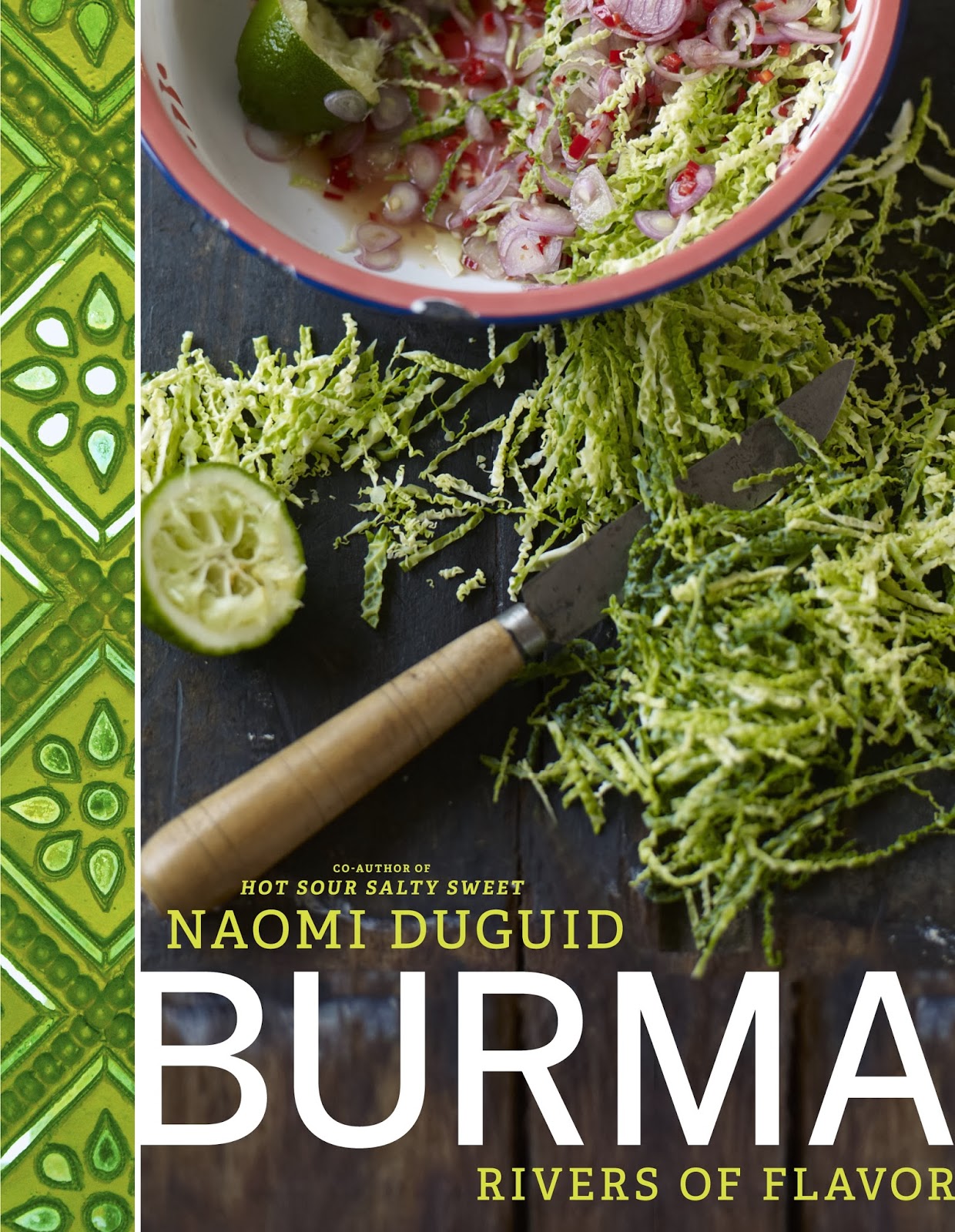
That's better.  The inspiration for this wine club dinner are those "spicy garlic smells" ... or the food of Burma, also known as Myanmar.  For this wine club, there will be a three course dinner of Burmese food based upon the recipes of Naomi Daguid's book, Burma, Rivers of Flavor.

FIRST COURSE
Ragoon Mohinga

Our gastronomic tour begins at the "End of Strife," also known as Rangoon or, now, Yangon. The former capital of Burma (or Myanmar) started as a small fishing village at the convergence of the Bago and Yangon rivers and around the most sacred of Buddhist temples for the Burmese people, the Shwedagon Pagoda.   The first course will be Rangoon Mohinga, which is a dish of broth poured over rice vermicelli noodles.  Mohinga is the Burmese version of Vietnamese phở, but with one significant difference.  Whereas phở is made with beef broth, mohinga is made with a delicate fish broth.  The mohinga is served with fish and shallots, along with some optional toppings and condiments. 

SECOND COURSE
Khua Haeng (Aromatic Chicken from the Shan Hills)

The tour continues northward to the Shan Hills, which stretch across Eastern Burma and lead the way to the city of Mandalay.  For the second course of this Burmese gastronomic tour, we will be serving Khua Haeng or Aromatic Chicken from the Shan Hills.  This is a relatively simple dish representing the Shan people, which live predominantly in the Shan state in eastern Burma, but also in the central regions of Burma, including the city of Mandalay.  Khua Haeng involves the frying of chicken in a large pot or wok with certain spices (tumeric, lemongrass, garlic, ginger, chiles and tomatoes) and then some aromatics toward the end of the cooking process.  The fried chicken will be served with perfumed coconut rice and a tender greens salad with crispy fried shallots.

THIRD COURSE
Shwe Gyi Mont (Semolina Cake)

For our final dish, we will be serving Shwe Gyi Mont, which is the Burmese version of an Indian semolina halva.  The semolina flour is toasted first, with liquids added and cooked over low heat and baked.  The result is described by Daguid as a "delicious cross between cake and sweetmeat."

So, that is the menu.  As always, it is subject to change depending upon the availability of ingredients. Any changes or updates will be added to this post.  Looking forward to seeing everyone soon!

ENJOY!