Showing posts with label Lemongrass. Show all posts

Sunday, August 23, 2026

Oysters with Lemongrass Chile Mignonette

Perhaps one of the greatest things about a mignonette sauce is its adaptability to ingredients. One never has to stick with a traditional mignonette that consists of shallots, vinegar, salt and vinegar. The sauce is, in many ways, a small canvas on which a cook or chef could create a variety of culinary artwork. 

Over the years, I have produced some culinary artworks (I use that phrase very lightly). I've prepared a Balsamic Mignonette, Lemon-Basil MignonetteBeer MignonettePeach Champagne MignonetteMango Habanero Mignonette, and Green Mignonette. None of these mignonettes come close to a work of art. I am no culinary Leonardo da Vinci, Khalil Rabah, Amoaka Boafu, or Diego Rivera when it comes to mignonettes or any other culinary work. 

That is okay, because mignonettes are not supposed to be masterpieces. The sauces always play a supporting role. That role focuses upon highlighting the sweetness or brininess of the oyster. If someone is using an oyster to eat a mignonette, then they have turned the entire experience on its head. Mignonettes are intended to elevate the eating of raw oysters. 

But, I firmly believe that mignonettes can serve another purpose, namely, to introduce people to new flavors and flavor combinations. A mignonette should serve not only to enhance, but to educate. I often look for unique or different mignonette recipes that shed some additional light upon a cuisine or a people. That search led me to this Lemongrass Chile Mignonette. Lemongrass is a common ingredient in southern and southeast Asian cuisines, from Sri Lanka to Vietnam and every where in between (think Thailand, Cambodia, Laos, Malaysia and Indonesia). It is also a foundational pairing with chiles. Together, both ingredients add something missing from raw oysters. Lemongrass provides a citrusy aroma, as well as a little bitter or tartness, which works well with sweeter oysters). Chiles, of course, provide a little kick that also works very well with sweet oysters. 

Together, lemongrass and chiles (or, in this case, sambal oelek, which is an Indonesian chile paste) play their supporting role. They worked very with the Chesapeake Bay oysters that I paired them with, both Misty Points and Chincoteague Salts. But, I hope that this mignonette will open the door for those who may not be as familiar as myself with Burmese, Thai, Cambodian, Laotian, Vietnamese, Malayasian or Indonesian cuisine. Both ingredients can be found in many recipes from across the region. If you are looking for a starting point, perhaps consider Aromatic Chicken from the Shan Hills, a Burmese recipe' Ga Xao Xo Ot (Lemongrass Chile Chicken), a Vietnamese recipe; or Larb, a Laotian dish. All of these recipes are easy to make and delicious to eat.

OYSTERS WITH LEMONGRASS CHILE MIGNONETTE

Recipe from Hama Hama Oysters

Serves 2-3

Ingredients:

  • 1 dozen oysters
  • 1/3 cup rice vinegar
  • 1 makrut lime leaf
  • 1 tablespoon chopped lemongrass
  • 1 tablespoon sambal oelek
  • 1/4 cup finely minced shallots
  • 1 teaspoon coarsely ground black peppercorns

Directions:

1. Infuse the vinegar. Heat the vinegar to a simmer, take off heat, and add lime leave and lemongrass. Let the vinegar infuse for at least an hour in the refrigerator (overnight is even better). 

2. Finish the mignonette. Strain out the aromatics and stir in the shallot, sambal and pepper. Chill for an hour to let the flavors come together. 

PEACE.

Saturday, March 15, 2025

Lowcountry Brown Oyster Stew

This post about an oyster stew takes us to a very specific and incredibly important part of South Carolina's lowcountry. It is that part that overlaps with the Gullah-Geechee Corridor. The corridor itself runs from Jacksonville, Florida to Wilmington, North Carolina. However, as the corridor passes through South Carolina, it crosses islands, along with towns and cities, with the rich history of the Gullah-Geechee people. 

The Gullah-Geechee are descended from West Africans who were forcibly taken places ranging from modern day Senegal to Angola during the 18th century. The enslaved West Africans were brought to the United States to labor on rice plantations on the South Carolina's sea islands and along its Atlantic Coast. I had an opportunity to learn about this history and its profound impact upon our country as I prepared a dish of Carolina Crab Rice. (Hint: it was the knowledge and skills, along with the uncompensated hard labor, of those enslaved West Africans that created the infrastructure for, as well as enabled the successful production of, rice in South Carolina.)

The enslaved brought more than their knowledge and skills to this country, they also brought a variety of ingredients that were not part of the American-table at that time. This recipe captures some of those ingredients. For example, dawadawa or fermented locust beans. The fermenting of locust beans can be traced back to the 14th century, and its use in the preparation of food goes equally far back in time. Cooks in African countries like Nigeria, Benin and Ghana use dawadawa in many iconic dishes, like Jollof, as well as soups or stews like Fakoye. Locust beans are typically not cultivated, rather they are dispersed by people and animals. That brings us to the connection between Africa and the "New World." Slaves brought these locust beans with them as they were forcibly taken from Africa and transported to various places in North America, like the South Carolina coast, or the Caribbean. That may be one reason why one can find locust beans, as well as dawadawa, in Haiti

Dawadawa (Source: Slow Food)

Another interesting ingredient is the dried crayfish powder. As someone who has used dried shrimp when preparing dishes from Sri Lanka, I have a little familiarity with the umami-like scents and tastes that the ingredient can provide to a dish. The use of dried crayfish powder is used for that very purpose -- to add umami -- in dishes prepared along the African coastline of modern day Ghana and Benin. The technique of drying crayfish - which thrive in freshwater and some brackish water -- could have been brought with Africans so that they could preserve this source of protein for use in dishes.

Both dawadawa and dried crayfish powder are more than ingredients; they embody culinary techniques. A natural processing of ingredients from the land or the water to obtain something more. This particular recipe highlights that fact. The use of dawadawa and ground crayfish powder, along with the sundried tomato powder, served as a substitute for bacon or smoked pork. These ingredients provided elements that mimic smoked flavors, earthiness and richness that one would ordinarily get from using diced up bacon or smoked ham.  

Together, these ingredients helped to produce a stew that I have to say is far more complex and delicious than any oyster stew made with heavy cream. If I had my druthers, I would produce a huge batch of this stew and enter as a contestant in the next Oysterfest held by the Chesapeake Bay Maritime Museum in October 2025. It probably would not win (as the winners are usually the heavy-cream based stews), but it would introduce a completely different, but equally authentic and historic, way to prepare this dish to an audience who would probably never have the opportunity to taste it. 

LOWCOUNTRY BROWN OYSTER STEW

Recipe from Saveur

Serves 4

Ingredients:

  • 2 teaspoons toasted benne (sesame seeds)
  • 1/2 teaspoon ground ginger
  • 1/2 teaspoon lemongrass powder
  • 4 tablespoons all purpose flour
  • 3 tablespoons vegetable oil, divided
  • 2 tablespoons unsalted butter
  • 1 celery stalk, finely chopped
  • 1 small yellow onion, finely chopped
  • 1.5 tablespoons sundried tomato powder
  • 2 teaspoons Caribbean bay leaf powder or 2 dried bay leaves; 
  • 1.5 teaspoon crawfish powder or dried shrimp powder
  • 2 teaspoons ground dawadawa
  • 1.5 teaspoon garlic powder
  • 1.5 teaspoon onion powder
  • 1.5 teaspoon smoked paprika
  • 1 teaspoon chipotle powder
  • 2 pints shucked fresh oysters
  • 6 cups seafood stock, vegetable stock or water
  • 1 teaspoon kosher salt, plus more
  • 2 tablespoons finely chopped onion sprouts or chives

Directions:

1. Toast the spices. in a large skillet set over medium-low heat, add the benne, ginger powder and lemongrass powder; toast until golden-brown, 3-5 minutes. Remove from heat. 

2. Prepare the roux. In a large pot over medium high heat, whisk together the flour, 2 tablespoons of oil and the butter. Stir continuously until the roux turns a dark chocolate brown color, about 5 minutes. 

3. Saute the vegetables. In a separate skillet over medium high heat, add the remaining oil, celery and onion. Cook, stirring frequently, until soft and translucent, about 3 minutes. Remove from the heat. 

4. Continue working with the roux. Turn the heat down to low, then add the tomato powder, bay leaf powder, dawadawa, crawfish powder, garlic powder, onion powder, smoked paprika and chipotle powder. Cook, stirring continuously until fragrant, about 1 minute. Stir in the celery-onion mixture and then slowly pour in the oyster liquor and the tock, stirring continuously until all the liquid is incorporated into the roux. Add the salt, turn the heat up to medium-low to bring the stew to a boil, then turn the heat back down to maintain a simmer. Cook until the broth is thick enough to coat the back of a wooden spoon and has reduced by about a third, 40 to 45 minutes. 

5. Finish the dish. Remove the stew from the heat, then immediately stir in the oysters (the residual heat will cook them). Season to taste with more salt as needed. Ladle the brown oyster stew into wide soup bowls, garnish with onion sprouts and reserved benne seed-ginger-lemongrass mixture and serve hot. 

PEACE.

Saturday, January 18, 2025

Fish Curry

Whenever I prepare a dish, I always have expectations. I have greater expectations when it comes to my favorite cuisine. I am a huge fan of south Asian cuisine. When asked for more specificity, my initial response is Sri Lankan cuisine (usually with an add-on that I also love the cuisine from Tamil Nadu and Kerala). The cuisine is fiery, due to the use of various chiles. It is also curry-based. Taken together, that is where my preferences are at the moment. 

As readers of this blog know, I have made many a curry recipe, sambol or other dish from this part of the world. Those recipes and dishes have created certain expectations whenever I pull a new recipe from a cookbook off of the shelf or print one off of the Internet. Those expectations include a fiery meal, fueled by the use of fresh chiles or piquant curry powders, along with a certain umami that comes from unfamiliar ingredients, like Maldive fish chips, or a particular combination of herbs and spices. 

Recently, I had the urge to make a fish curry. Often times, those curries end up being Chef Bolek Originals, like this one or this one. They basically represent an effort to use what I have learned over time making curries and then just "wing it." This time, the urge was different. I wanted to make a fish curry that more closely followed the lines of a cuisine. The cuisine that first came to mind was, of course, Sri Lanka. And, I had just the cookbook, Lanka Food.

I reviewed the recipe and prepared my grocery list. I then went to my local Asian grocery store to get the ingredients that I did not have on hand, like curry leaves, pandan leaves and coconut cream. I proceeded to make this dish according to the recipe. However, in the end, the dish was not what I had expected. 

Indeed, the dish challenged my expectations. Do all Sri Lankan dishes have to burn with the intensity of a blue flame? Even when I try to make the dish spicy, such as grabbing my hot curry powder instead of my regular curry powder, does that mean that the dish itself should change? It got me to thinking that, whenever I try to be mindful and in the moment, I also have to go one step further with my mind. Namely, I have to approach the present moment with an open mind.

Looking back, and setting aside my expectations, I can say that this particular fish curry dish is very good, even if it is not all that spicy. It is an acknowledgement that there is more to Sri Lankan cuisine than the Scoville-busting curries. That is a good thing to remember. 

FISH CURRY

Recipe from O Tama Carey, Lanka Food, pg. 162

Serves 4-6

Ingredients:

  • 500 grams skinless and boneless snapper fillets (or other firm white fish)
  • 40 grams coconut oil (or ghee or vegetable oil)
  • 4 grams curry leaves
  • 220 grams sliced brown onions (or yellow onions)
  • 20 grams finely chopped garlic
  • 15 grams finely chopped ginger
  • 15 grams finely chopped lemongrass, white part only
  • 1 long green chile, cut into thin rounds
  • 30 grams brown curry powder
  • 8 grams fennel seeds
  • 4 grams fenugreek seeds
  • 40 ml coconut cream
  • 4 x 5 pieces pandan leaf
  • Salt flakes
  • Freshly ground black pepper

Directions:

1. Prepare the fish. Slice the fish into bite sized pieces. Much will depend upon the size of the fillet, but try to make the slices about 1/2 inch thick. Cut them into similar sized pieces. Set aside in the refrigerator.

2. Saute the initial ingredients. Melt the coconut oil in a medium saucepan over medium heat, add the curry leaves and cook, stirring, for a minute or so until the leaves are fried. Add the onion, garlic, ginger, lemongrass, and chile and lightly season with salt and pepper. Cook, stirring occasionally for 6-7 minutes until the onion has softened. 

3. Continue the saute. Add the curry powder and fennel and fenugreek seeds and cook, stirring for 1-2 minutes until the curry powder begins to catch the bottom of the pan. Season again. Add the coconut cream, pandan leaf and 500 ml of water and bring to a boil, then reduce the heat and simmer gently until everything is cook and you can no longer taste a sharpness from the ginger. 

4. Cook the fish. Add the fish pieces and simmer gently until cooked. The cooking time will depend upon the size of the pieces but start checking from about 5 minutes. Taste the curry and season as needed.

PEACE.

Saturday, April 6, 2024

Lemongrass Chile Chicken (Ga Xao Xa Ot)

As followers of this blog may know, I am a big fan of the public broadcast television series, Luke Nguyen's Vietnam. I watched every episode, as the chef made his way across the country  to showcase the ingredients, dishes and traditions that make Vietnamese cuisine special. 

Many years later, I got a copy of the Luke Nguyen's cookbook, The Food of Vietnam. Much like his television series, the cookbook is a culinary tour from south to north, with many stops along the way.

One such stop was in Hoi An. As Nguyen describes the city: "There are no street lights, but the entire town is dotted with thousands of colourful lanterns, lighting up ancient old buildings and cobbled streets, a slow-folowing river and pretty foot bridges." Hoi An is a remarkable place, finding itself on UNESCO's World Heritage List as a well preserved Southeast Asian trading port. The government owns the entire town, with its structures and environment controlled by several laws. 

As Chef Nguyen made his way through this beautiful town, the one thing he noticed was an "obsession with food." As he wrote, "I am surrounded by street food, market food, restaurants, cafes, and even liitle old ladies sitting on the streets with a steam pot and kerosene lamps." Chef Nguyen had more stories about the town, its people and their food; but, I have to admit I skipped to the recipes (knowing that I would return to read the rest of what he wrote). As I paged through recipes, such as Green Mango & Dried Anchovy Salad and Whole Chicken Pot-Roasted in Sea Salt, my attention fixated upon one particular dish ... Lemongrass Chile Chicken. 

Chef Nguyen prepared this dish in the garden of Brother's Cafe, a restaurant in Hoi An. This dish presented an opportunity to cook with many familiar ingredients, such as fish sauce, chiles, lemongrass and garlic, along with a new ingredient, coconut water.  Coconut water is a clear liquid found in young coconuts, and it is available in many supermarkets. 

This dish is very easy to make, with the only issue being the time it takes to marinate the chicken. (I really wanted to try the dish, so I was a little impatient while the chicken rested in the refrigerator.) Once prepared, this recipe reminded me of all the great things about Vietnamese cooking, such as the lightness of the dish and the balance of the five flavor elements.

LEMONGRASS CHILE CHICKEN (GA XAO XA OT)

Recipe from Luke Nguyen, The Food of Vietnam, pg. 175

Serves 4-6

Ingredients:

  • 3 tablespoons of fish sauce
  • 1.5 tablespoons of sugar
  • 2 lemongrass stems, white part only, finely diced
  • 4 garlic cloves, finely diced
  • 2 long red chiles, finely diced
  • 1 pound of boneless, skinless, chicken thighs, cut into bite-sized pieces
  • 3 tablespoons vegetable oil
  • 1 cup young coconut juice
  • 1/2 onion cut into wedges
  • Cilantro sprigs, for garnish

Directions:

1. Prepare the chicken. In a mixing bowl, combine the fish sauce and sugar and mix until the sugar has dissolved. Add half the lemongrass, half the garlic, half the chile and all of the chicken. Toss the chicken to coat, then cover and marinate in the refrigerator for one hour or overnight for an even tastier result. 

2. Cook the chicken. Heat a large saucepan or work over medium heat. Add the oil and the remaining lemongrass, garlic, chile and stir-fry for one minute, or until fragrant and slightly brown. Increase the heat to high, then add the chicken and sear for 2 minutes on each side or until browned all over. Now add the coconut juice and the onion. Cover and cook over medium heat for 5 minutes or until the sauce has reduced by half. 

3. Finish the dish. Transfer to a bowl, garnish with coriander and serve with steamed jasmine rice.

PEACE.

Friday, February 2, 2024

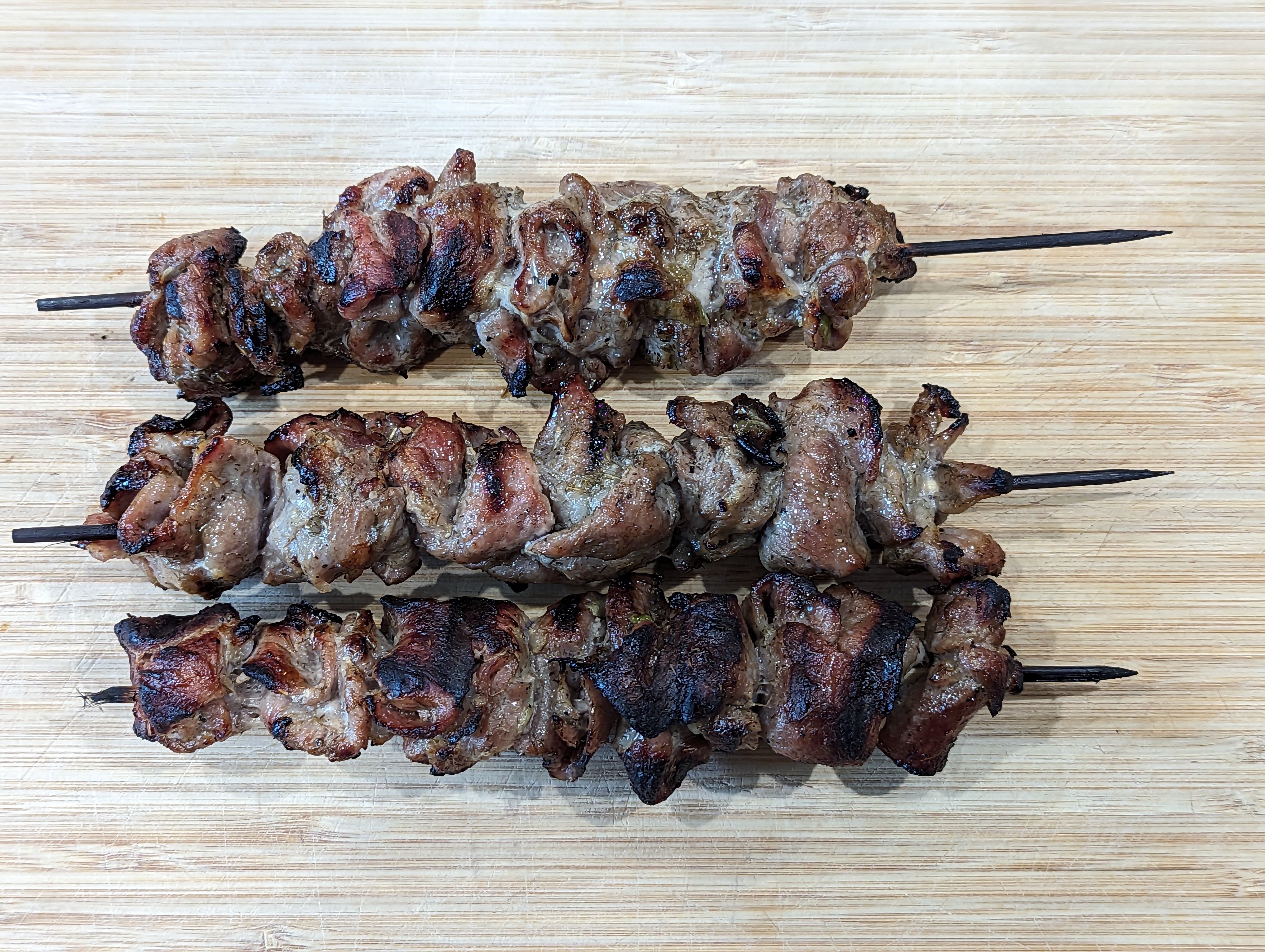
Chargrilled Hmong Black Pig Skewers with Sesame Salt

"I would tell people that Hmong food is not just a type of food. It's not about the product. It's a philosophy.... If you want to know our people you have to know our food. By knowing our food, you will know our story. You'll know where we been and it will show the trajectory of where we're going.  

-- Chef Yia Vang

To the extent people know about the Hmong, that knowledge comes more from political history. The Hmong are an indigenous ethnic group that has lived for centuries as a minority in eastern and southeastern Asia. During the Vietnam War, the United States Central Intelligence Agency recruited and trained the Hmong living in Laos for a "secret war" against the North Vietnamese Army. The Hmong harassed the North Vietnamese along the Ho Chi Minh trail, safeguarded U.S. radar installations, and rescued downed American pilots. After the war, the communist governments of Vietnam and Laos declared that the Hmong were "traitors." The governments persecuted the Hmong. They arrested the Hmong, who were sent to hard labor camps. They sprayed Hmong villages with chemicals, including napalm.  Nearly ten percent (10%) of the Hmong population was killed and around 100,000 Hmong sought refuge in neighboring Thailand and beyond. 

The culinary history of the Hmong is far less known. Before the Vietnam War, the Hmong had a strong agrarian tradition in the mountains of northern Laos and Vietnam. They grew rice and other produce, as well as raised livestock, such as pigs. The Hmong practiced animism, believing that objects, plants animals, and even places have their own spirit. These beliefs underlie the respect that the Hmong hodl for what they have. It also informs their traditions. 

For example, there is a Hmong tradition -- called Noj Tsiab (nee-al jia) -- that centers around the butchering of a pig. During the last week of December, each family would select a pig from their herd to be butchered. Every family member had a role in the process, being taught by the elders how to prepare the pig, how it would be cut, and how to ensure that all of the pig would be used with nothing going to waste. This knowledge was important, and it was passed on from generation to generation. The end products would be used to prepare a meal for the community for the new year. It enabled everyone to participate in a tradition that gives thanks for what they have been given and to their ancestors for watching over them.

This tradition was lost, at least temporarily, for those Hmong who fled their homes and found themselves in refugee camps. Even after they escaped those camps, making their way to the United States or elsewhere, many of their new lives did not include the raising of pigs, let alone the opportunity to butcher them in accordance with their traditions. 

I knew none of this when I came across a recipe for Chargrilled Hmong Black Pig Skewers with Sesame Salt.  It was in a cookbook called the Food of Vietnam. The author, Luke Nguyen, is a Vietnamese-Australian chef who was part of a television show, Luke Nguyen's Vietnam, that I watched on public television. Every episode fascinated me, both with respect to the people, the surroundings, and, of course, the food. When I got this cookbook, as well as another Vietnamese cookbook, I spent a lot of time paging through the recipes. This one caught my eye because of the reference to the Hmong people. 

Roasted sesame seeds with salt
According to Chef Nguyen, the Hmong raised black pigs in the hills and mountains of Vietnam. The cuts from the necks would be used for this dish. I had access neither to those particular black pigs, or, more generally, to pig necks. Instead, I looked for any cut of pork that would enable me to slice thinly or that came sliced thinly. 

There are two things that I really like about this recipe. The first thing is the marinade. The recipe calls for a combination of scallions, lemongrass, fish sauce, oyster sauce, black pepper, and honey, for a marinade. This particular combination of ingredients imparts a lot of flavor into the meat, which is facilitated by the fact that the meat has been thinly sliced.  The second thing is the ease of preparing this dish. Once the marinade is complete, the rest of this recipe is easy: just thread some pre-soaked skewers, place on a heated grill, flip the skewers a few times and you are done. 

These skewers are very delicious and, given the ease of preparing this dish, I will very likely make this recipe again. The next time will take on a little more meaning now that I have some understanding of the traditions of the people behind the recipe. 

CHARGRILLED HMONG BLACK PIG SKEWERS WITH SESAME SALT

Recipe from Luke Nguyen, The Food of Vietnam, pg. 318

Serves 4-6

Ingredients:

  • 300 grams (10.5 ounces) pork neck, thinly sliced
  • 2 tablespoons toasted sesame seeds
  • 3 spring onions, sliced then bashed to release the flavor
  • 4 tablespoons finely diced lemongrass, white part only
  • 3 tablespoons fish sauce
  • 1 teaspoon oyster sauce
  • 1 teaspoon sugar
  • 1 tablespoon honey
  • 1/2 teaspoon freshly ground black pepper
  • 3 tablespoons vegetable oil

Directions:

1. Prepare the marinade. Combine the onions, lemongrass, fish sauce, oyster sauce, sugar honey and black pepper in a mixing bowl and mix well. Add the pork and toss until well coated. Cover and marinate in the refrigerator overnight. 

2. Prepare the skewers. Soak 12 bamboo skewers in water for 30 minutes to prevent scorching. Thread the pork on to the skewers and chargrill on each side for 3 minutes. Mix the sesame seeds with a pinch of sea salt. Serve on the side for dipping the skewers into. 

PEACE. 

Monday, December 26, 2022

Around the World in 80 Dishes: Sri Lanka

As a young kid, I was always fascinated with maps, both new and old. I spent a lot of time going from continent to continent,  country to country. I spent a lot of time learning the geography of each country ... their shapes, capitals, major cities, and much more. Whenever I looked at these maps, one teardrop-shaped  island always caught my eye. It has the shape of a little teardrop, falling off the southeastern coast of the Asian subcontinent. I traced the outline of the island, from Jaffna at the tip, down the coast through either Colombo or Trimcomalee, to the bottom at Matara. All of those old maps referred to that little island as "Ceylon."  Go back further, and the island was referred to as "Serendip," short for serendipity. 

Since 1972, the country has been known as Sri Lanka (which translates as "resplendent island") or, officially, the Socialist Democratic Republic of Sri Lanka. The country is home to diverse groups, from the majority Sinhalese to a large minority of Tamils, along with Moors, Burghers, Malay, Chinese and indigenous people known as the Vedda. Nearly every major religion -- Buddhism, Hinduism, Christianity and Islam -- is practiced in Sri Lanka. This multi-ethnic country provides the setting for my latest Around the World in 80 Dishes personal culinary challenge.

This particular challenge has probably been the longest of my Around the World challenges in terms of the recipe planning. That planning began a few years ago. I met one of my best friends for dinner at a pop-up restaurant.  The menu featured a range of Sri Lankan dishes.  We selected a range of dishes from all of the categories on the menu. Every single dish was an amazing experience. 

Since that pop-up dinner, I had a lot of thoughts about what I would prepare if I would be presented with the challenge of making a main course from Sri Lanka as part of my Around the World in 80 Dishes culinary challenge. I started to organize my thoughts, but, then I realized that I needed to learn more about the cuisine itself. This challenge provided me with the best opportunity for that education. It was a challenge that I was more than ready to accept.

One common theme emerged very early in my research is the following: Sri Lankans curry just about anything and everything. As someone who loves everything about the cuisine from the subcontinent, this theme greatly appeals to me. It led me to spend some extra time learning about just what makes this cuisine so special. 

I searched the internet for articles about the ingredients, cooking processes and ingredients, finding some articles that provided a decent background into Sri Lankan cuisine. However, it was a the book Lanka Food that really fueled my research. The book provided an introduction into the cooking processes (such as use of chatty pots over a hearth) and ingredients (with explanations for ingredients that I have never heard of or used before, such as pandan leaves, goraka and Maldive fish chips).  Most importantly, it provided another source of recipes from which I could use as a guide for not only the main course, but also the accompaniments, such as the sambols.

One final note about Sri Lankan cuisine, which ties into something that has really caught my attention in recent months. It is how the cuisine incorporates the five flavors - sweet, sour, salty, bitter, and umami. I was first introduced to this concept through Vietnamese cuisine, where it is known as "Ngu Hanh" or "Ngu Vi." I got to learn more about this concept with my introduction to Sichuan cuisine, which actually adds additional flavors, such as "fragrant." As with Chinese and Vietnamese cuisine, Sri Lankan cuisine incorporates this balancing of different flavors, and, it often does so not just in one dish, but by the incorporation of multiple dishes, such as the pairing of a curry with a sambol.

For this challenge, I decided to do more than just the main course. I had too much information in front of me to simply complete the challenge and move on to the next one. I wanted to try to create that balance of flavors through not just one dish, but with a whole meal. So, here it goes....

MAIN COURSE

For the cuisine that curries everything, the most iconic of Sri Lanka's curries revolves around chicken. Sri Lankans refer to it as Kukul Mas. The history of this dish traces it to Colombo, which was the country's historical capital. (The capital, at least for legislative purposes, has moved to Sri Jayewardenepura Kotte.) It is a dish that comes from the island's Sinhalese community. They represent a majority of the Sri Lankan population and their cuisine has been described as one of the most complex of South Asia. While I am still looking for an adequate explanation of that complexity, the one thing that I have learned from this challenge that there is a complexity in terms of how different flavors and textures are added to dishes. 

This chicken curry dish provides an example of another feature of Sri Lankan cuisine: the many variations of dishes. In some respects, there are as many variations of Kukul Mas as there are families and restaurants that prepare the dish. Many of the variations are based on the different spices used to create the curry powder. Other variations surround other ingredients. For example, some recipes for Kukul Mas use tomatoes or tomato puree (a nod to the colonial influences that brought the ingredient to the island). Tomatoes provide the curry with a reddish hue. Others, such as the recipe that I used, dispense with the tomato. These recipes result in a dish of golden chicken, thanks to the turmeric in the curry powders. Despite all of the variations, one common note among recipes is the preference for using a whole chicken, broken down into its constituent parts. This approach ensures that the bones are used and ensures that they provide additional flavor to the dish. In the end, regardless of the recipe used, the end result is a delicious dish that can be found on the tables of many homes in Sri Lanka.

KUKUL MAS CURRY

Recipe from Dish

Serves 4

Ingredients:

  • 1 whole chicken (about 3 pounds), cut into pieces (or bone-in, skin on chicken thighs and drumsticks)
  • 3 tablespoons olive oil
  • 4 cardamom pods, bruised
  • 3 dried chiles
  • 8-10 curry leaves
  • 2 onions, finely chopped
  • 2 cm piece fresh ginger, peeled and grated
  • 4 cloves garlic, finely chopped
  • 1 teaspoon ground turmeric
  • 2 teaspoons ground paprika
  • 1 teaspoon ground cumin
  • 1 teaspoon ground coriander
  • 1/2 teaspoon ground fennel
  • 1 cup coconut milk
  • 1 stem lemongrass, bruised
  • 1 cinnamon stick
  • 1 teaspoon salt
Directions:

1. Prepare the chicken.  Joint the chicken, then cut the breast and thigh in half, leaving the wings and drumsticks whole.

2. Sauté the spices.  Heat the oil in a large heavy-based saucepan over medium heat. Add the cardamom pods, chiles, and curry leaves and fry for 2 minutes, stirring. Add the onion and cook until golden. Add the ginger and garlic and cook for 2 minutes.  Add the ground spices and stir well to combine. 

3.  Sauté the chicken.  Add the chicken to the pan and stir until it is well coated with the spice mix.  Add half of the coconut milk, the lemongrass and cinnamon, cover and cook over low heat for 40 minutes to 50 minutes.  Stir in the remaining coconut milk, season with salt and cook uncovered for a further 5 minutes to 10 minutes. 

SIDE DISH

Although the Kukul Mas satisfies the challenge, I wanted to prepare an entire Sri Lankan meal.  The author O Tama Carey describes dhal as the "most essential side dish" in her Lanka Food cookbook (at page 183). A dhal is basically a curry that features a dried, split pulse - such as lentils, beans or peas - as the principal ingredient. Given Carey's description, I had to make a dhal to accompany my chicken curry. Dhals can be found across the subcontinent.

In Sri Lanka, dhals are commonly prepared with red lentils. The common ingredient belies a range of variations in dishes, with some dhals being spicier than others, and some dhals being thicker than others. There are also differences in how the dhal is finished, with some adding green leaves (such as curry leaves, which help reinforce flavors), while others get a garnish, such as fried onion, to add texture to the dish.

In my research for this challenge, I spent a lot of time at a local Sri Lankan grocery store called Spice Lanka. (BTW, I strongly recommend this small, family owned business, because they have a good selection of ingredients and the owners and staff are always very friendly.) I also purchased quite a few ingredients from the store, including a bag of red lentils. Those lentils enabled me to make this Sri Lankan dhal. 

DHAL

Recipe from O Tama Carey, Lanka Food, at 186

Serves 4-6

Ingredients:

  • 75 grams (2 3/4 ounces) coconut oil
  • 5 grams (1/5 ounce) curry leaves
  • 550 grams (1 lb, 3 oz.) brown onions, cut into medium dice
  • 18 grams (2/3 ounce) finely chopped garlic
  • 15 grams (1/2 ounce) finely chopped ginger
  • Salt
  • Freshly ground black pepper
  • 7 grams (1/4 ounces) black mustard seeds
  • 5 grams (1/5 ounce) turmeric powder
  • 1 cinnamon stick
  • 4 2-inch pandan leaf
  • Bottom 2 inches lemongrass stem, lightly bruised
  • 525 grams (1 lb, 3 oz.) red lentils, thoroughly washed
  • 450 ml (15 fluid oz) coconut cream
Directions:

1. Saute Ingredients. Melt the coconut oil in a medium saucepan over a medium heat, add the curry leaves and cook, stirring, for a minute or so until the leaves are fried. Add the onion, garlic and ginger and cook, stirring occasionally, for 6-7 minutes until the onion has softened. Lightly season with salt and pepper. Add the mustard seeds, turmeric, and cinnamon and cook, stirring, 1-2 minutes until the turmeric begins to catch the bottom of the pan.

2. Cook the lentils. Add the pandan leaf, lemongrass and lentils and give everything a good stir to combine. Pour in the coconut cream and 1 liter (36 fluid ounces or 4 1/4 cups) of water and mix well, then reduce heat to low and simmer gently for 10-15 minutes, stirring occasionally. the dhal is ready when all the lentils have just given away and turned yellow while still retaining a little texture. Re-season with salt and pepper and serve hot. 

CONDIMENT (SAMBOL #1)

"Sambal is a state of mind." While an Indonesian chef, William Wongso, may have uttered those words, the statement is seemingly universal in southern and eastern Asian cuisine. Sambals - or Sambols, as they are referred to in Sri Lanka (the only country that uses an "o" instead of an "a") are a condiment based upon chiles.  As Carey notes in Lanka Food (at pg. 209), sambols play an important role in adding flavors, spices and textures to dishes. 

There are many different sambols in Sri Lankan cuisine. I decided to make two of them for this challenge.  The first one - pol sambol - literally translates into coconut sambol. It is perhaps the most common sambol in Sri Lanka. It also serves as a good representation of the balancing of the five tastes. There is the sweet from the coconut, the umami from the Maldive fish chips, the heat from the chiles and the sour or bitter from the lime juice. 

POL SAMBOL

Recipe from O Tama Carey, Lanka Food, at 214

Serves 8-10

Ingredients:

  • 300 grams or 10 1/2 ounces of grated coconut
  • 100 grams or 3 1/2 ounces finely sliced shallots
  • 3 small green chiles, finely chopped
  • 20 grams or 3/4 ounce Maldive fish chips
  • 5 grams (1/5 ounce) chilli powder
  • 3 grams (1/10 ounce) freshly ground black pepper
  • 3 grams (1/10 ounce) sweet paprika
  • 1-2 limes juiced
  • Salt, to taste
Directions:

1. Combine the ingredients. Place all of the ingredients, except the lime juice and salt, in a bowl and firmly mix them together with one hand, using a squeezing and kneading motion. This not only combines the ingredients, but it helps to release the oils from the coconut. Keep going until the texture of the sambol is almost a little sticky.

2. Finish the dish. Season to taste with lime juice and a generous amount of salt, mixing and squeezing again. Serve at room temperature.

CONDIMENT (SAMBOL #2)

For the second sambol, I decided to continue my exploration of new ingredients. This sambol introduced to me the use of dried shrimp. Much like the Maldive Fish Chips, the dried shrimp provided an almost umami flavor to this particular sambol.  

DRIED SHRIMP SAMBOL

Recipe from Asia Society

Ingredients:

  • 1 cup dried shrimp
  • 1 cup desiccated coconut
  • 3 teaspoons chopped red chiles or sambal oelek
  • 2 medium onions, chopped
  • 2 tablespoons garlic, chopped
  • 3/4 cup lime juice
  • 1 teaspoon salt, or more to taste
Directions:

1. Prepare the shrimp and the coconut. Floss prawns in a blender or food processor. Put desiccated coconut in a dry frying pan and toast, stirring constantly, until there is a rich brown color. Immediately turn out onto a plate to cool.

2. Blend the ingredients. Blend the chiles, onion, garlic, lime juice and salt to a smooth puree.  Add the coconut and blend again, adding a little water if necessary to produce a smooth paste.  Add the shrimp floss and blend again, scraping down the sides of the container with a spatula. Serve as a relish with rice and curries. 

*    *    *

This challenge may have taken a really long time to come together, but the end result was perhaps one of the most delicious meals that I have had in a long time. I really liked the Kukul Mas Curry and I will eventually make it again, perhaps adding some of the variations that I came across while researching the dish. As for the sambols, I think I should have them around like bottles of hot sauce. Fortunately, I have enough Maldive fish chips and dried shrimp to make both of the sambols ... again and again!

Until next time ...

ENJOY!    

Sunday, September 25, 2022

Catfish Curry with Lemongrass and Chiles

It has been a very long time since I have made a "Chef Bolek Original." There are a few reasons. I have not had a lot of time to cook recently, so that limited the opportunities to get creative. When I have been cooking, I have been trying to learn how to make certain types of dishes, whether it is exploring the curries of the subcontinent or southeast Asia or experimenting with different whole fish recipes. 

Nevertheless, the cooking that I have done has left me with a lot of leftover ingredients, such as long lemongrass stems and more habaneros than I know what to do with. Rather than let those ingredients sit around until they are ready to be composted (which, unfortunately, happens from time to time because of my busy schedule), I decided that I would take the ingredients that I had and make a dish just off the top of my head. It is a slightly different method than how I used to make Chef Bolek original recipes. (The old way was for me to wander the aisles of grocery stores and try to get "inspired" to make something - a process that often resulted in a lot of leftover ingredients destined for the compost pile.)

I did have some inspiration this time around, which I drew from a catfish curry that I had previously made. The difference is in the principal ingredients for this curry, which were lemongrass stalks and those habanero peppers. I also had some extra shallots and scallions lying around, so I incorporated those into the recipe as well.  As for the main ingredient - the centerpiece if you will - I went with catfish nuggets. The pieces left over after the filleting of catfish. It only seemed appropriate that those scraps be used in a recipe where I was basically throwing the "kitchen sink" into the bowl. 

In the end, this curry was something completely different and delicious than what I have previously made. The lemongrass, accentuated by the garlic and the fish sauce, was front and center, distracting one from the kick of the habanero chiles. Perhaps the lesson from this dish is to change how I make Chef Bolek originals. Only time will tell. Until next time ...


CATFISH CURRY WITH LEMONGRASS AND CHILES

A Chef Bolek Original

Serves 2

Ingredients:

  • 3/4 pound of catfish nuggets or catfish fillet
  • 1 tablespoon of fresh lemongrass, peeled to soft core and chopped
  • 2 cloves garlic
  • 1 shallot, sliced
  • 2 habanero chiles, deseeded and sliced
  • 4 scallions, white parts only
  • 2 tablespoons of ginger, peeled and chopped
  • 2 tablespoons fish sauce
  • 2 tablespoons rice vinegar
  • 2 tablespoons vegetable oil or canola oil, plus one tablespoon
  • 1 teaspoon turmeric powder
  • 1 lime, juiced

Directions:

1. Prepare the marinade.  Add the lemongrass, garlic, shallot, habanero chiles, scallions, ginger, fish sauce, rice vinegar, turmeric powder and oil to a food process and process until you have a relatively smooth sauce. 

2. Marinate the catfish. Place the catfish in a bowl, add the marinade and mix thoroughly. Let rest for 15 to 20 minutes or cover and refrigerate for a couple of hours. When you are ready to cook make sure to bring out the catfish at least 15 minutes before you start so that it can come to room temperature.

3. Prepare the curry. Heat 1 tablespoon of oil in a pan over medium high heat. Add the catfish and saute for about 10 minutes, stirring occasionally. As you stir, break larger pieces of catfish into smaller ones and continue to stir so that all pieces are coated by the sauce. 

4. Finish the dish. Remove the catfish from the heat. Sprinkle the lime juice over the catfish. Plate some rice and put the catfish on top. Serve immediately.

ENJOY!

Saturday, September 17, 2022

Whole Roast Fish with Lemongrass and Ginger

There is something about a whole fish that is either roasted or grilled. The entire fish - head to tail (minus the innards), laying on the plate, inviting the diner to peek below the skin to see the flaky, flavored meat. Working one's way down the filet and then lifting the backbone to reach the other fillet resting on the plate. It is perhaps the best way to enjoy fish because the cooking process ensures the maximum amount of flavor, given the fish is cooked with the bones and the skin. 

As much as I love whole fish, it is a preparation that I have rarely done. There are quite a few reasons; however, the main one is that I had some difficulty in finding whole fish that I would want to cook in this manner. Most standard grocery stores don't carry a large selection of whole fish. Some higher end stores have the selection, but it comes with a rather hefty price. All of this changed when I started shopping at the local Asian markets. Those stores had a large selection of whole fish.

I recently decided to take advantage of that selection. I purchased four whole sea bass because I wanted to make a New York Times recipe for whole roast fish with lemongrass and ginger. This particular recipe reminded me of my recent forays through southeast Asian cuisine. The lemongrass and ginger reminded me of Burmese (or Myanmar) cuisine, which utilizes these ingredients provide freshness to their curry dishes. The use of habanero chiles evokes Laotian cuisine, which boasts of dishes that have a spicy kick. The coconut milk draws parallels to Thai curries. All of these ingredients come together for a completely unique dish, which is why the recipe caught my attention. 

This recipe worked very well with sea bass. It could also work well with any other mild white fish. Truth be told, that would most likely come in the form of whole Tilapia, but it might work well with speckled trout or rainbow trout. Other mild white fish, such as cod, grouper or halibut are rarely sold whole and, if so, are well beyond the budgets of most people (including me). 

WHOLE ROAST FISH WITH LEMONGRASS AND GINGER

Recipe from New York Times Cooking

Serves 4

Ingredients:

  • 2 1/2 pounds of whole fish, scaled and cleaned (about 3 branzino)
  • 6 tablespoons of neutral oil (such as grapeseed or canola oil)
  • 1 1/2 tablespoons Kosher salt
  • 1 stalk lemongrass (about 2 1/4 ounces tougher outer part discarded, chopped)
  • 1 (2-inch) piece of ginger, scrubbed and chopped
  • 4 scallions, green parts sliced and white parts trimmed and left whole
  • 1 scotch bonnet chile, with or without seeds, chopped
  • 1 shallot, peeled and and chopped
  • 2 lemons
  • 1/2 teaspoon ground turmeric
  • 1/2 cup full fat coconut milk
  • 10 cilantro sprigs, cut crosswise
Directions:
1. Prepare the fish. Preheat the oven to 425 degrees Fahrenheit.  Pat the body and inside of the fish dry, and space the fish evenly apart on an unlined sheet pan.  Using a sharp knife, cut two diagonal slits, 2 inches apart, into the skin of each fish, making sure not to cut through to the bone. Repeat the slits on the other side.  Drizzle both sides and the inside with 3 tablespoons of oil and season with 1 1/2 tablespoons salt. 

2. Prepare the marinade. Working in batches if necessary, transfer the lemongrass to the bowl of an asanka or a mortar.  Use the pestle to pound the lemongrass pieces until fragrant.  Move the crushed pieces to one side of the mortar bowl or the asanka.  Add the ginger pieces and repeat the process until they are crushed.  Combine the ginger and the lemongrass.  Add the scallion greens and the scotch bonnet chile.  Use the pestle to crush and combine these with the lemongrass mixture.  Add the shallot and the zest of 1 lemon, crush and combine with the paste.  Stir in the turmeric and coconut milk.  (Makes about 1 1/4 cup marinade.)  As an alternative, you can use a food processor, adding the ingredients in order and pulsing them together.  Stir in the turmeric and coconut milk.

3. Continue to prepare the fish. Slice the zested lemon into 3 or 4 rounds. Spread the marinade generously over both sides of each fish and about 2 tablespoons into each cavity.  Place a lemon slice, the white end of a scallion and some cilantro sprigs in each cavity.  (At this point, the fish can be left to marinate for up to 30 minutes or covered and refrigerated overnight.) Drizzle the tops of the fish with the remaining oil.

4.  Roast the fish. Roast the fish until firm and cooked through, rotating the sheet pan once halfway through the process, about 22 to 25 minutes.  Slice the remaining lemon into wedges.  Serve the fish over steamed rice or alongside a hearty salad with lemon wedges for squeezing.

ENJOY! 

Saturday, March 19, 2022

Aromatic Chicken from the Shan Hills

There is a region in Myanmar (or Burma) just east of Mandalay, which is historically referred to as the Shan Plateau. If one were to look at a map of the area, it is not so much of a plateau, but hills and mountain ranges divided by narrow valleys. In more recent years, the area has been referred to as the Shan Hills rather than the Shan Plateau. This new name is a little more representative of the landscape in the area. 

The Shan Hills are also a part of the Shan State, which is a political division in eastern Myanmar. It is an area with a long history of armed conflict between the central government and various militias seeking greater autonomy or independence. At the center of that conflict in many ways is the Shan, which form the largest ethnic group in the Shan State and the largest minority in the entire country of Myanmar.

The name "Shan" generally refers to a range of ethnic groups who refer to themselves as the Tai (တႆ). Their cuisine of the Shan or Tai is popular in Myanmar. It incorporates a wide range of ingredients and foods, primarily because the climate enables the cultivation of a wide range of fruits and vegetables. Some of these ingredients include water bamboo, banana buds, quince fruit and pennywort. The Shan also utilize every protein in a wide range of preparations. One that caught my attention is a fermented pork "sashimi."

My introduction to Shan cuisine is going to be a little more traditional, namely, a chicken curry. Generally speaking, Burmese curries stake their own position separate and apart from the curries of their neighbors, such as India, China and Thailand. Burmese curries do not use the spices that often find their way into Indian curries, such as coriander seeds, cumin, cinnamon or cardamom. (Khin Maung Saw, Burmese Cuisine, Its Unique Style and Changes After British Annexation, at 6.) There are also no traditional masalas or curry powders in Burmese cooking. Instead, Burmese curries begin with a generous amount of garlic and ginger, followed by different ingredients, such as lemongrass and lime leaves, to build the flavor of the dish. As for Shan curries, they are known for their use of fresh herbs, such as galangal, lemongrass and sawtooth coriander. (Naomi Daguid, Burma.)

This recipe for aromatic chicken demonstrates the uniqueness of Burmese curries, as well as what one could find in the Shan Hills. The recipe begins with a lot of garlic and ginger, which are pounded into a paste with dried chiles. The curry is then prepared by first browning the chicken in hot oil before adding the paste, along with onions and turmeric.  The recipe demonstrates its Shan roots with the use of lemongrass, lime leaves and cilantro, all of which provide a freshness to the dish.

In the end, this recipe demonstrates what I love about cooking and learning about cooking. Dishes such as this Aromatic Chicken from the Shan Hills represents one significant truism. It is how different groups of people but their own mark on the food they eat, yet, at its most basic level, that food -- such as a curry (however defined) -- is what is common among all of those people. That truism applies in many ways in Myanmar, a country with 136 recognized indigenous ethnic groups. (I underline the number because the Myanmar government only officially recognizes 135 ethnic groups, which include the Shan. The government does not recognize the Rohingya as an indigenous ethnic group within the borders of Myanmar, which I believe to be wrong.)

AROMATIC CHICKEN FROM THE SHAN HILLS

Recipe from Naomi Duguid, Burma, page 167

Serves 6

Ingredients:

  • 2/3 cup chopped garlic
  • 1/2 cup sliced ginger
  • 2 dried red chiles, stemmed
  • 1 tablespoon salt
  • 1/4 cup peanut oil or vegetable oil
  • 1 3 to 3 1/2 pound chicken chopped into small pieces
  • 1 cup sliced white or yellow onion
  • 1 tablespoon turmeric
  • 3 stalks lemongrass, trimmed, smashed and sliced into 1 inch lengths
  • 2 Roma or other tomatoes, cut into small wedges (about 8 per tomato)
  • 1/2 cup fresh young lime leaves
  • 1/2 cup cilantro leaves, finely chopped

 Directions:

1. Prepare a paste. Pound the garlic, ginger and chiles together with a little salt to make a course paste; otherwise, mince them. set aside. 

2.  Cook the chicken. Heat the oil in a large pot or wok over medium-high heat. Add the chicken and turn the pieces in the hot oil for about 3 minutes. Add the onion, 2 teaspoons of salt, turmeric, lemongrass, garlic, ginger, chiles and tomatoes and stir and cook for 2 minutes. Lower the heat to medium, cover and simmer for 5 minutes. 

3. Finish the dish. Add the lime leaves and other 1/2 teaspoon of salt, stir and simmer for 10 minutes or until the chicken is tender and cooked through. Taste and adjust the salt if you wish. Add the coriander, stir in and serve. 

ENJOY!

Friday, November 2, 2018

Angel Cruz Beef Skewers

After the overthrow of the Khmer Rouge in 1979, thousands of Cambodians sought refuge in the United States.  It is estimated that, by 1994, approximately 158,000 Cambodians had legally entered the U.S., most of those were refugees. The United States settled these refugees across the country; and, over time, Cambodian communities began to emerge. Communities such as those in Lowell, Massachusetts (which is the second largest in the United States); Jacksonville, Florida; and Columbus, Ohio, along with Los Angeles and Stockton, California.

And, in Stockton, there is Angel Cruz park, a local gathering site for the Cambodian Community.  Families gather together at the park to "hang out, grill, and eat."  I have never been to Stockton, California, let alone to Angel Cruz Park.  Thanks to the wonder of the Internet, I can still get a sense of what happens there. If one were to Google "Cambodian Angel Cruz Park," like I did, he or she would find videos of cooks grilling and preparing a variety of Cambodian foods. 

If you want to get a sense of the kinds of food being prepared, this video provides an example of the experience: 


While I may not be in Stockton, and, I am not Cambodian, that does not mean that I can't try to bring a little of Angel Park out my way.  I found a recipe from Nite Yun, the owner and chef of Nyum Bai (which means "Let's Eat!" in Khmer).  According to Eater, Nite Yun was born in a refugee camp in Thailand.  At age 2, her parents made their way to the United States as refugees. While her parents had been sponsored to go to Texas, they settled in California, Stockton to be exact.  Although her parents were thousands of miles away from their home, they brought their culture, and their food, with them to the U.S.  Yun remembers, "sitting on the floor, chopping lemongrass, peeling garlic, washing veggies and herbs."  She loved that work, and she eventually learned how to cook on her own.  

As her interest in food grew, Nite Yun realized that the food of her family and culture, Cambodian food, was unrepresented.  There were no good Cambodian restaurants.  During a trip to Phnom Penh, the capital of Cambodia, Yun was at a noodle stall when she decided that she would start her own restaurant.  A restaurant focused on her culinary and cultural heritage.  That moment led to Nyum Bai. The menu is graced with dishes such as Naim Chien Chrouk (crispy rolls filled with taro, cabbage, glass noodles, pork, garlic and onions), Kuy Teav Phnom Penh (rice dish with minced pork and shrimp served in a 7 hour pork broth with herbs and crispy garlic) and Chien Trey & Ngoum Mango (crispy catfish topped with tangy and tart green mango salad, shallots and red pepper).

Unfortunately, I have not had the opportunity to try any of these dishes, all of which sound delicious.  I did find a recipe from Nite Yun's for beef skeewers.  The name is Angel Cruz Beef Skewers, a nod to the gathering of Cambodian families at Angel Cruz park. The recipe calls for the beef to be marinated in a very tasty paste of lemongrass, kaffir lime and fish sauce.  The end result is so good that I am seriously thinking of trying this marinade with chicken or pork skewers. 


ANGEL CRUZ BEEF SKEWERS
Recipe from Saveur
Serves 2-4

Ingredients:
6 stalks lemongrass, tough outer layers removed, 
     soft inner cores thinly sliced
6 makrut lime leaves finely chopped
6 cloves garlic, peeled
2 shallots, finely chopped
1 (1-inch) piece of ginger, peeled and minced
3 pounds beef chuck, cut into 1/2 inch pieces
1 teaspoon ground turmeric
1/2 cup plus 1 tablespoon of honey
6 tablespoons vegetable oil
6 tablespoons fish sauce
6 tablespoons oyster sauce
1 1/2 tablespoons sweet paprika
Wooden skewers, soaked in water for 30 minutes

Directions:
1.  Prepare the beef.  In a food processor, combine the lemongrass with the lime leaves, garlic, shallots, ginger, and turmeric, and pulse until a smooth paste forms.  Scrape the past in a large bowl, and add the beef, honey, oil, fish sauce, oyster sauce and paprika.  Toss the beef until evenly coated and then cover with a plastic wrap and refrigerate for at least 3 hours. 

2.  Grill the skewers.  Light a grill.  Thread the beef on to wooden skewers and then grill, turning as needed until charred and cooked through, about 8 minutes.  Transfer to a platter and serve while hot.  

ENJOY!

Tuesday, August 4, 2015

Grilled Steak with Green Sriracha

One of the things on my culinary bucket list is to make my own hot sauce.  It may not seem like much, especially to cooks and chefs who could easily make a hot sauce for various dishes.  However, I love hot sauce.  I really, really LOVE hot sauce.  I usually keep at least 3 or 4 different types of hot sauce on hand in our refrigerator, including the "staples," like Tabasco and Sriracha. 

Recently, I came across a recipe for a grilled steak with a green sriracha sauce.  A sriracha sauce is a type of hot sauce typically made from chiles, distilled vinegar, garlic, sugar and salt. The sauce is Thai in origin, often called sot Siracha; the name comes from the city of Si Racha, which is located in the Chonburi province of eastern Thailand.  The sauce is typically used in Thai cuisine as a condiment; and, it even finds its way into Vietnamese cuisine, served alongside bowls of phở.

Sriracha is particularly popular in the United States.  Given that over one ton of Sriracha sauce is produced every hour, it has found its way into many grocery stores and restaurants across the United States.  The supply is readily eaten by demand, including one person who consumed three bottles of it at one time.  While I have consumed my fair share of Sriracha sauce, I have never simply guzzled the hot sauce.  It is best drizzled over food, especially fried or grilled foods.

While the red Sriracha sauce is almost ubiquitous, the green sauce seems more intriguing and it is one that I have never tried before.  The recipe incorporates green chiles -- roasted poblano peppers and serrano chiles -- with a range of fresh ingredients such as basil, chives, cilantro, lemongrass, lime leaves and coconut.  The poblano peppers add depth to the flavor of the sauce, while the serrano chiles provide quite the kick, which one would expect.  The end result is a hot sauce that is in many respects better than the red Sriracha.  Maybe it is the use of fresh ingredients, prepared using a blender.  Maybe it is the tartness of the lime juice contrasted with the heat of the serranos, along the field of chives, cilantro, basil and mint.  Maybe it is just that I love most of what I make.    


GRILLED STEAK WITH GREEN SRIRACHA
Recipe from Food & Wine
Serves 4

Ingredients:
3 large poblano chiles 
2 serrano chiles
3 large garlic cloves, peeled & smashed
1/2 cup fresh ginger, sliced
1 half-inch piece of turmeric or
     1/2 teaspoon of ground turmeric
1 cup shredded unsweetened coconut
2 loose cups of basil leaves
2 loose cups of mint leaves
1 1/2 cups of snipped chives
1/2 cup of chopped cilantro
4 makrut lime leaves, shredded
1 lemongrass stalk, tender inner bulb, bottom 4 inches
     peeled and thinly sliced
1 cup canola oil, plus more for grilling
1/4 cup of lime juice, plus 2 tablespoons
Kosher salt
4-5 pounds of steak, such as flank steak or skirt steak, cut into 
     4 even sized pieces

Directions:
1.  Prepare the Green Sriracha.  Roast the poblano chiles directly over a gas flame, turning, until charred and tender.  Transfer to a bowl, cover with plastic wrap and let cool.  Peel, core and seed the poblanos.  Transfer the poblanos to a blender.  Add the serranos, garlic, ginger, turmeric, coconut, basil, mint, chives, cilantro, lime leaves and lemongrass and pulse to chop.  With the machine on, add the 1 cup of oil and puree.  Add the lime juice and season the green Sriracha with salt. Once the sauce is made, it can be refrigerated for up to three days.

2.  Grill the steak.  Light a grill.  Brush the steaks with oil and season with salt.  Oil the grill grates and grill the steaks in batches over high heat, turning once or twice, until the meat is lightly charred and medium rare, 5 to 6 minutes.  Cook a little longer, 1 to 2 minutes more, to obtain medium, if that is your desired doneness.  Transfer to a carving board and let rest for 5 minutes before slicing across the grain.  Serve the steak with the green Sriracha.