Showing posts with label Fish Sauce. Show all posts

Saturday, November 23, 2024

Goi Ga (Vietnamese Chicken Salad)

 Ăn uống hài hoà 
(Eat and drink harmoniously)

Balance is important in every aspect of one's life, including what one cooks and eats. As I continue to explore the cuisines of cultures around the world, I have noticed a current that runs through the recipes and dishes of many cultures, including, by way of example, Vietnamese, Chinese, Thai, Indian and even Native American. It is balance. This balance may take many forms, such as a balance of ingredients or a balance of cooking methods. Nevertheless, it is still there. 

More recently, I found this balance in Goia Ga, a chicken salad that is commonly prepared in Vietnam. From what I could find, the salad originated in the north of the country. However, it is dish that is popular throughout Vietnam. Goi Ga is often served at home for family gatherings; but, people can also find the salad being served at festivals and even as street food. When one peruses the ingredient list, they will find a recipe for a light salad that incorporates chicken, fresh vegetables, fresh herbs and a dressing that features one of my favorite ingredients, fish sauce. 

Yet, there is something more fundamental about Goi Ga. It represents balance, or as the Vietnamese would describe it ngu hanh or ngu vi. I have previously explored the multiple levels of balance in Vietnamese cuisine. For example, there is the balance among the five tastes: spice, sour, bitter, salty and sweet. There is also a balance in texture: crispy crunchy, chewing, soft and silky. There are even further levels of balance, such as in cooking methods. 

Balancing ngu hanh or ngu vi on multiple levels can seem somewhat like a culinary game of 3-D chess. Goi Ga achieves that balance. The ingredient list illustrates the balance across all five tastes: peppers (spice), lime juice and vinegar (bitter), sugar (sweet), and fish sauce (sour and salty). It similarly shows a balance with respect to texture, with crispy elements (fried shallots), crunchy (peanuts), silky (olive oil), soft and chewy (chicken). 

Each bite of the Goi Ga brings with it a sense of harmony, and, along with that, a sense of happiness. This recipe is a call to be mindful of ingredients and how they interact. It is a mindfulness that I lack and have struggled to develop, especially given the lack of balance elsewhere in life, such as the work-life balance.  Still, If I can make this dish every once in a while, it will serve as a necessary reminder to take a moment and think more about what I prepare, eat and serve to others.

This may be the reason why I subconsciously keep coming back to dishes from Vietnam or elsewhere, such as China's Sichuan province. It is my own little nudge to find my some balance, even if it is only of the culinary kind. 

GOI GA (VIETNAMESE CHICKEN SALAD)

Recipe from Food & Wine

Serves 4

Ingredients:

  • 2 tablespoons sugar
  • 2 tablespoons plus 1 teaspoon fish sauce
  • 1.5 tablespoons fresh lime juice, plus lime wedges for serving
  • 1.5 tablespoons distilled white vinegar
  • 1 tablespoon water
  • 1 serrano chile with seeds, minced
  • 1 small garlic clove, minced
  • 1 cup vegetable oil for frying
  • 2 large shallots, thinly sliced
  • Kosher salt
  • 4 cups green cabbage (from 1/2 small head), finely shredded
  • 2 carrots, finely shredded 
  • 1/2 small red onion, thinly sliced
  • 1/4 cup coarsely chopped cilantro
  • 1/4 cup coarsely chopped mint
  • 3 cups chicken (from 1/2 chicken), shredded
  • 2 tablespoons extra virgin olive oil
  • 3 tablespoons coarsely chopped unsalted roasted peanuts

Directions:

1. Prepare the dressing. In a small bowl, combine the sugar, fish sauce, lime juice, vinegar, water, chile and garlic. Stir until the sugar is dissolved. Let the dressing stand for 5 minutes.

2. Fry the Shallots. In a small saucepan, heat the vegetable oil until shimmering. Add the shallots and cook over heat heat, stirring constantly, until golden, 3 to 4 minutes. Drain the shallots on paper towels. Reserve the oil for another use. Sprinkle the shallots with salt and let cool.

3. Finish the dish. In a large bowl, toss the cabbage, carrots, red onion, cilantro, mint and shredded chicken. Add the olive oil and the dressing and toss. Sprinkle with the peanuts and fried shallots and serve the chicken salad with lime wedges.

PEACE.

Saturday, October 19, 2024

Nuoc Cham Marinated Steak

One thing has become increasingly clear as I cook my way around the world: namely, that I have become a huge fan of fish sauce and recipes that incorporate that ingredient into a dish.  My growing interest in this sauce made from fermented fish and salt has led me to prepare a variety of dishes from southeast Asia. 

Many of those dishes incorporate a Vietnamese sauce known as nuoc cham. It is typically served as a condiment, served alongside something else. For example, I prepared and served it as a dipping sauce for raw oysters.  I also prepared nuoc cham as an unconventional sauce for a New Year's Eve fondue.

These efforts have elevated nuoc cham, increasing its presence in my mind. For this reason, when I happened to stumble across a recipe for Nuoc Cham Marinated Steak, I immediately added it to my "to-do" list. Unlike many recipes on my to-do list, which languish for long periods of time before I get around to making them, this recipe was made within just a few days.

There are three regional variations of nuoc cham - northern, central and southern. The northern Vietnamese version uses a broth made from pork and shrimp. The central Vietnamese version uses recipes that incorporate the same amounts of fish sauce, lime juice and sugar, but also with fresh chiles. The southern version uses palm sugar and coconut water.

This particular recipe seemingly draws from the central Vietnamese variation, because of the balance of ingredients and the incorporation of chiles. If the Thai chiles are too spicy for you, you can substitute a less spicy chile, such as a serrano chile or jalapeno chile. 

NUOC CHAM MARINATED STEAK

Recipe from Food & Wine

Serves 4

Ingredients:

  • 1/2 cup fish sauce
  • 3 tablespoons granulated sugar
  • 3 tablespoons fresh lime juice (from 2 limes)
  • 1 tablespoon soy sauce
  • 1.5 teaspoons grated garlic (from 4 medium garlic cloves
  • 3 Thai chiles, halved
  • 1.5 pound beef strip steak (about 1.5 inches thick)
  • 1.5 tablespoons canola oil
  • 1 teaspoon kosher salt
  • Lime wedges for serving

Directions:

1. Prepare the marinade. Whisk together the fish sauce, sugar, lime juice, soy sauce, garlic and chiles in a small bowl until sugar dissolves. Prick steak all over with a fork and place in a ziploc plastic freezer bag. Pour nuoc cham all over steak in bag. Seal bag and shake to ensure that steak is evenly coated. Chill for 4 hours. 

2. Prepare the steak. Preheat the oven to 400 degrees Fahrenheit. Remove the steak from the refrigerator and let come to room temperature for 30 to 45 minutes. Heat oil in large cast iron skillet over medium high heat. Remove steak from marinade; discard marinade. Pat steak dry with a paper towel and sprinkle both sides with salt. 

3. Cook the steak. Add the steak to the skillet and cook, undisturbed, about 3 minutes per side. Transfer skillet to preheated oven and bake until a thermometer inserted in the thickest steak registers 125 degrees Fahrenheit, 12 to 15 minutes, turning half way through. 

4. Finish the dish. Transfer steak to cutting board and let rest for 10 minutes. Cut steak against the grain into thin slices and serve with lime wedges. 

PEACE.

Monday, May 20, 2024

Crying Tiger (Suea Rong Hai) with Jaew Sauce

One can trace the origin of this recipe -- Crying Tiger (Suea Rong Hai) -- to its principal range, which extends from northeastern Thailand into Laos. One could find cuts of beef, usually brisket, marinating in a mixture of herbs and spices that balances sweet, spicy, sour, and savory.  Cooks then grill the marinated meat over charcoal. Once the meat is grilled, the cooks slice it thinly and serve it with a dipping sauce.

There is a lot to learn about Crying Tiger, but some of it is shrouded in mystery, like the name.  There are at least three different versions of where this recipe got its name. The first one focuses on the meat itself. It is said that cooks used cuts of beef that were so tough that they would make tigers cry when they chewed them.  The second focuses on a farmer's cow. A tiger came out of the jungle and stole the cow. The tiger then proceeded to eat most of the cow. The tiger eventually was too stuffed to eat the brisket. The tiger looked at the juicy piece of meat and began to cry because it could not finish it. Finally,  there is the story that the fat marbling on a brisket looked like tiger stripes and, when the brisket was grilled, the fat dripping off the meat looked like a tiger's tears.

Whatever the origin of the name, this dish represents some of the best qualities of Thai cuisine, especially given the balance of flavors that I mentioned above. That balance is reinforced with the jaew sauce, which is one of many nam jim (or sauces) that are served alongside Thai dishes. The jaew sauce comes from Isan, the northeastern Thai region that borders Laos. The one ingredient that sets jaew sauce apart from other nam jin is the use of toasted rice powder. The powder adds an element of toastiness to the sauce, as well as serves as a thickener. The other ingredients -- lime juice (bitter), tamarind (sweet), chile pepper (spice), and fish sauce (sour or umame) -- provide a level of balance to the entire dish.

In the end, Suea Rong Hai with Nam Jim Jaew provides a multi-dimensional balance of flavors that makes one of the best beef dishes that I have made or had recently. It gets me to thinking about what other recipes are lurking out there, waiting to be discovered.


CRYING TIGER (SUEA RONG HAI) WITH JAEW SAUCE

Recipe from Thai Caliente & The Wanderlust Kitchen

Serves 4

Ingredients (for the steak)

  • 2 tablespoons soy sauce
  • 1 tablespoon fish sauce
  • 1 teaspoon palm sugar (or brown sugar)
  • 1 pound of beef (such as rib eye, sirloin or strip steak)
  • 1 lime, juiced

Ingredients (for the Jaew Sauce):

  • 2 tablespoons fish sauce
  • 1/3 cup lime juice (about 2 limes)
  • 1 teaspoon tamarind concentrate
  • 1 teaspoon ground toasted rice
  • 2 teaspoons ground Thai chile peppers
  • 2 teaspoon coconut sugar (or brown sugar)
  • 2 tablespoons cilantro, chopped
  • 2 tablespoons scallions, chopped
  • 1 tablespoon water, if needed

Directions:

1. Marinate the beef. Combine the soy sauce, fish sauce, sugar and lime juice. Whisk the ingredients. Add the beef and allow it to marinate for 30 minutes to 45 minutes at room temperature. 

2. Prepare the Jaew Sauce. Combine fish sauce, lime juice, tamarind, toasted rice powder, chile peppers, sugar, cilantro green onion and, if necessary, water.  Adjust the sauce by adding water to dilute it or lime juice, sugar, or fish sauce to balance the flavors.

3. Grill the beef. Heat a grill or cast iron skillet over the stove to hot. Pat steaks dry, season with salt and pepper, and place steaks on grill or skillet. Cook for a couple minutes on each side until desired temperature (medium rare) is reached.  Allow the steaks to rest for 10 minutes. 

4. Finish the dish. Slice the steak and serve immediately with the Jaew sauce and condiments such as lettuce leaves, cucumber slices and rice. 

PEACE.

Saturday, April 6, 2024

Lemongrass Chile Chicken (Ga Xao Xa Ot)

As followers of this blog may know, I am a big fan of the public broadcast television series, Luke Nguyen's Vietnam. I watched every episode, as the chef made his way across the country  to showcase the ingredients, dishes and traditions that make Vietnamese cuisine special. 

Many years later, I got a copy of the Luke Nguyen's cookbook, The Food of Vietnam. Much like his television series, the cookbook is a culinary tour from south to north, with many stops along the way.

One such stop was in Hoi An. As Nguyen describes the city: "There are no street lights, but the entire town is dotted with thousands of colourful lanterns, lighting up ancient old buildings and cobbled streets, a slow-folowing river and pretty foot bridges." Hoi An is a remarkable place, finding itself on UNESCO's World Heritage List as a well preserved Southeast Asian trading port. The government owns the entire town, with its structures and environment controlled by several laws. 

As Chef Nguyen made his way through this beautiful town, the one thing he noticed was an "obsession with food." As he wrote, "I am surrounded by street food, market food, restaurants, cafes, and even liitle old ladies sitting on the streets with a steam pot and kerosene lamps." Chef Nguyen had more stories about the town, its people and their food; but, I have to admit I skipped to the recipes (knowing that I would return to read the rest of what he wrote). As I paged through recipes, such as Green Mango & Dried Anchovy Salad and Whole Chicken Pot-Roasted in Sea Salt, my attention fixated upon one particular dish ... Lemongrass Chile Chicken. 

Chef Nguyen prepared this dish in the garden of Brother's Cafe, a restaurant in Hoi An. This dish presented an opportunity to cook with many familiar ingredients, such as fish sauce, chiles, lemongrass and garlic, along with a new ingredient, coconut water.  Coconut water is a clear liquid found in young coconuts, and it is available in many supermarkets. 

This dish is very easy to make, with the only issue being the time it takes to marinate the chicken. (I really wanted to try the dish, so I was a little impatient while the chicken rested in the refrigerator.) Once prepared, this recipe reminded me of all the great things about Vietnamese cooking, such as the lightness of the dish and the balance of the five flavor elements.

LEMONGRASS CHILE CHICKEN (GA XAO XA OT)

Recipe from Luke Nguyen, The Food of Vietnam, pg. 175

Serves 4-6

Ingredients:

  • 3 tablespoons of fish sauce
  • 1.5 tablespoons of sugar
  • 2 lemongrass stems, white part only, finely diced
  • 4 garlic cloves, finely diced
  • 2 long red chiles, finely diced
  • 1 pound of boneless, skinless, chicken thighs, cut into bite-sized pieces
  • 3 tablespoons vegetable oil
  • 1 cup young coconut juice
  • 1/2 onion cut into wedges
  • Cilantro sprigs, for garnish

Directions:

1. Prepare the chicken. In a mixing bowl, combine the fish sauce and sugar and mix until the sugar has dissolved. Add half the lemongrass, half the garlic, half the chile and all of the chicken. Toss the chicken to coat, then cover and marinate in the refrigerator for one hour or overnight for an even tastier result. 

2. Cook the chicken. Heat a large saucepan or work over medium heat. Add the oil and the remaining lemongrass, garlic, chile and stir-fry for one minute, or until fragrant and slightly brown. Increase the heat to high, then add the chicken and sear for 2 minutes on each side or until browned all over. Now add the coconut juice and the onion. Cover and cook over medium heat for 5 minutes or until the sauce has reduced by half. 

3. Finish the dish. Transfer to a bowl, garnish with coriander and serve with steamed jasmine rice.

PEACE.

Friday, February 2, 2024

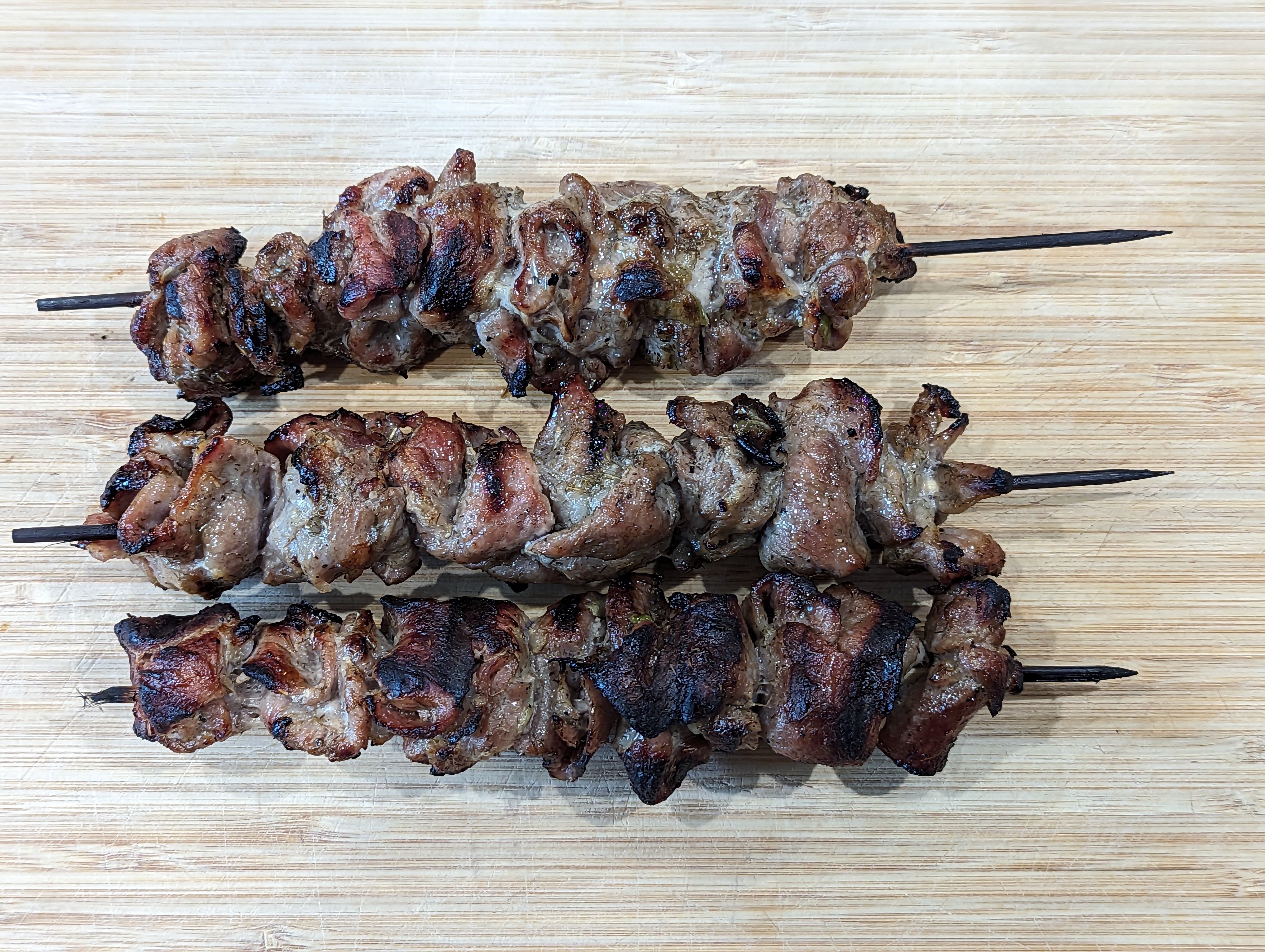
Chargrilled Hmong Black Pig Skewers with Sesame Salt

"I would tell people that Hmong food is not just a type of food. It's not about the product. It's a philosophy.... If you want to know our people you have to know our food. By knowing our food, you will know our story. You'll know where we been and it will show the trajectory of where we're going.  

-- Chef Yia Vang

To the extent people know about the Hmong, that knowledge comes more from political history. The Hmong are an indigenous ethnic group that has lived for centuries as a minority in eastern and southeastern Asia. During the Vietnam War, the United States Central Intelligence Agency recruited and trained the Hmong living in Laos for a "secret war" against the North Vietnamese Army. The Hmong harassed the North Vietnamese along the Ho Chi Minh trail, safeguarded U.S. radar installations, and rescued downed American pilots. After the war, the communist governments of Vietnam and Laos declared that the Hmong were "traitors." The governments persecuted the Hmong. They arrested the Hmong, who were sent to hard labor camps. They sprayed Hmong villages with chemicals, including napalm.  Nearly ten percent (10%) of the Hmong population was killed and around 100,000 Hmong sought refuge in neighboring Thailand and beyond. 

The culinary history of the Hmong is far less known. Before the Vietnam War, the Hmong had a strong agrarian tradition in the mountains of northern Laos and Vietnam. They grew rice and other produce, as well as raised livestock, such as pigs. The Hmong practiced animism, believing that objects, plants animals, and even places have their own spirit. These beliefs underlie the respect that the Hmong hodl for what they have. It also informs their traditions. 

For example, there is a Hmong tradition -- called Noj Tsiab (nee-al jia) -- that centers around the butchering of a pig. During the last week of December, each family would select a pig from their herd to be butchered. Every family member had a role in the process, being taught by the elders how to prepare the pig, how it would be cut, and how to ensure that all of the pig would be used with nothing going to waste. This knowledge was important, and it was passed on from generation to generation. The end products would be used to prepare a meal for the community for the new year. It enabled everyone to participate in a tradition that gives thanks for what they have been given and to their ancestors for watching over them.

This tradition was lost, at least temporarily, for those Hmong who fled their homes and found themselves in refugee camps. Even after they escaped those camps, making their way to the United States or elsewhere, many of their new lives did not include the raising of pigs, let alone the opportunity to butcher them in accordance with their traditions. 

I knew none of this when I came across a recipe for Chargrilled Hmong Black Pig Skewers with Sesame Salt.  It was in a cookbook called the Food of Vietnam. The author, Luke Nguyen, is a Vietnamese-Australian chef who was part of a television show, Luke Nguyen's Vietnam, that I watched on public television. Every episode fascinated me, both with respect to the people, the surroundings, and, of course, the food. When I got this cookbook, as well as another Vietnamese cookbook, I spent a lot of time paging through the recipes. This one caught my eye because of the reference to the Hmong people. 

Roasted sesame seeds with salt
According to Chef Nguyen, the Hmong raised black pigs in the hills and mountains of Vietnam. The cuts from the necks would be used for this dish. I had access neither to those particular black pigs, or, more generally, to pig necks. Instead, I looked for any cut of pork that would enable me to slice thinly or that came sliced thinly. 

There are two things that I really like about this recipe. The first thing is the marinade. The recipe calls for a combination of scallions, lemongrass, fish sauce, oyster sauce, black pepper, and honey, for a marinade. This particular combination of ingredients imparts a lot of flavor into the meat, which is facilitated by the fact that the meat has been thinly sliced.  The second thing is the ease of preparing this dish. Once the marinade is complete, the rest of this recipe is easy: just thread some pre-soaked skewers, place on a heated grill, flip the skewers a few times and you are done. 

These skewers are very delicious and, given the ease of preparing this dish, I will very likely make this recipe again. The next time will take on a little more meaning now that I have some understanding of the traditions of the people behind the recipe. 

CHARGRILLED HMONG BLACK PIG SKEWERS WITH SESAME SALT

Recipe from Luke Nguyen, The Food of Vietnam, pg. 318

Serves 4-6

Ingredients:

  • 300 grams (10.5 ounces) pork neck, thinly sliced
  • 2 tablespoons toasted sesame seeds
  • 3 spring onions, sliced then bashed to release the flavor
  • 4 tablespoons finely diced lemongrass, white part only
  • 3 tablespoons fish sauce
  • 1 teaspoon oyster sauce
  • 1 teaspoon sugar
  • 1 tablespoon honey
  • 1/2 teaspoon freshly ground black pepper
  • 3 tablespoons vegetable oil

Directions:

1. Prepare the marinade. Combine the onions, lemongrass, fish sauce, oyster sauce, sugar honey and black pepper in a mixing bowl and mix well. Add the pork and toss until well coated. Cover and marinate in the refrigerator overnight. 

2. Prepare the skewers. Soak 12 bamboo skewers in water for 30 minutes to prevent scorching. Thread the pork on to the skewers and chargrill on each side for 3 minutes. Mix the sesame seeds with a pinch of sea salt. Serve on the side for dipping the skewers into. 

PEACE. 

Friday, December 22, 2023

Pad Kaprow

My culinary journeys around the world have often led me to "national dishes." Generally speaking, these are meals that have a strong connection to a particular country. This connection may arise in one of several ways. It may involve an ingredient that is produced locally or prepared in way only done in that area. It may form part of a cultural tradition. Or, it may be actively promoted by a government as part of an effort to create a national identity. 

Take, for example, the country of Thailand. At one point in its history, roughly corresponding to the beginning of World War II, the military dictatorship of Thailand promoted a national Thai identity. Field Marshal Plaek Phibunsongkram issued twelve (12) cultural mandates from 1939 to 1941. Each mandate set forth objectives for the people. For instance, the third cultural mandate -- On referring to the Thai people -- prohibited Thais from referring to themselves inconsistently based upon preferred group, region or religion (for example, don't refer to oneself as a southern Muslim Thai). It also required the people to refer to themselves as the Thai people. The fifth mandate also had multiple requirements, including Thai people should make an effort to consume food made only from Thai products. Such an edict is often said to be the basis for some of Thailand's national dishes, such as Pad Thai and Pad Kaprow. 

Thai Basil
While Pad Thai is perhaps the most popular and well-known dish, Pad Kaprow comes in a close second. The name translates into basil stir fry. It is not just any basil, but Thai Basil (or Holy Basil) that makes this a Thai dish. 

The history of this dish is a little unclear. The main ingredient -- Thai Basil -- had been introduced into Thailand centuries ago (approximately around 2,450 B.C.E. or 2,500 B.C.E.). Yet, the dish of stir frying basil with chicken (or other protein), chiles and other ingredients goes back only a few or several decades. Indeed, I could not find anything in my research that would enable me to trace this dish back to the time when Field Marshal Phibunsongkram was issuing his edicts. Then again, while there are a lot of articles about the greatness of Pad Kaprow, few of those articles actually delve into how the dish came into existence or how it has evolved over the years. 

Nevertheless, the research does point out a couple of key things about Pad Kaprow. First, the dish represents a Thai version of the five tastes: salty, sweet, sour, hot (spice) and bitter. (I have talked about the five tastes before, check out this post and this post for more.) One Thai chef, Chakkrit Chuma, once said that Pad Kaprow or "Pad kaphrao has to be salty first, sweet after and then feeling hot and spicy in your mouth." Chef Chuma lamented that "sometimes people just make it too spicy and you don't taste anything else." (The Chef also acknowledges that he uses seven chiles in his recipe.)  Second, Pad Kaprow is flexible when it comes to the protein. It is most commonly made with chicken -- Pad Kaprow Gai -- but it can also be made with beef, pork, vegetables and seafood. For this dish, I made it with turkey, because that is the only meat that my beautiful Angel will eat. Also, while many recipes used ground meat, I used turkey thighs because I think that the bite-sized pieces are better. (Also, the use of ground meat reminds me too much of laab or larb, which is considered the national dish of neighboring Laos.) 

PAD KAPROW

Recipe from All Recipes

Serves 2

Ingredients:

  • 1/3 cup chicken broth
  • 1 tablespoon oyster sauce
  • 1 tablespoon soy sauce, or more as needed
  • 2 teaspoons fish sauce
  • 1 teaspoon white sugar
  • 1 teaspoon brown sugar
  • 2 tablespoons vegetable oil
  • 1 pound boneless, skinless chicken thighs, chopped
  • 1/4 cup shallots, sliced
  • 4 garlic cloves, minced
  • 2 tablespoons Thai chiles, minced or sliced
  • 1 cup basil, thinly sliced
  • 2 cups rice, cooked

Directions:

1. Prepare the broth. Whisk the chicken broth, oyster sauce, soy sauce, fish sauce, white sugar and brown sugar together until well blended. 

2. Sauté the chicken. Heat a large skillet over high heat. Drizzle in oil. Add chicken and stir fry until it loses its raw color, 2 to 3 minutes. Stir in shallots, garlic and chiles. Continue cooking on high heat until some of the juices start to caramelize in the bottom of the pan, about 2 to 3 more minutes. Add a tablespoon of the sauce mixture to the skillet; cook and stir until the sauce begins to caramelize, about 1 minute. 

3. Continue to cook the chicken. Pour in the rest of the sauce. Cook and stir until the sauce has deglazed the bottom of the pan. Continue to cook until the sauce glazes onto the meat, about 1 to 2 minutes more. Remove from heat. 

4. Finish the dish. Stir in basil. Cook and stir until the basil is wilted, about 20 seconds. Serve with rice. 

PEACE.

Thursday, October 19, 2023

Cuminatum in Ostrea

I love reading about history, including culinary history. My travels through books and along the Internet take me to a lot of recipes. Many of those recipes, along with the resulting dishes, have long histories that date back decades, centuries and, in a few cases, perhaps a millennium or two. Yet, the recipes I find are usually the present day versions of those recipes, with little to no discussion about how we got to this point or that recipe.

Every once in a while, I will stumble upon someone who takes the time to find and talk about those recipes. In this case, it is the Historical Italian Cooking blog. The recipe that caught my eye is called cuminatum in ostrea et conchylia, which is Latin for cumin sauce for oysters and shellfish. The recipe dates back to at least the 5th century C.E., during which the Roman Empire collapsed (476 C.E.). We can go this far back because the recipe was found in the midst of a collection of recipes compiled in De Re Culinaria, also known as Apicius. The only surviving version of the Apicius dates back to the 5th century

Yet, cookbooks are sometimes akin to history books: they recount the recipe at the time of publication. This particular recipe may be much older, perhaps dating all the way back to the 1st century C.E. Some have attributed the Apicius to Marcus Gavius Apicius, who noble who was renown for his love of luxury foods. The Roman philopsopher Seneca once remarked that Apicius "proclaimed the science of the cookshop" (Seneca, Consolatio ad Helviami 10) and then corrupted the age through his example.

As the Historical Italian Cooking blog explains, Romans considered oysters to be a "costly food." Oysters may have been a luxury to the point that there was a reluctance to share them. The Roman poet, Martial (known as the father of the epigram, after all, he wrote 1,561 of them) recounted the following interesting epigram about a guest's response to the host's dinner: 

I dine with you at my own cost,

So why not fare the same, both guest and host?

You swallow Lucrine oysters large and fat,

I suck a whelk and cut my lips at that.

You're served with mushrooms, I chew fungus still,

You have to do with turbot, I with brill

Plump yellow doves your appetite assuage, 

I have a magpie starved within its cage.

I am by your side and yet I'm far away.

The dole has gone. Let's fare the same, I say.

Clearly, oysters ranked with other luxurious food items, such as mushrooms, turbot, and "plump yellow doves." (By the way, the underlying message in this epigram is as timeless is as true today as it was when Martial wrote it back in the first century A.D.) Other epigrams and poems by Martial underscore the oyster as an expensive food for Romans. 

Yet, even a costly food item like oysters has its limits. In another poem, Martial wrote, in part: 

I WILLINGLY accept your dainty fare

If hospitality be undesigning: 

Not so, if you imagine that I care

For nothing in the world so much as dining; 

A dozen oysters will not make you heir

To my reputed wealth for which you are pining; 

The feast is elegant; that I admit

But on the morrow what is left of it? 

Upon the morrow? Where is it to-day

The moment after it has passed your gullet?

Thus, oysters won't make you rich during Roman times, but they were certainly enjoyed by the rich.

This leads me to how Romans ate oysters. For that, I turned back to the Historical Italian Cooking blog. The author writes that in books wrote in the 2nd century, Galen's De Facultatibus Alimentorium, and in the 6th century, Anthimus' De Observatione Ciborum, recount that Romans ate oysters both raw and cooked (either boiled or fried). 

However, the recipe in Apicius provides for the oysters and shellfish but did not provide a cooking method. it provided only a sauce, and one that has its base in cuminum or cumin. In fact, the sauce requires a good amount of cumin (or cuminum plusculum). The recipe also calls for other spices (black pepper and lovage), herbs (fresh parsley and mint, the recipe calls for dried mint but you can use fresh mint), and a liquid mixture that consists of honey, garum and vinegar. If you do not have lovage, Historical Italian Cooking advises that, according to Pliny, you could use anise seeds, or according to Dioscorides, you can use fennel seeds.

For this recipe, I decided to prepare the sauce to serve with raw oysters. While I do not have authentic Roman garum (check out this post by Historical Italian Cooking on how to make it), I do have a significant amount of Vietnamese fish sauce (check out my post with a brief discussion of the history of fish sauce, including a reference to garum). I have modified the recipe slightly from the one provided by Historical Italian Cooking to show both how the writer described the preparation and how I prepared this dish. 

In the end, I have to say that I was not a big fan of this sauce. While I like cumin as a spice, I came to the realization that I am not keen on cuminum plusculum. The large amount of cumin overwhelmed the flavors of the oysters, with the brininess being lost in the loud notes of the spice. 

CUMINATUM IN OSTREA

Recipe adapted from Historical Italian Cooking

Serves several

Ingredients:

  • 1.5 kilograms (about 3 pounds) of oysters
  • Pinch of freshly ground black pepper; 
  • Pinch of fennel seeds; 
  • 4 tablespoons of cumin;
  • 1 bunch of parsley, minced finely
  • 1 tablespoon of dried mint leaves
  • 1 tablespoon honey
  • 1 tablespoon fish sauce
  • 2 tablespoons white wine vinegar

Directions:

1. Prepare the sauce. Mince the parsley (and mint, if you use fresh mint). Pound them in the mortar with the pepper and the fennel seeds (or anise seeds or lovage), adding the cumin as you work. Move the mixture to a bowl and then proceed to mix in the honey and fish sauce (or garum), diluting it with the vinegar. 

2.  Finish the dish. Shuck the oysters and reserve the liqueur. Add some of the liqueur to the cumin sauce. Spoon some of the sauce over the shucked oysters and serve immediately. 

ENJOY!

Friday, May 5, 2023

Oysters with Nuoc Cham

There was a point in time when I was experimenting with all sorts of mignonette sauces, seeking out the best ones to serve alongside raw oysters. The sauces include a Green Sauce, as well as ones made with balsamic vinegarbeer, or champagne. The experimentations continued; but, honestly, none of them stood out as something that I really wanted to make again, and again, and again. 

Recently, I got to thinking about a sauce that I really do love ... nuoc cham. My introduction to this sauce came about from my efforts to learn more about Vietnamese cooking. The sauce caught my attention because of how it balances sweet, sour, salty, bitter, and spicy. In addition, the backbone of nuoc cham is fish sauce, which adds umami to that balance.

Indeed, the history of nuoc cham is inextricably tied to the history of fish sauce. And, that history appears to be subject to some debate. There is quite a bit of literature about the development of fish sauce in the West, whether by the ancient Greeks (who called it garos) or the Ancient Romans (who referred to it as garum). Some of that literature (such as the one I have linked) suggest that fish sauce traveled east to Eastern and Southeastern Asia. However, there are other sources that propose the idea that fish sauce developed independently in Asia, rather than being an import from the West. 

Regardless of where it originated, there is no doubt that fish sauce - and nuoc cham - are very popular in Southeast Asia. Every country's cuisine has some form of the sauce, but it goes by a variety of names, including not only nuoc cham (Vietnam), but also tuk trey (Cambodia), nam pla prik (Thailand), budu (Malaysia), and ngan-pye-ye (Myanmar). 

In any event, my recent use of nuoc cham got me to thinking that it might make a great "mignonette" to be served alongside raw oysters. It is definitely a different taste, but the balance of flavors works well, especially with larger, meatier oysters. For this dish, I used Chincoteague Salts, which come from the Chesapeake Bay. These oysters tend to be more on the briny side. The brininess worked well with the sauce. The other flavors, namely the fish sauce, the chile and lime juice, still balanced the added saltiness from the oysters.  

Needless to say, I may dispense with mignonette sauces altogether and just prepare nuoc cham whenever I have or serve raw oysters. It is that good.


OYSTERS WITH NUOC CHAM

Nuoc Cham recipe from Luke Nguyen, The Food of Vietnam, pg. 358

Serves 3-4

Ingredients:

  • 2 dozen oysters, rinsed and shucked
  • 3 tablespoons fish sauce
  • 3 tablespoons white vinegar
  • 2 tablespoons sugar
  • 2 garlic cloves, chopped
  • 1 red bird's eye chile, thinly sliced 
  • 2 tablespoons lime juice

Directions:

1. Heat the liquid ingredients. Put the fish sauce, vinegar and sugar in a small saucepan with 1/2 cup of water. Place over medium heat, stir well and cook until just before boiling point is reached. Remove the pan from the heat and allow to cool. 

2. Finish the dish. Just before serving, stir in the garlic, chile and lime juice. Store in a tightly sealed jar in the fridge for up to five days.

ENJOY!

Saturday, March 25, 2023

Vietnamese Grilled Whole Fish

There are a wide variety of fish dishes in Vietnamese cuisine, which is only to be expected given the country has 3,260 kilometers of coastline. There are also several major rivers that run through the country, such as the Song Da, Song Chiang, and, of course, the Mekong River.

One of the most interesting subset of dishes are the whole fish dishes. Setting aside the relatively easy preparation, I find that it is the sauces that one prepares alongside the whole fish to be one of the truly interesting aspects of Vietnamese whole fish dishes. The sauces provide an extra level of flavor that often enhances whatever spices, herbs and citrus are stuffed into the fish. 

Take, for example, chef and author Charles Phan, who has quite a few whole fish recipes out there. My parents gave me his cookbook, Vietnamese Home Cooking, as a gift. I decided to make the whole fish recipe in that cookbook, which is set forth below. The fish was delicious, but it was that dipping sauce that, for me, completed this dish.

The dipping sauce represents what the Vietnamese call "Ngũ Hànhor the five tastes. It is an excellent balance of those tastes, namely, spice, salt, bitter, sour and sweet. The chiles provide the spice; the lime juice offers the bitterness; the fish sauce contributes both the sour and the salt; and, the sugar provides, as you can guess, the sweet. The balance in this dipping sauce led me to dipping every bite-sized morsel of the fish into the sauce. 

VIETNAMESE GRILLED WHOLE FISH

Recipe from Charles Phan, Vietnamese Home Cooking at pg. 181

Serves 2

Ingredients (for the fish):

  • 1 (1 1/2 to 2 pound) whole branzino, cleaned with head and tail intact
  • Kosher salt
  • Freshly ground black pepper
  • 1 by 1-inch piece of ginger, cut into thin coins
  • 2 large Thai basil sprigs
  • 2 large cilantro sprigs
  • 3 thin lemon slices
  • 3 thin lime slices
  • 2 tablespoons canola or olive oil

Ingredients (for the dipping sauce):

  • 2 1/2 tablespoons freshly squeezed lime juice
  • 2 tablespoons fish sauce
  • 2 teaspoons sugar
  • 1 teaspoon peeled and minced fresh ginger
  • 1/4 teaspoon minced garlic
  • 1/4 teaspoon minced Thai chile

Directions:

1. Prepare the grill.  Prepare a hot fire for direct heat grilling in a charcoal grill (you should be able to hold your hand 1 to 2 inches above the grate for only 2 to 3 seconds). When the coals are ready, place a cast iron griddle or large cast iron frying pan on the grill grate and let it preheat until very hot.

2. Prepare the fish. While the fire is reaching temperature, rinse the fish in cold water and pat dry with paper towels. Season the inside with salt and pepper and then stuff the cavity with the ginger, basil, cilantro and lemon and lime slices. Drizzle the oil on both sides of the fish and set aside. 

3. Make the dipping sauce. To make the sauce, in a small bowl, stir together lime juice, fish sauce, sugar, ginger, garlic, and Thai chile until the sugar has dissolved. Set aside.

4. Grill the fish. When the griddle or pan is very hot, add the fish and cook it without moving for about 6 minutes until the skin is a deep golden brown and no longer sticking to the griddle. To check, gently try to lift the fish; of it does not release easily, continue to cook until it does. 

5. Continue to grill the fish. With a large, wide spatula centered at the middle of the fish, flip the fish and cook on the second side until golden brown. After 1 minute, begin checking to see if the fish is done. Insert a knife into the fish and wiggle it gently; the flesh should be barely clinging to the bone. If you feel resistance, continue cooking, repeating the test until the flesh offers no resistance.

6. Finish the dish. Transfer the fish to a plater and serve immediately. Accompany with the dipping sauce. 


Sunday, September 25, 2022

Catfish Curry with Lemongrass and Chiles

It has been a very long time since I have made a "Chef Bolek Original." There are a few reasons. I have not had a lot of time to cook recently, so that limited the opportunities to get creative. When I have been cooking, I have been trying to learn how to make certain types of dishes, whether it is exploring the curries of the subcontinent or southeast Asia or experimenting with different whole fish recipes. 

Nevertheless, the cooking that I have done has left me with a lot of leftover ingredients, such as long lemongrass stems and more habaneros than I know what to do with. Rather than let those ingredients sit around until they are ready to be composted (which, unfortunately, happens from time to time because of my busy schedule), I decided that I would take the ingredients that I had and make a dish just off the top of my head. It is a slightly different method than how I used to make Chef Bolek original recipes. (The old way was for me to wander the aisles of grocery stores and try to get "inspired" to make something - a process that often resulted in a lot of leftover ingredients destined for the compost pile.)

I did have some inspiration this time around, which I drew from a catfish curry that I had previously made. The difference is in the principal ingredients for this curry, which were lemongrass stalks and those habanero peppers. I also had some extra shallots and scallions lying around, so I incorporated those into the recipe as well.  As for the main ingredient - the centerpiece if you will - I went with catfish nuggets. The pieces left over after the filleting of catfish. It only seemed appropriate that those scraps be used in a recipe where I was basically throwing the "kitchen sink" into the bowl. 

In the end, this curry was something completely different and delicious than what I have previously made. The lemongrass, accentuated by the garlic and the fish sauce, was front and center, distracting one from the kick of the habanero chiles. Perhaps the lesson from this dish is to change how I make Chef Bolek originals. Only time will tell. Until next time ...


CATFISH CURRY WITH LEMONGRASS AND CHILES

A Chef Bolek Original

Serves 2

Ingredients:

  • 3/4 pound of catfish nuggets or catfish fillet
  • 1 tablespoon of fresh lemongrass, peeled to soft core and chopped
  • 2 cloves garlic
  • 1 shallot, sliced
  • 2 habanero chiles, deseeded and sliced
  • 4 scallions, white parts only
  • 2 tablespoons of ginger, peeled and chopped
  • 2 tablespoons fish sauce
  • 2 tablespoons rice vinegar
  • 2 tablespoons vegetable oil or canola oil, plus one tablespoon
  • 1 teaspoon turmeric powder
  • 1 lime, juiced

Directions:

1. Prepare the marinade.  Add the lemongrass, garlic, shallot, habanero chiles, scallions, ginger, fish sauce, rice vinegar, turmeric powder and oil to a food process and process until you have a relatively smooth sauce. 

2. Marinate the catfish. Place the catfish in a bowl, add the marinade and mix thoroughly. Let rest for 15 to 20 minutes or cover and refrigerate for a couple of hours. When you are ready to cook make sure to bring out the catfish at least 15 minutes before you start so that it can come to room temperature.

3. Prepare the curry. Heat 1 tablespoon of oil in a pan over medium high heat. Add the catfish and saute for about 10 minutes, stirring occasionally. As you stir, break larger pieces of catfish into smaller ones and continue to stir so that all pieces are coated by the sauce. 

4. Finish the dish. Remove the catfish from the heat. Sprinkle the lime juice over the catfish. Plate some rice and put the catfish on top. Serve immediately.

ENJOY!

Sunday, September 11, 2022

Ping Gai Wings

"Don't be surprised if you see a Ping Gai buffalo wing post in the near future."

- Me

And here is that post. For the few ardent followers of my Chef Bolek blog, you may remember my post about Ping Gai or Laotian Grilled Chicken.  I loved that recipe, which was one of the best (and still remains one of the best) chicken recipes that I have ever made and tasted. 

As the name reflects, the recipe comes from the southeastern Asian country of Laos. Whole chickens are halved, marinated and then grilled over charcoal. The grilling is often done low and slow, which a typical way one would prepare barbecue. The dish of Ping Gai has its place in Lao cuisine, especially on the street where one could buy the chicken with a spicy dipping sauce or sides (like sticky rice or papaya). This dish can also be found across the Mekong River in the northeastern Isan region of Thailand, where it is called kai yang or gai yang

Fun fact: prior to French colonization of southeast Asia, the Isan region was part of what was then "Laos." Another fun fact: there are more people of Lao identity and heritage in Isan (about 13 million) than in Laos (about 7.5 million).

Turning to the recipe, the key to Ping Gai is the marinade. At its core, the marinade is the umami combination of soy sauce, oyster sauce, and fish sauce, highlighted with fresh cilantro, and underscored with the kick from black pepper and cayenne pepper.  As with any recipe, the marinade used in Ping Gai has its regional, familial and individual variations in how to prepare the marinade. Some of these recipes incorporate ingredients such as coriander, garlic, hoisin sauce, lemongrass and vinegar. 

All of the ingredients in the Ping Gai recipe highlight what separates Lao cuisine from its neighbors, such as Thailand. The recipes in Laos feature herbaceous and bitter flavors, along with the use of dried, ground peppers to give its dishes a spicier kick. Lao dishes rely less on coconut milk (in contrast to Thai cuisine), resulting in somewhat lighter dishes that are not weighed down by thicker sauces. 

Another key aspect of Ping Gai is how it is prepared. As I noted above, the standard method of preparation involves grilling the chicken low and slow over a charcoal fire. Whether over a charcoal fire or a gas grill, I have come to find that grilling is a far better method of preparing buffalo wings than deep frying. The grilled wings have crisp edges and tastier meat (due to the marinade), which cannot be found as much in fried wings. 

In the end, the best chicken recipe (in my humble opinion) produces one of the best buffalo wing recipes that I have made or had in a long time. I think the one change I would make is to take the additional step to prepare the dipping sauce that accompanies Ping Gai. The recipe for the dipping sauce can be found here


PING GAI WINGS

Recipe adapted from Allrecipes

Serves several

Ingredients for the wings:

  • 1 tablespoon, freshly ground black pepper
  • 3 tablespoons oyster sauce
  • 2 tablespoons soy sauce
  • 2 tablespoons fish sauce
  • 2 tablespoons vegetable oil
  • 2 pinches cayenne pepper
  • Dipping Sauce, optional (recipe can be found here)

Ingredients (for the dipping sauce):

  • 2/3 cup seasoned rice vinegar
  • 1 lime juiced
  • 4 cloves garlic, crushed
  • 1 tablespoon sambal oelek
  • 1 tablespoon fish sauce
  • 1/4 cup freshly chopped cilantro
  • 2 tablespoons honey or more to taste

Directions:

1. Prepare the marinade. Combine the black pepper, cayenne pepper, oyster sauce, soy sauce, fish sauce and vegetable oil in a bowl. Mix very well to combine ingredients. Add the wings and toss the wings. Cover the bowl and refrigerate for four hours or overnight.

2. Prepare the dipping sauce. Combine rice vinegar, lime juice, garlic, sambal, fish sauce, cilantro, and honey to make the dipping sauce. Refrigerate until ready to use.

3. Grill the wings. Heat a gas grill over medium high heat or prepare a charcoal fire. Place the wings on an oiled grill grate and grill the wings for about seven minutes on each side or a total of 15 minutes. Once the wings reach an internal temperature of 165 degrees Fahrenheit, remove from the heat.  Serve immediately by themselves or with a side of the dipping sauce.

ENJOY!

Sunday, May 1, 2022

Catfish Curry

It seems that, in recent weeks, I have been making a lot of dishes influenced by Southeastern Asian cuisine. These dishes include Chengdu Chicken with Black Beans, Chiles and Peanuts and African Chicken, which draw from Chinese and Macanese cuisine. Other dishes include Vietnamese Grilled Clams with Oyster Sauce and Peanuts and Aromatic Chicken from the Shan Hills (in Myanmar).

I prepared all of these dishes from recipes, either found in cookbooks on my shelves or on the Internet. The question for me is whether I learned anything from making these recipes. Could I use the techniques, ingredients and inspiration embodied in these ingredients to make my own recipe? A Chef Bolek original?

The last Chef Bolek original recipe dates back to May 30, 2020, when I smoked a turkey breast. The time seemed right for a Chef Bolek original. This recipe for Catfish Curry emerged. 

Catfish had long been on my mind. It is perhaps one of my favorite fishes to eat (and I love to eat pretty much any kind of fish). When I was at the grocery store recently, I saw that there were "catfish nuggets" for sale. Some stores sell these nuggets, which are the pieces left over after the fish have been filleted. Rather than throw them away, the stores sell these catfish pieces, usually at a discount. It is a way to reduce waste and one that I accept in open arms. Catfish is catfish, whether in whole fillets or in nuggets. 

Turning to the recipe, I began by creating a garlic, ginger and chile paste, similar to what I had to create for the Aromatic Chicken from the Shan Hills recipe. I added that paste to the catfish, along with some wet ingredients (namely, fish sauce, rice vinegar and oil, all of which were inspired by the African Chicken recipe), and some dry ingredients (ground coriander and turmeric). I left the fish to marinate for a very short period of time, as is customary for some curries, like the Aromatic Chicken. Once I was ready, I sautéed the fish and added some garnishes, like lime leaves and cilantro. The dish was complete and served with rice. 

In the end, this dish represents an elevation beyond the Chef Bolek original recipes of the past. It represents an effort to apply something I learned while cooking to create something of my own. Perhaps it could be the start of my own Chef Table.  


CATFISH CURRY

A Chef Bolek Original

Serves 3-4

Ingredients:

  • 1 pound of catfish fillets, cut into bite-sized pieces, or catfish nuggets
  • 1 1/2 tablespoons minced ginger
  • 1 1/2 tablespoons minced garlic
  • 1/4 to 1/2 teaspoon salt
  • 2 Thai bird's eyes chiles, minced
  • 1 tablespoon fish sauce
  • 1 tablespoon rice vinegar
  • 2 tablespoons vegetable oil, plus 1 tablespoon vegetable oil
  • 1 teaspoon ground coriander
  • 1 teaspoon ground turmeric
  • 1 bunch of scallions, whites and greens sliced
  • 1 tablespoon cilantro, chopped
  • 8-10 lime leaves (optional)
Directions:

1. Prepare the catfish.  Combine the garlic, ginger, chiles and salt in a mortar and pestle. Grind the ingredients until they become a paste.  Place the catfish in a large bowl, add the garlic/ginger/chile paste.  Then add the wet ingredients (fish sauce, vinegar and 2 tablespoons of vegetable oil) and the dry ingredients (coriander and turmeric). Mix well to ensure that the catfish is well coated. 

2. Sauté the catfish. Heat 1 tablespoon of vegetable oil over medium high heat. Add the scallion whites and sauté for 2 to 3 minutes.  Add the catfish and continue to sauté, stirring occasionally to ensure that the catfish is thoroughly cooked.  Add the lime leaves and cilantro after about 5 minutes.  Cook the catfish for about 10 minutes or until fully cooked. Remove from the heat.

3. Finish the dish. Serve the catfish with rice, garnish with the scallion greens.

ENJOY!


Wednesday, April 6, 2022

Vietnamese Grilled Oysters

Thanks to aquaculture, oysters can be found pretty much anywhere in the world, even in places where one may least suspect their presence. One such place is Vietnam. While the shellfish industry is not a traditional one, oyster cultivation has taken root in Vietnam, spanning over twenty-eight (28) provinces from the north to south of the country.  Given most of the oyster production is sold for local consumption, there is little chance that an oyster from Vietnam would grace a seafood market on the other side of the globe. 

It has been said that "oyster farming is cushy." Those words came from the first oyster farmer in the Long Hoa commune, which is found in the Can Gio District just outside of Ho Chi Minh City. The oysters are placed in cages, or hung from ropes on rafts in March, which the farmers tend as the oysters grow. After about four or five months, the farmers begin to harvest the oysters. The harvesting continues for the rest of the year and into the new year, ending around the time of the Tet holiday. The harvested oysters then make the trip to the nearest processing facility. 

In doing the research for this post, I found the two different methods of oyster farming -- cages or ropes, to be really interesting. The first method, cages, is fairly self explanatory. The cages are situated on structures that keep them off of the bottom. The structures also keep the cages in place, where their contents -- mesh begs -- allow oysters to grow. The other method involves the use of rafts, with ropes that hang down from the rafts. The oysters grow on the ropes.

Oyster cultivation using rafts and ropes in
Van Don District, Quang Ninh Province in Vietnam
(Source: Cuisine of Vietnam)

According to one oyster distributor, Vo Tien Chuong, the Vietnamese prefer to eat raw oysters; however, their cuisine does feature dishes such as sour oyster soup and oyster floss. The latter dish is an almost dried mixture of oyster meat, shrimp, pork, fish sauce and salt. While oyster floss made it to the list of dishes that I will make some day, I decided to approach the interplay of oysters and Vietnamese cuisine from a different angle. 

More specifically, I wanted to further explore the Vietnamese concept  of ngu hanh or ngu vi. This concept is otherwise known as the five elements. When it comes to cooking, there are multiple levels of quintuple elements. For example, there are the five flavors: spice, sour, salty, bitter and sweet. There are also the five textures: crispy, crunchy, chewy, soft and silkg. There are even the five preparation methods: raw, steamed, broiled, fried/grilled and fermented. East Asian cuisines generally, and Vietnamese cuisine in particlar, have achieved an amazing balance at every level.  

I found a recipe for a "zesty Vietnamese dressing" that demonstrated this balance, at least as it came to the five flavors.  Running down the ingredient list, I saw how each item could fit in the balance. The chiles provided the spice. Lime juice perhaps contributes the sour or bitter flavors. Fish sauce definitely imbues a salty umami flavor and there can be no dispute that honey adds sweetness to the dish. 

Together all of these ingredients provide that balance that contributes to an overall amazing flavor of a sauce that could be served alongside or on top of oysters. While I have made many a mignonette sauce to go with raw oysters, I think this cause could perhaps be the best one for oysters served in any of the five cooking methods, thereby achieving balance in yet another, albeit indirect way.  

VIETNAMESE GRILLED OYSTERS

Recipe from Irena Macri

Serves 2-4

Ingredients:

  • 1 tablespoon grated fresh ginger
  • 1 small garlic clove, finely diced
  • 1/2 long red chile, finely diced
  • 1 teaspoon sesame oil
  • 2 tablespoons of extra-virgin olive oil
  • 1 lime, juiced
  • 2 tablespoons fish sauce
  • 1 teaspoon coconut sugar/syrup or raw honey
  • 1 tablespoon Tamari sauce
  • 1 tablespoon chopped scallions
  • 1 tablespoon chopped cilantro
  • 1 or 2 dozen oysters

Directions:

1. Prepare the sauce. Mix or whisk all of the ingredients in a bowl. 

2. Prepare the oysters. Shuck the oysters, removing the top shell but leaving the oysters in the bottom shell.  Spoon 1/2 tablespoon to 1 tablespoon (depending upon the size of the oyster) over the oyster.

3. Grill the oysters. Heat a grill on high heat. Add the oyster shells and grill for 2 minutes. Remove from the grill and serve immediately. 

ENJOY!