Showing posts with label Celery. Show all posts

Sunday, April 12, 2026

Chesapeake Oyster Dressing

The history of oyster stuffing can be traced back to the 17th century where, in Britain, cooks incorporated oysters with the ingredients used to stuff, among other things, chicken, fish, and rabbits. in the stuffing of for, among other things, chickens, fish, and rabbits. One of the earliest recipes can be found in The Accomplisht Cook (1685), where it appears in a recipe that called for the oysters to be cooked, mixed with herbs and spices, and then stuffed in a young hen's belly for roasting. 

The use of oysters in stuffing or dressing (the former refers to cooking it in the bird while the latter refers to cooking it separately), made its way across the Atlantic Ocean when the British colonized the new world. With oysters as plentiful up and down the east coast as they were in the British isles, it was only a matter of time before cooks would use oyster stuffings when preparing chicken, fish and, of course, turkeys. Thus, oyster stuffing itself migrated from New England down the coast to the Chesapeake Bay.

As the few who follow this blog know, I have an affinity for the Chesapeake Bay. I have spent a lot of time exploring various aspects about the Bay, especially when it comes to its cuisine. Recently, my beautiful Angel and our wonderful family spent some time during the most recent Thanksgiving holiday in Crisfield, Maryland. Crisfield is "the City Built on Oysters." It began as a small fishing village known as Sumer's Cove. However, John Crisfield had other ideas. He worked to get a railroad line built to the village, which was completed in 1866 when the first train pulled into the station. That railine, along with a steamboat wharf, turned the town into a transportation hub.  The residents renamed the town Crisfield. But, there was more in store for the town. 

Six years after that first train arrived in the city, there were 600 hundred registered oyster boats working out of the harbor. Thirteen years after that, an average of 400,000 bushels of oysters were arriving at the Crisfield Wharf annually. At its height, there were 40 to 50 seafod houses along the Crisfield waterfront. The city had become the "Seafood Capital of the World."  Oysters contributed more than just economic growth, their shells helped the city expand. People started taking the oyster shells from the shucking houses and using them to provide a building foundation. Those shells provided stability in an area that was primarily marshland prone to flooding. 

Maryland oysters.

Simply put, oysters were critical to the Crisfield's rise. So, it seemed appropriate that as the Savage Boleks had their Thanksgiving meal in Crisfield, I should prepare and serve an oyster dressing. The internet contains quite a few possible recipes, but I decided to prepare a recipe from the Oyster Recovery Partnership ("ORP"). The ORP is a non-profit dedicated to rebuilding the oyster population in the Chesapeake Bay. They do that through a variety of initiatives, including the restoration of public fishery reefs and the establishment of an oyster shell recycling program. The ORP has had an undeniable, beneficial impact on the oyster population, having planted more than 3.1 billion oysters on 3,000 acres of reef, and recycled more than 350,000 bushels of oyster shells. 

This recipe is very good and it was a hit at the meal. Just one note: I made one adjustment to the fourth step. As I was combining the ingredients, I noted that the mixture was a little dry. The recipe calls for adding some turkey stock to the mixture. I decided to add both stock and a little more white wine, roughly in equal proportions, until the mixture was moist enough. I have to admit that I did not measure as I worked, I just used my eye to make sure that the stuffing had the right moisture before being put into the oven. 

CHESAPEAKE OYSTER DRESSING

Recipe adapted from Oyster Recovery Partnership

Ingredients:

  • 14 ounces of day-old bread, cut into pieces
  • 8 tablespoons butter (1 stick)
  • 1 large onion, chopped
  • 3 celery ribs, chopped
  • Sea salt, to taste
  • Freshly ground black pepper, to taste
  • 6 ounces of chicken (or turkey) broth, more if needed
  • 4 ounces white wine
  • 1 pint oysters (including liquor, strained)
  • Juice of 1 lemon
  • 1-2 teaspoons of hot sauce
  • 2 tablespoons chopped parsley
  • 1/4 teaspoon mace
  • 1 tablespoon of Old Bay or XO spice
  • 2 tablespoons of butter, cut into small pieces.

Directions:

1. Prepare the dressing. Place bread stuffing in a large bowl. Melt butter in a large skillet over medium heat. Add the chopped onion and celery and saute for 6-8 minutes until soft and just beginning to brown. Season lightly with salt and pepper, deglaze the pan with chicken (or turkey) broth and white wine and cook for another 2-3 minutes. Remove from heat and let cool slightly. 

2. Prepare the oysters. In a medium bowl, mix lightly the oysters, lemon juice, hot sauce and parsley. 

3. Bake the dressing. Add the cooled onion mixture to the bread. Gently fold in the oysters, mace, and Old Bay or XO spice. Add the reserved oyster liquor and mix gently. Add more chicken (or turkey) stock if the stuffing seems dry. It should be very moist. Put the stuffing in a large greased baking dish. Dot the surface with small pices of butter. Cover tightly with foil and bake at 350 degrees Fahrenheit for 30 minutes. Remove foil and bake for an additional 15 minutes. 

PEACE.

Saturday, December 6, 2025

Roast Turkey, Wild Onions, and Maple Squash

"We will be known forever by the tracks we leave." 
-- Words of wisdom from the Dakota People

Thanksgiving is supposed to be a day in which we give thanks for all of our blessings over the past year. The holiday draws inspiration from events, partly historical and partly fictional, that transpired in the fall of 1621. The pilgrims of the Plymouth colony (that is, white colonizers) organized a feast to celebrate their successful harvest, giving thanks for the cultivation of food that would support them through the winter. 

That's where the history ends and much of the fiction begins. Subsequent generations would be taught that the feast was one shared by grateful pilgrims and their neighbors, the indigenous Wampanoag people. That is not entirely accurate. The feast was initially a white person, pilgrim/colonizer affair, because they did not initially invite the Wampanoag to the feast. Rather, the Wampanoag arrived after hearing gunshots fired off by celebratory pilgrims, thinking that the pilgrims were under an attack. Only after they arrived were the indigenous people allowed to stay and join in the feast. 

Thanksgiving was, and continues to be, built upon a myth of celebration and cooperation between white colonists and the indigenous people. The actual history -- over four hundred years of it -- defined what would become the United States. That definition includes the forced displacement and death of a majority of the indigenous people, removed from the land upon which their ancestors built not only comunities but also entire cultures and societies. Much of those civilizations have been lost, as the United States established itself, and expanded itself, at the expense of the indigenous peoples, nation after nation. 

Those are the tracks that we have left as a country and as "the American people." It is a path hardly discussed because holidays like Thanksgiving have us looking anywhere but down at our feet. So, for this particular Thanksgiving in 2025, I thought I would do something other than express gratitude for my blessings. I am looking down at my feet, at the ground.

The particular context of my feast unfolded in the city of Crisfield, Maryland, where my beautiful Angel and my wonderful family took a short trip during the holiday weekend. I found a lovely house in Crisfield, Maryland (more about that in another post), where I would prepare our holiday feast with help from our family. The city of Crisfield lies on a peninsula that was originally the home of the Annamessex people, who, in turn, were part of the Pocomoke Paramountcy. As an aside, the colonizers who reached this penninsula referred to it as the "Annamessex Neck." 

It is difficult to find much about the Annamessex people, but there is more out there about the greater Pocomoke nation. That nation stretched across the eastern shore, particularly along the Annamessex, Manokin, and Pocomoke rivers. They were organized into communities, with women and younger children growing corn, beans and squashes, while men and older boys hunted, trapped and fished. The Pocomoke were also traders, producing wampum, which are the shell beads and belts, and peake, which are darker beads made from clams. In addition to trading wampum and peake, the Pocomoke also crafted dug-out canoes that they used for transport and trade. 

As European colonizers settled in Annamessex Neck, the indigenous people were driven from their lands. The colonizers claimed the territory, refused to allow indigenous people to hunt on the land, and, with the assistance of the local and state governments, forced the Annamessex onto a reservation located at Askiminokonson, near present day Snow Hill, Maryland. Eventually, the white colonizers claimed that territory, leaving the Annamessex, along with the greater Pocomoke nation, with nothing. 

I have been unable to locate any Annamessex or even Pocomoke recipes for a turkey. This particular roast turkey recipe comes from Sean Sherman, an Ogala Lakota chef who has made it his mission to preserve and advance indigenous cuisine. He focuses upon both the ingredients and cooking processes used by indigenous cooks across Turtle Island. (I also used his recipe for wojape to serve alongside the turkey). 

I have to admit that I had some concerns, because the recipe did not call for a stuffing. I have always prepared roast turkeys with stuffings, using the latter to help regulate temperatures and add flavors to the meat. Fearful that I would overcook the bird without a stuffing, I decided to utilize a stuffing from Renewing America's Food Traditons, a book written by Gary Paul Nabhan. A first-generation Lebanese-American, Nabhan is an Agricutural Ecologist, Ethnobiologist, and Franciscan brother. He has worked with indigenous peoples, particularly in the southwestern United States and Mexico to preserve their foodways and advocate for their sovereignty. This particular stuffing comes from the opposite side of the United States, with a recipe offered in connection with a discussion of the endangered Naragannsett Turkey. The stuffing is not a traditional one that would be served alongside the bird. Instead, it consists of ingredients intended to provide additonal flavors to the meat. 

With these recipes in hand, I proceeded with Chef Sherman's Roast Turkey, Wild Onions and Maple Squash recipe. The overall dish provided a great example of indigenous foods could be prepared by indigenous peoples like the Annamessex. Wild turkeys are found across the State of Maryland; and, as noted above, the Annamessex cultivated squash. They could have easily gathered wild onions from around their village, along with other ingredients, such as juniper berries, which could have been gathered from the eastern red cedar trees or perhaps the common juniper (before it went locally extinct in the State of Maryland). 

In sum, this dish and my heart is with honoring those who were originally present and thriving here, long before any Spanish explorer or English colonizer ever set foot on dry land in this hemisphere. I also want to acknowledge the tracks that have been left over the centuries, and, for what that means when it comes to the United States. Our greatness (if it can be called that) came with a tremendous cost, a price not paid by those who benefitted the most, year after year, decade after decade, generation after generation. If we want to truly be known as a great country (however that could be defined), then that requires us to come to terms with our past. Otherwise, we can never truly achieve greatness as a country.  

ROAST TURKEY, WILD ONIONS AND MAPLE SQUASH

Recipe from Sean Sherman, The Sioux Chef's Indigenous Kitchen, pg. 107

Additional cavity stuffing recipe from Gary Paul Nabhan, Renewing America's Food Traditions, pg. 125

Serves 8

Ingredients (for the roast turkey):

  • 1 small turkey (about 10-12 pounds)
  • 1/4 cup hazelnut oil
  • 2 tablespoons chopped sage
  • Coarse salt
  • Crushed juniper
  • 2 cups corn, wild rice, or turkey stock
  • 4 wild onions or 2 large onions, quartered
  • 1 cup wild mushrooms, chopped
  • 2 cups winter squash, cubed
  • 1/4 cup maple syrup

Ingredients (for the cavity stuffing):

  • 2 tablespoon sea salt
  • 1 teaspoon freshly ground black pepper
  • 1 tablespoon dried marjoram or sweet basil leaves
  • 1/4 cup finely chopped flat-leaf parsley
  • 1/2 cup whole wheat bread crumbs
  • 1 tablespoon unsalted butter
  • 1/4 cup chopped celery stalks
  • 1 small white onion, chopped

Directions:

1. Prepare the turkey. One hour before roasting, remove the turkey from the refrigerator and bring to room temperature. In a blender, puree the hazelnut oil and sage and rub over the turkey. Season with salt and juniper.

2. Prepare the cavity. Rub the cavity with a mixture of 1 tablespoon of salt, 1/2 teaspoon of pepper, all of the basil or marjoram, and some of the chopped parsley. Combine the bread crumbs, lump of butter (mixed with salt and pepper), the rest of the parsley, chopped celery and onion. Stuff the mixture into the cavities of the turkey. 

3. Roast the turkey. Preheat the oven to 450 degrees Fahrenheit. Place the turkey in a roasting pan, add the stock and put in the oven. Roast until the turkey is a light golden brown, about 45 minutes. Reduce the oven temperature to 350 degrees Fahrenheit and continue roasting. After about 1 1/2 hours, scatter the onions, mushrooms and squash into the roasting pan and baste the turkey and vegetables occasionally with the pan juices. Continue cooking until the an instant-read thermometer inserted into the thigh reads 160 degrees Fahrenheit, about 30 minutes to 1 hour longer. Brush the turkey with the maple syrup. 

4. Finish the dish. Remove the turkey from the oven and transfer to a cutting board. Arrange the vegetables on a platter. Carve the turkey and arrange over the vegetables. Drizzle the pan juices over all. Serve with wild rice and cranberry sauce or wojape.  

PEACE.

Saturday, November 1, 2025

Around the World in 80 Dishes: Estonia

"Kuna eestlased pole suured arvult, siis peavad nad selleks saama vaimult." 

(Since Estonians are not large in numbers, they must become so in spirit.")

-- Jakob Hurt (Estonian forklorist)

The Baltic countries have always fascinated me. Three little countries -- Lithuania, Latvia and Estonia -- each with a fierce sense of independence and solid understanding of their own identity. Those identities were born out of a shared history over the past two hundred years. As the first challenge of my Around the World in 80 Dishes in the Baltic region, I get to explore the northernmost of the three countries ... Estonia. This challenge also provides me with an opportunity to explore the Estonian culture and cuisine, which itself gives rise to a story of how an identity can awaken in the darkness of occupation, as well as survive the trip through the peaks and valleys of history. 

While the first peoples to settle in the region arrived nearly 13,000 years ago, this post will focus only on the past 250 years. Back in the mid-1800s, the Russian Empire occupied all of what constitutes present-day Estonia. Yet, the Tsarist government allowed a certain degree of localized government in the Baltic region. This autonomy primarily benefited the Germanic nobility, which had previously dominated the government and economic strutures. It also provided enough room for independent thought amongst the maarahvas (country folk) and others whose heritage was closer to Finland than Prussia or Germany. That thought coalesced around an eestlane identity. It grew around the Estonian language, with the first Estonian newspaper being published John Voldemarr Jannsen in 1857. Soon, more literary works began to emerge, including the poetry of Lydia Koidula, as well as Estonian theater. As a passage from one of Koidula's most noteworthy poems illustrates, there was a strong current of developing nationalism: 

My country is my love,

To whom I've given my heart

To you I sing, my greatest happiness,

My flowering Estonia!

Your pain boils in my heart,

Your pride and joy makes my happy,

My country, my country!

At its simplist, nationalism involves an effort to separate oneself. For the eestlane, they sought to separate themselves not just from the Germanic nobility, but also the larger Russian empire. As one could expect, the Tsarist empire was not pleased with such independent thought; and, in the 1890s, it began a russification campaign intended to bring the occupied closer in line with the occupier. For example, the Russian language replaced Estonian and German in schools and in newspapers. Yet, the Estonian identity did not die or even fade. Estonians continued to pursue their culture and develop their identity, just away from the eyes of the government. In the process, Estonians achieved the second highest literacy rate within the Russian empire. 

Russification fiurther led to an evolution in the Estonian identity, expanding it into the political sphere, as Estonians worked their way into government positions. By the time of the Russian Revolutions (of 1905 and 1917), there were Estonian political parties. With the parties came demands, including freedom of the press and freedom of speech, as well as greater autonomy and even independence. They achieved that independence between the two great wars (from 1917 until 1939), but it would take the end of the Cold War and the fall of the Soviet Union before Estonia would achieve lasting independence, which began on August 20, 1991, and continues to this day.

This quick discussion of the Estonian identity, although grounded in history, also provides the background for Estonian cuisine. While the cuisine is as eestlane as the people, history has left its mark. The influences of the Swedish, Germans, Russians and even the Finnish can be seen in the various dishes that find their way to the Estonian table. 

As for that table, Estonia has four general, regional cuisines. First, there is the northern Estonian and Tallin region, where one could find traditional dishes like verivorst (blood sausage) and a range of seafood dishes. Second, along the western shores and islands, seafood also reigns in the cuisine, with herring dishes and a black bread known as leib. Third, there is the southern Estonian region, where the dishes focus more on the land than the sea. Finally, there is the eastern Estonian region, where Russian influences can be more readily seen. The common theme that ties together all of thes regions is a simplicity in terms of ingredients and processes, reflecting the peasant origins of many of the dishes. 

APPETIZER

The start of this challenge begins with the Russian influence. It is a dish brought to Estonian by the Soviets. Shashlik are the kebabs of Central Asia, but it is the Soviets that introduced them throughout their union.  In Estonia, the skewers are made usually with pork, which is cut up, combined with onions, garlic and vinegar, and then left to marinate overnight. Once they are ready for the grill, they are skewered and grilled over charcoal (although a gas grill works just as well). 

In researching this dish, I came across an interesting description of a recent event -- Midsummer's Eve, "When the Village Folk Come Together -- at the Estonian Open Air Museum: 

Kolkhoz apartment building. It is the year 1988, and the idea of independence of Estonia has found its way to Sookuru collective farm. There was a meeting in Hirvepark in Tallinn a year earlier, the concept of self-managing Estonia is in the air, and five national patriotic songs by Alo Mattiisen are becoming more and more popular. All of it happened so fast and is hard to believe! The dwellers of the building have hung out the Estonian tricolour flag; they are singing new and old songs about the homeland and planning to organize a support group for the Popular Front of Estonia. Shashlik will be served.

While the Soviets may be gone, the skewers -- and Estonian independence -- remain.  

ESTONIAN SHASHLIK

Recipe from Nami-Nami

Serves 4

Ingredients:

  • 1 kg (2.2 pounds) of pork shoulder
  • 4 large onions
  • 2-3 garlic cloves, crushed
  • 2 tablespoons vinegar (30% proof)
  • 2 teaspoons finely ground salt
  • 1 teaspoon freshly ground black pepper
  • 1 teaspoon caster sugar

Directions:

1. Prepare the pork. Cut the pork into thick slices (about 1.5 to 2 centimeters, or 3/4 to 1 inch), then small chunks (4 centimeters by 4 centimeters, or 1.5 inch by 1.5 inch). Place in a large bowl. Peel the onions and cut into thin slices. Add to the bowl with the crushed garlic, salt, pepper and sugar. Sprinkle the vinegar on top. Wearing a pair of kitchen globes, massage the meat and onions for about 10-15 minutes, so the onion juices are released and the seasonings are firmly massaged into the meat chunks. Instead of dark red, the meat should be paler. Cover the bowl and marinate in the refrigerator for 24 hours.

2. Prepare the shashlik. Remove the meat from the refrigerator and let the meat come to room temperature, about 1 hour. If using wood skewers, soak the skewers for about 1 hour. Piece the meat chunks onto skewers.

3. Grill the shashlik. Prepare a charcoal fire or heat a gas grill to medium-high heat. Place the shashlik on the grill grate. Grill the shashlik for about 3-4 minutes, and turn. Repeat this process until each side is grilled and the temperature reaches 145 degrees Fahrenheit (62.8 degrees Celsius).

MAIN COURSE

The main course -- and the challenge for my Around the World in 80 Dishes -- is Frikadellisupp, which has been described as "the kind of soup that makes a meal." As Jennifer Eremeeva writes for the Moscow Times, "[e]fforts to pin down a 'classic' recipe for Frikadellisupp are frustrating, since the soup is nothing if not a thrifty 'sweep the fridge' improvised recipe for stretching meat into a meal, by combining it with bread, and anything else that might reach its sell-by date." 

I decided to prepare the meatballs in a slightly different manner than the recipe suggests. Instead of cooking them in the soup, I separately baked the meatballs and then added them to the soup. I did this in part because the preparation of the meatballs was a little different than other meatballs that I made. There is no filler (for example, breadcrumbs) and I feared that the meatballs would break up in the soup. By baking them first, I ensured that the meatballs would stay together in the soup. (I baked them in the oven at 350 degrees for about 40 minutes, times will vary depending upon the size of the meatballs.)

Apart from that, I could not find much describing the history of this dish. It may very well be something that has always been there, especially when times were difficult (and, for Estonia and Estonians, there were many difficult times since they achieved their independence and reclaimed it again). 

FRIKADELLISUPP

Recipe from Cook, Eat Share

Serves 4

Ingredients (for the soup):

  • 3 carrots
  • 1 turnip
  • 1 leek
  • 1 parsnip
  • 2 celery sticks
  • 2 medium potatoes
  • 1 cup chicken stock
  • 2-3 tablespoons of oil
  • Fresh or dried dill

Ingredients (for the meatballs):

  • 1 egg
  • 1 onion
  • 200 grams minced meat (pork or beef)
  • Salt
  • Black pepper

Directions:

1.  Prepare the vegetables. Wash, peel, and chop carrots, turnip, leek, parsnip and celery into bite sized pieces. Heat an oil in a large pot over medium heat and add the chopped vegetables. Fry slightly for about 5 minutes. 

2. Prepare the soup. Add about 2 liters of water. If you would like a thicker soup, add less water and more vegetables. Bring to a boil and add the chicken stock cube or chicken broth. Reduce heat and simmer for 30 minutes.

3. Prepare the meatballs. Place the minced meat in a bowl. Finely chop the onion and add to the bowl. Add the egg, salt, black pepper and mix well (use hand or wooden spoon). Using your hands, form small balls out of the mix and place them onto a plate for later.

4. Continue to prepare the soup.  After the 30 minutes, add peeled and chopped potatoes. Simmer for a further 10 minutes and then bring the soup to a boil. Add the meatballs and boil until they surface. Right before turning off the heat, add the fresh or dried dill. 

5. Finish the dish. Once the meatballs are cooked and the vegetables are soft, the soup is ready. Serve with a slice of bread or toast. 

*     *    *

For my first foray into Baltic cuisine (and, for that matter, northern European cuisine) as part of my Around the World in 80 Dishes challenge, I think that this challenge went well.  I particularly liked the soup, and this recipe made me think abouut additional soups that I will be doing in future challenges. Until then...

PEACE.

Tuesday, July 1, 2025

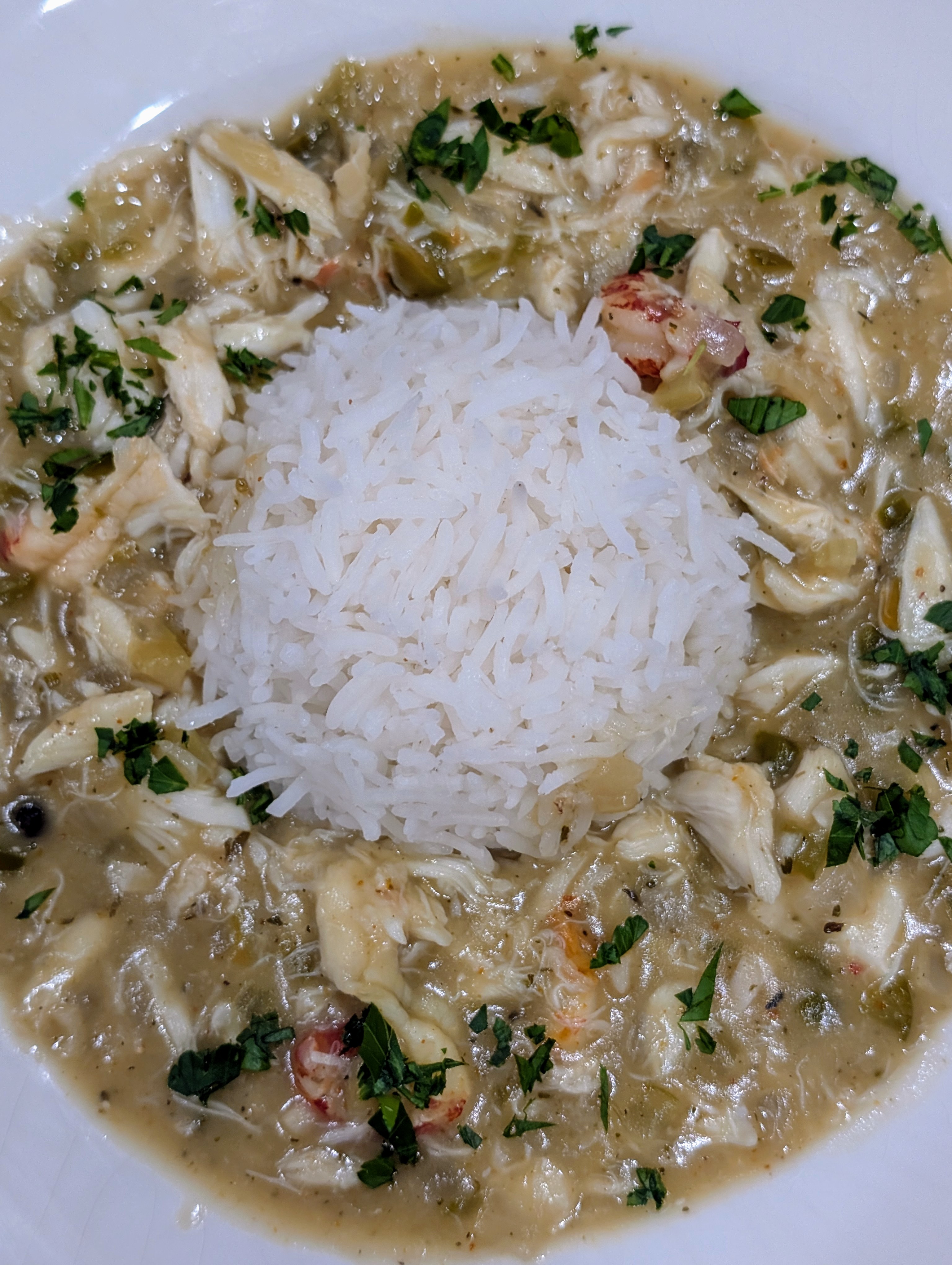
Crab and Crawfish Etouffee

"We have a common language with food."
-- Chef Leah Chase

Chef Leah Chase was a culinary icon in New Orleans, known as the "Queen of Creole Cuisine." Her restaurant, Dooky Chase, was a center of Creole cuisine and culture, earning her many awards and honors. But, Chef Chase's contributions go far beyond food. 

The restaurant, Dooky Chase, had an important role in the civil rights movement. It was one of the very few places in New Orleans where African Americans could meet and discuss the struggles of the time. Local civil rights leaders would meet in the upstairs meeting rooms of the restaurant, while Chef Chase would serve gumbo and fried chicken. Some of those meetings involved Martin Luther King, Jr. and the Freedom Riders. As they began to organize the bus boycott in Montgomery, Alabama, King and others would meet with local civil rights leaders at Dooky Chase to learn about the similar boycott in Baton Rouge.

The struggle for equal rights is an important part of our history as a country. That history is under attack. Such an attack is not simply an attack upon African Americans, but it is an attack upon all of us. It is an effort to deny a painful part of our past, out of a mistaken notion that our admitting to our shortcomings somehow makes us weak. To the contrary, acknowledging our shortcomings actually makes us stronger, because it is the first step toward fixing our past mistakes and building a better future. 

All of this requires us to know our true history, which inevitably and unquestionably demands that we acknowledge the contribution of everyone to our combined existence. This acknowledgment in particularly embodied in Creole cuisine. When one thinks of Creole food, perhaps the first thing that comes to mind is its relationship to French cuisine, most likely because of the Acadians who migrated from Canada to the Mississippi delta. But, the true history of Creole cuisine is so much more. It is a true melting pot, incorporating African American and Native American ingredients, processes and traditions. Creole food is truly a common language that unites multiple groups of peoples, each unique in their own history, but each of whom share a common bond. 

I wanted to acknowledge that common bond when I prepared this recipe of Crab and Crawfish Etouffee. I used my No Man's Land seasoning. The mix uses a Creole seasoning base but adds sundried tomato powder and crawfish powder, both of which are ingredients drawn from the culinary history of enslaved Africans. The combination of those powders added an earthiness and almost an umami to the dish, whcih easily made up for the lack of pork or sausage. In the end, this dish was perhaps one of the best dishes that I have prepared in recent months. 

CRAB AND CRAWFISH ETOUFFEE

Recipe adapted from Food & Wine

Serves 6-8

Ingredients:

  • 2 pounds crawfish. tails and meat removed
  • 4 1/2 cups of water
  • 1/2 cup unsalted butter
  • 1/2 cup all purpose flower
  • 1 medium sized yellow onion, finely chopped
  • 2 large celery stalks, finely chopped
  • 2 large green bell peppers finely chopped
  • 10 garlic cloves, coarsely chopped
  • 1 tablespoon Creole seasoning (or No Man's Land Seasoning)
  • 1 dried bay leaf
  • 4 thyme sprigs
  • 1 pound fresh crabmeat, picked over
  • Kosher salt
  • Long grain rice, for serving

Directions:

1. Prepare the crawfish. Rinse well. Remove the tails and remove the meat from the tails, reserving the shells from the tails. Bring 4 1/2 cups water and reserved shells to a simmer in a large saucepan over medium heat. Remove from heat; let stand for 15 minutes. Strain stock and discard shells. Set aside 4 cups crawfish stock.

2. Prepare the base. Melt butter in a large heavy saucepan over medium heat. Whisk in flour. Cook, whisking constantly until light blond in color, about 3 minutes. Add onion, celery, bell pepper and garlic. Cook, stirring occasionally, until the vegetables are tender, about 8 minutes. Add the creole seasoning, bay leaf and thyme and cook, stirring constantly 1 minute. Add stock, cook, stirring occasionally until slightly thickened, about 30 minutes. 

3. Add crawfish and crab meat. Add the crawfish and crab meat. Cook over medium heat, stirring occasionally, about 3 minutes. Discard the bay leaf and thyme sprigs. Season with Kosher salt to taste. Serve over rice.

PEACE.

Saturday, March 15, 2025

Lowcountry Brown Oyster Stew

This post about an oyster stew takes us to a very specific and incredibly important part of South Carolina's lowcountry. It is that part that overlaps with the Gullah-Geechee Corridor. The corridor itself runs from Jacksonville, Florida to Wilmington, North Carolina. However, as the corridor passes through South Carolina, it crosses islands, along with towns and cities, with the rich history of the Gullah-Geechee people. 

The Gullah-Geechee are descended from West Africans who were forcibly taken places ranging from modern day Senegal to Angola during the 18th century. The enslaved West Africans were brought to the United States to labor on rice plantations on the South Carolina's sea islands and along its Atlantic Coast. I had an opportunity to learn about this history and its profound impact upon our country as I prepared a dish of Carolina Crab Rice. (Hint: it was the knowledge and skills, along with the uncompensated hard labor, of those enslaved West Africans that created the infrastructure for, as well as enabled the successful production of, rice in South Carolina.)

The enslaved brought more than their knowledge and skills to this country, they also brought a variety of ingredients that were not part of the American-table at that time. This recipe captures some of those ingredients. For example, dawadawa or fermented locust beans. The fermenting of locust beans can be traced back to the 14th century, and its use in the preparation of food goes equally far back in time. Cooks in African countries like Nigeria, Benin and Ghana use dawadawa in many iconic dishes, like Jollof, as well as soups or stews like Fakoye. Locust beans are typically not cultivated, rather they are dispersed by people and animals. That brings us to the connection between Africa and the "New World." Slaves brought these locust beans with them as they were forcibly taken from Africa and transported to various places in North America, like the South Carolina coast, or the Caribbean. That may be one reason why one can find locust beans, as well as dawadawa, in Haiti

Dawadawa (Source: Slow Food)

Another interesting ingredient is the dried crayfish powder. As someone who has used dried shrimp when preparing dishes from Sri Lanka, I have a little familiarity with the umami-like scents and tastes that the ingredient can provide to a dish. The use of dried crayfish powder is used for that very purpose -- to add umami -- in dishes prepared along the African coastline of modern day Ghana and Benin. The technique of drying crayfish - which thrive in freshwater and some brackish water -- could have been brought with Africans so that they could preserve this source of protein for use in dishes.

Both dawadawa and dried crayfish powder are more than ingredients; they embody culinary techniques. A natural processing of ingredients from the land or the water to obtain something more. This particular recipe highlights that fact. The use of dawadawa and ground crayfish powder, along with the sundried tomato powder, served as a substitute for bacon or smoked pork. These ingredients provided elements that mimic smoked flavors, earthiness and richness that one would ordinarily get from using diced up bacon or smoked ham.  

Together, these ingredients helped to produce a stew that I have to say is far more complex and delicious than any oyster stew made with heavy cream. If I had my druthers, I would produce a huge batch of this stew and enter as a contestant in the next Oysterfest held by the Chesapeake Bay Maritime Museum in October 2025. It probably would not win (as the winners are usually the heavy-cream based stews), but it would introduce a completely different, but equally authentic and historic, way to prepare this dish to an audience who would probably never have the opportunity to taste it. 

LOWCOUNTRY BROWN OYSTER STEW

Recipe from Saveur

Serves 4

Ingredients:

  • 2 teaspoons toasted benne (sesame seeds)
  • 1/2 teaspoon ground ginger
  • 1/2 teaspoon lemongrass powder
  • 4 tablespoons all purpose flour
  • 3 tablespoons vegetable oil, divided
  • 2 tablespoons unsalted butter
  • 1 celery stalk, finely chopped
  • 1 small yellow onion, finely chopped
  • 1.5 tablespoons sundried tomato powder
  • 2 teaspoons Caribbean bay leaf powder or 2 dried bay leaves; 
  • 1.5 teaspoon crawfish powder or dried shrimp powder
  • 2 teaspoons ground dawadawa
  • 1.5 teaspoon garlic powder
  • 1.5 teaspoon onion powder
  • 1.5 teaspoon smoked paprika
  • 1 teaspoon chipotle powder
  • 2 pints shucked fresh oysters
  • 6 cups seafood stock, vegetable stock or water
  • 1 teaspoon kosher salt, plus more
  • 2 tablespoons finely chopped onion sprouts or chives

Directions:

1. Toast the spices. in a large skillet set over medium-low heat, add the benne, ginger powder and lemongrass powder; toast until golden-brown, 3-5 minutes. Remove from heat. 

2. Prepare the roux. In a large pot over medium high heat, whisk together the flour, 2 tablespoons of oil and the butter. Stir continuously until the roux turns a dark chocolate brown color, about 5 minutes. 

3. Saute the vegetables. In a separate skillet over medium high heat, add the remaining oil, celery and onion. Cook, stirring frequently, until soft and translucent, about 3 minutes. Remove from the heat. 

4. Continue working with the roux. Turn the heat down to low, then add the tomato powder, bay leaf powder, dawadawa, crawfish powder, garlic powder, onion powder, smoked paprika and chipotle powder. Cook, stirring continuously until fragrant, about 1 minute. Stir in the celery-onion mixture and then slowly pour in the oyster liquor and the tock, stirring continuously until all the liquid is incorporated into the roux. Add the salt, turn the heat up to medium-low to bring the stew to a boil, then turn the heat back down to maintain a simmer. Cook until the broth is thick enough to coat the back of a wooden spoon and has reduced by about a third, 40 to 45 minutes. 

5. Finish the dish. Remove the stew from the heat, then immediately stir in the oysters (the residual heat will cook them). Season to taste with more salt as needed. Ladle the brown oyster stew into wide soup bowls, garnish with onion sprouts and reserved benne seed-ginger-lemongrass mixture and serve hot. 

PEACE.

Monday, January 1, 2024

A Chef Bolek Fondue

Fondue originated in Switzerland, most likely in the Valais region through which the Rhone River flows in southern Switzerland. The tradition emerged as Swiss farm families gathered around a hearth over which they melted hardened cheese in a pot called a caquelon. The family members would then dip pieces of stale bread into the cheese, which softened the bread and made it easier to eat. It was a way for these poor farming families to make the most out of what little they had. 

Although originating as a cucina povera dish, fondue made its way into cookbooks, with the first known written recipe dating back to 1699. That recipe was published in a cookbook under the recipe name of Kass mit Wein zu Kochen or "to cook cheese with wine."  Fondue even made its way into the cookbooks for the Swiss military. Over time, the farm family tradition would be elevated beyond as a national dish of Switzerland (or so the Schweizerische Kaseunion - or Swiss Cheese Union - wanted everyone to believe because it would lead to the sale of more cheese).  And, as the dish spread across the world, it would take on new preparations and new ingredients.

Nothing says Switzerland like an "envelope" of Lipton's Onion Soup Mix.

Indeed, the passage of time gave rise to other versions of fondue. One popular one is fondue au chocolat, which involves dipping those food bites (usually bread, cheese or fruit) in a pot of melted chocolate. To be sure, my kids love chocolate fondue because they love anything that has a nice, chocolate coating. Another version is known as fondue bourguignonne, also known as beef fondue. The cheese or chocolate is replaced with hot oil, which is perfect for dipping bite sized pieces of your favorite protein or, on occasion, a vegetable or mushroom. 

Apparently, a guitar is required for fondue.

It is this latter version of fondue that became part of my family's New Year's Eve tradition. We would gather around a pot of hot oil, which was also encircled with dishes containing raw pieces of beef, chicken, sausage, mushrooms, broccoli and other foods. We pierced each bite and dipped it into the oil, becoming our own cook for a few minutes. Over the years, it became clear that dipping a bunch of things in hot peanut oil is not necessarily the healthiest way to ring in the New Year. So the tradition evolved to using vegetable broth, which cooked the food without the added consequence of clogging an artery. 

Fast forward to today, my beautiful Angel suggested that we have a fondue to ring in the new year. After clarifying that cheese and chocolate would not be involved, the Chef Bolek began to emerge. Rather than unhealthy oil or plain vegetable broth, what if I made a court bouillon for the fondue pot? A court bouillon is a flavorful liquid that is often used to poach proteins, such as fish or seafood. It would provide a healthy alternative in which I could control the ingredients and, by extension, the flavors. I quickly found a good court bouillon recipe as a starting point. Then my mind started thinking about the sauces. 

The tradition in my family, as is the tradition typically for a fondue bourguignonne, would be to serve about three to four sauces as part of the meal. These sauces typically included a Béarnaise sauce, a Bordelaise sauce, and, if I recall correctly, a horseradish sauce. However, I wanted to take those sauces to the next level. I wanted to serve sauces from around the world. So, for a Chef Bolek Fondue, I drew upon my experience and made the following sauces: 

Argentinian Chimichurri: I recently completed the Around the World in 80 Dishes challenge for Argentina, which had me prepare chimichurri in two different ways. I decided to prepare one of those chimichurris, because the garlicky sauce goes well with beef, chicken and vegetables.

Catalan Romesco Sauce: This sauce goes well with just about any food, with the smoked paprika, almonds and sherry vinegar providing different flavors for the meal. I borrowed from a recipe that I prepared more than ten years ago, but I will post a new one in the near future.  

Sri Lankan Lunu Miris: An extremely fiery sambol with three chiles and freshly ground black pepper from the cuisine that curries everything, which is why I love Sri Lankan food. This sauce is really just for me; it is too spicy for everyone else. I will post the recipe in the near future. 

Vietnamese Nuoc Cham: I have spent a lot of time this year learning about Vietnamese cuisine. I have become a huge fan of nuoc cham because of how it balances the different flavor elements. I used this recipe in which I paired the sauce with raw oysters in place of a mignonette. 

With these sauces, one has a fondue Chef Bolek style. The recipe for the court bouillon is set forth below. 


COURT BOUILLON

Recipe from Rouxbe

Ingredients:

  • 5 cups cold water
  • 1 cup white wine
  • 2 ribs celery
  • 1 leek (white part only)
  • 1 small onion
  • 1 lemon
  • 1 bay leaf
  • 1 teaspoon whole peppercorns (white or black)
  • 2 teaspoons Kosher salt (or to taste)
  • 1 sprig fresh parsley

Directions:

Place the cold water and wine in a pot. Slice the celery into 1/8 inch slices. Cut the leek in half, wash, and thinly slice the white part. Dice the onion and add everything to the liquid. Cut the lemon and squeeze the juice into the liquid (keep the seeds out of the liquid). Add the bay leaf, peppercorns and parsley and bring to a simmer. Once the liquid comes to a simmer, turn off the heat. Cover with a lid and let steep for about 30 minutes. Strain the liquid and transfer to the fondue pot.  

Once the court bouillon is prepared, then it can be used for a fondue, with the sides served alongside all of the cut meats and vegetables. 

PEACE.

Saturday, July 1, 2023

Jambalaya

While there is no dispute that jambalaya comes from Louisiana, there is a fair amount of uncertainty as to where "jambalaya" comes from. One school of thought is that the word itself originated from Provence, France. There is a Provencal word - jambalaia - that means "mixed up." Then again, the name could be a mixture itself, from the French word for ham, jambon and the African word for rice, ya. (Although, I have serious doubts about this theory, because I cannot find an African language that translates "rice" into "ya.") There is still another thought that the origin is Spanish, with the combination of jamon and paella

One of the most interesting theories is that the word "jambalaya" is actually derived from the Atakapa, a Native American tribe who lived along the Gulf Coast in what is present-day Texas and Louisiana. The Atakapa would say, Sham pal ha, Ya! This translates roughly into "be full, not skinny, eat up!"

Whatever the name's origin, what is beyond dispute is that jambalaya is a mélange of influences. Perhaps the most obvious influence comes from western Africa, with the use of rice and its similarity to jollof rice. There is an equally apparent influence from southern Spain, with the dish resembling paella and probably the use of tomatoes (rather than saffron).  There are French influences, mostly in the form of the spices used, which may have come from the Caribbean as well. 

Yet, there is still some mystery surrounding even the culinary influences, as the written record of recipes for jambalaya date only back to the late 19th century, even though the dish itself goes back much further in time. As for this particular recipe, it is a rather straightforward version of the dish. The absence of tomatoes pushes this dish more into the Cajun column than the Creole one (as the latter is known for its use of tomatoes in the preparation). I have also used turkey based products, such as smoked turkey sausage and turkey thighs, because that is the only meat that my beautiful Angel eats. You can use the more traditional ingredients, such as Andouille and chicken thighs in its place.

JAMBALAYA

Recipe adapted from Kitchn

Serves 4

Ingredients (for the seasoning):

  • 1 tablespoon garlic powder
  • 1 tablespoon onion powder
  • 1 tablespoon paprika
  • 1 teaspoon white ground pepper
  • 12 teaspoon ground cayenne pepper

Ingredients (for the jambalaya):

  • 2 medium scallions, sliced thinly
  • 1 small yellow onion, diced
  • 3 medium celery stalks, diced
  • 1 medium green bell pepper, diced
  • 3 cloves garlic, minced
  • 1 (about 12-ounce) package smoked turkey sausage
  • 1 pound turkey thighs, skinned, trimmed, and de-boned
  • 1 pound of shrimp
  • 8 ounces lump crab meat, picked
  • 1 1/2 teaspoons kosher salt, divided
  • 2 tablespoons neutral oil, divided
  • 2 cups medium or long grain rice
  • 2 1/2 cups turkey broth 

Directions:

1. Make the seasoning. Combine garlic powder, onion powder, paprika, white ground pepper and cayenne pepper in a small bowl. Stir well to combine. 

2. Prepare the vegetables. Thinly slice the 2 scallions and set aside for garnish. Dice 1 small yellow onion, 3 medium celery stalks, and the green bell pepper (about 1 cup of each). Mince the three garlic cloves.

3. Prepare the meats. Cut the sauce into 1/2-inch thick rounds. Cut the turkey thighs into bite-size pieces. Season the turkey with 1/2 teaspoon of the salt and 1 tablespoon of the seasoning. Carefully rinse the crab meat in a colander and pick out any shells. Season the shrimp with 1 tablespoon of the seasoning. 

4. Brown the sausage. Heat 1 tablespoon of canola oil in a large, heavy-bottomed pot or Dutch oven over medium high heat until shimmering. Add the sausage in a single layer and cook until browned on the cut sides, 3 to 4 minutes per side. Transfer to a platter using tongs and repeat until all the sausage has been browned.

5. Brown the turkey. Add the remaining 1 tablespoon canola oil to the drippings in the pot. Add the turkey and cook until brown, about 2-3 minutes per side. Using tongs, transfer the turkey to the plate with the sausage. 

6. Sauté the vegetables. Add the onion and garlic mixture, remaining seasoning and remaining salt. Cook, scraping up the browned bits from the bottom of the pot and stirring occasionally until the onions are translucent, about 2 minutes. Add the celery and bell pepper, continue to scrape up the browned bits and continue to stir occasionally, about 2 more minutes. 

7. Add rice. Add the 2 cups of rice and cook, stirring frequently until the rice is opaque and toasty smelling, about 3 minutes. 

8. Add liquid and meats. Pour in the turkey broth and bring to a boil. Add the turkey and sausage and any accumulated juices to the pot and give everything one good stir to mix together. Cover, reduce the heat to low, and simmer undisturbed until the rice is cooked through, about 20 to 30 minutes. 

9.  Sauté the shrimp. Add 1 tablespoon of oil to a small sauté pan. Add the shrimp and sauté until opaque, 2-3 minutes per side. 

9. Stir and let sit. After the rice is cooked through, add the shrimp to the top. Give the mixture a gentle stir on top. Cover again and remove from the heat and let sit for 10 minutes. If the rice is still too wet, take the lid off so the extra liquid evaporates. If the rice is a little dry, keep the lid on a little longer to give the rice more time to absorb the liquid.

ENJOY!

Saturday, November 19, 2022

Carolina Crab Rice

Mine is a living culture, not one of some 200 years ago. It's a culture that continues to shape our surroundings.

- Ron Daise, Singer/Cultural Preservationist

The above quote refers to the Gullah Geechee, an African-American ethnic group who live along the coastal lowlands, from Jacksonville (North Carolina) to Jacksonville (Florida). The two names cover one people, with Geechee referring to those who live in the Carolinas and Gullah referring to those who live in Georgia and northern Florida.

The story of the Gullah Geechee is a history about culture.  That history can be traced back to Africa, mostly the Western coastline of the continent, from what is known today as Senegal down to Angola.  Their ancestors were slaves, taken by force from their homes and brought to the southeast  to work on plantations along the coast and on the sea islands. These African ancestors originated from different parts of the African continent, especially along the western coast from Senegal down to Angola.  

Rice cultivation along the Niger River
Source: Wikimedia
If one went inland from those African coasts, following rivers into the heart of the continent, one would have encountered the cultivation of rice. Africa has its own indigenous form of rice, Oryza glabberima. Indeed, it is widely believed that rice cultivation first started in the inland delta regions of the Niger River in an area that now falls within the country of Mali. Africans brought that rice to other parts of the continent, such as westward what would become known as the "Rice Coast," which stretched from Senegal to Sierra Leone.

That same coast was also known for a commodity other than rice ... slaves. European slavers brought Africans from that region (and other parts of the continent) to North America to work on plantations. American plantation owners discovered during the 1700s that they could grow rice in the subtropical regions bordering the coastline. Those owners did not know anything about growing rice, so they turned to the slave trade. The plantation owners were even willing to pay a higher price for slaves from Senegal, Guinea and Sierra Leone, with the expectation that those slaves would know how to cultivate rice. 

Rice raft with Gullah Geechee (1904)
Source: South Carolina Gullah Museum
The slaves who were forcibly brought to Georgia and the Carolinas to work the rice plantations became the foundation of the Gullah Geechee culture. Given the relative isolation of their plantations, and the strong community they built over time, the Gullah and Geechee have been able to preserve much of their culture, including ties to Africa. The Gullah language is an English Creole that has similarities to a Sierra Leone Krio, including common terms such as bigyai (greedy) and swit (delicious). Other words in the Gullah language have been drawn from the indigenous languages of Sierra Leone.

Apart from language, it is rice that provides the Gullah Geechee with the connection to the lands from which they were forcibly taken. The connection was not very simple on the plantations. Slaves first had to remove cypress trees and gum trees, drain swamps (which had alligators and snakes), and create the hydrological infrastructure (think dams, dikes and floodgates) that could be used to irrigate the rice fields. It is estimated that the slaves cleared more than 40,000 acres of land and dug more than 780 miles of canals to provide the foundation for the production of rice in South Carolina.

So, it comes as little to no surprise that a rice dish would be considered as a cornerstone of Gullah Geechee cuisine. I came across a recipe from the Smithsonian Institution's Folklife Festival, from a year with the institution celebrated Gullah Geechee culture. The recipe relies upon one developed by Sallie Ann Robinson, a chef, cookbook author and culinary historian who celebrates the Gullah culture. This particular recipe has some adaptations, which are not identified, nevertheless, the end product is reminiscent of what someone could find on the sea islands of Georgia or along the coast of South Carolina. That end product was also very delicious and, if it were not for the high price for crab meat, would be part of a regular rotation of dishes for me.

CAROLINA CRAB RICE

Recipe from the Smithsonian Institution

Serves 4

Ingredients:

  • 1 cup long grain rice, uncooked
  • 2 cups water
  • Small pinch of salt
  • 2-3 strips of thick cut bacon, diced
  • 1 celery stalk diced
  • 1/2 bell pepper, any color, diced 
  • 1 small onion, diced
  • 1 pound of crabmeat, cooked (preferably lump)
  • Garlic powder
  • Onion powder
  • Salt
  • Black pepper

Directions:

1.  Prepare the rice. Rinse the dry rice under cool water 3 to 4 times and drain. Put the rinsed rice into a small pot, cover with 2 cups of water, add a pinch of salt and bring to a boil. Turn the heat to low, cover the pot and let the rice cook undisturbed for 20 minutes. Remove from heat, crack the lid of the pot so the rice can stop cooking and set aside. 

2. Fry the bacon. In a small skillet, fry the bacon pieces over medium-low heat until all of the fat is rendered and the bacon is crispy, about 3 to 5 minutes. Carefully remove the bacon pieces and set them aside. Reserve the rendered fat in the pan.

3. Fry the vegetables. Over medium heat, add celery, bell pepper and onion to the pan with the bacon fat and sauté until vegetables have softened and onions are translucent, about 5 minutes. Then add crabmeat and cook for an additional 5 to 10 minutes until crab has begun to crisp. 

4. Finish the dish. Add the cooked rice, bacon and seasonings to the pan with the vegetables. Incorporate all of the ingredients until evenly mixed, turn to low and let cook for an additional 5 to 10 minutes. Serve immediately. 

ENJOY!

Friday, August 19, 2022

Maine Lobster Rolls

While the first documented lobster roll may have been served at a restaurant in Milford, Connecticut, there is no doubt that the lobster roll is an icon of Maine cuisine. Anyone who takes a vacation in Maine -- from Kennebunkport to Lubec -- will inevitably have the opportunity to try a roll. And, there are many places across the State to get one. 

However, there are a lot of stories behind this sandwich. It is the stories about the lobsters and those who catch them that need to be told more. 

One of those stories is presently unfolding in the Gulf of Maine. Climate change is clearly making its presence known. The waters in the western part of the Gulf of Maine - such as Casco Bay (near Portland, Maine) - are beginning to get warmer. As anyone who has cooked a lobster will tell you, lobsters don't like warm water. As the waters of Casco Bay get warmer, the lobsters move north and east. As one fisher told Norah Hogan, a journalist with WMTW, "[w]hen I started [about 30 years ago], almost half of the lobsters in the state of Maine were landed in this part of the state - Casco Bay region." He added, "[w]e're not in the ballpark anymore." 

Lobsters thrive in waters that are between 54 degrees and 68 degrees Fahrenheit. The waters in the western portions of the Gulf of Maine exceed 68 degrees from time to time. This means that the lobsters will migrate to where it is cooler, which is toward the northeastern shore of the State and into Canadian waters. It also pushes the lobsters further offshore, to cooler, deeper waters. 

This means that, as the waters warm, there will be less lobsters around the shores of Maine. Less lobsters mean that the already high prices for lobster rolls will only go higher (as long as the demand is there). In fact, I was quite surprised that the cost of a lobster roll could be from $28 to $38 for each roll. If both my beautiful Angel and I had a lobster roll, we would be looking at paying $56 to $76 for a meal (and that is without any beer or anything else). 

As it turns out, I had brought my trusty steam pot to Maine for our vacation. As I noted in my post about Steamed Lobsters, I was able to find a seafood market that sold whole lobsters for anywhere from $8.00 to $12.00 per pound, depending upon the lobster. The market only had soft shelled lobsters (that is, those who had recently molted). Soft shelled lobsters come with a lot of water since they have not fully regrown into their new shells. So, part of what one is paying for with that $8.00 to $12.00 per pound is water. I knew this fact when I bought them, but I could buy 4 soft-shelled lobsters for the price of 2 lobster rolls. 

With those lobsters, I proceeded to make my own lobster rolls. I found a recipe, which is set forth below, and tried to follow it as best I could. I also decided that I would do the "presentation piece" and have a whole lobster claw served on the top of the sandwich. However, I think in the future that I perhaps do a rough chop of the claw into pieces. I think that would be better than a whole claw.

MAINE LOBSTER ROLLS

Recipe from Food & Wine

Serves 2

Ingredients:

  • 1/2 cup mayonnaise
  • 2 tablespoons fresh lemon juice
  • 2 teaspoons fresh chervil or tarragon
  • Kosher salt
  • Freshly ground black pepper
  • 1/4 cup minced celery
  • 1 pound cooked, shucked and chopped lobster meat (from knuckles and 6 pincer claws)
  • 6 top split (New England style) hot dog buns, separated
  • 2 tablespoons salted (or unsalted butter), softened
  • 1 tablespoon fresh chives, plus more for garnish
  • 6 butter lettuce leaves

Directions:

1. Prepare the lobster. Whisk together mayonnaise, lemon juice and chervil. Season lightly with salt and pepper. Stir in celery and fold in chopped lobster meat. Cover and chill up to 4 hours.

2. Prepare the buns.  Heat a large skillet over medium heat. Butter the sides of buns and toast in skillet until golden and heated through, about 2 minutes. 

3. Finish the dish. Fold chives into lobster salad. Place a lettuce leaf inside each bun. Divide lobster salad evenly among buns. Sprinkle with chives. Serve immediately. 

ENJOY!