Showing posts with label Rosemary. Show all posts

Friday, May 8, 2026

Awaze Wings

Ethiopia is well known for its spice blends, most notably berbere, a very spicy mix consisting of ground chiles, cardamom, fenugreek, ginger and other ingredients. The country is also known for its sauces, such as awaze.  It is this sauce that served as an inspiration for this post. 

I came across a recipe for an awaze sauce that could be used for barbecue ribs. The recipe was fairly simple, clarified butter, berbere spice mix, rosemary and ground cardamom. I decided to take this recipe, adapt it a little, and use it for a buffalo wing sauce. 

The first modification to the recipe was the berbere spice mix. You can probably find pre-made berbere in an Ethiopian market or at Penzey's. Alternatively, you can do what I do and make your own spice mix. I prepared my own berbere, using a recipe from Huntler, Angler, Gardener, Cook, which is a great resource from author Hank Shaw. 

True awaze uses clarified butter, which I have in my refrigerator; however, my second modification was to go a slightly different route. I decided to stick with Hank Shaw's recipe, which uses water or oil to create a berbere paste. I used oil and, given that choice, I decided to forego the clarified butter. I have enough "fat" being used in the wings with the oil, which I added a little more to make the paste into a rough marinade sauce.

Finally, I decided that I would grill the wings. This decision is based upon my growing preference for grilled wings, especially over fried ones and even roasted wings.  

Overall, these are perhaps the spiciest wings that I have prepared as part of my Wings Around the World project. I recognize that the preparation is not a true Ethiopian awaze, but I will make up for it in the future with a traditional awaze recipe, such as tibs. Until then ...

AWAZE WINGS

Recipe adapted from The Food Network; Berbere Recipe from Hunter Angler Gardener Cook

Serves 3-4

Ingredients:

  • 12 chicken wings (drummettes and flats)
  • Kosher salt
  • Freshly ground black pepper
  • 1 teaspoon whole black peppercorns
  • 12 cardamom pods
  • 2 large shallots minced
  • 6 cloves garlic, minced
  • 3 tablespoons vegetable oil or peanut oil
  • 2 tablespoons grated fresh ginger
  • 1 tablespoon salt
  • 2 tablespoons paprika
  • 3 tablespoons cayenne
  • 1 teaspoon turmeric
  • 1 teaspoon fenugreek
  • Water

Directions:

1. Prepare the rub. Toast all of the whole spices in a dry pan over medium heat until they are fragrant. Set aside. In the same pan, heat the oil and sweat the shallots and garlic over medium heat. Do not let them turn color. Turn off the heat and set aside. Grind the whole spices in a spice grinder and then mix with the powdered spices. Add the shallots and garlic to a food processor, then add the spices and drizzle in water or oil as you buzz it on low. 

2. Cook the chicken wings. Heat a grill on medium high heat. Rinse the chicken wings and pat them dry. Season with salt and pepper. Spread the paste on the wings so that they covered all over. Oil the grates of the grill and place the chicken wings on the grill. Grill for about seven minutes and then flip the wings, grilling them for about seven minutes more. Watch to make sure the rub does not burn, if it starts to blacken, move the wings to a cooler part of the grill and extend the cooking time. 

3. Finish the dish. Once the wings reach an internal temperature of 165 degrees Fahrenheit, remove them from the grill.  

PEACE.

Saturday, June 7, 2025

Persian Roast Lamb

Persian cuisine has a very long history and, within that history, there has has been a long tradition of roasting lamb. That tradition has been dated as far back as the Achaemenian dynasty, which rule from approximately 770 B.C.E. to 330 B.C.E. At its height, around 550 B.C.E. to 330 B.C.E., the Achaemenid Empire stretched from southeastern Europe and northeastern Africa all the way to the edges of the Indian subcontinent. This empire encompassed many different groups -- Greeks, Egyptians, Babylonians, Lydians, and others -- who were able to retain their identities and their cultures.

One of the many legacies of the Achaemenid rulers revolves around food. Rather than requiring conquered peoples to assimilate into the empire, the Achaemenid rulers incorporated aspects of their cultures into the empire, especially when it came to food. The empire adopted the Greek methods of producing olive oil, the Egyptian practices of cultivating grain, and the Mesopotamian baking recipes. 

It was during the Achaemenid dynasty that some of the earliest accounts of roasted lamb could be found. The Achaemenid kings were known for their grand feasts and elaborate dining traditions. Claudius Aelianus wrote in his Varia Historia that one would eat with a knife in the right hand and a piecce of bread in the left hand. The food was cut with the knife and then placed on the bread. As for the food itself, another writer -- the Macedonian writer Polyaenus -- wrote in the second century B.C.E. that the ingredients of a dinner featured "sweet grape jelly, candied turnips and radishes prepared with salt, candied capers with salt, from which delicious stuffings weremade, terebinth (from pistachio nuts) oil, Ethiopian cumin and Median saffron." Other fruits and nuts would have graced the tables as well, including dates, pomegranates, figs, apples, raisins and almonds. The main course of the royal feasts featured among other things, roasted lamb and saffron-infused rice. 

By contrast, the masses across the empire generally ate grilled meats, flatbreads and porridge. 

The traditions and cuisine of the Achaemenid empire constitute a noteworthy part of the history of Persian cuisine. The dishes of that time focused on a balance between sweet, sour and savory, which  was achieved through the use of spice mixes, fruit-based sauces and other methods. That balance continues to this day in Persian dishes. 

Drawing from this culinary history, I wanted to prepare a Persian-style roasted lamb. I found a recipe online that tracks the balance of sweet, sour and savory which defined the Achaemenid cuisine. That balance could be found in the marinade, whose ingredients include pomegranate molasses, honey, lemon juice, cumin, saffron, and turmeric. I opted for an overnight marinade given I was woking with a six pound boneless leg of lamb. I have to say that the lamb cooked faster than the times indicated in the recipe, which I think would probably be more accurate for a bone-in leg of lamb. 

In the end, I had my own little Persian feast when the lamb was finished. The table not only featured the sliced leg of lamb, but also jeweled rice and a Shirazi salad. Both of these dishes made excellent sides, adding a lot of colors and flavors to complement the meat. 

PERSIAN ROAST LAMB

Recipe from Lin's Food

Serves 8

Ingredients:

  • 1 leg or shoulder of lamb, about 3.5 to 4.5 pounds
  • 1 large onion, sliced in rings
  • 1 cup chicken stock, vegetable stock or water
  • 5 cloves of garlic, finely minced or crushed
  • 4 tablespoons pomegranate molasses
  • 2 tablespoons honey
  • 1 tablespoon extra virgin olive oil
  • 1 lemon, juiced
  • 1 tablespoon ground cumin
  • 1 teaspoon turmeric
  • 1 teaspoon ground black pepper
  • 2 strops of fresh rosemary leaves, pounded or finely chopped
  • 1 pinch saffron
  • 2 tablespoons hot water 
  • Pomegranate seeds, for garnish

Directions:

1. Prepare the saffron. Tip the saffron in a mortar with a small pinch of salt. Crush the saffron with the peste, goung round and round. Add the hot water and leave it to soak while you get everything else ready. 

2. Prepare the marinade. Combine the garlic, pomegranate molasses, honey, olive oil, lemon juice, liquid saffron, ground cumin cumin, turmeric, black pepper and rosemary. Mix well. Set aside.

3. Prepare the lamb. With a small knife, make a half dozen small slashes straight down into the lamb, especially around the thicker parts. Rub the marinade all over the lamb, pushing down into the cuts and into the meat folds. Cover the lamb and allow to marinate for at least 2 hours or overnight.

4. Roast the lamb.  Heat the oven to 350 degrees Fahrenheit. Line the roasting pan or baking dish with the sliced onions. Sit the lamb on the onions. Pour the stock or water in, making sure to pour it on the onions and not the lamb. Cover with foil and roast for 1 hour by which time the lamb should be almost done. Take the cover off and roast for another 30 minutes, so that the meat will be pink. 

5. Finish the dish. When the lamb is done, there will be a little sauce or gravy that can be served separately. You can choose to get separate the excess fat, but that is not required. Slice the roast and serve on a platter with the onions.

PEACE.

Tuesday, September 19, 2023

Sumac Navajo Leg of Lamb with Onion Sauce

As the Navajo (Dine) chef and author, Freddie Bitsoie recounts the Navajo story, "there was a thick fog for four days. No one could see their hand in front of their faces, and people were growing worried and scared. But, when the fog lifted, little cloud puffs were left behind: the sheep."

Sheep are not indigenous to the North American continent. The "fog" that brought the sheep there were Spanish conquistadors and colonizers. The person credited with bringing sheep to the area where the Navajo lived is Don Juan Onate, a conquistador who would later become governor of Santa Fe de Nuevo Mexico. He brought 2,900 hundred sheep with him and Spanish settlers, who continued to raise those sheep on ranches throughout the province. Apart from bringing sheep to the region, Onate is known for his massacre of indigenous people of the Acoma Pueblo. 

Onate embodies the reason why the Navajo were worried and scared of that fog of colonization (as history has shown, see books like Sundberg, Dinetah and Denetdale, The Long Walk). When the fog lifted, the Navajo found themselves on a reservation that spans an area larger than West Virginia. That reservation covers a hot, arid region that crosses over the political boundaries that separate Arizona, Utah, and New Mexico 

Nevertheless, the Navajo accepted in those "little cloud puffs." The Navajo Churro sheep are descendants from the original stock brought to the new world by the Spanish. The Navajo obtained the sheep from the Spanish, whether by trade with the Spanish or raids on their settlements.  The Navajo had great success in raising these sheep, which grew in numbers until they were more than 574,000 in the 1930s. 

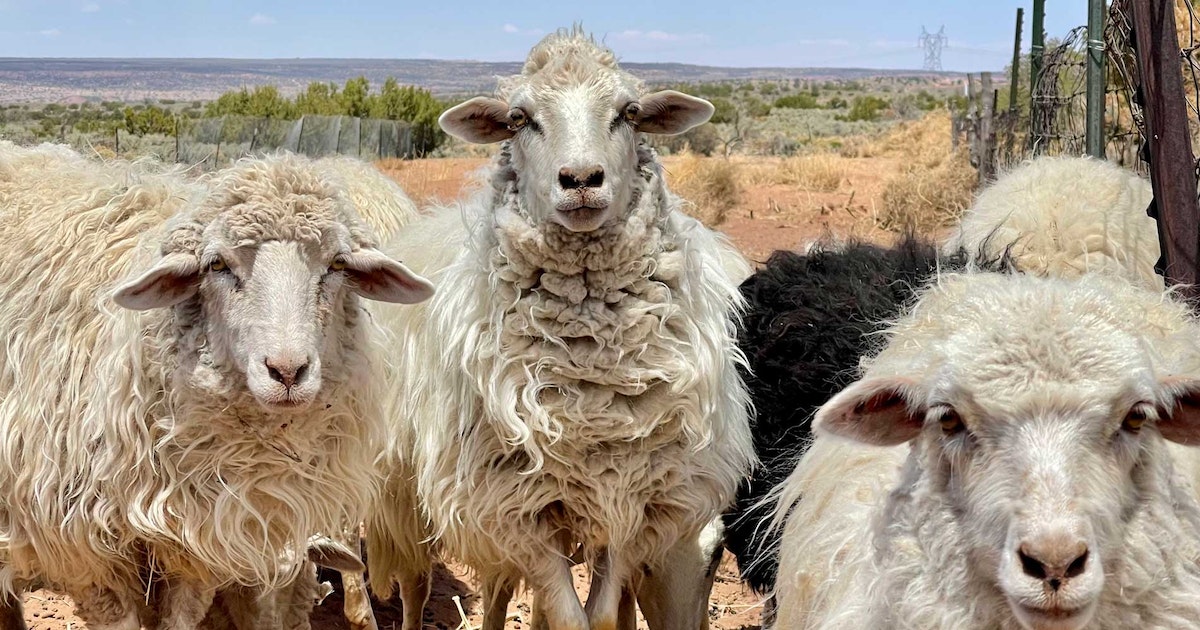
Navajo Churro Sheep (Source: Nikyle Begay)

However, the drought conditions at the time led the United States to engage in a forced reduction. The reduction resulted in a loss of about 30% of a household's livestock, including sheep, cattle and horses. For the Navajo, the forced reduction was as painful as the Long Walk. The stocks of Navajo Churro continued to decrease until the point that they faced extinction. Efforts were made to revive the numbers of sheep, which have been largely successful. 

Although not an animal native to North America, the Navajo Churro has nevertheless assumed an important place within Navajo culture. The stocks may have declined, but Navajo have continued to raise the sheep throughout the years. They have also used the wool, spinning it and dyeing it to produce fibers that make their way into clothing, blankets, rugs and decorative arts. 

In addition to the wool, the Navajo have used the meat of the lamb and sheep in various dishes. Recipes have been developed over generations, and indeed centuries, that feature this protein. One common recipe is Navajo Lamb Stew. This recipe combines mutton with carrots, onions, potatoes and cabbage for a dish that is ideal on cool to cold nights.

Another recipe is this Sumac Navajo Leg of Lamb with Onion Sauce. The recipe is an inspiration of Chef Bitsoie, drawing from his memory of his grandfather, who would roast lamb over a fire and then serve it with a sauce made out of chopped onion. His grandfather did not necessarily use sumac, but Chef Bitsoie thought that the flavor of the sumac worked well with the lamb. (He is correct.)  He used juniper berries and rosemary in the onion sauce because he believed that his grandfather would have foraged those ingredients while he was herding the cattle and sheep in the mountains. 

The use of sumac drew my attention to this recipe. It pairs a non-indigenous protein with a very indigenous little sumac berry. There are 14 species of sumac that grow only in North America. The range of these species runs from southern Quebec across to southern British Columbia, and then south to northern Florida and across to northern Arizona. 

The sumac berry is known for providing a lemony element to dishes, which was part of the overall balance to this dish. The slightly bitter, lemon flavor brought by the sumac berry complements not only the rich taste from the leg of lamb, but also the sweetness of the onion sauce. That balance makes this dish one of the best leg of lamb dishes that I have made in a very long time. 

SUMAC NAVAJO LEG OF LAMB

Recipe adapted from Washington Post

Serves 6-8

Ingredients (for the lamb):

  •  One three pound leg of lamb or tied lamb roast
  • 1 teaspoon fine salt
  • 1 teaspoon freshly ground black pepper
  • 1/3 cup (1 1/2 ounces) ground sumac
  • 3 tablespoons canola oil

Ingredients (for the onion sauce):

  • 2 tablespoons canola oil
  • 1 large yellow onion, halved and thinly sliced
  • 2 sprigs fresh thyme
  • 1 spring fresh rosemary
  • 5 dried huniper berries
  • 1 teaspoon fine salt
  • 1 teaspoon freshly cracked black pepper
  • Water, as needed
  • 2 cups chicken stock

Directions:

1. Prepare the lamb: Heat the oven or a grill to 375 degrees (or heat a smoker to about 275 degrees, and smoke some oak or mesquite wood chunks for about 1 hour). Season the lamb on all sides with salt and pepper, then coat the lamb on all sides with the sumac.

2. Brown the lamb: If you are going to roast the lamb, heat the oil in an ovenproof skillet over high heat, heat the oil until it shimmers. Add the meat and sear on all sides until evenly browned, about 8 minutes. If the lamb is going on the grill or into a smoker, then skip this step. 

3. Roast/Grill/Smoke the lamb. Transfer to the oven to roast for about 40 minutes or until a thermometer inserted into the center reaches 145 degrees for medium-rare. Depending upon the size of the lamb roast, it may take longer to reach that temperature. If using a grill or smoker, place the lamb on the grill and cover. Grill or smoke the lamb until it reaches 145 degrees.

4. Prepare the onion sauce. While the lamb is roasting/grilling/smoking, in a medium saute pan over high heat, heat the oil until it shimmers. Add the onion, thyme, rosemary, juniper berries, salt and pepper. Lower heat to medium and cook, stirring often until the onions are soft and brown, about 20 minutes. If the onions begin to stick,  or darken in any places, stir in a splash of water and adjust theheat. Once browned, add the stock and simmer until the liquid is reduced by half, about 10 minutes. Remove from the heat and discard the herb stems and juniper berries.

5. Finish the dish. When the lamb is done, remove it from the oven and let it rest on a cutting board for 10 minutes before slicing. Serve warm, with the onion sauce on the side. 

ENJOY!

Friday, October 7, 2022

Garlic and Lavender Rubbed Leg of Lamb

Since I started cooking as a hobby, I have become more and more interested in what are known as "foodways." Generally, a "foodway" is the eating habits and culinary practices of a people, region or historical period. Some of the most interesting perspectives - at least in my humble opinion - come from a viewpoint of a people in a region over a period of time (that is, essentially combining all three components of a foodway). There many different foodways, but, one in particular grabbed ahold of my attention and pushed me to learn more. It is the African-American foodway. 

The eating habits and culinary practices of African-Americans was undeniably "molded in the crucible of enslavement." Africans were uprooted from their homes and forcibly brought to the New World. Yet, they did not leave everything behind. As is well documented in the works of culinary historicans and authors, such as Jessica B. Harris and Michael W. Twitty, they brought some of those habits and practices with them. Africans were then forced to adjust under circumstances marked by deprivation and dehumanization. Nevertheless, enslaved Africans were able to develop their own foods, cooking practices, and cuisine. Put differently, in the words of Randy Fertel of the Fertel Foundation, they were "making a way of no way and taking advantage of disadvantages." 

I came across an article on Epicurious by Gabrielle Carter, who is a cultural preservationist who uses food to reimagine, among other things, marginalized food systems. She wrote about what she would serve at a dinner party after emerging from the COVID pandemic. The centerpiece of that dinner was a roasted leg of lamb. The recipe comes from Jessica B. Harris, and it includes what Carter describes as a "fragrant paste of garlic, lavender and other herbs." 

Apart from the connection to my exploration of African-American foodways, it was this paste that also caught my attention. I have been wanting to make a dish that incorporated lavender. During the COVID pandemic, my family took a camping trip in rural Maryland. As we made our way back home, we stopped at a local lavender farm. I had purchased some "culinary lavender" to use in recipes, but I did not have any such recipes at the time. When I came across the recipe from Jessica Harris, which was introduced to me by the article written by Gabrielle Harris, I knew that I had to make this leg of lamb. 

While I have used lavender in recipes in the past, I think this recipe represents the first time that I used the ingredient successfully in a recipe. The aroma and the flavor of the lavender was just right, present enough to know that it was there, but not to overpowering or offsetting to throw off either the smell or the taste of the roasted lamb.

GARLIC AND LAVENDER RUBBED LEG OF LAMB

Recipe by Jessica B. Harris, available on Epicurious

Serves Several

Ingredients:

  • 1 leg half bone-in leg of lamb (4 to 5 pounds)
  • 6 large garlic cloves
  • 1 1/2 teaspoons dried lavender flowers
  • 1 tablespoon fresh thyme leaves
  • 1 1/2 tablespoons finely ground sea salt
  • 2 tablespoons mixed peppercorns
  • 1 tablespoon dried rosemary
  • 1 tablespoon herbes de Provence
Directions:
1. Prepare the leg of lamb. Preheat the oven to 450 degrees Fahrenheit.  If the butcher has not already removed the fell (parchment like membrane) from the lamb leg, trim it away along with the excess fat.  Using the tip of a sharp knife, make 15 or so small incisions in the leg, spacing them evenly. 

2. Prepare the rub. Place the garlic, lavender and thyme in a small food processor and pulse until you have a thick paste.  Poke a bit of the paste into each of the incisions in the lamb. Place the salt, peppercorns, dried rosemary and herbes de Provence in a spice grinder and pulse until you have a coarse mix.  Rub the mix all over the lamb, covering it evenly. Place the lamb on a rack in a roasting pan.

3. Roast the lamb. Roast the lamb for 15 minutes. Lower the heat to 350 degrees Fahrenheit and continue to roast for about 1 hour or until a thermometer inserted into the thickest part away from the bone registers 130 degrees Fahrenheit for rare, or 140 to 145 degrees Fahrenheit for medium rare.  Remove the lamb from the oven and let it rest for 15 minutes before carving. 

4. Finish the dish. Carve the lamb parallel to the bone in long thin slices and arrange the slices on the platter. Transfer the warm sauce to a sauceboat and serve immediately. 

ENJOY!

Friday, November 26, 2021

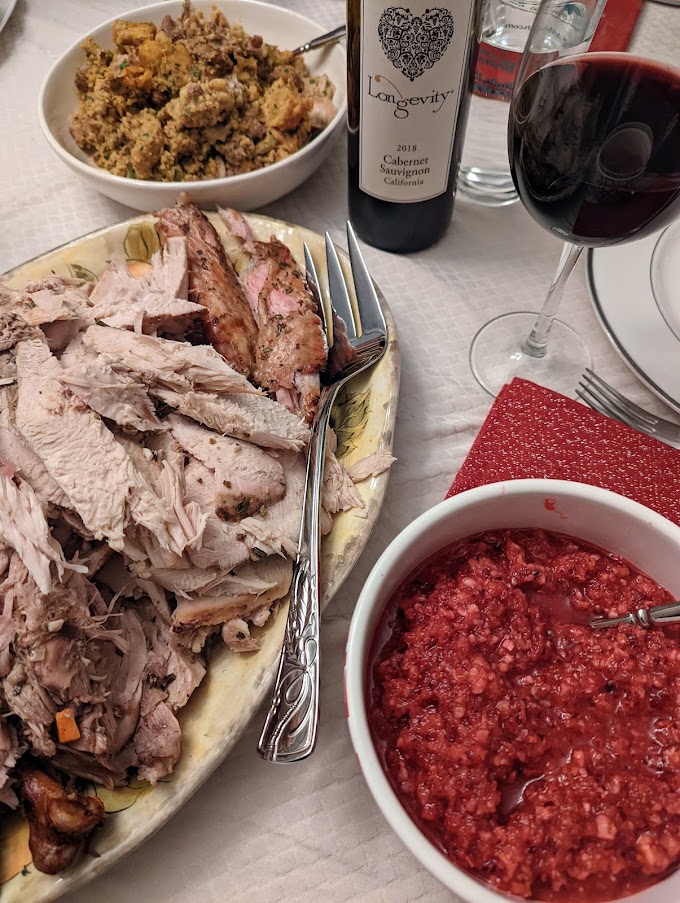
Arista-Style Turkey with Tuscan Chestnut Stuffing (Savage Boleks' Thanksgiving 2021)

It is interesting how a decision to depart from a tradition could, itself, turn into a tradition.  Nearly two years ago, I decided to try prepare a Christmas dinner that was different than what the traditional Italian holiday meal that my family has prepared for more than fifty years. I prepared a turkey in the style of a Tuscan pork roast. That experience gave rise to a blog post, Turkey in the Arista Style with Tuscan Bread Stuffing. My beautiful Angel loved the meal so much, both the turkey and the stuffing, that I have made the dish a few times since that holiday dinner. And, now, it has officially become the traditional Thanksgiving dinner for the Savage Boleks. 

Yet, a turkey in the arista style is itself a departure from tradition in another sense. Since the dawn of the thirteenth century, an arista has always been a pork roast. That roast evolved over time to what it is today: a mass of porcine goodness covered in a rub consisting primarily of rosemary and garlic, along with other ingredients, such as lemon, cloves and/or fennel seeds. While recipes change, the one constant is that the protein used in an arista comes from some part of a pig, either a roast or the loin. The use of a turkey is a break from that tradition. Yet, it is a good break. The reason is simple: much like pork, turkey meat provides a tableau upon which all of the flavors used in the rub come together to provide a culinary image of Tuscan flavors.  If pork is the other white meat, then turkey is the other, other white meat.

The arista-style turkey is just the beginning of this new Savage-Bolek tradition. Another important aspect is the stuffing and, because I make so much of it, the dressing. (As you may know, it is stuffing if it is stuffed in the bird; it is dressing if it is baked alongside the bird.) This stuffing is a culinary mélange of Tuscan flavors and aromas. It begins with the bread, which is focaccia. The bread is cut up and toasted until the moisture is removed. One then adds in diced pancetta (or, if that person is me cooking for my beautiful Angel, diced turkey bacon), along with diced turkey heart, liver and gizzard (that is, all of the giblets in the package provided with the turkey). This step is followed by the addition of the traditional elements of a stuffing, namely, diced onion, celery and carrots. Finally, just before the liquid (turkey stock) is added, one adds a heaping 1/4 cup of rosemary, sage and the chestnuts. after the liquid is added, the ingredients are mixed well, left to marry for an hour and then stuffed into the bird or placed in a dish to be baked.

This stuffing or dressing is perhaps the best stuffing that I have ever made. One does not have to take my word for it, my beautiful Angel has made similar proclamations. This stuffing or dressing pairs perfectly with the ingredients used to make the arista-style turkey. There are major connections in terms of flavor, with the use of turkey bacon and rosemary. Yet, the stuffing or dressing adds to the flavors of the turkey with the use of sage and chestnuts. 

The recipe set forth below is not the same recipe that I used back in 2019. I have made some modifications based upon my subsequent efforts to make this dish. The two major changes are as follows: (1) I have incorporated the juice from the zested lemons into the marinade, as a way to utilize all of the ingredients; (2) I increased the amount of times that I baste the turkey with the juices and butter from once every hour to once every 40 minutes; and (3) I added an uncovered/covered/uncovered sequence to roasting the bird. While this additional work extends the cooking time a little, it is definitely worth it if you are trying to get crispy, brown skin on  the bird. 


ARISTA-STYLE TURKEY
WITH TUSCAN CHESTNUT STUFFING
Turkey recipe adapted from Reinhardt Hess & Sabine Salzer, 
Regional Italian Cuisine, pp. 148-49
Tuscan Bread Stuffing Recipe adapted from Tasting Table
Serves many

Ingredients (for the turkey):
1 whole turkey (about 12 pounds)
4 lemons, zested and juiced
8 to 10 sprigs of rosemary
10 cloves of garlic
4 teaspoons of fennel seeds
4 pinches of ground cloves
Kosher salt
Freshly ground black pepper
Olive oil
1 stick of unsalted butter

Ingredients (for the stuffing):
1 1/2 pounds ciabatta bread, cut into 1 inch cubes
8 ounces pancetta, small dice
1 package turkey liver and gizzards (from 1 large turkey)
2 medium carrots, peeled and small dice
2 celery stalks, small dice
1 large yellow onion, small dice
2 sticks unsalted butter
1/4 cup heavy cream
3 cups turkey stock + 2 cups of turkey stock
1 cup roasted chestnuts, roughly chopped
1/4 cup minced sage
1/4 cup minced rosemary
Kosher salt, to taste
Freshly ground black pepper, to taste

Directions:
1.  Prepare the turkey.  Rinse the turkey well.  Pat the turkey dry.  Separate the skin from the turkey so that you can apply the rub directly onto the meat. Combine the lemon zest, rosemary, fennel seeds, ground cloves, garlic, salt and black pepper into a small bowl.  Mix well. Juice the lemons and pour into a separate bowl.  Whisk in olive oil with the lemon juice and then add it to the small bowl with the dry ingredients to create a paste. Add additional olive oil, if necessary, to create that paste.  Continue to mix.  Once the paste has the desired consistency, apply it to all parts of the turkey, including under the skin.  Reserve some of the rub for basting. Allow the turkey to rest for at least 2 hours in the refrigerator.

2.  Prepare the stuffing.  Preheat the oven to 225 degrees Fahrenheit.  Lay out the bread on a baking sheet and bake until dry, about 25 to 30 minutes.  Transfer the bread to a huge bowl.  While the bread is baking, heat the pancetta in a medium skillet over medium-high heat. Cook, stirring often until the pancetta is crispy and the fat has rendered, about 8 to 10 minutes. Using a slotted spoon, transfer the pancetta to the bowl with the bread.  Drain the fat into a separate bowl. Add back 1 to 2 tablespoons of the fat to the pan and add the liver and gizzards.  Cook the ingredients, turning as needed until golden and cooked through, about 4 to 5 minutes for the liver and 8 to 10 minutes for the gizzard.  Transfer to a cutting board and roughly chop, then add to the stuffing bowl.

3.  Continue to prepare the stuffing.  Add a little more of the pancetta fat back to the pan.  Add the carrots, celery and onion to the pan.  Sweat the ingredients until softened, 6 to 8 minutes.  Transfer the vegetables to the stuffing bowl.   Add the butter to the pan and cook until it begins to brown and has a nutty aroma.  6 to 8 minutes.  Turn off the heat and stir in the cream to warm through.  Add the butter mixture to the stuffing bowl with the remaining ingredients (namely, the turkey stock).  Using your hands, mix the stuffing to incorporate.  Let sit at room temperature for 1 hour. 

4.  Prepare to roast the turkey.  Preheat the oven to 400 degrees Fahrenheit. Stuff the turkey's cavities with the stuffing, and place the remaining stuffing in a baking dish.  Roast the turkey for about 3 hours or until the turkey's internal temperature reaches 160 degrees. I roast the turkey uncovered for about the first hour and twenty minutes, cover the bird for the next hour and twenty minutes, and then leave the bird uncovered for the rest of the time. Baste the turkey approximately every 40 minutes with melted butter that has some of the rub mixed into it.  Once the turkey reaches that temperature, remove the turkey from the oven and cover it.  Place the baking dish full of dressing in the oven and cook for about 30 minutes to 45 minutes, or until the dressing begins to crisp on the surface.  Remove the stuffing and set on the stove to cool.

5.  Prepare the au jus.  Drain the liquid from the roasting pan into a separator.  Pour the juices into a pot, along with 2 cups of the turkey stock. Taste and adjust the seasonings with salt and pepper if necessary.  Bring to a boil under medium high heat and reduce to a simmer.  Allow to simmer until you are ready to serve. 

6.  Finish the dish.  Spoon the stuffing and dressing into a serving bowls (one for the stuffing and another for the dressing).  Slice the turkey and place on a serving dish.  Serve immediately.

ENJOY!

Saturday, March 27, 2021

Arrosticini

You are standing next to your horse on the hillside in the province of Abruzzo, halfway between the mountains and the plains. You are following the "silent grassy river," trekking "on the footsteps of ancient fathers." This particular route was  restored in the 13th century by the Holy Roman Emperor, Frederick II.  It was his zeal to return to the glory of ages past that led to the restorations of trails like this one, which were first trodden by the Romans centuries earlier.  You are not an emperor. You are just a guide. Those who you guide are grazing peacefully on the verdant grass that leads down to the valley.  They are your flock of sheep.  It is your job to lead them to greener pastures,

It's getting late, the sun will soon set. You survey the green landscape in the distance: the mountains, the valleys, the small towns in the distance. Yet, your eyes always return to those sheep. They are the reason why you are standing in this spot at this particular moment. These sheep are the means by which you, and your family, are able to make a living, as meager as it may be. 

The Transumanza
As you watch the sheep, you begin to realize how tired you are. Shepherds do not get very many breaks. You are in the midst of the Transumanza, or "crossing the land."  It is the three-week trek from the mountains to the plains in search of better grazing lands. The sheep are eating, but you are hungry too. However, there is still work to do. You need to set up your stazzi, the temporary fencing that will keep the sheep corralled during the night.  As you set the remaining posts of that fence, you call upon your Maremmano-Abruzzese sheepdog to corral the straggling sheep into the enclosure. With the fencing in place and the sheep inside, you can finally take a rest ... and eat. 

You start a fire over which you will cook your meal. You don't have a furnacella, which is the brazier that you would traditionally use to make your meal. Instead, you just have to work with what you have. With the words of O Surdato Nnammurato singing through your head, you pulled out some mutton from an old sheep you recently butchered, stringing roughly similar sized pieces on wooden skewers known as ceppos. Once the coals take on their ashy appearance, with the heat radiating from the center, you place the skewers over the fire. Turning the skewers every once in a while, you watch the meat cook as the embers burn a deep red. That red begins to illuminate the space around you as the sun begins to set. Soon enough, the skewers are cooked and you are ready to begin eating your meal. 

This dish is known Arrosticini -- kebabs of mutton, rubbed with rosemary or other available herbs -- is  one of the iconic foods from the Abruzzo region. Yet, it is the simple food of the shepherds. It is what they would prepare when they were out with their flocks of sheep or herds of cattle. It is a dish that reflects the particular circumstances of a shepherd.  Very tired, with little at his or her disposal, he or she would prepare this simple meal to provide needed sustenance. They took what little they had -- and, perhaps, the most important thing they had, namely, their animals -- to produce a meal that, in my humble opinion, is far greater than the sum of its ingredients.  

Today, most arrosticini are prepared in kitchens and restaurants throughout Abruzzo and, as evident from this post, around the world. Home cooks can buy their own furnacella to grill the skewers in their backyards. They can even buy their own special knives by which they can cut the mutton for the kebabs. If one is too tired (or lazy), he or she can simply forgo the butchering of a piece of mutton or lamb and order pre-made arrosticini. 

Pre-made kebabs is not for me, especially when dealing with a dish with such humble and simple origins. That is one of the important purposes of this blog: namely, my effort to learn about the origins of a dish, as well as what that the dish means for those who originally made it. For the shepherds, arrosticini was sustenance. It fulfilled a basic need for someone who worked long hours, perhaps on an equally long journey. And, those skewers were damn good to eat. 


ARROSTICINI

Recipe adapted from Great Italian Chefs

Serves 8

 Ingredients:

  • 1.5 pounds of lamb shoulder or leg, diced into 1 inch cubes
  • 1 spring of rosemary, chopped finely
  • Olive oil
  • Sea salt
  • Freshly ground black pepper
Directions:

1. Marinate the lamb.  Place the lamb in a bowl with the rosemary and olive oil and season with salt and pepper. Mix well and set aside while you preheat a barbecue for direct cooking.

2. Skewer the lamb.  if using wooden skewers, leave to soak in cold water for at least 20 minutes to prevent them from burning during cooking.  Thread the lamb onto the skewers neatly, ensuring an even distribution of fat and meat. 

3. Cook the skewers.  Once the coals in the barbecue have turned an ashy white, or the gas grill is heated to medium high.  Cook the skewers for 2-3 minutes, turning them halfway through. 

4. Finish the dish. Serve hot with pepperoncini and crusty bread with good quality olive oil. 

For an excellent article about the Transumanza through the neighboring province of Molise, check out this New York Times article by Maria Russo.

ENJOY!

Saturday, May 30, 2020

Chef Bolek's Half Turkey Breast

This is a basic recipe.  It is something that I go to when I am very busy and need something that requires very little prep.  The only thing that needs to be done is the rub.  And, even the rub is simplified so that it can be prepared in a couple of seconds.

The base of the rub is onion powder and garlic powder.  The flavor elements include thyme, coriander and fennel seeds.  (I have recently been on a big fennel kick, especially in roasting, grilling and even barbecue.) All of those ocmponents are just 1 teaspoon.  Additional flavor comes from some stronger herbs, both rosemary and sage. I reduced the amounts for each of these two herbs to half teaspoons each. The rub is completed with a teaspoon of salt and freshly ground black pepper.  The work is complete. 

This is a great recipe to make on the weekend.  Once the breast is roasted and sliced, then you can make turkey sandwiches for lunch during the week.  It is a great way to skip the processed meats in the deli section of the local grocery store. 


CHEF BOLEK'S HALF TURKEY BREAST
A Chef Bolek Original 
Serves 8

Ingredients:
1 half turkey breast, about 3 to 4 pounds
1 teaspoon onion powder
1 teaspoon granulated garlic powder
1 teaspoon dried thyme
1 teaspoon fennel seeds
1 teaspoon ground coriander
1 teaspoon freshly ground black pepper
1 teaspoon kosher salt
1/2 teaspoon dried rosemary, cracked
1/2 teaspoon dried sage
1/2 cup of wateror more if needed
1/8 cup of olive oil, more if needed

Directions;
1.  Prepare the turkey breast.  Combine all of the dried ingredients and mix well.  Brush olive oil all over the turkey breast.  Sprinkle the herb/spice mix all over the turkey breast.

2.  Roast the turkey breast.  Preheat the oven at 350 degrees Fahrenheit.  Place the breast in a roasting pan, add 1/2 cup to 1 cup of water around the edge of the breast. Roast the turkey breast in the oven until it reaches 160 degrees Fahrenheit. The end temperature is 165 degrees, but the breast will continue to cook for several minutes afer being removed from the oven. Remove from the oven, cover and let rest for 15 minutes.  Slice thinly and serve immediately or refrigerate for use in sandwiches later.

ENJOY!

Sunday, March 1, 2020

Parmesan Crusted Rack of Lamb

A rack of lamb or carré d'agneau presents an amazing canvas for the right ingredients. The rack of lamb is a cut perpendicular to the spine of the lamb that includes sixteen (16) ribs.  This is an amazing cut of meat, which was often referred to by the British as the "best end of lamb."  And, as one could expect for the "best end," it is also one of the more expensive cuts of lamb sold at a butcher shop or grocery store.  

There are many recipes for a rack of lamb out there on the Internet.  A large segment of those recipes focus around a "crust" for the meat.  Generally speaking, a crust has two to three components: something wet, something dry and something interesting.  The "something wet" is an ingredient that can hold together the other components to the rack. Typically, mustard or olive oil could work. The "something dry" is usually bread crumbs. Finally, for that "something special," it is typically a combination of herbs and spices.  If the right ingredients are combined together, the crust will enhance the taste of the lamb with a depth of added flavors and aromas.

For this recipe the three components are fairly straight forward.  The "something wet" is olive oil and the something dry is bread crumbs. The "something special" is truly special, the king of cheese, Parmigiano Reggiano, along with rosemary and parsley.  The combination of the Parmigiano Reggiano, parsley and rosemary provide levels of earthy flavors that complement the lamb. The amazing flavors are really noteworthy given how easy it is to prepare the dish.

Everytime I think about this recipe, I think about how I need to go out and buy a rack of lamb.  Speaking of which, I need to go out and buy one.  Until next time....


PARMESAN CRUSTED RACK OF LAMB
Recipe adapted from New York Times Cooking
Serves 41

Ingredients:
1 rack of lamb, approximately 1.5 ponds, frenched
2 tablespoons extra virgin oil
Kosher salt
Freshly ground black pepper
1/4 cup bread crumbs
1/4 cup grated Parmigiano Reggiano
1/2 tablespoon fresh rosemary, chopped finely
1 tablespoon fresh parsley

Directions:
1. Sear the lamb.  Preheat the oven to 450 degrees Fahrenheit.  Put a large frying pan over high heat until very hot.  Rub lamb with 1 tablespoon of the oil, season aggressively with salt and pepper and then sear the meat in the pan the meat in the pan until it is golden brown all over, about 4 minutes a side.  Place on a rimmed baking sheet and let rest for 20 to 30 minutes, until cool.

2.  Prepare the crust.  In a bowl, combine the bread crumbs, cheese, rosemary and parsley.  Rub the cooled off lamb with the remaining oil, then pat the seasoned bread crumbs all over the meat in an even layer. 

3.  Roast the lamb.  Put the lamb back on the baking sheet, and roast until a thermometer inserted into the thickest part of the meat registers 120 degrees Fahrenheit, about 20 to 30 minutes.  Remove the lamb from the oven and allow to stand, covered loosely in foil for about 10 minutes.  Carve into chops and serve on a warmed platter.

ENJOY!

Friday, December 27, 2019

Turkey in the Arista Style, with Tuscan Bread Stuffing

For this holiday season, I decided that I would try something different.  Christmas Eve dinner is a well established tradition in my family, with the antipasta plate and wedding soup, followed by pasta with meatballs and sausage. That tradition has produced many great memories for me going back to my childhood. 

Traditions are good, in fact, they are great.  But, at least for me, I felt that I could be missing something if I didn't take a chance and try something different. There was only one question: what to make?

Recently, my beautiful Angel's parents traveled to Italy, spending time in Lazio, Tuscany and Liguria.  I too spent time in Tuscany, which provided me with the inspiration for the dinner.  I spent a lot of time researching main courses, but I wanted to make something that everyone could enjoy.  I ultimately decided to do an Arista, which is a dish that I previously made. Arista is a roast pork dish that is quintessential Tuscan cuisine. The problem with an Arista is that it is roast pork, and, my beautiful Angel does not eat pork.  My Angel does eat turkey, so I decided to apply the ingredients and cooking techniques of an Arista to a turkey.

To be sure, there are not very many turkeys gobbling around Tuscany. (Although, interestingly, there is a highly challenged study that says the ancient Etruscans, who called the area of Tuscany their home around 900 B.C. came from Anatolia, which is currently known as Turkey.) But, the use of a rub of rosemary, garlic, fennel seed and clove pretty much made this turkey smell like a Tuscan pork roast. 

Additional Tuscan flavor and character was added to the bird with the stuffing.  I searched far and wide  on the Internet for a "Tuscan stuffing."  I came across one recipe for a Tuscan Bread Stuffing. This recipe incorporated many classic Tuscan ingredients, such as rosemary, sage and chestnuts.  The use of pancetta is also key, as its fat provides flavor at every level and stage of preparation.  

Overall, this is perhaps the best turkey that I have ever made; and, according, to my beautiful Angel, the stuffing is the best that she has ever had.  This recipe is now the Savage Boleks' standard for a stuffed turkey dinner.  This may be the beginning of a new tradition ... for now.


TURKEY IN THE ARISTA STYLE
WITH TUSCAN BREAD STUFFING
Turkey recipe adapted from Reinhardt Hess & Sabine Salzer, 
Regional Italian Cuisine, pp. 148-49
Tuscan Bread Stuffing Recipe adapted from Tasting Table
Serves many

Ingredients (for the turkey):
1 whole turkey (about 12 pounds)
4 lemons, zested
8 to 10 sprigs of rosemary
10 cloves of garlic
4 teaspoons of fennel seeds
4 pinches of ground cloves
Kosher salt
Freshly ground black pepper
Olive oil
1 stick of unsalted butter

Ingredients (for the stuffing):
1 1/2 pounds ciabatta bread, cut into 1 inch cubes
8 ounces pancetta, small dice
1 package turkey liver and gizzards (from 1 large turkey)
2 medium carrots, peeled and small dice
2 celery stalks, small dice
1 large yellow onion, small dice
2 sticks unsalted butter
1/4 cup heavy cream
3 cups turkey stock + 2 cups of turkey stock
1 cup roasted chestnuts, roughly chopped
1/4 cup minced sage
1/4 cup minced rosemary
Kosher salt, to taste
Freshly ground black pepper, to taste

Directions:
1.  Prepare the turkey.  Rinse the turkey well.  Pat the turkey dry.  Separate the skin from the turkey so that you can apply the rub directly onto the meat. Combine the lemon zest, rosemary, fennel seeds, ground cloves, garlic, salt and black pepper into a small bowl.  Mix well.  Add enough olive oil to create a paste.  Continue to mix.  Once the paste has the desired consistency, apply it to all parts of the turkey, including under the skin.  Reserve some of the rub for basting. Allow the turkey to rest for at least 2 hours in the refrigerator.

2.  Prepare the stuffing.  Preheat the oven to 225 degrees Fahrenheit.  Lay out the bread on a baking sheet and bake until dry, about 25 to 30 minutes.  Transfer the bread to a huge bowl.  While the bread is baking, heat the pancetta in a medium skillet over medium-high heat.  Cook, stirring often until the pancetta is crispy and the fat has rendered, about 8 to 10 minutes.  Using a slotted spoon, transfer the pancetta to the bowl with the bread.  Drain the fat into a separate bowl.  Add back 1 to 2 tablespoons of the fat to the pan and add the liver and gizzards.  Cook the ingredients, turning as needed until golden and cooked through, about 4 to 5 minutes for the liver and 8 to 10 minutes for the gizzard.  Transfer to a cutting board and roughly chop, then add to the stuffing bowl.

3.  Continue to prepare the stuffing.  Add a little more of the pancetta fat back to the pan.  Add the carrots, celery and onion to the pan.  Sweat the ingredients until softened, 6 to 8 minutes.  Transfer the vegetables to the stuffing bowl.   Add the butter to the pan and cook until it begins to brown and has a nutty aroma.  6 to 8 minutes.  Turn off the heat and stir in the cream to warm through.  Add the butter mixture to the stuffing bowl with the remaining ingredients (namely, the turkey stock).  Using your hands, mix the stuffing to incorporate.  Let sit at room temperature for 1 hour. 

4.  Prepare to roast the turkey.  Preheat the oven to 400 degrees Fahrenheit. Stuff the turkey's cavities with the stuffing, and place the remaining stuffing in a baking dish.  Roast the turkey for about 3 hours or until the turkey's internal temperature reaches 160 degrees. Baste the turkey approximately every hour with melted butter that has some of the rub mixed into it. Fahrenheit. Once the turkey reaches that temperature, remove the turkey from the oven and cover it.  Place the baking dish full of stuffing in the oven and cook for about 30 minutes to 45 minutes, or until the stuffing begins to crisp on the surface.  Remove the stuffing and set on the stove to cool.

5.  Prepare the au jus.  Drain the liquid from the roasting pan into a separator.  Pour the juices into a pot, along with 2 cups of the turkey stock. Taste and adjust the seasonings with salt and pepper if necessary.  Bring to a boil under medium high heat and reduce to a simmer.  Allow to simmer until you are ready to serve. 

6.  Finish the dish.  Spoon the stuffing into a serving bowl.  Slice the turkey and place on a serving dish.  Serve immediately.

ENJOY!

Saturday, October 19, 2019

Arista, Patate Rosse Arrostite, Cavolo Nero

It was Florence, Tuscany. The year was 1430.  The Byzantine patriarch, Bessarion, was visiting the city, which was the center of an oligarchic republic at time.  The visit of the patriarch was an occasion to celebrate. Accordingly, along with the other bishops and cardinals, Bessarion was treated to a feast that included a roasted pork dish.  After eating some of that roast pork, the Bessarion exclaimed, "aristos!" His Tuscan hosts looked at him and then at each other.  After all, what the Byzantine patriarch said was Greek (literally). The Tuscan hosts thought Bessarion was shouting the Greek word for pork; instead, he was really saying "best" or "excellent." 

This is a great story, but it is most likely a culinary myth. "Arista" goes back at least one century before Bessarion set foot in Florence.  Records apparently include references to the roast pork dish going back to the 1200s.  Regardless of when it first appeared, the dish has become one of the culinary cornerstones of Tuscan cuisine.

Indeed, arista is in many ways the porcine equivalent to Bistecca alla Fiorentina, another Tuscan culinary classic.  Like bistecca, arista combines garlic, rosemary, salt and pepper into a crust that infuses those flavors into the meat.  Arista can also be made using a crown roast or a rib roast, which are probably as close to a bone-in cut like a porterhouse.  However, most recipes for arista focus more on cuts like the pork tenderloin than roasts.  Moreover, unlike bistecca, arista works best when it is roasted slow rather than with a sear over extremely hot coals.  

Most arista recipes are relatively the same.  This recipe is a Chef Bolek original insofar that I have taken what I liked from dfferent arista recipes, including some of my own additional ingredients, like the crushed red pepper. 

For this dish, I decide to pair the roasted pork with side dishes of roasted red potatoes (patate rosse arrostite) and sauteed black kale (cavolo nero).  The red potato recipe is rather basic, drawing upon the fundamental ingredients of the rub for the pork roast (rosemary, garlic, salt and black pepper) to underscore the complementary nature of the roasted potatoes.  As for the kale, I am not a big fan of the leafy cabbage.  Still, I am a big fan of balsamic vinegar, which provides some sweetness to balance out the bitterness of the kale. 

In the end, I was just cooking for myself, not a feast for bishops and cardinals.  Yet, as the picture shows, it was nevertheless a personal feast.  Just a couple of bites of the roasted pork is all the explanation one needs for why this recipe has survived over at least 800 years. 


ARISTA, PATATE ROSSE ARROSTITE, CAVOLO NERO
A Chef Bolek Original
Serves 6-8

Ingredients (for the pork loin):
1 boneless pork loin roast (about 3 pounds)
4 springs of fresh rosemary, chopped finely
4 cloves of garlic, minced finely
1 tablespoon sea salt (or more if desired)
1 tablespoon of freshly ground black pepper (or more if desired)
Pinch of crushed red pepper flakes
3 or 4 tablespoons of olive oil (or more if desired)
1 cup of water or white wine

Ingredients (for the red potatoes):
2 pounds of red potatoes, washed, cut into large pieces
1 tablespoon of fresh rosemary, chopped finely
1 tablespoon of garlic, minced finely
Sea salt, to taste
Freshly ground black pepper, to taste
2 tablespoons of olive oil

Ingredients (for the kale):
1 bunch of Tuscan kale (or kale), 
     leaves and stems roughly chopped
2 cloves of garlic, minced finely
1 shallot, minced finely
2 tablespoons extra virgin olive oil
Sea salt, to taste
Freshly ground black pepper, to taste
Balsamic vinegar 

Directions:
1.  Prepare the pork loin.  Brush the pork loin with the olive oil.  Salt and pepper the pork loin generously on all sides.  Then add the minced garlic and rosemary on all sides.  Allow the pork loin to rest for 30 minutes or overnight in the refrigerator.  

2.  Prepare the red potatoes.  In a large bowl add the potatoes, olive oil, garlic and rosemary.  Salt and pepper the potatoes.  

3. Roast the pork.  Heat the oven to 350 degrees Fahrenheit.  Place the pork loin roast in the center of a lightly oiled roasting pan.  Add the potatoes around the pork loin roast.  Cook uncovered for 45 minutes.  Check the loin roast and the potatoes. Raise the heat to 450 degrees and cook for another 30 minutes to brown well.  Remove the roast when the internal temperature reaches around 150 degrees Fahrenheit.  Allow the roast to rest for 10 minutes before carving. 

4.  Prepare the kale. Heat the olive oil over medium heat.  Add the stems, garlic and shallots.  Season with salt and pepper.  Reduce heart to low and cook, stirring occasionally for 10 minutes or until the stems soften.  Add the kale leaves and increase the heat to high.  Cook, stirring the leaves until they have wilted, about two to three minutes.

5.  Finish the dish. Carve the roast into thin slices and serve with the potatoes and kale.

ENJOY!  

Saturday, March 16, 2019

Chicken Vesuivio

It is the early 1930s. The Great Depression has settled in, but, for some reason, you find yourself at the corner of East Wacker Drive and North State Street.  That intersection near the heart of downtown Chicago. At the corner, you watch Packards and Cords drive by. As you turn your head, something catches your eye. It is an Italian restaurant called Vesuvio.  The hunger pangs in your stomach tell you it is time for a meal.  You walk over to the restaurant and open the door.  Before any person can great you, the smells of Italian food greet your olfactory senses.

You take a step in to the restaurant and survey the wood-paneled walls and thick red curtains.  A host guides you to a table in the corner and provides you with a menu.  You can the offerings, which are traditional Italian-American fare.  One dish catches your attention ... Chicken Vesuvio. (A dish named after the infamous volcano in Calabria, even though the owner of the restaurant was from Turin, which is located in Piedmont.) You decide to order the dish.  What comes next is what becomes not only a traditional Italian-American dish, but a traditional Chicago dish as well.

Chicken Vesuvio was traditionally made with bone-in chicken or, quite frankly, an entire chicken deconstructed into pieces.  The chicken is prepared with potatoes sauteed in garlic, oregano, white wine, and olive oil.  This recipe includes a healthy twist, substituting the bone-in chicken (which would traditionally legs or thighs) with boneless, skinless chicken breasts.

In the end, this is a very tasty dish that provides a window into how Italian immigrants who came to the United States are able to create dishes that become their own traditions.  Now, I will have to try some other Italian-American classics, like Chicken Francese or Penne alla Vodka.   


CHICKEN VESUVIO
Recipe from Cooks Country Eats Local, pp. 198-199
Serves 4

Ingredients:
4 (6 ounce) boneless, chicken breasts, trimmed
Salt and pepper
2 tablespoons olive oil
1 1/2 pounds small red potatoes, unpeeled, halved
1 teaspoon minced fresh rosemary
2 garlic cloves, minced
1/2 teaspoon dried oregano
1 1/2 cups chicken broth
1/2 cup white wine
1 cup frozen peas, thawed
2 tablespoons unsalted butter
2 teaspoons lemon juice

Directions:
1.  Brown the chicken.  Pat chicken dry with paper towels and season with salt and pepper. Heat 1 tablespoon of olive oil in 12-inch nonstick skillet over medium-high heat until just smoking.  Brown chicken well, 3 to 4 minutes per side. 

2.  Continue cooking.  Add remaining 1 tablespoon oil to skillet and heat until shimmering.  Add potatoes, cut side down, and cook until golden brown, about 87 minutes.  Stir in garlic, rosemary, oregano and 1/2 teaspoon salt and cook until fragrant, about 30 seconds. Add broth and wine, scraping up any browned bits, and bring to boil.  Return chicken to skillet on top of potatoes.  Reduce heat to medium low and simmer, covered, until potatoes are tender and chicken registers 160 degrees, about 12 minutes.  Using slotted spoon, transfer chicken and potatoes to serving platter and tent loosely with aluminum foil.

3.  Finish the sauce.  Increase heat to medium high and cook, uncovered, until sauce is reduced to 1 cup, about 5 minutes.  Stir in peas and cook until heated through, about 1 minute.  Off heat, whisk in butter and lemon juice and season with salt and pepper to taste.  Pour sauce over chicken and potatoes and serve. 

ENJOY!

Sunday, February 25, 2018

Bone Marrow Mashed Potatoes

One of my favorite ingredients to cook with is bone marrow.  It is the soft, flexible material inside of bones that, when raw, is relatively firm, but when cooked, is soft, oily, fatty, and buttery in texture.  When I make bone marrow, it often does not last long enough to be used in a recipe.  I just pull out a small spoon, scoop out the marrow and eat it right on the spot.  In my moments of greater discipline, I am able to use that incredible delicious ingredient in dishes such as those that I made as part of my incredibly rare Iron Chef Event.

Sometimes, it is not necessary to come up with a bunch of  different recipes for bone marrow.  Instead, it is better to go with something simple.  And there is nothing simpler than making bone marrow mashed potatoes.  It is just mashed potatoes with some bone marrow added just after you add the milk and butter.  That one ingredient does more to add flavor to the mashed potatoes than either the milk or the butter.  (Let's face it, those two ingredients are more about getting the right texture for the potatoes.  They have little or nothing to do with the flavor of the potatoes.)  Bone marrow adds a beefy undertone to the potatoes, which is especially good when those potatoes are served alongside ... a ribeye or strip steak.

While some may think that using bone marrow just adds another step to the already simple process of making mashed potatoes, I think it is definitely worth it.  In fact, bone marrow makes every dish definitely worth the effort. 


BONE MARROW MASHED POTATOES
Recipe from John Whalen, 
Prime: The Complete Prime Rib Cookbook, pg. 172
Serves 6 to 8

Ingredients:
8 Yukon Gold potatoes, peeled and cut into quarters
4-6 large beef marrow bones, halved lengthwise
1/2 cup half and half
1/2 cup unsalted butter, softened
1 teaspoon fresh rosemary
Coarsely ground black pepper
Fresh sea salt

Directions:
1.  Roast the marrow bones.  Preheat the oven to 375 degrees, placing the rack in the center of the oven.  Place the marrow bones on a baking sheet, transfer to the oven, and then cook for about 15 minutes, until the marrow is nicely browned.  Remove from the oven and let stand.

2.  Prepare the potatoes.  While the marrow bones are roasting, place the potatoes in a large stockpot and fill with water so that it covers the potatoes by 1 inch.  Place the stockpot on the stove and bring to a boil.  Cook the potatoes by boiling for about 20 minutes until you can pierce the potatoes with a fork.  Remove the pot from the heat and drain the water, leaving the potatoes in it.

3.  Mash the potatoes.  Using a potato masher or fork, start mashing the potatoes so they begin to break apart.  Gradually mash in the half-and-half and butter, tasting the potatoes as you go along, until you arrive at the perfect blend of creamy butter, mashed potatoes. 

4.  Add the marrow.  Scoop the marrow from the bones and add to the potatoes, along with the rosemary.  Mix thoroughly, and then the season with the coarsely ground black pepper and fresh sea salt.

ENJOY!