Showing posts with label The Mindfulness Foodways. Show all posts

Tuesday, September 1, 2026

Dhal Bhat

"Dhal bhat power, 24 hours."
-- Nepali saying

Many cuisines are readily identifiable by one dish. For example, jollof rice would be cited for the cuisines of Ghana or Nigeria. Sushi could be identified for the cuisine of Japan, while pho could be identified for the cuisine of Vietnam. And, if one had to choose which dish could be representative of Nepali cuisine, that dish would be dhal bhat. 

The name translates literally into lentil soup and rice, which is a very good description of the dish. Yellow or red lentils are prepared with a variety of spices, like mustard, turmeric, coriander and cumin, to prepare a stew that is served alongside or with rice.

Yet, to Nepalis, dhal bhat is not just a dish or even a meal. It is a story as old as the people themselves. Nepali farmers have been cultivating both lentils and rice for centuries. Nepali cooks have take those two building blocks to prepare a dish that became the source of fuel or energy for farmers when they went back into the field. Hence the phrase, "dhal bhat power, 24 hours." Between 400 C.E. and 750 C.E., dhal bhat became more popular generally as both Buddhism and Hinduism, with their emphasis on vegetarian dishes, spread among the Nepali people. As time went on, especially during the thirteenth through eighteenth centuries,  dhal bhat went from representing fuel for farmers to a dish that meant hospitality and community. It was something that not only energized farmers in the fields, but also something that brought families together. Even today, when someone serves dhal bhat, it is a sign of regard and respect of the host toward guests. 

There are regional variations of dhal bhat within Nepal. If one travels the terai, which are the lowlands of western Nepal, they would most likely find a thinner dhal bhat prepared with mustard oil and chiles, making a spicer dish. If they headed into the Himalayan mountains, they would be served a thicker stew, with barley or millet serving as a substitute for the rice. 

I found a recipe for a dhal bhat prepared in connection with the Tibetan Nuns' Project, a charity that supports and educates nuns living in India. The dish caught my attention as part of my own Mindfulness Foodways, where I have been exploring healthier foods to prepare. A dish that could naturally provide power for twenty-four hours is far more preferable than western-style supplements. Although the source describes this dhal bhat as "Tibetan-style," it is very similar to the dishes prepared by Nepalis, whether in the Himalayas or the terai.

This dish challenged me in a few ways, but all of them are good. I have eaten lentil dishes in the past, but they are not a regular part of my culinary repetoire. This dish provided a compelling reason why they should be. Quite frankly, I should be preparing a huge pot of this at the beginning of the week and making a small bowl of this part of my breakfast for the day. That definitely provides me with something to think about. Until then ....

DHAL BHAT

Recipe from the Tibetan Nuns Project

Serves 4

Ingredients:

  • 1 cup red lentils
  • 1 tablespoon vegetable oil
  • 1 small red onion, chopped in small dice
  • 2 cloves garlic, minced
  • 1 tablespoon ginger minced
  • 3/4 teaspoon salt
  • 1/2 teaspoon mustard seed
  • 1/2 teaspoon tumeric
  • 1/2 teaspoon cumin seeds
  • 1/2 teaspoon coriander powder
  • 1 medium tomato, diced
  • 1/2 tablespoon butter or ghee
  • 2 tablespoons cilantro and/or green onion, chopped. for garnish
  • Water
  • Basmati rice
  • Indian chutney or pickle (achar) as accompaniment

Directions:

1. Prepare the lentils. Wash the lentils and rinse a couple of time. Be careful to remove any stones. If you have the time, soak the lentils in water as long as you can, up to overnight, before you cook. They can get very soft and can cook faster.

2. Prepare the rice. Prepare the rice according to its instructions. 

3. Prepare the base. Heat the oil in a pan for a minute or two. Add the ginger, garlic and onion and stir fry on high until the onion is a little brown on the edges, about a minute or two. Stir in the cumin seeds, salt, turmeric, mustard seed and coriander powder, turn down the heat to medium and cook for two minutes (stirring often). Add the tomatoes and butter. Stir and cover with the lid and cook for four minutes. 

4. Continue cooking the lentils. Stir in the lentils, cover and cook for 5 minutes. Add one cup of water, cover the lid and cook for 5 more minutes. Stir in 2 more cups of water, as the water will begin to decrease as you cook. Continue to cook on medium heat for 10 minutes. 

5. Finish the dish. Remove from the heat, garnish with the cilantro and/or green onions. Serve immediately with rice. 

PEACE.

Friday, May 22, 2026

Chicken Tikka Masala

As the story goes, it all began the Shish Mahal, which is currently located at the corners of West Prince's Street and Park Road. It was the 1970s, and, the owner of the restaurant - Ali Ahmed Aslam - was confronted by customers who complained that his tandoori chicken tikka was slightly dry. Chicken tikka, is actually a kebab of boneless chicken chunks cooked in a tandoor oven. Apparently, at the time, Aslam was perhaps cooking his kebabs a little too long. The complaints motivated the owner to respond by adding a creamy tomato sauce. The end result was the first serving of Chicken Tikka Masala

I have prepared Chicken Tikka in the past. However, until very recently, I have never went the additional step to add the creamy tomato sauce.  The recipe came from an unlikely place ... Ayurvedic cooking. I have always thought that Ayurvedic cuisine focused heavily on vegetables. That thought was reinforced by many of the recipes that I came across as I was researching ways to improve my cooking. Not that vegetables are a bad thing, I have quite a few Ayurvedic vegetable recipes that I want to make. But, I still remain an omnivore, and, protein (in some form) still remains a significant part of my diet. 

Yet, as I have learned, Ayurvedic cuisine does not completely take chicken off the table. The cuisine definitely promotes vegetarianism as it helps to promote higher consciousness. It does include chicken (and turkey) dishes because Ayurveda recognizes those proteins as something that has a range of chicken dishes in its repertoire. Chicken is considered nourishing and warming, something that can balance certain doshas (like Vata and Pitta). In taking an ayurvedic test, my results labeled me as Vata with some Kapha. As I searched for recipes that would fit this profile, I found one for Chicken Tikka Masala. 

The recipe has some modifications that make it healthier, such as the use of chicken breasts instead of chicken thighs. The one modification that specifically addresses a Vata dosha is the addition of four tablespoons of coconut milk. That also helps to add to the creaminess of the sauce. It also made this dish a little lighter than the Chicken Tikka Masala that I have gotten at restaurants, which is okay given the reason why I made it. And, why I will make it again ... and again. 

CHICKEN TIKKA MASALA

Recipe from Tomas Yareda, et al., Eat Taste Heal, pg. 267

Serves 4

Ingredients:

  • 4 skinless chicken breast halves
  • 1/4 cup organic plain yogurt
  • 2 tablespoons sunflower oil or ghee
  • 1 tablespoon lemon or lime juice
  • 4 tablespoons organic tomato paste
  • 2 teaspoons curry powder
  • 1 teaspoon salt
  • 1/2 teaspoon chile powder
  • 2 teaspoons paprika
  • 1 teaspoon minced garlic
  • 1 teaspoon grated ginger
  • 1/4 teaspoon ground turmeric
  • 6 kari leaves, chopped or 1 tablespoon chopped fresh mint
  • 4 tablespoons coconut milk

Directions:

1. Prepare the chicken. Make several deep slits over the meaty side of each chicken breast. Put the chicken in a baking dish, bone down.

2. Prepare the sauce. In a mixing bowl, whisk the yogurt, sunflower oil (or ghee), lemon (or lime) juice, tomato paste, curry powder, salt, chile powder, paprika, garlic ginger, turmeric, coconut milk, and kari leaves (or fresh mint). Spread the yogurt mixture over the chicken evenly. Cover and refrigerate for at least 3 hours or overnight. 

3. Bake the chicken. Preheat the oven to 475 degrees Fahrenheit. Transfer chicken and marinade to a baking pan and cook until tender, about 25 minutes. 

PEACE.

Friday, May 15, 2026

Tsam-Thuk (Tsampa Soup)

"Rise up, all tsampa-eating Tibetans"

-- Protest Chant of Tibetan Monks (2008)

Tibet and the Tibetan people can trace their history back to 604 C.E. That history alternated between long periods of independence and periods of occupation. For nearly 75 years, Tibetans have experienced the latter, with Tibet -- or as it is currently known, the Tibet Autonomous Region, -- has been under the control of the People's Republic of China ("PRC"). 

Chinese control over Tibet has not been very easy to maintain. When the Chinese formally annexed Tibet in 1951, the communists claimed a territory and a people who had significiant cultural and social differences. At first blush, the traditional Tibetan society and economy, which was more feudal in nature, was exactly the type of system that the communists sought to eradicate. However, the Chinese communists granted autonomy to the Tibetans, allowing their culture, society and economy to continue, albeit with the presence of twenty thousand communist soldiers in the area. 

There were reasons for such autonomy. China faced a huge problem: namely, there were no roads connecting Tibet with mainland China. Resupplies required pack animals and long treks over the mountains. Thus, the Chinese soldiers stationed in Tibet were completely dependent upon the Tibetans for food. One interesting story to emerge out of that time period involved hungry Chinese soldiers. They knew very little about Tibetan cuisine, and, when they saw tsampa (roasted barley flour), they tried to relate it to something they were familiar with, such as rice or wheat. Yet, when the Chinese soldiers ate tsampa, they choked and gagged on the roasted flour.  

Finely ground roasted barley, also known as Tsampa.

As an aside, I have previously walked the "Tsampa Path," exploring the cultivation of barley in Tibet, as well as the preparation of the ground flour. It was part of my effort to be more mindful of my cooking, which, in part, involved an effort to incorporate Buddhist principles in what I prepared. I even established my own practice of eating tsampa every morning, although it has been hard to keep up.

Returning to the story, the roasted barley flour quickly became a symbol of Tibetan identity. It emerged as a culinary distinction that separated the Tibetans from the Han Chinese (who are the majority ethnic group in the People's Republic of China). This distinction, in turn, became a rallying cry to unite Tibetans in the years after the Chinese annexation of their homeland. In 1952, the year after the formal annexation of Tibet by China, the editor of the Tibetan language newspaper The Tibet Mirror, Dorje Tharchin Babu (a staunch anti-communist) wrote a letter to his fellow Tibetans: 

We, the tsampa eaters, chuba wearers, dice players, raw and dry meat eaters, followers of Buddhism, Tibetan language speakers, the people from the Three Circuits of Ngari (Ngari Korsum), Four Hours of Central Tibet (U-Tsang Ru-Zhi), Six Ranges of Eastern Tibet (Dokham Gangdrug) and the Thirteen Myiarchies of Tibet (Bod Trik-khor Chuksum) we must make an effort to end the [Chinese] occupation.

Thus, to be Tibetan is to be a tsampa-eater, or po mi tsmasey. And, a few years later in 1956, The Tibetan Mirror called upon "tsampa-eaters" to "unite their minds" and "stand up." Tibetans eventually stood up in the 1959 uprising; however, the Chinese communists won that battle. In its aftermath, the Chinese government cracked down on Tibetan society. The autonomy was gone, the communist policies would be formally (and brutally) imposed upon Tibet as they were elsewhere around the country.

While many Tibetans lost their lives in 1959, along with their autonomy, their collective identity survived. The Tibetans residing in the Tibetan Autonomous Region held onto their culture, and their cuisine, especially barley, even while the newly arrived Han Chinese settled in the region, bringing their preference for rice or wheat. Uprisings would erupt from time to time, but the Chinese hold over the Tibetan Autonomous Region remained firm. 

In 2008, the tsampa-eater identity re-emerged as protests commenced again, this time with 300-400 Buddhist monks from the Drepung Monastery marching for religious freedom. They were met with violence by Chinese police, who arrested 60 of the monks. The next day, another 300-400 Buddhist monks from the Sera monastery when to march for the release of their brothers. They too encountered police violence, and more were arrested. A few days later, more monks tried to protest, but they were blocked from leaving their monastery. Violence erupted, that led to burning and destruction of buildings and stores owned and operated by Han and Hui (eastern-Asian Muslims). The calls evolved from the release of imprisoned monks to the independence of Tibet and its people. The response was yet another crackdown.

But, Chinese crackdowns could not break the Tibetan identity. In the following years, such as 2009, Tibetan monks called upon "tsampa eaters" to "rise up." Tsampa itself became part of the protest, with protestors eating tsampa and throwing the ground barley flour into the air during demonstrations. In 2012, tsampa eating made its way into rap, as NPR noted in an article back in 2019. A Tibetan rapper named Shapaley wrote a song and produced a music video about Tsampa and the Tibetan identity. The video is below: 

The music is very catchy, and the lyrics sum up the centrality of tsampa in the Tibetan identity better than I have done in this entire post. (That is almost always the case when someone discusses their own experiences, as opposed to another trying to recount them.) While I may not be a Tibetan, I am a tsampa-eater in solidarity with them.

I am happy to say that my tsampa eating now includes Tsam-Thuk, a Tibetan soup recipe. Tsampa plays and important role as a thickener. The preparation begins with the ground barley flour being mixed with bone broth or beef broth to create smooth base, which is then made into the consistency of soup with more broth. The additional ingredients include onions, radishes and beef, which is found in versions made in Tibet's capital, Lhasa (as rural versions are prepared with yak meat). The soup is then finished with baby spinach and melted butter. I decided I wanted a soup with a thicker consistency, so I only used 2 cups of water (in actuality, I just used the rest of the beef broth, to avoid any waste). The end result is a very delicious and hearty soup (which one needs when they live at the altitudes of Tibet). 

TSAM-THUK (TSAMPA SOUP)

Recipe from Jeffrey Alford and Naomi Daguid, 

Beyond the Great Wall, pg. 47

Ingredients:

  • 1.25 cups of Tsampa (or substitute 1 cup barley flour dry roasted in a skillet until golden)
  • 1/4 pound daikon radish (about 1/2 small radish)
  • 6 cups of Tibetan bone broth (or substitute beef broth or chicken broth)
  • 2 tablespoons peanut oil, vegetable oil, or butter
  • 1/2 medium onion, thinly sliced
  • 1/2 pound to 3/4 pound boneless beef round or sirloin steak, cut into strips about 1.5 to 2 inches long and 1/4 inch wide
  • 2-3 cups water
  • 1.5 to 2 cups baby spinach leaves or coarsely chopped regular spinach
  • 2 tablespoons butter

Directions:

1. Prepare the ingredients. To make sure that the tsampa or roasted flour is fine enough, pass it through a fine sieve. Set aside. Peel the daikon radish, then grate it on a coarse greater into long strands.

2. Prepare the broth. Pour 3 cups of the broth into a heavy pot (4 quarts is a good size) and bring to a boil. Add the tsampa or roasted flour and stir until smooth. Add the remaining 3 cups of broth and bring to a boil. Add the radish strands and simmer until tender, about 10 minutes. 

3. Prepare the other ingredients. Meanwhile, heat the oil or butter in a heavy skillet over medium heat. Add the onion and sauté gently for several minutes. Add the meat strips and 1/2 teaspoon salt, raise the heat to medium high and cook turning once, until just the beef has changed color, about 3 minutes. Use tongs to lift out the meat and set it aside on a plate. Add the onion and oil or butter to the soup. 

4. Deglaze the pan. To deglaze the skillet, place the pan over high heat and add a cup of water and bring to a boil. Scrape the bottom of the pan with a spatula to detach any browned bits or caramelized juices, then add the flavored water to the soup. (The recipe can be prepared ahead to this point and set aside for up to 1 hour. Or let cool, refrigerate for up to 36 hours. Bring the soup to a simmer before proceeding.)

5. Finish the dish. Add 1 cup more of water to the soup and bring back to a simmer. Add the meat and bring back to a simmer. Add extra water if you wish a thinner broth. Taste for salt and add up to 2 more teaspoons if necessary. Add the spinach leaves to the simmering broth. When they turn bright green, after a minute or two, add the butter and stir to blend it in. Serve the soup hot in large bowls with bread, or with rice if you prefer. 

PEACE.

Sunday, February 15, 2026

Turmeric Steamed Clams with Cabbage

I have made a commitment to myself to improve what I eat. The task requires me to focus on the balance in my cooking, incorporating new ingredients, new cooking techniques and, most importantly, new cooking philosophies. All of this work will hopefully improve my diet and my health. 

This effort has broadened my search for recipes, which is being documented as part of my culinary journey in The Mindfulness Foodways. The particular focus of this journey revolves around  how food can be used as "medicine." This focus has led me to longstanding culinary teachings like Ayurveda and Yakuzen, but it has also led me to other unexpected places. 

One such place is a website that has a mental health magazine, Awai Life. The website also has a wide range of recipes, each with an objective, such as improving sleep, regaining energy or eliminating loss of concentration. One recipe -- Turmeric Steamed Clams with Cabbage -- has the goal of relieving tension. Given the amount of stress and tension that I have in my work life, I thought it was a good idea to try this recipe. 

This recipe also represents a particular challenge for me. I am not a big fan of cabbage, and that is due to the taste of the vegetable. Over the course of my life, I only ate cabbage I was served cole slaw. Perhaps it was the vinegar dressing (that is the type of cole slaw that I prefer) or the celery seeds. Both of which can mask the flavor of cabbage. Yet, this recipe puts cabbage along side the clams. The use of turmeric adds flavor, but it is more of an earthy flavor rather than a tart or bitter flavor. The combination of turmeric and cabbage is not the same as vinegar/celery seeds and cabbage. 

Nevertheless, I made this dish and ate it, including the cabbage (although admittedly not all of it). This effort represented a first step forward to using cabbage, more specifically Napa cabbage, in my cooking. Time till tell how the journey will progress. 


TURMERIC STEAMED CLAMS WITH CABBAGE

Recipe from Awai

Serves 2

Ingredients:

  • 1/2 pound of littleneck clams
  • 1/2 pound of cabbage
  • 1 tablespoon cilantro/coriander
  • 1/2 teaspoon turmeric
  • 4 tablespoons white wine
  • 1 teaspoon butter

Directions:

1.  Prepare the clams. Wash the clams and place them in a tray. Add enough salt water to cover them (similar salt concentration to seawater, roughly 1 tablespoon of salt per 2 cups of water), cover with a dish towel, and leave in a cool dark place for 2-3 hours to remove the sand. Cut the coriander and coriander into bite-sized pieces.

2. Steam the cabbage. Place the cabbage in a heat-resistant container and place it in a steamer with the steam rising. Cover and steam for 5-6 minutes. Add the clams, along wtih the turmeric and white wine to a small pot, cover and steam for about 3 minutes. Remove the clams to a tray as they open, add butter to the broth and simmer for 1-2 minutes. 

3. Finish the dish. Return the clams to the cabbage, pour the broth over them and top with the coriander.

PEACE.

Thursday, January 1, 2026

The Next Step on My Culinary Journey

Around this time last year, I announced -- or, more appropriately, confirmed -- a shift in my cooking and blogging toward learning, understanding and empathy through food. That shift took me to a path created by three individuals who I admire: Anthony Bourdain, Andrew Zimmern and Jose Andres. I will still walk that path, because I believe, as all three of them did, that food has the power to unite us if we open our eyes, free our minds and listen to others. 

Yet, I feel that, as I continue to walk that path, I need to do something for myself. I have always been attuned to the need to be in the present moment, something that I picked up with my learning and practicing Buddhist meditation. It even led me to start a project, The Mindfulness Foodways, where I incorporated Buddhist principles to improve my cooking. More recently, I have become aware of the impact of food on my health. This new awareness has opened my eyes and freed my mind in a different way, which provides me with an opportunity to take the next step on my culinary journey. 

That step is a figurative one, as I remain committed to walking my present culinary path. It involves a change in mindset, one that is brought about by a trinity of different individuals: Confucius, the Buddha and Laozi (or Lao Tzu). All three of them are represented in the Ming Dynasty painting above. 

There was a story about all three philosophers being asked to taste from a barrel of vinegar. It comes from Daoist teaching, so that gives some perspective as I recount it. All three philosophers were asked to give their opinions of the vinegar. Confucious went first, and, after a few moments of contemplation, he declared the vinegar to be sour, much like he found the world to be full of degenerate people. The Buddha went next, tasting the vinegar and declaring that it was bitter, like he found the world to be full of bitter suffering. Loazi went last. He tasted the vinegar and declared it to be sweet, just as he found the world. He found that there was a balance between harmony and beauty even with the sourness and bitterness. 

The story represents, not just three opinions about vinegar, but a much bigger picture. Yet, while they may not agree, the three philosophers wrote extensively about food, from its preparation to its consumption. For instance, Confucius once wrote, "eat only until seven-tenths full; control in portions promotes longevity." The Buddha also spoke similar words to a king, "when a man is mindful, knowing moderation in the food he eats, his ailments then diminish: he ages slowly, thus guarding his life." Those words are sage advice for which I need periodic reminders, especially when I am presented with a plate of something I love to eat. These words, as well as other advice will guide me as I walk my path going forward. 

But, it is the Daoist (or Taoist) view that will reshape my mindset the most. It is recognizing the "Dao" of cooking and eating, the balance of not just flavors, but processes and ingredients. This is a path that I have wandered down somewhat in the past, with my exploration of the five tastes, which is a concept that originated with Laozi's Dao de Jing (or Tao Te Ching). Much of my learning has focused on its application in Vietnamese cuisine, in which it is referred to as Ngu Hanh or Ngu vi.  But, now, I need to embrace a balance far greater than tastes or cooking processes. I need and overall balance in what I eat. 

This leads to the next step on my culinary pathway. I am opening my eyes, freeing my mind, and listening to new approaches. For example, I am working to incorporate Ayurvedic principles into my cooking. The goal is to build on what I have learned about balance in food to introduce new ingredients, with new flavors and textures, to improve the balance in what I eat. This includes ingredients that I previously would have dismissed as "sour" or "bitter." I am going to find the beauty and harmony in it all. But that is not all, my efforts -- all of which will become part of my Laozi Initiative within The Mindfulness Foodways -- will also incorporate other teachings that center around food as medicine, such as Yakuzen, or food as ways to improve health, such as Washoku. Both of these approaches come from Japanese cooking (although Yakuzen is based on Chinese medicinal teachings known as Yaoshan). 


I should have taken these steps much earlier in my culinary life, but my mind was not ready. I believe that it is now. This more spiritual and philosophical mindset will become my focus as I continue on my culinary journey. That journey will remain along the same path to which I have committed myself: one of learning, understanding and empathy through food.  

You can follow me by checking out The Mindfulness Foodways, where you can see both my Buddha Initiative (being more mindful when cooking) and my Laozi Initiative, which focuses on the balance in my cooking. It is truly a thousand mile journey, so feel free to visit periodically.

PEACE.

Saturday, November 15, 2025

Grilled Beef (or Bison) Skewers

I had grand intentions of creating a dish, Grilled Bison Skewers. It is a recipe from Chef Sean Sherman that would have been part of my Beyond Borders project. Chef Sherman is someone that I have closely followed, ever since I ate at his amazing restaurant Owamni and learned about his efforts to restore indigenous foodways. My parents gave me his cookbook, The Sioux Chef's Indigenous Kitchen, as a gift, where this recipe could be found. 

One day, while I was walking through the aisles of a grocery store, I decided to make the skewers. I knew that the grocery store had bison, so all I needed was the other ingredients. I got the corn and squash, but I could not find any turnips. After some thought, I decided to substitute parsnips. As I already had a lot of sumac and smoked salt at home, I was ready to get the bison meat.

I headed over to the meat section and perused the bison. The store had bison ribeyes and bison strip steaks, both of which were very expensive. Right next to them were packages of sirloin. Thinking (incorrectly) that it was bison sirloin, I grabbed a package, especially given it was much cheaper than both the ribeyes and the strip steaks. It was not until I was in the middle of checking out that I realized that it was beef sirloin, not bison sirloin. The grand intention of creating an indigenous dish came crashing down with what would be characterized as a colonialist ingredient. (Cows were introduced to this continent by the Spanish.) I could no longer do a Beyond Borders post, because the skewers did not reflect the cuisine of the indigenous peoples.

I was very frustrated with myself. Ordinarily, this post, even with its beef, would never have seen the light of day on this blog because of my mistake. However, I have another project, The Mindfulness Foodways, where I am working to change how I approach cooking. And, here is the thing: as I thought about this project, I acknowledged that my mistake was due to inadvertence. I also recognized how fortunate I was to be able to make such a mistake. If I was in the shoes of an indigenous person who was living on a reservation (where the conditions of poverty are well documented), I would most likely not be standing in a store with the range of food before me, let alone have the ability to buy expensive ingredients, like beef. I stood in a position of privilege, which remained a position of privilege even though I sought to honor indigenous cuisine. 

As part of being mindful, I must acknowledge my privilege and the conflict that it creates within me. I want to explore and learn about the cultures and cuisines of other peoples, yet, I do not walk in their shoes when doing so. My present circumstances limit my ability to travel and learn first-hand from the people themselves. While I hope to do that someday, I am presently left with all I can do to learn about their cuisine and culture from afar. In so doing, I spend a lot of time thinking through everything I write to ensure that the proper respect is given. Perhaps that intent, as well intentioned as it is, can allow an erroneous purchase to be overlooked. 

GRILLED BEEF (OR BISON) SKEWERS

Recipe respectfully adapted from Sean Sherman, 

The Sioux Chef's Indigenous Kitchen, page 128

Serves 4-6

Ingredients:

  • 1 to 1 1/4 pounds of bison sirloin (preferably, or beef sirloin), cut into 1- to 2-inch cubes  
  • 2 tablespoons sunflower oil
  • Pinch sumac
  • Pinch smoked salt
  • 2 to 3 ears of sweet corn, shucked and cut into 2-inch chunks
  • 2 to 4 young turnips (or parsnips), cut into 2-inch chunks 
  • 3 summer squash, cut into 2-inch chunks
Directions:
1. Prepare the grill. Heat the coals or a gas grill for direct heat.

2. Prepare the skewers.  Brush the bison with 1 tablespoon of the sunflower oil and sprinkler with sumac and smoked salt.  Brush the corn, turnips and squash with the remaining oil. Thread the meat, sweet corn, turnips, and squash alternately on 4 to 6 skewers. Sprinkler the meat and vegetables with additional sumac and smoked salt.

3. Grill the skewers.  Grill the skewers about 4 to 6 inches from the heat, turning frequently, until the bison is no longer pink in the center, about 15 to 20 minutes.  Serve drizzled with wojape.

ENJOY!

Saturday, September 6, 2025

Blistered Shishito Peppers with Gomasio

While I was strolling through a local supermarket, I came across a bag of shishito peppers. These small green peppers are a Japanese ingredient, as "shishito" translates into "lion's head" in Japanese. I have previously used these peppers in my cooking (you can check it out here). They are a quintessential simple ingredient. All you need to do is roast them or saute them, and they are a tasty snack. (They are also a game, as most - but not all - of the peppers are usually mild; however, every once in a while, there will be a spicy one in the bunch.)

It seems somewhat obvious that a simple ingredient should be paired with another simple one. And, I had just the ingredient in mind ... gomasio. For those who may follow this blog, gomasio is a Japanese condiment that consists of two ingredients: toasted sesame seeds and salt. I had recently made the recipe and had a nice supply in the kitchen. All I needed was a recipe that uses the Japanese spice mix with shishito peppers. (Actually, given the simplicity of what I was about to do, a recipe is not really required.) 

Nevertheless, I found a recipe that combined shishito peppers and gomasio, along with a couple of other ingredients, namely lemon juice, olive oil and sea salt. Five total ingredients produced a simple dish. Yet, this dish could be served as an appetizer or small plate. A simple tapa or meze (or pintxos if it had a toothpick skewered through it). 

Making a simple recipe every once in a while provides a nice balance to the many more complicated recipes that are still vying for my limited time and, if they get made, working their way through the post-writing queue. It also does somthing more. I often joke about how one could measure my level of stress by the dishes I make. The more complicated the dish, the higher level of stress. Yet, making a series of small dishes is perhaps a better way of dealing with stress, as the success of each dish builds upon the next one, helping to keep my focus off of what stresses me and helping to feel more accomplished. I need to keep this in the back of my mind more often, especially during these times. 


BLISTERED SHISHITO PEPPERS WITH GOMASIO
Recipe from Bits of Wellness
Serves 2

Ingredients:
2 cups of shishito peppers
2 teaspoons extra virgin olive oil
1/2 lemon juiced
1 tablespoon Gomasio
Flaky sea salt

Directions:
Heat oil in a large cast-iron skillet or other heavy skillet over medium-high heat.  Cook peppers, turning occasionally, until they begin to blister on all sides. Remove from heat and squeeze the lemon over the peppers. Plate the peppers and sprinkle with Gomasio. Serve immediately. 

PEACE.

Saturday, June 21, 2025

Gomasio

"Simplicity reveals the truth of taste."
 
There seems to be an eternal struggle within myself, particularly when it comes to cooking. I always feel the urge to prepare something big, even when (especially when) I am just cooking for myself. This blog recounts (in some, albeit incomplete detail) some of those cooking efforts. Those efforts send me on a search for hard-to-find ingredients, reading recipe after recipe for new processes and techniques. I spend a significant amount of time to prepare a dish that, in the end, usually does not look like the picture and does not always leave me satisfied in any or every sense of the term. 

In recent months, I have been trying to break free from that culinary and personal struggle. There are many reasons, beyond the obvious (namely, less stress). The most important of those reasons is my health. I want to prepare dishes and learn cooking techniques that can improve my overall health. And, as I have come to learn (and relearn again and again), the starting point begins with the principle of simplicity.

The concept of simplicity is a core precept of Japanese cuisine. A couple of ingredients, prepared together using basic processes, can be used to create a healthy dish. Rather than layer that dish with sauces or additional proteins, one can use other precepts, like balance, to add carefully ingredients that maintain the minimalist or simplistic approach. 

For me, gomasio represents a starting point for simplicity in cooking. Two ingredients - sesame seeds (goma) and salt (shio) -- are ground together to create a simple condiment. That condiment is packed with protein and calcium, which comes from the sesame seeds. It can then be used when one seeks balance in a dish, providing an earthy and salty flavor to a dish. It can be sprinkled over rice, added to soup dishes, or over sushi.

GOMASIO

Recipe from Elana's Pantry

Ingredients:

  • 1 cup raw sesame seeds
  • 1/2 tablespoon sea salt

Directions:

1. Roast the sesame seeds.  Place the seeds in a cast iron skillet over medium heat. Roast for 10 minutes, stirring constantly until the seeds turn golden brown. 

2. Grind the seeds and salt. Place the toasted sesame seeds and salt in a suribachi or mortar and pestle, grind to a coarse meal. Transfer to a glass container. 

PEACE.

Saturday, May 17, 2025

White Mushroom & Cilantro Soup

"Peace comes from within. Do not seek it without."

-- Siddhartha Gautama

Those words came to mind as I stared down at this bowl of soup. A warm broth, infused with miso and sesame flavors, full of mushrooms and garnished with cilantro leaves. 

In the hours that led to this bowl of soup, I had a conflict. I was standing in the aisle of my local supermarket, staring down at a bottle of miso. That bottle cost $12.99. That was a lot of money for one bottle of an ingredient that I do not normally use in my cooking. Truth be told, I am not even much of a fan for miso soup, which I often skip if it is served as part of a meal at a Japanese restaurant.

However, I really wanted to make a particular soup -- White Mushroom & Cilantro Soup -- which I found on the website of the International Buddhist Society. I had all the ingredients that I needed -- white mushrooms, cilantro, soy sauce, sesame seed oil and even Korean barbecue sauce (which was far cheaper per bottle) -- but the miso. I searched up and down the shelves, looking for any other bottle of miso that was less than $12.99. I had to have searched at least two or three times, but to no avail. I was on the verge of returning those ingredients and giving up with preparing the soup. 

Then my eyes trained on something else ... a $2.99 package of red miso soup mix. That package had more than just red miso. It had dried bits of tofu and seaweed (the usual ingredients one would expect in a miso soup). I thought that if I could sift those bits out, I could have dried red miso, which I could make into a paste with a little water.  I bought the package and headed home. 

I prepared the soup, using the sifted and picked through red miso powder, which I made into a paste. The end result was an absolutely delicious soup that was stunning in its presentation. (And, presentation is one of my weaker qualities as a cook.)

Once I finished the preparing and eating the soup, I realized that the struggle I found myself was not going to be answered by anything on a grocery store shelf. It would only be answered by myself, relying upon my own ability and creativity to come up with a solution. To find the peace that I needed to prepare this recipe. 

WHITE MUSHROOM & CILANTRO SOUP

Recipe from International Buddhist Society

Serves 8

Ingredients:

  • 8 ounces of white mushrooms, sliced
  • 1 bunch cilantro
  • 1 tablespoon sesame seed oil
  • 3 teaspoons miso
  • 1 tablespoon black soy sauce
  • 1 teaspoon vegetarian barbecue sauce

Directions:

1. Prepare the mushrooms. Heat a wok over medium high heat. Add the oil. Add the sliced mushrooms. Sauté the mushrooms for a couple of minutes. Set aside.

2. Prepare the broth. Bring 8 bowls of water to a boil. Add the miso, black soy sauce and barbecue sauce. Stir well. Add the mushrooms. Cook for 2-3 minutes. 

3. Finish the dish. Stir in the sesame oil and cilantro. Remove from heat. Serve immediately.

PEACE.

Saturday, January 18, 2025

Fish Curry

Whenever I prepare a dish, I always have expectations. I have greater expectations when it comes to my favorite cuisine. I am a huge fan of south Asian cuisine. When asked for more specificity, my initial response is Sri Lankan cuisine (usually with an add-on that I also love the cuisine from Tamil Nadu and Kerala). The cuisine is fiery, due to the use of various chiles. It is also curry-based. Taken together, that is where my preferences are at the moment. 

As readers of this blog know, I have made many a curry recipe, sambol or other dish from this part of the world. Those recipes and dishes have created certain expectations whenever I pull a new recipe from a cookbook off of the shelf or print one off of the Internet. Those expectations include a fiery meal, fueled by the use of fresh chiles or piquant curry powders, along with a certain umami that comes from unfamiliar ingredients, like Maldive fish chips, or a particular combination of herbs and spices. 

Recently, I had the urge to make a fish curry. Often times, those curries end up being Chef Bolek Originals, like this one or this one. They basically represent an effort to use what I have learned over time making curries and then just "wing it." This time, the urge was different. I wanted to make a fish curry that more closely followed the lines of a cuisine. The cuisine that first came to mind was, of course, Sri Lanka. And, I had just the cookbook, Lanka Food.

I reviewed the recipe and prepared my grocery list. I then went to my local Asian grocery store to get the ingredients that I did not have on hand, like curry leaves, pandan leaves and coconut cream. I proceeded to make this dish according to the recipe. However, in the end, the dish was not what I had expected. 

Indeed, the dish challenged my expectations. Do all Sri Lankan dishes have to burn with the intensity of a blue flame? Even when I try to make the dish spicy, such as grabbing my hot curry powder instead of my regular curry powder, does that mean that the dish itself should change? It got me to thinking that, whenever I try to be mindful and in the moment, I also have to go one step further with my mind. Namely, I have to approach the present moment with an open mind.

Looking back, and setting aside my expectations, I can say that this particular fish curry dish is very good, even if it is not all that spicy. It is an acknowledgement that there is more to Sri Lankan cuisine than the Scoville-busting curries. That is a good thing to remember. 

FISH CURRY

Recipe from O Tama Carey, Lanka Food, pg. 162

Serves 4-6

Ingredients:

  • 500 grams skinless and boneless snapper fillets (or other firm white fish)
  • 40 grams coconut oil (or ghee or vegetable oil)
  • 4 grams curry leaves
  • 220 grams sliced brown onions (or yellow onions)
  • 20 grams finely chopped garlic
  • 15 grams finely chopped ginger
  • 15 grams finely chopped lemongrass, white part only
  • 1 long green chile, cut into thin rounds
  • 30 grams brown curry powder
  • 8 grams fennel seeds
  • 4 grams fenugreek seeds
  • 40 ml coconut cream
  • 4 x 5 pieces pandan leaf
  • Salt flakes
  • Freshly ground black pepper

Directions:

1. Prepare the fish. Slice the fish into bite sized pieces. Much will depend upon the size of the fillet, but try to make the slices about 1/2 inch thick. Cut them into similar sized pieces. Set aside in the refrigerator.

2. Saute the initial ingredients. Melt the coconut oil in a medium saucepan over medium heat, add the curry leaves and cook, stirring, for a minute or so until the leaves are fried. Add the onion, garlic, ginger, lemongrass, and chile and lightly season with salt and pepper. Cook, stirring occasionally for 6-7 minutes until the onion has softened. 

3. Continue the saute. Add the curry powder and fennel and fenugreek seeds and cook, stirring for 1-2 minutes until the curry powder begins to catch the bottom of the pan. Season again. Add the coconut cream, pandan leaf and 500 ml of water and bring to a boil, then reduce the heat and simmer gently until everything is cook and you can no longer taste a sharpness from the ginger. 

4. Cook the fish. Add the fish pieces and simmer gently until cooked. The cooking time will depend upon the size of the pieces but start checking from about 5 minutes. Taste the curry and season as needed.

PEACE.

Saturday, November 23, 2024

Goi Ga (Vietnamese Chicken Salad)

 Ăn uống hài hoà 
(Eat and drink harmoniously)

Balance is important in every aspect of one's life, including what one cooks and eats. As I continue to explore the cuisines of cultures around the world, I have noticed a current that runs through the recipes and dishes of many cultures, including, by way of example, Vietnamese, Chinese, Thai, Indian and even Native American. It is balance. This balance may take many forms, such as a balance of ingredients or a balance of cooking methods. Nevertheless, it is still there. 

More recently, I found this balance in Goia Ga, a chicken salad that is commonly prepared in Vietnam. From what I could find, the salad originated in the north of the country. However, it is dish that is popular throughout Vietnam. Goi Ga is often served at home for family gatherings; but, people can also find the salad being served at festivals and even as street food. When one peruses the ingredient list, they will find a recipe for a light salad that incorporates chicken, fresh vegetables, fresh herbs and a dressing that features one of my favorite ingredients, fish sauce. 

Yet, there is something more fundamental about Goi Ga. It represents balance, or as the Vietnamese would describe it ngu hanh or ngu vi. I have previously explored the multiple levels of balance in Vietnamese cuisine. For example, there is the balance among the five tastes: spice, sour, bitter, salty and sweet. There is also a balance in texture: crispy crunchy, chewing, soft and silky. There are even further levels of balance, such as in cooking methods. 

Balancing ngu hanh or ngu vi on multiple levels can seem somewhat like a culinary game of 3-D chess. Goi Ga achieves that balance. The ingredient list illustrates the balance across all five tastes: peppers (spice), lime juice and vinegar (bitter), sugar (sweet), and fish sauce (sour and salty). It similarly shows a balance with respect to texture, with crispy elements (fried shallots), crunchy (peanuts), silky (olive oil), soft and chewy (chicken). 

Each bite of the Goi Ga brings with it a sense of harmony, and, along with that, a sense of happiness. This recipe is a call to be mindful of ingredients and how they interact. It is a mindfulness that I lack and have struggled to develop, especially given the lack of balance elsewhere in life, such as the work-life balance.  Still, If I can make this dish every once in a while, it will serve as a necessary reminder to take a moment and think more about what I prepare, eat and serve to others.

This may be the reason why I subconsciously keep coming back to dishes from Vietnam or elsewhere, such as China's Sichuan province. It is my own little nudge to find my some balance, even if it is only of the culinary kind. 

GOI GA (VIETNAMESE CHICKEN SALAD)

Recipe from Food & Wine

Serves 4

Ingredients:

  • 2 tablespoons sugar
  • 2 tablespoons plus 1 teaspoon fish sauce
  • 1.5 tablespoons fresh lime juice, plus lime wedges for serving
  • 1.5 tablespoons distilled white vinegar
  • 1 tablespoon water
  • 1 serrano chile with seeds, minced
  • 1 small garlic clove, minced
  • 1 cup vegetable oil for frying
  • 2 large shallots, thinly sliced
  • Kosher salt
  • 4 cups green cabbage (from 1/2 small head), finely shredded
  • 2 carrots, finely shredded 
  • 1/2 small red onion, thinly sliced
  • 1/4 cup coarsely chopped cilantro
  • 1/4 cup coarsely chopped mint
  • 3 cups chicken (from 1/2 chicken), shredded
  • 2 tablespoons extra virgin olive oil
  • 3 tablespoons coarsely chopped unsalted roasted peanuts

Directions:

1. Prepare the dressing. In a small bowl, combine the sugar, fish sauce, lime juice, vinegar, water, chile and garlic. Stir until the sugar is dissolved. Let the dressing stand for 5 minutes.

2. Fry the Shallots. In a small saucepan, heat the vegetable oil until shimmering. Add the shallots and cook over heat heat, stirring constantly, until golden, 3 to 4 minutes. Drain the shallots on paper towels. Reserve the oil for another use. Sprinkle the shallots with salt and let cool.

3. Finish the dish. In a large bowl, toss the cabbage, carrots, red onion, cilantro, mint and shredded chicken. Add the olive oil and the dressing and toss. Sprinkle with the peanuts and fried shallots and serve the chicken salad with lime wedges.

PEACE.

Friday, February 9, 2024

Morning Tsampa

In a prior post, I began the exploration of tsampa, one of the most fundamental aspects of the Tibetan foodways. The cultivation of barley, along with the roasting of barley berries, gave rise to a foodstuff that provided sustenance to the Tibetan people, allowing them to expand their culture and civilization across the high, arid Tibetan plateau. As part of this journey, I made my own tsampa, roasting the barley and grinding it down into the finest powder that I could with what I have. 

Now it is time to go further down those foodways, to explore the uses of tsampa. A British adventurer and food writer, Peter Fleming, once recounted a basic way of preparing breakfast with tsampa: 

You fill your shallow wooden bowl with tea, then you let the butter melt in the tea (the butter is usually rancid and has a good cheesy flavor); then you put a handful of tsampa in. At first it floats; then like a child's castle of sand, its foundation begins to be eaten by the liquid. You coax it with your fingers until it is more or less saturated and has become a paste; this you knead until you have a kind of doughy cake in your hand and the wooden bowl is empty and clean. Breakfast is ready.

Fleming provides quite the description, and, maybe someday I will try to prepare breakfast in that manner. That date may have to wait until I have some rancid butter. 

More recent accounts, such as one by Barbara Hazelton, who visited Tibet in 2016, provide a similar glimpse into how tsampa is eaten at breakfast. Hazelton wrote: 

The trip to Tibet is long and arduous, and over these many trips to Tibet, I have found I have developed my wits and ways of adapting to this fierce world. In the monastery, the food, tiresome, over-fried and boiled vegetables and tasteless white rice which the kind, bow-legged cook Karma carefully prepares for the "foreigners," Rinpoche's guests, I discovered one gloomy cold morning, can be avoided by taking refuge in the warm cozy kitchen, where one finds the dzo yogurt from the nunnery and the leather bag of tsampa from the cook's family, hanging on a post by the kitchen stove and in the decorated wooden bowl, dried cheese, and sugar. This is where the monks gather and laugh and chat, as they make their morning tsampa balls and slurp the heavy nourishing butter tea, in the kitchen y the long black metal stove filled with fragrant wood, that snaps and spreads out its waves of welcome heat. 

This account -- with its dzo yogurt and tsampa -- provides a tie-in to what I decided would become my attempt to make a breakfast meal using tsampa. 

The recipe, Morning Tsampa, comes from the Beyond the Great Wall cookbook, which was written by Jeffery Alford and Naomi Duguid. That cookbook taught me how to make tsampa in the first place, so it seemed only appropriate that it should guide my on my next step: to incorporate the roasted barley flour into a dish. 

The Morning Tsampa recipe, like many tsampa recipes, is very simple. It involves up to four ingredients, namely, tsampa, yogurt, berries and some sugary ingredient like maple syrup or honey. Those ingredients are combined in a bowl and eaten. The combination of tsampa (which is high in fiber, has important minerals, and promotes the growth of healthy gut bacteria), along with the yogurts and berries, probably represents the healthiest breakfast that I have ever had in my life time. 

For that reason, I have resolved that this dish will constitute the start of my day whenever possible. It also represents a significant step forward on my Mindfulness Foodways, as it not only represents a notable improvement in my diet, but one based upon an ingredient and foodstuff that has an important place in our world. 

MORNING TSAMPA

Recipe from Jeffrey Alford and Naomi Daguid, 

Beyond the Great Wall, pg. 181

Ingredients:

  • About 1/2 cup whole milk yogurt, plain or sweetened
  • 3 tablespoons Tsampa, or to taste
  • Handful of berries or chopped fruit (optional)
  • Honey, sugar or maple syrup, to taste

Directions:

Place the yogurt in  bowl and stir in the tsampa thoroughly so it is all moistened. Add fruit and a sweetener (honey, sugar or maple syrup) if you wish.

PEACE.

Sunday, January 7, 2024

Tsampa

Tsampae-drima kha (Having a Tibetan quality) - Tibetan proverb

At its simplest, tsampa is roasted barley flour. Hulled barley grains are roasted over fire until they turn a golden, slightly brownish hue. The grains are then removed from the heat, ground into a flour, and then set aside to cool.

Tibetans then combine tsampa in a bowl with butter and tea, rolling the mixture into small balls to be eaten. One may also see Tibetans combine tsampa with other ingredients to create a porridge called jham-thoo

However, tsampa is more than a fundamental staple food for Tibetans. It has a very meaningful story to tell. To understand this story, one needs to walk in the boots or shoes of the Tibetans themselves. If you are like me, and unable to actually travel to Tibet, then the next best way to traverse that path is to read about those who have done so. In the end, you learn that tsampa is not just any food, it is a fundamental aspect of the Tibetan identity.  This post represents the first of a few posts in which I explore tsampa and its connection to the Tibetan people. These posts will be available as part of my Beyond Borders project and my Mindfulness Foodways project. 

The Tibetan Tsampa Path

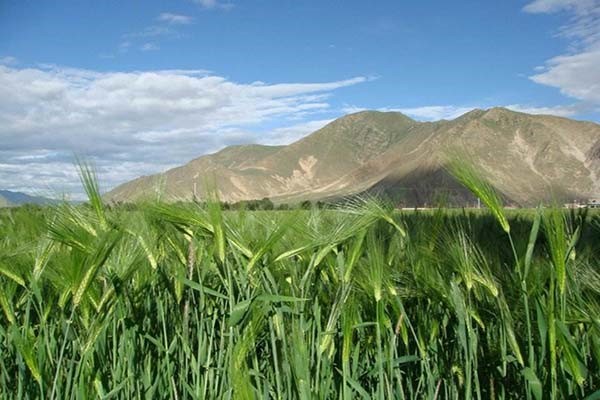
I have never traveled to Tibet, which rests mostly on the world's highest and largest plateau; but, from what I have read, the area is beautiful - with towering mountain ranges enclosing valley with rivers, plains, and lakes. The altitude, combined with the dry climate (Tibet receives only about 18 inches of precipitation annually), limits what vegetation can grow on the plateau. Grasslands cover nearly two-thirds of the Tibetan region, which provide areas for livestock -- from chickens to yaks -- to graze, but limit the types of crops that can be grown. The principal agricultural crop grown by Tibetans is barley.

Barley growing in Tibet. Source: Go To Tibet

Barley played a pivotal role in the settlement of the Tibetan plateau. The grain is hardy, with a high tolerance for frost and dehydration. Thus, Tibetans could grow barley with little effort or resources (like water). Once harvested, they could also turn the barley grains into tsampa, because the process (as outlined above) is relatively quick and requires little fuel. All of these factors led to an agricultural system that was built predominantly around that single grain.  

Thus, the singular importance of barley to the Tibetans also provides an important starting point on the map for the Tibetan food pathway. 

The Preparation of Tsampa

The preparation of tsampa.
Source: Ravencywoodpress

The traditional process of turning barley into tsampa is often described as long or arduous; and, before many of the modern conveniences, I can understand that characterization. If one were a Tibetan living out on the plateau during the 19th century through the mid-twentieth century, the process was, in fact, time-consuming. The process can be broken down into four basic steps: (1) acquiring the barley; (2) prepping the barley, if necessary; (3) roasting the barley; and (4) grinding the barley. While the first step would seem to be easy, given the availability of barley in Tibet, the rest of it required time and resources. Some of those resources, like fuel for the fire, are precious given their scarcity on the plateau.

During my research, I came across a personal account of how a Tibetan nun, Choe-la, prepared tsampa. According to the account: 

My mother would get barley grown at high altitude from Manali or Ladakh. [Manali is a city in India and Ladakh is region within India, so the account comes from someone whose family had left Tibet.] Once it arrived, Choe-la would get one or two helpers and they would start the washing process - which is tedious and time-consuming. Then comes my favorite part, which is the roasting. The washed and dried barley is roasted in hot sand until the barley is cooked through - like popcorn, one can smell the roasted barley or "yoe" as we call it, from a distance and Choe-la would allow us kids to fill our pockets with fresh "yoe" to eat on the way to school. Next is the final step of grinding the roasted barley into Tsampa flour .... Choe-la always said, the best Tsampa comes from the "chu-tha" - water mill.

This account tells us a lot about how tsampa was made. From the purchase of the barley, to the washing and drying of the seeds, and ending with the roasting over hot sand. 

Tsampa on the Tibetan Table

The roasted barley flour - having already been "cooked" - became a very flexible ingredient that could be used in a variety of ways. As the British travel writer, Peter Fleming, recounted during a trip in the Tibetan region: 

Tsampa ... is sustaining, digestible and cheap. For nearly three months we had tsampa for breakfast, tsampa for lunch and the diet was neither as unappetizing nor as monotonous as it sounds. One of the great virtues of tsampa is that you can vary the the flavour and the consistency at will. You can make it into a cake or you can make it into a porridge; and either can be flavored with sugar, salt, pepper, vinegar or (on special occasions for you only had one bottle) Worcester Sauce. And, if that were not enough, you can make it with cocoa instead of with tea. I would not go so far as to say that you never get tired of tsampa, but you would get tired of anything else much quicker. 

This food finds itself not only on the Tibetan Table, but in religious ceremonies as well. Some Buddhist rituals call for the throwing of pinches of tsampa into the air as a "mark of joy and celebration." Throwing tsampa has made its way into other occasions, such as throwing it on the new year, while chanting verses calling for good luck. To round out the occasions, Tibetans also throw tsampa at funerals, where, according to Buddhist ritual, it is intended to release the soul of the departed. 

The Mindfulness of Tsampa Preparation

Recently, I decided that I would prepare tsampa myself. Fortunately, I have a ready source for hulled barley and a ready fuel (namely, my stove). I also had a recipe in a cookbook, Beyond the Great Wall, which was written by Jeremy Alford and Naomi Duguid. While this book was given to me as a present, I had become familiar with Duguid's work exploring cuisines such as those in Burma or Persia (that is, Iran and the Caucuses). 

The process was not long or arduous to prepare tsampa, thanks to many modern conveniences. I did not have any barley on hand, but with the advent of the Internet, it was not hard to find a bag of organic, hulled barley berries. I also did not need any sand, I just used a good, solid pan on a stove. With the berries literally in hand, along with that heated pan, I began the roasting process. Once the berries were in the pan, things began to change. 

I look for moments in the day when I can use my mindfulness techniques. Some of those moments are forced, such as when I am dealing with a lot of stress, uncertainty or conflict. Other moments - such as my preparation of tsampa - come naturally. As I looked down at the seeds in the pan, I began to view them as one may view grains of sand. My pan had itself become a kind of sand garden. I took deep breaths and focused on the tasks presently before me. 

The recipe directed me to use a wooden spoon to move the seeds, so that they would not become scorched or burnt. As I moved the spoon, I focused on the movement of the seeds, as they were pushed ahead or fell to either side of the spoon. I moved the spoon in circular motions, occasionally flipping the seeds to bring the ones from the bottom to the top. As I did these moves, my sand began to slowly turn more golden and eventually a little browner in color. When the barley was roasted, I turned off the heat, moved the pan, and made some final stirs with the spoon. 

For that brief period of time, I felt as if I had a mindfulness moment. One that was quiet, where I could focus on the present, without thinking about what I had done previously or what I had left to do after the recipe was completed. The ability to take some deep breaths gave me a break during a relatively stressful holiday season. It also reinforced in me the need to find more such moments going forward. 

TSAMPA

Recipe from Jeffrey Alford and Naomi Daguid, 

Beyond the Great Wall, pg. 180

Ingredients:

  • 2 cups barley berries (whole grain)

Directions:

1. Roast the barley berries. Place the barley berries in an 11 to 12 inch heavy skillet (cast iron works very well) and dry roast over medium heat. Stir constantly with a flat-ended spatula or wooden spoon, moving the grains off the hot bottom surface and rotating them from center to the outside, to ensure an even roast with no scorching. The grains will crackle a little as they expand in the heart, will start to give off a toasted grain aroma and will change color. Keep on stirring and turning until all of the grains have darkened to more than golden, about 10 to 14 minutes. 

2. Check the barley berries. Test for doneness by trying to bite into one of the grains - it should yield easily. Times will vary depending on the amount you are roasting, the size of your pan and the heat. Remove the pan from the heat and keep stirring for another minute or two to prevent scorching.

3. Grind the berries. If you are using a coffee or spice grinder to grind the grain, you will need to work in batches. A flour mill works well if you have one, no need for small batches and your grind will be finer and more even. Transfer about 1/2 cup of the toasted grains to a clean, dry coffee or spice grinder and grind to a fine flour-like texture (you will hear the sound change as the granules get reduced to a powdery texture.) Turn out into a bowl and repeat until all the grain has been ground to flour. If you want to perfect your grind, pass the milled powder through a fine sieve and then regrind any remaining larger pieces. 

4. Finish the Tsampa.  Let cool completely, then store in a well-sealed wooden or glass container in a cool place. Tsampa keeps indefinitely in the refrigerator.

*     *     *

Postscript (05.25.26): I continue to make Tsampa, usually for my morning breakfast, which I highly recommend. The recipe above provides an option for "perfect[ing] your grind," which involves passing the powder through a fine sieve and regrinding the remainder. I have done that on occasion and decided to post a picture of both types of Tsampa. The regular grind of tsampa, which is on the left, and the more perfected grind of tsampa, which is on the right. I love both kinds. 

PEACE.