Showing posts with label Kaffir Lime Leaves. Show all posts

Saturday, March 19, 2022

Aromatic Chicken from the Shan Hills

There is a region in Myanmar (or Burma) just east of Mandalay, which is historically referred to as the Shan Plateau. If one were to look at a map of the area, it is not so much of a plateau, but hills and mountain ranges divided by narrow valleys. In more recent years, the area has been referred to as the Shan Hills rather than the Shan Plateau. This new name is a little more representative of the landscape in the area. 

The Shan Hills are also a part of the Shan State, which is a political division in eastern Myanmar. It is an area with a long history of armed conflict between the central government and various militias seeking greater autonomy or independence. At the center of that conflict in many ways is the Shan, which form the largest ethnic group in the Shan State and the largest minority in the entire country of Myanmar.

The name "Shan" generally refers to a range of ethnic groups who refer to themselves as the Tai (တႆ). Their cuisine of the Shan or Tai is popular in Myanmar. It incorporates a wide range of ingredients and foods, primarily because the climate enables the cultivation of a wide range of fruits and vegetables. Some of these ingredients include water bamboo, banana buds, quince fruit and pennywort. The Shan also utilize every protein in a wide range of preparations. One that caught my attention is a fermented pork "sashimi."

My introduction to Shan cuisine is going to be a little more traditional, namely, a chicken curry. Generally speaking, Burmese curries stake their own position separate and apart from the curries of their neighbors, such as India, China and Thailand. Burmese curries do not use the spices that often find their way into Indian curries, such as coriander seeds, cumin, cinnamon or cardamom. (Khin Maung Saw, Burmese Cuisine, Its Unique Style and Changes After British Annexation, at 6.) There are also no traditional masalas or curry powders in Burmese cooking. Instead, Burmese curries begin with a generous amount of garlic and ginger, followed by different ingredients, such as lemongrass and lime leaves, to build the flavor of the dish. As for Shan curries, they are known for their use of fresh herbs, such as galangal, lemongrass and sawtooth coriander. (Naomi Daguid, Burma.)

This recipe for aromatic chicken demonstrates the uniqueness of Burmese curries, as well as what one could find in the Shan Hills. The recipe begins with a lot of garlic and ginger, which are pounded into a paste with dried chiles. The curry is then prepared by first browning the chicken in hot oil before adding the paste, along with onions and turmeric.  The recipe demonstrates its Shan roots with the use of lemongrass, lime leaves and cilantro, all of which provide a freshness to the dish.

In the end, this recipe demonstrates what I love about cooking and learning about cooking. Dishes such as this Aromatic Chicken from the Shan Hills represents one significant truism. It is how different groups of people but their own mark on the food they eat, yet, at its most basic level, that food -- such as a curry (however defined) -- is what is common among all of those people. That truism applies in many ways in Myanmar, a country with 136 recognized indigenous ethnic groups. (I underline the number because the Myanmar government only officially recognizes 135 ethnic groups, which include the Shan. The government does not recognize the Rohingya as an indigenous ethnic group within the borders of Myanmar, which I believe to be wrong.)

AROMATIC CHICKEN FROM THE SHAN HILLS

Recipe from Naomi Duguid, Burma, page 167

Serves 6

Ingredients:

  • 2/3 cup chopped garlic
  • 1/2 cup sliced ginger
  • 2 dried red chiles, stemmed
  • 1 tablespoon salt
  • 1/4 cup peanut oil or vegetable oil
  • 1 3 to 3 1/2 pound chicken chopped into small pieces
  • 1 cup sliced white or yellow onion
  • 1 tablespoon turmeric
  • 3 stalks lemongrass, trimmed, smashed and sliced into 1 inch lengths
  • 2 Roma or other tomatoes, cut into small wedges (about 8 per tomato)
  • 1/2 cup fresh young lime leaves
  • 1/2 cup cilantro leaves, finely chopped

 Directions:

1. Prepare a paste. Pound the garlic, ginger and chiles together with a little salt to make a course paste; otherwise, mince them. set aside. 

2.  Cook the chicken. Heat the oil in a large pot or wok over medium-high heat. Add the chicken and turn the pieces in the hot oil for about 3 minutes. Add the onion, 2 teaspoons of salt, turmeric, lemongrass, garlic, ginger, chiles and tomatoes and stir and cook for 2 minutes. Lower the heat to medium, cover and simmer for 5 minutes. 

3. Finish the dish. Add the lime leaves and other 1/2 teaspoon of salt, stir and simmer for 10 minutes or until the chicken is tender and cooked through. Taste and adjust the salt if you wish. Add the coriander, stir in and serve. 

ENJOY!

Friday, November 2, 2018

Angel Cruz Beef Skewers

After the overthrow of the Khmer Rouge in 1979, thousands of Cambodians sought refuge in the United States.  It is estimated that, by 1994, approximately 158,000 Cambodians had legally entered the U.S., most of those were refugees. The United States settled these refugees across the country; and, over time, Cambodian communities began to emerge. Communities such as those in Lowell, Massachusetts (which is the second largest in the United States); Jacksonville, Florida; and Columbus, Ohio, along with Los Angeles and Stockton, California.

And, in Stockton, there is Angel Cruz park, a local gathering site for the Cambodian Community.  Families gather together at the park to "hang out, grill, and eat."  I have never been to Stockton, California, let alone to Angel Cruz Park.  Thanks to the wonder of the Internet, I can still get a sense of what happens there. If one were to Google "Cambodian Angel Cruz Park," like I did, he or she would find videos of cooks grilling and preparing a variety of Cambodian foods. 

If you want to get a sense of the kinds of food being prepared, this video provides an example of the experience: 


While I may not be in Stockton, and, I am not Cambodian, that does not mean that I can't try to bring a little of Angel Park out my way.  I found a recipe from Nite Yun, the owner and chef of Nyum Bai (which means "Let's Eat!" in Khmer).  According to Eater, Nite Yun was born in a refugee camp in Thailand.  At age 2, her parents made their way to the United States as refugees. While her parents had been sponsored to go to Texas, they settled in California, Stockton to be exact.  Although her parents were thousands of miles away from their home, they brought their culture, and their food, with them to the U.S.  Yun remembers, "sitting on the floor, chopping lemongrass, peeling garlic, washing veggies and herbs."  She loved that work, and she eventually learned how to cook on her own.  

As her interest in food grew, Nite Yun realized that the food of her family and culture, Cambodian food, was unrepresented.  There were no good Cambodian restaurants.  During a trip to Phnom Penh, the capital of Cambodia, Yun was at a noodle stall when she decided that she would start her own restaurant.  A restaurant focused on her culinary and cultural heritage.  That moment led to Nyum Bai. The menu is graced with dishes such as Naim Chien Chrouk (crispy rolls filled with taro, cabbage, glass noodles, pork, garlic and onions), Kuy Teav Phnom Penh (rice dish with minced pork and shrimp served in a 7 hour pork broth with herbs and crispy garlic) and Chien Trey & Ngoum Mango (crispy catfish topped with tangy and tart green mango salad, shallots and red pepper).

Unfortunately, I have not had the opportunity to try any of these dishes, all of which sound delicious.  I did find a recipe from Nite Yun's for beef skeewers.  The name is Angel Cruz Beef Skewers, a nod to the gathering of Cambodian families at Angel Cruz park. The recipe calls for the beef to be marinated in a very tasty paste of lemongrass, kaffir lime and fish sauce.  The end result is so good that I am seriously thinking of trying this marinade with chicken or pork skewers. 


ANGEL CRUZ BEEF SKEWERS
Recipe from Saveur
Serves 2-4

Ingredients:
6 stalks lemongrass, tough outer layers removed, 
     soft inner cores thinly sliced
6 kaffir lime leaves finely chopped
6 cloves garlic, peeled
2 shallots, finely chopped
1 (1-inch) piece of ginger, peeled and minced
3 pounds beef chuck, cut into 1/2 inch pieces
1 teaspoon ground turmeric
1/2 cup plus 1 tablespoon of honey
6 tablespoons vegetable oil
6 tablespoons fish sauce
6 tablespoons oyster sauce
1 1/2 tablespoons sweet paprika
Wooden skewers, soaked in water for 30 minutes

Directions:
1.  Prepare the beef.  In a food processor, combine the lemongrass with the lime leaves, garlic, shallots, ginger, and turmeric, and pulse until a smooth paste forms.  Scrape the past in a large bowl, and add the beef, honey, oil, fish sauce, oyster sauce and paprika.  Toss the beef until evenly coated and then cover with a plastic wrap and refrigerate for at least 3 hours. 

2.  Grill the skewers.  Light a grill.  Thread the beef on to wooden skewers and then grill, turning as needed until charred and cooked through, about 8 minutes.  Transfer to a platter and serve while hot.  

ENJOY!

Tuesday, August 4, 2015

Grilled Steak with Green Sriracha

One of the things on my culinary bucket list is to make my own hot sauce.  It may not seem like much, especially to cooks and chefs who could easily make a hot sauce for various dishes.  However, I love hot sauce.  I really, really LOVE hot sauce.  I usually keep at least 3 or 4 different types of hot sauce on hand in our refrigerator, including the "staples," like Tabasco and Sriracha. 

Recently, I came across a recipe for a grilled steak with a green sriracha sauce.  A sriracha sauce is a type of hot sauce typically made from chiles, distilled vinegar, garlic, sugar and salt. The sauce is Thai in origin, often called sot Siracha; the name comes from the city of Si Racha, which is located in the Chonburi province of eastern Thailand.  The sauce is typically used in Thai cuisine as a condiment; and, it even finds its way into Vietnamese cuisine, served alongside bowls of phở.

Sriracha is particularly popular in the United States.  Given that over one ton of Sriracha sauce is produced every hour, it has found its way into many grocery stores and restaurants across the United States.  The supply is readily eaten by demand, including one person who consumed three bottles of it at one time.  While I have consumed my fair share of Sriracha sauce, I have never simply guzzled the hot sauce.  It is best drizzled over food, especially fried or grilled foods.

While the red Sriracha sauce is almost ubiquitous, the green sauce seems more intriguing and it is one that I have never tried before.  The recipe incorporates green chiles -- roasted poblano peppers and serrano chiles -- with a range of fresh ingredients such as basil, chives, cilantro, lemongrass, lime leaves and coconut.  The poblano peppers add depth to the flavor of the sauce, while the serrano chiles provide quite the kick, which one would expect.  The end result is a hot sauce that is in many respects better than the red Sriracha.  Maybe it is the use of fresh ingredients, prepared using a blender.  Maybe it is the tartness of the lime juice contrasted with the heat of the serranos, along the field of chives, cilantro, basil and mint.  Maybe it is just that I love most of what I make.    


GRILLED STEAK WITH GREEN SRIRACHA
Recipe from Food & Wine
Serves 4

Ingredients:
3 large poblano chiles 
2 serrano chiles
3 large garlic cloves, peeled & smashed
1/2 cup fresh ginger, sliced
1 half-inch piece of turmeric or
     1/2 teaspoon of ground turmeric
1 cup shredded unsweetened coconut
2 loose cups of basil leaves
2 loose cups of mint leaves
1 1/2 cups of snipped chives
1/2 cup of chopped cilantro
4 kaffir lime leaves, shredded
1 lemongrass stalk, tender inner bulb, bottom 4 inches
     peeled and thinly sliced
1 cup canola oil, plus more for grilling
1/4 cup of lime juice, plus 2 tablespoons
Kosher salt
4-5 pounds of steak, such as flank steak or skirt steak, cut into 
     4 even sized pieces

Directions:
1.  Prepare the Green Sriracha.  Roast the poblano chiles directly over a gas flame, turning, until charred and tender.  Transfer to a bowl, cover with plastic wrap and let cool.  Peel, core and seed the poblanos.  Transfer the poblanos to a blender.  Add the serranos, garlic, ginger, turmeric, coconut, basil, mint, chives, cilantro, lime leaves and lemongrass and pulse to chop.  With the machine on, add the 1 cup of oil and puree.  Add the lime juice and season the green Sriracha with salt. Once the sauce is made, it can be refrigerated for up to three days.

2.  Grill the steak.  Light a grill.  Brush the steaks with oil and season with salt.  Oil the grill grates and grill the steaks in batches over high heat, turning once or twice, until the meat is lightly charred and medium rare, 5 to 6 minutes.  Cook a little longer, 1 to 2 minutes more, to obtain medium, if that is your desired doneness.  Transfer to a carving board and let rest for 5 minutes before slicing across the grain.  Serve the steak with the green Sriracha.

Monday, January 27, 2014

Thai Shrimp with Red Curry

A few weeks ago, I posted a recipe for Kaeng Kiao Wan Kung  or Thai Shrimp in Green Curry.  In that post, I noted my many efforts to make the dish, all of which technically failed due to my failure to procure one of the most vital ingredients of the dish ... green curry paste.  Whenever I was at the store, the shelves were stocked with red curry paste, but no green curry paste.  I would inevitably leave with a jar of red curry paste.  However, red curry paste does not make for a good Thai Shrimp in Green Curry.

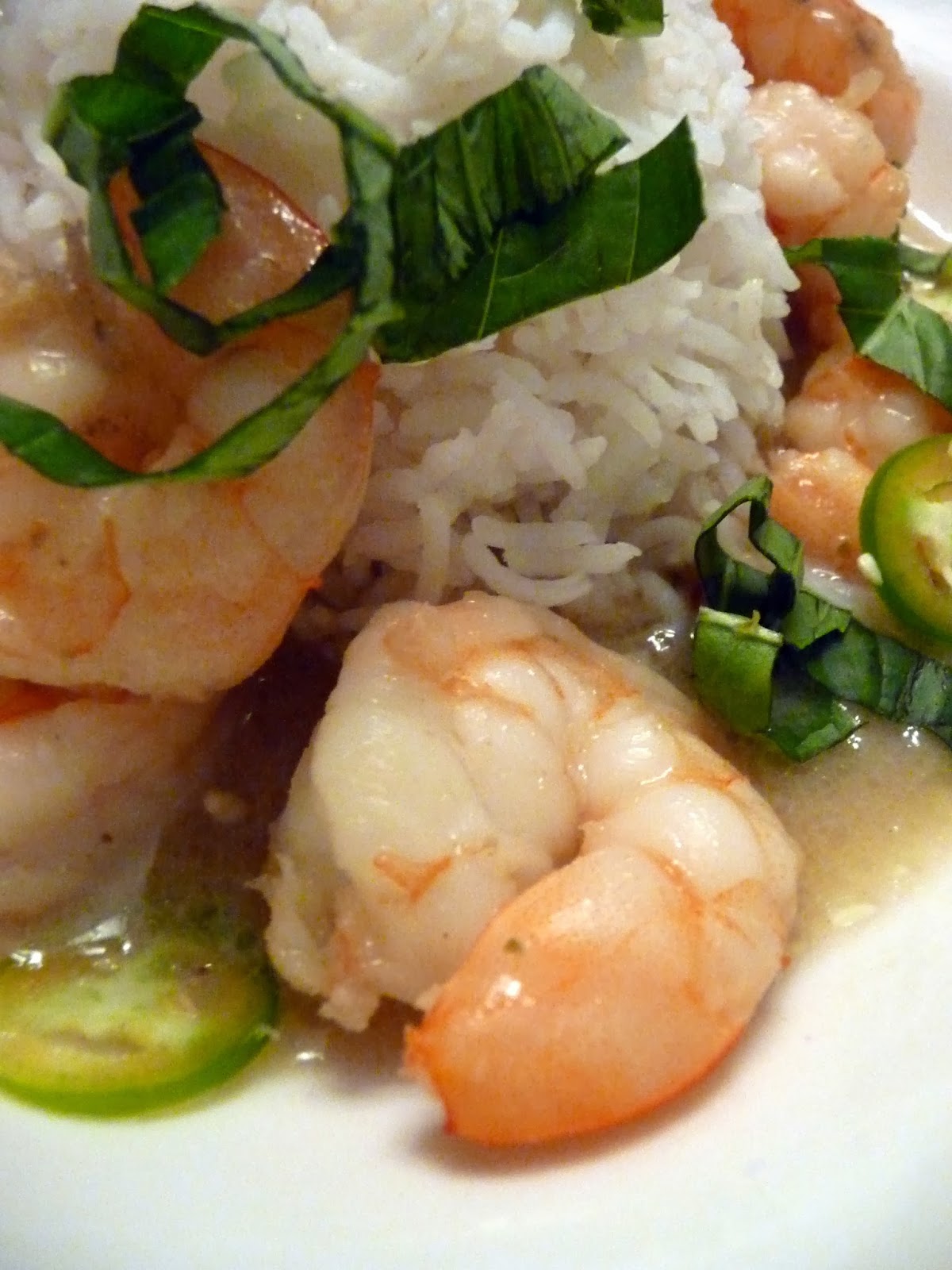
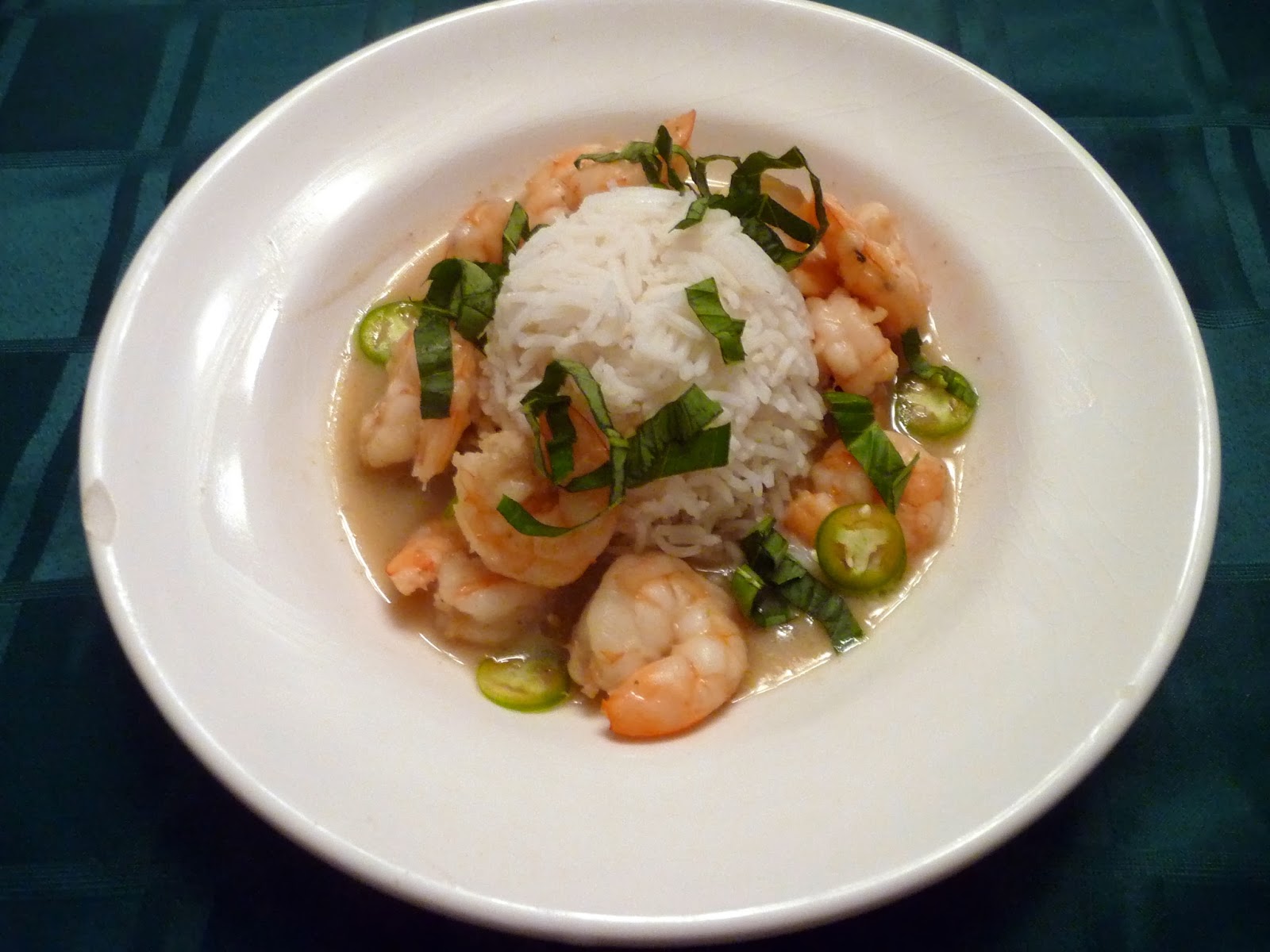
Nevertheless, I used that paste and made Thai Shrimp in Red Curry.  This dish most resembled the curry dishes that I would order whenever we went out to eat at a Thai restaurant.  The aromas were very similar, as were the tastes.  The combination of the red curry paste, coconut milk, brown sugar, and, the fish sauce work very well with this dish.  This curry dish was a good consolation for all those times that I failed to find the green curry paste.

This leaves the question of the moment: which is better ... Thai Shrimp with Green Curry or Thai Shrimp with Red Curry?  I think it is a draw.  I have to admit that I just about love any curry that I eat.


THAI SHRIMP WITH RED CURRY
Recipe adopted from from Whats4Eats
Serves 4
Ingredients:
1 cup of coconut cream
2-3 tablespoons of red curry paste
3 cups of coconut milk
1/4 cup of fish sauce
2 tablespoons of brown sugar
1 pound of shrimp, peeled and deveined
Shrimp, peeled and deveined -- 1 pound
1/2 cup of basil
3 kaffir lime leaves
2-3 serrano chiles, sliced into thin rounds

Directions:
1.  Simmer the cream and paste.  In a large saucepan or wok, simmer the coconut cream over low heat until most of the moisture boils away and the oil separates out. Stir in the curry paste and simmer for another 2 or 3 minutes. Do not allow to burn.

2.  Add the coconut milk. Add the coconut milk, fish sauce and sugar. Increase heat to medium high and bring to a boil. Then reduce heat to low and simmer for 5 to 10 minutes.

3.  Add the shrimp. Stir in the shrimp and simmer another 5 or 6 minutes, or until the shrimp is just cooked through. Adjust seasoning adding more fish sauce or sugar if you like and stir in the basil and lime leaves.

4.  Plate the dish.  Serve in individual bowls with steamed rice or rice noodles and garnish with the sliced chile pepper.

 ENJOY!

Sunday, January 5, 2014

Kaeng Kiao Wan Kung (Thai Shrimp in Green Curry Sauce)

This particular recipe -- Kaeng Kiao Wan Kung (Thai Shrimp in Green Curry Sauce) -- has a little backstory to it.  I found this recipe on one of the websites that I regularly visit (Whats4Eats) several months back.  This recipe was high on the priority list of things to make for my beautiful Angel, because I thought she would really like it.  I tried to make it several times; however, each time failed.  It was not because I screwed up the recipe.  Each meal turned out well and we enjoyed the food.  

The meal failed because every time I made the dish, I made with red curry paste.  What was supposed to be Thai Shrimp in Gren Curry Sauce ended up being Thai Shrimp in Red Curry Sauce.  (Don't ask me how that translates in Thai.)  The reason was simple: every time I went to a particular grocery store after work, I would go to the Asian foods section.  As I stood before the shelves, basket in hand, my eyes always fixated on the one gap -- the one open space -- on the shelves. Sure enough, the little tag read "Green Curry Paste."  There were lots of jars of red curry paste, but no jars of green curry paste.  I would reach to the back of the shelf, hoping that there was a stray jar of green curry paste.  Each time, I left ... with a jar of red curry paste.

However, on one occasion, I checked that shelf and there it was ... green curry paste.  A bottle of water, green chilies, onions, lemon grass, galangal, garlic, sugar, salt and tamarind.  All of those ingredients pureed into the one paste I needed to make Kaeng Kiao Wan Kung.  I purchased a jar and a pound of the larges shrimp I could find.  I headed home to make the dish for Clare.

Overall, the dish turned out well, although the green curry sauce did not end up as green as I thought it would.  The lack of a greenish hue is most likely due to the color of the green curry paste that I used.  Still, we both really enjoyed this dish.  It is simple to make and has those Thai flavors that appeal to both of us.


KAENG KIAO WAN KUNG 
(THAI SHRIMP IN GREEN CURRY SAUCE)
Recipe from Whats4Eats
Serves 4


Ingredients:
1 cup of coconut cream
2-3 tablespoons of green curry paste
3 cups of coconut milk
1/4 cup of fish sauce
2 tablespoons of brown sugar
1 pound of shrimp, peeled and deveined
Shrimp, peeled and deveined -- 1 pound
1/2 cup of basil
3 kaffir lime leaves
2-3 serrano chiles, sliced into thin rounds

Directions:

1.  Simmer the cream and paste.  In a large saucepan or wok, simmer the coconut cream over low heat until most of the moisture boils away and the oil separates out. Stir in the curry paste and simmer for another 2 or 3 minutes. Do not allow to burn.

2.  Add the coconut milk. Add the coconut milk, fish sauce and sugar. Increase heat to medium high and bring to a boil. Then reduce heat to low and simmer for 5 to 10 minutes.

3.  Add the shrimp. Stir in the shrimp and simmer another 5 or 6 minutes, or until the shrimp is just cooked through. Adjust seasoning adding more fish sauce or sugar if you like and stir in the basil and lime leaves.

4.  Plate the dish.  Serve in individual bowls with steamed rice or rice noodles and garnish with the sliced chile pepper.

 ENJOY!