Tuesday, September 6, 2011

Oven Roasted Tomatoes

Sometimes the most simplest of recipes can result in the most delicious of dishes.  This is one such recipe.  A handful of small tomatoes, generous amounts of salt, black pepper and sugar, and liberal drizzles of olive oil and balsamic vinegar.  Add the heat of an oven and the end result are some amazing roasted tomatoes.

I used cherry tomatoes for this recipe; however, the great thing about this recipe is that any type of  small tomato could be used.  This recipe would also work well with Roma, plum or grape tomatoes.

One last note about this recipe.  Do not use aged balsamic vinegar. It is simply too expensive and to fragile to be subjected to heat for any period of time.  It is okay to use a balsamic vinegar of lesser quality.  As an alternative, you can simply withhold the aged balsamic vinegar until after the tomatoes are roasted and then drizzle it over the tomatoes before serving. 

OVEN ROASTED TOMATOES
Adapted from a recipe by Ina Garten
Serves 2-4

Ingredients:
12 small tomatoes of any variety
Sea Salt, to sprinkle
Ground black pepper, to taste
6 cloves, smashed
Extra virgin olive oil, for drizzling
Balsamic vinegar

Directions:
1.  Cut the tomatoes in half and arrange on a baking sheet with the garlic cloves.  Drizzle the olive oil and balsamic vinegar over the tomatoes.  Sprinkle the sea salt, ground black pepper and sugar.  

2.  Heat an oven to 450 degrees Fahrenheit.  Roast for twenty-five or thirty minutes. 

ENJOY!

Sunday, September 4, 2011

Peach Cobbler

I am not the only one who cooks in our family.  My beautiful wife, Clare, is also a great cook and a great baker.  Every once in a while, I ask my Angel to provide a guest blog post so that I can share some of the amazing and delicious things that she makes for family, friends and, of course, me.  She has already provided guest blog posts about Tuscan Vegetable Soup, Cuban Bread, Loyalist Bread and Salmon Burgers.  So, without further ado,

A Guest Blog Post by Clare ...

Peaches are a great summertime fruit and are very versatile.  I bought some peaches during a recent trip with Keith to Eastern Market.  I have previously used peaches to make ice cream, which Keith devours at every chance he can get.  But, I decided to do something different.  After doing a little searching on the Internet, I came across a recipe for a peach cobbler.  Keith devoured that as well.  Fortunately for me and this guest post, Keith took pictures of the cobbler before he began eating it.   

Usually, at this point, Keith would probably say something about the history of the dish or the ingredients used to make the dish. According to the Food Timeline, food historians have determined that the cobbler dates back to the second half of the 19th century, when settlers where making their way across North America.  These pioneers created the dish using a crust, filling it with whatever fresh or canned fruit they may have, and cooking it in a dutch oven.  The first reference to a "cobbler" appeared as early as 1839 in a book called The Kentucky Housewife, which provided a recipe for a "peach pot-pie" or "cobler."  The term also began to appear in American dictionaries in 1859.

Over the past 160 years, the cobbler has evolved over time, as people settled down and, once again, were able to cook with ovens rather than over a fire.  This recipe comes from the Food Network.


PEACH COBBLER
Adapted from Food Network
Serves many

Ingredients (for the filling):
4 cups of peeled and sliced peaches
3/4 cup of brown sugar
1 teaspoon cinnamon
1 teaspoon vanilla
1 tablespoon flour
1 cup flour

Ingredients (for the crust):
1 teaspoon baking powder
1/2 teaspoon of baking soda
3 tablespoons of brown sugar
4 tablespoons of unsalted butter, cut in to small pieces
2/3 cup of buttermilk
1 tablespoon brown sugar for topping
Whipped cream

Directions:
1.  Preheat the oven to 425 degrees F.

2. Generously butter a 1 1/2-quart shallow baking dish. Place the sliced peaches in the dish and sprinkle with brown sugar, cinnamon, vanilla, and flour. Mix gently and spread evenly again. Bake for 10 minutes.

3. Meanwhile combine all dry ingredients for cobbler crust in a bowl. Cut in the butter with a pastry cutter or your fingers, to make the texture like coarse crumbs. Add buttermilk and stir to form a soft dough.

4.  Remove fruit from oven and drop rounded spoonfuls of dough on top. Sprinkle with last tablespoon of brown sugar and return to oven. Bake until fruit is bubbly and crust topping is golden brown, about 20 minutes. Serve warm with whipped cream. 

A great accompaniment for this dessert is either some whipped cream (which I made from scratch) or some ice cream.  Maybe some peach ice cream.  Well, until next time, as Chef Bolek would say ...

ENJOY!

Saturday, September 3, 2011

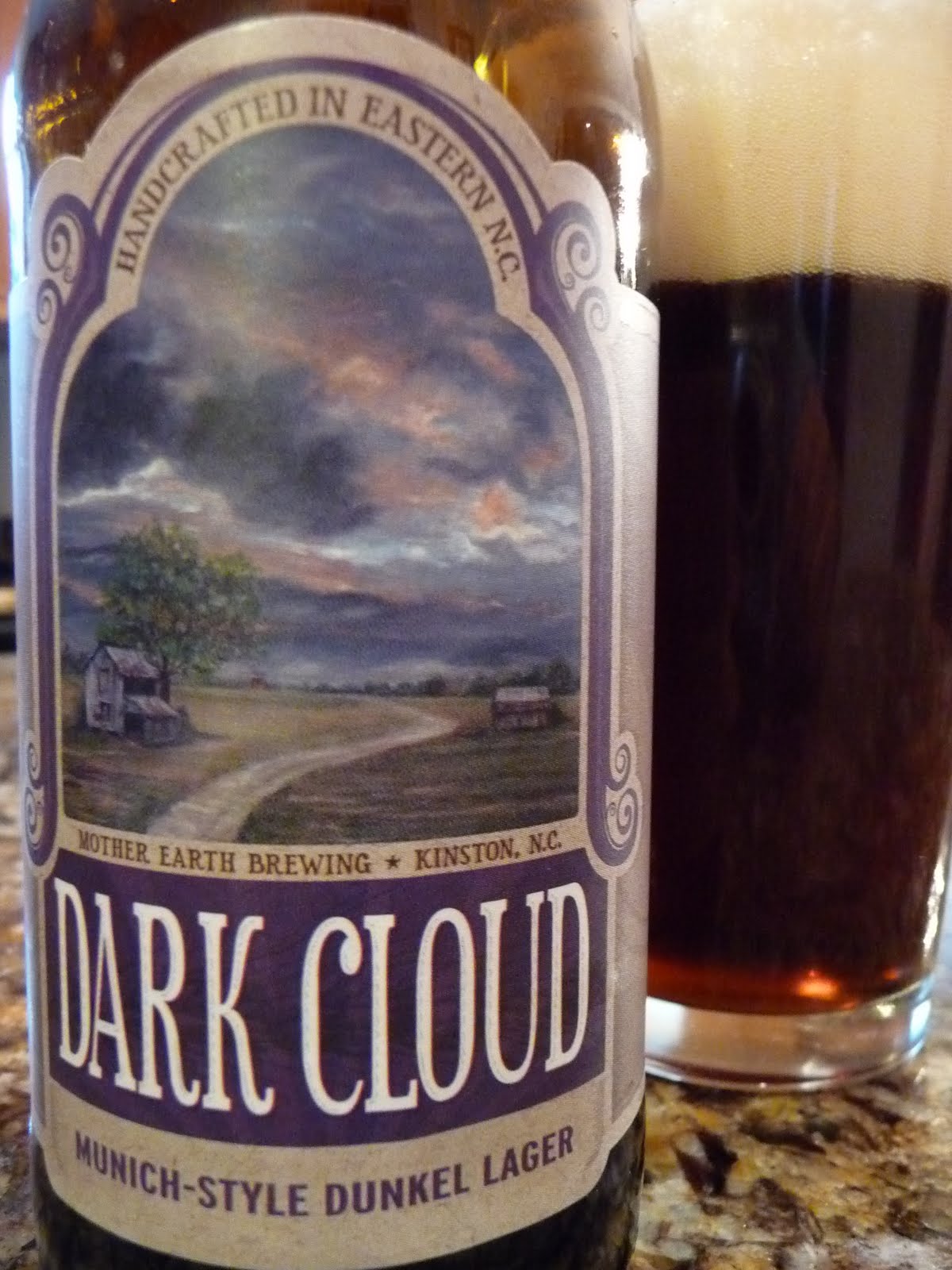
Mother Earth Brewing Dark Cloud

The history of beer in Munich has a dark past.  When I speak of a "dark past," it is nothing sinister.  Instead, the first beers brewed in the city, as well as elsewhere in Bavaria were dunkel lagers, or dark lagers.  Generally speaking, the grist used to make the beer is made from primarily German munich malt, with some German pilsner malt.  Some chocolate malts may be used to darken the color of the beer, but not to affect the taste.  

Mother Earth Brewing is a craft brewer whose motto is "Peace, Love & Beer."  Located in Kinston, North Carolina, the brewer produces four year around beers -- Sisters of the Moon India Pale Ale, Endless River Kolsch Style Ale, Weeping Willow Wit, and the Dark Cloud Munich-Style Dunkel Ale.  I first tried Mother Earth Brewing when Clare and I were vacationing in the Outer Banks.  A small restaurant in Ocrakoke had the Sisters of the Moon.  It was a very good IPA and, when I saw some other Mother Earth Brewing beers, I bought a couple and brought them home to try at a later date. 

The Dark Cloud is definitely a dunkel lager because it pours a dark brown in color.  The beer is very carbonated, with a thick foam developing as the beer is poured. The aroma of the beer is full of malt, with a gentle sweetness.  This beer is surprisingly light and sweet for a dark lager.  I definitely enjoyed this beer, which I think is a very good example of an American craft brewer working with a European beer style.

The brewer suggests several pairings for this beer. These pairings include cheeseburgers, chicken with brown mushroom gravy, Eastern Carolina BBQ, and garlic mashed potatoes.  As you can tell, these pairing all suggest meatier, earthier flavors, which I think is probably the best pairing for a beer like the Dark Cloud.  The lightness of the beer will not make any of these foods seem "heavy."  The sweetness of the beer would pair well with the tart, vinegary taste of Eastern Carolina BBQ (of which, by the way, I am a big fan).

From what I can tell, Mother Earth Brewing is a small craft brewery.  Just as I look for wines made with grapes I have never heard of, I also look for craft brewers (and beer styles) that are completely new to me.  Prior to visiting Okracoke, I had not seen or heard of Mother Earth Brewing.  Since then, I have not seen Mother Earth beers around where I live, but they are obviously available in North Carolina.

ENJOY!

For more information about the Munich Dunkel style, check out the Beer Judge Certification Program.

Friday, September 2, 2011

L'Ecole No. 41 Columbia Valley Sémillon (2009)

If wine grapes were Hollywood actor, Sémillon would probably be an extra.  The grape is fairly easy to cultivate, fairly resistant to diseases that plague other grapes, and is fairly available, as it is found around the world, including countries such as France and Australia.  Thus, the grape is always available. 

However, the grape is hardly ever featured on its own in a wine.  Instead, winemakers usually blend Sémillon with other grapes.  For example, French winemakers blend Sémillon with Sauvignon Blanc and Muscadelle.  Australian winemakers blend Sémillon with Sauvignon Blanc and Chardonnay. In the end, it is almost always the other grape that gets the top billing, with the Sémillon grape getting attention in the fine print of the credits.

In the United States, one winemaker is giving Sémillon a starring role in a wine.  L'Ecole No. 41 is a winery in the Walla Walla region of Washington State where, from a historic Frenchtown School, the Clubb family has been producing wines like the Sémillon since 1983.  To produce this wine, L'Ecole No. 41 uses grapes that are grown at vineyards in the Columbia Valley.  The wine is then made with 87% Sémillon and 13% Sauvignon Blanc.  This turns the tables, making Sémillon the lead actor in this wine while relegating the Sauvignon Blanc to what could be best described as a supporting role.

The Sémillon pours bright and lustrous, almost like a shiny, clear apple or pear juice.  The aroma of the wine, like most wines, speak of fruit.  Melon, pear and apple seem to be the principal aromatic elements of the wine.  The taste of the wine is light, but a little tart, speaking more of pear and apple than melon.  The tartness is not bad; instead, it is a tartness one expects from citrus, like lemons.  The winemaker says that the wine has honeysuckle, with lemon bar, lychee nut and key lime showing through the finish.  I'm not sure about the honeysuckle (which is a good thing because I am not a big fan of honeysuckle), but the lemon and the lime do show through as part of that slightly tart citrus flavor in the wine.  The body of the wine is quite light, and, lends itself to the wines that one would like to drink on or after a very hot, summer day.

When it comes to pairing this wine with food, I paired the L'Ecole No. 41 Columbia Valley Sémillon with the Panni Ularthiyathu, a dry curry from the Indian State of Kerala. I chose this pairing not simply because it was a white wine and the dish had white meat (pork is, after all the "other" white meat).  Rather, I knew the dish would be spicy and I wanted a lighter wine with some citrus and a little sweetness to round out the heat of the peppers.  I am a little proud of myself with respect to the pairing, because, although perhaps a sommelier may take issue with it, the wine worked very well with the flavors of the dish. 

For a starring role, the Sémillon could definitely win some awards.  It has won some rave reviews in the past., from other bloggers, like Cuvée Corner Wine Blog.  I found this wine at a local Whole Foods Market for about $16.99 a bottle.   You should be able to find it at other wine retailers. 

ENJOY!

Thursday, September 1, 2011

Panni Ularthiyathu (Kerala Dry Pork Curry)

A few months back, I made a rub for a big pork chop based upon the dry curry from Kerala known as Panni Ularthiyathu or Kerala Dry Pork Curry.  Panni Ularthiyathu is a popular dish in Kerala, whose origins could probably be traced back to the Portuguese who visited the subcontinent during the late 15th century.  The Portuguese brought with them Christianity, chile peppers and lots of pigs.  Take the latter two and you are on your way to Ularthiyathu.  Panni Ularthiyathu means sauteed pork, and it is actually a dry curry.  In other words, unlike some curries -- where the protein is swimming in a spiced broth -- this curry has little to no liquid to it.   Ularthiyathu is a favorite among Christians in Kerala, who serve it at Christmas.

After having made a rub inspired by this dish, I promised myself that I would make the actual curry.  Well, I recently fulfilled that promise. I researched the dish and prepared myself to make it for the first time. The key to making this dish is to use a cut of pork with some fat in it.  The fat helps to provide some moisture to the dry curry.  Luckily for me, I had a couple pounds of sliced boston butt in the freezer.  (Long story, but the lesson is always check to see if your local grocer sliced the pork shoulder before you buy it to smoke it.)  The hardest part of this recipe is to cook off the liquid so that the curry remains "dry."  The one other consideration for this recipe is the chile that you use.   Some recipes call for fresh green chiles, others call for chile powder.  I opted for the latter, because I had some leftover dried Sanaam peppers from previous recipes.

The picture below is not the greatest one that I've taken, but do not be misled.  This is a very tasty dish.


PANNI ULARTHIYATHU (KERALA DRY PORK CURRY)
Adapted from a Indimom Recipe
Serves 4-6

Ingredients:
2 pounds of pork (preferably with some fat on it, like from the belly or shoulder)
     sliced into even bite-sized pieces
2 onions, thinly sliced
1 tablespoon of minced ginger
1 tablespoon of minced garlic
2 teaspoons of chile powder (I used ground Sanaam peppers)
2 tablespoons of coriander powder
1/2 teaspoon of ground black peppers
1/2 teaspoon of turmeric powder
2 teaspoons of lime juice
Salt to taste
1 inch of cinnamon
4 cardamom pods (2 green and 2 black)
5 cloves
1/4 teaspoon of fennel seeds
3 tablespoons of canola oil

Directions:
1.  Prepare the spices. Grind the cardamom, chile peppers, cloves, and fennel seeds.  Add the coriander powder, black pepper, salt, turmeric powder.  Mix well.

2.  Saute the pork.  Heat the oil in a big pan over medium heat.   Add the pork.  Add the spice mix, garlic and ginger.  Mix well so that all of the pork is covered.  Add the lime juice.  Cook the pork until it is almost done.  (It is hard to give a timeframe because it depends upon the size of the pork pieces.)  Remove the pork and set aside.

3.  Saute the onions and the pork again.  Add the onions to the pan.  Saute the onions until they begin to brown.  Keep stirring the onions until they are evenly browned.  Drain the onions, if necessary, and return the pork to the pan.   Continue to cook until the pork is finished, mixing so that the spices from the pork are also on the onions.  

4.  Finish the dish.  Once the pork is cooked, remove from the heat.  Serve immediately with Indian rice.

ENJOY!

Sunday, August 28, 2011

Stone Brewing Company Belgo Anise Imperial Russian Stout

As a style, the Imperial Russian Stout has a rather interesting origin.  The style did not develop in Russia; instead, it was English brewers who began to brew the dark, almost viscous beers.  In the 18th century, the Thrales brewery in London began to brew imperial stouts for export to the court of Catherine the Great.  The beer became a popular drink in the Baltics and Russia, hence the name "Imperial Russian Stout."  More recently, the Imperial Russian Stout has gained a lot of interest amongst American craft brewers.  

Stone Brewing Company has seized upon this style and twisted it in a fit of creative fancy.   Stone brews this beer with Warrior hops, but, as with any stout, it is the malts that provides the character of the beer. The creativity of the brewers is also displayed by their choice of a Belgian yeast strain for the fermentation of the beer.  Add a lot of star anise, as well as the technique of "oaking" the beer, and the result is a truly unique Imperial Russian Stout.  (As the brewer notes, the "oaking" of the ber is actually a tip of the hat to the history of the style, because the beer used to be kept in wooden barrels rather than stainless steel containers.)

As with any Russian Imperial Stout, the Belgo Anise Imperial Russian Stout pours pitch black, almost tar in color.  The foam that develops as the beer is poured has a brownish tinge that is reminiscent of cream as it slowly blends into coffee.  The star anise is prominent in the aroma of the beer, providing a nice tinge of spiciness.  The aromatic elements include some of the more traditional flavors, such as roasted malts and chocolate as well.

The flavors of the Belgo Anise Imperial Russian Stout are a little more difficult to describe.  Obviously, chocolate is the principal flavor of this beer, but it is not any ordinary chocolate. Whether it is the star anise or the oaking of the beer, the chocolate flavor takes on spice notes.  The spices go beyond the star anise and are take on almost a mild pepper flavor.  In many respects, the flavors of this beer reminds me a little of El Mole Ocho, New Holland's tip of the hat to Oaxacan cuisine.  While El Mole Ocho was definitely a piquant spice, the Belgo Anise Imperial Russian Stout nevertheless provides a similar drinking experience, perhaps better for those who (unlike me) do not like heat in their food or their beer. 

This beer packs a punch, with a 10% ABV and 52 IBUs.  It is available at many beer stores or supermarkets.  A twenty-two ounce bottle sells for about $7.99.

ENJOY!

For more information about the Imperial Russian Stout style, check out the Beer Judge Certification Program

Saturday, August 27, 2011

Tonno alla Fiorentina (Tuna Steak, Florentine Style)

One of my favorite beef recipes is Bistecca alla Fiorentina, or Florentine-style steak.  A very large porterhouse steak is rubbed with rosemary, salt and pepper (along with additional herbs such as sage or thyme), and then grilled to a perfect medium rare).  While this recipe works very well for me, it does not do much for my pescatarian wife, Clare, who has sworn off all red and white meat.  But, as a pescatarian, she will eat fish.  

So, when I saw some Ahi tuna available at a local Costco, I bought the fish because I thought that it would be the perfect fish to grill in the Fiorentina style.  "Ahi tuna" is a marketing term, a name given to Yellowfin Tuna.  Although a large fish, it is smaller than its Atlantic and Pacific Bluefin relatives.  The most sustainable Yellowfin Tuna is the fish caught by troll or the pole-and-line methods in the United States.  Unfortunately, Costco does not label its food well.  After a little debate within myself, I decided to buy the fish because it was the first time I saw enough Ahi tuna that I could make a dish for myself and my beautiful wife, Clare. 


TONNO ALLA FIORENTINA
A Chef Bolek Original
Serves 2-3

Ingredients:
1 pound of Ahi tuna steak(s)
2 tablespoons of fresh rosemary, chopped finely
1 tablespoon of sea salt
1 tablespoon of ground black pepper
2 cloves of garlic, diced finely
2 tablespoons of extra virgin olive oil

Directions:
1.  Marinate the steak.  Combine the rosemary, salt, pepper and garlic with the olive oil.  Spread the mixture liberally over all of the tuna steak(s).
 
2.  Prepare the grill.  Heat the grill on high heat.  If the steaks are cut in a way that may cause parts to cook faster than the steak as a whole, tie those parts to the steak with cooking twine.  

3.  Grill the steak(s).  Place the steak(s) on the grill.  Cook for two and one-half minutes and turn ninety degrees, cooking for two and one-half minutes more.  Flip the steak and repeat, cooking for two and one-half minutes and then turning ninety degrees to cook for an additional two and one half minutes.  After the steak has cooked for about ten minutes (or a couple minutes more), remove the steaks from the heat.

The goal is to replicate Bistecca alla Fiorentina ... a rare to medium rare steak.  Given Ahi tuna is used to make sushi and is served raw, serving it rare to medium rare should be okay for most people.  This recipe produced a delicious piece of tuna; however, as you can see from the pictures, I got a little more to medium rare to medium.  I reduced the cooking times in the recipe from those that I used when I made the dish for the first time.  I will continue to work on the recipe and update it based upon my subsequent efforts. 

Finally, I served the tuna with a simple salad of arugula with a dressing of one part balsamic vinegar and one part extra virgin olive oil.  

ENJOY!

Friday, August 26, 2011

Harviestoun Ola Dubh 30 Year

Harviestoun is a craft brewer in Scotland, founded by Ken Brooker.  Before entering the business of craft beer, Brooker built wood design prototypes for Ford Motor Company.  That work had a profound impact upon Brooker, which carried over to the beer.  Harviestoun Brewery is best known for its Old Engine Oil beer.  This beer is brewed strong and dark with the use of a lot of roasted barley.  The beer is also well-hopped, with the use of Galena hops from Washington State.  As good as this beer is, it is only the start of an even greater beer.

Harviestoun takes the Old Engine Oil and, in a collaboration with Highland Park, a distinguished distiller who has been producing single malt Scotch whiskey in the Orkney Islands since 1798.  Harviestoun ages its Old Engine Oil in Highland Park's 30 Year Old Single Malt Scotch Whiskey casks.  The end result is the exceptional beer known as Ola Dubh 30 Year. 

The Ola Dubh or "Black Oil" is true to its name.  The beer pours a pitch black, like used engine oil.  A thin light foam develops as the beer is poured into the glass.  The aging of this beer in the 30 Year Old scotch whiskey casks has definitely left its mark, with the aroma of whiskey gently greeting the nose.  The whiskey is accompanied by aromas of smoke, peat, and a little cocoa.  The brewer also observes that there may be notes of truffle oil, vanilla and heathery peat.   

Although the scotch contributes to the taste of this beer, the flavors are far more complex than any porter-aged-in-whiskey-barrels. Chocolate, cocoa and smoked oak flavors work well with the whiskey to provide a truly exceptional beer that is best enjoyed sip by sip.  Clare even thought she could taste cola in this beer, which I could also get a faint hint from in the beer, along with notes of espresso and vanilla. 

The Ola Dubh is not just any beer.  It has its own provenance.  Each bottle bears the signature of the master brewer and the master of wood.  Each bottle has its own number and date of bottling.  The bottle I enjoyed was numbered 21640 and was bottled in September 2007.
This beer has an ABV of 8% and comes with a high price tag at about $20.00 for a twelve ounce bottle.  It is available at stores with a very large beer selection, such as State Line Liquors in Elkton, Maryland.

ENJOY!

Thursday, August 25, 2011

Dungie Cakes with a Yellow Pepper Saffron Sauce

Having lived near the Chesapeake Bay for many years, I have a particular fondness for crabcakes.  Every chef in this region has his or her own recipe that, as a general rule, is a closely guarded secret.  I have previously posted a Crabcake Sandwich - Italian Style;. however, that is not my personal recipe for crabcakes.  I have yet to post that recipe and, for now, I do not intend to post it.

Still, I experiment with crabcakes, using different ingredients and, in this case, a different species of crab. Typically, crab cakes are made with blue crabs; however, I recently made crabcakes using dungeness crab meat.  Unlike blue crabs, which are an endangered species (especially in the Chesapeake Bay), dungeness crabs are considered a sustainable choice.  The dungeness crab fishery is well managed, limited to fishing male crabs of six and one quarter inches or larger.  Certain traps are used that allow for undersized crabs to escape and that minimize the bycatch.  Fishing is altogether prohibited during the molting season, thereby ensuring the continued propagation of the crabs.  For these reasons, dungeness crab is considered a "best choice" by Seafood Watch and has been certified as "sustainable" by the Marine Stewardship Council.

This recipe is one that is under development.  I wanted to push these crabcakes beyond a typical crabcake.  There is no Old Bay.  There is no mustard, Worcestershire sauce, or mustard.  The binding used consists simply of a cage free egg and unsalted butter, along with panko bread crumbs and finely diced peppers.  This recipe creates about six medium sized cakes, which can be served as two servings of three cakes or three servings of two cakes.


DUNGIE CAKES WITH A YELLOW PEPPER SAFFRON SAUCE
A Chef Bolek Original
Serves 2-3

Ingredients (for the crab cakes):
2 pounds of dungeness crab clusters, picked
1/3 red bell pepper, diced finely
1/3 orange bell pepper, diced finely
1/3 yellow bell pepper, diced finely
1/2 sweet onion diced finely
2 cloves of garlic, diced finely
4 tablespoons of butter, melted
1 egg
1 cup of panko bread crumbs

Ingredients (for the Yellow Pepper Saffron Sauce)
2/3 yellow pepper
1/2 sweet onion
1 small clove of garlic, diced
1 healthy pinch of crushed red pepper
1 teaspoon dried thyme 
1 pinch of saffron
1/4 cup of olive oil
Sea salt to taste

Directions:
1.  Make the crab cakes.  Add the red, yellow and orange peppers to a bowl.  Add the onion and garlic.  Add the bread crumbs and mix well.  Add the crab meat and mix again.  Add the egg and the butter and mix thoroughly.  Make six balls of the crab mixture, working the mixture to ensure that they are compacted well.  Cover and refrigerate for about twenty minutes. 

2.  Make the sauce.   Saute 2/3 of the yellow bell pepper with the 1/2 onion and small clove of garlic.  Add the crushed red pepper and the thyme.  When the vegetables are translucent, which should be about five minutes, then remove from the heat and add to the food processor. Use the "food processor" function and add about 1/4 cup of olive oil by a slow steady stream.  Warm the saffron in hot water and then add to the food processor.  Once fully blended, add to a sauce pot and keep warm.

3.  Saute the crab cakes.  Heat about two to three tablespoons of olive oil in two pans over medium high heat.   Remove the crab cakes from the refrigerator.  Using your hands, press each ball into a cake.  Add the cakes to the oil and saute for about four to five minutes on each side.  

4.  Plate the dish.  Remove and plate two to three cakes on each plate.  Spoon the sauce over the cakes and serve immediately.  

ENJOY!

Tuesday, August 23, 2011

Chehalem Winery Oregon Pinot Noir Ridgecrest (2006)

I have previously reviewed a wine from Chehalem, the Cerise, which was very good blend of Gamay Noir and Pinot Noir.  Chehalem (chuh-HAY-lem) is a vineyard in the Willamette Valley of Oregon that, like nearly all of the vineyards in the valley, produces some great Pinot Noir wines. 

Chehalem began with Harry Peterson-Nedry at the Ridgecrest Vineyards, one of the first wineries on Ribbon Ridge, northwest of Newberg, Oregon.  The vineyard's first release was the 1990 Ridgecrest Pinot Noir.  Fast forward sixteen years later, Clare and I were traveling through the Willamette Valley on our honeymoon and we stopped by the Chehalem tasting room.  We had the opportunity to taste a few of the winery's selections, both white and red.  We really liked the wines; and, as we did at every vineyard we stopped at, we purchased a bottle or two of their wines, including the 2006 Oregon Pinot Noir Ridgecrest.

The Ridgecrest Pinot Noir pours a perfect crimson red.  The edges of the wine show have a nice lighter red to almost clear ring, which shows that the wine aged nicely over five years. Even after all of that time, the aromatics of this wine are still fresh, full of red cherries, and blackberries.  There is a hint of pepper in the aroma.  The taste of this wine is much fruitier than some of the other Pinot Noir wines that I've had, which have tastes of darker fruit, earth and/or some spice.  The fruit is in the front of the wine and carries through to the finish. 

Like most red wines, this wine goes very well with red meats and red sauces.  In particular, I paired this wine with my Maccheroni alla Chitarra con Aragosta ed i Funghi.  The San Marzano tomato sauce, with just enough peperoncino, was a very good pairing with the fruitiness of this wine.

We picked up a bottle of this wine at the tasting room in Newberg, Oregon.  I checked the website and the Ridgecrest was not listed among the current offerings. Hopefully, newer vintages will become available.

ENJOY!