Friday, December 24, 2010

Minestra Maritata (Italian Wedding Soup)

One of the Christmas Eve traditions in my family is to have Wedding Soup. I love this soup.  A sumptuous chicken broth, punctuated by pieces of tender chicken and browned meatballs, surrounded by escarole.  The recipe has been perfected by my great grandmother, my grandmother and my mother.  Now it is my turn, as the recipe, which has been passed down from my grandmother to my mother, now finds itself in my hands.

I've always wondered about the origin of the name "Wedding Soup."  Was this soup served at weddings in Italy?  Well, from what I've been able to determine, the etymology of the name "Wedding Soup" does not come from the marital bliss of many Italian couples.  Instead, the name originates from what cooks use to say about the ingredients of soup ... vegetables and meat ... se maritato bene or or they have married well.  (On a side note, it is kind of like Clare and me ... vegetarian and carnivore, we have married well.)  In the case of the soup, which is a Neapolitan green and meat soup, cooks would say that the flavors of the greens and the meat married well together as they cooked together in a pot over a wood fire.  

The version typically cooked in kitchens throughout Campana used different cuts of meat, usually from a pig.  In other regions, cooks used meats that were common for them.  For example, in Abruzzo, cooks used meatballs.  And, given the relatives on my mom's side of the family came to this country from two small towns in Abruzzo, Rivisondoli and Roccaraso, meatballs figure prominently in the recipe handed down through the generations in our family. 

MINESTRA MARITATA (Italian Wedding Soup)
Serves many

Ingredients:
1 whole chicken
3 bunches of celery
1 bunch of carrots
2 large onions
1 pound of escarole lettuce
1 pound of ground beef
1 can of low sodium chicken broth
Water
Salt, to taste
Pepper, to taste

Directions:
1. Wash the chicken thoroughly.  Put the chicken in a kettle and add water until chicken is covered.  If you can't cover the chicken completely, that is okay.  Just place the chicken breast down and bring the water to as high of a level as possible.  Bring the pot to a boil and skim off the top.  Add salt, pepper, the tops of the celery stalks (including leaves), some of the carrots and onion.  Bring to a boil again and continue to simmer, covered, until the chicken is done, which may take two to four hours depending on the size of the chicken.

2.  While the chicken is cooking, wash the escarole lettuce and break it into little pieces.  Begin filling the pot with the lettuce.  When you have put about a third of the lettuce in the pot, add a layer of carrots and celery.  Repeat this twice until the pot is filled about half way.    Add water to cover, about 1/2 to 3/4 full.  Bring to a boil, reduce heat and continue to simmer.

3.  Take the ground meat, and add some salt and pepper.  Mix the meat.  Then make small meatballs, making sure each meatball is compacted.  With one and one-half pounds of meat, you should be able to make about one-hundred, forty-four meatballs.  Brown the meatballs in a frying pan just enough to take the pink out of the meat.  Using a slotted spoon, remove them from the frying pan and put them into the pot with the escarole.  Keep the pot simmering, as the water cooks down.

4.  When the chicken is done, pull it out and de-bone it.  Break the chicken into small pieces.  Chop the cooked celery and mash the carrots.  Strain the chicken broth into the kettle.  Add the chicken, celery and carrots.  Also, add the chicken broth.  Stir to mix the ingredients and bring to a boil.

5.  Allow the soup to simmer for about an hour or two.  Stir the soup occasionally.  Refrigerate the soup overnight to allow the fat to congeal at the top.  The next day, carefully skim off the fat from the top of the soup.

6.  Bring to a boil and allow the soup to simmer until you are ready to eat. If you want to add pastine, add about five minutes before serving.

To serve, ladle some of the soup into a bowl.  Make sure that you get a lot of the individual ingredients -- chicken, meatballs, carrots, celery and escarole -- into each bowl.  Then top each bowl with a healthy amount of grated Pecorino Toscano, Pecorino Romano or Parmigiano Reggiano.


ENJOY!

For more about Minesta Maritata or Italian Wedding Soup, check out Supereva or About.com

Monday, December 20, 2010

Collina dei Lecci Sangiovese di Romagna Riserva (2004)

Collina dei Lecci is a farmhouse near San Gimignano, in Tuscany, Italy.  The city is just off the beaten path between Florence and Siena.  The farmhouse is an "agri-tourist" spot where vacationers can relax and experience all that is great about Tuscany.

There is also wine that shares the Collina de Lecci name.  I had the opportunity to try a bottle of the Collina de Lecci Sangiovese di Romagna Riserva 2004.  The bottle caught my attention because the name -- Sangiovese di Romagna.  Sangiovese grapes make some great wines -- like Chianto Classico or Brunello di Montalcino.  And all of those wines are from Tuscany, not Emilia Romagna.

However, growers have vineyards of Sangiovese grapes in the provinces of Bologna, Forli-Cesena, Ravenna and Rimini.  According to the rules of the AC (Appellation Controllee), they can grow Sangiovese grapes in fields with, at most, fifteen percent of other grapes. 

Presumably, all of the grapes used in this wine are grown in Emilia-Romagna, but the wine is made in Montalcino, Tuscany.  The wine poured a ruby red, and, at more than six years old, the wine has definitely aged well.  The wine has a tangy flavor, with cherries and raspberries coming through as you drink the wine.

I think this wine would match well with the pastas and sauces that epitomize the cooking of Emilia Romagna.  It also goes well with pizza, which is what Clare and I had when we ate this pizza. 

But, I don't remember where I got this wine.  More than likely, it was one of the different wines that I bought from VinoMatique, a great little wine store that unfortunately closed its doors recently.  I will truly miss that store.  But, at least the memories will live on with wines like this one.

ENJOY

For more about Sangiovese di Romagna, check out Wine & Food.

Sunday, December 19, 2010

Pollo alla Marsala (Chicken Marsala)

The namesake of Pollo alla Marsala, or Chicken Marsala, is Marsala wine.  I've used the wine in my cooking, adding it to dishes as the recipe would require, but I never took the time to understand and appreciate the wine.  So, when I decided to make Chicken Marsala as the main course of a Christmas party for some friends, I decided that I would take the time to learn about and understand the key ingredient to this ubiquitous dish.

One could say that Marsala is Italy's version of Port, Sherry or Madeira, but, other than the fact that Marsala is a fortified wine like Port, that would be a gross oversimplification. Marsala originated in the town, aptly named Marsala, which is located in western Sicily. Local producers make Marsala from Grillo grapes, as well as Catarrato and Inzolia grapes.  These are white grapes and produce an amber or golden Marsala.  Producers add  local red grapes -- such as Nero d'Avola, Calabrese and Pignatello grapes -- to make Marsala wine that is red in color.  

Producers classify Marsala wine by age, alcohol content, color and flavor.  The most common classification is Fine, which is aged for one year.  Marsala Fine is ordinarily used for cooking.  By contrast, Marsala Superiore Riserva is the type of Marsala wine that would be served as an aperitif or used in deserts.  And, then there are the vintage blends, like Vergine Soleras and Vergine Stravecchio.  But that would best be left for another post.

Returning to the recipe, Chicken Marsala seems to be everywhere.  Most Italian restaurants have this dish on their menu and I have had it at a lot of restaurants.  Few of the Chicken Marsala dishes that I've had have been memorable; more often than not, they were pedestrian.  My goal was to try to make a memorable Chicken Marsala dish without having to use an expensive bottle of Marsala. I made this dish for a party of more than twelve people and decided to serve it family-style, so the picture shows a lot more food than the recipe will produce. 


POLLO ALLA MARSALA
Adapted from Tyler Florence's recipe
Serves 4

Ingredients:
1 1/2 pounds of skinless chicken breasts
1/4 pound of Proscuitto di Parma, thinly sliced
1/4 pound of porcini mushrooms, thinly sliced
1/2 cup of Marsala wine
1/2 cup of chicken stock
2 tablespoons of unsalted butter
1/4 cup chopped flat leaf parsley
1/4 cup of extra virgin olive oil
All purpose flour, for dredging
1 tablespoon of dried thyme
1 teaspoon of crushed red pepper
1 clove garlic, minced
Salt, to taste
Ground pepper to taste

Directions:
1.  Put the chicken breasts side by side on a cutting board and lay a piece of plastic wrap over them.  Using the flat part of a meat mallet (or a rolling pin) and flatten the chicken until it is about 1/4 inch thick.  (As an alternative, most stores sell thin-cut chicken breasts, and you can use those without having to go through the process of flattening them.)

2. Put some flour in a small bowl and season it with the dried thyme, crushed red pepper, salt and ground pepper, then mix it thoroughly.

3.  Heat the oil over medium high in a large skillet.  Dredge the chicken cutlets on both sides in the flour and then add them to the skillet.  Add enough so that they fit comfortably in the skillet.  Do not overcrowd the chicken.  You can do multiple batches if necessary.  Fry each piece of chicken for five minutes on each side until golden, turning once.

4.  Remove all of the chicken to a large platter, in a single layer to keep warm.

5.  Lower the heat to medium and add the prosciutto to the drippings in then pan.  Saute for about a minute to render out some of the fat.  Add the mushrooms and garlic and saute until the mushrooms are browned and have lost their moisture. Season with salt and pepper, and a little more dried thyme if you desire.

6.  Pour the Marsala into the pan and boil down for a couple of minutes to cook out the alcohol.  Add the chicken stock and continue to simmer to reduce the sauce slightly.  Add the butter, and stir until it is incorporated into the sauce.

7.  Add the chicken to heat it through.  Season with salt and pepper, if desired.

Serve the chicken immediately, topped with a little chopped parsley. 

ENJOY!

For more about Marsala wine, check out Wikipedia.

Thursday, December 16, 2010

Some Thoughts About Pasta for the Christmas Eve Dinner

Pasta at La Greppia in Emilia-Romagna
There is something about handmade pasta that is important to me.  When I started to cook as a hobby, I initially focused on trying to learn about the different regions of Italy.  I got to see how to make pasta by hand and I told myself that I would never buy pasta from a box or a store that I could make myself.

For the Christmas Eve dinner, the traditional pasta is fettuccine.  It is a relatively wide noodle that is commonly used in Italian restaurants throughout the United States.  In my family, however, my grandparents used to make the fettuccine by hand, using a traditional hand crank pasta machine in the basement.  I can still remember my sister and myself working with my grandparents making the pasta for the Christmas Eve meal. 

To fulfill my personal commitment to make my own pasta, I have three pasta makers ... an electric pasta maker, a hand crank pasta maker and a chitarra.  Initially, I used the electric pasta maker to make all of my pasta.  It was a great way to start learning how to make pasta.  You put all of the ingredients into the bin, which mixes everything for you and then the pasta comes out through a die.  My pasta-making skills evolved, where I would make the pasta by hand, using the old volcano technique and then using a hand crank pasta machine to make the pasta.

A Chitarra
And then there is the chitarra.  This is a piece of pasta making equipment that is special to Abruzzo.  It is used to make Maccheroni alla Chitarra, one of the traditional dishes of the Abruzzese.  To make this pasta, you would use the old volcano technique and a hand crank pasta maker to make the sheets of pasta.  You would then cut the pasta into sheet to fit the chitarra and, with a small rolling pin, roll the pasta gently so that it is cut by the strings.  The end result is a bit rustic (especially when done by a novice like myself).

Last Christmas, I tried to make the pasta for the Christmas Eve meal using the chitarra; but trying to make a lot of pasta in a short period of time is very difficult with that pasta maker.  I ended up switching to using the hand crank machine and still made some really great pasta, with the valuable assistance of Clare's father, Frank.

This year, in keeping with the theme of trying to make a special Christmas Eve dinner, I might try using the Chitarra again.  Then again, I might just stick with the hand crank machine and make fettuccine (I would not make any other pasta for this special occasion) and  use the time that I save to focus on other aspects of the meal.  Like the meatballs.  But that is for another blog post....

ENJOY!

Tuesday, December 14, 2010

Terrapin Cellars Pinot Noir (2007)

After spending part of our honeymoon in the Willamette Valley, I became a big fan of Pinot Noir wines from the Valley's vineyards.  I follow a lot of the vineyards, and read a lot about their wines.  A few days ago, Clare brought a bottle of Oregonian Pinot Noir from a vineyard that I had not heard of before.  The winemaker is called Terrapin Cellars.

There are two types of winemakers.  First, there are the vineyards, like Sokol Blosser and Chehalem.  These are vintners who own acres of vines, cultivate the grapes and produce the wine.  Second, there are winemakers who don't own acres of grapes.  Instead, they buy grapes from vineyards and make their own wines, sometimes with the assistance of the vineyards.  

Terrapin Cellars is one of the latter.  It is not a vineyard, but a person who relies upon vineyards to further his craft.  That person is Rob Clarke, a vineyard manager who oversees the fields of small vineyards, usually two to ten acres in size.  Clarke gets the grapes for his wines from these vineyards to make his wines.

The grapes of five small vineyards in the Willamette Valley are used to make the Terrapin Cellars Pinot Noir.  The blend of grapes from different vineyards is then aged for ten months in barrels with 15% new oak.  Only 620 cases of this wine were produced.

The Terrapin Cellars Pinot Noir is a good wine.  It pours a lighter ruby red than other Pinot Noirs that I've had.  The wine has has a fruit forward scent, which also makes its presence known in the taste of the wine, with the presence of raspberries and cherries.  The wine is lighter, drier and not as earthy as some Pinot Noirs that I've tasted in the past. 

You can find Terrapin Cellars at Gilly's Craft beer and Fine Wine in Rockville, Maryland and other wine stores. 

ENJOY!

For more on Terrapin Cellars, check out this review by Northwest-Wine.com.

Monday, December 13, 2010

Some Thoughts About Antipasti for Christmas Eve

It is a tradition in my family that the Christmas Eve dinner begin with a course of antipasti.  My grandparents would prepare a platter of baccala, or salted cod.  They also prepared another platter of meats and cheese, along with anchovies, olives and vegetables (like celery or fennel).  This first course would involve a substantial amount of food, all of which was slowly enjoyed with the knowledge of several more courses -- and a lot more food -- were still to come.

Now, I've made antipasti platters for holidays, like Easter and Christmas Eve in the past.  (That's me with platters prepared for Christmas Eve back in December 2007.)  My antipasti platters never included baccala, because, although I used to eat it, I just don't care much for salted cod anymore.  Instead, I've focused on the meats and cheeses. 

I would try to get certain cheeses and/or meats that were special to me and that I wanted to share with my family. I would try to get certain cheeses and/or meats that were special to me and that I wanted to share with my family. For example, I would get Prosciutto di Parma, which would bring back memories of my trip to Emilia-Romagna, where I got to see how this delicious meat was made.  Rows and rows of the rear haunches of pork rubbed down with a salt and pepper mixture, air dried and cured according to specifications that date back hundreds of years. I would also get Soppresata, dried cured sausage, from Abruzzo, from where the relatives on my mom's side of the family emigrated in the early twentieth century.

Boschetto al Tartufo at Il Forteto
And then there is the cheese.  Again, I would select cheeses that draw from my memories of being in Emilia Romagna and Tuscany.  I would serve Parmigiano Reggiano, which is sometimes referred to as the "King" of Italian cheeses (a title that is undoubtedly in dispute, because Italians love the wide array of cheeses that they produce).  I would also serve other cheeses, such as Boschetto al Tartufo, a pecorino cheese with black truffles.   

Burrata Appetizer with Tri-Color Crostini at Cesco Trattoria
So, the question is what to do for this Christmas Eve?  It's been more than four years since I've been to Emilia Romagna and Tuscany.  Over those four years, as I have gotten back into cooking, there are a lot of new memories that could serve as inspiration for creating the antipasti course.  For example, after proposing to my beautiful wife Clare at Cesco Trattoria, we were served a three course dinner that included, as an appetizer, a serving of burrata, which is an amazing version of mozzarella cheese made from the milk of water buffaloes in Apulia, Italy.  There is also Melon Wrapped with Proscuitto, which was one of the appetizers served during our wedding reception.  

But, a good course of antipasti should be based on more than just the memories of the cook; it should also be based upon what each individual meat, cheese, fish or vegetable contributes to the overall course.  When selecting meats and/or cheeses, you should choose a selection that provides different flavors and, hence, different experiences for the guests. 

Just a few thoughts as I start to plan the antipasti course for the Christmas Eve dinner. 

ENJOY!

Saturday, December 11, 2010

Breuwerij Huyghe Delirium Noel

It is that time of year, when craft brewers bring beer geeks much cheer ... in the form of Christmas and Holiday ales.  I often look forward to this time of year, because there are a lot of great beers in this style.  In the days and weeks to come, I plan to review some of those beers, such as the Great Lakes Christmas Ale and the Abita Christmas Ale.

But today, it is the Delirium Noel.  If you were to ask someone, what beer comes from Belgium, probably ninety-five percent of the people would respond, "Stella Artois."  Of the remaining five percent, I think a sizeable number of them would answer Delirium Tremens.  The beer of the pink elephant.

Well the brewer of the pink elephant beer also brews a Christmas ale.  Breuwerij Huyghe boasts of being the oldest brewing activity in Ghent, Belgium, dating itself back to 1654.  Well, Leon Huyghe started brewing in 1906 and, for more than one hundred years, the brewery has produced some commonly known Belgian beers, the Delirium Tremens and the Delirum Nocturnum.

As for the Delirium Noel, it is a lot like the Nocturnum.  The beer pours a deep amber, with little foam.  When drinking the beer, you definitely taste the alcohol.  The ABV is about 10%.  Although I wish I could say that I can taste some flavor when drinking the beer, I really can't.  The beer does actually taste a lot like the Nocturnum.  I don't taste anything that you would normally associate with a Christmas Ale, like clove, cinnamon, or cardamom.  The Delirium Noel tastes a lot like the other Deliriums. 

Still, that is not necessarily a bad thing.  Breuwerij Hugyhe produces some good beers.  But, if you are looking for a "Christmas Ale," as that is understood in the American craft beer market, then I would suggest other beers for you.  If you just like Belgian beers and would drink it anyways (kind of like me), then you can find it at most beer stores and supermarkets (where beer is sold).  It sells for about $10.99 a bottle.

ENJOY!

Friday, December 10, 2010

Christmas is Coming!

The Christmas holiday is perhaps my most favorite holiday.  Not because of the presents, although they are greatly appreciated.  But the food.  Some of my oldest memories involve my family getting together on Christmas Eve and Christmas day, with the culmination of each day being a large meal prepared either by my Grandparents or my Mom.  On Christmas Eve, my Grandparents would make their traditional Italian meal.  There was an antipasti course, followed by wedding soup, salad, and spaghetti with meatballs and sausage.   And, on Christmas day, my Mom would make a turkey or a prime rib, with mashed potatoes and a vegetable.  I still look back fondly to those days, and to all of that great food.

For the holidays this year, I'll be doing the cooking on both Christmas Eve and Christmas day (of course, with the assistance of family members).  This is a very special holiday and I want to make two incredible meals for everyone to enjoy.  I plan on drawing from the traditions of, not just my family, but also my wife's family.  The end result will hopefully be my best cooking to date.  And, if it is not, then I can at least take solace with the knowledge that I gave it my best shot. 

The planning is in its initial stages and will continue in full earnest through the holidays.  I hope to document these plans on this blog as they develop so that my family and friends can follow along.  Perhaps, they will also gain some insight as to how my mind works when it comes to cooking. 

So, over the next two weeks, I'll be putting up every recipe that I make, along with some thoughts and ideas as I plan for both Christmas Eve and Christmas Day.  Feedback is always welcomed.  I  would especially like to hear about your holiday traditions, especially when it comes to food and meals. Maybe this can become a forum to exchange ideas for the holidays. 

And, therefore, with great anticipation and a little trepidation, this constitutes the first post of many about my cooking for Christmas!

Thursday, December 9, 2010

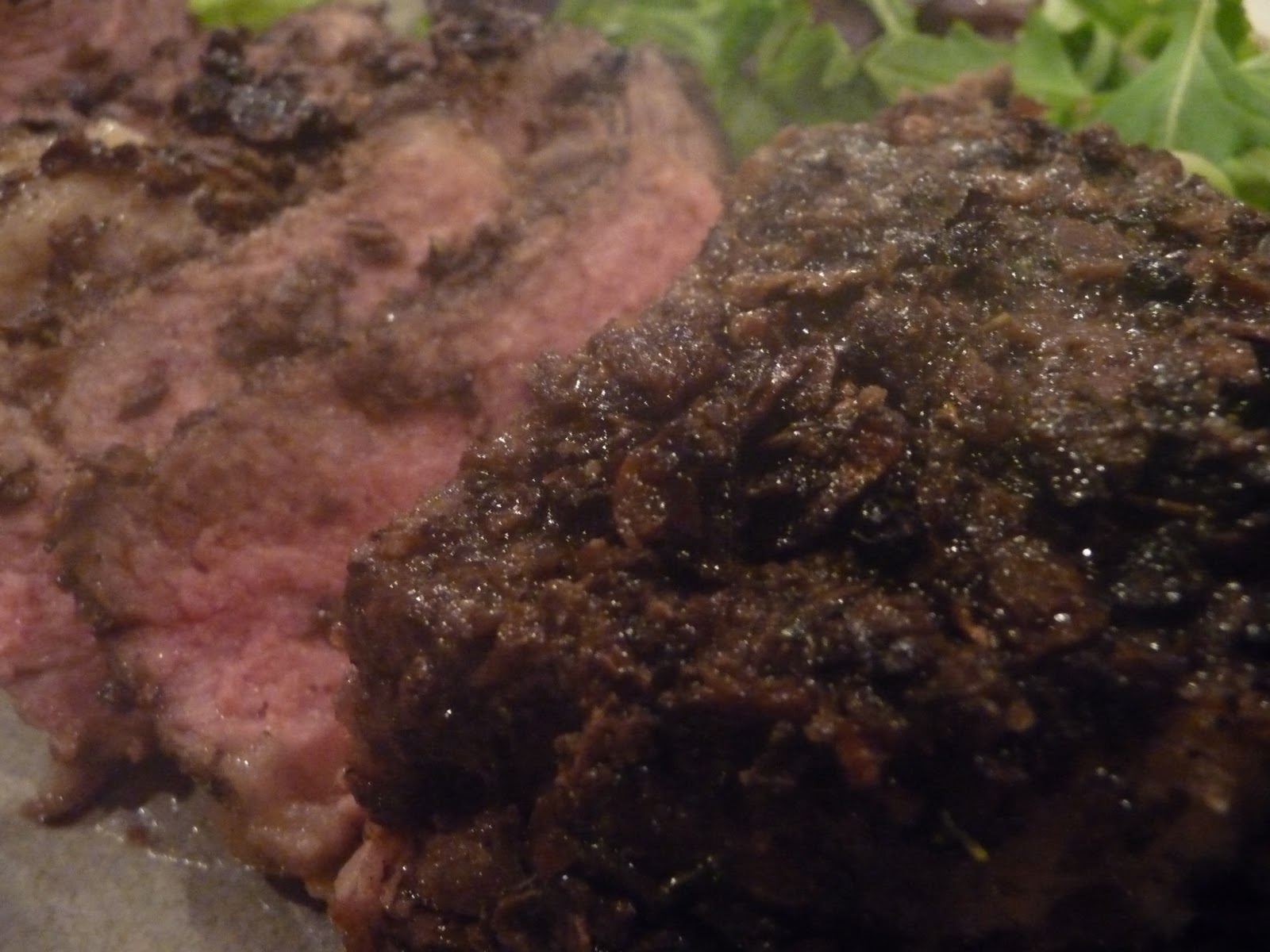
Portobello Peppercorn Crusted Ribeye

Whenever I buy beef, I try hard to buy grass-fed beef.  Grass-fed beef has less total fat and saturated fat than grain-fed beef.  Not only is it lower in fat, it is lower in calories. Grass-fed beef also has more Omega 3 fatty acids, conjugated linoleic acid, and Vitamin E, all of which are part of a healthy diet.  So, for those like me who love to eat meat, grass-fed beef is the best way to enjoy beef. 

My favorite cuts of beef are the porterhouse, N.Y. strip and the ribeye.  So, when I saw grass-fed ribeyes at my local Whole Foods, I bought one.  The general rule -- or so I'm told -- to cooking cut s like porterhouses, strip steaks and ribeyes is to use just salt and pepper, but no rubs.  The reason to forgo a rub is that you want to be able to enjoy the flavor of the beef, not the spices.  But, every once in a while, I defy convention and experiment with a rub that I think would pair well with the meat.

For this experiment, I wanted to use dried mushrooms.  You can get dried mushrooms in mushroom form or in a powder.  A mushroom powder would work fine, but I wanted to try it with dried mushrooms in mushroom form.  The next question is which type of mushroom to use.  You can use porchini, but they are a little expensive.  Dried shiitakes may be a little cheaper.  But dried portobello mushrooms are definitely cheaper and, because it would be the primary ingredient in my rub, I would need more mushrooms.  I also added a healthy tablespoon of black peppercorns , along with dried thyme, garlic powder, sea salt and some olive oil.  My plan was to make a rub that was just "wet" enough to stick to the meat and impart just enough flavor to make it interesting without overwhelming the meat.

So, with a food processor, a little time and a big grass-fed ribeye, I proceeded with my experiment and the result was ... very, very tasty.


PORTOBELLO PEPPERCORN CRUSTED RIBEYE
A Chef Bolek Original
Serves 1 (if it is me), Serves 2-3 (for everyone else)

Ingredients:
1 ribeye (between 3/4 pound to 1 pound)
1 package of dried portobello mushrooms
1 tablespoon of black peppercorns
1 tablespoon of dried thyme
1 tablespoon of garlic powder
1 tablespoon of sea salt (feel free to use less)
4 tablespoons of olive oil

Directions:
1.  Grind the mushrooms.  Put the dried mushrooms in a food processor and grind the mushrooms on the food processor setting until you have as small of mushroom pieces as you can get.

2.  Add the spices.  Add the peppercorns, dried thyme, garlic powder and sea salt.  Continue to use the food processor setting to grind everything and mix everything together.  Run the food processor on pulse a few times more to ensure everything is mixed thoroughly.

3.  Add the olive oil.  Continue the food processor on the mix setting and pour the olive oil slowly.  If you are not getting a paste like rub, use the pulse setting a few times more times.  With each pulse, the mixture should absorb more olive oil.

4.  Apply the rub to the ribeye.  Take the rub and apply it liberally to all sides of the ribeye.

5.  Cook the ribeye.  Place the ribeye under the broiler.  After about eight to ten minutes, flip the ribeye.  Some of the extra mushroom rub may smoke while the ribeye is under the broiler, but that is okay.   Cook the ribeye for about eight to ten more minutes or until your desired level of doneness. 

I have to say that this experiment was a success.  The dried portobello mushrooms imparted a very earthy flavor to the steak. In addition to the mushrooms, you can also taste the pepper and the salt.  The thyme and garlic powder get a little lost in the mushroom rub, but that was okay for me.  If you truly want to taste the garlic, I would add about 1/2 to 1 additional tablespoon.   I was just happy to sit down to a nice big ribeye with a great, off-of-the-cuff rub that I was able to think up on my own. 


ENJOY!

For more about the health benefits of grass-fed beef, check out Eatwild.com.

Wednesday, December 8, 2010

Hacienda Araucano Carmenere (2008)

A couple weeks back, Clare and I met some friends at Fogo de Chao, or, the "meat church."  There is something about a restaurant where you can have a seemingly endless number of waiters come to you with long skewers of meat to enjoy.  But, apart from the company of Clare and my friends, which is always the best part of any meal, I was taken back by the glass of wine I had.  Feeling like trying something different, I ordered a glass of Carmenere wine.  And, after one glass, I was wondering if I could have a new favorite grape.

Carmenere is, in fact, a grape of the Cabernet family that was originally grown in the Medoc region of France.  Along with Cabernet Sauvignon, Cabernet Franc, Merlot, Malbec and Petit Verdot, the Carmenere is considered one of the original six grapes of Bordeaux, France.   Despite its long history in France, the Carmenere grape is not really grown there any more; instead, the grape is grown elsewhere, such as the eastern parts of the Veneto region, as well as the Friuli region in Italy.  But, the preeminent region for the Carmiere grape is not even in Europe; rather, it is in the valleys of Chile, where the French brought the grape in the 1800s.

Eager to try another Carmenere to see if I could repeat the vinous experience I had at Fogo de Chao, I picked up a Carmenere wine.  Not knowing which wine to pick, I chose a reasonably priced one and took it home to try.  The wine is the Hacienda Araucano Carmenere, which was produced by Francois Lurton, a winemaker whose reach extends from France to Chile -- with Spain, Portugal and Argentina in between. 

In doing a little research for this post, most of what I found compared a Camenere to a Merlot or a Cabernet Franc, which kind of makes sense in a way given the common heritage of these grapes originating in France.  However, for me at least, I think the Carmenere has much more spice and pepper than a Merlot or Cabernet Franc.  Perhaps that is because of the soil in Chile.  The grapes for the Hacienda Araucano come from the Valle de Colchagua, which boasts of deep sedimentary soil protected by two mountain ranges (one of which is the Andes Mountains).  Apparently, the Colchagua Valley is a well regarded wine growing region in Chile, garnering commendations including the Best Wine Region in the World from the Wine Enthusiast in 2005.

Whatever the reason, both the wine I had at Fogo de Chao and the Hacienda Araucano had strong notes of pepper and spice, reminiscent of something bolder and stronger than a Merlot.  The Carmenere wine is definitely gentler than a bolder wine, like a Zinfandel, because tannins in the Camenere wine are not as strong.  Thus, the drinking experience is rather unique ... a peppery wine that is smooth to drink. 

I can't say that Carmenere is my favorite grape.  Pinot Noir, Montepulciano, Sangiovese, Syrah and Petit Syrah still rank higher.  But, the Carmenere is definitely a different and interesting grape.  I bought this bottle of Hacienda Araucano for $10.99 at Rodman's in Washington, D.C.  Other Carmenere wines may be available at wine stores.  

One last note, they say Carmenere wines should be enjoyed while young, so if you buy a bottle, drink it!

ENJOY!

For more information, check out the Francois Lurton website for info on the wine, the Colchagua Valley website for more information about the Colchaqua Valley, and Wikipedia for the Carmenere grape.