Wednesday, January 26, 2011

Cuscusu (Sicilian Couscous with Fish)

The largest island in the Mediterranean, Sicily, has a very interesting history, which has left its mark on Sicilian cuisine.  The Greeks brought farming to the island.  The Romans turned Sicily into a breadbasket for the mainland.  However, it is the Arabs that brought changes that have endured in the cuisine of Sicily.  Arabs brought irrigation to the island, as well as a host of fruits and vegetables that are not just common, but perhaps synonymous with the cuisine, such as eggplants, oranges, pistachios and lemons.  Arabs also introduced spices such as cinnamon, nutmeg, cloves and saffron.  And, finally, Arabs introduced couscous.

This recipe is from a cookbook called Regional Italian Cuisine, which provides more than 200 recipes from every region of Italy.  The recipe requires everything to be made from scratch, including the fish stock used when steaming the couscous.  And, while I would ordinarily make my own fish stock, I decided to try to modify the recipe to make it easier for people to cook.  The first step to making the recipe easier is to substitute seafood stock for the fish stock, thereby allowing people to use fillets rather than whole fish to make the recipe.

I also made a couple of other adjustments.  First, cuscusu, like many Italian fish dishes (such as brodetto) usually is made with different types of fish.  However, that can be a little costly, as fish can be expensive.  So, I decided to make this dish with one fish, halibut, which is a more economical way of making this dish.  Second, I did not have any fresh parsley, so I skipped adding the parsley at the end.  But, in the future, I will definitely make sure that I have parsley to add as a garnishment.

The following is my adaptation of the recipe from Regional Italian Cuisine.  The original recipe can be found at pages 288-289.


CUSCUSU (Sicilian Couscous with Fish)
Serves 4-6

Ingredients:
1 and 2/3 cups of couscous
1 big pinch of saffron
1 pinch of ground clove
1 pinch of ground nutmeg
1 pinch of cinnamon
1 and 1/2 to  2 pounds of mixed fish
6 cups of seafood stock
2 cups of flat leaf parsley, chopped
1 bay leaf
2 whole cloves
Salt, to taste
Pepper, to taste

Directions:
1.  Prepare the fish and saffron.  Cut the fillets into even sized pieces, rinse those pieces and set aside in a refrigerator.  Dissolve the saffron in a few tablespoons of the stock.

2.  Cook the couscous.  Pour four cups of fish stock in a pot, with the bay leaf and whole cloves.  Bring the fish stock to a boil. Add the couscous in a heat resistant sieve or colander.  Moisten the couscous with the saffron and water.  Place the couscous over the boiling fish stock and cover.  Steam for about twenty minutes, periodically fluffing up the couscous, until it is done.

3.  Cook the fish.  Meanwhile, bring two cups of seafood stock to a boil in a deep pan or pot.  Place the fish in the stock and simmer for about five to ten minutes on medium. 

4.  Season the couscous.  When the couscous is done, season it with the salt, pepper, ground cloves, cinnamon and nutmeg and place on a preheated platter.

5.  Plate the dish.  Top the couscous with the fish and sprinkle the chopped parsley.

ENJOY!

For more about the history of Sicilian cuisine, check out In Mama's Kitchen and Wikipedia.

Tuesday, January 25, 2011

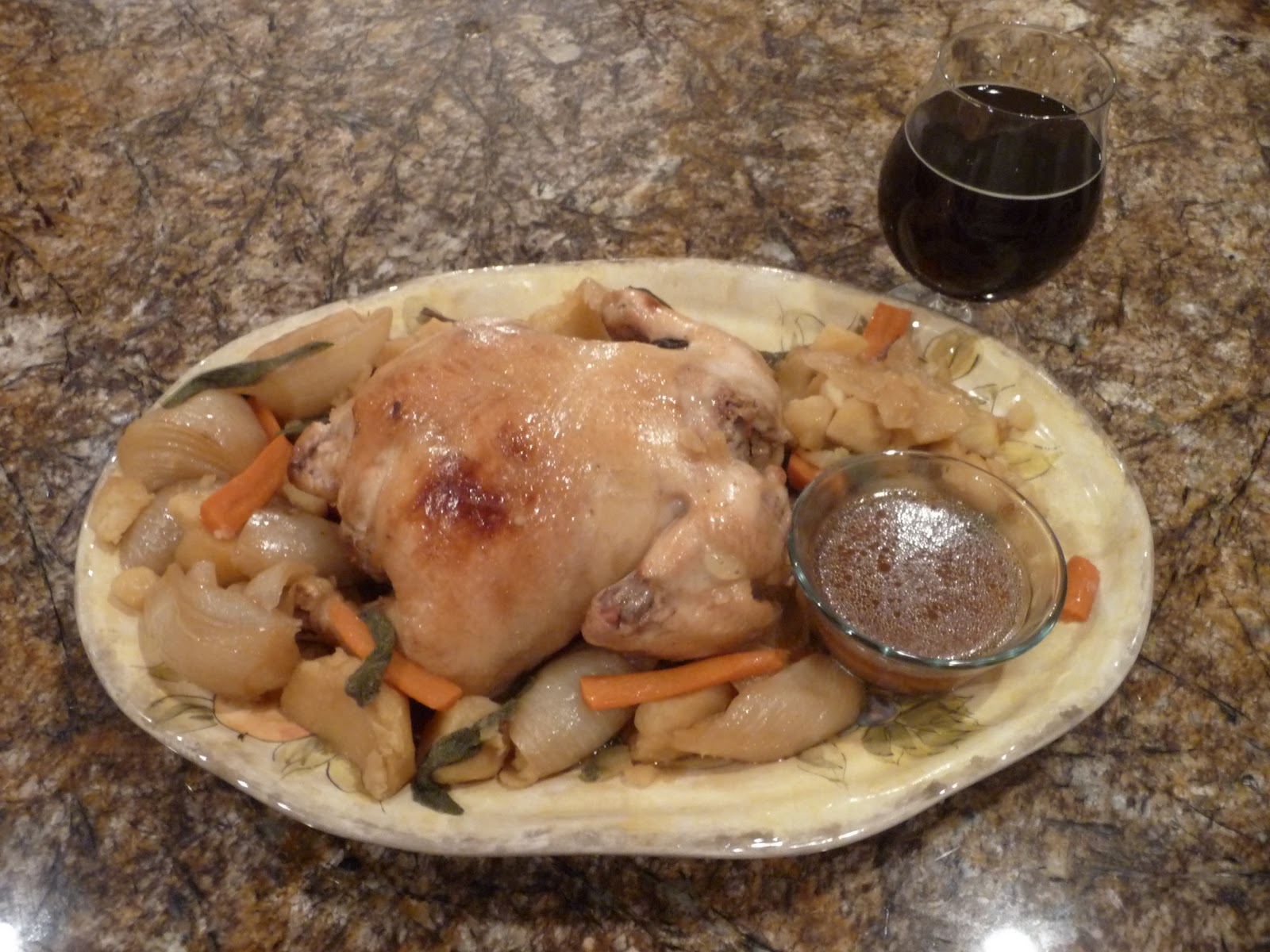
Pollo alla Birra (Roasted Chicken with Beer)

I recently bought Lidia Bastianich's newest cookbook, Lidia Cooks from the Heart of Italy, because I was very interested in her recipes from the various regions of Italy.  Much of my Italian cooking is inspired by Tuscany, Emilia-Romagna and Abruzzo.  However, I bought the book to read and try Lidia's recipes from other, perhaps lesser-known regions, such as Basilicata or Trentino-Alto Adige.  With respect to the latter region, Trentino-Alto Adige is a mountainous region in northern Italy along the border with Switzerland and Austria.  Given its mountainous terrain, as well as its location, the cuisine of Trentino Alto-Adige has characteristics that are drawn more from German cuisine than Italian cuisine.

Perhaps the German influences explain the recipe for Pollo alla Birra (Roast Chicken with Beer), which was amongst the recipes that Lidia gathered from the region of Trentino-Alto Adige. Lidia leaves open the type of beer to use in the recipe, although she notes that, in testing the recipe, she used a pale ale and a brown ale, such as the Brooklyn East India Pale Ale or the Brooklyn Brown Ale.  Lidia also notes that the darker the beer, the more sweetness would be imparted onto the chicken.   I happen to have some leftover Old Miser from Franklin's Restaurant, Brewery and General Store.  It is an English Strong Ale, which has a very well developed body, primarily due to the use of select malts and molasses.  I thought that the molasses used in making the beer would add some complexity to the flavor of the chicken.  But, you can use really any beer in this recipe.

One other note: although the recipe calls for parsnips, I decided against buying a bag of parsnips because I do not normally cook with them.  However, you can substitute any root vegetable or, in this case, I substituted some potatoes that we had lying around the kitchen. 


POLLO ALLA BIRRA (Roast Chicken with Beer)
Adapted from Lidia Bastianich's
Serves 3-4

Ingredients:
1 whole chicken
1 carrot, peeled, halved crosswise and quartered
2 medium onions, peeled, quartered through the root
2 medium parsnips (or other root vegetables),
     peeled, halved crosswise and quartered
2 tablespoons of fresh sage leaves
4 whole cloves
1 cinnamon stick
1 1/2 cups of chicken stock
1 1/2 cups beer (I used an English Strong Ale)
1 cup apple cider
2 teaspoons of kosher salt

Directions:
1.  Prepare the chicken.  Preheat the oven to 400 degrees Fahrenheit.  Rinse the chicken thoroughly.  Trim the excess fat of of the chicken and season the chicken (inside and out) with salt.  Although Lidia suggests kosher salt, I used sea salt.

2.  Cook the vegetables and chicken on the stovetop.  Scatter the onions, carrot, parsnips (or other root vegetables), sage, cloves and cinnamon stick in a heavy six-quart ovenproof pot.  Set the chicken on top of the vegetables.  Put the pot on the top of the stove, add the stock, beer and apple cider.   Bring the liquid to a simmer over medium heat.  Cook, uncovered for about fifteen minutes on top of the stove.

3.  Cook the chicken in the oven.  Put the pot in the oven, cover the chicken and roast the chicken for about thirty minutes, basting the chicken with the pan juices at least two or three times.

4.  Continue to cook the chicken in the oven.  Remove the cover and continue to roast for another twenty to thirty minutes, basting frequently, until the chicken and the vegetables are cooked through and tender.

5.  Finish the dish.  Remove the chicken to a warm platter and surround with the vegetables.  Meanwhile, bring the pan juices to a boil and reduce by half.  Cut the chicken at the table and spoon some of the pan juices over the meat.


The chicken was cooked perfectly.  The meat was very juicy and full of apple flavor from the cider and sweetness from the beer.  As I continue to pick at the meat from the bones while I write this blog, I am satisfied that I have successfully prepared Pollo alla Birra for the first time.  And it will not be the last....

ENJOY!

Sunday, January 23, 2011

Tuscan Vegetable Soup with White Beans and Parmesan


A GUEST BLOG BY CLARE...
I feel honored to be the first guest blogger for Chef Bolek’s blog.  It is hard to compete with Keith’s words and history, but I will try. 

I knew how much Keith loved me when he was willing to accept a vegetarian in his life.  Keith often jokes about his master plan to convert me to being a meat eater again, but in the meantime, he enjoys trying new vegetarian friendly recipes with me.  Keith’s mom made this recipe for me the first Christmas I shared with his family.  It was very good but a great deal of preparation is involved.  After making it myself, I know his mom and dad love me too.

I made this soup this past Christmas for our guests and it turned out very well.  The soup is an interesting mix of beans, cabbage, tomatoes, celery, carrots and zucchini.  There are a couple of options for enhancing this soup, such as adding toasted slices of bread to the bottom of the bowl and spooning the soup over the bread.  I did those options this past Christmas and would recommend them when you make this recipe.


TUSCAN VEGETABLE SOUP WITH WHITE BEANS AND PARMESAN
Serves many

Ingredients:
1 pound of dried cannelloni (white kidney beans)
2 tablespoons of olive oil
1 large onion, finely chopped
2 tablespoons of fresh thyme
4 cloves of garlic, minced
1/4 head of green cabbage, cut into 1/2 inch pieces
2 cups chopped fresh tomatoes
4 celery stalks, cut into 1/2 inch pieces
3 carrots, cut into 1/2 inch pieces
10 cups of vegetable stock
2 medium potatoes, cut into 1/2 inch pieces
1/2 cup of fresh basil, chopped
1/2 head of red cabbage cut into 1/2 inch pieces
6 3/4 inch thick slices of 7 grain bread, toasted (optional)
1 cup of grated Parmigiano Reggiano
Additional olive oil (optional)

Directions:
1.  Place beans in a heavy large pot.  Pour in enough water to cover beans by 3 inches. Soak overnight.  Drain beans.  As an alternative, you can buy canned white beans.  Just make sure to rinse the beans before suing them.  

2.  Heat 2 tablespoons in a very large pot over medium heat.  Add onion, thyme and garlic.  Saute for five minutes.  Then add the green cabbage, tomatoes, celery and carrots.  Saute for an additional ten minutes.

3.  Add the beans, 10 cups of stock, potatoes and basil.  Bring to a boil, cover, and reduce the heat to allow for the soup to simmer.

4.  After 1 hour, add the red cabbage and zucchini.  Cover and allow the soup to continue to simmer until the vegetables are tender, which should be about twenty more minutes.

5.  Add toasted bread slices to soup and remove from heat; let stand for 10 minutes.

6.  Stir in cheese.

7.  Divide soup among bowls.  Top each with ground pepper and additional olive oil.

And, as Keith would say ...

ENJOY!

Saturday, January 22, 2011

L'Abri de la Tempete Corps Mort

Located in an old fish processing plant on the Isles de Madeline, there is a craft brewer called L'Abri de la Tempete or "Shelter from the Storm."  The brewer's location, on an archipelago in the middle of the Gulf of Saint Lawrence, provides the brewery with, not only character, but also the ability to make some very interesting and unique beers.  One such beer is "Corps Mort," or the "Dead Man."

The "Corps Mort" is a "salty" barleywine that, according to the brewer, is inspired by a rocky outcrop near the brewery.  Not only is the beer inspired by the locale, it is brewed using local ingredients, including smoked grains that are used by Le Fumoir d'Antan, a local smokehouse on the Isles de Madeline, that specializes in smoking herring and mackerel.

The Corps Mort pours a reddish color with a good layer of foam.  The aromatic elements of the beer suggest caramel, molasses or brown sugar.  The sweetness of the beer's aroma deceives the drinker, because the taste of the beer is anything but sweet.  Instead, the beer is intensely smoky.  What may seem like molasses to the nose, tastes like chipotle or ancho pepper to the tongue.  The smoke flavors comes from the grains that, as noted above, were used in the smoking of the herring.  (It is also the reason why the beer comes with the warning that there may be traces of smoked herring in the beer!)  As the beer warms, the smoky flavors become smoother.

The Corps Mort is also very dry, leading the drinker to sip it more like scotch than a beer.  This is a good thing, because the beer should be enjoyed slowly.  There is no reason to drink it fast.  First, the ABV is 11%, so it packs a punch.  Second, it is an excellent beer that should be savored.

This beer is available at Gilly's in Rockville, Maryland and other beer stores that sell a lot of craft beers.  The Corps Mort sells for more than $10.00 for a twelve ounce bottle.

ENJOY!

Thursday, January 20, 2011

The Brew Kettle Copperhead Red Amber Ale

Often times, when I am in Cleveland, I visit a brewpub called the "The Brew Kettle Taproom and Smokehouse" in Strongsville, Ohio.  The Brew Kettle began as a brew on premises business, where people could brew their own batch of craft beer, using one of dozens of recipes.  I've made a couple of batches of beer at the Brew Kettle with my dad, with the last one being the East India Trading Company's Perilous Voyage Imperial Pale Ale.  We used the Brew Kettle's recipe and we were able to brew an excellent beer.

The Brew Kettle was such a success, that its owners decided to open The Brew Kettle Taproom and Smokehouse.  Guests are able to have some of the Brew Kettle's own beers, which are produced by the Brew Kettle Production Works, which operates a twenty barrel system to produce a line of beers such as the Big Woody, Erie Gold and Copperhead Red.

The American Amber Ale style gets its name from the amber hue of the beer, which is contrasted with the lighter color of other beers like pale ales.  The amber ale also contrasts with pale ales in other ways.  The amber ale is brewed in a way to achieve a balance between the malts and hops, which results in a beer that is mellower, less bitter and a smoother body than a pale ale.

The Copperhead Red is a good example of an Amber Ale.  When poured, the beer displays some reddish or amber hues, along with a good amount of carbonation.  The nose of the beer gives hints of the hops' citrusy aroma to the drinker, which is balanced by an equal hint of the two-row malts that may have been used to produce this beer. 

When drinking this beer, the malt flavors predominate up front.  The flavors of the two-row malts, along with the hint of caramel malts, give this beer a very good taste for an amber ale.  These flavors also suggest that the brewers have tilted the balance of the beer a little more toward the malts than the hops.  However, the taste of the hops comes out with the finish, completing the beer.

This is a beer will not overwhelm you with either malts or hops, because I don't believe that it was brewed with that intent.  Instead, it is a beer that provides you with a little of each, malts and hops, that leads to a very good drinking experience.

While The Brew Kettle bottles its own beers, those beers are distributed primarily in Ohio.  You can always pick up a bottle at The Brew Kettle Taproom and Smokehouse.  I strongly suggest a visit to the restaurant, because you can have the beer on tap along with a plate of pulled pork nachos, which are always very good.

ENJOY!

For more information, check out the Beer Judge Certification Program.

Wednesday, January 19, 2011

Erath Oregon Pinot Noir (2006)

Earth, from which the grapes come.  Heart, from which the wine comes.  Taken together, you get  Erath.  The founder of Erath Winery, Dick Erath established one of the first vineyards on Chehalem Mountain in Oregon.  He and his winery also produced the first wines commercially in Dundee Hills.  The winery has thirteen vineyards, with names like Leland, Prince Hill and Quail Run, where Erath grows Pinot Noir, Pinot Blanc, Pinot Gris, and Gewurztraminer.

Both Clare and I visited Erath Winery's tasting room while we were in Willamette Valley.  We were able to taste four or five of their wines, including the Pinot Noir.  The Erath Pinot Noir is made with 100% Pinot Noir grapes from Willamette Valley and is aged in 25% French Oak barrels. 

We brought back a bottle of the 2006 Pinot Noir for us to enjoy at home and we recently opened the bottle.  The wine poured a nice ruby red and aromatics are nice, full of cherries and other fruit. According to the winemaker's notes, which I found on the Wine.com website, there are black cherry aromas, with sweet mandarin orange.  While I could smell the black cherry, I was not quite getting the orange.  The winemaker also says that, as the wine opens, aromas of clove, vanilla, anise and caramel, some of which I found to become more prevalent as I drank the wine.  

The wine is milder and less earthy than other Pinot Noir wines that I have tasted.  I definitely was able to taste the cherry, as well as hints of the clove.  The milder taste of this wine makes it very drinkable, one that could be enjoyed with just about any meal. 

The 2006 vintage is sold out.  Nevertheless, I still post wines like this Erath Pinot Noir because, the wine is so good that I would definitely consider buying a more recent vintage.  To be sure, there may some differences in a wine from year to year.  However, given the history of the winemaker and the 2006 Pinot Noir, the odds are that I would be getting a great wine.

Erath is one of the more widely available Pinot Noir wines from the Willamette Valley.  You can find it at stores like Rodman's.  More recent vintages sell for about $18.99 a bottle.

ENJOY!

Sunday, January 16, 2011

Around the World in 80 Dishes: Cuba

After having Hushuur in Mongolia, my culinary adventures take me half-way around the world to ... Cuba. The cuisine of Cuba reflects its history and culture, influenced by a melange of Caribbean, Spanish and African foods and cooking techniques.  The European influences are more predominant in Western Cuba, while the Caribbean and African influences are more present in Eastern Cuba.  And, for my personal culinary challenge, I decided to draw from the entire island with a main dish of Ropa Vieja, with a side of Congri (red beans and rice).  And, for good measure, I decided that I would also make my own Cuban sofrito.

I've had Ropa Vieja at Cuban or Latin American restaurants before, so the dish is not new to me.  However, I've never made that dish before.  I have also never made Congri or my own Cuban sofrito before.  So, this challenge represents some firsts for me and, as you will see, there will not be any lasts.

THE MAIN DISH

Ropa Vieja means "old clothes" in Spanish and it is a dish that is not only enjoyed in Cuba, but also in Panama, the Dominican Republic and Puerto Rico.  This dish originated in the Canary Islands of Spain, which served as the last stop before the voyage to the Caribbean and the first stop when returning from the Caribbean.  In the Canary Islands, the dish was made with beef, chicken or pork, with garbanzo beans and potatoes.  However, in Cuba, it is just made with the meat, no beans or potatoes are added. 

In making this dish, I worked off of two recipes, which had different ways of preparing the dish.  The first way to prepare the dish (which is done by 3 Guys from Miami) is to prepare the meat separately from the sauce.  The second way (which is done by Taste of Cuba)  is to prepare the meat and cook it in the sauce.  The second recipe also included the use of sofrito, which I wanted to make as part of this challenge.  So, I combined both recipes, by first preparing the meat separately by simmering it in a broth with vegetables for a couple of hours and then preparing the sauce in the same pot, thereby enabling me to use the broth and browned bits in the sauce.  I also used some sofrito, in addition to the vegetables called for in the recipe, to give extra flavor to the sauce.


ROPA VIEJA
Serves 4 to 6

Ingredients (for the beef):
2 pounds of flank steak
5 tablespoons of olive oil
1 large onion, sliced
1 green pepper, diced
5 cloves of garlic, chopped
Flour for dusting

Ingredients (for the sauce):
2 onions, diced
2 green peppers, diced
1 can of crushed tomatoes
4 ounces tomato paste
4 cloves of garlic, mashed with 1 teaspoon of salt
1 cup of red wine (I used Tempranillo)
1 bay leaf
2 teaspoons of ground cumin
Olive oil for sauteing
Salt, to taste
Black pepper, to taste
6 ounces of sofrito (see recipe below)

Directions:
1.  Brown the flank steak.  Dust the flank steak with flour, as well as salt and pepper the beef.   Heat the olive oil to medium high.   Brown the flank steak in a dutch oven or a deep cast iron pot.

2.  Simmer the steak with the vegetables.  Add enough water to surround the meat without covering it.  Add the onion, garlic and green pepper.  Simmer covered for about two hours. 

3.  Shred the steak.  When the meat is fork tender, then it is done.  Remove the meat to a platter and shred it. Discard the vegetables but save the broth.

4.  Prepare the sauce.  In the same pot that you cooked the meat, add additional olive oil for sauteing and heat to medium high.  Add the sofrito, along with the onions, garlic, and green pepper.  Saute until all of the vegetables are tender, which should be about ten minutes. Add the tomato paste, crushed tomatoes, cumin, red wine and bay leaf.  Also add a few ladles of the broth.  Salt and pepper to taste.  Let the sauce simmer for ten minutes.  Add the shredded beef and continue to simmer for about ten more minutes.  

THE SIDE DISH

Ropa Vieja is usually served with or on top of rice. As with prior challenges, I try to make a complete meal whenever I can, including side dishes and beverages if possible.  One of the most common rice and bean dishes is Moros y Christianos (Moors & Christians), which is made with black beans and white rice.  However, as I noted above, I wanted to draw from the entire island of Cuba with this challenge.  The Ropa Vieja, with its European history, represents the western part of Cuba.  I needed a recipe that represents Cuba Oriente, or the eastern part of Cuba.

So, I decided to make Congri, which is a variant of Moros y Christianos.  Instead of using black beans, recipes for Congri call for the use of red beans.  This dish is very easy to make, especially if you use canned beans instead of dried beans, which saves time in terms of cooking the beans.  It is also a very fragrant dish, as the oregano and thyme, combined with the tomatoes, will fill the kitchen with wonderful scents. 


CONGRI (Cuban Red Beans and Rice)
Adapted from Whats4Eats
Serves 4 to 6

Ingredients:
2 cups red beans
2-3 tablespoons of olive oil
1 onion, finely chopped
2-3 garlic cloves, minced
1 teaspoon dried thyme
2 teaspoons dried oregano
1 bay leaf
1 cup of rice
1 3/4 cup of chicken broth
1 tablespoon of red wine vinegar

Directions:
1.   Saute the vegetables.  Heat the oil in a large saucepan over medium flame. Add the onion and bell pepper and sauté until the onion is translucent. Add the garlic and sauté for another 1 to 2 minutes.


2.  Add ingredients.  Add the tomato sauce, beans and herbs.  Simmer for ten minutes.

3.  Add more ingredients.  Stir in the rice, broth and vinegar.  Season everything with salt and ground pepper.  Bring to a boil and the reduce, cover and simmer for about fifteen to eighteen minutes.

4.  Let the rice stand.  Remove from the heat and let stand for five to ten minutes.  Stir lightly and serve.

THE EXTRA

A sofrito is the term for the combination of finely cut ingredients that are sauteed in oil.  In Spanish cooking, a sofrito is the combination of garlic, onions and tomato, which are sauteed for a period of time in olive oil.  In Cuba, a sofrito has one additional ingredient ... green bell peppers. You could also add other ingredients, such as white wine, cumin or cilantro, but the basic recipe calls for five ingredients: garlic, onion, tomato, bell pepper and olive oil.  So, I stuck with that recipe, which is used by cooks and chefs as the basis for many dishes, including Ropa Vieja.


CUBAN SOFRITO
Adapted from Whats4eats
Makes 1 1/2 cups 

Ingredients:
1 tomato, seeded and diced
1 onion, finely diced
1 green pepper, finely diced
1/8 cup of olive oil
2-3 garlic cloves, minced
1/4 cup olive oil

Directions:
1. Saute the vegetables.  Heat 1/8 of a cup of olive oil over medium.  Add the onions and garlic.  Saute until the onions are translucent.

2.  Continue to cook the vegetables.  Add the diced tomato.  Stir and continue to cook until it reduces a little.

3.  Add olive oil.  Remove heat and stir in the 1/4 cup of olive oil.


Overall, I think this meal was a great success.  I was able to prepare the Vieja Ropa very well, cooking the flank steak to a point that it shredded easily.  Preparing the flank steak separately from the sauce also made the whole process a lot easier, reducing the mess of trying to pull the steak out of the sauce to shred it.  It also provided me with an additional ingredient to flavor the sauce, namely the broth in which the steak and vegetables had been cooking for two hours.  And, as for the final product, the Vieja Ropa was very good, the cumin balanced well with the tomato, although the flank steak was a little chewy.

The Congri was excellent.  The rice was cooked perfectly and was a very good counterpart to the red beans.  This dish can be modified to make it vegetarian by substituting vegetable broth or vegetable stock for chicken broth.  You could also use water instead of broth or stock, although I think that will lessen the favor of the dish.  I will definitely make this meal again, especially the Congri. Until next time....

ENJOY!

For more information on Ropa Vieja, check out Wikipedia and for more information on sofrito, check out Wikipedia.

Saturday, January 15, 2011

Pesci e Patate al Forno (Oven Roasted Fish and Potatoes)

This is a recipe that I created myself, inspired by a Patate al Forno recipe, which is a dish of oven-roasted potatoes and tomatoes that is made in Abruzzo and Apulia.  The layers of potatoes and tomatoes, with a generous sprinkling of cheese is a great side dish.  However, I was trying to make a main dish.  So out with the tomato and in with the fish.  In this case, I bought some halibut, although any fish will do. 

This dish is fairly simply to make, requiring only fish, potatoes, sage, olive oil and a lot of grated cheese, along with salt and pepper.  The key is to slice the potatoes as thinly as possible, so that they cook fast.  Also, you should grate the cheese as finely as possible, so that it can brown faster.  And use a hard cheese, like Pecorino Romano or Parmigiano Reggiano.

This dish is very "user-friendly," because you can tweak it any way you want.  You could add some diced garlic, shallots or onions.  You could also use other herbs, such as rosemary or basil.  You could even use different fish, although that will most likely change the cooking times. 

PESCI E PATATE AL FORNO (Oven Roasted Fish and Potatoes)
A Chef Bolek Original
Serves 2-3

Ingredients:
About 1 pound of fish, cut into even sized pieces
4 medium-sized potatoes, peeled and sliced thinly
1/4 pound of Pecorino Romano, grated finely (at least)
4-5 tablespoons of olive oil
Sage, chiffonade (cut into thin strips)
Salt, to taste
Pepper, to taste

Directions
1.  Prepare the baking dish. Spread the olive oil along the bottom and sides of a glass casserole dish.  Then lay the potato slices on the bottom of the dish, making sure that the entire bottom of the dish is covered.

2.  Assemble the fish and potatoes.  Place the fish on top of the potato slices.  Salt and pepper the fish generously.  Apply a liberal amount of Pecorino Romano and sage.  Cover the fish with the remaining potato slices.  Once again, apply a liberal amount of Pecorino Romano and Sage.


3.    Bake the fish.  Preheat the oven to 425 degrees Fahrenheit.  Place the casserole dish in the oven and cook for about 35 to 45 minutes.  When the cheese begins to brown and the fish begins to flake, it is done.


4.   Plate the dish. Plate each piece of fish with a good amount of the potatoes. Serve immediately.


This recipe is my quick and easy version of much more complicated recipes.  Overall, it turned out well.  Both Clare and I enjoyed this dish.  I'll be making it again, perhaps with some of the tweaks I mentioned above.

ENJOY!

Friday, January 14, 2011

Oysters with a Sun-Dried Tomato and Parsley Mignonette

Sweet Oysters -- or Choptank Sweets -- are "aqua-cultured" or farmed oysters from the Chesapeake Bay.  These oysters are not raised at the bottom of the bay or on reefs, but in floats just below the surface of the water where they feast on algae.  The oysters are also removed at various points in their development to remove barnacles, mussels and other organisms from their shelles.  The result is a meaty oyster that is low in salinity and briny taste.

However, unlike other oysters, like Chesapeake oysters, the shells of Sweet Oysters are more brittle, making them harder to shuck.  (I'm speaking from experience.)  Once they are shucked, you are greeted with a meaty oyster that is actually sweet in taste (hence, the "sweet" in the name).

When thinking of the mignonette for a sweet oyster, I tried to think of flavors or tastes that would provide a contrast.  The first things to come to mind were earthy flavors.  The sweetness of the oysters are subtle and, therefore, the earthiness of the contrasting flavors also have to be subtle.  So, I chose sun-dried tomatoes and flat-leaf parsley for the mignonette.  The result was very good.

OYSTERS WITH SUN-DRIED TOMATO AND PARSLEY MIGNONETTE
A Chef Bolek Original
Serves 2-3

Ingredients:
12 fresh oysters, shucked (I used Chesapeakes, but any will do)
4 tablespoons of sun-dried tomatoes, chopped finely
2 tablespoons of flat leaf parsley, chopped finely
1 shallot, diced
2-3 tablespoons of white vinegar

Directions:
 1.  In a non-reactive bowl, add the shallot, sun-dried tomatoes, parsley and vinegar. Mix all of the ingredients well. 

2.  Spoon the mignonette over the oysters.

ENJOY!

To learn more about Choptank Sweets, check out Sustained Seas.

Thursday, January 13, 2011

Sam Adams & Weihenstephan Infinium Ale

It is not very often that one comes across an attempt by a brewery to create a new beer style.  And it is even less often to find that new beer bottled in a champagne bottle.  And it is truly a unique experience to have that new beer be a collaboration between Sam Adams and Weihenstephan.  

Everyone knows about Sam Adams, but not everyone knows about Weihenstephan.  About a thousand years ago, it was a brewery run by a Benedictine monastery.  The brewery then became the Bavarian royal brewery and, today, it is the Bavarian state brewery.  Although it is a state brewery, it operates like a private business, guided by the principle of "class not mass."

The Infinium is marketed as a beer that combines European brewing with American innovation.  Brewers of Sam Adams and Weihenstephan worked for two years on the recipe of this beer, which marks the first champagne beer (i.e., the new beer style).  To make this beer, the breweries followed the Reinheitsgebot, which is the law passed in 1516 to maintain the purity of beer by limiting its ingredients to malt, hops and water.  The law was later amended to add yeast.  Using these four ingredients, Sam Adams and Weihenstephan have created a beer that is a first.

When you pour the infinium, the carbonation is about the same as a champagne.  So you need to pour it carefully.  The brewers say that the beer should have a fruity, spicy aroma, which I think is what I could smell after pouring the beer.  The brewers say that the use of Noble hops should impart a a soft citrus and floral flavor.  The flavors that I tasted were not necessarily soft citrus and floral, they were a little more a combination of bitter and fruity.  That is not necessarily a bad thing, but I when I think of soft citrus and floral, I think of a beer like the Fleurette.  At least for me, this beer does not achieve that result, but it is still a very good beer.

The beer is sold in champagne beers for $18.99 a bottle, which is a little pricey for beer but actually cheap for good champagne.

ENJOY!

For more about the Infinium, check out the Sam Adams website.  For more about the Weihenstephan, check out its website.