Wednesday, March 23, 2011

The Brew Kettle Big Horn Bock

Germany has a rich beer history, going back centuries.  For example, during the 14th century, brewers in the town of Einbeck brewed a dark, lightly hopped but very malty ale.  A couple of hundred years later, in the 16th century, brewers in Munich adopted the beer style, but adapted it to the lager style.  Supposedly, Bavarians would pronounce the town "Einbeck" as "ein Bock," and, hence the beer of Einbeck got its name, "Bock."  (It should be noted that "ein Bock" also means "billy goat.")

Thousands of miles away from Bavaria, The Brew Kettle brews its "Big Horn Bock."  This beer is not brewed in the traditional bock style; instead, it is brewed in the helles style.  The "helles" style dates back to the Spaten Brewery, which began to brew lighter beers, which it dubbed as "helles," which is German for light colored.  The brewers referred to their beers as "helles" to distinguish them from doppelbocks.  Eventually, brewers tried to strike a balance between the two beers, brewing a bock beer in the helles style, which is also known as a Maibock.

The Big Horn Bock pours an amber color, which what a little surprising to me, because I expected a more golden color.  However, amber colors are certainly within the Helles Bock style.  The aroma of the beer is relatively light, especially compared to some of the recent beers that I've reviewed.  There is a slight malty nose to the beer.  The taste of the beer heavily emphasizes the malts, with almost no hop flavors to be found.  I expected a little more of a hop flavor, but, I was certainly not disappointed in any way.  This is a good beer that reflects its style.

The Big Horn Bock is a very drinkable beer and it is a good beer for people who do not like hoppy beers like pale ales.  Although the beer is available in bottles, those bottles are sold at The Brew Kettle restaurant in Strongsville.

ENJOY!

For more on the history of bock beers and helles beers, check out Wikipedia.  For more about the Maibock or Helles Bock style, check out the Beer Certification Judge Program.

Tuesday, March 22, 2011

Spicy Swai with Rice Sticks

I have to admit that I need to learn how to cook Asian food.  Sure, it would be a great thing to learn how to cook Chinese, Japanese or Thai food.  However, I also want to learn how to cook some other cuisines, like Vietnamese, Malaysian or Korean.  This recipe is somewhat of an accident.  I really planned on making Bucatini with a Soft Shell Crab Sauce.  There is a seafood store that usually carries soft shells, even when no one else does.  However, when I went there, they did not have any soft shells.  So, I left dejected and wondering what I would make.  When I stopped at my local grocery store, I perused the small seafood counter and saw something that I had not seen before ... swai.

The swai, also known as the basa fish, is a species of river catfish from the delta.  The particular delta is not the Mississippi delta, but the Mekong delta.  For the most part, swai or basa are raised on commercial farms in southeast Asia, most specifically Vietnam and Thailand.  According to Seafood Watch, the swai have a "strong" potential to be a sustainable fish.  There are some concerns about the method by which farmers raise the swai, particularly the use of open cages.  There is some research that shows that the use of open cages may have an adverse effect on the environment, plus an increased possibility of disease amongst the fish and escape of the caged fish into the rivers or waters where the cages are maintained.  Still, in terms of sustainability, Seafood Watch rates the Swai as "good," although not as good as U.S. farmed catfish.

In making this dish, I wanted to try something different and push myself a little.  Given swai is a Vietnamese fish, I wanted to use my wok to make a stir fry.  As I strolled the aisles of the produce section, I picked up a couple red peppers, some baby eggplant, and some cilantro.  As I headed to the checkout aisle, I passed the Asian food section and debated whether I should serve this with rice or noodles.  I came across a package of "Rice Sticks," which are basically rice noodles.  Having never used rice noodles before, let alone in a stir fry, I thought I would give them a try.  I returned home and, with some ingredients out of the pantry, I created this dish off the top of my head.  And, while this dish will not win any awards, it actually turned out to be quite tasty.


SPICY SWAI WITH RICE STICKS
A Chef Bolek Original
Serves 3-4

Ingredients:
1 pound of swai fillets, cut into bite-sized pieces
2 red peppers, diced
3 baby eggplant, diced
1 clove of garlic, finely diced
2 tablespoons of fresh cilantro, chopped
4 tablespoons of canola oil
1 teaspoon of sambal oelek
1 teaspoon of fish sauce
1 teaspoon of dark soy sauce
Salt, to taste
Pepper, to taste
Lemon, juiced

Directions:
1.  Prepare the rice sticks.  Generally, you place the rice sticks in warm water for five to eight minutes until they have softened.  Drain the rice sticks and set aside until you are ready to fry them.

2.  Prepare the swai.  Salt and pepper the swai liberally.  Sprinkle the lemon juice over the swai and set aside.

3.  Cook the vegetables and spices.   Heat the canola oil in the wok on high.  Add the peppers and saute for about three minutes.  Add the garlic, saute for a minute more.  Add the eggplant and continue to saute for about five minutes.  While sauteeing the eggplant, add the cilantro, sambal oelek, fish sauce and dark soy sauce.

4.  Cook the fish. Add the swai and stir to make sure that the liquid covers the swai.  Cook for about five to seven minutes.  Add the noodles and continue to stir until everything is incorporated well.

While this may not have been my strongest outing, it was definitely a tasty dish.  I plan on tweeking this recipe a little to improve upon it.  I'll keep you apprised of any changes in the recipe.  Until then ...


ENJOY!

Sunday, March 20, 2011

Amping Fresh Food @ Amp 150

Recently, when Clare and I stopped back in Cleveland for a visit with my parents, they wanted to take us to AMP 150, America's Modern Palate.  AMP 150 is a restaurant in the Cleveland Marriott Hotel on West 150th Street.  My parents had eaten there a couple of times, and, each time, they loved the food.  And, with the restaurant's concept being "farm to table," they knew that I would love this restaurant as well. They were right.  I loved this restaurant so much that I decided to do my first ever restaurant review so that I can share some of the great food that I was able to enjoy. 

The chef, Ellis Cooley, maintains an ambitious menu, which is executed to near perfection. Guests have the option of ordering dishes -- appetizers, soups and greens, small bites, large bites and gardens (sides) -- but I would strongly suggest the Chef's Choice Tasting Menu.  In D.C., most tasting menus offered by chefs in restaurants provide you with four or more courses, usually for a price of $50 per person or more.  At AMP 150, you can get a four course meal (which is actually six courses) for $35 per person and a six course meal (which I presume would be eight courses) for $45 dollars.  So, this is a great value for what will be a lot of food by the time you are finished.

The Chef's Choice Tasting Menu requires the whole table to put itself in the hands of the Chef and his sous-chefs.  They will choose the particular dishes that will be served for each course, all of which come straight off of the menu.  You can tell them that certain things are off limits, such as Clare telling them that she does not eat meat, or you can tell them that you are really interested in trying a particular dish, such as when I told them that I would really like to try the grilled sweetbreads.  Otherwise, you need not worry, because the Chef and the sous-chefs have a great sense of selecting dishes to present to a table of guests who each have their own likes and dislikes when it comes to food. 

Velvet Mushroom Soup
The First Starter Course: The first two courses start small but are big on flavor.  They are sort of amuse-bouches, intending to wake up the taste buds of the guests.  The first starter course is a small little cup of the Velvet Mushroom Soup.  The mushrooms are pureed and then cream is added to make a soup that has an incredibly earthy and creamy consistency.  The soup is garnished with a little truffle oil and chives. 

Chicken Liver Pate with Apple Jam
The Second Starter Course: After we finished the soup, the server brought out the second starter course ... crostini.  We were given two types of crostini.  First, there was the chicken liver pate with apple jam and, second, there was a mushroom pate.  I had the chicken liver pate with apple jam, which was delicious.  The combination of the chicken and apple jam worked very well together. 

Grilled Sweetbreads
The Appetizer: After finishing the crostini, the server brought out the appetizers.  Each person gets a plate and additional plates are brought for people to share.  We were served the Black Mussels, which included Chinese sausage, lemongrass, plum wine, coconut milk and ginger cilantro.  The broth was amazing and we requested some bread to dip into the broth to eat. We also had the House Made Ricotta Cavatelli, which was delicious with its brocollini, spec ham and pecorino. The third appetizer was Roasted Cauliflower, with goat cheese, pine nuts and a beet vinaigrette. Finally, we had the Grilled Sweetbreads.  The sweetbreads were served with caramelized cauliflower, sweet and sour raisins and micro-cress.  The sweet breads were grilled perfectly, with just enough char on the outsides.

The Salads and Other Dishes
The Salads: After completing the appetizers, the server brought out two salads and two other dishes for everyone to share.  The first salad was the Baby Beet Salad, which included Lake Erie Creamery Goat Cheese, mesculn greens, and a champagne vinaigrette.  The second salad we got was the Blood Orange Salad, which included arugula, parmesan and toasted almonds.  The third dish we got was the Crispy Duck Confit, with Maytag blue cheese, polenta, caramelized onions and cherries.  Finally, we also got the Edamame Falafel, which was surprisingly good and included pickled cucumber, Kalamata olives, preserved lemon and Greek yogurt. All of these salads and dishes were excellent.

The Main Courses:  We then turned our attentions to the main courses.  Although we were beginning to feel full, the dishes that were brought out were so good that, at least for me, I forgot that I already had more than two courses of food.

Roasted Free-Range Chicken
The first main course dish was the Roasted Free Range Chicken.  The chicken was roasted to perfection, with crispy skin but very juicy meat.  The chicken was served with Catalane bean ragout and rosemary, all of which served as a great base for this dish.  If one was to order only a dish, rather than the tasting menu, I would strongly recommend the chicken.

Wild Striped Bass
The second main course dish was the Wild Striped Bass.  Once again, the dish was cooked very well, with a crispy outer skin and very tender meat underneath.  The fish was served with Brussels sprouts, chestnuts, Killbuck Valley Mushrooms, and topped with a Mascarpone foam.  Personally, I am not a big fan of Brussels sprouts, however, they were delicious.  I am also not a big fan of foam, but, in this case, the foam provided an interesting, but subtle, contrast with the fish.

Marinated Flank Steak
The third main course dish was the Marinated Flank Steak.  The steak itself was delicious and I am still trying to figure out what was the marinade, because, whatever it was, it contributed a lot of flavor to the meat.  The steak was served with fingerling potato "coins," which were a great starchy complement to the meat.  The steak was also served with a red wine shallot puree, which provided a nice sauce to add to each bite of the steak.

Braised Lamb
Finally, the last main course dish was the Braised Lamb, another dish that I would recommend if you were going to skip the Chef's Choice Tasting Menu and order only one dish.  The lamb was cooked perfectly, falling with little effort from the bone.  The lamb was served with Jameson Farms Merguez sausage, parsnip and almond hummus, and lentils.  All of which were very delicious.

Sweet Potato Tower
The Desserts: The last course,was the dessert course.  By this time, it was getting a little dark in the restaurant and I could muster only one good picture of the four desserts that were served. The picture is of the Sweet Potato Tower.  This dish included brown butter ice cream, bourbon caramel, and pecan praline. Although I am not a big fan of sweets and desserts, this was very good and the perfect way to end the evening.  While I don't have pictures for all of the other desserts, and I am having a hard time reading my written notes, all I can say is that they were all interesting and delicious.

Finally, I want to take a moment to thank my parents for taking Clare and I to this great restaurant for such an amazing dinner.   AMP 150 provides the food, flavor and presentation one would expect at fancy restaurants in New York City or Washington, D.C., however, it does so in a way that opens that experience to many more people at a much more reasonable price.  I am definitely going to add this to my list of restaurants that I would return to whenever I am back in the Cleveland area.

ENJOY!


For more information about the restaurant, check out its website.

Friday, March 18, 2011

Lamb Korma

Recently, Clare and I had dinner with some of my best friends at a local Indian restaurant called Indian Ocean, where I ordered one of the daily specials, Lamb Korma.  The dish was excellent, especially the rich sauce. I kept eating the sauce even after I finished the lamb, using naan to get as much of the sauce as possible.  A few days later, when Clare and I were cleaning out our cupboard, we came across a recipe packet for Lamb Korma that I had bought from Lewes Gourmet when we had visited Lewes, Delaware.  The packet, which includes all of the spices and the instructions needed to make lamb korma, was sold by the World Cuisine Institute, LTD.   With that packet, I decided that I would make this dish.

The origins of what is known as korma generally date back to the 16th century, when the Mughal Empire controlled a large swath of land that is now Pakistan and India.  Mughlai cuisine represents the cooking styles of Punjab and Delhi, influenced by both Persian and Turkic cuisines.  However, korma is distinctly an Indian dish of meat and/or vegetables braised in water, stock or cream.  In fact, the word "korma" is derived from the Urdu and Hindu word for "braise." 

The flavors of the dish, as well as its spiciness, depend upon the herbs and spices that you use. In the case of the recipe that I was using, the spices included, but were not limited to, ginger, cardamom, chile powder, coriander, cumin, turmeric and cinnamon.  All of the herbs and spices were pre-measured and sealed in little packets.  This made preparing the dish much easier, but it makes blogging a little harder.  I did my best to estimate the measurements for the recipe. 


LAMB KORMA
Recipe from World Cuisine Institute
Serves 4-6

Ingredients:
1 1/2 pounds of lamb, cut into 1/2 inch cubes
3 tablespoons of olive oil
2 medium onions, diced (about 3 cups)
1/2 tablespoon of garlic, minced
1/2 tablespoon of ginger, minced
2 cups of water
1 medium tomato, peeled and roughly chopped.
3 tablespoons of cream
2 tablespoons of fresh cilantro
1 tablespoon of Kasoori Methi (dried fenugreek) leaves
Salt, to taste
Ground cashew nuts

Ingredients (for the Garam Masala):
6 whole cloves
1 cinnamon stick
2 bay leaves 
6 whole green cardamom seeds

Ingredients (for the Curry Masala):
Ground coriander
Cumin powder
Turmeric 
Chili Powder 

Directions:
1.  Make the sauce.  Heat the oil on medium heat in a medium sized sauce pan with a lid.  Add the Garam Masala spices immediately followed by the onions.  Saute the onions until they are caramelized, which is about fifteen minutes.

2.  Add the garlic and ginger.  Saute the garlic and ginger in the pan.  Continue to saute the garlic begins to brown, about two minutes.  Add some water if the mixture begins to stick.

3.  Add the spices, tomatoes and water.  Add the Curry Masala spices, salt, tomato and 1 cup of water.  Cook until the tomato has broken down, about eight minutes.

4.  Add the lamb.  Stir in the lamb and remaining water.  Cover, reduce heat and simmer for thirty minutes. Remove the lid and cook for another fifteen minutes, or until the meat is tender.  Add additional water if the mixture becomes dry and begins to stick.

5.  Finish the dish. Turn off the heat.  Stir in the cream, cashews and cilantro.  Crumble and stir in the Kasoori Methi leaves.

6.  Plate the dish.  Spoon some of the lamb korma in the dish.  Serve with rice or naan bread.

Overall, the recipe produced a great dish.  However, I think that I would change the recipe a little by first browning the lamb meat in a couple tablespoons of vegetable or canola oil.  Browning the lamb helps to improve the taste and texture of the meat, as well as seal in some of the juices so that it does not dry out or become tough during the cooking process. 

ENJOY! 

Check Wikipedia for more about korma and about Mughlai cuisine.

Thursday, March 17, 2011

Fat Head's Head Hunter India Pale Ale

Cleveland is the home of many great craft brewers, such as Matt Cole, the brewer of Fat Head's Brewery & Saloon in North Olmsted, Ohio.  Whenever I am in Cleveland, I always try to stop by Fat Heads in order to try whatever Matt happens to have on tap at the time.  I've previously reviewed one of his beers, the Hop Juju Imperial India Pale Ale, which is probably one of the best Imperial IPAs that I've ever had.  I was able to do that review because I happened to be in Cleveland at the time when it was on draft.  Now, however, Matt has begun to bottle his beers, opening new possibilities in terms of distribution.  And, recently, I was able to try a bottle of his Headhunter IPA, although my father had to bring it to me from Cleveland.

The India Pale Ale style can be traced back to the pale ales of the seventeenth century in England.  One of the earliest brewers was George Hodgson of Boss Brewery.  Traders working for the East India Trading Company liked the beers of Boss Brewery because they could survive the trip to India.  Eventually, however, the Boss Brewery beers fell out of favor with those traders, and the East India Training Company turned to Allsop Brewery and others, which produced a strongly hopped pale ales in the style of the Boss beers.  The reason for all of those hops was to help preserve the beer. The use of hops, in conjunction with a beer that had a higher alcohol content, helped to prevent spoilage on the vessels during the long voyages to India. 

The IPA brewed by Fat Head's is brewed in a style that could take it around the world.  Matt describes the Head Hunter as a "balls-to-the-wall IPA" that surpasses all others, and an "in-your-face, dry-hopped West Coast-style IPA.  These descriptions are very appropriate.  From the moment you start to pour the beer, you see a nice orange beverage in your glass, but you are greeted with a nose that is basically a ton of grapefruit packed in pine crates.  For a hophead like myself, this is a much treasured aroma.  The nose of the beer clearly summarizes the taste of the beer, which is full of grapefruit, along with some pine and, as the label notes, some tangerine and pineapple. These bitter flavors are rounded, just a little, by the caramelized malts used in the brewing process.  All of these flavors have the tendency to make you forget that the beer has a whopping 7.5% ABV.

When it comes to pairing food with a beer like this one, the effort may require a little creativity. A beer that is packed with this much grapefruit flavor would seem to call for food that is equally full of flavor.  A good marbled piece of beef, or, perhaps chicken wings with a sauce that is full of spices or heat.  In the case of the beef, the beer would be a good contrast to the flavor of the meat.  And, as for the wings, the dry, hoppy nature of the beer may intensify those spices in the sauce, enhancing the meal.  Or, you could do what I did when I tried this beer ... just enjoy the beer by itself.

I would highly recommend this beer for those of you who can lay your hands on it.  It is an excellent example of the India Pale Ale style.  It is often available on tap at Fathead's Brewery and Saloon in North Olmsted, Ohio and bottles may be available there for purchase. 

ENJOY!

For more about the history of India Pale Ale, check out Wikipedia and Brewing Techniques.

Tuesday, March 15, 2011

Cuban Bread

A Guest Blog Post by Clare ...

This the second post that I have done for Keith's blog, and, I get to post about something that Keith has never posted about ... bread.  Keith does not bake, but I love to bake.  For example, if I mention the word "Cuban" to Keith, he'll think of the sandwich, with its ham and roast pork.  Mention the word "Cuban," I think of a bread I made a while back called "Cuban bread."

This recipe makes two round loaves of bread, which is very similar to a French bread made with only yeast, flour, water, salt and a little sugar.  When making this bread, you cut a little "x" into the top of the bread.  As it bakes, the bread opens at the top.

This is a very easy recipe to make.  I think even Keith could make this recipe. 


CUBAN BREAD
Makes 2 loaves
Adapted from Bernard Clayton's New Complete Book of Breads at pages 23-24

Ingredients:
5 to 6 cups of bread or all purpose flour, approximately
2 packages of dry yeast
1 tablespoon of salt
2 tablespoons of sugar
2 cups of hot water (120 to 130 degrees)
Sesame seeds

Directions:
1.  Place four cups flour in a large mixing bowl and add the yeast, salt and sugar.  Stir until they are well blended.  Pour in the hot water and beat with one hundred strong strokes or for three minutes with a mixer flat beater.  Gradually work in the remaining flour 1/2 cup at a time (using fingers if necessary), until the dough takes shape and is no longer sticky.

2.  Sprinkle the work surface with flour.  Work in the flour as you knead, keeping a dusting of it between the dough and the work surface. Knead for eight minutes by hand or with a dough hook until the dough is smooth, elastic and feels alive under your hands.

3.  Turn the dough fro the bowl and allow it to rest for four or five minutes before dividing it into two pieces.  Shape each piece into a ball.  Flatten with the palm into an oblong roughly the length of the loaf pan.  Fold lengthwise, pinch the seam together, tuck in the ends and drop into the prepared tin.  Press down with the hand to force the dough into the corners.

4.  Cover the pans with greased wax or parchment paper and put aside to almost tripe in volume.  The dough should rise 1 1/2 to 2 inches above the rim of the tin in about fifty minutes.

5.  Preheat the oven to 400 degrees about fifteen minutes before baking.

6.  Brush the loaves with the egg-milk wash and place the pans on the middle or lower shelf of the oven.  Bake until the loaves are a golden brown, thirty to forty minutes, and test done when rapped on the bottom crust with a forefinger.

7.  Remove the loaf from the oven and allow to cool on a metal rack before slicing.

ENJOY!

Monday, March 14, 2011

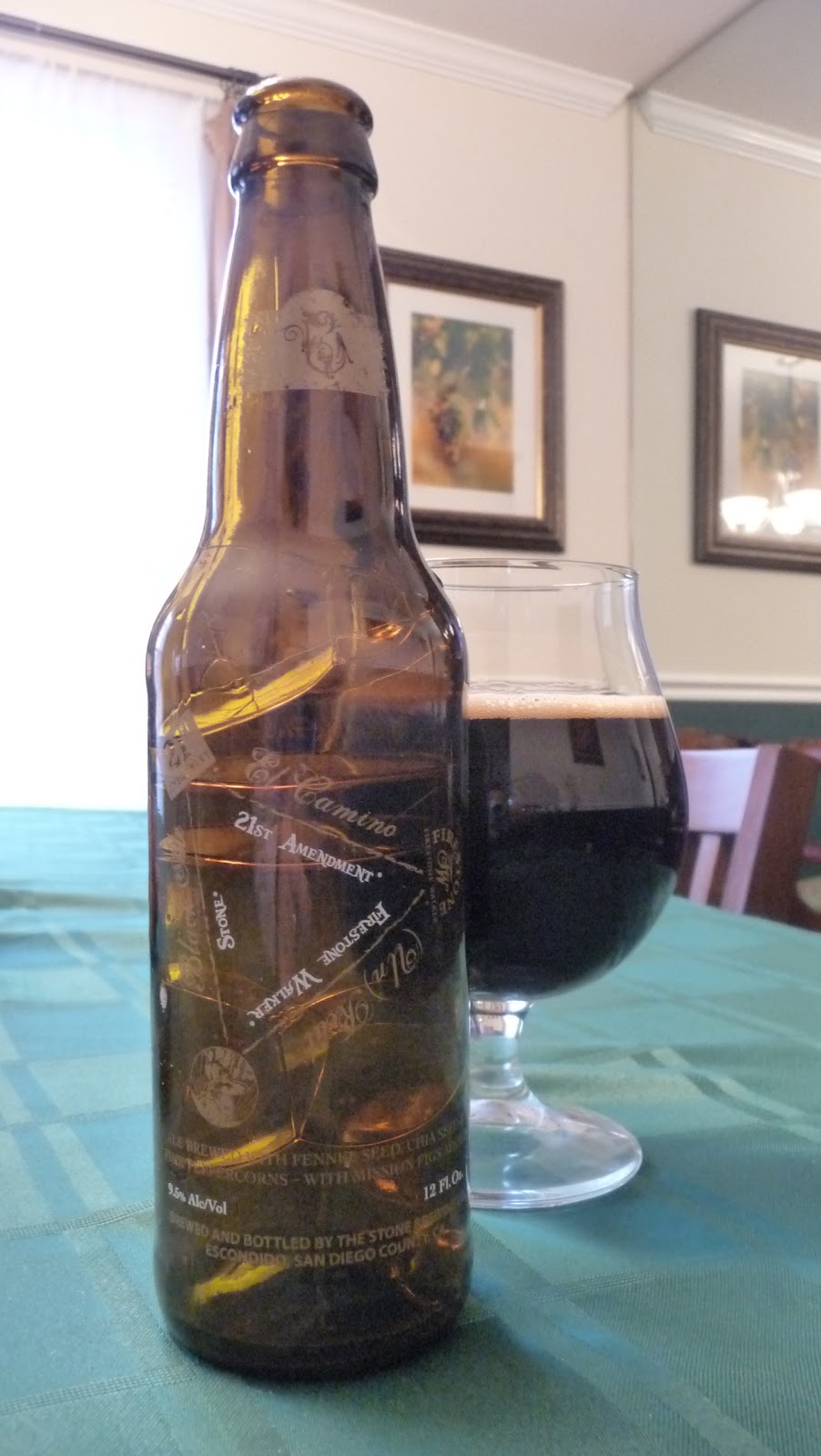
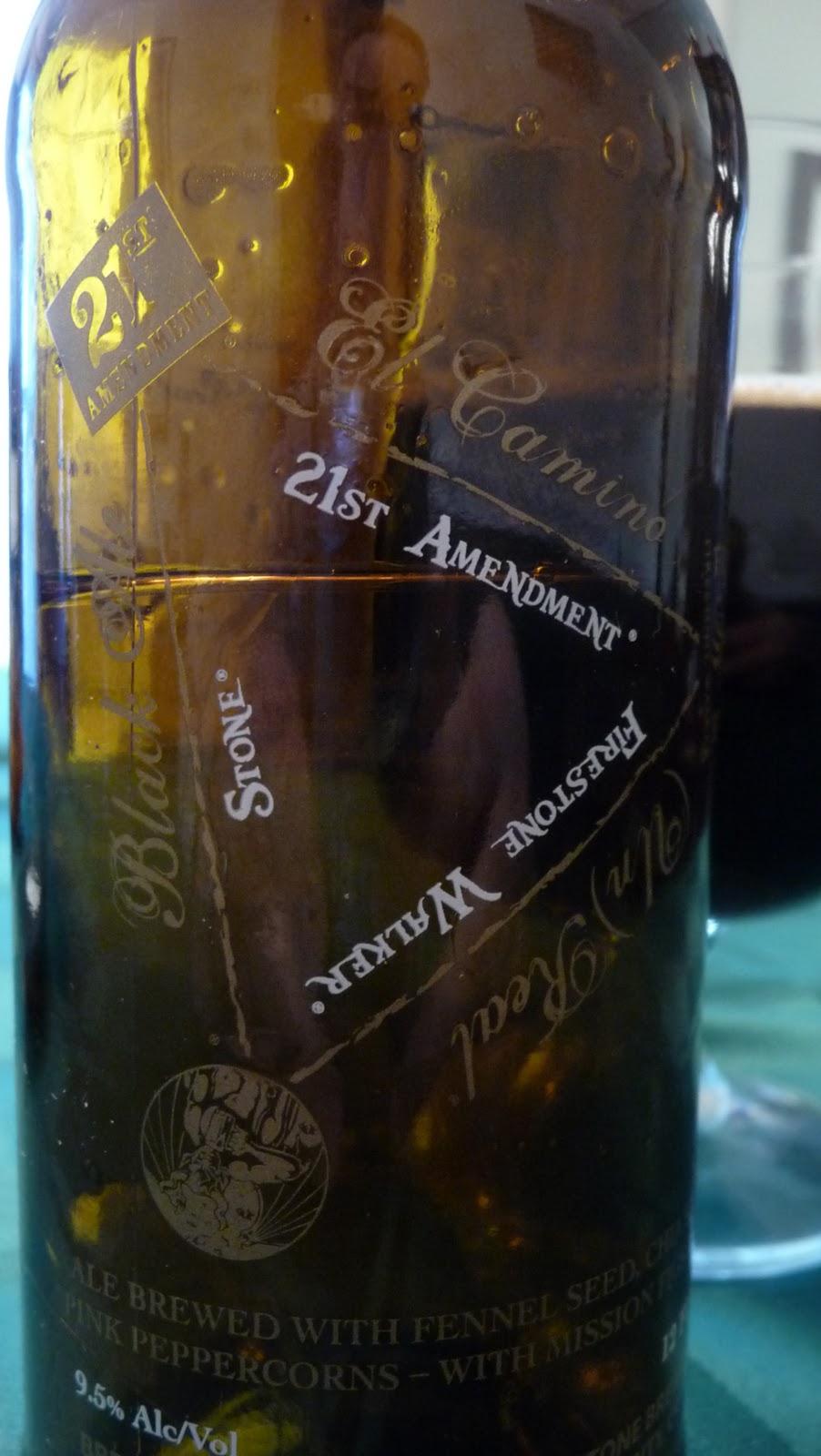
Stone Brewing Company El Camino (Un) Real Black Ale

There is a growing trend amongst craft brewers to band together to brew special beers.  These beers offer the brewers the opportunity to put their heads together to create some truly one-of-a kind beers.  One such beer was the Saison Du Buff, a collaboration between Stone Brewing, Dogfish Head and Victory Brewing that resulted in a beer made with sage, rosemary and thyme.  I found that beer while perusing the beer selection at a Binny's outside of Chicago.  When I bought that beer, I also picked up a bottle of another collaboration beer called El Camino (Un) Real Black Ale.  The masterminds behind this beer are three well known Californian craft brewers ... Stone Brewing, 21st Amendment and Firestone Walker.

The name El Camino is in honor of the Spanish mission trail that connected North and South California, which is particularly appropriate given the collaboration is between North (21st Amendment) and South (Stone Brewing) with one in the middle (Firestone Walker).  The El Camino is brewed with fennel seeds, chia seeds and pink peppercorns, along with mission figs added during the brewing process.  The choice of ingredients is rather interesting and would lead one to expect a beer that has anise and pepper flavors.  (I'm not really sure what chia seeds taste like, although they are said to be very healthy, being full of Omega-3 fatty acids.)  However, the brewers intended, as they put it, "a pitch black monster loaded with roasty, spicy flavors."  (You can check out their blog about this beer at Stone Brewing's website.) To add to the complexity of this beer, the brewers fermented fifteen percent of the ninety barrel batch in oak barrels, provided by Firestone Walker. 

The beer pours pitch black, a promising start.  The roasted malts are clearly present in the nose of the beer.  Other aromatic elements include notes of vanilla and some spice, although it is hard to detect the fennel or peppercorn.  The taste of the beer is full of roasted malt, along with some chocolate and coffee flavors.  There is some subtle pepper in the finish of the beer.  As the beer begins to warm, the figs become a little more pronounced and the bitterness, which initially could be tasted both in the front adn the finish, begins to subside and mellow.

The maxim is that, with strong beer goes strong food.  The El Camino is definitely a strong beer, so foods with strong flavors or rich flavors would pair well with this beer.  I think this beer would pair well with mushrooms, such as mushroom risotto, along with spicier foods, such as jerk chicken.  

I found this beer at a Binny's Beverage Depot outside of Chicago.  Given this beer was brewed early last year, I doubt that there is much of it left.  All the more reason for these three brewers to get back together and collaborate again. 

ENJOY!

Dogfish Head Palo Santo Marron

Dogfish Head and its founder, Sam Caligione, have created a wide array of different beers, such as the Theobroma, which is based on an ancient Aztec recipe and the Sah'tea, which is a take on the Finnish beer. My favorite beer produced by Dogfish Head is the Palo Santo Marron.  Last year, Clare and I took her parents to Dogfish Head's restaurant in Rehobeth Beach, Delaware, where it all started.  When we left, we bought a couple of four packs home to enjoy at our leisure.

According to Dogfish Head, the Palo Santo Marron is an "unfiltered, unfettered and unprecedented" brown ale that is is aged in handmade barrels made from Palo Santo wood brought from Paraguay to the United States.  Palo Santo or "Holy Stick" is actually bulnesia sarmientoi, a heartwood that grows in the Gran Chaco, a region that straddles Paraguay and Argentina.  The wood is used for making posts and engravings, as well as charcoal.  Dogfish Head used the wood to build large wooden tanks holding 10,000 gallons each, making them the largest wooden tanks in use in the United States since Prohibition.

The Palo Santo Marron pours as dark as a brown ale can be poured before turning black.  The nose of the beer is intertwined with alcohol and caramel, with roasted notes most likely from roasted malts.  The brewer describes the taste of the beer as having caramel and vanilla notes, along with the Paraguayan Palo Santo wood.  The caramel is definitely there, as well as coffee.  The vanilla is also present, although it is subdued somewhat by the alcohol.  The beer has an ABV of 12%, which next to the Samichlaus, is the second highest ABV of a beer that I have reviewed on my blog.

The brewer suggests steak, chorizo and Cajun food as the pairing for this beer.  These suggestions are understandable, because strong beers should be paired with foods that have strong or rich flavors.  I paired the Palo Santo Marron with the Broiled Tilapia with Crawfish, primarily because I thought that the roasted malt flavors of the beer would be a good complement to the spiciness of the crushed red pepper and the smokiness of the smoked paprika, both of which were used to create the sauce for the crawfish.

I love this beer, although it is one that I enjoy only on a rare occasion.  While the Palo Santo Marron is available year round, but it is pricey at about $17.00 or $18.00 for a four pack. The beer can be found at Rodmans and other stores that sell Dogfish Head.  If you would like to enjoy just a glass of the Palo Santo Marron, it is usually available on tap at the Dogfish Head Alehouse restaurants.

ENJOY!

Sunday, March 13, 2011

Broiled Tilapia with Crawfish

As I was preparing for making a Mardi Gras meal of Seafood Gumbo, I bought a package of frozen Crawfish, which is already precooked.  The package was too large for the Seafood Gumbo, so I divided the package into two and decided to use one part to make a small and quick dish for Clare.  We had tilapia in the freezer and I decided to use that fish and make a sauce that could be put over the fish.

In trying to think through the sauce, I had a brown butter sauce in mind.  I've made a brown butter sauce for pasta, but this time, it would be only for the fish.  I also wanted to layer a few different flavors into the sauce, to make it a little more complex.  I bought some sweet peppers, roasted them and diced them.  This would add sweetness to the butter sauce.   I decided to add a teaspoon of crushed red pepper, which would provide the spice and a teaspoon of smoked paprika, which would provide a smokiness to the butter sauce.   For a sauce that I thought up in about five minutes, it did not turn out too bad.  However, I think that, if I make the sauce again, I would probably reduce the amount of butter used by about a quarter or a third.

BROILED TILAPIA WITH CRAWFISH
A Chef Bolek Original
Serves 2

Ingredients (for the tilapia):
2 pieces of tilapia
Extra virgin olive oil
Salt, to taste
Pepper, to taste

Ingredients (for the Sauce):
1/2 cup of crawfish tails
2 roasted peppers, diced
1/2 red onion
1 clove garlic, diced
5-6 tablespoons of butter
1 tablespoon of rosemary, diced
1 tablespoon of sage, diced
1 tablespoon of thyme, diced
1 teaspoon of crushed red pepper
1 teaspoon of smoked paprika

Directions:
1.  Prepare the fish.  Heat the broiler.  Brush the tilapia with olive oil and brush a broiler-safe pan with olive oil (to avoid sticking).

2.  Saute the vegetables.  Heat the butter on medium heat in a saute pan.  Add the garlic and onions and saute for about five minutes.  Add the crushed red pepper and continue to saute for the rest of the five minutes.  Add the roasted peppers and fresh herbs (rosemary, sage, thyme).  Stir the vegetables and continue the sauteing for another couple of minutes.  Add the smoked paprika and stir very well.

3.  Broil the tilapia.  Cook the tilapia under the broiler until it is done, which should take about seven minutes.  Remove from the heat.

4.  Add the crawfish to the vegetables.  While the tilapia is cooking, add the crawfish and stir.  Reduce the heat to low and continue to cook until the crawfish is warmed through.

5. Finish the dish. Plate the fish, spoon some of the crawfish and vegetable mixture over the fish.  Serve immediately.

ENJOY!

Saturday, March 12, 2011

Rockfish Provencal

Recently, I decided that I wanted to make a nice meal for my wife.  I did not know quite what to make, and, I perused a bunch of recipes until I came across one for Halibut Provencal.  I went to my local grocery store, but they did not have halibut, and many of my choices -- such as cod -- were not very sustainable. There was one fish that is rated as sustainable and, even better, it is a local fish from the Chesapeake bay ... rockfish.

Now, not all rockfish are sustainable and, indeed, the name "rockfish" is a little misleading.  Many fish go by different names when sold in the store, which makes buying fish based upon sustainability a major challenge.  Rockfish is a very good example because it may be labeled with many completely different names, such as Red Snapper, Black Bass and Striped Bass.  On the West Coast, a "rockfish" is more than likely a snapper while, on the East Coast, it is more than likely a striped bass.

So, it is important to see where the fish is caught, and that will more often than not tell you if the fish is sustainable.  Rockfish or Striped Bass caught in the Chesapeake Bay are sustainable because, unlike some of the other residents of the bay (most notably blue crabs and oysters), there are still sufficient populations of rockfish in the bay and the amounts of rockfish that may be caught are subject to strict regulation.

With all of that said, I decided to make Rockfish Provencal, which is a great dish that brings together all of the flavors of Provence, such as garlic, fennel, tomatoes, olives and sage. This is a very delicious dish.

ROCKFISH PROVENCAL
Adapted from About.com 
Serves 4

Ingredients:
1 1/4 pounds of Rockfish
3 tablespoons of extra virgin olive oil
1 clove of garlic, diced finely
1/4 teaspoon of crushed red pepper flakes
2 shallots, sliced thinly
1 fennel bulb, chopped
1 can of whole, peeled tomatoes
1/2 cup of bottled clam juice
12 black olives, pitted
1/2 teaspoon of salt
1/4 teaspoon of black pepper
1 tablespoon of fresh sage, chiffonade or cut into fine strips 

Directions:
1.  Preheat the oven to 400 degrees Fahrenheit.

2.  Heat the olive oil in a deep, ovenproof skillet over medium heat.  Saute the garlic and red pepper flakes for about a minute.  Add the shallots and fennel, continuing to saute for about another five minutes.  Add the tomatoes and the clam juice.  Breakdown the tomatoes using a potato masher until they are in large pieces.  Remove from the heat and stir in the olives.

3. Season the rockfish with salt and pepper.  Arrange the rockfish over the hot tomato mixture in the skillet.  Bake in the preheated oven for about fifteen to twenty minutes, until the cook is fished through.  Stir in the sage chiffonade into the tomato mixture.

4.  Plate the fish first and then spoon the tomato mixture over the fish.

ENJOY!

For more about sustainable choices when buying Rockfish, check out Seafood Watch.