Wednesday, November 23, 2011

Bergström Winery's Dr. Bergström Riesling (2007)

The Riesling wine is said to have originated in Germany, in the Rhein and Mosel river valleys.   The Riesling is a white grape variety that is known for producing fruity and floral wines that can differ based on the terroir.  And there are a lot of terroirs.  Riesling grapes are planted around the world, not only in Germany but also in Austria, Australia, Canada, Czech Republic, Luxembourg, northern Italy, New Zealand, and the United States (including California, New York and the Pacific Northwest).

Riesling production in the Pacific Northwest is growing in Washington State, but on the decline in Oregon.  Still, there are vineyards and wineries in Oregon's Willamette valley that continue to produce this style of wine.  One of those vineyards is Bergström Wines. I've previously reviewed Bergström's Shea Valley Pinot Noir.  In addition to the Pinot Noir, Bergström also produces the Dr. Bergström Riesling.  When Clare and I visited the Bergström tasting room during our honeymoon, we purchased a bottle of the 2007 vintage.  

The Dr. Bergström Riesling is produced with grapes from four different vineyards: Hyland, Chehalem Mountain, Cherry Grove and the Territorial Vineyard.  The grapes from these vineyards enable Bergström to create a wine that, in its view, mirrors the Rieslings of Germany.  The wine is fermented for five months in stainless steel vats before being bottled.

The Dr. Bergström pours a color that is reminiscent of apple juice or white gold.  Little bubbles dot the sides of the glass, shining like stars through the wine. The wine has aromas of starfruit, kiwi and pears, along with a faint sense of apples and minerality.  As for the taste, the wine has the bright, crisp apple flavor that is one often finds with a Riesling.  Other fruits can be found in this wine, such as a hint of pear and melon.  There is also surprisingly a hint of lemon in this wine.  The wine has a high acidity and crispness to it, which makes it very enjoyable to drink. 

This vintage is probably not available now, but later vintages may be available.  We purchased this wine at the Bergström tasting room in Willamette Valley.

ENJOY!

Monday, November 21, 2011

Parmesan Soufflé with White Wine Butter Sauce

I am not the only one who cooks in our family.  My beautiful wife, Clare, is also a great cook and a great baker.  Every once in a while, I ask my Angel to provide a guest blog post so that I can share some of the amazing and delicious things that she makes for family, friends and, of course, me.  She has already provided guest blog posts about Cuban Bread, Loyalist Bread, Salmon Burgers and Peach Cobbler.  So, without further ado,

A Guest Blog Post by Clare ...

As you may know, both Keith and I hosted a dinner for a Wine Club.  We both decided to cook a four-course meal using recipes from Frank Stitt's Bottega Favorita.  Frank Stitt is a well known chef who owns a few restaurants in and around Birmingham, Alabama.  My parents took Keith and myself to one of those restaurants, Bottega, for dinner during the weekend that Keith met them for the first time.  Perhaps the most memorable moment of that dinner, apart from spending time with my parents and with Keith, was the Parmesan Soufflé that we had as an appetizer.

This dish was amazing ... as one can expect when Frank Stitt describes it as a "cloud-like" pudding.  The eggs, cream and garlic make for a rather light soufflé.  This lightness is contrasted with the richness of the white wine butter sauce.  The wine, vinegar, cream and butter are combined together in the sauce, which is then infused into the mushrooms.  The dish is completed with a garnish of a few strips of prosciutto. 

Looking back, this is a recipe that was easier than what I thought.  One bit of advice that I have learned from making this dish.  When you are baking the soufflés, you should make sure that the sides of the pan or baking dish are not that much higher than the sides of the ramekins.  I found that the best dish for baking the soufflés is a pyrex glass baking dish.  The soufflés seemed to set better in the pyrex dish than the other dishes that I used, such as a roasting pan.


PARMESAN SOUFFLE WITH WHITE WINE BUTTER SAUCE
Recipe from Frank Stitt's Bottega Favorita at p. 40
Serves 6

Ingredients (for the Souffle):
8 large eggs
3 cups heavy cream
1/2 teaspoon roasted garlic puree
Pinch of freshly grated nutmeg
3/4 cup freshly grated Parmigiano Reggiano
1/2 teaspoon kosher salt
1/4 teaspoon white pepper
Dash of Tabasco Sauce

Ingredients (for the White Wine Butter Sauce):
3/4 cup dry white wine
3/4 cup white wine vinegar
1 shallot, finely minced
1 thyme sprig
1 1/2 teaspoons heavy white cream
1/2 pound of unsalted butter
Kosher salt
Freshly ground white pepper
Fresh lemon juice, to taste
Tabasco sauce

Ingredients (to add to the White Wine Butter Sauce):
1 tablespoon of unsalted butter
2 cups quartered or thickly sliced cremini, oyster or button
     mushrooms or a mix of mushrooms
1 shallot, minced
2 thyme sprigs, leaves only
Kosher salt, to taste
Ground black pepper, to taste
4 thin slices of Prosciutto di Parma, sliced julienne

Directions:
1.  Preheat oven to 300 degrees Fahrenheit.  Butter six 6 ounce ramekins and place them in a large shallow baking dish or pan.

2.  Combine all souffle ingredients in a bowl and whisk until combined.  Fill the ramekins almost to the top (use 5.5 ounces in each ramekin).  Fill the baking dish with enough water to come up to about three-quarters the side of the ramekins.

3.  Cover the pan with foil and bake for 1 hour.  Uncover and bake until the souffles are slightly puffed, set and golden, about fifteen minutes more.

4.  Meanwhile, shortly before the souffles are done, prepare the butter sauce.  Combine the wine, vinegar, shallot, and thyme in a small heavy non-reactive pan, bringing it to a boil over high heat to reduce to a syrupy glaze.  This should take about twelve minutes.  Then remove the saucepan from the heat and stir in the cream.  Return it to a simmer and simmer for about 1 minute.  reduce the heat to low and whisk in the butter bit by bit, adding more only after each previous addition has been incorporated.  Regulate the heat so that the sauce stays warm but does not get too hot (otherwise it will separate).  Add the salt, pepper, lemon juice and hot sauce.  Taste and add a little more vinegar or hot sauce is needed.  Strain the sauce. Keep the sauce warm while you saute the mushrooms.

5.  Heat a large saute pan over medium-high heat, and add the butter.  When the butter is melted, add the mushrooms and saute until the edges are golden, about 3 minutes.  Add the shallot and saute for one 1 minute.  Season with the thyme leaves and add the salt and pepper and toss for about 30 seconds.  Set aside, covered to keep warm.

6.  Unmold the souffles onto warm plates and ladle the butter sauce around.  Scatter some of the sauteed mushrooms and sliced prosciutto around each one and serve.

And, as Keith would say,

ENJOY!

Friday, November 18, 2011

Liberty School Cabernet Sauvignon (2008)

California has over one hundred American Viticultural Areas.  If I had to choose one as my favorite, it would be the Paso Robles AVA.  Located in San Obispo County, the Paso Robles AVA has a long history of winemaking.  Around 1797, missionaries brought vines to the Mission San Miguel Arcangel.  For more than three hundred years, people have been cultivating those vines.  

The primary grape of the Paso Robles AVA is Zinfandel.  While Paso Robles Zinfandel wines are very good, I find that some of the other grapes grown in Paso Robles produce far better wines for their particular styles.  I have previously reviewed These grapes date back to the 1950s and 1960s. During that time, vineyards began to plant Cabernet Sauvignon, Syrah, Viognier and Roussanne.   Vineyards also grow Petite Sirah, producing wines like the San Simeon, which I have previously reviewed.  In recent years, winemakers have taken these grapes to create some interesting blends.  These blends have helped to increase the image of the AVA.  
 
Forgoing the blends, I bought a bottle of a Cabernet Sauvignon from Paso Robles.  The wine was produced by Hope Family Wines.  The Hope family has been producing wines in the Paso Robles AVA for more than thirty years on land that was formerly apple orchards.  The Cabernet Sauvignon is harvested and fermented by individual lots.  The wine is then aged in French and American oak barrels for twelve months, during which time it is racked twice.

The Liberty School Cabernet Sauvignon pours a cranberry red.  The aroma of this wine is suggests cherries, blackberries, along with a hint of vanilla.  The flavors of this wine have multiple layers.  In the front, there are full, ripe berries.  Cherries and a little strawberry.  However, some darker fruits begin to appear later in the taste and in the finish.  Fruits such as plum, a little cranberry. The wine has a medium body and, while the tannins are fairly pronounced, they do not overwhelm the drinker.

I found this wine at a local Whole Foods Market and it should be avialable at other grocery stores or wine stores. 

ENJOY!

For more about the Paso Robles AVA, check out Wikipedia.

Wednesday, November 16, 2011

Wine Club ... An Evening at Frank Stitt's Bottega

Picture from www.dailysalt.org
Both Clare and I will be hosting our first wine dinner this month.  One couple cooks a four course meal, another couple pairs wines for each course, and everyone gets to enjoy the food and wine.  For this month, we get to play host.  The first question we faced was what will we cook?

The answer was easy ... an Italian meal.  I immediately began scouring my cookbooks and the Internet, looking to make a meal based upon the cuisine of a particular Italian region.  Tuscany, Abruzzo, Sicily, Emilia-Romagna, Sardinia ....  While I found a lot of recipes, I could not decide upon four courses from any of the regions.

Clare and I then turned our attention to where we have had some great Italian food.  One such place was Frank Stitt's Bottega Restaurant, which is located in the Magic City of Birmingham, Alabama. Frank Stitt decided to become a chef after meeting Alice Waters (of Chez Panisse fame).  Stitt opened Bottega in an Italian-style mansion in Birmingham with the goal of experimenting with the flavors of Italy, as well as Spain and Greece. 

I remember our dinner at Bottega very well.  We went there on my first trip to Birmingham, when, while Clare and I were dating, I met Clare's parents for the first time.   Her parents knew that I loved to cook and that my focus was Italian cuisine. We had an amazing meal that night and, as a wedding shower gift, we received Frank Stitt's cookbook, Bottega Favorita.

For this months wine club, Clare and I will be recreating some of Frank Stitt's dishes from that cookbook.   Typically, the structure of an Italian meal typically consists of five courses: the antipasta, prima, secondo, contorno and dolce.  We have created a four course dinner, beginning with the antipasta, followed by the prima and secondo, and concluding with the dolce.

Antipasta: Parmesan Soufflé.  
The antipasta, or appetizer, will be Parmesan Soufflé, which draws its inspiration from the Italian region of Emilia-Romagna. Frank Stitt describes his soufflé dish is a "cloud-like pudding," which is made with eggs, cream and one of the region's most iconic foods, Parmigiano Reggiano.  After the soufflé is baked in a mold, we will garnish the dish with another icon of the region's cooking -- prosciutto -- along with mushrooms and, of course, a lot more grated Parmigiano Reggiano.   

Prima: Gnocchi with Prosciutto and Sage
The prima or first course of an Italian meal is usually a soup, salad or pasta.  We have chosen to make Gnocchi with Prosciutto and Sage.  While the use of prosciutto ties the prima with the antipasta, this dish draws its inspiration from the Italian regions of Lazio and Abruzzo.  We intend to prepare the gnocchi or potato dumplings by hand.  The gnocchi will be served with a brown butter sauce, garnished with the prosciutto and sage.  

Secondo: Lamb Spiedini with Sicilian Couscous and Yogurt Sauce.
The secondo or second dish is usually a heavier dish consisting of meat or lamb.  We have selected Lamb Spiedini and, with the couscous, this dish draws its inspiration from Sicily.  The lamb will be marinated overnight in olive oil, basil, rosemary, salt and black pepper.  Threaded on skewers, the lamb will be cooked to medium and served over couscous prepared in a Sicilian style with a mint yogurt sauce.

Dolce: Warm Cream Cheese Tart with Cinnamon and Almonds.
For our final course, the dolce or dessert, we draw inspiration from northern Italy with a Warm Cream Cheese Tart with Cinnamon and Almonds.  Frank Stitt describes this dish as having the "right balance" of a buttery crust, creamy filling, and a sweet and spicy topping.  We will garnish the dessert with sliced almonds.

We hope that everyone will enjoy this meal. Until then ...

ENJOY!

Monday, November 14, 2011

Rinkuškiai Werewolf

Having reviewed a beer named after a Vampire, I thought it was necessary to review a beer named Werewolf.  A few months back, my father picked up a beer called "Werewolf" from Brewery Rinkuškiai.  The brewery was established in 1991.  It is located in the "beer country" of Lithuania.  When one thinks of "beer country," thoughts turn to Germany, England, or the Czech Republic.  One does not think of the region around Biržai, Lithuania.

Biržai is a city in northern Lithuania, along the border with Latvia, that dates back centuries.  While the city has a long beer history, the history between the two World Wars.  According to one source, the Red Army approached in 1944 and took the town of Biržai without much resistance.  The commanders ordered the troops to chase after the Nazis.  Meanwhile, the commanders and the remaining soldiers got drunk at Biržai's breweries.  When the Nazis counter-attacked, the Red Army was forced to retreat.  Eventually, the Red Army recaptured the city, but two-thirds of the city had been destroyed. 

It was very hard to find anything on the Internet about Brewery Rinkuškiai and its Werewolf beer, apart from reviews on websites such as RateBeer and BeerAdvocate. 

The Werewolf pours a reddish copper in color, which is a little unexpected.  The malts give this beer its aroma, wrapped in alcohol.  (The beer has an ABV of 8.2%.)  There really is not much more to the aroma of this beer. 

The label of the Werewolf cautions, "you must be sure you want to taste it."  Well, given I am writing a review of the beer, I guess I am sure that I want to taste the beer.  The malts lend a certain sweetness to the beer, reminiscent of a Belgian beer or a barleywine.  The beer is sort of a simplistic version of either style, focusing primarily on alcohol content with less emphasis on developing taste.  Still, the beer has a flavor that is reminiscent of ripe fruit.

I have seen this beer in several beer and wine stores in the area for about $5.00 to $6.00 a bottle.

ENJOY!

Friday, November 11, 2011

Mahi-Mahi "Mojo" with Aleppo Pepper

The word, mahimahi, means "very strong" in Hawaiian. On the eastern coast of the United States, Americans use mahimahi --or  Mahi-Mahi -- to refer to the common dolphinfish.  A slightly odd looking fish, with a big head and long dorsal fin that runs the length of its body.  The oddness of the fish is lost in the beauty of its colors.  The body is an iridescent blue green, with golden fins and a forked tail.  The fish is a favorite amongst sport fishermen, who often look for floating debris or fish buoys, because such locations are often good spots to find these fish.

The dolphinfish is a sustainable fish, especially if caught in the Atlantic ocean.  Fishermen use troll and pole and line to catch dolphinfish along the east coast.  In addition, according to Seafood Watch, there is strict regulation when it comes to dolphinfish, thereby helping to keep the catch within manageable limits.  Add the fact that dolphinfish are fast growing and fast maturing fish, they are able to maintain their populations better than other fish.  Mahi-Mahi is also a good alternative along the western coast of the United States, as well as in Hawaii, but the regulations are not as strict as in the east.

This recipe starts with my own version of a "mojo," a Cuban marinade.  Typically, a mojo is made with sour orange juice, but I like using a combination of citrus, such as oranges, lemons and limes.  I have used a mojo marinade in the past, when I made Atun Mojo (or Tuna Mojo).  The marinade time is important because, if you let it marinate for too long, you will have ceviche.  For this recipe, I just wanted a hint of citrus in the flesh of the dolphinfish.  I let it marinate for about fifteen minutes.  It could marinate for a little longer, but I would not marinate the fish for longer than thirty minutes total. 


MAHI-MAHI "MOJO" WITH ALEPPO PEPPER
A Chef Bolek Original
Serves 2

Ingredients:
1 pound of Mahi-Mahi, sliced into 2 fillets
1 lemon, zested and juiced
1 lime, zested and juiced
1 orange, zested and juiced
1/2 avocado sliced
1/2 teaspoon of Aleppo pepper
7 tablespoons of canola oil
3 cloves of garlic, diced
Several springs of thyme
Salt, to taste
Ground pepper, to taste

Directions:
1.  Marinate the mahi-mahi.  Salt and pepper the Mahi-Mahi.  Add four tablespoons of canola oil, lemon juice, lime juice and orange juice to a Ziploc bag.  Add the fish and let it marinate for about fifteen minutes.  Preheat the oven at 350 degrees Fahrenheit.

2.  Saute the fish.  Pour the remaining oil into an oven-proof pan.  Heat on medium high heat.  Remove the fish from the marinade and pat dry.  Add the fish, skin side down.  Cook for about five minutes.  Cook each of the remaining sides for about a minute or two per side.  Return the fish to skin side down.

3.  Cook the fish.  Place the pan in the oven for at least five minutes.  Check the fish for firmness.  If the fish is firm to the touch, it is finished.  If it is not, cook it for a few minutes more. 

4.  Plate the dish.  Set the fish on top of the couscous.  Top the fish with slices of avocado and the zest from the lemon, lime and orange. Sprinkle the Aleppo pepper over the fish and couscous.

ENJOY!

Thursday, November 10, 2011

J.V. Fleury Côtes du Rhône (2010)

The Côtes du Rhône is a fairly well known Appellation d’origine contrôlée (AOC) along the Rhône River.  The AOC is divided into two sections  The first section is the Northern Rhône, which is also known as the Rhône septentrional.  There are eight appellations in the Northern Rhône, such as Condrieu and Château-Grillet, both of which produce white wines with the Viognier grape.  The other section is the Southern Rhône, which is referred to as Rhône méridional.  The Southern Rhône has sixteen appellations, including Châteauneuf-du-Pape and Vacqueyras AOC.

Most of the wines carry the Côtes du Rhône name, although wines may also carry the names of the AOCs within the Côtes du Rhône AOC, like Châteauneuf-du-Pape.  The Côtes du Rhône wines span the spectrum of red, white and rose wines.  The principal grapes of the Côtes du Rhône region are Grenache and Grenache Blanc.  However, vineyards cultivate a wide range of grapes from Bourboulenc to Viognier.  Like any AOC, the Côtes du Rhône AOC has certain rules that govern the cultivation of grapes and the production of wines.  When it comes to whites, the wine must have a minimum of 80% of the main grapes, such as Grenache Blanc, Viognier and/or Clairette Blanche.

Once again, I had a difficult time trying to find information about J.V. Fleury, because I could not locate any vineyard website or other website.  However, the label provided some information.  J.V. Fleury was established in 1781 in the northern part of the Rhône valley, making it one of the longest operating winery in the valley.  This Côtes du Rhône is made with 100% Vigonier grapes.

The J.V. Fleury Côtes du Rhône pours straw in color, somewhat reminiscent of apple juice.  The wine has aromas of apricot, grass and some flowers.  The body of the wine is light.  The taste of the wine is apricot, with some flowers in the finish.  That finish is somewhat dry.  The dryness mimics the astringency of the tannins of some red wines. 

Clare and I found this wine at Corridor Wine, a local wine store.  This wine is probably available at other wine stores and maybe some grocery stores. 

ENJOY!

For more about the Côtes du Rhône  and Rhône wine , check out Wikipedia.

Tuesday, November 8, 2011

Mole Ole Wings

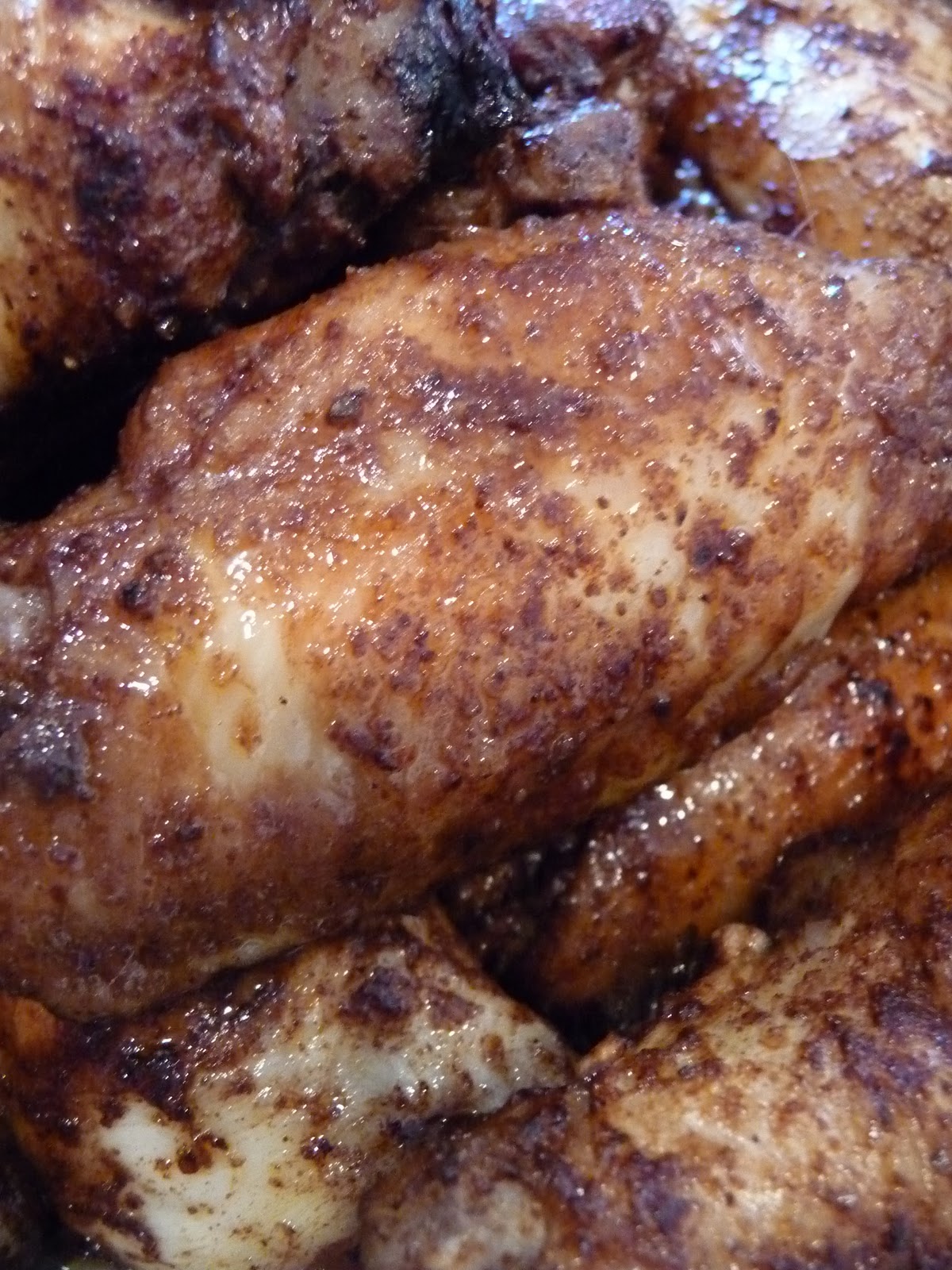
Every Sunday, during the National Football League season, I have a ritual of making buffalo wings to enjoy either before or during the game.  I try to make a different sauce each week.  I have to admit that some sauces are pre-made (everyone deserves a break once in a while), while others are made by scratch and/or using recipes.  This recipe falls in the latter category.  I followed a recipe from a book called Wings, which has more than fifty different recipes for chicken wings.  

This recipe appealed to me because of my growing interest in moles, the amazing sauces from various states in Mexico.  Much like the Mole Verde Zacatecano, this recipe is based upon a simplified version of the sauces.   If you wanted to vary this recipe, you could use different ground chiles -- such as ground ancho, chipotle, hatch or other peppers -- for the cayenne pepper.  You could also substitute those ground peppers for the chili pepper.


MOLE OLE WINGS
Recipe from Debbie Moose, Wings, at p. 68
Makes 24 pieces

Ingredients:
1/2 cup of chili powder
2 teaspoons of cocoa
1 teaspoon salt
1/2 teaspoon of ground cayenne pepper
1/2 teaspoon freshly ground black pepper
1/2 teaspoon of ground cumin
1/2 teaspoon garlic powder
12 wings cut in half at joints, wing tips
     (or twenty-four individual buffalo wings)
1/4 cup olive oil

Directions:
1.  Prepare the rub.  In a small bowl, combine the chili powder, cocoa, salt, cinnamon, cayenne, black pepper, cumin and garlic powder.

2.  Marinate the wings.  Place the wings in a resealable plastic bag.  Pour in the olive oil and shake to coat the wings.  Pour in the rub mix and shake again to coat the wings.  Let sit for fifteen to twenty minutes.

3.  Cook the wings.  Cover a rimmed baking sheet with foil and spray the foil with nonstick cooking spray.  Place the wings on the baking sheet and cook for 20 to 25 minute or until done, turnign the wings about halfway through the cooking time.

ENJOY!

Sunday, November 6, 2011

Oysters with Champagne, Anjou Pear and Pink Peppercorns

This recipe is still a work in progress.  It was a last minute recipe that I thought of while staring at a bin full of ice ... and Chincoteague oysters.  I have previously posted recipes for mignonettes, which are generally a "sauce" of vinegar and shallots with additional ingredients.  In the place of vinegar, I used Champagne.  Rather than shallots, I thought of pairing an Anjou pear and a little spice kick with pink peppercorns.

Champagne and pepper pair well with oysters.  Pears are a little more of a stretch.  However, it was still worth the experiment.  As it turns out, the pear gets a little lost in the taste of the oysters. The Champagne and peppercorns work well, providing some tartness and spice to the briny flavor of the oysters. A little experimentation with flavors that worked well, but not as well as some of the mignonettes that I have done in the past.

Even though the recipe was not a complete success, I decided to still post it so that I can go back and work on it a little more.

OYSTERS WITH CHAMPAGNE, ANJOU PEAR
AND PINK PEPPERCORNS
A Chef Bolek Original
Serves 2

Ingredients:
12 oysters, shucked
1/2 Anjou pear, skinned, de-seeded and diced
1/2 cup of Champagne
Reunion Pink Peppercorns

Directions:
1.  Prepare the mignonette.  Add the pear and the champagne to a bowl.  Let the pear sit in the champagne for about ten or fifteen minutes.  

2.  Plate the dish.  Spoon a little of the pear and champagne over the oysters.  Add a couple pink peppercorns.  Serve immediately.

ENJOY!

Friday, November 4, 2011

De Proef Brouwerij and Terrapin Beer Company Monstre Rouge

Over the past year, I have reviewed a couple of collaboration beers, such as the El Camino (Un)Real Black Ale and the Saison du Buff.   These beers involved the collaboration of American craft brewers, who banded together to test the limits of craft brewing and to produce a beer that has not been seen before. 

This time, the collaboration goes international, with brewer Brian "Spike" Buckowski from Terrapin Beer Company in Athens, Georgia and Dirk Naudts from De Proef Brouwerij in Locristi, Belgium.  These brewers decided to test the limits of not just any beer style, but the Flanders Red Ale.

The Flanders Red Ale is a Belgian sour ale from West Flanders.  The beer is aged for up to two years in oak barrels, where the resident bacteria work their magic to "sour" the beer.  In the past, it was common for Belgian brewers to blend in some younger beer with the old beer to balance the acidity and sourness.

The Monstre Rouge -- or Red Monster -- is an Imperial Flanders Red Ale.  According to the label, the Monstre Rouge is based off of Terrapin's Big Hoppy Monster recipe.  This particular beer also uses Spike's favorite ingredient (rye malt), along with a lot of crystal and Munich malts, and a Brettanomyces yeast strain.  After the brewing process, the beer is aged with toasted American oak. 

Both the aroma and the taste of this beer prominently feature cherries and dark cherries.  The taste of the beer also heavily emphasizes the alcohol and, as the beer warms, it hearkens to wines or liqueur.  In terms of the taste, this Flanders Red Ale is very similar to a barleywine.  Only the sourness provides a casual reminder that one is drinking a Flanders Red Ale rather than a British barleywine.

I found this beer at a local wine and beer store. Beers from Terrapin and de Proef are a little hard to find around where I live, but, if you like trying different beers, it may be worth the search.

ENJOY!