Thursday, February 14, 2013

Westmalle Tripel

There is always a story; you just have to look for it.  One of my goals with this blog is to learn those stories.  On this occasion, the story begins with a quote: living and acting, knowing and doing, experience and action, cannot be experienced without one another: the one makes the other possible.  Those are the words of the Westmalle Abbey -- also known as the Abdij Onze-Lieve-Vrouw van het Heilig Hart van Jezus or the Brouwerij der Trappisten van Westmalle.

According to the Oxford Companion of Beer, edited by Garrett Oliver, the abbey was founded in 1794 by several Cisterian monks.  The abbey started brewing beer in 1836 and it was selling beer to the public by 1856.  During that same year, the trappist monks brewed a beer that some consider to be the first "double" beer or "dubbel."  Using their knowledge and experience, which was developed over the succeeding decades, the trappist monks also brewed a beer in 1934 that was labelled as the first "triple" or "tripel." 

Recently, I bought a bottle of the Westmalle Tripel.  The recipe used to produce this beer is not the same as the original Tripel, as the monks reformulated the recipe in 1956.  Nevertheless, the monks produce the beer using the same ingredients: water, barley malts, liquid sugar, hops and yeast from the family of Saccharomyces Cerevisia.  The one difference between Westmalle and other brewers, including other trappist abbeys, is that the monks at Westmalle use only whole hop cones.  They do not use liquid hop extract or pellets to produce the beer. 

There is something to the adage that the first is the best.  In this case, the Westmalle Tripel poured a beautiful light golden color.  The beer is partial bottle conditioned and has a high level of carbonation, which results in a large thick foam when the beer i poured.  That foam eventually gives way, but it still coats the sides of the glass.

As the foam recedes, the Westmalle Tripel begins to exude the classic elements of a Tripel.  The aroma is full of bananas and cloves, with a few notes of bread and yeast.  The beer has those same banana flavors, but with a good balance of malt and hops throughout.  There was a little tartness or bitterness in the finish, which was a little surprising, but it did not take away from the beer at all.

When it comes to food pairing, Serious Eats has some suggestions for the Westmalle Tripel or, for that matter, any tripel.  These suggestions include foods in which basil is a primary component, ham and cheese, and "troublesome veggies" like asparagus.  I just enjoyed the beer by itself, which is always an option.

For the trappist monks, their lives and actions, experience and knowledge are all primarily focused upon their higher calling.  Brewing is an endeavor that they undertake only to support themselves (as opposed to making a profit).  Yet, the monks produce beer of far superior quality than anything produced by the corporate behemoths whose sole existence is to sell mass-produced beer intended to dominate the market.

If you want a good Belgian trappist tripel, the Westmalle is the perfect starting point.  Westmalle beers are generally available at beer and grocery stores.   If I recall correctly, a bottle sells for about $16.99.

ENJOY!   

Tuesday, February 12, 2013

Chicken and Andouille Étouffée

Today is officially Fat Tuesday, the last big party before Lent.  I felt that it was appropriate to post a recipe that is appropriate for the occasion.  There are a lot of jambalaya and gumbo recipes out there; however, I was looking to do something a little different for this particular occasion.  I tried to think of the various Cajun and Creole dishes that I have had in the past, and, then I became inspired to prepare an Étouffée.

There is quite the variety of Étouffée recipes on the Internet.  Some recipes call for the use of a blond roux, while others call for the use of a darker brown roux.  (The difference is simply the amount of time you spend whisking the flour and oil to achieve the desired shade of blond or brown.)  Some recipes incorporate the use of tomatoes, while others do not.  And, when it comes to the protein, there are a wide range of choices: crawfish, shrimp, seafood (crawfish, shrimp, plus scallops or fish), chicken and andouille sausage.  After having reviewed the various recipes, I decided to make the recipe for Chicken and Andouille Sausage on Saveur.com. 

I basically followed the recipe with two exceptions.  I bought some fresh andouille sausage, rather than the pre-cooked version called for in the recipe.  If I followed the recipe and cut the raw sausage, it would be a complete mess.  So, I decided to fry the sausage whole in a pan until it is basically cooked through.  I then removed the sausage from the pan to a cutting board.  After about a minute, I sliced the sausage according to the recipe and added it to the Étouffée with the chicken.  The other modification I made to the recipe is that I omitted the last cup of chicken stock.  The reason is that I had regular chicken stock and I did not want to add the extra salt to the Étouffée.   I also felt that I would get to the desired thickness sooner, which I did.  Notwithstanding these alterations, I have included the recipe from Saveur below, with some minor changes in the instructions because I have that need to rewrite things (it comes from my day job). 


CHICKEN AND ANDOUILLE ETOUFEE
Recipe adapted from Saveur.com
Serves 8

Ingredients:
3/4 cup of canola oil
3/4 cup flour
2 ribs celery, finely chopped
1 small yellow onion, finely chopped
1/2 green pepper, stemmed, seeded and finely chopped
2 teaspoons of kosher salt
1 teaspoon of cayenne pepper
1 teaspoon of freshly ground black pepper
1 teaspoon of freshly ground white pepper
1 teaspoon of dried basil
1/2 teaspoon dried thyme
3 cups of chicken stock
2 pounds of boneless, skinless chicken thighs, cut into 1 inch pieces
1 pound andouille sausage, halfed lengthwise and cut cross-wise 
     into 1/2 inch thick pieces
6 large scallions, thinly sliced
Cooked white rice, for serving

Directions:
1.  Prepare the roux.  Heat the oil in a 6-quart dutch oven or pot over medium high heat until it begins to smoke.  Add flour, a little at a time, whisking constantly, until all of the flour has been added.  Reduce the heat, and continue to whisk constantly until the roux achieves the color of milk chocolate, about 12-15 minutes.  

2.  Add the ingredients to the roux.  Add the onions, celery, and peppers.  Cook until soft, stirring constantly, for about five minutes.  Stir in salt, cayenne pepper, black and white peppers, basil and thyme.  Cook until fragrant, about 1 minute more.  Add 2 cups of chicken stock, and bring to a boil.  Cook until the sauce thickens, about 5 minutes.

3.  Cook the chicken.  Meanwhile, heat the butter in a 12 inch skillet over medium high heat.  Add teh chicken and cook, turning once, until lightly browned, about 4-6 minutes.  Transfer the chicken and butter to the dutch oven or pot.  Pour remaining chicken into the skillet, stir to scrape up any browned bits, and then pour into the dutch oven or pot, along with the andouille, stirring occasionally, until thick and chicken is cooked through, about 10 minutes more.  

4.  Finish the dish.  Remove pan from heat, serve Étouffée with rice and garnish with the scallions.  

PAIRING THIS RECIPE

When it comes to pairing this recipe, I have only four words ... anything from Abita Brewing.  If those words do not work for you, here are four more ... anything from Dixie Brewing.  'Nuff said. 
ENJOY!

Saturday, February 9, 2013

Veal and Pork Meatball Sandwiches

There is this sandwich shop called The Sentinel in San Francisco.  Zagat's Guide tells of long lines at the take-out only shop.  It was opened by chef Dennis Leary.  After having served as the chef at Rubicon, Chef Leary decided to downsize to a small shop, one that would serve simpler, yet authentic fare for breakfast and lunch.  The result is the Sentinel.

I have never eaten at the Sentinel; and, until a few weeks ago, I never even knew about the restaurant.  I was researching recipes, looking for an appetizer or sandwich that I could use to represent San Francisco at the Savage Boleks Super Bowl Party VI.  I had already had the recipe that would represent Baltimore, the Charm City's classic, Baltimore Pit Beef with Tiger Sauce. That sandwich originated on Pulaski Highway, sold by restaurants like Chaps.  I needed a similar type of recipe to represent San Francisco.  That is when I came across The Sentinel.  I looked at its menus, and I came across a menu item ... Veal and Pork Meatball Sandwich, with cabbage. I thought that this recipe could work for a Super Bowl Party.

The only problem is that I did not have a recipe.  Chef Leary has not posted any recipes for the dishes that he creates or makes.  I scoured the Internet and eventually found a recipe for pork and veal meatballs.  I decided to make a few, very minor alterations to the recipe, such as making the meatballs larger than the size called for in the recipe.  The Italian side of my family seemed to be calling out to me for bigger meatballs.  They got their wish.  I also used breadcrumbs instead of stale bread for the meatballs, and adding more dried herbs to the tomato sauce.  I think these modifications worked well.  

The one thing I would have done differently is add some additional herbs and spices to the meatballs themselves.  The recipe calls for the use of fresh oregano, which is fine.  However, it is not as potent in terms of aroma and flavor as dried oregano.  I would have also added some basil and some crushed red pepper, both of which are usually standards for when I make meatballs.  If I felt a little adventurous, maybe some dried thyme or dried parsley would be added to the mix. 

Nevertheless, in the end, I think the recipe worked well.  I do not know how it fared being pitted head to head against Baltimore Pit Beef at a Super Bowl Party held about one hour away from Charm City.  I think the outcome may have been reflected in the final score of the big game itself. Who knows? The one thing that I know is that this is a fairly easy dish to make for a party, which means that I'll be making it again. 


VEAL AND PORK MEATBALL SANDWICHES
Recipe for the meatballs adapted from Tiny Test Kitchen
Serves 4-6

Ingredients (for the meatballs):
1 pound of ground veal
1 pound of ground pork
1/4 cup organic whole milk
1 tablespoon olive oil
1 small yellow onion, finely chopped
1 egg, lightly beaten
2 tablespoons parsley, finely chopped
1 tablespoon fresh oregano, finely chopped
1 tablespoon of fresh flour, for dusting
1/4 cup dried breadcrumbs

Ingredients (for the sauce):
2 tablespoons of olive oil
2 garlic cloves
1 28 ounce can of crushed tomatoes (preferably San Marzano)
2 tablespoons of dried basil
2 tablespoons of dried oregano
1/2 teaspoon of crushed red pepper

Ingredients (for the sandwiches):
1/2 head of cabbage, sliced thinly
Hoagie rolls

Directions:
1.  Saute the onions and garlic.  Heat 9 inch frying pan over medium heat.  Add oil to hot pan.  Add onion and cook for 4 minutes, stirring occasionally, until soft.  Add garlic, cook for 1 minute and make sure it does not color.  Let cool.  While the onions and garlic are cooking, add bread crumbs and milk in a small bowl, stir to combine.

2.  Make the meatballs.  In a large bowl, combine cooled onion and garlic, milk and crumbs, pork, veal, egg, parsley and oregano.  Season with a sprinkle of kosher salt and a couple grinds of pepper.  Line 2 baking sheets with parchment paper.  Form 1 inch meatballs and place them 3 inches apart on the lined baking sheets.  (You should have 3 rows of 6 on each sheet).  Place flour into a sieve or sifter and dust meatballs with flour.

3.  Bake the meatballs.  Preheat the oven to 390 degrees Fahrenheit. Place meatballs in oven and cook for 20 minutes.

4.  Make the sauce.  Heat oil in large sauce pan.  Add garlic, cook for 1 minute, stirring occasionally, making sure it does not color.  Add tomatoes, reduce heat to medium, to prevent splitting and leave to cook for 15-20 minutes.

5.  Add meatballs to sauce.  When meatballs are done, remove from oven.  Using tongs, place the meatballs in the sauce.  Reduce heat to low and cook covered for an additional 20 minutes.

6.  Finish the dish.  Toast the hoagie rolls.  Add 3-4 meatballs to a roll and spoon some sauce over the meatballs.  Garnish with some sliced cabbage and serve immediately.

ENJOY!

Friday, February 8, 2013

The Lost Belgian Brett

The label of a recent Lips of Faith bottled by New Belgium Brewing confirms what I've said in the past, "[t]he best part of collaboration is discovering mutual passions."  I have tried a wide range of collaboration beers, which usually showcase the brewers' interests and passions, often with some rather interesting and unique ingredients.  There are the collaborations that feature green tea in an India Pale Ale or the use of rye malt in a Saison.  Other collaborations seek to transform existing beer styles, such as "imperialize" a Flanders red ale

With the recent collaboration of New Belgium Brewing and The Lost Abbey, it was the use of Brettanomyces, a wild yeast strain.  The term is Greek for "British fungus."  Why it is referred to as "British fungus" is a little unclear, although Wikipedia notes that, in 1904, N. Hjelte Claussen discovered one strain of the yeast, Brettanomyces claussenii, while investigating the spoilage of English Ales.  Whatever the origin of the name, it is the bane of the wine world, causing wines to exude smells or display tastes that have been described with words and phrases like "barnyard," "horse stable," "sweaty saddle," and "cheese."  With respect to that last description, wine may go well with cheese, you just don't want your wine tasting like cheese.

Many of these elements may also be present in beers that are fermented with Brett.  However, the elements seem to work much better with hops and malts than with grapes.  Indeed, the Brett often provides a distinctive, yet agreeable character, such as a grassy aroma or a tart flavor.

This is what the brewers of New Belgium and The Lost Abbey were striving to achieve.  As they note on the bottle, "[u]sing Belgian inspiration, we fermented the beer with Brettanomyces, to bring out tropical fruit notes, crisp haziness and bright flavors."  They also brewed the beer with pale malts, along with Target, Centennial and Sorachi hops, which were intended to bring a slight citrus flavor to the beer.

The Brett pours a light golden color, with a substantial amount of "haziness" and a decent amount of foam.  The aromas were definitely suggestive of fruit, such as lemon, pineapple or tropical fruits.  However, the distinction comes from the flavor of the beer.  Of all the Brett beers I've tried (and I've had several), this beer was perhaps the most distinctive.  There was no significant barnyard or horse stable element to the beer.  Sure, there was a little funk, but it was relegated to the background or edges of the beer.  The principal feature of the taste was the citrus fruits from the hops wrapped in a bread-like notes from the malts and yeast.   This was by far the most drinkable Brett beer insofar as the funk was relatively tamed and not running wild through the aroma  and taste of the beer.

Beers brewed with Brettanomyces are often very difficult to pair with foods, precisely because of the unique flavors added by the yeast.  The brewers at New Belgium do offer a suggestion: Roasted Salmon with Lemon Scented Goat Cheese.  It might be worth a try the next time I have one of these beers.  And there will be a next time. 

I found the Brett beer at a local beer store with a large selection of craft beer.  If I recall correctly, it sold for about $8.99 per bottle.

ENJOY!

Tuesday, February 5, 2013

A Colonial Dinner in New England

During our stay at the Little Inn of Washington (check out our amazing dinner there), I picked up a book at the hotel's store.  The book is The Founding Foodies, written by Dave DeWitt.  The subtitle said it all, How Washington, Jefferson and Franklin Revolutionized American Cuisine.  Well, it did not say it all, because DeWitt discussed many other influences upon American cuisine, including those that predate our Founding Fathers. 

Not only does DeWitt discuss influences on American cuisine, but he also provides "menus" of dinners hosted during the Colonial times.  Each menu sets forth several courses and explains the background to each of the dishes.  There are several menus, focusing on specific regions of the colonies or specific occasions.  After having read all of the menus, I thought it would be a great idea to make a colonial meal for our next wine club.

The menu for this meal is drawn from the ingredients and recipes made in New England, which have created some of the most well known dishes from the colonial period.  The three course dinner will be the following:

APPETIZER:
Classic Clam Chowder

Seafood chowders are considered a signature dish of the colonies, and, even of the Northeast today.  The chowders were often made with fish, such as cod or pollock, but they also used lobster and clams.  DeWitt includes a recipe in his book based upon the 1842 recipe of Mrs. N.K.M. Lee, who wrote, "[t]his Receipt is according to the most approved method, practiced by fishing parties in Boston harbor."

MAIN COURSE:
Roasted Turkey with Herb and Wine Stuffing

The first known recipe that paired turkey with cranberry sauce is a recipe by Amelia Simmons, which she included in her 1796 book, American Cookery.  That recipe has served as the standard for Thanksgiving dinners for more than two centuries.  DeWitt provides a slightly updated version of the recipe, which calls for a stuffing of cornbread, bread crumbs, vegetables, herbs and white wine.

SIDE DISH
Boston Baked Beans

We plan on serving the traditional Boston baked beans as a side dish.  DeWitt includes a recipe based on one by Mrs. A. L. Webster that appeared in her cookbook, The Improved Housewife, which was published in Boston in 1855.   

DESSERT 
Strawberries in Madeira

Thomas Jefferson called them "Arcadian dainties," strawberries served with cream and Madeira wine.  According to DeWitt, Abigail Adams wrote in 1798, "after walking in the garden we returned and found the table spread with 6 or 8 quarts of the large ... strawberry gathered from the vines with a proportional quantity of cream, wine and sugar."  We will be making this recipe to conclude this New England dinner.  

We hope that this will be a great dinner and that the entire wine club will enjoy!  The recipes and pictures will be posted on the blog for so that family and friends can share in the experience.  Until that time ...

ENJOY!

Sunday, February 3, 2013

A Tribute to St. Eadman ... Just Don't Draw Him

It is a little fuzzy.  Somewhat vague.  A picture could be made out, but someone has to connect the dots.  The dots are there.  There are even that many of them.  The only question is where to start.  As the struggle to decide grips the mind, it becomes clear that the dots are not dots at all.  They are people.  Only people. Still where to start?

Hunter S. Thompson, a.k.a. "Gonzo."  The journalist and author who got so deep into the story that he would figure as one of the central characters.  That was Gonzo.  

Ralph Steadman.  The British cartoonist who brought the Gonzo works to life with his unique, impressionist style.  Well, I am not sure that "impressionist" is the right description, but unique fits perfectly.   Steadman brought to life Thompon's works with images that have become as iconic as the words themselves.

George Stranahan.  Astrophysicist, photographer, writer, hunter, philantrophist and co-owner of Flying Dog Brewery.  Flying Dog first started in Colorado. That is where Stranahan met Hunter S. Thompson, who, in turn, introduced George to Ralph Steadman.  Soon enough, Ralph was not just bringing Hunter S. Thompson's work into the visual realm, but he was also drawing the art for Flying Dog's beer labels.  Make no mistake, Flying Dog is clearly inspired by Hunter S. Thompson, and the labels look as if ripped from the book jacket of Thompson's works. 

For all of his work with Hunter S. Thompson, Ralph Steadman never got the same recognition as Gonzo.  Or at least that is how it seems.  Or seemed, because Flying Dog has now given the cartoonist his due.  This recognition is perhaps the best of all types of recognition, because it can be imbibed.

Flying Dog released the "St. Eadman" as a Brewhouse Rarity.  The St. Eadman is brewed in the style of a Belgian Dark Ale.  The beer pouros a dark brown, with a large, vanilla colored foam.  the foam dissipates rather quickly, giving way to what the brewers describe as a beer having "bright fruity esters of pears and strawberries blend with caramel malt character and brown fruit notes of cherry and plum." 

This is a good description of the St. Eadman.The aroma is full of fruit such as raisins, figs and dark cherries, all of which are wrapped around a little caramel or toffee.  These elements are also apparent in the flavor of the beer, which is encased in a warm, boozy body with a sweetness that you would expect from a Belgian style beer.

The St. Eadman can obviously be enjoyed on its own, but it is also a beer that could pair well with certain types of foods.  I think that this beer would go well with soft cheeses, such as Camembert and Taleggio, as well as blue cheeses.  This Strong Ale could also pair well with roasted pork or beef dishes, served with a gravy or sauce that is not tomato-based. 

I found Flying Dog's St. Eadman Belgian Strong Ale at a local grocery store, but I have also seen it at beer stores.  A bottle sells for about $12.99.

ENJOY!

Saturday, February 2, 2013

Steak Frites with Bone Marrow Butter

When it comes to cooking, I am a deeply conflicted individual.  The conflict comes from a very simple question: what is your favorite ingredient?  Reflexively, I would answer "saffron."  The world's most expensive spice.  And, why not?  It lends its unique aroma, color and taste to any dish.  However, deep down, I know there is another answer to that question.  And that answer is "bone marrow."  

I have made a few dishes incorporating bone marrow. Heck, I even had my own Iron Chef challenge with the ingredient.  These dishes have provided me with some experience when it comes to roasting bones, removing the marrow and pairing it with complementary ingredients, such as garlic and flat leaf parsley.  The marrow imparts a very beefy flavor to the dishes and it is a very healthy ingredient to use in cooking.  Bone marrow is full of polyunsaturated fatty acids like Omega 3, which is the good type of fatty acids, along with iron, phosphorus and Vitamin A.

Recently, I had the urge to cook steak frites.  As I searched through steak frites recipes, I found there were two types of recipes.  First, there was the recipe that served a sauce, usually made with brandy and cream.  I have to admit that I am not one to work with brandy in my house for fear of setting the cabinets surrounding my oven on fire.  So I turned to the second type of steak frites recipes, which use a herbed butter.  I decided to incorporate the bone marrow into both the butter and the fries.  I first found a recipe for bone marrow butter.  I roasted the bone marrow in the traditional way, which provides both the bone marrow and some oil.  I decided to use that oil in place of olive oil when I baked the fries.  This would add a beefy flavor to the fries as well.   


STEAK FRITES WITH BONE MARROW BUTTER
Bone Marrow Butter Recipe adapted from Food with Legs
Serves 1-2

Ingredients (for the Steak Frites):
1 New York strip steak (about 3/4 of a pound)
1 Russet potato
Sea salt, to taste
Ground black pepper, to taste
Oil from the roasted bone marrows
1 tablespoon of diced garlic cloves
1 tablespoon of diced flat leaf parsley
1 tablespoon of olive oil

Ingredients (for the Bone Marrow Butter):
1/2 cup of unsalted butter
3 bones with marrow
1 tablespoon of diced garlic cloves
1 tablespoon of diced shallots
1 tablespoon of diced flat leaf parsley

Directions:
1.  Roast the bones.  Preheat the oven to 375 degrees Fahrenheit.  Cover one end of the marrow bones with foil and stand them up foil side down.  Roast the marrow bones for forty-five minutes.  Remove the marrow and the oils into a small bowl.

2.  Bake the fries.  Preheat the oven to 400 degrees Fahrenheit.  Toss the fries with the oil from the marrow bones, salt and pepper.  Lay the fries on a baking sheet and bake for 45 minutes, until tender and starting to get crispy.   Shake the fries a few times during baking to keep them from sticking 

3.  Cook the steak.  Preheat the olive oil in a cast iron pan on high heat.  Add the steak and sear the meat for about two to three minutes.  Flip the steak and sear that side for another two to three minutes.   Remove the pan from the heat and place in the oven to cook, for about an additional four to six minutes per side, depending upon the thickness of the steak and your desired doneness.  I usually like my steaks between medium rare and medium.

In the end, this recipe worked fairly well.  It was something different and it still needs some work, especially with respect to the fries.  It was a little difficult getting the fries to be as crisp as if they were fried.  In addition, the recipe will produce more butter than you need.  You could easily cut the recipe in half (use 1 to 2 bones, instead of 3) or you could store the butter in the refrigerator, wrapped in wax paper, for a day or two.  As with many recipes, this one continues to be a work in progress and any progress will be noted in the future. 

ENJOY! 

Wednesday, January 30, 2013

The Belleruche

I always say that I never buy a wine based upon the label.  Well, I recently made a sort-of an exception.  I was looking for a French Côtes du Rhône but I was torn between a couple different wines.  Until I saw a label.  There were no bright colors, provocative names, eye-catching images.  Indeed, what caught my attention is something that ordinarily would not be seen by those for whom it was intended.  That something was the use of Braille.  After all, people who are visually impaired drink wine and why should they not be guided to a very delicious Rhone blend.

After remaking about the use of Braille, I was quickly informed by a friend that the winemaker's daughter is blind and, for that reason, Braille is used on the labels.  This tidbit led me to the winemaker's website to learn a little more about the winery and the vineyards.  The winemaker is Michel Chapoutier, who produces wines in France, Portugal, and Australia.  The wine that I enjoyed was one from the Côtes du Rhône region called Belleruche (2010).

The Belleruche is a Rhône blend of 80% Grenache and 20% Syrah.  The grapes are cultivated in vineyards that cover four different departments (Drôme, Vaucluse, Gard and Ardèche) on different soils (such as clay and calcareous alluvial deposit terraces).  The winemaker believes that this variety gives the wine "an extraordinary richness and complexity."

Such a description is accurate.  The Belleruche pours a garnet red, almost burgundy in color.  The winemaker suggests aromatic elements of ripe fruit (such as morello cherries) and spice (like liquorice and grey pepper). There was definitely fruit and spice in the aroma of the wine, but I also got an earthiness in the aroma.  Many of the aromatic elements also carry over to the flavor of the wine.  There are a lot of ripe, red cherries in the flavor, along with other red fruits, like plums and currants.  There was also a little earth in the background.  There are also some tannins in the wine, but they hang around the edges of the wine, along with a little dryness in the finish. 

This is a great wine for any protein, whether beef, pork, lamb, chicken or fish.  One website suggested roast chicken or grilled lamb, although it would also complement grilled beef or steak, and even grilled fish.  It is also a great wine for any grilled or roasted vegetable dish.  Really, I think this is a wine that could be paired with just about anything.

I found this wine at a local grocery store.  A bottle sold for less than $15.00 per bottle.  This easy-drinking wine is definitely worth the price.

ENJOY!

Saturday, January 26, 2013

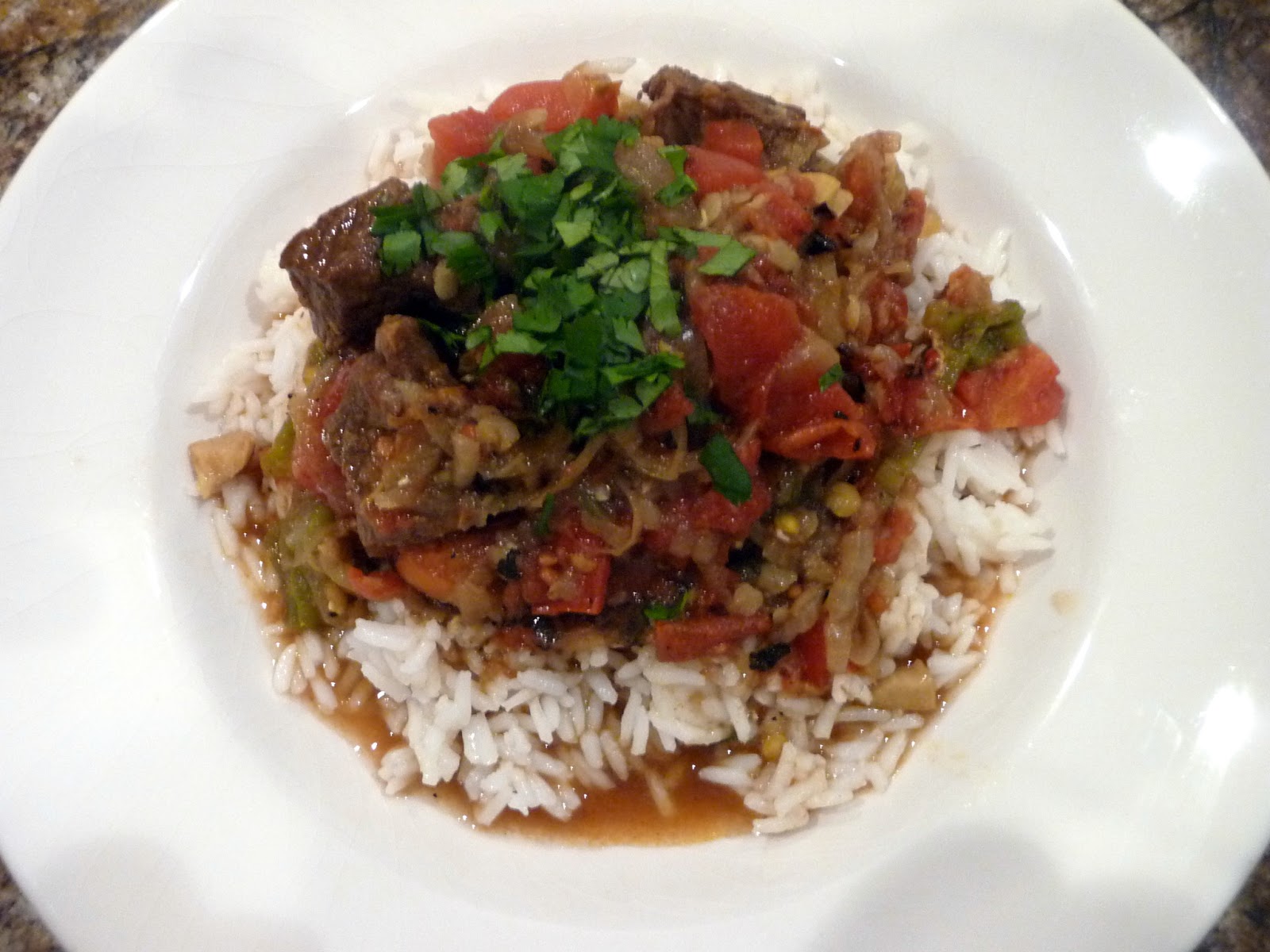
Lahore-Style Lamb Curry

One of the things that I love most about cooking is the ability to transport someone to places that he or she has not been and may not visit.  It starts with a recipe for a dish from a particular country, region, city or even neighborhood.  After gathering all of the ingredients, the prep work gives hints of far away places.  The smells and tastes begin to carry you to the place.  As the ingredients cook, those smells and tastes intensify, and the travels begin to pick up pace.  Finally, as the food is served and enjoyed, the person can find himself or herself at that place.

Maybe I have watched one too many episodes of No Reservations or Bizarre Foods.  Perhaps it is also my love of food-based tours, such as the one I took in Italy.  The one thing that I am certain of is that there is a level of creativity and imagination with cooking that goes far beyond the plating of a dish. 

For this recipe, I find myself in the capital of Pakistan's Punjab province, Lahore.  The recipe is for a Lahore-style lamb curry.  The ingredients that go into this curry are fairly familiar to someone who loves and strives to make curries ... turmeric, coriander, chilies, cloves.  The one thing that I did not expect was the rather thin consistency of the curry.  This was due to the large amount of water used in the recipe.   At least for me, it seems that curries from the subcontinent -- whether Pakistani or Indian (including regional dishes) -- seem to be a little thicker, like a sauce.  The liquid from this lamb curry was more soup-like than sauce-like.  

In the end, I liked this recipe and I would make it again.  I will experiment with this dish to see what I can do to thicken the sauce.  There are a couple of options, such as letting the sauce cook down after the allotted time for cooking the lamb.  Another option may be to cut the amount of diced tomatoes in half and use tomato puree or tomato paste, both of which would thicken the resulting sauce.  I will definitely provide an update to this post (or perhaps write an entirely new post) with the result. 


LAHORE-STYLE LAMB CURRY
Recipe from Fearless Kitchen
Serves 4

Ingredients:
1 tablespoons of olive oil
1 bay leaf
1/4 teaspoon of ground cloves
1/4 teaspoon of ground black pepper
1 onion sliced thin
4 garlic cloves, sliced
5 green chiles, sliced
1 pound of boneless leg of lamb, cubed
1/2 teaspoon of ground turmeric
1/ teaspoon of cayenne pepper
1/2 teaspoon of chipotle chile powder
1 teaspoon of ground coriander
1 teaspoon of ground cinnamon
1 1/2 teaspoons of kosher salt
6 1/4 cups of water
2 ounces of red lentils
14 ounces diced San Marzano tomatoes
Chopped fresh cilantro to taste

Directions:
1.  Prepare the lentils.  Combine the lentils with 2 1/2 cups of water in a saucepan.  Bring to a boil.  Boil 12-15 minutes or until the water is evaporated.  The lentils should just fall apart for the most part.  Set aside.

2.  Saute the vegetables.  Heat the oil in a medium saute pan.  Add the onion, bay leaf, cloves and pepper, saute until the onion is golden.  Add the garlic and chiles.  Saute for about a minute. 

3.  Saute the lamb.  Add the lamb, turmeric, cayenne pepper, ground coriander, chipotle powder, ground coriander, cinnamon and salt.  Saute for 5 minutes, stirring constantly.

4.  Add the water and simmer.  Add 3 3/4 cups of water to the pan.  Cover with a lid, reduce heat adn simmer until the lamb is tender, about 35-40 minutes. 

5.  Finish the dish.    Add the lentils and tomatoes.  Stir well and make sure the curry is warm throughout.  Transfer to a serving vessel and garnish with cilantro.

ENJOY!

Thursday, January 24, 2013

The Tiny Beer

Back in the late eighteenth century, Thrale's Anchor Brewery was hard at work brewing beer.  They had to meet royal demand.  But the Anchor brewers were not brewing for King Phillip II, the sovereign of their native England.  Instead, they were brewing beer for a Queen or, more appropriately, a Czar ... Catherine the Great. 

The Anchor Brewery was not the first to produce beer for the Russian Imperial Court.  The Barclay brewery had produced beer for Peter the Great.  The beer was a porter, which was beloved by the Czar.  However, their beer spoiled during the long journey from London to St. Petersburg.  The embarrassment was too much.  The brewers at Barclay amped the alcohol in their beer, as well as the hops, so that the beer could survive the long and tumultuous journey across the Baltic Sea.

The brewers at the Anchor Brewery followed the path blazed by Barclays, brewing a beer that they boldly proclaimed would keep for seven years.  Anchor Brewery was able to supply the Russian Czars with this bold, imperial stout ... until the French blockades during the Napoleonic wars.  The markets figuratively -- and perhaps literally -- dried up.  Brewers eventually produced less of these imperial stouts and they receded to the distant memories of history.

Within the past twenty years, however, craft brewers like Weyerbacher Brewing Company have resuscitated the Imperial Stout style.  Unlike the brewers of the past, who directed their goods to European royalty, the modern craft brewers produce these hefty beers for consumption by the masses.  Recently, I purchased one of these modern versions of the Imperial Stout ... a bottle of Weyerbacher's Tiny.

The name Tiny seems rather ironic for an Imperial Stout that packs an 11.8% ABV.  This is not a tiny beer; instead, it is a bold beer in every respect -- appearance, aroma and taste.  The beer pours pitch black, with the color of tar or old, used oil.  A thin level of foam appears when poured, but it quickly recedes, leaving just the beer.  The aroma of the Tiny has its boozy notes, which compete with the Belgian yeast, roasted malts, with their chocolate and cocoa notes, and the hints of oak from the barrel aging.   As for the taste, the Tiny tastes like dark chocolate infused with alcohol, with a somewhat dry finish that seems to alternate between cocoa and coffee. All of those flavors -- dark chocolate, cocoa, and coffee -- come from the roasted malts.  There are hints of other flavors, such as a little earthiness and perhaps a little fruit, like plums or figs, but they are relegated to the edges of the palate.  

When it comes to pairing this beer, I suppose you could enjoy it with a dessert.  The question is why would you do that?  This beer is best enjoyed as a digestive, something that you can sip and enjoy after a delicious dinner.  

I found Weyerbacher's Tiny at a local grocery store.  It sold for $8.99 a bottle, which is actually a good price for such a high-powered beer. 

ENJOY!

For more about the history of imperial stouts, and the Anchor Brewery, check out the Alexander Place Time Machine and Anchor Brewery