Sunday, August 11, 2013

Chef Bolek's Two Pound Ribeye

One of the "regular" features on the Chef Bolek blog is Steak Night.  The story behind Steak Night begins with my beautiful wife, Clare.  She is a pescatarian, and, thus, does not eat red meat.  Given that Clare is one of my principal inspirations for cooking, I make a lot of seafood and vegetable dishes.  Red meat, such as steak, is off the menu.

However, there was usually one or two nights per week when Clare had either work or personal obligations that prevented us from having a meal together.  Those evenings presented the opportunity for me to cook and eat red meat.  Originally, the goal of Steak Night was to make the biggest steak I could find, apply a spice rub, and cook the steak to medium rare.  I would serve the steak to myself with some white rice, whose sole purpose was to absorb some of the meat's juices (or some hot sauce) as I ate the steak.  Over time, and as this blog grew, Steak Night became an opportunity to try to make different types of beef recipes, research how different cuisines prepare beef, and to experiment with different ingredients.  This led to recipes and dishes such as Gaucho-Style Steak with Argentinian Chimichurri Sauce, the Inferno Steak, and Green Hatch Chile Rubbed Bison Cowboy Steak.

Recently, while shopping at Costco, I came across some two-pound ribeyes.  This brought back memories of the original Steak Nights, with the huge hunks of meat, straight forward rubs, and grilled to medium rare.  I bought a package and decided to make a simple rub of spices that often made their way into the rubs of the past: smoked paprika, onion powder, garlic powder, and cumin.  I usually make a lot of a rub so that it can be applied liberally to all sides of the meat.

Grilling a large piece of meat can be difficult, because inevitably the meat does not have the same thickness throughout.  This means that some parts will cook faster than others.  I have a general rule of about four to five minutes.  After the first four to five minutes, I turn the meat by 90 degrees.  After the second four to five minutes, I flip the steak.  After the third four to five minutes, I rotate the meat again by 90 degrees.  I then check the temperature with a meat thermometer, with 130 degrees Fahrenheit (medium rare) being the goal.  I then figure out how much longer the steak needs to remain on the grill to reach about 135 degrees or so before I remove it to rest.  It is important to keep in mind that a steak will cook at least five degrees while resting.

The dish is completed with some white rice, which as I noted above, is used primarily to gather the juices of the meat as it is sliced.  At first, I just used minute rice (which is really not all that good).  Now, I use basmati rice.  Whatever rice does not soak up meat juices usually gets doused with some hot sauce. 

That is the old-school, traditional Steak Night: a massive dish of food.  I probably could have finished off the dish in one sitting while I was in my prime.  It now takes a couple of sittings. Or, better yet, a couple of friends to join me. 


CHEF BOLEK'S TWO POUND RIBEYE
A Chef Bolek Original
Serves 4 (or 1 Chef Bolek)

Ingredients:
2 pound ribeye
1 teaspoon of sea salt
1 teaspoon of freshly ground black pepper
1 teaspoon of smoked paprika
1 teaspoon of onion powder
1 teaspoon of garlic powder
1 teaspoon of dried thyme
1/4 teaspoon of ground cumin
Extra virgin olive oil

Ingredients:
1.  Prepare the rub.  Mix all of the ingredients together.   Apply olive oil to all sides of the ribeye.  Add the rub to all sides.  Make sure that all sides are coated evenly with the rub.  Let the ribeye sit for about 10 to 15 minutes.  

2.  Prepare the rice.  Prepare the rice according to the instructions on the package. 

3.  Grill the ribeye.  Heat the grill to 400 degrees Fahrenheit.  If you have a three burner grill, turn off one burner.  Place the ribeye over that burner.  Cook until you reach the desired doneness, such as 130 degrees for medium rare or 140 degrees for medium.

ENJOY!

Saturday, August 10, 2013

Gadino Cellars Petit Verdot (2010)

Classic Bordeaux blends are made with five grapes.  Some of those grapes are very well known, such as Cabernet Sauvignon, Cabernet Franc, Merlot, and Malbec.  Others are not so well known ... like Petit Verdot. 

The origin of Petit Verdot has been lost to history.  Many believe that the planting, harvesting and use of Petit Verdot in the Bordeaux dates back to the 16th or 17th century, which predates the cultivation of Cabernet Sauvignon.  However, a look at any shelf in a wine store clearly reveals that Cabernet Sauvignon predominates over Petit Verdot.  This dominance extends far beyond French wines.  Quite frankly, Cabernet Sauvignon rules over Petit Verdot practically everywhere.  

The reason is simple: it is a lot easier to cultivate Cabernet Sauvignon than Petit Verdot.  The Petit Verdot vines are much more temperamental, requiring more work and oversight.  The grapes also ripen later than Cabernet Sauvignon and other red grapes.  As a result, Petit Verdot grapes are rarely used to make single varietal wines; instead, it is used as a blending grape, such as in those Bordeaux blends. However, during our little trip to the Inn at Little Washington, my beautiful Angel and I stopped at a nearby winery, Gadino Cellars, and discovered a Petit Verdot wine that was very good.  Given Clare could not drink at the time, I bought a bottle for us to enjoy at a later date.

Recently, we opened the bottle of Gadino Cellars' Petit Verdot (2010).  The wine poured a ruby red, with some darker crimson tones.  After doing a little research about Petit Verdot, I was expecting a wine that would be full of aromatic elements such as, by way of example, "Cigar Box, Pencil Shavings, Cellar Floor, Leather and Smoke" or "vanilla, smoke, spice, cedar, molasses and even tar."  With respect to fruits, the suggested notes would be dark cherries, plums or blackberries.

The Gadino Cellars' Petit Verdot featured a nose that was full of ripe dark cherries, accompanied by some more darker fruit, such as plums.  Those cherries and dark fruit were present throughout the wine.  The winemakers describe the flavor as including "juicy dark fruits," which "lead into a velvety texture of cocoa, crushed dried herbs and a caramel finish."  There is also a suggestion of tobacco.  I don't know if I could sense a "velvety texture of cocoa" or "tobacco," but I could say that there was a nice earthiness.  Nothing like a cellar floor, but something reminiscent of the ground on which the grapes were grown.  There was also a component of dried herbs, which provided a thyme or sage element to the flavor profile of the wine.  The Petit Verdot has its share of tannins, which provided an ever so subtle sense of astringency, which were mostly around the edges and gave way long before the finish. 

The winemakers suggest that this Petit Verdot pairs very well with a rack of lamb, eye of round, veal shank, duck and steak. This wine definitely goes well with red meat, whether grilled, roasted or braised. 

Overall, this wine is a very good example of an Old World varietal in a New World expression,  I have not seen this wine in stores but if you find yourself in Little Washington, you should check out Gadino Cellars.

ENJOY!

Tuesday, August 6, 2013

Crispy Salt and Pepper Squid with a Cucumber Salad

In a land where the food airwaves are dominated by Food Network, one can understandably look elsewhere for inspiration.  Rather than watching shows like Diners Dives and Drive-Ins, Semi-Homemade Meals and What is Brian Boitano Cooking, I find myself watching shows like Hell's Kitchen and MasterChef.  Both of those shows feature Gordon Ramsay, but they reveal very little about his cooking.  I found myself channel surfing again, only to stop at a show called the F-Word

When it comes to Gordon Ramsay, who built his reputation on being a brash, straightforward chef, the "F Word" could have a couple of meanings.  In this case, the "F Word" means food.  What sets the F-Word apart from other Ramsay shows is that the F-Word shows Gordon Ramsay cooking dishes and providing the recipes for the viewers.  One such recipe is Gordon Ramsay's Crispy Salt and Pepper Squid with a Cucumber Salad.

Of course, the recipe comes with that thought of Gordon Ramsay critiquing you from a distance.  As I made this recipe, I thought "what would the Chef say?"  Those thoughts became more and more frequent as it became clear as I struggled with the breading of the calamari.  In the end, I do not think that Chef Ramsey would have approved of the dish because the breading did not adhere to the calamari as much as I think he would expect.  There was still enough breading left that you could taste the peppercorns and Chinese five spice with every bite of the squid.  In any event,  I am not cooking on any of his shows and I have the opportunity to practice the dish before the rather unforeseeable event that I should find myself on one of those programs.


CRISPY SALT AND PEPPER SQUID WITH A CUCUMBER SALAD
Recipe by Gordon Ramsay
Available at BBC America

Ingredients (for the squid):
3/4 pound squid, both bodies and tentacles
1 tablespoon of Szechuan peppercorns
     (or substitute black peppercorns, with 1/2 teaspoon of red chile flakes)
1 teaspoon Chinese five spice powder
1 tablespoon sea salt
8 tablespoons of corn flour
Vegetable oil for frying

Ingredients (for the salad):
1 cucumber, peeled and shaved into thin ribbons
1 carrot, peeled and shaved into thin ribbons
1 chile, diced finely
1 to 2 tablespoons rice wine vinegar
1 teaspoon toasted sesame oil
1 pinch of sugar
Salt, to taste
1/4 cup of cilantro leaves
Lime slices, for serving


Directions: 
1.  Prepare the squid. Crush together the peppercorns, chilli flakes and sea salt with a pestle and mortar then mix with the flours. Slit the squid hoods down one side, open out then score the inside lightly in a criss-cross pattern. Cut into bite-size pieces.  Add the squid to the flour and toss to coat the squid as much as possible.

2.  Prepare the salad.  Combine all of the ingredients, mix thoroughly.

3.  Fry the squid.  Fill a large pan or wok 1/3 full with oil. Heat until a cube of bread browns in 30 seconds. Coat the squid pieces in the flour, shaking off the excess, and fry for 1-2 minutes or until golden. Serve with lemon wedges.

ENJOY!

Monday, August 5, 2013

Black Ankle Vineyards Albariño (2011)

For many, the word Albariño evokes images of a certain type of landscape ... panning from green rolling hills towards valleys and ultimately cliffs that drop into the Atlantic Ocean.  The land is that of Galicia, the northwestern part of Spain where nearly ninety percent of Albariño grapes are cultivated. From those grapes, wines such as Pazo Serantellos Albariño and Gran Vinum  Albariño Nessa

However, the rolling hills of Galicia are not the only place where you will find Albariño grapes.  Halfway around the world, there are rolling hills in the United States where adventurous vineyards and winemakers are trying to create Albariño wines that, at least, provide a unique character for the varietal and, at most, seek to rival those Galician wines.  The "New World" winemakers include Black Ankle Vineyards, which has planted Albariño grapes and has produced a very popular wine.  The wine is so popular that seventy-five cases can be sold in less than 18 business hours

Fortunately for Clare and myself, we were able to obtain a couple of the 2011 vintage of Black Ankle Vineyard's Albariño.  The question for me is whether an Albariño from Maryland could compare to a wine from Rias Biaxas, the region of Galicia that produces some of the best Albariño wines in Spain.  According to Rias Biaxas Wines, the promotional website for Spanish Albariño wines, Albariño wines possess the characteristics of many established varietals.  The website notes, "[i]t has been compared to Riesling for its minerality and bracing acidity; to Viognier, because of its fleshiness and peach/apricot character; and to Pinot Gris for its floral bouquet."  It adds, "when grown in highly acidic, granitic earth, Albariño yields a more mineral-driven and structured wine. In sandy soil, however, the Albariño grape gives a softer, rounder wine."

The Black Ankle Vineyard's Albariño provides an interesting look at a New World version of this old-world wine.  the wine leans toward that more mineral-driven, structured wine," which makes sense because those vines are not growing in sandy soil.    Instead, those vines are growing in decomposing slate laced with veins of quartz. 

The Albariño pours a light straw color.  The aromatic elements suggest grapefruit and perhaps some apple or a little lemon.  The taste also features these elements, with the grapefruit and citrus notes being at the forefront.  There was definitely a minerality and even a little hay or straw that followed in the background.  There is also a little tartness that grips the edges of the tongue long after the wine has been consumed, something of a reminder that you should take another sip.  Of course, this leads to one to drinking the wine faster than one should.  After drinking this wine, I can understand why Black Ankle Vineyards sells out of this wine so fast.  It also makes me look forward to the bottle of the 2012 vintage that is still resting in our little wine cages.  

When it comes to pairing, the Black Ankle wine follows the rules of any Spanish Albariño.  The wine pairs very well with fresh seafood, whether fish or shellfish, prepared on the grill or sauteed on the stovetop.  It would also work well with spicy dishes, such as lighter, spicy dishes from Indian, Thai or Chinese cuisines.   Finally, this wine pairs well with pasta and vegetables, which is the pairing that we chose.  The dish was Fettuccine with an Asparagus Puree.  The Albariño complimented the flavors in the asparagus puree, which was quite a feat, given the general difficulty that arises when pairing wine to asparagus. 

Unfortunately, this vintage is sold out and, it seems pointless to note the price of a bottle.  All I can say is that if you happen to see a bottle of a later vintage of the Black Ankle Vineyard's Albariño, you should give it a try. 

ENJOY!

Saturday, August 3, 2013

Grilled Leg of Lamb

A few weeks ago, I prepared a special, three-course menu for my parents.  I have already posted about the first two course ... Grilled Apricots, Burrata and Arugula Salad, followed by Grilled Calamari with a Red Pepper Sauce.  When it came to the main course, I had a decision to make.  I made that decision as I strolled the aisles and stands of the West Side Market in Cleveland, Ohio.  I debated different cuts of beef, such as a rib roast or strip steaks, as well as whole chickens and legs of lamb or goat. 

I ultimately decided on a portion of a leg of lamb.  A whole leg of lamb could easily weigh six to seven pounds, with the bone.  I was feeding three people (my beautiful Angel does not eat lamb), so that much meat was simply too much.  One of the vendors had a three pound piece that was perfect.  I had the piece de-boned, because, given I was going to grill the lamb, I wanted to be able to adjust cooking times.  I could lay the piece out flat, to cook it faster, or roll it up into a roast-like form, to slow down the cooking.  I had the meat, and, along with my family, we returned home to decide on how best to grill the lamb.

I recalled a story told by my mother about the leg of lamb that used to be prepared by my great grandmother whenever my mom and my dad would visit her.  My great grandmother emigrated to this country from Abruzzo and, in preparing the lamb, she would insert whole cloves into the meat before roasting the leg.  Rather than put whole cloves in this leg of lamb, I inserted garlic slices throughout the meat.  I also marinated the lamb in a garlic-herb marinade for an hour or two to help add flavor to the meat.

When it came to grilling the lamb, I grilled for a very short period of time over direct heat and then moved the lamb to a cooler part of the grill, using indirect heat to finish the grilling.  However, the lamb still cooked much quicker than I thought it would.  I was shooting for medium rare, which would have been 145 degrees Fahrenheit, but I pulled it off at about 150 degrees Fahrenheit.  By the time the lamb rested, the temperature probably pushed about 160 degrees, which is medium.  In the end, it did not matter.  My parents like their lamb cooked medium to medium well.  More importantly, the lamb was still juicy and tasty.  A success!


GRILLED LEG OF LAMB
A Chef Bolek Original
Serves several

Ingredients:
1 boneless leg of lamb, about three pounds
6 cloves of garlic, sliced
4 tablespoons of rosemary, chopped finely
4 tablespoons of thyme, chopped finely
1 tablespoon of salt
1 tablespoon of freshly ground black pepper
1/2 tablespoon of crushed red pepper
Extra virgin olive oil

Directions:
1.  Marinate the leg of lamb.  Make slits in the thicker parts of the leg of lamb and insert slices of garlic.   Add any remaining garlic to a bowl, along with the rosemary, thyme, red pepper, black pepper and salt.  Add olive oil until the mixture becomes a paste.  Add the paste on all parts of the leg of lamb.  Let the lamb marinate in the refrigerator for at least an hour but preferably three or four hours.  

2.  Grill the lamb.  Heat the grill to about 275 to 300 degrees Fahrenheit.  Cooking times will vary depending upon the size of the leg of lamb, but cook the lamb to about 145 degrees Fahrenheit, which is medium rare.  Remove the lamb from the grill, allow it to rest fifteen to thirty minutes.  Slice the lamb and serve immediately. 

When it comes to pairing a wine or beer with this lamb, there are a lot of options.  The ingredients in the marinade -- rosemary, thyme, garlic -- immediately suggest a red wine from Italy.  The easiest choice would be a Chianti, but other Tuscan wines such as a Vino Nobile di Montepulciano or a Morellino di Scansano could work as well.  When it comes to Spanish wines, a wine produced with varietals like Tempranillo or Garnacha would work well. 

If you are not into wine, this lamb could also pair well with beer.  The most obvious pairing is an India Pale Ale.  I would choose an English IPA over an American IPA, because the English beers tend to a little more balanced, with a good dose of hops but a developed malt backbone. Another option is a Czech style pilsner, something that, like the English IPA, would complement the flavors of the meat rather than compete with them. 

ENJOY!

Thursday, August 1, 2013

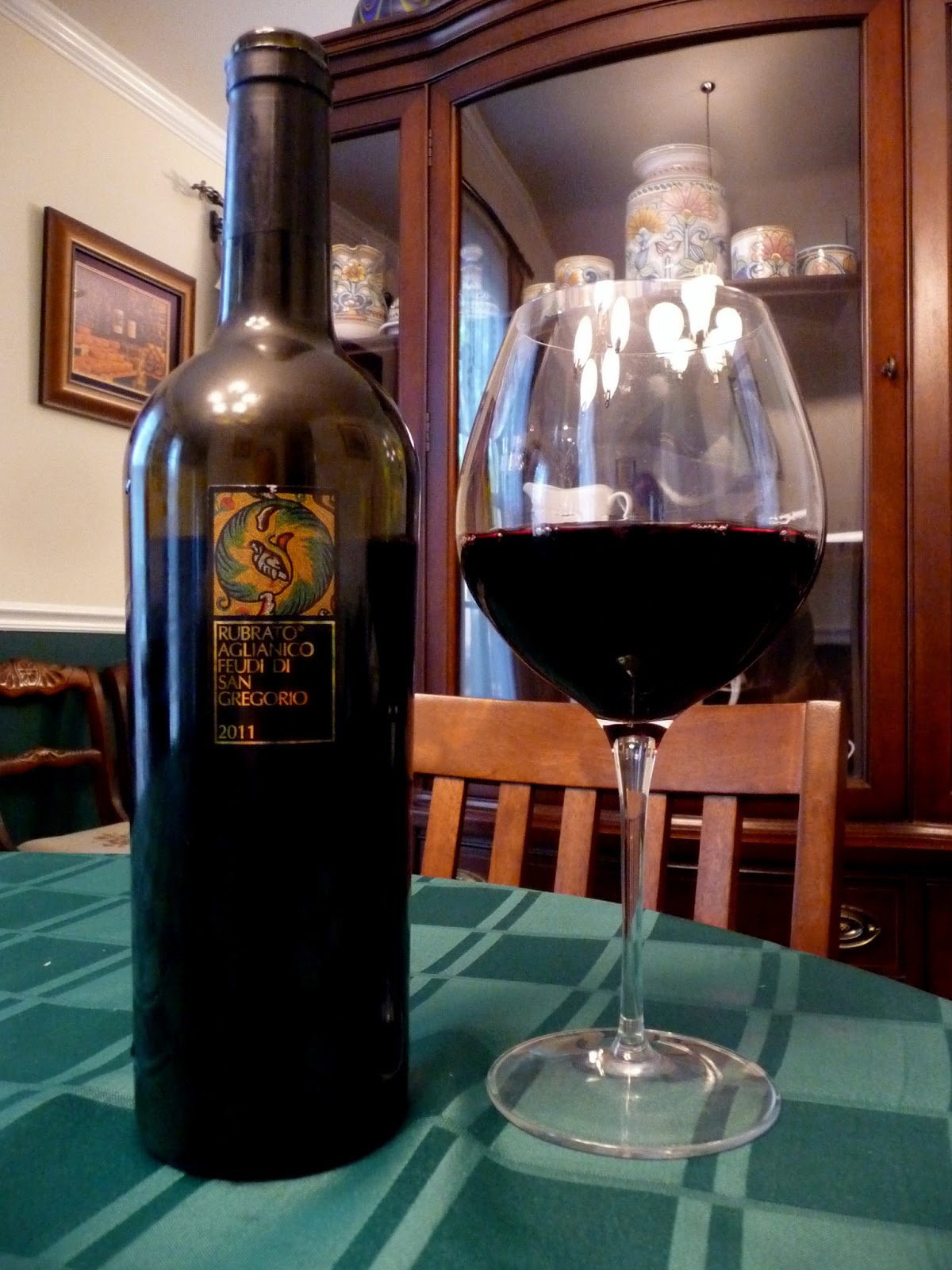
Feudi di San Gregorio Rubrato Irpinia Aglianico (2011)

There is a DOC -- a Denominazione di Origine Controllata -- in Campania.  It can be found in the province of Avellino known as Irpinia. A wide range of wines are produced by winemakers in this DOC, with names as unique and interesting as Irpinia Foxtail, Irpinia Piedirosso and Irpinia Sciascinoso.  Other wines have names that are more familiar to me, such as Iripinia Falaghina and Irpinia Aglianico.  I know these names because they are names of grape varietals.  Some lesser known varietals, which almost always piques my interest.  

The latter grape, Aglianico, is a particularly interesting one.  It is a black grape grown in Campania and Basilicata.  The varietal has a long history; Wine Enthusiast notes that the grape was originally cultivated by the Phoenicians, exported by Greeks and consumed by the Romans.  Aglianico outlasted the Roman Empire, continuing to be cultivated by vineyards and winemakers such as Feudi di San Gregorio, who produce the Rubrato Irpinia. 

According to the winemaker, Feudi di San Gregorio worked with the Universities of Napoli and Milan in a "a project of recognition of the merit and rediscovery of this grape." That work is embodied in the Rubrato, which is an example of a youthful wine made with 100% Aglianico grapes.  The youth of this wine comes from the fact that the wine is aged for a relatively short period of time ... and I mean relatively short in wine terms. The wine is matured for about eight to ten months in stainless steel vessels, and, it is then aged for six months in the bottle.

That youthfulness is present in all aspects of the wine.  The Aglianico pours a nice, brilliant ruby red.  The aromatic elements suggest, as the winemakers note, wild raspberries and dark cherries.  The winemakers also suggest elements of licorice and "underbrush."  I could not sense the licorice, but there was an earthiness to the wine.  As for the taste of this wine, it is full of those raspberries and cherries.  The youth of this wine means that those elements are rather full and perhaps a little undeveloped or nuanced.  This may turn off some people, but I think that it works well.  I also found a nice spice component, which definitely adds to the complexity of the wine. As the fruit and spice recede into the background, the dryness of the wine becomes a more noticeable. 

When it comes to pairing the Rubrato Aglianico, the winemakers suggested roasted red and white meats along with eggplant parmigiana and  a cake known as rice sartù. I think this wine will also pair well with other regional dishes, such as Bistecchine alla Napoletana and Costolette alla Pizzaiola, and even Pizza Margherita.

I found Feudi di San Gregorio's Rubrato Irpinia Aglianico (2011) at a local grocery store.  A bottle sells for about $16.99.

ENJOY!

Sunday, July 28, 2013

Grilled Calamari with a Red Pepper Sauce

A couple of weeks ago, I had the privilege of cooking a three course meal for my parents.  The theme of the meal was two fold: (1) grilled dishes and (2) most of the ingredients were to come from the West Side Market in Cleveland, Ohio.  My first dish was Grilled Apricots, Burrata and Arugula Salad, which was very good.  The second dish was an appetizer: grilled calamari with a red pepper sauce.

This recipe is a simplified version of a recipe that I found on Saveur's website.  The reason that this recipe is "simplified" is the lack of access to certain ingredients, such as aji dolce peppers and sherry vinegar.  I decided that I would simply make my own red pepper sauce that would parallel a romesco sauce.  A romesco sauce is a Spanish sauce made with roasted peppers and almonds that is often served with seafood.  However, a romesco sauce is very versatile and it can be served with really any kind of meat, including beef, chicken and turkey.

This dish was the least faithful to my theme, because the key ingredients -- calamari, roasted peppers and almonds -- came from the grocery store rather than the West Side Market.  The reason is that, by the time I got to the seafood vendor, the calamari was picked over and what was left was really too small to grill.  I really wanted a nice combination of big bodies and tentacles.  I also had to get the peppers and almonds from the grocery store, although I could have bought some red peppers and roasted them on the grill and then pureed them.  Even though this aspect of my theme fell short, the dish itself still worked out very well.

One final note: the calamari should be grilled whole.  It is not worth the effort to grill calamari rings.  The reason is that the rings will cook too fast and spend only about a minute or two total on the grill.  I wanted to keep the calamari on the grill for as long as I could without overcooking it.  So, look for large bodies and good sized tentacles for this dish. After grilling the calamari, you could serve the bodies whole, which I did, or cut them into rings. 


GRILLED CALAMARI WITH A RED PEPPER SAUCE
Recipe adapted from Saveur
Serves 4

Ingredients:
1 1/2 pounds of calamari, bodies and tentacles
1 jar of roasted red peppers
1/4 cup of sliced almonds, toasted
2 cloves of garlic, diced finely
2 tablespoons of flat leaf parsley
1 tablespoon of smoked paprika
1/2 teaspoon of cayenne pepper
1/4 to 1/2 of olive oil
Sea salt
Freshly ground black pepper
Extra virgin olive oil

Directions:
1.  Make the red pepper sauce.  Combine the red peppers, toasted almonds, flat leaf parsley, garlic, smoked paprika and cayenne pepper in a blender.  Blend the ingredients, and add the olive oil slowly in a stream.  Salt and pepper to taste.  Move the sauce into a small saucepan and heat the sauce.  Do not let the sauce come to a boil.

2.  Grill the calamari.  Thread the squid bodies on skewers, about two bodies per skewer.  Thread the tentacles on a separate skewer.  Baste the squid bodies and tentacles liberally with olive oil.  Heat a grill to medium heat (about 300 degrees Fahrenheit).  Place the skewers on the grill.  Grill the skewers about two minutes per side.

3.  Plate the dish.   Place a couple of squid bodies on a plate, with a couple of the tentacles.  Spoon the sauce over the squid. Serve immediately.

ENJOY!

Saturday, July 27, 2013

The X IPA

The history of the India Pale Ale provides a rather interesting chapter in the story of beer.  There are many different websites that recount that history, and, I am loathe to add my blog to that list.  However, when I recently tried the Schlafly "English Style Export India Pale Ale," I felt that I should at least inquire into that history.  And, figure out just what is an English Style Export India Pale Ale. 

Well, first things first, an export India Pale Ale is an India Pale Ale.  In other words, it is a pale ale brewed in England that was destined for the subcontinent.  As the story goes, brewers -- such as George Hodgson's Bow Brewery confronted a problem.  The beer transported aboard the East India Trading Company's vessels often did not survive the voyage.   By not surviving the voyage, I mean it was spoiled by the time it reached the subcontinent.  At some point, the brewers figured out that the beer fared much better when a lot of hops were added to the brew.  Those hops helped to keep the beer from spoiling, which made it available to some very thirsty people in India.   

Thus, the use of those hops obviously means that they are the key to a good IPA.   Schlafly notes that, in brewing its English Style Export IPA, it used 100% English hops.  Those hops are East Kent Goldings, Pilgrim, Northdown, Target and Brambling Cross hops.  The brewers also used pale, caramel and biscuit malts, along with a London Ale yeast to brew this beer.

The combination of hops and malts produced an interesting beer.  The beer poured an orange color, with a good, thick foam, along with a fair amount of carbonation.  The brewers suggest a spicy, lemony flavor to their X IPA. The aromatic elements of the beer clearly feature that lemon and other citrus notes.  The beer seemed much lighter than one would expect for an IPA.

In this case, the appearance is not deceiving.  This IPA is a little bit lighter in body than other IPAs that I have tried.  This lightness, which translates into an easiness when it comes to drinking, is somewhat surprising.  The surprise comes from the fact that the beer has a heavy hop presence in its taste.  Those hops provide a citrus punch, which is to be expected from an IPA.

As for pairing this IPA, I think of grilled or roasted meats, such as grilled seafood or roasted chicken.  This is also a beer that would work well with any barbecue, whether you are smoking a pork shoulder or brisket, or having a more informal grilling session with hamburgers or hotdogs.

I have not seen this beer around where I live.  I was fortunate enough to have been given it as a present by some very good family friends.  I am grateful and thankful for their generosity.   What I can tell you is that if you are in the St. Louis area, where Schlafly is based, you should check out this beer.

ENJOY!

Thursday, July 25, 2013

Grilled Apricots, Burrata and Arugula Salad

Recently, I had the honor and privilege of cooking a multiple course dinner for my parents.  I wanted to prepare a three course meal focused upon the grill.  The three courses were a salad, an appetizer and a main course.  Moreover, I decided that I would strive to obtain all of the ingredients from the West Side Market in Cleveland, Ohio.  The combination of really fresh ingredients, the grill, and the opportunity to cook for my parents motivated me to create a great dining experience.

For the salad, I decided to go with a fruit that is in season ... apricots.  I found a recipe that combined grilled apricots with some of my favorite ingredients, such as burrata cheese and arugula.  The recipe also called for the use of radicchio, which, unlike the apricots, was not in season.  (Radicchio is a late winter, early spring vegetable, while apricots are an early summer fruit.) Given it was out of season, I had to get the radicchio from a local grocery store.  Finally, the recipe calls for the use of "country ham."  I omitted that ingredient from the salad because my beautiful Angel does not like to eat ham.  However, if you want to include it, use about 1/3 to 1/2 of a pound of prosciutto or iberico ham, rather than "country ham."  Personally, I would use prosciutto, because the use of arugula, burrata and radicchio (along with the balsamic vinegar) clearly suggests an Italian influence to this dish.

Overall, this dish is very delicious.  The grilling of the apricots softened them just a little, contributing a sweetness that, with the balsamic vinegar, offsets the tartness of the radicchio and the pepper of the arugula.  The burrata cheese added a luxuriousness to the dish that helped to elevate the dish.

Finally, I want to thank my beautiful Angel, Clare, who helped with the preparation of this dish while I frantically worked on the other course.  Together, we make a great cooking team!


GRILLED APRICOTS, BURRATA AND ARUGULA SALAD
Recipe adapted from Food & Wine
Serves 8

Ingredients:
1 1/4 pounds apricots, halved and pitted
1/4 cup extra virgin olive oil, plus more for brushing
1 1/2 tablespoons of fresh lemon juice
1 small head radicchio, cored and thinly sliced
5 ounces baby arugula
1/2 pound of burrata cheese, shredded or cubed
1 tablespoon, aged balsamic vinegar
Sea salt
Freshly ground black pepper
4 ounces shaved country ham or proscuitto

Directions:
1.  Grill the apricots.  Light a grill or preheat a grill pan. Brush the apricots with oil and season with salt and pepper. Grill over high heat, cut sides down, just until lightly charred, 5 minutes. Let cool.

2.  Make the salad.  In a bowl, whisk the lemon juice with the 1/4 cup of oil and season with salt and pepper. Gently toss in the apricots, radicchio and arugula. Transfer to a platter and top with the burrata, ham and vinegar. Serve immediately. 

ENJOY!

Tuesday, July 23, 2013

Corne de Brume

Corne de Brume ... "Foghorn."  For those interested in history, the first automated, steam-powered foghorn was developed by Robert Foulis, a Scot who emigrated to St. John, New Brunswick, Canada.  According to Wikipedia, Foulis was listening to his daughter play the piano one night, when he realized that the lower notes were more clearly audible than the higher notes.  Foulis' invention was first installed in a lighthouse in 1859.

About 150 years later, there was the first beer named Foghorn or Corne de Brume.  The beer is named more for the murky environments in which vessels found themselves as they transported the dark beers, having long aged in oak barrels, during the long voyage on the cold and foggy waters of the North Atlantic.  It was not so much the low notes of the foghorn, blasting through the dark, foggy night.  It was more about that night itself. 

The Corne de Brume is brewed in the style of a Scotch Ale and it very much resembles the style.  The beer pours a very dark brown, almost as dark as the night. As the beer is poured, there is a thin, wavy foam, something similar to the clouds that sit high in the sky and pass occasionally by the sliver of the moon overhead.  

As for the aroma and taste, the brewers suggest that there are dark fruits and heady malts. There are some dark fruits in the aroma, such as raisins, plums and/or prunes.  The malts are also present in the aroma, as they have little competition from any hops.  The only challenge to the bready nature of the malts comes in the taste, when those raisins and plums make themselves more noticeable than the toasty, somewhat cereal elements provided by the malts. The taste also has a sweetness, reminiscent of caramel or molasses, but it stands behind the dark fruit in the beer.  Overall, the Corne de Brume provides an interesting and enjoyable example of a Scotch Ale. 

This beer could be paired with some cheeses, such as brie, gouda or Swiss.  However, I think it is best enjoyed on its own.

I bought this beer at a local beer store.  I do not remember what it cost, but I think that a 12 ounce bottle is about $4.99 to $6.99 a bottle.

ENJOY!