Monday, January 27, 2014

Thai Shrimp with Red Curry

A few weeks ago, I posted a recipe for Kaeng Kiao Wan Kung  or Thai Shrimp in Green Curry.  In that post, I noted my many efforts to make the dish, all of which technically failed due to my failure to procure one of the most vital ingredients of the dish ... green curry paste.  Whenever I was at the store, the shelves were stocked with red curry paste, but no green curry paste.  I would inevitably leave with a jar of red curry paste.  However, red curry paste does not make for a good Thai Shrimp in Green Curry.

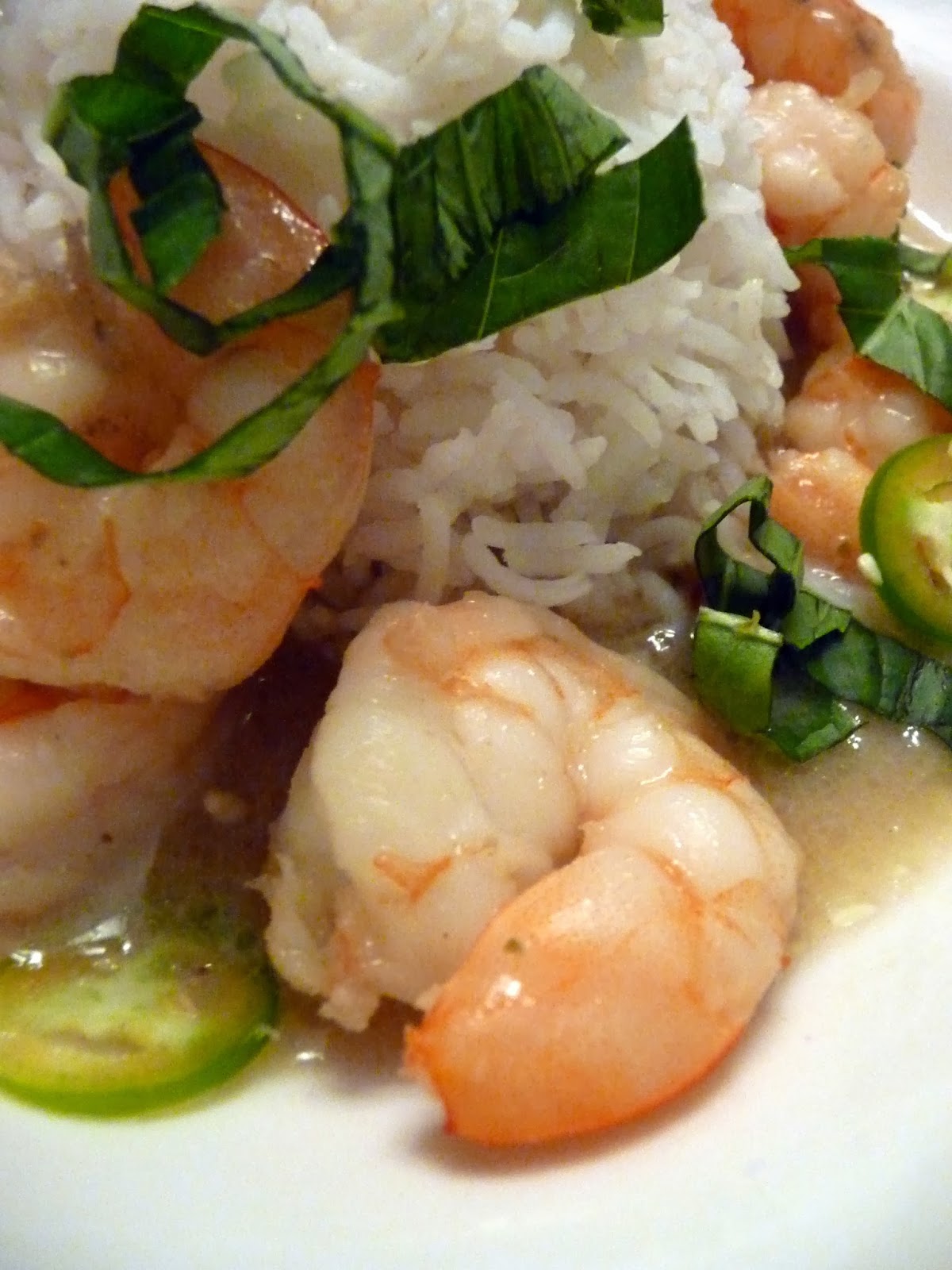
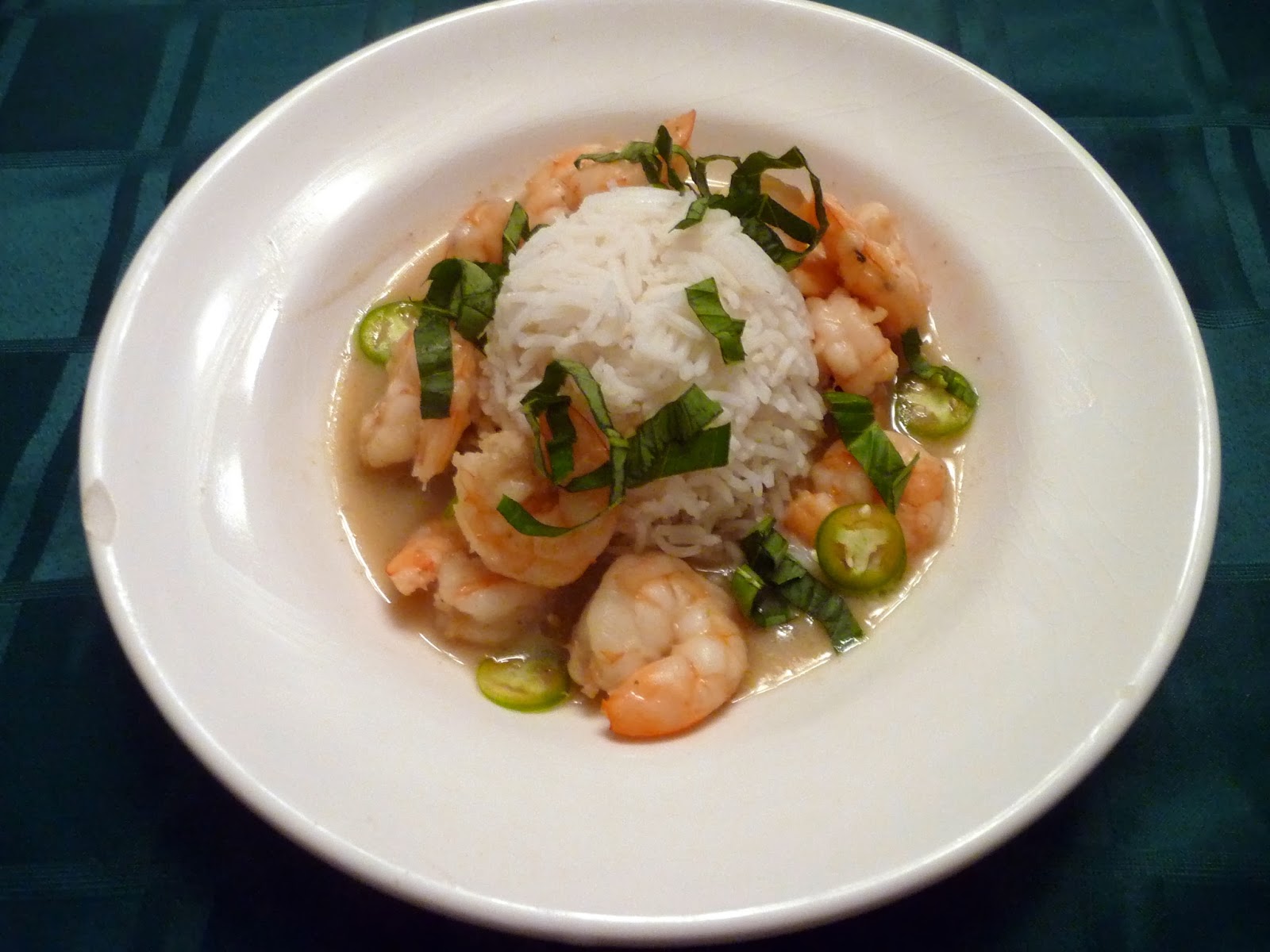
Nevertheless, I used that paste and made Thai Shrimp in Red Curry.  This dish most resembled the curry dishes that I would order whenever we went out to eat at a Thai restaurant.  The aromas were very similar, as were the tastes.  The combination of the red curry paste, coconut milk, brown sugar, and, the fish sauce work very well with this dish.  This curry dish was a good consolation for all those times that I failed to find the green curry paste.

This leaves the question of the moment: which is better ... Thai Shrimp with Green Curry or Thai Shrimp with Red Curry?  I think it is a draw.  I have to admit that I just about love any curry that I eat.


THAI SHRIMP WITH RED CURRY
Recipe adopted from from Whats4Eats
Serves 4
Ingredients:
1 cup of coconut cream
2-3 tablespoons of red curry paste
3 cups of coconut milk
1/4 cup of fish sauce
2 tablespoons of brown sugar
1 pound of shrimp, peeled and deveined
Shrimp, peeled and deveined -- 1 pound
1/2 cup of basil
3 makrut lime leaves
2-3 serrano chiles, sliced into thin rounds

Directions:
1.  Simmer the cream and paste.  In a large saucepan or wok, simmer the coconut cream over low heat until most of the moisture boils away and the oil separates out. Stir in the curry paste and simmer for another 2 or 3 minutes. Do not allow to burn.

2.  Add the coconut milk. Add the coconut milk, fish sauce and sugar. Increase heat to medium high and bring to a boil. Then reduce heat to low and simmer for 5 to 10 minutes.

3.  Add the shrimp. Stir in the shrimp and simmer another 5 or 6 minutes, or until the shrimp is just cooked through. Adjust seasoning adding more fish sauce or sugar if you like and stir in the basil and lime leaves.

4.  Plate the dish.  Serve in individual bowls with steamed rice or rice noodles and garnish with the sliced chile pepper.

 ENJOY!

Friday, January 24, 2014

The 8th Wonder of the Trappist World

For many years, there were seven wonders of the trappist beer world (i.e., the world were the beers are made by or produced under the strict supervision of trappist monks). Six of them are found in Belgium: Chimay (Bières de Chimay), Orvan (Brasserie d'Orval), Rochefort (Brasserie de Rochefort), Westmalle (Brouwerij der Trappisten van Westmalle), Westvleteren (Brouwerij Westvleteren) and Achel (Brouwerij der Sint-Benedictusabdij de Achelse Kluis).  The seventh wonder is found in the Netherlands: La Trappe (Brouwerij de Koningshoeven).  It is one of my goals to try beers from each of the trappist breweries.  To date, I have tried and reviewed beers from three of the breweries: the Westmalle Tripel, the Orval Trappist Ale, and the La Trappe Quadrupel.  (I have had Chimay beers, but I have not done a review of any of those beers). 

As I struggle to achieve my goal of trying beers from the seven trappist breweries, more such breweries have emerged.  Indeed, there is now an eighth trappist brewery: Stift Engelszell.  (There is also a ninth and a tenth trappist brewery, including one in the United States.)  Unlike the older trappist breweries, which are found in either Belgium or the Netherlands, Gregorius brews its beer at the Engelzell Abbey, which is located near Engelharrzell and der Donau in northern Austria. It is the only trappist brewery in Austria. 

The abbey was founded in 1293, although it was dissolved by Emperor Joseph II in 1786.  German monks, who were expelled from Oelenbery Abbey in Alsace after World War I, re-founded the abbey in 1925. Having being originally established as a priory, Engelszell was elevated to an Abbey with Gregorius Eisvogel named as the abbot. In 1939, the Engelszell monks were evicted by the Gestapo (with four monks being sent to the Dachau Concentration Camp). 

Fast-forward over 70 years, and we come to the first beer to be produced by Stift Engelszell.  The beer is a dark ale brewed in the Belgian style, with an ABV of  9.7%.  The beer is named "Gregorius," which is a tribute to Abbott Gregorius Eisvogel who was at the Abbey for 25 years (1925-1950). The monks produce Gregorius with honey that is local to the monastery and a unique Alsacian wine yeast. 

The Gregorius pours a dark brown color, that is typical of the Belgian dark ale.  The aroma is malt driven, with bready tones that are accentuated by the alcohol and yeast.  Some dark fruit, perhaps some raisons or plums, are present in the aroma.  As for the flavor of the beer, there is a noticeable, sweet Belgian candy element to the beer.  The candy is complemented with a light chocolate taste and a little bit of bitterness on the finish, which reminds you that there is more to this beer than just malts.  

Although I could venture some food pairing for this beer, I think that the beer is best enjoyed on its own ... as, in my humble opinion, are most trappist beers. 

This beer was available in the Chicago area, which is where a bottle was picked up and given to me.  I have not seen it around where I live.  If you happen to come across a bottle, it is worth trying.

ENJOY!

Sunday, January 12, 2014

The "Italian" Ribeye

Three words always appeal to me ... Bistecca alla Fiorentina.  Those three words speak of a recipe that is among my favorites.  One starts with a huge porterhouse steak.  The steak itself must be at least two pounds, but often times it will be larger.  Then there are the fresh herbs ... usually rosemary and thyme ... that are combined together with salt and black pepper to make a simple, but incredibly tasty rub.  After that rub is pressed into the meat, the steaks are left to rest, which allows the flavors to develop. After a couple hours, or overnight, then the steak is grilled over charcoals until it has a nice crust, while a pink to red interior.  

That recipe is one of my go-to recipes for my Steak Nights.  It is also perhaps my most favorite preparation of meat. While many steak lovers simply swear by salt and pepper, there is something about the addition of rosemary and thyme that transforms a piece of meat into something much more than a steak.

For this particular recipe, I decided to start with the "Fiorentina" and add more herbs to the rub.  In addition to rosemary and thyme, I added dried oregano, parsley and sage.  I also grinded the dry spices until they were a fine powder, and, rubbed that powder into the meat. (I used a little olive oil to help keep the powder on the meat).  The end result was a rub that incorporated some of the most basic, but most flavorful spices used in Italian cooking.

For this recipe, I found a two-pound ribeye, which keeps with the classic Fiorentina-style steak ... a massive hunk of meat rubbed with herbs.  The only deviation is that it was cooked under the broiler.  It was simply too darn cold outside to start a charcoal fire, let alone cook the ribeye. 


THE "ITALIAN" RIBEYE
A Chef Bolek Original
Serves Several

Ingredients:
1 very large, very thick ribeye (about 2 to 3 pounds)
2 teaspoons of dried thyme
2 teaspoons of dried parsley
1 teaspoon of dried sage
1 teaspoon of dried rosemary
1 teaspoon of dried oregano
1 teaspoon of crushed red pepper
Olive oil
Salt
Freshly ground black pepper

Directions:
1. Marinate the ribeye.  Salt and pepper all sides of the ribeye several hours before adding the spice rub.  Prepare the rub by combining all of the dried ingredients (thyme, parsley, sage, rosemary, oregano, and crushed red pepper).  Grind in a spice grinder until it is very fine and powdery.  Apply some olive oil on each side of the ribeye and then rub the spice mixture into the meat.  Refrigerate the ribeye for at least a couple of hours, if not overnight.

2.  Grill/broil the ribeye.  Heat the charcoal in a grill (or heat a gas grill) to high.  Add the steak, cook over direct heat for about five minutes on each side, for about fifteen minutes until you reach an internal temperature of 120 degrees Fahrenheit.  Alternatively, grill the ribeye over high heat, turning so that every side of the ribeye faces the heat for at least four to five minutes each (less time on small sides), until you get an internal temperature of 120 degrees Fahrenheit, which is medium rare.  Remove and let rest for ten minutes.  Slice and serve.

ENJOY!

Sunday, January 5, 2014

Kaeng Kiao Wan Kung (Thai Shrimp in Green Curry Sauce)

This particular recipe -- Kaeng Kiao Wan Kung (Thai Shrimp in Green Curry Sauce) -- has a little backstory to it.  I found this recipe on one of the websites that I regularly visit (Whats4Eats) several months back.  This recipe was high on the priority list of things to make for my beautiful Angel, because I thought she would really like it.  I tried to make it several times; however, each time failed.  It was not because I screwed up the recipe.  Each meal turned out well and we enjoyed the food.  

The meal failed because every time I made the dish, I made with red curry paste.  What was supposed to be Thai Shrimp in Gren Curry Sauce ended up being Thai Shrimp in Red Curry Sauce.  (Don't ask me how that translates in Thai.)  The reason was simple: every time I went to a particular grocery store after work, I would go to the Asian foods section.  As I stood before the shelves, basket in hand, my eyes always fixated on the one gap -- the one open space -- on the shelves. Sure enough, the little tag read "Green Curry Paste."  There were lots of jars of red curry paste, but no jars of green curry paste.  I would reach to the back of the shelf, hoping that there was a stray jar of green curry paste.  Each time, I left ... with a jar of red curry paste.

However, on one occasion, I checked that shelf and there it was ... green curry paste.  A bottle of water, green chilies, onions, lemon grass, galangal, garlic, sugar, salt and tamarind.  All of those ingredients pureed into the one paste I needed to make Kaeng Kiao Wan Kung.  I purchased a jar and a pound of the larges shrimp I could find.  I headed home to make the dish for Clare.

Overall, the dish turned out well, although the green curry sauce did not end up as green as I thought it would.  The lack of a greenish hue is most likely due to the color of the green curry paste that I used.  Still, we both really enjoyed this dish.  It is simple to make and has those Thai flavors that appeal to both of us.


KAENG KIAO WAN KUNG 
(THAI SHRIMP IN GREEN CURRY SAUCE)
Recipe from Whats4Eats
Serves 4


Ingredients:
1 cup of coconut cream
2-3 tablespoons of green curry paste
3 cups of coconut milk
1/4 cup of fish sauce
2 tablespoons of brown sugar
1 pound of shrimp, peeled and deveined
Shrimp, peeled and deveined -- 1 pound
1/2 cup of basil
3 makrut lime leaves
2-3 serrano chiles, sliced into thin rounds

Directions:

1.  Simmer the cream and paste.  In a large saucepan or wok, simmer the coconut cream over low heat until most of the moisture boils away and the oil separates out. Stir in the curry paste and simmer for another 2 or 3 minutes. Do not allow to burn.

2.  Add the coconut milk. Add the coconut milk, fish sauce and sugar. Increase heat to medium high and bring to a boil. Then reduce heat to low and simmer for 5 to 10 minutes.

3.  Add the shrimp. Stir in the shrimp and simmer another 5 or 6 minutes, or until the shrimp is just cooked through. Adjust seasoning adding more fish sauce or sugar if you like and stir in the basil and lime leaves.

4.  Plate the dish.  Serve in individual bowls with steamed rice or rice noodles and garnish with the sliced chile pepper.

 ENJOY!

Thursday, December 12, 2013

A Brief Break ...

As followers of the blog have probably noticed, the posts have become fewer and fewer.  It is not that I have not been cooking or that I don't have posts, it is just that I have not had enough time to write the posts about my cooking.  There is a backlog, but I have been very busy with my beautiful Angel and my little big guy.  I have also been very busy at work. 

I have decided to take a brief break from posting on this blog until the new year.  I hope that this will give me some time to work on some posts.  

I hope everyone has a happy holiday! See you after the new year.

Monday, November 25, 2013

Grilled Cherry Tomato Chutney

A while back, I was making a grilled-theme dinner for my beautiful Angel.  The main course was Masaledar Macchi, or Spicy Grilled Fish.  I needed a couple of side dishes to complete the meal.  I wanted to do a grilled side dish.  I also wanted to make an Indian side dish.  This limited the number of available recipes.  Nevertheless, I found quite a few.  I went through those recipes and chose one from the most unlikely of sources.

The source was Bobby Flay.  The chef who is practically synonymous with Southwestern American cuisine had a very interesting and tasty Indian side dish.  The recipe was for a grilled cherry tomato chutney.  Interestingly, according to Wikipedia, chutneys can be traced back to approximately 500 B.C.  It was first used by northern Europeans during the Roman period to preserve food.  This process was exported by Europeans, such as the British, during the colonial period.  When the British arrived in India, for example, they brought various chutneys and marmalades to the subcontinent.  From there, as they say, the rest is history. 

Some variant of tomato chutneys can be found across the Indian subcontinent, from Assam to Karnataka.  Bobby Flay does not describe where he draws the inspiration from this particular chutney.  Nevertheless, the combination of spices (cumin and coriander) with fresh herbs (mint and cilantro) makes for more than just a condiment.  It makes a great side dish.


GRILLED CHERRY TOMATO CHUTNEY
Recipe by Bobby Flay and available at
Serves 6

Ingredients:
1 pint grape tomatoes
Canola oil
Kosher salt and freshly ground black pepper
1 cup cider vinegar
2 tablespoons light brown sugar
1/2 teaspoon coriander seeds
1/2 teaspoon cumin seeds
2 tablespoons chopped cilantro
2 tablespoons chopped mint
Zest of 1 lime

Directions:
1.  Prepare the grill.  Prepare a charcoal grill for direct grilling, high heat.  If you are using a gas grill, heat to high heat. 

2.  Grill the tomatoes.  Toss the tomatoes with oil and season with salt and pepper. Transfer to a grill basket and grill until charred and slightly soft, tossing occasionally, about 5 minutes. 

3.  Prepare the spice and herb mixture.  Combine the vinegar, sugar, coriander and cumin seeds in a small saucepan and bring to a boil. Reduce the heat and simmer until thickened to a glaze, about 10 minutes. Let cool slightly, then pour over the tomatoes. Toss, mashing the tomatoes slightly. Add the herbs and the zest, toss again, taste and season.

ENJOY!

Thursday, November 21, 2013

Prive Vineyard's Mélange (2008)

The label reads, as you stroll past the winery, the lavender gardens draw you toward the old world brick oven.  The chimney fills our patio with the aroma of cherry wood embers.  Rustic pizzas and breads appear begging for a great bottle of wine and friends to share it with.  Those words bring back memories for myself, because I have visited the winery, strolled around the patio and seen that old world brick oven.

The winery is Privé Vineyard, a small family-owned vineyard in the Willamette Valley of Oregon.  Both Clare and I visited the vineyard as part of our honeymoon, which included a two day, chauffeured trip to over a dozen vineyards in the valley.  While we can say that our experience at each of those vineyards was amazing, the one that probably left the biggest impression upon us was Privé.

I have previously wrote about Privé when I reviewed a couple of their wines in the past, like the Le Nord (2006) and Le Sud (2008).  Both of those wines were estate-wines, produced only with grapes grown on the property.  However, the demand for Le Nord and Le Sud, as well as the limited amount of grapes grown on the estate (it is only a couple acres in size), the winemakers have branched out to produce wines with grapes grown elsewhere.  One of these wines is the Mélange, which is the winemaker's nod to a Bordeaux-style blend.

The Mélange is produced Cabernet Sauvignon, Cabernet Franc, Merlot and Malbec grapes.  All of the grapes are cultivated in Washington State.  The winemakers blend the grapes together and then age the wine in 15% new French oak barrels.  The result is a substantial red wine that can cellar for up to 12 years.  Neither Clare nor myself were patient enough to let the bottle of Mélange (2008) age until 2020.  We lasted only about five years.  

The Mélange pours a nice magenta or crimson red color.  The aromatic elements of the wine suggest dark red fruit, something that carries over into the taste of the wine.  I definitely sensed the pleasing aroma and taste of both blackberries, dark cherries and plums.  There was also a nice hint of spice and pepper, which often came through in the finish.  The wine itself is somewhat dry, with manageable tannins that are not overwhelming.  

The winemakers describe this wine as having been blended for the pizzas that come out of their old world brick oven.  This wine is far more versatile, and could be paired with a range of proteins (beef, lamb, chicken and pork) that are roasted, braised or grilled.  It could also be paired heartier vegetable dishes.  

Overall, the Mélange is another excellent wine made by a very small, boutique vineyard.  As we drank this wine, Clare and I were reminded of why we like Privé so much.  The wine sold for about $28.00 a bottle; however, Privé is no longer producing the Mélange.  The winemakers are looking to transition from a Bordeaux style blend to a Rhone style blend.  Both Clare and I will definitely looking for that wine when it comes out.

ENJOY!

Monday, November 11, 2013

Baby Chef: Three Apple Medley

Recently, I decided to take a day off from work (and, it just happened that the day-off coincided with a federal holiday, which meant that the office was closed).  I decided to spend a good part of that day cooking.  I first began making food for our little guy.  I made some more pear puree, but I also decided to make a "Chef Bolek" original for my little guy ... a Three Apple Medley Puree.

To be sure, our little guy has already had a good amount of pureed apples.  We went to an apple farm in northern Ohio and bought a bag of apples, most of which went to puree for his breakfast, lunch and dinner.  We have also bought apples on occasion thereafter to make puree.  In making this food, however, we have limited ourselves to just one kind of apple for the puree.

So, this is where the "originality" comes in, to the extent there is any originality at all.  I was pursuing the selection of organic apples at our local store.  I decided that, rather than buying all of one type of apple, I would buy a couple of a few different apples and then combine them together.  This presented a minor challenge: what apples to choose?  I immediately ruled out Granny Smith apples, because I was a little unsure about introducing tartness at this stage.  I ultimately chose Honeycrisp, Gala and Fuji apples. I selected each for a reason.  

First, Fuji apples are bigger, with denser flesh and sweetness.  These apples -- which derive their name from the town of Fujisaki, and not Mount Fuji -- were developed as a cross between two American apples, the Red Delicious and the Virginia Ralls Genet.  The Fuji apples, which were first grown in the Aomori Prefecture of Japan, are the most popular apples in Japan.  They are also some of the hardiest apples, with longer shelf lives than others.  I chose these apples because I wanted to add some some substance and texture to the medley puree.  Given their size, this also ensured that there would be more of the medley when I was finished pureeing the apples. 

Second, the Gala apples are very sweet and have a lighter, grainy texture.  These apples are very popular in the United States, primarily because they are fairly versatile. The Gala apple originated as a cross between the Golden Delicious and Kidd's Orange Red apple.  The first Gala apples were cultivated in New Zealand, although they are now the second most popular apple in the United States (behind the Red Delicious apple).  I selected the Gala apples because of their sweetness.  These apples are the primary contributor of sweetness to the medley, with the Fuji apples providing some additional sweetness.  

Finally, there are the Honeycrisp apples.  These apples are known for their sweetness and tartness.  These apples originated from a hybrid of the Macoun and Honeygold apples.  I chose these apples specifically for their balance between sweetness and tartness.  I wanted to introduce a little tartness into the medley so that our little guy could get just a little hint of it.  Babyfood cookbooks tell you to steer clear from tart apples, like Granny Smith apples, because the tartness is likely to be off-putting to the infant.  However, the balance of Honeycrisp apples, with the reinforcing sweetness of the Gala and Fuji apples, offered an opportunity to introduce a very little amount of tartness under the cover of the sweetness.  I want to expand my little guy's palate as early as possible, without turning him off of any food. 

Overall, I think the puree came out very well. Of course, my opinion does not matter.  It is all about the little guy.


THREE APPLE MEDLEY
A Chef Bolek Original

Ingredients:
2 Honeycrisp apples, quartered, cores and seeds removed
2 Gala apples, quartered, cores and seeds removed
2 Fuji apples, quartered, cores and seeds removed

Directions:
1.  Steam the apples.  Steam all of the apples in accordance with the directions of a steamer (or, create your own steamer by placing a steamer basket over a pot of boiling water and then cover the pot).  The apples should be tender after about fifteen to twenty minutes.  Remove the apples from the steam and let them cool. 

2.  Puree the apples.  Remove the skins and place the apples in a food processor. Blend until you reach your desired consistency, adding water, breast milk or formula to get that consistency.

ENJOY!

Thursday, November 7, 2013

Paardebloem

If one were to ask what ingredient would seem to be the most unlikely to be used in brewing beer, I think dandelion greens would be near the top, if not at the top, of the list.  The leaves of seemingly ubiquitous weed are earthy and minerally in taste, but they are also very bitter.  I would think that a lot of work would need to be done to balance that bitterness, and, it would take some very adept brewers to achieve that balance.

Enter the brewers of New Belgium Brewing and Red Rock Brewery, who teamed up to brew the Paardebloom, an ale brewed with dandelion greens.  The brewers not only used those bitter greens, but also grains of paradise. This ingredient, which goes by a more formal name ... Aframomum Melegueta, is the seeds from a plant that is principally grown in western Africa.  Those seeds impart a peppery taste.  While pepper can complement and curtail the tartness of the greens, still more work needs to be done to produce a balanced beer, let alone a great beer.

Once again, the New Belgium and Red Rock brewers did that work.  Along with a wild Belgian yeast and some wood-aged beer, the brewers produced a Belgian-style ale with Pale, German Pilsner, Dark Wheat, Rye and Munich malts, with Target Hops.  All of these ingredients helped to balance the bitterness of the greens and grains, while allowing those ingredients to contribute to the overall taste.

The Paardebloem pours a golden color, with a thin light foam.  The brewers describe the aroma as having peach, fresh baked bread, fresh greens, white wine, slight pepper and clove, with a hint of that funky barnyard esters.  I definitely got the peach, bread, greens and white wine.  There was also some pepper and clove. I did not get that barnyard ethers, perhaps because I have had one too many Brettanomyces beers and "barnyard' for me literally means two feet in the middle of a pigpen.   As for the taste, many of those aromatic elements find their way onto the tongue.  The brewers suggest a slight tannic bitterness from the dandelion greens, which is definitely present.  However, the malts provide some sweetness that counters the bitterness of the greens, as well as provides some freshness.

When it comes to pairing, the brewers suggest Hawaiian Short Ribs and Citrus Fennel Salad.  This recommendation sheds light on good pairings.   This beer can pair well with any beef and pork, even chicken, although a more substantial dish would work well.  A lighter dish may not tame the bitterness of the beer enough. 

I found this beer at a local grocery store.  I do not remember the cost of the beer, but it should be about $10 a bottle.

ENJOY!

Sunday, November 3, 2013

Blue Crabcake Algonquian

The Chesapeake Blue Crab is a very special animal.  Its scientific name -- Callinectes sapidus --  is Latin for beautiful, savory swimmer.  I have worked with these beautiful creatures when I was a steam cook for a local seafood restaurant.  The crab are not only beautiful to look at, but their meat is very delicious.  It is so prized that the Blue Crab has been one of the most valuable, if not the most valuable, fishery in the Chesapeake Bay.

For the locals, eating the crab right out of the shell is a timeless ritual.  There used to be, and there still are, many crab houses that dot the region.  Dozens of crabs can be ordered, served on brown, butcher-type paper.  Mallets are handed out to everyone and the feast begins.  

Apart from these crab feasts, the second most popular way for locals to enjoy the meat of the blue crab is the crabcake.  According to Renewing America's Food Traditions, the first recipe for a crabcake was published back in 1685, and, was first recorded twenty-five years earlier when chef Robert May told readers in 1660 that one could: "take the meat out of the great claws being first boiled, flour and fry them to take the meat out of the body, strain half of it for sauce and the other half to fry, and mix it with grated bread, almond paste, nutmeg, salt and yolks of eggs, fry in clarified butter, being first dipped in batter, put in a spoonful at a time; then make a sauce with wine-vinegar, butter, or juice of orange, and grated nutmeg, beat up the butter thick and put some of the meat that was strained into the sauce, warm it and put it in a clean dish, lay the meat on the sauce, slices of orange over all and run it over with beaten butter, fried parsley, round the dish bring and the little legs round the meat."

It would take more than 250 years before the term "crabcake" would bed used for the first time in 1930.  Over that period of time, the historic recipes for crabcakes -- like Chef May's recipe -- continued to evolve.  At the same time, the once bountiful populations of blue crab began to decline.  The reasons are varied: overfishing, chemical runoff (like PCBs and mercury), disease, and other reasons.  Another problem has been the algae blooms, which damage and kill the sea grasses that are vital to the diet of the blue crab.  

This recipe -- Blue Crabcake Algonquian -- comes from the Renewing America's Food Traditions book.  It is a straightforward, traditional recipe for a Maryland crabcake that has been adapted from a couple of recipes used by restaurants and chefs along the Chesapeake Bay.  The recipe calls for the use of "lump" crab meat, which is okay.  If you can find "jumbo lump" crab meat, that would be even better.  Both lump and jumbo lump crab meat provide big pieces of crab that stand out from the binding that keeps the crabcake together.  A great crabcake is one where the crab is the star, not the binding. 


BLUE CRABCAKE ALGONQUIN
Recipe from Renewing America's Food Traditions, edited by
Gary Paul Nabhan at page 163
Serves 3

Ingredients:
1 pound of jumbo lump blue crab meat, preferably local
4 tablespoons of minced onion
1/2  teaspoon of dry mustard
1/2 teaspoon of paprika
4 tablespoons of bread crumbs (such as panko)
1 egg, beaten
2 dashes of Worcestershire sauce
4 tablespoons of butter
2 ounces of white wine
Sea salt, to taste
Ground black pepper to taste

Directions:
1.  Make the crab cakes.  In a mixing bowl, use your hands to combine the crab meat with the minced onion, dry mustard, paprika, breadcrumbs, and egg.  Form six small balls of crabcakes.  Refrigerate for about 15 minutes.

2.  Saute the crab cakes.  Heat the butter in a skillet.  Saute the crabcakes over medium heat until brown and bubbly.  Fluff up and turn over with a spatula without disturbing the lumps of crab, then brown on the other side.  Next remove the skillet from the heat and quickly pour the white wine over the edges of the crabcakes.  While they are still sizzling and bubbling, serve in the skillet.

ENJOY!