Thursday, March 21, 2019

Gochujang Chicken

This recipe is an experiment wherein an air fryer recipe never made it into the air fryer.   As readers of this blog probably know, my beautiful Angel and I recently bought an air fryer.  I am intrigued by air fryers, because I have basically given up on a deep fryer.  I did not want to deal with the leftover oil.  When one adds the negative health aspects of deep fried food, that made it easy for me to move on from a deep fryer or event the cooking process.  When I recipe called for deep frying, I would broil it or grill it.  

Last Christmas, I got an air-fryer cookbook.  There are a lot of interesting recipes in that book, including one for Gochujang Chicken. The Gochujang sauce got my attention. I wanted to make that sauce.  However, the recipe in the book called for the use of chicken wing sections.  I had bone-in thighs.  While I could have thrown those thighs into the air-fryer, I needed the cooking times for bone-in thighs in an air fryer.  After looking around the internet, I just decided to cook the thighs in a conventional oven. 

Overall, the recipe worked very well.  I was able to get the skin crisp, the heat from the sauce was present, and, there were chicken thighs, which are perhaps the best part of the bird.  This is the type of experimentation that I hope to do more in the future!


GOCHUJANG CHICKEN
Sauce recipe from Urvashi Pitre, Every Day Easy Air Fryer, pg. 69
Serves 4

Ingredients (for the chicken):
1 pound of chicken thighs, with skin and bone
1 teaspoon kosher salt
Freshly ground black pepper
1 teaspoon gochugaru
1 teaspoon sesame seeds

Ingredients (for the sauce):
3 tablespoons gochujang (Korean chile paste)
1 tablespoon toasted sesame oil
1 tablespoon minced fresh ginger
1 tablespoon minced garlic
1 teaspoon sugar
1 teaspoon agave nector or honey

Directions:
1.  Make the sauce. In a small bowl, combine the gochujang, sesame oil, ginger, garlic, sugar and agave, set aside. 

2.  Cook the chicken.  Place the chicken skin side down and cook at 360 degrees Fahrenheit for 8 minutes.  Spread some of the sauce on the chicken and flip the thighs.  Spread more of the sauce on the skin and underneath the skin.  Continue cooking for about 6 minutes more or until the chicken is browned with crispy skin and with an internal temperature of 165 degrees Fahrenheit. Remove from the heat, let rest for about five minutes, and serve immediately.

ENJOY!

Saturday, March 16, 2019

Chicken Vesuivio

It is the early 1930s. The Great Depression has settled in, but, for some reason, you find yourself at the corner of East Wacker Drive and North State Street.  That intersection near the heart of downtown Chicago. At the corner, you watch Packards and Cords drive by. As you turn your head, something catches your eye. It is an Italian restaurant called Vesuvio.  The hunger pangs in your stomach tell you it is time for a meal.  You walk over to the restaurant and open the door.  Before any person can great you, the smells of Italian food greet your olfactory senses.

You take a step in to the restaurant and survey the wood-paneled walls and thick red curtains.  A host guides you to a table in the corner and provides you with a menu.  You can the offerings, which are traditional Italian-American fare.  One dish catches your attention ... Chicken Vesuvio. (A dish named after the infamous volcano in Calabria, even though the owner of the restaurant was from Turin, which is located in Piedmont.) You decide to order the dish.  What comes next is what becomes not only a traditional Italian-American dish, but a traditional Chicago dish as well.

Chicken Vesuvio was traditionally made with bone-in chicken or, quite frankly, an entire chicken deconstructed into pieces.  The chicken is prepared with potatoes sauteed in garlic, oregano, white wine, and olive oil.  This recipe includes a healthy twist, substituting the bone-in chicken (which would traditionally legs or thighs) with boneless, skinless chicken breasts.

In the end, this is a very tasty dish that provides a window into how Italian immigrants who came to the United States are able to create dishes that become their own traditions.  Now, I will have to try some other Italian-American classics, like Chicken Francese or Penne alla Vodka.   


CHICKEN VESUVIO
Recipe from Cooks Country Eats Local, pp. 198-199
Serves 4

Ingredients:
4 (6 ounce) boneless, chicken breasts, trimmed
Salt and pepper
2 tablespoons olive oil
1 1/2 pounds small red potatoes, unpeeled, halved
1 teaspoon minced fresh rosemary
2 garlic cloves, minced
1/2 teaspoon dried oregano
1 1/2 cups chicken broth
1/2 cup white wine
1 cup frozen peas, thawed
2 tablespoons unsalted butter
2 teaspoons lemon juice

Directions:
1.  Brown the chicken.  Pat chicken dry with paper towels and season with salt and pepper. Heat 1 tablespoon of olive oil in 12-inch nonstick skillet over medium-high heat until just smoking.  Brown chicken well, 3 to 4 minutes per side. 

2.  Continue cooking.  Add remaining 1 tablespoon oil to skillet and heat until shimmering.  Add potatoes, cut side down, and cook until golden brown, about 87 minutes.  Stir in garlic, rosemary, oregano and 1/2 teaspoon salt and cook until fragrant, about 30 seconds. Add broth and wine, scraping up any browned bits, and bring to boil.  Return chicken to skillet on top of potatoes.  Reduce heat to medium low and simmer, covered, until potatoes are tender and chicken registers 160 degrees, about 12 minutes.  Using slotted spoon, transfer chicken and potatoes to serving platter and tent loosely with aluminum foil.

3.  Finish the sauce.  Increase heat to medium high and cook, uncovered, until sauce is reduced to 1 cup, about 5 minutes.  Stir in peas and cook until heated through, about 1 minute.  Off heat, whisk in butter and lemon juice and season with salt and pepper to taste.  Pour sauce over chicken and potatoes and serve. 

ENJOY!

Friday, March 8, 2019

Ommegang's Bigger and Bretter

Brewery Ommegang is one of those breweries that I enjoy but which has not found its way into any beer review on this blog.  The Cooperstown, New York-based brewery produces some very good Belgian style and French style ales.  One such beer is the Bigger and Bretter, Ommegang's Biere de Garde that was brewed with Brettanomyces, or wild yeast.  

Brett beers are for those beer aficionados who also love to gamble. The reason is that some beers brewed with Brettanomyces have very strong aromas and tastes.  Think of descriptions "barnyard funk" or "horse blanket." The wild yeast does a number to these beers, which only a fan of Brett beers can love.  Other Brett beers are more mild, evoking rather tame descriptions such as "earthy" or "floral." These are the examples of beers brewed that wild yeast that should be tried by a wary beer lover.  The reason is that it provides an opportunity for that person to try a beer style that he or she would not otherwise try ... out of a fear of horse blankets.  The thing is that one will not really know where the Brett beer will fall on this scale -- from barnyard funk to floral -- until the bottle or can is opened.  That is why it is a gamble. 

Fortunately, the Bigger and Bretter finds itself on the milder side of the scale.  The beer pours a orange color, with copper or bronze tones.  As the beer rests in the glass, aromas of cherry pie and cinnamon, along with the yeast, rise up to greet the nose. Those elements also include some herbal notes, which could be expected from a Brett beer.  When compared to some of the Brett beers that I have had in the past, the aromas of this beer were more modest and restrained. 

Not only were the aromas more restrained, but so were the flavors. The flavor of the Bigger and Bretter features tart cherries, but the beer lacked some of the "funk" that seems to set Brett beers apart, such as Les Deux Brasseurs or Orval. 

This beer is a good Brett beer for those who are reluctant to try a beer brewed with wild yeast.  Unfortunately, for those people, Brewery Ommegang has retired this beer.  For those who love Brett beers, you can still find Orval, which is perhaps one of the best Brett beers out there.   

Saturday, March 2, 2019

Chicken Shawarma

My beautiful Angel and I recently purchased an air fryer.  I have been intrigued by air fryers for quite a while.  Generally, I do not like to deep fry foods, and, for that reason, I do not own a deep fryer.  Moreover, when a recipe calls for something to be fried in 2 to 3 inches of oil, I find a different way to cook it.  Often times, I use the broiler, the grill or a wok.  It was my effort, however little, to try to cook in a healthier way.

Last Christmas, I got an air fryer book from my parents as a gift. The book has a lot of great recipes, which I want to make. Recipes such as African Piri-Piri Chicken drumsticks, Gai Yang (Thai-Style Cornish Game Hens), and Tandoori Chicken.  It is not just chicken, there are interesting recipes like Dukkah Crusted Halibut, Char Siu (Cantonese BBQ Pork), and Nem Nuong (Vietnamese Grilled Pork Sausages. Needless to say, I have a lot of cooking ahead of me. I have started a label, "Air Fryer Recipe," to keep track of all those recipes and my cooking.

For the first air-fryer recipe, I decided to make Chicken Shawarma. This is obviously not the classical shawarma, as the air fryer does not come with a vertical spit attachment.  There is also no layering of marinated meats, such as chicken, lamb, beef or even goat.  Instead, this recipe calls for the use of a spice mix that recreates the smells and flavors of shawarma. The mix used in the recipe was the classic set of ingredients: oregano, cinnamon, cumin, coriander, ground pepper, cayenne (or hot) pepper and salt. (To be sure, other recipes may add ingredients like cardamom, but the mix in the recipe was very good.)

More importantly, Chicken Shawarma was probably the easiest recipe to make in the book. It was culinary equivalent dipping your toes in the shallow end of the pool.  A quick way to try out the air fryer to see how it worked and whether the end result would be delicious.  I am happy to say that the result was very delicious.  I can't wait to try some more of the recipes in this book.


CHICKEN SHAWARMA
Recipe from Urvashi Pitre, Every Day Easy Air Fryer, pg. 63
Serves 4

Ingredients (for the Shawarma Spice):
2 teaspoons dried oregano
1 teaspoon ground cinnamon
1 teaspoon ground cumin
1 teaspoon ground coriander
1 teaspoon kosher salt
1/2 teaspoon ground allspice
1/2 teaspoon cayenne pepper

Ingredients (for the chicken):
1 pound, boneless, skinless, chicken thighs (or breasts), 
     cut into bite-sized chunks
2 tablespoons vegetable oil

Directions:
1.  Prepare the chicken.  In a small bowl, combine the oregano, cayenne, cumin, coriander, salt, cinnamon and allspice.  In a large bowl, toss together the chicken, vegetable oil, and shawarma spice to coat.  Marinate at room temperature for 30 minutes or cover and refrigerate for up to 24 hours. 

2.  Cook the chicken.  Place the chicken in the air fryer basket.  If using dark meat, set the air fryer to 350 degrees Fahrenheit for 15 minutes or until the chicken reaches an internal temperature of 165 degrees Fahrenheit. If using white meat, set the air fryer to 350 degrees for 10 minutes (turning the chicken half way through) and then set the air fryer to 400 degrees for 2 minutes.

3.  Finish the dish.  Transfer the chicken to a serving platter.  Serve with tzatziki and pita bread, or with rice. 

Wednesday, February 27, 2019

The Drizzy

When I saw the beer on the board, I was skeptical. A Cinnamon Bun Imperial Stout. I am a big fan of Imperial Stouts, but I am also traditionalist. I like the Russian Imperial Stout. I am open to barrel aged Russian Imperial Stouts.  That's about it. I have never been a big fan of flavored stouts.  

But, a Cinnamon Bun Imperial Stout? That is what confronted me during a recent visit to Black Flag Brewery.  My beautiful Angel and I took my parents there because my dad loves trying new craft beer and he had never been to Black Flag before.  By contrast, I have been there a few times and tried all of their standard beers, such as the Mambo Sauce Double IPA.  While my dad tried a flight to sample the different beers, I wanted to try something new.  That is when I was introduced to the Cinnamon Bun Imperial Stout.  A beer that changed my views about the introduction of different flavors into a traditional style. In fact, I liked the beer so much that I bought a four pack and brought it home.

The reason why I liked the beer so much is that the beer actually combines the best elements of a Russian Imperial Stout with cinnamon buns.  The Drizzy pours a very dark black, with an off-white, cream colored foam.  The aromatic elements feature the roasted malts, but those malts are coated with a lingering cinnamon, molasses and sugar weaved into the traditional aromas of a stout.  As for the taste, the cinnamon, sugar and slight vanilla tones are so well together, against that malt background, so as to actually give someone the impression that there is a cinnamon bun in the beer.  That is quite a feat.  

The Drizzy is -- or was -- a seasonal beer at Black Flag Brewing and it is long gone.  Hopefully, the brewers will bring it back again.  Only time will tell.  Until then,

ENJOY!

Saturday, February 23, 2019

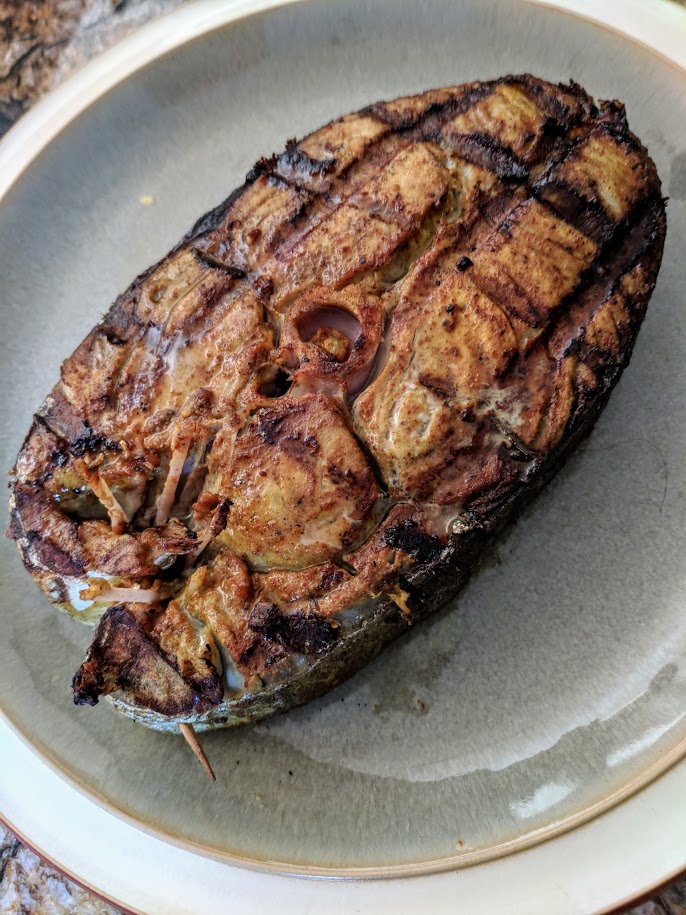
Grilled Kingfish Steak

As I stood before the seafood counter of my local Korean supermarket, a certain fish caught my attention.  The fish had been cut into steaks, but it was the greyish-blueish tint of the meat that caught my eye.  I had not seen those steaks or that fish before. The sign read "Kingfish."

Kingfish -- or King Mackerel -- is a long fish, with an iron-grey color on its back that fades into a silver along its belly. The fish grows fast, and, with a lifespan that can reach 20 years (as long as it never finds itself on a hook), that means that a king mackerel can grow to be five and one-half feet and weigh as much as 100 pounds.  All the while, the kingfish feeds on smaller migratory fishes, shrimp and squid.   In turn, the king mackerel, finds themselves as part of the diet of dolphins, sharks and tuna.

The king mackerel can be found in the coastal zones of the western Atlantic ocean, from Maine to Brazil.  A little cloer to home (the United States), the king mackerel population is divided into two distinct communities: (1) the Atlantic Group and (2) the Gulf of Mexico Group.  The boundary of the two groups runs along the line between Miami-Dade and Monroe counties in southern Florida. 

The King Mackerel a/k/a Kingfish

The story of the king mackerel is a story of the success of regulatory management.  For decades, there were no rules or limits on the catch of king mackerel.  This led to a decline in the populations with the stock reaching critical lows.  In the 1980s, the United States adopted regulations governing the catch of kingfish.  An example of the regulations can be found at this link, which are for the south Atlantic region.  The overall regulations, coupled with the fact that the fish grows at a rapid pace (as well as can reproduce at 2 years of age), has led to the growth in the populations.  The growth has been so successful that the fish has reached the target levels.  This success makes this fish one of the more sustainable choices to grace those seafood counters.

This brings me back to my first effort to cook with kingfish.  As it turns out, the kingfish is not only located along the western Atlantic, but there are populations of the fish along the coastal waters of the Indian subcontinent, especially around Chennai.  I was able to find a recipe that called for grilling the kingfish steaks, after they have been marinated in a chile-turmeric oil.   The recipe is very easy, and, a great way to introduce oneself to this wonderful fish. 


GRILLED KINGFISH STEAKS
Recipe adapted from The Indian Claypot
Serves 2

Ingredients:
2 kingfish steaks
1 tablespoon of olive oil
2 teaspoons of red chile powder
1/4 teaspoon freshly ground black pepper
1/4 teaspoon of ground turmeric
1/2 tablespoon lemon juice
Salt, to taste

Directions:
1.  Prepare the fish.  Rinse the kingfish well, using lemon and salt water.

2.  Prepare the marinade.  In a bowl, mix together the olive oil, chile powder, ground black pepper, lemon juice, and salt until a smooth paste.  Apply the paste over the fish steaks until well coated and set aside at room temperature or the refrigerator for an hour.

3.  Prepare the grill.  Heat a grill on medium-high heat.  Brush oil on the grates.  

4.  Grill the steaks.  Place the kingfish steaks on the grill.  Grill for 10 minutes and flip.  Grill for 8 minutes more.

ENJOY!

Tuesday, February 19, 2019

A Hideaway in Sin City

Over the next few months, I will be doing a lot of traveling for work, which means that I won't be doing a lot of cooking.  The traveling has already begun, with a trip to Las Vegas.  My job usually requires me to make a trip to Vegas at least once (and up to four times) per year. 

Whenever I am in Las Vegas, I inevitably look for a place where I can go to get away from work and relax.  A year or so ago, I found one such place.  It is a little bar tucked away in a corner on the Strip. The small bar is lined with approximately half a dozen seats and another half dozen taps. From those taps pour the beers of Sin City Brewing.   

Each time I made my way to that spot, I would sit down and quickly scan the taps.  The same six (or so beers).  I would then order the "seasonal," which happens to be the same beer every time.  The double India Pale Ale.  The only difference is whether I get a 16 ounce or 24 ounce cup. (The picture on the right is the 24 ounce cup.)

Like those taps, the double IPA is also always the same, a tribute to consistency.  It pours light golden color, with a thin foam covering the entire surface of the beer.  This double IPA does not pack the "in your face" punch of the piney or citrusy notes of other double IPAs that I have had in the past, such as the Columbus Brewing Bodhi or the D.C. Brau Deus Ex Machina.  The aromatic and taste elements that one would expect are there: hints of pine and citrus greet both the nose and the palate. These elements are moderated by the malts, which are more present in this beer than I would have expected for a double IPA.  Nevertheless, the moderation of those elements make this an easy drinking double IPA. That can be as dangerous as Las Vegas, given the IPA comes in at about an 8.3% ABV.

Now that I have given away the little corner where I go to relax, I will have to work on finding new ones.  Perhaps it is time to check out some new breweries or brewpubs in the Las Vegas area, like Tenaya Creek Brewery, Craft Haus Brewery or Banger Brewing.  We'll see what the future holds. Until next time ...

ENJOY!

Thursday, February 14, 2019

Trinidad Oyster Cocktail

Last year, there was a time when I was making many different oyster shooters.  It all started with the Oyster Shooters with Tomato, Lime and Chiles, which I named the best recipe ever.  It still is the best recipe. Needless to say, I wanted to try different oyster shooter recipes. That led to Andalusian-Inspired Oyster Shooters, which used a gazpacho base for the shooter. Finally, I tried a more traditional oyster shooter recipe, a Sriracha Bloody Mary Oyster Shooter. 

This year, I decided to take the oyster shooter world-wide.  The start is with a recipe for Trinidad Oyster cocktail.  Oysters are a popular street food in Trinidad and Tobago.  The oysters -- crassostrea rhizophorae -- are harvested from the western shores of Trinidad, and/or the Claxton Bay Mangrove System.  The oysters make their way to local markets, such as the market in Marabella, where they would be sold raw or in a cocktail.  

It is that cocktail that is my focus with this recipe.  I found a recipe from someone who could recall eating the oyster cocktail in Marabella.  However, that was over twenty years ago, and, was an approximation based on memory.  The recipe nevertheless provided a good start.  But I made some adjustments to the recipe.  I eliminated the chives, because I did not have any on hand.  I decided to substitute out the water and replace it with beer.  After all, there should be some alcohol in a cocktail, right?  To keep it at least regional, I decided to use either Carib or Red Stripe.  (Given the greater availability of Red Stripe, that beer made its way into the cocktail.) 

Another adjustment, and by far the biggest one, had to be to the amounts of the ingredients.  The original recipe called for 2 oysters, but I had a pint of oysters.  That pint probably had about 10 to 12 oysters. Multiplying that recipe by a factor of five to six would mean that I was using 5 to 6 habanero peppers.  So, I reduced the number of peppers, increased the amount of tomato and added scallions.  When I prepared the base using my approximation of the ingredients, which included only 2 habanero peppers, it was still very spicy and acidic. The addition of the beer cut the acidity and blunted the piquancy of the peppers.  The base was still too spicy for some of my guests, so I cut it further with a pinch or three of sugar.  The sweetness of the sugar balanced the spiciness of the peppers.

My final adjustment was to puree the ingredients together.  My concern with the original recipe is that the cocktail would end up more like a salsa.  The blending of the ingredients allowed for something that looked more like cocktail, a far better liquid in which the raw oysters could "swim." 

In the end, this is not a true Trinidad Oyster Cocktail, at least how it was remembered by the author of the recipe.   It is my version of the cocktail.  And, in the end, every stall in any market inevitably has someone who makes a cocktail in their own way, with their own recipe.  One could try an oyster cocktail from two different sellers and have two different culinary experiences. This is what I love about cooking.  


TRINIDAD OYSTER COCKTAIL
Recipe adapted from CaribbeanPot
Serves 4

Ingredients:
1 pint of oysters, liqueur reserved
3 cloves of garlic, minced
1 bunch of scallions, white portions sliced,
      green portions sliced thinly and reserved
3 tomatoes, seeded and chopped
2 lemons juiced
2 limes juiced
2 small habanero peppers, seeded
1 small bunch of cilantro, chopped
1 cup of beer (preferably Carib or Red Stripe)
A couple pinches of sugar (optional)

Directions:
1.  Prepare the base.  Add the tomatoes, white portions of the scallions, garlic, cilantro, lemon juice, lime juice and habanero peppers to a blender.  Puree until smooth.

2.  Add the beer.  Pour the base into a plastic bowl.  Add the beer.  Taste to determine the spiciness of the base.  At this point, it should be quite hot.  If it is too spicy, you can balance it out with a pinch or two of sugar.  

3.  Finish the cocktail.  Ladle some of the cocktail into a lowball glass or a shooter.  Add 1 to 2 oysters and ladle a little more of the cocktail.  Garnish with the thinly sliced green portions of the scallions.  Serve immediately. 

ENJOY!

Sunday, February 10, 2019

Kansas City Style Spareribs

One caveat at the outset of this post ... this is the very first time that I have smoked ribs of any kind.  While there are quite a few Savage Boleks BBQ posts, none of them involve the smoking of pork ribs.  Beef ribs, yes (already marked that off my list).  Pork ribs, no.  No baby back ribs.  No spare ribs.  Until now.  I am going to smoke some spareribs, and, do a little experimentation with the cooking method along the way. 

A friend from Kansas City bought me a pack of rubs and sauces from Gates BBQ, one of the legends of barbecue in the City of Fountains. (Let me just say, I am very thankful for the gift.) Those rubs and sauces got me to research and learn about the Kansas City style of barbecue.  If one had to write one sentence to describe KC BBQ, and be incredibly general about it, one could write (as one did in Wikipedia): the meat is "rubbed with spices, slow smoked over a variety of woods, and served with a thick, tomato-based sauce."  

There are over 100 barbecue restaurants in the Kansas City area; and, many of them are well known.  There is Arthur Bryant's BBQ, whose namesake stakes the claim of the "most renown barbequer in history."  There is only one Arthur Bryants, which has stood at the corner of 18th & Brooklyn for as long as anyone can remember.  Then there is B.B. Lawnside's BBQ, a barbecue joint that may not have been around as long as Arthur Bryant's, but it still has developed its own lore.  And, there is Gates BBQ, which my friend swears is the best in Kansas City.

I did a little research into Gates BBQ and found that there are many others who think very highly about Gates' barbecue.  One writer noted, when discussing Gates' ribs:

The ribs are excellent, and like another of my favorites covered in this column, the Salt Like outside of Austin, they employ a less common hybrid method where they are slightly seared close to the live fire then moved away and slow smoked in a more traditional fashion.  Most ribs are overcooked and too tender or mushy, but these are perfect consistency, tender but with enough bite so it doesn't fall apart, and very flavorful. 

The use of dry rub is minimal by Kansas City standards, with more reliance on Gates' line of proprietary sauces, which you add at your discretion.  The sauces come in varying degrees of heat, but all are tomato and vinegar based, tasty and delicious and not as cloying or sweet as common supermarket sauces. The popularity of the sauces has in large part been responsible [for] the growth and success of Gates, and they are now widely available in bottles nationwide. 

With reviews like that, there was no choice to be made.  I would try to smoke my first spare ribs in the Gates style.  The only problem that I have is that I don't have the Gates' recipe.  Instead, I have to work from the above quote: slightly seared close to the live fire then moved away and slow smoked in the traditional fashion. The smoke would be between 225 degrees and 275 degrees Fahrenheit, but I started the smoker out at a higher temperature, between 300 to 325 degrees.  I placed the ribs on the smoker without the liquid bowl, which made it a direct cook.  I closed off the air vents to help bring the temperature down as slight sear took place.  After about 15 minutes (I did not want to go too long), I put the liquid bowl back in and got the temperature down to about 275 and proceeded to smoke "in the traditional fashion."

From what I tell, when it came to the wood, it appears that, just with the meat, a variety of wood can be used in K.C. barbecue.  I decided to use hickory wood, but apple wood could work just as well.

With everything in place, I made my first barbecue ribs.  The experiment was basically a success.  To be truthful, the ribs were slightly overcooked, as some of the bones came right out during the slicing of the ribs.  The thing with ribs is that thermometers really don't work well during the smoking process.  There is simply not enough meat and too many bones for them to work.  It takes practice to know when the ribs are done.  I guess that I need more practice and that is something that I will happily undertake.


KANSAS CITY-STYLE PORK RIBS
Recipe adapted from many, including one by Tuffy Stone,
available on Saveur, and Aaron Franklin's Franklin's Barbecue, pp. 161-68
Serves 2

Ingredients:
1 rack St. Louis-style spareribs (about 3 pounds)
1 cup of barbecue rub (Gates Spicy Rub)
1 1/2 cups of apple juice
1/2 cup apple cider vinegar
1 cup of barbecue sauce (Gates Extra Spicy)
Chunks of hickory wood

Directions:
1.  Prepare the ribs.  Trim the excess fat off of the ribs and remove the membrane off of the bone side of the ribs.  Sprinkle the rub over the ribs so that the meat is covered evenly on both sides and along the edges.

2.  Smoke the ribs.  Start the smoker at about 300 to 325 degrees Fahrenheit.  Place the ribs on the smoker, meat side up and cook over the direct coals for about 15 minutes.  After that, remove the ribs from the smoker, add the liquid bowl and return the ribs to the smoker.  Add the hickory wood to create the smoke.  Get the temperature down to between 225 degrees to 275 degrees Fahrenheit and cook the ribs for 3 hours, spritzing or mopping the ribs with the combination of apple juice and apple cider vinegar once every 30 minutes.

3.  Wrap the ribs.  Remove the ribs from the grill and transfer to two sheets of foil.  Cover the ribs with 1/2 cup of the barbecue sauce. Place the ribs meat side up and close the foil.  Return to the smoker for 2 hours

4.  Finish the ribs.  Uncover the ribs and discard the foil.  Return the ribs to the grill and cook ,basting with sauce after 30 minutes, until the tip of a small knife slips easily in and out of the meat for abut 1 hour.    Remove the ribs and let them rest for 15 to 30 minutes.

ENJOY!

Sunday, February 3, 2019

The Death of Cthulhu

Ph'nglui mglw'nafh Cthulhu R'lyeh wagh'nagl fhtgan ("In his house at R'lyeh, Cthulhu waits dreaming"). 

H.P. Lovecraft's masterpiece, The Call of Cthulhu, is one of my favorite works of fiction.  Published in February 1928, it is a short story  from the perspective of Francis Wayland Thurston, who discovers notes left behind after the death of his grand uncle, George Gammell Angell, a linguistics professor at Brown University.  Thurston finds a small bas-relief sculpture among those notes, which he describes as "simultaneous pictures of an octopus, a dragon and a human caricature." The notes themselves reveal that, in 1907, the New Orleans police, led by officer John Raymond Legrasse, intervened during a ritual by an all-male cult.  After killing five of the cultists and arresting the remaining forty-seven members, Legrasse learns that the cult worships the "the Great Old Ones" and is awaiting the return of Cthulhu.

Thurston further investigates Cthulhu, and, to make a short story even shorter (you should, after all, read the original story yourself), he receives a manuscript from the widow of a dead sailor.  That manuscript recounts an uncharted island where there is a "nightmare corpse city" known as R'lyeh. The sailor's crew tried to understand the non-Euclidean geometry of the city, but were unable to do so.  Eventually, the crew accidentally released Cthulhu, who killed most of the crew.  The sailor was the only one who escaped and lived to tell the story. 

Last year, I spotted the visage of an octopus, dragon and person resembling the Great Old One.  Only, it was in the form of The Death of Cthulhu, a beer from Adroit Theory. The label depicted the monster, with the following passage: 
In the darkest depths of the ocean slumbers the Great Old One, for whom this humanity and so-called life means little. So transcendent is he, so free of the bondage of rules and regulations we so desperately adhere to for meaning, that we are drawn either to his cult or his destruction.
Between the reference to Cthulhu and the label, this beer got my attention and I knew that I had to do my own investigation into the Great Old One.

The investigation first began with the style.  Any beer that is based upon a reference to the Great Old One must involve a beer style that is dark, with a sense of foreboding. After all, do you honestly think that a ghastly monster -- part octopus, part dragon, part human -- could haunt the label of a Hefeweizen?  Would such a beast be the best marketing vehicle for an American Light Lager? While I would not put it past the marketing people of Molson Coors to put Cthulhu on a bottle of Miller Chill (after all, the green skin is a perfect reflection of the lime taste of the beer, LOL). But, Cthulhu would have to look something like this ...

But, even in fiction, there is a reality.

Returning to Lovecraft's work itself, Cthulhu is described as "a monster of vaguely anthropoid outline, but with an octopus-like head whose face was a mass of feelers, a scaly, rubbery-looking body, prodigious clause on hind and fore feet, and long, narrow wings behind."  Something that terrible has to be associated with a dark beer style.

But, not just any dark beer. the style has to have a seemingly impenetrable murkiness, something that could hide such a malevolent force  appears to be hiding a deadly secret that does not want to be found. something that is murky and projects a foreboding feeling as it pours into the bottle. Few styles could achieve such results, but a Russian Imperial Stout is one of them.

Like any Russian Imperial Stout, the Death of Cthulhu pours a very dark color, near total blackness, light the depths of the ocean.  Its near impenetrable liquid is covered with a light brown foam.  The foam provides a temporary veil from which the aromas of the beer try to escape.  Aromas such as dark toasted malts, chocolate, and some dark stone fruit.  Those elements call out for a sip, which, when taken, reveals the deep dark character of the beer.  There is definitely dark chocolate notes, even some coffee tones, in the beer, which give rise to a somewhat surprisingly smooth finish.  Who would have thought that Cthulhu or its death could have been so smooth.

I have to say that artwork alone makes this beer a winner, but it is also a very good example of a Russian Imperial Stout.  I found this beer in Williamsburg, Virginia, where it sold for $13.39 a bottle.  My only regret is not buying a second bottle.

ENJOY!