Friday, December 1, 2023

Qidreh

"Under international law, the responsibility for protecting civilians in conflict falls on the belligerents. Under military occupation, the responsibility for the welfare of the population falls upon the occupiers." -- Kofi Annan

In the days and weeks following the October 7, 2023 barbaric attacks by Hamas against Israelis and foreigners, Israel proceeded to impose a complete blockade and then inflict a relentless military campaign upon the Gaza strip. Israel directed its self defense not simply toward Hamas, but also at more than two million Palestinians who live in Gaza. 

Israel's response has resulted in unimaginable suffering for those innocent people, who saw food stores run out, clean water run dry, and medical supplies become scarce. Supporters of Israel's strategy blamed all of the Palestinians' suffering on Hamas (or worse, they equated innocent Palestinian people with Hamas). The terrorist organization had control over Gaza since 2006 and which, during that time, entrenched itself amongst the civilians. The innocent Palestinians became the human shield of Hamas. Yet, Israel nevertheless chose to drop bombs and shoot missiles at that shield. The Palestinian people are caught between two warring sides, with indefensible losses of life and indescribable suffering. 

As I watched the unfolding events, a profound sadness overwhelmed me for the everyday Palestinian people. Those individuals who were just trying to make a life for themselves and their families, overcoming obstacles and shouldering burdens imposed upon them because of who they are and where they lived, not for what they have done. I have explored Palestinian culture and cuisine, with its ties to the sea and its roots in the ground. Now, in this post, I take a step back, because the situation has become much more dire for the everyday Palestinian people and their future in Gaza.

While everyone focuses upon the savagery of Hamas' central tenet (that is, the eradication of the Jewish people living in Israel or Palestine), there have been many statements by officials of the Israeli government that suggest the same outcome for the Palestinian people living in Gaza. These statements include, but are not limited to: 

  • October 9, 2023: Israel's Defense Minister, Yoav Gallant, stated, "we are fighting human animals and we will act accordingly."
  • October 10, 2023: Israeli Army spokesperson says the emphasis is on damage, not precision.
  • October 28, 2023: Israel's Prime Minister, Benjamin Netanyahu invokes the biblical passages about Amalek, in which the prophet Samuel conveys God's command to King Saul that the Hebrew people "punish the Amalekites and totally destroy all that belongs to them," adding "do not spare them; put to death men and women, children and infants, cattle and sheep, camels and donkeys." 
  • November 13, 2023: Israel's Agricultural Minister, Avi Dichter, described the current war as "Gaza's Nakba," which is a reference to the original Nakba that resulted in the displacement of over 700,000 Palestinians when the State of Israel was created in 1948 (many of whom fled to Gaza).
  • November 14, 2023: Israel's Finance Minister, Bezalel Smotrich, called for the voluntary migration of the Palestinian people out of Gaza, claiming it was the right humanitarian solution to do (it is also the first and principal step toward ethnic cleansing). 
  • November 17, 2023: The Deputy Speaker of Israel's Knesset, Nissim Vaturi, stated that, "We are too humane. Burn Gaza now no less."

Statements like those set forth above suggest an objective that involves far more than simply eradicating Hamas. They are opening a door to take action against the Palestinian people who live in Gaza, forcing them to flee their homes in what could become another Nakba. (The original Nakba refers to the dislocation of Palestinians when Israel was established.) Israel's "self-defense" appears to involve little differentiation between everyday Palestinians and Hamas fighters, as evidenced by block after block of destroyed buildings, the targeting and destroying of civilian infrastructure, and the devastating boycott, denying the people of Gaza the very things they need to survive (like food, water, medical supplies, and fuel).

Two pictures: (L) Palestinians fleeing during the Nakba in 1948 and
(R) Palestinians fleeing the current conflict. 

Accountability for the above is deflected by a range of defenses. For example, the death toll of Gazans is often discounted as Hamas propaganda. More disturbingly, those who challenge Israel's "self-defense," are labelled as anti-Semitic. The calls upon Israel to international law and refrain from imposing collective punishment upon the Gazan people supposedly become anti-Semitic because it is believed that the challengers have not held other countries to such standards (regardless of whether that is true or not). Simply put, it is not anti-Semitic at this present moment in time to call upon people to be not only human, but humane. Our history should shape our future, where everyone on both sides learns from our prior failings and mistakes in order to prevent us from repeating them, time and again. One should not use the failings of the past as a defense to the failures of the present. We need to call out violations of human rights and international, calling for their cessation and remediation. 

I have been doing so in my own small way, by focusing on the Palestinians as a people. I wanted to do what I could to restore their humanity by recognizing their struggles while learning about their culture and cuisine. That cuisine can be best summarized by a headline to an article that I read: Dill, Fish and Resilience: The Holy Trinity of Gazan Cuisine.  To be honest, I don't cook with a lot of dill because it is not my favorite herb. Yet, many of the recipes that I reviewed included dill, and a lot of it. Dill can be found in salads, seafood dishes, soups and stews. As one put it, dill "is the smell of Gaza." Where the French have mirepoix and the Spanish have sofrito, the use of dill, in combination with chiles and garlic, provides a base for much of Gazan cooking. The other key element of Gazan cuisine, as it is for all Palestinian cuisine, is olive oil. The olive tree has an especially important place in Palestinian cooking. 

Yet, Palestinian cuisine also includes some more intangible ingredients. One of which is generosity. It features itself not only in the dishes, but also in the offering of food to others, especially those who are less fortunate. (Given the Palestinians' plight, that is really saying something.)

Whalid Al-Hattab serves Jarisha to his poor neighbors. Source: Arab News

The other intangible ingredient to Gazan cuisine is resilience. When one talks of food in Gaza, the discussion often gets intertwined is Israel's blockade of the territory. This blockade predated the events of October 7, 2023; and, its imposition has bordered on not just inhumane, but also irrational. At various points in time, basic food items -- such as pasta, lentil and coffee -- have been denied to the Gazan people by Israel. Indeed, even crayons were once blocked from entry into Gaza. The arbitrary denial of food and ingredients has had a negative impact upon not just the cuisine, but the every day meals for Gazans. Yet, Gazans continue to prepare dishes with what they have, and continue to share those dishes with the have-nots. 

The dish of Qidreh is not Gazan in origin, unlike Zibdiyet Gambari or Gazan Dagga. Its origins lie in the West Bank city of Hebron. Qidreh actually refers to the copper pot used to prepare the meal.  However, like most recipes, there are regional versions of Qidreh. For example, cooks in Jerusalem add chickpeas to the rice. Gazan cooks use much more garlic and a range of spices. I selected a recipe that draws not only from the traditional Hebron dish, but includes the chickpeas from Jerusalem and enough spices to make me believe that there is a nod to Gaza in the meal. The one variation on the recipe is that, rather than using a seven spice blend like Baharat, I used the Palestinian Nine Spice blend. 

I don't know what the future holds for Palestinians in Gaza (or the West Bank), but, if the past is any indication, it is not a good one. As long as far-right governments control the Israeli government, as long as extremist settlers wage violence upon Palestinian communities in the name of a greater Israel, the risk that a people, along with its culture and cuisine, may become endangered. All because of an inability or unwillingness to differentiate between those who wage terror and those who face terror.

QIDREH

Recipe from Fufu's Kitchen

Serves 5

Ingredients (for the lamb):

  • 12 cuts of medium sized lamb (preferably lamb shoulder)
  • 2 tablespoons extra virgin olive oil
  • 1 tablespoons salt
  • 1 tablespoon ground allspice
  • Boiling water
  • 1/2 teaspoon turmeric
  • 1/2 teaspoon garlic powder 
  • 1 onion, quartered
  • 4 bay leaves
  • 4 cardamom pods
  • 2 garlic cloves
  • 1 cinnamon stick

Ingredients (for the rice):

  • 1 tablespoon extra virgin olive oil
  • 1 yellow onion, chopped
  • 20 garlic cloves, halved
  • 1/2 teaspoon ground cumin
  • 1/4 teaspoon turmeric powder
  • 1 teaspoon seven spice (or Palestinian Nine Spice)
  • 1 teaspoon salt
  • 2 cups basmati rice
  • 15 ounces chickpeas, drained

Ingredients (for the garnish):

  • 1/3 cup slivered almonds or pine nuts
  • 1 tablespoon ghee

Directions:

1. Brown the lamb. Rinse the lamb pieces thoroughly under cold water and trim excess fat if necessary. Pat the lamb dry.  In a large pot, add the olive oil on medium heat allowing for it to warm up. Once the oil is hot, add the lamb pieces and sear for 4 minutes each side to achieve a light browning. Season with half of the salt, pepper, and all spice from the ingredient list. 

2. Prepare to stew the lamb. Add enough boiling water to cover 2 inches over the lamb. Let this simmer covered for about 30 minutes. If residue rises to the top, skim it off. At this point add the rest of the seasonings and components on the ingredient list for the lamb. Allow to simmer for another 1.5 hours on low to medium heat. Once the time has passed, check the tenderness of the meat. Depending on cut and size, it may need more time but should be ready. take out the lamb pieces through a strainer on top of a bowl and reserve the lamb broth.

3. Prepare the rice. Wipe the same pot used to cook the lamb and add the olive oil with the onions. Sauté until fragrant, which is about 5 to 8 minutes and then add the garlic and saute for another 5 minutes. Season with all of the spices in the rice list and add the rice and chickpeas to this as well. Give it a nice stir so that everything is coated. Take a majority of the rice out and put on a plate to the side. Leave a layer of rice in the pot and top it with half of the lamb pieces and then add the remaining rice and top of the remaining lamb. Add enough lamb broth to cover the rice 1 inch over. Put a heat proof plate that fits on top of the pot. Store extra broth in a container to use for other purposes.

4. Cook the rice. Cook the rice covered with a lid for about 20 to 25 minutes on low to medium heat making sure not to scorch the bottom of the pot. Once the liquid is evaporated and the rice is cooked through, turn off the heat. allow for the rice to stay in the steam for another 5-10 minutes before serving on a platter of your choice.

5. Finish the dish. Top with toasted slivered almonds and/or pine nuts in ghee. Enjoy with a refreshing salad and plain yogurt. 

PEACE. 

Thursday, November 16, 2023

Gazan Dagga

"We are so proud that we can feed our families fresh, natural food and that we can finally see our business bloom like our vegetables. -- Abu Riyad

As the Hamas-Israeli war wages on, I cannot help but think about the people caught in the middle. I think about the Israeli hostages who are being held by Hamas within the Gaza Strip. I think about the people who were visiting the strip when the hostilities broke out. And, I think about the Palestinian people who call the Gaza Strip their home. 

These Palestinians (who I will sometimes refer to as Gazans) are caught between two warring sides, both of which have dehumanized them. On the one hand, Hamas uses the Gazans as human shields, placing them between Hamas soldiers and Israeli missiles. On the other hand, the Israeli government knows that the Gazans are being used as human shields and the Israeli government fires the rockets anyways. 

While Israel has a right to defend itself against Hamas's barbaric attacks, I believe that a self-defense that disproportionately affects innocent the Palestinian civilian population, or that imposes a collective punishment on the Gaza population, is ethically and morally wrong. As I have watched the armchair commentariat on social media, I also find myself repulsed by people who conflate the Palestinian population of Gaza with Hamas. This conflation has inspired me to learn more about the everyday Palestinians who live in Gaza, as well as their culture and  cuisine. As with my earlier post about Zibdiyet Gambari, and my Beyond Borders project generally, my goal is to restore some of the humanity that has been taken away from these people. 

Once again, I go back in time, to a period when Gaza was a thriving region. Agriculture played an important role. Back in the 1960s, farmers in Gaza were able to grow and export produce such clementines, grapefruit, lemons and oranges. The cultivation and production of citrus constituted nearly thirty-five percent (35%) of the Gazan workforce in the 1960s. If someone took the time to listen, they would hear Palestinians fondly remember those times. Not only was citrus critical to the economy, but also to the culture. There are over sixty-seven (67) references to oranges in the works of Palestinian poet, Mahmoud Darwish.

Picking oranges in Gaza. Source: Middle East Monitor

Everything changed with the Israeli occupation of Gaza after the 1967 war. The Israeli government coerced Gazan farmers to shift production from citrus to other crops, such as strawberries and flowers, for international markets. Over time, the Israeli government took more direct acts of interference.  For example, in the 1990s, the Israeli government began to bulldoze orange groves, claiming that they were being used as shelters for terrorists. These actions contributed to the end of the citrus industry in Gaza.

However, things got worse for Gazan agriculture. As the Israeli Defense Forces left Gaza in 2005, Israel created "Access Restricted Areas." Those areas were not created on Israeli land, but using some of the 140 square miles of the Gaza strip.  The ARA extended 300 meters from a perimeter fence built by Israel, which deprived Gazans from approximately 35% of their farming land (and 17% of the entire Gaza Strip). Palestinians who maintained farms just beyond the ARA were also affected. It has been well documented that the Israeli government has sprayed herbicides in the ARA that have been lethal to the crops of Palestinian farmers. The loss of crops has been significant for Palestinians. They estimate that, between 2014 to 2019, the loss was between $140,000 to $280,000.

Notwithstanding all of these obstacles, there are stories that illustrate the resilience of the Palestinians who live in Gaza. Take, for example, farmer Abu Riyad, who lost all of his crops in 2014 due to the violence. The not-for-profit, Anera, worked with farmers like Riyad to restore farmland that was either damaged by war or left fallow because of a lack of resources to farm it.  Riyad is able to not only grow vegetables and other produce to feed his family, but to also sell it at a farmers' market in Khan Yunis.

Abu Riyad with his new farm. Source: Anera.

There are more stories like the one involving Riyad. Back in May 2021, the Israeli government engaged in sustained bombing of the Gaza strip. That bombing damaged over fifty percent (50%) of the farms owned by Palestinian women.  With outside assistance, these farmers were able to rebuild with new machinery, new livestock and other resources. These farmers have also given back, creating a program to provide food to families in need. Even as they make recoveries, they still have to deal with adversity, including another sustained bombing campaign by Israel in May 2023. 

Now, with Israel's sustained campaign after Hamas' October 7 attack, farmers must again deal with the inability to maintain their farms. Only this time it is worse: the farmers are suffering from the collective punishment imposed by Israel, which includes a complete blockade, the civilian infrastructure (including the water infrastructure), and large numbers of deaths, injuries and displacement. The resilience that defines the Palestinian spirit, as demonstrated by their ability to not only rebuild their farms but to also help their communities, will truly be tested in the coming days and months.

GAZAN DAGGA

Recipe from Chef in Disguise

Serves 4

Ingredients:

  • 1/2 teaspoon salt
  • 1 small onion, chopped
  • 2 hot chile peppers, roughly chopped
  • 1 cup fresh dill, minced, or 1 teaspoon of dill seeds
  • 2 very rip tomatoes, chopped
  • 1-2 tablespoons lemon juice
  • 2 tablespoons extra virgin olive oil

Directions:

1. Prepare a paste. In a Gazan clay bowl or zibdiya (or a mortar), mash the onion and salt into a paste using a pestle. Add the chiles and continue to crush. Add half the dill (if using fresh dill) or all of the dill seeds and crush them to release their oils. 

2. Add the tomatoes. Add the tomatoes, and mash. You can make the salsa as sooth or as chunky as you would like. If using fresh dill, add the other half along with the lemon juice and toss. 

3. Finish the dish. Toss generously with olive oil. Serve with flat bread on the side for dipping. 

PEACE.

Monday, November 6, 2023

Zibdiyit Gambari (Spicy Shrimp and Tomato Stew)

"If cooking is in part an act of preservation, a way to sustain cultural identity, it is also an art of resilience, demanding the ability to adapt."  --  Ligaya Mishan

The New York Times columnist, Ligaya Mishan, wrote those words about the Palestinian people and their cuisine in February 2020. However, as I write this post, these words take on more meaning and, in a very real sense, more urgency. 

On October 7, 2023, Hamas perpetrated barbaric acts of murder, rape and inhumanity upon Israeli and other civilians. The scale of the terror attacks shocked the world, which quickly and rightfully rallied around the Israeli people. The Israeli government responded with a "self defense" campaign, vowing to end Hamas. The campaign included a complete blockade of the Gaza strip, where Hamas has wielded control since 2006, as well as a relentless military assault upon that territory with the objective of eliminating the terrorist organization. 

A view of the Gaza strip in 2020.

While Hamas deserves to be eliminated, there are over two million Palestinians who live in Gaza (who I sometimes refer to as "Gazans"). These Palestinians live in cities such as Khan Yunis, Beit Hanoun, Rafah and, of course, Gaza City. Many live in neighborhoods such as Jabalia and Al-Shati, which originated as refugee camps. All of these cities, with their neighborhoods, occupy an area of 140.9 square miles. By comparison, the city of Las Vegas, Nevada occupies 135.9 square miles. In addition, Gaza City, which is the largest city on the strip, has a higher population density (with 36,296 people per square mile) than New York City (which has only 29,303 people per square mile). The overwhelming majority of the more than two million Palestinians had nothing to do with Hamas's October 7 terrorist attack.  

Israeli airstrikes in Gaza in October 2023
Despite that fact, Gazans have found themselves caught between two warring parties -- Hamas and Israel -- and dehumanized by both sides. Hamas uses the Palestinians living in the Gaza strip as human shields against Israeli attacks. Much of the terrorist organization's command and control structure exists in tunnels beneath schools, hospitals and apartment buildings of Gaza. If Israel were to strike at Hamas, then it would have to go through the Palestinian people. And, as the events after October 7 have shown, Israel has engaged in an aerial bombardment that has resulted in significant deaths, injuries and displacement of Gazans. As of this post, nearly 10,000 Palestinians have been killed (many of whom were children), with thousands more injured and over 1 million (or half of Gaza's population) displaced. The numbers that are being reported as of the time of this post include nearly 10,000 Palestinians dead, countless thousands more injured, and over 1 million (or half the population of Gaza) being displaced. Put bluntly, while Hamas may be using the Palestinian people as human shields, the Israeli Defense Forces nonetheless continued their relentless assault and their complete blockade. Everyday Gazans are struggling to find food, clean water, and fuel, against a backdrop of Israeli bombardment in which the only numbers rising are the dead and injured, as hospitals deal with dwindling medical supplies and resources. 

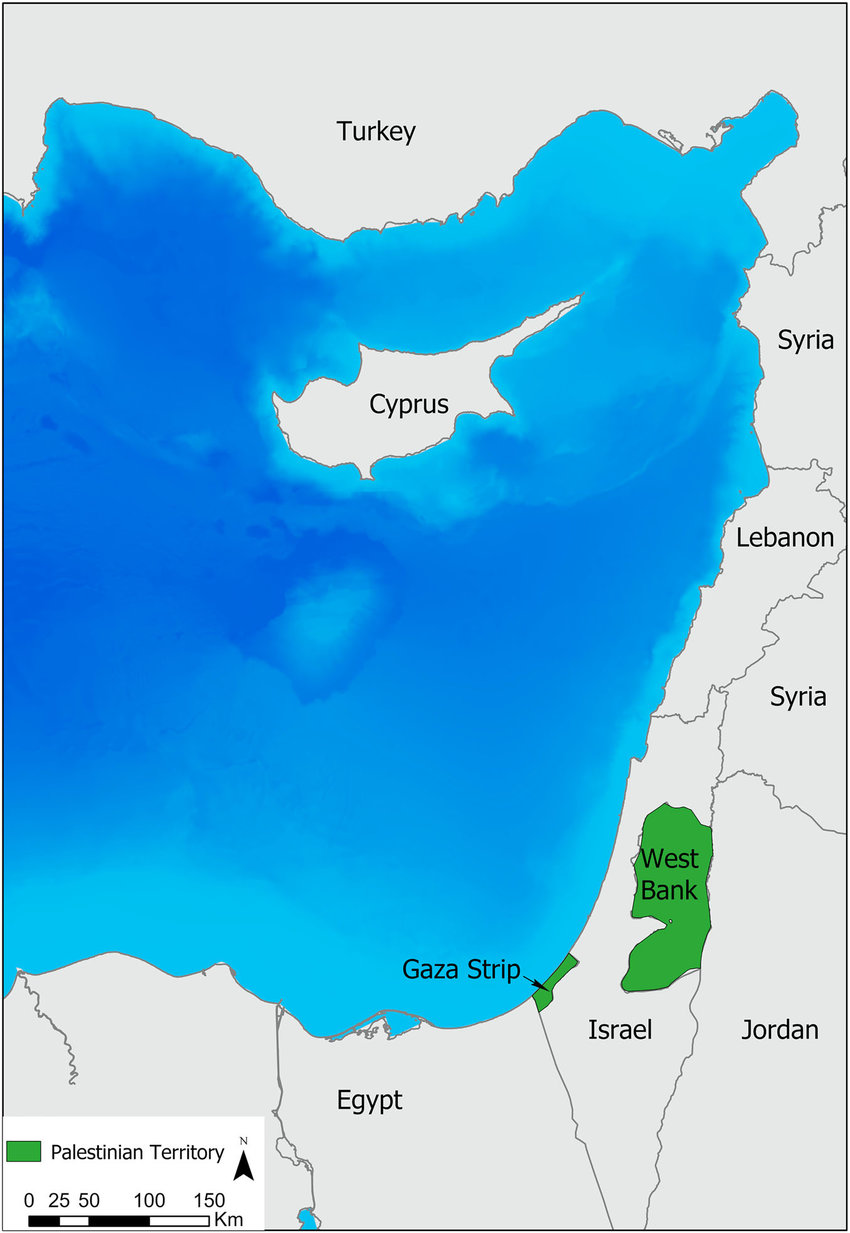
While bombs drop across Gaza, as the armchair experts exchange salvos and blame on social media, one basic fact seems to have been forgotten: Palestinians living in Gaza are humans just like everyone else. Together, they have their own culture, cuisine, and history that is also part of a larger Palestinian one. I want to take this moment to restore, in whatever small way that I can, the humanity of these people whose were already struggling -- but surviving -- before the recent events. This post will delve into the history, culture, and cuisine of the Palestinians who live in Gaza, with a particular focus to their ties to the Mediterranean Sea.

If we go back in time, Gaza was definitely a different place. Long before the first blockade, which Israel imposed after Hamas took control of the strip in 2006. Even before the Yom Kippur war of 1973.

Source: Research Gate

The Gaza strip is located on the southeastern edge of the Mediterranean Sea. There are forty (40) kilometers of coastline, which has a long historical connection with the sea. From 800 B.C.E. to 1,000 A.D., a thriving port known as Anthedon provided sea access to a succession of peoples, including Neo-Assyrian, Babylonian, Persian, Greek, Byzantine and eventually, Islamic empires (such as the Umayyad and Abbasid). During this time, the port played an important role in the incense trade and the silk route.  Goods such as spices, frankincense, myrrh, rare woods and precious stones made their way through the port.  The Anthedon Harbor is on a tentative list for designation as a UNESCO Heritage Site. 

While the Anthedon port continued into history under names, such as El-Blakiyeh, the strip continued to play an important role in connecting people with the sea, as well as promoting trade. Indeed, Gaza continued to serve as an important point in the spice trade until the 19th century. It served as the main port for goods being imported into southern Palestine, as well as Jordan and Iraq.

The Gazan coastline was not only important to international trade in the region, but also the local economy. Gazans have a long history and tradition of shipbuilding and fishing.  Workers would take their boats out to sea, drop their nets, wait patiently a few hours, and then pull up the nets to reveal the catch. At one point in time, that catch included  sardines, sea bass, mullet and various types of bream. The vessels would return with the catch, which would then make its way into the local market and on to the plates of Palestinian families.

Things changed after the Israeli government occupied Gaza in 1967. While a small port continued to exist in Gaza City, its role began to diminish and eventually end when Israel closed the port to international shipping. 

The Israeli government began to impose increasingly greater restrictions upon Gazan fishing boats. For comparison purposes, international law provides that the first twelve (12) nautical miles are territorial waters, with an additional twelve miles constituting a "contiguous zone" over which a country can exert certain authorities, which include fishing. Under the Oslo Accords of 1993, the area of territorial waters (and the contiguous zone) open to Gazans was limited to twenty (20) nautical miles. That area shrank to approximately twelve (12) nautical miles with the Bertini Commitment in 2005. Israel reduced the area open to Gazan vessels to six (6) nautical miles one year later. By 2009, the area open to Gazan fishing boats had been reduced to three (3) nautical miles, which is well short of where much of the fish swim. Israeli's navy enforced the restrictions, not only arresting workers on vessels that ventured too far out, but also shooting at them when at them for crossing the arbitrary lines that Israel drew in the sea. 

The lines changed again, with Israel widening them to fifteen (15) nautical miles in 2019, only to reduce it again one year later to eight (8) nautical miles a year later. The lines would change again and again at the whim of the Israeli government, usually in response to violence by terrorists, leaving Gazan fisheries uncertain about what their future held. Those uncertainties increased with Israel's initial blockade in 2006, which made fishing equipment and boat fuel harder to come by and more costly when found. The restrictions made it extremely difficult for Gazans to make a living off the seas, with an overwhelming number of fishermen living in poverty. 

Yet, there are still stories of how the Palestinians have persevered in the face of adversity. The Fishermen's Wives Seafood Kitchen provides one such example. Twenty wives of Gazan fisherman -- who call themselves Zawajat al-Sayyadin or "Fishermen's Wives" -- opened the kitchen to help their spouses. When the fishermen returned to port with their catch, the wives would prepare the seafood according to customers' orders. These orders include crispy fried fish, grilled fish, fish soups and fish pies. The prepared dishes could be sold for more than the fish. This effort followed a previous one that failed. But, the wives learned from the prior attempt, made changes, and found success, as well as support from a non-profit organization.

Some of the Fishermen's Wives preparing the catch. Source: Middle East Eye

For those Gazans who did not venture out into the dwindling areas where they could fish, they looked for other opportunities to continue their connection with the sea. One such opportunity involves a fish farm that is expected to raise sixty to eighty tons of sea bream each year. The farm was established with the assistance of the United Nations Food and Agricultural Organization and Italy. Palestinians have also established inland fish farms to raise tilapia. Both the sea bream and tilapia present opportunities to address needs within the Gaza strip, as well as potential "exports" to at least the West Bank, if not beyond (when allowed by the Israeli government). 

More importantly, these stories, and many others, provide insights into the Gazan people. Although told over the years, these voices are now silenced by the thunderous tones of war and weakened by the sharp propagandist attacks by each side's supporters.  The ultimate casualty are the innocent civilians who are caught in the cross-fire. They are first deprived of their humanity by outside forces, with the truly unfortunate being deprived of their lives. 

Martin Luther King, Jr. once said, "[o]ur lives begin to end the day we become silent about the things that matter." I have used this blog to protest the inhumanity of how people have been treated, such as Myanmar's treatment of the Rohingya or China's treatment of the Uyghurs. For me, this blog has evolved beyond just cooking food, but to learn about cultures and to gain a better understanding of other people and, most importantly, have a greater empathy for their lived experiences. 

So, I refuse to be silent in the face of so many people who appear to accept or ignore the dehumanization of everyday Palestinians. I will use my voice, through this blog, to recognize their lived experience (as briefly outlined in part, above) and to respect their culture and cuisine by preparing one of their traditional dishes (as set forth below).  

I have selected a dish that dish that represents the Palestinians' ties to the sea, namely, Zibdiyit Gambari (Spicy Shrimp and Tomato Stew). The dish calls for ingredients that are common in Gazan recipes, such as the use of dill, which has been referred to as part of the "Trinity of Gazan Cuisine," with the other parts of the trinity being seafood and resilience.  I also learned that Gazans have a love of spicy food, using chiles to bring a kick to many of their dishes. That is something that, as the more than a dozen dried and ground chiles in my pantry will attest, is something that I have in common with them. This particular dish was not too spicy, as I left out the seeds from the chiles. The end result was still a very delicious stew, that I served with some white rice and flat bread. 

ZIBDIYIT GAMBARI (SPICY SHRIMP AND TOMATO STEW)

Recipe from New York Times

Serves 4

Ingredients:

  • 2 tablespoons extra virgin olive oil
  • 1 medium red onion, finely chopped
  • 1 (14-ounce) can whole, peeled plum tomatoes, juices reserved
  • 1 teaspoon granulated sugar, plus more to taste
  • 3/4 teaspoon ground cumin
  • 1/2 teaspoon caraway seeds
  • 1/4 teaspoon ground allspice
  • Sea salt
  • Freshly ground black pepper
  • 1 to 2 jalapenos, finely chopped, plus more to taste
  • 3 garlic cloves, chopped
  • 2 tablespoons finely chopped fresh dill
  • 2 tablespoons sesame seeds
  • 1 pound raw medium shrimp, peeled and deveined, tails removed
  • Coarsely chopped parsley leaves, for serving

Directions:

1. Sauté the onion and garlic. Heat 2 tablespoons extra virgin olive oil in a large saucepan over medium heat. Add the onion and cook, stirring occasionally, until softened, about 10 minutes. Add tomatoes and their juices; 1 teaspoon sugar, the cumin, caraway seeds, allspice, 1/2 teaspoon each salt and pepper, and 1 cup of water to bring to a boil. 

2. Prepare the jalapeno, garlic and dill paste. Mash the jalapeno, garlic, dill and 1/2 teaspoon together using a mortar and pestle for a few minutes. Alternately, finely chop them together on a cutting board, then  mash them by pressing back and forth using the flat side of your knife until a paste forms. (Both approaches release the oil from the jalapeno and dill and make them more fragrant.) Add to the tomato sauce and stir to combine. Cover and simmer over low heat, stirring occasionally to break down the tomatoes, until the sauce is thickened and flavors meld, about 20 minutes. 

3. Toast the sesame seeds. in a small skillet, stir the sesame seeds over medium heat until golden brown, about 3 minutes. Transfer to a small bowl.

4. Cook the shrimp. When the tomato sauce is ready, taste and adjust the seasoning (you may want to add some more sugar or jalapeno). Finally stir in the shrimp, making sure that they are submerged, and cook over medium heat, stirring occasionally until they have all just turned pink and are cooked through, about 2 to 3 minutes. 

5. Finish the dish. To serve, drizzle with a generous amount of extra-virgin olive oil and scatter with the sesame seeds and chopped parsley.

*    *    *

I will have more to say in my efforts to protest against the dehumanization of the Palestinians who live in Gaza, as well as about the experiences of people around the world. Until then, lets pray for ...

PEACE.

Wednesday, November 1, 2023

Vindaloo Wings

If one was to look for a dry rub recipe for buffalo wings, they would most likely find a lot of commonality in the recipes. That commonality draws inspiration from Mexico (such as the use of ancho chile powder) or barbecue (with the use of smoked paprika, brown sugar and other ingredients). Those recipes may produce some very tasty wings,  but I want to go down a different path with dry rub wings. 

That is when I got to thinking of creating a dry rub that draws its inspiration from curries. More specifically, curries from India. Even more particularly, a particular curry that is symbolic of Goa. That curry is the fiery vindaloo. 

Typically, vindaloo is a sauce-based curry, with strong vinegar notes and a very spicy kick. There are a lot of recipes for a vindaloo paste, which could work well with buffalo wings. (I have used the paste in the past.) But, I wanted an even simpler preparation: just a spice mix.  

I found a basic spice mix that incorporates many of the spices that find their way into a vindaloo. These spices include chiles (of course), along with cardamom, cumin, coriander, cloves, and cardamom. The one spice that was missing, but which could usually be found in a vindaloo recipe, is turmeric. I could live without the use of the golden spice on this one occasion. 

One last note about this recipe, the chiles used in the spice mix are Kashmiri chiles. Those chiles are not as piquant as the chiles that would typically be used in a vindaloo. Goan dishes are well known for their use of the peri-peri chile, a very spicy chile introduced by Portuguese explorers and colonialists to the subcontinent. Kashmiri chiles have their own kick, which will probably be more appealing to people who do not ordinarily eat very spicy wings. 

VINDALOO DRY RUB WINGS

Spice mix recipe from Ministry of Curry

Serves 3-4

Ingredients:

  • 1 pound chicken wings, drumettes and flats
  • 1/4 cup apple cider vinegar
  • 2 teaspoons cumin seeds
  • 2 teaspoons coriander seeds
  • 20 black peppercorns
  • 4 green cardamom seeds
  • 4 cloves
  • 1 inch cinnamon stick
  • 8 dried Kashmiri chiles

Directions:

1.    Prepare the dry rub. Add all the spices to a dry frying pan and lightly toast until aromatic, about 2-3 minutes. Transfer the spices to a plate to cool completely. Grind the spices in a spice grinder to make a fine powder.

2.    Prepare the wings. Add the wings to a bowl and add the apple cider vinegar. Toss the wings in the vinegar until they are coated. Then add the dry rub and toss until all the wings are well coated with the spice mixgture. 

3.    Cook the wings. Heat an oven to 400 degrees Fahrenheit. Lay out the wings on a baking sheet lined with parchment paper. Place the wings in the oven and cook for about 25 minutes or until the wings reach an internal temperature of 165 degrees Fahrenheit. Remove from the oven, allow the wings to cool for about 5 minutes and then serve immediately. 

ENJOY!

Thursday, October 19, 2023

Cuminatum in Ostrea

I love reading about history, including culinary history. My travels through books and along the Internet take me to a lot of recipes. Many of those recipes, along with the resulting dishes, have long histories that date back decades, centuries and, in a few cases, perhaps a millennium or two. Yet, the recipes I find are usually the present day versions of those recipes, with little to no discussion about how we got to this point or that recipe.

Every once in a while, I will stumble upon someone who takes the time to find and talk about those recipes. In this case, it is the Historical Italian Cooking blog. The recipe that caught my eye is called cuminatum in ostrea et conchylia, which is Latin for cumin sauce for oysters and shellfish. The recipe dates back to at least the 5th century C.E., during which the Roman Empire collapsed (476 C.E.). We can go this far back because the recipe was found in the midst of a collection of recipes compiled in De Re Culinaria, also known as Apicius. The only surviving version of the Apicius dates back to the 5th century

Yet, cookbooks are sometimes akin to history books: they recount the recipe at the time of publication. This particular recipe may be much older, perhaps dating all the way back to the 1st century C.E. Some have attributed the Apicius to Marcus Gavius Apicius, who noble who was renown for his love of luxury foods. The Roman philopsopher Seneca once remarked that Apicius "proclaimed the science of the cookshop" (Seneca, Consolatio ad Helviami 10) and then corrupted the age through his example.

As the Historical Italian Cooking blog explains, Romans considered oysters to be a "costly food." Oysters may have been a luxury to the point that there was a reluctance to share them. The Roman poet, Martial (known as the father of the epigram, after all, he wrote 1,561 of them) recounted the following interesting epigram about a guest's response to the host's dinner: 

I dine with you at my own cost,

So why not fare the same, both guest and host?

You swallow Lucrine oysters large and fat,

I suck a whelk and cut my lips at that.

You're served with mushrooms, I chew fungus still,

You have to do with turbot, I with brill

Plump yellow doves your appetite assuage, 

I have a magpie starved within its cage.

I am by your side and yet I'm far away.

The dole has gone. Let's fare the same, I say.

Clearly, oysters ranked with other luxurious food items, such as mushrooms, turbot, and "plump yellow doves." (By the way, the underlying message in this epigram is as timeless is as true today as it was when Martial wrote it back in the first century A.D.) Other epigrams and poems by Martial underscore the oyster as an expensive food for Romans. 

Yet, even a costly food item like oysters has its limits. In another poem, Martial wrote, in part: 

I WILLINGLY accept your dainty fare

If hospitality be undesigning: 

Not so, if you imagine that I care

For nothing in the world so much as dining; 

A dozen oysters will not make you heir

To my reputed wealth for which you are pining; 

The feast is elegant; that I admit

But on the morrow what is left of it? 

Upon the morrow? Where is it to-day

The moment after it has passed your gullet?

Thus, oysters won't make you rich during Roman times, but they were certainly enjoyed by the rich.

This leads me to how Romans ate oysters. For that, I turned back to the Historical Italian Cooking blog. The author writes that in books wrote in the 2nd century, Galen's De Facultatibus Alimentorium, and in the 6th century, Anthimus' De Observatione Ciborum, recount that Romans ate oysters both raw and cooked (either boiled or fried). 

However, the recipe in Apicius provides for the oysters and shellfish but did not provide a cooking method. it provided only a sauce, and one that has its base in cuminum or cumin. In fact, the sauce requires a good amount of cumin (or cuminum plusculum). The recipe also calls for other spices (black pepper and lovage), herbs (fresh parsley and mint, the recipe calls for dried mint but you can use fresh mint), and a liquid mixture that consists of honey, garum and vinegar. If you do not have lovage, Historical Italian Cooking advises that, according to Pliny, you could use anise seeds, or according to Dioscorides, you can use fennel seeds.

For this recipe, I decided to prepare the sauce to serve with raw oysters. While I do not have authentic Roman garum (check out this post by Historical Italian Cooking on how to make it), I do have a significant amount of Vietnamese fish sauce (check out my post with a brief discussion of the history of fish sauce, including a reference to garum). I have modified the recipe slightly from the one provided by Historical Italian Cooking to show both how the writer described the preparation and how I prepared this dish. 

In the end, I have to say that I was not a big fan of this sauce. While I like cumin as a spice, I came to the realization that I am not keen on cuminum plusculum. The large amount of cumin overwhelmed the flavors of the oysters, with the brininess being lost in the loud notes of the spice. 

CUMINATUM IN OSTREA

Recipe adapted from Historical Italian Cooking

Serves several

Ingredients:

  • 1.5 kilograms (about 3 pounds) of oysters
  • Pinch of freshly ground black pepper; 
  • Pinch of fennel seeds; 
  • 4 tablespoons of cumin;
  • 1 bunch of parsley, minced finely
  • 1 tablespoon of dried mint leaves
  • 1 tablespoon honey
  • 1 tablespoon fish sauce
  • 2 tablespoons white wine vinegar

Directions:

1. Prepare the sauce. Mince the parsley (and mint, if you use fresh mint). Pound them in the mortar with the pepper and the fennel seeds (or anise seeds or lovage), adding the cumin as you work. Move the mixture to a bowl and then proceed to mix in the honey and fish sauce (or garum), diluting it with the vinegar. 

2.  Finish the dish. Shuck the oysters and reserve the liqueur. Add some of the liqueur to the cumin sauce. Spoon some of the sauce over the shucked oysters and serve immediately. 

ENJOY!

Thursday, October 12, 2023

The Long History Told by Bones

Salmon are an intrinsic part of us. They're in our blood. They're in our being.

- Hereditary Chief Don Svanvik, 
Namgis First Nation, 
Alert Bay, British Columbia

Recently, an online article caught my eye. The article's title was "Salmon Bones Confirm Sustainable Chum Fishery for 2,500 Years Under Tsleil-Waututh Nation."  That title represented a ray of light, a little bit of good news, that brightened what is becoming an otherwise dark picture.

It seems - to me at least - that much about what I have been reading about Pacific salmon has ranged from bad to ominous. This sense seems particularly the case for the salmon in the Pacific Northwest.  For example, a report in 2019 found that, while the preliminary forecasts for chum salmon in the Puget Sound hovered around 550,000 fish, the actual amount may have been more along the lines of 243,000 fish. That statistic is particularly alarming given that the chum salmon has traditionally been the most abundant of all the different types of salmon. 

There are many reasons for the population declines. At first, the culprit was overfishing in the 19th and 20th centuries. The loss in fish numbers was compounded by the loss of their habitat, which was primarily due to the construction of dams that blocked the rivers used by the salmon, along with the timber industry, which damaged the rivers and streams.  And then there is climate change and, in particular, the warming of the Pacific Ocean. As it turns out, just a few degrees of increased temperatures can have a significant impact on salmon populations. As the oceans warm, it favors subtropical zooplankton, which are not eaten by juvenile salmon. Warmer water also has less oxygen, making it harder for the fish to breath.

Yet, this is all the bad news; and, I started out this post noting a ray of light. Research has shown that one of the Salish peoples of the Pacific Northwest - the Tsleil-Waututh - have a long history of managing the chum salmon populations where they live. The story actually explains that the Tsleil-Waututh have a much longer history of managing that important resource.

Archeologists had already known that the Tsleil-Waututh, who live in the Burraud tribal territory, have been sustainably fishing chum salmon for about 1,200 years, from approximately 400 BCE to 1200 A.D. However, recent finds at an archeological site at təmtəmíxʷtən, a very important site for the Tseleil-Waututh, have revealed that this fishery has existed for an additional 1,300 years. This history is important because of one fact: chum salmon are especially vulnerable to overfishing. 

This story has led me to think about how we develop our guidelines for sustainability. Often times, those guidelines are dictated from the top down, from the government to the people, with a healthy disdain for guidelines coming from the reverse direction. As long as people are motivated by capitalistic desires, such as the private ownership of resources and maximizing profit for personal gain, that disdain is warranted. But, what if the people are motivated by something else. What if, like the Tsleil-Waututh, the people are motivated by preserving the resources for future generations to enjoy. Resources that are able to thrive in a larger, more balanced ecosystem. 

All of the foregoing also got me thinking about the salmon recipes that I have made over the years. This is perhaps my most favorite recipe on my blog: 


COPPER RIVER SALMON WITH AN ORANGE-SAFFRON SAUCE
Adapted from recipe by Hunter Angler Gardener Cook
Serves 4

Ingredients for the Orange-Saffron Sauce:
1/2 cup of white wine
1/2 cup orange juice
A healthy pinch of saffron, crumbled
A healthy pinch of sugar
1 shallot, minced
Salt
2 tablespoons of unsalted butter

Ingredients (for the fish and greens):
1 1/2 pounds of tender spring greens, such as spinach
5 tablespoons of unsalted butter or vegetable oil, divided
A splash of water (no more than 3 tablespoons)
Grated zest of an orange
1 1/2 pounds of Copper River Salmon (or any wild salmon)

Directions:
1.  Make the Orange-Saffron Sauce.  Make the sauce by bringing the white wine, orange juice, saffron, sugar and shallot to a boil in a small pot.  Simmer strongly for 5 minutes, then turn off the heat and puree the sauce in a blender.  Return the sauce to the pot and turn the heat to low.  Add salt to taste and keep warm, but do not boil it or simmer it any further.

2.  Make the Greens.  Cook the greens in 2 tablespoons of butter or oil over high heat in a large saute pan, stirring constantly until they wilt. Add a splash of water, the orange zest and some salt and cover the pot. Lower the heat to medium-low and steam the greens for 2 minutes. Turn off the heat.

3.  Sear the salmon.  Heat the remaining butter in a pan large enough to hold the fish.  (If you don’t have such a pan, put a baking sheet in the oven and set the oven to 200 degrees Fahrenheit so you can keep the fish warm as you do this in batches.)  Heat the butter over high heat until it stops frothing. Pat the fish dry with paper towels and set it skin-side down in the hot butter. Turn the heat down to medium-high for a typical fillet  or to medium if you are working with a thicker piece of fish.

4.  Continue cooking the salmon.  Let the fish cook undisturbed for 2 minutes, then use a large spoon to baste the meat side of the fish with the hot butter. Baste the salmon for 90 seconds, then give it a rest. A thin fillet will only need one quick basting, but thicker pieces of fish will need a second or even third round of basting.  It took about four to five rounds of basting for the fillets that I had.  When the basting is done, salt the meat side. The skin side should lift off the pan easily after about 4 to 5 minutes of steady cooking. The moment you take the fish off the heat, salt the skin side.

5.  Finish the dish.  To serve, swirl in the remaining 2 tablespoons of butter into the sauce, one tablespoon at a time. Pour some sauce on everyone’s plate. Top with the greens and then with a piece of fish. Serve immediately.

OTHER DELICIOUS SALMON RECIPES TO TRY

If you are looking for other recipes to honor the salmon and its place in the foodways of different cultures, or if you are just looking for a delicious recipe, I suggest these possibilities:

Smoked Sockeye Salmon:
 This is about as close as I can get to trying to pay homage to how Native Americans and First Nations would prepare their catches. You can check out the post and learn about the Legend of the Lost Salmon. This is one of the recipes that I wish I made more often, if only I had the time and the memory to remind myself. 

"Imperial" King Salmon:
This dish features king salmon grilled on an alder plank. It also features a crab imperial over the top. The imperial literally places this dish over the top. 

Cedar Plank Salmon:
 This recipe was truly an educational experience for me. The "smothering" of the salmon with onions serves an important purpose. The water in the onions help to keep the salmon moist.

Pike's Place Salmon Burgers: 
The final recipe comes from one of my Super Bowl parties, when I prepared a dish from the city of one of the Super Bowl contenders. Back in 2014, that contender was the Seattle Seahawks. So, I prepared a salmon burger recipe that comes from the city's iconic Pike's Place market. 

These are just some of the salmon recipes on this blog. If you want to see the other posts, just click on "Salmon" in the word cloud in "What's in my Fridge + Pantry." Until next time, 

ENJOY!

Sunday, October 1, 2023

A Casualty of History

When the people don't give a damn about reason, they can be manipulated quite easily - and in such cases the perception of the people are manufactured by those controlling the narratives. As a result, ask an Azerbaijani, "who do you think is at fault for the conflict at Nagorno-Karabakh" and they'll say, "Armenia of course" .... Hard as it may sound, whoever controls the narrative, controls the people. And the only way to break that spell is to practice reason, but without losing your warmth.

-- Abhijit Naskar

It is often hard to find a narrative that is not tainted by whoever wields it, especially when it comes to culture, history and/or politics. There are often multiple narratives, some of which are irreconcilable. Yet, even in the fog of conflicting narratives, some facts shine through. Those facts cannot be denied, because they unfold before our eyes or the sounds reach our ears. This has been the case for the past days, weeks and indeed months as a so-called "breakaway republic" will now fade into the pages of history books. The consequences of what happened will live on, not only in those who suffered in the past, but in the suffering of untold numbers in the future. 

The "breakaway republic" that I am referring to is known as the Republic of Artsakh, more commonly known as Nagorno-Karabakh. The latter name is a combination of Russian (Nagorno) and Turkish/Persian (Karabakh) that translates roughly into "mountainous black garden." The Armenians living in the region preferred to call it Artsakh, because that lacked any reference to Russians, Turks, Persians or Azerbaijani. I will refer to Nagorno-Karabakh and Artsakh interchangeably. No country has recognized Nagorno-Karabakh as an independent state; instead, it has been considered to be part of Azerbaijan. Yet, the people who live within the borders of Nagorno-Karabakh are overwhelmingly Armenian. 

That one fact -- a region populated by Armenians that is part of a larger country whose majority is Azerbaijani -- provides the starting point. The mapmakers who created this issue were colonialists, but of a Russian kind. The Russian Empire obtained territory throughout the Caucasus Mountains, including both Armenia and Azerbaijan, as part of treaties that ended the Russian-Persian war in the early nineteenth century. Wars erupted between the Armenians and Azerbaijani in 1917 over various parts of their territories.  It was not until the aftermath of the Russian Revolution, when the Bolsheviks occupied Azerbaijan (including Nagorno-Karabakh) and Armenia, that the borders began to become fixed. The resulting Soviet Union decided that the Nagorno-Karabakh region would remain in Azerbaijan, but the region would retain significant autonomy. That seemed to settle the matter ... until the Soviet Union ceased to exist. 

Azeri poster about Karabakh,
saying "Stand up, son of a Turk" 

As the Soviet Union crumbled, tensions increased within Nagorno-Karabakh. The majority Armenian population wanted the region to be transferred to Armenia. However, they could not get anyone to support their calls. In August and September 1991, both Azerbaijan and Armenia obtained their independence from what was the Soviet Union. Thereafter, the situation began to deteriorate precipitously.  On November 26, 1991, Azerbaijan ended the separate structure of Nagorno-Karabakh (officially known as the Nagorno-Karabakh Autonomous Oblast) and placed the entire region under Azeri control. The region conducted a referendum on December 10, 1991 (boycotted by Azerbaijanis) that resulted in a call for unification with Armenia. The lines were drawn. War broke out. 

The war killed approximately 30,000 people and made refugees out of hundreds of thousands more. A ceasefire was negotiated in 1994 and relative peace was achieved. I say relative because fighting would take place over the coming years and decades, including as recently as 2020. During that conflict, Azerbaijan not only attacked positions within Nagorno-Karabakh, but also Armenia. Those hostilities ended with another cease fire, but it seemed that Azerbaijan was gaining the upper hand.

But it is the events of the past few weeks that gave rise to the casualty of history. For some (additional) context, the predominantly Armenian territory of Nagorno-Karabakh was connected to the country of Armenia by one road, known as the Lachin corridor. Initially, a group of "environmentalists" blocked the corridor. I use the term in quotes because many of those "environmentalists" had connections with the Azerbaijani government. That government also cut off all gas supplies to Nagorno-Karabakh.

The Lachin checkpoint
Azerbaijan escalated the issue by establishing a checkpoint in the Lachin corridor. Perhaps the more appropriate term is a "chokepoint." The Azerbaijani military has used the checkpoint to restrict the passage of goods, materials and commodities between Armenia and Nagorno-Karabakh. Azerbaijan imposed a blockade in April 2023, depriving the people of Nagorno-Karabakh of what they needed to survive, like food, gas and medicine. The blockade soon extended to anything and everything by June 2023. The people of Nagorno-Karabakh were cut off from not only Armenia, but the entire world.  

On September 19, 2023, Azerbaijan commenced a military offensive, which ended one day later with a ceasefire, along with subsequent violations of the ceasefire. Azerbaijan then commenced its efforts to integrate Nagorno-Karabakh into the country. The violence, along with the seeming end of any autonomy, led to a mass exodus of Armenians from Nagorno-Karabakh to Armenia. As of the end of September 2023, more than 100,000 Armenians have fled to safety in Armenia. The population of Nagorno-Karabakh was approximately 120,000 prior to the recent Azerbaijani military offensive. Those who remain would be forced to accept Azerbaijani citizenship.

Ethnic Armenians fleeing Nagorno-Karabakh. Source: Vasily Krestyaninov (AP)

So, here we are, after months of an economic blockade, Azerbaijan used overwhelming military might to force the surrender of the governmental authorities in Nagorno-Karabakh. The military victory paves the way for the former Republic of Artsakh to be fully incorporated into Azerbaijan. The treatment of the Armenian people has led to a mass exodus that could, at the very least, be described as an act of ethnic cleansing.  Alternatively, Azerbaijan's conduct could be described, as it has by several legal experts, as a crime against humanity

The objective of the crime is two-fold: (1) to eliminate the Republic of Artsakh; and (2) to eliminate the Armenian culture that developed within its borders. As Azerbaijan has largely achieved both goals, feelings of powerlessness and meaninglessness may seem too much to overcome. Then again, remember who controls the narrative. In the face of violence and inhumanity, we can break the control over the narrative. So that no one will forget who lived in the mountainous black garden that the Armenians called Artsakh.

That is the purpose of this post. My goal is to make the one food that indisputably comes from the Armenian community that lived in Artsakh. That food is called Zhingalov Khats. The recipe embodies the principle of "Karabaghstin sovadz chi mnoum" or "the people of Karabakh do not remain hungry." During the wars with Azerbaijan, the local populace would gather greens from the forest and elsewhere to prepare this dish, as well as a broth of wild greens. 

The recipe starts with an unleavened dough, which is rolled out into a thin circle. A filling is then prepared by chopping various herbs very finely. If one were preparing this dish in Artsakh, they would be looking for herbs that go by the name of k'ndzmendzyuk, chercheruk, s'msemok and mokhratal. These are just some of the at least seven herbs that are used to make zhingalov khats. Some recipes call for as many as twenty herbs for the filling. Regardless of the number of herbs used, the other ingredients include lemon juice, paprika and some salt. The dough is then folded over and sealed. The packet is then pressed slightly so that it looks like a deflated American football. Once the bread is ready, it is cooked over a saj, which is a specialized domed griddle.

In my case, I prepared a filling that consisted of cilantro, spinach, kale, Swiss chard and scallions.  I could not reach the threshold of seven ingredients because I had some difficulty in finding the other greens at my local grocery store. These greens and herbs included chervil, turnip greens, tarragon, radish tops, sorrel and watercress. Nevertheless, I kept those ingredients in the recipe below in case you are able to find them in your local store. As for the preparation, once I placed the stuffing and sealed the dough, I used a standard griddle to cook the bread.

One final note: it is said that zhingalov khats is best enjoyed with a fine red wine. I definitely have a suggestion, namely, the Karas Classic Red, which comes from Armenia.

ZHINGALOV KHATS

Recipe adapted from Cafe Osharak and New York Times

Serves 4

Ingredients (for the Lavash):

  • 2/3 cup lukewarm water
  • 1 teaspoon kosher salt
  • 1 1/2 cups of all purpose flour, plus 200 grams more for dusting

Ingredients (for the filling):

  • 2 pounds chard, tough stems discarded
  • 4 packed cups fresh cilantro, chervil and dill leaves and tender stems
  • 4 packed radish greens and sorrel
  • 6 spring onions or 10 scallions, thinly sliced
  • 2 tablespoon lemon juice
  • 3 tablespoons sunflower oil or other neutral oil
  • Lavash dough

Directions:

1. Prepare the lavash. In a medium bowl, combine 1 1/2 cups of flour and the salt. pour the lukewarm water into a large bowl, then gradually add the flour mixture, using your hands to incorporate. The dough will be sticky. Dust the counter with flour, turn dough onto it and knead gently until the surface becomes smooth and the dough stops sticking to your hands and counter, about 5 minutes. Roll the dough into a ball, place it in a lightly oiled bowl, turn it to coat, then cover it with a kitchen towel. Let it rest at room temperature for 20 minutes to 1 hour.  

2. Prepare the filling. Wash and dry all of the greens. Chop the greens finely. Mix with spring onions, lemon juice and salt. 

3. Prepare the bread. Spread flour over the work surface. Divide the dough into 4 equal pieces and roll into thin 8 inch ovals using a rolling pin. Place about 2 cups of the filling in the center, then use your hand to pat it down into a round, leaving about a 1 inch border of dough. Pick up the two opposite sides of the dough and pinch them together over the center of the filing, from top to bottom so the middle is wide and the ends form points. 

4. Continue to prepare the bread. Firmly pinch the seam to make sure it's sealed, then turn the dough over and gently flatten it out with the palm of your hand so it resembles a deflated football, sealing any holes in the rough. It should be about 1/4 to 1/2 inch thick. If it is thicker, use a rolling pin to smooth it out aa little. Pinch shut any holes in the dough and then place it on parchment. Repeat steps 3 and 4 with the remaining dough.

5. Cook the bread. Heat a large cast iron pan over medium high. Working with one dough portion at a time, place the dough seam-side down in the center of the pan. Lower the heat to medium and cook for about 3 minutes, until cooked and lightly browned in places. Flip, and cook the other side for 2 minutes. If the dough seems raw in places, flip and cook evenly. Repeat for the rest of the zhingalov khats and serve warm or at room temperature.

*    *    *

Nagorno-Karabakh has become a casualty of history. A history of artificially drawn borders, dividing communities with political boundaries that, sometimes, bind those communities with larger groups of people. When one adds the worst of humanity - distrust and hatred of those who are different - with the desire for power and control, then the scene is set for the events of Nagorno-Karabakh. The only question is when the final act will play out. It has unfolded while the world has watched. It did so silently as brutality, inhumanity and violence caused Artsakh to fall and to force over 80% of the population to flee their homes. 

I leave you with one last note: there are many more Nagorno-Karabakhs across the globe. As you read this post, the military forces of Serbia are amassing along the border with Kosovo, a breakaway republic in the Balkans that is only partially recognized. My guess is that the Serbian government has made a bet: if the West sat silent as Azerbaijan ethnically cleansed Nagorno-Karabakh, then it is unlikely to do anything if the scene repeats itself in Kosovo. 

Only time will tell.