Sunday, May 6, 2012

Ancho Chipotle Rockfish Burgers with Oaxacan Guacamole

One day, my beautiful Angel, Clare, said that she really wanted some guacamole.  Those words got me to thinking ... how could I make some awesome and different guacamole for her.  I ran through some different ingredients in my head and I did a couple Google searches.  I ultimately decided to make some Oaxacan guacamole.  

The recipe caught my attention because I am fascinated with Oaxacan cuisine, especially the use of sauces and moles.  The principal difference between Oaxacan guacamole and other guacamole is the use of garlic.  A lot of garlic.   After I settled on a recipe, I got to thinking about how to serve the guacamole.

Being an amazing cook herself, Clare once made Salmon Burgers with an Ancho Guacamole.  I decided that I would work off of that recipe.  However, instead of using salmon, I used rockfish.  The Chesapeake Bay has large, sustainable populations of rockfish, which makes it my usual go to for any fish course.  So, I decided to make rockfish burgers. 

Given I was making rockfish burgers with the Oaxacan guacamole, I decided to give the rockfish a little Mexican kick.  I added a little ancho chile powder and some chipotle chile powder to the ground fish.  I also decided to double down on the chipotle flavor by using a chipotle mustard.  If you do not have any chipotle mustard, you could just use plain ground mustard.


ANCHO CHIPOTLE ROCKFISH BURGERS
WITH OAXACAN GUACAMOLE
Recipe for guacamole adapted from Whole Food Markets
Serves 2-4

Ingredients (for the rockfish burgers):
1 pound of rockfish fillet
1/2 cup of panko bread crumbs
1 tablespoon of lemon juice
1/4 teaspoon of ancho powder
3 tablespoons of Lusty Monk Chipotle Mustard
    (or substitute with 3 tablespoons of ground mustard
    and one-half teaspoon of chipotle powder)
1 teaspoon of ground mustard
Salt, to taste
Ground black pepper, to taste
2 tablespoons of vegetable oil
Kaiser rolls

Ingredients (for the Oaxacan Guacamole):
4 avocados, mashed
Juice from one lime
3 garlic cloves, thinly minced
5-6 green onions, thinly sliced
1 cup of cilantro, chopped
1 jalapeno, diced

Directions:
1.  Prepare the rockfish burgers.  Pulse the rockfish in a food processor about a dozen times until it is chopped well.  Transfer the fish to a bowl, and add the bread crumbs, lemon juice, mustard, ancho powder, salt and ground black pepper.  Mix thoroughly with your hands.  Form four patties.  Refrigerate the patties for about twenty to thirty minutes.

2.  Prepare the salsa.  Mix avocado with lime juice and then stir in garlic, onions, cilantro and jalapeno peppers. 

3.  Cook the rockfish burgers.  Heart the vegetable oil on high.   Add the burgers and reduce the heat to medium high.  Continue cooking for about eight minutes, and flip the burgers.  Cook for eight more minutes or until done.  

4.  Plate the dish.  Place a rockfish burger on each roll.  Spoon a large dollop of guacamole on top of the burger.  Serve immediately.  


PAIRING THIS RECIPE

When thinking about what to pair with this dish, I decided that a smooth, rich white wine would work well.  I think that a Chardonnay, Viognier, or Sémillon.  A couple of wines that I have reviewed that may go well with the Ancho Chipotle Rockfish Burgers with Oaxacan Guacamole are the following:

L'Ecole No. 41 -- Columbia Valley Sémillon
100% Sémillon
Walla Walla, Washington USA
Flavors of melon, pair and apple

Sugarloaf Mountain Vineyard -- Chardonnay
100% Chardonnay
Comus, Maryland, USA
Flavors of apple and pair

 ENJOY!

Friday, May 4, 2012

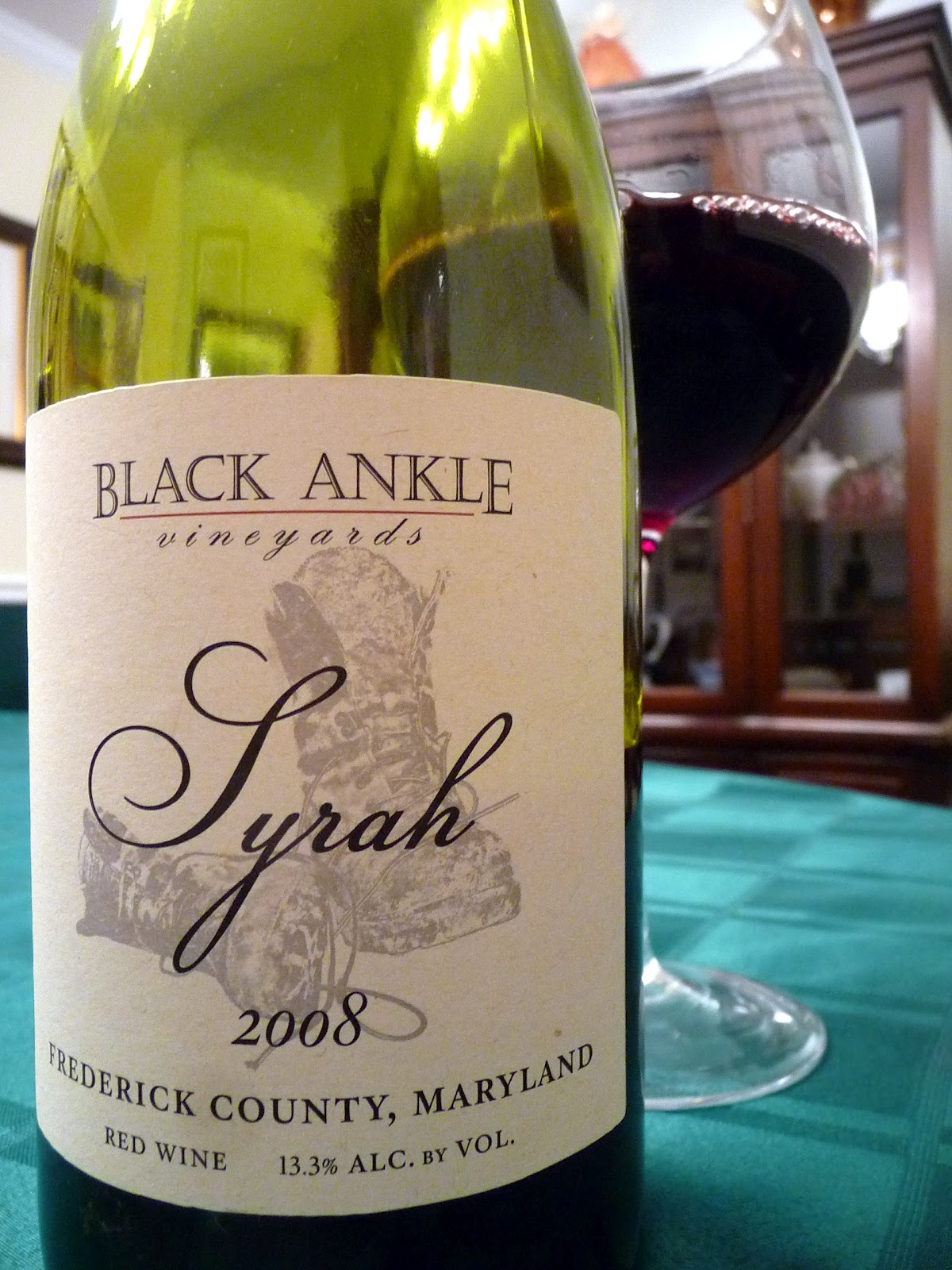
Black Ankle Vineyards Syrah (2008)

The year is 77 AD.  Pliny the Elder (that is Gaius Plinius Secundus, not the beer from North Coast Brewing) was writing his Naturalis Historica.  The particular topic at that moment was the wines of Vienne, which is in the present day Appellation d'Origine Contrôlée (AOC) of Côte-Rôtie northern Rhône wine region of France.  The local peoples, the Allobroges, made a prized wine from a dark-skinned grape. As he described the grapes and the wine, Pliny called it "Allobrogica," and, some people today think that Pliny the Elder was referring to what is known today as the Syrah grape. 

The foregoing story, which is recounted in Wikipedia, is disputed by historians.  What cannot be debated is that the Syrah grape, whether grown in Côte-Rôtie or anywhere else, produces some very good wines.  Recently, I saw a bottle of a Syrah from Black Ankle Vineyards at a local grocery store.  Black Ankle is the realization of a dream for two people -- Sarah O'Herron and Ed Boyce -- who left their jobs as consultants, traveled the world to learn about wine and food, and, ultimately, choose a spot in Maryland where they would make Old World-style wines in the New World.  They purchased a working farm, planted a variety of grapes, and waited.  And waited.  After all, it takes a few years before vines will produce grapes for wines.  The wait was well worth it.  Black Ankle now produces a wide range of wines from blends like the Slate to single grape varietals like the Viognier and the Syrah. 

The Black Ankle Syrah pours a nice ruby red color, with crimson tones.  The winemaker suggests there are "smokey aromas of coffee, dark chocolate, cinnamon and spice are finished with hints of savory maple and bacon."  I have to admit that my palette is still developing, and I was not able to sense all of those flavors.  However, for me, I could smell flavors of coffee, spice and a little earth or leather, wrapped around deep, ripe cherries. 

As for the taste, the winemaker describes the wine as having "rich tannins support flavors of cranberry and tapenade, followed by espresso bean and vanilla."  I definitely could taste cranberries, along with those ripe cherries that I sensed in the aroma, with some vanilla undertones and spices.  The wine had a nice dry finish, which also had some of the tannins that one would typically expect in a syrah wine.

Wines such as Black Ankle's Syrah can be paired with food in the same manner as a French Syrah from the Rhône valley.  The earthy quality of the wine, with its spice, would pair well with just about any red meat dishes, whether beef or bison.  Grilled ribeyes or strip steaks would work well with this wine.  Some cuts, such as flank steaks or iron steaks, could also be paired with this wine, provided that the marinade used does not contain a lot of heat from peppers or chiles .  The tannins in the wine will emphasize the spice in the marinade.  There are many other possible pairings, such as with lamb or pork, but that discussion could continue for quite a while.

I found the Black Ankle Syrah at a local grocery store in Olney, Maryland.  This particular vintage is sold out, as is the 2009 vintage, but there may still be some on store shelves.  I am looking forward to seeing the 2010 vintages on the shelves at some point.  It would be particularly interesting to compare the vintages.  However, that is for another post....

ENJOY!

Thursday, May 3, 2012

Grilled Calamari Salad

When I looking for frog legs to make Grenouille à la Provençale, I saw something that I had never seen before in a grocery store ... large, whole squid.  I am not talking about the little white cones and small tentacles that one usually sees  in the seafood section of most grocery stores.  Those are baby squid.  This particular grocery store had much larger squid, measuring nearly a foot long.  And, while I recognize that squid can grow to as large as forty-three feet long, these foot-long specimens were the largest that I had ever seen in a grocery store.  So, of course, I had to cook with them.

The first question that came to mind is how to prepare the squid.  Fry, saute, or grill.  I settled on the last option, primarily because of the size of the squid.  The only issues with respect to grilling the squid are (1) to ensure that the squid does not become to tough to eat; and (2) to ensure that the squid remains flat during grilling to guarantee even cooking.  The first issue is resolved by the technique recommended for cooking large squid generally ... scoring the inside of the bodies.  Small squid are popular because they are tender.  As a squid grows in side, the meat becomes tougher and more chewy.  By scoring the inside of the bodies, it makes the large squid a little more tender.  As for the second issue, the use of skewers would keep the squid flat as they were grilled. 

The next question was how to serve the squid.  I answered that question with a salad.  It is a healthy option so long as you are mindful of what you add to the salad.  In this instance, I added some diced, roasted bell pepper, some red onions marinated in balsamic vinegar and some tomatoes.  The effort was definitely a success, both with respect to the squid and the salad. 


GRILLED CALAMARI SALAD
A Chef Bolek Original
Serves 2-4

Ingredients:
3 whole squid bodies
Juice from 1 lemon
1 teaspoon of lemon zest
Juice from 1 lime
1 teaspoon of lime zest
1/4 teaspoon of sea salt
1/2 teaspoon of sugar
Pinch of crushed red pepper
Pinch of dried thyme
Ground black pepper, to taste
1/4 cup of extra virgin olive oil
1 bell pepper
1/2 red onion, thinly sliced
1/2 cup of balsamic vinegar
2-4 cups of baby arugula
Skewers

Directions:
1.  Prepare the squid. Clean the squid.  Using a small sharp knife carefully cut to separate the innards from the back of the body.  Pull out the head and the innards carefully, making sure not to break any of the insides.  Wash the inside and outside of the squid thoroughly.  Using a sharp, thin knife, fine the seam of the squid body (where the backbone/cartilage was) and slice through to open the squid body until it lays flat.  Score the inside of the squid body carefully, making sure that you do not pierce the meat.  

2.  Marinate the squid.  Combine the juice of the lemon and lime, along with the zest, sea salt, sugar, crushed red pepper, thyme, black pepper and olive oil.  Stir well.  Add the bodies and tentacles to the marinade.  Marinate the squid for no more than thirty minutes.  

3.  Roast the bell pepper and marinate the onions.  If you have a gas range, place the bell pepper over one element on high heat.  Blacken the skin, use tongs to rotate the pepper and continue to roast until the pepper is blackened on all sides.  Let the pepper cool down.  Once you can handle the pepper, peel off all of the black skin under a little running water.  Dice the bell pepper.  Also, place the sliced red onions in the balsamic vinegar.  Toss and let sit for about twenty minutes. 

4.  Grill the squid. Soak some skewers in water.  Thread the squid bodies with the skewers so that they will lie flat when grilled.  Also wrap the tentacles around skewers.   Heat the grill on high heat. 


PAIRING THIS RECIPE

Generally speaking, squid is the type of seafood that pairs best with a white wine.  The grilling of the squid opens up options both for light, fruity whites -- such as a Pinot Grigio -- as well as more rounded whites like a Chardonnay.  Both Clare and I paired this recipe with the following Chardonnay:

Sugarloaf Mountain Vineyard -- Chardonnay (2010)
100% Chardonnay grapes
Comus, Maryland, USA
Flavors of pears and apples
ENJOY!

Tuesday, May 1, 2012

Sugarloaf Mountain Vineyard Chardonnay (2010)

After experiencing the great wines of Black Ankle Vineyards and Serpent Ridge Vineyard, it has become a "mission" of sorts for me to learn more about Maryland's wine movement.  A couple months back, Clare and I took my parents on a little "wine-tasting" tour of Maryland.  We began our tour at Sugarloaf Mountain Vineyard in Comus, Maryland.  After tasting Sugarloaf's wines, Clare and I purchased a bottle of the vineyard's Chardonnay. 

Sugarloaf Mountain Vineyard produces the Chardonnay in a Chablis style.  Chablis is the northernmost wine district in Burgundy, France.  The wines produced in this region have their own truly unique characteristics.  The cool climate of the Chablis region lessens the fruity flavors of the grapes and heightens the mineral flavors of the wine.  Some describe the mineral flavors as having flinty notes, a sort of "goût de pierre à fusil" or the taste of gunpowder.  Most Chablis wine is not aged in oak barrels; instead, winemakers age the wine in stainless steel tanks.  The white wines of Chablis have less of an oak influence than other whites produced in Burgundy or with the Chardonnay grape. 

Although I have not had a lot of Chablis wine, I can see why Sugarloaf Mountain Vineyard says it produces its Chardonnay in the Chablis style.  Although this Chardonnay is aged in oak barrels (which would be challenged by Chablis purists), the presence of the oak in the wine is much less than other Chardonnays that come from California or elsewhere.  

Apart from the taste imparted by the oak barrels, the Chardonnay pours a color of light gold or, as the winemaker suggests, yellow straw.  The winemaker also describes the wine has having "aromas of vanilla, ripe pear and apple, citrus and spices."  For me, the aromatic elements of the wine suggest some mineral (not quite a goût de pierre à fusil), but also an abundance of fruit, such as apples, as well as a little pear or melon.  The wine is smooth, with a little tartness around the edges that frame a pear-filled taste.  As the winemaker suggests, the finish of the wine is open with apple and pear fruit. 

The winemaker suggests that this wine will be great with salads and grilled fish or seafood.  Clare and I paired this wine with a Grilled Calamari Salad.  The wine paired well with the grilled squid and the other flavors in the salad. 

We purchased this wine at Sugarloaf Mountain Vineyard's tasting room and it may still be available for purchase online or at some stores in the area around the Vineyard. 

ENJOY!

For more about Chablis wine, check out Wikipedia.

Monday, April 30, 2012

Angels v. Devils

Two of my most favorite flavors in the world are oysters and bacon.  Recently, I came across a couple of recipes that combined both of these flavors.  The recipes are called "Angels on Horseback" and "Devils on Horseback."  A quick glance over the recipes and I knew I had to make these dishes. 

According to Wikipedia, Angels on Horseback are a hot appetizer of oysters wrapped in bacon that originated in England.  The first recorded reference to the dish was in 1888.  The dish eventually made its way to the United States shortly thereafter; however, it was never as popular as it was in England.  The height of popularity in the United States -- if one could call it that -- was reached in the 1960s, when, during the Kennedy Administration, the wife of Ambassador David K.E. Bruce, Evangeline Bruce, served this dish at her famous soirees in Washington, D.C. 

Add one ingredient to this recipe and the Angels become Devils.  All it takes is a few dashes of Tabasco sauce or, for that matter, any hot sauce.  The reference to "Devils" comes from the heat created by the hot sauce.  Although the recipe calls for only a couple of dashes, I like to use a lot of Tabasco sauce.  I would suggest at least two dashes for each oyster.  As for myself, I lost count of the dashes when I made the "Devils on Horseback." 

The most intriguing aspect of making both "Angels on Horseback" and "Devils on Horseback" at the same time is that both dishes will look identical when cooked.  One does not know if one is dealing with an Angel or a Devil until the first bite.  At that point, the true identity is revealed...


ANGELS ON HORSEBACK
Adapted from a recipe of the Oyster Company of Virginia
Serves 2

Ingredients:
6 oysters
1 garlic clove, minced
1/4 cup of white wine
Salt, to taste
Ground pepper, to taste
3 slices of bacon

Directions:
1.  Prepare the "Angels."  Mix the wine, garlic, salt and pepper together.  Add the oysters and marinate for ten to twenty minutes.  Preheat the broiler.  Cut each bacon slice in half and wrap each oyster with the half slice of bacon.  Secure each "Angel" with a toothpick.

2.  Broil the "Angels."  Broil each "Angel" on each side until the bacon is crisp. 


DEVILS ON HORSEBACK
Adapted from a recipe of the Oyster Company of Virginia
Serves 2

Ingredients:
6 oysters
1 garlic clove, minced
1/4 cup of white wine
Salt, to taste
Ground pepper, to taste
Tabasco sauce, to taste
3 slices of bacon

Directions:
1.  Prepare the "Angels."  Mix the wine, garlic, salt, Tabasco sauce and pepper together.  Add the oysters and marinate for ten to twenty minutes.  Preheat the broiler.  Cut each bacon slice in half and wrap each oyster with the half slice of bacon.  Secure each "Angel" with a toothpick.

2.  Broil the "Angels."  Broil each "Angel" on each side until the bacon is crisp. 

PAIRING THIS RECIPE

This recipe calls for a white wine, and, really, any white wine will do.  A fruity, light wine always works well with oysters.  A smoother wine, such as a chardonnay, will also work well.  On this particular occasion, I paired both of these recipes with the following wine: 

Serpent Ridge Vineyard -- Albariño (2010)
100% Albariño
Carroll County, Maryland, USA
Flavors of green apple, apricot and a little peach

ENJOY!

Saturday, April 28, 2012

Serpent Ridge Vineyard Albariño (2010)

Albariño is the quintessential grape of the Rias Biaxas DO in Galicia, Spain. However, it has firmly taken root in the United States. The first Albariño grapes were planted in Virginia; and plantings quickly spread to California, Oregon and Maryland.  In the "Free State," at least two vineyards -- Black Ankle Vineyards and Serpent Ridge Vineyards -- grow Albariño grapes.   Both my beautiful Angel, Clare, and I have made multiple visits to both vineyards.  And, at Serpent Ridge, we had the opportunity to taste their Albariño wine.

Before I get to the wine, a little background.  Serpent Ridge Vineyard opened in 2009, with two acres of vineyards in rural Carroll County, Maryland.  If I recall correctly, Serpent Ridge's Albariño vines are still too young to produce grapes for wine making.  Consequently, the wine maker purchases grapes from other growers at this time.  The plan is that, once their own vines are ready, Serpent Ridge will produce an Albariño wine from those grapes.  With the Albariño grapes, the winemaker ages them in stainless steel or new oak barrels.  When the wine is ready for bottling, Serpent Ridge does something that no other vineyard does ... they "cork" the bottles with a "zork."  The zork is an Australian invention; an alternative to corks and even screw caps.  The greatest feature of the zork is that it can be reused, making it very environmentally friendly.   

Serpent Ridge says that its Albariño is "very true to the original Spanish style with notes of apricots, peaches, green apples, and pears." I have reviewed a couple of Albariños in the past, the Pazo Serantellos Albariño and the Gran Vinum Albariño Nessa.   And, I have to say that the winemaker is right.  The Albariño pours a golden color, reminiscent of apple juice.  The color was slightly darker than the Pazo Serantellos and Gran Vinum.  The apple juice color of the wine foreshadows both the aroma and taste of the wine.  Much like the other Albariño wines that I have reviewed, the Serpent Ridge Albariño features green apples first and foremost both in the aroma and the taste.  Green apples are not the only element to the fruity aroma of this wine.  there are also apricots and a little peach, just as the winemaker suggests.  When it comes to the taste, the green apple is the star, shining from the light, fruity body of the wine.  The wine has a dry finish, which is to be expected from a fruity, crisp wine. 

The winemaker suggests that this wine pairs well with seafood, particularly shellfish and white fish.  This pairing makes sense, given that the Rias Biaxas DO is in Galicia, a region in Spain known for its amazing seafood.  In his book, Wine & Food: A New Look at Flavor, Joshua Wesson suggests pairing an Albariño wine with Sauteed Sole with Fennel and Lemon Compote. I paired this wine with an appetizer of Angels on Horseback and Devils on Horseback, which were oysters wrapped in bacon.  The apple flavors work well with the oysters (as apple always does) and the lightness helped to offset the bacon.

We purchased this wine straight from the winemaker at its tasting room in Carroll County.  A bottle sells for about $23.00.

ENJOY!  

Friday, April 27, 2012

Grenouille à la Provençale

After seeing a sign for frog legs at a local restaurant, Tubby asks himself, "Gosh, frogs' legs for sale. Imagine that! I wonder what people do with them. Well, it won't hurt to ask."  Tubby walks into the restaurant and inquires what people do with frog legs.  The answer ... we eat them!  This scene comes from the aptly named movie, Frog's Legs (1962).  

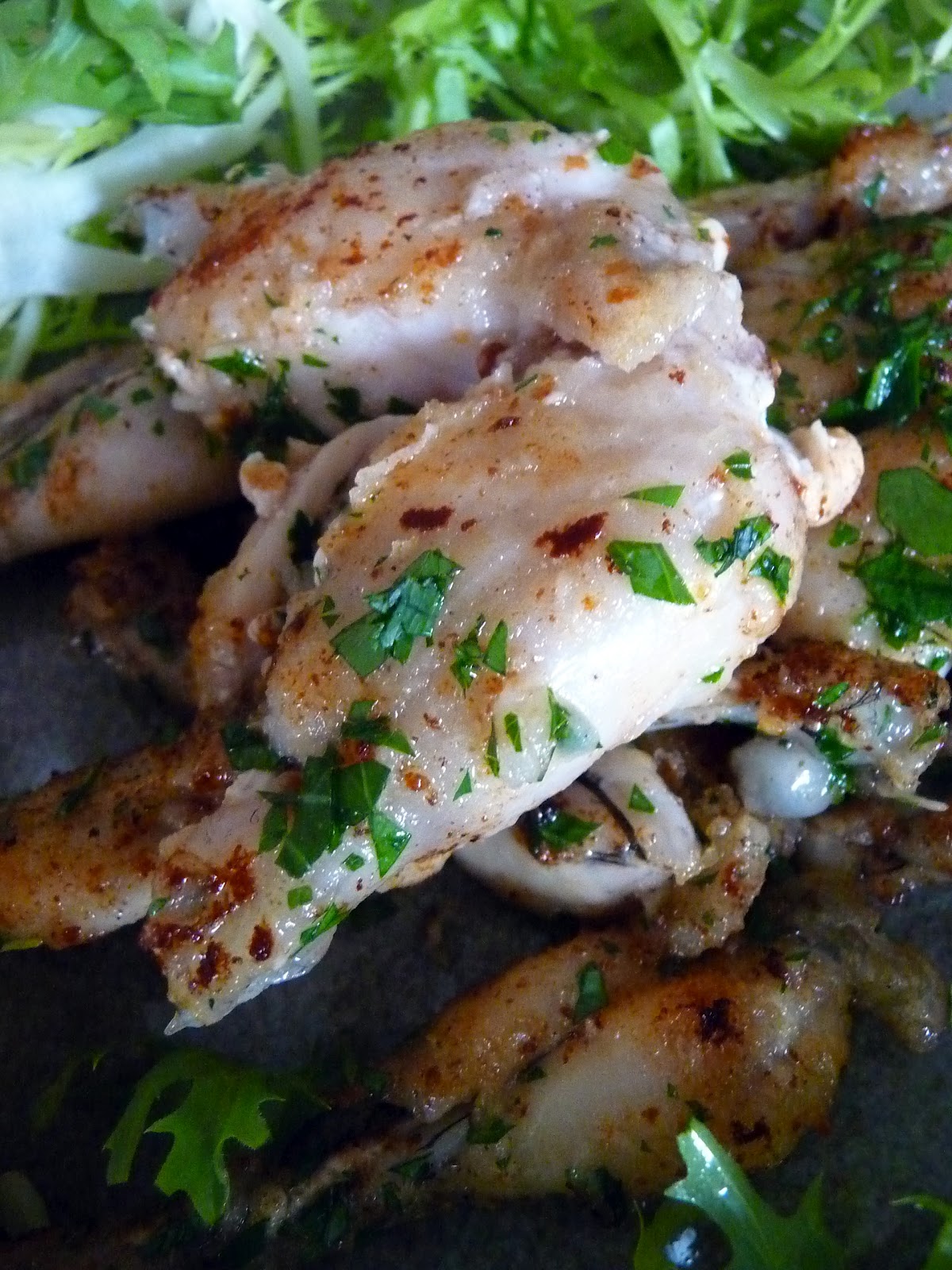
I have been in a few restaurants that served frog legs and have never felt the need to ask what people do with them.  I know to eat them, because, when done right, they are very delicious.  The best frog legs that I have ever had was a dish called Cuisses de Grenouille a l'Ail et au Persil, served at Le Bistro du Beaujolais.  Large frog legs, cooked with garlic, parsley and white wine, and served in a mesclun salad. I am salivating right now thinking about it. (Le Bistro du Beaujolais serves probably some of the best French food that I have ever had and it is always on the short list of Cleveland-area restaurants that I strive to visit whenever I am in the area.)  The frog legs were so delicious that I have been wanting to make frog legs for quite some time.

The only problem was finding the ingredient.  I had no desire to go gigging for frogs.  Gigging -- which involves using a gig or small spear to hunt frogs -- is usually done at night.   I like to sleep at night.  And, besides, I do not think gigging frogs is legal in Maryland.  So, I would search for the amphibians at the grocery stores, but to no avail ... until very recently.  I found frog legs at a local Asian store.  While everyone associates frog legs with French cuisine, they are also a popular ingredient in Chinese cooking.  So, I picked up a package of frozen frog legs and headed home.

I thought about making frog legs as I enjoyed them at Le Bistro du Beaujolais; however, I wanted a recipe to use as a guide, because this was the first time that I was cooking with this ingredient.  I found a recipe for Grenouille à la Provençale on Food Network's website.  Christophe Marguin provided the recipe that presumably is used in his restaurant, Marguin Restaurante, in Les Echets en Dombes, France, which is just outside of Lyon, France.

This dish turned out well, but it is was not as good as the frog legs that I had at Le Bistro du Beaujolais.  Still, it was great to cook with a new ingredient for the first time.  


GRENOUILLE A LA PROVENCALE
Recipe from Christophe Marguin of Marguin Restaurante in
Les Echets en Dombes, France, available at Food Network
Serves 1

Ingredients:
1/2 pound of frogs' legs
Salt
Ground white pepper
All purpose flour
1/4 pound unsalted butter
1 clove of garlic, diced
1 tablespoon of fresh flat leaf Italian parsley

Directions:
1. Prepare the frogs' legs.  Season frog legs with salt and white pepper. Dust the frog legs with flour.

2.  Saute the frogs' legs.  Heat a large saute pan with butter over medium heat.  Add frog legs and saute until golden brown, approximately 3 to 4 minutes. Turn over and brown other side, approximately 3 to 4 minutes. Add garlic and parsley and cook for an additional 30 seconds. Serve immediately.

3.  Plate the dish.  Plate the legs.  Spoon some of the garlic and parsley over the legs.

PAIRING THIS RECIPE

The Brotherhood of Frog Thigh Tasters (yes, there is a brotherhood, they host the yearly frog leg festival known as the Vittel Frog Fair in eastern France) recommends that frog legs be paired with a Riesling.  It is not hard to see why.  The light fruity wine pairs well with the flesh of the frog legs.  In addition, one does not have to go too far from Lyon, France to find some good Riesling wines.  The Alsace region produces some very good Riesling wines. 

ENJOY!

Wednesday, April 25, 2012

Shaggin in the Wood

A Scottish proverb says that "double drinks are good for drouth (or thirst)."  The brewers at Tyranena channeled that proverb with their Shaggin in the Wood, which combines Scotch Ale with Bourbon barrels (although, without the bourbon). This beer is another of Tyranena's "Brewers Gone Wild! series.  I have previously reviewed the Bitter Woman IPA, another of the series; and, while both beers are from the same series, the Shaggin in the Woods was much more interesting.  

The Shaggin in the Woods originated as another, uniquely-named beer, "Sheep Shagger."  The Sheep Shagger is a Scotch Ale, brewed with 2-Row, Pale, Amber, Brown, Promise and Smoked Malts, as well as Northern Brewer and Golding hops.  The brewer took the Sheep Shagger and aged seventy percent of it in bourbon barrels.  The aged beer was then blended with the remaining thirty percent to, as the brewer describes it, "harness the same big caramel malt notes and smokiness that made the Sheep Shagger delectable, with added elements of bourbon and wood."

Shaggin in the Wood pours a bronze, almost rust color.  As the beer warmed in the glass, I could sense aromas of oak and bourbon, with tones of caramel and malts wrapped around those two elements.  The oak predominated over the bourbon, but the reason may be that the bourbon was merely waiting for its time to shine.  

With each sip of the beer, the bourbon begins to emerge.  Although it was present in the first sip, it became more pronounced with each taste.  Other flavors that also emerged, such as caramel and toffee.  As I tried to identify each individual flavor, I was impressed with how each one melded together to provide an enjoyable taste.  Normally, I have some reservations about bourbon aged beers (primarily due to the fact that I do not drink bourbon).  However, this beer was very drinkable, even for people like myself who ordinarily steer clear from hard liquor.  

This beer is available at stores in Wisconsin and Illinois.  This beer came from a Binny's located in suburban Chicago.  

ENJOY!

Saturday, April 21, 2012

Acme's New Mexican Rub for "Roadrunner" (Chicken)

I was a big fan of Looney Tunes as a kid.  (Actually, I still am a big fan of the show.)  I love watching the whole crew ... Bugs Bunny, Daffy Duck, Porky the Pig, Wile E. Coyote and the Roadrunner.  Recently, however, the last two characters got caught up in a recipe that I was thinking about.  The Roadrunner always outwitted the hapless Wile E. Coyote, whose odd contraptions for catching the elusive bird invariably backfired and left the predator in pain.  Why not make a recipe "inspired" by both Wile E. Coyote and the Roadrunner.

My mind went to work like one of Coyote's Rube Goldberg-inspired contraptions.  It went something like this: Roadrunners are the state bird of New Mexico.  The State of New Mexico is known for its Hatch chiles.  I have pounds of ground Hatch chiles in our cupboard.  The chiles have varying degrees of piquancy.   I could add some of each different chile in succession.  I also then add other base rub ingredients -- like paprika, ground garlic, ground onion, salt and pepper -- to create a spice mix.  I could then apply that mix to the bird using melted butter.

I envisioned the end result, a New Mexican chile rub, as something that Wile E. Coyote would have purchased from Acme when the "Genius" thought about what he would do when he caught the Roadrunner.  Wile E. Coyote would baste the Roadrunner with the rub and grill/roast/broil the bird.  After removing the bird from the heat and putting it on a platter, the Coyote would sit down at a table, tie the bib around his neck, grab his fork and knife and dig in to the enticing meat.  As he chewed the first bite, steam slowly would leak out of his ears and quickly followed by flames shooting out of his mouth.  Once again, Acme would let down the Coyote, allowing the Roadrunner to burn Wile E. Coyote, "Genius," one last time.


ACME'S NEW MEXICAN RUB FOR "ROADRUNNER"
(CHICKEN)
A Chef Bolek Original
Serves 2

Ingredients:
2 chicken quarters (thighs and legs)
1 teaspoon of ground paprika
1/2 teaspoon of ground garlic powder
1/2 teaspoon ground onion powder
1/4 teaspoon of ground Hatch red chile (mild)
1/2 teaspoon of ground Hatch green chile (hot)
1/4 teaspoon of ground Hatch red chile (very hot)
2 tablespoons of butter
Salt, to taste
Ground black pepper, to taste

Directions:
1.  Prepare the rub.  Combine all of the dry ingredients in a small bowl.  Mix well.  Melt the butter and add the spice mix until the consistency is that of a wet rub.  Apply the spice mix/butter to all sides of the chicken, including under the skin.  

2.  Bake/broil the chicken.  Heat the oven to 350 degrees Fahrenheit.  Add the chicken, skin side down, and cook for twenty minutes.  Flip the chicken and cook for fifteen minutes more.  Finish the chicken by placing the chicken under the broiler, skin side up, for three to five minutes or until the chicken skin is crispy and browned.

Just a few remaining thoughts.  If you want to grill the chicken, I would suggest using olive oil instead of butter.  I would also make the consistency of spice mix more like a liquid paste than a wet rub.  Also, while this recipe calls for three different chiles, the end result is very spicy.  It was the right level of piquancy for me (no smoke or flames), but it may be a little too spicy for others.  You can always add a little less of the ground chiles (and a little more paprika) to tone down the heat of the recipe.

Finally, the disclaimer.  The Roadrunner is only the inspiration for the dish.  Do NOT attempt to go hunt an actual roadrunner for this recipe. I say this for two reasons.  First, you are not Wile E. Coyote. If you have any doubts, just look in the mirror.  Second, Federal law protects roadrunners (Geococcyx Califorianus) and makes it illegal to hunt the bird.  If you want to hunt something, track down organic, hormone free, cage-free chicken at your local grocery store.   

 PAIRING THIS RECIPE

For this recipe, the best pairing is with beer.  Personally, I enjoyed the chicken with a pale ale, which is probably the best beer to have with this dish.

D.C. Brau -- The Public Pale
American Pale Ale
Washington, D.C., USA
Flavors are balanced hop and malts, with some citrus

ENJOY!

Thursday, April 19, 2012

D.C. Brau's The Public

D.C. Brau is the first production craft brewery to brew beer for sale in the District of Columbia since the Heurich Brewery closed its doors. However, D.C. Brau's decision to sell their beer in cans follows follows a path taken by many other brewers over the past several decades.  According to Oxford Companion of Beer, which was edited by Brooklyn Brewery's Garrett Oliver, beer was first canned shortly after the repeal of Prohibition.  In 1993, Gottfried Krueger Brewing Company sold the first beer in a can, Krueger's Finest Beer.  Two thousand cans left the brewery into the hands of thirsty customers ... in Richmond, Virginia.  Gottfried Krueger decided to test the cans in a "remote location" (apparently Richmond, Virginia is considered a remote location to a brewer in Newark, New Jersey) just in case it flopped.  The locals would be none the wiser.  

Of course, others followed Gottfried Krueger and they have names that are much more recognizable.  Pabst.  Schlitz.  Schaeffer.  Busch.  Busch Lite.  Shudder.  (That last one is not a beer, just a reaction from typing the previous six words.)  These beers were basically the beers that dominated the market for decades.  Fortunately, in recent years, the craft beer movement has made great strides in the canned beer market.  It began with Oskar Blues, followed by others like Ska Brewing, and, most recently, D.C. Brau.

The Public is brewed in the style of an American Pale Ale, which is a variation of the English Pale Ale.  I searched for the different types of malts, hops and yeast used to produce this beer.  According to the D.C. Brau website, the brewers use C-60 and Munich malts, but they do not identify the hops or the yeast.

The Beer Judge Certification Program ("BJCP") describes an American Pale Ale as having a pale golden to deep amber color, a moderate to strong hop aroma (with primarily citrusy elements, but some malty, toasty elements as well) and a moderate to high hop flavor.  These are rather wide ranges in descriptions, which bespeaks of the varieties of American Pale Ales that are out in the market. 

D.C. Brau's The Public fits neatly within the BJCP's Guidelines.  While the brewers describe the appearance of the beer as a "crimson copper," I think it is more of an amber, orangish copper color.  The beer is nicely carbonated, pouring with a good, thick foam of large bubbles that takes its time to recede.  This foam provides a hint as to how to enjoy the beer ...  slowly.  The aromatic elements of The Public are a nice mix of the malts and hops.  No one predominates over the other, rather they are in a nice equilibrium.  The brewer suggests hints of white citrus and grapefruit, and I can get a sense of some of those aromas in the beer.  As for the taste, there is the piney, citrusy flavors that one expects from an pale ale.  The beer follows in the style of an American Pale Ale by not overwhelming the drinker with those bitter flavors as some India Pale Ales have a tendency to do.  Instead, the hop flavors are well balanced with the malt flavors, just like the aroma of the beer. 

One final thought about food pairing.  American Pale Ales are fairly versatile beers, pairing well with an array of foods.  The pairings include all types of meat, especially beef, bison, lamb and chicken.  The beers also fare well with foods that have a little spice or smoke element to them.  For that reason, American Pale Ales go well with grilled burgers or steaks, as well as spiced rubbed chicken or pork.  

If you are lucky to live in the Washington, D.C. Metropolitan area, you could possibly find The Public at a local grocery store.  It sells for $10.99 for a six pack. 

ENJOY!

For more about canning beers, checkout The Oxford Companion to Beer, edited by Garrett Oliver, at pages 214-215.