Friday, June 27, 2014

Hoppin' to Heaven

The Hoppin' to Heaven is described by its brewery -- Hopping Frog -- as a "classic American I.P.A."  This is a rather odd description, given there is nothing really "American" about an India Pale Ale.  The style was born in England, not New England. Brewers developed this style to weather the voyage to India, not Indiana.  So, it seems odd to use the words "classic" and "American" when one talks about an IPA.

Still, American brewers have a knack for taking a style and making their mark on it.  Take the barleywine.  English brewers have brewed barleywines for a very long time.  Those beers had high alcohol contents, but were very malty in structure, taste and aroma.  When the barleywine style made it across the Atlantic Ocean, American brewers took the beer and gave it their own twist. American barleywines were set apart from their British counterparts with the use of hops.

With all of that said, perhaps that there is something "American" about this IPA.  It is representative of the urge of American brewers to hop their beers aggressively.  That is not a bad thing.  I consider myself a hop head and I love very hoppy beers.  The reason is that, for all of their love of hops, American brewers also know how to balance the beer so that enough of the aroma and the taste of the malt shines through.  The Hoppin' to Heaven IPA is a great example of how this balance can be achieved, with an aggressive hop profile in both aroma and taste, rounded out with a smooth malt character in the background.

The Hoppin to Heaven pours a golden brown to amber in color with thick, fluffy foam that persists for a long time.  The carbonation was quite intense with this beer, and the thick foam made the IPA seemingly impossible to reach.  Yet, with patience and time, the foam receded enough to allow for taking in the aroma and the taste of the beer.

Both the aroma and taste of this beer are very good.  The aroma was fairly well developed, with the hops providing both pine and floral notes. A little work produced some notes of the malt and even a little earthiness character.  The earthiness is something a little different in an Imperial Pale Ale, but it worked with this beer.  As for the taste of the beer, there is a nice amount of pine hop flavors up front.  Some spice notes and pepper also follow the pine elements, with a sweetness around the edges of this beer.  The sweetness is no match for the bitterness of the hops, which prevail and cling around the edges of the tongue as you drink the beer.

Overall, this beer is a very good India Pale Ale and, to the extent that it is an American interpretation of an IPA (that is, a hoppy version of an already hoppy beer), it is a very good example of that.  I found this beer at a local grocery store. It sells for around $10.99 a bottle (give or take a dollar or two).

ENJOY!

Saturday, June 21, 2014

Spanish Black Grouper with Saffron Rice

For ichthyologists (those who study fish), it goes by the name of Mycteroperca Bonaci.  For everyone else, including fishermen and chefs, it goes by the name of Black Grouper.  Generally, grouper has been on my "bucket list" of fish to cook.  I have cooked with many different types of fish ... including bluefish, branzino, mahi mahi, pompano, red snapper, rockfish, and sheephead.  However, I have never cooked grouper before.

The reason why is that black grouper -- or any grouper for that matter -- is rare around where I live.  A search for the fish usually ends in failure.  Any sighting is usually found on the menu of a pricey restaurant or the seafood section of an upscale grocery store.  Those sightings are not only very rare, but pricey as well.  As a result, I have to wait for special occasions, like our recent vacation in the Outer Banks, to enjoy that fish.  (By the way, if you are there, you should check out the Diamond Schoals Restaurant in Buxton where they have a very delicious fried grouper sandwich on their menu.  They also have a seafood market where you can take some fresh fish "to go" and cook for yourself.)  That vacation really inspired me to cook with the fish; and, when I saw it in the seafood section of a grocery store, I took the bait and paid (a lot) for a pound of black grouper.

Photo is from Florida Museum of Natural History
The black grouper is a big, beautiful fish. According to the Florida Museum of Natural History and the Smithsonian Institution, black grouper can grow to more than four feet in length and over 170 pounds.  Most of this growth occurs over the first ten years of their life, but grouper can live for as long as thirty years.  As they grow, their skin develops interesting designs over their olive or gray bodies.  Dark rectangular blotches, and hexagonal bronze spots.  The fins have long black lines that offset and frame the large body of the fish.  These amazing fish are found along rocky bottoms and coral reefs between 32 to 98 feet in depth.

As with any fish, sustainability is an important consideration for me.  Sustainability is particularly important with respect to a fish like the grouper, which lives for a long period of time and, despite its rapid grown rate, its reproduction rate may not keep up with fishing pressures.  Fortunately, Seafood Watch notes that there are strict fishery guidelines that have helped to stabilize and even increase the black grouper populations near Florida and in the Gulf of Mexico.

With a pound of black grouper in my hands, the question quickly turned to how I should prepare this fish.  The fillets are thick and meaty, which, at least to me, means that they are perfect for a simple rub.  I decided to go with a Spanish-inspired rub.  I have always liked the combination of paprika and smoked paprika, along with other ingredients like parsley or garlic.  As the fish marinates in the rub, I decided that I would make a Spanish style rice ... starting with the basic ingredients of a sofrito -- bell peppers, onions, tomatoes, and garlic -- and then cooking the rice with those ingredients.  I also decided to add a very special ingredient (to go with the special protein) ... saffron.  As the rice cooked, I decided that the grouper should be broiled rather than pan seared or pan fried.  The reason is that I did not want to burn the rub.  After all, my goal was to make a Spanish Black Grouper, not a Cajun Black Grouper.

The end result was very delicious.  The thick fillets, with the large flaky meat, was delicious. The rub worked well with the fish and the rice, which was also very tasty.  To round out this wonderful meal, I paired a Muga Rioja Blanco with the Spanish Black Grouper with Saffron Rice.  The crisp nature of this wine, with its aromas of almond and wild herbs works perfectly with this dish.


SPANISH BLACK GROUPER WITH SAFFRON RICE
A Chef Bolek Original
Serves 2-4

Ingredients (for the Grouper):
1 pound of black grouper, cut into 2 to 4 fillets
1 1/2 teaspoons of paprika
1 1/2 teaspoons of smoked paprika
1 teaspoon of onion powder
1 teaspoon of garlic powder
1 teaspoon of dried parsley
1 teaspoon of kosher salt
1/4 teaspoon of crushed red pepper

Ingredients (for the rice):
1/2 large tomato, peeled and diced
1/2 yellow bell pepper, de-seeded and diced finely
1/2 orange bell pepper, de-seeded and diced finely
2 cloves of garlic, minced
1 pinch of saffron
1 cup of rice
2 cups of water, plus more if needed
A splash of white wine
Sea salt, to taste
Freshly ground black pepper, to taste
Sliced almonds
Fresh cilantro, chopped 

Directions:
1.  Prepare the fish.  Mix all of the dry ingredients in small bowl.  Apply the rub to all sides of the grouper.  Cover the grouper and place in the refrigerator until about fifteen minutes before cooking the fish.

2.  Prepare the rice.  Heat the olive oil on high heat in a deep pan with a cover.  Add the bell pepper and onion and reduce the heat to medium.  Continue to saute for a couple of minutes until the onion begins to soften.  Add the tomato and garlic and continue to saute, stirring occasionally, until the onion and bell pepper have completely softened.  Add the rice and stir constantly to slightly toast the rice.  Add the water and the wine, stir to make sure that the rice is covered by the liquid and bring to a boil.  Once the liquid is boiling, cover the pan, reduce the heat, and let it simmer until the liquid is absorbed by the rice.  Check occasionally to make sure that the rice is cooked through.  If the liquid is absorbed but the rice is still not cooked, add more liquid, about 1/2 cup at a time until the rice is al dente.

3.  Cook the fish.   Heat the broiler in the oven.  Place the fish under the broiler.  While the fish is cooking, toast the almonds in a pan (without any oil or butter) over high heat for about a minute, shaking consistently to avoid burning.  After about seven minutes, flip the fish and cook for about seven minutes more or until the internal temperature reaches about 145 degrees Fahrenheit.   Remove from the heat.

4.  Plate the dish.  Place some rice on the bowl.  Place the fish over the rice and garnish with the almonds and cilantro. 

ENJOY!
 

Sunday, June 8, 2014

Grilled Turkey Thighs with Lemon-Garlic Asparagus and Roasted Potatoes

Turkeys are tough birds.  This is a truism both while the birds are alive and after their death.  Both wild and domesticated turkeys have an aggressive disposition.  The bird's behavior has been documented numerous times, like the case of a wild turkey named Godzilla who harasses a homeowner in Detroit or the turkeys who chase after runners in the neighborhoods of Boston.  While turkeys may be beautiful in appearance, they are very nasty in character.  

Turkeys can be difficult in death as they can be when they are alive.  They can present a lot of challenges to cooks, who sometimes struggle to present a dish of juicy, tender meat for their guests.  This is especially true when it comes to cooking turkey breasts.  The breast meat can dry out very fast, requiring brines to ensure that the meat remains moist and flavorful.  

By contrast, turkey thighs are much easier to work with as a cook.  The main reason is that the fat content in the thighs is higher than in the breast, making the meat a little more forgiving when being cooked.  That fat also provides a lot more flavor than what can be found in the breast.  For these reasons, I have used thighs for a number of recipes, including Turkey Paella, Beer Braised Turkey Tacos with Chipotle Guacamole, and Turkey Biryani.

While I love all of those recipes, my favorite way of cooking turkey is using the grill.   I have grilled turkey thighs on a number of occasions, including when I made Batali-Style Turkey Thighs with Snap Peas and Agliata.   I prefer grilling to other methods of cooking, such as braising or roasting, because it is easier to get the skin to become crispy without drying out the meat.  For this reason, I am always trying to think of new and different ways to grill turkey thighs, which led to this recipe.

I started with the idea of creating a rub that has an Italian inspiration.  The combination of flavors -- onion, garlic, rosemary, thyme and crushed red pepper -- is perhaps a classic in Italian grilling.   It is one that can easily be used to grill steak or chicken.  It also works very well with turkey thighs. 

One cannot serve turkey alone, so I needed some sides.  Given I was using the grill, I decided to make some asparagus because grilling asparagus is my preferred way of preparing the vegetable.  I also made a potato dish, but, given that grill space would be taken up with turkey thighs and eventually asparagus, I chose to roast the potatoes in the oven while I worked on the rest of the course.  

Overall, this dish was a success.  The turkey was moist and the rub did its part to infuse flavor into the meat.  I would have liked to have gotten the skin a little crispier; but, the thighs reached the desired temperature before that could happen. When given the choice between crispy skin and moist meat, I choose the latter every time. 


GRILLED TURKEY THIGHS WITH LEMON-GARLIC ASPARAGUS 
AND ROASTED POTATOES
A Chef Bolek Original
Serves 2-4

Ingredients (for the turkey):
2 turkey thighs, trimmed
1 tablespoon of dried rosemary
1 tablespoon of dried thyme
1 tablespoon black peppercorns
1 tablespoon of sea salt
1/2 tablespoon garlic powder
1/2 tablespoon of onion powder
1 teaspoon of crushed red pepper

Ingredients (for the asparagus):
1 pound of asparagus
1 lemon, juiced
1 tablespoon of garlic powder
Freshly ground black pepper
Sea salt, to taste
1/2 cup extra virgin olive oil

Ingredients (for the potatoes):
1 pound of small potatoes, washed and halved
2 cloves of garlic, sliced
1/2 cup of olive oil
1 tablespoon of flat leaf parsley, finely chopped
Salt
Freshly ground pepper

Directions:
 1.   Roast the potatoes.  Bring a pot of hot water to a boil.  Add the potatoes and boil until the potatoes start to become tender.  Drain the potatoes and allow them to cool.  Once the potatoes are cool enough to handle, place them in a bowl with the olive oil and garlic.  Mix thoroughly so that the oil covers the potatoes.  Season liberally with salt and pepper.  Heat an oven to 375 degrees Fahrenheit and spread the potatoes out on a non-stick pan.  Roast the potatoes in the oven for about 7 to 8 minutes.  Flip the potatoes and continue to roast until they are fork-tender, yet crisp.

2.  Prepare the turkey and asparagus.  Grind the rosemary, thyme, black pepper and sea salt.  Place ground mixture in a small bowl and add garlic powder, onion powder and crushed red pepper.  Mix thoroughly.  Rinse the turkey thighs and dry them well.  Apply the rub to all parts of the turkey thighs.  Wrap and refrigerate for two to three hours.  Trim the asparagus and place in a ziplock bag with the olive oil, garlic powder and lemon juice.  Season with freshly ground black pepper and salt.  

3.  Grill the turkey and asparagus.  Heat the grill on medium high heat.  Grill the turkey thighs, skin side facing up for about ten minutes.  Flip the thighs and continue to cook for about eight to ten minutes, until the turkey approaches an internal temperature of 165 degrees.  During the last five minutes of the grilling, grill the asparagus, turning occasionally to prevent burning and remove the asparagus as soon as they have softened and crisped along the edges.

4.  Finish the dish.  Once the temperature of the thighs is between 160 to 165, remove the turkey thighs from the grill and tent with some foil.  Allow the turkey thighs to rest for about five to ten minutes.  Slice the thighs and portion out the slices on the plates.  Serve immediately with the some of the roasted potatoes (garnished with the parsley) and grilled asparagus. 

ENJOY!

Friday, June 6, 2014

Good People

Legally brewed since 2008.  That's what it says on the can.  The story goes back to the Prohibition era, when many states -- such as Alabama -- passed laws prohibiting the brewing of alcoholic beverages in one's home, along with laws prohibiting the production of beverages with alcohol contents over a very low threshold.  If someone were to brew a beer, like an India Pale Ale with an ABV of 7.1%, that person would be violating not one, but two laws.  Laws that carried fines and prison time as punishment. 

However, Alabama is no different than any other state when it comes to craft beer.  There are people who want more than the High Life. They would prefer that it is Imperial.  In 2008, craft beer lovers were able to get the Prohibition era laws repealed, opening the way for craft brewers to begin brewing anything from a session beer to a Russian imperial stout.  This set the stage for Good People to emerge.

Good People sold its first keg on July 4, 2008.  Since then, the brewers have developed an offering that includes a pale ale, brown ale, an India Pale Ale, a double IPA, and a stout.  Recently, my beautiful Angel's father brought a six pack of the IPA for us to enjoy during our family vacation. 

The brewers at Good People produce the IPA with 2-Row malts and 5 specialty grains, along with 5 different types of hops.  The hops are Columbus, Willamette, Cascade, Simcoe and Citra.  Add a Californian ale yeast, and the end result of the brewing process is a beer with a hazy, golden color and a strong, thick foam.  The five hops make their presence known in the aroma and taste of the beer.  Citrus notes, such as grapefruit and tangerine, are in the nose of this beer.  Some malt notes can be detected in the background, but the aroma is hop driven.  As is the taste.  When I first tried this beer, I could easily detect the citrusy notes of grapefruit and lemon.  However, I also sensed a sweetness in the beer, which could have been the result of the grains used in the malt.  As I drank the beer, the hop-centric elements of the flavor became much more prominent and that sweetness faded into memory.

Good People beers are available in Alabama and have a limited distribution.  If you are lucky enough to have someone who can get his (or her) hands on a six pack of the IPA, it is definitely worth it. 

ENJOY!

Tuesday, June 3, 2014

Pan-Seared Bluefish with Rainbow Chard, Fingerling Potatoes and Oysters

During a recent vacation in the Outer Banks, I went on a fishing trip with my beautiful Angel and her father, Frank.  The charter took us fishing on the Pamlico Sound.  We were fishing for grey trout, flounder, redfish and bluefish. While I enjoy fishing for all of those species, the one that intrigued me the most is the bluefish. 

Bluefish are a migratory, open-water species of fish that can be found in every ocean and in many waterways.  The species goes by different names around the world ... they are called "tailor" in Australia, "shad" in South Africa and by other names such as "elf," "chopper" and "anchoa" in other parts of the world.  Chopper is an apt name for this species, because it has a reputation for being a voracious predator, striking at anything with its triangular, razor-sharp teeth.  Schools of bluefish -- known as "blitzes" -- have been known to relentlessly chase their prey, which includes butterfish, herring, weak fish and croakers.  In the Chesapeake Bay, bluefish feast upon bay anchovies, white perch, American shad, and alewife. 

The best way to catch a bluefish is by handline fishing, although that has proven tricky for me (because I have yet to catch one).  If one were to catch a bluefish, he or she would be greeted by a beautiful creature.  The bluefish has  a large head, compressed body and broad, forked tail.  The color of its skin starts as a greenish-blue and fades to a white tone on its belly.  If you come across bluefish in a store, you should look to see if it was caught by handline, as that is the most sustainable way of catching this fish.  However, Seafood Watch advises that bluefish caught by bottom gillnet or bottom-line trawl are a good alternative, although there are some concerns about by-catch. 

Once you have a bluefish in your hands, the fish provides very meaty fillets that are excellent for cooking.  Bluefish fillets are amenable to many different processes, such as pan-searing, broiling, baking, and even grilling.  They also provide a great palate for a variety of herbs and spices.  

This dish represents an attempt myself to create a special dish for my beautiful Angel. The centerpiece is pan-seared bluefish.  However, there are a few additional elements.  There are fingerling potatoes, which I sliced into coins to facilitate the cooking of the potatoes.  There is rainbow chard, which is wilted in a mixture of butter, oil and white wine.  Finally, there are raw oysters, which are added at the end of the cooking process so that they cook just a little before being served.  (Oysters can quickly overcook and become tough and chewy.)  

This dish truly challenged me, because I do not have formal training and the different elements have different means of being cooked, require different times for cooking and are difficult to put together in one combined dish.  This recipe remains a work in progress and I will tweak it based upon my subsequent efforts.   


PAN-SEARED BLUEFISH WITH RAINBOW CHARD, 
FINGERLING POTATOES AND OYSTERS
A Chef Bolek Original
Serves 2-4

Ingredients:
1 pound of bluefish, cut into even sized fillets
1/2 pint of oysters
1 pound of fingerling potatoes, sliced thinly into coins
1 bunch of rainbow chard, washed, de-stemmed 
1 cup of yellow onions, diced finely
4 cloves of garlic, diced finely
1/4 cup of white wine
5 tablespoons of butter
6 ounces of olive oil
1 bay leaf
Several sprigs of thyme
Salt, to taste
Freshly ground black pepper to taste

Directions:
1.  Cook the potatoes.  Heat 2 tablespoons of butter and 2 ounces of olive oil in a pan.  Add the onions and garlic.  Cook until the onions begin to soften, about three to four minutes.  Add the potatoes, bay leaf and thyme.  Continue to cook, stirring occasionally, until the potatoes begin to cook through.  Remove from the heat.

2.  Prepare the fish.  Season the fish with salt and pepper.  Heat 1 tablespoons of butter and 2 ounces of oil in a second pan over high heat. Place the fillet flesh side down in the pan and reduce the heat to medium high or medium.  Make sure that the fish does not stick to the pan.  Cook the fish for about three minutes and then flip the fish so that the fish is skin side down.  Continue cooking the fish until it is cooked through, with the flesh being opaque and the internal temperature of 145 degrees Fahrenheit. 

3.  Cook the chard.  While the fish is cooking, return the pan with the potatoes to the heat.  Add the remaining butter and/or oil if necessary.  Add the chard and white wine and continue to cook for a couple of minutes.  As the chard begins to evaporate, add the oysters and cook only until the oysters begin to become opaque.  Remove the pan from the stove.

4.  Plate the dish.  Plate each of the dishes with the potatoes and shard.  Place the bluefish over the potatoes and shard, and, the oysters around the bluefish.  Return the pan to the heat on high for a couple of minutes to cook down the remaining pan sauce.  Spoon the sauce over the fish and serve immediately.

ENJOY!

Sunday, June 1, 2014

Sam Adams' Sahti

Sahti.  For many a craft beer aficionado, it is a Norse legend.  A beer that one may have heard about, but has never seen on the shelves of the local beer store.  Yet, Michael Jackson -- the legendary beer writer -- has described the Sahti as "the only primitive beer to survive in Western Europe."   According to Brewing Techniques, the brewing process traveled from Western Europe to Finland and was in full swing by the 1400s, when the territory was part of the Kingdom of Sweden.

As Brewing Techniques further explains, Finland served as Sweden's strategic entrenchment against its rival during the 1400s and 1500s, which was Russia.  Sweden built castles, around which towns developed in localities of strategic importance. These towns were separated by quite a distance, which led to the building of a network of inns and royal estates.  These inns provided board and lodging for ordinary travelers, whereas the royal estates served those in royal service. Each inn and estate brewed its own beer on the premises, while the royal estates served as model farms for the peasantry.  This network provided the created the foundation for peasants to learn the craft of brewing beer.

Finnish peasants began to brew Sahti in the 1500s and the Sahti developed varying characteristics depending upon the part of Finland where it was being brewed. Despite its regional variations, the one thing that defines a Sahti is the use of juniper.  As Michael Jackson notes, the twigs from a juniper bush are used in the filter bed of the bottom of the lauter tun and are also infused in the brewing water.  Juniper berries are used in place of or alongside with hops. Today, many Finns still brew the beer, using the same equpment as their brewers in the past, namely, woodfire-heated kettles and saunas for mash tuns.  The result is that one could taste a beer today just as it looked and tasted back in the 1500s. 

I tried a Sahti once as part of a beer tasting hosted by Garrett Oliver and the National Geographic.  The theme of the tasting was Scandanavian beers.  Since that time, I have looked everywhere to find a Finnish Sahti.  To date, I have been unsuccessful.  However, American brewers have begun to brew this rather unique style of beer.  Dogfish Head has brewed a Sah'tea, which is a cross between the Sahti and Chai tea.  Although I have thought about reviewing that beer, I wanted to have my first Sahti review focus on a traditional Sahti.  I eventually found a beer brewed by Sam Adams that represents an effort to brew such a beer.  The beer was the Norse Legend.

Sam Adams brews the Norse Legend with a 2 Row Pale Malt blend, rye, special B and aromatic malts, along with Hallertau Mittelfrueh hops.  The brewers also use juniper berries during the brewing process and age the beer on those berries as well. 

The Norse Legend pours a reddish brown color, this a relatively thin foam that recedes gradually as the beer sits in the glass.  Given that the central characteristic of a Sahti is the use of juniper berries, those berries are featured prominently in both the aroma and taste of the beer.  The Sam Adams brewers use of the various malts add differing layers of bread and biscuit tones to both the aroma and the taste.  This work leads to Sam Adams' effort to resemble a more traditional Sahti.  (According to what I read, traditional Sahti's are not brewed with hops.)  For what I could find in the Sahti style, this was a very good beer.

I had hoped to pair this Norse Legend with a dinner featuring Finnish cuisine, but the dinner never materialized.  (As a result, the beer sat on our beer shelves for a while.) Nevertheless, the beer still exhibited the aromas and tastes that one would expect from a Sahti beer.  One does not have to prepare a Finnish dinner to enjoy the beer, as the brewers suggest that it would pair well with Scallops Eschabesh, Irish Red Brined Pork Chops and pizza.

Sam Adams is not currently brewing this beer.  If they start again, it is definitely worth a purchase for beer connoisseurs like myself, who struggle to find beers of very specific styles.  

ENJOY!

Saturday, May 31, 2014

Boneless Spring Lamb Roast

A while back, we hosted a dinner with a theme that featured recipes from Maryland.  The theme was America in Miniature, which featured recipes that highlight the produce and products of that wonderful state.  I have already posted two of the recipes from that dinner, an appetizer of Shrimp Pâté with Crostini and a Cream of Asparagus Soup.  Now, we have reached the main course ... Boneless Spring Lamb Roast.
 
The raising of lamb and sheep is an important part of the agricultural sector in Maryland.  There are farms throughout the state -- such as Jehovah Jireh Farm, Evermore Farm and Castle Hill Harm -- where farmers raise lamb and sheep in environmentally conscious and humane ways.  There are organizations and associations, such as the Frederick County Sheep Breeders Association, which are devoted to promoting and improving the raising of these animals within Maryland.   Even the University of Maryland has a role, with a program specifically designed to various aspects of raising sheep and goats. 

Most importantly, there are people like myself in Maryland who love to eat lamb.  When I planned our wine dinner, this recipe stood out as a perfect main course.  The recipe is relatively easy to make, with three basic steps: (1) marinating the meat, (2) prepping the meat for roasting; and (3) roasting the meat.  Although you have to watch the temperature of the meat, so as to not overcook it, this recipe allows you to turn to the preparation of other dishes while the roast is cooking in the oven. 

The one slight change I made to the recipe is that, after straining the drippings, I returned them to a small pot and added a little beef stock to the drippings.  I brought it to a boil and reduced it slightly.  This allowed for more "drippings" to ensure that every plate has some of the jus to go with the lamb.


BONELESS SPRING LAMB ROAST
Recipe from Dishing up Maryland, page 68
Serves 6

Ingredients:
1 lemon
3/4 cup olive oil
10 garlic cloves
2 teaspoons dried oregano
2 teaspoon dried rosemary leaves
1/2 teaspoon paprika
1/2 teaspoon salt
1 boneless leg of lamb (3 to 3 1/2 pounds)
1 tablespoon coarse sea salt
1 teaspoon freshly ground black pepper

Directions:
1.  Marinate the lamb.  Zest and juice the lemon.  Combine the lemon zest and juice with the olive oil, 3 of the garlic cloves, 1 teaspoon of he oregano, 1 teaspoon of the rosemary, the paprika and salt in a blender or food processor and blend until smooth.  Place the leg of lamb in a large ziplock bag and add the marinade.  Put the ziplock bag into a larger plastic bag or large container to ensure there is no leakage and place it in the refrigerator to marinate over night or for at least four hours.

2.  Prepare the lamb.  Remove the lamb from the refrigerator and allow the contents to come to room temperature.  Preheat the oven to 450 degrees Fahrenheit.  Combine the remaining 1 teaspoon  oregano and 1 teaspoon rosemary with the sea salt and pepper.  Rub this mixture all over the lamb.  Cut small incisions into the lamb and insert the remaining 7 garlic cloves into the incisions.  Insert a meat thermometer into the roast.

3. Roast the lamb.  Place the lamb on a rack in a roasting pan, fattiest side up.  Roast for 15 minutes.  Reduce the oven to 325 degrees Fahrenheit and roast for an additional 10 to 15 minutes per pound, 30 to 45 minutes, until the meat thermometer reads 140 degrees for medium rare to 150 degrees for medium.  Remove the lamb from the oven, cover it with foil or a lid and allow it to rest for 20 minutes.  Cut the strings from the lamb and transfer it to a serving platter.  Cut the lamb into thick slices.  Strain the pan drippings and pour them over the lamb.

ENJOY! 

Sunday, May 25, 2014

Grilled Soft Shell Crabs

It has been almost three years since I professed my culinary love for the soft shell crab in a post entitled Much Ado about Molting.  My beautiful Angel and myself had just been introduced to Endurance Seafood in Kill Devil Hills, North Carolina.  We had to depart the Croatan Highway (Route 158) down Colington Road, which ran along the contour of the island.  As we drove down this winding road, we were presented with some of the island's beauty, such as the views of the Pamlico Sound that are otherwise unavailable to those who remain on the beaten path. Turn after turn, we continued our drive until we saw the Endurance Seafood sign. 

A turn down a gravel driveway, a quick drive past a house, and we reached our destination.  Endurance Seafood is a family run operation that sells blue crabs in both of their majestic forms ... hard shell and soft shell.  We made our trip specifically for the latter form of blue crabs.

Endurance Seafood in Kill Devil Hills, North Carolina
As we exited our car, we faced a building surrounded on two sides with white tubs.  Those tubs were filled with water and blue crabs in the various stages of molting.  As we approached, we could see people working to box soft-shell crabs for shipment to distributors and restaurants across the eastern United States.  Fortunately, we arrived just in time to purchase some soft crabs.  As the crabs were gathered, we were allowed to walk through the rows of white sinks and see the blue crabs in the various stages of the molting process.  After the crabs shed (or molt) their shells (or exoskeleton), they become soft-shell crabs.  They will remain in this state until that shell hardens once again.  We were able to purchase two dozen soft shell crabs to enjoy during our trip to the Outer Banks. These were the largest and meatiest soft shell crabs that I had ever seen.  Most importantly, they were the freshest soft shell crabs because we got them directly from the source.

The soft shell crabs from Endurance Seafood.
When we arrived at our vacation spot, I sauteed some of the soft-shells for everyone.  One can eat almost the entire crab.  To prepare the crab, you have to remove the eyes, the tail and the gills.  This can be done with a pair of scissors, cutting off the face of the crab, as well as snipping off the tail and the gills.  It is gruesome, but necessary task, in order to enjoy these delicious crabs. 

The easiest way to cook a soft shell crab is to coat it in a light coating of flour and pan fry (or saute) it in a combination of oil and butter.  That is how I first prepared the crabs. However, I had several crabs left over.  I prepped those crabs (that is, I removed the eyes, tails and gills), and then froze them.  Unlike hard shell crabs, soft shell crabs can be frozen and enjoyed later.

This is exactly what we did.  Once we returned from our Outer Banks trip, some of those frozen soft shell crabs began to thaw, despite my best efforts to keep them frozen for our return home.  I decided to cook those crabs in a way that I had never done before.  I cooked them on the grill.  I looked over a few recipes to get some basic ideas as to how to grill soft shell crabs.  I then proceeded to grill them by first preparing a butter that can be basted over the soft shell crabs before they went on the grill.  The butter is melted in a pan and then some garlic and shallots are sauteed briefly in the butter.  The butter is removed and allowed to cool, and then it is ready for the soft shells.  The soft shells cook quickly, needing to be grilled only for about four to five minutes per side.  (Less time is needed for smaller crabs.)

In the end, I have to say that grilling these beautiful crabs is now my favorite way to prepare them.  By grilling them, I used far less oil or butter than the more conventional ways, such as a deep frying or pan frying them.  The grill also crisps them in a way that provides a better taste, one that cannot be replicated in a deep fryer and is difficult to replicate in a pan. 

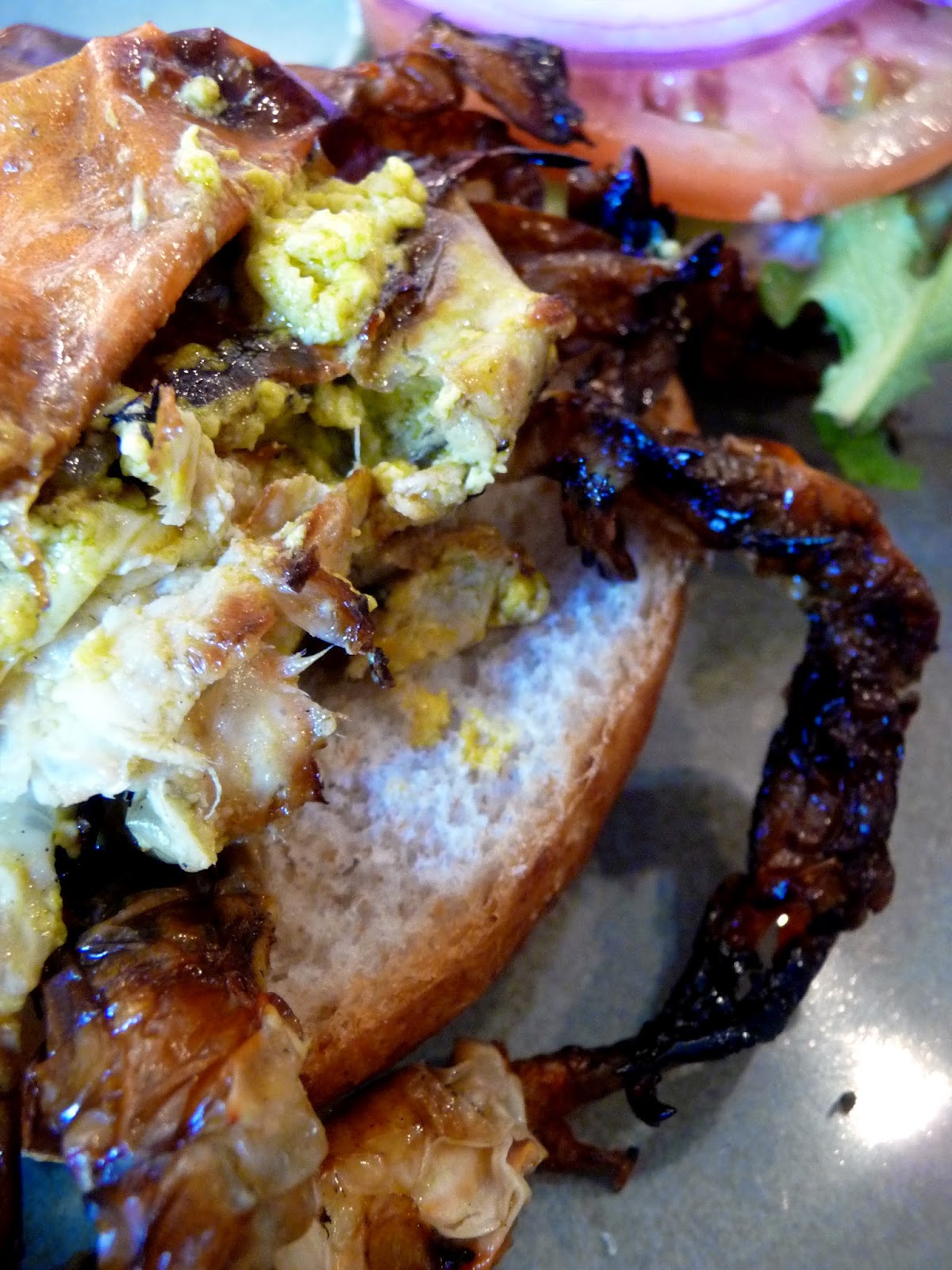
One last note ... the grilled sot shell crabs can be served by themselves.  Personally, I think that the grilled crabs are perfect for a soft shell crab sandwich (especially if you have guests who may have a difficult time with the fact that you are eating an entire crab, as opposed to a crab cake).  You can use whatever toppings you like.  I kept it simple: lettuce, tomato and onion.  No condiments.  In this case, less is better because you want to taste as much of the crab as possible. 


GRILLED SOFT SHELL CRABS
A Chef Bolek Original
Serves 2-4

Ingredients:
6 soft shell crabs, cleaned and rinsed
4 tablespoons of butter
1 shallot, minced
1 clove of garlic, minced
Salt, to taste
Ground black pepper, to taste

Directions:
1.  Prepare the butter.  Melt the butter in a saucepan over medium high heat.  Add the shallots and garlic and saute for a couple of minutes.  Remove from the heat.  Baste the soft shell crabs generously with the butter.

2.  Grill the soft shell crabs.  Heat the grill to a medium high or high heat.  Apply some vegetable oil to the grill grates to ensure that the crabs do not stick to the grates. Grill the soft shell crabs until they turn bright red and begin to crisp along the edges, about four to five minutes per side. 

 ENJOY!

Wednesday, May 21, 2014

Big Chuck's Barleywine

They were an institution in Cleveland.  From 1979 until 2007.  Chuck Schodowski and John Rinaldi -- known to every Clevelander as "Big Chuck and Little John" used to host late night horror movies on WJW-TV.  They operated out of a studio in downtown Cleveland, hosting the movies before a live studio audience.  I was once a part of that audience when I was a kid.  I have some vague memories of that day, being in the studio and seeing the two television personalities.

People did not necessarily watch Big Chuck and Little John for the horror movies.  The movies were usually of the type that would serve as the backdrop for a Mystery Science Theater 3000 show.  Rather,  everyone watched Big Chuck and Little John for the skits that the two entertainers would perform.  These included skits such as "A Certain Ethnic ________," which played on Big Chuck's Polish heritage, the Kielbasa Kid, a spoof of western movies, and Cuyahoga Jones and the Castle of Doom, which was an obvious play on the Indiana Jones franchise:


Everyone who grew up in Cleveland during the 1980s and 1990s remembers (or should) remember skits like these.

Recently, Portside Distillery brewed a barleywine in honor of Big Chuck, aptly named the "Big Chuck Barley Wine Ale."  Portside is Cleveland's first distillery since Prohibition; however, it also brews beers, including this barleywine.  While I searched for the ingredients, I was unsuccessful, much like Cuyahoga Jones.  However, from the description below, it is clear that some form of roasted malts were used, along with a fair amount of hops.

The Big Chuck Barley Wine Ale pours a dark brown, almost black in color.  This suggests the use of roasted malts, which are often used in darker beers such as porters or stouts.  The malts provide a bready, toasty and almost earthy notes.  The malts also drive the taste of the beer, providing the backbone of the taste, with a dark roasted, bready, malty elements.  There was also some cocoa, coffee or espresso in the taste of the Big Chuck barleywine, which was followed by a very astringent and dry finish, which is where the hops most likely figure into this beer.  The hops most likely accentuate the astingency and dryness brought about by the roasted malts.  Finally, there is a booziness in the background of the beer, which is expected with an ABV of 11.7%. 

The heavy emphasis on the malts would ordinarily suggest an English style barleywine; however, the dark, roasty, coffee notes are not typical of what I would expect or ordinarily find in that style of a beer.  This uniqueness is perfectly acceptable, because Big Chuck (and Little John) were unique in their own way when it came to late-night television in the Cleveland area market.  

ENJOY!

Monday, May 19, 2014

National Geographic Live: The Taste of Saison

The National Geographic Society is a long established institution with a long history in geography, cartography and exploration.  Once a year, the National Geographic asks the head brewmaster of Brooklyn Brewery, Garrett Oliver, to create a beer tasting experience that combines beer with geography and exploration.  I have attended several of these beer tastings.  At each event, Garrett Oliver introduces guests to beers that they have never heard or seen before.  He places each beer in its own context, weaving stories about the brewers and the beers with a combination of facts and humor that keeps the crowd listening throughout the event. 

Each beer tasting has a theme and Garrett Oliver chooses beers that best exemplify that theme.  Previous beer tastings have included "Beers from Where?", a tasting focused on beers from unexpected places, "The Power and the Glory," a tasting focused on high powered beers, and "Mini-Micros," a tasting focused on beers from very small producers.

The theme for this year was a first for Garrett Oliver and the National Geographic ... it focused solely upon one style of beer.  The style was the Saison.  This beer first emerged from the farms in southern Belgium.  According to The Year in Beer, farmers would take part of their harvest in the autumn and brew a beer that could ferment during the cold months.  Once the spring and summer arrived, the farmers had a beer that they could give to their saisonnieres or "seasonal workers." The beers helped quenched the thirst of the workers and, brewed at 3.5% ABV, it did so without causing the workforce to become drunk in the fields. 

As one would expect, each farm had its own recipe for a Saison beer.  The recipes generally were produced with whatever the farms had on hand, plus hops and, in many cases, whatever spices the farmers could get their hands on.  This beer tasting, which featured nine Saisons, provided a good example of the variety that comes with this style.

1.  Brooklyn Half Ale.  The first beer of the night was one of Garrett's own beers, the Brooklyn Half Ale.  It is dubbed a Session Saison, that is, a saison beer brewed as a session beer.  At 3.4% ABV, it clearly falls within the lower alcohol content one expects from a session beer.  Garrett explained that this particularly low ABV was intentional.  The beer was brewed and first released in Sweden (where Brooklyn Brewery recently opened a new brewery).  In order to sell beer in a grocery store, the beer must have an ABV of less than 3.5%.  Most of the beers sold in Swedish grocery stores tended to be of the "industrial variety," i.e., mass produced beers.  Garrett and the other brewers thought it would be a great idea to brew a craft beer that could be sold along side the mass-produced beers in the supermarkets. 

This beer pours a light straw color, with aromas that suggest grass or flowers.  Those aromas also carry over somewhat to the taste of the beer.  There is a noticeable tartness or bitterness, which comes from the fact that the beer has 40 IBUs.  The brewers used Sorachi Ace hops, which principally contributed to the aromas, but also provided some of the traditional hop elements in the taste.  This beer is not yet available in the United States.

2.  Allagash Saison.  The next beer was the Allagash Saison.  I am familiar with Allagash, which operates out of Portland Maine.  I have had several of their beers, including the reknown White and the Curieux Ale.  The Allagash Saison is a brewed with 2-Row blend, malted rye, oats and dark Belgian candi sugar.  The brewers hopped the beer with Tettnang, Bravo and Cascade hops. 

Their efforts produced a beer that has a golden hue, with aromatic elements of spice and tropical spice.  I had a harder time registering the aromatic notes of this beer, but they came through in the end.  As for the taste, the brewers suggest "citrus and a peppery spice," which is a good characterization of the beer."  The beer also had a tartness and a dry finish that I think has become a characteristic of a saison.  With a 6.1% ABV, the Allagash Saison felt like a high powered beer compared to the Brooklyn Saison.  Fortunately, this beer is available in the United States and I have seen it in local grocery stores.

3.  Rue Saison de Lente.  The Bruery has established itself in recent years with some very interesting beers.  One of those beers is the Saison de Lente, a beer that, as its name suggests, is brewed in the springtime.  Unlike the previous two beers, I have actually had this one before ... and I even wrote a review about it.   I have to admit that I did not remember having the beer at the time of the tasting.  I am not sure how that necessarily bodes for this beer. 

Still, the Saison de Lente set itself apart from the first two Saisons by the use of Brettanomyces or wild yeast.  The wild yeast was mild in comparison to some of the other Brett beers that I have had in the past.  The yeast provided aromatic elements of grass and wild flowers, along with some citrus from the hops.   The brewers suggest that this beer pairs well with strawberry salads, turkey burgers and roasted bell peppers.  The Saison de Lente was a nice transition from the first two beers to the next one.

4.  Boulevard Saison-Brett.  This beer took the Brettanomyces to another level.  The Boulevard Saison-Brett featured the wild yeast much more prominently than the Saison de Lente.  This provided a funkiness that was perhaps a throwback to the Belgian farmyards of times past.  When the farmers brewed the beer, they used wild yeast or reused yeast that provided a certain funk to their beers. Boulevard brews its saison with pale malt and malted wheat, along with magnum and amarillo hops.  The brewers also used corn flakes in the brewing process. 

The beer exhibited everything one would expect from a Brett beer ... a certain type of grass and earth that pervades the aroma and taste, only to be complemented by some grapefruit notes from the Amarillo hops.  Perhaps the most unusual aspect of this beer, according to Garrett Oliver, is the fact that Boulevard Brewing referments its Saison-Brett in a keg, as opposed to a stainless steel container or a wooden barrel.

5.  Wild Beer Company Somerset Wild.  "There is something about saying, Wild Beer Company, Somerset Wild, Evercreech, Somerset, United Kingdom."  That is how Garret Oliver began his explanation of the fifth saison beer.  The Somerset Wild provided a nice divergence from the Saison de Lente and the Saison-Brett.  A departure from the wild, barnyard notes provided by wild yeast.  I don't remember the specific malts or yeasts used to produce this beer; however, the Wild Beer Company did use Sorachi Ace hops in the beer. 

This beer pours much like the other Saisons that we tasted to this point ... golden hued, with notices of tropical fruit that provide a tangy and somewhat tart flavor.  The bottle's line -- "Crisp + Zesty + Spicy" -- is accurate.  The beer is definitely crisp, somewhat zesty and does have spice notes that reinforce its saison style and demonstrate how the saison was able to cross the English Channel and emerge in a rather interesting form.  After this beer, the saisons presented by Garrett began to take on a whole different character.

6.  Brooklyn/Mountain Goat Ridgy Didge.  After trying a saison from the United Kingdom, Garrett Oliver took the guests half way around the world to try one from Australia.  Actually, the beer is a collaboration between Brooklyn Brewing and Mountain Goat Brewing.  Mountain Goat is located in Richmond, Victoria, and it is one of the older craft brewers in Australia. 

The Ridgy Didge took the fundamental characteristic of a saison -- the brewing of a beer with what is available to you or around you -- and gave it a distinctly local outback flavor.  The brewers used lemon myrtle and Tasmanian pepper berries when they brewed the Ridgy Didge.  These ingredients helped to contribute to a unique aromatic and flavor profile, one that made this beer smell and taste more like a hefeweizen than a saison.  There were definitely aromas and flavors of clove and banana in this much more amber-hued offering.  Those flavors are probably more the result of the lemon myrtle, as the pepper berries are more hidden in the background and only emerge later as you sip the beer.

7.  Franches Montagnes Square Root 225. The tasting continued on the international leg of the tour, with the next stop being Switzerland.  The unique, individual characteristic of this beer begins with the name.  The square root of 225.  The answer is also the age of the brewery, Brasserie des Franches Montaignes or BFM.  This saison is different from the others that we tasted in that it is aged or matured for four months in Saint Bon Chien barrels.  Those are the barrels that BFM ages its signature beer, the Abbaye de Saint Bon Chien.  The beer is then aged for Like the Ridgy Didge, the Square Root of 225 had its own distinct flavor.  Distinct even from the Ridgy Didge.  This beer was very tart, bitter and astringent.  The tartness was intentional, as the brewers were playing a sort of prank on the domestic market, which they believe is not ready or willing to accept such beers.  I love tart beers, even sour beers, so that prank would not have worked on someone like me.

8.  Saison de Pipaix. As the beer tasting winds down, Garrett Oliver returned the guests to the home of the Saison with the Saison de Pipaix, which is produced by Brasserie a Vapeur.   The brewers describe the beer as being brewed in the traditional Wallonian style of a saison.  Garrett described this Saison that one that confounds people because of the flavor elements that can be found in this golden/amber hued offering.  The brewers describe those elements to include black pepper, ginger, sweet orange peel, curacao, and star anise.  All of these flavors did make themselves known as the beer is sipped.  The brewers also note that this beer has been brewed by Brasserie a Vapeur since 1785.  That would make this beer a very old example of a saison and is a nod to how some brewers may have produced saisons back in the 18th and 19th centuries.  As the first Belgian saison in this beer tasting, it was an interesting introduction to the style as brewed in the country of its origin.

9.  Avec les Bon Voeux de la Brasserie Dupont.  In my opinion, Garrett Oliver always seems to save the best beer for last.  This tasting was not any different.  Garrett introduced everyone to Brasserie Dupont, which is considered to produce the gold standard of saisons.  The last beer is the Avec Les Bons Voeux de las Brasserie Dupont or "With the Best Wishes of Brasserie Dupont."  With an ABV of 9.5%, this beer is like a "super" Saison or Imperial Saison.  The beer was very smooth, with almost a cordial like body.  The aroma and taste of the beer has been described as having a golden color with elements of marmalade and spicy apple and pair aromas.  I have to be honest that, after having tasted eight beers, my smell and taste senses were a little "compromised."  The description continues by observing the taste of the beer as having notes of pepper, dates, sour cherry, earth and spices.  Other descriptions note citrus, bananas and cloves.  While I cannot say that I recall any of those elements, what I can say is that the Best Wishes of the Dupont Brewery was the best saison of the tasting.

In the end, this was a great tasting that that exemplified the variety that falls within the style of the saison.  As always, Garrett Oliver did an excellent job in terms of describing the beers, telling stories about the beers and generally keeping the interest and attention of the crowd.  He also did a great job in terms of selecting the beers, showing that one can taste a wide range of different beers even when the tasting is limited to one style.  

Until next time...

ENJOY!