Friday, May 18, 2012

Herb Roasted Pork Sandwiches

Every once in a while, I get the urge to roast or smoke a pork shoulder.  The urge manifests itself as visions of roasted pork or pulled pork, often dominating my thoughts especially when I am hungry.  I do not always act on the urge, because roasting a pork shoulder takes some time and effort.  In addition, smoking that pork shoulder takes a lot of time and effort.  This is particularly true for me, because I cannot seem to buy a pork shoulder that is less than four pounds.   

I am still a novice when it comes to roasting or smoking a pork shoulder.  As followers know, I am not a trained chef, nor am I an experienced pitmaster.  I just love to cook.

For this recipe, which I made up as I went, I used a simple Italian-inspired rub with rosemary, sage and thyme.  I added some crushed red pepper to give the rub a little spice, along with the customary sea salt and freshly ground black pepper.  I also used some of my own pork stock, which I had from the liquid used to make my Pork Offal Meatballs.  If you do not have any pork stock, a good substitute is white wine. 

Overall, this recipe worked out well.  I was able to make some great sandwiches for work.  The one area that still needs some work is the skin.  I tried to crisp the skin; however, it did not work.  The skin was a little too chewy.  If that happens, you can just remove the skin as you carve or slice the shoulder.  However, I am going to continue to work on this recipe because I think that having crisp skin would really add to the sandwich.  I will continue to update this post as my work progresses....


HERB ROASTED PORK SANDWICHES
A Chef Bolek Original
Serves 6 to 8

Ingredients:
1 picnic shoulder (about three to four pounds)
1 1/2 tablespoons of fresh rosemary, chopped finely
1 tablespoon of fresh sage, chopped finely
1 teaspoon of fresh thyme, chopped finely
3 garlic cloves, minced finely
2 teaspoons of sea salt
2 teaspoons of ground black pepper
1/4 teaspoon of crushed red pepper
1/3 cup of extra virgin olive oil, plus 1 tablespoon
1 cup of pork stock (or white wine)
Water, if needed
Kaiser buns or hoagie buns

Directions:
1.  Prepare the picnic shoulder.  Combine the rosemary, sage, thyme, garlic, black pepper, crushed red pepper and salt.  Mix well.  Stir in the olive oil.  Score the skin on the shoulder.  Apply the rub to all sides.  Let the should rest at room temperature for about fifteen to twenty minutes.

2.  Roast the shoulder.  Preheat the oven to 350 degrees Fahrenheit.   Place the shoulder in an oven safe pot or roasting pan.  Roast the shoulder in the oven for about two and one-half hours to three hours.  You want to reach an internal temperature of 160 degrees Fahrenheit. 


PAIRING THIS RECIPE

This recipe can be paired with either beer or wine.  With respect to beer, the best choice would be a pilsner or a hefeweizen.  The light body of these types of beers helps to cut through the rich and fatty tastes and texture of the pork shoulder.  With respect to wine, a wide range of lighter wines would pair well with this dish.  For example, a light, crisp white wine -- such as a Vinho Verde or a Pinot Gris -- will cut through the fat in the pork shoulder. A lambrusco or rose wine would also work well with this dish.  If you have to have a red wine, think of a Pinot Noir.  A couple of beers and wines that I have previously reviewed, that should work well with this dish include:

Dogfish Head Ales -- My Antonia
Pilsner
Delaware, USA
Flavors of malts with some hops

Famille Bougrier -- Rose d'Anjou
Loire Valley (D'Anjou), France
Flavors of strawberries and raspberries

ENJOY!

Tuesday, May 15, 2012

International Beer Fest 2012, Part 2

This is the second part of the two part series about my exploration through craft beer at the 2012 International Beer Fest in Cleveland, Ohio.  In the first part, I detailed the eleven or so craft beers from Europe.  I tried a wide range of beers, from Belgian Tripels to an Irish Oyster Stout.  

This time, I turn my attention to the craft brewers in the United States.  The craft beer movement has grown exponentially across the country.  The Beer Fest divided the American craft brewers by regions, although that categorization did not matter to me.  Just as with the European bears, I focused on some beers that I had not heard of before and/or that I cannot get near me.

The ten or so American craft beers that I sampled include the following: 

Jolly Pumpkin -- Maraicabo Especial: I have seen Jolly Pumpkin beers around, but I have to say that I have not had any of them.  That ended with a sample of the Maracaibo Especial.  This beer is brewed with cacao, cinnamon and sweet orange peel.  Although these ingredients were in the brew, the beer was not just any Special Brown Ale.  Instead, it was more like a Flanders Sour Ale.  The light brown, amber color of the beer gives rise to aromas of green, sour apples.  The taste of the taste of the beer is also full of green apples.  I did not get any of the cacao or cinnamon though.

Rockmill Brewing -- Organic Saison: This is a small-production organic brewery located in Lancaster, Ohio.  The brewery models its beers after those found in Wallonia, Belgium.  The brewer believes that the Wallonian water has the same minerality profile as the water of Lancaster.  In addition to using local water, the brewer also uses whole hops in the production of the Saison.  This beer pours light golden in color.  The aroma has elements of spice, as well as an earthy tone to it.  The taste of the beer has elements of grass, whole cardamom seed and a slight Brettanomyces flavor.  These flavors give this beer a unique flavor profile. 

Great Divide Brewing Co. -- Chocolate Oak Aged Yeti: Great Divide is known for its Yeti, an Imperial Stout.  This particular bottle is a version is produced with coca nibs and aged in oak barrels, which impart a little oak and vanilla flavor to the beer.  The brewer also adds some cayenne pepper to give the beer a kick.  The Chocolate Oak Aged Yeti pours pitch black, which aromas of chocolate, spice and pepper.  The taste of this beer is brings in all of the central ingredients -- the cocoa nibs, the oak barrels and even the cayenne barrels.  The cayenne pepper comes out in the finish of this beer.

The Brew Kettle Production Works -- Jack Hammer Barleywine: The next beer I tried is one from a brewer that I know well, the Brew Kettle.  My father suggested that I try the Jack Hammer Barleywine, which has won awards in competitions.  The Jack Hammer pours brown in color, with sweet fruit aromas.  Brewed in the British style, the Jack Hammer was tastes of candied fruit and alcohol, with more of a focus on the malts than on the hops.  This is the principal difference between the British-style barleywine and an American-style barleywine.

Cellar Rats Brewery -- Black Rat Imperial Stout: The next beer that I tried comes from Cellar Rats Brewery, a craft brewery based in Madison, Ohio.  This beer is a more straightforward example of an imperial stout, without the added flavors that were used in the Yeti.  The Black Rat Imperial Stout pours black in color.  The aromatic elements are primarily sweet chocolate and coffee.  The principal flavor of this beer is roasted coffee, but some chocolate can be sensed in the background of this beer.

Chardon Brew Works -- Ironworker India Pale Ale: I have to admit that the title of the next beer caught my attention and is the reason why I tried it.  The Ironworker IPA caught my attention, because it evoked images of iron workers and union workers.  This beer poured a cloudy, orangish/copper color.  The aromatic elements of this beer suggest oranges and orange peel, as well as grass.  The taste of the beer is what one expects from an IPA, basically a citrus driven beer.  However, the citrus is not the normal types when one describes an IPA, such as lemon or grapefruit.  Instead, there where hints of lime that shined through the tartness, particularly in the finish.

Epic Brewery (In Collaboration with D.C. Brau): Once again, I sampled another imperial porter.  This particular beer is a collaboration with D.C. Brau.  As they brewed the imperial porter, they added two hundred pounds of pumpkin and whole Madagascar vanilla beans.  The beer poured like any other imperial porter or imperial stout ... pitch black.  However, the aroma was like a pumpkin pie, with pumpkins and spices greeting the nose.  The taste of the beer also featured pumpkin spices, such as allspice and clove. 

AleSmith Brewery -- Old Numbskull Barleywine: Next to the Epic Brewing beers, there was AleSmith, a southern Californian craft brewer.  I tried some of their beers at the last Beer Fest; however, I saw a barleywine that I did not recall seeing.  The barleywine pours brown in color.  The aromatic elements are primarily spice and malt.  The taste of the beer includes sugar and citrus.  Whereas the Brew Kettle's Jack Hammer is brewed in the British style, the Old Numbskull is brewed in more of an American style.  The hops were clearly more evident in this beer. 
 
Hopping Frog Brewing -- Barrel Aged B.O.R.I.S. Oatmeal Imperial Stout: Continuing with the high powered imperial stouts and porters, the next beer I tried is Hopping Frog's Barrel Aged B.O.R.I.S. Oatmeal Imperial Stout.  This beer won a gold medal at the World Beer cup. The beer is aged in whiskey barrels, which contribute to the aroma of the beer.  The flavor of this beer is reminiscent of chocolate liqueur, the combination of chocolate and alcohol.

Rust Belt Brewing Co. -- Coke Oven Stout: The final beer that I tried is a stout.  After all, I have tried several stouts this time, so why not finish with one more.  This one comes from Rust Belt Brewing Company, a craft brewer located in Youngstown, Ohio.  This is one of the brewers that I have seen, but have never been able to try its beers.  Like all of the other porters, the beer pours black in color.  The aroma had elements of chocolate and coffee, which are also part of the flavors of the beer.  

Overall, the 2012 IX Beer Fest was a great time.  The one lesson that I learned is that I cannot exhaust thirty-six, two-ounce tasting tickets.  That is seventy-two ounces of beer, or a six pack.   It may be because I am getting older, but it is probably due to the fact that, unlike just about everyone else at the Beer Fest, I was taking photos and notes with each beer I tried. 

In the end, I got to try some really interesting and great beers.  I did not get to one of my favorite brewers, Fat Head's.  The brewer at Fat Head's, Matt Cole, brews some excellent beers, like the Head Hunter IPA and the Hop JuJu.   I should note, however, I had stopped by Fat Head's for lunch the day before and got to enjoy a couple full-sized beers ... the Mexicali Smoke and the Zeus Juice.

Hopefully, when the next fest comes around, I will be able to find some more unique beers to try.  Until that time ...

ENJOY!

Monday, May 14, 2012

International Beer Fest 2012, Part 1

Beer is in many ways a reflection of us ... molded and shaped by history, it comes in different styles that have their own unique characteristics and interesting back stories.  When I do a craft beer review, I try to research the history of the beer, the style and/or the ingredients used.  Fortunately, I have access to stores that carry a wide range of craft beer from, not only the United States, but around the world.  

Still, there are events -- such as the International Beer Fest -- that provide me with an opportunity to try beers that I have not seen or heard of before.  I went to the first annual  festival, which was held last year in Cleveland, Ohio last year.  The event was a lot of fun, although many of the beers that I wanted to try were gone by the time I got to them.  This was especially true of the Belgian beers.  It seemed everyone went first to the Belgian beers with the hope that, even though each taste was only two ounces, the high ABVs would help to get the buzz going early.  By contrast, I had mapped out a different strategy, looking to try different styles and beers brewed with different ingredients, with all of the beers being ones that I cannot find or had not heard of before.. I started at the opposite end of the convention center and, by the time I got to the Belgians, many of the ones I had really wanted to try, like the Trappist beers, were gone.

This year, I decided to keep the same strategy, with one exception.  This year I would start in the Belgian section and work may way from there. I had a map with the beers that I wanted to try already planned out.  One problem. I left it at home.  I was able to recreate the game plan as we waited for the event to start.

This is the first of a two part blog series of the beers that I tried at the International Beer Fest. Part One focuses on the beers that I tried from European brewers.

Brasserie Halve Maan -- Brugse Zot Dubbel: The tour of beers begins in Belgium with a dubbel produced by Brasserie Halve Maan.  I had not heard of this brewery before, so I decided to try its Brugse Zot Dubbel.  The beer poured brown in color, with a good amount of foam.  The aromas of this beer are typical of most Belgian beers ... yeast, with a sweetness reminiscent of sugar or candy.  The beer also has a taste that is in line with a dubbel.  Flavors of bananas and cloves are present, with a surprising tartness that comes out in the finish.  The beer has an ABV of 8.5%.


Rochefort Monestary -- Rochefort 10: Followers of this blog know of my interest in Trappist beers.  The Rochefort 10 is one of two Trappist beers that I tried this time.  This beer is brewed in the style of a Quadrupel, with an ABV of 11.3%.  The beer pours a dense brown in color, with red hues.  The aroma heavily emphasized spices, but other interesting aromas such as port wine and apricots.  The flavors of this beer included nutmeg, candy sugar and cloves.  The nutmeg flavor was the most surprising element of the taste.

Westmalle Monastery -- Westmalle Tripel: The other Trappist beer I tried was the Westmalle Tripel.  (For those following, my first three beers ended up being a dubbel, tripel and quadrupel.)  This beer was quite different from the first two beers.  It poured a clear golden color, with a thick foam.  The aromas suggest fruit and hops.  The taste was lighter and the other two beers, as well as little crisper.  The tripel exhibited flavors of sweet fruit, like a combination of bananas and sugar.  After having sampled this beer, I think I have sampled one beer from each of the seven Trappist monasteries that currently produce beer.

Timmerman's Lambic Brewery -- Bourgogne des Flandres: While I am still sampling beers from Belgium, this Bourgogne des Flandres represents a steep departure from the dubs, trips and quads.  It is brewed in the style of a Flanders sour red ale.  The beer pours brown, and exudes aromas of sour apples.  The taste of the beer is reminscent of Granny Smith apples, with a little spice.  The beer is crisp and has a clean finish.  Indeed, once you have finished the beer, it is as if it has cleansed the palate, leaving just a faint sense of those sour apples.  This beer is a good example of a Flanders Red or Sour Ale.


Dubuisson -- Scaldis Refermentee: I decided to try this amber ale because of the interesting process used to produce it.  The beer is bottle fermented in a hot chamber for three weeks.  The beer pours an amber or gold in color, with little to no foam.  The aroma of this beer features the malts, but there is also hints of the nuts, and yeast.  The taste of this beer is a balance between bitter and sweet, all encapsulated in a smooth body with some carbonation.  (The carbonation is a little surprising given the lack of foam when poured, but that could be just due to the fact that the bottle may have been opened for a while).  The bitterness seems to prevail in the finish of the beer.

Birra Amiata -- Contessa Italian Pale Ale: After sampling some Belgian beers, I moved to trying a couple of Italian beers.  First, I tried Birra Amiata's Contessa Italian Pale Ale.  Although described as an "Italian" Pale Ale, it is definitely in the American style, even down to the use of American yeast and hops.  Still, there was something different about this beer.  While the citrus and pine flavors were present in this beer, there was also a hint of sweetness in the beer.  A sense of caramel that goes along with the bitterness of the hops.

Birra Tenute Collesi -- Collesi Ambiata: The second Italian beer that I tried is called the Ambiata, an amber beer.  This beer is produced with dried fruit, which contributed to the taste of the beer.  The Collesi Ambiata pours a reddish orange in color, with some foam.  The aroma of the beer included some malt and caramel, perhaps from the dried fruit.  The beer had a fruity taste to it, but not as much as some of the Belgian beers that I tried.  

Porterhouse Brewery -- Oyster Stout: From Italy, the tour turns to Ireland.  I said no to Harp or Guinness.  Instead, I tried an Oyster Stout from Porterhouse Brewery. This is a sweet stout, whose sweetness comes from fresh oysters that are shucked into the conditioning tank.  The beer is produced with Pale malts, roasted barley, and flaked barley, along with Galena, Nugget and East Golding hops. The beer pours a dark brown in color.  The aromas of the beer include chocolate and coffee.  the beer is balanced between hops and malts, with the malts having a slight edge. 

Nøgne-Ø -- Two Captains: After an oyster stout, I decided to try a double India Pale Ale from Nøgne-Ø.  This brewery has made a name for itself with some good beers, including a barleywine that I have previously reviewed.  The double IPA is made with grimstad water, malted barley, hops and yeast, with an ABV of 8.5%.  The beer pours a golden color, with a nice foam.  The aromatic elements of the beer feature crisp, whole hops.  The hops provide a citrus aroma to the beer.  The taste of the Two Captains is a good representation of a double or Imperial Pale Ale.  There is definitely citrus, with a little grass as well.

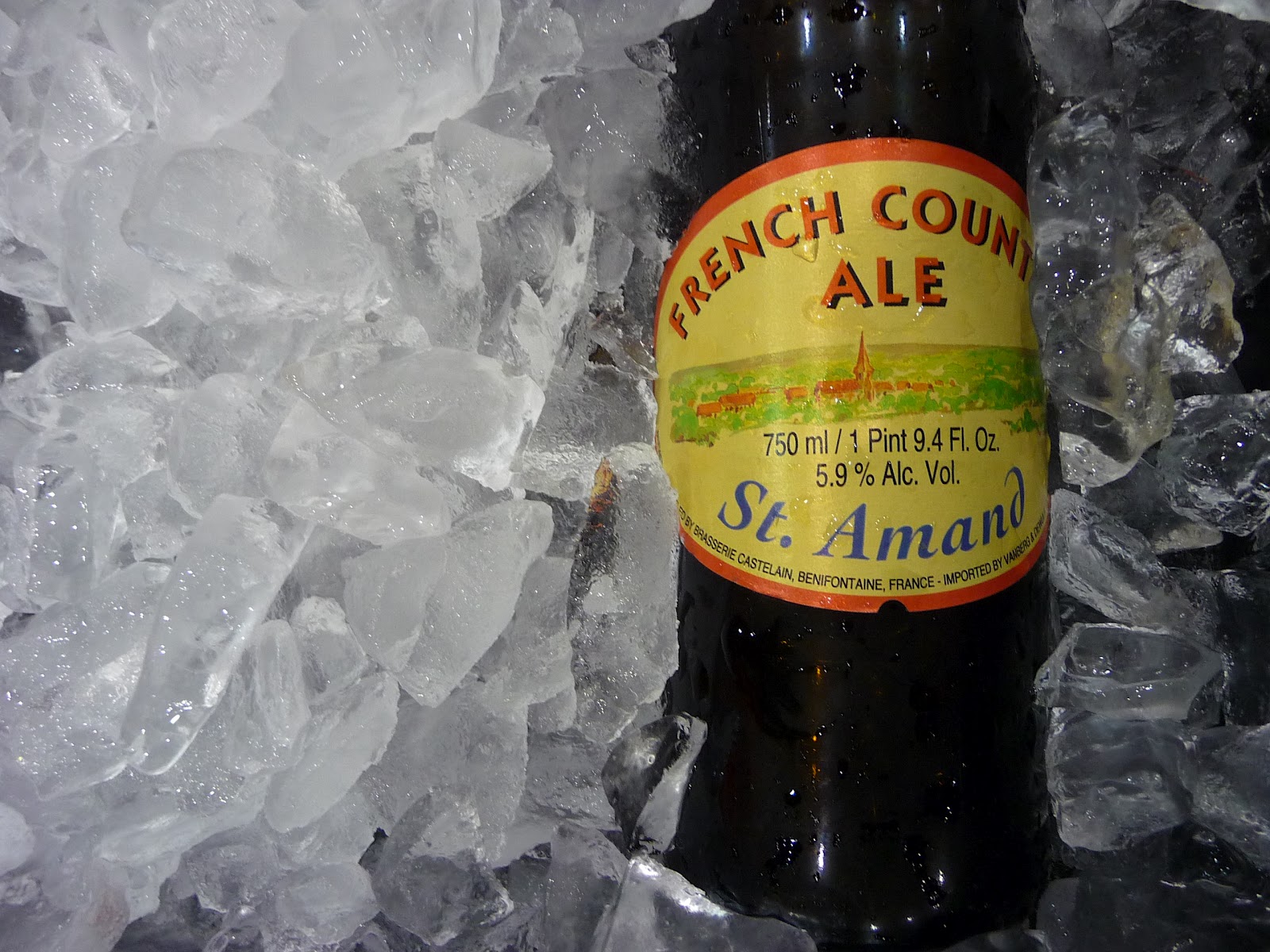
Castellain -- St. Amand French Country Ale: Although France is known for its wine, it does have some good beers as well.  For that reason, I tried the Castellain St. Amand, which is brewed in the style of a French country ale.  The beer is produced with well water, barley from Champagne and hops from Alsace.  The color of the beer is gold, with some copper tones. The aroma is clearly malt driven.  The taste of the beer is likewise malt-driven, with taste elements one would associate with a beer that has a high ABV.  However, this beer has an ABV of only 5.9%. 


Christoffel -- Christoffel Nobel: This beer caught my attention because of the category description, "traditionally brewed beer."  This is a dry-hopped tripel lager produced in the Netherlands.  The beer pours a cloudy, brownish color, with no foam.  The aromatics of the beer are much like a tripel.  The taste of the beer likewise falls within the tripel category.  I could get a sense of Belgian candy sweetness, fueling a malt-centric flavor.    For the last of the European beers that I would try, it was a good way to end.  A full circle, beginning with a Belgian beer and ending with a Belgian style beer.

For the next chapter, I will summarize the American beers that I tried.  Until then ...

ENJOY!

Friday, May 11, 2012

Barbi Orvieto Classico (2010)

The one wine that best exemplifies Umbria is Orvieto, which is produced from grapes grown around the southern Umbrian commune that shares the same name.  Winemaking in Umbria dates back to the Etruscans, long before the Roman Empire.  They dug out cellars in the ground where the wine could age in cool conditions throughout the year.  From the Middle Ages until very recently, Umbria was known for sweet wines.  However, in recent years, the popularity of wines such as the Orvieto have helped to put the Italian region on the map. Indeed, the Orvieto region has its own DOC, which is devoted exclusively to white wine. 

Historically, Orvieto was one of those sweet wines.  Today, it is produced in a couple of different styles.  Normally, Orvieto wines are dry white wines.   Some vineyards produce an Abbocato, or semi-sweet wine or a Dolce, which is the sweet version.  Orvieto wines are produced with Grechetto and Trebbiano grapes, as well as a few other varietals.  The Barbi Orvieto Classico, which is produced in the Abbocato style, is made from a blend of 45% Trebbiano Toscano, 30% Grechetto, 15% Verdello and 10% Drupeggio and Malvasia.

The Barbi Orvieto Classico pours light gold in color, with little bubbles that form along the bottom of the glass.  Those bubbles suggest an effervescence that is a little deceptive, given the wine does not have any carbonation.  The aromatic elements of the wine suggest floral notes and melon.  The semi-sweet nature of the wine does show through in the aroma, even hinting at a little sugar.

As for the taste, this wine is heavily emphasizes citrus, especially grapefruit.  The Abbocato nature of the wine is clearly evident, with a medium body wrapped with a little sweetness balancing the citrus of the flavor.  The sweetness gives way to a dryness in the finish. 

The semi-sweet nature of the Orvieto Classico makes the wine a good pairing with dishes that have some heat, whether by chiles or other spices, as well as for seafood dishes.  I think this wine could also work well with white meat, such as grilled chicken or grilled  pork.  This wine could also lighten up vegetable and bean dishes, such as an Umbrian style lentil dish.

I found this wine at a local grocery store.  It sells for about $11.00 per bottle.

ENJOY!

Wednesday, May 9, 2012

Cowboy Steak in The Prime Style

I can still remember the meal at George Vongerichten's The Prime, even though it was several years ago.  The Prime is located at the Bellagio in Las Vegas.  I was in Sin City for a convention and, after a day of meetings, I was invited by colleagues to a dinner at the Steakhouse.  I am not one to turn down a steak, and, the meal was amazing.  I have always wanted to make it back to The Prime for another steak.  The problem is that there are a lot  of restaurants in Las Vegas and, each time that I visit the city, I end up going to other restaurants.  

Fortunately, Saveur magazine recently published its Las Vegas issue.  The issue contained a recipe for a Porterhouse with Lemon-Thyme Butter, which was inspired by a recipe from The Prime.  I really wanted to make this recipe; however, I could not lay my hands on a three pound, two-inch thick porterhouse steak.  (It was not for lack of trying.)  Still, I found a two pound cowboy steak, which worked perfectly for the dish.  

Cowboy steaks are basically ribeyes that are still on the bone.  The butcher "frenches" the bone, so that the end result is a big piece of meat on a nice, long bone.  One cannot ask for much on a steak night.


COWBOY STEAK IN THE PRIME STYLE
Recipe from The Prime Steakhouse, printed in
Saveur Magazine at p. 76 (April 2002)
Serves 4-6

Ingredients:
2 pound cowboy steak
2 tablespoon of canola oil
3 tablespoons of unsalted butter
6 sprigs of thyme
1 lemon, halved cross wide

Directions:
1.  Cook the steak.  Season steak heavily on all sides with salt and pepper, let sit for thirty minutes.  Heat oven to 500 degrees Fahrenheit.  Heat a 12 inch cast iron skillet or oven proof skillet over high until it begins to smoke.  Add oil and steak.  Cook until lightly charred on one side, about five minutes.  Flip steak and transfer skillet to oven and cook until medium rare and an instant read thermometer reads 135 degrees, about ten to twenty minutes.  Transfer steak to a platter and let rest for ten minutes.  

2.  Prepare the thyme butter.  Meanwhile, pour off the pan drippings and return skillet to stove over high heat.  Add butter and then thyme and lemon halves, cut sides down.  Cook until golden brown, about four minutes.  Remove from heat.  Slice the steak, transfer to plates and drizzle from the skillet.  Serve with lemon for drizzling. 

PAIRING THIS RECIPE

Red wine. This is the first pairing that comes to mind for this recipe.  Any bold red will do.  Chianti, Cabernet Sauvignon, Malbec, Merlot, or Zinfandel.  I went a completely different direction and paired this meal with a beer.  More specifically, I paired the dish with the following beer:

D.C. Brau -- The Corruption
India Pale Ale
Washington, D.C., USA
Flavors of pine, citrus and resin

ENJOY!

Tuesday, May 8, 2012

The Corruption

The can reads, "[i]n 1824, Speaker of the House Henry Clay forged a coalition that secured the White House for John Quincy Adams.  In return, Adams named Clay as his Secretary of State in what has become known as 'The Corrupt Bargain.'" The bargain is what provides the name for D.C. Brau's India Pale Ale. 

D.C. Brau describes this beer as being brewed just at the line of an India Pale Ale and an Imperial IPA.  Each batch of the Corruption India Pale Ale is brewed with Pale 2-Row, C-10, Honey and Munich Malts, along with 40 pounds of Columbus Hops.  The beer has an ABV of 6.5% and 80 IBUs.  The ABV places this beer squarely on the side of an India Pale Ale, while the IBUs are what nudge it toward an Imperial IPA.  (I have tried some Imperial IPAs that have an ABV as high as 10% and as much as 100 IBUs).

The Corruption pours a hazy orange or copper color, suggesting that that the beer is unfiltered.  Although the brewer does not say whether the beer is filtered or unfiltered, my guess is that it is filtered.  In any event, the aroma of the beer presents the classic India Pale Ale scents of pine and citrus.  The pine aromas are clearly more prominent than the citrus.  The pine is also a principal flavor of the beer.  The pine is coated resin flavors, which sets this beer apart from some of the other India Pale Ales that I have tried.  

As with any India Pale Ale, the Corruption is best paired with meats such as beef, lamb, or bison. The citrus and pine flavors of the beer work well with a steak, as the astringency of those flavors cut through the fat of a cut such as a ribeye, sirloin or or a cowboy steak.   I paired this beer with the Cowboy Steak that I made using a recipe from The Prime Steakhouse at the Bellagio in Las Vegas.  

The beer is available in the Washington, D.C. metropolitan area.  It sells for about $10.99 or $11.99 a six pack.  

ENJOY!

Sunday, May 6, 2012

Ancho Chipotle Rockfish Burgers with Oaxacan Guacamole

One day, my beautiful Angel, Clare, said that she really wanted some guacamole.  Those words got me to thinking ... how could I make some awesome and different guacamole for her.  I ran through some different ingredients in my head and I did a couple Google searches.  I ultimately decided to make some Oaxacan guacamole.  

The recipe caught my attention because I am fascinated with Oaxacan cuisine, especially the use of sauces and moles.  The principal difference between Oaxacan guacamole and other guacamole is the use of garlic.  A lot of garlic.   After I settled on a recipe, I got to thinking about how to serve the guacamole.

Being an amazing cook herself, Clare once made Salmon Burgers with an Ancho Guacamole.  I decided that I would work off of that recipe.  However, instead of using salmon, I used rockfish.  The Chesapeake Bay has large, sustainable populations of rockfish, which makes it my usual go to for any fish course.  So, I decided to make rockfish burgers. 

Given I was making rockfish burgers with the Oaxacan guacamole, I decided to give the rockfish a little Mexican kick.  I added a little ancho chile powder and some chipotle chile powder to the ground fish.  I also decided to double down on the chipotle flavor by using a chipotle mustard.  If you do not have any chipotle mustard, you could just use plain ground mustard.


ANCHO CHIPOTLE ROCKFISH BURGERS
WITH OAXACAN GUACAMOLE
Recipe for guacamole adapted from Whole Food Markets
Serves 2-4

Ingredients (for the rockfish burgers):
1 pound of rockfish fillet
1/2 cup of panko bread crumbs
1 tablespoon of lemon juice
1/4 teaspoon of ancho powder
3 tablespoons of Lusty Monk Chipotle Mustard
    (or substitute with 3 tablespoons of ground mustard
    and one-half teaspoon of chipotle powder)
1 teaspoon of ground mustard
Salt, to taste
Ground black pepper, to taste
2 tablespoons of vegetable oil
Kaiser rolls

Ingredients (for the Oaxacan Guacamole):
4 avocados, mashed
Juice from one lime
3 garlic cloves, thinly minced
5-6 green onions, thinly sliced
1 cup of cilantro, chopped
1 jalapeno, diced

Directions:
1.  Prepare the rockfish burgers.  Pulse the rockfish in a food processor about a dozen times until it is chopped well.  Transfer the fish to a bowl, and add the bread crumbs, lemon juice, mustard, ancho powder, salt and ground black pepper.  Mix thoroughly with your hands.  Form four patties.  Refrigerate the patties for about twenty to thirty minutes.

2.  Prepare the salsa.  Mix avocado with lime juice and then stir in garlic, onions, cilantro and jalapeno peppers. 

3.  Cook the rockfish burgers.  Heart the vegetable oil on high.   Add the burgers and reduce the heat to medium high.  Continue cooking for about eight minutes, and flip the burgers.  Cook for eight more minutes or until done.  

4.  Plate the dish.  Place a rockfish burger on each roll.  Spoon a large dollop of guacamole on top of the burger.  Serve immediately.  


PAIRING THIS RECIPE

When thinking about what to pair with this dish, I decided that a smooth, rich white wine would work well.  I think that a Chardonnay, Viognier, or Sémillon.  A couple of wines that I have reviewed that may go well with the Ancho Chipotle Rockfish Burgers with Oaxacan Guacamole are the following:

L'Ecole No. 41 -- Columbia Valley Sémillon
100% Sémillon
Walla Walla, Washington USA
Flavors of melon, pair and apple

Sugarloaf Mountain Vineyard -- Chardonnay
100% Chardonnay
Comus, Maryland, USA
Flavors of apple and pair

 ENJOY!

Friday, May 4, 2012

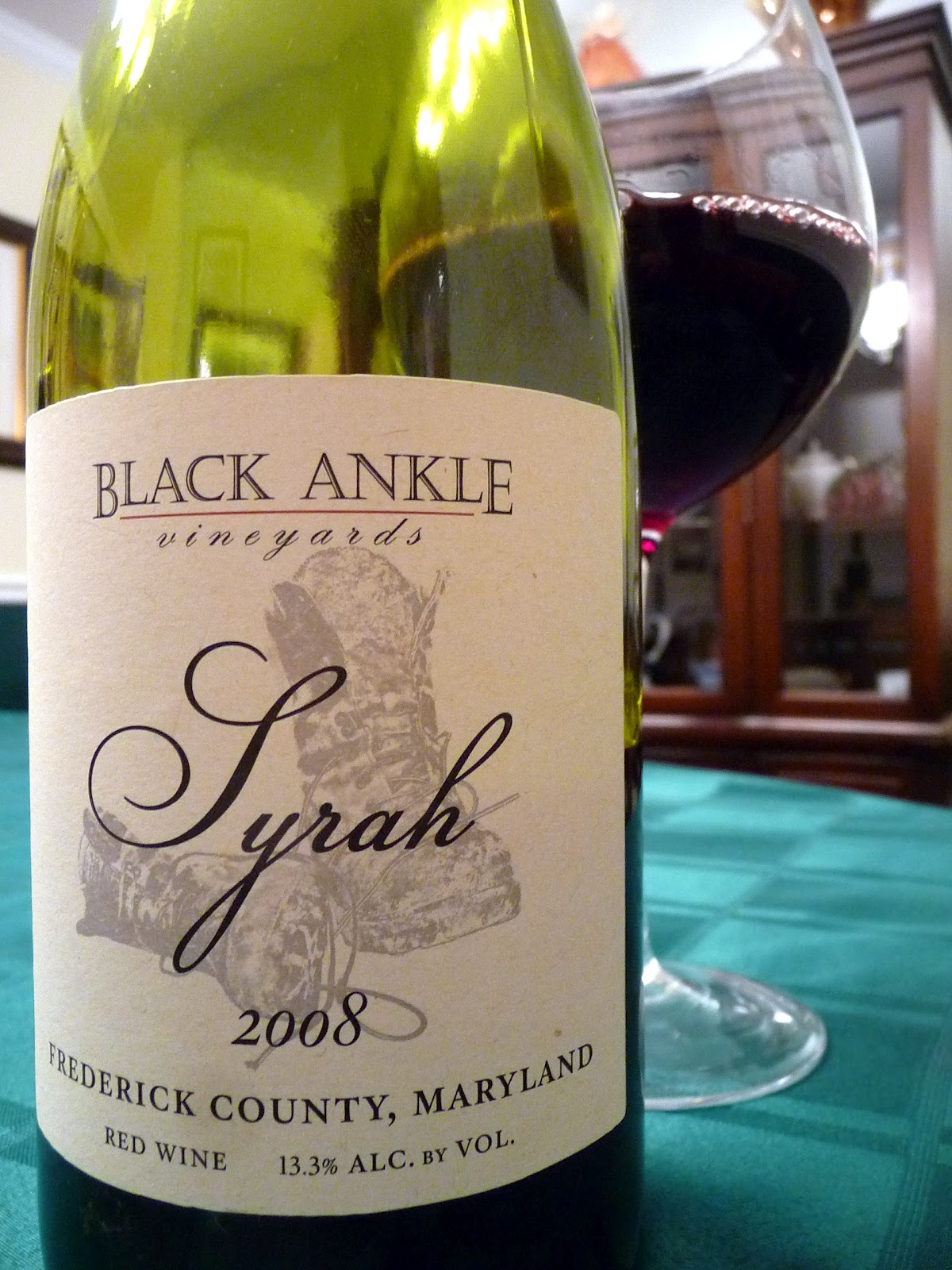
Black Ankle Vineyards Syrah (2008)

The year is 77 AD.  Pliny the Elder (that is Gaius Plinius Secundus, not the beer from North Coast Brewing) was writing his Naturalis Historica.  The particular topic at that moment was the wines of Vienne, which is in the present day Appellation d'Origine Contrôlée (AOC) of Côte-Rôtie northern Rhône wine region of France.  The local peoples, the Allobroges, made a prized wine from a dark-skinned grape. As he described the grapes and the wine, Pliny called it "Allobrogica," and, some people today think that Pliny the Elder was referring to what is known today as the Syrah grape. 

The foregoing story, which is recounted in Wikipedia, is disputed by historians.  What cannot be debated is that the Syrah grape, whether grown in Côte-Rôtie or anywhere else, produces some very good wines.  Recently, I saw a bottle of a Syrah from Black Ankle Vineyards at a local grocery store.  Black Ankle is the realization of a dream for two people -- Sarah O'Herron and Ed Boyce -- who left their jobs as consultants, traveled the world to learn about wine and food, and, ultimately, choose a spot in Maryland where they would make Old World-style wines in the New World.  They purchased a working farm, planted a variety of grapes, and waited.  And waited.  After all, it takes a few years before vines will produce grapes for wines.  The wait was well worth it.  Black Ankle now produces a wide range of wines from blends like the Slate to single grape varietals like the Viognier and the Syrah. 

The Black Ankle Syrah pours a nice ruby red color, with crimson tones.  The winemaker suggests there are "smokey aromas of coffee, dark chocolate, cinnamon and spice are finished with hints of savory maple and bacon."  I have to admit that my palette is still developing, and I was not able to sense all of those flavors.  However, for me, I could smell flavors of coffee, spice and a little earth or leather, wrapped around deep, ripe cherries. 

As for the taste, the winemaker describes the wine as having "rich tannins support flavors of cranberry and tapenade, followed by espresso bean and vanilla."  I definitely could taste cranberries, along with those ripe cherries that I sensed in the aroma, with some vanilla undertones and spices.  The wine had a nice dry finish, which also had some of the tannins that one would typically expect in a syrah wine.

Wines such as Black Ankle's Syrah can be paired with food in the same manner as a French Syrah from the Rhône valley.  The earthy quality of the wine, with its spice, would pair well with just about any red meat dishes, whether beef or bison.  Grilled ribeyes or strip steaks would work well with this wine.  Some cuts, such as flank steaks or iron steaks, could also be paired with this wine, provided that the marinade used does not contain a lot of heat from peppers or chiles .  The tannins in the wine will emphasize the spice in the marinade.  There are many other possible pairings, such as with lamb or pork, but that discussion could continue for quite a while.

I found the Black Ankle Syrah at a local grocery store in Olney, Maryland.  This particular vintage is sold out, as is the 2009 vintage, but there may still be some on store shelves.  I am looking forward to seeing the 2010 vintages on the shelves at some point.  It would be particularly interesting to compare the vintages.  However, that is for another post....

ENJOY!

Thursday, May 3, 2012

Grilled Calamari Salad

When I looking for frog legs to make Grenouille à la Provençale, I saw something that I had never seen before in a grocery store ... large, whole squid.  I am not talking about the little white cones and small tentacles that one usually sees  in the seafood section of most grocery stores.  Those are baby squid.  This particular grocery store had much larger squid, measuring nearly a foot long.  And, while I recognize that squid can grow to as large as forty-three feet long, these foot-long specimens were the largest that I had ever seen in a grocery store.  So, of course, I had to cook with them.

The first question that came to mind is how to prepare the squid.  Fry, saute, or grill.  I settled on the last option, primarily because of the size of the squid.  The only issues with respect to grilling the squid are (1) to ensure that the squid does not become to tough to eat; and (2) to ensure that the squid remains flat during grilling to guarantee even cooking.  The first issue is resolved by the technique recommended for cooking large squid generally ... scoring the inside of the bodies.  Small squid are popular because they are tender.  As a squid grows in side, the meat becomes tougher and more chewy.  By scoring the inside of the bodies, it makes the large squid a little more tender.  As for the second issue, the use of skewers would keep the squid flat as they were grilled. 

The next question was how to serve the squid.  I answered that question with a salad.  It is a healthy option so long as you are mindful of what you add to the salad.  In this instance, I added some diced, roasted bell pepper, some red onions marinated in balsamic vinegar and some tomatoes.  The effort was definitely a success, both with respect to the squid and the salad. 


GRILLED CALAMARI SALAD
A Chef Bolek Original
Serves 2-4

Ingredients:
3 whole squid bodies
Juice from 1 lemon
1 teaspoon of lemon zest
Juice from 1 lime
1 teaspoon of lime zest
1/4 teaspoon of sea salt
1/2 teaspoon of sugar
Pinch of crushed red pepper
Pinch of dried thyme
Ground black pepper, to taste
1/4 cup of extra virgin olive oil
1 bell pepper
1/2 red onion, thinly sliced
1/2 cup of balsamic vinegar
2-4 cups of baby arugula
Skewers

Directions:
1.  Prepare the squid. Clean the squid.  Using a small sharp knife carefully cut to separate the innards from the back of the body.  Pull out the head and the innards carefully, making sure not to break any of the insides.  Wash the inside and outside of the squid thoroughly.  Using a sharp, thin knife, fine the seam of the squid body (where the backbone/cartilage was) and slice through to open the squid body until it lays flat.  Score the inside of the squid body carefully, making sure that you do not pierce the meat.  

2.  Marinate the squid.  Combine the juice of the lemon and lime, along with the zest, sea salt, sugar, crushed red pepper, thyme, black pepper and olive oil.  Stir well.  Add the bodies and tentacles to the marinade.  Marinate the squid for no more than thirty minutes.  

3.  Roast the bell pepper and marinate the onions.  If you have a gas range, place the bell pepper over one element on high heat.  Blacken the skin, use tongs to rotate the pepper and continue to roast until the pepper is blackened on all sides.  Let the pepper cool down.  Once you can handle the pepper, peel off all of the black skin under a little running water.  Dice the bell pepper.  Also, place the sliced red onions in the balsamic vinegar.  Toss and let sit for about twenty minutes. 

4.  Grill the squid. Soak some skewers in water.  Thread the squid bodies with the skewers so that they will lie flat when grilled.  Also wrap the tentacles around skewers.   Heat the grill on high heat. 


PAIRING THIS RECIPE

Generally speaking, squid is the type of seafood that pairs best with a white wine.  The grilling of the squid opens up options both for light, fruity whites -- such as a Pinot Grigio -- as well as more rounded whites like a Chardonnay.  Both Clare and I paired this recipe with the following Chardonnay:

Sugarloaf Mountain Vineyard -- Chardonnay (2010)
100% Chardonnay grapes
Comus, Maryland, USA
Flavors of pears and apples
ENJOY!

Tuesday, May 1, 2012

Sugarloaf Mountain Vineyard Chardonnay (2010)

After experiencing the great wines of Black Ankle Vineyards and Serpent Ridge Vineyard, it has become a "mission" of sorts for me to learn more about Maryland's wine movement.  A couple months back, Clare and I took my parents on a little "wine-tasting" tour of Maryland.  We began our tour at Sugarloaf Mountain Vineyard in Comus, Maryland.  After tasting Sugarloaf's wines, Clare and I purchased a bottle of the vineyard's Chardonnay. 

Sugarloaf Mountain Vineyard produces the Chardonnay in a Chablis style.  Chablis is the northernmost wine district in Burgundy, France.  The wines produced in this region have their own truly unique characteristics.  The cool climate of the Chablis region lessens the fruity flavors of the grapes and heightens the mineral flavors of the wine.  Some describe the mineral flavors as having flinty notes, a sort of "goût de pierre à fusil" or the taste of gunpowder.  Most Chablis wine is not aged in oak barrels; instead, winemakers age the wine in stainless steel tanks.  The white wines of Chablis have less of an oak influence than other whites produced in Burgundy or with the Chardonnay grape. 

Although I have not had a lot of Chablis wine, I can see why Sugarloaf Mountain Vineyard says it produces its Chardonnay in the Chablis style.  Although this Chardonnay is aged in oak barrels (which would be challenged by Chablis purists), the presence of the oak in the wine is much less than other Chardonnays that come from California or elsewhere.  

Apart from the taste imparted by the oak barrels, the Chardonnay pours a color of light gold or, as the winemaker suggests, yellow straw.  The winemaker also describes the wine has having "aromas of vanilla, ripe pear and apple, citrus and spices."  For me, the aromatic elements of the wine suggest some mineral (not quite a goût de pierre à fusil), but also an abundance of fruit, such as apples, as well as a little pear or melon.  The wine is smooth, with a little tartness around the edges that frame a pear-filled taste.  As the winemaker suggests, the finish of the wine is open with apple and pear fruit. 

The winemaker suggests that this wine will be great with salads and grilled fish or seafood.  Clare and I paired this wine with a Grilled Calamari Salad.  The wine paired well with the grilled squid and the other flavors in the salad. 

We purchased this wine at Sugarloaf Mountain Vineyard's tasting room and it may still be available for purchase online or at some stores in the area around the Vineyard. 

ENJOY!

For more about Chablis wine, check out Wikipedia.