Saturday, April 13, 2013

Souvlaki Hirino (Pork Kebabs)

In the times of antiquity, the Greeks prepared a meal that consisted of grilling skewers of pork over pits of charcoal and flames.  They referred to these pork skewers as ὀβελίσκος (obeliskos), which is a diminuitive form of the ancient Greek word for "spit," ὀβελός (obelos).    References to obliskos can be found in the literary works of Ancient Greeks such as Aristophanes, Xenophon and Aristotle.

At some point in culinary history of Ancient Greece, someone paired these grilled pork skewers with a slightly leavened, wheat bread.  We commonly refer to that bread as pita, but when it was combined with the pork skewers, the Greeks referred to the dish as kandaulos.  Much like the obliskos, there are references to the pork skewer/pita bread kandaulos in ancient literary works, including the works of Homer.

Fast forward to today, if one wanted to find this dish while strolling the streets of a Greek city, such as Athens, one could walk into a souvladzidika or souvlaki shop and ask for Souvlaki Hirino.  I decided that I would turn my kitchen into that souvladzidika for one night and make this dish.  Previously, I focused more on Persian cuisine, such as making Kebab-e Jojeh (Chicken Kebabs) and Kebab-e Chenjeh (Lamb Kebabs).  These preparation of these dishes is very similar to Souvlaki Hirino.  The meat is marinated for a period of time, from just a couple of hours to overnight, and then skewered.  While the marinating process is common to these recipes, the ingredients used in the marinade reflect the cuisines of the countries and the ingredients available to their cooks.  For example, the marinade for the Jojeh uses saffron, an ingredient that is available in the Middle East and, in particular, in Iran.  By contrast, the Souvlaki Hirino uses mint and oregano, which are ingredients commonly associated with Greek cuisine.

When I made this dish, I decided to use the broiler as opposed to the gas grill.  I admit that the choice was one of ease as opposed to authenticity.  The broiler did its job, but I could not stop thinking about how grilling the kebabs would provide those slight singed edges that I like with grilled meats.  I also decided to make a simple tzatziki-like sauce, which used yogurt, garlic, mint and cucumber,  In the end, I really liked this dish, although I plan on grilling the pork skewers rather than using the broiler.


SOUVLAKI HIRINO (PORK KEBABS)
Recipe from Saveur
Serves 2-4

Ingredients (for the Souvlaki Hirino):
1⁄4 cup extra-virgin olive oil
1⁄4 cup red wine
2 tbsp. fresh lemon juice
1 tbsp. dried mint
1 tbsp. dried oregano
8 cloves garlic, smashed and 
   minced into a paste
1 bay leaf, finely crumbled
1 lb. trimmed pork shoulder, 
   cut into 1 1⁄4" cubes
4  9" wooden skewers
Kosher salt and freshly ground 
   black pepper, to taste
Lemon wedges, for serving

Ingredients (for the Yogurt Sauce):
1 cucumber (about 12 oz.)
1 1⁄2 cups yogurt
1⁄2 cup chopped fresh mint leaves
2 tbsp. extra-virgin sesame oil or
   extra-virgin olive oil
2 cloves garlic, finely chopped
Kosher salt, to taste

Directions:
1. Marinate the pork.   In a medium bowl, whisk together oil, wine, lemon juice, mint, oregano, garlic, and bay leaf; add pork and toss to coat. Cover and refrigerate for 1 hour or overnight. Meanwhile, soak skewers in water. 

2.  Make the yogurt sauce.  Meanwhile, make the yogurt sauce. Cut the ends off the cucumber and peel it. Cut the cucumber in half lengthwise. Using a small spoon, scrape out and discard the seeds from each half. Finely chop the cucumber and transfer it to a bowl. Stir in the yogurt, mint, oil, and garlic, and season with salt. Cover the sauce with plastic wrap and refrigerate until ready to use. (The sauce can be made ahead and refrigerated for up to 1 week.)

3. Grill or broil the kebabs.  Build a medium-hot fire in a charcoal grill or heat a gas grill to medium-high. (Alternatively, arrange an oven rack 4" below the broiler element and set oven to broil.)  Thread about 4 to 6 pieces of pork onto each skewer so that pork pieces almost touch each other.  I like to leave a little space between the pieces of pork.   Season with salt and pepper and transfer to the grill (or, covering exposed ends of skewers with foil, put skewers on a rack set over a foil-lined baking sheet). Cook, turning often, until cooked through and slightly charred, about 10 minutes.

4.  Plate the dish.  Heat up a pita bread under the broiler for 1 minute on each side.  Place the bread on the plate, spoon some of the yogurt sauce in the middle of the bread and place 1 to 2 skewers on the bread.  (You can and probably should remove the pork from the skewers when you serve the dish).  You can also serve the souvlaki with lemon wedges.

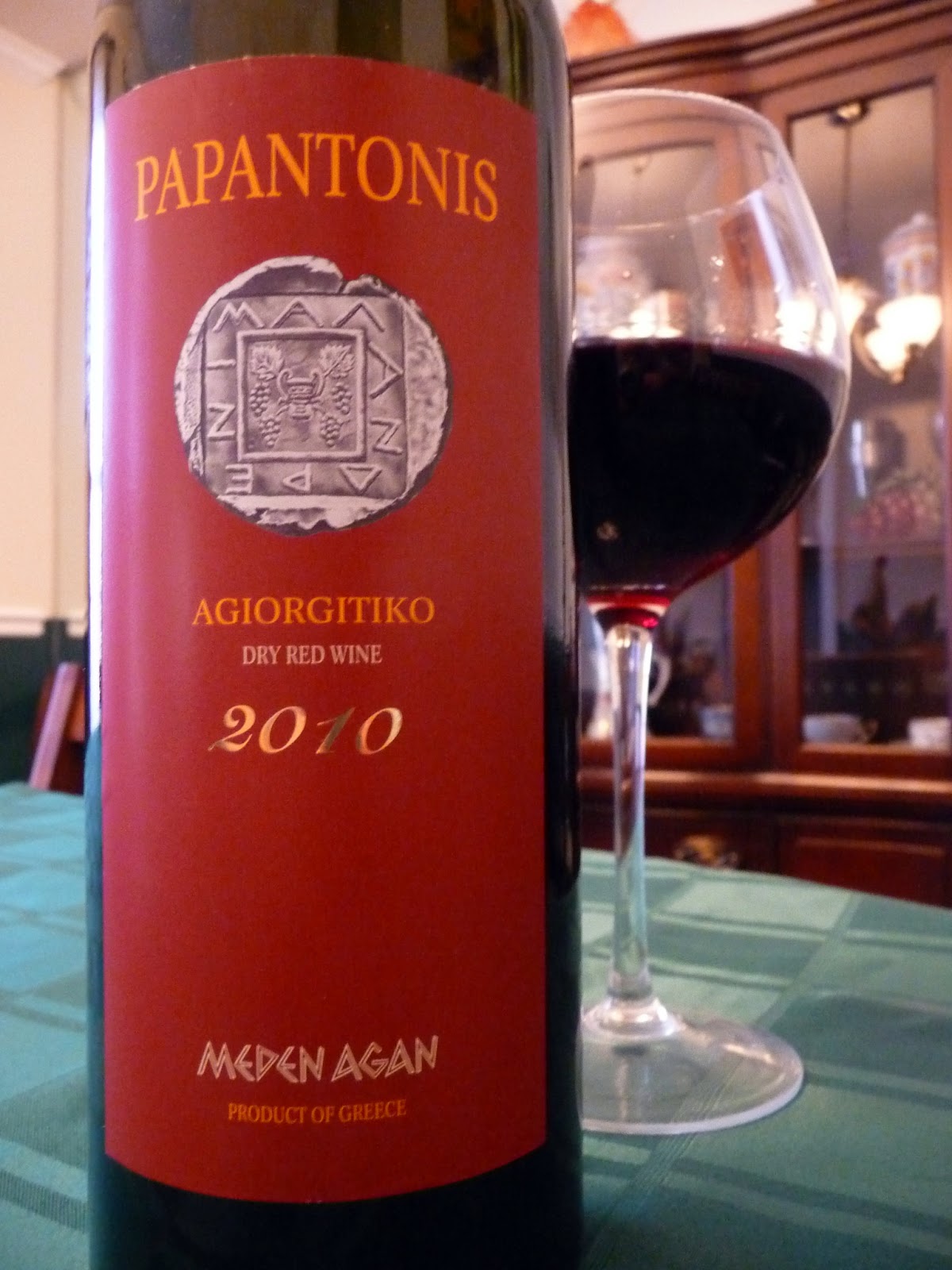
If you are looking for a wine to pair with this dish, check out a Greek wine, like the wines made with the Assyritiko grape. I paired a Papantonis Meden Agen Agiorgitiko (2010), which paired perfectly with the Souvlaki Hirino.   

ENJOY!

For more about the history of souvlaki, check out Wikipedia.

Thursday, April 11, 2013

The Taster's Choice

The lyrics are straightforward ... "Well I guess I'd better drink me one more bottle of beer. Well I guess I'd better drink me one more bottle of beer.  Well baby baby baby why don't you come on here."  They come from a B-side song aptly entitled, "One more bottle of beer," which is performed by the Washington, D.C. area ska band, the Pietasters. And, if you were to ask the Pietasters which beer, perhaps the answer would be ...

Taster's Choice.  And it is not what first comes to your mind!

The Taster's Choice is a collaboration between the Pietasters and two breweries: D.C. Brau and Ska Brewing.  It is brewed in the style of a Doppelbock, which is a stronger and darker version of the traditional Bavarian bock beer.  By their very nature, doppelbock beers are usually a dark gold to brown color, with strong malt aromas and rich flavors.  The brewers from Ska and D.C. Brau reinforced those traditional characteristics by infusing the Taster's Choice with coffee.

I recently purchased a growler of the Taster's Choice from D.C. Brau's brewery.  The beer pours a dark coffee brown, with a thin, off-white, creamy foam.  As that foam recedes, the light struggles to penetrate the surface of the beer.  After the beer is poured, light aromas of coffee bean and mocha greet the nose.  As for the flavor of the beer, the Taster's Choice is malt-driven, with little hop presence in the beer.  This is to be expected from a doppelbock.  What is a little unexpected is the nice balancing of the bitter and the sweet.  The bitter is embodied in flavors of roasted coffee.  (And, by coffee, I don't mean the kind made by a certain Swiss company.  I mean really good coffee.)  The sweetness is present in flavors of chocolate powder or maybe some molasses. The beer balances the bitter and the sweet exceptionally well.  The Taster's Choice is a good illustration of how to achieve complexity in the flavor of a beer in ways other than the traditional contrast between hops and malts. 
 
The proceeds from this beer go to the Todd Eckhardt Scholarship Fund, which was set up to honor the memory of former Pietasters bassist and songwriter Todd Eckhardt, who passed away in 2001. The scholarship fund provides benefits to students at the Duke Ellington School of the Arts through the Ellington Fund.  A great beer and a worthy cause.  What more could you ask for.

The beer is available on draft, with an ABV of about 7.4%, at DC Brau and, perhaps, at local beer bars.  If you can find it, try it ... if only to try a unique twist on a doppelbock.  Hopefully, the brewers at Ska and DC Brau will join forces again to brew this beer very soon.  

ENJOY!

Monday, April 8, 2013

Quiche Lorraine

I am not the only one who cooks in our family.  My beautiful wife, Clare, is also a great cook and a great baker.  Every once in a while, I ask my Angel to provide a guest blog post so that I can share some of the amazing and delicious things that she makes for family, friends and, of course, me.  She has already provided guest blog posts about Cuban Bread, Loyalist Bread, Salmon Burgers, Peach Cobbler and Parmesan Soufflé with White Wine Butter Sauce.   So, without further ado,

A Guest Blog Post by Clare ...

It has been a very long time since my last guest blog post.  Every Easter, Keith and I host some friends for dinner.  The meal is a potluck, with the guests bringing appetizers, salads, sides, beverages and even dessert.  We supply the main course.  In the past, Keith has prepared the main course, but, this Easter, I decided to take the lead in the kitchen.  I also decided to host a brunch, and, I knew what I wanted to make ... quiches.

I made three quiches, all of which everyone enjoyed.  However, Keith asked if I would agree to do a guest blog post about the Quiche Lorraine.  I think it is because it was the only quiche that had bacon in it.  (The other two quiches were a broccoli quiche and a spinach quiche.)  In fact, I know that is the reason.

At this point, Keith would probably give some background or history of the dish.  Something like an observation about how Quiche Lorraine dates back to the 16th Century, when it was said that Charles III, the Duke of Lorraine would eat this dish.  Keith would also probably note that, at that time, they did not call it quiche.  The name "quiche" did not appear to until the 19th century, when it was used in L'Histoire de Nancy.  He would most likely add that the word "quiche" is not even of French origin.  It is derived from the German word "küchen" or "cake."

A quiche is hardly a cake. It is more like a delicious egg pie.  And, this particular quiche is doubly delicious for Keith because of the use of bacon.  One thing that I did differently is that I did not use all of the bacon in the initial making of the quiche.  Instead, I reserved some of the bacon to sprinkle on the top before I put it into the oven to bake.  


QUICHE LORRAINE
Recipe from All Recipes
Makes 1 Quiche

Ingredients:
9 inch single crust pie
12 slices of bacon
1 cup shredded Swiss cheese
1/3 cup minced onion
4 eggs, beaten 
2 cups light cream 
3/4 teaspoon of salt
1/4 teaspoon of white sugar
1/8 teaspoon cayenne pepper

Directions:
1.  Preheat the oven. Preheat oven to 425 degrees Fahrenheit.

2.  Prepare the quiche. Place bacon in a large skillet, and fry over medium-high heat until crisp. Drain on paper towels, then chop coarsely. Sprinkle bacon, cheese and onion into pastry shell.  In a medium bowl, whisk together eggs, cream, salt, sugar and cayenne pepper. Pour mixture into pastry shell.

3.  Bake the quiche. Bake 15 minutes in the preheated oven. Reduce heat to 300 degrees Fahrenheit, and bake an additional 30 minutes, or until a knife inserted 1 inch from edge comes out clean. Allow quiche to sit 10 minutes before cutting into wedges.

And, as "Chef Bolek" always says ...

 ENJOY!

Saturday, April 6, 2013

Papantonis Meden Agen Agiorgitiko (2010)

The history of Greece is full of ancient lore, so it comes as no surprise that there are myths about wine.  One of those legends explains the rich, dark and soft wines produced with the Αγιωργίτικο or Agiorgitiko grape.  The wines got their character because of the vines of the Agiorgitiko grapes were stained by the blood of the lion slayed by the Greek hero, Hercules.

The Agiorgitiko grape is grown throughout the region of the Nemea on the Pelopennese.  One of the vineyards that grows this grape is the Papantonis winery, which is located in the ancient city of Argos.   The vineyards themselves are located near the village of Maladreni, which is in the highlands of the Argolis province and is nestled in the Nemea region.  

The winery grows only two grapes and produces only two wines, one of which is the Meden Agan Agiorgitiko.  The name, Meden Agan, is derived from the Ancient Greek for "nothing in excess."

The Medan Agan pours a dark ruby red, which reviewers say is typical of an Agiorgitiko wine.  The wine has a nice aroma of ripe cherries and maybe even a little strawberry or blueberry.  There is a little hint of earth or spice, but not much.  The berry aromas carry over to the taste of the wine, which is full of cherries and some of those strawberries.  Although I may still be learning about wines and reviewing them, I thought that the taste of the Medan Agan Agiorgitiko was somewhat reminiscent of a Chianti or maybe a Beaujolais. 

One reviewer suggested that an excellent pairing for the Medan Agan is any red meat, as well as hearty stews or casseroles. In my opinion, the Medan Agan pairs very well with souvlaki.  I paired this Agiorgitiko wine with Souvlaki Hirino, which was a very good pairing.  The fruit flavors of the wine worked well with the grilled pork kebabs.

I found this wine at a local grocery store.  I don't recall the price of the wine, but it was definitely under $20 and most likely under $15.  

ENJOY!

Thursday, April 4, 2013

Blackened Catfish with Maque Choux

An important aspect of my cooking hobby is education, an effort on my part to learn from others.  I strive to achieve that goal in many different ways.  I  have taken cooking classes, I read cookbooks, and I follow websites of people who share a love of cooking.  One of the websites that I follow is Hunter, Angler, Gardener, Cook.  It is the website of Hank Straw; and, in some ways, his story is one that I quite admire.  

As you can tell from his website address, Hank Straw and HAGC is all about "honest food."  But, it is his efforts to walk the "less-traveled path" that have me checking the website on a regular basis. Hank does not purchase packaged and processed foods; he hunts for his meat or buys it from people who raise animals in a humane way; and he focuses his attention on, in his words, "those meats and veggies that people don't eat much any more."  It's that less traveled path.

Recently, I made one of Hank's recipes ... Blackened Catfish with Maque Choux.  You can read his post about the history of blackened fish, which is a very interesting one, especially considering the sustainability issues.  What got my attention was the Maque Choux, a dish that incorporates the cooking of the Acadians (i.e., the Cajuns) and Native Americans in southern Louisiana.   The recipe incorporates corn, green peppers, onions and tomatoes.  Due to the time of the year, I had to use frozen corn, but I think that the dish would be infinitely better with fresh corn.  I will definitely be making Maque Choux in the summer.

Finally, one note about the blackened catfish.  Hank suggests that you use a cast-iron skillet to cook the fish.  When I worked in a seafood restaurant, we used a large cast iron skillet to cook blackened catfish and blackened tuna.  While I do have a cast iron skillet, I decided to try using a regular, non-stick pan.  While a certain aspect of the "blackened" character of the fish is lost with a non-stick pan, it is easier to clean up and I don't have to worry about cracking any pans. 


BLACKENED CATFISH WITH MAQUE CHOUX
Serves 4

Ingredients (for the catfish):
4 catfish fillets
1/2 cup melted butter

Ingredients (for the blackening rub):
1 teaspoon black pepper
1/2 to 1 teaspoon cayenne pepper
1 teaspoon celery seed
2 tablespoons sweet paprika
1 tablespoon garlic powder
1 tablespoon dried thyme
1 tablespoon of dried oregano

Ingredients (for the Maque Choux):
2 tablespoons of butter
1 small onion, chopped (about 1 cup)
1 green pepper, chopped
4 cups corn kernels
1 cup cherry tomatoes, sliced in half
Salt, to taste
Tabasco sauce, to taste

Directions: 
1.  Make the maque choux.  Heat the butter in a saute pan over medium-high heat, then add the onion. Saute the onion for 1 minute, then add the green pepper. Sprinkle salt over everything and saute for about 4-5 minutes, stirring often. Add the corn kernels and cook for another 10 minutes. Turn off the heat and cover while you make the fish.

2.  Prepare the pan.  Get a cast-iron frying pan hot over your hottest burner.  Turn the stove fan on high, and open the windows nearby, as this creates smoke. Let the frying pan get hot for a good 3-4 minutes. (Alternatively, you can heat a non-stick pan on high for a couple of minutes).  

3.  Prepare the catfish fillets. While the pan is heating up, melt the butter and pour the Cajun spices into a shallow dish.  Dip the fish fillets in the melted butter, then dredge in the Cajun spices. Shake off any excess spices. Do this for as many fillets as will fit in the frying pan, which is usually about four fillets. 

4.  Cook the fillets.  Lay the fish down on the hot pan. It will sizzle up fiercely and smoke. This is normal. Let the fish cook this way for 2-3 minutes. Using a wide metal spatula, carefully flip the catfish fillets and cook on the other side for another 2-3 minutes.  

5. Finish the maque choux.  When you flip the catfish, add the tomatoes and the Tabasco to the maque choux.

6.  Plate the dish.   Plate one fillet on a dish, add the maque choux, and serve with rice and a good beer.  (I suggest anything from Abita Brewing.)

ENJOY!

Tuesday, April 2, 2013

Ska + Peppers = Mole Stout

One of the trends in craft beer is the "mole" beer.  This growing "style" of beer is one that is brewed using some of the ingredients that are used to make the sauces that define the cuisines of Mexican states like Oaxaca, Puebla and Tlaxcala.  I have previously reviewed two mole beers in the past ... New Belgium Brewing Company's  Cocoa Mole and New Holland Brewing Company's El Mole Ocho.  

There are several different mole sauces.  For example, in Oaxaca, there are seven traditional moles: Mole Negro, Mole Rojo, Mole Coloradito, Mole Amarillo, Mole Verde, Mole Chichilo and Mancha Manteles.  As the names suggest, these moles use different ingredients and result in sauces of different colors (negro = black, rojo = red, verde = green, etc.).  However, when it comes to "mole" beers, brewers stick to the one that could most easily been reproduced in a beer ... turning a stout into mole negro.  Both the Cocoa Mole and El Mole Ocho embodied this approach.

Recently, I was able to try other mole beer, the Autumnal Mole Stout brewed by Ska Brewing Company.  The brewers describe the beer as "an ale brewed with cocoa nibs, spices and three varieties of chile peppers: Mulato, Ancho and Hatch green chiles, (also known as Anaheim Peppers.)"

The description is fitting.  The Mole Stout pours pitch black.  The beer gives hints of aromas of cinnamon, Mexican chocolate, coffee and/or espresso.  There are also some hints of spice from the peppers, along with some nutmeg in the aroma.  As for the taste, this beer is very similar to the El Mole Ocho, with flavors of the ancho and hatch chiles really come through in the taste.  The peppers are seemingly surrounded or encased by the sweetness of Chocolate and cocoa, presumably brought out by the use of chocolate and/or roasted malts in the brewing process.

When it comes to pairing this beer, it would be easy to say ... "serve it with Mexican cuisine."  You should think of the beer as the sauce.   For example, Chef Rick Bayless prepared a Oaxacan Black Mole for the Mexican state dinner at the White House.  That mole was served over grilled chicken.  Any grilled or roasted meats, including beef and pork, would be easily paired with a mole beer like the Autumnal Mole Stout  You could also pair this beer with barbecue, although I would avoid very spicy rubs and/or sauces because that would only increase the spice in the beer.  (I don't mind the increase in heat, but for people who are not used to very spicy foods, it may be a little too much.)

This beer was given to me as a gift.  I do not see Ska Brewing Company's beers around me, but I believe they are available out west and as far east as Chicago.  Until next time ...

ENJOY! 

Friday, March 29, 2013

Agnello al Fiorentino

Bistecca alla Fiorentina is a standard of Florentine cooking. Traditionally, the steak is a t-bone or porterhouse steak from either the Chianina or Maremma breed of cattle.  Most recipes call for each steak to be at least two pounds. Those recipes also call for a rub consisting of black pepper, salt, rosemary and thyme. 

At least for me, it is perhaps the best way to grill a porterhouse steak.  It can also be the best way to grill any meat.  I put that to the test recently when I bought some lamb t-bones.  These t-bones were miniature in size, weighing about 1/3 of pound or more.

Although the lamb t-bones were good enough on their own, I decided to make a simple mushroom sauce.  The reason for the sauce is that I wanted to incorporate mushrooms into the dish.  I suppose I could have just sauteed the mushrooms and then topped the t-bones with them. However, I wanted to try my hand at a basic sauce.  A very basic sauce ... stock, butter, garlic, oregano and, of course mushrooms. I think it worked out well for something to do on a whim.


AGNELLO AL FIORENTINO
A Chef Bolek Original
Serves 2

Ingredients (for the lamb):
4 lamb steaks
1 tablespoon of rosemary, finely chopped
1 tablespoon of thyme, finely chopped
1/2 tablespoon garlic powder
1/2 tablespoon of salt
1/2 tablespoon of ground pepper
1/4 tablespoon of crushed red pepper
1/4 tablespoon of dried oregano
1/2 cup of olive oil
Ingredients (for the sauce)
8 ounces of portabello mushrooms, sliced
1/4 tablespoon of dried oregano
3 tablespoons of butter
2 cloves of garlic, diced
1/4 cup beef stock
Salt, to taste
Ground pepper, to taste

Directions:
1.  Marinate the lamb steaks.  Combine the rosemary, thyme, garlic powder, salt, ground pepper, crushed red pepper, oregano and oil in a bowl or a zip lock bag.  Mix the ingredients.  Add the lamb steaks and make sure all of the steaks are covered with the marinade.  Cover and refrigerate for about one-half hour.

2.  Grill the lamb steaks.  Heat a grill to medium high heat (about 400 degrees Fahrenheit).  Clean and oil the grates.  Add the lamb steaks.  Cook for about four minutes, turn ninety degrees.  Cook for four minutes more.  Flip and cook for four minutes.  Turn ninety degrees and cook for four minutes.  Remove from the heat, cover and set aside.

3.  Make the sauce.  Heat a medium saucepan over medium heat.  Add the mushrooms and saute for about six to eight minutes, until the mushrooms have released their moisture.  Stir or shake the pan occasionally to prevent the mushrooms from burning.  Add the garlic and cook for 1 to 2 minutes.  Add the beef stock and 1 tablespoon of butter.  Season with salt and pepper.  After the butter has melted, add another tablespoon of butter.  Stir until the butter is melted and add the final tablespoon of butter.  Once it has melted, remove from heat.

4.  Plate the dish.  Place 2 lamb steaks on the plate.  Spoon some of the mushrooms over the steaks and then some of the sauce around the steaks.

Although the sauce worked well, I don't know that I would use it every time I make these lamb t-bones.  If I do use it again, I may try improving the sauce.  One way would be to  sear the lamb t-bones in the skillet before adding the mushrooms, and then using the stock to deglaze the pan.  The lamb t-bones could be finished under the broiler. This is the great thing about cooking, there are always way to improve what you make. 

ENJOY!

Sunday, March 24, 2013

Bourbon Oak Smoked Ribeye with Rogue Blue Mashed Potatoes and Roasted Bell Pepper Salad

A few years ago, I got a stovetop smoker for a gift.  I lived in an apartment at the time.  Although living on a high floor had its advantages, the major drawback was that I could not own, let alone use, a real smoker.  I was very happy and excited to use the smoker. I bought several containers of "wood chips," which are really more like wood shavings or wood dust.  Still, I had all the necessary woods ... oak, alder, pecan, cherry, apple, and, of course, bourbon oak.  

I used the stovetop smoker several times while I lived in the apartment; however, once I moved to a house and got my own yard, I got a bullet-style smoker.  I began using that to smoke meats and the stovetop smoker began to sit on the shelf.  (It also did not help that the one time I did use it in my new home, I set off the smoke alarm.) 

While I really like to use my bullet smoker, it has its limits.  It is inefficient and unwieldly when it comes to smoking just a small piece of meat, like a steak.  This is where the stovetop smoker still serves a purpose.   I can use it to impart a slight smoke flavor to a small piece of meat, which I can then just finish under the broiler or in the oven. 

Recently, I decided to use the stovetop smoker just to smoke a ribeye.  I pulled out the Bourbon Oak chips, got the stovetop smoker working and used it to provide that steak with a slight smoked flavor.  I also made a small salad of roasted onions and peppers and a side of mashed potatoes with Rogue blue cheese.  Everything was delicious, although the mashed potatoes needed a little more liquid to make them a little creamier.  I usually eyeball the amount of milk and butter, but I figured out how much I used and just increased the amount in the recipe.


BOURBON OAK SMOKED RIBEYE WITH ROGUE BLUE
MASHED POTATOES AND ROASTED BELL PEPPER SALAD
A Chef Bolek Original
Serves 2-4

Ingredients:
1 pound, grass-fed ribeye
1 green bell pepper
1 yellow bell pepper
1 red bell pepper
1 yellow onion, thinly sliced
1 tablespoon fresh rosemary, chopped
1 tablespoon fresh thyme, chopped
2 Yukon Gold potatoes, peeled and cut into big pieces
1/8 pound of Rogue Blue Cheese, cut or broken into pieces
1 tablespoon of butter
1/4 cup of skim milk
Sea Salt
Freshly ground black pepper 

Equipment:
Cameron's Stovetop Smoker
Cameron's Bourbon Oak Chips

Directions:
1.  Prepare the mashed potatoes.  Fill a small pot half way with water and add the potatoes.  Turn heat to high and boil the potatoes for 10 to 15 minutes or until they can be easily pierced with a fork.  Drain the potatoes, add the butter, half of the cheese and milk.  Using a hand masher, mash the potatoes until they are the desired consistency.  Add the remainder of the cheese and stir it into the potatoes.

2.  Prepare the bell peppers.  While the potatoes are boiling, use the elements of your gas stove to roast the bell peppers.  Turn the bell peppers as each side blackens until the peppers are charred on all sides.  Set aside for five minutes.  Once the bell peppers have cooled, run them under cold water, using your fingers to remove all of the blackened skin.  Dry off the bell peppers and thinly slice them.

3.  Prepare the ribeye.  Liberally salt and pepper the steak.  Heat a pan over high heat.  When the pan is really hot, sear the steak for a few minutes on each side.  Remove the steak from the heat.    Follow the directions on the stovetop smoker and smoke the ribeye for about ten minutes or until it is done to your desired temperature.  (I like my steaks between medium rare and medium.)  Remove the steak from the smoker and let it rest for five minutes. 

ENJOY!

Wednesday, March 20, 2013

Its all about the Alchemy Hour ...

Along the beaches of California, surfers have a term for that period of time when they can enjoy the best that a swell has to offer ... the "Alchemy Hour."  The origin of the phrase is unknown, but one could surmise that it is the combination of elements to transform regular waves into those surface gravity waves that provide the best surfing.

Great Lakes Brewing Company has borrowed the term "Alchemy Hour" for its Double India Pale Ale.  The brewery claims that it chose the name to commemorate those who surf the Great Lakes.  That hardy lot has to work a little harder than their brethren who surf the Pacific Ocean's waves.  (Swells are not as swell on the Great Lakes and the reasons are better left for something other than a beer review.)   The GLBC brewers note that, on the Great Lakes, "our surfers have to work a little harder to find the perfect swell, waking at dawn and camping out on icy beaches in freezing temperatures.  Crazy?  Yes.  Extreme? Definitely, But we crafted our Double IPA for the bold ones."   

The choice of words often provides hidden clues or suggestions.  Take, for example, "crafted."  Alchemy is the medieval practice of transmuting one thing into another, relying upon the properties of materials to craft something truly special.  For centuries, people used alchemy in an effort to turn base metals into gold or other precious metals.  Those people failed.  Perhaps they were trying to create the wrong kind of gold.  After all, the end product need not carry the chemical symbol "Au."    
Gold could be something else.  It could be liquid gold, like beer.  In this case, the "alchemy" practiced by the brewers produced a Double India Pale Ale that pours pours a burnt copper or orange color, several shades off from what one would ordinarily consider the color of gold.

Color aside, the brewers were able to use the properties of the all natural ingredients -- Harrington 2 Row Base Malt, Caramel 45 malt, and honey malt, as well as Mosaic, nugget and cascade hops -- to produce a beer that is definitely golden in both aroma and flavor.  The beer as the aromas of citrus, like fresh grapefruit

However, the "alchemy" practiced by the brewers at Great Lakes Brewing Company produced  the end product does not need Pours a burnt copper or orange color.  Aromas of citrus, like grapefruit.  These aromas are from the use of the Mosaic hops, which provide floral, citrus and fruity aromas to the beer.  The citrus tones carry over to the taste of the beer, providing the bitter bite one expects from a hopped-up India Pale Ale.  There was also a little pine flavor in the beer, perhaps offered by the nugget hops.  While this citrus and pine bitterness was fairly strong in the beer, it was nevertheless wrapped up in a surprising sweetness, brought out by the use of the honey malts.

The brewers at the GLBC suggest that the Alchemy Hour Double IPA pairs well with smoked beef brisket, grilled lamb, sharp and rich cheeses, and sweet desserts.

Great Lakes Brewing Company definitely found liquid gold with the Alchemy Hour Double IPA.  As for myself, I found this beer at a local grocery store, where it sold for about $10.99 a four-pack.  This is a limited production beer.  If you see it, you should buy it.

ENJOY!

Saturday, March 16, 2013

Pork Laab

Transport yourself to Southeast Asia where you find yourself near the border of northeast Thailand and Laos.  Hunger grips your stomach, the clench tightening as the thought of food travels through your brain.  You enter a village and head immediately to the market.  The market just consists of just a few vendors.  However, there is one stall around which the local people gather.  You politely work your way in to see a vendor cooking a dish of minced meat, nutmeg/black pepper/chile spice blend and fresh herbs.  The aromas are so enticing that you almost miss the fact that the vendor is adding slices of pork liver and pork heart, along with a little pork blood.  As the vendor finished the dish for individual patrons, adding rice and topping it with fried garlic and pork cracklings.  You turn to a local standing next to you and ask what is this dish.  (Remember, you are not actually there, so a translator is not required.)  The local responds, "it is Laab."

Laab is a popular dish throughout Southeast Asia.  The story describes how the Tai Koen prepare this dish in Northeast Thailand.  If you were in Burma (Myanmar), the Shan people prepare Laab with lightly fried minced pork, along with shallots, lemongrass, galangal, sesame seeds, and a roasted chile paste.

I learned about these different variations of Laab in an article published by Naomi Duguid in Saveur.  The article included a recipe by Hong Thaimee of Ngam Restaurant in New York City.  This recipe does not require pork livers or pork blood.  Instead, it is a recreation of a classic Laab that does recreate many of the aromas and flavors one would expect is you were eating this dish in Southeast Asia.  This is definitely a great dish, which I will make again. 

PORK LAAB
Recipe from Saveur
Serves 2-4

Ingredients:
⅓ cup canola oil
3 tbsp. mashed garlic
4 red Thai chiles, stemmed and minced
10 oz. ground pork
1 tsp. crushed red chile flakes
1 tsp. Chinese five-spice powder
1 tsp. freshly grated nutmeg
1 tsp. kosher salt
¼ tsp. ground black pepper
¼ tsp. ground coriander
¼ tsp. ground cardamom
2 tbsp. minced mint, plus more to garnish
1 tbsp. minced scallions, plus more to garnish
1 tbsp. minced cilantro, plus more to garnish
2 tsp. fish sauce
Thinly sliced kaffir lime leaves, lemongrass, shallots, cucumbers, and cherry tomatoes to garnish

Directions:
1.  Cook the garlic and peppers.  Heat oil in a 12" skillet over medium heat. Add garlic and chiles, and cook, stirring, until fragrant, about 2 minutes. 

2.  Cook the pork and spices.  Add pork, chile flakes, five-spice, nutmeg, salt, pepper, coriander, and cardamom, and cook, stirring, until pork is browned, about 2 minutes. Stir in mint, scallions, cilantro, and fish sauce, and cook until pork is done, about 4 minutes.

3. Finish the dish. Transfer to a large serving bowl, and top with scallions, cilantro, kaffir leaves, lemongrass, shallots, mint, cilantro, cucumbers, and tomatoes. Serve at room temperature.

ENJOY!