Friday, December 7, 2012

Around the World in 80 Dishes: The Specials

As you may know, I am in the midst of a personal culinary challenge that I have named "Around the World in 80 Dishes."  The challenge is to make 80 main courses from 80 different countries.  (By the time I am done, I will have prepared a main course from over 40% of the 195 countries around the world.)   I recently completed my 20th challenge, which involved the preparation of a tasty carpetbag steak ... a New York Strip stuffed with fresh oysters ... that is a main course served in Australia.

Over the course of those challenges, I benefited from many new experiences.  For example, I got to pretend that I was part of the Germandat de Escullaires for a day, when I prepared Escudella, the national dish of Andorra.  The dish is prepared in the streets and served to the public on every St. Anthony's Day (January 17).  I also had the opportunity to cook with offal for the first time, when I made Khalyat Alkadba wal Galoob, or sauteed lamb hearts and livers, which is served as a main dish in Libya.  Speaking of unusual ingredients, I worked with pig trotters -- an ingredient that I never liked as a kid -- when I made Kangchu Maroo, a delicious pigs' feet curry served in the Land of the Thunder Dragon, also known as Bhutan.  I could go on, but I think you get the drift.  To this point, I look back with amazement at all that I have accomplished over my first 20 challenges and I look forward to the remaining 60 challenges.

However, I have also been reflecting upon my Around the World in 80 Dishes challenge.  To this point, every challenge has been based on a country's cuisine.  There are many more cuisines than countries.  Many of these cuisines, like their associated ethnicities, do not have their own countries.  The ethnicities may be minorities in a country.  They may be split between two or more countries.  I realized that, as I continue my personal culinary challenge, I will never have the chance to learn about these ethnic groups or the opportunity to prepare a meal reflective of their cuisine or culture. 

For this reason, I have decided to do four "special challenges."  The focus of these special challenges will be on the culture and cuisine of an ethnicity that does not have its own, formally-recognized country and/or would not otherwise be part of the challenge to prepare 80 dishes from 80 different countries.  Each such special will take place after I have completed twenty challenges.

That means the first special will be coming very soon. 

So, stay tuned and ... 

ENJOY!

Wednesday, December 5, 2012

A Beer for Keeping

One of the great things about collaboration beers is that you can buy a beer from a brewery that you love -- like New Belgium -- and learn about breweries that you did not even know about  -- like Brewery Vivant.  I have reviewed a few great New Belgium beers, such as the Grand Cru Abbey Ale and the Le Fleur Misseur? Ale.  Those beers made me a big fan of New Belgium and I always keep an eye out for their beers.  

That is how I found the Bière de Garde, which is a collaboration between New Belgium and Brewery Vivant.  Located in Grand Rapids, Michigan, Brewery Vivant draws its inspiration from the small farmhouses in Northern France and Southern Belgium.  They have transcribed that inspiration into beers such as the Farm Hand Farmhouse Ale and the Solitude Abbey Style Ale.  

For this particular collaboration, the brewers at New Belgium and Brewery Vivant chose to brew a Bière de Garde.  This style, which translates into "beer which has been kept or lagered," originated in Northern France in regions such as Nord-Pas-de-Calais, Artois and Picardie.  Farmhouses would brew a Bière de Garde in the spring and cellar the beer so that they could enjoy it during the summer.  This was a far better way to enjoy beer than trying to brew during those hotter months, when the heat added a sense of unpredictability to the fermentation of the yeast.

There are three variations of the Bière de Garde style.  According to the Beer Judge Certification Program, there is the brown (brune), blond (blonde) and amber (ambrée) styles.  The New Belgium/Brewery Vivant Bière de Garde fits neatly within the blonde style, with a nice yellow or gold in color.  The brewers produced this beer with pale, Munich and C-120 malts, as well as Target and Sorachi hops.  The brewers also used orange peel in the production of the beer. 

The brewers describe the aroma as being "[f]ruity orange and lemon peel, lots of spicy phenolic yeast flavors (clove, peppercorn), fresh herbal tea, fennel, some tropical fruit notes, cellar-like notes."  I could definitely sense the orange, as well as the lemon peel (which most likely came from the Sorachi hops, which do a great job adding citrus aromas and flavors to beer). There were some faint clove and spice flavors in the aroma.  As for the taste, the brewers suggest sweet fruit, citrus tart and mineral.  I definitely got the orange citrus flavors, which were clearly prominent in the light, dry and crisp body of the beer, as well as in its finish.

The Bière de Garde bottle may be a little suggestive of the ideal pairing for this beer.  Draft Magazine suggests that a Bière de Garde style beer can be paired with roast chicken or roast duck, as well as a vegetable omelet or corn bread.  The brewers at New Belgium suggest a pineapple soup or mixed paella. 

This beer is definitely worth a try, if not just to sample a beer from the Bière de Garde style.  This beer caught my eye at a local grocery store, where it sold for about $12.99 a bottle.

ENJOY!

Monday, December 3, 2012

Djej Mechoui (Moroccan Grilled Chicken)

My culinary adventures have given me the opportunity to try new recipes and cooking techniques.  One of these new found experiences involves grilling whole chickens.  I have taught myself how to spatch-cock (or butterfly) the whole chicken and then learned how to use different rubs to create some amazing dinners.   

The rub recipes have provided me with a small window into different cuisines.  For example, the recipe for Pollo a las Brasas con Cebollitas -- with its use of ancho chile, oregano, cinnamon, garlic and citrus juice -- provides me with an insight as to how cooks at roadside stands in Mexico prepare their chicken.  By contrast, the recipe for Chicken Hawayil -- with a dry rub consisting of cumin, caraway, cardamom, saffron, cloves, coriander and turmeric -- illustrates the greater range of spices that may be available to cooks in the Yemen.  

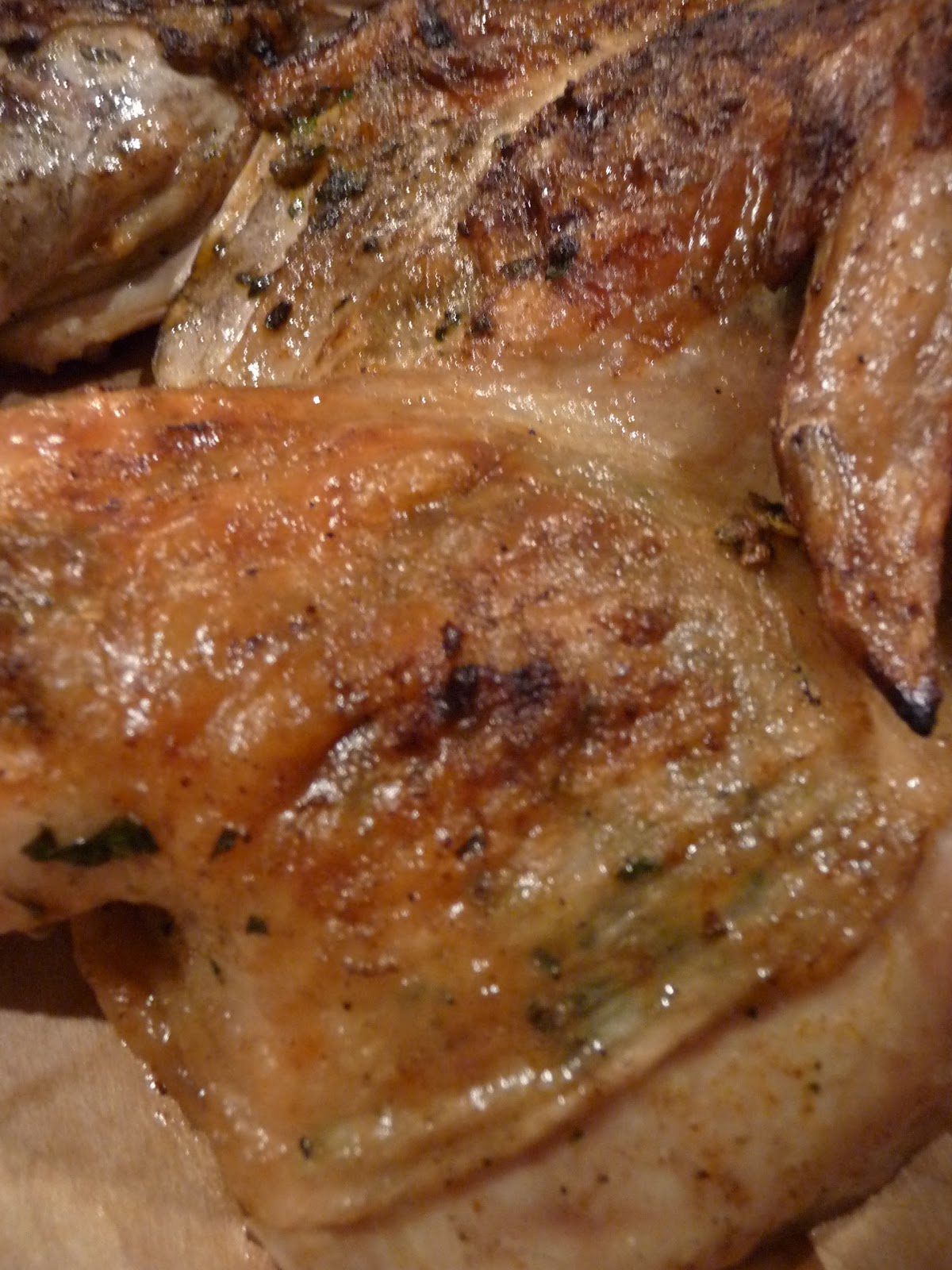
Recently, I had the opportunity to prepare a grilled chicken recipe from a country that sort of sits at the midway point between Mexico and the Yemen ... Morocco.   The recipe is Djej Mechoui.  The word "Mechoui" is Arabic for "roast on a fire" and it describes a popular, North African grilled meat dish.  According to Wisegeek, there are two traditional ways to prepare a "Mechoui."  In Algeria, it involves the roasting of a whole lamb or sheep over a fire.  In Morocco, it involves roasting the lamb or sheep in the ground in a manner similar to a Polynesian pig roast.   Either way, the meat is heavily spiced before it is roasted.  

The use of spices differs greatly from the other recipes that I have tried.  Rather than using a dry rub, or a combination of dry ingredients with citrus juice, the Djej Mechoui uses a spice butter.  The spices are a combination of fresh ingredients (parsley, cilantro, garlic and scallions) and dried ingredients (sweet paprika, hot paprika, and cumin) that are blended into the butter.  The butter is then applied to both the skin and meat of the chicken just before the meat is placed on the grill. 
 
Finally, just a couple of technical notes.  For this recipe, I used a whole, free-range chicken that was fed a natural diet.  After all, I suspect (and hope) that most Moroccans (as well as Mexicans and Yemenis for that matter) are not getting their chickens from industrialized, mass-producing poultry farms.  In addition, as I did not have an open fire available to roast a chicken, I used my gas grill.  The result still produced a very delicious, tender and juicy chicken.


DJEJ MECHOUI
Recipe adapted from Saveur
Serves 4

Ingredients:
3 scallions, white ends only, chopped
1 clove garlic, peeled
2 tbsp. fresh cilantro, chopped
2 tbsp. fresh parsley, chopped
1 tsp. salt
1 1⁄2 tsp. sweet paprika
1 pinch hot paprika
1 1⁄2 tsp. ground cumin
1⁄4 cup butter, soft
1 3 pound chicken (or 4 poussins or 2 small chickens)

Directions:
1. Make the spice butter.  Crush the scallions, garlic, cilantro, parsley, salt, sweet paprika, hot paprika, and cumin with a mortar and pestle. Blend in butter.

2. Marinate the chicken.  Wash poussins or chickens; split them down the back and flatten; dry well; and rub inside and out with butter paste. Let stand at least 1 hour.

3. Grill the chicken.  Preheat the grill, then cook chicken skin side up. Turn after 2 minutes and baste with any extra paste. Continue to turn and baste until skin is crisp and flesh is firm.

One last note ... I served this Djej Mechoui with a Moroccan Raw Carrot Salad.  This Moroccan-inspired meal was amazing.

ENJOY!

Sunday, December 2, 2012

The Angel's Share

So, as the story goes, "[w]ay down in Kentucky and across the pond in Scotland, distillers age their whiskeys for many years in oak barrels. Over time, some whiskey is lost to evaporation. They refer to this loss of spirits as 'The Angel’s Share.' Each time a barrel is filled, a measure of this liquid seeps into the oak and is lost forever."  The story is actually true.  Distillers and winemakers traditionally age whiskeys and wines in oak barrels.  According to Wisegeek, when those barrels are stored at 60% humidity or higher for long periods of time, some of the liquid will permeate and evaporate through the staves of the barrels.  This leads to a reduction in the alcohol content and it allows the flavors of the whiskey or wine to develop.  

For the brewers at Port Brewing, the story serves as an inspiration for a brandywine that they describe as "a barrel aged burgundy colored ale infused with copious amounts of dark caramel malt to emphasize the vanilla and oak flavors found in freshly emptied bourbon or brandy barrels. Each batch spends no less than 12 months aging in the oak."

The Angel's Share pours pitch black, far from any angelic color.  Little to no carbonation is present, resulting in little foam as the beer is poured into the glass. 

The year-long aging of the beer is clearly present in the aroma and the taste of the Angel's Share.  It is very boozy, with elements of the wood present in the background.  There are also aromas of raisins caramel and vanilla.  As for the taste, the liquor -- whether it is whiskey or bourbon (given I do not drink hard liquor, it is sometimes difficult to tell the difference in a beer) -- is first in line to greet the drinker.  It is also the last to leave, hanging on through the finish.  Other flavors are present for the party, such as alcohol-infused raisins, caramel and perhaps a little toffee.

This beer is relatively hard to find and it was given to me as a gift by my father.  I have not seen it on the shelves at any stores and I do not know how much it costs.  Still, if you happen to see a bottle, you should pick one up.  It is worth a try.

ENJOY!

Friday, November 30, 2012

Moroccan Raw Carrot Salad

According to one source, carrots originated in Afghanistan or Iran, where there is still a wide variety of wild carrots growing today.  Initially, people cultivated carrots for their leaves and seeds, not their taproots.  Eventually, people realized that those roots are edible and, as with many things, the planting and cultivation of carrots spread around the world.  The references to carrots in Europe can be found as early as the 11th and 12th centuries, when people like Ibn al'Awwam, an Arab Andalusian agriculturist, wrote about red and yellow carrots in his treatise, Kitab al-Filaha, which is considered to be an important medieval work in the field of agriculture.

This raw carrot salad recipe is inspired by the cuisine of peoples who reside just south of Andalusia ... in Morocco. I made this recipe as part of a dinner that I prepared for Clare's parents during a recent visit. The main dish was Djej Mechoui, a whole grilled chicken marinated in a Moroccan spice rub.  I also needed a side dish or sald.  I perused several cooking websites looking for Moroccan side dishes.  I came across a recipe for a raw carrot salad, which is kind of like a combination of a side dish and a salad. 

This use of raw carrots intrigued me.  Personally, I am not a big fan of the taste of a raw carrot and, if I can avoid eating them, then I do.  However, the use of spices (cumin, ginger, cinnamon, coriander, pepper and allspice), along with the citrus juice, transformed the raw carrots in this dish.  They provided a range of flavors that mask the flavor of the raw carrot, making the root vegetable more palatable.   In the end, I really liked this salad.


MOROCCAN RAW CARROT SALAD
Recipe from Bon Appetit
Serves 6 to 8

Ingredients:
1/2 teaspoon ground cumin
1/2 teaspoon ground ginger
1/4 teaspoon ground cinnamon
1/4 teaspoon ground coriander
1/4 teaspoon cayenne pepper
1/4 teaspoon ground allspice
Pinch of ground cloves
1/3 cup olive oil
1/4 cup orange juice
1/4 cup lemon juice
3 tablespoons fresh mint, chopped 
1 pound of carrots, peeled, coarsely grated
4 cups mixed baby greens
1 small sweet onion, thinly sliced

Directions:
1.  Make the dressing.  Combine the first seven ingredients (cumin, ginger, cinnamon, coriander, cayenne, allspice and cloves) in a non-reactive bowl.  Whisk in the olive oil, orange juice, lemon juice and mint.

2.  Add the carrots and greens.   Add the carrots and greens.  Toss the ingredients.

3.  Plate the dish.  Plate the carrots and greens.  Garnish with the onions.

ENJOY!

Tuesday, November 27, 2012

George Dubouef's Beaujolais Nouveau (2012)

Le Beaujolais Nouveau est arrive!   Actually, it arrived a week ago.  (There is a little lag time when it comes to posts.)  The date and time were 12:01 a.m. on the third Tuesday of November.  At that precise moment, thousands upon thousands of Beaujolais Nouveau bottles were released to the public.  This release has followed a tradition that dates back to 1951.  Today, people come together to celebrate the release of each new vintage of Beaujolais Nouveau.  And the 2012 vintage was just released ....

Winemakers, like George Dubouef, produce Beaujolais Nouveau using the Gamay Noir à Jus Blanc grapes, which are also known as "Gamay" grapes.  These grapes are purplish in color, and are primarily grown in the Beaujolais region of France.  By law, the grapes must be picked by hand.  The winemaker then uses the process of carbonic maceration to ferment the grapes.  Whole grapes are fermented in a carbon-dioxide rich environment, which results in the juice fermenting inside the grapes.  (By contrast, traditional winemaking processes involving crushing the grapes to separate the juice and pulp from the skin, as well as using yeast to ferment the wine.)  The resulting wine is then "aged" for only a short period of time.  It is then bottled six to eight weeks after the harvest.  The result is a very young wine, that is said to be full of fruit.

This was the first time that I have tried Beaujolais Nouveau.  When I poured the wine, it was a purplish-pink in color.  The aroma and flavor of the wine seemed to exude citrus -- like grapefruit and melon -- as well as sour cherries.  This was a little unexpected, and, I just wrote it off to the youth of the wine.

However, that wine transformed before my eyes.  As it rested and got some air, the Beaujolais Nouveau began to transform itself.  The tart citrus and sour cherries that first greeted the drinker transformed themselves into full, ripe, red cherries.  As subsequent glasses of wine were poured and the bottle sat empty on the table, each new glass seemed as if it came from a different wine.  The young and edgy newcomer -- that 2012 vintage -- seemed to have aged, taking on the characteristics of a slightly older, but mellower vintage.

Once the wine has mellowed, it can be paired with a wide range of dishes.  The full berry flavor goes well with earthy and spicy flavors.  This wine may have actually paired well with a Thanksgiving dinner, complementing not only the turkey but all of the traditional sides, such as mashed potatoes and cranberries.  (Mere coincidence when it comes to the timing of the release ... or is it?)  I would think this wine could go well with roasted or grilled meats (which seem to grace the table of every party), as well as a host of French cheese, including brie.  

The Beaujolais Nouveau seems like it is available everywhere, both in wine stores and grocery stores.  A bottle sells for about $9.99.

ENJOY!

Monday, November 26, 2012

Spinach, Pear and Kerrygold Salad with Sweet Dressing

Recently, I made Carrot Soup with Coriander, Curry, Ginger and Chives for my Angel and I needed something else to make it a meal.  Clare has been craving salads, so I decided to prepare a salad for her.  I looked through the three pregnancy books that I have but there were no salads that captured my attention at that time.  So, I turned to the Internet, surfing pregnancy websites for a good, healthy salad. 

I came across a recipe for Spinach, Pear and Gruyere Salad with Sweet Dressing.  The recipe appeared on several pregnancy websites and it caught my attention because of the accompanying description.  "This recipe is especially for pregnant and breastfeeding women...."  I thought I could not go wrong with this recipe.  

It is a good thing, however, that I do not simply place blind trust in things I find on the Internet.  I check the labels of everything that goes into a dish for my beautiful Angel.  And, when I checked the label for Gruyere cheese, I discovered that it is unpasteurized.  It appears that much of Gruyere cheese is unpasteurized. One of the most fundamental dietary principles is that pregnant women should not eat unpasteurized cheese, because of the dangers of listeriosis.  I quickly "86'd" the Gruyere cheese and substituted it with a pasteurized cheese, namely Kerrygold Irish Cheddar.  That worked out well, because Clare really likes Kerrygold.  


SPINACH, PEAR AND KERRYGOLD SALAD WITH SWEET DRESSING
Recipe adapted from Kid's Health
Serves 4

Ingredients (for the salad):
8 cups of raw spinach
2 medium pears, sliced thin and cut into 1/2 inch pieces
2 ounces of Kerrygold Irish Cheddar
4 tablespoons of walnuts
Freshly ground pepper

Ingredients (for the dressing):
2 tablespoons of canola oil
2 tablespoons of apple cider vinegar
2 tablespoons of maple syrup

Directions:
1.  Prepare the salad.  Wash and dry the spinach, tear into smaller pieces if necessary, and place in a large bowl.  Add the sliced pear.  

2.  Prepare the dressing.  Whisk the canola oil, apple cider vinegar and maple syrup.  Heat in a microwave safe container for 30 seconds.

3.  Finish the salad.  Toss the spinach and pears with the warm dressing.  Garnish with the sliced Kerrygold cheese, walnuts and freshly ground pepper.  

ENJOY!

Sunday, November 25, 2012

The Inferno

Corruption, greed and lust.  They're all represented on the hooks today.  Tomorrow, they'll be stringing Gluttony, Desire and Sloth.  Go ahead.  Tell yourself you're better then all of them.  But you can't.  Hell can be funny like that.  Down here it's all just sin.  Everyone here is screwed just like you.  They don't care who you sliced, diced or cheated.  No one is escaping this heinous place.

Those are the words on the label.  Well, most of the words.  The label continues:

Your roommate is an ax murderer.  Eerily, he's not threatening. How can he be? Here, the Fallen Angel owns your body, mind and soul.  As such, no one can take your life.  It's already been taken.  Or was it given?  Neither matters.  Did you seriously think you were living a virtuous life.  At least, Satan serves beer in Hell.  He brews it himself right there in that flame stoked cauldron.  Rumor has it the beer is straw yellow, bone dry and simply labeled Inferno. 

That is the introduction to the Inferno Ale, a beer that is brewed and bottled by Port Brewing Company in San Marcos, California.  The brewers produced this beer in the style of a Belgian Strong Ale, with an ABV of 8.5%. This is one of their year-round beers, and, it has the distinction of being the most carbonated of the beers, which becomes very apparent one you begin to pour it into a glass. 

The beer pours a cloudy, straw yellow in color, with a very large, puffy foam that takes a very long time to recede.  The aromatic elements of this beer draw present the picture of a field, with hints of straw, grass, and floral tones, tied together with scents of the yeast used in the brewing of the beer. 

As for the taste of the beer, it is truly bone dry, one of the driest beers that I have tasted in a long time.  The aromas of grass and flowers are present in the flavor of the beer, as well as a little .  There is a little of muskiness in the beer, but it is not overwhelming or off-putting.  In fact, I sort of expected it from having tasting a wide range of Belgian beers. 

The brewers at Lost Abbey suggest that this is a stand-alone beer.  In other words, it is meant to be enjoyed by itself, without food.  This beer was given to me as a gift, so I don't know how much it costs.  I also have to say that I have not seen Lost Abbey beers in the Mid-Atlantic region, although I have seen them at beer stores in Chicago. 

ENJOY!

Thursday, November 22, 2012

Happy Thanksgiving!

Henry David Thoreau said it best, "I am grateful for what I am and have. My thanksgiving is perpetual… O how I laugh when I think of my vague indefinite riches. No run on my bank can drain it, for my wealth is not possession but enjoyment."  

For me, my thanksgiving is also perpetual because, like Thoreau, I have been blessed with indefinite riches.  Those riches come principally in the form of my family and friends (you know who you are).  They have supported me not only with my blog but with everything that I have done.  I am also thankful for my beautiful wife, Clare, who is the inspiration for much of what I cook.  And, as I write this, I know that there will be much more to be thankful for as Baby Bolek is on his or her way.

Finally, I wanted to say that I am thankful for all of you who visiting my blog and reading my posts.  Although I set up this blog up for my family and friends to follow my cooking, a lot of people have joined in my culinary adventures. I am thankful for your interest and input.

So, I hope everyone has a safe and happy Thanksgiving!  And, of course ...

ENJOY!

Wednesday, November 21, 2012

Carrot Soup with Coriander, Curry, Ginger and Chives

With the cooler days of autumn now upon us, my focus has turned to heartier fare.  Still, every once in a while, I come across a recipe that is not just hearty, but also healthy.  I came across a recipe for Carrot Soup with Coriander, Curry, Ginger and Chives in one of the pregnancy cookbooks that I recently bought.  Although I am not the biggest fan of carrots, I nevertheless decided to make the recipe because I was not cooking just for myself.  I was also cooking for my beautiful wife and our child on the way. 

This soup did a lot to improve my view of carrots.  (I have to admit that it was probably the use of the coriander, curry, and ginger that helped in this regard.)  This soup is very easy to make and it can be enjoyed both as a warm soup or a cold soup.  Moreover, this soup could also double as baby food.  The only change to the recipe is that the salt and pepper should be omitted, as well as the garnish of chives. I can't wait to start preparing baby food dinners for the little Baby Bolek!  Until that time, I will continue to focus on my presentation.  I think it still needs a little work.


CARROT SOUP WITH CORIANDER, CURRY, GINGER AND CHIVES
Recipe from The Well Rounded Pregnancy Cookbook at 48
Serves 4

Ingredients:
2 tablespoons olive oil
1 medium sweet onion, chopped
1 medium Yukon Gold potato, peeled and chopped
1 clove of garlic, chopped
1 tablespoon peeled and grated fresh ginger
1 teaspoon curry powder
1 1/2 pounds carrots, peeled and chopped
4 cups vegetable stock
Salt
Freshly ground pepper
1/2 cup heavy cream
1/2 cup fresh chives, chopped

Instructions:
1.  Saute the vegetables.  Heat the olive oil  in a large saucepan over medium heat.  Add the onion, potato, garlic, ginger, coriander, and curry powder and cook until the onion is soft and translucent, about 5 to 8 minutes.  

2.  Simmer the soup.  Add the carrots and stock and bring to a boil.  Reduce the heat, cover and simmer for 20 minutes or until the carrots are tender.

3.  Puree the soup.  Puree in a blender and season to taste with salt and pepper.  Swirl in the cream and garnish with the chives before serving.

ENJOY!